What to look for in nature in Oregon this May
May is when Oregon's coast offers its deepest tide-pool lows and its offshore rocks fill with nesting seabirds, while songbirds that wintered in Mexico stream into the willows and sagebrush of the east. Rhododendrons peak in Portland around Mother's Day, the Cascades are still shedding snow, and every field, beach and trail holds young animals that need to be left alone. Overhead, the Eta Aquariid meteors peak at a new moon, and the Flower Moon, which an older rule also calls a seasonal Blue Moon, rises on the evening of May 19. Each entry carries its location, the typical window and where the information came from.
Other months in Oregon: October, November, December, January, February, March, April.
Start here
- Tide pools at the May 8 low. On the morning of Saturday, May 8, NOAA predicts a low near 8:31 a.m. at South Beach, about two feet below the usual zero. Pick a beach with easy access, such as Quarry Cove at Yaquina Head, and be off the rocks before the tide turns.
- New birds in the willows. Wilson's warblers, western tanagers and lazuli buntings reach Malheur in the first days of the month on average, and black-headed grosbeaks follow by the 11th. Go out in the first hours after sunrise and bring binoculars.
- Rhododendrons in Portland. The Crystal Springs Rhododendron Garden describes its larger display as coming on Mother's Day weekend, which is May 8 and 9 in 2027. Call ahead, because bloom shifts with the season.
Record it: give each tide-pool visit a daily field log entry with the tide height and weather. Put every first arrival of the year on birds I have seen; a nest watched from far off goes on nest observed. Revisit one rhododendron or camas patch for the same place twice, and give the Blue Moon evening a dusk and dawn watch page.
Regions used below: Portland and the Columbia River Gorge; Willamette Valley; Oregon Coast; Southern Oregon: the Rogue and Umpqua valleys; Central Oregon and the Cascades; Eastern Oregon: the Blue Mountains, the Wallowas and the high desert.
When are the best May low tides for tide pools on the Oregon coast?
The mornings of May 6 to 11 and again May 19 to 23. NOAA's predictions for South Beach, at the Yaquina Bay entrance near Newport, show daytime lows sinking to about two feet below mean lower low water on May 8, the level that tide tables treat as zero. A low that deep uncovers rock and pool bottoms that spend most days under the sea. ODFW describes Oregon's beaches as excellent for tidepooling, and this is the month to prove it. Tide times differ from beach to beach, so check the predictions for yours.
-
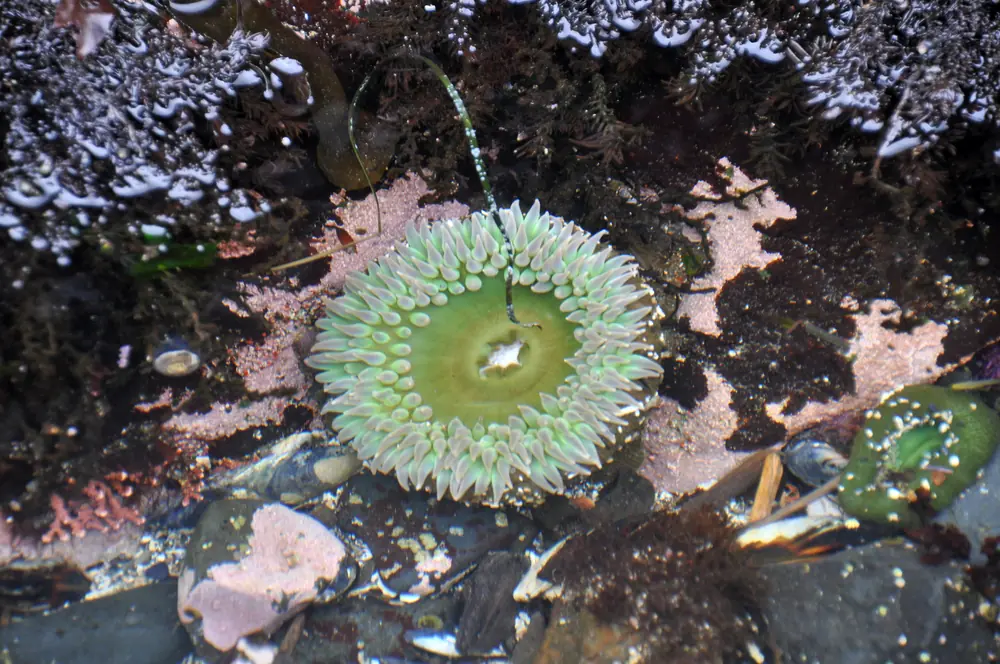
The morning of May 8
Saturday, May 8; predicted low 8:31 a.m. PDT at South Beach · Yaquina Bay entrance; other beaches differ by minutes to an hour or more
The month's deepest predicted low lands on a weekend, so expect company. Plan to arrive an hour or so before the bottom of the tide and head back up as the water turns. Oregon State Parks warns that a rising tide can strand visitors on tidepool rocks and secluded beaches, particularly during extreme tides and storms.
-
Quarry Cove at Yaquina Head
Check the tide chart; the site is open year-round · Yaquina Head Outstanding Natural Area, north of Newport
The Bureau of Land Management says the Quarry Cove trail gives easy access to tidepools and seal haul-outs. Hours are 8 a.m. to 6 p.m. Monday through Thursday and 8 a.m. to 7 p.m. Friday through Sunday. Seabird nesting and seal pupping can close the tide pools and Cobble Beach in May, so ask at the entrance station. Wear closed-toe shoes with grip, and leave rocks, plants and shells where they lie.
-
Reading the pools
Any low tide; watch the clock more than the water · Rocky shelves and boulder fields
Step on bare rock, move slowly and put every animal back. Face the surf while you crouch over a pool, and stay off beach logs: Oregon State Parks says soaked logs can gain several tons and the waves can roll them.
| Day | Low tide (PDT) | Predicted height (ft) |
|---|---|---|
| Thursday, May 6 | 7:04 a.m. | -1.4 |
| Friday, May 7 | 7:46 a.m. | -1.8 |
| Saturday, May 8 | 8:31 a.m. | -2.0 |
| Sunday, May 9 | 9:18 a.m. | -1.9 |
| Monday, May 10 | 10:10 a.m. | -1.5 |
| Tuesday, May 11 | 11:05 a.m. | -1.1 |
| Wednesday, May 19 | 6:28 a.m. | -1.2 |
| Thursday, May 20 | 7:08 a.m. | -1.4 |
| Friday, May 21 | 7:46 a.m. | -1.4 |
| Saturday, May 22 | 8:24 a.m. | -1.2 |
| Sunday, May 23 | 9:02 a.m. | -0.9 |
The two runs of deep lows bracket the May 6 new moon and the May 20 full moon, the usual pattern for big tides. Our moon phase page keeps the calendar, and the beach cautions at the end of this page apply to every outing.
What are seabirds and harbor seals doing on the Oregon coast in May?
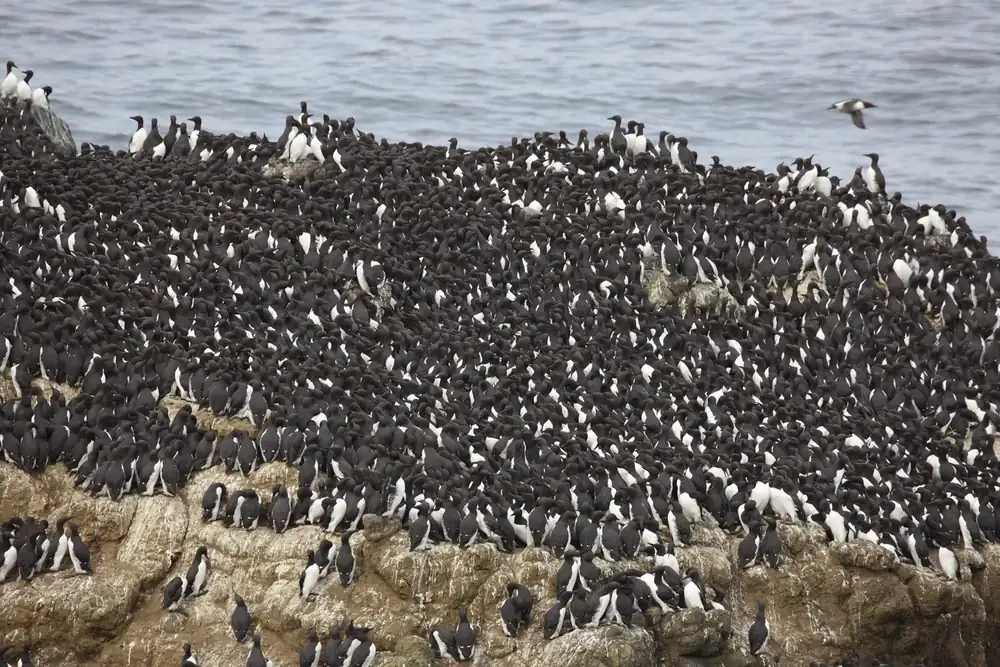
Nesting, mostly out of reach. Fish and Wildlife Service figures show that the Oregon Islands National Wildlife Refuge spans 1,853 rocks, reefs and islands from Tillamook Head to the California line and hosts most of the state's estimated 1.2 million nesting seabirds. The colonies are offshore, so binoculars or a scope serve better than any attempt to get closer.
-
Seabird season at Yaquina Head
May through September · Yaquina Head Outstanding Natural Area, near Newport
The Bureau of Land Management dates the seabird nesting season there from May through September, and says active nests may limit or close access to Cobble Beach and the tide pools. The black-and-white common murres that pack the offshore rocks are the sight most visitors come for. Stay on the maintained trails; the cliffs are unstable.
-
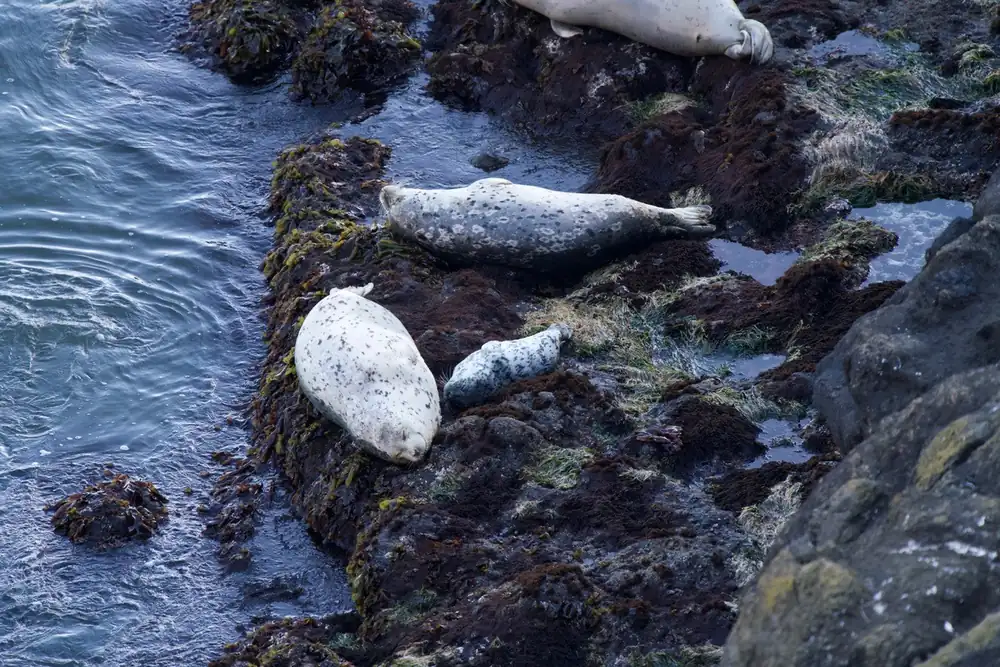
Harbor seal pups
Mid-May to mid-June at Yaquina Head, per BLM; sources differ on the full season · Sandy and cobble beaches and haul-outs
BLM puts pupping at Yaquina Head from mid-May to mid-June. A 2020 Oregon State University release described a statewide season from March to June, peaking in mid-May, while ODFW's advice says late March through April. Whichever you trust, a pup alone on the sand has usually just been left while its mother hunts. Give it 50 yards of room, leash the dog, and report harassment or distress to Oregon State Police at 1-800-452-7888.
-
Puffins at Haystack Rock
Through the summer · Haystack Rock, Cannon Beach
A regional tourism article reports roughly 60 pairs of tufted puffins arriving in early April and staying to hatch and feed their chicks; we could not confirm that count or timing with an agency, so treat both as approximate. The rock lies within the national wildlife refuge, and climbing it or bothering the wildlife is against the law.
-
Snowy plover beaches
Rules run March 15 through September 15 · Designated plover management areas
Oregon State Parks bars dogs even on a leash, along with bikes, vehicles, kites and drones, and asks walkers to keep to the wet, hard sand. If you find a nest on an unmapped beach, back away and call the ocean shore specialist at 503-857-9000.
-
The last gray whales
Through May, per NOAA · Any headland
NOAA Fisheries says northbound gray whales can be seen until the end of May, and asks viewers to stay 100 yards from large whales and to limit an encounter to 30 minutes.
A calm morning with the tide out lets you combine all of these: tide pools first, then a scope on the nearest offshore rock. Tally what you see in the Naturalist's Field Journal; the April page for Oregon covers the puffins' arrival.
Which songbirds reach Malheur and eastern Oregon in May?
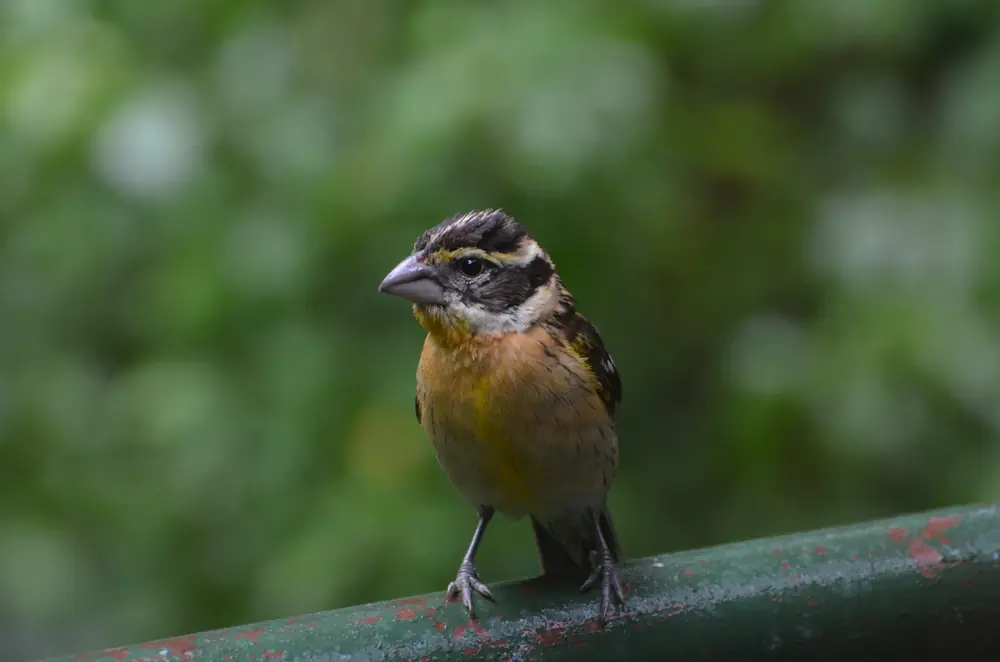
The late arrivals, which are many. Malheur National Wildlife Refuge says its greatest variety of waterfowl and songbirds runs from late winter through the end of May, and that songbirds come later than waterfowl and shorebirds, so timing a visit is critical. The refuge's own arrival records show the neotropical migrants (birds that winter in Mexico and farther south) arriving steadily across the month.
-
Malheur's May arrivals
Averages run from May 2 to May 26; see the table · Harney Basin; refuge headquarters and the nearby willows
In the refuge's records, Wilson's warbler averages May 2, western tanager and lazuli bunting May 3, black-headed grosbeak May 11 and Swainson's thrush May 26. Early mornings are best. Gravel roads can turn soft after rain, so ask the refuge about conditions.
-
Klamath Basin grebe dances
Likely at their best from late April through May · Putnam's Point on Upper Klamath Lake; open water at Tule Lake and Lower Klamath
The Klamath Basin Birding Trails guide holds that the courtship display of western and Clark's grebes is probably at its peak in late April through May, and breeding bird activity is busiest from late April to early July. It adds that migrant songbirds frequent willows and cottonwoods along watercourses from early April through June, and recommends mornings.
-
Summer Lake Wildlife Area
April to May for migrants; May to July for breeding shorebirds and waterfowl · Highway 31, Lake County
ODFW's guide lists American avocet, black-necked stilt, willet, Wilson's and red-necked phalaropes and long-billed curlew among the shorebirds, and white pelican, Forster's tern and white-faced ibis among the waterbirds. The area is open around the clock and needs a parking permit; for road conditions call 541-943-3152.
-
Ladd Marsh Bird Festival
Annual, held in May; check with ODFW or the organizer for 2027 · Ladd Marsh Wildlife Area, near La Grande
ODFW says the festival takes place in May and welcomes birders of every level. No 2027 date had turned up when this page was written. The area also requires a free daily access permit and bars dogs outside authorized game bird seasons.
-
World Migratory Bird Day
Held each May; no 2027 date posted yet · Anywhere with a feeder, a park or a window
Organizers mark the day in May, and in 2026 it fell on May 9; the 2027 date was not yet posted at our last look, so check their site first. Whatever the date turns out to be, spend an hour logging every species you see.
| Species | Average arrival | Earliest on record | Latest on record |
|---|---|---|---|
| Wilson's warbler | May 2 | Apr 24, 1981 | May 15, 1967 |
| Western tanager | May 3 | Apr 10, 1977 | May 15, 1961 |
| Lazuli bunting | May 3 | Apr 24, 1966 | May 25, 1965 |
| Bullock's oriole | May 5 | Apr 25, 1959 | May 14 (1965 and 1967) |
| Rufous hummingbird | May 7 | Apr 21, 1959 | Jun 28, 1965 |
| Townsend's warbler | May 8 | Apr 21, 1992 | May 19, 1988 |
| Black-headed grosbeak | May 11 | Apr 20, 1964 | Jun 2, 1968 |
| Black-throated gray warbler | May 12 | Apr 23, 1979 | May 29, 1996 |
| Olive-sided flycatcher | May 17 | May 2, 1981 | Jun 1, 1988 |
| Swainson's thrush | May 26 | Apr 30, 1984 | Jun 16, 1965 |
Treat each average as a midpoint. The records for the rufous hummingbird and the willow flycatcher run into June, and several early dates fall in April. Write the date, the weather and the habitat for every first of the year on the birds I have seen plate.
What is arriving in the Willamette Valley and around Portland in May?
Hummingbirds on territory, songbirds in the willows, and ground nesters in open fields. The valley's refuges and wildlife areas are good places to compare the east side's calendar with the west side's.
-
Rufous hummingbirds nesting
April in warm areas to as late as July in the north, per OSU Extension · Gardens, forest edges and flowering shrubs
The extension bulletin describes the spring flight from Mexico as running February to May. The female builds a tiny nest bound with spider webs and may raise two broods. Its feeder mix is cane sugar and water at one to four, boiled for a minute and cooled. A stiff hummingbird on a cold morning may only be in torpor. Journey North maps sightings as the birds move north.
-
Sauvie Island Wildlife Area
Eastside reopens May 1; spring and summer are best for songbirds · Sauvie Island, north of Portland
ODFW says the Westside, Oak Island and North Unit stay closed October 1 to April 15, and the Eastside reopens May 1. Parking always needs a wildlife area permit, and alcohol is banned from May 1 through September 30.
-
Tualatin River National Wildlife Refuge
Trails open daily, dawn to dusk · Near Sherwood
Bald eagles, red-tailed hawks and herons are among the regulars; the visitor center is open Tuesday through Sunday, 10 a.m. to 4 p.m. The refuge cannot take injured wildlife or baby birds.
-
Ground nesters in the fields
Mid-April through mid-August · Bare fields, farm edges and airfield margins in the Willamette Valley
Oregon's conservation strategy says streaked horned larks need open, sparsely vegetated ground and are most vulnerable while breeding and fledging. Mowing, haying and spraying can ruin a nest, so step back if a small brown bird flushes from bare ground.
-
NestWatch
Spring and summer · A yard nest box or a local park
NestWatch, from the Cornell Lab of Ornithology, is open to anyone. Volunteers read the code of conduct, locate a nest, log what they observe, and can use a phone app in the field.
Photograph from a distance and do not linger near a nest, since loitering can draw predators. Note the weather too; the cloud guide can help you name it.
Where are Oregon's rhododendrons and wildflowers at their best in May?
The cultivated show peaks in Portland while the grasslands of the Columbia Gorge and the snowmelt meadows run on their own schedules. Plan for crowds, and for mud.
-
Crystal Springs Rhododendron Garden
The larger display is on Mother's Day weekend; Mother's Day is May 9, 2027 · Southeast Portland
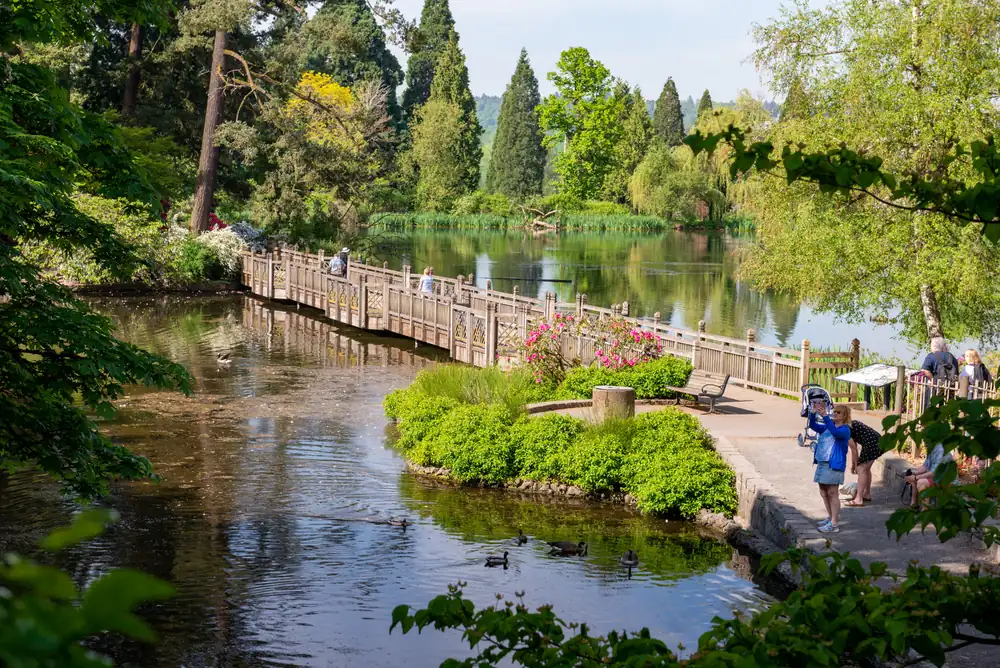
The garden's page describes an early show on the first weekend of April and a bigger display on Mother's Day weekend. Hours are Thursday through Tuesday, 10 a.m. to 5:30 p.m., and Wednesday, 1 to 5:30 p.m. The page lists children's admission inconsistently, so call 503-267-7509 to confirm. A spring-fed lake wraps most of the garden, and waterfowl nest there. Bloom shifts with the season, so call before you drive.
-
Tom McCall Preserve at Rowena
Most abundant in April and May; open March 1 through October 31 · Rowena Crest, Columbia River Gorge
The Nature Conservancy describes a March-through-June display and suggests visiting early or late in the day, avoiding weekends. It states the McCall Point trail's season two ways (May through October in one place, March 1 to October 31 in another), so check before hiking. No dogs, bikes, drones, picnics or camping.
-
Camassia Natural Area
Common camas blooms in April and early May · West Linn
The last of the blue camas may still be out in the first days of May. Expect mud, a slick boardwalk and poison oak beside the path, according to the Conservancy. Dogs stay home, and a pair of ospreys nests nearby each spring.
-
Snowmelt flowers at Crater Lake
Flowers follow the melting snow; dates vary · Crater Lake National Park
The National Park Service says bloom starts as the snow melts, with western springbeauty and spreading phlox among the earliest. With snow lingering high, May is mostly for scouting the lower meadows and road edges.
Stay on paths and leave every flower where it grows. The field journal has a plate for seeds, pods and cones that suits the weeks after these petals fall.
What should I do if I find a baby animal outdoors in Oregon in May?
Almost always: nothing, and walk away. ODFW says a young wild animal found alone is usually not abandoned, that its parents are often close, and that removing wildlife is illegal and can bring a citation from Oregon State Police.
-
Fawns and elk calves
Births occur May through July · Fields, brush and forest edges
ODFW says mothers hide their young and feed elsewhere for long stretches, returning once people, pets and predators are gone. Dogs can provoke aggressive defense from a doe or cow elk.
-
Fledgling songbirds
Late February through early summer · Lawns, trails and shrubs
Fledglings often leave the nest before they fly well. ODFW says to leave a healthy one alone or set it gently on a nearby branch, and to call a licensed rehabilitator only if it is injured or surely orphaned.
-
Ducklings and goslings
Spring and early summer · Ponds, ditches and parking lots
With no mother in sight, leave the brood and move off so she can return. ODFW asks people not to feed ducks and geese, since close contact spreads avian influenza, and noted that rehabilitators were not accepting sick waterfowl.
-
Shorebird chicks
May to July, per ODFW · Wetlands and lake margins at Summer Lake and Malheur
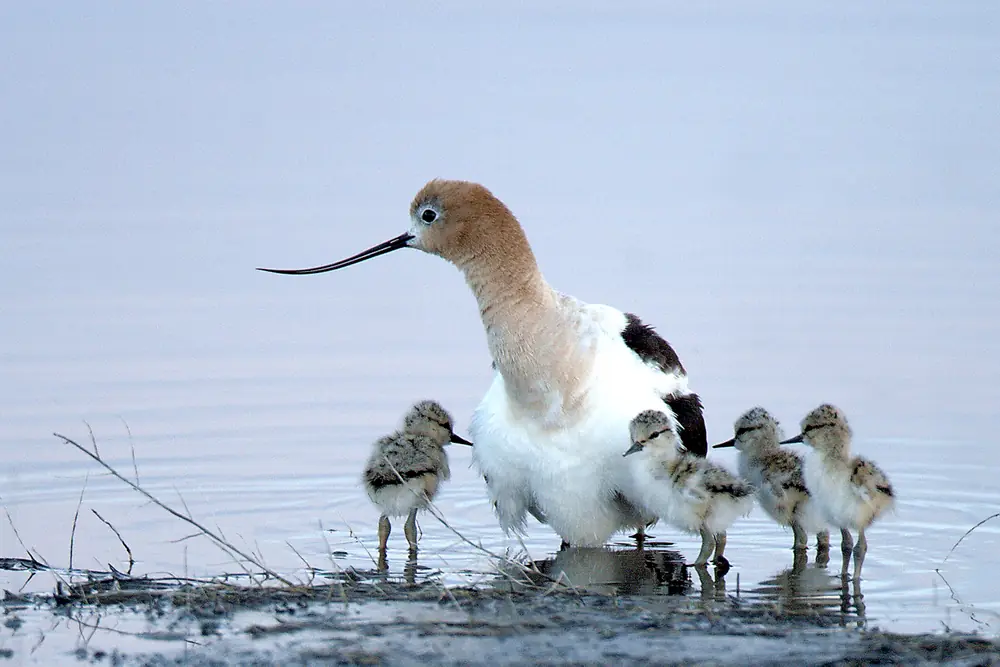
ODFW lists the American avocet among the breeding shorebirds at Summer Lake from May to July. Avocet chicks leave the nest soon after hatching and feed in the shallows. Watch from a car or blind, and never walk toward an adult that calls and runs ahead of you.
Leashed dogs and indoor cats protect more young animals than any rescue. If you are certain an animal is injured, call ODFW, a licensed rehabilitator or Oregon State Police rather than driving it anywhere yourself. For seal pups, see the coast section.
When is the last spring freeze in Oregon, and can May still bring frost?
In the lower valleys, the risk is nearly over; in the high country east of the Cascades, it is not. At La Grande the middle-of-the-road date for the last freeze is May 6, and at Redmond and Burns it is June 9 and June 11. The "nine years in ten" column is the safe bet for tomatoes, beans and anything else that dies at 32 degrees.
| Station | One year in ten | Median | Nine years in ten |
|---|---|---|---|
| Astoria Regional Airport (north coast) | Feb 27 | Mar 26 | Apr 18 |
| North Bend Regional Airport (south coast) | Dec 31 | Feb 21 | Mar 25 |
| Portland International Airport | Feb 22 | Mar 13 | Apr 1 |
| Eugene Mahlon Sweet Airport (southern Willamette Valley) | Mar 15 | Apr 11 | May 9 |
| Medford Rogue Vly Airport (Rogue Valley) | Mar 17 | Apr 8 | Apr 30 |
| The Dalles (Columbia River Gorge) | Mar 27 | Apr 14 | May 1 |
| Redmond Roberts Field (Central Oregon) | May 17 | Jun 9 | Jun 26 |
| La Grande (Grande Ronde Valley) | Apr 21 | May 6 | May 26 |
| Burns Municipal Airport (high desert) | May 21 | Jun 11 | Jun 28 |
Look up your own town on the Oregon frost-date tables. North Bend's December 31 entry means the mildest tenth of years there had their last freeze before the new year began.
How wet and cool is May in Oregon, and what should you watch for?
Showery on the coast, drier inland, and still wintry above 5,000 feet. In NOAA's 1991 to 2020 normals, Government Camp on Mount Hood gets 5.75 inches of precipitation in May and Astoria 3.40, against 0.97 at Bend and 1.27 at Burns. Crater Lake's park headquarters averages 14.5 inches of May snow and a daytime high of 49.0 degrees.
-
Crater Lake roads reopen in pieces
Spring melt; East Rim Drive is often not fully open until mid-July · Crater Lake National Park
The park says the West Rim and East Rim Drives reopen in segments as plows clear the snow, with the North Entrance Road and Rim Drive closed each winter by November 1 or earlier. The page gives no spring opening date, so check its conditions page before you drive. Munson Valley Road can close briefly when heavy snow falls.
-
Surf and sneaker waves
Any day · The whole coast
The National Weather Service says a sneaker wave can reach at least 150 feet up the sand, sometimes after a quiet spell of 10 to 20 minutes. It suggests studying the surf for 20 minutes before you settle, and staying far back.
-
The outlook
Updated mid-month · NOAA Climate Prediction Center
The Climate Prediction Center says its 90-day outlooks come out once a month near mid-month. The latest outlook page has the maps and discussion, and our weather page has forecasts and radar.
| Station | Precipitation (in) | Snowfall (in) | Average high (°F) | Average low (°F) |
|---|---|---|---|---|
| Astoria Regional Airport (north coast) | 3.40 | 60.5 | 46.3 | |
| North Bend Regional Airport (south coast) | 2.95 | 0.0 | 60.5 | 48.0 |
| Portland International Airport | 2.51 | 0.0 | 69.3 | 49.4 |
| Eugene Mahlon Sweet Airport | 2.46 | 68.1 | 44.0 | |
| Medford Rogue Valley Airport | 1.34 | 0.0 | 73.9 | 46.9 |
| Government Camp (Mount Hood) | 5.75 | 4.2 | 53.7 | 36.1 |
| Crater Lake National Park headquarters | 3.65 | 14.5 | 49.0 | 29.3 |
| Bend | 0.97 | 0.0 | 66.3 | 37.0 |
| Pendleton | 1.45 | 0.0 | 70.9 | 45.0 |
| Burns Municipal Airport | 1.27 | 68.2 | 37.4 |
Pack for four seasons if your trip crosses the Cascades: a coastal morning in the 50s, an afternoon near 70 in the Willamette Valley, and a near-freezing night at altitude. Average May lows are 37.0 degrees at Bend and 37.4 at Burns.
How much daylight does Oregon gain in May?
About an hour more across the month, with the daily gain easing as the month goes on. In Portland the day grows from 14 hours 19 minutes on May 1 to 15 hours 25 minutes on May 31, a gain of 66 minutes, and by May 31 each city listed has more than 15 hours of daylight. Clocks changed on March 14, so every May sunrise and sunset is in daylight time (Mountain daylight time in Ontario and the part of Malheur County that follows it).
| City | May 1 | May 31 | Gained | Per day |
|---|---|---|---|---|
| Astoria | 14 h 22 m | 15 h 31 m | 69 min | 2.3 min |
| Portland | 14 h 19 m | 15 h 25 m | 66 min | 2.2 min |
| Pendleton | 14 h 19 m | 15 h 26 m | 67 min | 2.2 min |
| Newport | 14 h 15 m | 15 h 19 m | 64 min | 2.1 min |
| Bend | 14 h 12 m | 15 h 15 m | 63 min | 2.1 min |
| Ontario | 14 h 11 m | 15 h 14 m | 63 min | 2.1 min |
| Medford | 14 h 04 m | 15 h 03 m | 59 min | 2.0 min |
| Brookings | 14 h 03 m | 15 h 02 m | 59 min | 2.0 min |
Astoria gains the most, 69 minutes, and Brookings the least, 59. Evenings are long enough for a dusk walk after work, and the dawn chorus starts early, so set an alarm for a morning birding trip.
The day-length tool lists sunrise and sunset for any Oregon address.
What can you see in the Oregon night sky in May 2027?
A meteor shower under a dark sky, a seasonal Blue Moon and Mercury's best dusk showing of the year. Times are Pacific daylight time; Mountain time, an hour later, applies in Ontario and eastern Malheur County.
-
Eta Aquariid meteors
Best mornings May 5, 6 and 7, before dawn · East, low, in the hours before sunrise
These meteors run from late April to late May and peak overnight on May 5 to 6, when a thin new moon leaves the sky dark. The American Meteor Society's figure of 10 to 30 meteors an hour shortly before sunrise is meant for the southern two-thirds of the country. At Oregon's latitudes the radiant in Aquarius climbs late, so count on fewer. Find a clear eastern horizon away from town lights and lie back.
-
The Flower Moon and a seasonal Blue Moon
Full at 3:59 a.m. PDT, Thursday, May 20; the best look is the evening of Wednesday, May 19 · Rising in the east-southeast near sunset
The traditional name for May's full moon is the Flower Moon. Four full moons land in astronomical spring in 2027, and counting the third as the Blue Moon is the older seasonal convention. No calendar month holds two full moons this year. By our calculation moonrise on May 19 is about 8:25 p.m. at Medford and Bend and about 8:35 p.m. at Portland, within minutes of sunset.
-
Mercury at dusk
Greatest eastern elongation May 28; best evenings about May 12 to June 5 · Low in the west-northwest, 45 to 90 minutes after sunset
Mercury's widest evening angle, 22.8 degrees east of the Sun, arrives at 6:14 a.m. PDT on May 28, so both the 27th and the 28th work well. It shines near magnitude -0.6 in mid-May. A flat western horizon and binoculars help.
| Phase | Date | Time |
|---|---|---|
| New moon | Thursday, May 6 | 3:58 a.m. PDT (4:58 a.m. MDT) |
| First quarter | Wednesday, May 12 | 9:44 p.m. PDT (10:44 p.m. MDT) |
| Full moon, the Flower Moon (a seasonal Blue Moon) | Thursday, May 20 | 3:59 a.m. PDT (4:59 a.m. MDT) |
| Last quarter | Friday, May 28 | 6:58 a.m. PDT (7:58 a.m. MDT) |
Planets shine steadily where stars twinkle. A free sky app confirms which is which, and our moon phase page keeps the full calendar.
What can families do outside in Oregon in May?
- Go tide pooling on a May 8 morning. Pick a beach with easy access, arrive early, tread lightly and be off the rocks before the tide returns.
- Smell the rhododendrons. Crystal Springs in Portland is at its best around Mother's Day weekend; confirm hours and admission before you leave.
- Count birds on World Migratory Bird Day. The organizers had not posted the 2027 date, so check their site, then log what you see in your yard for ten minutes.
- Build a first-arrival list. Compare your first hummingbird, tanager and grosbeak with Malheur's averages in the table.
- Join NestWatch. A nest box in the yard makes a good classroom.
- Watch the Moon on May 19. Bring a blanket and watch the seasonal Blue Moon clear the horizon.
Phone ahead, since roads and refuges change. The nature index lists the rest of the country. Tide-pool, nest and arrival notes fit the Naturalist's Field Journal, and last month's Oregon page shows what came first.
What should I watch out for outdoors in Oregon in May?
- Spring turkey season. ODFW’s 2026 forecast shows the 2026 statewide spring season running April 15 through May 31, a youth weekend on April 11 and 12, a limit of one male or bearded bird a day and no more than three tags. We could not confirm 2027 dates on any ODFW page we could read, so expect something similar and check ODFW before you head out.
- Spring bear. ODFW's draft 2027 controlled-hunt list gave April 1 through May 31 for spring bear hunts. It was still a draft when this page was written, so confirm the final dates.
- Hunter orange. ODFW’s youth hunting page says hunters 17 and under must wear hunter orange when using a firearm on game mammals or upland birds, with turkey excepted. Adults walking in turkey country may still choose bright clothing.
- Ticks. The Oregon Health Authority says black-legged tick nymphs, found mostly west of the Cascades, feed in spring and summer, while the Rocky Mountain wood tick, which carries Colorado tick fever, is a concern mostly from April to July, chiefly in Deschutes County. Lyme transmission typically takes a tick attached a day and a half or longer. Use an EPA-registered repellent and inspect your skin after brushy walks.
- Beaches. Sneaker waves, rising tides and rolling logs are the main dangers, and Memorial Day weekend (Monday, May 31) brings crowds.
- Plovers and seals. Plover beaches ban dogs; give pups 50 yards and large whales 100.
- Poison oak and mud. Camassia's boardwalk is slippery and poison oak lines the path. Wear long sleeves and wash after the walk.
- Young animals. Leave fawns, fledglings and ducklings where you find them, and keep dogs leashed.
- Mountain weather. Snow still falls at Crater Lake and Government Camp in May. Carry layers and check road conditions.
- Cold water. Muscle control can be lost within minutes in cold water, according to the National Weather Service, so any immersion in surf or a snowmelt stream is dangerous.
Recheck road, beach and trail conditions the night before and again at breakfast. The Oregon frost-date tables and our weather page help with the planning.
Sources (46)
- U.S. Fish and Wildlife Service: Malheur NWR average spring migratory bird arrival dates
- U.S. Fish and Wildlife Service: Malheur NWR seasons of wildlife
- Klamath Basin Birding Trails: frequently asked questions
- ODFW: Summer Lake Wildlife Area visitor guide
- ODFW: Ladd Marsh Wildlife Area visitor guide
- ODFW: Sauvie Island Wildlife Area visitor guide
- U.S. Fish and Wildlife Service: Tualatin River National Wildlife Refuge
- U.S. Fish and Wildlife Service: Oregon Islands National Wildlife Refuge
- Bureau of Land Management: Yaquina Head Outstanding Natural Area
- Visit the Oregon Coast: the puffins are coming
- Oregon State University: public urged to refrain from approaching seal pups on Oregon beaches (2020)
- ODFW: give wildlife a chance, leave young wild animals where you found them (2024 news release)
- NOAA Fisheries: gray whale species page
- Oregon State Parks: western snowy plover beach restrictions
- Oregon State Parks: be safe exploring the beach
- National Weather Service: sneaker waves
- NOAA CO-OPS: tide predictions for South Beach, Yaquina Bay entrance (station 9435380), May 2027
- ODFW: marine life viewing in Oregon
- Portland Parks: Crystal Springs Rhododendron Garden
- Florence Rhododendron Festival (organizer site)
- The Nature Conservancy: Tom McCall Preserve at Rowena
- The Nature Conservancy: Camassia Natural Area
- National Park Service: Crater Lake road and weather conditions
- National Park Service: Crater Lake wildflowers
- Oregon State University Extension: rufous hummingbird (EC 1570)
- Journey North: hummingbirds
- Cornell Lab of Ornithology: NestWatch
- Oregon Conservation Strategy: streaked horned lark
- Oregon Conservation Strategy: tufted puffin
- ODFW: 2026 spring turkey hunting forecast
- ODFW: 2026-27 Oregon game bird hunting regulations
- ODFW: draft 2027 spring black bear controlled hunts
- Oregon Health Authority: ticks
- World Migratory Bird Day (organizer site)
- NOAA NCEI 1991-2020 monthly normals: Astoria Regional Airport
- NOAA NCEI 1991-2020 monthly normals: North Bend Regional Airport
- NOAA NCEI 1991-2020 monthly normals: Portland International Airport
- NOAA NCEI 1991-2020 monthly normals: Eugene Mahlon Sweet Airport
- NOAA NCEI 1991-2020 monthly normals: Medford Rogue Valley Airport
- NOAA NCEI 1991-2020 monthly normals: Government Camp
- NOAA NCEI 1991-2020 monthly normals: Crater Lake National Park headquarters
- NOAA NCEI 1991-2020 monthly normals: Bend
- NOAA NCEI 1991-2020 monthly normals: Pendleton
- NOAA NCEI 1991-2020 monthly normals: Burns Municipal Airport
- NOAA Climate Prediction Center: seasonal outlooks
- Photos via Wikimedia Commons; licenses and photographers are credited under each picture