What to look for in nature in Oregon this November
November is when Oregon settles into its winter shape. Swans and geese from Alaska fill the Willamette Valley and Sauvie Island, the Klamath Basin holds its largest crowds of waterfowl of the year, and coho push up small creeks in the Cascade foothills. On the coast the year's first king tides arrive in Thanksgiving week, and in the yard the varied thrush comes down from the mountains. Clocks change on the 1st, and from then on all of this fits into short, wet afternoons. Here is where to go, when, and who says so.
Other months in Oregon: October, December.
Start here
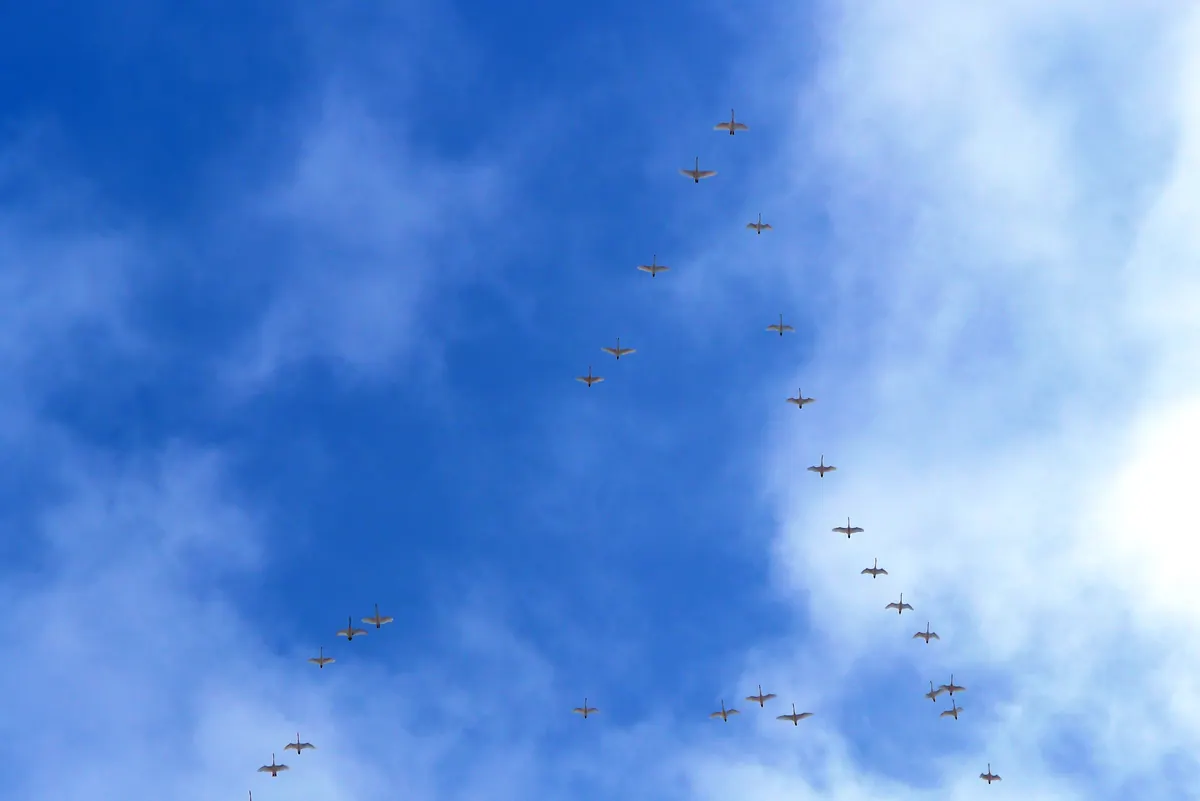
- Swans on the floodplain. ODFW lists September through March as the season for waterfowl and sandhill cranes on Sauvie Island, just downstream from Portland. Park at Raccoon Point or the Eastside viewing platform with a wildlife-area parking permit and scan the fields for swans, gray sandhill cranes and big mixed flocks of geese.
- King tides in Thanksgiving week. NOAA predicts the month's highest tides for November 23 to 27. At Newport's South Beach gauge the peak is about 10.3 feet just before noon on Wednesday the 25th, and at Astoria about 10.4 feet a little before 1 p.m. that day. Watch from a headland, not the sand.
- A supermoon and the Leonids. November's Beaver Moon reaches full at 6:53 a.m. PST on Tuesday the 24th, so both Monday's and Tuesday's moonrise show a round disk. A week before that, try for Leonid meteors between moonset and first light on Wednesday the 18th.
Record it: open the Naturalist's Field Journal to the birds I have seen plate for your first tundra swan or varied thrush of the season, and keep the map of sounds for a flock of geese calling overhead after dark. A buck's scrape or a line of hoofprints in wet leaves belongs on tracks to know, and the daily field log can hold the king-tide morning: the time, the height and how far up the beach the water came.
Regions used below: Portland and the Columbia River Gorge; Willamette Valley; Oregon Coast; Southern Oregon: the Rogue and Umpqua valleys; Central Oregon and the Cascades; Eastern Oregon: the Blue Mountains, the Wallowas and the high desert.
Where do swans, geese and cranes spend November in Oregon?
By November the birds that nest in Alaska and the Arctic have reached their winter grounds or are passing through in the largest numbers of the year. Oregon has three great places to see them: the wet fields of the lower Willamette and Columbia, the marshes of the Klamath Basin on the California line, and the ponds of the Harney Basin in the high desert. Go in the first hours after sunrise, when flocks lift off the roosts, or at dusk when they come back in.
-
Sauvie Island
Waterfowl and cranes September to March; eagles best January to March · Northwest of Portland, off Highway 30
Much of ODFW's wildlife area is shut to the public from October 1 to April 15 so the birds can feed and rest undisturbed, but the Raccoon Point overlook, the Eastside viewing platform, Rentenaar Road, the Columbia River beaches and the trail to Warrior Rock stay open. Sandhill cranes, swans, ducks and geese use the island through the winter. A wildlife-area parking permit is required at all times.
-
Dusky geese at Finley
Through the winter · William L. Finley National Wildlife Refuge, south of Corvallis
This refuge was created for the dusky Canada goose, which nests on the Copper River Delta in Alaska and spends the winter almost entirely in Willamette Valley wetlands. Walk the Woodpecker Loop or the boardwalk to the observation blind; the Fish and Wildlife Service suggests a winter visit for swans and Roosevelt elk as well. Finley is free and open every day from dawn to dusk.
-
The Klamath Basin's biggest month
Largest numbers usually mid-November · Klamath Marsh, Lower Klamath and the Klamath Falls area
According to the Klamath Basin Birding Trails, the fall flight through the basin runs from mid-October to late November and usually crests in mid-November, with one to two million ducks, geese and swans on the move. Lower Klamath straddles the state line between Klamath Falls and Tulelake, California. Water on the refuges varies a great deal from year to year, so check the Fish and Wildlife Service's refuge pages before a long drive.
-
Tundra swans at Malheur
October and November · Buena Vista, Knox, Benson and Dredger ponds; Krumbo Reservoir
The Friends of Malheur National Wildlife Refuge call the big gatherings of tundra swans a highlight of the cold season, with hundreds sometimes on a single pond. Look also for Barrow's and common goldeneyes and hooded mergansers. Duck numbers drop as the weather turns, the Friends explain, because cold leaves little open water.
-
Eagles and winter hawks
Migrant eagles arriving through November; Klamath peak in February · Klamath Basin, Harney Basin, river valleys statewide
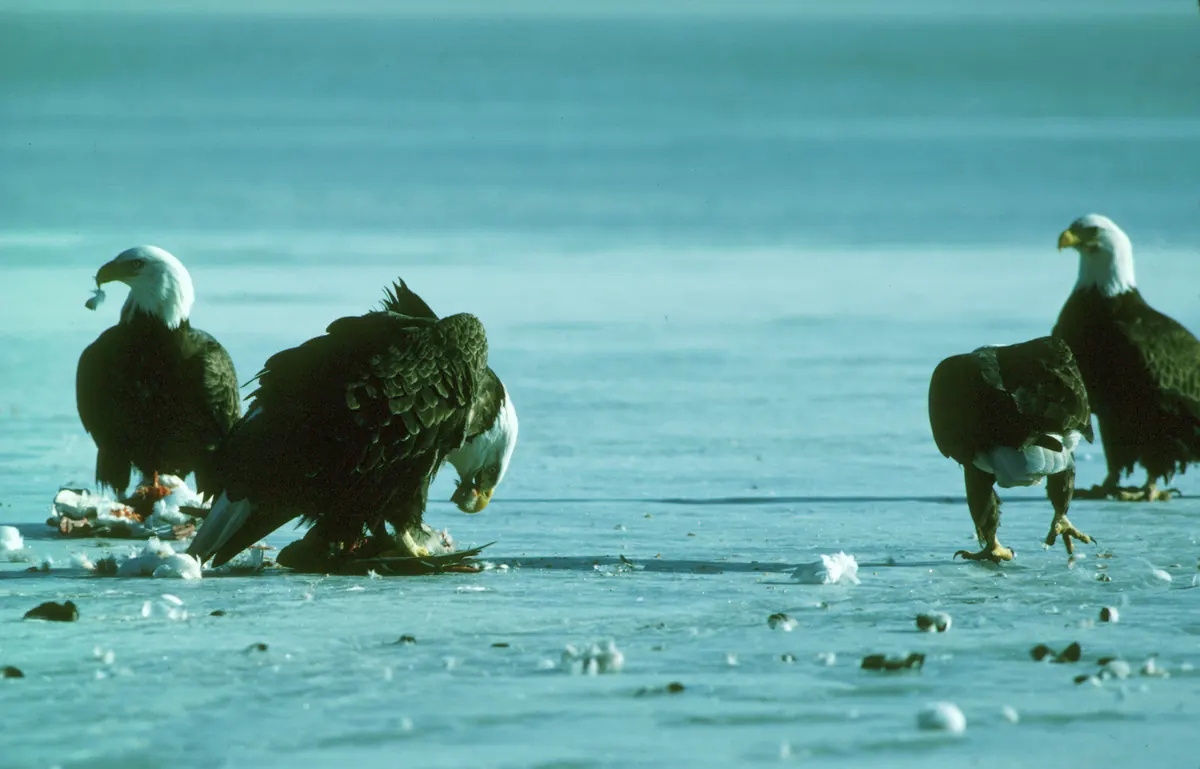
Rough-legged hawks from the Arctic, along with golden and bald eagles, spend the winter around Malheur; scan power poles and lone trees along the refuge roads. In the Klamath Basin, the Birding Trails site says wintering eagles are present in impressive numbers from early December to mid-March and peak in mid-February, so November is the month you see the first ones settle in. On the west side, eagles work the rivers wherever spawned-out salmon wash up.
A spotting scope helps, but a car makes a good blind: geese and swans in a field usually tolerate a vehicle on the road far better than a person walking toward them.
Which salmon are still spawning in Oregon in November?
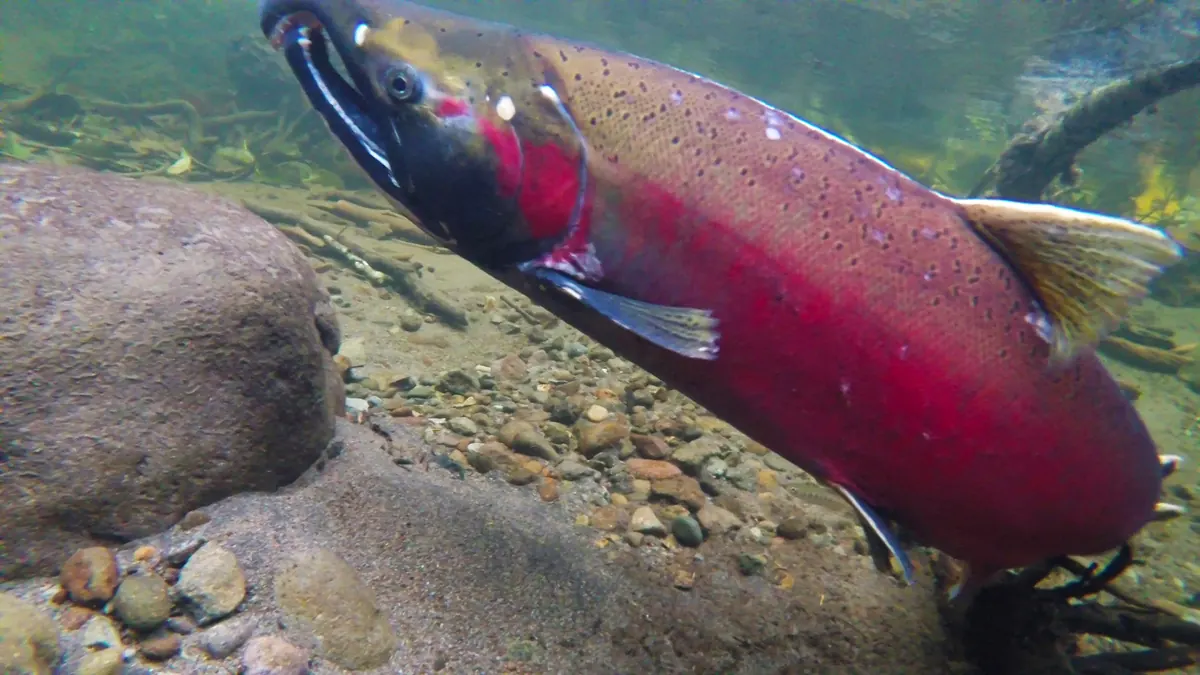
The fall chinook runs that filled October's rivers are winding down, and the smaller coho take over. Coho favor little, gentle tributaries with pea- to orange-sized gravel, which means you can often stand on a footbridge and watch them a few yards away. Their timing follows the rain: a good storm lifts the creeks and lets fish move upstream, then a few dry days clear the water enough to see them.
-
Coho in the Mount Hood foothills
November · Wildwood near Welches, Metzger Park near Estacada, Eagle Creek
ODFW names November as coho month in Clackamas County. The BLM's Wildwood Recreation Site on Highway 26 has an underwater viewing window on the Salmon River; Metzger Park, about five miles south of Estacada, gives access to spawning water; and tributaries in the Columbia River Gorge such as Eagle Creek often hold fish, as does the Old Salmon River Trail near Mount Hood.
-
The central coast's chinook
Best in the first half of November · North Fork Alsea at Clemons Park, the Salmon River, Drift Creek, Whittaker Creek
Around Newport, ODFW puts the best viewing in the first two weeks of the month. Try the Van Duzer corridor of the Salmon River off Highway 18, Drift Creek on the Siletz, and Whittaker Creek in the Siuslaw basin.
-
Chum near Tillamook
Catch-and-release season to November 15 · Kilchis and Miami rivers
Chum are poor jumpers, so they spawn low in a river, below falls and dams. Oregon sits near the southern edge of their range, and the Kilchis and Miami, which run into Tillamook Bay, are the two rivers where ODFW allows catch-and-release chum fishing, from September 16 to November 15.
-
Douglas County coho
Late November to early December · Cow Creek, the South Umpqua, Little River
ODFW points to Island Creek Day Use Area and Long Fibre Park on Cow Creek, tributaries of the South Umpqua such as Deer Creek and Myrtle Creek, and the North Umpqua where Little River joins it. In Coos County the coho come later still, peaking in December on the Coos and from late December into January on the Coquille.
Stay on the bank and keep dogs out of the water: the eggs lie buried in the riffles, and one careless wade can crush a whole nest.
When is the deer rut in Oregon, and where do elk gather for winter?
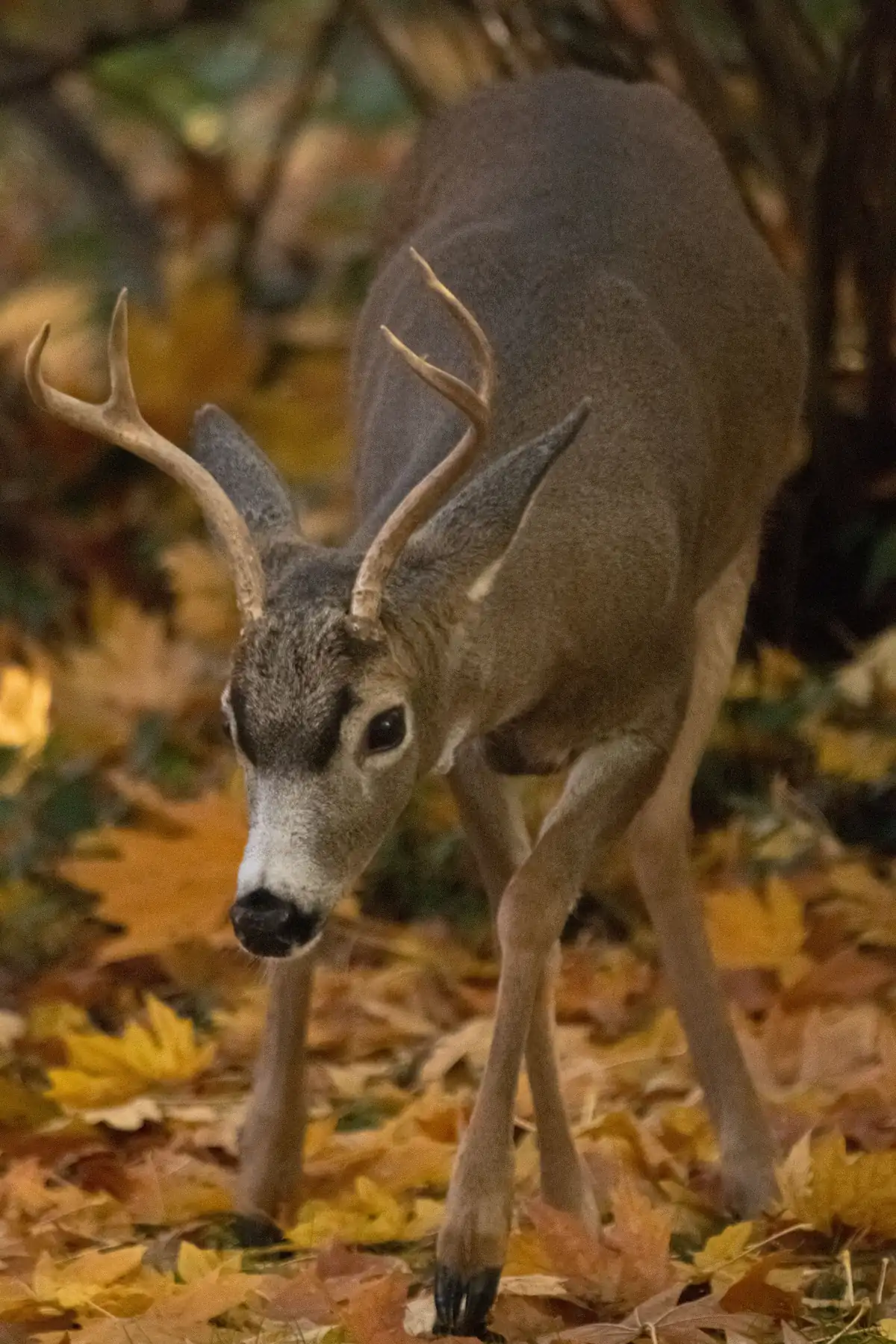
West of the Cascades, November belongs to the black-tailed deer. ODFW puts the rut from October through December, and bucks in the middle of it trail does, spar, and pay little attention to roads or people. On the elk side, the coast herds that bugled in September and October drift down to winter meadows.
-
Black-tailed bucks on the move
Rut October to December · Willamette Valley edges, the Coast Range, Southern Oregon foothills
Look for scrapes (pawed patches of bare ground under an overhanging branch) and saplings with the bark rubbed off at knee to waist height. ODFW notes that attacks are rare but that bucks can turn aggressive in the rut, so give any buck in a yard or park a wide berth and never try to feed one.
-
Jewell Meadows Wildlife Area
Elk viewing November to April · Clatsop County, southeast of Astoria
ODFW's season for elk watching here opens in November, and the area holds up to 200 Roosevelt elk through winter and spring. There are two paved parking areas and four viewing spots with signs; the main meadow is a refuge with no public entry. The staff-led feeding tours wait until December, and phone reservations (503-755-2264) open on December 1 at 8 a.m. A parking permit is required.
After the clock change the evening commute falls right in the deer's busiest hour, at dusk. Slow down where you see the yellow deer signs, and expect a second animal behind the first.
When are the king tides on the Oregon coast this year?
Oregon's tallest high waters of the year, the ones the coast calls king tides, need three things lined up: a new or full moon, the moon near perigee, and Earth near perihelion, its early-January closest pass by the sun. They give a preview of where everyday high water will reach as the sea rises. This year's November set lands on Thanksgiving week, around the Beaver Moon, and the peaks fall close to midday, which makes them easy to watch.
-
The Oregon King Tides Project
November 23–27, 2026 · Anywhere on the coast or a tidal river
Volunteers photograph the highest water against something fixed, a seawall, a piling, a bridge footing, a road edge, and upload the pictures with the place, date and direction to the project's site, which the state's Coastal Management Program supports. Explore Lincoln City lists the season's three windows as November 23–27, December 22–26 and January 20–24, 2027.
-
Spray on the seawall
Around the noon high tide, best with a west swell · Depoe Bay, Shore Acres, Cape Perpetua and other headlands
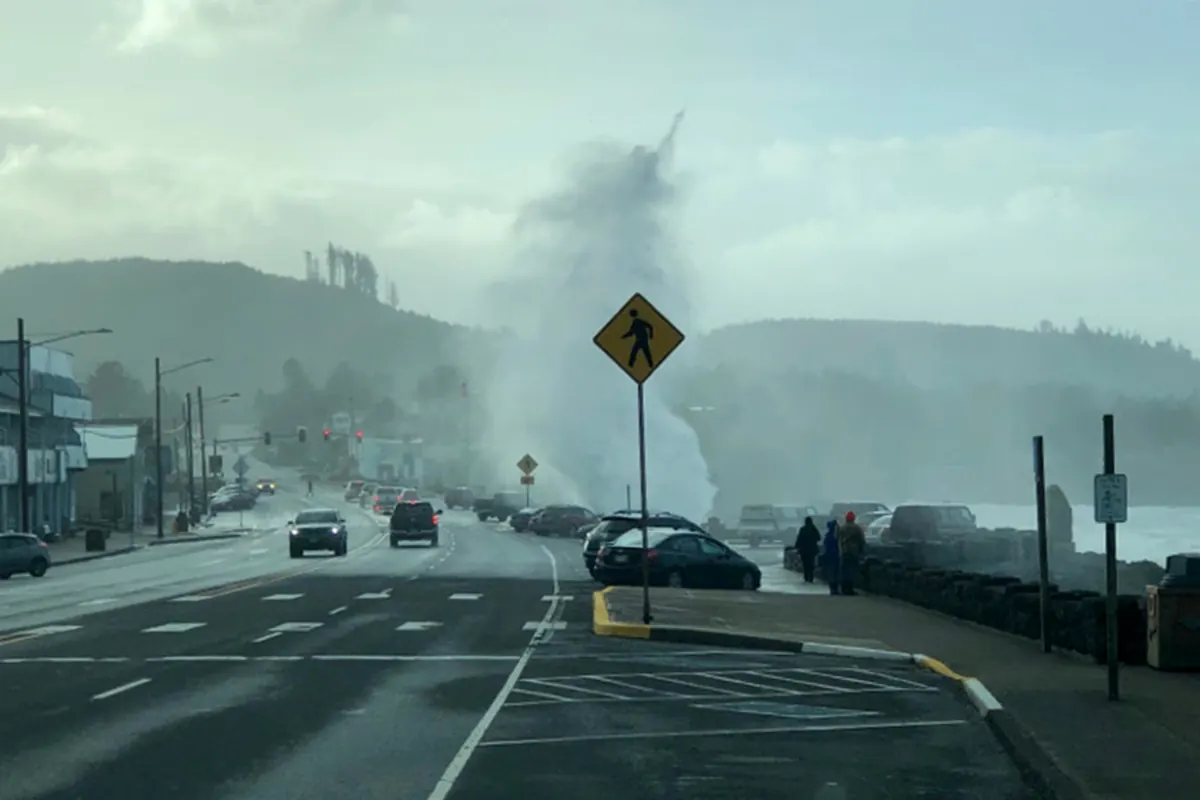
A king tide on a calm day is quiet; one that coincides with a winter swell throws water over the Depoe Bay seawall and onto the cliffs at Shore Acres. Watch from a railing or a parked car above the beach. The same water floods low spots on Highway 101 and the bay roads, so allow extra time.
-
The last of the summer gray whales
Until about mid-November · Central coast; Depoe Bay
Oregon State Parks says the resident gray whales feed close to shore from June to mid-November, so the first week or two of the month is the last chance for them. The big southbound migration, thousands of whales heading for Baja, follows from mid-December to mid-January.
| Date | Newport (South Beach) | Astoria (Tongue Point) |
|---|---|---|
| Monday, Nov 23 | 9.8 ft at 10:25 a.m. | 9.9 ft at 11:25 a.m. |
| Tuesday, Nov 24 | 10.1 ft at 11:07 a.m. | 10.3 ft at 12:06 p.m. |
| Wednesday, Nov 25 | 10.3 ft at 11:52 a.m. | 10.4 ft at 12:51 p.m. |
| Thursday, Nov 26 | 10.2 ft at 12:39 p.m. | 10.3 ft at 1:38 p.m. |
| Friday, Nov 27 | 9.8 ft at 1:30 p.m. | 10.0 ft at 2:29 p.m. |
The National Weather Service warns that a sneaker wave can run up the beach at least 150 feet past where the others stopped, and that the cold water can numb arms and legs within seconds. During king tides there may be no dry beach left at all; stay above the drift logs.
Which winter birds come to Oregon yards and feeders in November?
The yard changes in November. Summer's grosbeaks and swallows are long gone, and birds from the mountains and the north take their place. It is also the month to start counting them.
-
Varied thrush
From late fall through winter · Yards with shrubs and leaf litter west of the Cascades
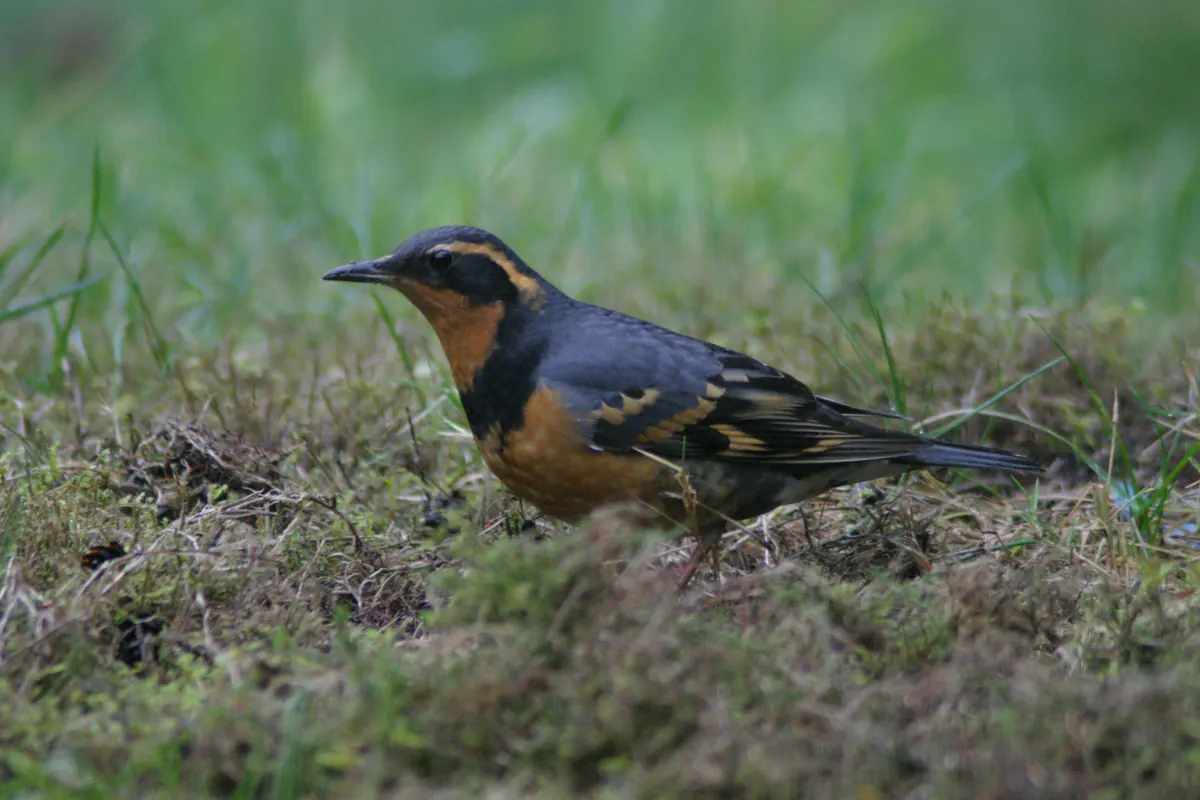
Robin-sized, slate blue with an orange throat, orange wing bars and a dark band across the chest, the varied thrush breeds in the dark conifer forests and comes down to lower woods and gardens for the winter, especially when snow covers the mountains. In winter it eats berries, fruit, seeds and acorns. Listen for its song: one long, buzzy whistle, a pause, then another on a different pitch.
-
Anna's hummingbird
All winter · Western Oregon yards and towns
Audubon describes Anna's as a permanent resident on the Pacific Coast that stays the winter where no other hummingbird does, and credits garden flowers and feeders with helping it spread north as far as British Columbia. A feeder left up for them needs fresh nectar every few days, and on frosty nights either bring it indoors or wrap it so the liquid stays thawed.
-
Winter finches, or not
Forecast for winter 2026–27 · Statewide
The Finch Research Network's forecast, by Tyler Hoar, says little about the Pacific Northwest this year. It reports failed crops of ponderosa, whitebark, limber and pinyon pine across the interior West, which is sending red crossbills east, and good spruce crops only in a band from Alaska into British Columbia. It expects pine grosbeaks and Bohemian waxwings to remain in the boreal forest. Expect the usual winter mix rather than a flood, and pine siskins in whatever numbers they choose.
-
Project FeederWatch begins
November 1 to April 30 · Your yard, balcony or schoolyard
The Cornell Lab's winter count works in pairs of back-to-back count days, repeated up to weekly; for each pair you write down, for every kind of bird, the biggest group that was in sight together. A season of counts from one yard shows exactly when your thrushes, juncos and siskins arrive and leave.
In western Oregon's rain, wet seed molds quickly; fill feeders with only a day or two's worth. To keep a yard list through the winter, there is a birds-I-have-seen plate in our Naturalist's Field Journal.
How wet is November in Oregon, and what will the El Niño winter bring?
For much of the wet side, November is the soggiest month on the calendar. Astoria's 1991–2020 normal for the month is 11.05 inches, more than any other month there, and North Bend's is 8.30. Portland averages 5.45 inches and Eugene 5.98. East of the mountains the numbers stay small (Pendleton 1.39 inches, Burns 1.02, Redmond 0.81), but the nights get cold: Burns' normal November low is 22 °F, and Pendleton picks up about an inch of snow in an average November.
-
A record-strength El Niño, probably
Building through the winter · Statewide
NOAA's Climate Prediction Center, in its September 10 El Niño update, said the odds of a very strong El Niño over this rainy season topped 90 percent, and put the chance that it beats every event on record since 1950 by late fall at about 75 percent. Oregon's state climatologist, Larry O'Neill of Oregon State University, has said the event looks to be off the charts. In his reading, a typical El Niño leaves Oregon warm and dry, but the three strongest of recent decades left it slightly wetter than normal and very warm, with more atmospheric rivers and a high snow line, so more of the water fell as rain. After a winter he called the worst for snowpack in the state's records, a warm, rainy one would be a second hard year for the mountains.
-
What to watch for in November
All month · West of the Cascades especially
El Niño's strongest effects usually come between December and February, so November weather may look ordinary. The federal December-to-February outlook lands on October 15; it will be posted with the Climate Prediction Center's three-month outlooks. For the storm due this week, check our local forecast page, and the cloud guide shows what the sky looks like as a front arrives.
Note the first day the creek in your neighborhood runs muddy, and the first morning you see snow on the hills from town. Over a few years those dates make a better local record than any forecast.
Has your part of Oregon had its first freeze yet?
East of the Cascades, almost certainly. Burns' median first freeze is September 6 and Redmond's September 14; La Grande's is October 1. In the valleys the median comes in late October: October 23 at both The Dalles and Eugene's airport, October 29 at Medford. Still unfrozen, in most years, as the month opens: the stations near salt water and the lower Columbia. Astoria's median is November 11, Portland's airport November 19, and North Bend not until December 9.
| Station | One year in ten | Median | Nine years in ten |
|---|---|---|---|
| Astoria Regional Airport (north coast) | Oct 22 | Nov 11 | Dec 8 |
| North Bend Regional Airport (south coast) | Nov 12 | Dec 9 | Jan 28 |
| Portland International Airport | Oct 29 | Nov 19 | Dec 10 |
| Eugene Mahlon Sweet Airport (southern Willamette Valley) | Oct 6 | Oct 23 | Nov 13 |
| Medford Rogue Vly Airport (Rogue Valley) | Oct 14 | Oct 29 | Nov 16 |
| The Dalles (Columbia River Gorge) | Oct 5 | Oct 23 | Nov 9 |
| Redmond Roberts Field (Central Oregon) | Sep 1 | Sep 14 | Oct 1 |
| La Grande (Grande Ronde Valley) | Sep 17 | Oct 1 | Oct 16 |
| Burns Municipal Airport (high desert) | Aug 21 | Sep 6 | Sep 20 |
North Bend has gone without a freeze until late January in one year out of ten, while even Portland has frozen by December 10 in nine years out of ten. For a station closer to home, and the spring dates too, see the first and last frost dates for Oregon.
How much daylight does Oregon lose in November?
A little more than an hour, less than October took, since the shortening eases off as the solstice approaches. Astoria, the farthest north of these towns, goes from 10 h 04 m to 8 h 55 m, a loss of 69 minutes or about 2.4 a day; Brookings, near the California line, loses 59. What most people notice is the clock. On Saturday, October 31, Portland's sun sets at 5:59 p.m. daylight time; the next evening, on standard time, it sets at 4:57. On the 30th, Portland's sunrise is 7:30 a.m. and sunset 4:29 p.m. Ontario, on Mountain time, has the latest mornings in the state, with sunrise at 8:02 a.m. at the end of the month.
| City | Nov 1 | Nov 30 | Lost | Per day |
|---|---|---|---|---|
| Astoria | 10 h 04 m | 8 h 55 m | 69 min | 2.4 min |
| Portland | 10 h 06 m | 8 h 59 m | 67 min | 2.3 min |
| Pendleton | 10 h 07 m | 8 h 59 m | 68 min | 2.3 min |
| Newport | 10 h 11 m | 9 h 06 m | 65 min | 2.2 min |
| Eugene | 10 h 13 m | 9 h 10 m | 63 min | 2.2 min |
| Bend | 10 h 13 m | 9 h 10 m | 63 min | 2.2 min |
| Ontario | 10 h 13 m | 9 h 09 m | 64 min | 2.2 min |
| Brookings | 10 h 21 m | 9 h 22 m | 59 min | 2.0 min |
For sunrise, sunset and twilight at your own address, any day of the year, try the daylight calculator.
What can you see in the Oregon night sky this November?
-
The Beaver Moon, a supermoon
Evenings of Monday, November 23 and Tuesday, November 24 · Rising in the east-northeast at dusk
The moon is exactly full early on Tuesday morning, so it rises round on both evenings. It is also one of 2026's supermoons, though a modest one: the moon is nearest Earth on the 25th, more than a day past full. Monday night's moon drifts across the Pleiades too, and the cluster's faint blue stars will struggle to show through that glare. December's full moon will be the nearer and larger of the two.
-
The Leonids
Best before dawn on Wednesday, November 18 · Look high in the east and south after midnight
The International Meteor Organization expects a quiet year, a peak rate near 15 an hour for a perfectly dark sky, and puts the nominal maximum in the afternoon of the 17th by Pacific clocks. The radiant in Leo climbs above the eastern horizon around midnight, and the half-lit moon sets at about the same time, so the hours from 1 a.m. to the start of dawn on the 18th are the ones to try; the nights before and after are almost as good. The high desert's clear nights give it the edge over the cloudy west side.
-
Taurid fireballs
Southern peak November 5, northern November 12 · Overhead for much of the night
The two Taurid streams are debris from Comet Encke. Expect a handful an hour, ten at most from the southern stream and five from the northern, yet now and then one drifts across as a slow, lingering fireball. Because the moon is new on the evening of the 8th, there is little moonlight to spoil the stretch between the two maxima.
-
Venus, Jupiter and Mars before sunrise
All month; Mars and Jupiter closest on the mornings of November 15 and 16 · East and southeast before dawn
Venus, newly switched to the dawn side of the sun, gains altitude week by week as a dazzling white lamp over the east-southeast horizon; its peak brilliance falls around Thanksgiving week. On the 9th it passes within roughly one degree of Spica. Above it, in Leo, bright Jupiter and fainter, orange Mars draw together until barely more than a degree separates the pair, closest for Oregon viewers in the predawn of the 15th and 16th. Low in the brightening east between about the 18th and the 25th, Mercury makes a fourth.
-
Saturn alone in the evening
All month · South and southwest after dark
The only bright planet after sunset is Saturn, a steady yellowish point in the southern sky. Uranus reaches opposition on the 25th near the Pleiades; in binoculars it is a small blue-green dot, but with the Beaver Moon next to it, wait until December for a try.
| Phase | Date | Time |
|---|---|---|
| Last quarter | Sunday, Nov 1 | 12:28 p.m. PST (1:28 p.m. MST) |
| New moon | Sunday, Nov 8 (Monday, Nov 9 on Mountain time) | 11:02 p.m. PST (12:02 a.m. MST) |
| First quarter | Tuesday, Nov 17 | 3:48 a.m. PST (4:48 a.m. MST) |
| Full moon, the Beaver Moon | Tuesday, Nov 24 | 6:53 a.m. PST (7:53 a.m. MST); looks full on the evenings of Nov 23 and 24 |
| Last quarter | Monday, Nov 30 | 10:08 p.m. PST (11:08 p.m. MST) |
Remember the clock change in the small hours of November 1: 2 a.m. daylight time becomes 1 a.m. standard. Want to know when the Beaver Moon clears the Coast Range or the Ochocos from your porch? The moon phases page times it for your town.
What can Oregon families do outside in November?
- Hunt for mushrooms with a ranger in Portland. Tryon Creek State Natural Area holds its third Mushroom Mania on Sunday, November 8, from 9 a.m. to 2:30 p.m., with a scavenger hunt, guided hikes at 10, 12 and 1:30, a truffle dog, storytimes and face painting; entry is free, but the park's parking pass is required. The Saturday naturalist hikes at 10 a.m. continue with fall colors on November 7, the park's geology on the 14th and mushrooms on the 21st, and the Friends of Tryon Creek list a mushroom storytime on Friday, November 6, morning bird walks on November 8 and 22 at 8:15 a.m., and a mushroom journaling session on Friday the 20th at 3 p.m.
- Join a free Metro walk. A birding walk with storytelling at Newell Creek Canyon Nature Park in Oregon City on Saturday, November 7, from 10 a.m. to noon, and a mushroom hike at Mount Talbert Nature Park on Saturday, November 14, from 9:30 to 11:30 a.m. Both are free but need advance registration, and the mushroom hike was already full with a waitlist by early October.
- Walk with the Deschutes Land Trust. In Central Oregon, the trust lists a forest bathing walk at the Metolius Preserve on November 8 and a bird walk at Priday Ranch on November 14; check its site for times and sign-up.
- See the swans, and count your birds. Drive out to Sauvie Island or Finley on a dry morning and count the swans in one field. Start Project FeederWatch at home on any two days in a row after November 1.
- Take a king tide photo. Any of November 23 to 27, around midday. Choose a spot with something fixed in the frame and upload the picture to the Oregon King Tides Project.
- Look at the holiday lights at Shore Acres. The gardens near Coos Bay open their light display on Thanksgiving, November 26, through December 31; timed parking ($10 a vehicle) must be bought before you arrive.
Two money notes. National wildlife refuges that charge an entry fee waive it on Veterans Day, Wednesday, November 11. Oregon State Parks, on the other hand, said in late 2025 that it would stop waiving day-use parking on the Friday after Thanksgiving because of a budget shortfall; unless the department announces otherwise, expect to pay the usual fee on November 27. More ideas for every season are on the nature pages, and the October list for this state is at Oregon in October.
Safety notes for November in Oregon
- Hunting seasons. Western Oregon's general rifle season for deer closes November 6. The general Cascade elk season runs November 7–13 and the second Rocky Mountain elk season November 7–15; the coast bull elk seasons are November 14–17 and November 21–27. Bear season stays open to December 31, and cougar all year. Duck season is open most of the month (Zone 1 reopens November 5 after a short break; Zone 2 runs to November 29), pheasant runs to December 31, and chukar, quail and forest grouse are open into winter. In the Northwest Permit Goose Zone, Canada goose hunting pauses after November 1 and resumes November 21.
- Hunter orange. Oregon only requires it of hunters under 18 using a firearm for game mammals or upland birds other than turkey, who must wear hunter orange (a hat or an outer layer) that shows from every side. Adults are not required to wear it, so walkers, mushroom pickers and anyone with a dog in elk and deer country, especially in the Coast Range and the Cascades this month, should put on something bright themselves.
- The beach. Sneaker waves, rolling drift logs and king tides make November one of the riskiest months on the coast. Watch the sea for 20 minutes before going down to the sand, stay off logs, and never turn your back on the surf.
- Atmospheric rivers. A long, warm, soaking storm can raise small rivers fast, set off landslides on steep roads in the Coast Range and the Gorge, and send debris down slopes burned last summer. Never drive into water over a road.
- The mountains. Snow and ice can arrive on the Cascade passes any week. Carry chains or traction tires when ODOT requires them, plus warm clothes, water and a charged phone.
- Short, dark afternoons. From November 1 the sun sets before 5 p.m. in Portland, and at 4:29 by November 30. Start hikes early, and carry a headlamp even on a short walk.
Sources
- ODFW: see salmon spawn (viewing sites and timing by region)
- ODFW: salmon fishing in Oregon (chum, Kilchis and Miami rivers)
- ODFW: Sauvie Island Wildlife Area visitors' guide (closures, open viewing areas, parking permit)
- U.S. Fish and Wildlife Service: William L. Finley National Wildlife Refuge
- Klamath Basin Birding Trails: frequently asked questions (fall migration, wintering eagles)
- U.S. Fish and Wildlife Service: Lower Klamath National Wildlife Refuge
- U.S. Fish and Wildlife Service: Klamath Marsh National Wildlife Refuge
- Friends of Malheur National Wildlife Refuge: seasons of wildlife
- ODFW: Jewell Meadows Wildlife Area visitors' guide
- ODFW: living with deer and elk (rut season)
- Oregon State Parks: whale watching
- Oregon King Tides Project
- Explore Lincoln City: king tides in Oregon, 2026–2027 dates
- NOAA Tides and Currents: high and low tide predictions, South Beach (Newport), November 2026
- NOAA Tides and Currents: high and low tide predictions, Astoria (Tongue Point), November 2026
- National Weather Service: sneaker waves
- Audubon field guide: varied thrush
- Audubon field guide: Anna's hummingbird
- Finch Research Network: winter finch forecast 2026–2027
- Project FeederWatch: how to participate
- NOAA NCEI: monthly climate normals 1991–2020 for eight Oregon airports (precipitation, snowfall, temperature)
- NOAA NCEI: U.S. climate normals (first-freeze probabilities)
- Climate Prediction Center: ENSO diagnostic discussion, September 10, 2026
- Climate Prediction Center: seasonal outlooks (winter outlook due October 15, 2026)
- OPB Think Out Loud: Oregon's state climatologist on a strong El Niño winter (September 3, 2026)
- KLCC / OPB: Pacific Northwest faces another bad snow year from a super El Niño (September 10, 2026)
- NOAA Climate.gov: United States El Niño impacts
- U.S. Naval Observatory: moon phases from November 1, 2026
- International Meteor Organization: 2026 meteor shower calendar
- EarthSky: what is a supermoon (2026 list)
- NASA JPL Horizons: planet and moon positions
- Sea and Sky: astronomy calendar 2026
- NIST: daylight saving time
- Oregon State Parks: Mushroom Mania, Tryon Creek State Natural Area, November 8, 2026
- Oregon State Parks: Saturday naturalist hikes, Tryon Creek State Natural Area (fall 2026 topics)
- Friends of Tryon Creek: calendar (November 2026)
- Oregon Metro: Reimagining birding, Newell Creek Canyon Nature Park, November 7, 2026
- Oregon Metro: Mushroom hike, Mount Talbert Nature Park, November 14, 2026
- Deschutes Land Trust: hikes and events
- Oregon State Parks: 2026 Shore Acres Holiday Lights
- U.S. Fish and Wildlife Service: fee-free day, Veterans Day
- KTVZ: Oregon State Parks face budget shortfall, end free parking days (November 5, 2025)
- Central Oregon Daily: annual parking fees double at Oregon state parks in 2026
- ODFW: big game hunting seasons, 2026
- Oregon game bird regulations (eRegulations, ODFW): 2026–27 migratory game bird seasons
- Oregon game bird regulations (eRegulations, ODFW): 2026–27 upland game bird seasons
- Oregon hunting regulations (eRegulations, ODFW): general rules, hunter orange
- Photos via Wikimedia Commons; licenses and photographers are credited under each picture
