What to look for in nature in Rhode Island this April
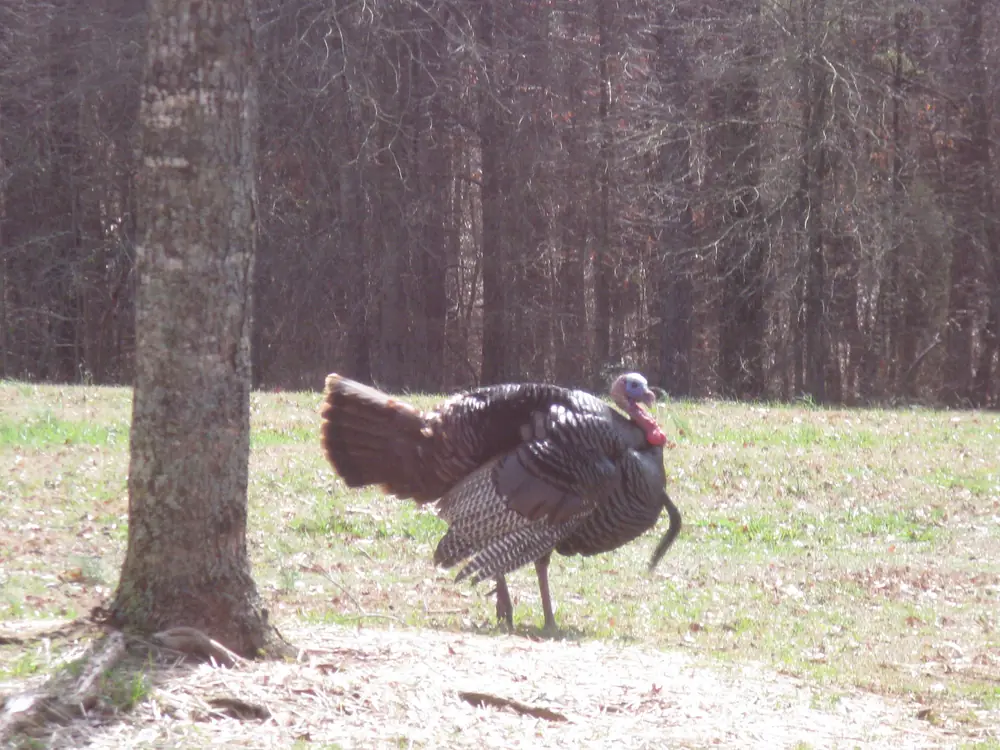
April is the month Rhode Island fills in. Volunteers crouch beside fish ladders to count river herring, swallows and thrashers return, and by the last week the first hummingbirds, orioles and warblers are on the way. American toads begin to trill, more than a million daffodils open in Newport, Bristol and Wickford, and wild turkeys gobble at dawn. It is also still brush fire season, and the last freeze comes late inland. The day gains 77 minutes in Providence, the full Pink Moon rises on the 20th, and a moonlit Lyrid shower peaks two nights later. Follow along from the Blackstone Valley to the shores of Block Island.
Other months in Rhode Island: October, November, December, January, February, March.
Start here
- Keep an arrivals list by ten-day block. Print the Audubon migrant checklist and write the date of each first sighting beside the species. Swallows come first, then wrens and thrushes, and the first vireos and warblers turn up at the very end of the month.
- Spend ten minutes at a fish ladder. Stand quietly at the Rising Sun Mills ladder in Providence or at the brook in Warwick, and watch for silver fish moving upstream. Volunteers who want to count have to attend a short training first.
- Walk a daffodil street. Pick Wickford, Newport or Bristol on a sunny day, and go slowly. Look at the blossoms, but do not pick them or step on them.
For the Naturalist’s Field Journal, April is a month of firsts and of numbers. Log every arrival on “birds I have seen,” note the hour and weather of the first toad trill on “a map of sounds,” and follow one flowering tree on “a tree through the seasons.” Sit at dawn on “dusk and dawn watch” for turkeys, check an osprey platform on “nest observed,” and return to the same pond or brook in the first and last weeks for “the same place twice.”
Regions used below: Northern Rhode Island and the Blackstone Valley; Providence and the upper bay; The western hills (Foster, Scituate, Coventry); South County and the salt ponds; Newport, Aquidneck Island and the East Bay; Block Island.
Can I help count river herring in Rhode Island in April?
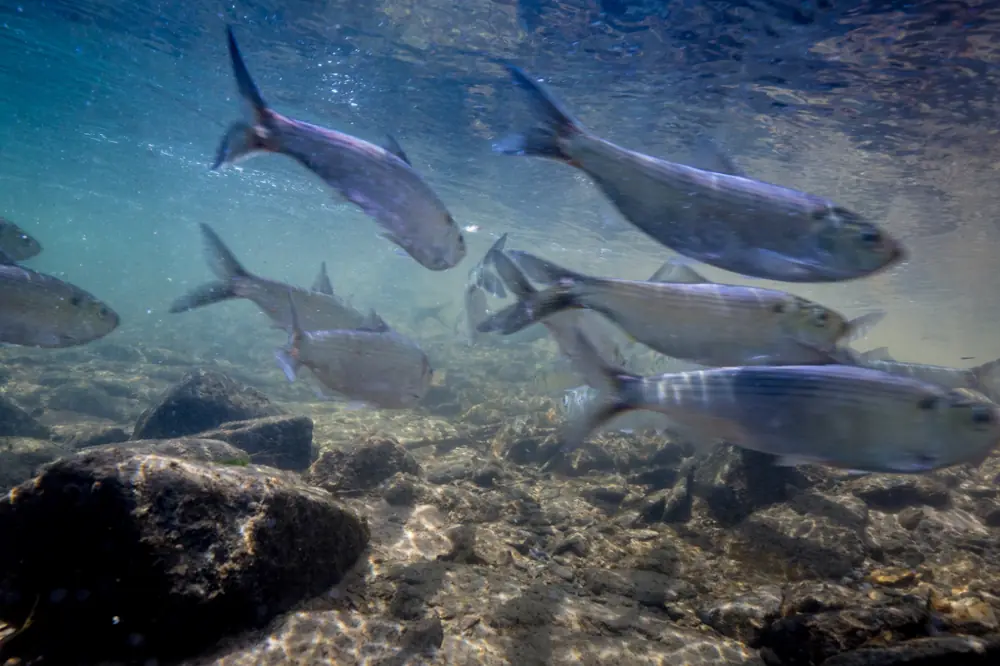
March has the first fish, and April has the counters. Rhode Island’s river herring (alewives and blueback herring) return to freshwater to spawn, and the state’s Department of Environmental Management (DEM) relies on trained volunteers who stand at a few streams and fishways and tally the fish going upstream. Anyone can watch, and with some training anyone can help. The numbers feed the state’s fishery biologists, who use them to judge whether the runs are growing.
-
Rising Sun Mills fish ladder, Providence
March through May, with volunteer counts twice a day · Olneyville, 166 Valley Street, on the Woonasquatucket River
The Woonasquatucket River Watershed Council has counted herring at this ladder since 2010 and says that in some years more than 39,000 fish have returned. More than 40 volunteers sign up for short ten-minute counts. Each one notes how many fish pass, the water temperature and the water depth, and the data go to the state’s fishery biologist, who calculates how many fish went upstream. The council explains that dams blocked the river for more than a century before fish passage was built. New volunteers are asked to attend a training first, so look for the council’s sign-up page in March.
-
Buckeye Brook, Warwick
The 2023 count ran April 1 to May 15; the 2027 window is not posted yet · Buckeye Brook and Warwick Lake, Warwick
The Buckeye Brook Coalition runs a yearly count with DEM’s Division of Fish and Wildlife. It describes the brook as a self-sustaining spawning stream with no fish ladder at all, so the herring make their way between Narragansett Bay and Warwick Lake on their own. In 2023 new volunteers had a choice of a virtual training in March or an on-site session at the brook on April 1. For the 2027 schedule, ask the coalition, or call 401-789-0281 and ask for DEM’s herring count coordinator.
The best viewing is on a mild afternoon from a bridge or the side of a fishway. Stay back from the water’s edge, keep dogs leashed, and do not net or lift fish out of the stream.
Which birds arrive in Rhode Island in April?
The Audubon Society of Rhode Island (ASRI) publishes a spring migrant checklist that sorts species into ten-day blocks. It is built from about ten years of sightings at Audubon refuges, and the shaded dates are described as approximate general peak arrival times, not hard rules. Cold snaps push the dates later and warm southerly winds pull them earlier. ASRI calls May the peak month of the spring migration, so think of April as the first act: the early arrivals sing before the trees leaf out and are easy to see.
-
Early April (the 1st to the 10th)
Swallows, a thrasher and some marsh birds · Open fields, farm buildings, bridges, colony houses and salt marsh edges
ASRI’s checklist places purple martin, barn swallow, northern rough-winged swallow, brown thrasher and chipping sparrow in this block, along with the Virginia rail, laughing gull, glossy ibis and tricolored heron of the marshes and shore. The swallows are the easiest to notice, skimming low over ponds and fields for the first insects.
-
Mid-April (the 10th to the 20th)
Wrens, thrushes, towhees and the first waterthrush · Brushy edges, wet woods and streams, pond shores
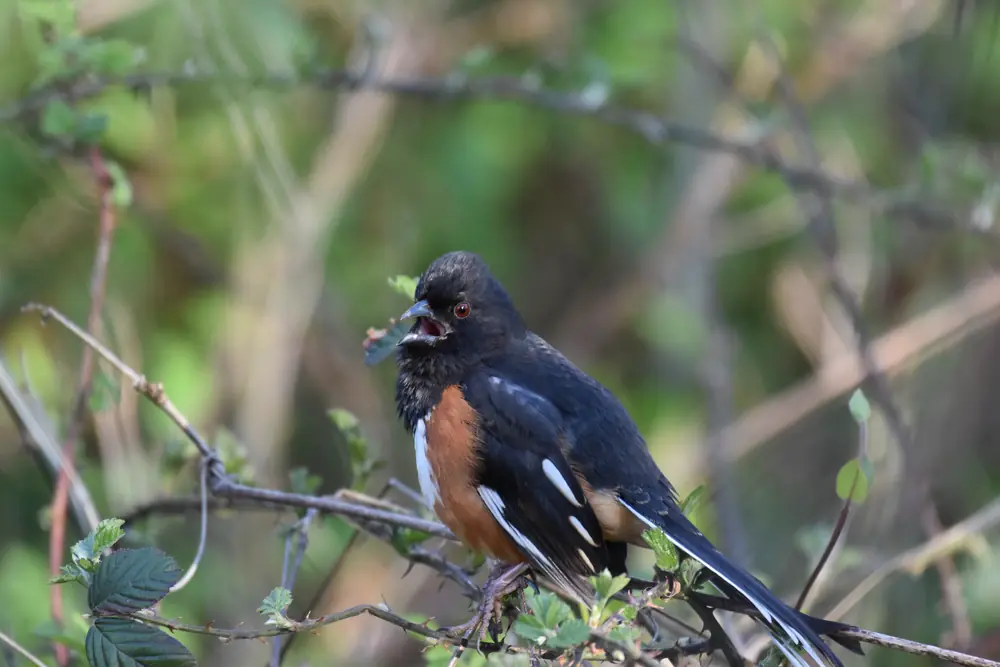
The list adds house wren, blue-gray gnatcatcher, hermit thrush, eastern towhee, field sparrow, broad-winged hawk and the Louisiana waterthrush, a streamside bird that bobs its tail. Shorebirds such as the spotted sandpiper and least sandpiper, and herons including the green heron and little blue heron, appear in the same block.
-
Late April (the 20th to the 30th)
The first warblers, vireos and the hummingbird · Woodland edges, gardens with feeders, orchards and shrubby fields
This is the longest block on the checklist. It names ruby-throated hummingbird, chimney swift, indigo bunting, wood thrush, veery, Baltimore oriole, ovenbird, yellow warbler, common yellowthroat, black-and-white warbler and yellow-rumped warbler, plus least terns on the coast. Some of these may not show up until the first days of May in a cold spring. The same checklist puts Nashville, magnolia and chestnut-sided warblers in early May and many more warblers in mid-May.
-
Winter birds heading north
Through April · Open bays and coastal ponds
ASRI’s spring migration article lists harlequin ducks, common goldeneyes, buffleheads and snowy owls among the winter visitors moving north as the migrants arrive.
Go out soon after sunrise, bring binoculars, and stand still near a wet thicket. ASRI’s free group walks have in past years clustered in May, with several set each week at refuges across the state, so check its calendar for 2027 dates and sign up where required.
Which frogs and toads are calling in Rhode Island after the first rush?
The wood frogs and peepers that start the season in March are still around, but April brings a second wave of voices. ASRI’s frog and toad guide, written for its wildlife refuges, is a handy field key to the species you can expect near ponds, wet meadows and woodland.
-
American toads
Trilling during April, the breeding season · Shallow ponds, ditches and vernal pools reached from open woods and short grass
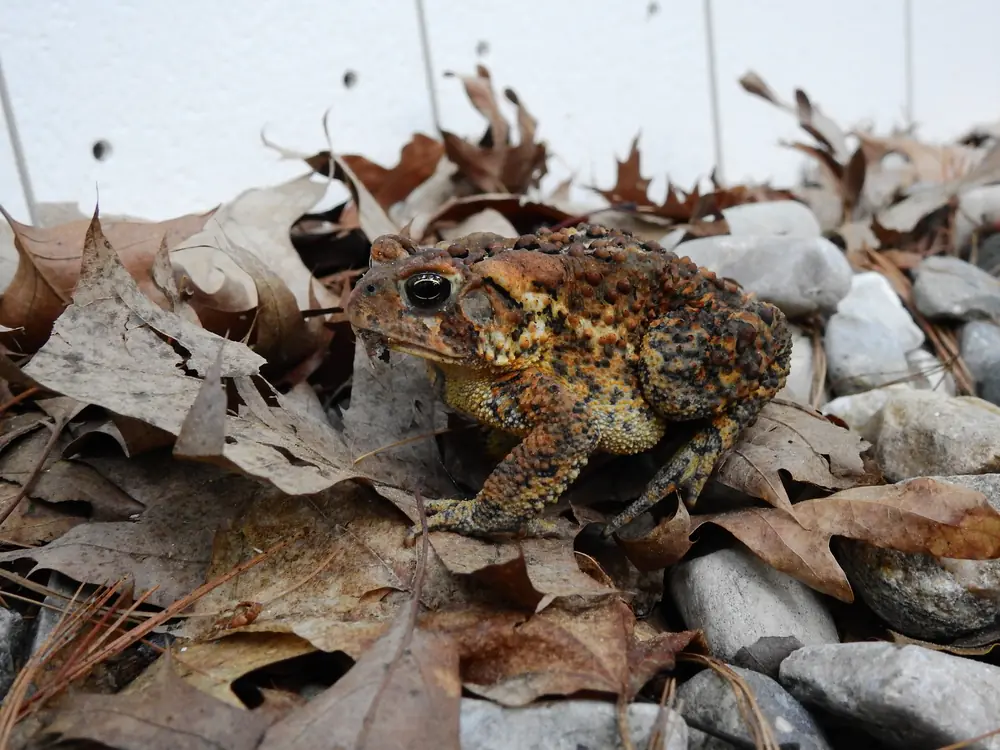
ASRI describes the American toad’s call as a high, rolling trill heard in April, when the stout, bumpy-skinned toads leave the woods and fields to lay their eggs in water. The large glands behind each eye release a toxin when the toad is threatened, which is a good reason to keep dogs from mouthing them.
-
Northern leopard and pickerel frogs
Calling around breeding ponds in spring · Meadows, grasslands, bogs, wet fields and stream edges
Both frogs make a mix of chucks and sounds like a creaky door. The guide says the leopard frog has round dark spots and golden ridges down its back and spends the warm months in meadows, while the pickerel frog has square spots and a yellow-orange flash on the inside of its hind legs and prefers wet meadows and bogs.
-
Green frogs, gray treefrogs and bullfrogs
Mostly later: gray treefrogs from mid-spring into early summer, bullfrogs in early summer · Pond edges and shrubby wetlands; gray treefrogs high in trees
The green frog’s call is described as a twanging banjo string, and the guide says the gray treefrog sings a chittering trill from mid-spring into early summer while living almost entirely up in the trees. Bullfrog choruses are an early-summer sound.
Visit a pond twice, once at dusk and once at midday, and compare the sound. Look and listen from the edge, and leave toads and frogs where you find them.
What are shorebirds doing on Rhode Island’s beaches and islands in April?
By April the beach-nesting birds are choosing sites, and the people who manage the shore are setting out protective fencing. A beach that was open all winter may have a roped zone by the middle of the month. Giving the birds a wide berth does more good now than at any other time of year.
-
Piping plovers
Arrivals in early April, courtship and nesting in mid to late April (federal species profile) · Sandy and gravelly Atlantic beaches; Misquamicut State Beach in Westerly has had a nest
Federal biologists describe the male plover scraping a shallow hollow in the sand to serve as the nest. A 2020 release from state and federal partners explains that plover chicks are not fed by their parents and must reach the wrack line, the strip of seaweed left by the tide, to find small invertebrates for themselves. The same release reported the first plover nest found at Misquamicut State Beach since monitoring began in the 1980s, at what it called the state’s busiest state beach, with over 300,000 visitors a year.
-
American oystercatchers
Federal crews begin posting and surveying nesting areas in late March to early April · Beaches southwest of Narragansett Bay, islands in the bay and the northwest coast of Block Island
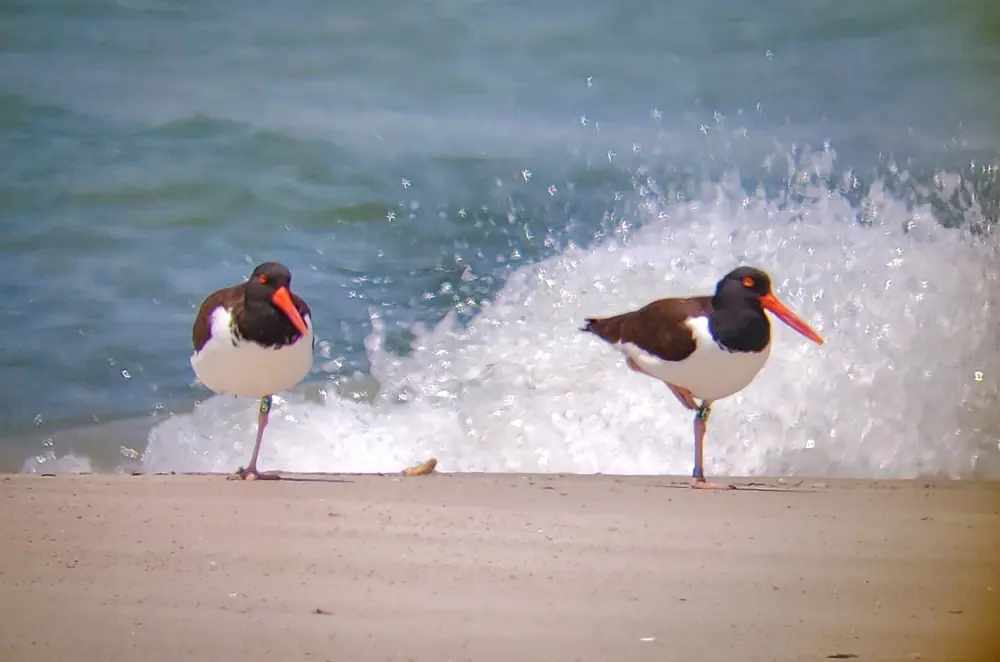
A 2019 state and refuge report says most of Rhode Island’s oystercatchers nest on natural islands in Narragansett Bay, where no chick-survival records are kept. Sandy Point Island hosts as many as ten pairs, and in 2019 Block Island was down to a single breeding pair, from as many as five in earlier years. Staff mark each nest and check it one to three times a week.
-
Closed bay islands
April 1 through August 15 · East Island, West Island, Dyer Island and Hope Island
DEM’s 2026–2027 hunting guide lists these four islands as closed to trespassing from April 1 to August 15 so that nesting birds are left in peace.
-
Ospreys on eggs
Eggs are laid in April and hatch in late May · Nest platforms, channel markers and poles near the bay
DEM’s osprey fact sheet gives an average clutch of three eggs, laid in April, and says the birds spend March through August in the state. A pair sitting low on a platform in April is probably incubating.
Two refuge notes apply to a spring shore walk. The Sachuest Point refuge warns that big waves and storms sometimes close its road, and that wet rocks at the shoreline can be deadly. Ninigret refuge in Charlestown is known for its migratory birds and has a visitor center.
Where and when do daffodils and spring wildflowers bloom in Rhode Island in April?
April is the month the state turns yellow. Rhode Island has some of New England’s biggest daffodil displays, and the woods have their own, quieter early flowers. Bloom dates swing with the weather, and the organizers below have not posted 2027 schedules, so treat their 2026 dates as a rough guide only and confirm before you travel.
-
Newport Daffodil Days
Activities ran all of April in 2026; check with the organizer for 2027 · Memorial Boulevard, Ballard Park, Cliff Walk, Miantonomi Park, Morton Park and other spots in Newport and Middletown
Discover Newport says the city and its neighbors hold more than 1.5 million daffodils, while a Rhode Island tourism guide from 2025 gave 1.3 million, so the exact count is anybody’s guess. The event is all-volunteer and supports Newport In Bloom, which gives away over 30,000 bulbs each fall. Visitors are asked not to pick or step on the flowers.
-
Blithewold, Bristol
In 2026, April 12 to May 11; the garden says bloom runs late March to early May depending on the weather · Blithewold Mansion, Gardens and Arboretum, a 33-acre seaside estate
Blithewold says its display has nearly 150,000 blooms from more than 100 varieties across all 13 daffodil divisions, and that Daffodil Days comes with general admission. Its month-by-month list shows daffodils in April, then star magnolia, quince, flowering cherry and primroses in early May, with tulips, crabapples and lilacs in mid-May.
-
Wickford Daffodil Days
April 9 to 12 in 2026 · Wickford Village, North Kingstown
The Wickford Village Association and the Historic Wickford group set out hundreds of daffodil pots on the village streets, and the 2026 festival had carriage rides and a Daffy Dog Parade. HistWick said almost 500 pots were bought for the event. Dates move from year to year, so confirm with the Wickford Village Association.
-
Wildflowers in the woods
Early spring, before the trees leaf out · Rich, moist woods, swamps and rocky slopes
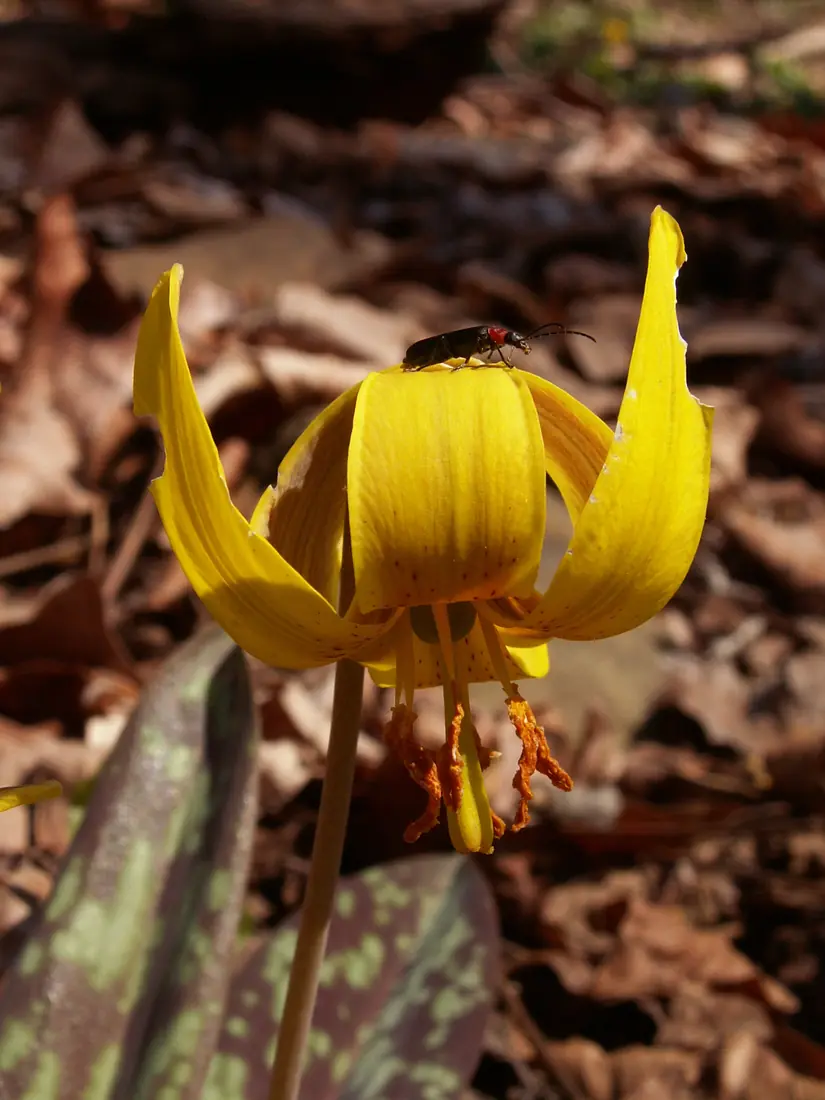
The Rhode Island Wild Plant Society’s early spring list calls skunk cabbage, wood anemone, wild columbine and doll’s-eyes common in the state, trout lily uncommon, and bloodroot, hepatica and purple trillium rare, and says almost all of them flower before leaves appear on the trees. Go Botany calls wood anemone one of the earliest bloomers in New England forests and notes that most trout lily colonies have more non-flowering plants than flowering ones, so a leafy patch without blossoms is normal.
-
Arbor Day
Friday, April 30, 2027, by state law · A different Rhode Island town hosts the state ceremony each year
Section 25-2-30 of the state’s General Laws makes the final Friday of April Arbor Day, to be marked with public ceremonies. The Rhode Island Tree Council’s celebration was held in Cranston on April 26, 2024, and was set for Providence Country Day School in East Providence on April 25, 2025, the state’s 138th. The 2027 site is not announced yet, so check with the Tree Council.
Photograph a single flowering tree weekly, on a fixed day, and you have the start of a real phenology record.
Where can I hear wild turkeys in Rhode Island, and when is turkey season?
Rhode Island’s wild turkeys are a restoration story. DEM says forest clearing, overhunting and harsh weather had wiped them out of the state by the early 1800s. A restoration project that began on February 8, 1980, released 29 birds trapped in Vermont into the town of Exeter, with more releases from New York and Pennsylvania in the 1990s. Turkeys have since spread to every mainland town and to Aquidneck Island, though not to Block Island.
-
Gobbling at dawn
Spring mornings; DEM runs its listening survey in the three weeks before the season opens · Fields and woods statewide
DEM’s gobble call count uses 11 driving routes with 13 stops each, one mile apart. At each stop a volunteer or biologist listens for four minutes and logs the gobbles. In 2024 about 11.5 percent of stops had a gobbling turkey. DEM’s report says activity at the stops has risen over the long run.
-
The 2027 spring season
Youth days April 19 to 25, paraplegic hunt April 24 and 25, spring season April 29 to May 23 · Statewide
DEM’s 2026–2027 guide gives those dates for the 2027 spring season, with legal shooting starting 30 minutes before sunrise and ending at 1 p.m. In 2024, hunters took 331 birds in the spring season, the second highest total on record, and 64 percent of them were taken before 9 a.m.
Even if you never hunt, the dates matter: from the third Saturday in April (April 17, 2027) hikers on state management areas must wear orange, as the safety notes below explain.
What is April weather like in Rhode Island, and when is brush fire season?
April is still a swing month. NOAA’s 1991–2020 normals put afternoon highs between about 55 °F on Newport’s harbor and 60.5 °F at Coventry, with lows from the mid-30s to about 40 °F. Precipitation is steady, between 3.9 and 4.9 inches, and falls on about 11 to 13 days. Snow has not quite vanished: the northwest hills at North Foster average 2.6 inches, while the Warwick airport station averages 0.6. Freezing mornings are the big difference between the coast and the interior. Newport’s harbor station averages 2.9 days with a low of 32 °F or colder in April, and Coventry averages 10.1.
The state’s forest rangers call mid-March through mid-May the traditional spring brush fire period. With bare trees, the sun dries last year’s leaves quickly, and a few windy, dry days with low humidity are enough for a Red Flag Warning. DEM says improperly discarded stove and fireplace ashes are a frequent cause, and that ashes can hold embers for days. Open burning needs a permit from the local fire district, and it is banned in some towns. Check the local forecast for warnings before a walk in dry woods, and for flood watches after a soaking rain, since streams and the herring brooks run high in spring. For the newest seasonal outlook maps, see the Climate Prediction Center’s three-month page, cpc.ncep.noaa.gov.
| Station | Average high | Average low | Precipitation | Snowfall | Days with a low of 32 °F or lower |
|---|---|---|---|---|---|
| N Foster 1 E (northwest hills) | 57.7 °F | 36.7 °F | 4.68 in | 2.6 in | 9.0 |
| Woonsocket (Blackstone Valley) | 59.8 °F | 38.0 °F | 4.71 in | 1.9 in | 7.7 |
| Coventry 2 (western Kent County) | 60.5 °F | 36.3 °F | 4.72 in | no normal | 10.1 |
| Providence T F Green Airport (Warwick) | 58.9 °F | 39.6 °F | 4.29 in | 0.6 in | 4.1 |
| Kingston (South Kingstown) | 59.7 °F | 37.1 °F | 4.90 in | 1.1 in | 9.8 |
| Westerly State Airport | 57.1 °F | 40.7 °F | 3.90 in | no normal | 5.9 |
| Tiverton (East Bay) | 60.0 °F | 39.3 °F | 4.50 in | 0.6 in | 4.2 |
| Newport Rose (Newport Harbor) | 55.2 °F | 39.7 °F | 4.73 in | 1.3 in | 2.9 |
These are thirty-year averages, and any single April can run colder, wetter or drier.
When is the last spring freeze in Rhode Island, and is it safe to plant in April?
Not yet for most places. The table lists NOAA’s freeze normals for eight stations. The harbor and coast are the first to warm: Newport’s harbor station reaches its median last freeze on April 7, with the Warwick airport, Westerly and Tiverton on April 11. The inland stations of Woonsocket and Coventry follow on April 22, North Foster on April 25, and the Kingston station trails at May 3, with nine springs in ten done only by May 16. Look up your own town on the Rhode Island frost dates page.
| Station | One year in ten | Median | Nine years in ten |
|---|---|---|---|
| Woonsocket (Blackstone Valley) | Apr 9 | Apr 22 | May 6 |
| N Foster 1 E (northwest hills) | Apr 13 | Apr 25 | May 9 |
| Coventry 2 (western Kent County) | Apr 10 | Apr 22 | May 4 |
| Providence T F Green Airport (Warwick) | Apr 1 | Apr 11 | Apr 23 |
| Kingston (South Kingstown) | Apr 21 | May 3 | May 16 |
| Westerly State Airport | Mar 31 | Apr 11 | Apr 26 |
| Tiverton (East Bay) | Apr 1 | Apr 11 | Apr 22 |
| Newport Rose (Newport Harbor) | Mar 28 | Apr 7 | Apr 21 |
The middle column is the median, so in half of all springs the last freeze comes after that date. Hardy peas and pansies shrug off light frost, but tomatoes and basil do not.
How much daylight does Rhode Island gain in April?
Providence starts April with 12 hours 42 minutes between sunrise and sunset and ends it with 13 hours 59 minutes, a gain of 77 minutes, or roughly 2.7 minutes every day. The clocks went forward on March 14, so the extra light now shows up in the evening: April sunsets arrive after 7 p.m. by the end of the month in daylight time.
| City | Apr 1 | Apr 30 | Gained | Per day |
|---|---|---|---|---|
| Woonsocket | 12 h 42 m | 14 h 00 m | 78 min | 2.7 min |
| Providence | 12 h 42 m | 13 h 59 m | 77 min | 2.7 min |
| Warwick | 12 h 42 m | 13 h 59 m | 77 min | 2.7 min |
| Coventry | 12 h 42 m | 13 h 59 m | 77 min | 2.7 min |
| Newport | 12 h 41 m | 13 h 58 m | 77 min | 2.7 min |
| Westerly | 12 h 41 m | 13 h 58 m | 77 min | 2.7 min |
| New Shoreham | 12 h 41 m | 13 h 57 m | 76 min | 2.6 min |
Sunrise and sunset for every state are on the daylight page, and the cloud guide explains which sky signs point to showers.
What can you see in the Rhode Island night sky in April 2027?
April evenings are mild enough for stargazing, but moonlight dominates the second half of the month. All times below are Eastern daylight time, since the clocks changed on March 14. The new moon falls on April 6, so the darkest skies come in the days around it.
-
Venus at dawn
All month; a thin crescent Moon sits near it on the mornings of April 3 and 4 · Low in the east before sunrise
Venus remains a dazzling morning object while slipping closer to the sun: on April 1 its lead over the sun is roughly 75 minutes at 40 degrees north, a gap that shrinks as the month goes on. A crescent Moon only about 9 percent lit passes 2.9 degrees from it at its closest, a pretty pair above the eastern horizon.
-
Jupiter and Mars in the evening
All month; the Moon passes both on the evenings of April 14 and 15 · High in the south after dark, in Leo and the Cancer region
Jupiter is the bright steady light that dominates the evening sky, setting in the small hours of the night. Around dusk on April 14 and 15 the Moon, roughly two-thirds lit, slides to within about a degree of Jupiter, and on the 15th it also sits about 3 degrees from Mars, which is fading and shines about as bright as a bright star.
-
Saturn leaves the evening
Conjunction with the sun on April 7 · Too close to the sun to see
Saturn slips behind the sun this month and will reappear in the dawn sky around the turn of April into May. There is nothing to see of it for most of April.
-
The Pink Moon
Full Tuesday, April 20, at 6:27 p.m. · Rising in the east around 7:40 p.m. at Boston, within a few minutes of that in Rhode Island
The April full moon is called the Pink Moon, an old name tied to the pink spring flower moss phlox (wild ground phlox), not to the color of the Moon. It comes up just after the moment of full, which makes the 20th the best evening, though the Moon also looks full the night before and after.
-
Lyrid meteors, a poor year
Peak around 9:41 p.m. on Thursday, April 22 (IMO excerpt; our own calculation gives about 14 minutes later) · Northeast to east, in the dark hours before moonrise
The Lyrids usually produce around 20 meteors an hour at best, but this time the Moon is some 95 percent lit, three nights past full, and comes up around 10 p.m. across southern New England. Just the first hours of the evening are dark, while the radiant in Lyra is still low in the east. Expect a handful an hour at most. The Eta Aquariids begin around April 19 and peak in early May.
| Phase | Date | Time |
|---|---|---|
| New moon | Tuesday, Apr 6 | 7:51 p.m. EDT |
| First quarter | Tuesday, Apr 13 | 6:56 p.m. EDT |
| Full moon, the Pink Moon | Tuesday, Apr 20 | 6:27 p.m. EDT |
| Last quarter | Wednesday, Apr 28 | 4:18 p.m. EDT |
Every phase of the year is on the moon phase page; plan faint-object viewing for the nights near April 6.
What can Rhode Island families do outdoors in April?
- Count fish for ten minutes. The Woonasquatucket council’s fish ladder in Providence welcomes short counts after a brief training, and Buckeye Brook in Warwick has a similar volunteer program.
- Walk a daffodil street. Newport, Bristol and Wickford all put on daffodil festivals in April, and none of the 2027 schedules is posted yet, so confirm before driving.
- Keep a first-arrivals list. Print ASRI’s migrant checklist, pin it to the fridge and tick off each bird by the date you see it.
- Learn to read a toad trill. At dusk beside a pond, listen for the rolling American toad trill, and compare it with the quacking of last month’s wood frogs.
- Plant a tree on Arbor Day. Rhode Island marks it on Friday, April 30, 2027, and local tree councils and towns often hold plantings that day. Check your town’s page.
- Mark Earth Day on Thursday, April 22. A shoreline or park cleanup is a good family job, and a nature journal turns it into a record.
- Catch the end of seal season. Save The Bay’s Newport seal tours run November through April.
- Join a citizen-science project. ASRI lists vernal pool monitoring (March to May) and osprey monitoring on its community science page, so pick one and report your finds.
Other states and months are collected in the nature guides. The thaw comes first in March in Rhode Island, and to keep a record of what you see, try the Naturalist’s Field Journal, which has plates for each kind of observation.
Safety notes for April in Rhode Island
- Hunting and orange. From April 17, 2027 (the third Saturday) through May 31, anyone using a state management area, a designated undeveloped state park or a cooperative unit must wear 200 square inches of fluorescent orange, according to DEM’s 2026–2027 hunting guide. People hunting spring turkey are exempt from that rule. The 2027 turkey dates are April 19 to 25 for youth days, April 24 and 25 for the paraplegic hunt, and April 29 to May 23 for the spring season. The same guide keeps coyote hunting open on state land during the turkey season. Confirm the details with DEM before you head out.
- Fishing. Trout opening day was April 13 in 2024 and April 11 in 2026, and DEM announces the date each spring, so look for the 2027 date. In 2026 a fishing license was required for anglers 15 and older, and a Trout Conservation Stamp was needed to keep trout, with listed exceptions.
- Fire. Spring fire danger lasts from mid-March into mid-May. Drench ashes in a metal can before dumping them, get a permit before any open burning, and put cigarettes fully out.
- Ticks. URI’s TickEncounter Resource Center says adult blacklegged ticks seek hosts from October into May on any day that stays above freezing, and that both the poppy-seed-sized nymphs and adult females can transmit Lyme disease. Choose light-colored clothing, wear long pants tucked into socks, and inspect your skin and pets once you are home.
- Nesting birds. Stay out of roped areas on beaches, keep dogs away from the dunes and wrack line, and never land on the closed bay islands before August 16.
- Surf and cold water. Avoid wet rocks at the shoreline, as the Sachuest Point refuge warns, and wear a life jacket on the bay, which is still cold in April.
Sources (43)
- Rhode Island DEM: 2026–2027 Rhode Island Hunting and Trapping Guide (PDF; turkey seasons, fluorescent orange, island closures, coyote)
- Rhode Island DEM: 2026–2027 hunting general information, fluorescent orange requirements (eRegulations)
- Rhode Island DEM Division of Fish and Wildlife: 2024 Rhode Island Wild Turkey Program Summary (restoration history, harvest, gobble call count)
- State of Rhode Island: spring turkey permits available beginning April 1 (DEM release)
- The Westerly Sun: RIDEM stocks 60,000 fish in over 100 waterbodies (trout opening day April 11, 2026)
- Newport Buzz: opening day of trout season set for April 13 (2024)
- Woonasquatucket River Watershed Council: fish counting (Rising Sun Mills fish ladder)
- Woonasquatucket River Watershed Council: join the spring herring fish count
- Buckeye Brook Coalition: home page and 2023 DEM herring count notice
- Audubon Society of Rhode Island: spring migrant checklist (ten-day arrival blocks)
- Audubon Society of Rhode Island: migrants are on the move (spring migration article, 2019)
- Audubon Society of Rhode Island: a busy time for birds and birders (May 2018 programs)
- Audubon Society of Rhode Island: community science programs
- Audubon Society of Rhode Island: frog and toad guide
- U.S. Fish and Wildlife Service: piping plover, Atlantic Coast population
- State of Rhode Island: conservation partners remind the public to be considerate of nesting birds (May 28, 2020)
- American Oystercatcher Working Group: Rhode Island 2019 state update
- Rhode Island DEM Division of Fish and Wildlife: osprey fact sheet
- U.S. Fish and Wildlife Service: Sachuest Point National Wildlife Refuge
- U.S. Fish and Wildlife Service: Ninigret National Wildlife Refuge
- U.S. Fish and Wildlife Service: Trustom Pond National Wildlife Refuge
- Discover Newport: Daffodil Days (Newport and Blithewold, April 2026)
- Visit Rhode Island: Daffodil Days in Rhode Island (2025)
- Blithewold Mansion, Gardens and Arboretum: Daffodil Days
- Historic Wickford: HistWick supports Daffodil Days (April 14, 2026)
- South County Tourism Council: South County welcomes spring with Daffodil Days in Wickford Village
- Among Rhode Island Wildflowers: Rhode Island early spring wildflowers, The Amateur Botanist
- Native Plant Trust Go Botany: wood anemone
- Native Plant Trust Go Botany: American trout-lily
- Rhode Island General Laws section 25-2-30: Arbor Day (last Friday in April)
- Rhode Island Tree Council: Arbor Day celebration (2024 and 2025)
- State of Rhode Island: State Arbor Day program, Friday April 24 (DEM release)
- State of Rhode Island: DEM warns public of increased fire danger (mid-March through mid-May brush fire period)
- State of Rhode Island: DEM urges caution when disposing of ashes
- Watch Hill Fire Department: welcome to spring, brush fire danger remains high (2021)
- University of Rhode Island TickEncounter Resource Center: blacklegged tick
- Save The Bay: seal watch tours (Newport, November to April)
- NOAA NCEI: 1991–2020 monthly normals for Rhode Island stations (data API, April values)
- NOAA NCEI: GHCN-Daily station list (station names and identifiers)
- Climate Prediction Center: 90-day (seasonal) outlooks
- U.S. Naval Observatory: moon phases, 2027
- Sea and Sky: astronomy calendar of celestial events, 2027 (April)
- Photos via Wikimedia Commons; licenses and photographers are credited under each picture