What to look for in nature in Rhode Island this February
February closes out meteorological winter, and in Rhode Island it has a stormy reputation. Both of the state’s benchmark blizzards struck in February: the Blizzard of ’78, and the storm of February 22 and 23, 2026, when 37.9 inches fell at the airport in Warwick, now the state’s official 24-hour snowfall record. Yet the month also turns toward spring. Maple sap begins to run on mild afternoons, skunk cabbage pushes purple hoods through frozen swamp mud, the first male red-winged blackbirds may show up in the final week, and great horned owls settle onto eggs. By February 28 the sun sets in Providence at 5:35 p.m., more than half an hour later than on the 1st. Here is the month, from the Blackstone Valley to Block Island.
Other months in Rhode Island: October, November, December, January.
Start here
- Count birds for four days. Over four days in mid-February, the 12th through the 15th, the Great Backyard Bird Count takes sightings from any place at all. Pick a window, a park or a stretch of shore, give it at least 15 minutes, and report every species you can name.
- Look down in a wet woodland. On a mild day late in the month, walk a boardwalk or brook-side trail and scan the mud for mottled purple hoods poking through the leaves. Skunk cabbage makes its own heat and is often the first native plant to flower.
- Find Jupiter and Mars together. After Jupiter’s opposition on February 10 and Mars’s on the 19th, the pair rise together out of the east at dusk: Jupiter the brighter, Mars a steady orange-red point a short way off.
For the Naturalist’s Field Journal, February is about first dates. Put the first skunk cabbage hood you find on “a tree through the seasons” beside your chosen maple, and log the first red-winged blackbird’s song on “a map of sounds” with the time and place. A snowstorm earns a page in the daily field log: start time, depth on a ruler, wind. Skunk trails in new snow belong on “tracks to know”, and every species from the bird count belongs in “birds I have seen”.
Regions used below: Northern Rhode Island and the Blackstone Valley; Providence and the upper bay; The western hills (Foster, Scituate, Coventry); South County and the salt ponds; Newport, Aquidneck Island and the East Bay; Block Island.
What were the biggest blizzards in Rhode Island history?
Rhode Island’s two most famous snowstorms both came in February, nearly half a century apart. In March 2026 a State Climate Extremes Committee, with members from the National Weather Service office in Norton, Massachusetts, the Northeast Regional Climate Center, the Rhode Island State Climate Office at DEM and NOAA’s National Centers for Environmental Information, reviewed both storms and set a new state record.
-
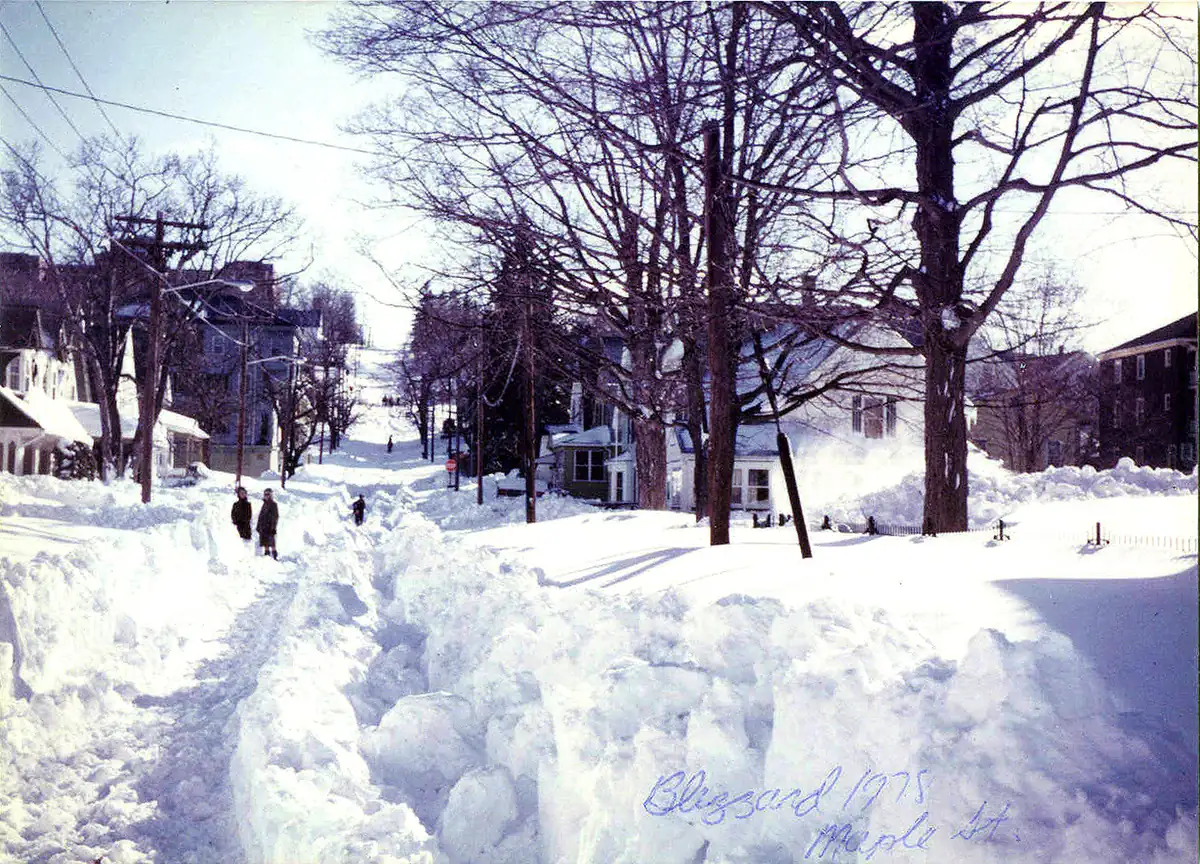
The Blizzard of ’78
February 6 and 7, 1978 · Statewide except Block Island, heaviest in the north and west
A coastal low formed off the Outer Banks on the evening of February 5 and deepened as it moved up the coast. At T.F. Green Airport the snow began at 10:10 a.m. on February 6, fell at 2 to 3 inches an hour that evening, and ended late on the 7th, with 28.6 inches over the two days and a gust of 58 mph. Woonsocket’s cooperative observer measured 30.0 inches in 24 hours and 38.0 for the storm, and the snow reached 42 inches deep at North Foster. Block Island had only 10.5 inches. Hundreds of cars were stranded on Interstate 95, a driving ban lasted days, and the report counts 26 deaths in the state.
-
The Blizzard of 2026
February 22 and 23, 2026 · Heaviest in Kent County, around the airport in Warwick
Snow reached the airport at 7:41 p.m. on February 22 as a low off North Carolina deepened by 36 millibars in a day, a true bomb cyclone. A band of heavy snow pivoted over Rhode Island and southeast Massachusetts, and between about 7 a.m. and 4 p.m. on the 23rd it dropped 2 to 4 inches an hour while the depth at the airport climbed from 21 to 42 inches. By the time the snow stopped that evening, 37.9 inches had fallen, beating Providence’s 1978 storm total and Woonsocket’s old state record. Winds gusted to 74 mph at Quonset, 73 on Block Island and 68 at Newport State Airport, and T.F. Green was in blizzard conditions from 5:25 a.m. to 2 p.m.
| Location | Blizzard of ’78 (Feb 6–7, 1978) | Blizzard of 2026 (Feb 22–23, 2026) |
|---|---|---|
| T.F. Green Airport, Warwick | 28.6 (27.6 in 24 hours) | 37.9 (state 24-hour record) |
| Woonsocket | 38.0 (30.0 in 24 hours) | 32.0 |
| North Foster | 36.0 | – |
| Newport Rose (Newport Harbor) | 28.0 | – |
| Kingston | 24.6 | 25.3 |
| Block Island | 10.5 (State Airport) | 28.0 (cooperative observer) |
Two storms do not make a pattern, but they show what a February nor’easter on the right track can do. The month’s normal snowfall and the El Niño outlook are in the weather section below.
When do great horned owls lay their eggs in Rhode Island?
In January the state’s great horned owls were calling and choosing partners. By February many pairs move on to the next stage. The Audubon Society of Rhode Island says its three common owls set up territories and find mates between late January and March, and the Massachusetts breeding bird atlas next door calls the great horned owl the earliest nester of the native birds.
-
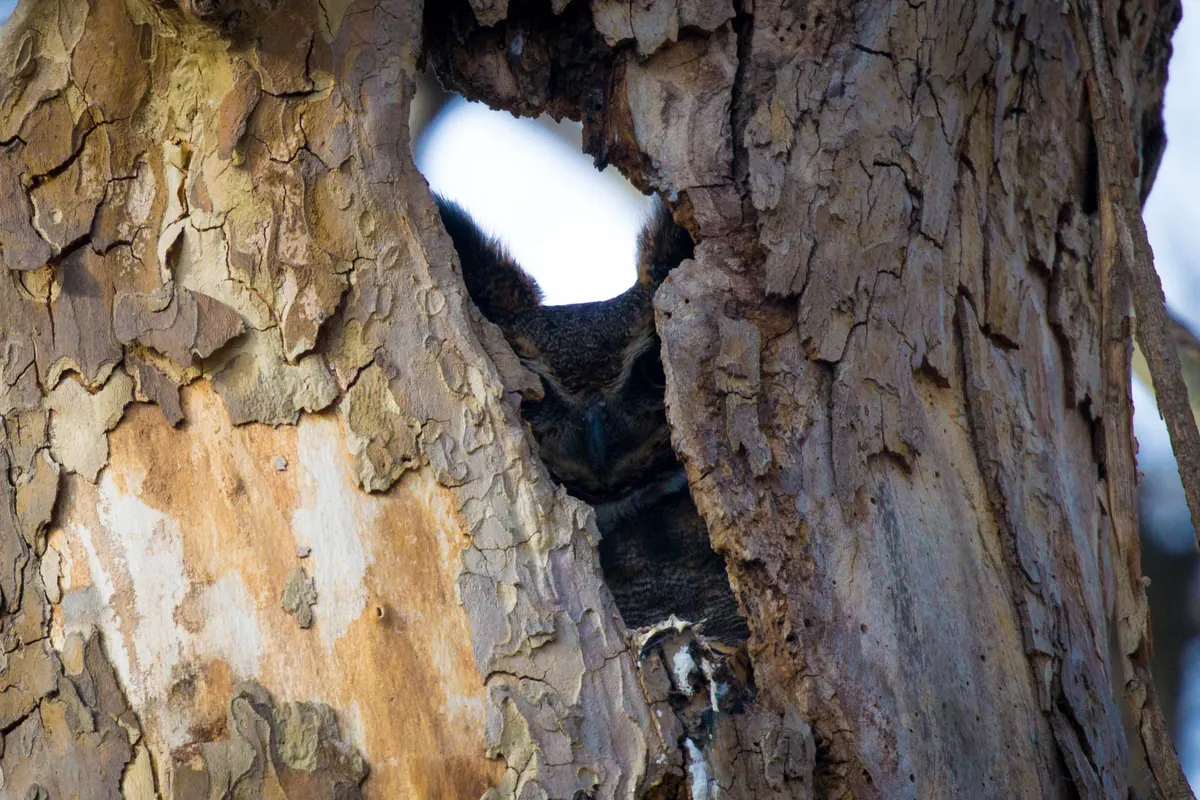
Great horned owls settling onto eggs
Mostly from about February 20 into March; a few earlier · Old hawk or crow nests, broken-off trunks and tree cavities, in woods, parks and cemeteries statewide
Rhode Island has no published table of egg dates, but next door the first Massachusetts Breeding Bird Atlas calls the great horned owl the earliest nester among the native birds there, usually laying between February 20 and March 25. Massachusetts nests were mostly 40 to 70 feet up in white pines. The female broods from the first egg for 28 to 30 days through whatever weather February sends, fed by her mate.
Watch only from a good distance, keep the visit short and do not share the location online. A sitting female that is pushed off her eggs in freezing weather can lose the whole clutch.
-
Barred and screech owls tuning up
Late February into March · Barred owls in swampy woods such as Fisherville Brook and the Great Swamp; screech owls in older neighborhoods and woodlots
These two nest later than the great horned owl. Audubon notes that a screech owl may lay up to six eggs, and that young barred owls stay with their parents for up to four months after fledging.
Dusk on a calm, frosty evening is the best time to listen. Audubon’s winter owl prowls, listed in the families section, are an easy way to start.
When does maple sap run in Rhode Island?
Maples store sugar in their roots and trunks through the dormant season. DEM’s forestry brochure on maple syrup explains that sap can flow whenever the air swings above and below freezing, with the strongest runs in February and March, when thawing days follow freezing nights. The flow ends when the leaves come out.
-
Red maple, the state tree
February until the buds break, which can be by mid-March · Swamps, stream banks and wet woods across the state
Sugar maple, the classic syrup tree of northern New England, is uncommon in Rhode Island and is found mostly along roads and around old farmsteads. So Rhode Islanders tap other maples. Red maple, the state tree, is very common here, especially in poorly drained ground, and its sap can be boiled into syrup, though it is less sweet than sugar maple sap. Red maple also starts growing earlier in spring, which makes for a shorter season: DEM says its leaves can emerge as early as mid-March, and the season ends when they do.
-
Norway maples on the street
Same freeze-and-thaw weather · Streets, yards and parks in towns and cities
Norway maple, a European street tree that has spread into many woods, is seldom tapped elsewhere, but DEM says Rhode Island producers often use it because it grows big and other maples are scarce. A tap is a 7/16-inch hole 2.5 to 3 inches deep with a metal spout feeding a bucket or tubing, pulled as soon as the season ends.
-
Sugarhouses and maple days
Late winter; most public events are in March · Glocester, Richmond, Bristol
Chepachet Farms in Glocester sets several hundred taps across the rural part of the town and, in a good run, collects several hundred gallons of sap a day. Spring Hill Sugar House in Richmond, a 22-acre farm founded in 1980, gives maple syrup demonstrations on March weekends. Coggeshall Farm Museum in Bristol holds Maple Sugaring Days each year, with tapping, sap boiling and children’s games; in 2026 they fell on March 7 and 8. None had announced 2027 dates by early October; ask each farm first.
Try it at home: log each day’s high and low beside a big red maple, and check whether a snapped twig drips after a frosty night turns into a bright, thawing afternoon.
What is the first wildflower to bloom in Rhode Island?
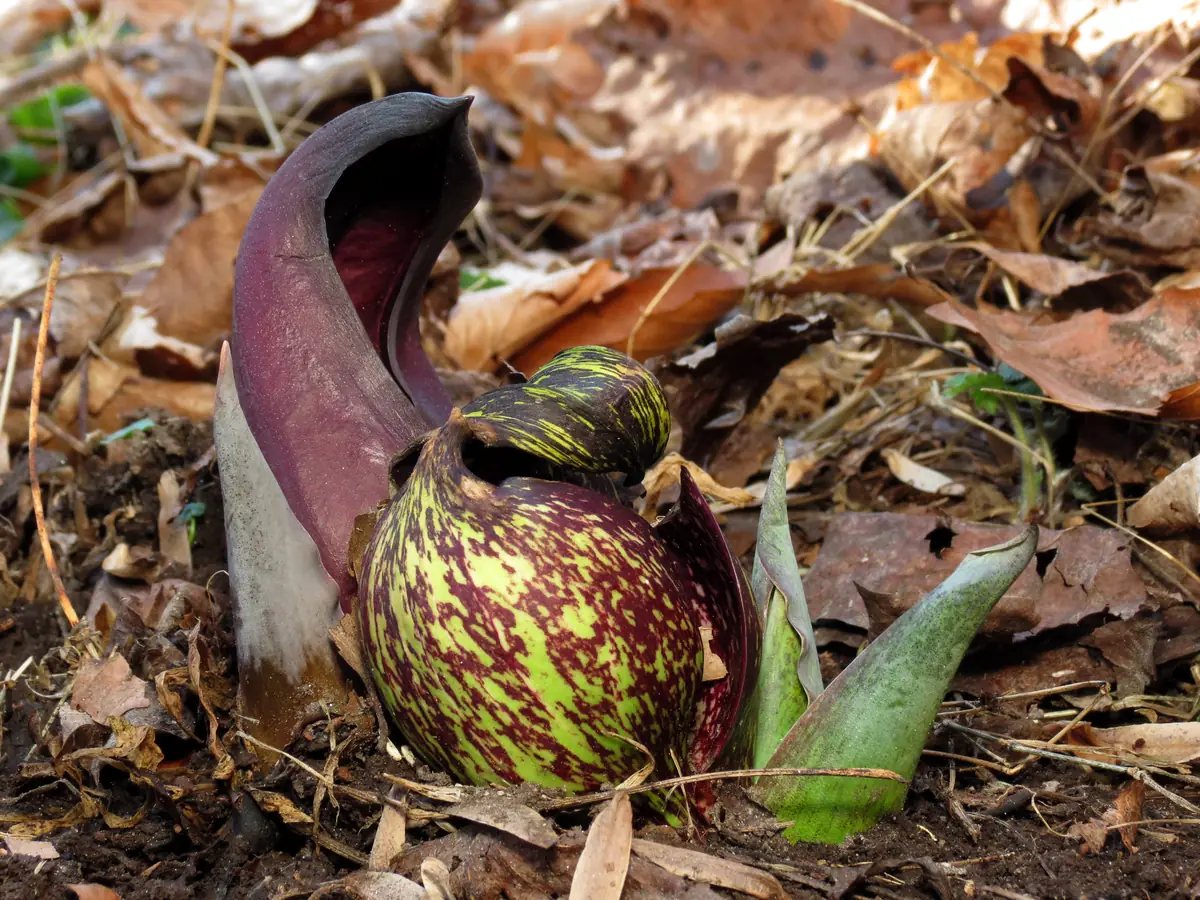
Long before any tree leafs out, one native plant is already in flower in Rhode Island’s swamps. Skunk cabbage is a member of the arum family, kin to jack-in-the-pulpit, and the Native Plant Trust lists it as native to all six New England states.
-
Skunk cabbage
Flowers can appear in late February; more open in March · Wooded swamps, seeps and stream banks: Audubon’s Maxwell Mays Wildlife Refuge in Coventry, The Nature Conservancy’s Whitehead Preserve in Little Compton
What you see first is not a leaf but the spathe, a hood 2 to 7 inches tall, streaked and mottled purple, brown and green, curled around a knob covered with tiny flowers. Go Botany calls skunk cabbage one of the earliest wildflowers of spring and points out that its flower spike makes heat. Researchers at the Tufts Pollinator Initiative, who photographed it blooming beside a Massachusetts stream in late February, note that the inside of the hood can stay above 50 °F while the air outside is below freezing, enough to melt a ring of snow and keep ice from forming around it. The warmth and the carrion smell draw early flies and other insects, the likely pollinators. The big, cabbage-like leaves unroll later in spring.
-
Red maple buds
Swelling through February; flowering usually follows in March · Swamp edges and roadsides
Check red maple twigs on a bright late-February afternoon. Go Botany points out that this tree is red in every season, beginning with its buds, and the clusters of flower buds plump up week by week before the swamps turn hazy red in March.
Stay on boardwalks: the hoods are easily crushed in soft mud.
When do red-winged blackbirds and woodcock come back to Rhode Island?
Short-distance migrants that winter in the southern United States are the first birds to return, and they can time their trips by local weather. According to Rhode Island Audubon, many of these species are reaching their Rhode Island breeding grounds earlier than they used to.
-
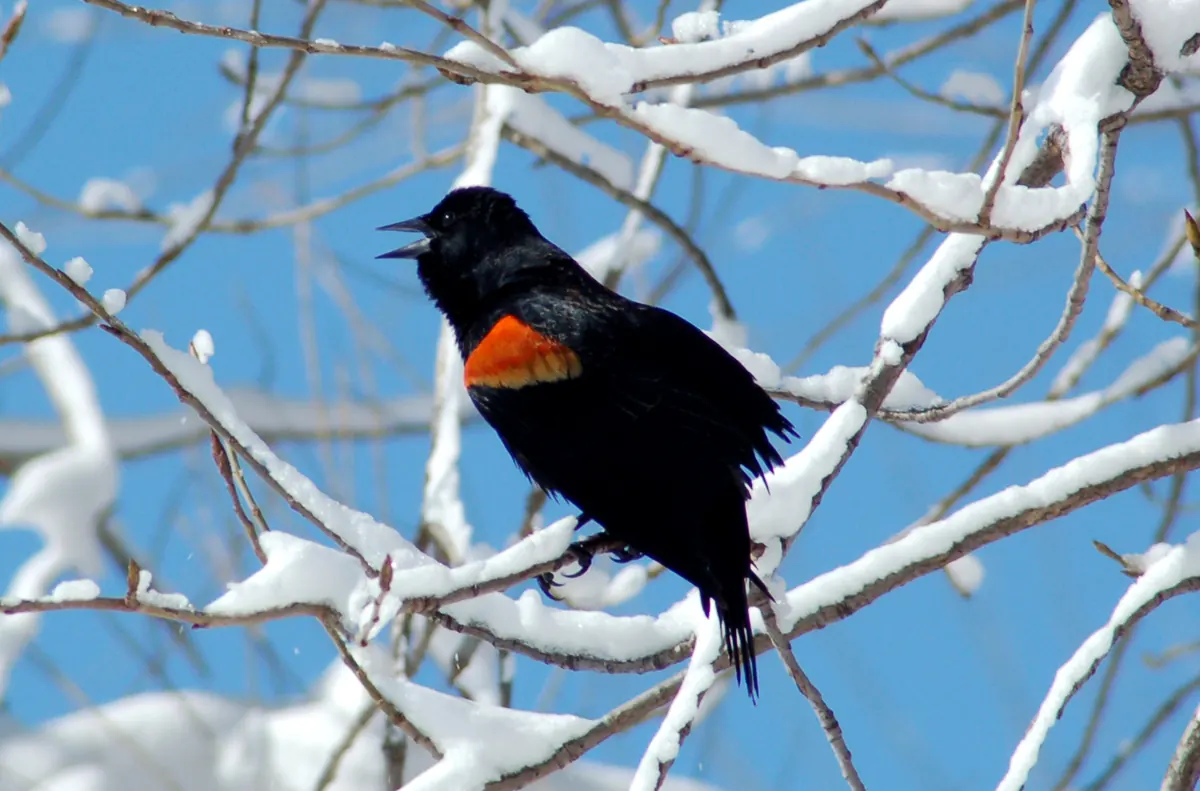
Red-winged blackbirds
First flocks often in the last week of February · Cattail marshes, wet meadows, pond edges and feeders
The species account in the first Massachusetts Breeding Bird Atlas describes the first flocks of the year arriving in the last week of February, made up almost entirely of adult males; the residents do not claim territories until about mid-March, and the females come a few weeks later. Rhode Island’s calendar should be similar. The male’s gurgling song, usually written conk-la-ree, is one of the surest signs that winter is ending.
-
American woodcock
Migration begins in February and early March; sky dances March through May · Brushy fields and young woods: Audubon’s Parker Woodland and Newman refuges, Trustom Pond, the Great Swamp
The woodcock is a plump, short-legged shorebird of the woods, patterned like dead leaves, with high-set eyes that see nearly all the way around and a bill about 2.5 inches long for probing soil for worms. Audubon says woodcock begin leaving their southern wintering grounds in February and early March. The males’ famous display, a nasal peent on the ground followed by a spiraling flight 200 to 300 feet up and a twittering descent, starts in March, so late February is for spotting the first arrivals on a thawed field edge.
-
The Great Backyard Bird Count
Friday, February 12, through Monday, February 15, 2027 · Anywhere: a feeder, a city park, a beach or a refuge
National Audubon lists the 30th count for February 12 to 15, 2027. Audubon runs it together with Birds Canada and Cornell’s ornithology lab. A Rhode Island list from that weekend often mixes winter visitors, such as brant and sea ducks on the bay, with whatever early migrants have arrived. Enter each session as its own checklist.
Keep a first-of-year list on the fridge: the date of the first blackbird song, the first grackle and the first woodcock is a small record worth comparing from year to year.
What are Rhode Island’s mammals doing in February?
Late winter is mating season for several common mammals, and the seal season in Narragansett Bay builds toward its peak.
-
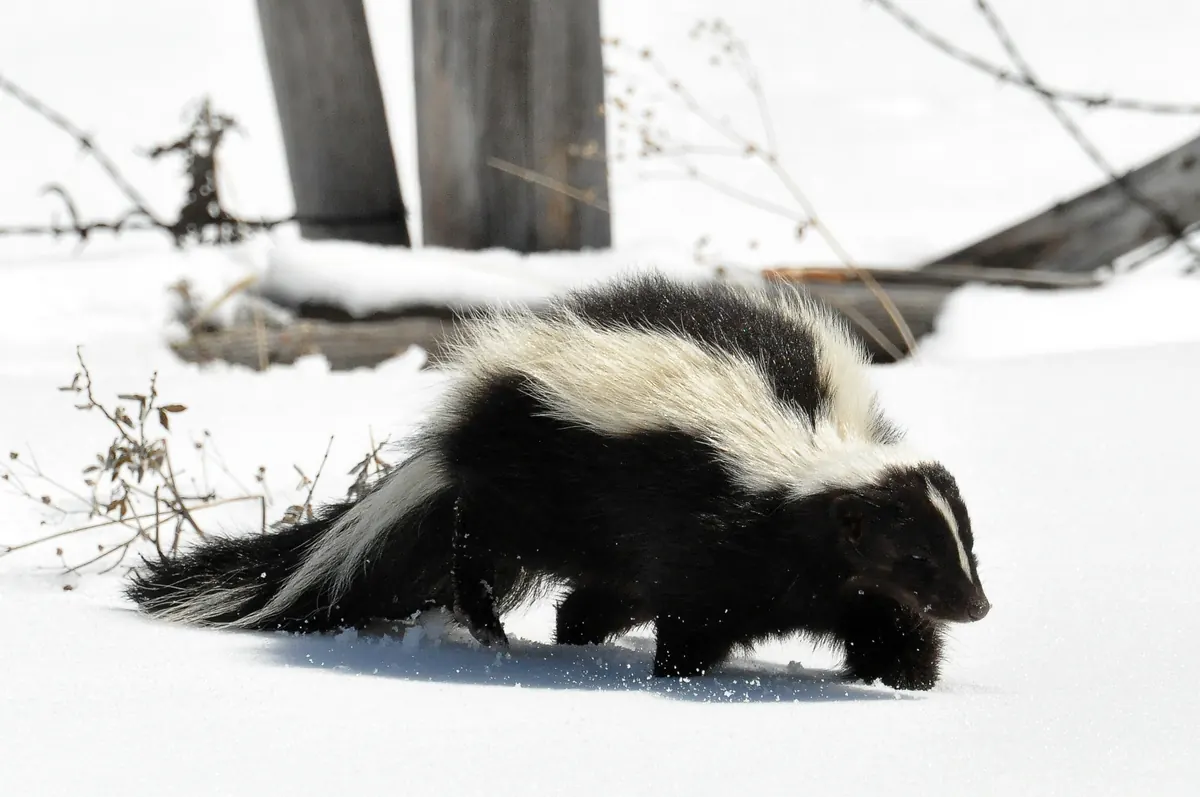
Striped skunks on the move
Breeding usually late February or March · Farmland, suburbs and towns statewide, but not Block Island or the smaller bay islands
Skunks do not truly hibernate, DEM explains; they lie low in a den during the coldest spells and can lose about half their body weight over the winter. Mating usually starts in late February or March: males travel far in search of females and brawl with rivals, and the spraying that follows explains why late-winter nights so often smell of skunk. Young are born in May or early June after a gestation of 60 to 75 days. Skunks often move into old woodchuck burrows or the space under a shed or porch, so close off those gaps before spring.
-
Opossums
Young may be born from late winter onward · Woods, farms and neighborhoods on the mainland
DEM says opossums reached Rhode Island in the 1960s and now live across the mainland, though not on Block Island or Prudence Island. Built for warmer country, they often carry frostbite scars on their tails. Young can be born from late winter on, jelly-bean sized after a 13-day pregnancy, and grow up in the pouch.
-
Harbor seals and gray seals
Numbers climb through February toward a March and early-April peak · Rome Point in North Kingstown, rocks off Rose Island in Newport Harbor, the shores of Block Island
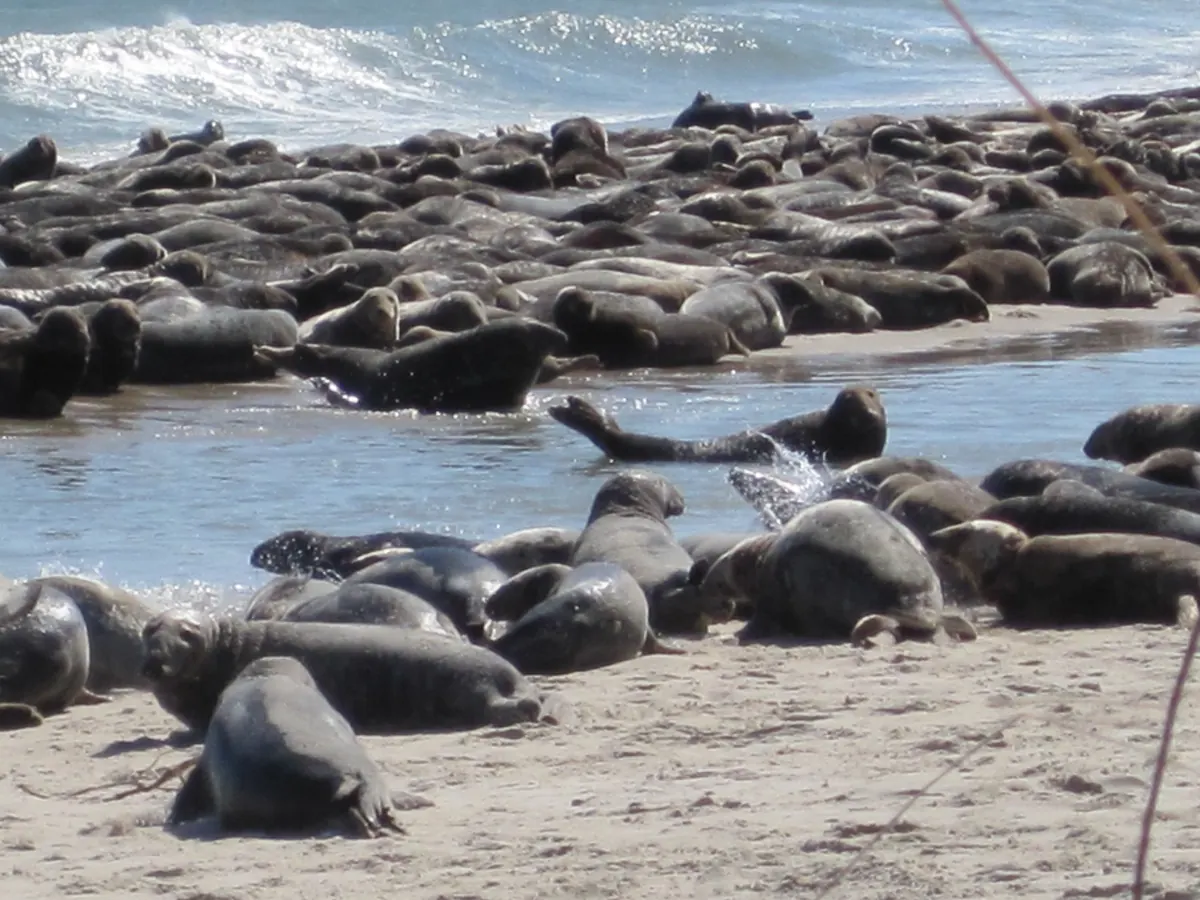
Harbor seals, the state marine mammal, visit Rhode Island only in the colder months. The volunteers behind Rome Point Seals count 50 to 80 animals on the North Kingstown ledges around the turn of the year and often more than 100 between early March and mid-April, so February is the climb in between. Gray seals, much larger with a long, horse-like head, live in the state’s waters all year and are increasing on Block Island, according to Save The Bay. In its 2026 statewide count, volunteers and scientists tallied 590 seals in two hours. Federal law protects seals from harassment: stay at least 50 yards away, keep dogs leashed, and back off if seals lift their heads and stare or start shuffling toward the water.
After a thaw, look on lawns for small cone-shaped holes: DEM notes that skunks dig them while hunting for grubs and other insects.
Is February the snowiest month in Rhode Island, and what might El Niño bring?
At several Rhode Island stations, yes, though only by a little. In NOAA’s 1991–2020 normals, February’s average snowfall matches or tops January’s at the airport in Warwick (10.5 inches against 10.3), at Tiverton (11.3 against 10.9), at North Foster in the western hills (15.6 against 15.5) and especially at Newport Rose by the harbor (9.1 against 5.5). Woonsocket and Kingston still average a bit more snow in January. February is also the shortest month, so it packs that snow into fewer days. Average highs climb into the upper 30s and low 40s, and lows run from about 20 °F in the hills to the mid-20s on the coast.
This winter the tropical Pacific may tip the odds. As of mid-September 2026 (the CPC update of the 10th), Rhode Island’s winter looked set to unfold under a Pacific warm event of the very strong kind, rated over 90 percent likely. An analysis on NOAA’s Climate.gov of past winters by Michelle L’Heureux and Brian Brettschneider finds that El Niño generally means less snow across the northern United States, with interior New England among the clearest examples, and that the stronger events tend to deliver their expected effects more reliably. NOAA’s Northeast El Niño summary adds the coastal side: more nor’easters running up the Eastern Seaboard, and big storms such as the Presidents’ Day storm of February 2003 that happened during El Niño. The Climate.gov authors stress that these are averages and that single winters differ a great deal; whether one February storm brings snow or rain to Providence comes down to its exact track.
NOAA issues its seasonal outlook for winter on October 15 and refreshes it every month; the newest maps, including February to April, are posted with the CPC seasonal outlooks.
| Station | Average high | Average low | Precipitation | Snowfall |
|---|---|---|---|---|
| N Foster 1 E (northwest hills) | 37.8 °F | 19.9 °F | 3.91 in | 15.6 in |
| Woonsocket (Blackstone Valley) | 39.9 °F | 21.1 °F | 3.67 in | 10.7 in |
| Coventry 2 (western Kent County) | 38.5 °F | 20.3 °F | 3.45 in | no normal |
| Providence T F Green Airport (Warwick) | 40.5 °F | 23.5 °F | 3.44 in | 10.5 in |
| Kingston (South Kingstown) | 42.5 °F | 22.0 °F | 3.77 in | 9.9 in |
| Westerly State Airport | 41.2 °F | 25.7 °F | 2.75 in | no normal |
| Tiverton (East Bay) | 41.3 °F | 24.5 °F | 3.84 in | 11.3 in |
| Newport Rose (Newport Harbor) | 40.0 °F | 25.1 °F | 3.57 in | 9.1 in |
Check the local forecast before heading to an exposed shore or a hilltop trail. For gardeners already planning, the Rhode Island frost dates show when the final spring freeze usually comes near you.
How much daylight does Rhode Island gain in February?
A little over an hour. In Providence the sunrise moves from 6:58 a.m. on the 1st to 6:22 on the 28th, and sunset from 5:01 p.m. to 5:35, so the evening gains 34 minutes and the morning 36. Across the state the day stretches by 68 to 70 minutes over the month, and the pace quickens daily until the equinox in March.
-
Groundhog Day and the real middle of winter
Tuesday, February 2; midpoint February 3 and 4 · Everywhere
Groundhog Day falls a little early for the true halfway point. The astronomical midpoint, halfway from solstice to equinox, arrives overnight from the 3rd to the 4th.
| City | Feb 1 | Feb 28 | Gained | Per day |
|---|---|---|---|---|
| Woonsocket | 10 h 02 m | 11 h 12 m | 70 min | 2.6 min |
| Providence | 10 h 03 m | 11 h 13 m | 70 min | 2.6 min |
| Warwick | 10 h 03 m | 11 h 13 m | 70 min | 2.6 min |
| Coventry | 10 h 03 m | 11 h 13 m | 70 min | 2.6 min |
| Newport | 10 h 04 m | 11 h 12 m | 68 min | 2.5 min |
| Westerly | 10 h 04 m | 11 h 13 m | 69 min | 2.6 min |
| New Shoreham | 10 h 06 m | 11 h 14 m | 68 min | 2.5 min |
For times at your own address, including twilight, try the daylight calculator.
What can you see in the Rhode Island night sky in February 2027?
Two planets reach opposition within eight days of each other this month, Mercury puts on its finest dusk show of the season, and the full moon of February 20 rises during a barely visible eclipse. Evenings from about the 2nd to the 11th are free of moonlight, thanks to the new moon of the 6th. Times are Eastern Standard Time.
-
Mercury low in the west
Late January to about February 10; farthest from the sun February 3 · Low in the west-southwest, 30 to 45 minutes after sunset
Its widest angle from the sun, roughly 18 degrees, comes before dawn on the 3rd, making the 2nd and 3rd the evenings to try, from a Charlestown or Narragansett beach with an open western view. On Sunday the 7th a day-old crescent moon keeps it company in the twilight.
-
Jupiter at opposition
Wednesday, February 10, 7:21 p.m. · Rising in the east at sunset, high in the south around midnight, in Leo
Earth passes between the sun and Jupiter, about 405 million miles from the giant planet, which is up from dusk to dawn and at its yearly brightest. Brace binoculars on a fence post to pick out its bigger moons as pinpoints beside it, then check the next night to see them rearranged.
-
Mars at opposition
Friday, February 19; closest to Earth February 20 · In the east after dusk, in Leo, not far from Jupiter and the star Regulus
Mars meets us this time from the outer stretch of its path around the sun, which keeps this a modest opposition. Its closest distance is roughly 63 million miles and its disk only 13.8 arcseconds wide, so a small telescope shows a little orange disk with few markings. To the eye alone it is still a bright, unblinking orange-red light, and the next approach as close as this one is in 2029.
-
The Snow Moon and a faint penumbral eclipse
Saturday, February 20; full at 6:23 p.m. · Rising in the east-northeast around sunset
That evening the moon crosses only the faint fringe of Earth’s shadow, the penumbra. The eclipse begins at 4:12 p.m., before moonrise, peaks at 6:13 and ends at 8:13. Here the moon rises close to mid-eclipse, hugging the horizon in twilight, and at most a faint gray shading may show on one edge; many people will not notice anything at all. Almanacs disagree on whether to call it a supermoon. Once it is dark, the moon, Jupiter, the star Regulus and Mars make a loose cluster in Leo. A night earlier, the moon, just short of full, glides very near Jupiter.
-
Venus before dawn, Saturn after dusk
All month · Venus low in the southeast before sunrise; Saturn low in the west-southwest at dusk
Venus is the bright light low in the southeast at dawn, and Saturn slips into the evening twilight. February 6 brings an annular solar eclipse for South America and Africa only, with nothing to see from Rhode Island.
| Phase | Date | Time |
|---|---|---|
| New moon | Saturday, Feb 6 | 10:56 a.m. EST |
| First quarter | Sunday, Feb 14 | 2:58 a.m. EST |
| Full moon, the Snow Moon (penumbral eclipse that evening) | Saturday, Feb 20 | 6:23 p.m. EST |
| Last quarter | Sunday, Feb 28 | 12:16 a.m. EST |
Before a planet night, check cloud cover across the state, and the moon phase calendar lists when the moon comes up each night. Solar activity is declining from its recent maximum, yet a strong geomagnetic storm is still possible; watch NOAA’s Space Weather Prediction Center for aurora alerts.
What can Rhode Island families do outdoors in February?
- Bird count weekend, February 12 to 15. Give children a clipboard and a window. Fifteen minutes or more of watching makes a checklist, and a family can send in as many as it likes over the four days.
- An owl prowl. In February 2026 the Audubon Society of Rhode Island led a Snow Moon owl walk at its Powder Mill Ledges headquarters in Smithfield, a family owl prowl and an afternoon of owls and hot chocolate at its Bristol nature center, and a winter tracks and signs walk in North Smithfield. The 2027 schedule should appear on Audubon’s calendar in winter.
- A seal cruise. Save The Bay’s one-hour seal tours and two-hour seal and lighthouse trips leave Perrotti Park in Newport from November through April. Dress for wind on the water.
- Sap watch. Hang a thermometer outside and keep a chart of highs and lows; when nights below freezing alternate with days above, the maples are running. Maple days at the sugarhouses mostly come in early March.
- Snow Moon and planets, Saturday, February 20. Watch the moon rise from a beach with an open view east, then find Jupiter and orange Mars nearby once it is dark.
- After a big snow. Stand a ruler in a spot away from drifts, write the depth in the journal, and go looking for tracks the next morning.
- Season-long projects. FeederWatch tallies continue to the end of April, and iNaturalist welcomes a photo of a skunk cabbage hood as much as a hawk.
Every state and month is linked from the nature guides, and the Naturalist’s Field Journal holds a season of first dates in one place. Look back at January in Rhode Island for the midwinter waterfowl count and owl courtship.
Safety notes for February in Rhode Island
- Hunting seasons still open. Mainland archery deer season closed January 31, but DEM’s 2026–27 guide keeps a good deal open in February: Block Island deer (archery, muzzleloader or shotgun) on February 1 to 5 and 8 to 12; a late Canada goose season through February 13, limited to Providence, Bristol and Kent counties and part of Washington County; crow on Fridays, Saturdays and Sundays until April 3; and cottontail rabbit, gray and red squirrel, raccoon, and pheasant, quail and woodchuck on state land through February 28, as well as coyote on state land.
- Blaze orange through the end of the month. On state management areas, cooperative units and designated undeveloped state parks, every visitor, hunter or not, must carry 200 square inches of blaze orange above the waist, seen from any angle, up to and including February 28, or 500 square inches whenever a shotgun deer season is open. Fluorescent camouflage is not enough. At Arcadia, Big River and the Great Swamp, that means a bright hat and vest for people and something orange for dogs.
- Traps. Beaver and coyote trapping on state land continues through February 28, and beaver trapping on private land with a special permit until March 14. Keep dogs close on management areas, especially near streams and beaver ponds.
- Ice. DEM does not consider ice safe until it is at least 6 inches thick across the whole pond, which usually takes five to seven straight days with temperatures in the low 20s; springs, currents and February thaws weaken it quickly. DEM does not check town ponds, so ask your town. The state parks advise never going out alone, never using ice as a shortcut and never going after a pet or a toy; if someone falls through, call 911 rather than following them out.
- Nor’easters and blizzards. February storms can bring deep snow, whiteouts, gusts of 58 to 74 mph and coastal flooding, as in 1978 and 2026. Stay off the roads during the worst of a storm, keep a car kit and charged phones, and never walk on sea walls or rocks in storm surf.
- Cold water. Narragansett Bay and the ocean are near their coldest. A fall from wet or icy rocks at Beavertail or Brenton Point can be deadly within minutes; keep well back from the waterline.
Sources
- NOAA NCEI State Climate Extremes Committee: decision on the 24-hour state snowfall record for Rhode Island (March 31, 2026; Blizzard of 2026 and Blizzard of ’78)
- National Weather Service Boston/Norton: Blizzard of 1978
- NOAA NCEI: 1991–2020 monthly normals for Rhode Island stations (data API, February values)
- NOAA NCEI: U.S. Climate Normals 1991–2020
- Climate Prediction Center: ENSO diagnostic discussion, September 10, 2026
- Climate Prediction Center: 90-day (seasonal) outlooks
- NOAA Climate.gov: S(no)w pain, S(no)w gain, how does El Niño affect snowfall over North America? (L’Heureux and Brettschneider, 2023)
- NOAA and Northeast Regional Climate Center: El Niño impacts and outlook, Northeast region (Drought.gov)
- Audubon Society of Rhode Island: owls on the refuge (nesting season, eggs, incubation)
- Mass Audubon, Massachusetts Breeding Bird Atlas 1: great horned owl (egg dates, nest sites)
- National Audubon Society: why great horned owls start nesting in the winter
- Rhode Island DEM and Rural Lands Coalition: maple syrup brochure (sap season, red and Norway maple)
- Chepachet Farms and Sugar House, Glocester
- Visit Rhode Island: Spring Hill Sugar House, Richmond
- Coggeshall Farm Museum: Maple Sugaring Days
- Native Plant Trust Go Botany: skunk cabbage
- Tufts Pollinator Initiative: turning up the heat, strange (and stinky) skunk cabbage (February 2020)
- Rhode Island Wild Plant Society: Maxwell Mays Wildlife Refuge, Coventry
- The Nature Conservancy: Whitehead Preserve at Dundery Brook, Little Compton
- Native Plant Trust Go Botany: red maple
- Audubon Society of Rhode Island: Rhode Island birds on the brink, climate change and migration timing
- Mass Audubon, Massachusetts Breeding Bird Atlas 1: red-winged blackbird (spring arrival)
- Audubon Society of Rhode Island: the amazing American woodcock
- National Audubon Society: Great Backyard Bird Count (February 12–15, 2027)
- Great Backyard Bird Count
- Rhode Island DEM Division of Fish and Wildlife: striped skunk fact sheet
- Rhode Island DEM Division of Fish and Wildlife: Virginia opossum fact sheet
- Rome Point Seals: when are seals at Rome Point?
- Save The Bay: annual seal count results, 590 seals seen across Rhode Island waters (March 23, 2026)
- Save The Bay: seal watch tours (Newport, November to April)
- U.S. Naval Observatory: moon phases, December 2026 to 2027
- U.S. Naval Observatory: Earth’s seasons and apsides, 2027
- Fred Espenak, Sky Event Almanac 2027 (oppositions, Mercury, Moon–planet pairings)
- NASA Goddard: lunar eclipses 2021–2030 (penumbral eclipse of February 20, 2027)
- NASA Goddard: solar eclipses 2021–2030 (annular eclipse of February 6, 2027)
- EarthSky: Jupiter at opposition
- Sea and Sky: astronomy calendar of celestial events, 2027
- NOAA Space Weather Prediction Center: aurora 30-minute forecast
- Audubon Society of Rhode Island: February 2026 program listings (owl prowls, bird count walk, tracks walk, vacation week)
- Audubon Society of Rhode Island: programs, tours and events calendar
- Rhode Island DEM: 2026–2027 hunting season summary (eRegulations)
- Rhode Island DEM: 2026–2027 hunting general information, fluorescent orange requirements (eRegulations)
- Rhode Island DEM: 2026–2027 Rhode Island Hunting and Trapping Guide (PDF; late goose area, trapping seasons)
- Rhode Island State Parks: winter safety tips (via Internet Archive)
- Rhode Island DEM via RI.gov: ice safety guidance (6-inch rule; via Internet Archive)
- Project FeederWatch: how to participate
- iNaturalist
- Photos via Wikimedia Commons; licenses and photographers are credited under each picture
