What to look for in nature in Rhode Island this January
January sits in the middle of meteorological winter, and in Rhode Island it is the month of the lowest average nights: below 20 °F in the northwest hills, by NOAA’s normals. It is also a month crowded with birds. On a single January day, state biologists and volunteers counted more than 33,000 ducks, geese and swans around Narragansett Bay, the salt ponds and a few inland ponds. Great horned owls call back and forth at dusk, coyotes and red foxes are pairing up, and harbor seals crowd the ledges below Rome Point at low tide. The afternoons stretch, too: Providence’s sunset moves from 4:25 p.m. on New Year’s Day to 4:59 on the 31st. What follows is the month, place by place.
Other months in Rhode Island: October, November, December, February.
Start here
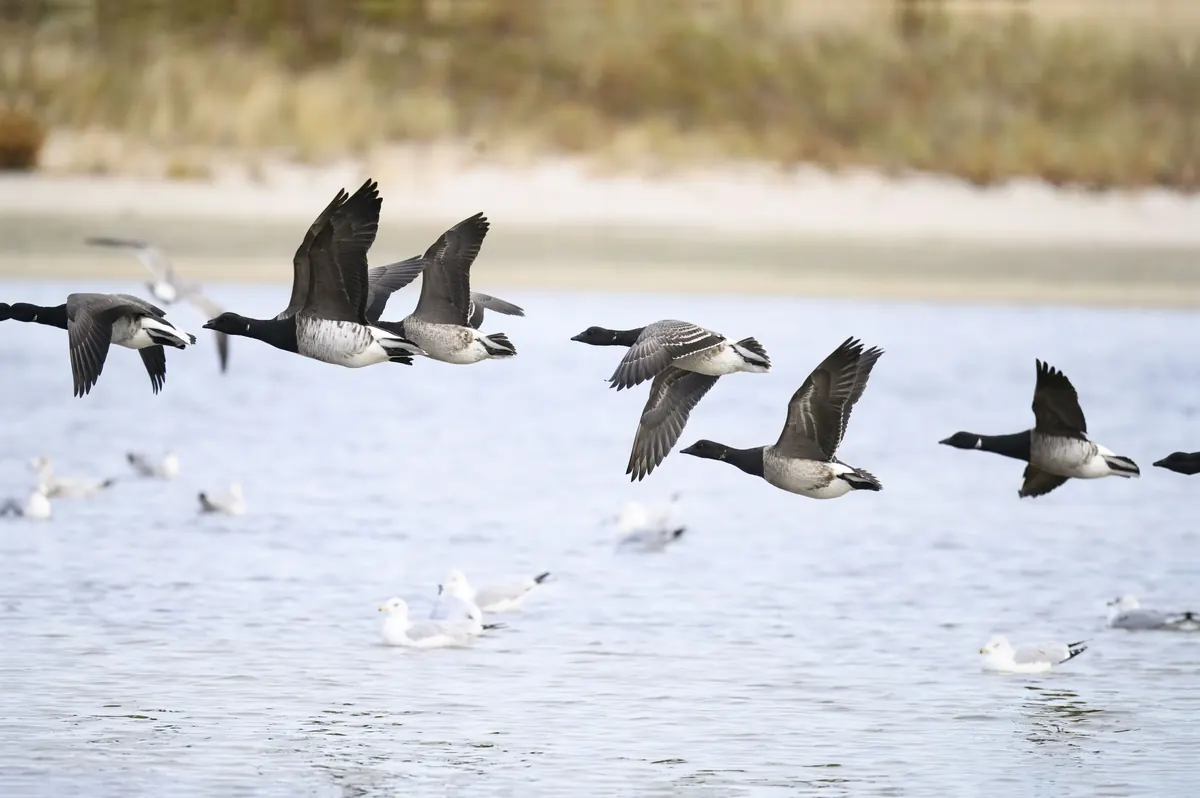
- Scan the bay for brant and scaup. Choose a calm, bright morning and a shoreline park on the upper bay or in the East Bay. Small dark geese with a white neck mark are brant; big floating rafts of black-and-white diving ducks are mostly scaup. Tally what you find and add it to eBird.
- Listen for owls at dusk. Stand still at the edge of a field or a wooded park just after sunset. The deep, rhythmic hoots of great horned owls carry a long way, and in January the male and female of a pair often trade calls, his voice the deeper of the two.
- Rise early for the Quadrantids. The Quadrantid meteors are at their best overnight between Sunday, January 3, and Monday, January 4. Moonlight barely interferes, and the dark hours just before Monday’s dawn give Rhode Island its best chance.
January in the Naturalist’s Field Journal is a month of patient pages. Every duck you sort out on the bay belongs in “birds I have seen”; a coyote’s straight line of prints across a snowy field goes on “tracks to know”; a shagbark hickory or black birch you can find again in May earns “a tree through the seasons”; owl duets and coyote yips fill “a map of sounds”; and the daily field log is the place to write down the date of the first sunset later than 5 p.m.
Regions used below: Northern Rhode Island and the Blackstone Valley; Providence and the upper bay; The western hills (Foster, Scituate, Coventry); South County and the salt ponds; Newport, Aquidneck Island and the East Bay; Block Island.
Where do ducks and geese spend the winter in Rhode Island?
Narragansett Bay seldom freezes over, so it gives ducks and geese a place to ride out the New England winter. Every January the Rhode Island Division of Fish and Wildlife holds a one-day midwinter waterfowl count at 140 fixed points spread around the entire bay, several coastal salt ponds, part of the south shore and some inland ponds. Small teams scan from each point between 7:30 a.m. and 4 p.m. with binoculars and spotting scopes. The count day is picked from early January; in 2026 it was January 8, and the total of 33,480 birds of 27 species was the highest the survey has ever recorded, the agency reported.
-
Brant on the upper bay
All January; busiest around low tide · Shallow coves and flats of the upper bay and the Providence River
Brant are compact sea geese with a black head and neck, a thin white collar and pale, barred flanks. They breed in the high Arctic and come down the Atlantic shore for the cold months. The 2026 count found 3,690 of them, and all but 41 were inside the bay rather than on the outer coast. A shifting flock keeps up a soft, rolling murmur of calls.
-
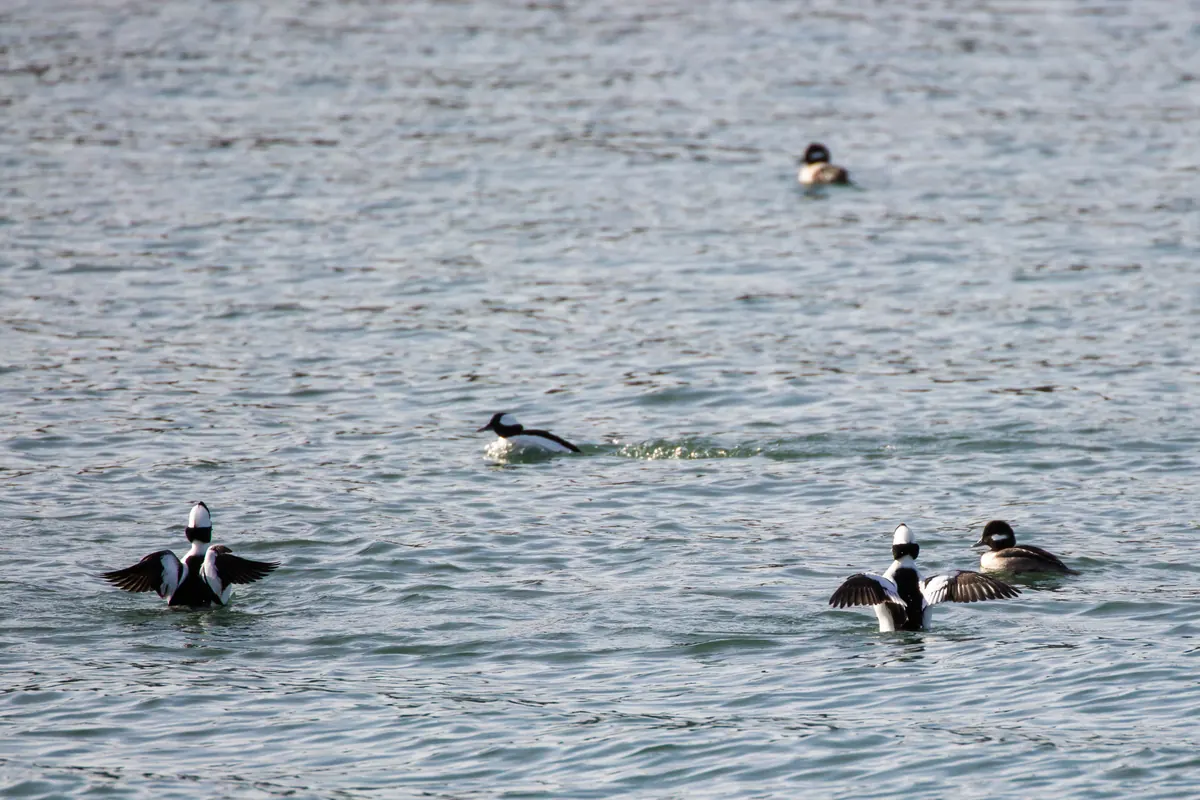
Scaup, bufflehead and goldeneye
All winter; rafts drift with tide and wind · Open water of the bay and its coves; the larger salt ponds; big inland ponds while they stay open
Diving ducks were the biggest group on the 2026 count, 14,427 birds. Scaup led with 5,421, mostly in large rafts on the bay. Bufflehead, tiny ducks whose males wear a white wedge on a dark, glossy head, numbered 3,047, and common goldeneye, whose wings whistle in flight, 1,853. Over the long run the trends diverge: DEM’s analysis of counts back to 2004 finds significant declines in scaup and goldeneye, and among dabbling ducks in the American black duck, a salt marsh bird the agency treats as a measure of habitat quality.
-
Eiders, scoters and long-tailed ducks
December through March; easiest on calm days · Beavertail, Jamestown; Brenton Point and Ocean Drive, Newport; Sachuest Point, Middletown; Point Judith
Sea ducks dive along the rocky shore for mussels and crabs. In 2026 observers counted 2,873 common eiders, the heavy, wedge-headed duck of rocky coasts, and 191 long-tailed ducks, more than twice the previous winter’s figure. According to the same report, black scoters have risen strongly in the bay over two decades, and long-tailed ducks faster still. In winter a long-tailed drake is mostly white, with a dark cheek patch and the slender tail that names it.
| Species | Statewide count | Narragansett Bay | Coast and inland |
|---|---|---|---|
| Canada goose | 6,507 | 5,244 | 1,263 |
| Scaup | 5,421 | 3,776 | 1,645 |
| Brant | 3,690 | 3,649 | 41 |
| Bufflehead | 3,047 | 2,083 | 964 |
| Common eider | 2,873 | about evenly split | about evenly split |
| Red-breasted merganser | 2,278 | 1,143 | 1,135 |
| Common goldeneye | 1,853 | 1,629 | 224 |
| Mallard | 1,149 | 863 | 286 |
| American black duck | 901 | 563 | 338 |
| Mute swan | 610 | 291 | 319 |
| American wigeon | 436 | 175 | 261 |
| Long-tailed duck | 191 | 81 | 110 |
Sachuest’s harlequin ducks are on the November page, and the bald eagles that hunt these flocks along the Seekonk River and inland reservoirs are on the December page. Both stay through January.
When do great horned owls start nesting in Rhode Island?
Owls keep an early calendar. The Audubon Society of Rhode Island notes that the state’s owls set up territories and find mates from late January through March. National Audubon gives the reason: the young need a long apprenticeship, and owlets that hatch in late winter have spring and summer to learn to hunt before their first cold season.
-
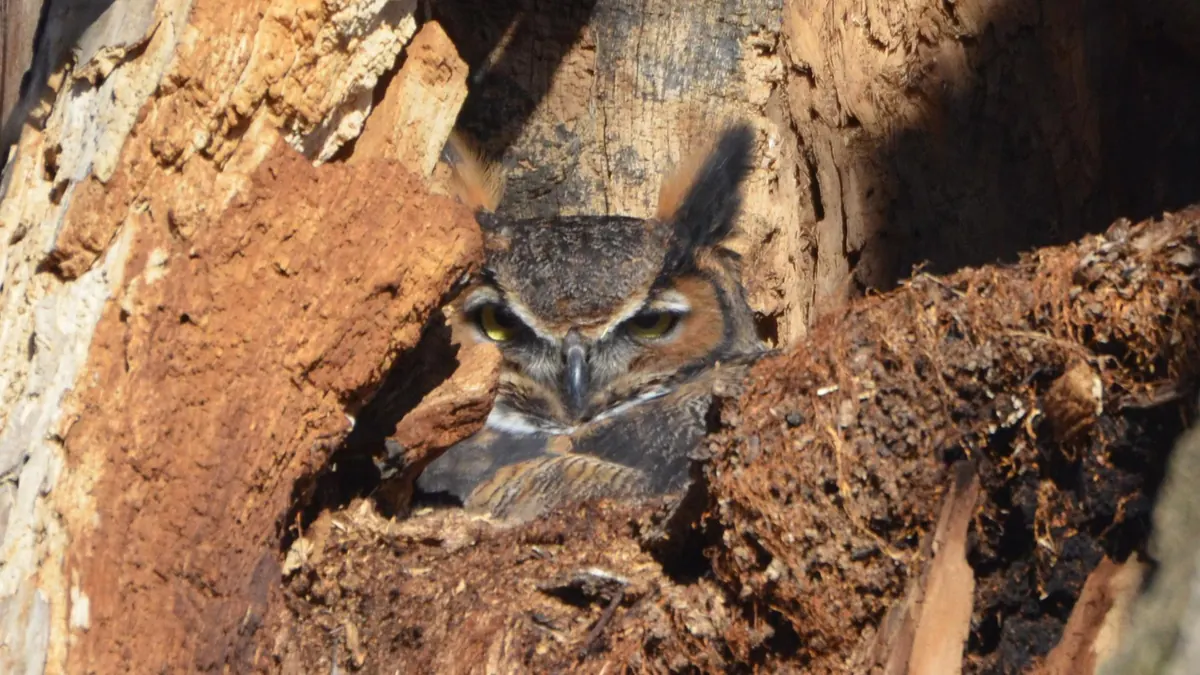
Great horned owls: duets at dusk
Calling builds through January; courtship and nest choice from late January · Almost anywhere with big trees, from the western forests to city parks, cemeteries and golf courses
Audubon’s refuge staff say the familiar hoo-h’HOO-hoo-hoo can be heard in nearly every habitat in Rhode Island, cities included. Pairs call to each other around dusk and again before dawn. Instead of building, a pair typically borrows: an old stick nest high in a bare tree, or the hollow top of a snapped trunk. Once eggs are laid, the female incubates for roughly a month and her mate hunts for both, so a male heard hooting late in the month may be supplying a female already sitting.
If you find a nest, watch from a distance, keep the visit short and keep the place to yourself; a female flushed off her eggs leaves them to chill.
-
Barred owls and screech owls
All winter; most vocal on still nights · Barred owls: wet woods and swamps such as the Great Swamp, Arcadia and Fisherville Brook. Screech owls: older neighborhoods, orchards and woodlots
Barred owls are the chattiest of the state’s three common owls, Audubon says, and sometimes call by day with a rich run of hoots and cackles. The little eastern screech owl never really screeches; listen instead for a quavering whinny that falls in pitch like a tiny horse, or a long, level trill.
Owl calls make an easy first entry on the journal’s sound map: mark where you stood, the time, and the direction the hoots came from.
Will snowy owls and winter finches come to Rhode Island this winter?
A few northern birds come south only in winters when food runs short at home. January may or may not bring them, but two groups are worth watching for.
-
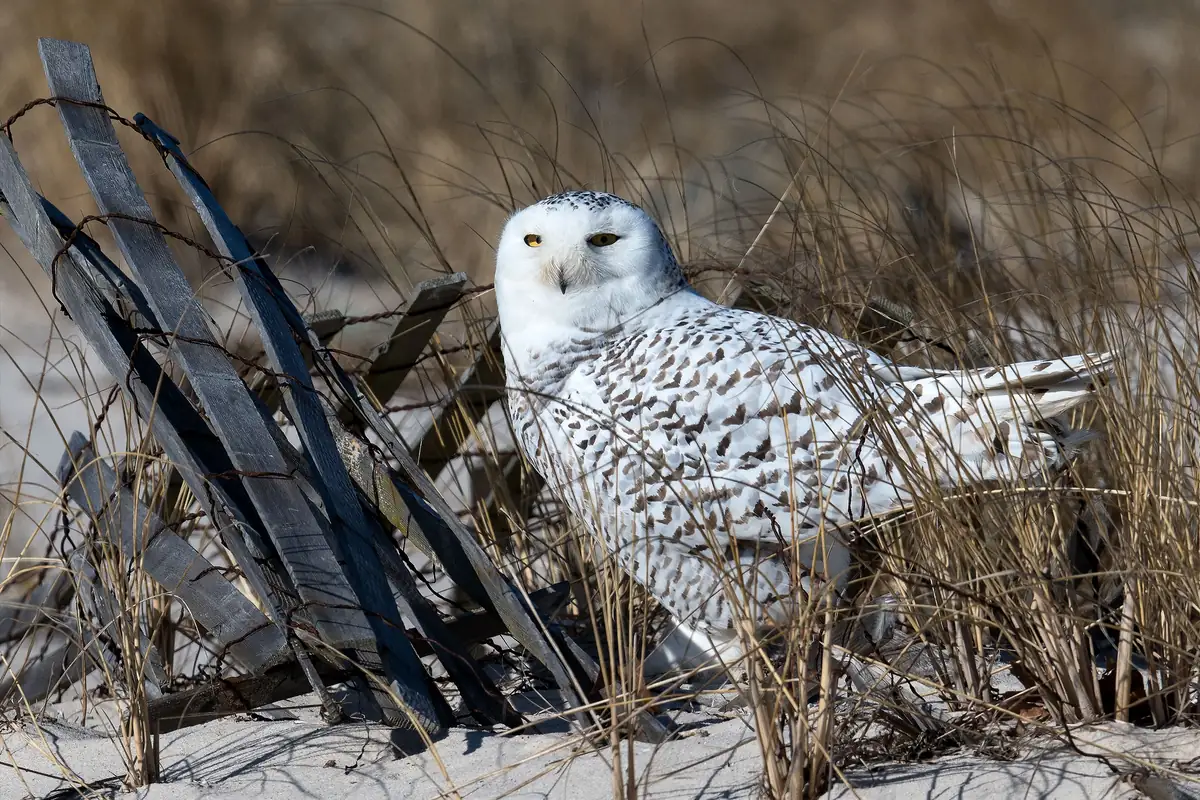
Snowy owls on the beaches
Late fall to early spring, in years when they come · Open beaches, dunes, marsh edges and breakwaters: Sachuest Point, Napatree, the South County barrier beaches
The Audubon Society of Rhode Island says a few snowy owls are found in the state in a typical year, usually low on a dune, a rock or a fence post by the shore, occasionally on a city rooftop. Many are young birds, worn out and hungry after a long trip. Audubon asks watchers to keep 200 to 300 feet away or more, to use binoculars instead of creeping closer for a phone picture, never to encircle an owl, to keep visits brief, not to offer food, and not to geotag photos posted online.
-
Pine siskins and red crossbills in the pines
All winter; mostly in the woods rather than at feeders · White pine and spruce stands: George Washington Management Area, Arcadia, the Big River woods
Released in late September, the Finch Research Network’s seasonal outlook describes very good cone crops on eastern white pine, with fair to good crops on hemlock and spruce across the northeastern forests. That points to plenty of finches in the woods but fewer at feeders. Pine siskins, small, streaky and edged with yellow in wing and tail, are expected in good numbers in the Northeast, and type 12 is predicted to be the red crossbill call type heard most in the northeastern states. Listen for hard, repeated kip notes overhead and watch for cone scales drifting down as the birds pry them apart. Evening grosbeaks have a fair chance of a small flight toward Massachusetts; pine grosbeaks are not expected, and redpolls at most in a small flight.
Keep feeders clean and stocked with black-oil sunflower; if siskins arrive, scrub the feeders often, since crowded flocks spread disease.
How can you start the new year outdoors in Rhode Island?
Three early-January traditions get people outside: a New Year’s Day walk, the final count days for Audubon’s winter census, and a drop-off that turns holiday trees into trout habitat.
-
First Day Hike
Friday, January 1, 2027 · A state park or campground chosen by DEM each year
In recent years the state has marked January 1 with a short public walk, Rhode Island’s share of the First Day Hikes promoted nationwide by America’s State Parks. For 2026 DEM’s news release described a self-guided loop of roughly a mile on stroller-friendly paths at Fishermen’s Memorial State Campground in Narragansett, and the site changes from year to year. The 2027 location had not been posted in early October; DEM usually announces it in late December.
-
Final days of the Christmas Bird Count
Through Tuesday, January 5, 2027 · Rhode Island’s count circles, from Providence to Block Island
Audubon’s 127th census window closes on January 5, and each circle counts on one day within it. A circle whose day falls in early January still wants field volunteers and feeder watchers, so look on Audubon’s circle map for any Rhode Island count not yet held.
-
Trees for Trout
Early January; check DEM · A drop-off site announced by DEM
DEM and Rhode Island Trout Unlimited gather real, undecorated Christmas trees and fix them along eroding stream banks, where they slow the water, catch silt and shelter young brook trout. Whole conifers only, with every light, strand of tinsel and stand removed. Watch DEM’s announcements in late December for the 2027 drop-off date.
Whatever you choose, open a new page in the field journal: date, place, weather and the first bird of the year.
What are Rhode Island’s mammals doing in January?
For some of the state’s mammals, deep winter is courtship season. Others simply wait for spring, and the bay’s seals gather on the rocks.
-
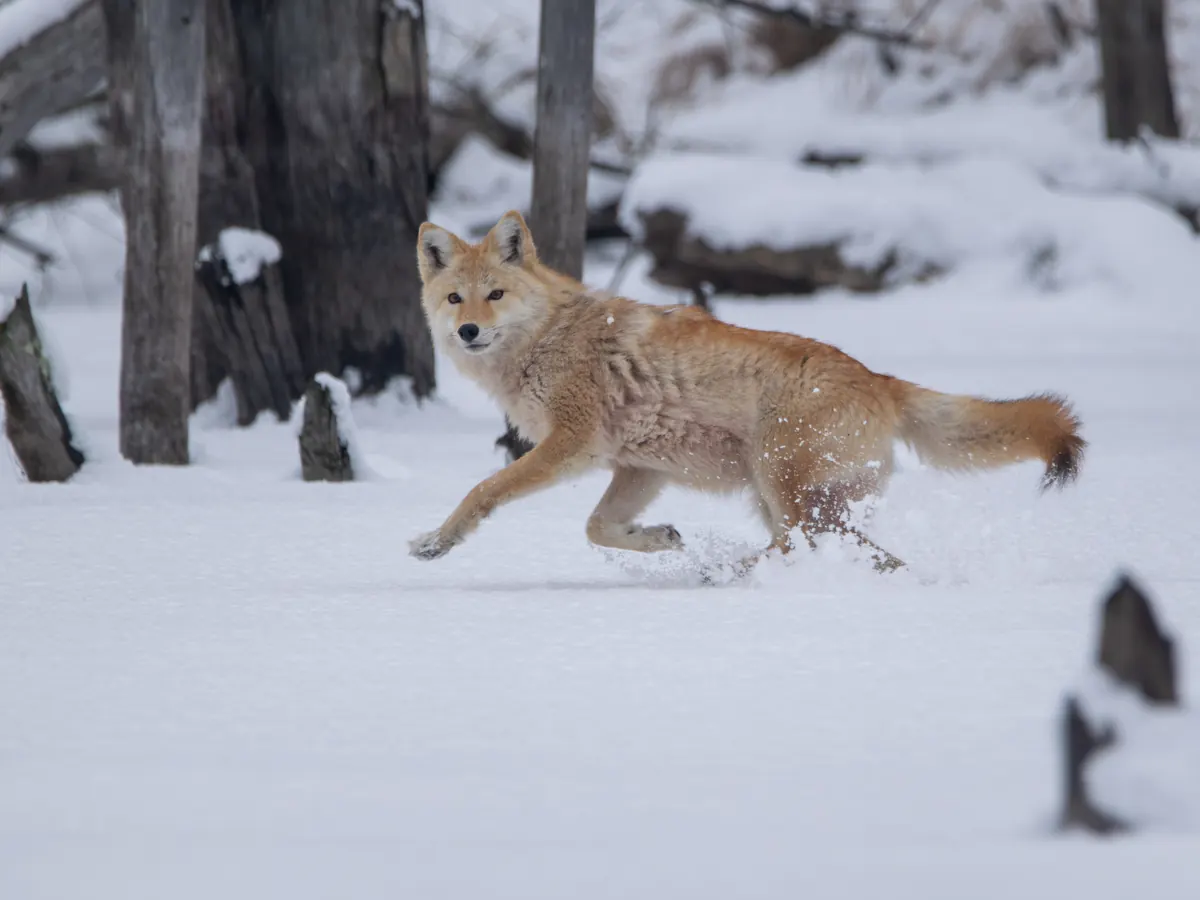
Coyotes: the howling season
Mating December through March; pups in spring · Everywhere in the state except Block Island
DEM biologists call the eastern coyote a fairly recent resident, first recorded here in the 1960s and now found everywhere but Block Island. Rhode Island’s mating season runs from December through March, and pups follow about two months after mating. A pack is a family: the breeding pair plus last year’s young and sometimes older offspring. Howls keep the group in touch and do not mean a kill, and coyotes use a wider range of calls than any other North American mammal. A territory covers 5 to 25 square miles, so the night chorus you hear is probably the same few animals each time.
Never feed coyotes, and lock up garbage, compost and pet food; animals that link people with food lose their caution.
-
Red and gray foxes pairing up
Red fox mating January to April; gray fox December to March · Field edges, farms, suburbs and woodland
Both foxes live here. The red fox is slender and long-legged, with black feet and a white tail tip; the gray fox is stockier and grizzled, with rusty sides and a black tail tip. DEM says foxes form lasting pairs and use dens mainly for mating and raising pups, often a reworked woodchuck burrow or the space under a shed. Gray foxes mostly bark. Red foxes yap, yip, howl and scream, and DEM notes that a red fox screaming in the night is often wrongly blamed on a fisher.
-
Harbor seals at Rome Point
Numbers build from December; most seals near low tide · John H. Chafee Nature Preserve, Rome Point, North Kingstown
A woodland path leads to a stony beach where harbor seals haul out on the ledges toward Fox Island. Romepointseals.org, which has followed the haul-out for years, reports 50 to 80 seals on good days around the turn of the year, with younger seals arriving in early January. The rocks are usually busiest from an hour before low tide at Wickford to an hour after, and calm days beat windy ones. Stay on the beach with binoculars; if heads come up and turn your way, step back.
Fresh snow turns all of this into a record. A trotting coyote lays its prints in a tidy, nearly straight line; sketch a few steps of any trail you find in the journal.
How can you identify Rhode Island trees in winter?
With the leaves down, bark, buds and twigs carry the clues. The Native Plant Trust’s Go Botany lists winter characters for New England trees; these four are easy to learn on a January walk.
-
Red maple
All winter; buds swell red before spring · Swamps, stream sides and dry ridges statewide
Look for reddish twigs and red buds, each wrapped in several shingle-like scales, set in opposite pairs. Go Botany notes that the name fits all year: red buds in spring, red leaf stalks in summer, red leaves in fall. Young bark is smooth and pale gray; old trunks turn ridged and plated.
-
American beech
All winter; papery leaves hang on · Rich woods in Arcadia, George Washington Management Area and Lincoln Woods
No other big tree here has such smooth, light gray bark. Beech also holds its toothed, golden-brown leaves very late into winter, so a stand of young beech rattles in a January wind.
-
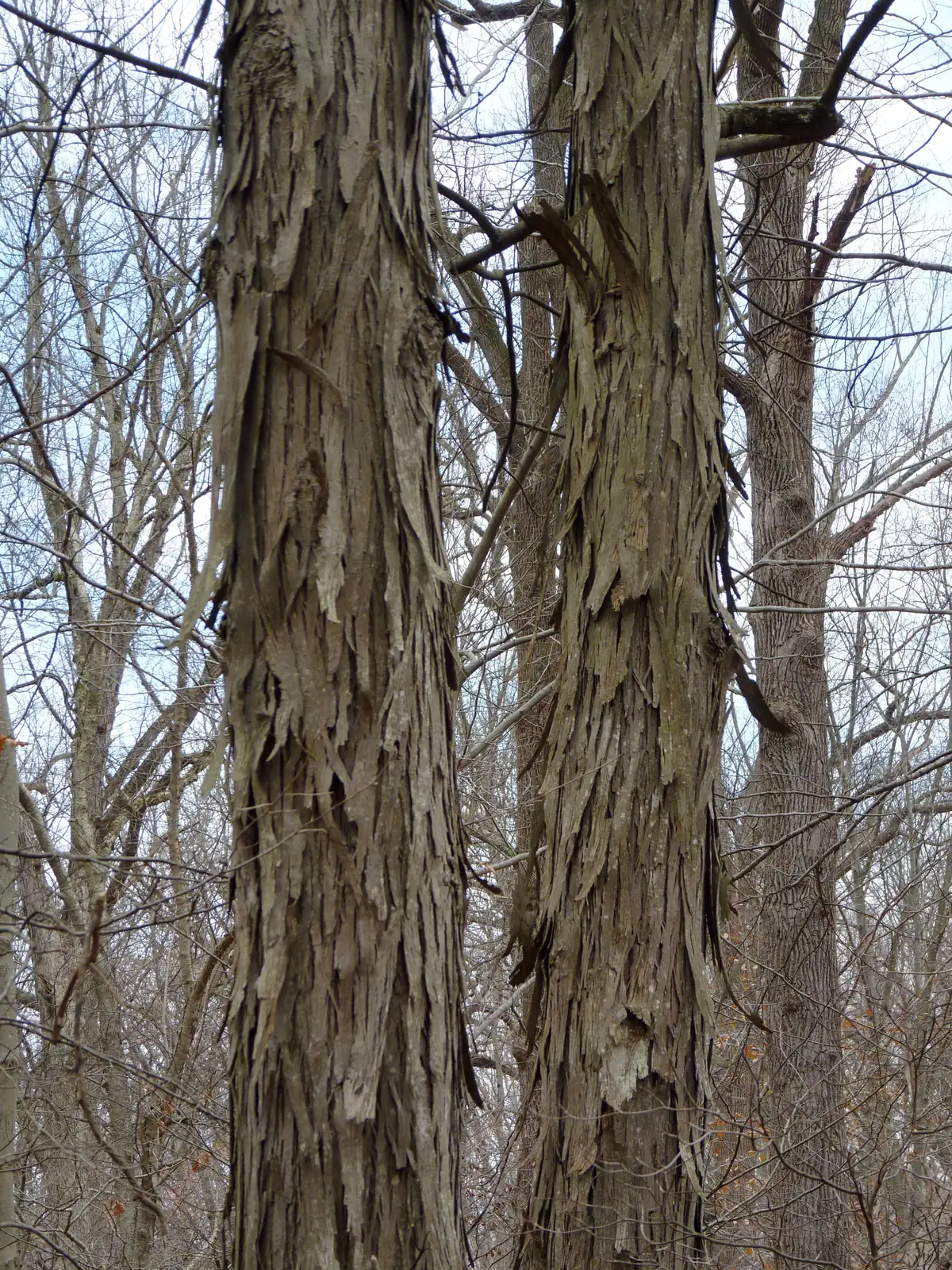
Shagbark hickory
All year · Dry upland woods, old farm edges and stone walls
The trunk gives it away: long gray plates of bark curl loose at both ends. Go Botany adds that the wood burns long and steady and gives hickory smoke its flavor. Buds alternate along stout twigs, with a terminal bud at the tip.
-
Black birch
All year · Recently cut woods and rocky slopes
Scratch a twig and sniff: it smells of wintergreen, which is why the tree is also called sweet birch, and it was once a source of birch beer. Young bark is dark and glossy, banded with short horizontal marks, much like a cherry’s.
Choose one tree near home, photograph its bark and a twig this month, and return in spring and summer for the journal’s “tree through the seasons” page.
When do Rhode Island sunsets get back to 5 p.m.?
Not quite within January: in Providence it happens on February 1. The afternoons start lengthening at once, but the mornings lag behind: in Providence the sun comes up at 7:13 a.m. from New Year’s Day through January 5, and at 7:12 on the 10th. Sunset moves from 4:25 p.m. on January 1 to 4:40 on the 15th and 4:59 on the 31st, and February 1 brings the first one after 5 o’clock, at 5:01. Across the state the day grows by 47 or 48 minutes over the month, slowly at first and faster each week.
| City | Jan 1 | Jan 31 | Gained | Per day |
|---|---|---|---|---|
| Woonsocket | 9 h 11 m | 9 h 59 m | 48 min | 1.6 min |
| Providence | 9 h 12 m | 10 h 00 m | 48 min | 1.6 min |
| Warwick | 9 h 13 m | 10 h 01 m | 48 min | 1.6 min |
| Coventry | 9 h 13 m | 10 h 01 m | 48 min | 1.6 min |
| Newport | 9 h 14 m | 10 h 02 m | 48 min | 1.6 min |
| Westerly | 9 h 15 m | 10 h 02 m | 47 min | 1.6 min |
| New Shoreham | 9 h 16 m | 10 h 03 m | 47 min | 1.6 min |
For your own address, with twilight times included, open the daylight calculator.
How cold and snowy is January in Rhode Island, and what might El Niño do?
In NOAA’s 1991–2020 normals, January’s average lows are lower than both December’s and February’s at every station in the table, from 18.4 °F at Coventry to 24.5 °F at Westerly’s airport, and average highs run from about 35 to 40 °F. Snow varies most: North Foster in the western hills averages 15.5 inches in January, the airport at Warwick 10.3 and Newport Rose, by the harbor, only 5.5.
Out in the tropical Pacific, conditions point to an unusual winter. The Climate Prediction Center’s mid-September discussion (dated the 10th) rated the odds at more than 90 percent that this fall and winter would see El Niño in its very strong category. What that means for Rhode Island snow is honestly two-sided. An El Niño summary for the Northeast, written by NOAA offices and the regional climate center at Cornell, finds that coastal snow in this part of the country tends to come in heavier when El Niño is underway, with December to February totals near the coast as much as 6 inches greater, because more storms track up the Eastern Seaboard; one study it cites found about two extra classic nor’easters in such winters, and eight of the ten snowstorms ranked as crippling on the regional impact scale happened during El Niño. Yet the same summary shows that in the record El Niño winter of 2015–16, temperatures ran above normal across the whole region and New England ended up with less snow than usual. Each storm’s track decides rain or snow at the coast, so a stormy January need not be a snowy one.
NOAA releases its official December to February outlook on October 15 and refreshes it each month; the current maps are on the CPC seasonal outlook page.
| Station | Average high | Average low | Precipitation | Snowfall |
|---|---|---|---|---|
| N Foster 1 E (northwest hills) | 34.8 °F | 18.5 °F | 4.49 in | 15.5 in |
| Woonsocket (Blackstone Valley) | 37.8 °F | 18.8 °F | 4.37 in | 12.3 in |
| Coventry 2 (western Kent County) | 36.4 °F | 18.4 °F | 4.47 in | no normal |
| Providence T F Green Airport (Warwick) | 38.3 °F | 22.1 °F | 3.96 in | 10.3 in |
| Kingston (South Kingstown) | 40.2 °F | 20.8 °F | 4.24 in | 10.0 in |
| Westerly State Airport | 39.5 °F | 24.5 °F | 3.34 in | no normal |
| Tiverton (East Bay) | 38.5 °F | 23.6 °F | 4.01 in | 10.9 in |
| Newport Rose (Newport Harbor) | 38.6 °F | 23.9 °F | 4.03 in | 5.5 in |
Before a long walk or a drive along the shore, look at the forecast page. The Rhode Island frost dates show how many weeks remain until the last spring freeze at your nearest station.
What is in the Rhode Island night sky in January 2027?
Long nights reward anyone willing to dress warmly. With the new moon on January 7, evenings from about the 3rd through the 12th have no moonlight to wash out faint stars. Times are Eastern Standard Time.
-
Quadrantid meteors
Night of Sunday, January 3, into Monday, January 4 · Anywhere dark; the radiant climbs in the northeast after midnight
This shower’s peak lasts just a few hours, and the 2027 predictions put it late on Sunday evening or shortly after midnight. Its radiant sits low early in the night and rises toward dawn, so the hours before Monday’s sunrise are the best compromise. From a truly dark site, dozens of meteors an hour are possible at the peak; near town, many fewer. Only a slim crescent moon comes up, late in the night. The beaches of Charlestown and Ninigret Park are far darker than anywhere around Providence.
-
Earth at perihelion
Saturday, January 2, 9:33 p.m. · Everywhere
That evening Earth reaches its yearly closest point to the sun, roughly 91.4 million miles. The cold has nothing to do with distance; Earth’s tilt holds the January sun low and the days short.
-
Venus, the morning star
All month; greatest elongation January 3 · Low in the southeast before sunrise
On Sunday, January 3, Venus swings 47 degrees west of the sun, the farthest it gets during this run as a morning planet. It outshines everything in the dawn sky except the moon, and a small telescope shows it half lit.
-
The Wolf Moon, the closest full moon of 2027
Full at 7:17 a.m. Friday, January 22 · Rising in the east-northeast near sunset on the 21st and 22nd
Full phase comes just after sunrise on Friday, with the moon about 222,229 miles away, its nearest full moon of the year and a supermoon by every definition. It looks roundest through Thursday night and is still full-looking when it rises Friday. The next evening, Saturday the 23rd, it rises near Jupiter.
-
Jupiter, Saturn and Mercury
All month · Jupiter in the east in the evening; Saturn low in the southwest after dusk; Mercury low in the west-southwest late in the month
Jupiter brightens all month ahead of its February 10 opposition. Saturn slips lower in the southwest each week. In the final days of January, Mercury appears low in evening twilight, heading for its greatest eastern elongation on February 3.
-
Public telescope nights
Fridays, weather permitting · Frosty Drew Observatory, Ninigret Park, Charlestown
Frosty Drew opens its observatory on Friday evenings for Stargazing Nights. Its calendar ran only to early December when this page was written, so confirm January dates and weather closures before driving down.
| Phase | Date | Time |
|---|---|---|
| New moon | Thursday, Jan 7 | 3:24 p.m. EST |
| First quarter | Friday, Jan 15 | 3:34 p.m. EST |
| Full moon, the Wolf Moon (a supermoon) | Friday, Jan 22 | 7:17 a.m. EST |
| Last quarter | Friday, Jan 29 | 5:55 a.m. EST |
Check current cloud cover before a meteor watch, and look up local moonrise times with the moon phase calendar.
What can Rhode Island families do outdoors in January?
- Friday, January 1: a New Year’s walk. The state’s First Day Hike is free and short enough for small children; look for the 2027 site in late December.
- Through January 5: one more bird count. Ask a Rhode Island circle compiler whether a count is still ahead.
- Before dawn, Monday, January 4: meteors. Bundle up, lie back on a sled or camp pad, and count Quadrantids until the sky pales.
- Early January: Trees for Trout. If DEM holds the drop-off again, children can see where their tree will end up.
- Audubon owl prowls and winter programs. Last January the Audubon Society of Rhode Island ran family owl prowls in Bristol, an owl walk under the Wolf Moon at Powder Mill Ledges, a winter waterfowl van trip and a wildlife tracks workshop. The 2027 lineup should appear on Audubon’s calendar in December.
- Seal tours from Newport. Save The Bay’s one-hour seal tours and longer seal and lighthouse trips leave Perrotti Park between November and April; book ahead and dress for wind.
- Thursday night, January 21: the Wolf Moon. Watch it rise over the water and compare it with a coin held at arm’s length.
- Snow days. Pulaski State Park and the George Washington Management Area are popular for sledding, snowshoeing and cross-country skiing when snow allows. Colt, Goddard and Lincoln Woods state parks have open ground for winter play.
- Citizen science. Continue your Project FeederWatch tallies, post duck lists to eBird and upload track photos to iNaturalist.
Every state and month is on the nature pages, and the Naturalist’s Field Journal keeps a winter’s notes in one place.
Safety notes for January in Rhode Island
- Hunting seasons and blaze orange. The mainland shotgun deer season ended December 31, but DEM’s 2026–27 guide keeps much open in January: deer archery until January 31; Block Island deer days (archery, muzzleloader or shotgun) on January 4 to 8, 11 to 15, 19 to 22 and 25 to 29; ducks, sea ducks, brant and the regular Canada goose season until January 24, with a late Canada goose season from January 30; and rabbit, squirrel, raccoon, pheasant and coyote on state land until February 28. DEM’s rule covers every user of its management areas, co-op areas and designated undeveloped parks: at least 200 square inches of solid fluorescent orange on the upper body so it shows all the way around, from the second Saturday of September until the end of February, rising to 500 square inches during any shotgun deer season. Orange camouflage does not qualify. At Arcadia, Big River and Great Swamp, wear an orange hat and vest and put one on the dog.
- Traps. Trapping for fox, mink, raccoon, opossum, skunk and weasel continues until January 31, and beaver and coyote trapping on state land until February 28. Keep dogs leashed and on the trail.
- Ice. The state parks put it plainly: no ice is completely safe, and the only safe ice is at a rink. DEM calls pond ice safe only when it is at least 6 inches thick everywhere, which generally takes five to seven days in a row with temperatures in the low 20s; springs, inlets and currents keep ice thin. For state park ponds, DEM Parks keeps a 24-hour ice safety hotline, 401-667-6222; for town ponds, ask the town recreation department. Never go out alone, never cut across a pond, and never follow a dog onto the ice. If someone falls through, call 911 and reach or throw from shore.
- Cold and hypothermia. Wind off the bay makes a 30-degree afternoon bite much harder. Wear layers, a hat and warm gloves, and watch children and older companions for shivering, confusion or clumsiness. A slip into January seawater is dangerous within minutes; stay off wet, icy rocks at Beavertail, Brenton Point and Point Judith.
- Nor’easters. One storm can bring heavy snow inland and wind, rain and coastal flooding at the shore. Check the forecast before coastal outings, and never drive into flooded roads.
- Short days. With sunset before 5 p.m. all month, aim to be out of the woods by mid-afternoon, and pack a headlamp just in case.
Sources
- Rhode Island DEM Division of Fish and Wildlife: 2026 Winter Waterfowl Survey Summary (survey of January 8, 2026)
- Rhode Island DEM Division of Fish and Wildlife: 2025 Winter Waterfowl Survey Summary (methods, black duck as habitat indicator)
- Rhode Island DEM: Fish and Wildlife conservation and research reports (via Internet Archive, June 2026)
- Audubon Society of Rhode Island: owls on the refuge (great horned, barred and eastern screech owls)
- National Audubon Society: why great horned owls start nesting in the winter
- Audubon Society of Rhode Island: respecting snowy owls, visitors from the Arctic tundra (viewing guidelines)
- Audubon Society of Rhode Island: January 2026 program listings (owl prowls, waterfowl trip, tracks workshop)
- Audubon Society of Rhode Island: programs, tours and events calendar
- Finch Research Network: Winter Finch Forecast 2026–2027 (September 25, 2026)
- Rhode Island DEM: First Day Hike event page (via Internet Archive)
- Rhode Island DEM: start 2026 on the right foot with a First Day Hike (via Internet Archive)
- America’s State Parks: First Day Hikes
- National Audubon Society: join the Christmas Bird Count (December 14 to January 5)
- National Audubon Society: Christmas Bird Count circle map
- Rhode Island DEM: turn your Christmas tree into fish habitat (Trees for Trout)
- Rhode Island DEM Division of Fish and Wildlife: Eastern coyote fact sheet
- Rhode Island DEM Division of Fish and Wildlife: red and gray fox fact sheet
- Rhode Island DEM Division of Fish and Wildlife: striped skunk fact sheet
- Rhode Island DEM Division of Fish and Wildlife: Virginia opossum fact sheet
- Rome Point Seals: when are seals at Rome Point?
- Save The Bay: seal tours (Newport, November to April)
- Native Plant Trust Go Botany: red maple
- Native Plant Trust Go Botany: American beech
- Native Plant Trust Go Botany: shagbark hickory
- Native Plant Trust Go Botany: black (cherry) birch
- NOAA NCEI: 1991–2020 monthly normals for Rhode Island stations (data API, January values)
- NOAA NCEI: U.S. Climate Normals 1991–2020
- Climate Prediction Center: ENSO diagnostic discussion, September 10, 2026
- Climate Prediction Center: 90-day (seasonal) outlooks
- NOAA and Northeast Regional Climate Center: El Niño impacts and outlook, Northeast region (Drought.gov)
- U.S. Naval Observatory: moon phases, December 2026 to 2027
- U.S. Naval Observatory: Earth’s seasons and apsides, 2027 (perihelion January 3, 02:33 UTC)
- Fred Espenak, Sky Event Almanac 2027 (planets, Moon–planet pairings, perihelion distance)
- American Meteor Society: meteor shower calendar (Quadrantids)
- EarthSky: Quadrantid meteor shower
- EarthSky: what is a supermoon? (full moon of January 22, 2027)
- EarthSky: Venus before sunrise, greatest western elongation (January 3, 2027)
- Sea and Sky: astronomy calendar of celestial events, 2027
- Frosty Drew Observatory: upcoming events
- Rhode Island DEM: 2026–2027 hunting season summary (eRegulations)
- Rhode Island DEM: 2026–2027 hunting general information, fluorescent orange requirements (eRegulations)
- Rhode Island DEM: 2026–2027 Rhode Island Hunting and Trapping Guide (PDF; trapping seasons)
- Rhode Island State Parks: winter safety tips (ice, hypothermia, ski trails; via Internet Archive)
- Rhode Island DEM via RI.gov: winter trout stocking and ice safety (6-inch rule, ice hotline; via Internet Archive)
- Rhode Island DEM: contacts for lakes, ponds and rivers (ice safety hotline; updated August 2025)
- Project FeederWatch: how to participate
- eBird
- iNaturalist
- Photos via Wikimedia Commons; licenses and photographers are credited under each picture
