What to look for in nature in Rhode Island this May
May is the month Rhode Island’s spring peaks and tips toward summer. Orioles, tanagers and grosbeaks arrive in what Audubon calls the busiest month of the migration, ospreys’ eggs begin to hatch, and piping plover chicks start to run the wrack line. Turtles cross roads to find soft ground, horseshoe crabs come ashore on bay beaches at the highest tides, and pink lady’s slippers open in acidic woods. Providence gains 57 minutes of daylight across the month, and its sun sets after 8 p.m. by the last week. The Flower Moon on the 20th is also a seasonal Blue Moon, and the Eta Aquariids peak at a moonless dawn. Follow it from the Blackstone Valley to Block Island.
Other months in Rhode Island: October, November, December, January, February, March, April.
Start here
- Take a morning walk for migrants. Head for a woodland edge or refuge just after sunrise with binoculars, a pencil and Audubon’s spring migrant checklist. Pencil in the day you first meet each species, and give the leaves time to reveal their singers.
- Hang an oriole or hummingbird feeder. Half an orange or a cup of grape jelly draws orioles, and plain sugar water with no red dye draws hummingbirds. Clean the feeder often and keep it clear of windows.
- Slow down for turtles and fawns. Drive carefully near ponds and wetlands, help a turtle across only when it is safe, and leave a lone fawn exactly where it is.
For the Naturalist’s Field Journal, May is a month for logging many things at once. Log every new arrival on “birds I have seen,” and a dawn chorus on “a map of sounds.” An osprey platform or a turtle’s nesting spot goes on “nest observed,” and a first look at an oriole’s hanging nest on “reading the signs.” Write a dusk or dawn visit to a beach on “dusk and dawn watch,” follow the leaves on “a tree through the seasons,” and revisit one pond for “the same place twice.”
Regions used below: Northern Rhode Island and the Blackstone Valley; Providence and the upper bay; The western hills (Foster, Scituate, Coventry); South County and the salt ponds; Newport, Aquidneck Island and the East Bay; Block Island.
Which birds arrive in Rhode Island in May, and when?
The Audubon Society of Rhode Island describes May as the high point of spring migration, a month when each week brings a different cast. Most of the travelers are insect eaters coming up from the tropics, timed to the leaf-out and the first big hatches of caterpillars and flies. A woodland edge that holds nothing on the 1st can hold a dozen new species by the 15th, so plan more than one visit.
-
Orioles, tanagers and grosbeaks
Through the month; orchard orioles usually arrive by mid-May · Park edges, old cemeteries and neighborhood trees in bloom, plus open woodland
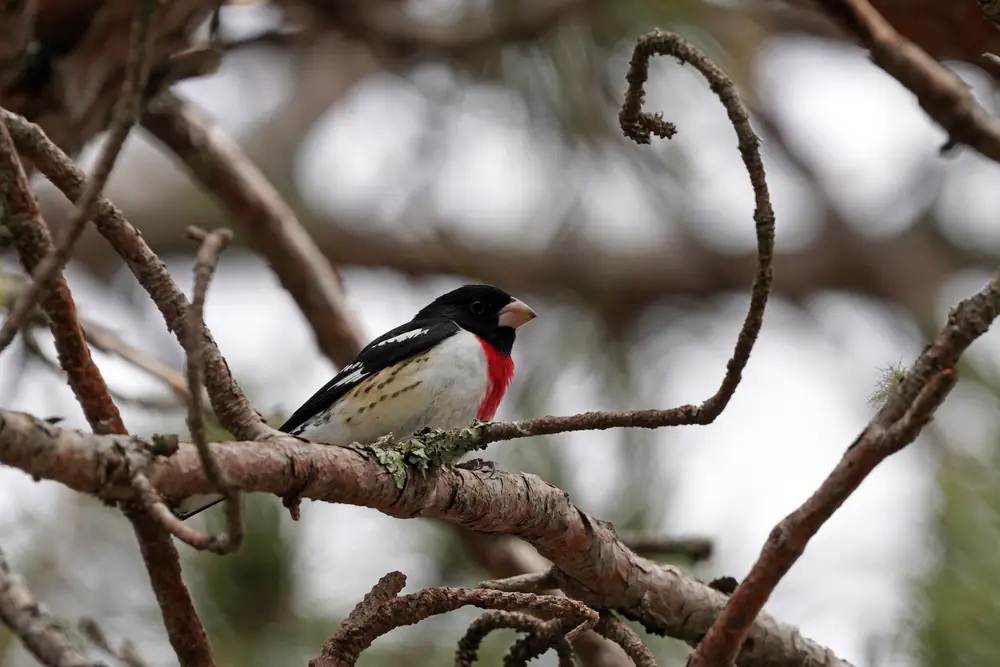
Audubon names yellow warblers, Baltimore orioles, scarlet tanagers and rose-breasted grosbeaks among the birds that fill in during the migration. Baltimore orioles return in May, when flowering trees are open. The female weaves a sock-shaped nest that hangs from a deciduous branch. Orchard orioles show up in mid-May and often leave again by mid-July. The rose-breasted grosbeak travels late in spring and at night, and its song sounds like an improved robin, according to the National Audubon Society’s field guide. To draw orioles to a yard, Audubon suggests planting flowering trees and setting out grape jelly in a cup or a skewered orange.
-
Ruby-throated hummingbirds
Males arrive ahead of females; follow the Journey North maps for the front · Gardens, feeders and flowers with long tubes, such as columbine
Journey North collects sightings from volunteers and draws maps that show the front of the hummingbird migration moving north each spring, so check the map before you hang a feeder. Males head north before females. If you keep a feeder, use plain sugar water without red dye, clean it often, and hang it away from windows and out of reach of cats, as the National Audubon Society advises.
-
Warblers and vireos
Mid-May is often the heart of the movement · Fisherville Brook in Exeter, Rome Point in North Kingstown, Prudence Island and the shrubby edges of the refuges
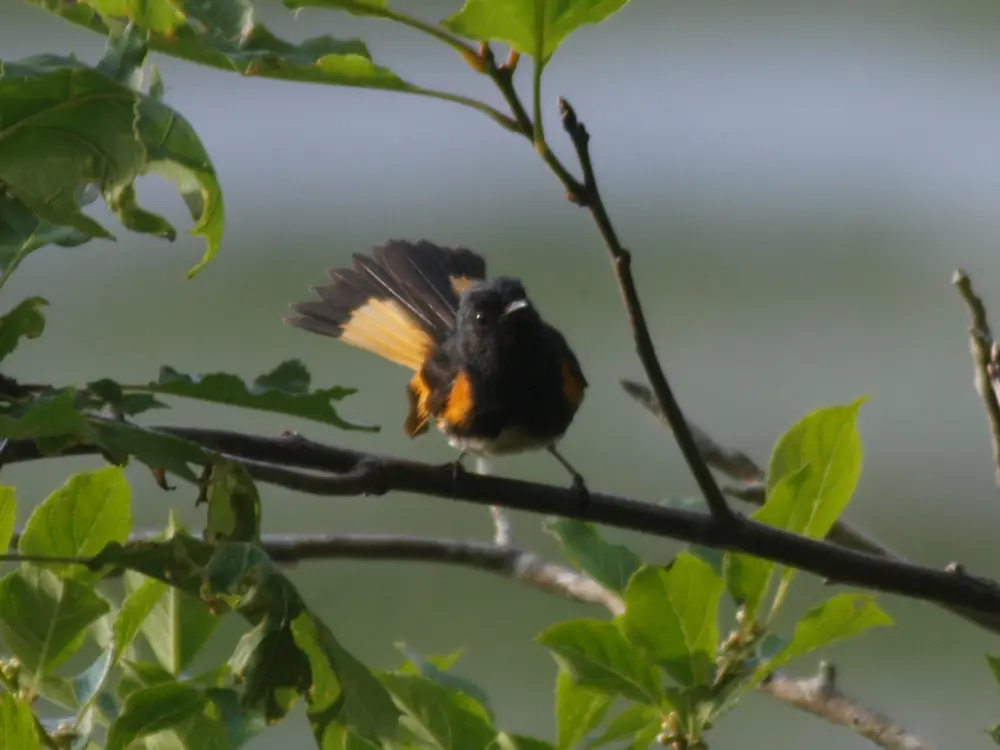
Audubon has hosted warbler workshops and field visits at Fisherville Brook Wildlife Refuge in Exeter and at Rome Point in North Kingstown, and a 2018 Audubon article expected Prudence Island’s spring migration to be in full swing by mid-May. Look for small, quick birds in the new leaves, and learn a few songs first, because the leaves hide most of them. Birds that nest here, such as the American redstart and the prairie warbler at Ninigret, stay all summer. Others pass through for a few days on their way to forests farther north.
-
The last of the northbound sea birds
Early and mid-May · Bays, ponds and rocky points
While songbirds fly in, scoters, mergansers and loons head out for northern nesting grounds. Audubon lists harlequin duck, common goldeneye and bufflehead among the ducks that leave, and Audubon’s birding guide says purple sandpipers feed on the rocks at Sachuest Point from late November to May, so the early days of the month are the last good chance to see them this season.
The earlier arrivals, from swallows to the first toad trills, are in the Rhode Island April guide.
Where are the best places to watch Rhode Island’s migrants and nesting birds?
Rhode Island is small, so a good spot is usually a short drive away. These are places that Audubon and the refuge pages describe for spring birds. Check each site for current trail and beach closures, since nesting areas can be roped off in May.
-
Norman Bird Sanctuary, Middletown
Spring through summer · Aquidneck Island
Audubon’s state birding guide calls the sanctuary especially good for birds in migration and lists willow flycatcher, black-and-white warbler, rose-breasted grosbeak, bobolink and Baltimore oriole among its nesters. The sanctuary’s own events page lists guided bird walks every other Sunday morning and nature walks on Wednesday afternoons; check it for the 2027 schedule and any fee.
-
Trustom Pond and Ninigret refuges, South County
All month · South Kingstown and Charlestown
Trustom Pond’s 787 acres of field, shrubland, pond, dune and beach hold willow flycatcher, warbling vireo, yellow warbler, bobolink and orchard oriole as nesters, according to Audubon’s guide. Part of the barrier beach is closed in nesting season to protect piping plovers and least terns, so ask at the contact station. Ninigret’s salt pond shore draws shorebirds in spring and fall, and blue-winged warbler, American redstart, prairie warbler and cedar waxwing nest there. Trustom Pond keeps daylight hours, sunrise to sunset, and each refuge page lists its closures for hunts.
-
Sachuest Point, Middletown
All month · The rocky shore and the salt marsh by Third Beach
Migrant shorebirds use the rocky shores and beaches, and Audubon says saltmarsh sparrows nest in the marsh by the Third Beach parking lot. The refuge warns that wet rocks along the shoreline are slippery and can be dangerous, and storm waves sometimes close the access road.
-
Prudence Island
Peak migration in mid-May, according to Audubon · Narragansett Bay, reached by ferry
The Narragansett Bay National Estuarine Research Reserve manages 63 percent of the island and its surrounding waters, with a learning center, hiking trails, fishing spots and birdwatching areas. Audubon has run spring birding trips there in past years, so look for a 2027 trip on its calendar.
-
Block Island
All season · Off the state’s southern shore
The Block Island National Wildlife Refuge is home to two breeding species that are federally listed: the threatened piping plover and the endangered American burying beetle. The Nature Conservancy’s island program protects nearly half the island, manages more than 2,000 acres of wildlife habitat, and sells a $2 map of 28 miles of walking trails. The Conservancy and the Block Island Conservancy co-sponsor free guided nature programs through the year.
-
Great Swamp Management Area, South County
Late May for breeding birds · Swamp forest and wetlands
Audubon’s guide lists yellow-billed cuckoo, eastern whip-poor-will, veery, hermit thrush, ovenbird and several warblers as spring nesters at the swamp. The area is open to hunting, and the spring turkey season runs into the third week of the month, so see the safety notes below before you go.
What hatches on Rhode Island’s beaches and nest platforms in May?
April belongs to eggs and May to hatching. Two of the most visible families are ospreys on their platforms and plovers on the sand, and the weeks around the end of the month are when the first chicks appear in both.
-
Osprey chicks
Eggs usually begin to hatch in late May · Platforms and poles over water; ASRI’s monitors watch about 150 active nests
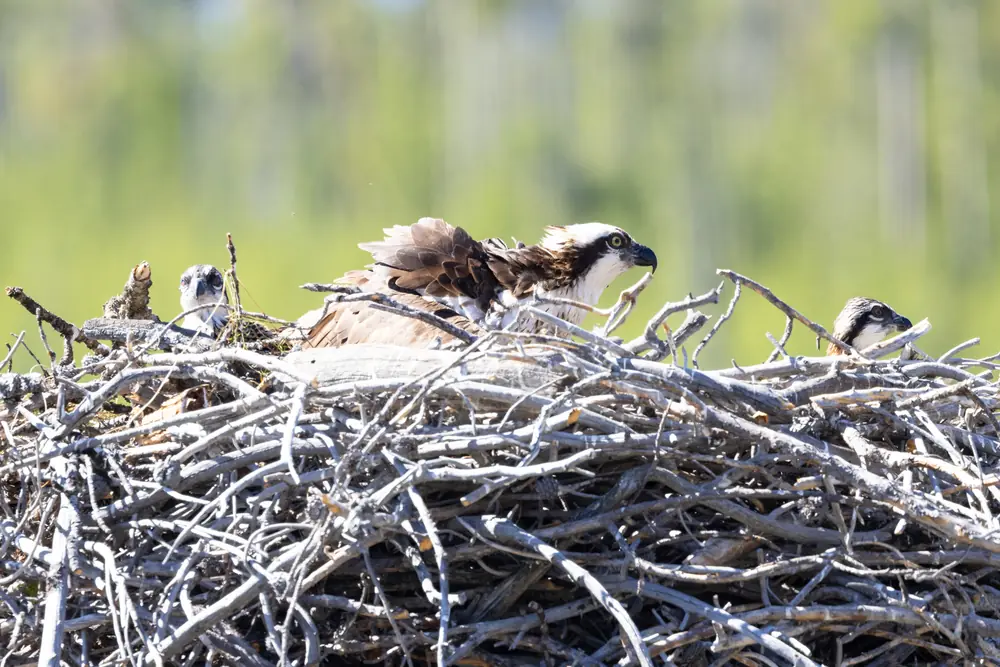
According to DEM’s fact sheet, a female typically lays three eggs during April and sits on them for about 38 days, which brings the first hatch at the end of May. The young fledge after about 50 days, and then depend on their parents for another eight weeks. Rhode Island was down to two nests in 1967 because of DDT, and the Audubon Society of Rhode Island has run the monitoring program since 2010, with volunteers watching nests from April to August. An active nest with eggs or chicks is protected under the Migratory Bird Treaty Act, so keep your distance, and phone the Division of Fish and Wildlife if a nest on a pole or building becomes a problem.
-
Piping plover chicks
Eggs hatch between late May and early June · Roped-off nesting areas on state and refuge beaches
Incubation lasts 25 to 28 days, shared by both parents, and a hatched chick leaves the nest within hours and feeds itself. The chicks reach the wrack line to find small invertebrates, because the parents do not feed them. Federal biologists say the young can fly 25 to 35 days after hatching. A 2020 state release counted 80 pairs in Rhode Island in 2019, up from 10 when the species was listed in 1986. It asked beachgoers to keep their distance, take trash and food scraps home, and fill in sandcastle moats and holes in which a small chick could be trapped. The same release listed a dog ban from April through September at state beaches, federal refuge beaches and the Nature Conservancy’s Goosewing Beach Preserve, so check the rules posted at your beach.
-
Terns on the open beach
Nesting through June · Barrier beaches in South County
The state release also named least terns among the species that nest on Rhode Island beaches, and Audubon’s birding guide lists common terns at Ninigret. Terns lay on bare sand with almost no nest, which is why beach closures are posted in May. A bird that dives at your head is telling you to back away from a nest.
-
American oystercatchers
Nesting now; chicks later in the season · Beaches southwest of Narragansett Bay, islands in the bay and northwest Block Island
A 2019 update from state and refuge biologists puts most of the state’s oystercatcher pairs on natural islands in Narragansett Bay, where nobody tracks how many chicks survive. Up to 10 pairs nest on Sandy Point Island, which the Fish and Wildlife Service leases from Avalonia Land Conservancy and where dogs are prohibited. Block Island was down to a single pair in 2019, after holding as many as five. Surveys and posting of old nest sites start in late March or early April, and staff check nests one to three times a week.
Confirm any beach closures with the agency that manages the site, because boundaries change from year to year.
Which animals are crossing Rhode Island’s roads in May, and what should I do?
Many of the animals you meet on a road in May are mothers. Turtles search for soft ground to lay in, and deer are close to giving birth. In both cases, the best help is usually to give them room.
-
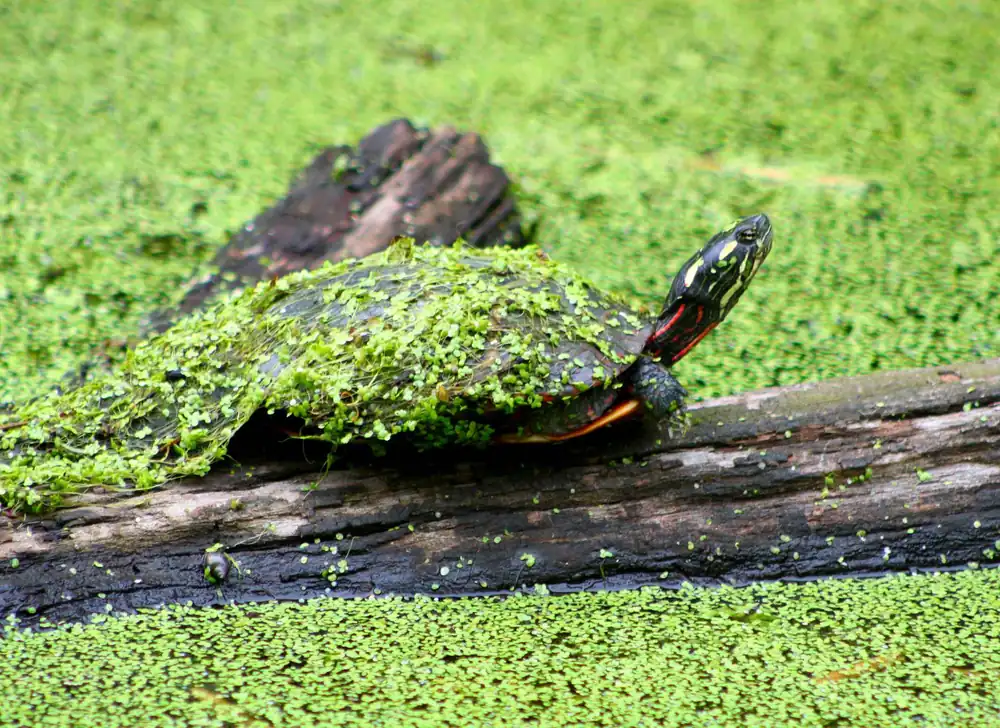
Painted and snapping turtles
Aquatic turtles leave the water in May and June to nest · Roads near ponds, rivers and wetlands, and sandy or loamy soil in fields, open woods and lawns
Audubon says the eggs laid this spring hatch from late August to early September, and the hatchlings cross roads too. The Wildlife Clinic of Rhode Island took in 44 turtles struck by cars in 2024. When stopping is safe, carry a turtle a few feet past the edge in the direction it was already facing, since it may not be going to water. Lift it with a hand under each side of the shell, never by the top shell or the tail. Do not pick up a snapping turtle: guide a large one across with a stick or a broom, or get help.
-
Box and wood turtles
Crossing again after nesting · Woods, fields and wet meadows
These land and semi-aquatic turtles cross roads again on the return trip. Native turtles should stay wild, and Audubon notes that removing any native reptile or amphibian from the wild is prohibited in Rhode Island. Audubon also sells yard signs for residents near ponds and wetlands, for display in May, June, August and September.
-
White-tailed deer fawns
Does give birth in late May or early June · Lawns, field edges and thickets
The state’s deer fact sheet says a fawn can stand within an hour of birth and wears a spotted coat for camouflage. For the first two weeks the mother leaves her fawn alone to feed and returns only now and then to nurse, so a fawn alone is normal. The sheet says never touch or approach a fawn. If a fawn is on a road or injured, call the Wildlife Rehabilitators Association of Rhode Island at (401) 294-6363, the number printed in the sheet. Young does usually have one fawn, and older does may have twins or triplets.
Do horseshoe crabs come ashore in Rhode Island in May?
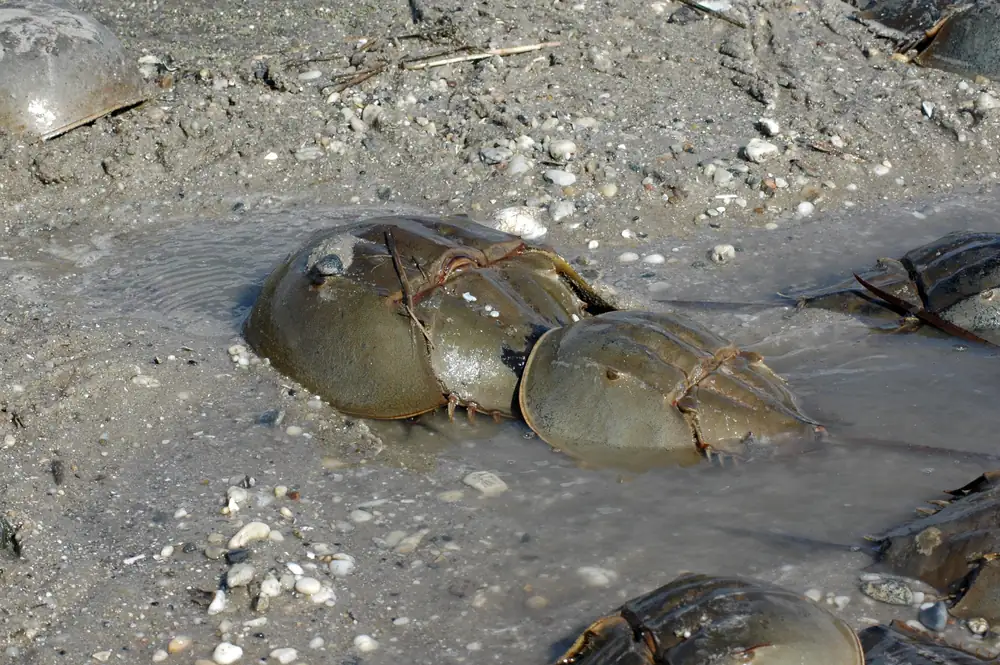
Yes. The Atlantic States Marine Fisheries Commission says adult horseshoe crabs move onto beaches and estuaries in spring to spawn, usually at high tide around the full and new moons. Spawning is heavier at the full moon than at the new moon, and heavier at night. They favor sandy beaches inside bays and coves that are sheltered from surf, so look first at protected bay and salt-pond shores. Pay particular attention to May 6 (new moon) and May 20 (full Flower Moon). The commission’s page gives no Rhode Island dates, so rely on a tide table for your own beach.
-
Guided looks at spawning
The Audubon Society of Rhode Island listed expeditions in May 2026; check for 2027 · Conimicut Point in Warwick and Napatree Point in Westerly
The Audubon calendar for May 2026 included a Horseshoe Crab Expedition at Conimicut Point and another at Napatree Point. Audubon had not published 2027 dates yet, so look at its calendar closer to the month.
-
Why shorebirds care
May at Delaware Bay · Delaware Bay, the largest staging area for shorebirds on the Atlantic Flyway
Crab eggs are an important food for migrating shorebirds. The Fish and Wildlife Service says Delaware Bay is the last Atlantic coast stopover for roughly 50 to 80 percent of the red knots heading to the Arctic, and that birds there can nearly double their weight in about two weeks. Managers allow only male crabs of Delaware Bay origin to be harvested in 2026 and 2027, with a limit of 500,000, and no females, according to the commission. The commission adds that Delaware Bay holds the world’s largest spawning population, and Rhode Island’s crabs are a smaller part of the coastwide picture.
What is blooming in Rhode Island’s woods in May?
The forest floor changes this month. Audubon explains that spring ephemerals such as trout lily, Dutchman’s breeches, bloodroot and wild ginger flower early, set seed and then vanish before summer, living on as dormant tissue underground. By May the trees are leafing out and the light is dimmer, so many of them are gone or going. Several species have declined statewide, and Audubon says habitat loss and the digging of wild plants are likely causes. Buy cultivated native plants for your garden, and never dig from the wild.
-
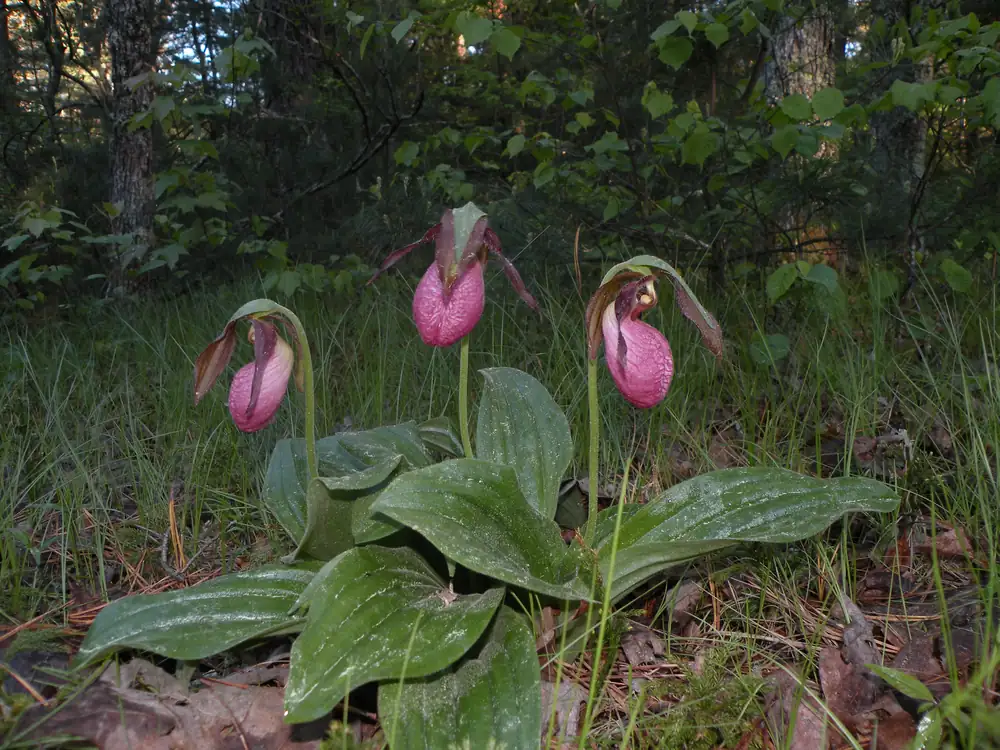
Pink lady’s slipper
May, June and July, according to Go Botany · Acidic soils in forests, swamps and bog edges
One nodding, pouch-shaped pink flower rises on a stalk above a pair of basal leaves. Go Botany explains that bumblebees enter through a slit in the pouch and leave by an opening at the back, and it warns that touching the floral bract can irritate some people’s skin. Leave the plant where it grows.
-
Wild columbine
Dates vary; the Among Rhode Island Wildflowers guide groups it with the early bloomers · Rocky woods and ledges
Pink-red flowers, sometimes yellow, hang downward, each with long nectar spurs, and long-tongued insects visit them. Go Botany says it grows in rocky and wooded places, including cliffs and ledges. No source gives a firm Rhode Island bloom week, so treat the first half of May as a good time to look.
-
Common blue violet
Flowers open about when the leaves come out · Woods, meadows, lawns and roadsides
The flowers hang downward on stalks, with five blue to purple or white petals. Go Botany notes that ants carry the seeds, which are attached to small food bodies. Violets that spread in a lawn are a good nature journal subject.
What is May weather like in Rhode Island, and what are the hazards?
NOAA’s 1991–2020 normals show how much the bay still shapes May. Afternoon highs average 64.8 °F at the Newport harbor station and 66.6 °F at Westerly, but 68 to 71 °F at the inland stations, with Coventry the warmest at 71.0 °F. Lows run from about 46.5 °F at North Foster and Kingston to 50.0 °F at Westerly. Rain totals sit between 3.3 and 3.9 inches. Hot days are rare and mostly inland: a high of 80 °F or more averages 1.3 days at Newport and Westerly and 4 to 6 days elsewhere, and only Coventry averages more than one day at 90 °F (1.6 days).
The traditional brush fire period, as the state’s forest rangers describe it, runs from mid-March to mid-May. Until the grass greens up and the rain evens out, a dry, windy afternoon can still start a fire. Burn only with a permit from your local fire district, and soak ashes in a metal bucket before dumping them. The water is the other hazard. Even on a mild afternoon the bay and ocean are cold, and the National Weather Service’s Boston/Norton office posts a surf zone forecast with rip current risk of low, moderate or high. Its advice is to swim near a lifeguard, stay at least 100 feet from piers and jetties, and swim parallel to shore if caught in a rip. Check the local forecast before a hike or beach day, and see the Climate Prediction Center’s newest seasonal outlook maps at cpc.ncep.noaa.gov.
| Station | Average high | Average low | Precipitation | Days with a low of 32 °F or lower | Days with a high of 80 °F or higher |
|---|---|---|---|---|---|
| N Foster 1 E (northwest hills) | 68.0 °F | 46.5 °F | 3.78 in | 0.5 | 4.2 |
| Woonsocket (Blackstone Valley) | 69.9 °F | 47.9 °F | 3.64 in | 0.3 | 5.6 |
| Coventry 2 (western Kent County) | 71.0 °F | 47.4 °F | 3.62 in | 0.2 | 6.0 |
| Providence T F Green Airport (Warwick) | 68.9 °F | 49.2 °F | 3.37 in | 0.0 | 4.5 |
| Kingston (South Kingstown) | 69.7 °F | 46.6 °F | 3.81 in | 1.4 | 4.3 |
| Westerly State Airport | 66.6 °F | 50.0 °F | 3.32 in | 0.4 | 1.3 |
| Tiverton (East Bay) | 70.1 °F | 49.0 °F | 3.57 in | 0.0 | 4.4 |
| Newport Rose (Newport Harbor) | 64.8 °F | 48.6 °F | 3.91 in | 0.2 | 1.3 |
Normals are thirty-year averages, so any single May can run cooler or warmer and a cold onshore wind can hold the shore well below the inland temperature.
Is the last spring freeze over in Rhode Island by May?
For the coast it is long past, and for the interior it ends this month. The table shows NOAA’s freeze normals for eight stations. At the median, the last freeze comes on May 3 at Kingston, the latest of the eight, while Coventry and Woonsocket reach theirs in late April. By May 4 at Coventry, May 6 at Woonsocket, May 9 at North Foster and May 16 at Kingston, nine springs in ten have already had their last freeze. The harbor and coastal stations finished earlier in April. NOAA’s May normals show a low of 32 °F or colder on about 1.4 days at Kingston, and on none at the Warwick airport station. For a station near your own street, open the frost dates for Rhode Island.
| Station | One year in ten | Median | Nine years in ten |
|---|---|---|---|
| Woonsocket (Blackstone Valley) | Apr 9 | Apr 22 | May 6 |
| N Foster 1 E (northwest hills) | Apr 13 | Apr 25 | May 9 |
| Coventry 2 (western Kent County) | Apr 10 | Apr 22 | May 4 |
| Providence T F Green Airport (Warwick) | Apr 1 | Apr 11 | Apr 23 |
| Kingston (South Kingstown) | Apr 21 | May 3 | May 16 |
| Westerly State Airport | Mar 31 | Apr 11 | Apr 26 |
| Tiverton (East Bay) | Apr 1 | Apr 11 | Apr 22 |
| Newport Rose (Newport Harbor) | Mar 28 | Apr 7 | Apr 21 |
Many gardeners wait for the nine-in-ten date at their own station before they set out tomatoes, basil or squash, since a late cold night is still possible in a cold hollow.
How much daylight does Rhode Island gain in May?
In Providence the day lasts 14 hours 2 minutes on May 1 and 14 hours 59 minutes on May 31, 57 minutes more, or about 1.9 minutes each day. That is a slower climb than in April, because the days are bending toward the June solstice on the 21st. By the U.S. Naval Observatory’s tables, the Providence sun rises at 5:36 a.m. and sets at 7:49 p.m. on the 6th. On the 19th it rises at 5:22 a.m. and sets at 8:03 p.m., and on the 27th it sets at 8:10 p.m. All of these are daylight time. Early light matters for birds: the dawn chorus starts well before sunrise, so a walk that begins at 5 a.m. catches it.
| City | May 1 | May 31 | Gained | Per day |
|---|---|---|---|---|
| Woonsocket | 14 h 03 m | 15 h 00 m | 57 min | 1.9 min |
| Providence | 14 h 02 m | 14 h 59 m | 57 min | 1.9 min |
| Warwick | 14 h 01 m | 14 h 59 m | 58 min | 1.9 min |
| Coventry | 14 h 01 m | 14 h 59 m | 58 min | 1.9 min |
| Newport | 14 h 00 m | 14 h 58 m | 58 min | 1.9 min |
| Westerly | 14 h 00 m | 14 h 57 m | 57 min | 1.9 min |
| New Shoreham | 13 h 59 m | 14 h 56 m | 57 min | 1.9 min |
Look up other towns and states on the daylight page.
What can you see in the Rhode Island night sky in May 2027?
Look for a dawn meteor shower under a dark moon, a fine evening for Mercury, and a full moon that carries two names. Times here are Eastern daylight time. Moonless nights cluster around the 6th, which helps anyone chasing the Milky Way: our own computations for the central United States put its bright core in the dark pre-dawn hours across roughly the first two weeks and the final week of the month.
-
Eta Aquariid meteors
Best mornings are May 5, 6 and 7 · The last hour or two of darkness before dawn, looking toward the southeast
In Sea and Sky’s listing the maximum falls overnight from May 6 into May 7, and 2027 is rated an excellent year because no moonlight interferes. Its figure is roughly 30 meteors per hour at best for northern observers. Rhode Island lies north of the ideal spot: Aquarius, where these meteors seem to originate, climbs only a little before the sky starts to brighten, so count on fewer. In Providence, civil twilight begins at 5:05 a.m. on May 6, so go out early and give your eyes 20 minutes.
-
Venus and Saturn at dawn
Friday, May 7, with about a degree between them on the mornings of the 6th and 8th · Very low in the east before sunrise
Our own calculations put the closest approach of Venus and Saturn on May 7, at a separation near 0.6 degrees. Both lie in Pisces and hug the horizon, standing about 3 to 6 degrees up thirty minutes ahead of sunrise. Binoculars and a clear view east are needed. Venus outshines Saturn by a wide margin (magnitude -3.9 against +0.7). This is a difficult sight, though a patient observer can catch it.
-
Jupiter in the evening
All month; the first-quarter Moon is near it on the evening of May 12 · High in the sky after dark
Jupiter is still the bright evening planet. By our computation it sets about seven hours after dusk on May 1 and only a little over four hours after dusk by June 1, so evenings are the time to look. On May 12 the Moon, close to first quarter, passes about 1.2 degrees from it.
-
Mercury’s best evening of the year
Greatest eastern elongation Friday, May 28, at 9:14 a.m.; look on May 27 and 28 · Low in the west-northwest, 45 to 90 minutes after sunset
Mercury reaches 22.9 degrees from the Sun, according to Sea and Sky. The U.S. Naval Observatory puts Providence’s sunset on May 27 at 8:10 p.m., so look between about 9 and 9:40 p.m., with an open view of the horizon and binoculars to help. By our own figures, the best evenings run from about May 12 to June 5. Mercury lingers in the evening sky into early June but fades fast after mid-month.
-
The Flower Moon, a seasonal Blue Moon
Full Thursday, May 20, at 6:59 a.m.; the best evening is Wednesday, May 19 · Rising in the east after sunset
The May full moon is the Flower Moon. Sea and Sky also calls it a Blue Moon in the seasonal sense: it is the third full moon in an astronomical spring that holds four, reckoned from the equinox in March through the solstice in June. It is not a Blue Moon by the calendar-month definition, as there is only one full moon in May. Because the full moment comes at dawn, the Moon looks round on both evenings. In Providence on the 19th it rises at 7:46 p.m., 17 minutes before the 8:03 p.m. sunset.
| Phase | Date | Time |
|---|---|---|
| New moon | Thursday, May 6 | 6:58 a.m. EDT |
| First quarter | Thursday, May 13 | 12:44 a.m. EDT |
| Full moon (Flower Moon) | Thursday, May 20 | 6:59 a.m. EDT |
| Last quarter | Friday, May 28 | 9:58 a.m. EDT |
For moon times anywhere in the state, see the moon phases page.
What can Rhode Island families do outdoors in May?
- Join a free bird walk. Audubon’s calendar for May 2026 listed free walks at refuges across the state, plus guided walks in Providence parks. The 2027 schedule is not posted, so check the calendar for days and places.
- Mark World Migratory Bird Day. The organizers’ spring observance fell on May 9 in 2026; the 2027 date and theme were still unannounced at our last check, so confirm both at migratorybirdday.org.
- Look for horseshoe crabs. Take a tide table to a protected bay beach near the new or full moon, or watch for an Audubon expedition.
- Give a turtle a lift, safely. Learn the two-hand hold, and never carry a snapping turtle.
- Put out an oriole feeder. Half an orange or a cup of grape jelly is enough.
- Walk the Blackstone Valley. The Blackstone River Valley National Historical Park lists events and ranger programs on its calendar.
- Stargazing on a Friday. Frosty Drew Observatory sits above Ninigret Park in Charlestown. Its page describes Stargazing Nights on Fridays, opening at whichever comes later, sunset or 6 p.m., with a $5 suggested donation; check which May Fridays are open.
- Help count. Audubon’s community science list includes osprey monitoring from April through August, vernal pool monitoring through May, window strike surveys on May mornings and breeding bird surveys from late May.
- Plan for Mother’s Day and Memorial Day. Mother’s Day is Sunday, May 9, and Memorial Day is Monday, May 31. Both make good days for a slow walk.
The Rhode Island Wild Plant Society links to walks and native plant sales, and had announced no 2027 dates when we compiled this. Other states and months live in the nature guides. Record each first in the Naturalist’s Field Journal, and use the cloud guide to read a May sky. April’s arrivals are covered in the April page for this state.
Safety notes for May in Rhode Island
- Spring turkey season and orange. DEM’s 2026–27 hunting summary lists the spring wild turkey season as April 29 through May 23, 2027, with coyote hunting on state land over the same dates. Orange: DEM’s spring rule runs through May 31 and asks anyone on management areas, some undeveloped state parks and co-op units to wear a fluorescent orange hat or vest of at least 200 square inches above the waist; spring turkey hunters are exempt. Archery-only areas are exempt. Confirm any change with DEM.
- Fishing. Season dates, size limits and licenses differ for each species, and freshwater and saltwater rules are on separate eRegulations pages. Look up each species you want before heading out.
- Ticks. The TickEncounter Resource Center at URI says adult blacklegged ticks stay active October to May whenever daytime highs hold above 32 °F. It adds that poppy-seed-sized nymphs, as well as adult females, can transmit Lyme disease. Inspect yourself and your pets after a walk.
- Nesting beaches. Keep out of roped areas, keep dogs away, and fill in holes. The 2020 state release lists a dog ban from April through September on many beaches.
- Turtles, fawns and baby animals. Do not pick up a snapping turtle, and do not touch a fawn.
- Rip currents and cold water. Swim near a lifeguard, and stay 100 feet from piers and jetties, per the National Weather Service. Narragansett Bay is still cold for kayakers and anglers, so wear a life jacket.
- Brush fires. Burn only with a permit, and drench ashes before disposal.
Sources (55)
- Audubon Society of Rhode Island: migrants are on the move (spring migration article, 2019)
- Audubon Society of Rhode Island: a busy time for birds and birders (May 2018 programs, Prudence Island)
- Audubon Society of Rhode Island: news and blog index (spring migrant checklist, orioles, ephemerals)
- Audubon Society of Rhode Island: all about amazing orioles (2023)
- Audubon Society of Rhode Island: fleeting beauty, ephemerals on the forest floor (2023)
- Audubon Society of Rhode Island: it’s turtle crossing season (2026)
- Audubon Society of Rhode Island: wildlife crossing yard signs
- Audubon Society of Rhode Island: community science programs
- Audubon Society of Rhode Island: nature programs and events page
- Audubon Society of Rhode Island: May 2026 program listings (bird walks, horseshoe crab expeditions)
- Audubon Society of Rhode Island: home page (spring migrant checklist, programs)
- National Audubon Society: birding Rhode Island (Sachuest, Trustom, Ninigret, Norman, Great Swamp)
- National Audubon Society field guide: Baltimore oriole
- National Audubon Society field guide: rose-breasted grosbeak
- National Audubon Society field guide: ruby-throated hummingbird
- Journey North: hummingbird migration maps and reporting
- Journey North: monarch migration and sighting reports
- World Migratory Bird Day: about the day and the 2026 theme
- Norman Bird Sanctuary: programs and events (guided walks)
- U.S. Fish and Wildlife Service: piping plover, Atlantic Coast population
- U.S. Fish and Wildlife Service: red knot (Delaware Bay stopover)
- U.S. Fish and Wildlife Service: Block Island National Wildlife Refuge
- U.S. Fish and Wildlife Service: Block Island refuge species list
- U.S. Fish and Wildlife Service: Ninigret National Wildlife Refuge
- U.S. Fish and Wildlife Service: Trustom Pond National Wildlife Refuge
- U.S. Fish and Wildlife Service: Sachuest Point National Wildlife Refuge
- State of Rhode Island: conservation partners remind the public to be considerate of nesting birds (May 28, 2020)
- American Oystercatcher Working Group: Rhode Island 2019 state update (PDF)
- Rhode Island DEM Division of Fish and Wildlife: osprey fact sheet (PDF)
- Rhode Island DEM Division of Fish and Wildlife: white-tailed deer fact sheet (PDF; finding fawns)
- Atlantic States Marine Fisheries Commission: Atlantic horseshoe crab
- The Nature Conservancy: Block Island (Rhode Island)
- Narragansett Bay National Estuarine Research Reserve: Prudence Island
- National Park Service: Blackstone River Valley National Historical Park
- Frosty Drew Observatory: Stargazing Nights
- Rhode Island Wild Plant Society: home page and events
- Native Plant Trust Go Botany: pink lady’s slipper
- Native Plant Trust Go Botany: red columbine
- Native Plant Trust Go Botany: common blue violet
- Among Rhode Island Wildflowers: Rhode Island early spring wildflowers, The Amateur Botanist
- Rhode Island DEM: 2026–2027 hunting season summary (eRegulations)
- Rhode Island DEM: 2026–2027 hunting general information, fluorescent orange requirements (eRegulations)
- Rhode Island DEM: eRegulations fishing section (freshwater and saltwater regulation pages)
- State of Rhode Island: DEM warns public of increased fire danger (mid-March through mid-May brush fire period)
- University of Rhode Island TickEncounter Resource Center: blacklegged tick
- National Weather Service Boston/Norton: home page (surf, fire weather and severe weather links)
- National Weather Service Boston/Norton: surf zone forecast and rip current safety
- NOAA NCEI: 1991–2020 monthly normals for Rhode Island stations (data API, May values)
- Climate Prediction Center: 90-day (seasonal) outlooks
- U.S. Naval Observatory: moon phases, 2027
- U.S. Naval Observatory: sunrise, sunset and moonrise for Providence, May 19, 2027
- U.S. Naval Observatory: sunrise and twilight for Providence, May 6, 2027
- U.S. Naval Observatory: sunset for Providence, May 27, 2027
- Sea and Sky: astronomy calendar of celestial events, 2027 (May)
- Photos via Wikimedia Commons; licenses and photographers are credited under each picture