What to look for in nature in South Dakota this April
April in South Dakota is the month the plains wake up all at once, with the weather arguing the whole way. On the prairie, grouse dancing is in full swing and the Forest Service opens its free viewing blinds. In the Black Hills and the Badlands the first bison calves of the year arrive, sometimes into snow. Piping plovers return to Missouri River sandbars, white pelicans cruise the lakes, tree swallows come back to nest boxes, and walleye crowd shallow gravel to spawn. A late blizzard is always possible, and so is a mild afternoon in the upper 50s with the first thunderstorm building in the west. Days lengthen by well over an hour across the month, Arbor Day falls on the last Friday, and the Pink Moon rises full on the evening of the 20th.
Other months in South Dakota: October, November, December, January, February, March.
Start here
- Sit in a grouse blind or beside a prairie road at dawn. April is the peak of the dancing season. Reservations for the Forest Service blinds on the Fort Pierre National Grassland usually run from April 1 to mid-May, and calling early matters. If you cannot get a blind, listen from a parked car on a quiet grassland road before sunrise and keep the engine off.
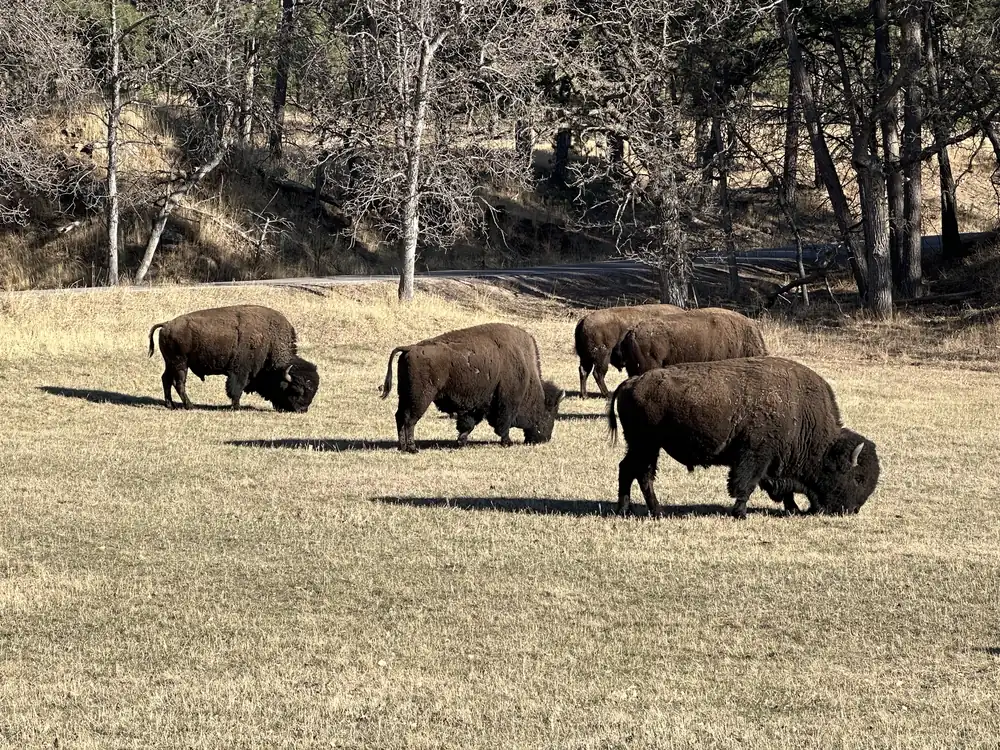
- Find a calf in a bison herd, from a safe distance. Calving at Custer State Park usually builds through mid to late April. Use binoculars or a long lens, stay in the vehicle where the park asks you to, and never approach a calf that seems to be on its own. The cow is nearby and she is not friendly.
- Visit a lake edge on a still morning. Look for white pelicans, loons in breeding plumage, early swallows over open water and ducks dabbling in the shallows. Write down the date of your first pelican and your first swallow, and compare them with next year.
In the Naturalist’s Field Journal, a birds-I-have-seen plate suits the pelicans, plovers, swallows and meadowlarks that return this month, and a nest-observed page can follow a bluebird box from the first twig. Use the daily field log for the month’s swings between snow and sun. A same-place-twice plate pairs well with a pasque flower patch visited in bloom and again in seed, the dusk-and-dawn-watch plate fits a grouse morning or a frog evening, and the mammal-watch page can hold bison calves.
Regions used below: Black Hills; West River prairie and the Badlands; Missouri River and the big reservoirs; Glacial Lakes and the northeast; Southeast and Sioux Falls.
Is April the best month to watch prairie grouse dance in South Dakota?
Game, Fish and Parks describes sage-grouse lekking as running from late February into early June, with the busiest weeks in April or early May. The prairie species are displaying on a similar schedule, and the public viewing program is built around this season. If March was the overture, April is the main performance.
-
The Forest Service grouse blinds near Fort Pierre
Reservations on the 2026 page ran April 1 to May 15; check the 2027 dates in February · Fort Pierre National Grassland, south of Pierre and north of Interstate 90
The Forest Service sets up plywood blinds each spring beside active leks and lends them out free of charge. Reservations are required, and requests have opened on February 1 of each year (the next business day if that falls on a weekend). The page we read said guests must arrive an hour before sunrise and stay at least an hour after it, that each blind has a designated parking spot marked with pin flags, and that the blinds move to a new lek every year, so no two seasons look quite alike. Each visitor receives a map and instructions. The page lists no drinking water and gives no restroom information, so bring what you need and dress warmly, since a clear April dawn on open grass can sit near freezing even when the afternoon will be mild. The reservation line is 605-224-5517.
-
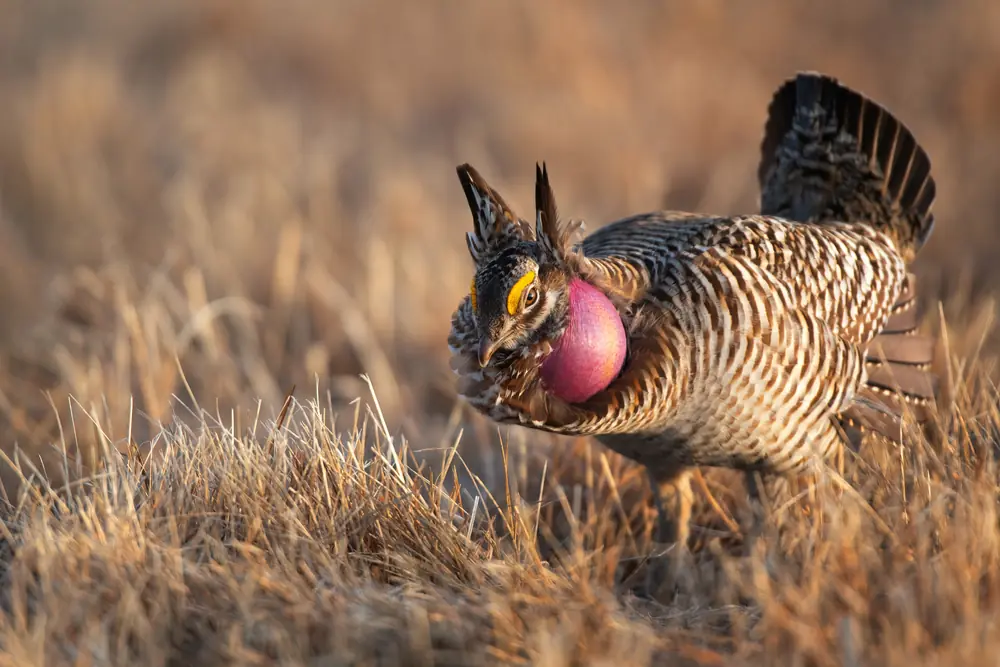
Greater prairie-chickens and sharp-tailed grouse
Displays continue through spring, ahead of nesting in May and June · Native mixed-grass prairie, especially in the central part of the state
South Dakota Birds and Birding describes the greater prairie-chicken as relatively common in the central part of the state, with males gathering on traditional leks to inflate orange neck sacs, stamp and give a deep, hooting boom, and with nesting following in May and June. You hear the show before you see it. If you cannot book a blind, a parked vehicle on a public grassland road gives a respectable view. Keep to the road, stay in the car and leave before the birds do.
-
Sage-grouse on the clay flats of Harding and Butte counties
Peak lekking in April or early May · Far northwestern South Dakota
The agency’s management document says South Dakota leks sit on large clay flats with sparse vegetation. The birds that remain are few, and a visitor on foot is a risk to a lek. The responsible way to enjoy this species is to follow the agency’s annual counts, not to go looking.
Wild turkeys are busy too. South Dakota Birds and Birding lists April through July as turkey nesting season, and dawn gobbling carries across timbered draws and river bottoms. Our March guide for South Dakota covers the early weeks of the grouse season.
When are bison calves born in the Black Hills and Badlands?
The first bison calf of the year is a small event in South Dakota, and parks tend to announce it. Calving at Custer State Park arrives in the same weeks as the last wet snows. That mix of newborns and winter weather is the story of the month in the Hills.
-
Calving at Custer State Park
First calves in early April some years; the busiest weeks are usually mid-April into the first couple of weeks of May · Custer State Park, with calves also reported in the Badlands
A KELOLAND report dated April 3, 2021 quoted the park’s visitor services manager on the first calf of that year: about 475 were expected, against a five-year average near 425, from a herd of roughly 1,450 animals. The park put prime calving at mid-April into the first couple of weeks of May. A 2023 report from South Dakota Public Broadcasting said that year’s first calf was found a day after a storm dropped close to two feet of snow, and described calves as usually arriving in late April or early May. The safe reading is that early April can bring a few and the main wave runs through the rest of the month into May.
Park staff told KOTA that visitors should leave a solitary calf alone, since the cow knows where she left it and comes back. Do not feed, call to or approach calves, and keep well away from any cow with young.
-
Other young animals, with a caution about dates
Late April into June, depending on species and weather · Needles Highway, Custer State Park, the Badlands and prairie dog towns
A regional tourism association blog says mountain goat kids and bighorn lambs begin to appear on rocky terrain in April, and that the youngest prairie dogs emerge in early April. That is one marketing source. The National Park Service gives a different clock: prairie dogs there mate from March into early April, and pups stay underground about six weeks, which puts most pups on the surface later in spring. Treat April as a time to watch the towns and May as the likelier time for pups. Burrowing owls are mostly a summer sight around the towns, according to the Badlands bird list.
Spring snow and newborns can overlap. An April blizzard in 2018 arrived during calving season for ranchers across the southern half of the state, according to the Sioux Falls National Weather Service office.
Which birds return to South Dakota’s lakes and rivers in April?
March belongs to snow geese. April belongs to a second wave: pelicans, swallows, loons passing through, shorebirds of the sandbars and the swans that nest at Lacreek. The open water of the Missouri River and the glacial lakes in the east are where to find them.
-
Piping plovers and least terns on Missouri River sandbars
Plovers arrive in April; most nests are started in May and June · Sandbars and shorelines along the Missouri River reservoirs, including Lake Oahe, and the river reaches below the dams
The state’s management plan for these two rare birds says piping plovers reach the Northern Great Plains in April, with males staking out territories through aerial displays and calls. Nesting runs from late April through August, with most nests started in May and June. People matter a great deal: the plan records that the Army Corps of Engineers attributed 20 least tern and 38 piping plover nest failures in South Dakota to human disturbance during its monitoring period, and it names foot traffic, off-road vehicles and unleashed dogs as threats. If a stretch of sand is marked off, stay out.
-
White pelicans, loons and the first swallows
April and May for pelicans; April is a good month for tree swallows over open water · Large lakes of the prairie pothole country in the east, reservoirs and wetlands
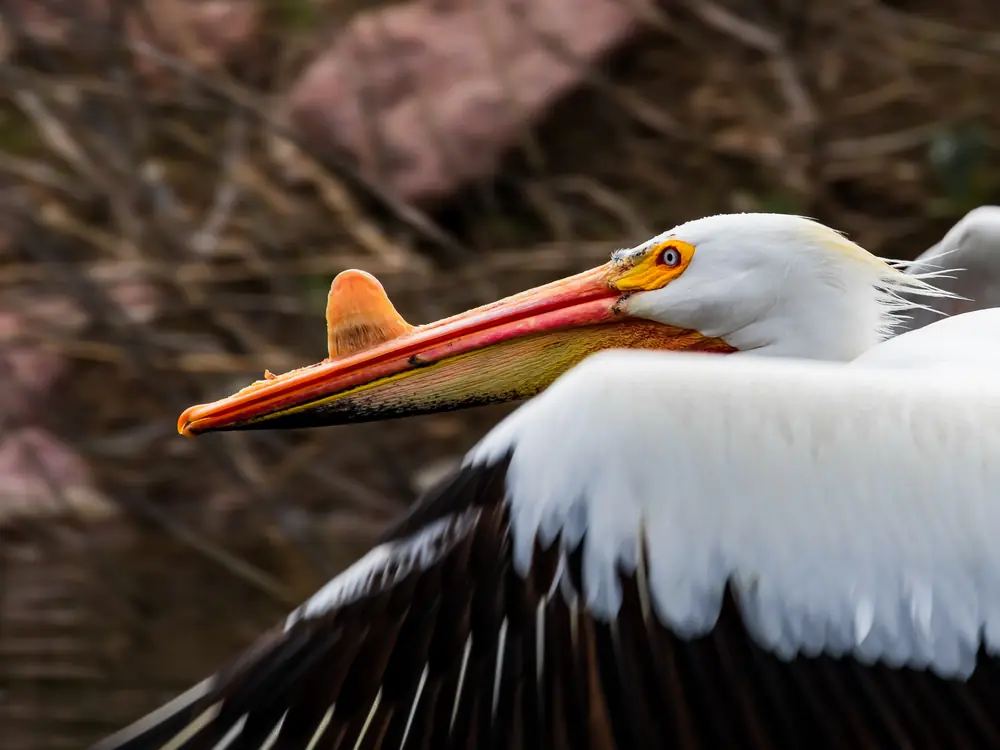
South Dakota Birds and Birding says American white pelicans are typically easy to find in April and May as they migrate toward their breeding grounds, and a few nest on isolated islands in the northeast. The bump on a pelican’s bill is only present in the breeding season, so a flock with knobbed bills is dressed for courtship. Common loons pass through and may still wear breeding plumage in spring. The same site calls the tree swallow usually the first swallow to return in spring, able to survive cold spells by eating berries and seeds when insects are scarce.
-
Sand Lake as the ice goes out
Ice-out varies by weeks · Sand Lake National Wildlife Refuge, Brown County
The refuge’s 2023 reports show how much a late spring can reshuffle things. On April 11 the lake was mostly frozen apart from a sliver of open water at the dam, about 30 geese were passing over in small flocks, and staff saw more raptors. They expected the birds to move onto the refuge once about a quarter of the lake was open. By April 26 the last ice was nearly gone and a good mix of puddle ducks, diving ducks, gulls, herons, pelicans and cormorants had shown up. Check the refuge page before you drive, because roads and tour loops can stay closed in a wet spring.
-
Trumpeter swans at Lacreek
Nesting April through July · Lacreek National Wildlife Refuge, near Martin, in the southwest
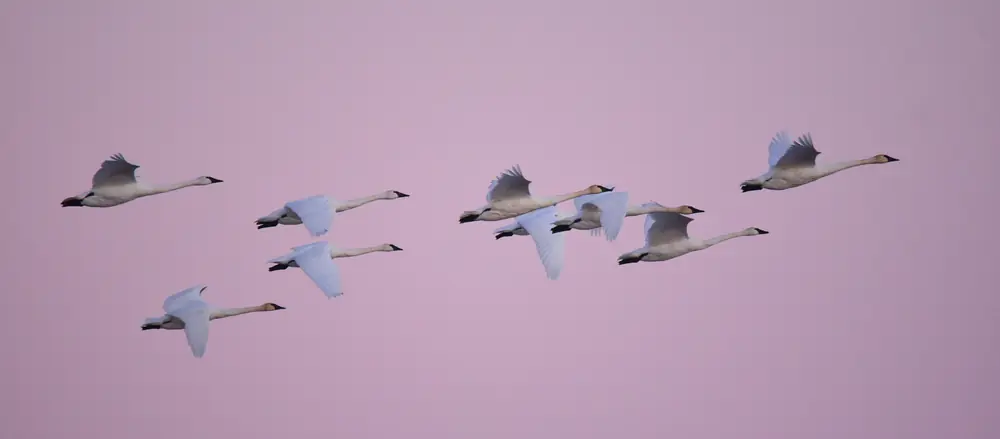
South Dakota Birds and Birding lists April through July as nesting time for trumpeter swans, which nest in select spots in western South Dakota. The Fish and Wildlife Service describes the 16,570-acre Lacreek refuge as a place of vital winter habitat for these swans and as a staging area for migrating waterfowl. Watch from a distance, because a swan on a nest is easily frightened off it.
-
A rare white crane
Spring migration; any day is a long shot · Central South Dakota wetlands and flooded fields
The whooping crane is a rare but regular migrant, according to South Dakota Birds and Birding, seen mostly in the middle of the state, with single birds or pairs often tagging along with sandhill cranes. Give any tall white crane plenty of room and report it to a wildlife agency without posting the location.
Journey North gathers spring sightings from watchers across the continent, so your own first-of-year dates can join a bigger picture.
When do walleye spawn in South Dakota?
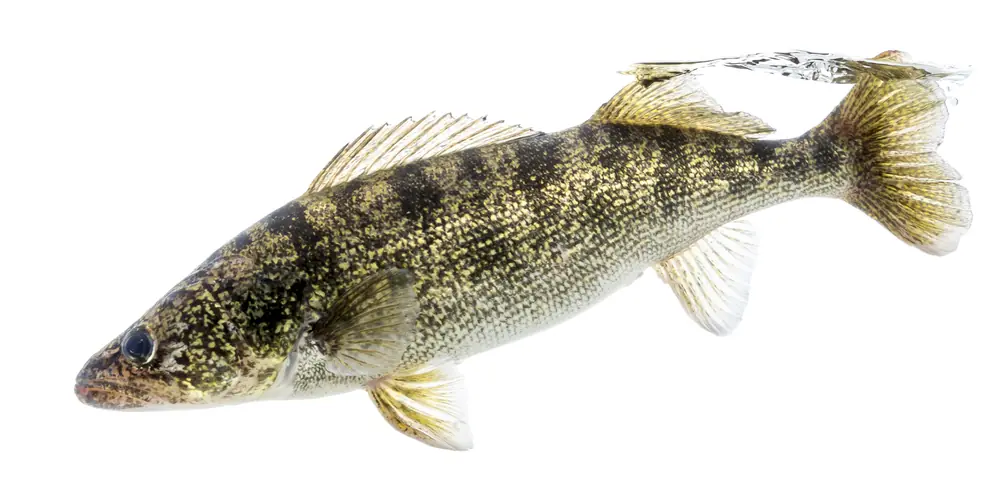
Ice-out sets the northern pike off in early spring, but the walleye follow a steadier clock. A state fisheries administrator explained in an April 2020 interview that both water temperature and day length drive the spawn.
-
April, with the peak often in the third week
Spawning runs through April; a 2020 interview with the state fisheries administrator put the peak in the third week · Gravel shorelines and tributary mouths of eastern lakes, and the Missouri River system
Because day length is part of the trigger, that interview said the peak of walleye spawning in South Dakota generally falls in about the third week in April, though the start of the run shifts with ice-out and weather, and a late spring can push the first egg-take close to the end of the month. Treat the date as a typical value, not a schedule. The Game, Fish and Parks department treats spawning as a major work initiative, with fisheries staff from across the state helping to net fish and collect eggs. The waters used in recent years have included Lake Oahe, Indian Springs, Sinai, Brush, West 81, Twin, Lynn, Mid Lynn, Reid and East Oakwood lakes.
Spawning happens out of sight, so the visible signs are indirect: anglers along the same rocky points and gulls working the shallows. Rules and limits vary by water, so read the current Game, Fish and Parks fishing handbook before you go. Cold water kills quickly, so wear a life jacket on any April boat trip and stay off ice that has pulled away from shore.
What blooms in the Black Hills and on the prairie in April?
April bloom is modest and patchy, and it moves uphill with the warmth. The Hills offer a long list of spring wildflowers, but the Forest Service dates only a few of them.
-
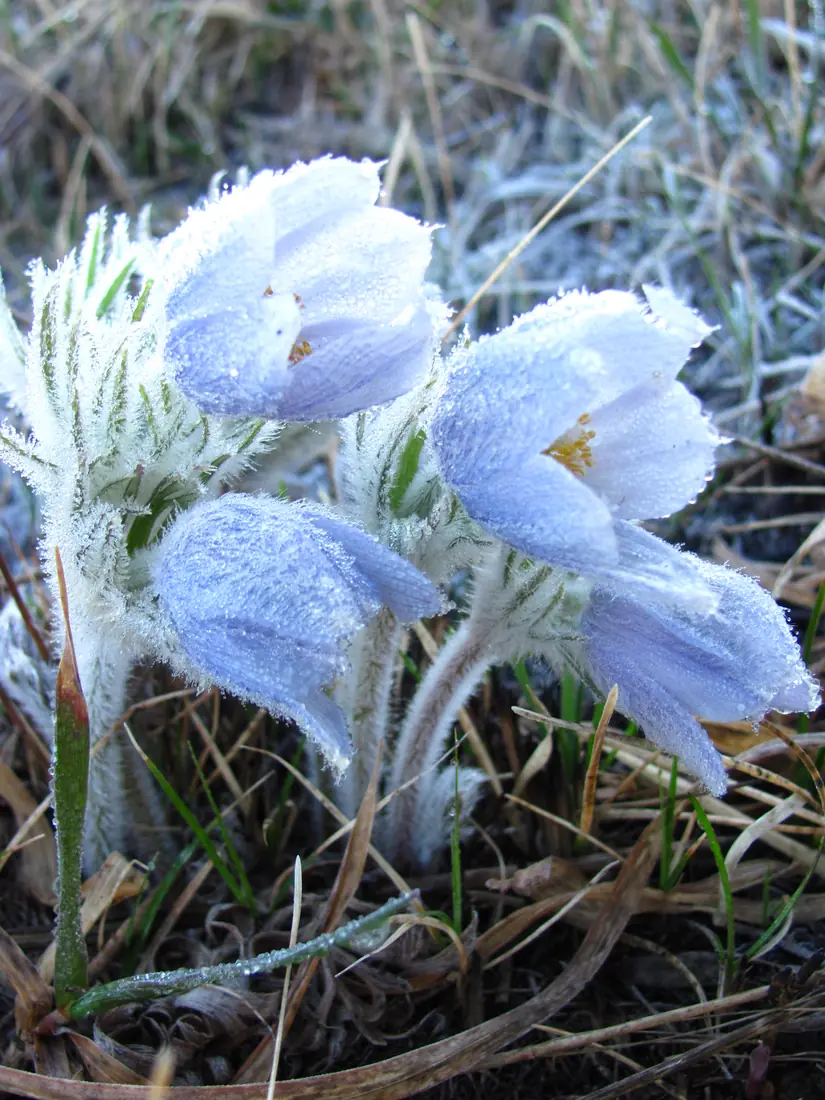
Pasque flowers, still going in the Hills
Early spring; later at higher elevation · Mixed-grass prairie and open pine forest, low to high elevations
The Forest Service calls the pasque flower one of the first blooms of early spring, common in mixed-grass prairie and open pine forest at all elevations, and notes that the fuzzy plant makes wispy, tufted seed heads in midsummer. The Park Service says it flowers as early as March at Wind Cave, well before the park’s main wildflower season, which runs from mid-May through early July. Visit one patch twice this month. The contrast between a blossom and a seed head makes a good page for a field journal.
-
Bluebells and the rest of the early group
Late April into May, depending on elevation · Grasslands, open forests and rocky slopes
The Forest Service’s list of spring-to-early-summer wildflowers includes lanceleaf bluebells, whose drooping blue clusters appear in early spring, along with darkthroat shootingstar, star lily, early cinquefoil, desert biscuitroot and, on higher limestone slopes in the west, yellow arrowleaf balsamroot. The page gives no bloom date for each plant, so use it as an identification list and expect low, sunny, south-facing slopes to bloom first.
Look rather than pick, and note that one plant on that list, meadow deathcamas, is poisonous. Arbor Day, on the last Friday of the month, is a reasonable day to plant a tree to feed next year’s pollinators.
Which frogs, toads and turtles are active in South Dakota in April?
April is the changeover month for amphibians. The earliest callers are at their height or finished, and most toads and the leopard frog are still weeks away. That is useful to know, because a loud night in the first half of April is almost certainly a boreal chorus frog.
-
Boreal chorus frogs and the end of the wood frog window
Chorus frogs through late spring; wood frogs typically finish by early April · Shallow wetlands, ditches and temporary pools
The state herp site says wood frogs breed in a short period, typically late March into early April, while the boreal chorus frog begins calling as early as March and continues to late May, with a breeding call that sounds like a comb being strummed. Both are small and hard to see. Stand still beside the water for a few minutes and the chorus stops and restarts around you.
-
Tiger salamanders on rainy nights
Active April through September; spring movements follow heavy rain · Near wetlands, in old burrows and sometimes basements
The same site says adult tiger salamanders are rarely encountered, since most movement to and from breeding ponds happens in early spring during and just after heavy rains, and the adults are generally active from April to September. If you find one on a wet road, move it the way it was heading, with wet hands.
-
What you will not hear yet
Mid-May to July · Prairie wetlands, flooded fields and ephemeral pools
The northern leopard frog breeds primarily from mid-May through June, and the American toad mostly in May and June. The Canadian toad, found only in the northeast corner, breeds from late May to June. The Great Plains toad breeds from late May through July and the plains spadefoot, an explosive breeder, calls for a night or two after heavy rain. If you hear an April trill from a roadside pool, think chorus frog first.
Painted turtles bask on logs and rocks on sunny days, and the prairie rattlesnake leaves its winter den before its late-spring mating season, so a warm April rock can hold one. The state herp site takes public reports if you hear something worth adding.
What is April weather like in South Dakota?
April is a month of climbing averages and wide swings. Normal highs run from the low 50s in the northern Black Hills and the northeast to near 60 in the southeast, and normal lows hover close to freezing in most places. The figures below are NOAA’s April normals for 1991 to 2020 at seven stations. For how to read the forecasts that matter this month, see our weather guide. Fresh 90-day outlooks come out of the Climate Prediction Center every month, and they are the place for the latest seasonal view.
| Station | Average high | Average low | Snowfall | Precipitation | Days with 1 in or more of snow cover |
|---|---|---|---|---|---|
| Lead (northern Black Hills) | 53.8 °F | 31.3 °F | 29.0 in | 3.54 in | 7.8 |
| Rapid City Regional Airport | 56.6 °F | 31.2 °F | 10.1 in | 2.08 in | 4.1 |
| Pierre Regional Airport | 58.5 °F | 33.3 °F | 5.3 in | 1.93 in | 2.5 |
| Aberdeen Regional Airport | 57.6 °F | 31.4 °F | 4.2 in | 1.91 in | 2.3 |
| Watertown Regional Airport | 54.0 °F | 31.5 °F | 5.2 in | 2.06 in | 3.7 |
| Huron Regional Airport | 57.9 °F | 33.6 °F | 5.5 in | 2.52 in | 2.6 |
| Sioux Falls (Foss Field) | 59.0 °F | 35.5 °F | 5.1 in | 3.00 in | 2.3 |
Snow can still win. At Rapid City and in the northern Hills, April snowfall in the normals matches or beats March’s (10.1 inches against 8.4 at Rapid City). Extremes happen. A South Dakota Public Broadcasting report on April 2013 quoted a Rapid City forecaster saying the city had 40 inches that month, its snowiest month on record, and the state climatologist saying the month was probably the coldest April statewide on record. On April 14, 2018 a blizzard brought gusts of 45 to 65 mph and a foot or more of record snow in many places, the Sioux Falls office reported.
Severe storms begin. The Rapid City office issues roughly 300 severe thunderstorm and tornado warnings in a typical year, mostly from late May through August, and about seven tornadoes occur each year in its area. Its table of average tornado warnings per month for 1986 to 2024 rounds to zero for April, against 2.5 in May and 5.9 in June, though tornadoes have been recorded as early as March. A single storm can still be dangerous in a quiet month. The Sioux Falls office page showed April 13 to 17 as the 2026 awareness week for South Dakota and Minnesota; look for the 2027 dates there.
Fire. Dry grass and wind make April a worry. In April 2021 the state fire meteorologist told KOTA that a spring that starts this dry brings a lot of concern to fire managers. Skip outdoor burning on windy days and keep hot exhausts off dry grass.
When is the last spring freeze in South Dakota?
The table below shows when freezing usually ends. April nights still drop to 32 degrees in most places, so frost-tender plants wait. The southeastern towns clear the freeze line first, near the end of April, while the western and northern stations run into mid-May. Our frost dates page for South Dakota lists more towns.
| Station | One year in ten | Median | Nine years in ten |
|---|---|---|---|
| Lemmon | Apr 30 | May 10 | May 24 |
| Aberdeen | Apr 27 | May 9 | May 22 |
| Watertown | Apr 26 | May 7 | May 20 |
| Pierre | Apr 24 | May 6 | May 21 |
| Rapid City | May 1 | May 12 | May 26 |
| Mitchell | Apr 12 | Apr 27 | May 10 |
| Sioux Falls | Apr 18 | May 1 | May 14 |
| Yankton | Apr 13 | Apr 27 | May 10 |
Every date in the table is a statistical midpoint or edge, not a promise. Chorus frogs and pasque flowers shrug off a late freeze, while tomato seedlings and young beans do not, so wait to set out tender plants until the latest date for your town has gone by.
How much daylight does South Dakota gain in April?
Daylight grows by roughly three minutes per day through April, a touch faster in the north than in the south. Day length here runs from sunrise to sunset, so the totals are untouched by the clock change; the clocks went forward on March 14, and sunrise and sunset now follow daylight time. A calculator for your own town is on our day length guide.
| City | Apr 1 | Apr 30 | Gained | Per day |
|---|---|---|---|---|
| Lemmon | 12 h 48 m | 14 h 18 m | 90 min | 3.1 min |
| Aberdeen | 12 h 48 m | 14 h 15 m | 87 min | 3.0 min |
| Watertown | 12 h 47 m | 14 h 12 m | 85 min | 2.9 min |
| Pierre | 12 h 46 m | 14 h 10 m | 84 min | 2.9 min |
| Rapid City | 12 h 46 m | 14 h 09 m | 83 min | 2.9 min |
| Mitchell | 12 h 45 m | 14 h 07 m | 82 min | 2.8 min |
| Sioux Falls | 12 h 44 m | 14 h 07 m | 83 min | 2.9 min |
| Yankton | 12 h 44 m | 14 h 04 m | 80 min | 2.8 min |
Dawn is still the best hour for grouse, and with the clocks forward it comes at a gentler time than it did in early March. Evening frog listening stretches later each week.
What can you see in the South Dakota night sky in April 2027?
Evenings this month belong to Jupiter and Mars, the Moon turns full on the 20th, and the Lyrid shower arrives under a bright Moon. All times are Central or Mountain daylight time.
-
The Pink Moon
Full on Tuesday, Apr 20; best evening that day · Rising in the east around sunset
On Tuesday the 20th the Moon reaches full at 5:27 p.m. CDT (4:27 p.m. MDT), a few hours before it clears the eastern horizon. Because it is already full when it appears, that evening is the best one to choose. A level horizon, such as the open breaks above the Missouri or any wide prairie, shows the rising disc well. Step outside close to sunset and look east.
-
The Lyrid meteor shower, a poor year
Active about Apr 14 to Apr 30; peak around the evening of Thursday, Apr 22 · Look northeast to east, away from town lights
Plan a short watch. The shower is active from about the 14th through the 30th, and the International Meteor Organization excerpt we found has the peak at roughly 8:41 p.m. CDT (7:41 p.m. MDT) on Thursday the 22nd; our own computation says about 14 minutes later. The trouble is a bright, nearly full Moon that rises between roughly 10 and 11 p.m. in South Dakota. Only a couple of hours remain between the sky going properly dark and moonrise, with Lyra low in the northeast. Expect a handful per hour, well under the 20 or so per hour that the American Meteor Society cites for ideal conditions. Lyrids now and then surprise, but not on cue.
-
Jupiter, Mars and the Moon
Evenings through the month; Moon near Jupiter on Apr 14 and 15 · High in the south after dark
Face south after dusk and look for the bright planet Jupiter, in the Leo and Cancer region. Mars, fainter but steady and reaching about magnitude 0.0 by mid-April, sits farther along in Leo. Jupiter is a late-night planet this month, visible well after most people have gone to bed. The Moon visits both: it passes Jupiter on the 14th and 15th, at under a degree on the 15th, and sits about three degrees from Mars that same day.
-
Venus in the dawn, Saturn out of sight
Venus before sunrise all month; a thin crescent Moon nearby on Apr 3 and 4 · Low in the east before sunrise
Early risers on a ranch road or a lakeshore will spot Venus first. It lifts clear of the horizon some 75 minutes before sunrise on the 1st and fades into the glow week by week. A slim old Moon lies nearby before dawn on Saturday the 3rd and Sunday the 4th. Saturn, which the Sun overtakes on April 7, is not worth a search until May.
-
The Milky Way’s return
Before dawn, best around the Apr 6 new moon · Dark prairie and Black Hills sites
The Milky Way’s bright core returns to the predawn sky in April. Our computation for 40 degrees north shows dark-core windows of up to about 2.3 hours from April 1 to 14 and April 28 to 30. South Dakota lies farther north, so expect somewhat less, and check the Moon first.
| Phase | Date | Time |
|---|---|---|
| New moon | Tuesday, Apr 6 | 6:51 p.m. CDT (5:51 p.m. MDT) |
| First quarter | Tuesday, Apr 13 | 5:56 p.m. CDT (4:56 p.m. MDT) |
| Full moon (Pink Moon) | Tuesday, Apr 20 | 5:27 p.m. CDT (4:27 p.m. MDT) |
| Last quarter | Wednesday, Apr 28 | 3:18 p.m. CDT (2:18 p.m. MDT) |
Our moon phases guide covers the other months, and the cloud guide helps with reading spring skies by day. Fronts move fast in April, so a clear sunset can turn cloudy by midnight.
What can South Dakota families do outdoors in April 2027?
April rewards short, flexible trips. Pack layers, boots and a snack, and leave extra time for gravel roads that may still be soft.
-
Celebrate Arbor Day on Friday, April 30
Friday, April 30, 2027 · Your yard, a school or a park
Codified Law 1-5-10 sets the last Friday in April apart as South Dakota’s tree planting day, making Friday, April 30 the day this year. It asks schools, civic groups and individual citizens to plant a tree and to care for the woody plants around them. Pick a species suited to your soil, call before you dig, and water it through its first summer.
-
Mark Earth Day and join a bioblitz
Earth Day is Thursday, April 22; the City Nature Challenge photo weekend is April 30 to May 3 · Anywhere with plants and animals
Earth Day is April 22 every year. The City Nature Challenge’s own site lists photo-taking for 2027 as April 30 to May 3, with identifying through May 16. It is organized by city, so check whether a South Dakota area is taking part before you plan around it; the iNaturalist app also works for your own records.
-
Keep a first-of-the-year list
All month · A yard, a gravel road or a lake edge
Note the day you first see a pelican, a tree swallow, a bluebird or a pasque flower, and hear your first chorus frog. Share dates with Journey North or the state herp website, never nest or den locations.
-
Take a park or refuge trip with realistic expectations
Check conditions the week before · Custer State Park, Wind Cave, the Badlands, Sand Lake, Lake Andes and Lacreek
Refuge roads and tour loops can stay closed while the ground is wet, as the Sand Lake reports from 2023 showed. Call ahead, pack binoculars, and hand a young naturalist the notebook to log every species.
More ideas for every month are in our Naturalist’s Field Journal and nature guide.
Safety notes for April in South Dakota
April mixes mud, wind, wildlife with young and the first real storms. A short check of the regulations helps if you hunt or fish.
-
Spring turkey and light goose seasons
Prairie turkey seasons have opened in mid-April; the light goose order has run to mid-May · Statewide; check unit rules
The Game, Fish and Parks Commission’s rule covered the 2025 and 2026 seasons: single-season prairie units ran April 12 to May 31 in 2025 and April 11 to May 31 in 2026, and the Black Hills and archery units opened April 26 and April 25. Only a bow, a shotgun with shot shells or a muzzleloading shotgun may be used. Shooting a turkey in a tree or roost is barred, and shooting is allowed from 30 minutes before sunrise until sunset. At its July 2026 meeting the Commission finalized further spring turkey changes, including county units for Day and Codington and a closure of Bennett and Sanborn counties to spring firearm turkey hunting, but we did not find the 2027 season dates, so check the agency before planning. We found no blaze orange requirement in the rule text. The 2026 conservation order for light geese covered February 16 through May 15 statewide, for snow, blue and Ross’s geese only; look for the 2027 order on the agency’s site.
-
Bison, elk and mothers with young
All month, especially mid-April on · Custer State Park, Wind Cave, the Badlands
Stay inside the vehicle where the park says to, use binoculars, and give any animal with a young one a very wide berth. Do not move a calf that looks abandoned.
-
Storms, wind and ticks
All month; ticks from the first warm days · Open prairie, river breaks, brush and grass
Check the forecast for thunderstorms and know where you would shelter on open grassland. Watch for water over gravel roads, and for dust and smoke on windy days. On ticks, SDSU Extension points out that blacklegged ticks can transmit Lyme disease and anaplasmosis, that permethrin sprayed on clothing repels ticks, and that a body check after time outdoors is wise.
-
Water and sandbars
All month · Lakes, rivers and reservoirs
April water is cold. Wear a life jacket, keep off sandbars where plovers and terns are nesting, and leash dogs near any open shoreline.
Our nature guide has more for every month, and our March guide for South Dakota covers the weeks just before this one.
Sources (56)
- South Dakota Game, Fish and Parks: sage-grouse (spring lek counts, hunting threshold)
- South Dakota Game, Fish and Parks: Management of Greater Sage-Grouse in South Dakota, January 2022 (lekking season, lek habitat)
- U.S. Forest Service: Grouse Viewing Blinds, Fort Pierre (reservations, arrival time, parking, no fee)
- South Dakota Birds and Birding: greater prairie-chicken
- South Dakota Birds and Birding: wild turkey
- KELOLAND: Custer State Park prepares for 475 bison calves this year (April 3, 2021)
- South Dakota Public Broadcasting: Custer State Park welcomes first bison calf of season amid winter storm (April 2023)
- KOTA: Custer State Park prepares for calving season (2020)
- Black Hills and Badlands Tourism Association: Baby wildlife season in the Black Hills and Badlands
- National Park Service: Prairie Dogs, Pipsqueaks of the Prairie (mating, pups below ground)
- National Park Service: Badlands birds (meadowlarks, burrowing owls in prairie dog towns)
- South Dakota Game, Fish and Parks: South Dakota Interior Least Tern and Piping Plover Management Plan, 2005
- South Dakota Birds and Birding: piping plover
- South Dakota Birds and Birding: least tern
- South Dakota Birds and Birding: American white pelican
- South Dakota Birds and Birding: common loon
- South Dakota Birds and Birding: tree swallow
- South Dakota Birds and Birding: trumpeter swan
- South Dakota Birds and Birding: whooping crane
- U.S. Fish and Wildlife Service: Lacreek National Wildlife Refuge
- U.S. Fish and Wildlife Service: Sand Lake Refuge Conditions and Migration Report, April 11, 2023
- U.S. Fish and Wildlife Service: Sand Lake Refuge Conditions and Migration Report, April 26, 2023
- KELOLAND: fisheries administrator on walleye spawning (April 29, 2020)
- U.S. Forest Service: Black Hills native plants (spring to early-summer wildflowers)
- National Park Service: Wind Cave wildflowers (pasque flower, peak season)
- Amphibians and Reptiles of South Dakota: boreal chorus frog
- Amphibians and Reptiles of South Dakota: wood frog
- Amphibians and Reptiles of South Dakota: tiger salamander
- Amphibians and Reptiles of South Dakota: northern leopard frog
- Amphibians and Reptiles of South Dakota: American toad
- Amphibians and Reptiles of South Dakota: Canadian toad
- Amphibians and Reptiles of South Dakota: Great Plains toad
- Amphibians and Reptiles of South Dakota: plains spadefoot
- Amphibians and Reptiles of South Dakota: painted turtle
- Amphibians and Reptiles of South Dakota: prairie rattlesnake
- NOAA NCEI: U.S. climate normals, 1991–2020
- NOAA NCEI: 1991–2020 monthly normals station files (Lead USC00394834, Rapid City USW00024090, Pierre USW00024025, Aberdeen USW00014929, Watertown USW00014946, Huron USW00014936, Sioux Falls USW00014944)
- National Weather Service Rapid City: severe weather climatology (tornadoes, warnings by month)
- National Weather Service Sioux Falls: severe weather awareness week and safety preparedness (2026 edition, April 13-17)
- National Weather Service Sioux Falls: April 14, 2018 blizzard
- South Dakota Public Broadcasting: Extreme spring weather sets records (April 2013)
- KOTA: Recent wildfires preview active fire season (April 5, 2021)
- NOAA Climate Prediction Center: 90-day outlooks
- U.S. Naval Observatory: dates of primary phases of the Moon
- American Meteor Society: Lyrids
- South Dakota Legislature: Codified Law 1-5-10, Arbor Day
- Earth Day Network: Earth Day (April 22)
- City Nature Challenge: 2027 dates
- Journey North: tracking migrations season by season
- South Dakota Game, Fish and Parks Commission: finalization of the 2025 and 2026 spring wild turkey seasons (Chapter 41:06:13)
- South Dakota Game, Fish and Parks: 2026 spring turkey prairie season application and dates
- South Dakota Game, Fish and Parks: turkey hunting
- KFGO: South Dakota GFP Commission holds July meeting (July 11, 2026)
- South Dakota Game, Fish and Parks: 2026 light goose conservation order
- South Dakota State University Extension: Be On the Lookout for Ticks
- Photos via Wikimedia Commons; licenses and photographers are credited under each picture
