What to look for in nature in South Dakota this January
January is the coldest month in most of South Dakota, and the cold concentrates life wherever water stays liquid. Bald eagles crowd the cottonwoods below Oahe, Fort Randall and Gavins Point dams, goldeneyes and mergansers raft on the tailwaters, and in Spearfish Canyon a small gray bird walks the bottom of an open creek. Great horned owls, meanwhile, are already sitting on eggs. West of the Missouri, warm chinook winds can wipe out a cold snap in minutes, as they did at Spearfish on January 22, 1943. The evenings stretch by more than half an hour, the Quadrantids peak on the night of the 3rd, and the year’s closest full moon sets at dawn on the 22nd.
Other months in South Dakota: October, November, December, February.
Start here

- Watch eagles fly in to roost. On a cold, gray afternoon, park near the open water below Fort Randall, Gavins Point or Oahe Dam and wait for the last hour of daylight. State biologists count roosting eagles at dusk because the birds are easiest to tally as they drift into the big cottonwoods for the night.
- Look for an owl already on eggs. Great horned owls in South Dakota start laying in January. Scan old stick nests in windbreaks and creek-bottom cottonwoods; often all that shows of a sitting owl is two feathered tufts poking over the sticks.
- See the Wolf supermoon set. The closest full moon of 2027 comes on the morning of Friday the 22nd (exact at 6:17 CST, 5:17 MST). Moonrise is around dusk on Thursday the 21st, and moonset comes close to sunrise, low over the western prairie.
In the Naturalist’s Field Journal, start a nest-observed page for the first great horned owl you find sitting tight in January, and return each week to note when the owlets’ heads appear. Add goldeneyes, mergansers and a Black Hills dipper to the birds-I-have-seen plate. Use the daily field log on a chinook day to write down the temperature at breakfast and again at noon, and give a bur oak or cottonwood near home a tree-through-the-seasons page, starting with bark and buds. The same place twice works well for an eagle roost, sketched now and again in April when the ice has gone.
Regions used below: Black Hills; West River prairie and the Badlands; Missouri River and the big reservoirs; Glacial Lakes and the northeast; Southeast and Sioux Falls.
Where can you see the most bald eagles in South Dakota in January?
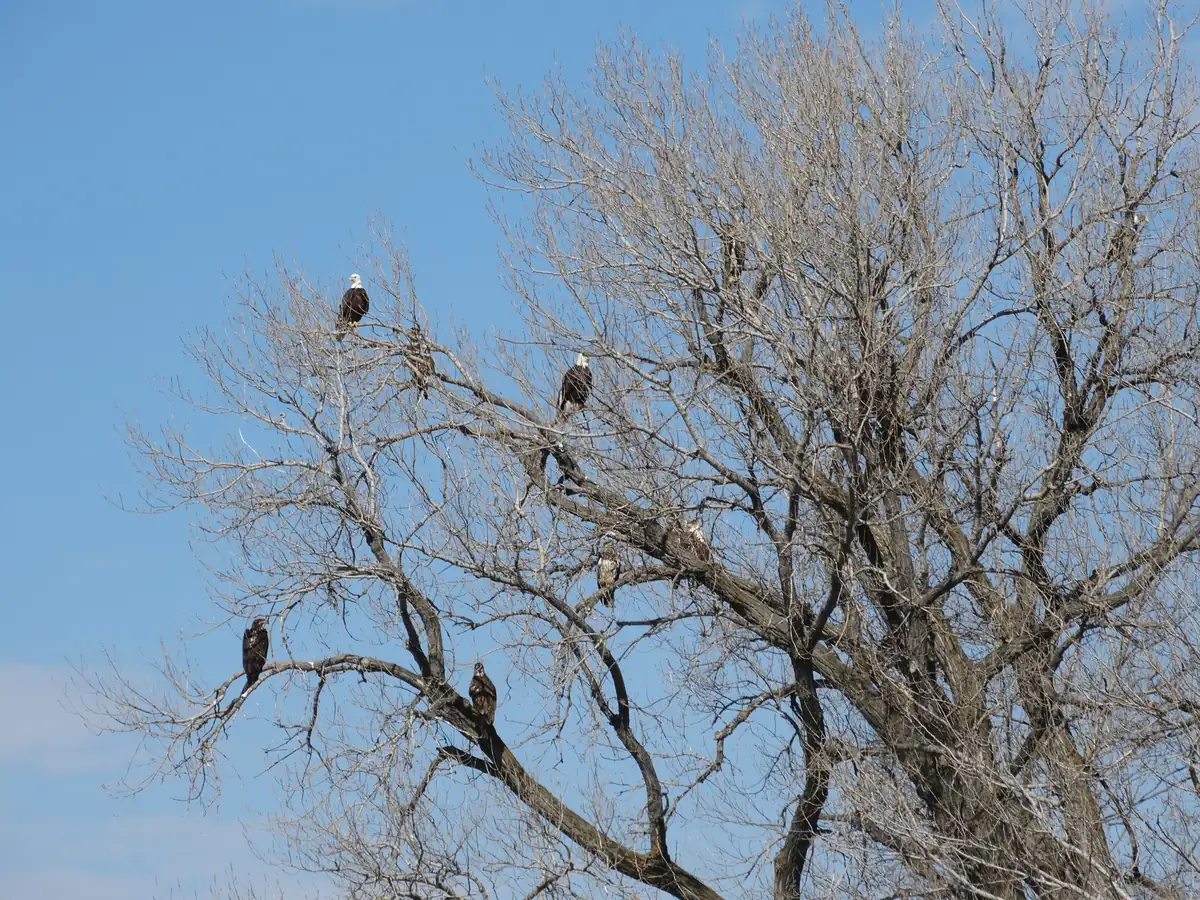
Below the big Missouri River dams. Water pouring through the turbines keeps the river open in the coldest weeks, and that open water, with fish and wintering waterfowl, draws in the eagles. Our November guide to South Dakota covered their arrival; by January the reservoirs upstream are frozen and the birds are packed into a few miles of river below each dam.
-
Fort Randall Dam and the Karl E. Mundt refuge
All winter; most crowded when the reservoirs freeze · Eagle Drive overlook below Fort Randall Dam, near Pickstown
The Karl E. Mundt National Wildlife Refuge was set aside for wintering eagles and stays closed to visitors so they are not disturbed, but an overlook on Eagle Drive below the dam has interpretive panels and a view over the river. The U.S. Fish and Wildlife Service says visitors can watch eagles hunting and squabbling from there, along with white-tailed deer and red-tailed hawks. Bring a spotting scope, stay by the car, and scan the cottonwoods for white heads and the mottled brown of younger birds.
-
Gavins Point and Oahe tailwaters
All winter, most reliably on bitter days · Below Gavins Point Dam near Yankton; below Oahe Dam north of Pierre
South Dakota Birds and Birding rates the river directly below Gavins Point as always good. Game, Fish and Parks’ bald eagle management plan names the night roosts: the Oahe Downstream Recreation Area below Oahe Dam, Randall Creek Recreation Area and the Mundt refuge below Fort Randall, and Chief White Crane Recreation Area below Gavins Point, with large gatherings also reported where the White River joins the Missouri. When the river is mostly iced over, the eagles roost together in a few large, sheltered trees that stay warmer than the open air.
-
The Midwinter Bald Eagle Survey
One day each winter, flown with the waterfowl surveys · The Missouri from the state’s southeastern tip to the end of open water on Lake Oahe
Game, Fish and Parks takes part in the national Midwinter Bald Eagle Survey, and its 2005 plan tabulates results back to 1986. The route runs up the Missouri from the southeastern corner of the state to the last open water on Lake Oahe, usually around Whitlocks Bay. Totals swing widely from winter to winter, which the agency puts down mainly to weather: across the 1986–2004 counts published in its 2005 plan, totals ranged from 58 bald eagles in 1993 to 327 in 1998 (the table below shows the last eleven years). Because the survey covers a single day, the plan cautions that it misses the birds’ substantial shifting within a season.
-
Roost areas closed to vehicles
Winter months · Oahe Downstream, Randall Creek and Chief White Crane recreation areas
To protect the roosts, the 2005 plan lists these areas as closed to vehicles in winter, and the park pages now give the current dates: at Chief White Crane vehicle traffic is barred from November 15 through the last Friday in March, at Randall Creek the campgrounds close to vehicles and campers from November 15 until the third Friday in March, and at Oahe Downstream campgrounds 1 and 2 close to camping from November 15 through the last Friday of March while the day-use area stays open. Walking in is allowed, but the plan asks visitors to come in midmorning, after most eagles have finished feeding, to leave before dusk, to stay a quarter mile from the birds and never to flush them. Resident eagles start nesting about now: the plan describes South Dakota’s nesting season as January through August, with nest buffers on state land from February through August.
| Year | Adults | Immatures | Total bald eagles |
|---|---|---|---|
| 1994 | 226 | 70 | 296 |
| 1995 | 208 | 14 | 222 |
| 1996 | 173 | 34 | 207 |
| 1997 | 136 | 28 | 164 |
| 1998 | 236 | 91 | 327 |
| 1999 | 191 | 100 | 293 |
| 2000 | 113 | 81 | 194 |
| 2001 | 59 | 70 | 130 |
| 2002 | 173 | 61 | 234 |
| 2003 | 158 | 55 | 218 |
| 2004 | 104 | 28 | 140 |
When do great horned owls lay eggs in South Dakota?
In January. South Dakota Birds and Birding puts the great horned owl’s nesting season at January through May, earlier than almost any other South Dakota bird. The hooting duets that started in December now lead to eggs, often laid in a nest that some other bird built.
-
Great horned owls on the nest
Eggs from January; owlets hatch after 4 to 5 weeks · Old hawk, crow and magpie nests in shelterbelts, river woods and farmyards; also cavities, cliffs and old buildings
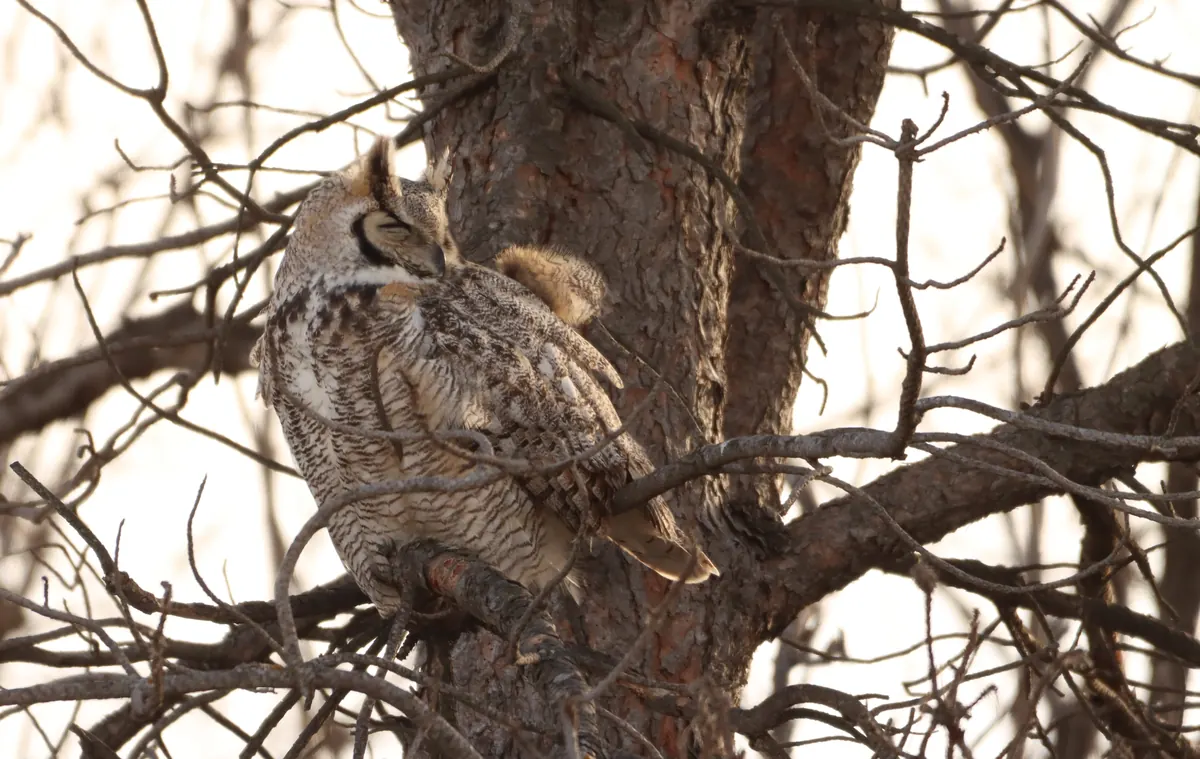
Clutches run from one egg to five, the female handling most of the sitting; hatching takes four to five weeks, with young leaving the nest about six weeks after hatching. Owls do not build their own stick nests, so look in last summer’s red-tailed hawk nests, in the crotches of big cottonwoods, and in barns. A brooding owl often sits through a snowstorm with snow on her back. Watch from a distance with binoculars; an owl flushed off eggs in subzero weather leaves them exposed.
-
Long-eared owls in the cedars
Winter · Dense conifer groves and shelterbelts, statewide
The same source calls the long-eared owl uncommon in every season and notes that in winter several sometimes roost together in a conifer grove. They sit upright and thin against the trunk, tufts raised, and are easy to walk past. Signs are better than searching: whitewash and gray pellets of fur and bone under a thick stand of redcedars or spruce. If you find a roost, back away and keep it to yourself; disturbed owls leave.
Which birds winter on the open water of South Dakota’s rivers and creeks?
Diving ducks that need a hole in the ice, and one songbird that needs a running creek. Wherever water keeps moving, there is food under it.
-
Common goldeneyes
All winter · Below the Missouri River dams and other open water
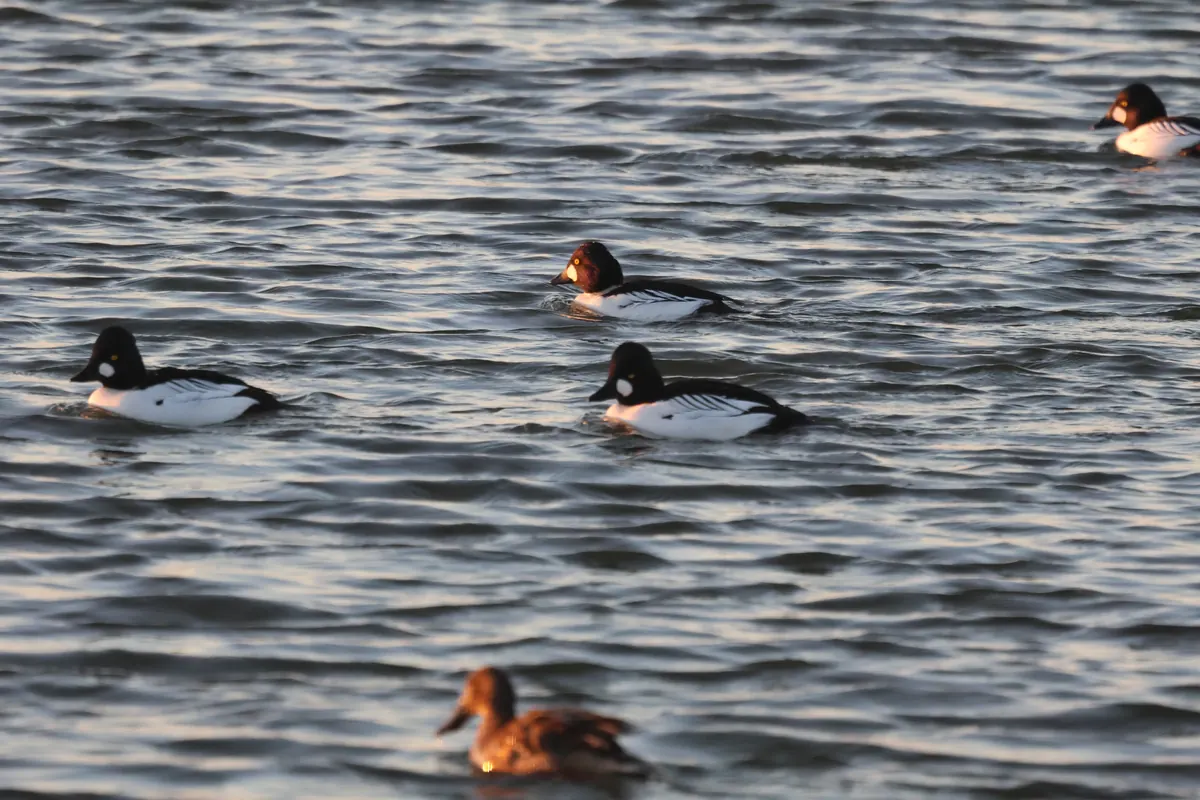
South Dakota Birds and Birding calls the goldeneye common in winter wherever open water is available, such as below the dams. Males are crisp black and white, with a round white spot between the eye and the bill; the wings make a whistling sound in flight. On calm days look for drakes throwing their heads back onto their backs: it is courtship, and it starts long before spring.
-
Common mergansers
All winter · Missouri River tailwaters; any open water elsewhere
The same source lists the common merganser as a common winter resident along the Missouri and uncommon elsewhere. These long, slim diving ducks hunt fish underwater, and below the reservoirs they gather in flocks. Males are white with a dark green head and a narrow red bill; females are gray with a rusty, crested head.
-
American dipper in Spearfish Canyon
Year-round; easiest to spot against snow · Spearfish Creek below Roughlock Falls; Rapid Creek, sometimes inside Rapid City
Uncommon but present all year in the Hills, the dipper is the state’s only songbird that feeds underwater. It needs fast, clear, cold water, feeds by walking along the stream bottom or plunging its head under to flip stones, and can swim to depths of 20 feet. In winter some birds move short distances in search of water that has not frozen. Look for a plump, slate-gray bird bobbing on an ice-rimmed rock; the bobbing gives it away before the color does.
-
Bohemian waxwings and winter finches
Some winters only · Most likely in the Black Hills; also juniper, mountain-ash and crabapple plantings in towns
Bohemian waxwings are irregular winter visitors, locally common some years and absent in others, most numerous in the Black Hills and usually mixed in with cedar waxwings. The Finch Research Network’s forecast for 2026–27 does not single out the Dakotas, and it predicts that heavy mountain-ash fruiting up north will keep most Bohemian waxwings and pine grosbeaks there, with redpolls reaching the western Great Lakes in small to moderate numbers at best. Check ornamental fruit trees anyway: a flock of waxwings, when it comes, is unmissable.
What is a chinook wind, and why do the Black Hills warm up so fast in January?
A chinook is a warm, dry wind coming down the slopes east of the Rockies and around the Black Hills. Air warms as it sinks, and when it scours out a shallow layer of Arctic air the temperature can jump by tens of degrees in minutes. That is why the Rapid City weather office says the Hills earned a name as the “Banana Belt” of the Midwest.
-
Spearfish, January 22, 1943
Anniversary January 22 · Spearfish and Rapid City
According to the National Weather Service in Rapid City, the boundary between bitter Arctic air and milder Pacific air rocked back and forth across the northern Hills that morning. At Spearfish the thermometer went from 4 below zero at 7:32 a.m. to 45 above, a rise of 49 degrees in two minutes. Later it fell from 54 back to 4 below in 27 minutes. Downtown Rapid City warmed from 5 to 54 degrees between 9:20 and 9:40 a.m. Windshields frosted over so drivers could not see, and plate-glass windows cracked.
-
The Banana Belt in the normals
Typical January · Rapid City and the Black Hills compared with the James River valley
The effect shows in the long-term averages. NOAA’s normals give Rapid City an average January high of 36 °F and Aberdeen just 23.7 °F, and Rapid City averages fewer than 6 nights at or below zero against more than 14 at Aberdeen (see the weather table below). Lead, high in the northern Hills, is milder by day still, but buries itself in about 25 inches of January snow.
-
Chinook Days in Spearfish
Annual week in mid to late January · Spearfish
Spearfish marks its record with a week of winter events, from a carnival on the Big Hill trails to a bonfire. In 2026 it ran from January 17 to 24. Visit Spearfish had not announced the 2027 week by early October.
How do bison and other South Dakota animals survive a January cold snap?
By insulation, by saving energy and by getting out of the wind. A January morning in the Hills or on the prairie shows each of these in action.
-
Bison in the snow
All winter · Wind Cave National Park, Custer State Park, Badlands National Park
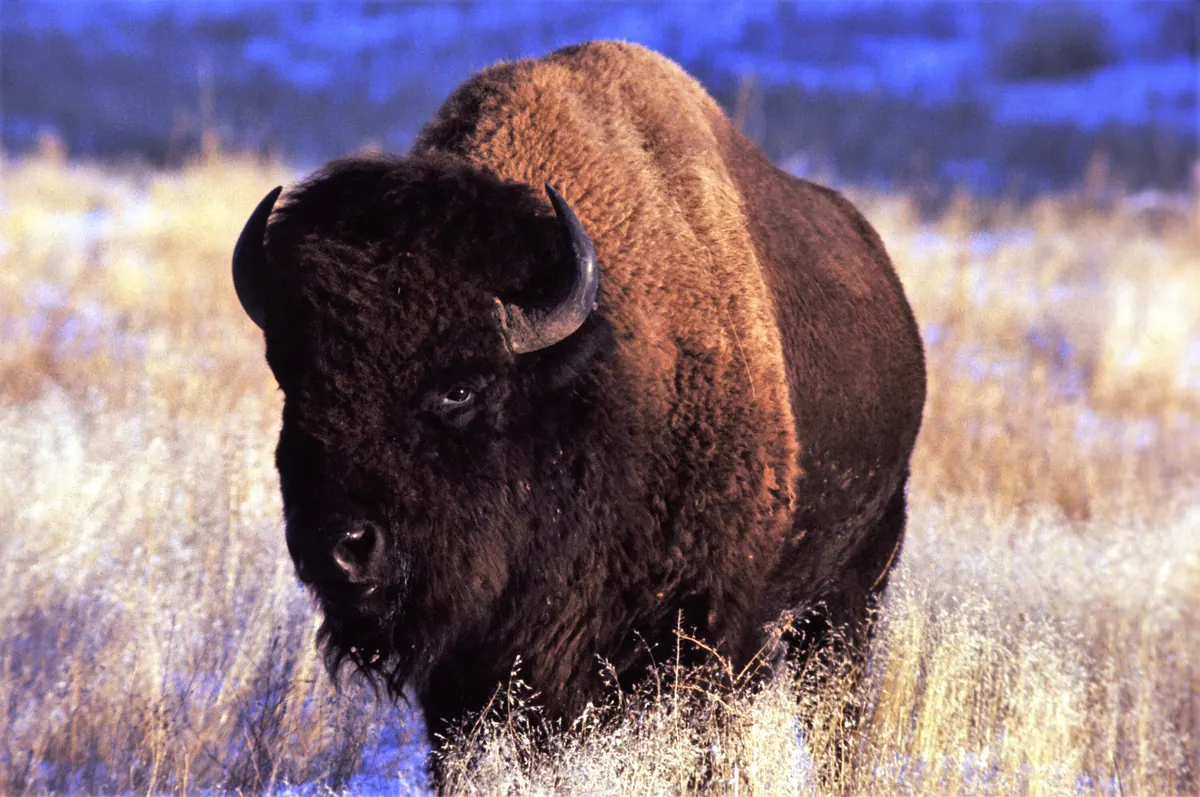
A National Park Service article on bison in winter says their woolly coats insulate so well that snow can settle on a bison’s back without melting. They swing their huge heads from side to side to plow snow off the grass, through drifts as deep as four feet, and they slow their metabolism to need less food. In a storm they turn to face the wind and wait it out. Wind Cave’s herd began with 14 animals from the New York Zoological Gardens in 1913; keep at least 25 yards away.
-
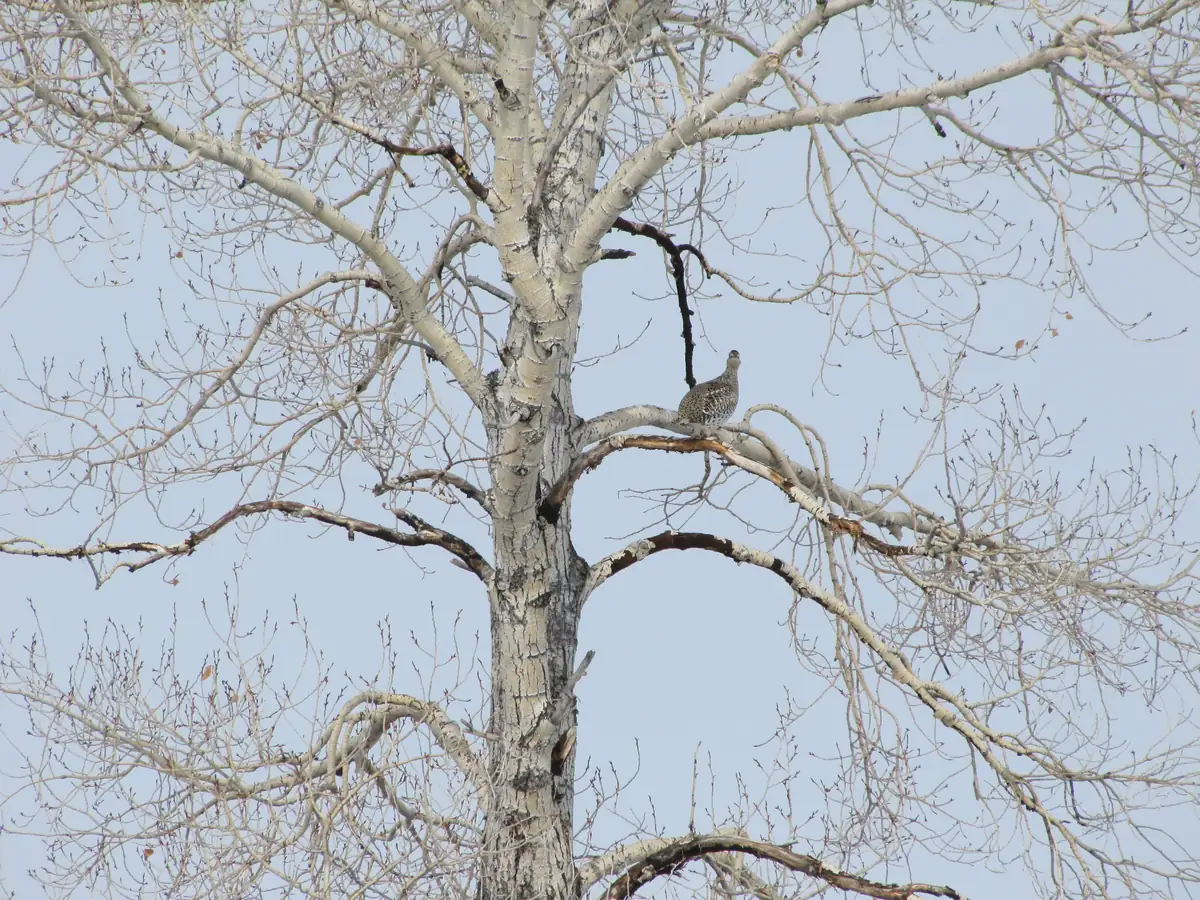
Sharp-tailed grouse in the trees
Winter · Grassland edges with shrubs and trees, central and western South Dakota
Sharp-tails prefer open country in summer, but South Dakota Birds and Birding notes that in winter they move to areas with more trees and shrubs, feed in them, and often roost in them, eating buds, berries, seeds and waste grain. A flock perched in a bare tree along a creek can look like a bunch of brown leaves until one bird flies.
What is happening to South Dakota trees in the middle of winter?
More than it seems. SDSU Extension’s forestry specialist writes a Tree Pest Alert through the winter, and its January 2025 issue (Volume 24, Number 1, covering January 7 to 14) shows how a warm spell sets things in motion.
-
Evergreens losing water
During mild spells · Young spruce, arborvitae and yew in yards and windbreaks
On days in the 40s and 50s, evergreen needles release moisture while the roots, in near-freezing soil, take up very little. The alert calls the result winter desiccation injury and says it shows up only in spring, as browning needles; on young birch, dogwood, linden and maple it appears as twig dieback. Its advice is to water only small trees and shrubs, only when the snow has melted around them and the air is above 40 °F, and only enough that the water does not pool and freeze.
-
Willow catkins that wake too early
Normally late March; occasionally in a warm January · Shrub willows on the sunny south side of houses
In South Dakota the silvery catkins of willows normally open in late March, an early herald of the growing season, but that January 2025 alert reported a few already open on shrub willows against south walls, which act as heat traps on sunny days. If you find one, note the date in your field log. It is a good measure of how mild a winter has been.
-
Emerald ash borer, waiting it out
All winter · Ash trees in eastern South Dakota
The same issue reports emerald ash borer larvae overwintering in a curled, J-shaped form under ash bark, from Dakota Dunes to Milbank. It would take about 35 below zero for at least a day or two to kill many of them, while the tiny wasps released to control the borer die in the 20s below, a much more common event.
-
Bur oak and cottonwood by bark and bud
All winter · River woods in the southeast, the Missouri bottoms, farmsteads and parks
Iowa State Extension describes bur oak with clustered buds covered in fine gray hairs, stout twigs that often grow corky ridges, and dark gray bark that becomes deeply ridged with age. Cottonwood buds, by Missouri State University’s description, are shiny brown and resinous, and old cottonwood bark is gray with thick ridges and deep fissures.
Is the ice safe for fishing on South Dakota lakes in January?
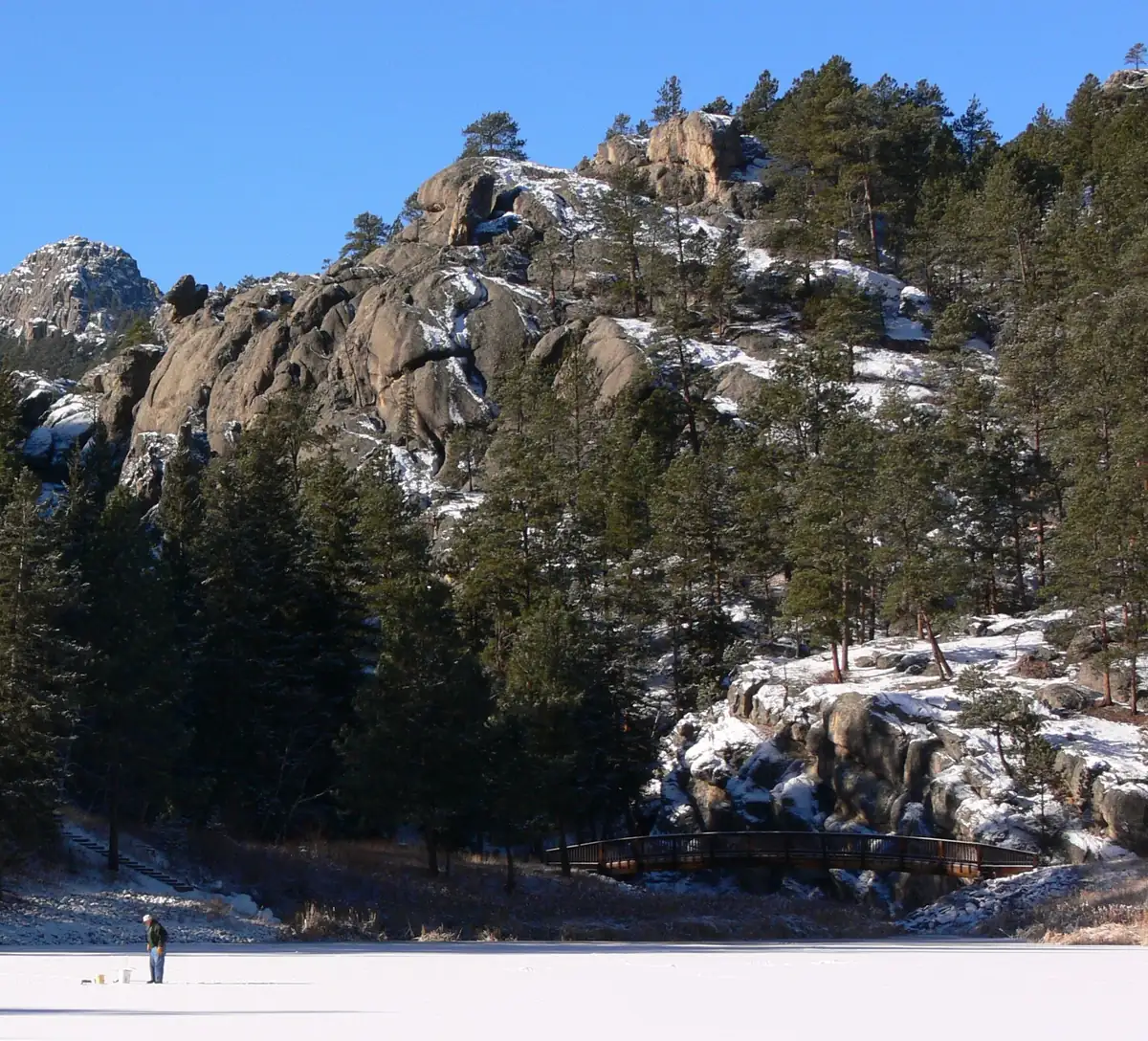
On many lakes January brings the thickest ice of the season, and ice anglers spread across the Glacial Lakes, the Black Hills reservoirs and the quiet bays of the big Missouri River lakes. Thick is not the same as safe, though, and a winter with warm spells is a winter with weak spots.
-
Know the rules on the ice
Through the ice season · Statewide
The 2026 Fishing Handbook allows four lines when fishing through the ice (two on the South Dakota–Minnesota border waters), with up to three hooks per line. Any fish house or shanty left on the ice must show the owner’s name and address on the outside in letters at least two inches tall, though portable shelters taken off the ice each day are exempt. On the border waters, shelters must be off the ice by midnight on March 5.
-
Reading the ice
Every trip · Lakes, ponds and reservoirs
Game, Fish and Parks reminds anglers each winter that no ice is fully safe, and the usual guideline, spelled out by the Minnesota Department of Natural Resources next door, is at least four inches of new, clear ice for walking or fishing. The National Weather Service notes that clear ice usually beats white snow ice for strength and that thickness varies over short distances, so drill test holes as you go and avoid inlets, springs, thawed patches and the current below the dams. Our November page for South Dakota covers how lakes freeze in the first place.
Carry ice picks around your neck, a rope, and a flotation vest or float coat, and tell someone where you are going.
How cold is January in South Dakota, and what might a strong El Niño change?
January is the heart of winter: the coldest month on average at every station in the table below. NOAA’s 1991–2020 normals put average lows in the single digits across the James River valley and the northeast (1.9 °F at Aberdeen), and Aberdeen and Watertown each average 23 to 24 days whose high stays at or below freezing. West River is drier and milder by day; Rapid City averages just 5.3 inches of January snow. The northern Black Hills are the snowy exception, with 24.8 inches at Lead.
| Station | Average high | Average low | Snowfall | Lows at or below 0 °F | Highs at or below 32 °F |
|---|---|---|---|---|---|
| Lead (northern Black Hills) | 38.3 °F | 17.7 °F | 24.8 in | 4.2 days | 10.4 days |
| Rapid City Regional Airport | 36.0 °F | 12.7 °F | 5.3 in | 5.9 days | 11.2 days |
| Pierre Regional Airport | 29.0 °F | 9.3 °F | 5.1 in | 8.3 days | 16.6 days |
| Aberdeen Regional Airport | 23.7 °F | 1.9 °F | 7.8 in | 14.4 days | 22.7 days |
| Watertown Regional Airport | 21.4 °F | 3.1 °F | 6.7 in | 13.6 days | 23.7 days |
| Huron Regional Airport | 25.8 °F | 6.2 °F | 7.8 in | 11.1 days | 20.4 days |
| Sioux Falls (Foss Field) | 27.2 °F | 8.5 °F | 8.0 in | 10.4 days | 19.9 days |
Pacific warming is the wild card. In their September 10 discussion, federal ENSO forecasters put the odds of El Niño peaking at very strong levels this winter at over 90 percent. The state climatologist, interviewed a few days later, expected above-normal warmth overall but said storms and hard cold snaps will still come; she saw no clear lean toward wet or dry, and warned that snow cover may melt off quickly between storms, with perhaps more rain than usual. In the strong El Niño of 2015–16, the Aberdeen weather office logged December through February at 3 to nearly 8 degrees above normal across its area. Look for NOAA’s latest monthly update of its October 15 winter outlook on the CPC 90-day outlook site. Our local forecast page covers the days ahead, and our South Dakota freeze-date tables count down to the end of the frost season.
How much daylight does South Dakota gain in January?
Between 51 and 57 minutes, depending on latitude, with roughly two-thirds of it added at the evening end. Sunrise barely moves in early January: Pierre’s stays at 8:17 a.m. from late December to about January 9, and Rapid City’s holds at 7:28 a.m. MST for most of the first week. Sunset, meanwhile, slides later every day. Rapid City’s first sunset at or after 5 p.m. MST comes on January 30, while Sioux Falls, on Central time, sets at 5:01 p.m. on New Year’s Day and at 5:37 p.m. on the 31st.
| City | Jan 1 | Jan 31 | Gained | Per day |
|---|---|---|---|---|
| Lemmon | 8 h 44 m | 9 h 41 m | 57 min | 1.9 min |
| Aberdeen | 8 h 47 m | 9 h 43 m | 56 min | 1.9 min |
| Watertown | 8 h 52 m | 9 h 46 m | 54 min | 1.8 min |
| Pierre | 8 h 56 m | 9 h 48 m | 52 min | 1.7 min |
| Rapid City | 8 h 57 m | 9 h 50 m | 53 min | 1.8 min |
| Mitchell | 9 h 00 m | 9 h 52 m | 52 min | 1.7 min |
| Sioux Falls | 9 h 01 m | 9 h 53 m | 52 min | 1.7 min |
| Yankton | 9 h 05 m | 9 h 56 m | 51 min | 1.7 min |
To time an eagle watch around the last light, look up your town in our sunrise and sunset tool.
What can you see in the South Dakota night sky in January 2027?
January brings a good meteor shower under dark skies, 2027’s nearest full moon and a dazzling Venus at dawn. Times are given in CST; for the Black Hills and the rest of the state on Mountain time, take off one hour.
-
The Quadrantids
Night of Sunday, January 3, into Monday morning, January 4 · Anywhere dark; radiant low in the north-northeast in the evening, climbing toward dawn
This shower has a short, sharp peak, and forecasters disagree slightly on its timing: the American Meteor Society points to about 9:30 p.m. CST on the 3rd, EarthSky to about 11:47 p.m. Its radiant point lies in the north, scraping the horizon after dusk and riding higher as the night wears on, which tilts the odds toward Monday’s predawn darkness. Only a thin waning crescent moon rises a few hours before sunrise, and from a dark site you could see dozens of meteors an hour.
-
Perihelion and Venus at its farthest
Saturday, January 2, and Sunday, January 3 · Venus in the southeast before sunrise
Perihelion, our nearest approach to the sun for the year, falls at 8:33 p.m. CST on January 2, at about 91.4 million miles. Our cold comes from the low winter sun, not from distance. Sunday the 3rd puts Venus at its widest morning gap from the sun (47°), a white lamp over the southeastern horizon at dawn.
-
The Wolf supermoon
Full at 6:17 a.m. CST (5:17 a.m. MST), Friday, January 22 · Rising in the east-northeast at dusk on the 21st, setting in the west-northwest at dawn
About 222,229 miles away, this is the closest full moon of 2027, with perigee coming roughly 14 hours before full. Thursday night, the 21st, is best, with Friday evening a close second. The next evening, the 23rd, the moon passes close to Jupiter and the star Regulus in Leo.
-
Mercury in the dusk, Saturn fading
Late January into early February · Low in the west-southwest after sunset
In the last days of January, Mercury can be picked out in bright twilight, west-southwest and close to the horizon, roughly half an hour after sundown; February 3 marks its widest evening gap from the sun. Saturn, in the southwest at nightfall, drops lower week by week. Moonless evenings, January 3–12, suit faint stars and, if the sun flares, aurora; NOAA’s Space Weather Prediction Center posts short-range forecasts.
| Phase | Date | Time |
|---|---|---|
| New moon | Thursday, Jan 7 | 2:24 p.m. CST (1:24 p.m. MST) |
| First quarter | Friday, Jan 15 | 2:34 p.m. CST (1:34 p.m. MST) |
| Full moon (Wolf Moon, a supermoon) | Friday, Jan 22 | 6:17 a.m. CST (5:17 a.m. MST) |
| Last quarter | Friday, Jan 29 | 4:55 a.m. CST (3:55 a.m. MST) |
Check the cloud forecast before heading out on a cold night, and the moon pages list when the Wolf Moon rises and sets where you live.
What can South Dakota families do outdoors in January 2027?
- Friday, January 1: First Day Hikes. This national program puts on guided New Year’s walks in state parks, and South Dakota parks have taken part before. None were posted for 2027 when we checked; search Go Outdoors South Dakota after Christmas.
- Saturday, January 2: the Canton Christmas Bird Count, the last South Dakota count on the South Dakota Ornithologists’ Union calendar, around Canton near Newton Hills State Park. Count season closes on January 5; Audubon’s circle finder lists any other circle still counting, with the compiler’s contact.
- Wednesday, January 6: Little Acorns, “Skunks,” at Good Earth State Park in Sioux Falls, starting at 10 a.m. for children 3 to 5, with a story, activity, craft and game. Registration closes at noon on January 1, and space is limited to 20.
- Mid to late January: Chinook Days in Spearfish, the town’s annual winter week around the January 22 anniversary of its record. Dates for 2027 were not out yet; check Visit Spearfish.
- Any day: Wind Cave. Through April 24 the visitor center is open daily from 8 a.m. to 4:30 p.m. Mountain time, with the Garden of Eden tours at 10 a.m. and 3 p.m. and a Fairgrounds tour at 1 p.m. Book on Recreation.gov; the cave is a steady 54 °F.
- Any snowy morning: measure it. CoCoRaHS volunteers of all ages measure rain, hail and snow at home and report it daily, which takes about five minutes.
- All month: count birds. Project FeederWatch keeps going through the winter, and eagle, owl and dipper sightings belong in eBird.
Programs inside state parks require an entrance license. More seasonal guides for South Dakota and other states are on our nature guides index, and young naturalists can log their finds in the Naturalist’s Field Journal.
Safety notes for January in South Dakota
- Hunting seasons still open in January. According to Game, Fish and Parks’ 2026–27 season table, pheasant, quail, grouse, partridge and fall turkey run to January 31, ducks until January 5 (Low Plains South) or 14 (High Plains), and light geese and tundra swans through January 8; Canada goose season in Unit 2 lasts until February 14. The muzzleloader and the youth and mentored deer seasons end on January 1, the Custer State Park trophy bison hunt on January 15, and archery deer season on January 17. Bobcat season runs from December 26 to February 15, and the Black Hills mountain lion season opened December 26 and lasts to April 30 unless the limit is reached first. Cottontails and squirrels are open to March 31, and coyotes and foxes year-round. Firearm hunters after big game (turkey and mountain lion are exempt) must wear at least one fluorescent orange or pink outer garment above the waist. On public land, wear something bright yourself.
- Wind chill. Wind turns a zero-degree morning into a wind chill of minus 19 at just 15 mph, the Weather Service says, and bare skin can then freeze within half an hour. Frostbite needs air below freezing, but hypothermia does not.
- Fast changes West River. The 1943 chinook was extreme, but sharp warmups and crashes still come with little warning. A thaw followed by a freeze glazes roads and weakens ice, so check the forecast morning and evening.
- Ice. Four inches of new, clear ice is the least anyone should walk on, and the open channels below the dams never freeze safely. Keep children and dogs off river ice entirely.
- Short days. Most of the state still sees sunset well before 6 p.m. all month, so plan to be off the trail and the ice before dark, pack a headlamp, and stow blankets, snacks, a shovel and a charger in your vehicle.
Sources
- U.S. Fish and Wildlife Service: Karl E. Mundt National Wildlife Refuge, wildlife viewing (Eagle Drive overlook)
- South Dakota Game, Fish and Parks: Bald Eagle Management Plan, 2005 (midwinter survey results, winter roosts, nesting season, roost closures, visitor guidance)
- South Dakota Game, Fish and Parks: Chief White Crane Recreation Area (vehicle closure November 15 through the last Friday in March)
- South Dakota Game, Fish and Parks: Randall Creek Recreation Area (campground closure November 15 through the third Friday in March)
- South Dakota Game, Fish and Parks: Oahe Downstream Recreation Area (campgrounds 1 and 2 closed November 15 through the last Friday of March)
- South Dakota Birds and Birding: bald eagle
- South Dakota Birds and Birding: great horned owl (nesting January through May)
- South Dakota Birds and Birding: long-eared owl
- South Dakota Birds and Birding: common goldeneye
- South Dakota Birds and Birding: common merganser
- South Dakota Birds and Birding: American dipper
- South Dakota Birds and Birding: Bohemian waxwing
- South Dakota Birds and Birding: sharp-tailed grouse
- Finch Research Network: Winter Finch Forecast 2026–2027 (September 25, 2026)
- National Weather Service Rapid City: the Black Hills temperature changes of January 22, 1943
- Visit Spearfish: Chinook Days (2026 dates, January 17–24)
- National Park Service: Bison Bellows, the winter survivor
- National Park Service, Wind Cave: bison (herd history, safe distance)
- National Park Service, Wind Cave: guided cave tours (winter schedule November 1, 2026, to April 24, 2027)
- SDSU Extension: Tree Pest Alert, Volume 24, Number 1 (January 7–14, 2025 issue: winter desiccation, willow catkins, emerald ash borer)
- Iowa State University Extension and Outreach: bur oak
- Missouri State University, Darr College of Agriculture: eastern cottonwood
- South Dakota Game, Fish and Parks: 2026 Fishing Handbook (ice lines, shelter marking, border water removal date, spearing seasons)
- Minnesota Department of Natural Resources: ice thickness guidelines (4 inches of new clear ice for walking or ice fishing)
- Sioux Falls Live: Game, Fish and Parks ice safety tips for anglers (January 24, 2025)
- KXLG: No ice is 100% safe, Game, Fish and Parks guidelines for ice fishing
- National Weather Service Caribou: ice safety (clear ice versus snow ice, variable thickness)
- NOAA NCEI: U.S. climate normals, 1991–2020
- NOAA NCEI: 1991–2020 monthly normals station files (Lead USC00394834, Rapid City USW00024090, Pierre USW00024025, Aberdeen USW00014929, Watertown USW00014946, Huron USW00014936, Sioux Falls USW00014944)
- NOAA NCEI: monthly normals documentation (definitions of day-count variables)
- NOAA Climate Prediction Center: ENSO diagnostic discussion, September 10, 2026
- NOAA Climate Prediction Center: seasonal outlooks (winter outlook issued October 15, 2026)
- Rapid City Post: state climatologist on the coming El Niño winter (September 14, 2026)
- National Weather Service Aberdeen: meteorological winter 2015–2016 in review
- National Weather Service: wind chill chart
- U.S. Naval Observatory: phases of the moon
- U.S. Naval Observatory: Earth’s seasons and apsides, 2027 (perihelion)
- U.S. Naval Observatory: sun and moon rise and set for one day
- Fred Espenak: Sky Event Almanac 2027 (Venus elongation, Mercury, Moon–Jupiter pairing)
- American Meteor Society: meteor shower calendar (Quadrantids)
- EarthSky: Quadrantid meteor shower
- EarthSky: what is a supermoon? (2027 list)
- NOAA Space Weather Prediction Center: aurora 30-minute forecast
- South Dakota Game, Fish and Parks: 2026 Hunting and Trapping Handbook (2026–27 season table, furbearer seasons, fluorescent orange or pink rule)
- Go Outdoors South Dakota: statewide event and class search
- Go Outdoors South Dakota: Little Acorns, Skunks, Good Earth State Park, January 6, 2027
- South Dakota Ornithologists’ Union: calendar (Canton CBC January 2, 2027)
- National Audubon Society: Christmas Bird Count (December 14 to January 5)
- America’s State Parks: First Day Hikes
- CoCoRaHS: Community Collaborative Rain, Hail and Snow Network
- Project FeederWatch: project overview
- Photos via Wikimedia Commons; licenses and photographers are credited under each picture
.jpg)