What to look for in nature in South Dakota this May
May is the month the plains finish waking up. Pelicans crowd island rookeries at Lacreek, piping plovers scrape nests on posted Missouri River sandbars, prairie dog pups begin to peer out of their burrows, and bison calves trail their mothers through the Hills and grasslands. The last spring freeze finally releases the eastern half of the state, the first night sky of the month brings the Eta Aquariid meteors under a new Moon, and the full Moon on the 20th wears two names, Flower and seasonal Blue. Storms are building too, with hail and tornado season ramping up toward its June peak. Days stretch by more than an hour across the month, and the evening gets just long enough to listen to toads.
Other months in South Dakota: October, November, December, January, February, March, April.
Start here

- Watch a pelican colony from a distance. Lacreek National Wildlife Refuge says visitors see thousands of white pelicans on its islands in late April and early May. Bring binoculars, keep to the marked roads, and ask the refuge about conditions after rain.
- Sit by a prairie dog town at dawn or dusk. Pups begin to leave their burrows from May to early June, according to the Park Service. Stay in the car or well back, and look for burrowing owls on the mounds.
- Get up before dawn for the Eta Aquariids. The best mornings are May 5 to 7, with a new Moon on the 6th, and the number of meteors is lower the farther north you are. Face east, dress warmly and give it an hour.
Several plates of the Naturalist’s Field Journal fit May well. Use birds-I-have-seen for the pelicans, phalaropes and orioles, nest-observed for a bluebird box, and mammal-watch for pups and calves. A same-place-twice page can set a pasque flower in bloom beside the same patch gone to seed, while dusk-and-dawn-watch suits a toad evening or a meteor morning, and the daily field log can record the swing from frost to thunderstorm.
Regions used below: Black Hills; West River prairie and the Badlands; Missouri River and the big reservoirs; Glacial Lakes and the northeast; Southeast and Sioux Falls.
Which birds arrive in South Dakota in May?
May is when the prairie fills with voices. Waterbirds crowd the lakes, shorebirds work the shallow wetlands, and songbirds sing from shelterbelts and cattails. Most of the state’s standard references describe these species by season, not by calendar date, so the windows below are loose ones and the weather will shift them from one year to the next.
-
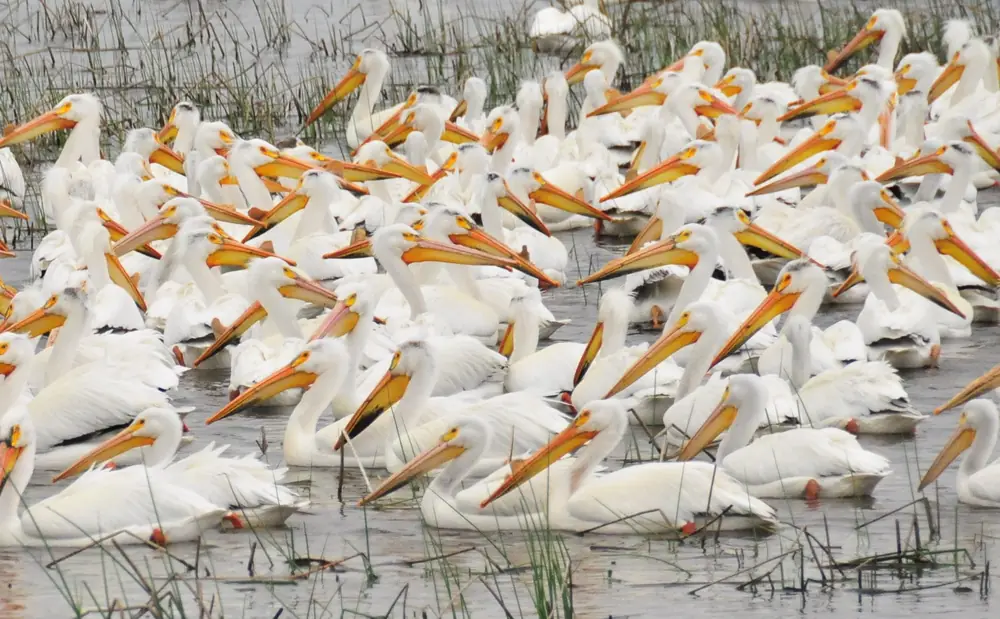
Thousands of white pelicans at Lacreek
Late April and early May, according to the refuge · Pelican Island Trail, about 2.5 miles north of the Lacreek visitor center, near Martin
The Fish and Wildlife Service says that during late April and early May visitors will see thousands of white pelicans on the islands of this southwestern refuge. The same page lists great blue heron, snowy and cattle egret, double-crested cormorant and black-crowned night heron rookeries on the islands, and names long-billed curlews, burrowing owls, short-eared owls, northern harriers and bobolinks among the birds that come back in spring. South Dakota Birds and Birding adds that pelicans migrate mainly in April and May in the east, nest in colonies on isolated islands and sandbars, and fish as a team: groups line up and herd fish into the shallows. The refuge’s auto tour is a 4.5-mile gravel route, and the page warns that road conditions deteriorate quickly after rain or snowmelt, so ask refuge headquarters before you drive on a wet day.
-
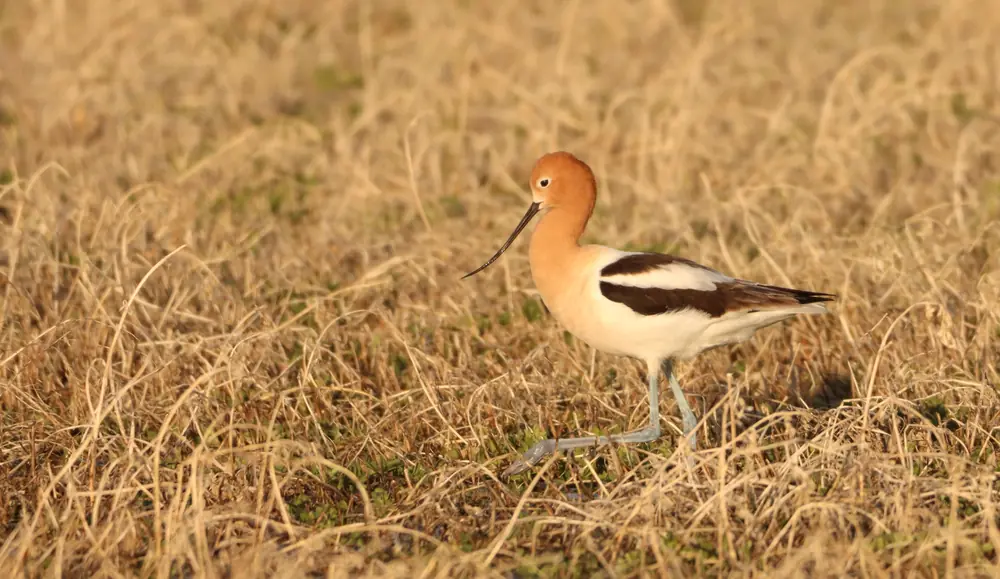
Wilson’s phalaropes and avocets in shallow wetlands
May, with nesting from late May · Prairie wetlands and flooded fields, most of the state
The Wilson’s phalarope is the bird to learn if you like a good story. South Dakota Birds and Birding calls it a common summer resident through most of the state, a bird of shallow prairie wetlands that feeds by spinning in circles to bring tiny prey to the surface. The roles are reversed: the female is the brighter bird, and after she lays her eggs she leaves, and the male incubates and guards the young alone. Nesting runs from late May into June. American avocets are common migrants and summer breeders in most of the state, according to the same site, which says to look for them in flooded fields during migration, and nesting there runs from May into July. Stand quietly at a wetland edge with binoculars and you may see both in one scan.
-
Yellow-headed blackbirds and yellow warblers
Arriving in spring; nesting late May and June · Cattail marshes, shelterbelts and willow thickets
Yellow-headed blackbirds are birds of the prairie pothole country. South Dakota Birds and Birding describes them nesting in colonies over water, with the female weaving a deep basket among cattails in late May and June, and the male giving a harsh, harsh, rough song from the stems. Yellow warblers, which that site calls common summer residents across much of the state, favor riparian thickets, wetlands and shelterbelts, and the site gives May through July as their nesting season. The American redstart is a common migrant throughout the state and a common breeder in the west, and the same source says it often forages low enough to be easy to watch. A shelterbelt on a mild morning in the middle of the month is a good place to practice.
-
Orioles, hummingbirds and feeders
Early to mid-May in the east, with big differences from year to year · Eastern South Dakota towns, parks and shelterbelts
South Dakota Birds and Birding rates the Baltimore oriole a common migrant and breeder in the east, scarcer farther west, nesting there from mid-May, with a preference for open woodland, river edges and shelterbelts. The ruby-throated hummingbird is the only hummingbird commonly found in the eastern half of the state. The site’s author reports that the birds reach his own yard around May 7 each year, which is one observer’s experience and not a statewide date, so watch for the first arrival where you live and log it. Sugar water at a clean feeder, orange fruit for orioles, and tubular red flowers are the usual invitations. Journey North collects hummingbird sightings from across North America, and a report with your date helps the picture build.
-
Bluebirds, buntings and sandpipers on the western grassland
May · West River grassland, the Black Hills foothills and Custer State Park
The Mountain Bluebird is a fairly common summer resident of western and central South Dakota, and the site names Custer State Park and the Wildlife Loop Road, grassy openings among ponderosa pines, and fencelines as places to look. Nesting runs from May through July. The species takes to a nest box set on a fence post in open ground, with a hole about 1¾ inches wide, and boxes close to buildings often end up occupied by house sparrows. Out on the shortgrass, the lark bunting is a locally common summer resident of the western and central prairie, and the site says it is most likely in the western half of the state. Upland sandpipers, which the same source says can be found easily on native grassland and hayfields, with Fort Pierre National Grassland a good place to look, nest from late May into July. In the Black Hills, the western tanager is most often found in conifer forest, and its nesting season is June and July, so May is mostly about migrants passing through.
World Migratory Bird Day happens in both May and October. The organizers show May 9 for the spring event in 2026 and no 2027 dates on the page we read, so look at worldmigratorybirdday.org and ask your nearest refuge or Audubon chapter about programs.
Where do piping plovers and least terns nest in South Dakota in May?
Two of the state’s rarest nesting birds raise their young on bare sand beside the Missouri River, and May is when the scrapes appear.
-
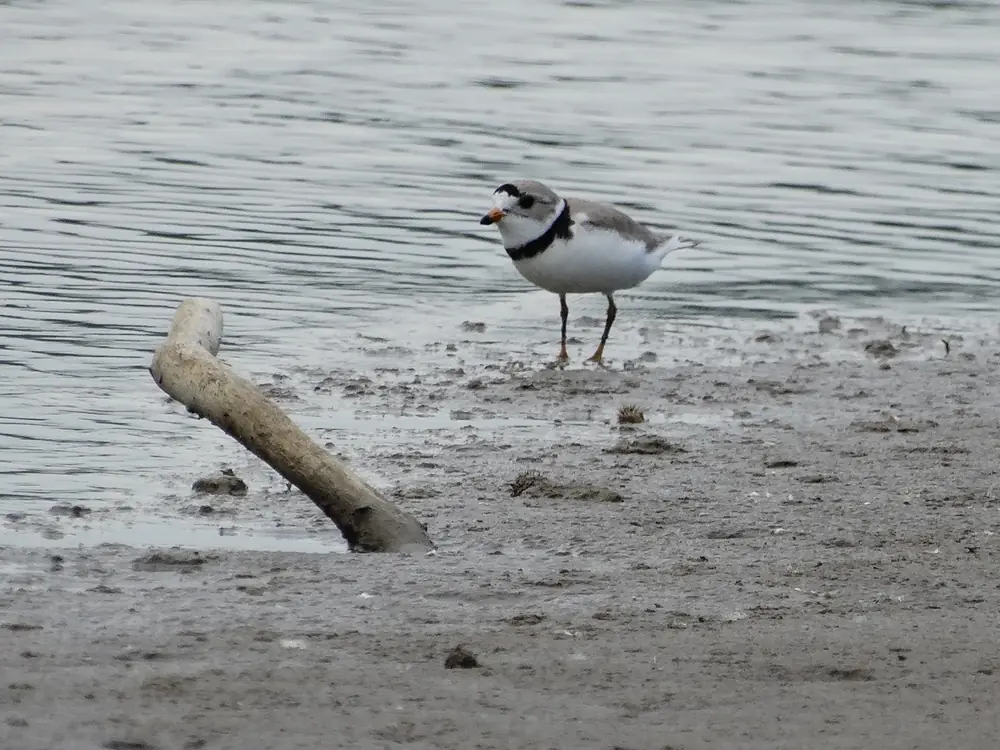
Piping plovers and the sandbar signs
Nesting begins in early May, says the Park Service · Missouri National Recreational River, below Gavins Point Dam, and North Alabama Bend near Vermilion
The National Park Service says plovers are on their Missouri River breeding grounds from April through August and that nesting begins in early May, with three or four eggs that hatch in about 28 days. South Dakota Birds and Birding calls the piping plover an uncommon summer breeding resident and says most of the state’s birds are below Gavins Point Dam in the far southeast, with North Alabama Bend, southwest of Vermilion, a good place to look. The Park Service notes that the birds are highly sensitive to people and that nesting areas are posted with black-and-white signs, with warnings at boat ramps and water access points. The practical rule is simple: if you see the signs, stay off that stretch of sand, keep dogs leashed and watch from the water at a distance.
-
Least terns, a local specialty
Nesting runs May through July · Missouri River sandbars along the Nebraska border
South Dakota Birds and Birding describes the least tern as an uncommon and local summer resident that breeds on Missouri River sandbars, mostly on the lower river along the Nebraska border, where the free-flowing stretch below Gavins Point Dam still has wide sandbars. Nesting runs from May through July, and the site says dams have submerged much of the habitat and that water regulation can cause nesting failures. If you want to see a tern, bring a spotting scope and look for a small, fast bird with a yellow bill hovering over a side channel.
These are species that depend on people leaving them alone. A good photograph of a plover is never worth a flushed nest on a hot afternoon.
What young animals can you see in South Dakota in May?
The grass is green, the days are long, and the babies are out. May is the best month of the year for mammals with young, and the best way to enjoy them is from a long way off.
-
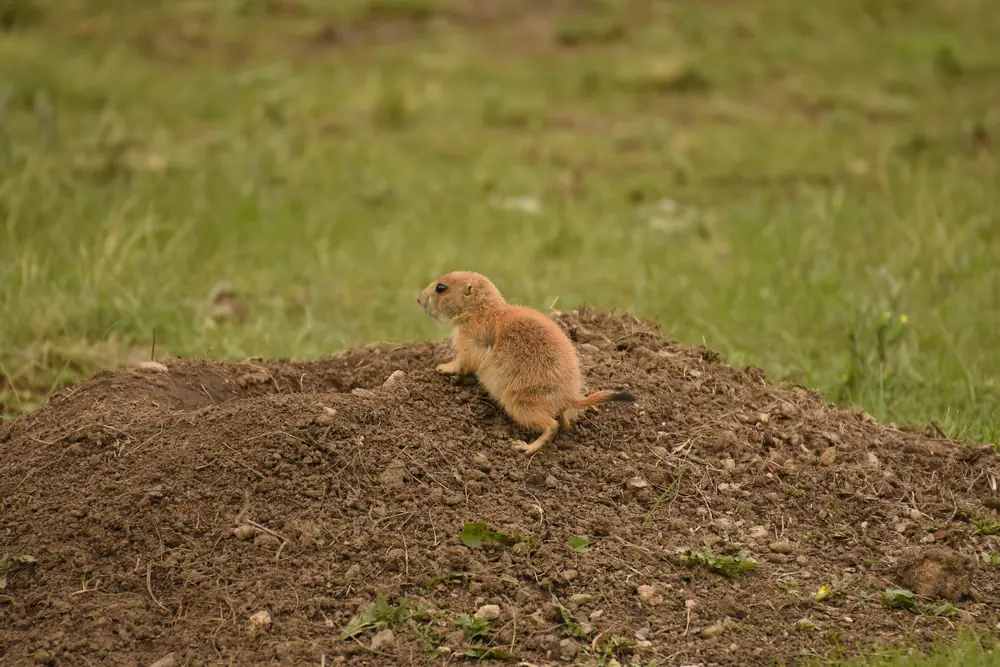
Prairie dog pups above ground
May to early June, per the Park Service · Badlands, Wind Cave, Lacreek and the national grasslands
The Park Service says black-tailed prairie dogs breed in March and April, with young born four to five weeks later in litters of two to eight, and that from May to early June the pups begin leaving their burrows. A pup’s first days above ground look like a game of peek-a-boo, with a head at the burrow mouth and a retreat at the first alarm call. A warning cry sends neighbors diving into their burrows, and predators the Park Service lists include coyotes, bobcats, eagles, hawks and badgers. Sit in a car or on a camp chair a good distance from a town and the colony will resume its business within minutes.
-
Burrowing owls and black-footed ferret kits
May and June · Prairie dog towns in western South Dakota
South Dakota Birds and Birding says burrowing owls nest in prairie dog burrows from May through July and that the species is uncommon to common in western South Dakota in summer; the Fort Pierre and Buffalo Gap National Grasslands both have extensive prairie dog towns. The black-footed ferret, which depends on prairie dogs for about 90 percent of its diet, mates in March and April, and with a gestation of 41 to 43 days the kits arrive around May. Newborn kits are blind and stay underground until about two months old, according to the Park Service, so the chance that a visitor sees one in May is very small. Badlands National Park puts the park’s ferret population at about 120, about 80 of them in the Conata Basin area.
-
Bison calves at Wind Cave and Custer
Generally April or May · Wind Cave National Park, Custer State Park and the Badlands
The Park Service says bison calves at Wind Cave are generally born in April or May, and that this is also the season when the animals rub off their winter coats on signs, fence posts and trees. The same page tells visitors to keep 25 yards or more between themselves and a bison and warns that raised tails, bluff charges, pawing and snorting mean the animal has had enough. Custer State Park’s rule is to stay in the vehicle or keep 100 yards away from bison and elk. The two numbers come from two different parks, so follow what is posted where you are and lean toward the larger one.
-
Bats are back in the Hills
Warm evenings from May · Jewel Cave and Wind Cave areas of the southern Black Hills
The Park Service says hoary bats, silver-haired bats and eastern red bats are summer residents of Jewel Cave National Monument, and that seven other bat species use the cave all year. The monument’s historic entrance is closed to entry from October through May to protect hibernating bats. Its midwinter count in 2023 and 2024 found 602 bats, 831 fewer than in 2018, and the Park Service says it does not know why, possibly white-nose syndrome or movement within the cave. The page gives no return dates, so I have none to offer. Look at dusk for dark shapes over a parking lot or a pond, and if one lands in your home, call the park or GFP before you try to move it.
-
Mountain goats, bighorns and fawns
Young appear from late spring · Black Hills granite and Badlands buttes; deer everywhere
Game, Fish and Parks describes the Black Hills mountain goats as an introduced population present since the 1920s, living on granite outcrops between 4,000 and 7,242 feet in a range that runs from Highway 385 near Crazy Horse to Mount Rushmore and south of Harney Peak toward the Needles. The Badlands has about 250 bighorn, according to the Park Service, which also pictures a ewe with two lambs on a butte. The agencies we read do not give birth dates for kids, lambs or fawns, so treat the late-spring timing as general. Whatever the species, the sound advice for a young animal alone is to leave it: a still fawn in the grass has typically been left there on purpose while the doe feeds elsewhere. Take your photograph from where you stand and walk on. For a real injury, call Game, Fish and Parks at 605-223-7660.
What blooms in the Black Hills and on the prairie in May?
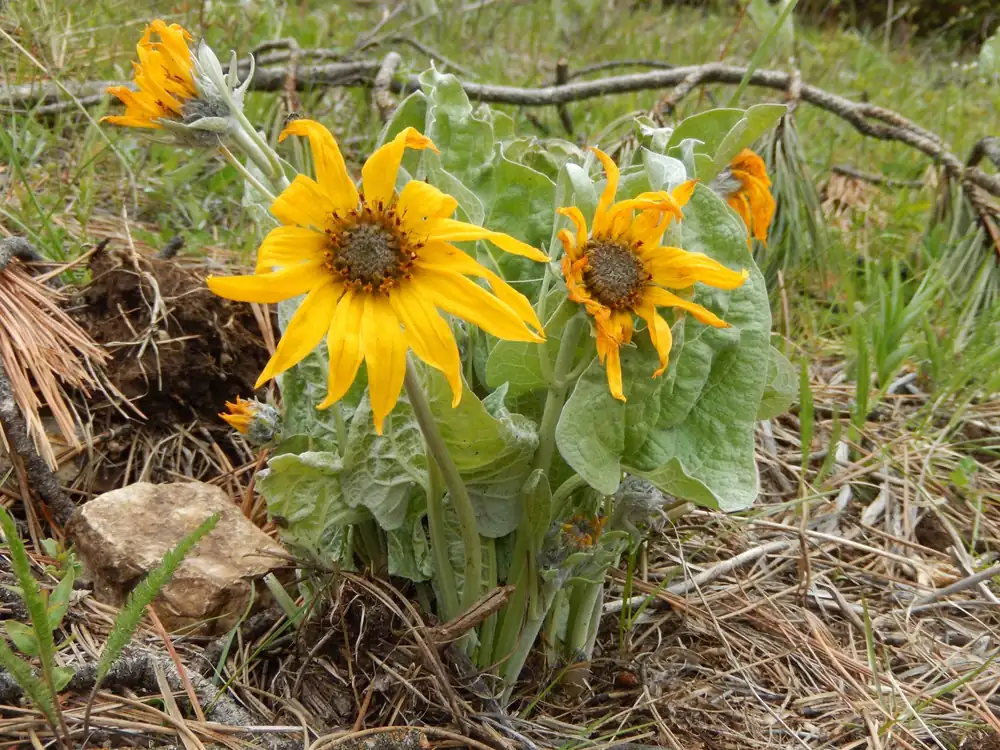
The Park Service says Wind Cave’s peak wildflower season runs from mid-May through early July, so the month is the start of the long show, with the earliest species fading as new ones open.
-
The Black Hills spring group
Spring into early summer, with varied timing by elevation · Open pine forest, meadows and limestone slopes in the Hills
The Forest Service lists a spring-to-early-summer group that includes arrowleaf balsamroot, with large arrow-shaped leaves and big yellow flowers on higher limestone slopes in the west and northwest Hills, darkthroat shootingstar, with nodding purple flowers and a sweet, clove-like scent, early cinquefoil, goldenpea, heartleaf arnica and Rocky Mountain iris, whose large light-purple flowers grow in moist meadows and open forests. Kinnikinnik, a mat-forming evergreen, carries white to pink urn-shaped flowers, and the star lily puts out white flowers at ground level on prairie and open pine ground. The page does not give bloom months for each plant, so a walk at the end of May will find more open flowers than one at the start.
-
Pasque flowers have gone to seed
May · Prairie hillsides and open pine forest
In the Forest Service’s words, the pasque flower is among the first flowers of early spring. By May, expect to find some plants already turning to seed, with later bloom on cooler slopes higher in the Hills. If you photographed the flower in March or April, May is the month for the same-place-twice page of a field journal: return to the spot and see what has changed.
Which toads and frogs call in South Dakota in May?
The earliest frogs are done by now, and the later breeders take over. Several of them wait for rain, so a warm, wet night is worth a walk.
-
Northern leopard frog
Mid-May through June · Dugouts, wetlands, reservoirs and oxbow lakes
The state amphibian and reptile site says northern leopard frogs mainly breed from mid-May through June. The call is a drawn-out rattling snore lasting three seconds or more, followed by several grunts or chuckles, and in a mixed chorus the boreal chorus frog can drown it out. On wet, humid nights the frogs may travel into upland areas, so you may meet one on a gravel road.
-
American toad
May to June · Semi-permanent wetlands, lakes and reservoirs
American toads breed from May to June, usually arriving at wetlands after the chorus frogs have come. The male gives a melodic trill lasting 5 to 30 seconds. After breeding, adults move to upland prairie.
-
Great Plains toad and plains spadefoot
Triggered by heavy rain · Temporary pools in fields and grassland
Great Plains toads breed from late May through July, but the state site says heavy rainfall mainly determines the timing, with adults moving to temporary wetlands during or just after the storm and breeding intensely for only a day or two. The call is a long, pulsing, metallic trill lasting about 10 to 50 seconds. The plains spadefoot is another explosive breeder, triggered by heavy rain, whose chorus lasts one or two nights; its call is a wail or snore-like bleat. Neither will wait for the weekend, so if a thunderstorm drops a couple of inches on a pasture, go out with a flashlight afterward.
-
Tiger salamander larvae and painted turtles
May · Fishless ponds, wetlands and prairie dog burrows
The state site says adult tiger salamanders are active from April through September, breed in early spring in wetlands without large fish, and often use abandoned prairie dog burrows; the gilled larvae grow through summer. The painted turtle, the state’s most common turtle, mostly breeds from early May to June, with eggs laid in June and July in sandy soil, sometimes along dirt roads, so slow down near water in the coming weeks.
What is the paddlefish season on the Missouri River?
For some anglers, May has an unusual event: a snagging season for one of the oldest and strangest fish in North America.
-
Paddlefish snagging on Lake Francis Case
May, by limited license · Lake Francis Case on the Missouri River
Game, Fish and Parks says a limited number of licenses are available, to residents only, to snag a paddlefish on Lake Francis Case during May. A second season, with licenses for residents and nonresidents, runs in October below Gavins Point Dam. The page does not list 2027 dates or say which year its season information covers, so call the agency (605-223-7660) or write to WildInfo@state.sd.us before you plan. Whether or not you fish, the season is a reminder that the big reservoirs hold more than walleye.
Wear a life jacket in May. Water temperatures are still low, and wind on the big reservoirs can build whitecaps quickly.
What is May weather like in South Dakota?
May is the month the thermometer finally behaves, and the sky starts to organize itself into thunderstorms. Normal highs climb from about 63 degrees in the northern Black Hills to nearly 71 in Sioux Falls, and the table gives NOAA’s May normals, averaged over 1991 to 2020, for seven stations. Our weather guide explains the forecast products worth watching. New 90-day outlooks are posted by the Climate Prediction Center each month; we leave their contents to that page.
| Station | Average high | Average low | Snowfall | Precipitation | Days at 90 °F or more |
|---|---|---|---|---|---|
| Lead (northern Black Hills) | 63.2 °F | 40.6 °F | 6.7 in | 4.90 in | 0.0 |
| Rapid City Regional Airport | 66.5 °F | 41.7 °F | 1.5 in | 3.45 in | 0.6 |
| Pierre Regional Airport | 69.5 °F | 44.9 °F | 0.0 in | 3.25 in | 1.0 |
| Aberdeen Regional Airport | 70.4 °F | 44.3 °F | 0.0 in | 3.28 in | 0.8 |
| Watertown Regional Airport | 66.9 °F | 44.5 °F | 0.1 in | 2.87 in | 0.3 |
| Huron Regional Airport | 70.0 °F | 45.9 °F | 0.0 in | 3.15 in | 0.8 |
| Sioux Falls (Foss Field) | 70.8 °F | 47.5 °F | 0.1 in | 3.86 in | 0.5 |
Storm season builds. The Rapid City office of the National Weather Service says its tornado warnings average 2.5 in May, against 5.9 in June, the peak month, and 4.1 in July, counting from 1986. Tornadoes have occurred there in every month from March through September, and on most days in May, June and July. The office notes that tornadoes peak from mid-afternoon to early evening, while severe straight-line winds and large hail are more likely from late evening into the overnight. It says golf-ball hail is common in summer and gives its record tornado for the month: the only F5 in its area struck Tripp County on May 8, 1965. Decide ahead of time where you would take shelter, turn on warning alerts on your phone, and take a late-evening storm line as seriously as an afternoon one.
Snow is mostly over, but not quite. Lead averages 6.7 inches of May snow in the normals and Rapid City 1.5, against April’s 29.0 and 10.1, while the eastern stations are essentially at zero. Heat arrives only occasionally, with the number of days at 90 degrees or higher averaging no more than about one in the normals.
When is the last spring freeze in South Dakota?
May is the month the last freeze finally loosens its grip. The table shows the point at which most gardens in the state become safe for tender plants. More towns are on our South Dakota frost page.
| Station | One year in ten | Median | Nine years in ten |
|---|---|---|---|
| Lemmon | Apr 30 | May 10 | May 24 |
| Aberdeen | Apr 27 | May 9 | May 22 |
| Watertown | Apr 26 | May 7 | May 20 |
| Pierre | Apr 24 | May 6 | May 21 |
| Rapid City | May 1 | May 12 | May 26 |
| Mitchell | Apr 12 | Apr 27 | May 10 |
| Sioux Falls | Apr 18 | May 1 | May 14 |
| Yankton | Apr 13 | Apr 27 | May 10 |
The median at Rapid City, Lemmon and Aberdeen falls in the second week of May, and the nine-years-in-ten date at those stations stretches to the fourth week. Mitchell and Yankton are done by about the tenth. Wait until your own date has passed before putting out tomatoes, peppers and beans, and keep a sheet handy for a night when the forecast says clear and calm.
How much daylight does South Dakota gain in May?
Days keep stretching through May, each one about two minutes longer than the last. Over the month, Yankton adds a little over an hour and Lemmon a little more, so the north edges ahead of the south. These totals count the time between sunrise and sunset and ignore the March 14 clock change, though the clock times of sunrise and sunset now follow daylight time. For your own town, try the daylight guide.
| City | May 1 | May 31 | Gained | Per day |
|---|---|---|---|---|
| Lemmon | 14 h 20 m | 15 h 29 m | 69 min | 2.3 min |
| Aberdeen | 14 h 19 m | 15 h 25 m | 66 min | 2.2 min |
| Watertown | 14 h 16 m | 15 h 21 m | 65 min | 2.2 min |
| Pierre | 14 h 13 m | 15 h 17 m | 64 min | 2.1 min |
| Rapid City | 14 h 11 m | 15 h 15 m | 64 min | 2.1 min |
| Mitchell | 14 h 10 m | 15 h 12 m | 62 min | 2.1 min |
| Sioux Falls | 14 h 09 m | 15 h 11 m | 62 min | 2.1 min |
| Yankton | 14 h 06 m | 15 h 07 m | 61 min | 2.0 min |
Come May 31 the Sun is above the horizon for over fifteen hours in every one of these towns. Birdsong starts earlier each morning, and the long, light evenings suit a toad walk or a look for Mercury in the west.
What can you see in the South Dakota night sky in May 2027?
The month opens with one of the year’s better meteor showers, a new Moon, and the full Moon on the 20th is the third of this spring’s four. Times below are given in Central and Mountain daylight time. Nights are short this far north, so patience helps.
-
The Eta Aquariid meteor shower, an excellent year
Best mornings Wednesday, May 5 to Friday, May 7, before dawn · Anywhere with a dark, open eastern sky
Meteors fall from late April into late May, with the maximum expected between the nights of May 5 and 6. A new Moon on the 6th means a black sky with no glare. Even in the southern states the rate is modest, perhaps ten to thirty meteors an hour in the final stretch of darkness, and the new Moon makes it an excellent year for the shower. The shower’s radiant, in the constellation Aquarius, does not climb into view until about one to two hours before dawn at northern latitudes, so the farther north you are, the fewer meteors you will see. In South Dakota, expect fewer than the figures quoted for the southern two-thirds of the country. Dress warmly, face east, lie back on a chair and give it an hour before sunrise. Our cloud guide helps with deciding whether to get up at all.
-
The Flower Moon, and a seasonal Blue Moon
Full at 5:59 a.m. CDT (4:59 a.m. MDT) on Thursday, May 20; best evening Wednesday, May 19 · Any horizon with a clear view to the east
The Moon becomes full in the predawn hours of the 20th, so the evening of Wednesday the 19th is the one to choose, with the Moon rising about the time of sunset, a little after 8 p.m. Check a moonrise table for your town, since the exact time depends on where you stand. An older almanac rule names the third of a season’s four full moons the Blue Moon, and astronomical spring this year holds four, with dates in late March, mid-April, mid-May and mid-June, so this Flower Moon counts as a seasonal Blue Moon. Under the newer rule of two full moons within one calendar month, 2027 has none. Flower Moon is the name most people know, and the Blue Moon label is the older seasonal one. Our moon phases guide covers the rest of the year.
-
Mercury at its best evening of the year
Look for it low in the west-northwest from roughly May 12 to June 5; greatest eastern elongation on May 28 · Open western horizon, 45 to 90 minutes after sunset
The planet’s widest angle to the east of the Sun comes on Friday, May 28, at about 23 degrees, so the 27th and 28th both rank among its best evenings. Of the year’s evening appearances, this is the best placed for northern states. At 40 degrees north, our calculations put it setting about 97 minutes after the Sun in mid-May, at about magnitude -0.6, and about 105 minutes after the Sun on June 1, though it fades quickly through mid-June. South Dakota is a few degrees north of that latitude, so the numbers are a guide and not a promise. Choose a spot with nothing blocking the west, wait for the deep blue of late twilight, and use binoculars to confirm what you see.
-
Venus and Saturn, a tough pairing
Friday, May 7 and the mornings around it · Flat eastern horizon before sunrise
Early on Friday, May 7, Venus and Saturn lie in Pisces roughly half a degree to one degree from each other, with their closest approach coming later that day while the Sun is up. Venus is just one hour or so ahead of the Sun, so at 40 degrees north both sit only a few degrees above the horizon thirty minutes ahead of sunrise. It is a binocular sight over a clear horizon and not an easy one, and it is worth a try only if you are already up for the Eta Aquariids. Venus shines at about magnitude -3.9, with Saturn near +0.7.
-
Jupiter and Mars in the evening
All month · South and southwest after dusk
Our calculations have Jupiter setting about seven hours after sundown on May 1, and Mars near 2 a.m., so both are high in the south as the sky darkens and both are slowly dimming. On the 12th the first-quarter Moon sits beside Jupiter, about 1.2 degrees from it at closest in the afternoon, so the evening of the 12th is the night to look. The Moon is near Mars, about three degrees from it, on the 13th. Our calculations give these pairings, so treat the times as a guide. These are the nights to pick out the planets beside a bright Moon.
-
Dark skies, the Milky Way and the Badlands
Best around the May 6 new moon, and again from May 25 · Badlands National Park and any dark-sky site
For a Moonless dark sky with the Milky Way’s core above the horizon, the early and late parts of the month work best, by our own calculations: at 40 degrees north the usable stretch is the first two weeks and the last week, with up to roughly four hours of darkness, while at 48 degrees north it shrinks to under two hours on a handful of nights because the nights are so short. South Dakota lies between the two. The Park Service says Badlands National Park runs telescope-assisted night sky viewings at the Cedar Pass Amphitheater each evening from Memorial Day through Labor Day, starting around 9:45 p.m. in the first months of summer, with the Milky Way described as especially phenomenal. Memorial Day in 2027 is May 31, and the page gives no 2027 dates, so confirm with the Ben Reifel Visitor Center. Geomagnetic storms favor the weeks around the equinoxes more than May, and no agency predicts them months ahead, so check NOAA’s aurora outlook on the night.
| Phase | Date | Time |
|---|---|---|
| New moon | Thursday, May 6 | 5:58 a.m. CDT (4:58 a.m. MDT) |
| First quarter | Wednesday, May 12 | 11:44 p.m. CDT (10:44 p.m. MDT) |
| Full moon (Flower Moon) | Thursday, May 20 | 5:59 a.m. CDT (4:59 a.m. MDT) |
| Last quarter | Friday, May 28 | 8:58 a.m. CDT (7:58 a.m. MDT) |
May’s lunation starts with the new Moon on the 6th and ends with a last quarter on the 28th. The next new Moon is June 4.
What can South Dakota families do outdoors in May 2027?
May is the first month when almost any outdoor plan works, so make a few small ones.
-
Join the City Nature Challenge identification weeks
Observations April 30 to May 3, 2027; identification May 4 to 16 · Wherever you live, with the iNaturalist app
Photographs for the 2027 contest are taken from April 30 to May 3, then volunteers name what is in them from May 4 to 16, and the organizers post results on May 20. Participation is by city region, and the site does not show whether a South Dakota area is in, so look before you plan; the iNaturalist app is handy for your own list either way.
-
Report spring arrivals
All month · Home, school yard or the nearest park
Journey North, which follows hummingbirds, monarchs and other travelers across the continent, takes sighting reports online. Log your first oriole, first hummingbird, first toad trill and the day the pasque flower went to seed. Share the date, never a nest location.
-
Go to a refuge early
Morning · Lake Andes, Sand Lake, Lacreek
Lake Andes National Wildlife Refuge covers 5,639 acres, including a 4,700-acre lake, and the Fish and Wildlife Service says waterbirds and songbirds nest there in great numbers and shorebirds gather in large flocks during migration. Sand Lake, 21,498 acres on the Central Flyway, has more than 266 bird species recorded and more than 123 that nest there. Roads are gravel and can be impassable after a rain, so call ahead.
-
Mark Memorial Day weekend with a field walk
Saturday, May 29 to Monday, May 31 · Any park
The holiday lands on the last Monday of the month, May 31, in 2027. Take a notebook to a cemetery or park, where old trees and open grass draw birds, and let children practice waiting and looking.
Every list above can live in the Naturalist’s Field Journal, while the nature section has pages for other places and months.
Safety notes for May in South Dakota
May’s hazards are mostly ones you can plan around.
-
Spring turkey season
Usually through May 31, check the 2027 rule · Prairie units and Black Hills
The commission’s last published rule was written for 2025 and 2026. In 2026, prairie units with one season ran from April 11 through May 31, the Black Hills and archery season ran from April 25 through May 31, and the late half of the split prairie units ran May 1 to 31. The rule limits the weapons that may be used, forbids shooting a bird that is on a roost or in a tree, and allows hunting only between thirty minutes before sunrise and sunset. The 2026 application sheet says state parks and recreation areas are closed to hunting after April 30 unless the unit description says otherwise. We found no published 2027 dates, so check the commission’s current rule and the GFP turkey page for 2027, and ask about any orange requirement. If you walk in turkey country in May, wear bright colors and never imitate a gobble.
-
Ticks and mosquitoes
From spring on · Tall grass, forest and water edges
South Dakota State University Extension names the American dog tick, the Rocky Mountain wood tick and the blacklegged tick, which can carry Lyme disease and anaplasmosis, and says ticks are most abundant in tall grass, forested areas and near water. Wear long pants and socks, use a repellent labeled for ticks, treat clothing with permethrin, and check yourself afterward. Remove an embedded tick with fine tweezers as close to the skin as you can.
-
Rattlesnakes
Warm days · Grassland, rocky outcrops and prairie dog towns, mostly West River
The state amphibian and reptile site says the prairie rattlesnake is the only South Dakota snake dangerous to people and that it is abundant in the west and along the Missouri River, living in grasslands near rocky outcrops and prairie dog towns. It is hard to see when still. Look before you step or reach, especially among rocks, and carry a light at dusk.
-
Bison, mothers with young and wet roads
All month · Parks, refuges and gravel roads
Bison with calves are not animals to test, so keep to the distances the parks give above. Gravel and grassland roads can become impassable after storms, and creek crossings can rise fast, so do not drive through water you cannot see the bottom of.
When a thunderstorm is nearby, go indoors, and stay there for 30 minutes after the last thunder.
Sources (57)
- NPS Wind Cave: flowering plants (peak wildflower season)
- South Dakota Birds and Birding: upland sandpiper
- South Dakota Birds and Birding: bobolink
- South Dakota Birds and Birding: Baltimore oriole
- South Dakota Birds and Birding: ruby-throated hummingbird
- South Dakota Birds and Birding: yellow warbler
- South Dakota Birds and Birding: American redstart
- South Dakota Birds and Birding: yellow-headed blackbird
- South Dakota Birds and Birding: Wilson’s phalarope
- South Dakota Birds and Birding: American avocet
- South Dakota Birds and Birding: American white pelican
- South Dakota Birds and Birding: mountain bluebird
- South Dakota Birds and Birding: lark bunting
- South Dakota Birds and Birding: western tanager
- South Dakota Birds and Birding: marbled godwit
- South Dakota Birds and Birding: common nighthawk
- South Dakota Birds and Birding: burrowing owl
- South Dakota Birds and Birding: piping plover
- South Dakota Birds and Birding: least tern
- South Dakota Birds and Birding: sharp-tailed grouse
- South Dakota Birds and Birding: wild turkey
- U.S. Fish and Wildlife Service: Lacreek National Wildlife Refuge
- U.S. Fish and Wildlife Service: Lacreek wildlife watching (Pelican Island Trail, auto tour)
- U.S. Fish and Wildlife Service: Sand Lake National Wildlife Refuge
- U.S. Fish and Wildlife Service: Lake Andes National Wildlife Refuge
- National Park Service: Missouri National Recreational River, piping plover
- National Park Service: Wind Cave prairie dogs (pup emergence, predators)
- National Park Service: Prairie Dogs, Pipsqueaks of the Prairie
- National Park Service: Black-footed ferrets in the Badlands
- National Park Service: Wind Cave bison (calving, safe distance)
- National Park Service: Badlands bighorn sheep
- National Park Service: Badlands birds
- National Park Service: Badlands night sky viewings
- National Park Service: Jewel Cave bats
- South Dakota Game, Fish and Parks: Custer State Park
- South Dakota Game, Fish and Parks: mountain goat
- South Dakota Game, Fish and Parks: paddlefish seasons
- South Dakota Game, Fish and Parks: turkey hunting
- South Dakota Game, Fish and Parks Commission: finalization of the 2025 and 2026 spring turkey seasons
- South Dakota Game, Fish and Parks: 2026 spring turkey prairie season application
- U.S. Forest Service: Black Hills native plants
- Amphibians and Reptiles of South Dakota: northern leopard frog
- Amphibians and Reptiles of South Dakota: American toad
- Amphibians and Reptiles of South Dakota: Great Plains toad
- Amphibians and Reptiles of South Dakota: plains spadefoot
- Amphibians and Reptiles of South Dakota: tiger salamander
- Amphibians and Reptiles of South Dakota: painted turtle
- Amphibians and Reptiles of South Dakota: prairie rattlesnake
- South Dakota State University Extension: Be On the Lookout for Ticks
- NOAA NCEI: 1991–2020 monthly normals station files (Lead USC00394834, Rapid City USW00024090, Pierre USW00024025, Aberdeen USW00014929, Watertown USW00014946, Huron USW00014936, Sioux Falls USW00014944)
- National Weather Service Rapid City: severe weather climatology
- NOAA Climate Prediction Center: 90-day outlooks
- U.S. Naval Observatory: dates of primary phases of the Moon
- City Nature Challenge: 2027 dates
- Journey North: tracking migrations season by season
- World Migratory Bird Day
- Photos via Wikimedia Commons; licenses and photographers are credited under each picture
