What to look for in nature in South Dakota this February
Winter’s final month by the weather scientists’ calendar brings most of South Dakota slightly more snow than January, yet it is when the year starts to turn. Bald eagles carry sticks to old nests in river cottonwoods, great horned owlets hatch under their mothers in the snow, and by late in the month the first flocks of snow geese are pushing into the eastern third of the state. Snow buntings and longspurs work the gravel shoulders, maple sap starts to stir on warm afternoons, and the days grow by well over an hour. After dark, Jupiter and Mars both reach opposition in Leo, and the Snow Moon, full on the 20th, lifts over the eastern prairie at dusk.
Other months in South Dakota: October, November, December, January.
Start here
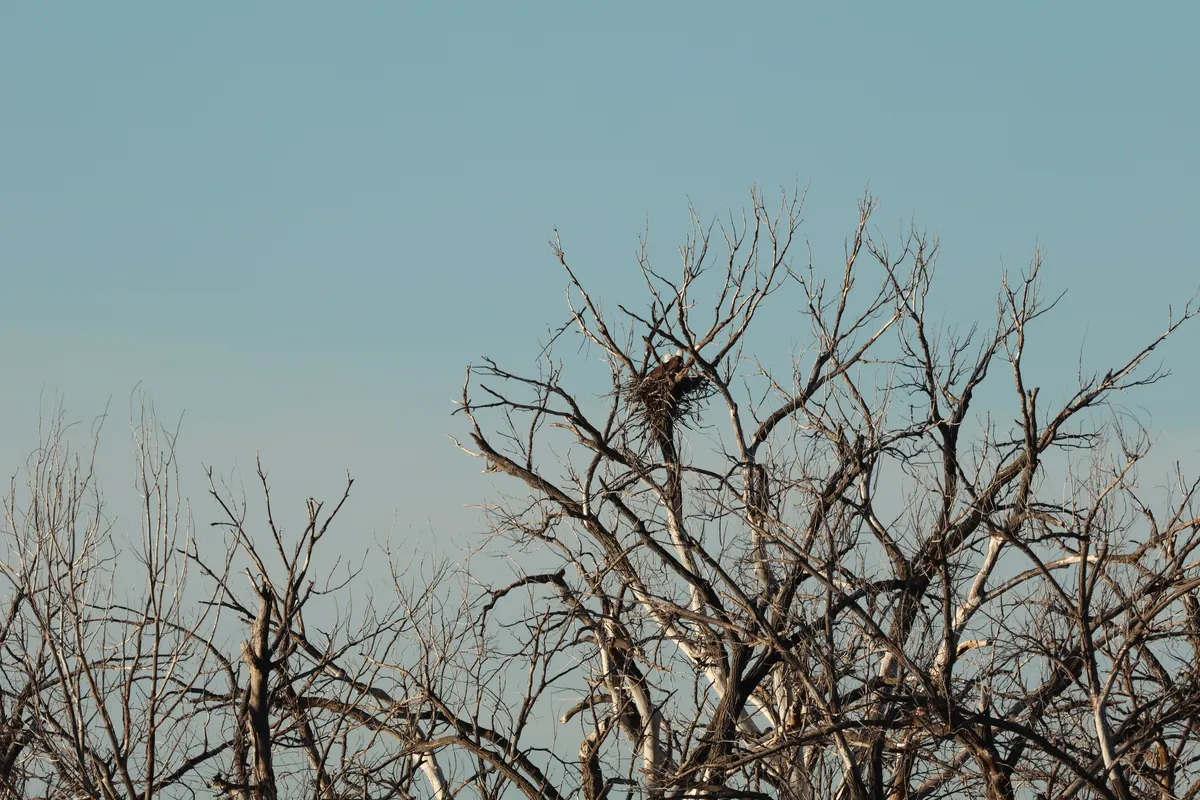
- Find an eagle nest in use. Drive a river road or a stretch of shelterbelts you know and look for a huge stick nest in the top of a cottonwood. In February a pair is often perched beside it or bringing in fresh sticks. Watch from the road with binoculars and do not walk closer.
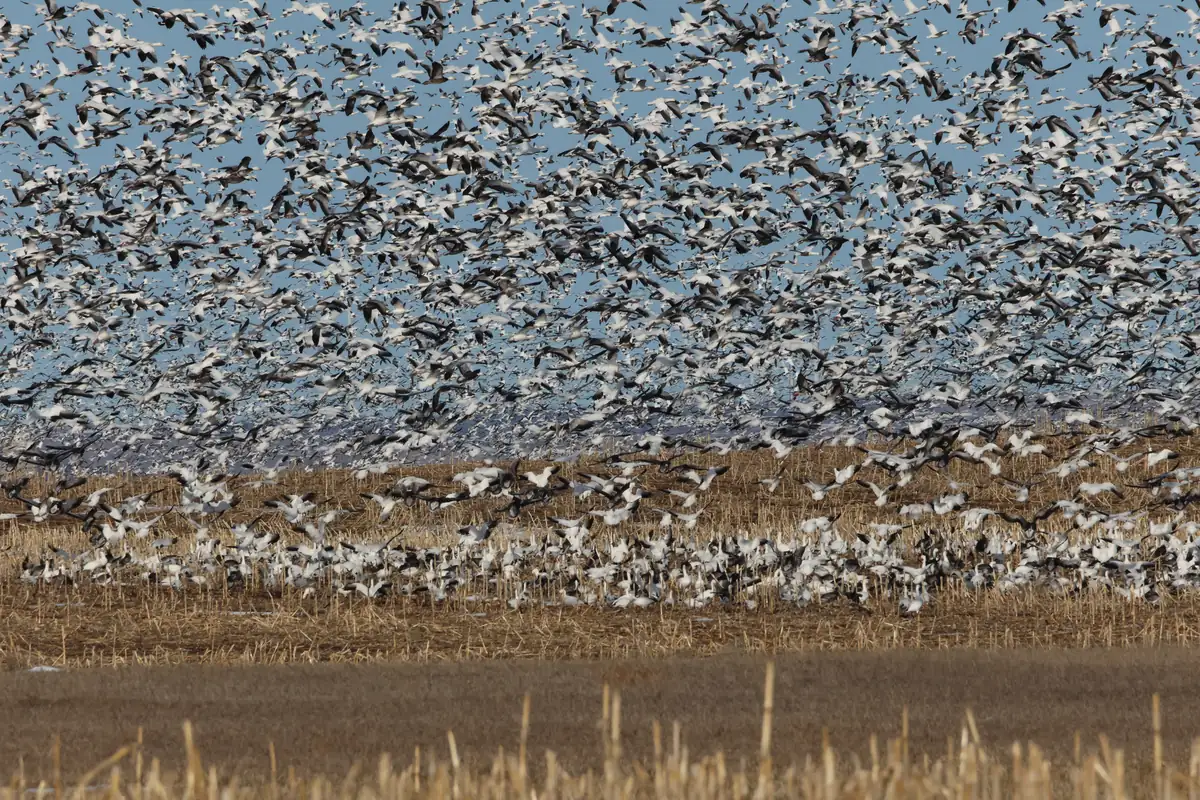
- Watch for the first snow geese. In the last week or two of February, scan open fields and the first open water east of the Missouri for white geese with black wingtips. Game, Fish and Parks says light geese usually start arriving in the eastern third of the state in late February or early March.
- Look for Jupiter, then Mars. Wednesday the 10th puts Jupiter directly opposite the sun: look east as daylight fades for a point brighter than any star. Nine nights on, reddish Mars reaches its own opposition nearby among the stars of Leo.
In the Naturalist’s Field Journal, give the nearest active eagle nest a nest-observed page, with the first date an adult stays hunkered down in the bowl. Add snow buntings, Lapland longspurs and your first snow geese of the year to the birds-I-have-seen plate. If you tap a boxelder or silver maple, start a tree-through-the-seasons page for it and use the daily field log to record the morning low, the afternoon high and how much sap dripped. A dusk and dawn watch fits the evening of the 20th, when the Snow Moon rises near Jupiter, and the same place twice works for a field where geese stop: once in late February, again in April.
Regions used below: Black Hills; West River prairie and the Badlands; Missouri River and the big reservoirs; Glacial Lakes and the northeast; Southeast and Sioux Falls.
Are bald eagles nesting in South Dakota in February?
Yes. While many eagles still roost below the Missouri River dams, the pairs that breed in South Dakota are already back at their nest trees. The 2005 eagle plan from Game, Fish and Parks describes the South Dakota nesting season as running from January through August, and sets February through August as the period when nests on the agency’s own land get a protective buffer; and South Dakota Magazine, reporting on eagles in 2014, said nests are built by mid-February, with eggs following in late February. Our January guide for South Dakota covered the winter roosts; this month the story is the nests.
-
Nests in the big cottonwoods
Nest repair through February; eggs from late in the month · River bottoms, shelterbelts and stock-pond trees statewide; many along the Missouri below Fort Randall Dam
In the state’s 2004 survey, every active nest but one of the 30 found was in a cottonwood, and about a third were on the Missouri, mostly along the stretch below Fort Randall Dam shared with Nebraska. Pairs build in the biggest tree around with a clear flight line to water, add to the same nest year after year, and often keep a spare nest or two in the territory. South Dakota Birds and Birding now calls the bald eagle an increasingly common breeder, with active nests within a few miles of Sioux Falls and others in shelterbelts and along stock ponds far from any big lake. A nest five or six feet across is easy to spot in a leafless crown.
-
From two dozen nests to hundreds
The long view · Statewide
When the management plan was written, its goal was an average of 25 active nests a year. That figure has been left far behind: South Dakota Magazine reported in 2014 that Game, Fish and Parks believed the state might hold as many as 300 nesting pairs. Treat that as an estimate rather than a count. If you log a nest in eBird, keep its exact spot out of public posts.
-
Eggs, incubation and space
Late February into spring · Any active nest
A clutch is usually one to three eggs, and the plan gives 34 to 38 days for them to hatch, with both adults taking turns on the nest. On state land, Game, Fish and Parks keeps a half-mile buffer around active nests during the nesting season and may post an 820-foot no-entry zone. The plan explains why: an eagle that calls or flushes as you approach is already disturbed and may abandon the attempt.
-
Great horned owlets hatching
February and March, about four to five weeks after laying · Old hawk and crow nests, cottonwood crotches and farm buildings
The owls that laid eggs in January are now hatching chicks. South Dakota Birds and Birding gives four to five weeks of incubation, so many South Dakota nests hold small, white, downy owlets by mid to late February, still tucked under the female through snow and wind. The young leave the nest about six weeks after hatching. If you found a sitting owl last month, keep checking from a distance; by late in the month a fuzzy head may show above the rim.
The wintering eagles are still worth a trip. At Randall Creek Recreation Area below Fort Randall Dam, vehicles and camping are barred from the campgrounds from November 15 to the third Friday in March so the roost is not disturbed, but walkers and cross-country skiers may go in if they leave the eagles alone. The park notes that the birds feed in the morning and rest in the afternoon in tall cottonwoods near the river.
When do snow geese come back to South Dakota?
The first light geese usually come in late February. Game, Fish and Parks says snow geese and their relatives generally migrate into the eastern one-third of South Dakota in late February to early March, and the big push follows in March. South Dakota Birds and Birding calls the snow goose an abundant migrant, uncommon in midwinter, that moves through in flocks of thousands to tens of thousands.
-
Sand Lake and the James River valley
First birds in late February; peak usually in March · Sand Lake National Wildlife Refuge, north of Aberdeen in Brown County
The U.S. Fish and Wildlife Service says spring snow goose numbers at Sand Lake have been documented at more than 1.2 million, on an 11,450-acre lake left by the last ice age in the heart of the prairie pothole region. A Fish and Wildlife Service officer at the refuge told Outdoor News in 2024 that the Sand Lake peak in a normal year comes around the middle of March, but the timing follows snow cover and open water: after a mild February that year, geese had already reached South Dakota by late in the month, and he warned the migration could pass quickly. The refuge posts migration reports through the spring.
-
Lake Thompson and the eastern lakes
Late February into April · Lakes around Lake Thompson in Kingsbury County; flooded fields statewide east of the Missouri
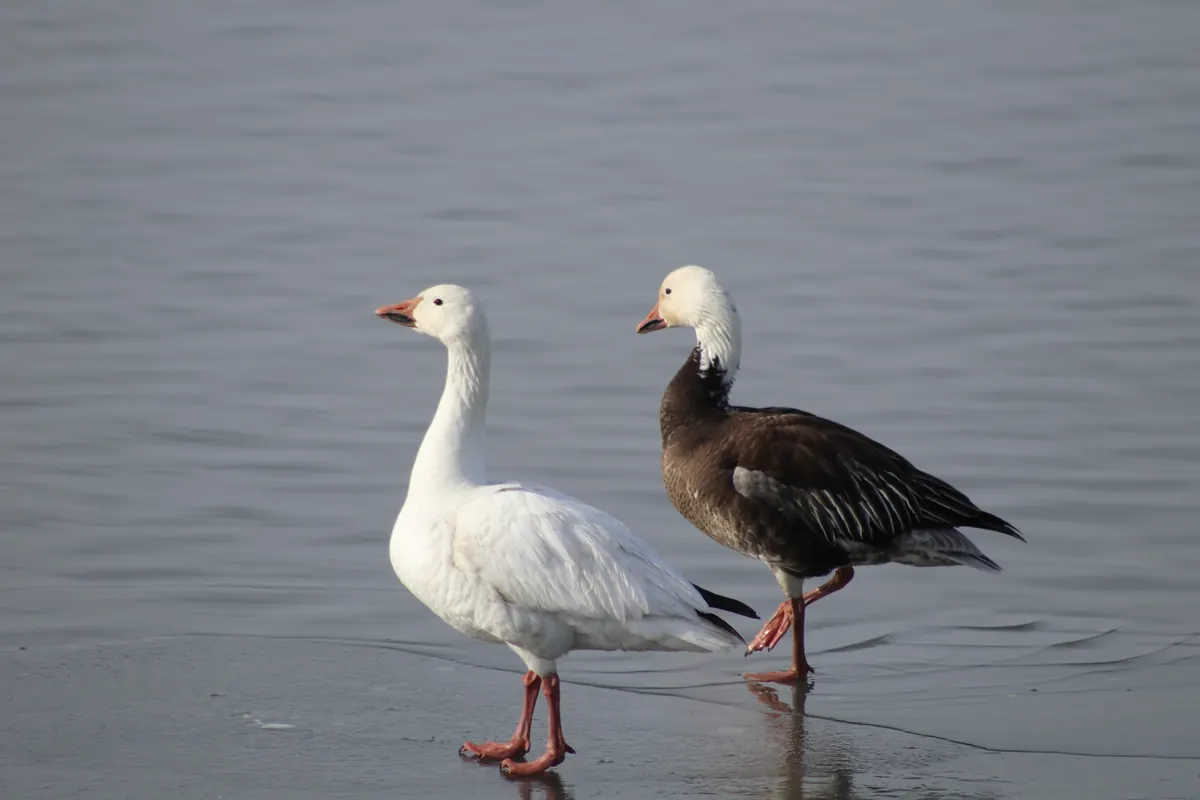
South Dakota Birds and Birding names the lakes around Lake Thompson as another traditional stop. In migration the flocks feed in crop fields as well as resting on lakes, so scan stubble near open water. Listen for the high, yelping chorus before you see them, and look for dark blue-morph birds mixed in with the white ones.
-
The spring light goose conservation order
From mid-February, the day after the Unit 2 Canada goose season closes, to May 15 · Statewide
Game, Fish and Parks issues a conservation order every spring to control an overabundance of light geese, with unlimited daily and possession limits and electronic calls allowed. By state rule, the order opens the day after the Unit 2 Canada goose season closes, which falls in mid-February, and runs to May 15. Game, Fish and Parks had not posted the 2027 opening date by early October; check its goose page before you go. In 2022 hunters took an estimated 169,646 light geese during the order, with the highest harvests in Brown, Yankton, Clark, Edmunds and Kingsbury counties.
What are the flocks of small birds along South Dakota’s gravel roads in winter?
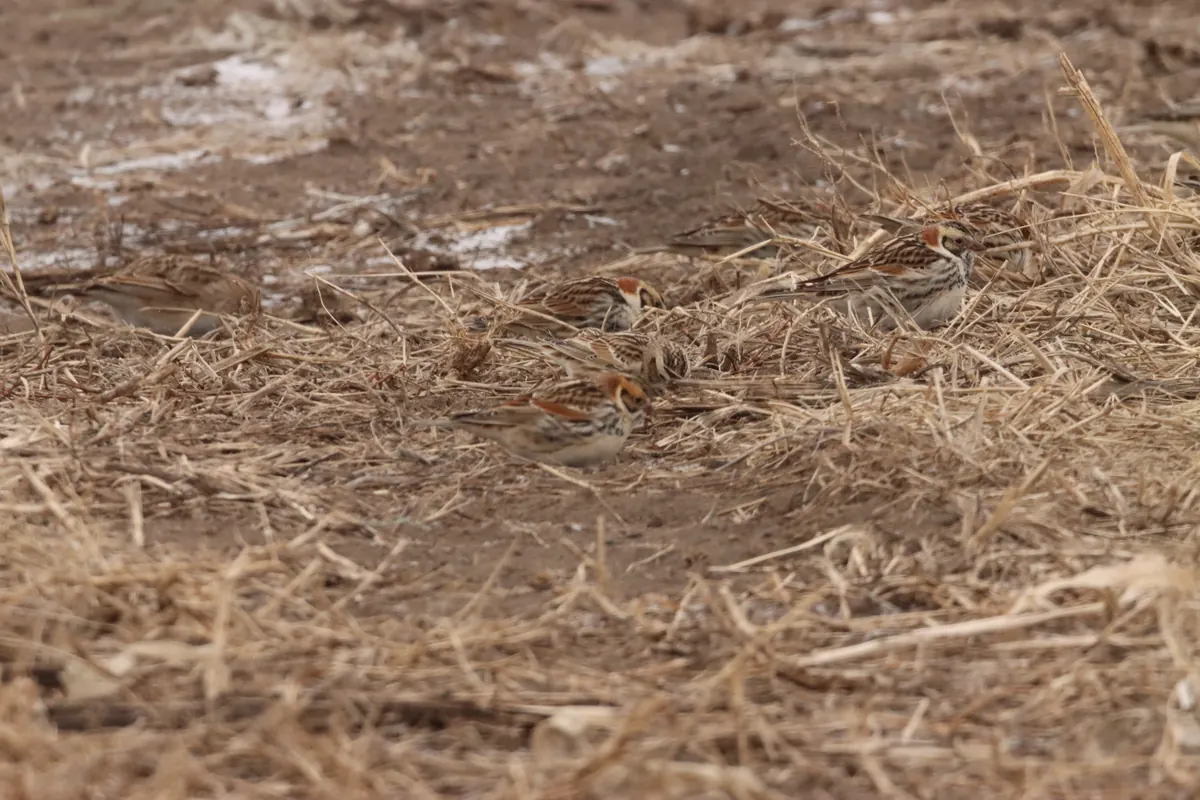
Most often horned larks, snow buntings and Lapland longspurs. After a fresh snow buries the fields, these ground birds come to the plowed shoulders and gravel roads to pick at seeds and grit, and a flock will rise ahead of the car, swirl, and settle again a little farther on. February is a good month to sort them out before they leave.
-
Horned larks
All year; most visible after snowfall · Gravel roads, stubble fields and pastures statewide
South Dakota Birds and Birding lists the horned lark as a common permanent resident across the state that becomes much easier to see in winter, gathering along roadsides after snow, often with longspurs and snow buntings. Look for a sandy-brown bird with a black mask and bib and, in good light, two tiny black feather horns. They nest from April through June, and males sing from high in the air over bare ground.
-
Snow buntings
Late fall to early spring · Open fields, prairie, roadsides and farm country
These Arctic songbirds are regular winter visitors and migrants, and their white wing patches flash as a flock wheels against the sky. The same source notes that males leave about a month ahead of the females in spring to claim breeding territories, so in late winter look for flocks with more buff-and-brown females and fewer bright males.
-
Lapland longspurs
Winter and migration · Farm fields, pastures and grasslands statewide
Lapland longspurs are common migrants and winter visitors statewide, sometimes in flocks numbering in the thousands. They are streaky and brown, with a rusty patch on the wing, and give a dry rattle and a short whistled call as they flush. Look for them mixed into horned lark flocks.
Pull fully off the road to watch, and never stop on a hill or curve.
Can you tap maple and boxelder trees for syrup in South Dakota?
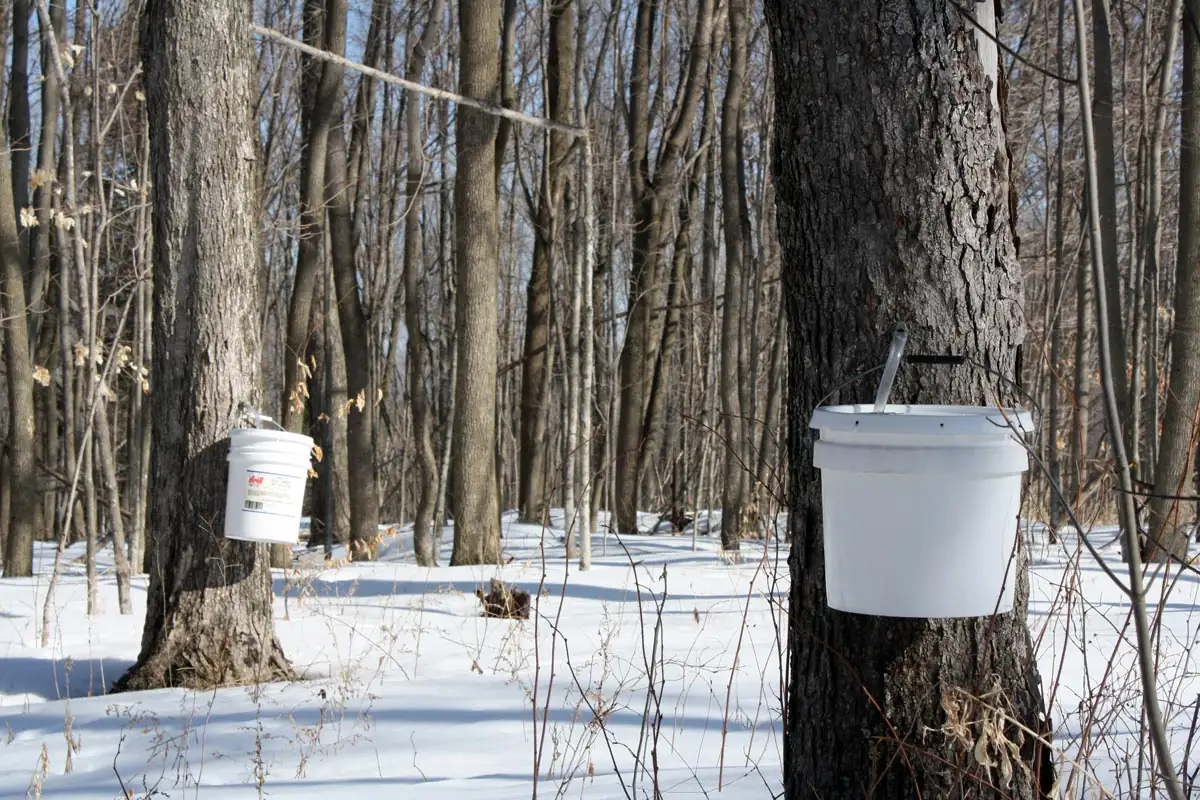
Yes, and late February is when to get ready. SDSU Extension’s guide to harvesting maple syrup in South Dakota says spiles should go into trees before the sap begins to flow, which for most people means by the end of February or in early March. Sap runs best when days climb above about 40 °F and nights drop to around 25 °F.
-
Which trees to tap
Late February into March · Yards, parks and shelterbelts, mostly East River
The guide names four choices. Silver maple is the most common maple in eastern South Dakota, sugar maple grows mainly in the far east and southeast, and boxelder, a maple with leaves split into three leaflets, grows across the whole state. Amur maple and silver-red hybrids can also be tapped. A tree should be at least 10 to 12 inches across at about 4 feet off the ground, and a larger trunk can take a second tap.
-
From sap to syrup
During each run · At home
SDSU Extension describes drilling a hole 1½ to 2 inches deep, 5/16 or 7/16 inch wide to fit the spile, and boiling down 35 to 45 gallons of sap for each gallon of syrup. Extension staff have tapped silver maples in their own yards and measured the sap at about 3 percent sugar, similar to sugar maple, and they say boxelder sap is much the same, so all three make syrup.
-
Give a stressed tree a rest
Before you drill · Any maple you plan to tap
In 2024, after a dry summer, SDSU Extension’s forestry specialist decided not to tap live trees for the McCrory Gardens workshop, saying the trees needed a rest, though he noted that a household tapping one or two trees raises fewer concerns. If your tree struggled last summer, one tap or none is the kind choice.
SDSU Extension and McCrory Gardens in Brookings have hosted a maple syrup and tree-tapping workshop in past springs (in 2024 it ran on March 23). No 2027 date had been posted by early October; check SDSU Extension’s events page.
What comes out on a mild February day in South Dakota?
More than you might expect. A sunny afternoon in the 40s, which happens often enough West River and now and then across the east, wakes up animals that spend the cold weeks in a half-sleep.
-
Snow fleas on melting drifts
Warm, sunny days in late winter · Snow at the base of trees, along woods edges and on melting drifts
SDSU Extension entomologists say snow fleas are one of the first small creatures you may notice in late winter. They are springtails, kin to insects, smaller than one-tenth inch and dark blue, so a patch of them looks like pepper sprinkled on the snow. A spring-like appendage under the body flings them into the air; they feed on rotting leaves, and are completely harmless.
-
Prairie dogs on the mound
Mild winter days · Prairie dog towns in Wind Cave and Badlands national parks and on the Buffalo Gap National Grassland
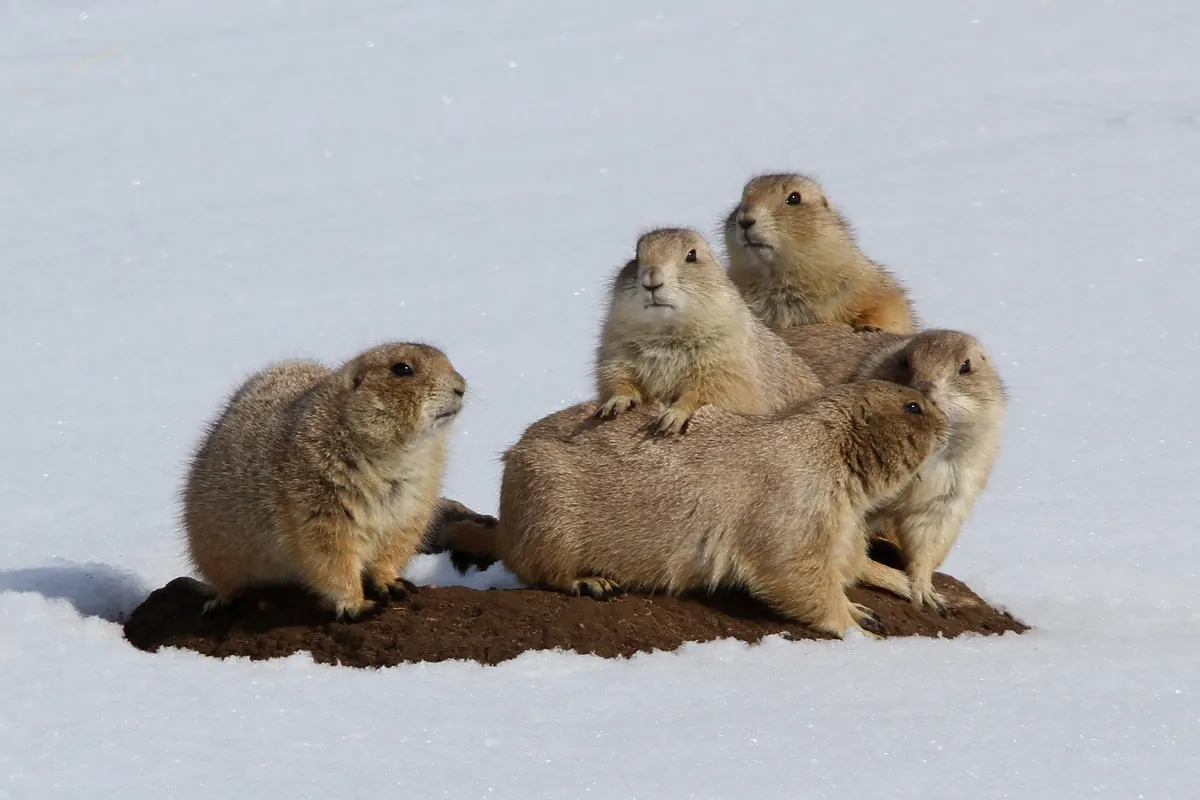
Wind Cave National Park explains that black-tailed prairie dogs have an incomplete hibernation: their activity and appetite drop in winter, and they may stay underground for long stretches, but they come up to feed on mild days. Breeding follows in March and April, with pups born four to five weeks later. On a calm, sunny day, watch for sentries at the burrows and listen for an alarm bark when a hawk passes over.
-
Raccoon tracks after a warm night
Warm winter nights · Creeks, river woods and farm buildings with big trees nearby
Game, Fish and Parks notes that raccoons are less active in winter but come out on warm winter nights, mostly along streams and other water with mature trees. After a thaw, look in soft snow or mud at the creek edge for their tracks, which look like small human handprints with five long toes, front and hind feet set side by side.
-
Shed antlers
Late winter · Game, Fish and Parks land; never in national parks
Deer and elk grow and drop a new set of antlers every year, and Wind Cave notes that elk shed theirs in spring. Game, Fish and Parks allows shed antler hunting on land it owns, including state parks, recreation areas and Game Production Areas, but walk-in areas and other leased private land need the landowner’s permission. In national parks such as Wind Cave, antlers are protected and must be left; the park points out that rodents and even elk and bison gnaw them for calcium. Keep a long distance from wintering deer and elk, which cannot afford to burn energy running from you.
Is February South Dakota’s snowiest winter month?
At most stations, yes, by a little. NOAA’s 1991–2020 normals give every station in the table below more snow in February than in January, even though February is three days shorter: Pierre averages 8.0 inches against 5.1 in January, and Rapid City 7.7 against 5.3. Against December the margin is thinner: February comes out ahead at five of the seven stations, ties at Watertown, and trails by a tenth of an inch at Sioux Falls. The northern Black Hills lead by far, with 26.2 inches at Lead and snow on the ground on more than 23 of February’s 28 days. In the snowiest years the Hills pile it deep: the state’s greatest measured snow depth, 73 inches, stood at Lead on March 1, 1998, according to NOAA’s State Climate Extremes Committee.
| Station | Average high | Average low | Snowfall | Precipitation | Days with 1 in or more of snow cover |
|---|---|---|---|---|---|
| Lead (northern Black Hills) | 38.8 °F | 17.6 °F | 26.2 in | 1.83 in | 23.2 |
| Rapid City Regional Airport | 38.1 °F | 14.0 °F | 7.7 in | 0.50 in | 10.1 |
| Pierre Regional Airport | 33.7 °F | 12.6 °F | 8.0 in | 0.74 in | 13.4 |
| Aberdeen Regional Airport | 28.6 °F | 6.3 °F | 8.6 in | 0.62 in | 18.2 |
| Watertown Regional Airport | 25.9 °F | 6.7 °F | 8.9 in | 0.65 in | 21.4 |
| Huron Regional Airport | 30.8 °F | 10.2 °F | 8.9 in | 0.75 in | 16.2 |
| Sioux Falls (Foss Field) | 32.0 °F | 12.6 °F | 8.6 in | 0.83 in | 15.9 |
Behind it all sits the Pacific: NOAA’s ENSO discussion of September 10 called a very strong peak likely, at odds above 90 percent, for the coming fall and winter. The state climatologist told KELO in September to expect a warmer winter than normal overall, but still with snow and spells of real cold, and she told the Rapid City Post that past El Niño winters here have gone both wetter and drier, so the clearer effect is on temperature, with snow cover that may not last between storms. NOAA’s October 15 winter outlook is refreshed each month, and its current February and late-winter maps sit on the federal 90-day outlook pages. Our forecast page handles this week, and our frost tables for South Dakota give typical last-freeze dates for spring planning.
What is the coldest temperature ever recorded in South Dakota?
Minus 58 °F, at McIntosh in Corson County on February 17, 1936. The State Climate Extremes Committee lists it as the state’s all-time low, and it came in the middle of the harshest month South Dakota has on record.
-
February 1936
Anniversary February 17 · McIntosh and the whole state
NOAA’s statewide records, which begin in 1895, show February 1936 averaging 5.2 degrees below zero across South Dakota, the lowest monthly average in the whole series. The same summer brought 120 °F to Gann Valley on July 5, 1936, which still shares the state’s record high. McIntosh sits on the open prairie of the Standing Rock Reservation, in the state’s northern tier.
-
Valentine’s week, 2021
February 13–16, 2021 · Southeast South Dakota and neighboring states
The National Weather Service in Sioux Falls wrote that Valentine’s Day 2021 was the coldest since 1936 at several locations, and that 22 sites in its area set at least one temperature record during the four-day outbreak, with wind chills of 30 to 40 below or colder.
How much daylight does South Dakota gain in February?
A lot more than in January: well over an hour in every city in the table, and the most in the north, where Lemmon gains 82 minutes over the month. The daily increase itself gets bigger right up to the March equinox; by month’s end South Dakota is banking nearly three extra minutes every day. On Sunday, March 14, 2027, clocks spring forward, pushing sunset an hour later in one night.
| City | Feb 1 | Feb 28 | Gained | Per day |
|---|---|---|---|---|
| Lemmon | 9 h 43 m | 11 h 05 m | 82 min | 3.0 min |
| Aberdeen | 9 h 46 m | 11 h 05 m | 79 min | 2.9 min |
| Watertown | 9 h 49 m | 11 h 07 m | 78 min | 2.9 min |
| Pierre | 9 h 51 m | 11 h 08 m | 77 min | 2.9 min |
| Rapid City | 9 h 52 m | 11 h 08 m | 76 min | 2.8 min |
| Mitchell | 9 h 54 m | 11 h 08 m | 74 min | 2.7 min |
| Sioux Falls | 9 h 55 m | 11 h 09 m | 74 min | 2.7 min |
| Yankton | 9 h 58 m | 11 h 11 m | 73 min | 2.7 min |
Groundhog Day is Tuesday, February 2, while winter’s astronomical midpoint lands on February 3 and 4. Look up your town’s sunrise and sunset times with our daylight tool.
What can you see in the South Dakota night sky in February 2027?
Two bright planets at their best within nine days of each other, a good evening look at Mercury, and a full moon with a faint eclipse in the eastern half of the state. Times are in Central Standard Time for East River; for West River and the Black Hills, on Mountain time, subtract an hour.
-
Mercury after sunset
Late January to about February 10; farthest from the sun on February 3 · Low in the west-southwest, 30 to 45 minutes after sunset
Mercury reaches its greatest angle from the sun, a little over 18 degrees, just after midnight CST on February 3 (late on the 2nd in Mountain time), the best dusk view of it all winter. The day-old crescent moon makes a pretty pair with it at dusk on February 7, a Sunday. Choose a clear, flat western horizon; the open prairie is ideal.
-
Jupiter at opposition
Evening of Wednesday, February 10 · Rising in the east at sunset, highest around midnight, in Leo
Opposition is exact at 6:21 p.m. CST (5:21 p.m. MST). Jupiter then stays up from dusk to dawn, shining at magnitude −2.5. Rest binoculars against a fence post and its four bright moons often show as tiny dots strung out beside the disk. The moon is out of the way until mid-month, making the first half of February the best time to look.
-
Mars at opposition
Friday, February 19; closest to Earth on the 20th · In Leo, east of Jupiter after dark
Opposition comes around 9 a.m. CST on the 19th, and the gap between us shrinks to its smallest, near 63 million miles, on Saturday the 20th. With Mars out near aphelion, this is a modest showing: magnitude −1.2, bright and orange but small in a telescope. Its next closer approach is in 2029.
-
The Snow Moon and a faint eclipse
Full at 5:23 p.m. CST (4:23 p.m. MST), Saturday, February 20 · Rising in the east-northeast around sunset
Some almanacs count the Snow Moon as a supermoon, though it is not as close as January’s. It comes with a penumbral eclipse: the moon slides through Earth’s pale outer shadow, deepest at 5:13 p.m. CST and over at 7:13 p.m. CST. East River, the moon rises in bright twilight just after the deepest point, and a sharp-eyed viewer might just catch faint gray shading along one side in the first hour. West River, the eclipse ends at 6:13 p.m. MST, and there is effectively nothing to see. Late on the 19th the moon, nearly full, glides very near Jupiter; a night later, Leo holds the full moon, both planets and the star Regulus at once. February 6 brings a ring-of-fire solar eclipse, but only for the far Southern Hemisphere and Africa; no part of the United States sees it.
-
Dark skies and aurora
Moonless evenings roughly February 2–11 · Away from town lights, especially in the north and West River
The sun’s eleven-year peak is behind us, but sunspots remain plentiful, so an aurora over the northern horizon is still possible this winter. The darkest evenings fall around the February 6 new moon. If NOAA’s Space Weather Prediction Center posts a storm watch, look low in the north from a dark spot; Saturn, meanwhile, is sinking into the southwestern twilight.
| Phase | Date | Time |
|---|---|---|
| New moon | Saturday, Feb 6 | 9:56 a.m. CST (8:56 a.m. MST) |
| First quarter | Sunday, Feb 14 | 1:58 a.m. CST (12:58 a.m. MST) |
| Full moon (Snow Moon) | Saturday, Feb 20 | 5:23 p.m. CST (4:23 p.m. MST) |
| Last quarter | Saturday, Feb 27 | 11:16 p.m. CST (10:16 p.m. MST) |
Before a planet night, check our cloud cover forecast; our moon phase calendar has the Snow Moon’s rise time for your town.
What can South Dakota families do outdoors in February 2027?
- Tuesday, February 2: Groundhog Day. Whatever the woodchucks decide, go outside at noon, measure your own shadow and mark the date in a field log. Repeat on the 28th and compare.
- Wednesday, February 3: Little Acorns, “Snakes,” a 10 a.m. program for ages 3 to 5 at Good Earth State Park on the edge of Sioux Falls: story time, a craft, a game and an activity about snakes. Registration on Go Outdoors South Dakota closes at noon on January 29, with room for 20.
- Friday to Monday, February 12–15: the Great Backyard Bird Count. Audubon has posted these four days for the 30th edition. Spend a quarter hour or more counting on any of the four days and send in the list; a gravel-road drive for horned larks and snow buntings counts as much as a feeder.
- Late winter: Bald Eagle Awareness Days. Game, Fish and Parks, the Fish and Wildlife Service and the Corps of Engineers have run raptor programs under this name, with live birds, in Sioux Falls, Pierre and Rapid City (in 2018 they fell on February 23 and 24). We could not find a 2027 schedule; check with Game, Fish and Parks.
- Late February: tap a tree. If you have a silver maple or boxelder at least a foot across, a spile, a bucket and SDSU Extension’s guide are all you need for a family sap project.
- Late February: goose watch. Follow Sand Lake refuge’s spring migration reports and plan a dawn drive when the numbers start to climb.
- All month: count at the feeder. FeederWatch counts continue into April, and any eagle nest, owl or snow goose flock you find is worth an eBird checklist.
State park programs need an entrance license. Browse every month and state on our guides to nature; the Naturalist’s Field Journal gives kids pages for nests, birds and sap runs.
Safety notes for February in South Dakota
- Hunting and trapping in February. Game, Fish and Parks’ 2026 handbook has Canada goose season in Unit 2 open until February 14 and bobcat season statewide until February 15. The Black Hills mountain lion season runs from December 26 to April 30 unless the harvest limit is reached sooner (outside the Black Hills Fire Protection District, lions may be hunted all year). Cottontail and tree squirrel seasons last to March 31; coyote, red and gray fox, raccoon, badger, skunk, opossum and jackrabbit are open year-round, as is beaver outside the Black Hills, muskrat trapping runs to April 30 East River and in the Black Hills (all year West River), and nonresidents may take raccoon, beaver and muskrat until March 15. The spring light goose conservation order opens in mid-February (see above), so expect decoy spreads and shooting in fields East River. The fluorescent orange or pink rule (an outer garment above the waist) applies to big game hunters with firearms, but turkey and mountain lion hunters are exempt, so in February many hunters will not be wearing it. Wear something bright yourself.
- Late-season ice. Warm afternoons rot ice from the top while currents and springs work from below, and the edges go first. The hunting handbook lists what happens in cold water: a gasp reflex and panic, then muscle failure within minutes, and only later hypothermia, which it says three-quarters of victims never live long enough to reach. Carry picks and a throw rope, and give up on a lake as soon as the shoreline softens.
- Blizzards and ground blizzards. A February storm with wind can drop visibility to nothing on open highways even after the snow stops. Check road reports before you leave and pack blankets, a shovel and snacks before any rural drive.
- Wind chill. The 2021 Valentine’s cold brought wind chills of 30 to 40 below in the southeast; at those values frostbite comes fast. Cover your face and keep children’s outings short.
- Thaw and refreeze. A chinook or a sunny week West River can melt snow by day and glaze it at night, turning trails, boat ramps and gravel roads to ice.
Sources
- South Dakota Game, Fish and Parks: Bald Eagle Management Plan, 2005 (nesting season January–August, nest buffers February–August, 2004 nest survey, clutch and incubation, nest buffers, winter roosts)
- South Dakota Magazine: Eagle Season (March 18, 2014)
- South Dakota Birds and Birding: bald eagle (nesting status)
- South Dakota Birds and Birding: great horned owl (nesting season, incubation, fledging)
- South Dakota Game, Fish and Parks: Randall Creek Recreation Area (eagle roost closure)
- South Dakota Game, Fish and Parks: goose hunting (light goose migration timing, conservation order)
- South Dakota Administrative Rule 41:06:16:07: goose seasons and conservation order
- South Dakota Game, Fish and Parks: Light Goose Conservation Order harvest report, 2013–2022
- South Dakota Birds and Birding: snow goose
- U.S. Fish and Wildlife Service: Sand Lake National Wildlife Refuge
- U.S. Fish and Wildlife Service: Sand Lake National Wildlife Refuge, activities and migration updates
- Outdoor News: Snow geese on their way to the Dakotas, Minnesota ahead of schedule (February 21, 2024)
- South Dakota Birds and Birding: horned lark
- South Dakota Birds and Birding: snow bunting
- South Dakota Birds and Birding: Lapland longspur
- SDSU Extension: Harvesting Maple Syrup in South Dakota
- SDSU Extension: McCrory Gardens to host maple syrup workshop (February 29, 2024)
- SDSU Extension: What are those black bugs jumping on the snow?
- National Park Service, Wind Cave: black-tailed prairie dog
- South Dakota Game, Fish and Parks: raccoon
- South Dakota Game, Fish and Parks: general hunting laws (shed antler hunting on GFP land)
- National Park Service, Wind Cave: visitors reminded to leave elk antlers
- National Park Service, Wind Cave: elk
- NOAA NCEI: U.S. climate normals, 1991–2020
- NOAA NCEI: 1991–2020 monthly normals station files (Lead USC00394834, Rapid City USW00024090, Pierre USW00024025, Aberdeen USW00014929, Watertown USW00014946, Huron USW00014936, Sioux Falls USW00014944)
- NOAA NCEI: State Climate Extremes Committee records (McIntosh −58 °F, Lead snow depth, Gann Valley 120 °F)
- NOAA NCEI: Climate at a Glance, South Dakota statewide February average temperature, 1895–2026
- National Weather Service Sioux Falls: mid-February 2021 record cold
- NOAA Climate Prediction Center: ENSO diagnostic discussion, September 10, 2026
- NOAA Climate Prediction Center: seasonal outlooks (winter outlook issued October 15, 2026)
- KELO: A rapidly developing El Niño will impact South Dakota weather this winter (September 14, 2026)
- Rapid City Post: state climatologist on the coming El Niño winter (September 14, 2026)
- U.S. Naval Observatory: phases of the moon
- U.S. Naval Observatory: Earth’s seasons and apsides, 2027
- Fred Espenak: Sky Event Almanac 2027 (Mercury elongation, Jupiter and Mars oppositions, Moon–planet pairings)
- EarthSky: Jupiter at opposition
- SEDS: Mars opposition of 2027
- NASA Goddard: lunar eclipses 2021–2030 (penumbral eclipse of February 20, 2027)
- NASA Goddard: solar eclipses 2021–2030 (annular eclipse of February 6, 2027)
- Old Farmer’s Almanac: eclipses (February 2027 visibility)
- Sea and Sky: astronomy calendar 2027 (Snow Moon)
- NOAA Space Weather Prediction Center: aurora 30-minute forecast
- U.S. Code, 15 U.S.C. 260a: daylight saving time
- Go Outdoors South Dakota: Little Acorns, Snakes, Good Earth State Park, February 3, 2027
- Go Outdoors South Dakota: statewide event and class search
- National Audubon Society: Great Backyard Bird Count (February 12–15, 2027)
- South Dakota Game, Fish and Parks: Bald Eagle Awareness Days highlights, February 23–24, 2018
- Project FeederWatch: project overview
- eBird
- South Dakota Game, Fish and Parks: 2026 Hunting and Trapping Handbook (2026–27 seasons, furbearer seasons, fluorescent orange or pink rule, cold-water stages)
- Photos via Wikimedia Commons; licenses and photographers are credited under each picture