What to look for in nature in South Dakota this December
Weather scientists start winter on December 1, and in South Dakota the new season shows itself first in the birds and the light. Arctic rough-legged hawks hunt the Fort Pierre grasslands, snowy owls join them in some winters, great horned owls begin their courtship duets, and volunteers spread out across the count circles for the Christmas Bird Count. In the Black Hills, families go looking for a spruce with a $10 permit while the bats of Jewel Cave sleep out the season underground. By the clock, sunset comes earliest on December 9 and 10; the Geminids peak a few nights later, the solstice falls on the 21st, and a supermoon comes up on the evening of the 23rd. Each item below carries a date and a source wherever we could find one.
Other months in South Dakota: October, November.
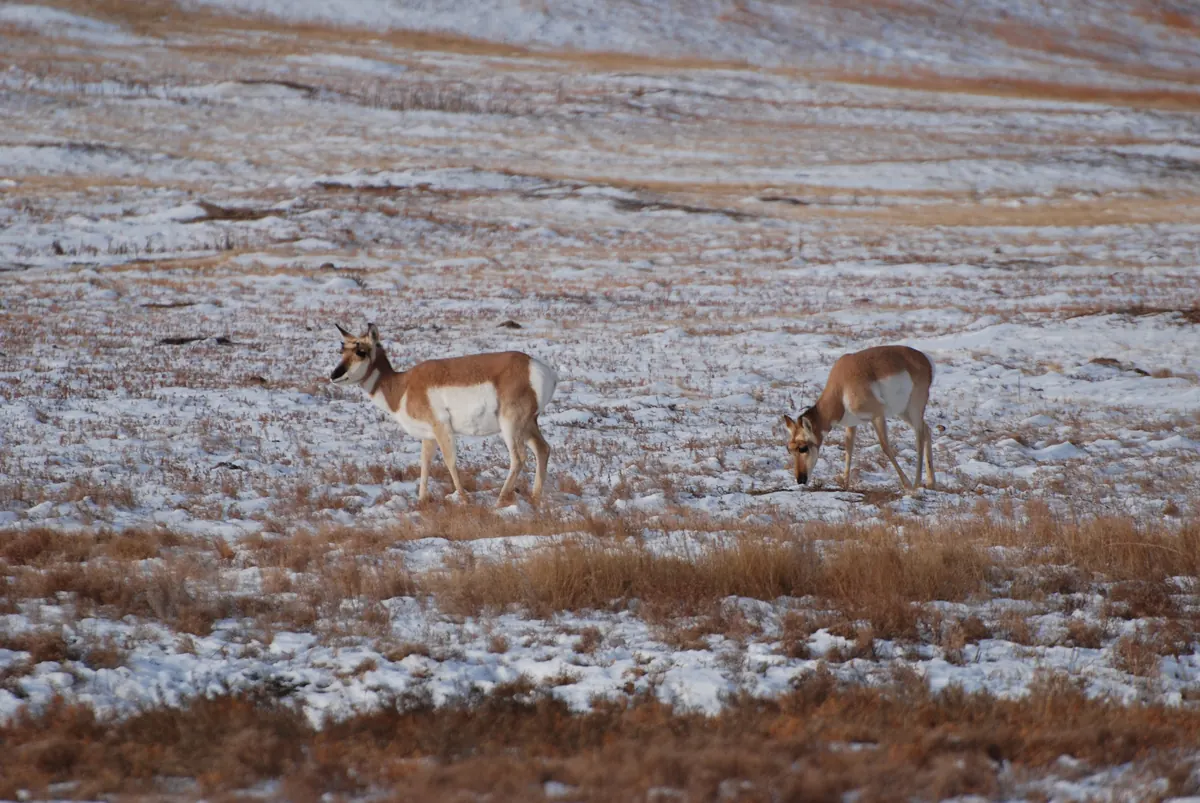
Start here

- Count birds for science. Count days for Audubon’s 127th Christmas Bird Count fall from December 14 to January 5. Sioux Falls counts on Saturday, December 19, and Canton on January 2. No experience is needed, and anyone living inside a circle can tally the feeder from indoors.
- Watch the earliest sunsets. Sunset reaches its earliest around December 9 and 10, not on the solstice: 4:03 p.m. at Lemmon and 4:14 p.m. at Rapid City (Mountain time), 4:50 p.m. at Sioux Falls and 5:02 p.m. at Pierre (Central). From then on the evenings stretch out a little, though mornings keep darkening into January.
- Geminids, then the Cold Moon. Geminid rates should peak in the dark hours between Sunday, December 13, and Monday morning, once the crescent moon has set in midevening. On Wednesday the 23rd the Cold Moon comes up at dusk, the biggest-looking full moon of 2026.
For the Naturalist’s Field Journal: start a tracks-to-know page the first morning after fresh snow, sketching a coyote’s neat line of prints beside a pheasant’s three-toed ones. Put every owl, hawk and solitaire you find this month on the birds-I-have-seen page, and add a great horned owl’s low hooting duet to the map of sounds. Pick one Black Hills spruce or ponderosa pine for a tree-through-the-seasons page, and log the year’s earliest sunset on the dusk-and-dawn watch plate.
Regions used below: Black Hills; West River prairie and the Badlands; Missouri River and the big reservoirs; Glacial Lakes and the northeast; Southeast and Sioux Falls.
When is the Christmas Bird Count in South Dakota, and how do you join?
Since 1900 volunteers have gone out every winter to count birds for Audubon, and in a thinly peopled state like this one each extra pair of eyes counts for a lot. This year’s 127th count covers the days between December 14 and January 5; each count circle chooses a single day in that span and records every bird seen or heard. It costs nothing, and birders of any level can join.
-
Sioux Falls count
Saturday, December 19, 2026 · The Sioux Falls count circle, city parks, the Big Sioux greenway and surrounding farmland
The South Dakota Ornithologists’ Union lists the Sioux Falls count on its calendar for December 19. No contact is posted with the listing, so reach the organizers through the SDOU mailing list or Audubon’s map.
-
Canton count
Saturday, January 2, 2027 · Around Canton, near Newton Hills State Park
The second count on the SDOU calendar falls just after New Year’s. The Big Sioux valley’s bur oak woods give it woodpeckers and nuthatches that open-prairie counts miss.
-
Finding other circles, or counting from home
December 14 to January 5 · Statewide; Audubon’s online circle finder
Other South Dakota circles may not appear on the SDOU calendar, and some set their dates only in late fall. Audubon’s circle finder shows each one with its compiler’s contact. You can join a field team for a day outdoors, or, if you live inside a circle, do a feeder count from home. Either way, the compiler needs to hear from you before count day.
Project FeederWatch keeps running all winter as well, so the birds you learn at the feeder now are the ones you will report on count day.
Where can you see snowy owls and rough-legged hawks in South Dakota in winter?
Two Arctic hunters make December on the open prairie worth a slow drive. Both prefer wide, treeless country, and both like the same stretch of the state: the Fort Pierre National Grassland, south of Pierre on the west bank of the Missouri. Bald eagles are still settling in along the river below the big dams; see our November notes for South Dakota for where to watch them.
-
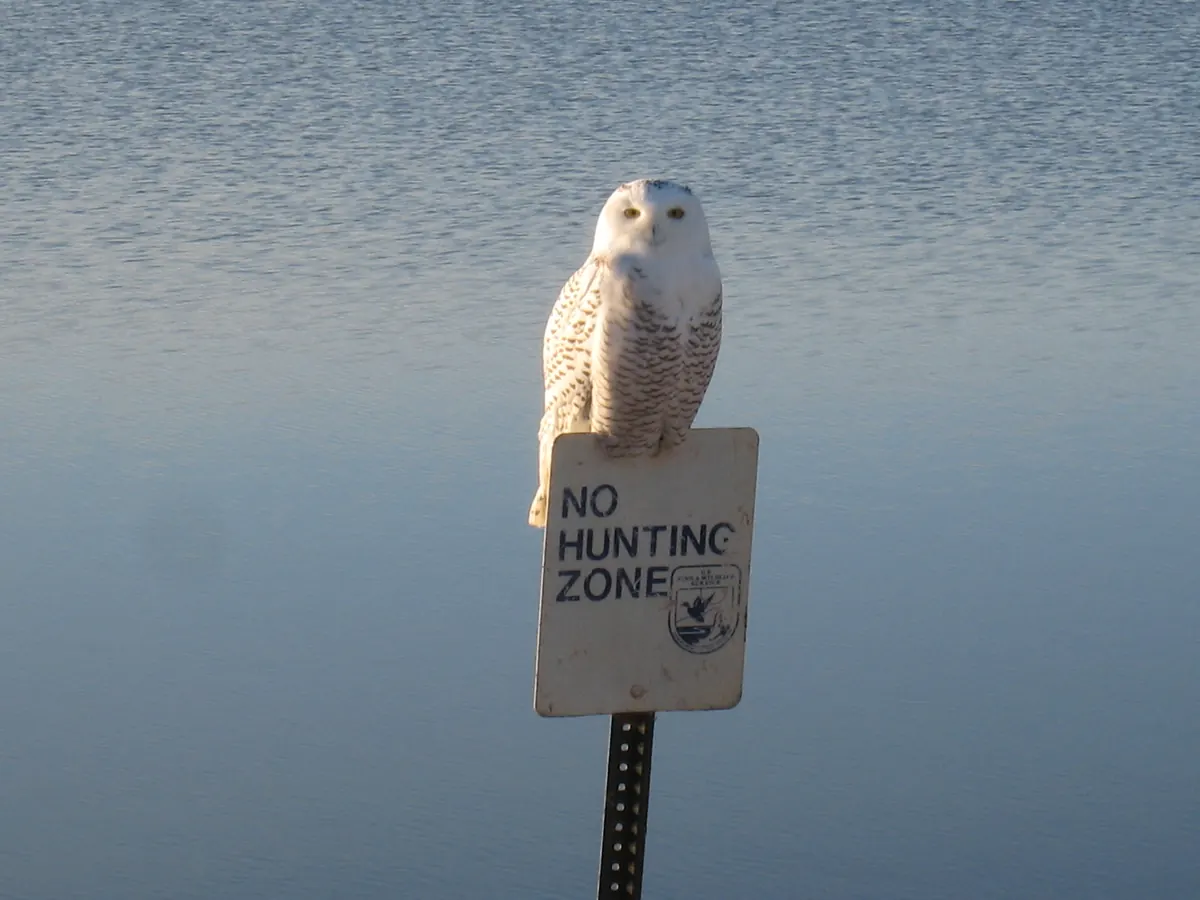
Snowy owls
Some winters, December through March; never predictable · Fort Pierre National Grassland; around Lake Oahe where open water holds waterfowl; more often in the northern counties
South Dakota Birds and Birding calls the snowy owl an irregular winter visitor that is never common. In some winters several turn up, in others hardly any, and the birds can appear almost anywhere. Look for a white or white-and-barred lump on a fence post, a hay bale or a rise in a stubble field, often in the middle of the day. Watch from the car; a resting owl needs its energy.
-
Rough-legged hawks
All winter · Fort Pierre National Grassland; the Presho area of Lyman County; open grassland statewide
Rough-legs breed on the Arctic tundra and visit only for the cold months, when the same source calls them uncommon to common and sometimes present in very high densities. The name comes from feathering that runs down the legs to the feet. Watch for a large hawk hanging in one spot over a field on flapping wings, or balanced on the very tip of a slender branch; many have a dark belly and a dark mark at each wrist.
Why do great horned owls start hooting in December?
Because they are already courting. Great horned owls are among South Dakota’s earliest nesters, and courtship can begin as early as December, with eggs from January onward. They are common year-round residents in every part of the state, from Sioux Falls shelterbelts to Badlands cottonwoods.
-
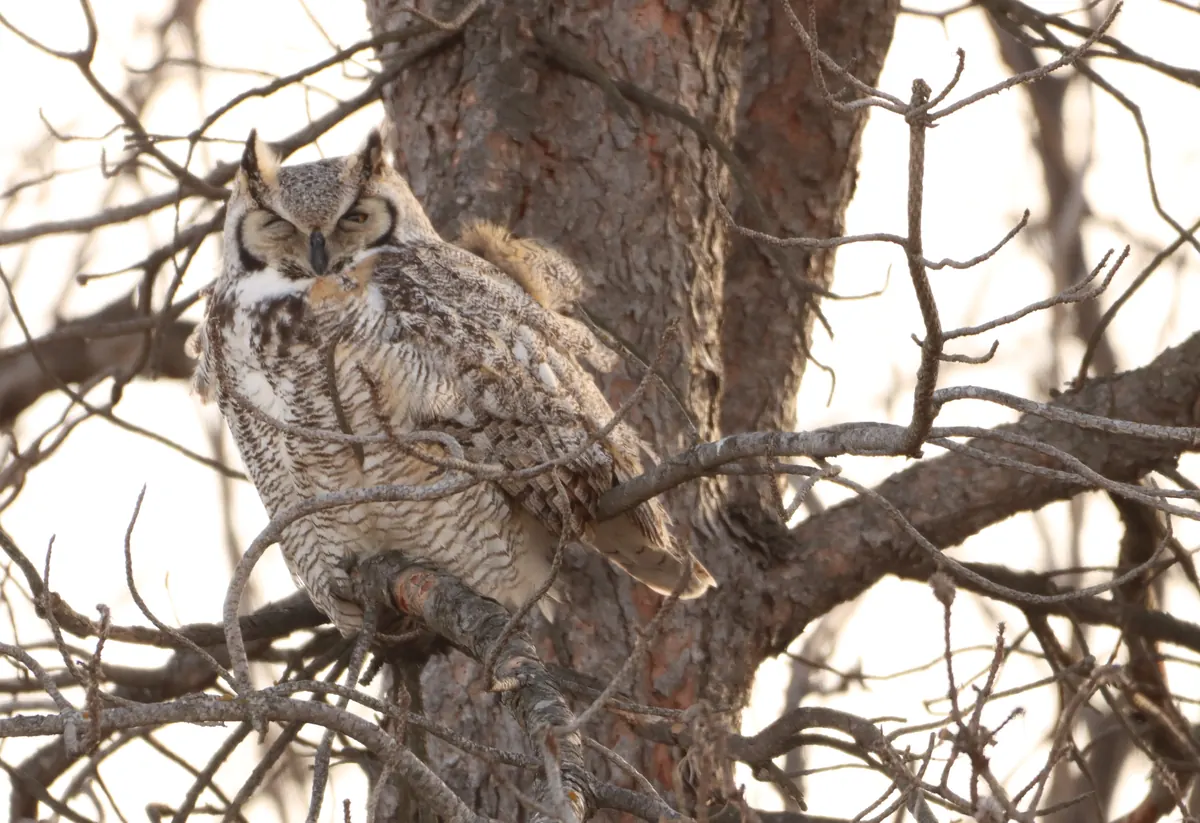
The hooting duet
Dusk and the hours before dawn, from December · Shelterbelts, farmsteads, river woods, city parks and cemeteries with big trees
Male and female both hoot, and in early winter a pair often calls back and forth, the male’s voice noticeably deeper than his mate’s even though she is the bigger bird. Stand outside on a still evening just after dark and listen for a soft, low series of five or so hoots. By day, check the crotch of a big cottonwood or a dense evergreen for an ear-tufted shape, and look on the ground beneath for pellets and whitewash.
-
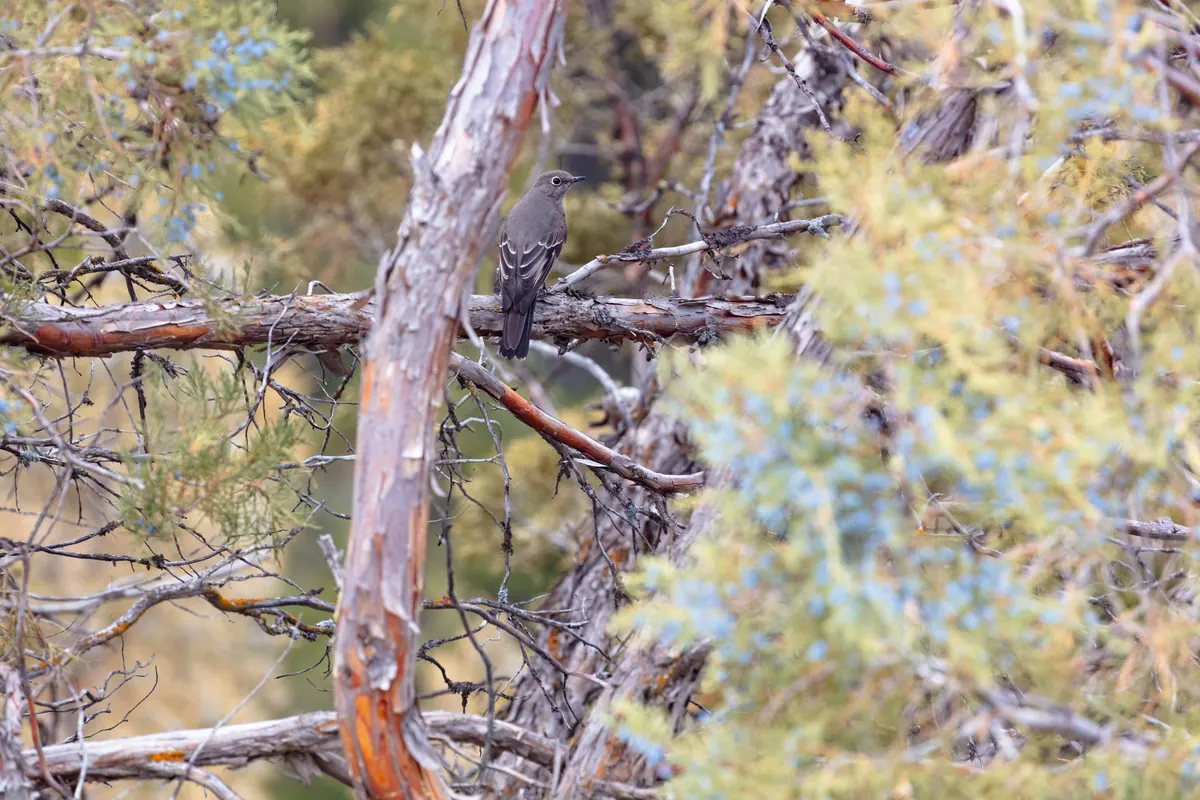
Townsend’s solitaire in the junipers
All winter · Year-round in the Black Hills; in winter also in shelterbelts, conifer plantings and parks elsewhere
This slim gray thrush with a white eye ring is an uncommon permanent resident of the Black Hills and a winter visitor in the rest of the state. In winter it eats mostly juniper berries, and it will chase other birds away from its own patch of junipers, often announcing ownership with a single clear, piping note repeated from a treetop. If you find one in December, you can usually find it again in the same trees in January.
Can you cut a Christmas tree in the Black Hills, and which evergreens grow there?
Yes, with a permit. The Black Hills National Forest sells Christmas tree permits for $10 each (plus a processing fee online) through Recreation.gov, and from Forest Service offices and some local vendors. Every fourth grader in the country can get a free one through the Every Kid Outdoors program. Permits are good through December 31, for a ponderosa pine, a spruce or a juniper.
-
Black Hills spruce, the state tree
All year; easiest to pick out against snow · Higher elevations, cool north-facing slopes and moist drainage bottoms in the Hills
The legislature named the Black Hills spruce, a regional form of white spruce, the state tree in 1947, calling it native and “a tree of noble attributes.” The forest’s brochure says spruce grows high and on wetter ground, with the classic tapered shape and short needles that make stringing lights easy. Spruce needles feel square when rolled between finger and thumb, and each grows singly from a tiny woody peg on the twig. The Forest Service publishes a map showing where spruce is thick and where it is sparse.
-
Ponderosa pine
All year · Nearly everywhere in the Hills, and on the pine ridges of the northwest and Pine Ridge country
Ponderosa is the tree that makes the Black Hills look black from a distance. Its needles are long and come in bundles of two or three, and the brochure praises its full shape. Old trees have orange bark plates that many people say smell of vanilla on a warm day.
-
Rocky Mountain juniper
All year · Lower and drier slopes in the southern and western Hills
The shortest of the three, bluish green and full, with tiny scale-like leaves instead of needles and frosty blue berries that are really cones. Those berries are what the Townsend’s solitaires and other winter birds come for.
-
Permit rules worth knowing
Through December 31 · Most of the national forest, with exceptions
The brochure caps trees at 20 feet, asks for stumps no taller than six inches and limbs scattered close to the ground, and requires the permit to be attached before you leave. Cutting is off limits in the Black Elk Wilderness, the Black Hills Experimental Forest near Rochford, campgrounds and picnic areas, active timber sales and other named areas, including Spearfish Canyon, the Jasper Fire area near Custer and Beaver Park near Sturgis. Stay off private land.
How do South Dakota animals get through the winter?
Only a few South Dakota mammals truly hibernate. Most stay awake and lean on fat, fur, stored food and shelter, and December is when you can see each strategy at work.
-
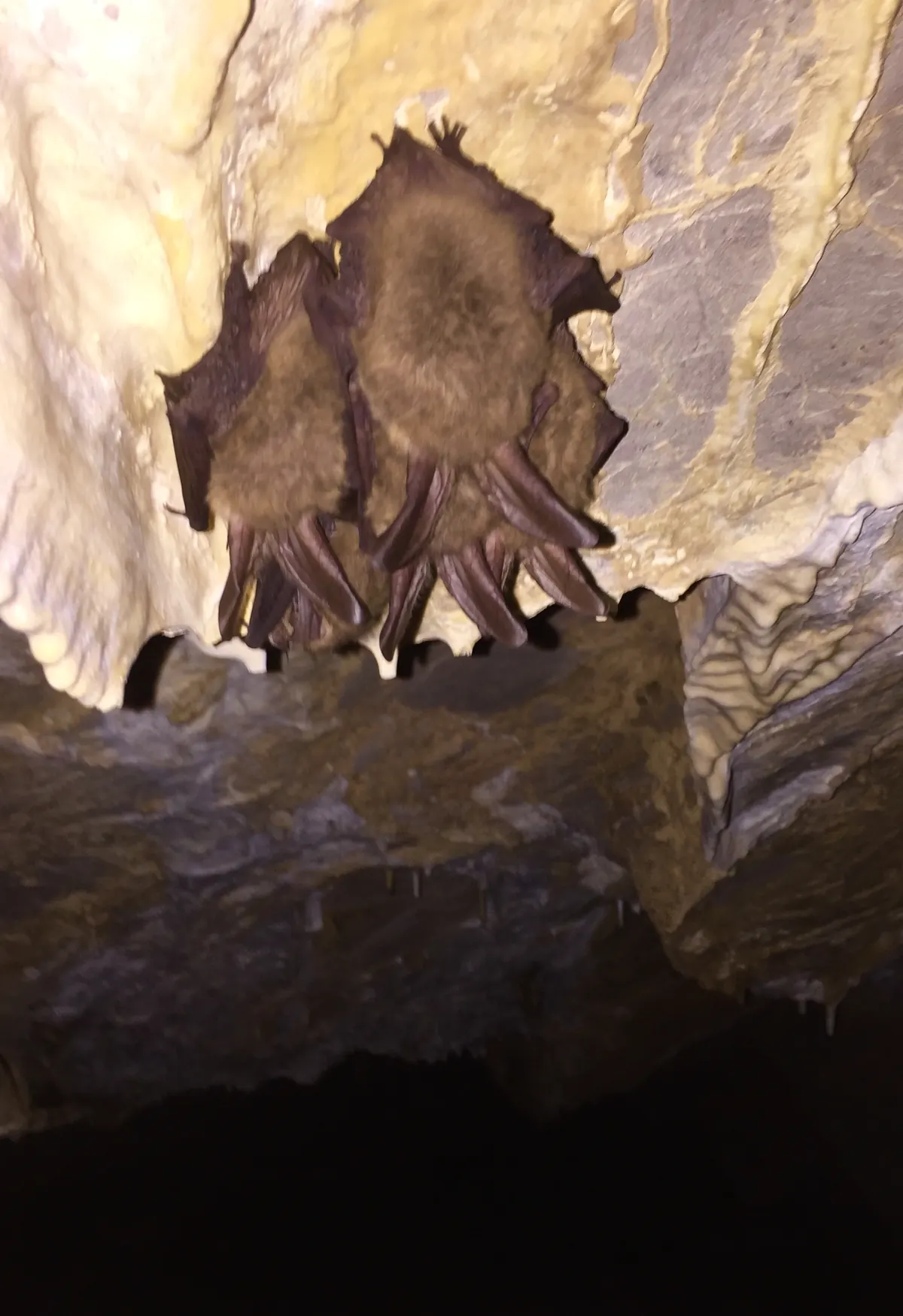
Bats asleep in Jewel Cave
October through May · Jewel Cave National Monument, west of Custer
Ten kinds of bats live in the monument, and more than half of the cave’s hibernators are Townsend’s big-eared bats, which hang from the ceiling with their long ears curled back. The park closes the historic entrance from October through May so no one disturbs them; a bat woken in midwinter burns fat it cannot replace. The 2018 midwinter count found over 1,400 hibernating bats, but the count of winter 2023–24 found only 602. The park says white-nose syndrome, a fungus that attacks bats while they hibernate, may explain the drop, or the bats may have moved to other parts of the cave.
-
Coyotes, the state animal
All winter, mostly from dusk to dawn · Almost every habitat in the state
The legislature made the coyote the state animal in 1949. Game, Fish and Parks notes that coyotes stay active right through the winter, rest during the day and move mostly between dusk and dawn. They hunt voles under the snow by ear, then pounce, and their yipping carries far on a calm, cold night.
-
Beavers under the ice
Once ponds freeze over · Creeks, rivers and ponds statewide
A beaver colony, usually four to eight animals according to Game, Fish and Parks, spends the winter in its lodge or bank den with a pile of branches sunk in the water nearby. When the pond ices over, the beavers swim out under the ice to fetch sticks from that food pile and eat the bark indoors. A lodge with a thin wisp of frost rising from its top on a cold morning is occupied.
-
Mountain goats on the granite
All year · Between Crazy Horse and Mount Rushmore, and from Highway 244 near Black Elk Peak south to the Needles; a few in Battle Creek and Spearfish Canyon
Mountain goats are not native to South Dakota. The National Park Service traces the herd to six goats that Canada gave Custer State Park in 1924 and that escaped into the granite peaks; there are now more than 200. Game, Fish and Parks puts their range at more than 32,000 acres of granite outcrops between 4,000 and 7,242 feet. Look for long, shaggy white coats against gray granite; soft pads on the bottoms of their hooves grip steep rock.
-
Fifty-four degrees underground
Winter tour season, November 1 to April 24 · Wind Cave National Park, north of Hot Springs
Wind Cave holds a steady 54 °F all year, which makes a cave tour a warm outing on a frozen day. Through the winter the park runs its Garden of Eden tour at 10 a.m. and 3 p.m. and its Fairgrounds tour at 1 p.m. (call ahead for the accessibility tour), with reservations on Recreation.gov from 120 days to two days ahead.
Prairie rattlesnakes are already denned up for the season in the rock outcrops and old burrows described in our October guide to South Dakota.
What animal tracks can you find in South Dakota snow?
The ideal tracking morning follows a light, fresh snowfall, before sun and wind blur the prints. Follow one trail rather than studying a single print; the spacing of the steps says as much as the shape of the foot.
-
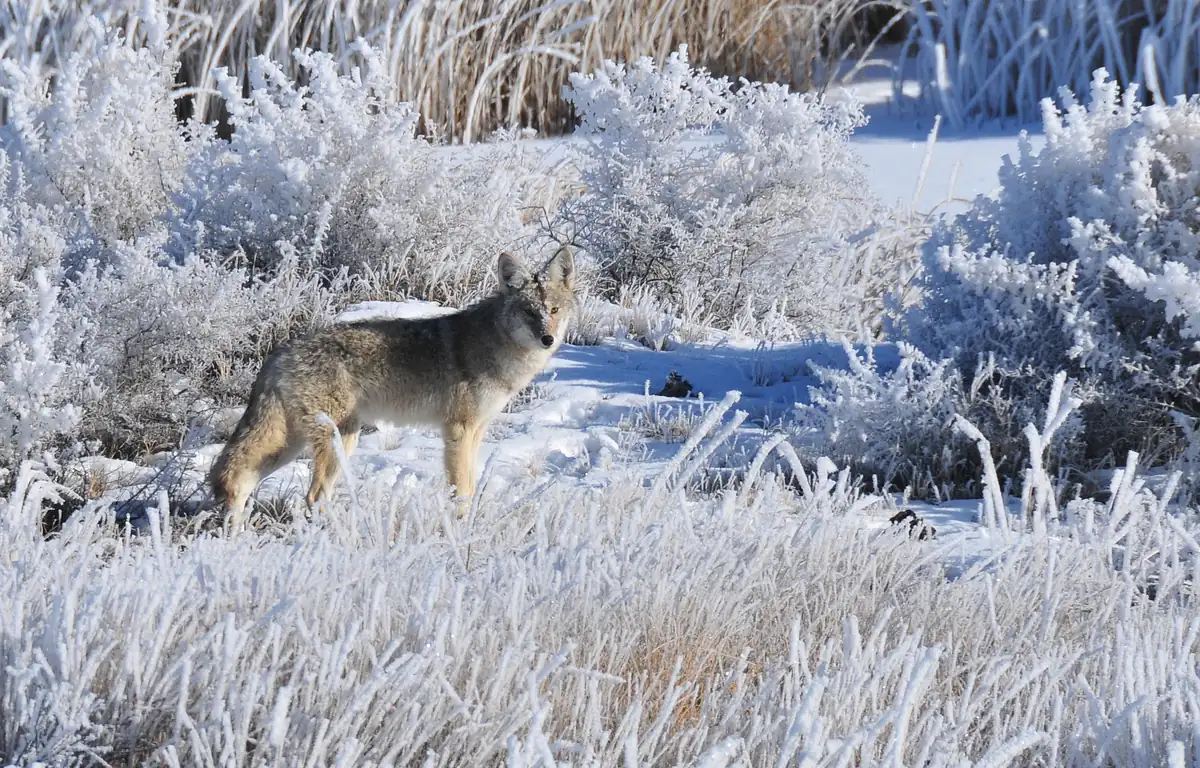
Coyote
After any overnight snow · Field edges, fence lines, frozen creek beds
Oval prints about the size of a large dog’s, with two claw marks at the front, set almost in a single straight line as the animal trots. A dog’s trail wanders and doubles back; a coyote usually travels with purpose.
-
Pheasant, the state bird
All winter · Cattail sloughs, shelterbelts and road ditches, mostly East River
Three long toes pointing forward and a short one behind, in a nearly straight line, sometimes with a drag mark where a rooster’s tail brushed the snow. Where the line simply ends, look for wing marks on each side: the bird flushed. The ring-necked pheasant has been the official state bird since 1943.
-
Cottontail and deer
All winter · Yards, brush piles, river woods
Rabbits leave groups of four prints, the two large hind prints falling in front of the smaller front ones. Deer leave split, heart-shaped prints with the point aimed the way the animal walked, and they reuse the same trails night after night, packing paths you can follow to a bedding thicket.
How much snow does South Dakota get in December, and what will El Niño change?
For climate records, winter means December, January and February, the coldest three months on average, so it begins on December 1; the solstice on the 21st is the astronomical start. NOAA’s 1991–2020 normals put December highs in the upper 20s and 30s across the plains and lows near 8 to 15 °F, coldest at Aberdeen. Normal December snowfall is only about 6 to 9 inches on the plains, and West River is dry: Rapid City’s airport averages just 0.35 inch of precipitation for the whole month. The northern Black Hills are another world, with 25.3 inches of snow at Lead.
Snowfall and snow cover are not the same thing. Watertown, in the Glacial Lakes, averages about 21 or 22 December days with an inch or more of snow cover, while Rapid City averages fewer than 12, probably because mild, dry spells between storms melt what falls there.
| Station | Average high | Average low | Snowfall | Days with 1 inch or more on the ground |
|---|---|---|---|---|
| Lead (northern Black Hills) | 38.1 °F | 18.5 °F | 25.3 in | 20.9 |
| Rapid City Regional Airport | 37.2 °F | 13.9 °F | 6.7 in | 11.6 |
| Mobridge Municipal Airport | 31.6 °F | 12.0 °F | 5.7 in | 13.7 |
| Pierre Regional Airport | 32.4 °F | 13.2 °F | 6.2 in | 15.0 |
| Aberdeen Regional Airport | 28.7 °F | 7.9 °F | 8.0 in | 16.9 |
| Watertown Regional Airport | 26.3 °F | 9.3 °F | 8.9 in | 21.5 |
| Huron Regional Airport | 30.2 °F | 11.0 °F | 8.4 in | 17.6 |
| Sioux Falls (Foss Field) | 31.6 °F | 13.4 °F | 8.7 in | 16.4 |
| Yankton Municipal Airport | 34.0 °F | 14.9 °F | 7.6 in | 12.8 |
This winter starts with a strong hand from the Pacific. NOAA forecasters wrote on September 10 that the odds of El Niño becoming very strong this fall and winter exceed 90 percent. What has that meant here? The Climate Prediction Center’s composite for South Dakota, built from nine or ten El Niño winters between 1914 and 1995, found December through February running 3.0 to 4.7 °F warmer than the long-term average in every one of the state’s climate divisions, with the largest departure in the northeast. Its precipitation map for December through March is less tidy: near or above average across the east and center (up to 147 percent of normal in the southeast), but 94 percent in the Black Hills division. Treat that as a lean, not a promise: the sample is small, it predates 1997–98, 2015–16 and 2023–24, and mild winters still bring blizzards. NOAA issues its formal winter outlook on October 15 and posts it with the CPC’s three-month outlook maps. Our weather page handles the shorter view, the next several days where you live, and the frost-date tables for South Dakota already list when spring’s last freeze usually comes.
When is the earliest sunset in South Dakota?
Around December 9 and 10, almost two weeks before the shortest day. Earth’s tilted axis and its elliptical path around the sun make solar noon creep later through December, so sunsets start coming later while sunrises are still slipping later too; the latest sunrises do not arrive until early January. The time zone line makes the earliest sunsets look very different by the clock. Lemmon, on Mountain time in the northwest corner, sees its earliest sunset at 4:03 p.m. on December 10, and Rapid City at 4:14 p.m. on December 9. Pierre, near the western edge of Central time, holds out until 5:02 p.m. on December 9, while Sioux Falls drops to 4:50 p.m. and Aberdeen to 4:51 p.m.
The shortest day is the solstice, which arrives at 1:50 p.m. MST (2:50 p.m. CST) on Monday, December 21: 8 h 39 m of daylight at Lemmon, 8 h 56 m at Sioux Falls and 9 h 01 m at Yankton. Every city in the table loses 14 to 16 minutes of daylight between December 1 and the solstice, then wins back about 4 by New Year’s Eve.
| City | Dec 1 | Dec 21 | Dec 31 | Earliest sunset |
|---|---|---|---|---|
| Lemmon | 8 h 55 m | 8 h 39 m | 8 h 43 m | 4:03 p.m., Dec 10 |
| Aberdeen | 8 h 58 m | 8 h 42 m | 8 h 46 m | 4:51 p.m., Dec 10 |
| Watertown | 9 h 03 m | 8 h 47 m | 8 h 51 m | 4:47 p.m., Dec 10 |
| Pierre | 9 h 06 m | 8 h 51 m | 8 h 55 m | 5:02 p.m., Dec 9 |
| Rapid City | 9 h 08 m | 8 h 52 m | 8 h 56 m | 4:14 p.m., Dec 9 |
| Mitchell | 9 h 10 m | 8 h 55 m | 8 h 59 m | 4:55 p.m., Dec 9 |
| Sioux Falls | 9 h 12 m | 8 h 56 m | 9 h 00 m | 4:50 p.m., Dec 9 |
| Yankton | 9 h 15 m | 9 h 01 m | 9 h 05 m | 4:55 p.m., Dec 9 |
Look up your own address in the daylight tool, which lists sunrise, sunset and the end of civil twilight, the practical deadline for a December walk.
What can you see in the South Dakota night sky in December?
The longest nights of the year come with the year’s best meteor shower and its biggest full moon. East River readers should use the CST times below; West River readers on Mountain time, Black Hills included, subtract an hour (MST).
-
The Geminids
Night of Sunday, December 13, into Monday morning, December 14 · Anywhere dark; the radiant in Gemini is high in the south by 2 a.m.
The International Meteor Organization expects as many as 150 meteors an hour at the peak under ideal skies, and this year only a slim crescent moon is up, going down around 9 or 10 p.m. Rates are best near 2 a.m. Dress for the coldest hours of a December night, lie flat on a pad or reclining chair, and give it at least 20 minutes.
-
The Cold Moon, the closest full moon of 2026
Full on Wednesday, December 23, at 7:28 p.m. CST (6:28 p.m. MST) · Rising in the northeast around sunset
Perigee, when the moon swings closest to Earth, comes about seven hours after full, so the Cold Moon will be roughly 221,700 miles away and appear slightly bigger than 2026’s other full moons, round on both the 23rd and Christmas Eve. On the solstice evening, the 21st, the waxing gibbous moon slides across or near the Pleiades, drowning out most of the cluster’s stars.
-
Venus at dawn, Saturn at dusk
All month · Venus in the southeast before sunrise; Saturn in the south and southwest after dark
Dazzling Venus climbs higher before sunrise all month, heading for its greatest western elongation in early January. The thin old moon, Spica and Venus make a short line at dawn on December 4, and a day later the moon sits nearer Venus. Jupiter, in Leo, rises by midevening late in the month and outshines everything but Venus, with fainter Mars nearby in the morning sky. Saturn owns the evening sky alone and by late December goes down roughly four hours after sunset.
-
Ursids, then the Quadrantids
Ursids peak December 22; Quadrantids the evening of January 3 into January 4 · The northern sky
The modest Ursids peak on the 22nd under an almost-full moon, so expect little. The Quadrantids are better: their brief peak falls about 9:25 p.m. CST (8:25 p.m. MST) on January 3, just before a new moon, though the radiant is low in the evening, so the dark hours before dawn on January 4 may be the more practical try.
| Phase | Date | Time |
|---|---|---|
| Last quarter | Tuesday, Dec 1 (Monday, Nov 30, in Mountain time) | 12:08 a.m. CST (11:08 p.m. MST on Nov 30) |
| New moon | Tuesday, Dec 8 | 6:52 p.m. CST (5:52 p.m. MST) |
| First quarter | Wednesday, Dec 16 | 11:42 p.m. CST (10:42 p.m. MST) |
| Full moon (Cold Moon) | Wednesday, Dec 23 | 7:28 p.m. CST (6:28 p.m. MST); nearly as full on Dec 24 |
| Last quarter | Wednesday, Dec 30 | 12:59 p.m. CST (11:59 a.m. MST) |
Before a cold night out, our cloud cover forecast shows whether the sky will cooperate, and the moon phases pages list moonrise and moonset wherever you live.
What outdoor events can South Dakota families do in December 2026?
- Wednesday, December 2: Little Acorns, “Winter Animals,” at Good Earth State Park, on the southeast edge of Sioux Falls, a half-hour of story, craft and game from 10 a.m. for ages 3 to 5, about what animals do in winter. Registration closes November 27.
- Thursday, December 3: two evening classes in Rapid City. At the Outdoor Campus, Winter Camping covers the gear for a cold-weather trip (6 to 8 p.m.), and Upland Bird Behavior and Hunting looks at how pheasants, grouse and partridge change through the year (6 to 7:30 p.m., ages 8 and up). Register first.
- Weekends from December 4 to 20: Homestead Holidays. Adams Homestead and Nature Preserve, by North Sioux City, opens its trails Fridays through Sundays (December 4–6, 11–13 and 18–20) from 5 to 9 p.m. for a walk among thousands of Christmas lights around the old homestead.
- Saturday, December 5: Holiday Trees at Good Earth State Park, 5 to 7 p.m., with a visitor center full of trees decorated by local businesses and groups, live music and Santa.
- Monday, December 7: Intro to Ice Fishing, 6 to 8 p.m., held indoors at Rapid City’s Outdoor Campus West, on equipment, safety, places and technique, including how to borrow one of the campus’s free ice fishing kits.
- Saturday, December 12: Frontier Christmas at Fort Sisseton Historic State Park near Lake City, 10 a.m. to 4 p.m., with crafts, homemade bread, sleigh rides (horse-drawn wagons if there is no snow), caroling, candle-lighting on the tree and a free-will chili lunch. The listing is dated for 2026, but part of its description still carries last year’s date, so confirm with the park (605-910-4465).
- Thursday, December 17: Punch the Lights Out, a tin candle lantern workshop at Fort Sisseton, 6 to 8 p.m., with registration.
- Saturday, December 19: the Sioux Falls Christmas Bird Count (see above); the Canton count follows on January 2.
- Any day: the caves. Wind Cave runs its winter tours on the schedule above; call 605-745-4600 about Christmas Day. Jewel Cave’s visitor center is open 8:30 a.m. to 4:30 p.m. Mountain Time, Tuesdays to Saturdays, with reduced tours bookable on Recreation.gov; it closes on December 25 and January 1, and the entrance gate shuts promptly at 4:30.
- New Year’s Day 2027: First Day Hikes. The national First Day Hikes program, run by America’s State Parks, puts on guided walks every January 1. No South Dakota hikes were posted when we checked in early October; watch the Go Outdoors South Dakota event calendar in late December.
- All month: citizen science. Keep up your FeederWatch counts, add owl and hawk sightings to eBird, and note the date your nearest pond freezes solid enough to hold snow.
State park programs require a park entrance license, and several classes have small caps, so register through GFP’s Go Outdoors event search. Our seasonal nature guides cover the other months and states, and a child who wants to draw what they find can use the Naturalist’s Field Journal.
Safety notes for December in South Dakota
- Who is hunting in December, and what to wear. GFP’s 2026–27 season table shows the muzzleloader deer season running December 1 to January 1, East River firearm deer continuing through December 6, and an antlerless-only stretch December 12–20 in both the West River and East River units. Archery deer and the youth and mentored deer seasons last through January 1, prairie elk and bighorn sheep through December 31, and the trophy bison hunt in Custer State Park through January 15. The Black Hills mountain lion season opens December 26, as does bobcat season. Anyone using a firearm for big game (turkey and mountain lion excepted) must have fluorescent orange or pink showing on at least one outer garment above the waist; a cap or vest counts. Bird seasons keep going too: pheasant, grouse, partridge, quail and fall turkey until January 31, with Sand Lake refuge opening to pheasant hunting on December 14 and several game bird refuges on December 1; ducks until December 8, January 5 or January 14 depending on the zone; light geese and tundra swans to January 8. Wear bright colors on any public land.
- Wind chill. The Sioux Falls weather office points out that 0 °F with a 15 mph wind feels like 19 below and can freeze exposed skin in about 30 minutes. Locally, a Cold Weather Advisory goes out when it feels like 25 below or colder and an Extreme Cold Warning at 35 below. Cover ears, nose and fingers first.
- Driving. The car should carry blankets or a sleeping bag, a flashlight and batteries, first aid supplies, high-calorie food and water, jumper cables, a shovel, sand or chains, flares and a phone charger. The Forest Service reminds tree cutters that Hills roads can need chains or four-wheel drive, and that weather there changes fast.
- Early ice. December ice is new, uneven ice. Check thickness yourself with an auger or spud bar every few steps, stay off ice over moving water, inlets and springs, and fish with a partner; the thickness rules of thumb are in our November guide.
- Short days. Most of the state loses the sun before 5 p.m., so begin hikes and tree hunts by early afternoon and carry a headlamp.
Sources
- National Audubon Society: Christmas Bird Count (127th count, December 14 to January 5)
- National Audubon Society: join a Christmas Bird Count (field and feeder counts, circle finder)
- South Dakota Ornithologists’ Union: calendar (Sioux Falls CBC December 19, 2026; Canton CBC January 2, 2027)
- South Dakota Ornithologists’ Union: sd-birds mailing list
- Project FeederWatch: project overview
- South Dakota Birds and Birding: snowy owl
- South Dakota Birds and Birding: rough-legged hawk
- South Dakota Birds and Birding: great horned owl
- South Dakota Birds and Birding: Townsend’s solitaire
- USDA Forest Service, Black Hills National Forest: Christmas tree permit
- USDA Forest Service, Black Hills National Forest: forest products permits (Christmas trees through December 31)
- USDA Forest Service, Black Hills National Forest: Christmas tree brochure (kinds of trees, cutting rules, closed areas)
- USDA Forest Service, Black Hills National Forest: spruce tree forest map
- Recreation.gov: Black Hills National Forest Christmas tree permit
- South Dakota Codified Laws 1-6-11: state tree (Black Hills spruce)
- South Dakota Codified Laws 1-6-8: state animal (coyote)
- South Dakota Codified Laws 1-6-9: state bird (ring-necked pheasant)
- National Park Service, Jewel Cave: bats (species, midwinter counts, entrance closure)
- National Park Service, Jewel Cave: operating hours and seasons
- National Park Service, Wind Cave: guided cave tours (winter schedule, cave temperature)
- National Park Service, Mount Rushmore: mammals (mountain goats)
- South Dakota Game, Fish and Parks: mountain goat
- South Dakota Game, Fish and Parks: coyote
- South Dakota Game, Fish and Parks: beaver
- South Dakota Game, Fish and Parks: mountain lion
- South Dakota Game, Fish and Parks: pheasant (open areas and refuge opening dates)
- South Dakota Game, Fish and Parks: 2026 Hunting and Trapping Handbook (2026–27 season table, fluorescent orange or pink rule)
- Go Outdoors South Dakota: statewide event and class search
- Go Outdoors South Dakota: Little Acorns, Winter Animals, Good Earth State Park, December 2, 2026
- Go Outdoors South Dakota: Winter Camping, Outdoor Campus Rapid City, December 3, 2026
- Go Outdoors South Dakota: Upland Bird Behavior and Hunting, Outdoor Campus Rapid City, December 3, 2026
- Go Outdoors South Dakota: Homestead Holidays, Adams Homestead and Nature Preserve, December 4, 2026 (first of nine evenings)
- Go Outdoors South Dakota: Homestead Holidays, Adams Homestead and Nature Preserve, December 20, 2026 (last evening)
- Go Outdoors South Dakota: Holiday Trees, Good Earth State Park, December 5, 2026
- Go Outdoors South Dakota: Intro to Ice Fishing, Outdoor Campus Rapid City, December 7, 2026
- Go Outdoors South Dakota: Frontier Christmas, Fort Sisseton, December 12, 2026
- Go Outdoors South Dakota: Punch the Lights Out, tin candle lantern making, Fort Sisseton, December 17, 2026
- America’s State Parks: First Day Hikes
- NOAA NCEI: U.S. climate normals, 1991–2020
- NOAA NCEI: 1991–2020 monthly normals, station files (Sioux Falls USW00014944, Rapid City USW00024090, Aberdeen USW00014929, Lead USC00394834 and others)
- NOAA Climate Prediction Center: ENSO diagnostic discussion, September 10, 2026
- NOAA Climate Prediction Center: South Dakota temperature and precipitation in El Niño winters (climate division composites)
- NOAA Climate Prediction Center: seasonal outlooks (winter outlook issued October 15, 2026)
- National Weather Service Sioux Falls: winter preparedness (wind chill, cold alert thresholds, car kit)
- U.S. Naval Observatory: phases of the moon
- U.S. Naval Observatory: Earth’s seasons, 2026 (December solstice)
- International Meteor Organization: 2026 meteor shower calendar
- EarthSky: what is a supermoon? (2026 full supermoons)
- EarthSky: Venus at greatest western elongation
- NASA JPL Horizons: planetary and lunar positions
- Royal Astronomical Society of Canada: 2026 lunar occultations (Pleiades)
- Photos via Wikimedia Commons; licenses and photographers are credited under each picture
.jpg)