What to look for in nature in South Dakota this November
November is when South Dakota’s water starts to lock up, and most of this month’s stories follow from that. Snow geese and tundra swans move down the Glacial Lakes and the James valley one cold front at a time, while the sloughs skim over behind them. The birds that stay crowd onto the few places that keep open water: the Missouri below its big dams, where bald eagles gather in the cottonwoods, and the spring-fed pools of Lacreek refuge, where trumpeter swans spend the whole winter. On land, white-tailed bucks chase does in broad daylight, bighorn rams start butting heads, and Custer State Park auctions hundreds of its bison on November 7. The clocks fall back on November 1, the evenings go dark before supper, and a normal November brings about 3½ to 6½ inches of snow to the plains and more than 20 to the northern Hills. The notes below run from the lakes to the Hills, dated wherever a source allows.
Other months in South Dakota: October, December.
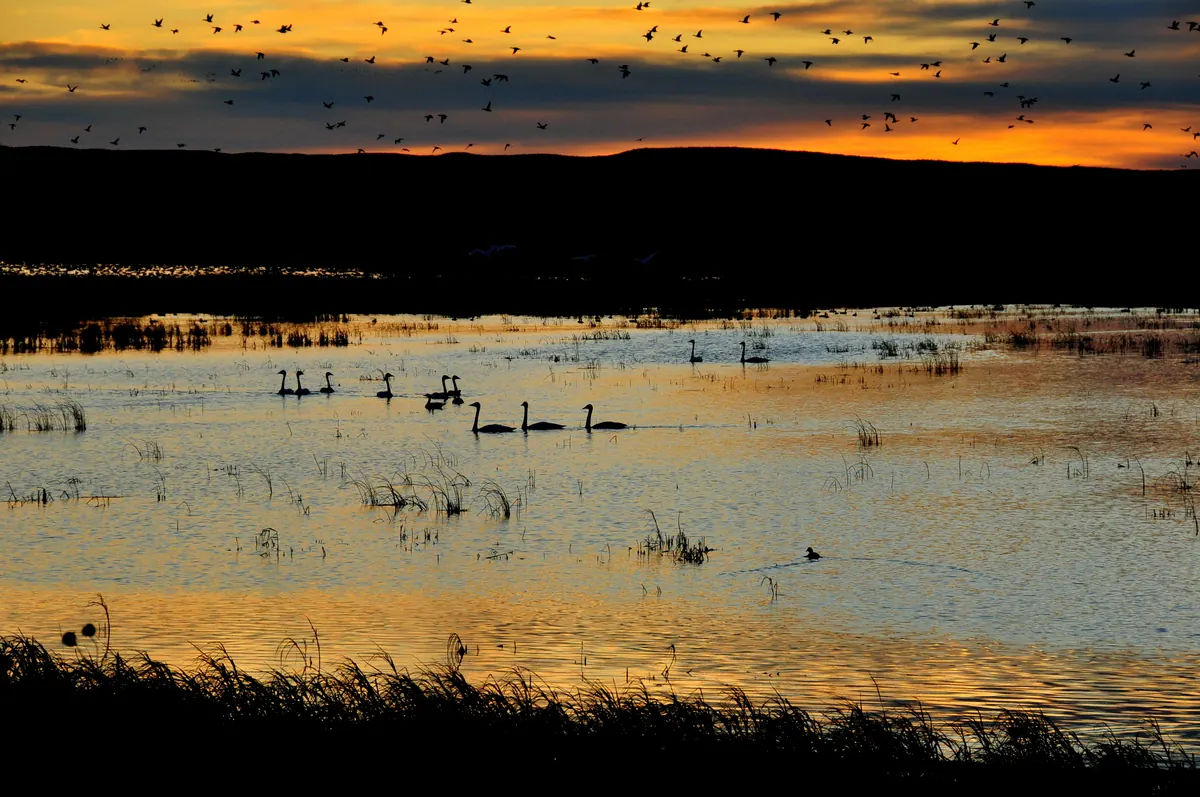
Start here

- Follow the freeze-up. Every cold snap seals the shallow sloughs first and pushes ducks, geese and swans onto the big lakes and the Missouri. Pick a marsh near home and write down the morning it freezes from shore to shore.
- Eagles and swans in the open water. Bald eagles gather below Fort Randall Dam near Pickstown, best seen from the Eagle Drive overlook. Near Martin, Lacreek refuge keeps open water for trumpeter swans all winter, and its gravel tour route passes them.
- Two planets nearly touching, then the Leonids. At dawn on the 15th and 16th, Jupiter and fainter Mars hang a hair over one degree apart, well up in the south, while brilliant Venus climbs in the east. The Leonid meteors peak the morning of the 18th, best after the moon sets around midnight, and a Beaver Moon turns full on the morning of the 24th.
For the Naturalist’s Field Journal: put every swan, eagle and snow bunting of the month on the birds-I-have-seen page, and keep a reading-the-signs page for the scrapes and rubbed saplings a rutting buck leaves along a field edge. A redcedar “berry” and a ponderosa cone make a good pair to sketch side by side for the seeds, pods and cones plate. Make your own pond the subject of the same-place-twice pages: once in open water, once the morning it freezes over. Track the sunset times in the daily field log as the evenings close in.
Regions used below: Black Hills; West River prairie and the Badlands; Missouri River and the big reservoirs; Glacial Lakes and the northeast; Southeast and Sioux Falls.
When do snow geese and tundra swans pass through South Dakota in November?
The white birds come late and leave with the ice. Game, Fish and Parks’ weekly waterfowl reports from last fall show how the month tends to go. In the first week of November 2025 the northeast was “on the leading edge” of the snow geese, swans were starting to show up in the northern counties, and a hard cold snap was expected to freeze small and mid-sized ponds. By November 17–21 snow geese numbers were “strong” in the James River valley and a large flock had settled into Campbell and Walworth counties in north-central South Dakota. By the first week of December nearly all the water in the northeast and southeast was frozen and the remaining ducks and geese were working the Missouri and cornfields. This year’s timing hangs on the cold fronts, and many wetlands start low after a dry summer.
-
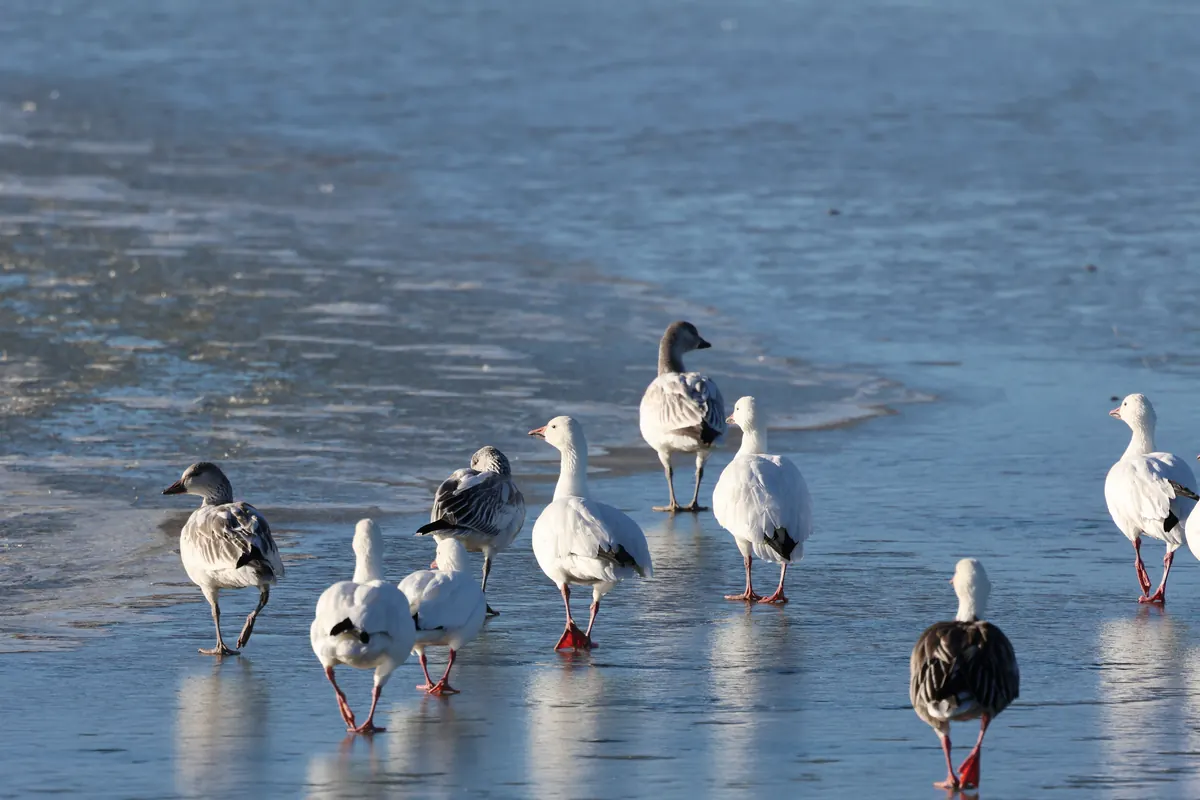
Snow geese on the Glacial Lakes and the James
Early November into early December, in pulses behind cold fronts · Sand Lake National Wildlife Refuge northeast of Aberdeen; the big lakes around Webster, Waubay and Watertown; Lake Andes in the south
Snow geese feed in harvested corn and rest on the largest lakes, so the classic view is a white line lifting off a field at sunrise and sliding toward the water. Look for the dark “blue goose” birds mixed in: they are the same species, a dark morph with a white head. Sand Lake’s Wildlife Drive is closed by now, so watch from the public roads around the refuge and from the headquarters area. Smaller Ross’s geese travel with the flocks; they have a stubbier bill with no black “grin.”
-
Tundra swans, a short window
Late October to mid-November · Northeast and east-central lakes and wetlands, especially around Sand Lake
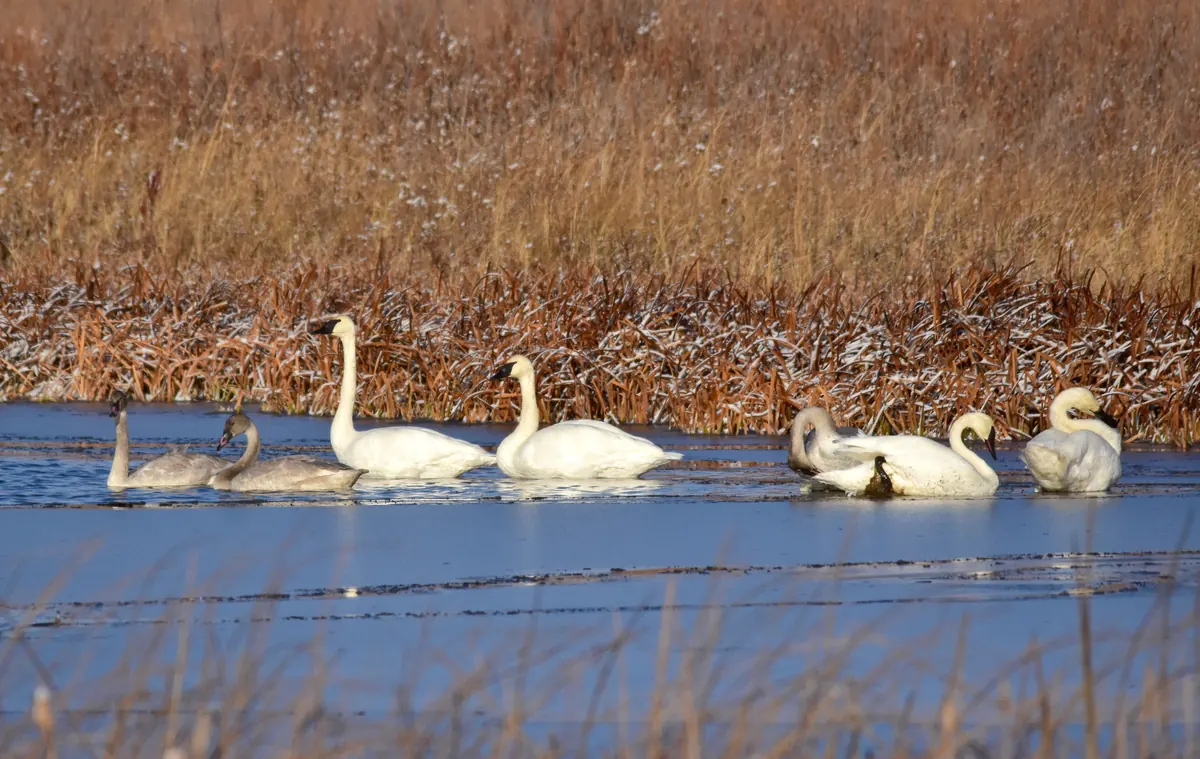
GFP says tundra swans, which nest in the high Arctic, cross South Dakota from late October to mid-November. They are the largest migratory bird the state lets hunters take, by permit, in 34 eastern and central counties. To tell one from a trumpeter, look for the small yellow spot that most adults show on the black bill just in front of the eye, and listen for the mellow, three-part hoo-ho-hoo that Audubon describes from migrating flocks. Swans tend to pick a favorite wetland and stay in a group, so once you find them, you often find a lot of them.
-
Trumpeter swans on Lacreek’s spring-fed pools
October through March · Lacreek National Wildlife Refuge, southeast of Martin in Bennett County
Lacreek works the other way round from the Glacial Lakes: when the rest of the northern plains freezes over, spring flows keep some of its pools open, and the refuge says “large concentrations of trumpeter swans, Canada geese, and mallards” stay all winter. The 4.5-mile auto tour from the visitor center runs on gravel, which turns slick after snowmelt, so check the forecast before you go.
Last November GFP staff also took reports of sick and dead snow geese in north-central South Dakota and sent some birds for avian influenza testing. Do not handle a sick or dead wild bird; note the place and call your local conservation officer or GFP office instead.
Where can you see bald eagles and winter birds in South Dakota in November?
November swaps one bird community for another. The last sparrows and blackbirds trickle south, and the winter crowd moves in: eagles on the rivers, snow buntings and longspurs on the gravel roads, juncos and tree sparrows under feeders.
-
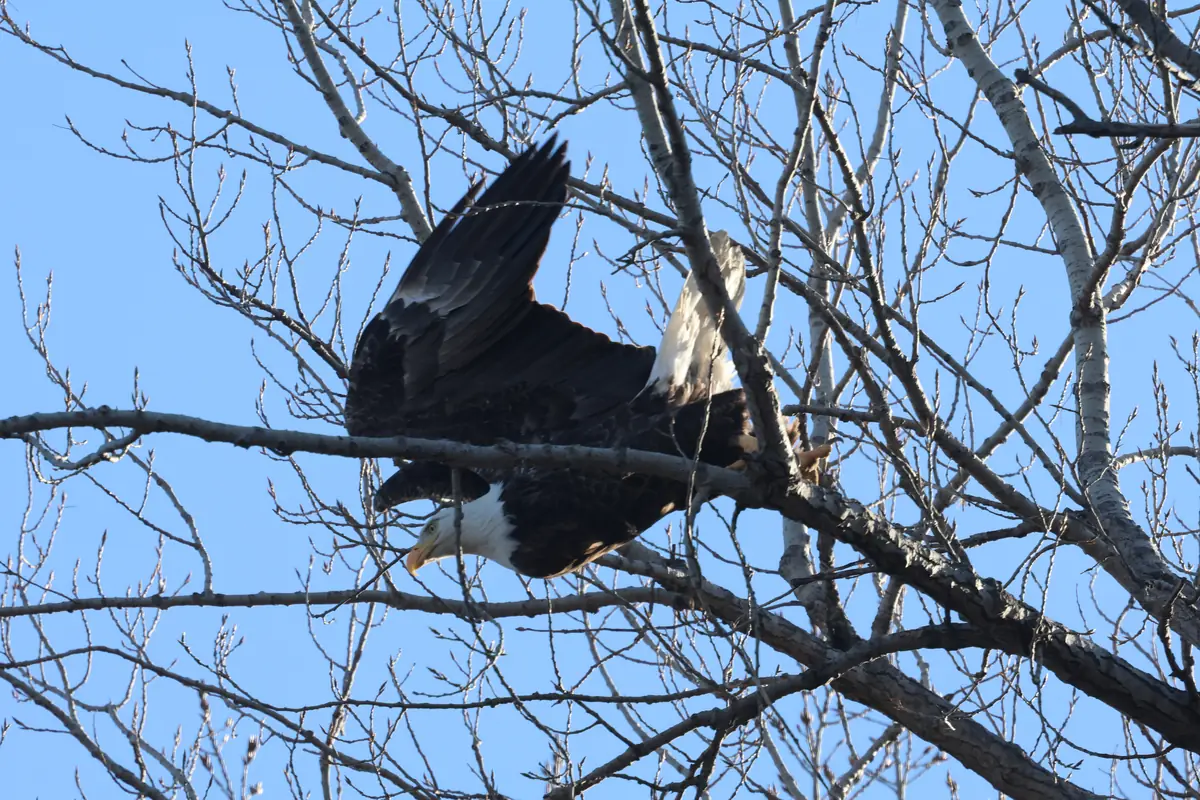
Bald eagles below Fort Randall Dam
Arriving through November; most numerous in midwinter · The kiosk and overlook on Eagle Drive, on the west bank below Fort Randall Dam near Pickstown
Water released through Fort Randall Dam keeps the Missouri open below it through the coldest weather. Refuge staff credit the fish (goldeye, shad and white bass), the waterfowl and the tall cottonwoods along the open channel for drawing them, and in 1967 the count peaked at 283, then the largest known wintering group in the lower 48 states. The Karl E. Mundt refuge was set aside for them in 1974 and is closed to entry, so watch from the overlook, where interpretive panels explain what you are seeing.
-
Snow buntings, longspurs and horned larks
Mostly late in the month, after the first snow · Gravel roads, stubble fields and windswept prairie, statewide
Snow buntings are among the last winter visitors to show up and the first to leave in spring. They travel in restless, tightly wheeling flocks with horned larks and Lapland longspurs, and they pick seeds and grit along road shoulders. A flock that flashes white wings as it lifts from a gravel road is almost certainly buntings.
-
Crossbills and the winter finch forecast
Through the winter · Ponderosa pine forest in the Black Hills and Pine Ridge; shelterbelts with spruce and pine
The Finch Research Network’s 2026–27 forecast, posted in late September, describes a big west-to-east movement of Type 2 red crossbills, a call type often associated with ponderosa pine, after “widespread pine failure” on several western pines, ponderosa among them. The forecast says nothing specific about the Black Hills, so watch the pines and listen for the hard “kip-kip” flight calls. Its evening grosbeak and redpoll outlooks are aimed at the Great Lakes and the Northeast, and it thinks plentiful mountain-ash berries will keep Bohemian waxwings well to the north. Any of these at a Black Hills feeder is worth an eBird checklist.
When is the deer rut in South Dakota, and when do the firearm deer seasons open?
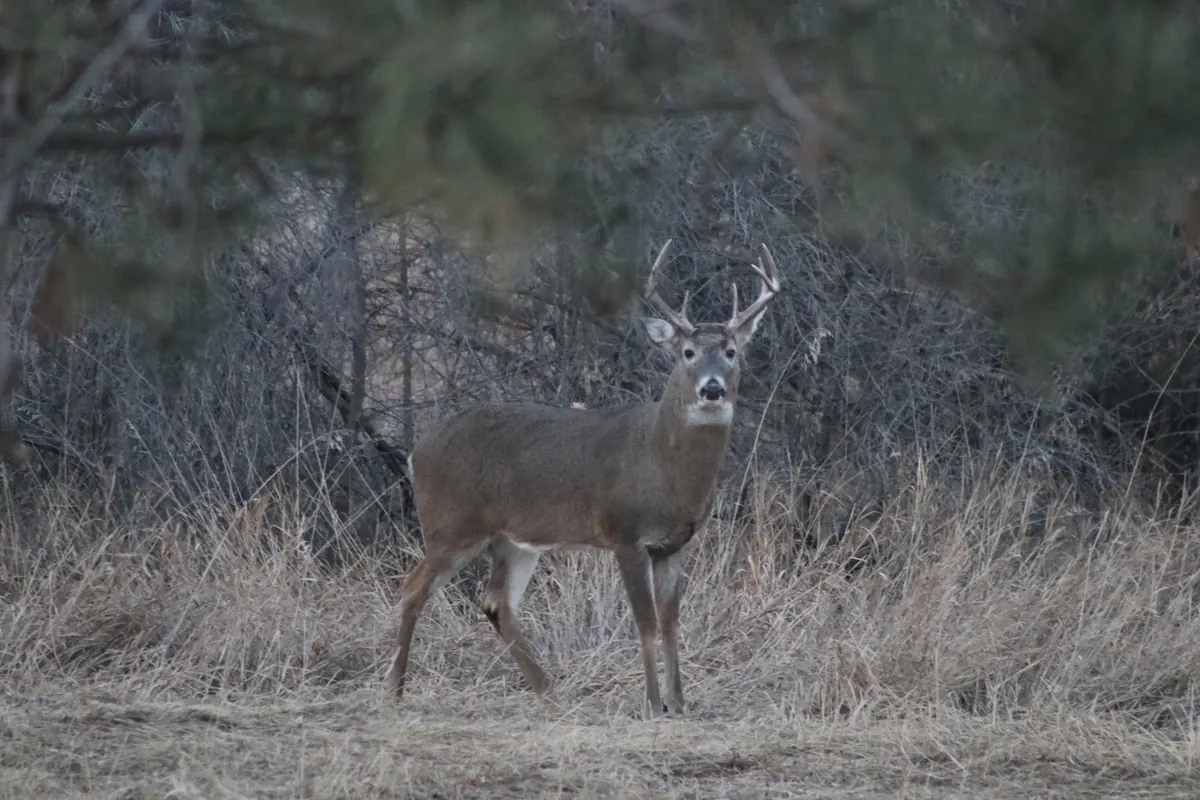
November is rut month. White-tailed deer breed within a few short weeks, and North Dakota Game and Fish biologists, writing about the northern plains, put the peak between November 15 and 20, keyed to shortening days; mule deer run a little later and taper off into December. GFP’s 2026 dates: the Black Hills and Custer State Park seasons run November 1–30, West River November 14–29 (Gregory County has its own dates), and East River November 21 through December 6. Archery deer runs through January 1. The Black Hills season is an old one; GFP’s deer plan traces a November 1–20 season there back to 1929.
-
White-tailed bucks on the move
All month; heaviest in the middle two weeks · River bottoms, shelterbelts and creek draws statewide; Missouri River refuges
A rutting buck walks with his nose down along doe trails, follows a single doe closely for a day or two, and pays less attention to traffic than he did in October. Look for fresh scrapes, bare patches of pawed earth under a low branch, and saplings with the bark stripped by antlers. Dawn and dusk are best, but in the peak days bucks travel at midday too.
-
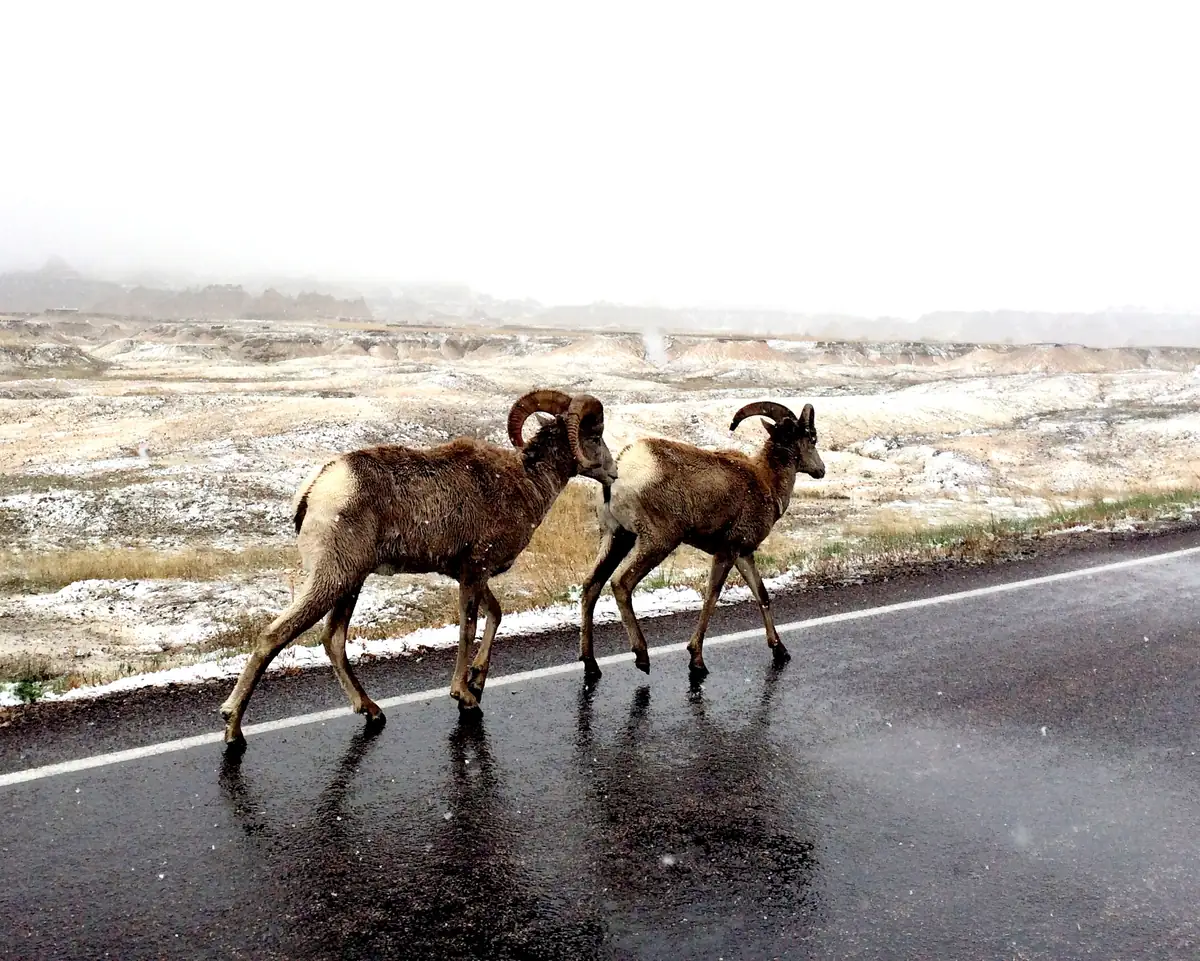
Bighorn rams butting heads
Breeding peaks mid-November to mid-December · Custer State Park (Grace Coolidge and French Creek areas), Badlands National Park (Pinnacles Overlook, Castle Trail, Big Badlands Overlook)
GFP’s bighorn management plan says breeding “typically peaks from mid-November to mid-December” and that rams settle rank by fighting first. Badlands National Park, home to about 250 bighorns descended from 22 animals brought from Pikes Peak in 1964, says rams leave their bachelor groups and join the ewes when the rut begins. A clash carries a long way on a still morning; stay in or near your car and give the animals room.
Watch the sunset times: a buck crossing the highway at 5 p.m. in November is crossing at dusk. Look up yours in the daylight calculator, which gives sunrise, sunset and twilight for any town.
What happens to Custer State Park’s bison and other wildlife in November?
Three smaller November stories, from the southern Hills to the eastern rivers.
-
The Custer State Park bison auction
Saturday, November 7, 10 a.m. Mountain Time · Custer State Park Visitor Center, on U.S. 16A
The park sells part of its herd each fall so the rest can winter on the available grass. The auctioneer lists the 61st annual sale for November 7, with live and online bidding. South Dakota News Watch reported on September 30 that about 612 bison are expected to go this year, compared with 435 last year, because of drought; the park’s visitor services supervisor said the range can carry about 900 animals over the winter. The herd that remains is easy to find along the Wildlife Loop Road afterward. The trophy bison hunt opens November 16.
-
Prairie dogs slow down
As the cold sets in · Wind Cave National Park, Badlands (Roberts Prairie Dog Town, Burns Basin Overlook), Lacreek
Black-tailed prairie dogs do not truly hibernate. Wind Cave National Park describes their winter as incomplete hibernation: they eat less, may sleep for days at a time, and pop back up to feed on mild afternoons. A sunny day after a cold spell is the time to look.
-
River otters on the Big Sioux
All winter; tracks show best in fresh snow · Streams, rivers and marshes in eastern South Dakota, especially the Big Sioux
Otters came off the state threatened list in 2020 after years of recovery, and GFP now opens a strictly limited season (November 1 to December 31, or until 30 are taken, one per person) in eastern counties. On a snowy bank look for a trough where an otter has slid on its belly, and for tracks with all five toes showing. On November 21 the Outdoor Campus in Sioux Falls hosts a free afternoon on the Big Sioux otters (see the family list below).
Has South Dakota had its first freeze by November, and when do the lakes ice over?
Yes, almost everywhere, almost every year. Look at the median column below: every station’s typical first 32 °F morning falls in September or October, from Hill City in the central Hills (Sep 10) and Aberdeen (Sep 26) to the late southeastern stations, Yankton 2 E (Oct 11) and the Sioux Falls Airport (Oct 13). Even the late-year column on the right stays inside October at every station, with Sioux Falls the latest at October 28. So if your thermometer has not dipped below freezing by the first week of November, you are living through an unusual fall. The hard freeze that matters now is the one that seals the water: small sloughs first, then the bays of the Glacial Lakes, while the Missouri below the dams stays open all winter.
| Station | One year in ten | Median | Nine years in ten |
|---|---|---|---|
| Hill City (central Black Hills) | Aug 29 | Sep 10 | Sep 26 |
| Lead (northern Black Hills) | Sep 15 | Sep 29 | Oct 13 |
| Rapid City (in town) | Sep 26 | Oct 8 | Oct 23 |
| Mobridge Municipal Airport (north-central, Missouri River) | Sep 21 | Oct 4 | Oct 17 |
| Pierre Regional Airport (central) | Sep 20 | Oct 3 | Oct 17 |
| Aberdeen (James River valley) | Sep 14 | Sep 26 | Oct 7 |
| Watertown Regional Airport (Glacial Lakes) | Sep 19 | Sep 30 | Oct 13 |
| Sioux Falls Airport (southeast) | Sep 28 | Oct 13 | Oct 28 |
| Yankton 2 E (Missouri valley, southeast) | Sep 27 | Oct 11 | Oct 23 |
First ice is thin ice. The National Weather Service’s rule of thumb is at least 4 inches of clear ice to walk on or fish from, 5 for a snowmobile and 8 to 12 for a car or small pickup, and it reminds anglers that no ice is ever “100% safe.” The Caribou, Maine, office adds that clear ice is usually more solid than white, gray or snow ice, so treat cloudy ice with extra suspicion. For a station near your home, including the spring dates, open the frost dates for South Dakota.
How much daylight does South Dakota lose in November?
A little more than an hour. Lemmon, in the northwest corner, has 10 h 05 m of daylight on November 1 and only 8 h 57 m by the 30th, a loss of 68 minutes; Aberdeen gives up 66, Sioux Falls 62 and Yankton 61, a little over two minutes a day. The bigger jolt is the clock. With the switch back to standard time early on Sunday, November 1, Sioux Falls jumps from a 6:19 p.m. sunset on Saturday, October 31, to 5:18 p.m. on Sunday, and by November 30 the sun there rises at 7:39 a.m. and sets at 4:52 p.m. In Rapid City, on Mountain time, sunset falls at 4:43 p.m. on the 1st and 4:16 p.m. by month’s end, and Lemmon’s is earlier still, 4:06 p.m. on the 30th. Day length drops a little more slowly by late November, but sunsets keep creeping earlier until the second week of December.
| City | Nov 1 | Nov 30 | Lost | Per day |
|---|---|---|---|---|
| Lemmon | 10 h 05 m | 8 h 57 m | 68 min | 2.3 min |
| Aberdeen | 10 h 07 m | 9 h 01 m | 66 min | 2.3 min |
| Watertown | 10 h 10 m | 9 h 04 m | 66 min | 2.3 min |
| Pierre | 10 h 12 m | 9 h 08 m | 64 min | 2.2 min |
| Rapid City | 10 h 13 m | 9 h 09 m | 64 min | 2.2 min |
| Mitchell | 10 h 15 m | 9 h 12 m | 63 min | 2.2 min |
| Sioux Falls | 10 h 15 m | 9 h 13 m | 62 min | 2.1 min |
| Yankton | 10 h 18 m | 9 h 17 m | 61 min | 2.1 min |
Short days are a reason to plan. The daylight calculator shows when civil twilight ends for your own farm or neighborhood, which is the honest end of a late-afternoon walk.
What is November weather like in South Dakota, and what will El Niño mean this winter?
November is the month South Dakota tips from fall into winter. On the plains, November’s normal daily high (NOAA, 1991–2020) sits in the low to mid 40s, from 39.8 °F at Watertown to 47.3 °F at the Rapid City airport, with average lows of about 19 to 25 °F. West River stays dry, under half an inch of precipitation for the month at Rapid City and Mobridge, while Sioux Falls and Yankton average about an inch and a quarter. Normal snowfall runs from 3.6 inches at Mobridge to 6.5 at Aberdeen. Lead, in the northern Hills, averages 22.3 inches.
Then there is the winter ahead. NOAA forecasters gave better than 90 percent odds, in their September 10 update, that the current El Niño becomes very strong by the cold season. In the northern plains, strong El Niño events have tended to mean warmth. Scott Rudge, a meteorologist at the Rapid City weather office, told KOTA in August that in the region’s strongest past El Niño winters temperatures ran three to four degrees above normal. Laura Edwards, the state climatologist at SDSU Extension, expects a warmer than normal winter that still brings snow and stretches of severe cold; she sees no reliable signal in precipitation, since earlier El Niño winters have gone both wet and dry, but does expect snow cover that melts between storms and a shorter cold season overall. The 2015–16 event shows the mix. The Aberdeen weather office ranked that winter sixth-warmest on record at Mobridge and seventh-warmest at Aberdeen, yet snowfall from October through February came in 1.9 inches below normal at Aberdeen and 9.8 inches above at Kennebec. November rarely shows much of an El Niño fingerprint, since the pattern does most of its work in December through February. Look for NOAA’s formal winter outlook after it is issued on October 15, on the CPC seasonal outlooks page.
| Station | Average high | Average low | Precipitation | Snowfall |
|---|---|---|---|---|
| Lead (northern Black Hills) | 46.0 °F | 25.4 °F | 1.70 in | 22.3 in |
| Rapid City Regional Airport | 47.3 °F | 21.9 °F | 0.47 in | 5.7 in |
| Mobridge Municipal Airport | 44.2 °F | 22.8 °F | 0.43 in | 3.6 in |
| Pierre Regional Airport | 44.9 °F | 23.2 °F | 0.77 in | 6.3 in |
| Aberdeen Regional Airport | 42.5 °F | 19.4 °F | 0.74 in | 6.5 in |
| Watertown Regional Airport | 39.8 °F | 21.3 °F | 0.68 in | 4.5 in |
| Huron Regional Airport | 43.9 °F | 22.2 °F | 0.82 in | 5.8 in |
| Sioux Falls (Foss Field) | 45.0 °F | 24.5 °F | 1.22 in | 6.2 in |
| Yankton Municipal Airport | 47.2 °F | 25.3 °F | 1.27 in | 5.9 in |
For the days ahead rather than the season, our current weather page pulls in the latest forecast for your location.
What can you see in the South Dakota night sky in November?
Long, cold, dry nights make November a generous month for the sky, and the morning sky is the busier one. Times below are Central Standard Time for East River and Mountain Standard Time for the Black Hills and most of West River, an hour earlier by the clock.
-
The Leonids
Before dawn on Wednesday, November 18 (and the mornings either side) · Facing east or overhead, away from town lights
According to the International Meteor Organization’s 2026 calendar, Leonid rates top out on November 17–18 at roughly 15 an hour for a dark site, and no outburst is due this year. Leo clears the eastern horizon near midnight, close to when the first-quarter moon goes down, so the hours from 1 a.m. to first light are the ones to give it. These meteors hit the air at high speed and sometimes leave short-lived glowing streaks.
-
Mars and Jupiter side by side
Before dawn on November 15 and 16 · High in the south and southeast before sunrise
The pair close to within 1.2 degrees, a bit more than the width of your little fingertip held at arm’s length, with Jupiter far the brighter and Mars a faint rusty dot beside it, both in Leo near the star Regulus. Later in the month Mercury joins the dawn lineup; try for it near the east-southeast horizon between about November 18 and 25.
-
Venus, the morning star
All month, rising earlier each morning · Low in the east-southeast before dawn
After its late-October pass between us and the sun, Venus rises higher each morning and is at its brightest of this apparition from about November 24 to 27; near November 9 look for the star Spica just beside it. Saturn has the evening sky to itself, in the south and southwest after dark.
-
The Beaver Moon
Full on the morning of Tuesday, November 24 · Rising in the east-northeast near sunset
Full at 8:53 a.m. CST (7:53 a.m. MST) on the 24th, which leaves both Monday and Tuesday evenings with a round-looking moon, Tuesday’s a little closer to exact. It counts as a modest supermoon, about 224,000 miles (360,800 kilometers) away. In the small hours after the 23rd it passes the Pleiades, washing out all but the brightest of the cluster. Two nights later Uranus is at opposition nearby in Taurus, findable with binoculars and a chart.
| Phase | Date | Time |
|---|---|---|
| Last quarter | Sunday, Nov 1 | 2:28 p.m. CST (1:28 p.m. MST) |
| New moon | Monday, Nov 9 | 1:02 a.m. CST (12:02 a.m. MST) |
| First quarter | Tuesday, Nov 17 | 5:48 a.m. CST (4:48 a.m. MST) |
| Full moon (Beaver Moon) | Tuesday, Nov 24 | 8:53 a.m. CST (7:53 a.m. MST) |
| Last quarter | Tuesday, Dec 1 (Monday, Nov 30, in Mountain time) | 12:08 a.m. CST (11:08 p.m. MST on Nov 30) |
Solar activity has passed its maximum yet still produces storms, so aurora over the northern counties stays possible, though nobody can predict a display this far ahead. Our sky and cloud forecast tells you whether a clear night is coming, and the moon phase pages list rise and set times wherever you live.
What seeds, cones and berries are left for wildlife in South Dakota in November?
Bare branches make it easy to see which trees still carry food for the winter.
-
Eastern redcedar cones
Ripe and blue through the winter · Shelterbelts, farmsteads, Missouri River breaks and, increasingly, open pasture
The “berries” on a redcedar are really soft cones, dusty blue with a waxy bloom. SDSU Extension lists cedar waxwings, pheasants, turkeys and rabbits among the animals that eat them, and the dense branches shelter roosting birds on bitter nights. The same tree is also a problem: birds spread the seeds into grassland, and SDSU Extension notes that the deep shade under redcedars cuts pasture and rangeland production.
-
Ponderosa pine and its cones
All winter · The Black Hills, Pine Ridge and the pine buttes of the northwest
Most of this year’s cones have already opened. Look under the pines for chewed cone cores and scattered scales, the work of red squirrels, and for crossbills hanging upside down on cones that still hold seed. Pick up an intact cone for the journal before snow buries them.
What outdoor events can South Dakota families do in November 2026?
- November 1 onward: Project FeederWatch. The winter count opens with the month; it costs $18 in the United States, and you count on any schedule you like.
- Wednesday, November 4: Little Acorns, “Spiders,” at Good Earth State Park near Sioux Falls, 10 to 10:30 a.m. (ages 3 to 5; registration closes October 30).
- Friday, November 6: Family Night, “Habitats,” at the Outdoor Campus in Rapid City, 6 to 8 p.m. (a walk through the habitat exhibits). The same day, the South Dakota Ornithologists’ Union opens its fall meeting in Yankton.
- Saturday, November 7: two big days. The Sioux Falls Outdoor Campus shows off its expansion (new classrooms and an indoor archery range) from 10 a.m. to 2 p.m. In the Hills, the Custer State Park bison auction starts at 10 a.m. Mountain Time at the park visitor center.
- Tuesday, November 10: South Dakota Waterfowl ID in Rapid City, a class at the Outdoor Campus from 10 a.m. to 11:30 for ages 8 and older; register first.
- Thursday, November 12: Nature Track and Traces Hike with the Littles, Sioux Falls Outdoor Campus, 10 to 11 a.m., about ducks and geese and their migration; ages 3 to 5 with an adult, dress for the weather.
- Saturday, November 14: Christmas at the Homestead at Adams Homestead and Nature Preserve near North Sioux City, noon to 4 p.m., with decorated homestead buildings, music, kids’ crafts, refreshments and Santa; register first through Go Outdoors South Dakota.
- Thursday, November 19: South Dakota Animal Adaptations, how local species cope with the seasons, Rapid City’s Outdoor Campus, 10 to 11 a.m., ages 6 and up; and in the evening a talk on photographing South Dakota at Good Earth State Park, 7 to 8 p.m.
- Friday, November 20: Little Naturalists, “Terrific Turkeys,” for ages 2 to 4 at Adams Homestead, 10 to 11 a.m. (call 605-232-0873 to register), and Birds of South Dakota, an identification class at the Outdoor Campus in Rapid City, 6 to 8 p.m.
- Saturday, November 21: The Return of the River Otter at the Outdoor Campus in Sioux Falls, 1 to 3 p.m., with Friends of the Big Sioux River, GFP and a member of the Flandreau Santee Sioux Tribe; children’s activities run while adults hear the talks. Free, no registration.
- Friday, November 27: the day after Thanksgiving. We found no free-entry day for South Dakota state parks, so plan on the usual park license, or walk a city greenway instead.
- Citizen science. Enter your swan, eagle and snow bunting sightings in eBird, send in FeederWatch tallies, and note the day ice first covers the closest pond.
Outdoor Campus classes are free but many fill early; register through GFP’s Go Outdoors event search, where every state park program is listed. State park programs need a park entrance license. For other states and other months, browse our seasonal nature guides, including South Dakota in October, and a child who likes to draw what they find might enjoy the Naturalist’s Field Journal.
Safety notes for November in South Dakota
- Firearm deer seasons and blaze orange. GFP requires every firearm hunter after big game, turkey and mountain lion excepted, to wear something fluorescent orange or pink on the outside above the waist: a cap, vest, jacket, shirt or similar. In November that covers the Black Hills and Custer State Park deer seasons (November 1–30), West River deer (November 14–29), East River deer (opening November 21 and running to December 6), the refuge deer seasons, the last days of the non-trophy bison hunt (through November 13) and the trophy bison hunt (from November 16). Pheasant season continues through January 31, the fall turkey season runs November 1 to January 31, tundra swan permits are good into January, and duck seasons stay open in every zone through the month. Anyone hiking walk-in areas, game production areas or the national grasslands in November should be in bright orange too, dogs included.
- Deer on the highway. State Farm’s claims data rank November first nationally for animal collisions, and the rut keeps deer on the move. Ease off on rural highways in the half-light, expect more deer to follow the one you see, and brake hard in a straight line instead of swerving.
- November storms. The late-November storm of 2005 is a fair warning: the Aberdeen weather office records as much as 20 inches of snow in central South Dakota (21 at Kennebec) with blizzard winds gusting to 70 mph, and 1 to over 2 inches of ice in the northeast that brought down several thousand power poles and closed Interstates 90 and 29. Keep a winter kit in the car (blanket, boots, water, food, a charged phone) and check road conditions before long drives.
- Thin ice. New ice on ponds and sloughs is tempting and treacherous. Keep children and dogs off it, and remember that ice near inlets, outlets, cattails and springs stays thin longest.
- Cold and early dark. Start hikes early, carry a headlamp and dress in layers; prairie wind makes 30 °F feel far colder.
- Sick birds. Last fall’s reports of sick snow geese are a reminder that avian influenza moves with the flocks. Leave sick or dead birds alone, keep dogs away from them, and report clusters to GFP.
Sources
- South Dakota Game, Fish and Parks: 2026 Hunting and Trapping Handbook (2026–27 season dates, fluorescent orange or pink rule)
- South Dakota Game, Fish and Parks: waterfowl migration reports (current season)
- South Dakota Game, Fish and Parks: 2025 waterfowl migration reports, November 3–7, November 17–21 and December 1–5 (archived copy)
- South Dakota Game, Fish and Parks: tundra swan
- South Dakota Game, Fish and Parks: river otter
- South Dakota Game, Fish and Parks: bighorn sheep management plan, 2018–2027 (breeding season)
- South Dakota Game, Fish and Parks: white-tailed deer and mule deer management plan, 2017–2023 (history of season dates)
- South Dakota Game, Fish and Parks: Custer State Park buffalo auction
- Bradeen Auction: 61st annual Custer State Park bison auction, November 7, 2026
- South Dakota News Watch: Drought and tourists reshape Custer area landscape (September 30, 2026)
- Go Outdoors South Dakota: statewide event and class search
- Go Outdoors South Dakota: Little Acorns, Spiders, Good Earth State Park, November 4, 2026
- Go Outdoors South Dakota: Family Night, Habitats, Outdoor Campus Rapid City, November 6, 2026
- Go Outdoors South Dakota: Outdoor Campus Expansion Celebration, Sioux Falls, November 7, 2026
- Go Outdoors South Dakota: South Dakota Waterfowl ID, Outdoor Campus Rapid City, November 10, 2026
- Go Outdoors South Dakota: Nature Track and Traces Hike with the Littles, Outdoor Campus Sioux Falls, November 12, 2026
- Go Outdoors South Dakota: Christmas at the Homestead, Adams Homestead and Nature Preserve, November 14, 2026
- Go Outdoors South Dakota: Owls and Owl Pellet Dissection, Outdoor Campus Sioux Falls, November 18, 2026
- Go Outdoors South Dakota: South Dakota Animal Adaptations, Outdoor Campus Rapid City, November 19, 2026
- Go Outdoors South Dakota: Thursday Talk, South Dakota Photography, Good Earth State Park, November 19, 2026
- Go Outdoors South Dakota: Little Naturalist Program, Terrific Turkeys, Adams Homestead, November 20, 2026
- Go Outdoors South Dakota: Birds of South Dakota, Outdoor Campus Rapid City, November 20, 2026
- Go Outdoors South Dakota: The Return of the River Otter, Outdoor Campus Sioux Falls, November 21, 2026
- South Dakota Ornithologists’ Union: calendar (fall meeting, Yankton, November 6, 2026)
- U.S. Fish and Wildlife Service: Sand Lake National Wildlife Refuge
- U.S. Fish and Wildlife Service: Lacreek National Wildlife Refuge, wildlife watching (winter swans, auto tour)
- U.S. Fish and Wildlife Service: Karl E. Mundt National Wildlife Refuge, about the refuge (eagle history)
- U.S. Fish and Wildlife Service: Karl E. Mundt National Wildlife Refuge, visiting (Eagle Drive overlook)
- South Dakota Birds and Birding: snow goose
- South Dakota Birds and Birding: snow bunting
- Finch Research Network: Winter Finch Forecast 2026–2027
- Project FeederWatch: project overview (season dates, fee)
- North Dakota Game and Fish Department: The Timing of It All (deer breeding on the northern plains)
- National Park Service, Badlands: bighorn sheep
- National Park Service, Badlands: spotting wildlife (viewing locations)
- National Park Service, Wind Cave: black-tailed prairie dog
- SDSU Extension: Woody weeds, eastern red cedar
- Amphibian Publishing: South Dakota frost dates (NOAA 1991–2020 normals)
- NOAA NCEI: U.S. climate normals, 1991–2020
- Applied Climate Information System (RCC-ACIS): November station normals
- National Weather Service Aberdeen: this day in weather history, November 28 (2005 blizzard and ice storm)
- National Weather Service Aberdeen: meteorological winter 2015–2016 in review
- National Weather Service Caribou: ice safety
- National Audubon Society: tundra swan field guide
- Travel South Dakota: viewing wildlife in the Black Hills (bighorn sheep in Custer State Park)
- National Weather Service Duluth: winter hazards awareness (ice thickness guidance)
- NOAA Climate Prediction Center: ENSO diagnostic discussion, September 10, 2026
- NOAA Climate Prediction Center: seasonal outlooks (winter outlook issued October 15, 2026)
- Rapid City Post: One of the strongest El Niño patterns ever measured expected this fall, winter (September 14, 2026; state climatologist and NWS)
- KOTA: Western South Dakota ranchers brace for El Niño winter (August 31, 2026; NWS Rapid City)
- U.S. Naval Observatory: phases of the moon
- U.S. Naval Observatory: sun and moon rise and set times
- International Meteor Organization: 2026 meteor shower calendar
- EarthSky: what is a supermoon? (2026 full supermoons)
- EarthSky: Uranus at opposition
- NASA JPL Horizons: planetary positions (Mars and Jupiter conjunction, Venus and Mercury)
- NOAA Space Weather Prediction Center: solar cycle progression
- State Farm: how likely are you to have an animal collision?
- NIST: daylight saving time
- Photos via Wikimedia Commons; licenses and photographers are credited under each picture
