What to look for in nature in Virginia this April
April is the month Virginia turns green from the bottom up. Bluebells flood the river floodplains of the Piedmont and the Shenandoah Valley in the first half of the month, redbud lights the woodland edges, and flowering dogwood opens in the middle of the month while the oaks are still bare. Behind the flowers come the birds: warblers drop out of the night sky into the woods, ruby-throated hummingbirds reach the feeders, and least terns and piping plovers begin scraping nests on the barrier islands. In the rivers, American shad build toward their peak below the fall line, and the first Saturday brings Trout Heritage Day to nineteen or twenty stocked waters. April’s full Pink Moon comes on the 20th, and its glow will wash out most of the Lyrid meteors. Read on for what to find from Mount Rogers to the Eastern Shore.
Other months in Virginia: October, November, December, January, February, March.
Start here

- Walk a bluebell floodplain on a weekday. The carpets are at their best for only a week or so in any one place. Stay on the marked trail, wear boots for the mud, and have a second park in mind in case your first is early or late.
- Listen at dawn for the warblers. The Department of Wildlife Resources (DWR) says the best time to see migrating warblers is April and May, and that the dawn chorus is the moment to be out. Choose a forest edge with layers of shrubs and trees, and bring binoculars.
- Look for the first Saturday fishing crowd. DWR stocks selected trout waters ahead of the first Saturday in April. Even if you do not fish, a stocked stream that morning is a lively place for a walk, so check which waters are listed before you go.
April suits the Naturalist’s Field Journal best on its birds I have seen plate, where you can add a line for every new arrival, with the date and place. Pick a single dogwood or redbud, and devote a tree through the seasons page to it, noting the day its first flowers open. The dusk and dawn watch plate suits the early chorus of warblers and the evening of the Pink Moon, and the map of sounds is the right place to mark where the first treefrogs and toads call.
Regions used below: Southwest Virginia and the Blue Ridge; Shenandoah Valley; Northern Virginia; Central Virginia and the Piedmont; Southside; Tidewater and Hampton Roads; Eastern Shore.
When do Virginia bluebells, dogwood and redbud bloom in April?
Bluebells come first and fade first. By the middle of April the pale blue floodplains are over in the lowlands and the dogwoods have taken their place on the hillsides. The Virginia tourism office’s April wildflower guide puts bluebells and several trilliums in the early part of the month, with flowering dogwood becoming prominent in the understory by mid-April and eastern redbud flowering along woodland edges through the month.
-
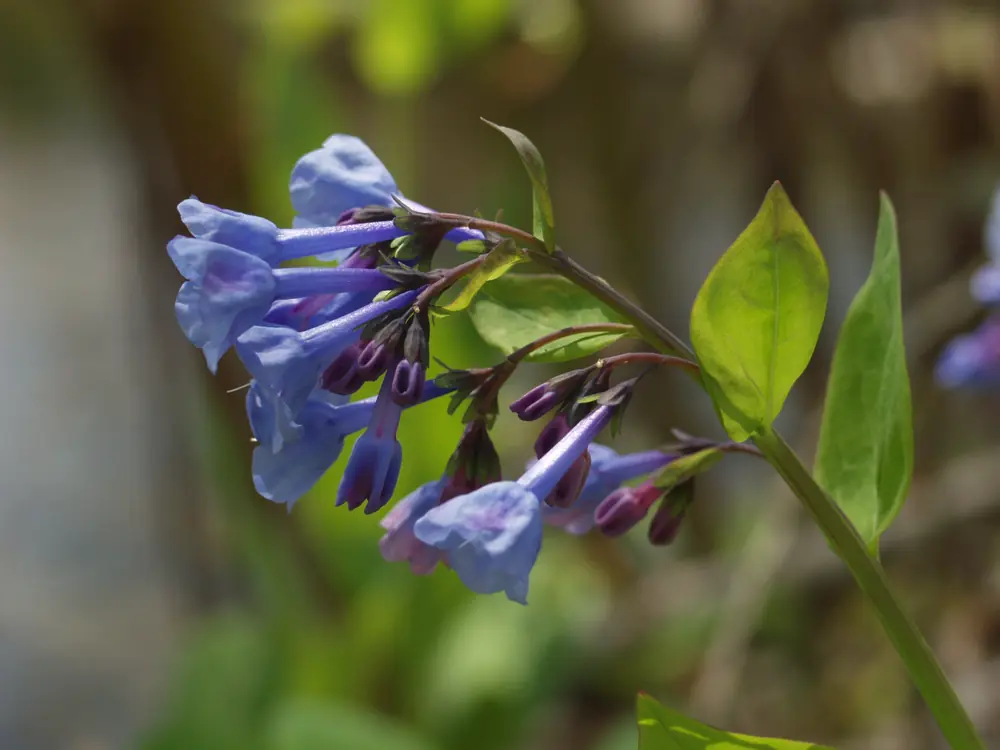
Virginia bluebells
Peak most often in the first half of April, for about a week to ten days in any one place · Floodplain woods along the Potomac, Occoquan and Shenandoah rivers, including Bull Run Regional Park, Riverbend Park, Merrimac Farm Wildlife Management Area and Shenandoah River State Park
The Northern Virginia Regional Park Authority’s naturalist told a local radio station in March 2026 that the display runs through the first two weeks of April in a typical year, and that the best stretch in any one spot is about a week to ten days. Rangers at Shenandoah River State Park have written that visitors can expect to see the flowers in all their splendor until about mid-April. Each bell starts as a pink bud and turns blue as it opens, and a rare plant may bloom pure white. The seeds float downstream and take root on the muddy banks, which is why the plants gather in carpets along rivers, and the roots spread underground like ginger.
State park staff stress one rule above the others: stay on the established trail. These flowers vanish by summer, and a footprint on bare ground in June may be a crushed plant in April.
-
Shenandoah’s early woods
Late March through April at lower elevations; later higher up · Streamside forest below the ridge: the South River, Hughes River, Rose River and Mill Prong
Shenandoah National Park counts 862 wildflower species. The park says its spring display opens in late March with hepatica and bloodroot, then adds violets, trilliums, lady’s slippers and wild geraniums, and that the richest displays grow at lower elevations along streams. The park warns that its summits run 10 to 20 degrees cooler than the valleys below, so bloom on the ridge should trail the valley, and the pink azaleas that tourists come for do not open until May.
-
A rare trillium in the Great Dismal Swamp
Spring, as the swamp forest leafs out · Great Dismal Swamp National Wildlife Refuge, Suffolk and Chesapeake
The refuge’s own seasonal guide says the forest fills with fresh growth and blooms in spring, and names the rare Virginia least trillium among them. The U.S. Fish and Wildlife Service profiles it as the Virginia wakerobin, a small trillium with its own variety name that grows in the Coastal Plain. If you find a trillium in the swamp, look at it without picking it, and keep to the boardwalks and trails.
-
Flowering dogwood and eastern redbud
Redbud earlier in the month; dogwood from about mid-April · Woodland edges and the understory statewide
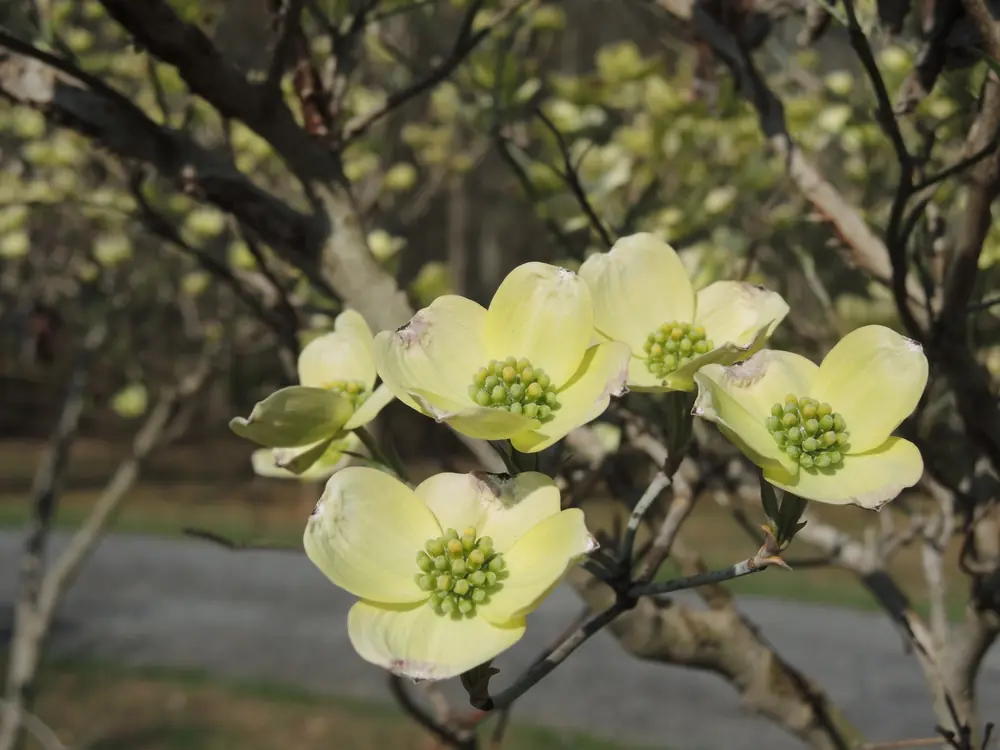
The tourism office’s guide explains that the showy white parts of a dogwood bloom are not petals but leaf-like bracts that surround a cluster of tiny yellow-green flowers. It places redbud at the woodland edge in pinkish-purple. Dogwood is Virginia’s state flower and its state tree, so a drive on any back road in the second half of April is a good way to see the whole pattern: pink redbud under bare oaks, white dogwood in the shade, and a first haze of green across the ridges. A yearly log of first-flower dates is a rewarding record to keep.
Spring flowers change quickly, and the guide’s main advice is not to wait. If March’s buds were still closed when you checked, return on a day with warm nights. The March page explains where to scout the bluebell leaves.
Which warblers and other migrants arrive in Virginia in April?
DWR counts about 34 warbler species that pass through Virginia each year on the Atlantic Flyway, many of them flying at night and dropping into patches of forest at dawn. DWR’s watchable wildlife biologist writes that the best time to see them is April and May. April is the month when the first of the long-distance travelers arrive and the resident birds start to sing in earnest, so the dawn chorus gets louder each week.
-
Warblers on the Piedmont and in the mountains
April and May, with the first arrivals in early April and the numbers building toward early May · G. Richard Thompson Wildlife Management Area, James River Park, Clinch Mountain Wildlife Management Area, Mount Rogers and local parks
DWR’s migration pieces name Palm, Yellow-throated, Kentucky, Prothonotary, Swainson’s and Cerulean warblers among the migrants, along with the blue-headed vireo. Its advice is simple: get outside at dawn, bring binoculars, search forest edges with several layers of vegetation, and listen before you look, because the birds are small and active. Different species appear on different days, so several short visits beat one long one.
-
Shenandoah National Park
April into May · Skyline Drive overlooks, Big Meadows and the forested hollows
The park describes itself as an important nesting habitat and travel corridor for neotropical migrants and lists more than 190 resident and migratory bird species, about half of which breed there, including eighteen warblers. It singles out the scarlet tanager, the declining cerulean warbler and the peregrine falcon, which has been the subject of restoration. Big Meadows supports birds that are not found elsewhere in the park.
-
Great Dismal Swamp and Back Bay
Early April to late May at the swamp · Great Dismal Swamp National Wildlife Refuge; Back Bay National Wildlife Refuge in Virginia Beach
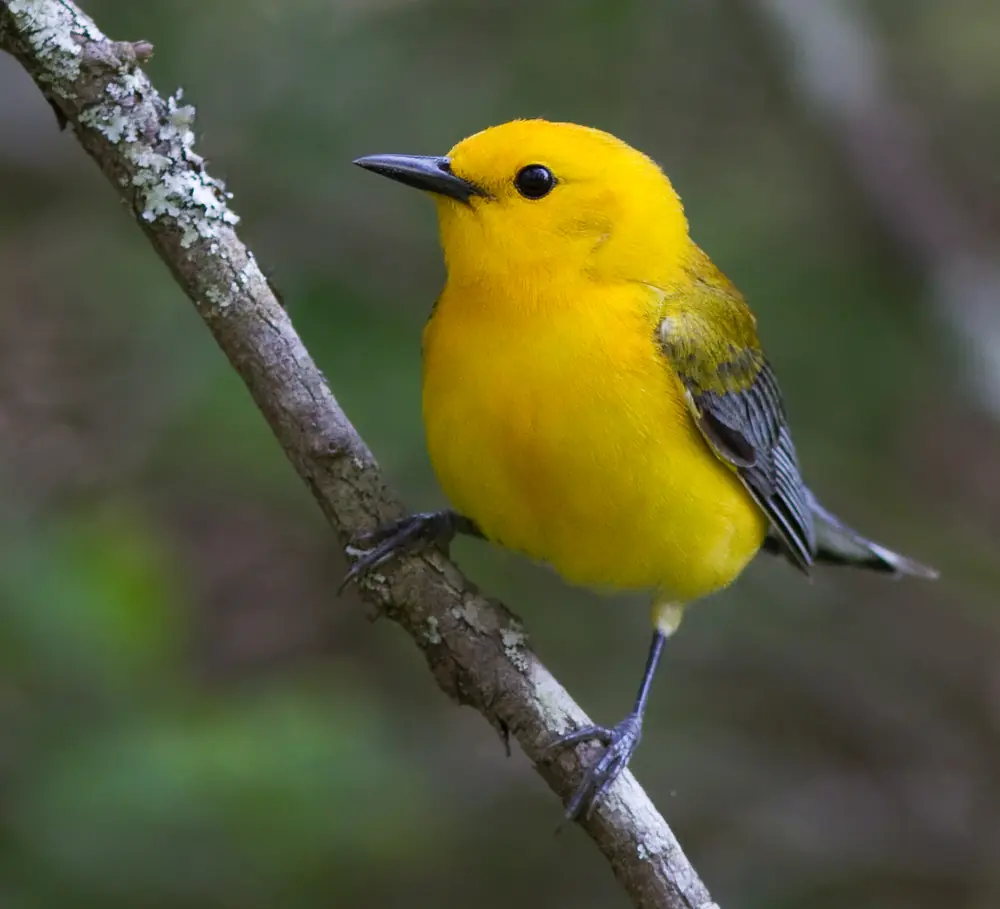
The Great Dismal Swamp refuge’s seasonal guide says the spring neotropical migration is under way and highlights the prothonotary warbler, a bright yellow bird of wet forest, adding that spring is a mild season with few insects. DWR has described a Migration Celebration at the refuge in April, with guided bird walks; confirm its 2027 dates with the refuge before you plan around it. At Back Bay, the refuge says spring and fall bring killdeer, sandpipers, yellowlegs and migrating songbirds such as the indigo bunting, while snakes, frogs and turtles also become active.
-
Ruby-throated hummingbirds
Early to mid April in most years · Feeders and flower beds, spreading north from the Carolinas
Journey North’s April 2026 report said sightings from the Carolinas crossed the Virginia line in the first couple of days of April, with one North Carolina observer calling an April 3 sighting a couple of days early. If your garden had a bird last spring, the safe plan is to hang a clean, fresh feeder in early April and to log the first arrival on the Journey North map, which turns thousands of backyard notes into a picture of the northward wave.
Free-roaming cats are the leading human-caused source of bird deaths in the United States, according to DWR, which estimates they kill about 2.4 billion birds a year. Keeping cats indoors, planting native shrubs and treating windows so birds can see them all help the travelers that stop to rest in your yard.
What nests on Virginia’s barrier island beaches in April?
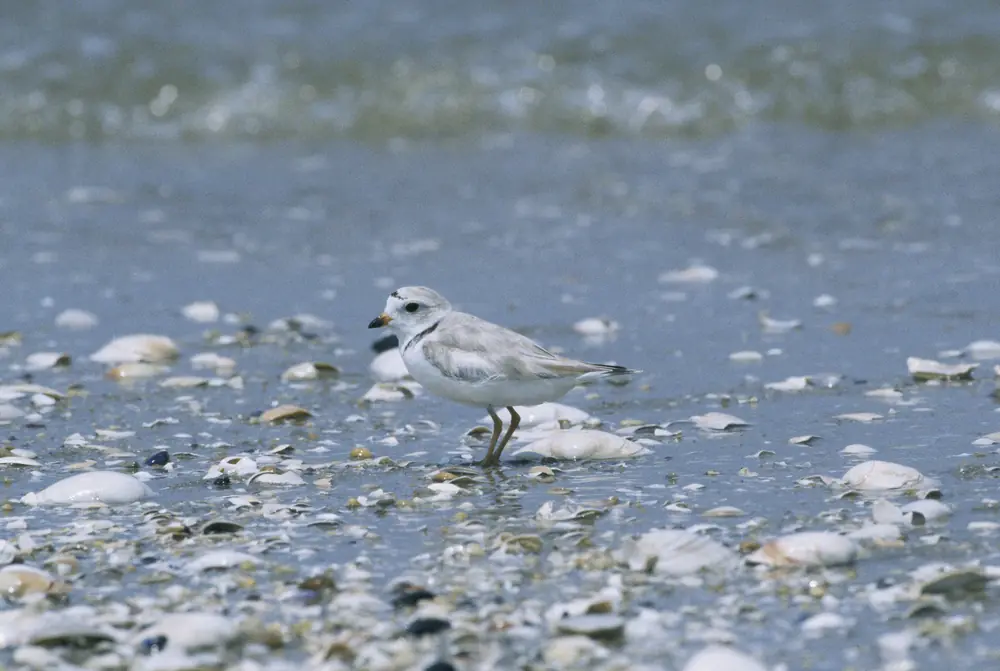
Terns, skimmers and plovers, and they nest in the open sand. The Nature Conservancy (TNC) says nesting on the Virginia Coast Reserve runs from April through August. DWR says that since the late 1990s all of Virginia’s piping plover breeding has happened on the barrier islands off the Eastern Shore, a chain of narrow beaches that run down the seaward side of the peninsula.
-
Least terns, skimmers, oystercatchers and plovers
Arrival and first nests in April; chicks into summer · Barrier islands off the Eastern Shore, managed by TNC, the U.S. Fish and Wildlife Service and the state
TNC lists black skimmers, royal, least, common, Forster’s and gull-billed terns, American oystercatchers and the federally threatened piping plover among the nesting birds of the reserve. The same page says the reserve hosts the second-largest concentration of migrating red knots in the country, a story for May. Predators such as raccoons, foxes and gulls take eggs, storms flood nests, and a remote camera project recorded more than 1.9 million photos to learn how and when it happens.
-
Piping plovers
Nesting from April; eggs hatch after about 25 to 28 days · Open sandy beaches on the Eastern Shore islands
DWR says Virginia’s peak count was 208 nesting pairs in 2008 and describes the birds as small shorebirds that nest on bare beach. Its advice for anyone visiting a beach in the breeding season is to stay at least 100 yards from nesting birds, keep pets at home, walk near the waterline rather than the dry sand, and avoid camping or fireworks. Many of the islands are closed to the public either year-round or during the nesting months, and DWR points visitors to the Explore the Seaside website for the current rules.
-
Migrants at Chincoteague and the Eastern Shore refuges
April and May · Chincoteague National Wildlife Refuge; Eastern Shore of Virginia National Wildlife Refuge
Chincoteague’s seasonal guide says shorebirds and songbirds arrive on the refuge in April and May. The Eastern Shore of Virginia refuge, at the southern tip of the peninsula, describes marsh pink wildflowers coming into bloom, songbirds stopping on the way north, marsh and shorebirds feeding in shallow water, and ospreys repairing nests while they fish over open water.
If a bird flushes from the sand and runs, or tumbles away as if its wing were hurt, you are too close to a nest or chicks. Back up slowly, and give the beach back to the birds.
Which frogs, toads and reptiles are active in Virginia in April?
The voices of warmer weather join the early ones. The Virginia Herpetological Society’s guide to the state’s frogs and toads lists a long run of species that begin calling in April, and the evening chorus gets thicker with every mild night.
-
Fowler’s toads and treefrogs
Calling begins in April and runs through August · Ponds, ditches, rain pools and garden water features
The society lists Fowler’s toad, Cope’s gray treefrog, gray treefrog, green treefrog and squirrel treefrog as calling from April through August, and the eastern American toad as calling from March. Add the eastern and southern cricket frogs and the carpenter frog, which also begin in April, and a spring evening beside a pond near the coast can hold half a dozen voices. Pickerel frogs call in April and May, and the eastern spadefoot calls from March to May.
-
How to learn the calls
Evenings and warm nights · Anywhere with standing water
DWR explains that each species has a call of its own, produced when the male forces air over his vocal cords, sometimes with a vocal sac to amplify it. It recognizes four types: the advertisement call that attracts a mate, a territorial encounter call, a release call and a distress call. The department’s guide to Virginia’s frogs and toads includes recordings, which is the quickest way to match what you hear to a name.
-
Copperheads begin to move
Mating in April or May · Forests, rocky hillsides and brush piles across the state
DWR calls the northern copperhead a stout, medium-sized venomous snake, 24 to 36 inches long, that relies on stealth, and says it rattles its tail quickly if alarmed. Mating comes in April or May, and the young arrive between mid-August and early October. Newborns have a sulfur-yellow tail tip. On warm days from April on, watch your footing near rock piles and brush.
-
Turtles on the move
Hatchlings and travelers in spring; road crossings peak in May and June · Roads beside wetlands, and the Great Dismal Swamp
DWR names May and June as the busiest months for turtles to cross Virginia roads, with thousands killed each year. If you stop to help, carry the turtle across the way it was facing. At the Great Dismal Swamp refuge, small turtles, some no bigger than a walnut, cross the roads at dusk and dawn.
Cold nights still stall the chorus, so a freeze in the first week of the month can silence a pond that was loud the week before. The March page covers the salamanders and the earliest callers.
Is April the best month for the shad run, and what is Trout Heritage Day?
For shad it is close to the best. DWR’s fisheries staff give mid-April through May as the peak for American shad, with 65 degrees the prime spawning temperature, while hickory shad run through April at about 61 degrees and blueback herring arrive in late March and continue through May. Striped bass spawn at around 55 degrees.
-
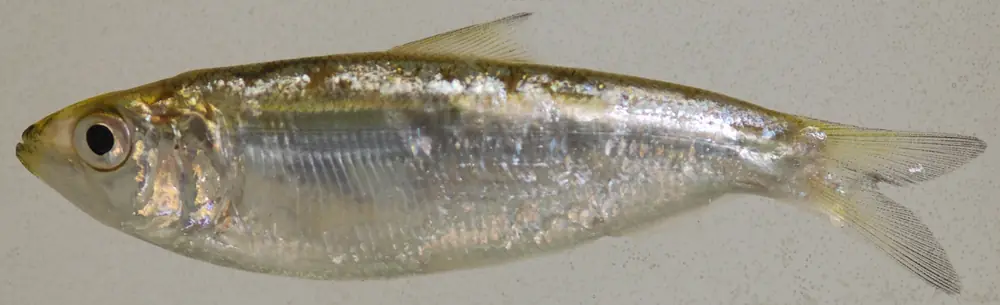
American shad
Peak mid-April through May · Fall-line reaches of the Potomac near Washington, the Rappahannock at Fredericksburg and the James at Richmond
DWR describes the shad as an anadromous fish that spends most of its adult life in salt water and returns to its birth river to spawn. Adults in Virginia are 13 to 22 inches long and can live to age ten. Broadcast spawning takes place over sandbars and rocky riffles in about five feet of water, usually beginning at dusk. The state’s wildlife action plan places the species in its Tier 4a list of Species of Greatest Conservation Need, and the department’s Fish Passage Program works to open the barriers that block its spawning water. DWR’s spring 2024 summary stated that American shad and blueback herring had to be released and that hickory shad had a 10-fish daily bag in specified rivers, so read the current rules before you fish.
-
Trout Heritage Day
The first Saturday in April, which is April 3 in 2027 · About twenty selected streams and lakes across Virginia
DWR describes Trout Heritage Day as an announced stocking event on the first Saturday in April. The waters are closed to angling on the Friday before, and fee-fishing areas open at 9 a.m. on the day. The department lists nineteen waters for 2026 and had not posted a 2027 list when we read the page. Designated stocked waters require a trout license between October 1 and June 15, and stocking there ends May 31. The department stocks about 1.2 million catchable-size trout a year and publishes some stocking dates two to three months ahead.
Watching is easy even if you do not fish: the fall-line parks at Richmond and Fredericksburg are good places to see the river at work, and a cold spring pushes the run later. For earlier fish see the March page.
What are turkeys and bears doing in Virginia in April?
Breeding, in both cases, or looking for food. Wild turkeys are courting across the state, and black bears are coming out of the dens with cubs that weigh only a few pounds.
-
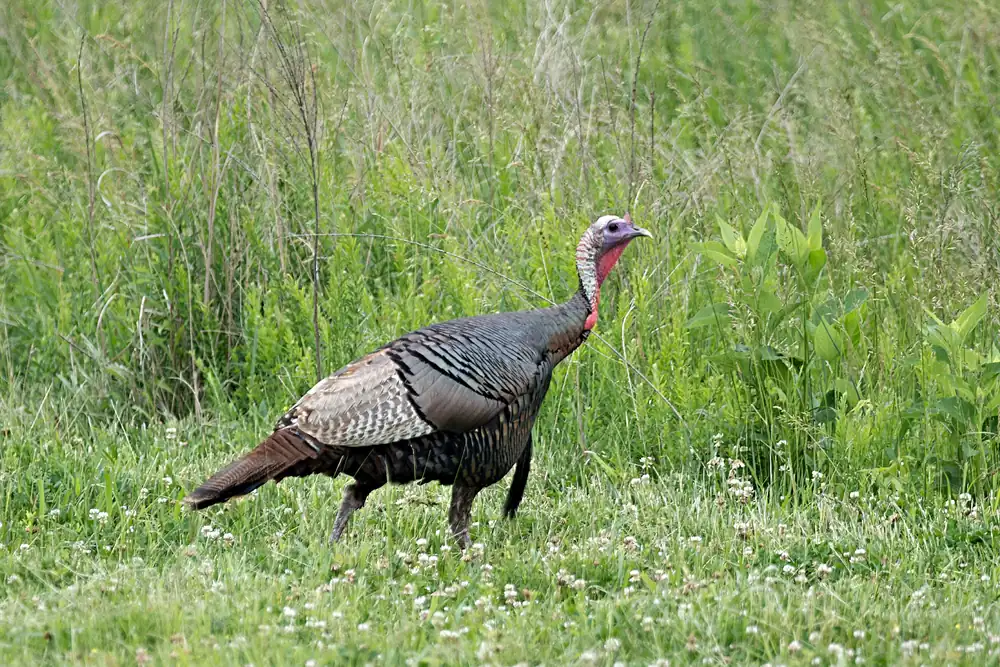
Wild turkeys gobbling
Gobbling typically peaks in late April to early May · Field edges and woods statewide
DWR’s turkey biologist says peak gobbling usually comes in late April to early May, though weather, hunting pressure and the previous year’s hatch can move it. Many hens are bred before the season opens, and as females begin laying and nesting, the males that are left without company gobble more. Young hens can keep the toms busy into May. A turkey strutting in a field with fanned tail and drooping wings is a courting male, and it is best watched from a parked car.
-
Black bears and cubs
Mothers and cubs leave the dens in April and May · Forests across the state, and the neighborhoods beside them
DWR’s guidance is that cubs may be separated from their mothers for a time and almost never need help. A mother may send cubs up a tree when she senses a threat, which is a reason to leave quietly; the cubs are good climbers. Keep dogs leashed and leave a den alone if you find one. DWR’s Wildlife Conflict Helpline, 1-855-571-9003, asks callers to phone only if a cub is hurt, lethargic or has stayed in one place for a long time; the page we read gives 12 hours, so check DWR’s current wording.
Food is the usual trouble: secure garbage and take down birdfeeders when bears are active. March’s page, March in Virginia, has the full BearWise checklist.
When is the last spring freeze in Virginia?
Earlier than the calendar suggests along the coast, and well into the month inland. NOAA’s 1991–2020 normals give median last-freeze dates of March 17 at Norfolk, March 24 at Washington (Reagan National), April 3 at Richmond, Roanoke and Charlottesville, April 6 at Fredericksburg, April 11 at Winchester and April 21 at Abingdon in the southwest. In about one spring in ten, Abingdon is still freezing on or after May 10.
| Station | One year in ten | Median | Nine years in ten |
|---|---|---|---|
| Abingdon | Apr 5 | Apr 21 | May 10 |
| Roanoke | Mar 19 | Apr 3 | Apr 18 |
| Winchester | Mar 30 | Apr 11 | Apr 29 |
| Fredericksburg | Mar 23 | Apr 6 | Apr 22 |
| Richmond | Mar 19 | Apr 3 | Apr 18 |
| Charlottesville | Mar 19 | Apr 3 | Apr 23 |
| Washington (Reagan National), for Northern Virginia | Mar 7 | Mar 24 | Apr 6 |
| Norfolk | Feb 27 | Mar 17 | Mar 31 |
April is the month when a freeze does the most damage, because blossoms and new growth are out. The nine-in-ten column is a safer guide than the median for planting anything tender, and Abingdon, in the southwest, has the latest dates on the list. Our frost dates for Virginia go town by town.
How much daylight does Virginia gain in April?
About an hour of gain in thirty days, a little over two minutes each day. NOAA’s solar equations give Winchester 12 hours 39 minutes between sunrise and sunset on April 1 and 13 hours 49 minutes on the 30th; Bristol, in the far southwest, goes from 12 hours 36 minutes to 13 hours 40 minutes. Winchester and Arlington add the most, and every city listed has 13 hours 40 minutes or more by the month’s end.
| City | Apr 1 | Apr 30 | Gained | Per day |
|---|---|---|---|---|
| Winchester | 12 h 39 m | 13 h 49 m | 70 min | 2.4 min |
| Arlington | 12 h 39 m | 13 h 48 m | 69 min | 2.4 min |
| Charlottesville | 12 h 38 m | 13 h 45 m | 67 min | 2.3 min |
| Richmond | 12 h 36 m | 13 h 43 m | 67 min | 2.3 min |
| Roanoke | 12 h 36 m | 13 h 42 m | 66 min | 2.3 min |
| Norfolk | 12 h 36 m | 13 h 41 m | 65 min | 2.2 min |
| Chincoteague | 12 h 37 m | 13 h 44 m | 67 min | 2.3 min |
| Bristol | 12 h 36 m | 13 h 40 m | 64 min | 2.2 min |
Because these figures measure the hours between sunrise and sunset, the March clock change leaves them untouched. The daylight page gives sunrise and sunset for a specific town.
What is April weather like in Virginia, and what are the hazards?
Warm days, cool nights and a lot of changeable weather. NOAA’s 1991–2020 normals put April highs at about 70 degrees in Richmond, Norfolk and Roanoke and in the mid-60s on the Eastern Shore, with the cooler inland stations still seeing a few frosty mornings, as the table shows. Precipitation is steady at roughly 3 to 4 inches for the month, and snow is a rarity apart from the highest ground.
-
Severe storms and tornadoes
April is one of two peaks · Statewide, though mostly the Piedmont and Coastal Plain
Virginia Places, a state geography site, reports that tornadoes in Virginia tend to peak in April and again in September, and that most of the state’s tornadoes between 1960 and 2019 struck in the Piedmont and Coastal Plain. The same site notes that Virginia receives only about 1 percent of the nation’s tornadoes and that strong ones are rare. Have a weather radio or phone alerts on, and know where your sturdiest interior room is before the storm.
-
Wildfire weather and the 4 p.m. burning law
Through April 30 · Dry, windy days across the state
Virginia’s 4 p.m. burning law, run by the Department of Forestry, applies from February 15 through April 30. Within that window, open-air burning is not allowed until after 4 p.m., and anyone burning must stay with the fire and extinguish it completely. The National Weather Service forecast office in Wakefield says spring fire danger can rise quickly as dead fuels dry out and the temperature climbs, and posts fuel-moisture maps. Cities and counties may set stricter rules.
-
Late freezes
Early April, and later in the mountains · The valleys and the southwest
Check the freeze table above. About one spring in ten at Winchester still sees a freeze after April 29, and the same is true after May 10 at Abingdon.
| Station | High (°F) | Low (°F) | Nights below 32 °F | Precipitation (in.) | Snowfall (in.) |
|---|---|---|---|---|---|
| Norfolk | 70.0 | 50.1 | 0.1 | 3.37 | 0.0 |
| Wallops Island (Eastern Shore) | 64.3 | 45.9 | 1.0 | 3.12 | 0.2 |
| Richmond | 70.4 | 46.4 | 1.0 | 3.18 | 0.0 |
| Washington (Reagan National), for Northern Virginia | 68.0 | 48.4 | 0.5 | 3.21 | 0.0 |
| Dulles Airport | 66.8 | 43.2 | 3.7 | 3.47 | 0.1 |
| Lynchburg | 68.8 | 43.5 | 2.5 | 3.45 | 0.1 |
| Roanoke | 69.7 | 46.3 | 1.4 | 3.49 | 0.1 |
| Bristol (Tri-Cities Airport, just over the Tennessee line) | 69.4 | 43.3 | 3.5 | 3.79 | 0.1 |
| Bluefield (Mercer County Airport, West Virginia) | 62.7 | 42.6 | 3.8 | 3.64 | 0.9 |
The Climate Prediction Center issues fresh seasonal outlooks each month; read the latest on its three-month outlook maps, as we do not summarize them. For the next few days, try our forecast page. To read an approaching front by eye, learn from the cloud guide.
What is in Virginia’s night sky in April 2027?
Moonlight shapes the month. Full on the 20th, the Moon spoils the meteor shower two nights later, yet the evening still belongs to two bright planets, and Venus lingers over the eastern horizon at dawn. We worked the sky details out for the center of the country, and a Virginia observer will see each event at a clock time that differs by perhaps half an hour. Every time below is on Eastern Daylight Time.
-
The Pink Moon
Full at 6:27 p.m. EDT on Tuesday, April 20 · The east, near sunset
Despite the name, the Moon will not look rosy. It reaches full at 6:27 p.m. Eastern time, an hour or two before moonrise in Virginia, so Tuesday evening, April 20, is the night to see it lift over the eastern skyline. The evenings on either side are nearly as round.
-
The Lyrid meteor shower
Peaks around 9:41 p.m. EDT on Thursday, April 22; active from about April 14 to 30 · The northeast to east sky, in the early evening hours
Do not plan an all-night vigil. The Moon, roughly 95 percent lit and barely past full, climbs above the horizon around 10 p.m., leaving only the early evening dark, with Lyra low in the east and northeast. Under a dark sky the shower can reach about 18 meteors an hour; with moonlight, count on a handful. The Lyrids have a history of brief, unannounced outbursts, though no one can forecast one.
-
Jupiter and Mars in the evening
All month; the Moon nearby at mid-month · High in the south and southwest after dark
Jupiter, the brightest planet in the evening, shines in the Leo and Cancer region all month. Around April 14 and 15, face south after dark to find the Moon, about two-thirds lit, close beside it. The next night the Moon also sits about three degrees from the fainter, orange-tinted Mars. Both planets stay up well past midnight.
-
Venus and Mercury before dawn
Venus all month; the thin Moon beside it on the mornings of April 3 and 4 · Low in the east, about an hour before sunrise
Venus remains the morning star but loses height week by week, up some 75 minutes ahead of sunrise on the 1st by our own computation. A thin waning crescent Moon, 9 percent lit, glides past it at first light on the 3rd and 4th, and by our own computation the pair is the best sight of the month. Mercury is no help this month, since by our own computation it clears the horizon only about 42 minutes ahead of sunrise on the 1st and about 22 minutes on the 15th. Saturn, meanwhile, is lost in the Sun’s glare, reaching conjunction on the 7th.
| Phase | Date | Time |
|---|---|---|
| New moon | Tuesday, Apr 6 | 7:51 p.m. |
| First quarter | Tuesday, Apr 13 | 6:56 p.m. |
| Full moon, the Pink Moon | Tuesday, Apr 20 | 6:27 p.m. |
| Last quarter | Wednesday, Apr 28 | 4:18 p.m. |
| New moon | Thursday, May 6 | 6:58 a.m. |
Our moon phases page follows the Moon night by night. For meteors, wait for the Eta Aquariids in May, which fall on a dark, moonless morning.
What can Virginia families do outdoors in April 2027?
- Photograph wildlife for the City Nature Challenge. Observations are collected from April 30 to May 3, with uploads and identifications through May 16 and results announced May 20. The challenge site shows whether your area has a team.
- Mark Earth Day on Thursday, April 22. Earth Day’s organizers give April 22 as the date and “Food for Our Planet” as the theme. A walk to a pond, a creek cleanup or a vegetable bed all count.
- Plant a tree for Arbor Day on Friday, April 30. Under Virginia’s Department of Forestry, the state’s Arbor Day falls on the final Friday of April; many towns, though, do their planting in autumn.
- Try a homeschool nature program at Douthat State Park. Its Homeschool Naturalists series meets monthly at the Discovery Center; the 2027 April session was not confirmed when we looked, so check the state parks events calendar.
- Learn the frogs and toads. The Virginia Living Museum’s FrogWatch USA chapter offers a free two-part training; its page listed dates as coming soon, so ask the museum about the spring session.
- Watch a nest. The Cornell Lab’s NestWatch project lets anyone with no experience record nesting observations on an app, and an April nest in the yard is a good first one.
Programs can change, so confirm with the park or organizer. Look back at the March page for what came before, and the nature index lists every state.
Safety notes for April in Virginia
- Spring turkey season. DWR’s turkey regulations page was still labeled with the 2025–26 license year when we read it, and it listed an apprentice and youth weekend on April 3 and 4, a regular season from April 10 to 25 with hunting until noon, and April 26 to May 15 with hunting until sunset. We could not confirm that these are the 2027 dates, so treat them as typical and check DWR for the official ones. Blaze orange or pink is required when hunting during a firearms deer season, not for spring turkey, but bright clothing is wise on public land, and walkers in hunting areas should avoid camouflage.
- Trout waters. Waters that are stocked for Trout Heritage Day close to fishing the Friday before, so look at the list before planning a Friday outing. A trout license is needed from October 1 through June 15.
- Backyard burning. Until April 30, Virginia law bars open fires before 4 p.m.
- Ticks. The Virginia Department of Health names the blacklegged tick and the lone star tick as active in Virginia and linked to Lyme disease, Rocky Mountain spotted fever, babesiosis and alpha-gal syndrome. Its tips: use a repellent containing DEET, picaridin or lemon eucalyptus, tuck trousers into socks, run clothes through ten minutes of high heat, and check your whole body, pets and gear afterward.
- Copperheads. They mate in April and May and depend on camouflage; look before you reach into a woodpile or step over a log.
- Bears and cubs. Leave cubs alone, leash dogs, and do not approach a den.
- Barrier islands and beaches. Stay 100 yards from nesting birds, keep dogs home, and obey closures.
- Severe weather. April is a peak month for Virginia tornadoes, so have a way to receive warnings.
- Fast, cold rivers. Spring runoff makes the fall-line rivers cold and strong, so avoid wading beyond your knees without a flotation vest.
- Wet roads at night. Slow down near wetlands on mild, rainy evenings when amphibians cross.
Sources (44)
- Virginia Tourism Corporation: April wildflowers in Virginia
- WTOP: sweeping carpets of color, the Virginia bluebells are on their way (March 2026)
- Virginia State Parks blog: tiptoe round the bluebells
- Visit Shenandoah: what’s blooming in the Shenandoah Valley
- National Park Service: wildflowers at Shenandoah National Park
- National Park Service: what to see in spring at Shenandoah
- National Park Service: birds of Shenandoah National Park
- U.S. Fish and Wildlife Service: Great Dismal Swamp National Wildlife Refuge, seasons of wildlife
- U.S. Fish and Wildlife Service: Virginia wakerobin (Trillium pusillum var. virginianum)
- Virginia DWR: spring migration begins in Virginia
- Virginia DWR: spring migration has begun, visit the Virginia Birding and Wildlife Trail
- U.S. Fish and Wildlife Service: Back Bay National Wildlife Refuge, seasons of wildlife
- Journey North: hummingbird migration moves along with sightings in Kentucky, Virginia and Missouri (April 2026)
- The Nature Conservancy: Virginia Coast Reserve migratory bird conservation
- Virginia DWR: piping plovers in Virginia
- U.S. Fish and Wildlife Service: Chincoteague National Wildlife Refuge, seasons of wildlife
- U.S. Fish and Wildlife Service: Eastern Shore of Virginia National Wildlife Refuge, seasons of wildlife
- Virginia Herpetological Society: frogs and toads of Virginia
- Virginia DWR blog: frog Friday, frog calls
- Virginia DWR: northern copperhead
- Virginia DWR blog: motorists, give turtles a brake
- Virginia DWR blog: ’tis the anadromous fish season
- Virginia DWR: American shad
- Virginia DWR: Trout Heritage Day
- Virginia DWR blog: DWR trout stocking explained
- Virginia DWR blog: Virginia’s spring gobbler season
- Virginia DWR: reminder, if you see a bear cub, leave it alone
- NOAA NCEI: 1991–2020 monthly normals for Virginia stations (data API)
- Virginia Places: tornadoes and derechos in Virginia
- Virginia Department of Forestry: fire laws (4 PM Burning Law)
- NWS Wakefield: fire weather briefing
- Climate Prediction Center: 90-day outlooks
- U.S. Naval Observatory: moon phases, April 2027 (data API)
- U.S. Naval Observatory: Earth’s seasons, 2027 (data API)
- City Nature Challenge
- Earth Day Network
- Virginia Department of Forestry: Arbor Day in Virginia
- Virginia State Parks: events calendar, April 2027
- Virginia Living Museum: FrogWatch USA
- Cornell Lab of Ornithology: NestWatch
- Virginia DWR: 2026 spring turkey season regulations
- Virginia DWR: general hunting regulations (blaze color)
- Virginia Department of Health: tick safety tips
- Photos via Wikimedia Commons; licenses and photographers are credited under each picture
