What to look for in nature in Virginia this January
Halfway through meteorological winter, January is, by NOAA’s 1991–2020 normals, the chilliest month of the year in Virginia, from Norfolk to the Bluefield plateau. It is also, quietly, the start of next year. Bald eagle pairs on the James and the Potomac finish their courtship and settle onto eggs, great horned owls move into nests that hawks built last spring, red foxes pair off, and black bear cubs weighing under a pound arrive in winter dens. Out at the mouth of the Bay, harbor seals sun themselves on the Bridge-Tunnel’s rock islands while young humpbacks chase menhaden off the Oceanfront. Evenings already stretch by about half an hour over the month, and the year’s closest full moon comes on the 22nd. Here is where and when to look, from the Cumberland Plateau to Chincoteague.
Other months in Virginia: October, November, December, February.
Start here

- Find an eagle pair on eggs. Along the James, eagles court from late December into mid-January and most pairs are incubating by mid-February, says the Center for Conservation Biology. Choose a nest visible from a road shoulder or a refuge path and look in on it each week: a single adult lying flat in the bowl means eggs.
- See seals and whales at the mouth of the Bay. Harbor seals haul out on the Chesapeake Bay Bridge-Tunnel islands from about mid-November to April, and juvenile humpbacks feed off Virginia Beach through the winter. The Virginia Aquarium runs whale-watching boat trips from December 16, and the Winter Wildlife Festival runs January 23 to 31, 2027.
- Quadrantids and a Wolf supermoon. Get up before dawn on Monday, January 4, for the Quadrantid meteors; the waning Moon is a slim crescent and barely matters. On Friday, January 22, the Moon is full at 7:17 a.m., the closest full moon of 2027, which makes Thursday evening, the 21st, your best look at it.
January is a fine month to start the Naturalist’s Field Journal. Give an eagle nest you can watch from the road its own nest observed page and date the first morning an adult is lying low in it. Draw a twig at actual size on the reading the signs plate, labeling buds and leaf scars, and press your boot beside a fox trail in fresh snow for tracks to know. A skunk cabbage hood belongs on the daily field log, with the air temperature beside it, and the minute the owls start hooting each evening goes on the dusk and dawn watch.
Regions used below: Southwest Virginia and the Blue Ridge; Shenandoah Valley; Northern Virginia; Central Virginia and the Piedmont; Southside; Tidewater and Hampton Roads; Eastern Shore.
When do bald eagles lay eggs in Virginia?
Starting about the middle of January. Nest repair began in the fall (the December page follows that), and this month the pairs move on to courtship and eggs. Virginia also gains extra eagles in winter: birds from farther north join the residents wherever rivers stay open.
-
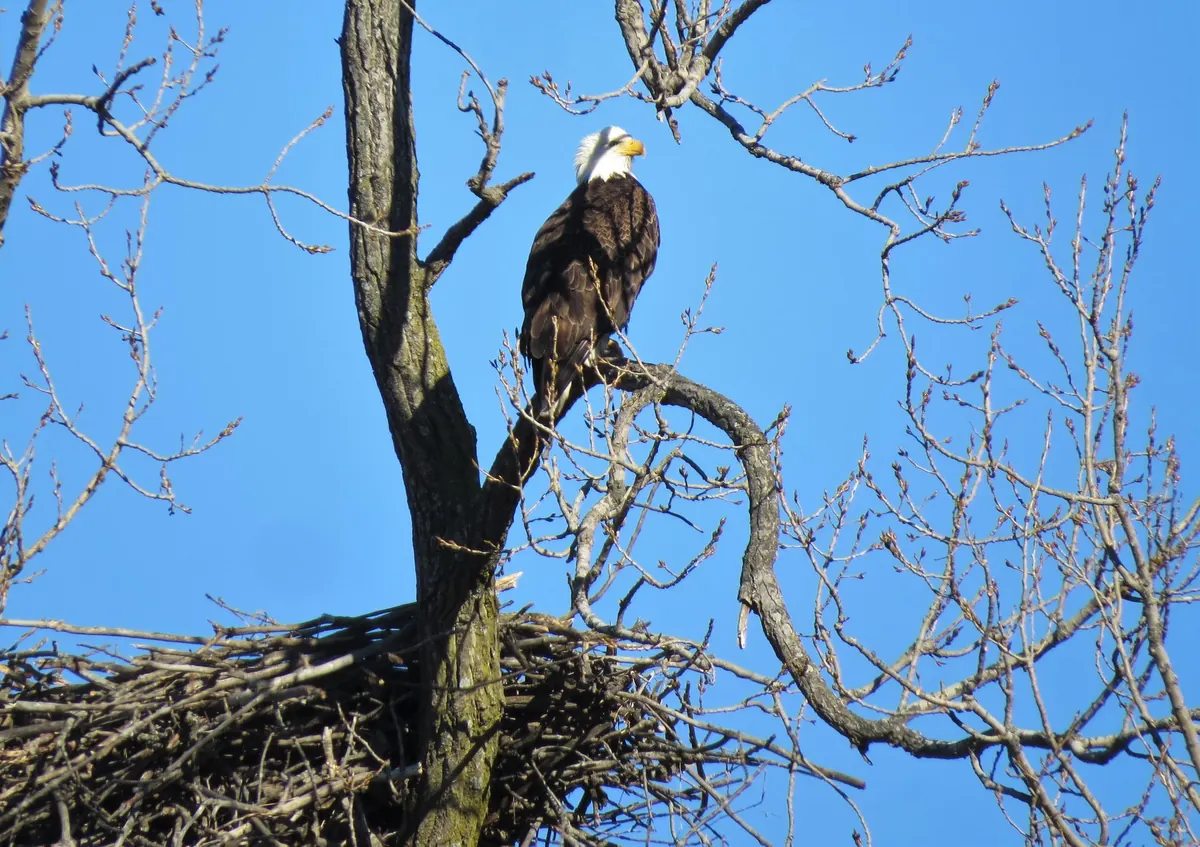
Courtship flights and the first eggs
Courtship late December to mid-January; eggs from mid-January to late March · Tidal rivers statewide, with the James, Rappahannock and Potomac the strongholds
The Center for Conservation Biology, which has studied James River eagles for decades, describes the sequence on that river: nest building picks up in October, courtship runs from late December through mid-January, and most pairs have eggs by mid-February. Laying dates differ by about five days between the James and the Potomac. The Department of Wildlife Resources’ guidelines for landowners give a wider window, mid-January to late March, and note that courtship flights are seen most often in January and February. Look for two adults soaring close together, locking talons or tumbling, and for one bird carrying fine grass or corn husks: eagles line the bowl with soft material before the eggs come.
Most clutches hold one to three eggs, and incubation lasts about 33 to 35 days, sometimes up to 40, so the first chicks are due around early March. When you find a nest, stay well back: a bird flushed off eggs on a 20-degree morning lets them cool fast.
-
Northern eagles on open water
January and February · The Potomac at Mason Neck, the lower James and other big tidal rivers
The U.S. Fish and Wildlife Service notes that in January and February eagles and waterfowl from the north feed along the Potomac at Elizabeth Hartwell Mason Neck National Wildlife Refuge, where the river stays clear of ice. That refuge, set aside in 1969, was the first in the country created for bald eagles, when fewer than 500 nesting pairs remained in the lower 48 states. Today the resident pairs there rebuild nests, mate and lay eggs on the same stretch of shore where the wintering birds roost.
When do great horned owls nest in Virginia?
In January and February, earlier than almost any other bird in the state. Great horned owls never build a nest of their own; they borrow one.
-
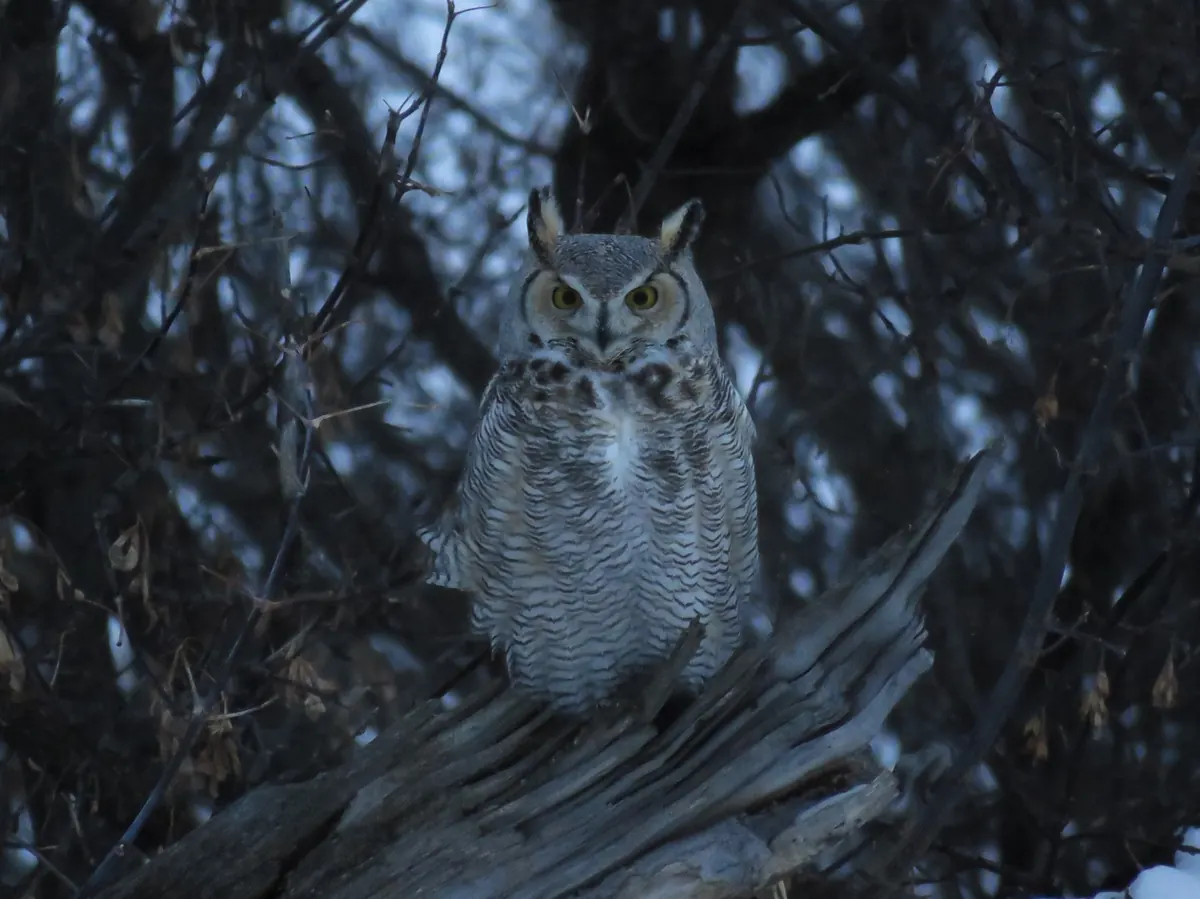
Great horned owls on borrowed nests
On nests by January and February; a few wait until March · Woodlots beside hayfields and pastures, river bottoms, large suburban parks
Two experienced nest-finders, writing on DWR’s blog for the Virginia Breeding Bird Atlas about rural northwestern Virginia, explain how: drive farm roads after leaf fall and scan the woodlot edges for the gray, flat-topped stick nests of red-tailed and red-shouldered hawks (not the brown, leafy balls that squirrels build). By January and February most great horned owls have taken over one of these, and the giveaway is a pair of feathery ear tufts sticking up above the rim. Overcast days make the silhouettes easier to pick out against the sky.
The Virginia Department of Forestry adds that the owls line their borrowed nests with fresh down, which helps keep the eggs warm in the coldest weeks of the year. Eggs take roughly a month to hatch, so the downy owlets appear while it is still winter.
-
Barred owls calling in the swamps
All winter, loudest on calm nights · Bottomland forest, swamps and river corridors, from the Great Dismal Swamp to the Shenandoah
Pairs call back and forth after dark, sometimes breaking into a cackling duet of whoops and gurgles. Stand by a creek at dusk and listen for the rhythmic phrase birders write as who cooks for you.
-
Whitewash and pellets
Any winter day · Under conifers and big hollow trees
In daylight, owls give themselves away by what lies below the roost: white streaks on the bark and the ground, and gray pellets of fur and small bones. Crows or jays scolding one spot in a pine often mark a roosting owl. Keep visits short, and never play recorded calls near a nest.
Can you see seals and whales in Virginia in winter?
Yes, and January is in the heart of the season for both. Seals were almost unknown along the Virginia coast until a few decades ago; reports grew from the 1990s, and now the lower Bay hosts a regular winter colony that researchers survey by boat, drone and camera.
-
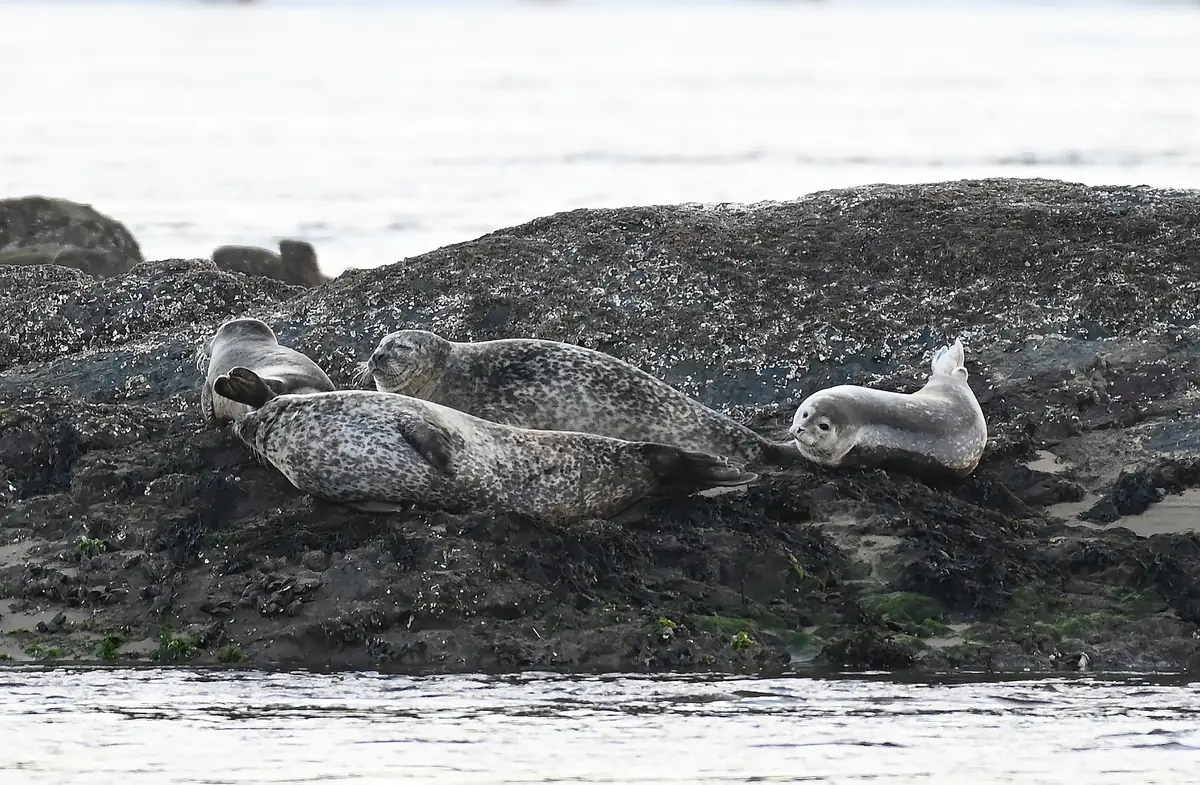
Harbor seals on the Bridge-Tunnel rocks
Mid-November to April · The four rock islands of the Chesapeake Bay Bridge-Tunnel and a handful of haul-outs on the Eastern Shore barrier islands
Navy-funded marine mammal surveys have counted seals at the Chesapeake Bay Bridge-Tunnel and on the Eastern Shore every winter since 2014. The surveys record seals from mid-November to April.
Photo-identification shows how faithful they are: by January 2025 the project had cataloged 198 individual harbor seals, just over half of them seen on more than one survey day and some across six or seven winters, with an average of about 150 seals estimated for the eight seasons from 2015 to 2023. A few gray seals turn up too. Counts on a given day vary a lot: the best day of the first half of the 2024–25 season found 12 at the Bridge-Tunnel and 33 on the Eastern Shore, and infrared cameras recorded upwards of 30 hauling out overnight.
-
Young humpback whales off Virginia Beach
Late fall through winter · Nearshore waters off the Oceanfront and the mouth of the Chesapeake Bay
Navy-funded survey biologists report that the humpbacks seen in nearshore Virginia waters are younger animals, while mature whales seem to use the waters farther offshore as a stopover. In November 2023 they watched a group of five humpbacks bubble-net feeding a couple of miles from where the menhaden fleet was fishing; all five were whales already known from earlier years, and a sixth, a juvenile seen the same day, was new to the catalog. Each humpback is recognized by the black-and-white pattern under its tail, and the Virginia Aquarium and Marine Science Center Foundation was tasked with building a shared photo-identification catalog of humpbacks for the Mid-Atlantic.
The Aquarium’s winter whale-watching boat tours begin December 16 and leave from its dock in Virginia Beach; sightings are never guaranteed and trips depend on the weather.
-
If you find a seal on the beach
Any winter day · Ocean and Bay beaches from Virginia Beach to Chincoteague
A seal resting on the sand is usually healthy. NOAA Fisheries’ guideline is 50 yards, roughly half the length of a football field, and to keep dogs leashed; if it stares, fidgets or heads for the water, you are too close. Report one that looks hurt or tangled to the Virginia Aquarium’s stranding response team rather than approaching it.
Where do tundra swans spend January in Virginia?
In the tidal marshes and big rivers, where they stay from October until they start back north as early as February. By January every wintering duck, goose and swan has arrived, and the duck season’s last weeks run to January 31.
-
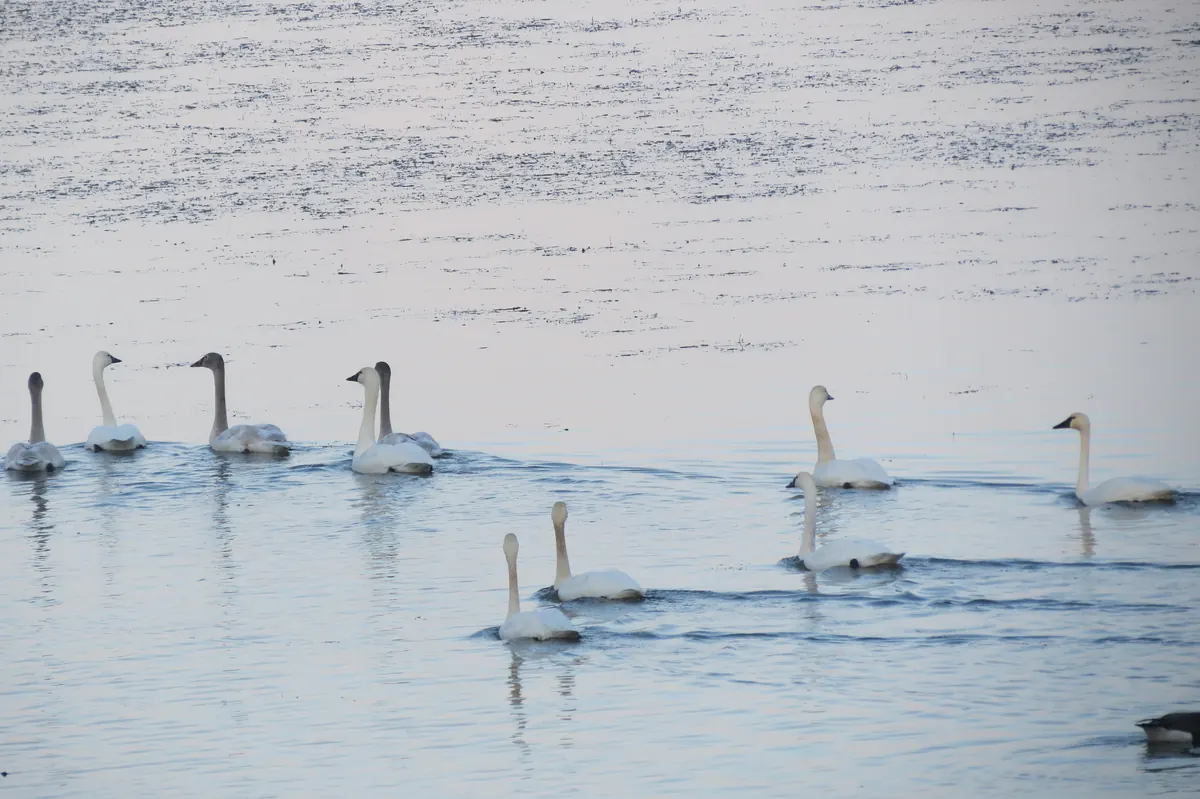
Tundra swans in the Great Marsh
October through March · Mason Neck on the Potomac, Back Bay, Chincoteague and other tidal marshes
Tundra swans nest on the tundra from Alaska’s North Slope to Hudson Bay and spend the winter in the Mid-Atlantic. At Mason Neck they gather in the 207-acre Great Marsh, one of the last big stands of wild rice in the region, and on Belmont Bay. They are vocal birds, with a high, soft, almost musical call that carries across the marsh on a still morning.
Mason Neck State Park’s staff note the swans may begin leaving as early as February, so January is the surest month.
-
The last days of the duck season
Ducks, mergansers, coots and snipe to January 31; brant January 15 to 31 · Statewide, especially tidal rivers and the Bay
Diving ducks, buffleheads and mergansers crowd the open water of the tidal rivers until the season’s close at the end of the month, and Canada geese of the resident population may be hunted until February 21 and snow geese until March 10. If you birdwatch from a public landing on a weekday morning, expect to share it with hunters; on refuges, check the hunt calendar first.
-
When the creeks freeze
During cold snaps · Shallow creeks, millponds and marsh guts
A hard freeze squeezes ducks into the last open water at creek mouths and below spillways, with eagles close behind; one scan from a bridge can then show a dozen species.
Which Virginia animals have their young in midwinter?
More than you would guess. While squirrels and chipmunks are living off their stores, several larger mammals are courting or giving birth.
-
Black bear cubs born in the den
Early January to mid-February · In dens across most of the state, from the mountains to the Great Dismal Swamp
DWR says Virginia’s black bears enter their dens anywhere from October to January, depending on weather and food, and cubs are born from early January to mid-February. A newborn cub weighs 6 to 12 ounces, less than a pound, and litters range from one to four. The mother does not eat, drink or pass waste while denned, yet nurses the cubs until they all emerge between mid-March and early May. Dens can be hollow trees, rock crevices, brush piles or, now and then, a culvert or a woodpile lean-to; if you stumble on one, leave quietly.
-
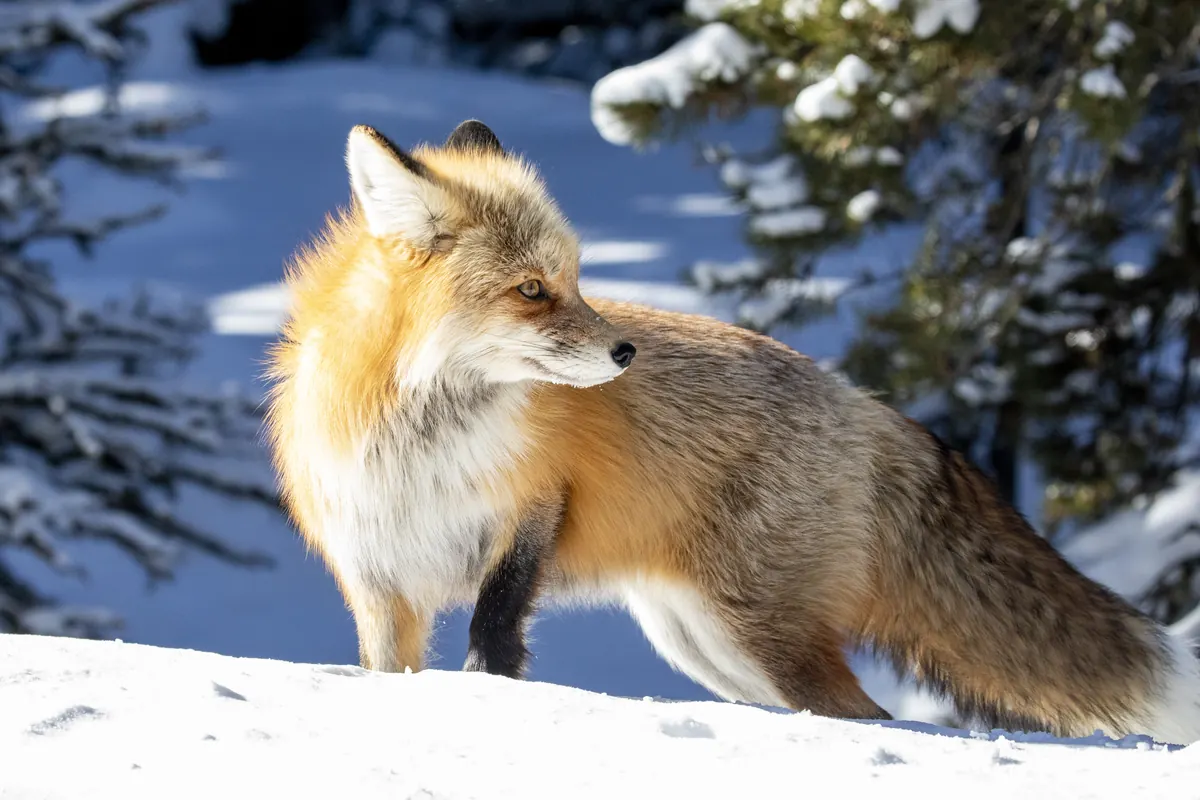
Red foxes pairing up
Breeding January and February · Farmland, suburbs and woodland edges statewide
DWR puts the red fox breeding season in Virginia at January to February. The female carries her kits for 51 to 53 days, so a litter of about five arrives in a den in spring. After a January snow you may find two trails running together where a pair has been hunting side by side. Most of a red fox’s diet is rabbits and mice, and a fox listening for voles under the snow and then pouncing nose-first is worth a long, still wait.
-
Gray foxes barking at night
Breeding January to April, peaking in February · Upland woods, pines and swamp edges
The gray fox climbs trees to escape danger and is mostly nocturnal. Its common calls are barks, yaps and yips, heard most in the breeding season, which in Virginia runs from January to April with a peak in February.
Is anything blooming in Virginia in January?
One native wildflower can bloom in January, and it does it by making its own heat. Otherwise this is the month to learn trees from their twigs and to look for eggs that should not be there.
-
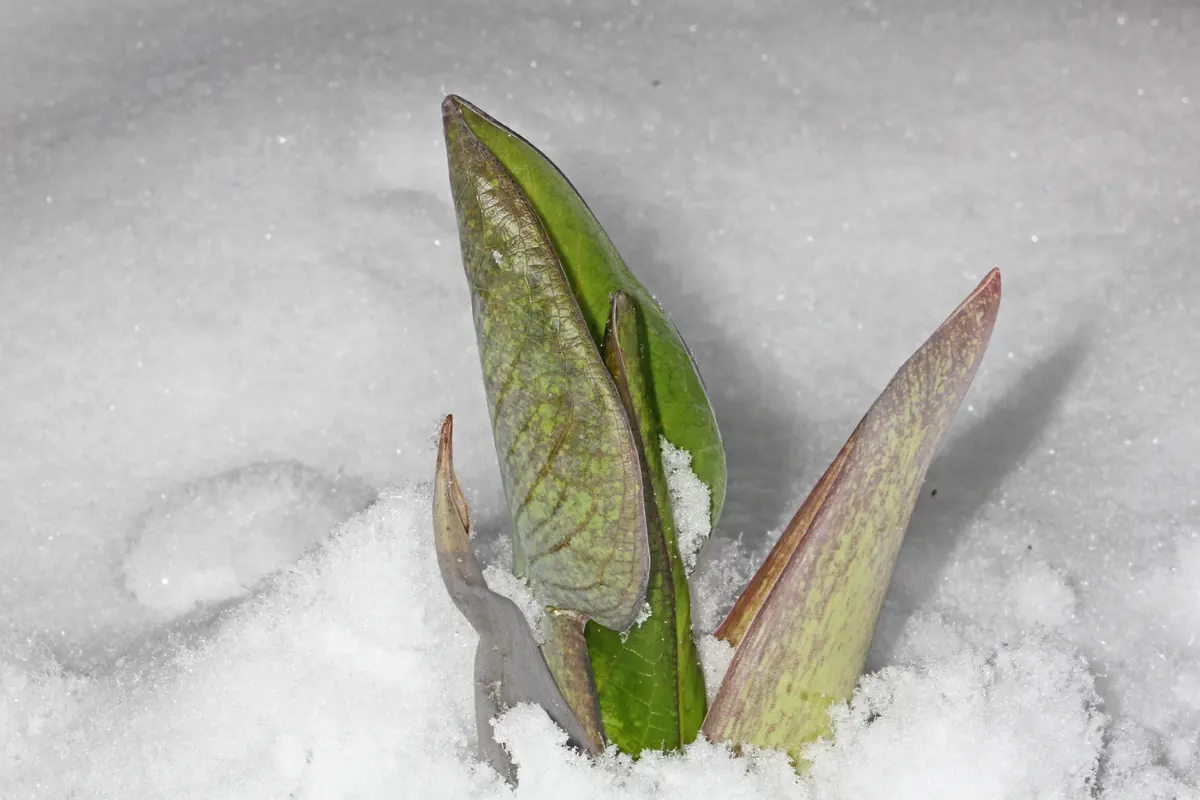
Skunk cabbage, the first wildflower
Some in January in mild spells; more widely in February · Seeps, springs and wet, shaded creek bottoms, mostly in the northern and western Piedmont and the mountains
The Virginia Outdoors Foundation reports finding skunk cabbage in flower in the second week of January at its Bull Run Mountains preserve, and the Department of Forestry places the start of bloom in early to mid-February. Either way it is the earliest native bloom of the year. Look for a mottled maroon-and-green hood, a few inches tall, poking up through the mud or snow where groundwater seeps out at the foot of a wooded slope.
Inside the hood, a knob covered in tiny flowers burns stored starch and holds itself at roughly 59 to 73 °F, enough to melt the snow around it. The warmth and the faint smell of decay draw flies, gnats and carrion beetles, the plant’s first pollinators of the year. The big cabbage-like leaves come much later in spring.
-
Winter twigs and buds
All winter · Any woodlot, park or street tree
Virginia Tech’s dendrology program calls twigs more distinctive than leaves. Start with arrangement: maples, ashes, dogwoods and horse-chestnuts have opposite buds, and most everything else alternates. Then look closer. Black walnut leaf scars look like monkey faces and its pith is chambered, white oak clusters several buds at the twig tip, yellow-poplar’s bud is a flattened duck bill of just two scales, and winged elm wears corky ridges. A hand lens and a pocketknife (to slice a twig lengthwise for the pith) are all you need.
-
Spotted lanternfly egg masses
Laid from September; hatching in spring · More than half of Virginia’s localities, thickest in the north; on trees, stone, vehicles and outdoor furniture
This invasive planthopper from Asia was first detected in Winchester in January 2018, and the state agriculture department now reports it in more than half of Virginia’s counties and independent cities. It spends the winter as eggs, laid on smooth surfaces such as bark, stone, picnic tables and trailers in masses of 30 to 50 that look like a smear of dried mud. Tree-of-heaven is its favorite host. Scrape any you find into a bag or jar of soapy water or rubbing alcohol; Fairfax and Loudoun counties no longer need reports because the insect is established there.
How much daylight does Virginia gain in January?
Roughly 40 minutes, and most of it comes in the evening. In Richmond the sun sets at 5:02 p.m. on New Year’s Day and at 5:33 p.m. on January 31, while sunrise only moves from 7:25 to 7:14 a.m.; the mornings are at their darkest in the first days of the month. In Bristol, far out at the western end of the state, the sun sets at 5:53 p.m. by January 31; on the Eastern Shore at Chincoteague, at 5:24 p.m.
| City | Jan 1 | Jan 31 | Gained | Per day |
|---|---|---|---|---|
| Winchester | 9 h 28 m | 10 h 12 m | 44 min | 1.5 min |
| Arlington | 9 h 30 m | 10 h 13 m | 43 min | 1.4 min |
| Charlottesville | 9 h 35 m | 10 h 17 m | 42 min | 1.4 min |
| Richmond | 9 h 37 m | 10 h 19 m | 42 min | 1.4 min |
| Roanoke | 9 h 39 m | 10 h 19 m | 40 min | 1.3 min |
| Norfolk | 9 h 41 m | 10 h 21 m | 40 min | 1.3 min |
| Chincoteague | 9 h 36 m | 10 h 17 m | 41 min | 1.4 min |
| Bristol | 9 h 43 m | 10 h 22 m | 39 min | 1.3 min |
Each day adds a little more than the one before, from under a minute at New Year’s to nearly two by month’s end. For your own town, the day-length calculator gives sunrise and sunset for every date.
How cold and snowy is January in Virginia, and what could El Niño do?
No month averages colder than January at any of the stations listed below. It is also the snowiest month on average at Norfolk, Wallops Island, Richmond and the Bluefield plateau, though at Dulles, Reagan National, Lynchburg and Roanoke the February normal is a shade higher. Even so, the averages are small away from the mountains: about 3 inches at Norfolk and 3.7 at Richmond, against nearly 7 at Dulles and almost 10 on the high ground around Bluefield, just over the West Virginia line from Tazewell County. Norfolk averages about 14 January nights below freezing, and most inland airports 20 or more.
| Station | High (°F) | Low (°F) | Nights below 32 °F | Precipitation (in.) | Snowfall (in.) |
|---|---|---|---|---|---|
| Norfolk | 50.7 | 33.6 | 14.2 | 3.41 | 3.2 |
| Wallops Island (Eastern Shore) | 46.2 | 29.5 | 19.7 | 3.15 | 3.5 |
| Richmond | 47.8 | 28.8 | 20.3 | 3.23 | 3.7 |
| Washington (Reagan National), for Northern Virginia | 44.8 | 30.1 | 19.5 | 2.86 | 4.9 |
| Dulles Airport | 42.6 | 25.2 | 24.3 | 2.94 | 6.9 |
| Lynchburg | 46.0 | 25.8 | 23.3 | 3.46 | 3.5 |
| Roanoke | 47.1 | 28.7 | 20.6 | 3.17 | 4.3 |
| Bristol (Tri-Cities Airport, just over the Tennessee line) | 46.5 | 26.3 | 21.8 | 3.65 | 3.0 |
| Bluefield (Mercer County Airport, West Virginia) | 39.9 | 23.8 | 22.5 | 3.03 | 9.9 |
Averages are made of a few big storms and many bare weeks. The largest January storm in modern northern Virginia records came on January 22–23, 2016, when Dulles measured 29.3 inches, its second-biggest storm since records began there, and Reagan National 17.8 inches, in the record lists kept by the Sterling forecast office of the National Weather Service. That blizzard arrived while El Niño was near its peak; the Climate Prediction Center’s Oceanic Niño Index stood at 2.6 for November to January of 2015–16.
This winter federal forecasters expect another very strong El Niño; their September 10 discussion put the odds above 90 percent. Looking back at El Niño winters between 1950 and 2009, NOAA’s Climate.gov found snowier-than-average seasons in the Mid-Atlantic and in the southern Appalachians of Virginia, West Virginia and North Carolina. The same site’s forecasters stress that El Niño only tilts the odds and that no impacts are guaranteed in any given event; a coastal storm still needs cold air already in place to bring snow rather than rain. The official winter outlook is published October 15 and updated every month; the 90-day outlook maps from the Climate Prediction Center show the latest tilt for Virginia.
For today’s conditions, the weather page has the forecast, and when seed catalogs start arriving, the Virginia frost dates page tells you when spring’s last freeze usually comes.
What is in Virginia’s night sky in January 2027?
A strong meteor shower with a dark sky, the year’s closest full moon, and Venus at its farthest from the Sun. All times are Eastern Standard Time.
-
The Quadrantids
Night of Sunday, January 3, into Monday, January 4 · Anywhere dark; the radiant, in the region of Boötes and Draco, climbs in the northeast after midnight
The Quadrantid maximum is brief, about six hours. For 2027 the American Meteor Society predicts it around 10:30 p.m. on the 3rd and EarthSky around 12:47 a.m. on the 4th, and both land in Virginia’s nighttime. With the radiant low at bedtime and high by 5 a.m., Monday’s predawn hours ought to deliver the most. Under a dark rural sky, expect dozens per hour at best; under city lights, a handful. The waning crescent Moon is only about a sixth lit and rises late, so it barely interferes. The shower’s active window runs from December 28 to January 12.
-
Earth at perihelion
Saturday, January 2, 9:33 p.m. · Everywhere
Earth reaches the closest point of its orbit to the Sun, about 91.4 million miles away, in the depth of the Northern Hemisphere’s winter. Winter is about the angle of sunlight, not distance: the low January sun spreads its light thin, which matters far more than being a few percent closer.
-
Venus at greatest elongation
Sunday, January 3, and all month before sunrise · Southeast sky before dawn
Sunday the 3rd brings Venus’s greatest western elongation, 47 degrees, its widest angle of this morning apparition, shining at about magnitude −4.3 and looking half-lit through a small telescope. It stays the brightest point in the predawn sky through the spring.
-
The Wolf Moon, the closest full moon of 2027
Full at 7:17 a.m. Friday, January 22; best seen the night of the 21st · Rising in the east-northeast at dusk on the 21st
Perigee comes late on the afternoon of the 21st, under 15 hours ahead of the full instant, and the full Moon is then 222,229 miles off, the nearest of 2027; every almanac we checked calls it a supermoon. Since the full instant comes at about sunrise here, plan on Thursday evening: the Moon comes up around dusk and stays up until dawn, lighting any snow on the ground. Jupiter sits close beside the Moon after dark on Saturday the 23rd.
-
Mercury low in the evening
Last days of January into early February · Low in the west-southwest, 30 to 45 minutes after sunset
Mercury climbs toward its best evening showing of the winter, reaching its greatest angle from the Sun on February 3. You need an open view to the west; it shows as an unblinking pinpoint just above the glow.
| Phase | Date | Time |
|---|---|---|
| Last quarter | Wednesday, Dec 30, 2026 | 1:59 p.m. |
| New moon | Thursday, Jan 7 | 3:24 p.m. |
| First quarter | Friday, Jan 15 | 3:34 p.m. |
| Full moon, the Wolf Moon | Friday, Jan 22 | 7:17 a.m. (closest full moon of 2027) |
| Last quarter | Friday, Jan 29 | 5:55 a.m. |
| New moon | Saturday, Feb 6 | 10:56 a.m. |
For faint stars, use the moonless evenings bracketing the January 7 new moon, roughly the 3rd through the 12th. Check the moon calendar for moonrise in your town, and the cloud forecast before a late night out. No eclipse is visible from Virginia this month.
What can Virginia families do outdoors in January 2027?
- Hike on New Year’s Day. Virginia’s 44 state parks hold First Day Hikes on January 1, with a sticker for hikers while supplies last and free parking at nearly every park (Natural Bridge still charges admission for the bridge). In early October the parks had posted just one 2027 hike, at Wilderness Road State Park from 10 a.m. to noon, and promised the rest soon.
- Finish the Christmas Bird Count. Count circles may choose any day through January 5, so a few still have their count ahead in the new year. Find a circle on Audubon’s map and contact the compiler; beginners are welcome.
- Bird the Potomac. Widewater State Park on Aquia Creek and the Potomac leads winter birding walks on Tuesday, January 12, and Saturday, January 30, from 9 to 10:30 a.m., and a Junior Duck Stamp program for students on Saturday, January 16, from 2 to 3:30 p.m.
- Go to the Winter Wildlife Festival. Virginia Beach Parks and Recreation’s festival runs January 23 to 31, 2027, opening with a kickoff day on Saturday, January 23, at the Princess Anne Recreation Center. Registration for its field trips opens at 9 a.m. on Monday, November 16, and the popular trips fill quickly.
- Take a winter boat trip. The Virginia Aquarium’s whale-watching tours run through the winter from December 16; ask about seals and seabirds, and dress for wind on the water.
- Count at the feeder. FeederWatch’s season lasts from November through April; on two counting days a week you log, for each species, the biggest group seen together. The Finch Research Network’s 2026–27 forecast does not expect big flights of northern finches into the Southeast this winter, though it allows that some pine siskins could travel this far, so a siskin at the thistle feeder would be worth reporting. February brings the Great Backyard Bird Count, a four-day event that usually lands mid-month; watch birdcount.org for 2027’s dates.
- Read the snow. After the next snowfall, go out early and follow one set of tracks as far as you can. Measure the stride, note where it stops at a tree or burrow, and sketch it.
Times and trips can change with the weather; confirm with the park or organizer before you go. The nature guides index links every month we have written for Virginia and the other states.
Safety notes for January in Virginia
- Deer seasons close on January 2, mostly. General firearms deer season, the late muzzleloader seasons and the late archery seasons all end on Saturday, January 2, as does bear firearms season. From January 3 deer hunting continues in narrower forms: urban archery in participating cities, towns and counties until March 28, and a late antlerless-only firearms season in Arlington, Fairfax, Loudoun and Prince William counties and on private land in 19 more counties from Frederick and Fauquier south to Carroll and east to York (to March 28), and on private land in Bedford County (to January 31).
- Birds and small game. Ducks, mergansers, coots, snipe and tundra swans (by permit) close January 31, Atlantic Population Canada geese and brant on the same day, and woodcock on January 18. Resident Canada geese stay open to February 21 and snow geese to March 10. Quail and pheasant close January 31, grouse runs to February 13 west of I-95, and rabbits and gray squirrels to February 28. Trapping for beaver, muskrat, mink, otter, foxes, raccoons, bobcats and opossums runs all month, to February 28.
- Blaze orange. During any firearms deer season, including January’s late antlerless season, every Virginia hunter needs a solid blaze orange or blaze pink hat or top that shows from all sides, or a 100-square-inch blaze panel carried at shoulder height. Waterfowl hunters are exempt. Walkers are not required to wear it, but bright colors are wise on any public hunting land, and Sunday hunting is legal in Virginia.
- Thin ice. Virginia’s ponds rarely freeze thick enough to stand on, and repeated thaws weaken what ice there is. Keep kids and pets off. Should anyone break through, phone 911, stay on solid ground, and hold out a branch or throw something buoyant.
- Cold water and wind. On a winter boat trip, the Bay is far colder than the air feels on shore; wear layers, a hat and gloves, and a life jacket on small boats. On the ridges and the Mount Rogers high country, wind chills can drop far below the town forecast.
- Short days and closures. Even on January 31 the sun sets between about 5:25 and 5:55 p.m., depending on how far west you are. Carry a headlamp, and in the mountains carry traction for your boots. Skyline Drive in Shenandoah closes during snow and ice, sometimes for days.
- Give wildlife room. Stay 50 yards from seals on shore and well back from eagle nests and owl nests, and leave any bear den alone. Report injured or tangled marine mammals to the Virginia Aquarium stranding team.
Sources
- Center for Conservation Biology: facts about Virginia eagles
- Virginia DWR: Virginia bald eagle guidelines for landowners (PDF)
- U.S. Fish and Wildlife Service: Elizabeth Hartwell Mason Neck National Wildlife Refuge, wildlife and habitat
- Virginia DWR blog: techniques for locating great horned owl and hawk nests
- Virginia Department of Forestry: springtime in February?
- Navy Marine Species Monitoring: haul-out counts and photo-identification of pinnipeds in Virginia
- Navy Marine Species Monitoring: winter is here in Virginia, and so are the seals (January 2025)
- WHRO: harbor seals are flocking to Hampton Roads (April 2026)
- Navy Marine Species Monitoring: humpbacks, new visitors and familiar friends in the Mid-Atlantic
- Navy Marine Species Monitoring: Mid-Atlantic Humpback Whale Catalog
- Virginia Department of Forestry: spotting the spotted lanternfly
- Virginia Department of Agriculture and Consumer Services: spotted lanternfly
- Virginia Aquarium: boat tours (whale watching from December 16)
- NOAA Fisheries: marine life viewing guidelines and distances
- Virginia State Parks blog: come see the swans at Mason Neck State Park
- Virginia DWR: 2026–27 migratory game bird seasons
- Virginia DWR: black bear
- Virginia DWR: red fox
- Virginia DWR: eastern gray fox
- Virginia Outdoors Foundation: skunk cabbage, the warm winter flower (February 2026)
- Virginia Department of Forestry: the smell of spring (skunk cabbage)
- Virginia Tech Dendrology: twig primer
- Fairfax County: spotted lanternfly
- Loudoun County: spotted lanternfly
- NOAA NCEI: 1991–2020 monthly normals for Virginia stations (data API)
- NWS Baltimore/Washington: top snowstorms at Washington, Baltimore and Dulles
- Climate Prediction Center: Oceanic Niño Index
- Climate Prediction Center: ENSO diagnostic discussion, September 10, 2026
- Climate Prediction Center: 90-day outlooks
- NOAA Climate.gov: snow during El Niños, 1950 to 2009
- NOAA Climate.gov ENSO blog: United States El Niño impacts
- U.S. Naval Observatory: moon phases, December 2026 to March 2027 (data API)
- U.S. Naval Observatory: Earth’s seasons and apsides, 2027
- Fred Espenak: Sky Event Almanac 2027
- American Meteor Society: meteor shower calendar
- EarthSky: Quadrantid meteor shower
- EarthSky: what is a supermoon?
- Virginia State Parks: First Day Hikes
- Virginia State Parks: events calendar, January 2027
- Virginia Beach Parks and Recreation: Winter Wildlife Festival, January 23–31, 2027
- Audubon: join the Christmas Bird Count
- Virginia Society of Ornithology: Christmas Bird Count in Virginia
- Project FeederWatch: how to participate
- Finch Research Network: winter finch forecast 2026–2027
- Great Backyard Bird Count
- Virginia DWR: 2026–27 deer seasons
- Virginia DWR: 2026–27 bear seasons
- Virginia DWR: small game seasons
- Virginia DWR: furbearer trapping seasons
- Virginia DWR: general hunting regulations (blaze color, Sunday hunting)
- Prince William County Fire and Rescue: stay off the ice, area waters unsafe
- National Park Service: Shenandoah in winter
- Photos via Wikimedia Commons; licenses and photographers are credited under each picture
