What to look for in nature in Virginia this October
October is the month the Blue Ridge turns and the coast fills with birds. Color starts on the high ridges in the first half of the month and reaches Tidewater at the end of it; sharp-shinned hawks, kestrels and falcons pour down the Eastern Shore to Kiptopeke; the elk are bugling in Buchanan County; and the first freeze arrives in the mountains while Norfolk is still a month away from one. Below, region by region, is what to look for and when.
Start here

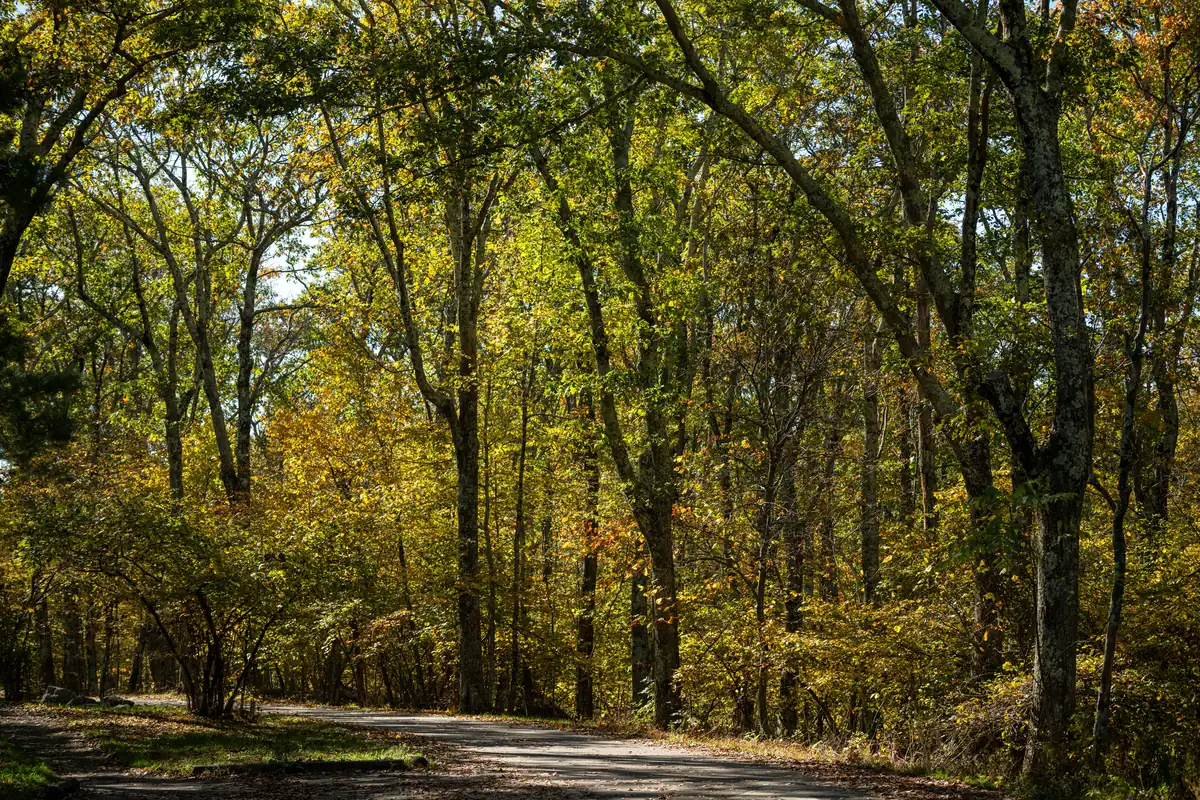
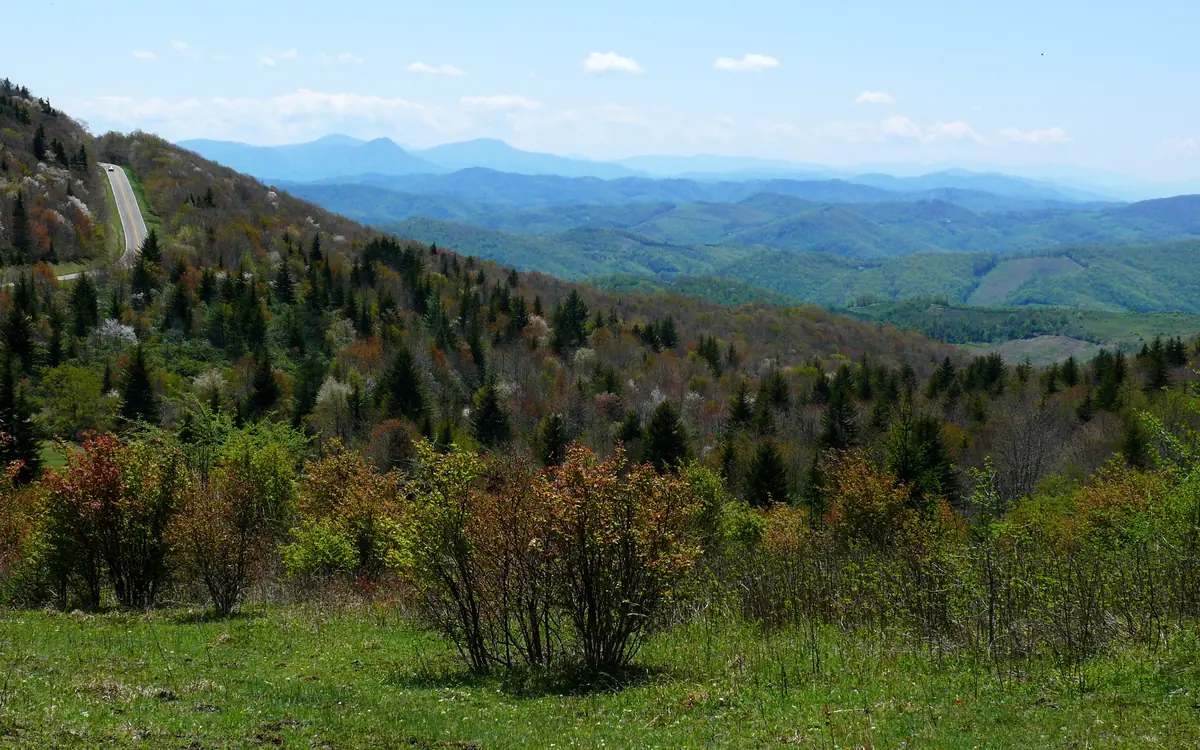
- Color coming down the mountains. The high ridges of the Blue Ridge and Mount Rogers turn in the first half of October, the Parkway and Skyline Drive overlooks in the middle two weeks, the valleys and the Piedmont in the last week, and the coast after that. Shenandoah posts a fall video every Thursday and runs two live webcams, so look before you go. After a dry summer, expect some early leaf drop and duller tones in places.
- The Eastern Shore funnel. Everything flying south on a northwest wind piles up at the tip of the Delmarva Peninsula. Kiptopeke’s hawk platform counts more sharp-shinned hawks, kestrels, merlins and peregrines than any ridge in the state, and the falcons peak in the first half of October; monarchs and songbirds gather in the same last miles of woods the morning after a front.
- The Moon hides Jupiter, then the Hunter’s Moon. Before dawn on Tuesday, October 6, the crescent Moon covers Jupiter at 4:19 a.m. in Richmond and gives it back at 5:24, well up in a dark sky; Virginia sees the whole event. The full Hunter’s Moon rises before sunset on Sunday, October 25 (full at 12:12 a.m. on the 26th), and the Orionids peak in the dark hours after moonset on October 21 and 22.
Keep a record as you go: the Naturalist’s Field Journal gives you a tree-through-the-seasons page to follow one maple on your daily route, a “birds I have seen” list to carry up to the hawk platform, a dusk-and-dawn watch for the elk and the deer, a seeds-pods-and-cones page for the acorns and witch hazel capsules, and the cricket thermometer for the last warm evenings. One observation at a time.
Regions used below: Southwest Virginia and the Blue Ridge; Shenandoah Valley; Northern Virginia; Central Virginia and the Piedmont; Southside; Tidewater and Hampton Roads; Eastern Shore.
When do the leaves change in Virginia, and where is the color this week?
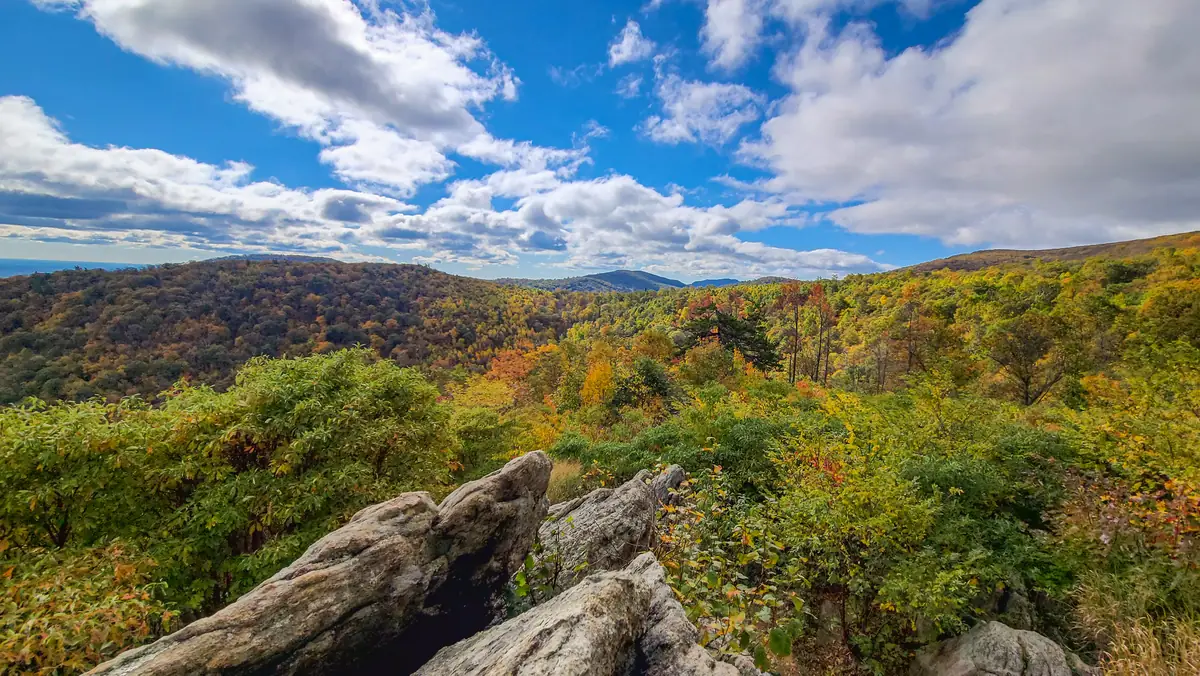
Color comes down the mountain. The Department of Forestry’s rule of thumb, as reported this fall, is a statewide peak between October 10 and 31: western Virginia roughly October 10–20, central Virginia October 15–25, eastern Virginia October 20–31. Virginia State Parks draws the coast later, mountain parks in mid-to-late October, central parks in early November and coastal parks in early-to-mid November. Shenandoah National Park declines to name a peak at all, because a park more than a hundred miles long, with thousands of feet between ridgetop and hollow, has several: the high ridges along Skyline Drive go first, the hollows and the Valley floor last. In 2026 the dry summer matters: the State Parks report of September 24 found most parks still green, with early yellows in tulip poplar and sycamore, reds in dogwood and blackgum, and “some early leaf drop and slightly muted tones” from the drought.
| Region | Reference places | Typical window |
|---|---|---|
| High Blue Ridge and Mount Rogers, above 3,500 ft | Grayson Highlands, Whitetop, the highest Parkway and Skyline Drive overlooks | First half of October |
| Southwest Virginia and the Blue Ridge, 1,500–3,500 ft | Harvey’s Knob, Douthat, Hungry Mother, the Alleghenies | October 10–20; the Roanoke and New River valleys late October |
| Shenandoah Valley and Northern Virginia | Skyline Drive’s lower overlooks, Sky Meadows, Winchester, the Bull Run Mountains | Mid-October on the ridges; late October in the Valley and around Washington |
| Central Virginia and the Piedmont | Charlottesville, Lynchburg, Richmond’s James River parks | October 15–25, often running to the first days of November |
| Southside | Danville, South Boston, Staunton River | Late October into early November |
| Tidewater, Hampton Roads and the Eastern Shore | First Landing, York River, the Dismal Swamp, Chincoteague | October 20–31 by the Forestry rule; early-to-mid November by the parks |
Shenandoah’s Thursday video and its two webcams (Big Meadows, and one looking up from the Valley) are the quickest check, and Virginia State Parks posts a weekly report through the season. Weekends on Skyline Drive mean queues at the Front Royal and Thornton Gap entrances, and Old Rag needs a day-use ticket from recreation.gov through November. For your own street, the Field almanac pulls leaf timing from satellite data.
Where can I watch migrating hawks in Virginia in October?
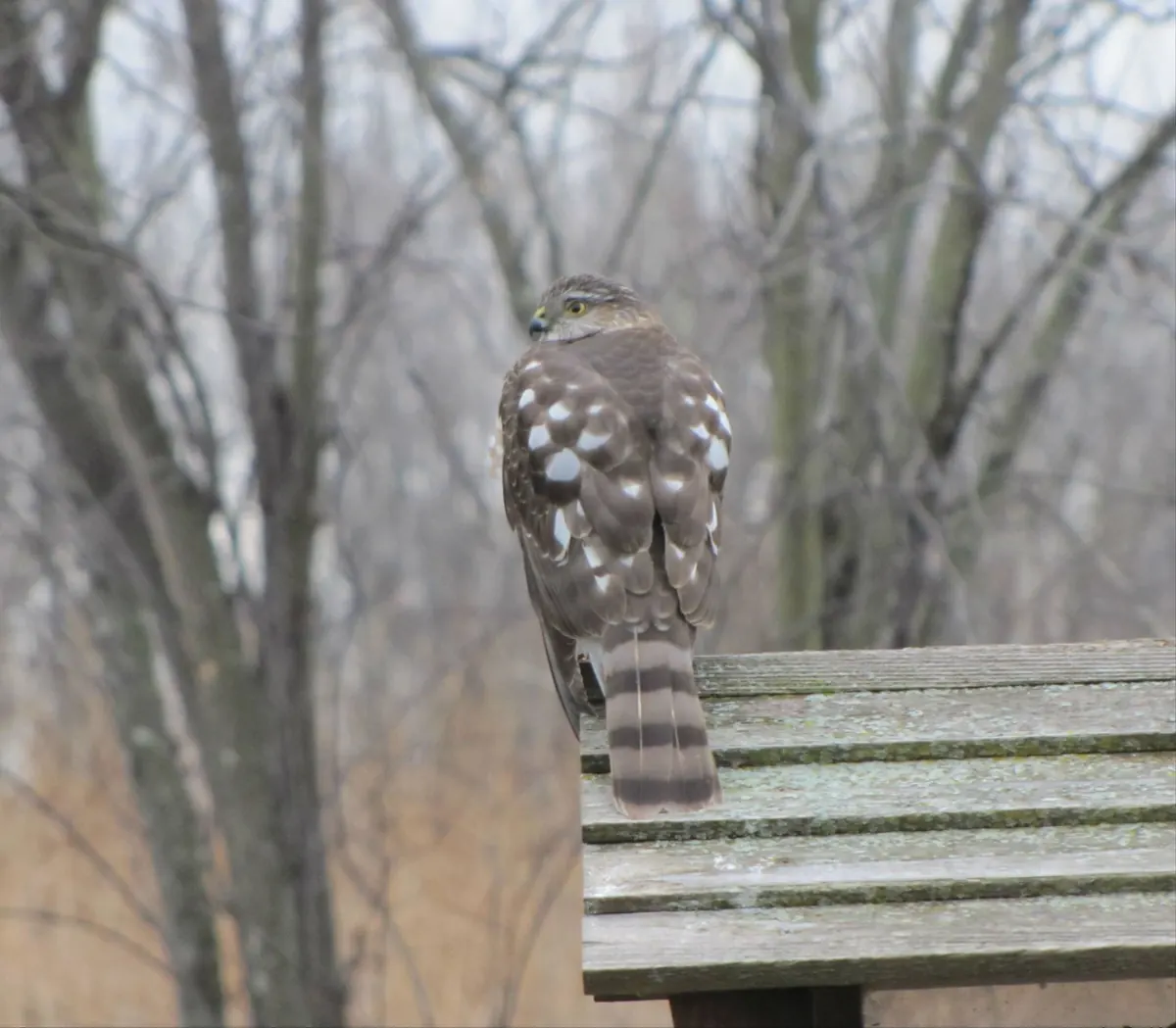
September belongs to the broad-winged hawks, which cross the Blue Ridge in kettles of thousands in the last two weeks of the month; October belongs to everything else. On the ridges, sharp-shinned hawks, Cooper’s hawks and kestrels ride the northwest winds behind each cold front through the first half of the month, red-tailed hawks build toward a November peak, and the first golden eagles appear on northwest winds in late October. At the tip of the Eastern Shore the land funnels birds to a point; the Kiptopeke hawkwatch there, begun by volunteers in 1977, is in its fiftieth season.
| Site | Where | Count season | What October brings |
|---|---|---|---|
| Kiptopeke Hawkwatch | Kiptopeke State Park, Northampton County, 3 miles north of the Bay Bridge-Tunnel; accessible platform | Sept 1 – Nov 30, daily | Sharp-shinned peak Oct 1–14 (about 7,900 a season), Cooper’s Oct 7–21, peregrine Oct 1–15 (364 in one day is the record), merlin to Oct 21, kestrel to Oct 15; bald eagles all month, golden eagles from Oct 7 |
| Rockfish Gap | Inn at Afton, 2,000 ft, Interstate 64 exit 99 at Waynesboro | Aug 15 – Nov 30 | Peak the last two weeks of Sept and first week of Oct; sharp-shinned and kestrels through Oct; red-tails and golden eagles mostly Nov; about 130 bald eagles a season |
| Snickers Gap | VDOT commuter lot on Route 7 at the Loudoun–Clarke line, 1,062 ft | Late Aug – late Nov, mostly weekends | About 1,000 sharp-shinned and 900 red-tails a season; golden eagles possible on northwest winds from late Oct |
| Harvey’s Knob | Blue Ridge Parkway milepost 95.4, Botetourt County, 2,524 ft | Aug 15 – Nov, weather permitting | Accipiters after the broad-wings; red-tails late in the season; about 500 sharp-shinned and 450 red-tails a season |
Two notes for 2026: the Rockfish Gap lot is now behind a locked gate that the counter opens on count days, so check the watch’s online calendar before driving up, and Snickers Gap has no facilities, so bring a chair and a scope. The same fronts bring juncos, white-throated sparrows and yellow-rumped warblers into yards and carry off the last hummingbirds; timing varies by place and year, so write down your own first and last dates. A northwest wind the morning after a front, read off the Weather now page, is the morning to go.
What is happening on the Virginia coast in October?
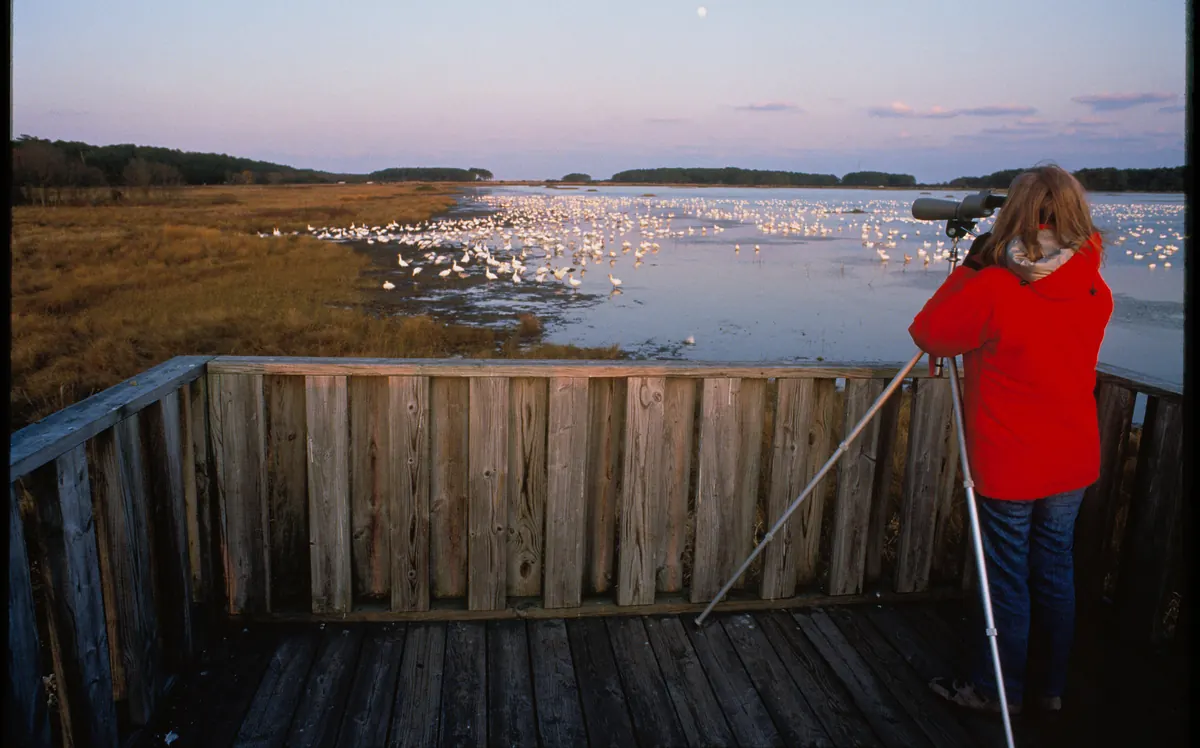
The southern tip of the Delmarva Peninsula is where October concentrates, and the Eastern Shore of Virginia National Wildlife Refuge describes “millions of songbirds and monarch butterflies and thousands of raptors” converging there each fall. Monarchs are the clearest case. Inland, Monarch Watch puts the peak passage for Virginia’s latitudes at September 14 to October 1, so by mid-October the Piedmont sees stragglers; at the tip, the Coastal Virginia Wildlife Observatory has counted and tagged monarchs each fall since 1998, and a three-year study in The American Midland Naturalist documented an annual accumulation area there, fed fastest by strong northerly winds.
-
Songbirds after a front
September into October, the morning after a northwest wind · Kiptopeke, the Eastern Shore refuge, Fisherman Island
Migration at the tip is feast or famine: after a strong cold front there can be hundreds or thousands of migrants in the thickets, and on a still morning almost none. The refuge’s pollinator garden behind the visitor center is the easiest place to stand, and guided tours of Fisherman Island run on Saturdays from October through February; call the refuge to reserve a place.
-
Falcons on the beach
First half of October · Kiptopeke, Back Bay, the barrier islands
Peregrines and merlins hunt the dunes as they pass; Kiptopeke’s one-day highs are 364 peregrines and 462 merlins.
-
Back Bay’s dike trails before they close
Open through October 31 · Back Bay National Wildlife Refuge, Virginia Beach
The East and West Dike trails, the land route through the refuge to False Cape State Park, close from November 1 through March 31 for the wintering waterfowl, so this is the last month to walk or bike the length of Back Bay; the Blue Goose tram tour into False Cape is listed for Friday, October 2 (registration required; confirm with the park). The refuge’s crowds of ducks, tundra swans and snow geese belong to the peak of winter.
-
Tundra swans and snow geese: not yet
First arrivals late October to early November; most in November · Chincoteague, Back Bay, Mason Neck, the tidal Potomac
The Northern Virginia Bird Alliance says the swans “begin to arrive here in November,” and the first eBird report at Mason Neck in 2025 was November 13; the Chesapeake Bay Program dates the first arrivals to late October and early November. Chincoteague’s Waterfowl Weekend is Thanksgiving Thursday through Sunday, November 26–29 this year; in October the refuge is open 6 a.m. to 8 p.m., and the Chincoteague Oyster Festival is Saturday, October 10.
-
Striped bass and oysters
Bay striper season opens Oct 4; oyster grounds Oct 1 · Chesapeake Bay and its rivers
The fall recreational striped bass season in the Chesapeake Bay and its Virginia tributaries runs October 4 to December 31, one fish per person between 19 and 24 inches. On the public oyster grounds the Marine Resources Commission’s draft 2026–27 rules open hand-tonging on October 1 in the James River seed area, the York, the Piankatank, Mobjack Bay and Pocomoke Sound, with hand scrapes in the James from October 15; confirm the final regulation with VMRC.
-
The Great Dismal Swamp
Best hiking from October; hunts Thursday to Saturday from Oct 1 · Suffolk and Chesapeake
The refuge calls October to May the best time to hike, once the biting insects thin out. Its deer hunts run Thursdays through Saturdays from October 1 to the first Saturday in January, and Chesapeake, Virginia Beach and Suffolk east of the swamp open their firearms deer season on October 1, so plan swamp walks for Sunday through Wednesday and wear orange.
If you find monarchs clustered for the night in the Shore’s cedars and pines, log the roost with Journey North before you go to bed; overnight roosts are among the fall reports the program collects.
What are Virginia’s deer, bears and elk doing in October?
-
Elk bugling in Buchanan County
Rut running down through October; bugling continues · Elk Viewing Area at Southern Gap, Grundy
Virginia’s restored elk herd lives on the Cumberland Plateau in Buchanan County, and the Department of Wildlife Resources says the best chance to see it is “September through the end of October at dawn and dusk hours,” as the rut runs down and the bulls are still bugling. Three viewing platforms off Chipping Sparrow Road are free and open daily, though the herd is not always in view. DWR’s guided tours leave from the Breaks Park Southern Gap site on Thursday, October 1 and Tuesday, October 6 at 5 p.m. and on Tuesdays October 20 and 27 at 4:30 p.m., $20 a person and 25 guests each, booked in advance.
-
White-tailed deer: the rut is next month
Peak conception about November 16 · Statewide
DWR’s deer biologist Justin Folks works the calendar backward from the fawn drop, which peaks in the first week of June: with a 200-day gestation, the peak of conception falls about November 16, and it is day length, not weather or the Moon, that sets it. October is the run-up. Bucks are sparring and making rubs and scrapes; watch a field edge at dusk with the journal’s dusk-and-dawn page, and expect the real chasing after Halloween.
-
Bears eating for winter
Hyperphagia now; denning between October and January · Mountains and Piedmont; sporadically on the coast
Black bears “may feed up to 20 hours per day” in fall, DWR says, and an adult male can gain more than a hundred pounds in a heavy acorn year before denning sometime between October and January. This year’s acorn report, out September 29, rates white oaks above average for the second year running and red oaks below average for the first time since 2022, with the crop patchy from ridge to ridge, so the department expects wildlife to be “more mobile throughout the fall.” Take the bird feeder down until December, keep the trash in, and do not leave pet food out.
-
Squirrels, acorns and the mast year
October into November · Every oak
Count the acorns under one white oak and one red oak and note the numbers; squirrels, jays, turkeys, deer and bears all follow the same crop.
When is the first frost in Virginia?
In the mountains, this month; on the coast, not yet. Blacksburg and the high valleys of Southwest Virginia have usually frozen by the middle of October, Bristol, Roanoke and Winchester by the end of it, Fredericksburg and Richmond in the first days of November, and Norfolk and Washington not until the middle of that month. The National Weather Service in Blacksburg keeps a longer record: in records running back many decades (to 1912 at Roanoke) the average first freeze at Roanoke was October 22, at Lynchburg October 25, at Danville October 27 and at Blacksburg October 10, a week or so earlier than the 1991–2020 normals below. The high country gets snow before the Piedmont gets frost: on October 16, 2023, the season’s first snow fell above a mile in elevation at Grayson Highlands, Mount Rogers and Whitetop, which the weather columnist Kevin Myatt called “a bit early but not terribly extraordinary at these elevations.”
| Station | One year in ten | Median | Nine years in ten |
|---|---|---|---|
| Bristol (Tri-Cities Airport, just over the Tennessee line) | Oct 7 | Oct 20 | Nov 4 |
| Roanoke | Oct 14 | Oct 28 | Nov 9 |
| Winchester | Oct 14 | Oct 29 | Nov 11 |
| Fredericksburg | Oct 19 | Nov 1 | Nov 12 |
| Richmond | Oct 23 | Nov 4 | Nov 19 |
| Charlottesville | Oct 29 | Nov 10 | Nov 28 |
| Norfolk | Nov 4 | Nov 16 | Dec 1 |
| Washington (Reagan National), for Northern Virginia | Nov 5 | Nov 18 | Dec 6 |
Look up the town nearest you on the Virginia frost dates page. Bring in the tender plants in the mountains now; in the Piedmont you have until about the first of November, and in Tidewater the fall garden has weeks to run. The first frost is worth a line in the daily field log: the date, the low, and what it took.
How quickly do Virginia’s days shorten in October?
About seventy minutes, a little more in the north of the state than the south. Sunrise in Richmond slips from 7:05 to 7:34 a.m. across the month and sunset from 6:53 to 6:12 p.m.; in Bristol the sun sets at 6:33 on Halloween. Then the clocks go back at 2 a.m. on Sunday, November 1, and the evening commute is in the dark from that day on.
| City | Oct 1 | Oct 31 | Lost | Per day |
|---|---|---|---|---|
| Winchester | 11 h 46 m | 10 h 34 m | 72 min | 2.4 min |
| Washington (Reagan National) | 11 h 47 m | 10 h 34 m | 73 min | 2.4 min |
| Fredericksburg | 11 h 47 m | 10 h 36 m | 71 min | 2.4 min |
| Charlottesville | 11 h 47 m | 10 h 37 m | 70 min | 2.3 min |
| Richmond | 11 h 48 m | 10 h 39 m | 69 min | 2.3 min |
| Roanoke | 11 h 48 m | 10 h 40 m | 68 min | 2.3 min |
| Norfolk | 11 h 47 m | 10 h 41 m | 66 min | 2.2 min |
| Bristol | 11 h 48 m | 10 h 42 m | 66 min | 2.2 min |
For your own address, the Field almanac lists this week’s sunrise, sunset, twilight and daylight lost.
Is October a dry month in Virginia, and what will El Niño do to the winter?
Drier than September everywhere in the normals, and in the far southwest the driest month of the year: the 1991–2020 averages give October 2.52 inches at Bristol (its lowest month), 2.96 at Roanoke (second only to February), 3.12 at Lynchburg, 3.39 at Richmond, 3.66 at Washington, 3.86 at Norfolk and 4.02 at Wallops Island. It is the month of the clearest skies and, after a summer like this one, of fire danger.
The dry average hides the wettest days, because October has brought some of Virginia’s worst coastal storms. The National Weather Service in Wakefield lists five damaging October storms between 1878 and 1903; Hurricane Hazel on October 15, 1954, with a 78 mph sustained wind and 100 mph gusts at Norfolk and 130 mph on a Hampton instrument; and Hurricane Matthew on October 8–9, 2016, when 6 to 11 inches of rain fell on southeast Virginia and gusts reached 75 mph at Oceana. Hurricane season runs to November 30, and the first nor’easters of the cool season work the same coast.
El Niño is the winter story. The Climate Prediction Center’s September 10 update put the odds of a very strong El Niño this fall and winter above 90 percent, with a 75 percent chance of an event stronger than any since 1950. For Virginia the signal is real but loose. The Wakefield office, writing ahead of the 2015–16 event, noted that in strong El Niño winters above-normal precipitation “typically extends across much of the southern United States and this includes the Wakefield County Warning Area,” with a mixed record on temperature; NOAA’s own review calls the relationship “not very strong” in the mid-Atlantic. Kevin Myatt of Cardinal News finds wetter winters and four foot-plus snowstorms in El Niño winters (January 1998, December 2009, January 2016, December 2018) but “no hard-set outcomes,” and NBC12 in Richmond expects a wetter, stormier winter with much of it too warm for snow. Wetter is the safe bet; snow is a coin flip. October itself is only weakly affected. NOAA’s seasonal outlook for the winter is due in mid-October, and we will explain what it means for Virginia once it is out.
What can you see in Virginia’s night sky this October?
-
The Moon hides Jupiter
Tuesday, October 6, about 4:19 to 5:24 a.m. EDT · East-southeast and well up; any open view east
The one to set an alarm for. The waning crescent Moon, 18 percent lit and already 17 degrees up, covers Jupiter with its bright edge at 4:19 a.m. in Richmond, 4:20 in Norfolk and 4:21 in Washington, probably a minute or two earlier in Roanoke and Bristol (the tables do not list them). About an hour later, at 5:24 a.m. in Richmond and Washington and 5:25 in Norfolk, the planet slips back out from behind the unlit side, with the Moon 29 degrees high and the sky still dark; civil twilight does not start until 6:44 in Richmond. In binoculars Jupiter’s disk takes a noticeable stretch of time, not an instant, to disappear. Times are from the International Occultation Timing Association.
-
The Hunter’s Moon
Sunday, October 25 and Monday, October 26 · Low in the east at dusk
The full moon after the Harvest Moon rises at 5:46 p.m. in Richmond on the 25th, half an hour before the 6:19 sunset, and at 6:21 on the 26th, three minutes after sunset; in Roanoke it is up at 5:57 on the 25th. It is officially full at 12:12 a.m. on Monday the 26th.
-
Orionid meteors
Pre-dawn, October 21 and 22 · Face southeast after the Moon sets
The American Meteor Society lists the Orionids from October 2 through November 7, peaking on October 21–22 at 10 to 20 meteors an hour under dark skies. In Richmond the gibbous Moon is down by 2:27 a.m. on the 21st and 3:30 a.m. on the 22nd (3:25 in Norfolk, 3:40 in Roanoke), so the hours from moonset to dawn are the ones to use. Each later night the Moon stays up longer and that gap narrows.
-
Draconid meteors
Evening of Thursday, October 8 · Look north after dark
A minor shower, usually only a handful of slow meteors an hour, but unusually it is best in the early evening, so children can watch before bedtime, and the thin crescent Moon is not up to wash it out.
-
Saturn all night
Opposition October 4; the Moon beside it Oct 23–24 · Rising in the east at sunset
Saturn reaches opposition on October 4, when it is nearest Earth and at its brightest this year; it comes up in the east as the Sun goes down and stays up until dawn, standing out in the faint star fields of Pisces near Cetus. On October 23 and 24 the nearly full Moon passes close by.
-
Venus goes, Jupiter and Mars take the morning
Venus in the evening until early October; Jupiter and Mars in the morning all month · West at dusk; east at dawn
Catch Venus low in the west after sunset in the first days of October; it sinks into the glow soon after and crosses between the Sun and Earth on October 23. In the morning sky Jupiter is bright and high in the east, with Mars higher still, and on the morning of October 11 Mars sits beside the Beehive cluster in Cancer.
-
The Staunton River Star Party
October 5–11; public night Friday, October 9, 8–10 p.m. · Staunton River State Park, Scottsburg
Virginia’s first International Dark Sky Park hosts the star party from October 5 to 11, in the dark-moon week, with a public observing night on Friday the 9th from 8 to 10 p.m.; the visitor center lends telescopes.
| Phase | Date | Time |
|---|---|---|
| Last quarter | Saturday, Oct 3 | 9:25 a.m. |
| New moon | Saturday, Oct 10 | 11:50 a.m. |
| First quarter | Sunday, Oct 18 | 12:12 p.m. |
| Full moon, the Hunter’s Moon | Monday, Oct 26 | 12:12 a.m. (looks full the evenings of Oct 25 and 26) |
| Last quarter | Sunday, Nov 1 | 3:28 p.m. EST |
Before heading out, see whether clouds will get in the way on the Today’s sky page, and find local moonrise and moonset times on the moon phases page. Daylight saving time ends at 2 a.m. on Sunday, November 1.
What is blooming, fruiting and falling in Virginia in October?
-
Witch hazel, the last flower of the year
Mid-October into November, as the leaves come off · Moist woods in nearly every county
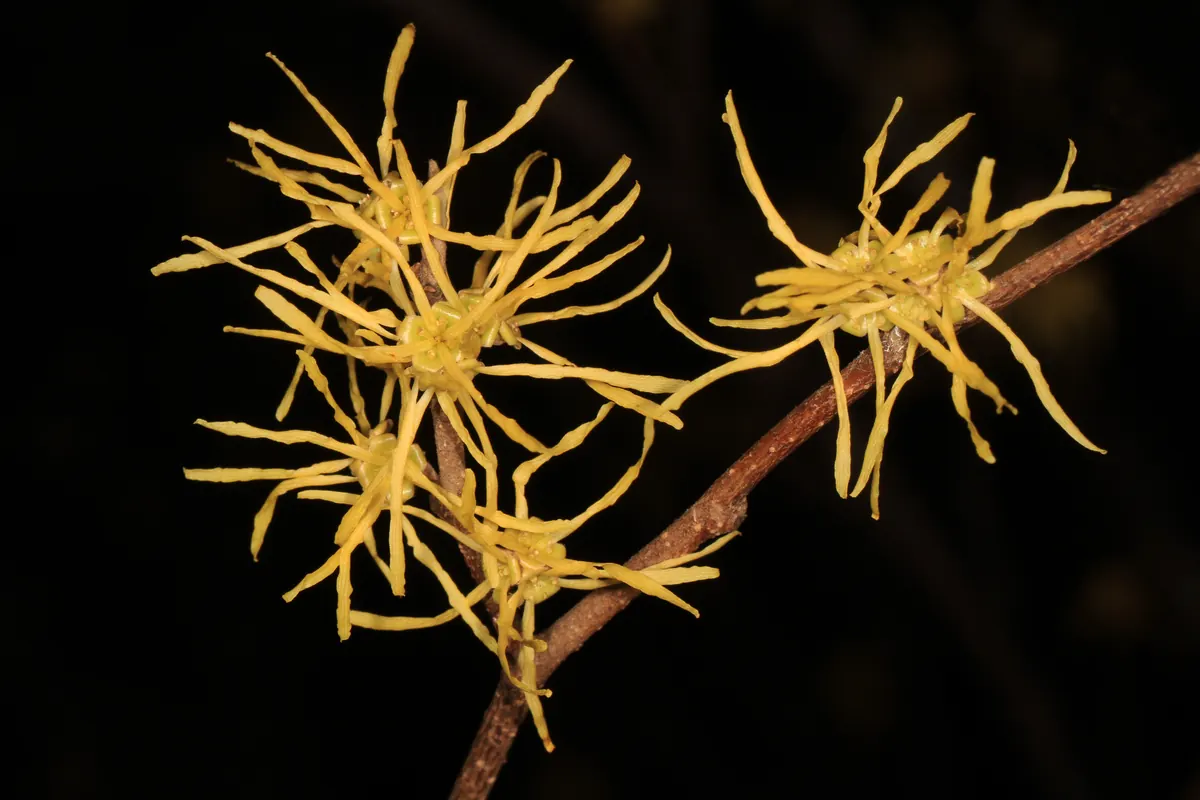
Virginia gave the plant its name, Hamamelis virginiana, and it grows in nearly every county. The flowers are four crinkled yellow straps with a spicy scent, opening in mid to late fall on bare or nearly bare branches; the Virginia Native Plant Society made it Wildflower of the Year in 2002. Look beside the flowers for last year’s woody capsules, which split in autumn and fling two black seeds 10 to 20 feet; on a still day you can hear them go.
-
Goldenrods and asters
September into October; some to November · Roadsides, meadows, woodland edges
Virginia has more than forty native goldenrods, and with the asters they carry the fall for bees and the last butterflies; the woodland goldenrods light up shaded trails in October while the purple asters run through the month in the open. Goldenrod does not cause hay fever; the ragweed in the same ditches does.
-
Acorns, hickories and dogwood berries
October into November · Every hardwood ridge and yard
DWR calls 2026 “a fairly good year for wildlife” in its acorn survey: white oaks above average for the second year, red oaks below average for the first time since 2022, and the crop patchy, with hickory, beech and the soft mast filling the gaps. Flowering dogwood, the state tree, turns wine-red early and hangs its clusters of red berries for the thrushes and bluebirds passing through.
-
The 2026 leaf drop
Early, from drought · Statewide
Trees stressed by the dry summer shed leaves before they color; the State Parks report of September 24 already noted early drop and muted tones. It does not cancel the season, it thins it; in our experience the wet hollows and stream bottoms hold their color longest in a dry year.
Are snakes still out in October in Virginia, and what else is stirring?
-
Copperheads, until the end of the month
Active to about October 30; out by day now · Statewide, most in the mountains
The Virginia Herpetological Society’s museum records put the copperhead’s normal season at April 9 through October 30, and in the cool months it is “primarily diurnal,” basking on warm afternoons on rock, trail and leaf litter where its pattern disappears. The young, born between August 10 and October 6, are on the ground now too.
-
Timber rattlesnakes going to den
September 26 to October 18; stragglers to November 5 · Blue Ridge and Alleghenies; the canebrakes of the southeast
Rattlesnakes return to the same ancestral dens each fall, and the Society’s records have them entering hibernacula between September 26 and October 18, with a few on the surface until November 5. A sunny rock outcrop near a den can hold several snakes on an October afternoon.
-
Marbled salamanders breeding on dry ground
Late September and October · Dried vernal pools statewide, rare in the far southwest
The one Virginia mole salamander that breeds in fall. Females lay their eggs under leaf litter and logs in the empty bed of a vernal pool and stay with them until the winter rains fill it and the eggs hatch. If you turn a log at a dry pool edge, put it back exactly as it was.
-
Brook trout on the redds
Early October to mid-November · Shenandoah and Blue Ridge headwaters
The native brook trout spawns in fall, “most typically from early October to mid November” in Shenandoah National Park streams, the females cutting shallow redds in the gravel; the eggs hatch in January. Keep boots out of clean gravel. Stocked trout run on a different calendar: DWR stocks its designated waters from October through May.
-
The cricket thermometer
Warm evenings until the first frost · Any porch
Count the chirps of a single cricket for 14 seconds and add 40 for the temperature in Fahrenheit. The rule comes from Dolbear’s law, published in 1897 and usually tied to the snowy tree cricket, and October is the month to test it, because the counts get slower every week until the frost ends them. The journal has a page for it.
What can Virginia families do outdoors in October?
- Stand on a hawk platform. Kiptopeke’s platform is wheelchair-accessible and staffed daily; check Rockfish Gap’s calendar for count days.
- Take an elk tour, or watch the platforms at dusk. Tours run October 1, 6, 20 and 27; the Southern Gap platforms are free every day.
- Join October Big Day on Saturday, October 10. Count birds anywhere for ten minutes and enter the list in eBird.
- Look for monarchs. Log any overnight roost you find with Journey North, and if you have a Monarch Watch tagging kit, October on the coast is the time to use it.
- Go to a star party. Staunton River’s public night is Friday, October 9, 8–10 p.m.; then set the alarm for 4:15 a.m. on October 6 for the Moon and Jupiter, or for the Orionids on the 21st and 22nd.
- Pick a fall festival. Holliday Lake’s Fall Festival and Hungry Mother’s Fall Colors Hike are Saturday, October 3; Hungry Mother’s Fall Fun Fest and the Wilderness Road Heritage Festival are the 10th; Powhatan State Park runs a Twilight Owl Prowl on Friday, October 16, 6:30–7:30 p.m.; Sky Meadows’ Fall Foliage Festival, Chippokes’ Harvest Festival, First Landing’s Fall Fest and Caledon’s “Finding Fall” walk are all Saturday the 17th, with Sky Meadows again on the 18th. Shenandoah National Park waives its entrance fee on Tuesday, October 27.
- Walk the Back Bay dikes before November 1, and sign up for Project FeederWatch, which starts that day.
For guided walks and citizen-science projects close to home, look up your local Virginia Master Naturalist chapter.
Safety notes for October in Virginia
- Bears are ranging widely in a patchy acorn year. Never feed one, and give any bear you meet room and a way out.
- Ticks do not stop at the equinox. The Virginia Department of Health says adult blacklegged ticks, the Lyme carriers, still bite “during the fall, winter (on warmer winter days) and during the early spring.” Permethrin on boots and socks, pants tucked in, a check after every walk and ten minutes in a hot dryer.
- Snakes: copperheads are out by day through October. Look where hands and feet go.
- Hunting seasons. Archery deer runs October 3 to November 13 statewide, early muzzleloader opens October 31, and the general firearms season opens November 14; Chesapeake, Virginia Beach and Suffolk east of the Dismal Swamp open firearms deer season on October 1. The youth and apprentice fall turkey weekend is October 10–11, and fall turkey opens October 17 in most counties. Virginia law requires solid blaze orange or blaze pink, a hat or 100 square inches at shoulder level visible all round, of every hunter and every person with a hunter during firearms deer seasons; hikers are not covered by the law, but on national forest and wildlife management areas the same orange hat is the obvious choice from Halloween on, Sundays included. The Great Dismal Swamp hunts Thursdays through Saturdays from October 1.
- Coastal storms. Check the forecast before a barrier-island day, and never drive through water on a road.
- Fire. After a drought summer the woods are dry; check the Department of Forestry’s daily fire-danger rating and local burn bans before any campfire, and drown it.
- High country. Mount Rogers and Grayson Highlands can see snow from mid-October; pack for winter above 4,000 feet.
Sources
- National Park Service: Fall in Shenandoah (weekly video, webcams, crowds)
- National Park Service: Shenandoah fees, 2026 fee-free days and Old Rag tickets
- Virginia State Parks: fall foliage report, September 24, 2026
- Virginia State Parks: peak foliage periods by region
- Virginia Department of Forestry: fall foliage report
- Alexandria Living Magazine: the Department of Forestry’s typical peak windows by region
- HawkCount: Virginia hawk-watch profiles and season averages (Kiptopeke, Rockfish Gap, Snickers Gap, Harvey’s Knob)
- Rockfish Gap Hawk Watch: access during the 2026 season
- Virginia Society of Ornithology, The Raven: The Kiptopeke Hawk Watch 1977–2018 (PDF)
- Coastal Virginia Wildlife Observatory: butterfly research (monarch program)
- Monarch Watch: peak migration dates by latitude
- Journey North: monarch sightings and fall roost reports
- American Midland Naturalist (2002): monarch autumn migration in coastal Virginia
- U.S. Fish and Wildlife Service: Eastern Shore of Virginia National Wildlife Refuge
- U.S. Fish and Wildlife Service: Back Bay National Wildlife Refuge rules (dike trail closure)
- Virginia DWR Bird and Wildlife Trail: Back Bay National Wildlife Refuge
- Chesapeake Bay Program: tundra swan
- Northern Virginia Bird Alliance: tundra swans
- U.S. Fish and Wildlife Service: Chincoteague National Wildlife Refuge, hours and Waterfowl Weekend
- Chincoteague Island events: Oyster Festival, October 10, 2026
- U.S. Fish and Wildlife Service: Great Dismal Swamp activities (hiking season, hunt days)
- Virginia Marine Resources Commission: recreational saltwater fishing rules (striped bass)
- Virginia Marine Resources Commission: draft 2026–27 public oyster ground seasons, Chapter 4VAC20-720 (PDF, August 25, 2026)
- Virginia DWR: Elk Viewing Area, Southern Gap
- Virginia DWR: 2026 elk viewing tours
- Virginia DWR blog: fawning dates are key to rut timing
- Virginia DWR: black bear
- Virginia DWR blog: 2026 acorn production report
- NOAA NCEI: 1991–2020 first-freeze probability normals (data API; Bristol and the main airports)
- NOAA NCEI: 1991–2020 monthly precipitation normals (data API)
- NWS Blacksburg: fall freeze climatology
- Cardinal News: Virginia’s first snowfall, October 2023
- U.S. Naval Observatory: moon phases 2026 and sunrise, sunset, moonrise and moonset (data API)
- International Occultation Timing Association: lunar occultation of Jupiter, October 6, 2026
- EarthSky: meteor shower guide (Draconids, Orionids)
- American Meteor Society: 2026 meteor shower calendar
- Virginia State Parks: Staunton River Star Party, October 5–11, 2026
- NWS Wakefield: the hurricane history of coastal Virginia (PDF)
- Climate Prediction Center: ENSO diagnostic discussion, September 10, 2026
- NWS Wakefield: The Weather Nut, fall 2015 (El Niño and the Wakefield area)
- NOAA Climate.gov: United States El Niño impacts
- Cardinal News (Kevin Myatt): what El Niño might mean for Virginia weather
- NBC12 Richmond: what a super El Niño means for winter in Virginia, August 19, 2026
- Virginia Native Plant Society: witch hazel, 2002 Wildflower of the Year
- USDA Forest Service: American witchhazel
- Virginia Native Plant Society: goldenrod blooms through fall
- Virginia Herpetological Society: eastern copperhead
- Virginia Herpetological Society: timber rattlesnake
- Virginia DWR: marbled salamander
- National Park Service: brook trout in Shenandoah
- Virginia DWR: trout fishing and stocking
- The Old Farmer’s Almanac: cricket chirps and temperature
- Virginia Department of Health: tick identification and seasonal activity
- Virginia DWR: 2026–27 deer seasons
- Virginia DWR: turkey seasons
- Virginia DWR: general hunting regulations (blaze orange, Sunday hunting)
- Virginia Department of Forestry: wildfire prevention, daily fire danger and burn bans
- Virginia State Parks: what’s happening in October 2026
- eBird: October Big Day, October 10, 2026
- Project FeederWatch: how to participate
- Photos via Wikimedia Commons; licenses and photographers are credited under each picture
