What to look for in nature in Virginia this December
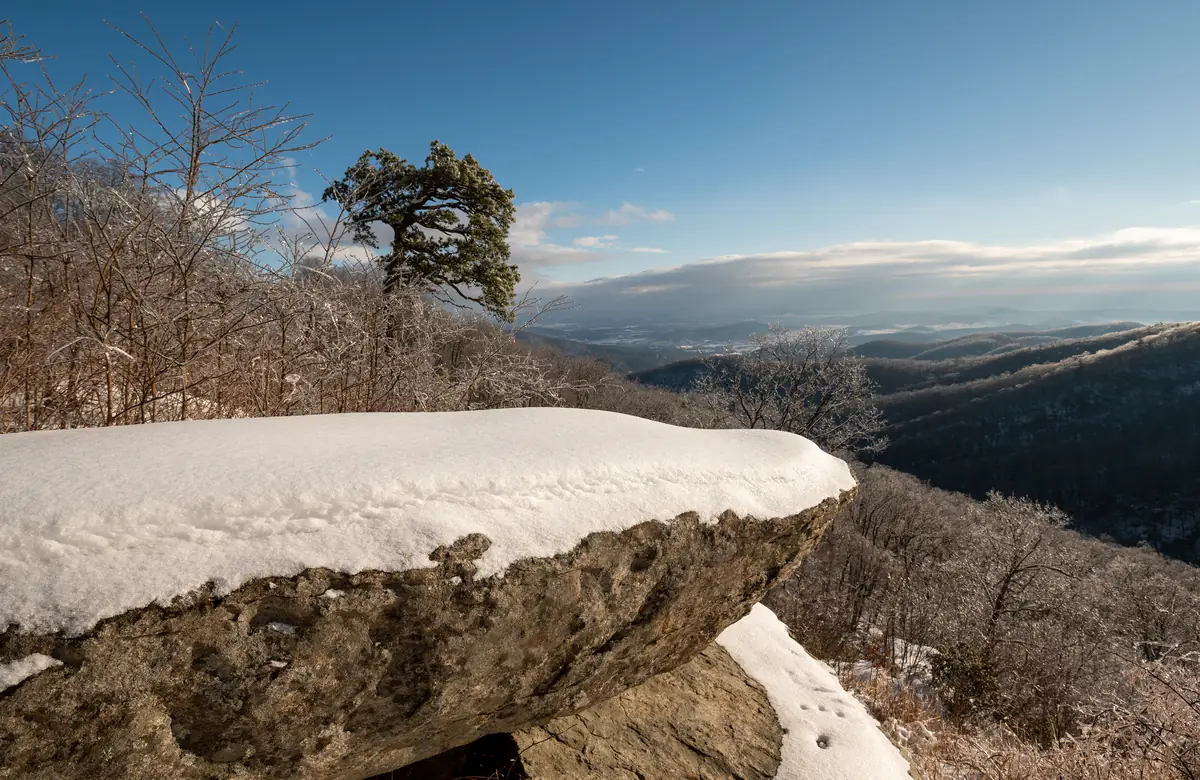
For forecasters, Virginia’s winter starts on December 1: in the long-term averages December, January and February are its chilliest quarter of the year, while the solstice waits until the 21st. The woods are bare enough now to show what the leaves hid: a bald eagle pair adding sticks to a nest that can weigh half a ton, the dark clumps of mistletoe high in a gum tree, a great horned owl outlined against the last light. Birders fan out across nearly sixty count circles, the Wilburn Ridge ponies wear their shaggy coats, and the earliest sunsets of the whole year fall in the first week. Here is what to look for, from the Alleghenies to the barrier islands.
Other months in Virginia: October, November.
Start here
- Join a Christmas Bird Count. Virginia runs close to sixty counts between December 14 and January 5, each a 15-mile circle covered in a single day. Beginners are paired with experienced teams, and a household inside a circle may report its feeder. Hampton Roads counts on Saturday, December 19, and Central Loudoun on Monday, December 28.
- Eagles at the nest, owls in the dark. Bald eagles repair and build nests from November, and DWR treats December 15 as the start of their breeding season. On still, cold evenings, listen for the deep, stuttering duet of a pair of great horned owls; they lay eggs earlier than almost any other Virginia bird.
- Geminids, solstice, Cold Moon. Watch the Geminids, the year’s richest meteor shower, on the night of Sunday, December 13, after the crescent Moon goes down. The solstice falls at 3:50 p.m. on Monday, December 21; two days later the Cold Moon, 2026’s biggest-looking full moon thanks to a close perigee, rises around sunset.
December is a good month to begin the Naturalist’s Field Journal. Put every species from your count day on the birds-I-have-seen plate, sketch a holly sprig or a few frosted cedar berry-cones at actual size for the seeds, pods and cones plate; set your boot beside a set of prints in mud or snow for the tracks to know plate. Use the nest observed page for an eagle nest visible from a public road or refuge trail, and the dusk and dawn watch for the minute the owls start up each evening.
Regions used below: Southwest Virginia and the Blue Ridge; Shenandoah Valley; Northern Virginia; Central Virginia and the Piedmont; Southside; Tidewater and Hampton Roads; Eastern Shore.
How do you join a Christmas Bird Count in Virginia?
Find the nearest circle and contact the person who runs it. Audubon’s 127th season straddles Christmas and New Year’s Day (the 14th to the 5th), and each group sets one date in it to sweep a 15-mile circle, some teams starting before dawn to hear owls. Virginia has close to sixty circles, says the Virginia Society of Ornithology. It is free and open to beginners. The first count in Virginia was run at Accotink in 1904 by one observer, who found six species; Charlottesville’s dates from 1924.
A few 2026 dates are already set. The Hampton Roads Bird Club counts on Saturday, December 19; Loudoun Wildlife Conservancy’s Central Loudoun count is Monday, December 28; and the Piedmont Virginia Bird Club will post the Charlottesville date around Thanksgiving. For the others, look up the circle on Audubon’s map and email its organizer early, because areas are handed out well before count day.
| Count circle | Region | Count day | Species | Birds | Field observers |
|---|---|---|---|---|---|
| Chincoteague | Eastern Shore | Dec 29, 2025 | 148 | 36,083 | 36 |
| Cape Charles | Eastern Shore | Dec 30, 2025 | 147 | 30,574 | 31 |
| Back Bay | Tidewater and Hampton Roads | Dec 29, 2025 | 127 | 22,787 | 37 |
| Fort Belvoir | Northern Virginia | Jan 4, 2026 | 111 | 86,543 | 190 |
| Central Loudoun | Northern Virginia | Dec 29, 2025 | 87 | 27,439 | 155 |
| Charlottesville | Central Virginia and the Piedmont | Dec 20, 2025 | 78 | 8,621 | 58 |
| Lynchburg | Central Virginia and the Piedmont | Dec 20, 2025 | 87 | 22,199 | 30 |
| Blacksburg | Southwest Virginia and the Blue Ridge | Dec 20, 2025 | 89 | 13,349 | 70 |
| Highland County | Alleghenies | Dec 14, 2025 | 56 | 2,255 | 13 |
| Bristol | Southwest Virginia and the Blue Ridge | Dec 28, 2025 | 64 | 4,035 | 8 |
| All Virginia counts | Statewide | Dec 14, 2025 – Jan 4, 2026 | 218 | 884,544 | all counts |
The coast wins on variety, because the barrier islands and the mouth of the Bay add gannets, scoters, loons and shorebirds that inland counts rarely record. Across the state last winter, counters tallied 2,576 tundra swans, 4,797 snow geese, 1,811 bald eagles and 13 golden eagles.
When do Virginia’s eagles and owls start nesting?
Earlier than any songbird. Large raptors can keep eggs warm through hard cold, so bald eagles, great horned owls and barred owls all begin breeding in winter, and the first signs show this month.
-
Bald eagles rebuilding nests
Nest work from November, peaking in midwinter; eggs from mid-January · Tidal rivers, reservoirs and big lakes statewide; the James, Rappahannock and Potomac above all
The Department of Wildlife Resources’ landowner guidelines say Virginia eagles may work on a nest in any month, but the building and repair usually starts in November and is busiest in midwinter. For management, the breeding season opens on December 15, and the same date begins the winter concentration season, which lasts until March 15, while wintering eagles of every age gather at shared roosts and feeding areas along the rivers. Pairs choose the tallest trees with limbs stout enough for the load, and a nest used for years can top a thousand pounds. Eggs normally follow between mid-January and late March. Last winter’s counts show where the birds gather: Fort Belvoir and Brooke, both on the tidal Potomac, each recorded 179 bald eagles, and Hopewell, on the James, 136. Watch an active nest from well back; the guidelines keep even construction crews hundreds of feet off during the season.
-
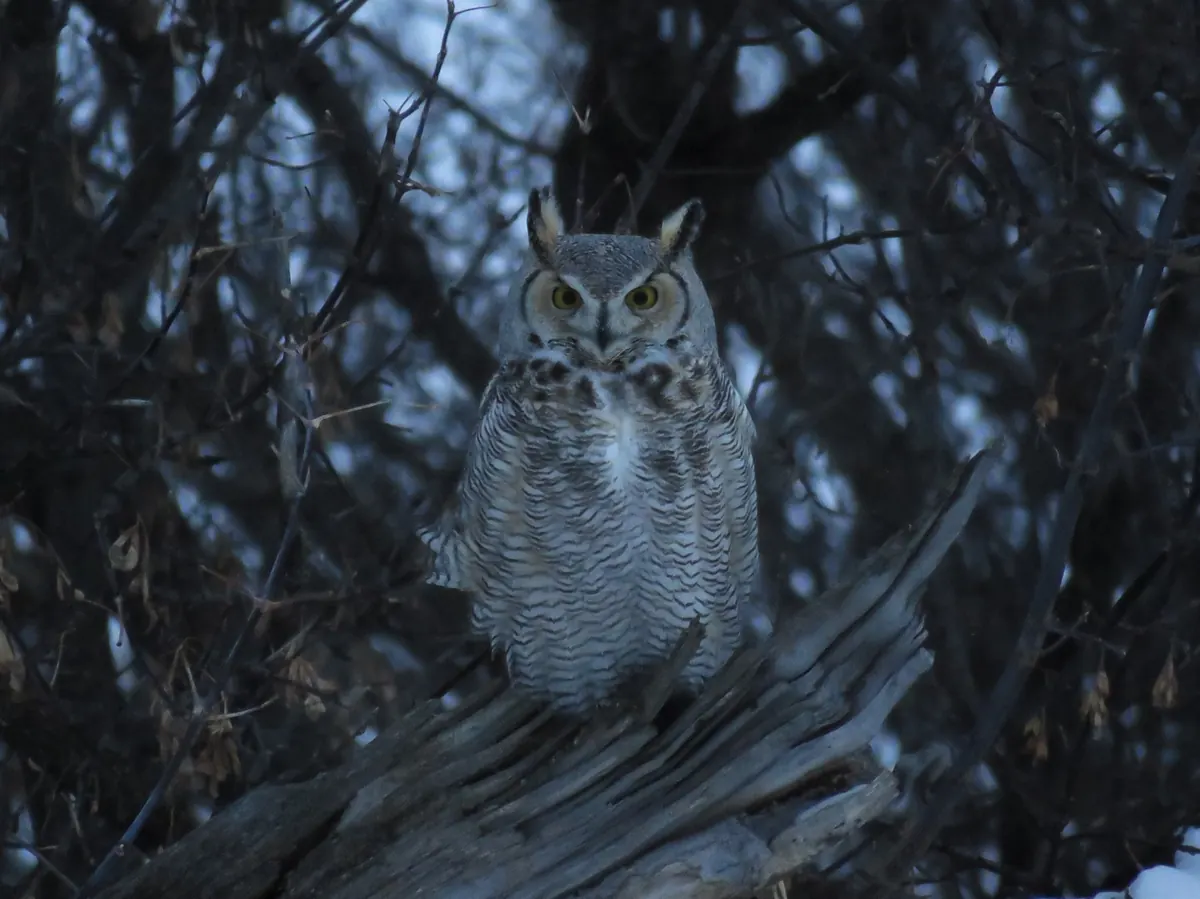
Great horned owls in duet
Hooting through December; pairs settle on nests around January · Woodlots, farm edges and suburban parks statewide
The Northern Virginia Bird Alliance calls November and December the best months to hear the species. Males claim territories in November, and in a courting pair the female answers the male’s hoots in a higher, rougher voice. The physics helps: on a clear, calm night the ground cools fastest, a layer of colder air forms beneath warmer air, and that inversion bends sound back toward the ground, so a low hoot carries much farther than on a summer evening. With the leaves down, little is left to muffle it.
-
Screech and barred owls
All winter · Screech owls in yards and parks; barred owls in swamps and bottomland woods
Last season’s Virginia counts found 218 eastern screech-owls, 131 great horned owls and 110 barred owls, mostly by teams out before dawn. Listen for the screech-owl’s falling whinny or level trill, and the barred owl’s rhythmic hooting in swamps and river bottoms. Please do not play recordings at a nest site.
-
A snowy owl, if you are lucky
Irregular; some winters none · Open dunes, beaches and airports
Snowy owls reach Virginia only in years when many young birds come south from the Arctic. In the record winter of 2013–14, the Center for Conservation Biology spotted six from the air in a single survey of the barrier islands on December 21, perched on bare dunes. Last season’s Virginia counts found one. Watch any you find from a distance.
Where are the ducks, geese and swans in Virginia in December?
At their most varied. November’s new arrivals have settled in for the winter (the November page follows them in), and on the Eastern Shore the Chincoteague refuge counts this month and last as the high point of its waterfowl season. December is also the month the diving ducks fill in on the Bay and the big rivers; last season’s Virginia counts logged 1,397 canvasbacks and 2,242 surf scoters.
-
Hog Island Wildlife Management Area
Winter is the best season · Surry County, on the tidal James
A 3,908-acre peninsula of marsh and impoundments on the brackish James. DWR’s birding trail page singles out winter, with flocks of snow geese, buffleheads, mergansers, ring-necked and ruddy ducks, snow buntings and large numbers of bald eagles. The road passes a power-plant security gate, so bring photo ID plus an access permit, a hunting or fishing license, or a Restore the Wild membership, and expect the area to close on some days for hunts.
-
Chincoteague in early winter
All month · Chincoteague National Wildlife Refuge, Assateague Island
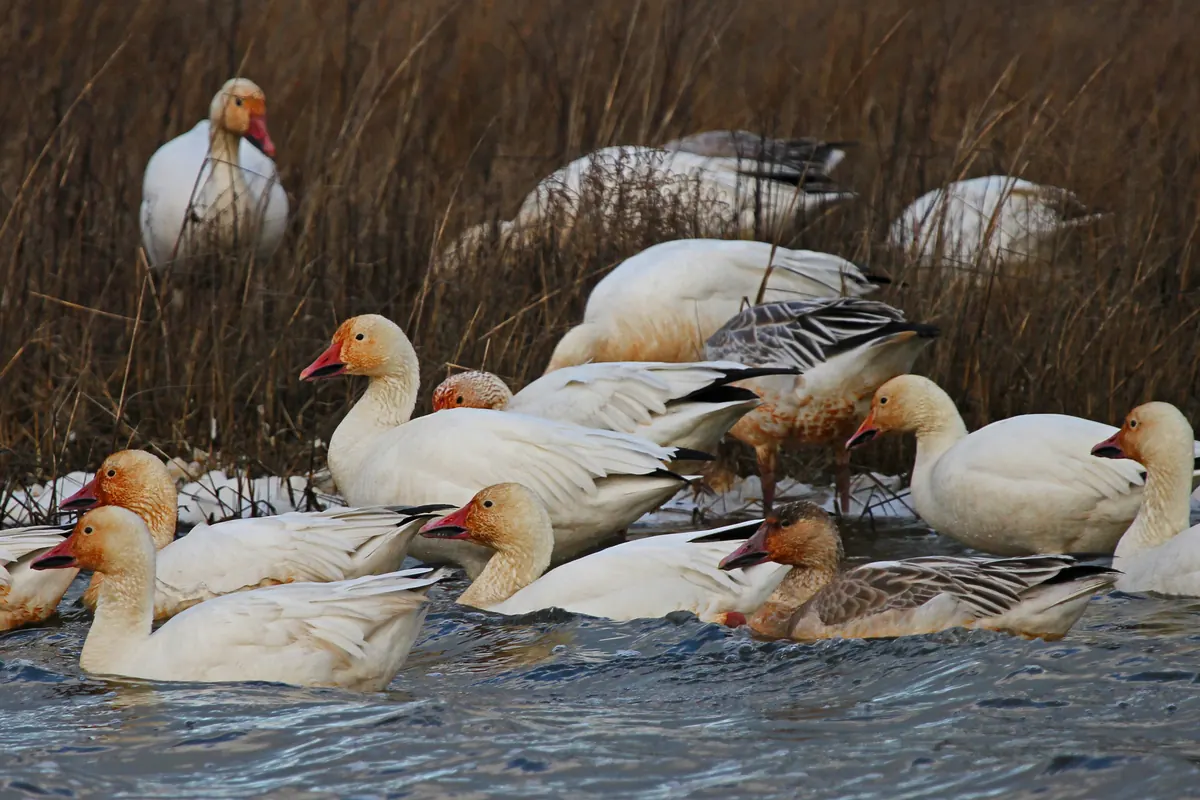
The impoundments along the Wildlife Loop hold thousands of snow geese that winter here or rest on the way south, along with brant and wintering ducks. Chincoteague’s count turned up 148 species last season, the most of any Virginia circle.
-
The third duck season
December 19 – January 31 · Statewide
Ducks reopen on December 19, along with brant (to December 31), mergansers and coots; light geese are open all winter, and swan permit holders may hunt until January 31. Refuge hunt days and blinds are posted; on hunting mornings, choose another trail.
What is winter like in Virginia’s mountains and high country?
Colder, windier and often icier than the cities below. The National Park Service says Shenandoah runs 10 to 20 degrees cooler than the lowlands, with average daytime temperatures in winter between 29 °F and 39 °F, and Grayson Highlands’ visitor center sits at 4,953 feet.
-
The Grayson Highlands ponies
All winter · Grayson Highlands State Park and the Mount Rogers high country
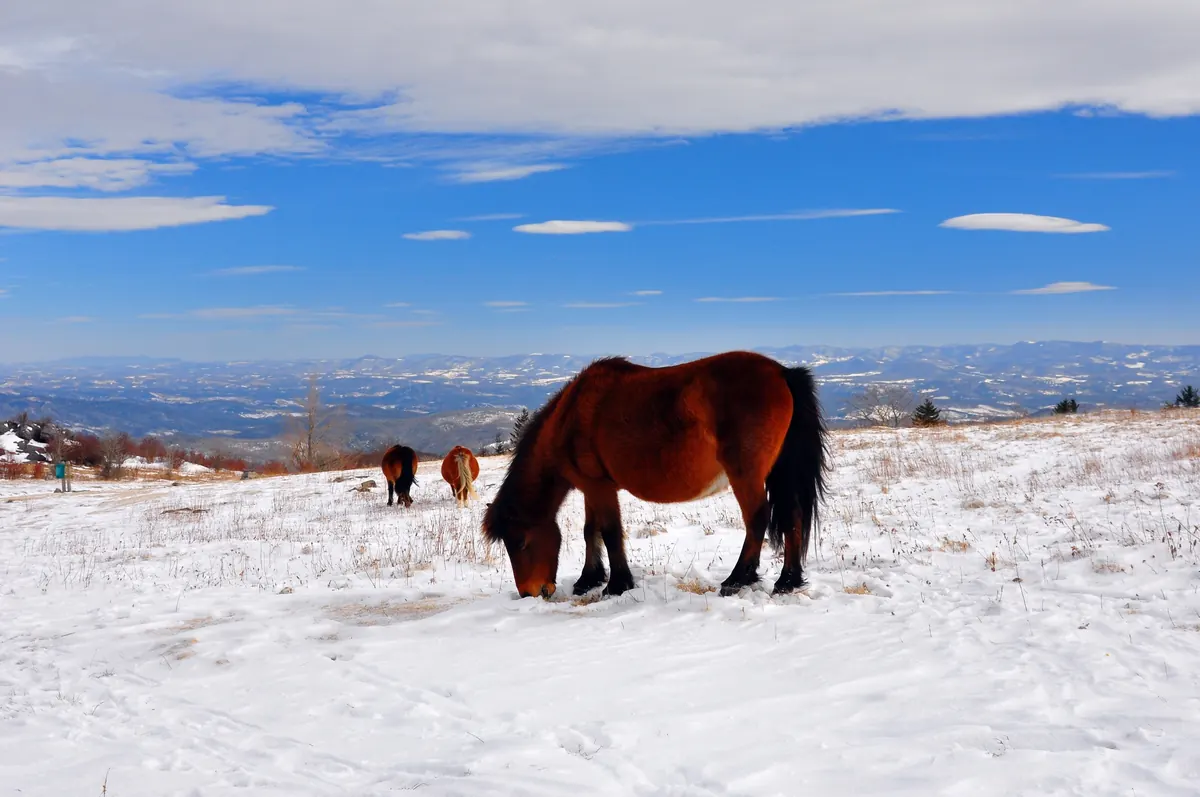
The park says the ponies were brought up in 1974 to graze the balds and keep them from growing back into forest. Small and stocky, of Shetland stock, they grow thick, shaggy coats for winter and forage through the snow after the cattle have been taken down. The Wilburn Ridge Pony Association manages the herds, now about 80 animals in all, according to Appalachian Voices this May, and brings out hay in hard weather, which has raised winter survival. The park’s rule is simple: do not approach, feed or pet them, because they bite and kick when they feel threatened and people food can give them colic. The park’s campgrounds close on the first Monday in December and stay closed until the first Friday in March, so this is a day trip.
-
Shenandoah after the leaves
November through February is the park’s winter season · Skyline Drive and the trails below it
The park stays open, but Skyland, Big Meadows Lodge and the Byrd Visitor Center have closed for the season, and Skyline Drive can shut at any time for ice or snow; after a storm it may take days to reopen. When the road is shut, you can still walk in, and deer and foxes are easier to spot in the open woods.
-
Hemlocks and the adelgid
Most visible from late fall through spring · Shaded ravines and stream banks in the mountains
Flip a hemlock twig over. Small white cottony tufts where the needles join it mark the hemlock woolly adelgid, an Asian insect first reported in eastern Virginia in the early 1950s. Unlike most insects it does most of its growing between October and June, and Virginia Cooperative Extension warns that an untreated tree can die in as little as four years.
How do Virginia’s animals survive the winter?
Three ways: they leave, they tough it out awake, or they shut down. December is the month the third group goes quiet, and the ways they do it are stranger than the word hibernation suggests.
-
Bears asleep, not hibernating
Denned through the winter; cubs born in January and February · Mountains and the Great Dismal Swamp
A denned black bear slows its whole body down and goes without food or water for the season, yet it can wake and wander on a warm day. Cubs are born in the den in the depths of winter. A bear still raiding a yard in December is usually after trash or birdseed.
-
Chipmunks and their pantries
Underground from late fall · Woods and yards with stone walls or brush
Virginia State Parks describes a chipmunk dropping its body temperature to that of its burrow, near 40 °F, and its heart rate from about 350 beats a minute to as few as four. It stores up to eight pounds of nuts and seeds, wakes every so often to warm up and eat, then goes back under.
-
Wood frogs that freeze
All winter, under the leaf litter · Moist woods statewide
DWR describes the wood frog as able to spend the winter almost entirely frozen, with no heartbeat and no brain activity. As ice begins to form, its liver floods the blood with glucose, which works as an antifreeze inside the cells and limits ice crystals. When it thaws, it simply carries on. Bullfrogs lie on or just under the pond mud all winter, and turtles absorb oxygen from the water through skin rich in blood vessels.
-
Bats in the caves
Hibernating from late fall to spring · Caves and mines of the Valley and Ridge and the southwest
Eight bat species hibernate in Virginia. White-nose syndrome, a fungal disease first confirmed in the state in 2009, grows best in the cool, damp air of hibernation caves; DWR documented a fall of more than 95 percent in little brown bats at studied sites in four years, and almost 90 percent in tricolored bats. Each time a hibernating bat is roused it burns fat it cannot replace, so leave caves alone until spring.
-
Tracks in snow and mud
After any snow; on any muddy morning · Creek banks, field edges, trails
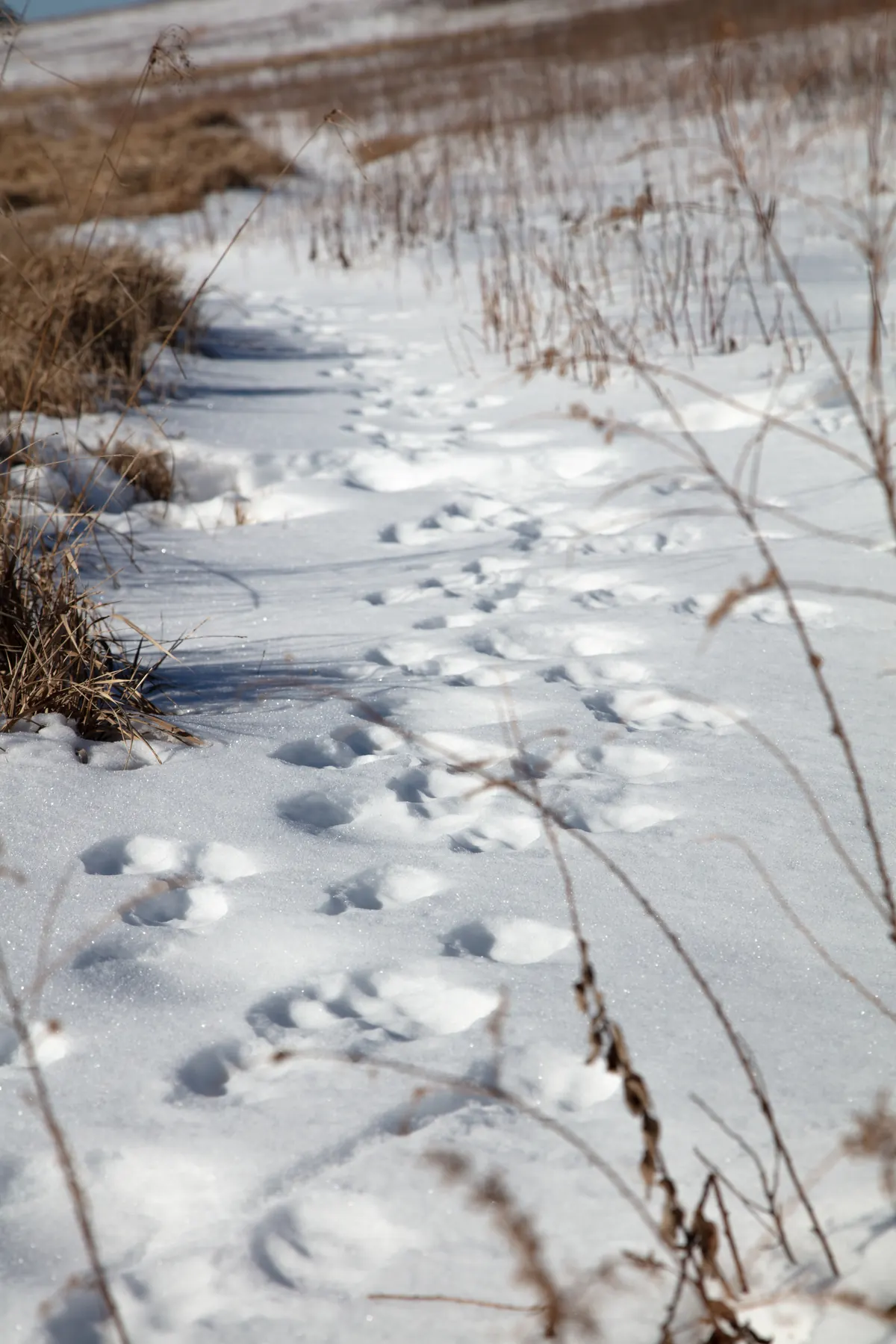
A fresh snow is a free census. Deer leave paired teardrops, foxes a neat single line, rabbits the paired long hind feet ahead of the front ones, and raccoons small handprints by the water. Sketch a short run of prints and measure the stride.
Which plants stay green in Virginia in December?
With the hardwoods bare, the evergreens stand out, which makes this a good month to learn them; Sky Meadows runs a winter tree walk on December 5 (see the families list).
-
American holly
Red fruit from fall into late winter · Understory of coastal and Piedmont woods; commonest on the sandy Coastal Plain
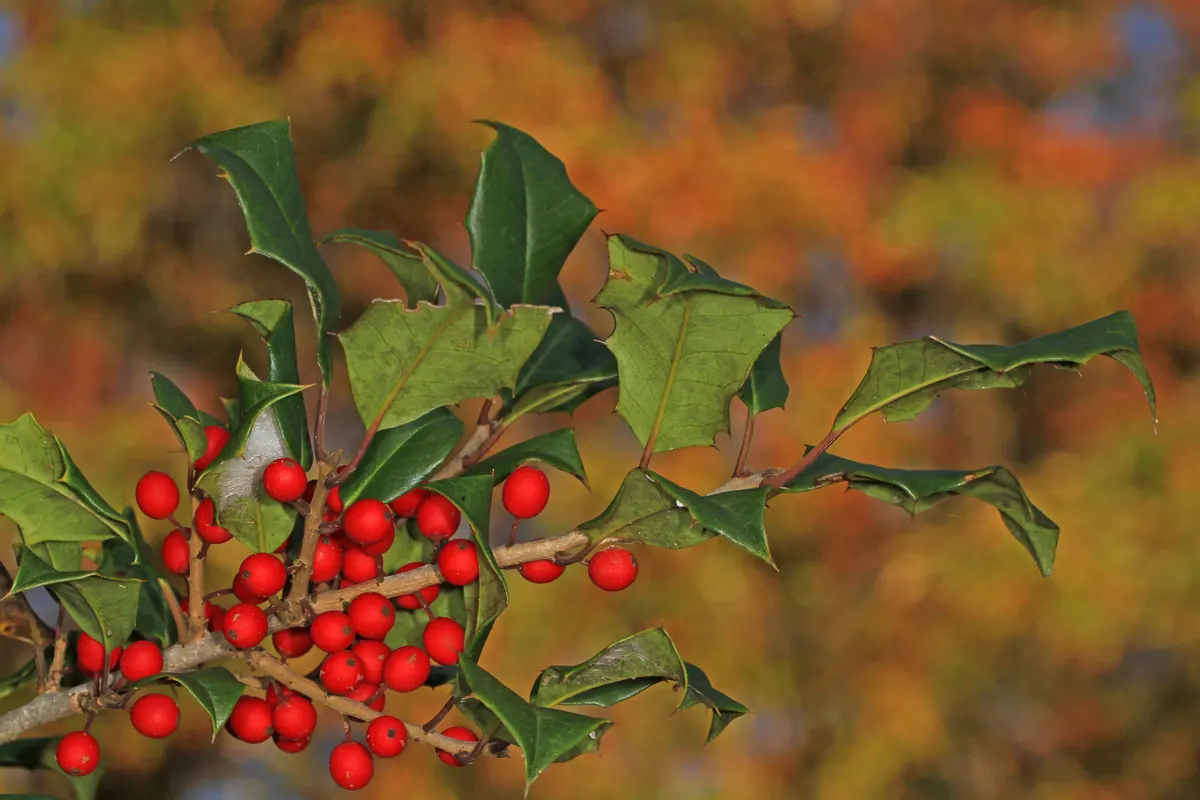
Spiny evergreen leaves and scarlet fruit make it the one native holly everyone knows. Only female trees bear fruit, and the Northern Neck chapter of the Virginia Native Plant Society notes the berries often hang on until late winter unless robins or cedar waxwings strip them first; turkeys, quail and small mammals eat them too. Wild trees can top 50 feet.
-
Mistletoe in the treetops
Easiest to see from leaf fall to spring; white berries in winter · Oaks, red maples and gums, most of all in the swamp forests of the Coastal Plain
American mistletoe is a partial parasite: it makes its own sugars from sunlight but draws water and minerals from the host branch. Look for rounded green clumps high in bare trees. Its berries are poisonous to people but eaten by bluebirds and waxwings, which leave the sticky seeds on new branches.
-
Eastern redcedar
Frosted blue berry-cones on female trees all winter · Old fields, fence lines and limestone soils statewide
The first tree to claim an abandoned field, planted by birds. Look for prickly juvenile needles and flat, scale-like adult foliage on the same tree. The dense crowns shelter birds and deer from wind, and waxwings, turkeys, quail, foxes and raccoons eat the fruit.
-
Christmas fern
Green through the winter · Wooded slopes and stream banks in every county
The little ear at the base of every leaflet is said to look like a Christmas stocking. Deer find the fronds distasteful, so it stays green on a bare forest floor.
When is the earliest sunset in Virginia, and how short is the shortest day?
The earliest sunset comes two weeks before the solstice. In Richmond the sun sets at 4:51 p.m. on December 6, its earliest of the year, and by December 21 it is already setting at 4:55. The mornings run the other way: sunrise there keeps getting later through the solstice (7:21 a.m.) and on into January, reaching about 7:25 in the first week of the new year. The shortest day itself is December 21, at 9 h 34 m in Richmond and 9 h 24 m in Winchester. Longitude matters as much as latitude for the clock: Bristol, far west in its time zone, has its earliest sunset at 5:13 p.m., while Chincoteague, on the Atlantic, sees the sun go down at 4:42 p.m. on December 6.
| City | Dec 1 | Dec 21 | Dec 31 | Earliest sunset |
|---|---|---|---|---|
| Winchester | 9 h 37 m | 9 h 24 m | 9 h 28 m | 4:50 p.m., Dec 7 |
| Arlington | 9 h 39 m | 9 h 27 m | 9 h 29 m | 4:46 p.m., Dec 7 |
| Charlottesville | 9 h 44 m | 9 h 32 m | 9 h 34 m | 4:54 p.m., Dec 7 |
| Richmond | 9 h 46 m | 9 h 34 m | 9 h 37 m | 4:51 p.m., Dec 6 |
| Roanoke | 9 h 47 m | 9 h 36 m | 9 h 38 m | 5:02 p.m., Dec 6 |
| Norfolk | 9 h 50 m | 9 h 38 m | 9 h 41 m | 4:48 p.m., Dec 6 |
| Chincoteague | 9 h 43 m | 9 h 32 m | 9 h 35 m | 4:42 p.m., Dec 6 |
| Bristol | 9 h 51 m | 9 h 40 m | 9 h 42 m | 5:13 p.m., Dec 6 |
Earth’s tilted axis and oval orbit push solar noon a little later by the clock each December day, so evenings recover before mornings do. For your own street, the daylight calculator lists the times day by day.
How much does it snow in Virginia in December, and what will El Niño bring?
Not much, on average. In NOAA’s 1991–2020 normals December snowfall is about an inch at Norfolk, under 2 inches at Richmond and Reagan National, and just over 3 inches at Roanoke; the high plateau around Bluefield, on the West Virginia line above Tazewell County, averages 6.6 inches. Most of December’s precipitation, 3 to nearly 4 inches, falls as rain, and the month’s average low sits within a few degrees of freezing at most stations.
| Station | High (°F) | Low (°F) | Precipitation (in.) | Snowfall (in.) |
|---|---|---|---|---|
| Norfolk | 54.7 | 37.6 | 3.28 | 1.1 |
| Wallops Island (Eastern Shore) | 50.5 | 33.5 | 3.75 | 1.7 |
| Richmond | 51.5 | 32.1 | 3.51 | 1.8 |
| Washington (Reagan National), for Northern Virginia | 48.8 | 34.5 | 3.41 | 1.7 |
| Dulles Airport | 46.5 | 29.0 | 3.30 | 2.8 |
| Lynchburg | 49.0 | 28.9 | 3.50 | 2.0 |
| Roanoke | 50.0 | 31.8 | 3.08 | 3.2 |
| Bristol (Tri-Cities Airport, just over the Tennessee line) | 49.5 | 29.2 | 3.76 | 1.7 |
| Bluefield (Mercer County Airport, W.Va., for the Tazewell plateau) | 43.2 | 27.9 | 3.01 | 6.6 |
Averages hide the big storms. On December 9, 2018, Roanoke recorded 15.0 inches, its snowiest December calendar day on record, according to NOAA. Richmond had 11.5 inches, its second-largest December snowstorm after the 17.2 inches of December 22–23, 1908, per the Wakefield office of the National Weather Service.
This winter the wild card is El Niño, now forecast by federal scientists (in a Climate Prediction Center discussion dated September 10) to be very strong, with odds above 90 percent. A strong El Niño pumps up the subtropical jet stream, and in Virginia that has usually meant a stormier, wetter cool season, with storms that run up the Atlantic coast. Snow is the uncertain part. The weather columnist Kevin Myatt, writing in Cardinal News this August, described El Niño snow as boom or bust: mostly mild and rainy, with the occasional blockbuster. By his tally, El Niño was under way for four of the last five storms that left a foot or more across much of the region, the December storms of 2009 and 2018 among them. The very strong event of 1997–98 shows the wet side: NOAA’s climate report for that winter lists record monthly precipitation in January 1998 at Roanoke (7.97 inches) and Blacksburg (7.39 inches), and Virginia had its second-wettest February since records began in 1895.
NOAA’s own winter outlook arrives October 15, after our deadline; the three-month maps on the Climate Prediction Center site will show which way Virginia is tilted. For conditions right now, the current weather page is a click away, and the Virginia frost dates page has last-spring-frost dates if you are already planning the garden.
What is in Virginia’s night sky in December 2026?
-
The Geminids
Night of Sunday, December 13 into Monday, December 14 · Anywhere dark; the radiant in Gemini is high in the south after midnight
The International Meteor Organization puts the 2026 maximum on December 14 at 14h UT, which is 9 a.m. EST, so Sunday night into Monday morning is the time to watch. Under a truly dark sky the shower can produce well over a hundred meteors an hour at its best; in a town you will see far fewer. The young crescent Moon sets by about 9 or 10 p.m. and stays out of the way, and rates rise until about 2 a.m., when the radiant is highest. Lie back on a pad, wrapped up, and look about halfway up the sky.
-
The solstice
Monday, December 21, 3:50 p.m. EST · Everywhere
The Sun reaches its farthest south and starts back. At noon on the solstice it stands only about 29 degrees above the southern horizon in Richmond, so shadows are at their longest; mark the tip of a fence post’s shadow at midday and compare it with June.
-
The Cold Moon
Evening of Wednesday, December 23 · Rising in the northeast around sunset
Full at 8:28 p.m., only about seven hours from perigee, the December full moon is the nearest and biggest-looking of 2026, a supermoon by the usual measures. Because the December full moon rides high, it lights snowy fields almost like dusk.
-
Venus at its most brilliant before dawn
All month, before sunrise · Southeast
Venus blazes in the southeast before sunrise at about magnitude −4.8, rising a little higher every week until its greatest elongation on January 3. The old crescent Moon joins Venus before sunrise on the 4th and 5th, with Spica set between them. Mars and Jupiter are morning planets too, though Jupiter clears the horizon by mid-evening late in the month; in the early evening, look south for Saturn, alone.
-
Star parties and dark-sky nights
December 5, 10 and 12 · Sky Meadows, Natural Bridge and James River state parks
Sky Meadows, an International Dark Sky Park, holds its monthly Astronomy for Everyone on Saturday, December 5, 5 to 8 p.m. Natural Bridge holds a Dark Sky Night Geminid watch on Thursday, December 10 (7 to 9 p.m.); James River State Park hosts a Geminid watch party with volunteer astronomers on Saturday, December 12, 6 to 8 p.m. at the viewing area by Shelter 4; if it is cloudy there is a talk instead.
| Phase | Date | Time |
|---|---|---|
| Last quarter | Tuesday, Dec 1 | 1:08 a.m. |
| New moon | Tuesday, Dec 8 | 7:52 p.m. |
| First quarter | Thursday, Dec 17 | 12:42 a.m. |
| Full moon, the Cold Moon | Wednesday, Dec 23 | 8:28 p.m. (also nearly round on Christmas Eve) |
| Last quarter | Wednesday, Dec 30 | 1:59 p.m. |
| New moon | Thursday, Jan 7, 2027 | 3:24 p.m. |
No eclipse is visible from the United States this month. For moonrise and moonset where you live, use the moon phase calendar, and check the sky and cloud forecast before setting an alarm.
What can Virginia families do outdoors in December?
- Learn trees in winter. Sky Meadows’ Winter Tree-mendous Hike is Saturday, December 5, 10 to 11 a.m., a three-tenths-of-a-mile walk on the Sensory Explorers’ Trail, which is adapted for visitors who are blind or have low vision. The same park leads a Twilight Hike from the Lost Mountain trailhead on Friday, December 18, 4 to 6 p.m., right through sunset.
- Walk with a birder. Widewater State Park’s winter birding walks are Tuesday, December 8 and Saturday, December 19, 9 to 10:30 a.m., and its Junior Duck Stamp program for students is the afternoon of the 19th.
- Be a counter. Sign up with a Christmas Bird Count team (Hampton Roads on the 19th, Central Loudoun on the 28th), and keep the Project FeederWatch tallies going at home.
- See the lights. Natural Bridge’s Luminary Nights light the Cedar Creek Trail on December 11–13 and 18–20, 5 to 9 p.m. ($9, or $6 for ages 12 and under), with carriage rides on the 11th, 20th and 26th by reservation. Wilderness Road State Park’s Karlan Christmas: Parade of Trees runs Fridays through Sundays on December 4–6, 11–13 and 18–20, and the Southwest Virginia Museum’s Festival of Trees in Big Stone Gap is open through December 31, with an evening viewing on December 19. Fairy Stone holds its own Festival of Trees on December 12–13.
- Watch the Geminids together. Go to a ranger watch on the 10th or 12th, then try your own on the night of the 13th.
- Mark the shortest day. Powhatan State Park’s “Embracing Darkness” walk is Sunday, December 6, 10 to 11:30 a.m., the week of the earliest sunsets; on the 21st, measure a noon shadow.
- Start 2027 outside. Parking is free at Virginia’s state parks on New Year’s Day, with ranger-led and self-guided First Day Hikes; the parks had not yet listed 2027’s hikes in early October, so look again in December.
Program times can change; confirm with the park before you drive. More seasonal pages are collected on the nature guides home page.
Safety notes for December in Virginia
- Hunting seasons run all month. General firearms deer season continues to January 2 east of the Blue Ridge and in a few western counties, including Clarke, Frederick, Carroll, Floyd and Montgomery; in most counties west of the Blue Ridge, and in Henry and Patrick, it closes December 12. In the three cities east of the Dismal Swamp it closed November 30, and archery runs there December 1 to January 2. Late muzzleloader season opens December 12 in most of the west, in Henry and Patrick, and in a few eastern areas, and late archery on December 13 west of the Blue Ridge and in Henry and Patrick counties (from November 29 in the far western counties), both running to January 2. Bear firearms seasons run to January 2, opening November 23 or November 30 depending on the county, and reopening December 21 in two dozen northern and Blue Ridge counties, from Loudoun and Frederick to Bath and Bedford, after a three-day season at Thanksgiving; there is no bear gun season on the Eastern Shore. Fall turkey runs to December 12 in much of the state and to December 26 in others. Ducks reopen December 19. Sunday hunting is legal, though not within 200 yards of a church or other house of worship, and not for deer or bear with dogs.
- Blaze orange. While firearms deer season is open, Virginia hunters and their companions must wear solid blaze orange or blaze pink on the head or upper body where it shows from every side, or display a 100-square-inch patch of it at the shoulders. Walkers are not covered, but in the George Washington and Jefferson National Forests or on a wildlife management area, borrow the habit, and give the dog an orange collar.
- Ice is rarely safe here. Prince William County’s fire and rescue department warns that the region seldom grows ice thick enough for recreation, because freeze-thaw cycles weaken it and ponds with moving or changing water are worst. If someone goes through, call 911, stay off the ice yourself, and reach or throw something that floats; hypothermia can set in within ten minutes.
- Short days and cold. Sunset comes before 5:30 p.m. everywhere in the state all month. Carry a headlamp, a warm layer and a charged phone, and tell someone your route. In the mountains add microspikes, and expect it to be 10 to 20 degrees colder on the ridges than in town.
- Road and trail closures. Skyline Drive closes for snow and ice without notice; text SHENALERTS to 888777 for alerts. Grayson Highlands’ campgrounds are closed from December 7 until March.
- Ponies and bears. Never feed the Grayson Highlands ponies. Keep bird feeders and trash secure on warm spells, when bears can stir.
Sources
- Audubon: join the Christmas Bird Count (127th season dates)
- Virginia Society of Ornithology: Christmas Bird Count in Virginia
- Virginia Society of Ornithology: 2025–26 Virginia Christmas Bird Count summary table (PDF)
- Hampton Roads Bird Club: bird counts (Christmas Bird Count, December 19, 2026)
- Loudoun Wildlife Conservancy: Central Loudoun Christmas Bird Count, December 28, 2026
- Piedmont Virginia Bird Club: Charlottesville Christmas Bird Count
- Virginia DWR: Virginia bald eagle guidelines for landowners (PDF)
- Virginia DWR blog: holiday birding can include breeding birds
- Northern Virginia Bird Alliance: autumn acoustics and great horned owls
- Center for Conservation Biology: snowy owls on Virginia beaches, December 2013
- U.S. Fish and Wildlife Service: Chincoteague National Wildlife Refuge, wildlife and seasons
- U.S. Fish and Wildlife Service: Chincoteague National Wildlife Refuge, visiting
- Virginia DWR Bird and Wildlife Trail: Hog Island Wildlife Management Area
- Virginia DWR: 2026–27 migratory game bird seasons
- Virginia State Parks: Grayson Highlands State Park (ponies, elevations, camping season)
- Appalachian Voices: the feral ponies of Grayson Highlands (May 2026)
- Appalachian Voices: ponies of the Grayson Highlands (history of the herd)
- National Park Service: Shenandoah in winter
- National Park Service: Shenandoah operating hours and seasons
- Virginia Cooperative Extension: hemlock woolly adelgid
- Virginia DWR: black bear
- Virginia State Parks blog: wildlife surviving winter
- Virginia DWR blog: where do frogs go in the winter?
- Virginia DWR: white-nose syndrome in Virginia
- Northern Neck Chapter, Virginia Native Plant Society: American holly
- Virginia Working Landscapes: American mistletoe
- Virginia Tech Dendrology: eastern redcedar
- Northern Neck Chapter, Virginia Native Plant Society: Christmas fern
- NOAA NCEI: 1991–2020 monthly normals for Virginia stations (data API)
- NOAA NESDIS: record December snowfall in the Mid-Atlantic, December 2018
- NWS Wakefield: December 9, 2018 winter storm summary
- Climate Prediction Center: ENSO diagnostic discussion, September 10, 2026
- Climate Prediction Center: 90-day outlooks (winter outlook due October 15, 2026)
- Cardinal News (Kevin Myatt): El Niño and the coming winter, August 5, 2026
- NOAA NCEI: the El Niño winter of 1997–98 (technical report, PDF)
- U.S. Naval Observatory: moon phases, November 2026 to January 2027 (data API)
- U.S. Naval Observatory: Earth’s seasons, 2026 (December solstice)
- International Meteor Organization: 2026 meteor shower calendar (PDF)
- EarthSky: supermoons of 2026
- EarthSky: Venus at greatest western elongation
- Virginia State Parks: events calendar, December 2026
- Virginia State Parks: Winter Tree-mendous Hike at Sky Meadows, December 5, 2026
- Virginia State Parks: Luminary Nights at Natural Bridge, December 2026
- Virginia State Parks: Geminids watch party at James River, December 12, 2026
- Virginia State Parks: First Day Hikes, January 1
- Project FeederWatch: how to participate
- Virginia DWR: 2026–27 deer seasons
- Virginia DWR: 2026–27 bear seasons
- Virginia DWR: turkey seasons
- Virginia DWR: general hunting regulations (blaze color, Sunday hunting)
- Prince William County Fire and Rescue: stay off the ice, area waters unsafe
- Photos via Wikimedia Commons; licenses and photographers are credited under each picture
