What to look for in nature in West Virginia this April
April is when spring climbs the mountains. In the river valleys the redbuds are pink and the last freeze of the year is already close, while on the plateaus around Canaan Valley the average high is still only 56 °F and frost can come into May. In between, the forest floor flowers in a rush that runs from toothwort in early April to trillium and violets by the end of the month. Ramps are up, and a town in Nicholas County cooks them for a crowd. Cerulean warblers, a bird that depends on these ridges, come back from the Andes, turkeys gobble at dawn, and eaglets in the Shepherdstown nest grow from fuzz to feathers. The Pink Moon rises on the 20th, and moonlight drowns most of the Lyrids on the 22nd. The sections below take these in turn, marking which dates are fixed and which to confirm.
Other months in West Virginia: October, November, December, January, February, March.
Start here

- Walk a woodland trail in the first half of April. Pick a hillside or hollow with old trees and look at your feet. Toothwort and trout lily come first, then trillium and violets. Note the date of each first bloom.
- Find a redbud on a hillside. Pink blossoms on bare branches, with white serviceberry nearby, mark the month's first color. Look at the flowers up close and watch for bees.
- Step outside for the Pink Moon on April 20. Go out around 8 p.m. and watch the full moon climb out of the east. Look for Jupiter high in the south, and for Mars nearby.
Keep April in the Naturalist's Field Journal: each first wildflower and its date on a tree through the seasons, with a return trip for the same place twice; the first warbler song on birds I have seen and a map of sounds; turkey gobbles and toad trills on dusk and dawn watch; eaglets and other nests on nest observed; the moon and the weather on the daily field log.
Regions used below: Potomac Highlands and the Allegheny Mountains; Eastern Panhandle; Northern Panhandle and Morgantown; Mid-Ohio Valley; Kanawha Valley and Charleston; Huntington and the Metro Valley; New River Gorge and the southern coalfields.
When are ramps up in West Virginia, and how much can you pick?
Ramps, the wild leeks of the Appalachians, are the mountain state's favorite edible sign of spring, and April is when they are both celebrated at the table and, in some places, protected from too much affection. Whether you may pick them depends on who owns the land.
-
The Feast of the Ramson at Richwood
Annual, in April; the 2026 feast was Saturday, April 18, and no 2027 date had been posted when this page was written · Richwood, Nicholas County
West Virginia Tourism listed the 2026 gathering as the 87th annual Feast of the Ramson, with a plate of ramps, potatoes, beans and cornbread and an arts and crafts show starting at 10 a.m., at Richwood High School. An earlier listing, for April 18, 2020, called it the "granddaddy of all Appalachian ramp feeds" and described a meal that also included ham, bacon and sassafras tea, plus craft sales in the town's fire station, city hall and library. The Richwood Area Chamber of Commerce organizes it. Venues, hours and prices have changed over the years, so ask the chamber for the 2027 details.
-
Where you may dig, and where you may not
Spring, while the leaves are up · National park units and the Monongahela National Forest
Three national park units in the southern part of the state, New River Gorge National Park and Preserve, Gauley River National Recreation Area and Bluestone National Scenic River, have not allowed ramp harvesting since January 1, 2022. Park biologists could not find several historic populations and judged the rest too small to harvest. The Monongahela National Forest takes a different approach. Its guidelines, published in March 2024, allow personal use of up to two gallons per person, about a grocery bag or roughly 180 whole plants, and rule out selling ramps, collecting for someone else or gathering for a fundraiser. The Forest Service also asks pickers to skip patches of fewer than 100 plants, take no more than one-fifth of a large clump, use a hand trowel and cover bare soil with leaves. Elsewhere the rules differ, so ask the manager or owner.
-
Picking so the patch comes back
Any time you gather · Forest, yard and field patches
West Virginia Living quotes forager Deaonna Crowe on gentle picking: cut only the leaves with a knife and leave the bulbs, or cut a bulb at its base so the roots stay, or trim a quarter off the bottom and replant the rest. She also passes on a traditional rule of four. Leave the first plant for wildlife, the second for other foragers and the third to reseed the patch, and take only the fourth.
Last month's guide to the thaw, peepers and the eagle hatch is the West Virginia March guide.
Which spring wildflowers and butterflies show up in West Virginia in April?
Spring ephemerals race the leaves. They come up, bloom and set seed in a few weeks on sun that reaches the ground through bare branches, then go dormant. Bloom comes first in the river valleys and the Eastern Panhandle and later on each Allegheny slope, so a drive uphill can buy a week or two of extra flowers.
-
A trail with a calendar: the Mylius Trail
Early April through early May; snow is possible on the ridge as late as the end of April · Mylius Trail (No. 128), Cheat-Potomac Ranger District, Monongahela National Forest, east of Elkins off U.S. 33
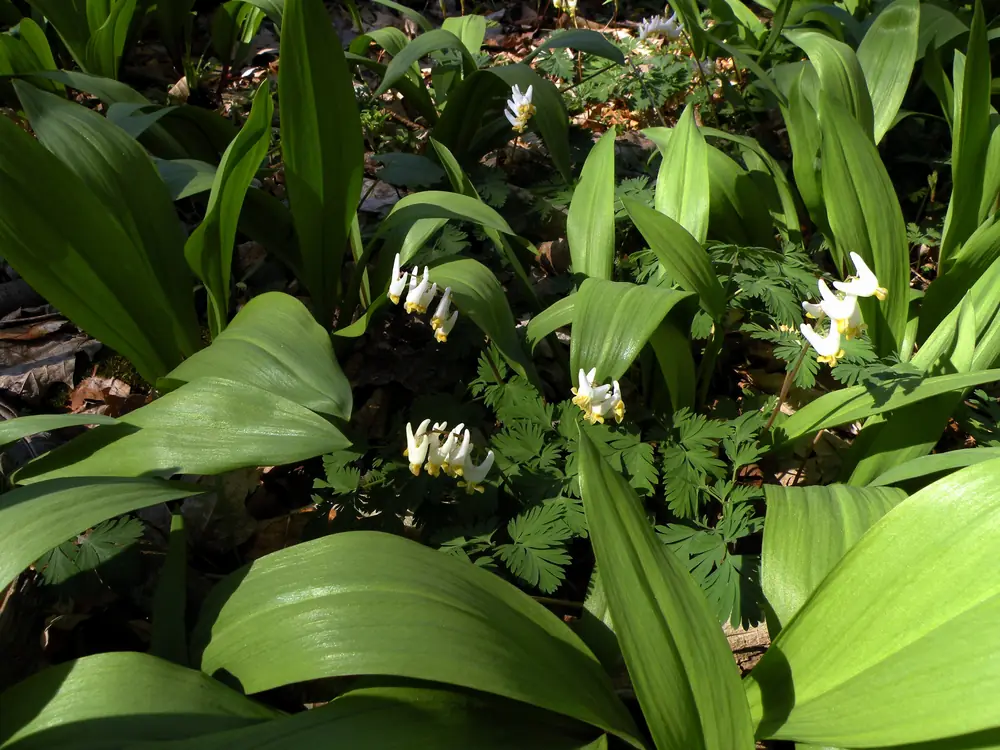
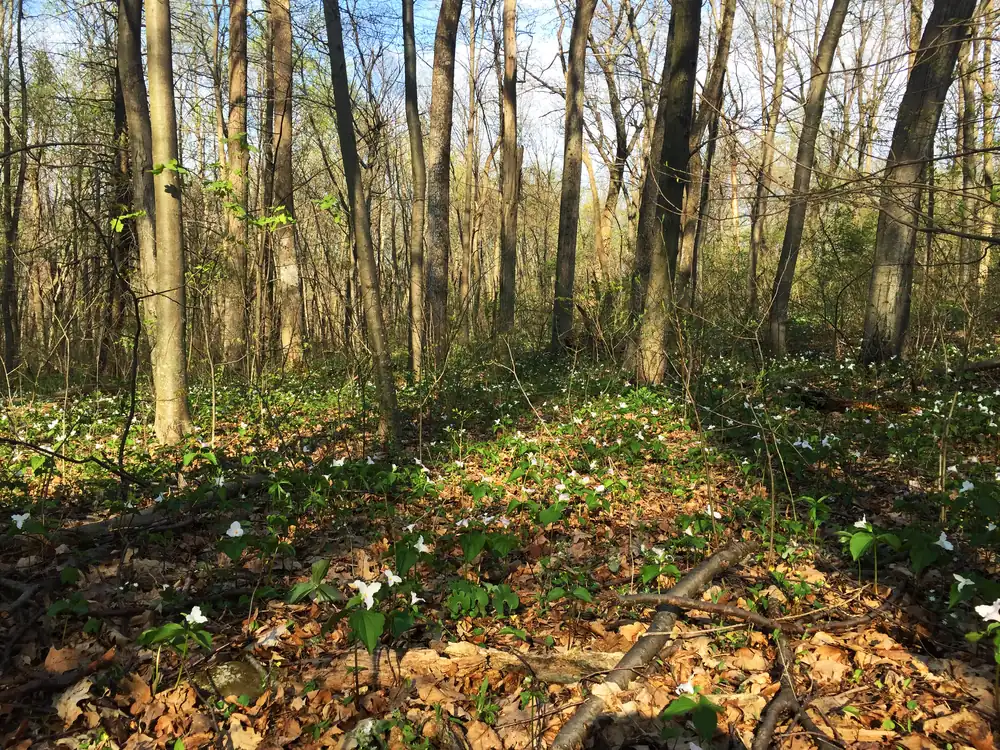
The Forest Service publishes a bloom schedule for this trail. Cutleaf toothwort and crinkleroot open in early April, and the yellow dogtooth violet (trout lily) follows in early to mid-April. From mid-April come blue cohosh, Carolina springbeauty, spotted geranium, red trillium, nightcaps, dwarf ginseng and several violets, and Canada mayflower, among the latest, opens in early to mid-May. The agency calls early April into early May the viewing window and warns of steep ground and late snow. The path climbs about 1.8 miles to the top of Shaver's Mountain, 850 feet up, or runs about 2.6 miles to Otter Creek. Carry a map.
-
The West Virginia white butterfly
On the wing in April and May in the southern Appalachians · Moist hardwood woods where toothworts grow; recent records include Kanawha, Fayette and Pocahontas counties
This small, translucent whitish butterfly shares the state's name. Look for blurry brown or gray scaling along the veins on the underside of the hindwing; the wings span about 1.75 to 2.1 inches. Its caterpillars eat toothworts, the early mustard-family flowers of April, so its calendar is tied to theirs. Butterflies and Moths of North America says southern Appalachian populations fly from April into May and northern ones only in May, and it lists invasive garlic mustard, which crowds out toothwort, as a threat along with logging and development.
-
Trillium and jack-in-the-pulpit
Mid-April into May, later at higher elevations · Rich forest floors across the mountains
The West Virginia Highlands Conservancy singles out two woodland favorites. Large-flowered trillium opens pure white and ages to soft pink, and the group says the Appalachians have the greatest variety of trilliums, with six species in the Greenbrier Valley. Jack-in-the-pulpit wears a hooded spathe, and oxalic acid crystals in the plant numb the mouth if eaten, so look and leave it.
-
Guided wildflower walks
Usually April; confirm 2027 dates with the organizers · Kanawha State Forest near Charleston, and Chief Logan State Park near Logan
The Osbra Eye Memorial Spring Walks at Kanawha State Forest are an April tradition. The 2024 edition was a Saturday, April 20, with registration at the Nature Center at 8:30 a.m. and guided walks on wildflowers, edible plants, trees, birds and local history until noon, plus an easier walk for limited mobility. Adults paid $7, ages 12 to 18 paid $2 and younger children were free; Master Naturalists, the Brooks Bird Club's Handlan Chapter and the West Virginia Native Plant Society helped lead. The state tourism office says the forest has up to 40 kinds of April wildflowers, and that the Sue Browning Wildflower Hike at Chief Logan State Park, on trails of 2.5 to 7 or 8 miles, can turn up 75 to 100 species, including Dutchman's breeches and violet larkspur. No 2027 dates were posted, so ask the parks.
-
Looking ahead: the Wildflower Pilgrimage
May 6 to 9, 2027 (the 65th annual) · Blackwater Falls State Park, Tucker County
The DNR lists the 2027 pilgrimage for Thursday through Sunday, May 6 to 9, at Blackwater Falls, a West Virginia Garden Club project co-sponsored by the DNR. It offers guided tours, birding, wildflower and fern identification, photography workshops and talks, with Thursday aimed at beginners. Registration is required; lodging bookings go through 304-558-2754. It is the way to meet the high-elevation bloom that is still weeks away in April.
When do redbud and serviceberry bloom, and when is Arbor Day in West Virginia?
Early April hillsides are not green, but they are no longer gray. Trees that flower before they leaf, pink redbud and white serviceberry, give the slopes their first color, while the orchards of the Eastern Panhandle bloom with a more anxious eye on the thermometer.
-
Redbud and serviceberry
April, earlier in the lowlands · Hillsides, roadsides and fencerows, most noticeable in the valleys
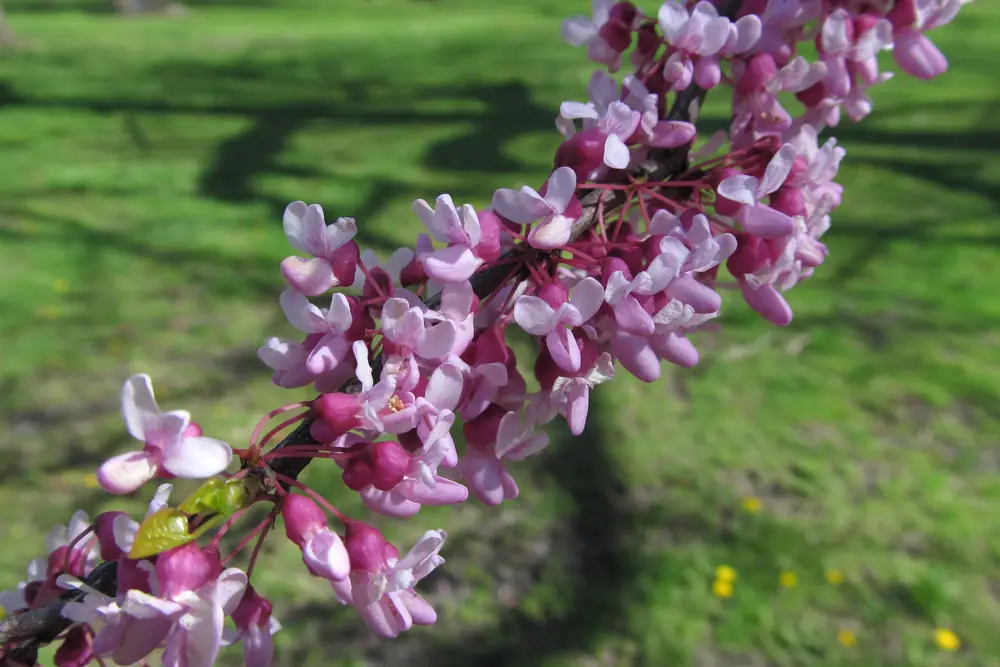
West Virginia Explorer counts redbud among the first native plants to bloom in the Appalachians in April, along with white-flowered serviceberry. It quotes Anthony Tomkowski, professor emeritus of forest resources at West Virginia University, on how early settlers read redbud and black walnut as signs of good cropland. The blossoms are edible, with a history in tea, jelly and pie filling, and their sugars draw bees.
-
Arbor Day, the second Friday in April
Friday, April 9, 2027 · Statewide, with plantings in towns and schools
The Division of Forestry says West Virginia keeps Arbor Day on the second Friday in April, which is April 9 in 2027. Communities plant trees, and fourth and fifth graders can enter the division's yearly poster contest. Ask your town about a community planting.
-
Bloom, frost and the orchards
April, when a freeze at the wrong moment can cost a crop · Berkeley, Jefferson, Morgan and Hampshire counties in the Eastern Panhandle
Those four counties grow well over 90 percent of the state's apples and peaches, a 2016 trade report said, and in that year an orchard operator near Martinsburg expected April freezes to cost his farm 20 to 30 percent of its apples and about 30 percent of its peaches. Virginia Tech's fruit specialists give these thresholds: apple blossoms at early or full bloom lose about 10 percent below 28 °F for more than 30 minutes and about 90 percent below 25 °F, while peaches and sweet cherries should not be hurt much above 28 °F. The last-freeze table below shows how late a freeze can come.
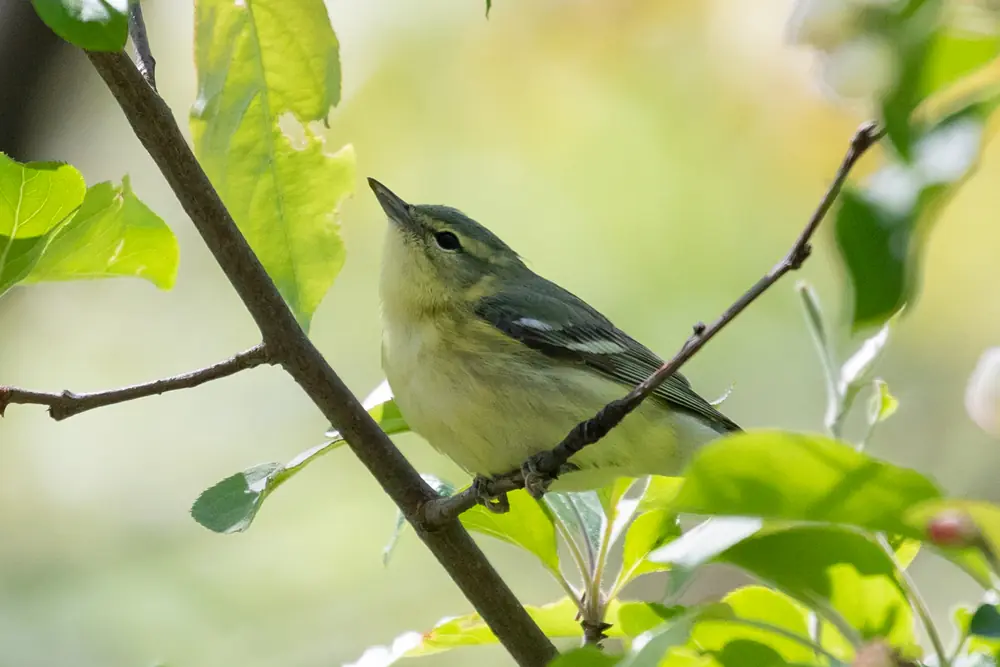
Which birds arrive in April, and where can you hear warblers?
Migration gathers speed this month. Travelers from the tropics pass through the Appalachians while the year-round residents pair off and nest. A few stream and ridge specialists lead, and most warblers follow in late April and May.
-
First warblers along the creeks
Early to mid-April for the first arrivals; more each week through May · Wooded streams, river bottoms and sycamores
Journey North's report of April 8, 2020 said northern parulas, Louisiana waterthrushes and yellow-throated warblers were abundant in Maryland, West Virginia, Ohio and Missouri, so walk a wooded stream early in the month and listen. Cornell's BirdCast mid-April summary describes migration as in full effect in many areas, with peak windows approaching. Timing follows the weather, so a log of your own first dates beats any calendar. The Brooks Bird Club, the state's bird society since 1932, and its affiliate the Mountwood Bird Club, which runs a spring migration count in Wood County and keeps early and late dates for it, are good places to compare notes.
-
The cerulean warbler, a mountain specialty
Spring and summer, nesting in the canopy; check eBird and local clubs for first-arrival dates · Oak and hickory forests on ridges and steep slopes
The sky-blue males sing from high in the trees, and West Virginia matters to the species. The DNR says roughly 80 percent of the world's cerulean warblers breed in the Appalachians and about a third of those nest here, and that the bird has declined by more than 65 percent since 1966 because of habitat loss. It likes forests with canopy gaps, and the agency has patch cut about 150 acres at Summersville Wildlife Management Area to make them. The birds winter in the Andes. Bring binoculars and patience, and stay on the trail.
-
New River Birding and Nature Festival
April 26 to May 1, 2027, per the organizer's site; register through it · New River Gorge National Park and Preserve and nearby, Fayette County
The Fayette County Education Fund runs the festival, with guided birding and nature trips for all skill levels, lodging partners and online registration; a first-day birding outing is listed for April 27. The park around it, the Park Service says, is breeding ground for warblers, vireos and thrushes that need unbroken forest.
-
Eaglets in the nest at Shepherdstown
Chicks grow fast through April; fledging comes in mid-June · National Conservation Training Center, Shepherdstown, Jefferson County, and its live camera
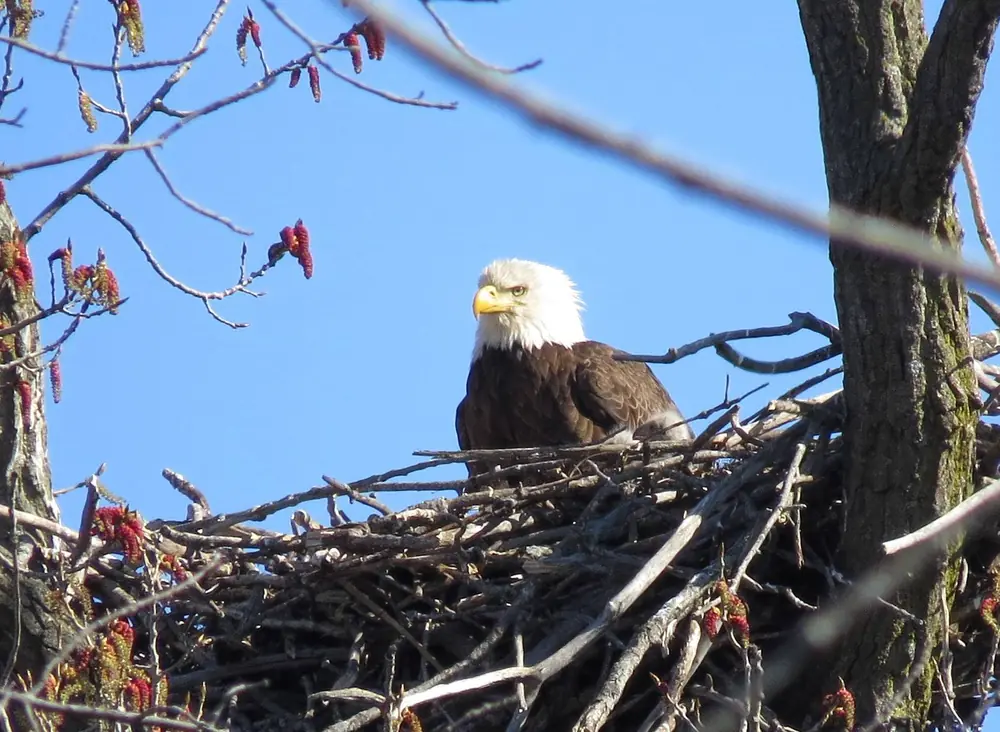
The Fish and Wildlife Service's nest notes describe eaglets at about two weeks as the size of small chickens with growing talons and beaks, and at about 32 days as nearly covered in feathers and starting to stand. Parents bring fish, sometimes hourly, plus squirrels, rabbits and waterfowl, and a bulge at the base of the neck, the crop, shows a chick has just fed. At three to four weeks the young begin to feed themselves.
-
Wild turkeys and the spring gobbler season
Youth hunt April 17 and 18; the season for bearded birds runs April 19 to May 23, 2027 · Statewide
Male turkeys gobble at dawn in spring, and the state's season is timed to it. The DNR's regulations summary lists a two-day youth hunt on Saturday and Sunday, April 17 and 18, and a statewide season for bearded turkeys from April 19 through May 23, with one bird a day and two for the season. Shooting ends at 1 p.m., and an uncased firearm, bow or crossbow in the woods after that hour is illegal, as are electronic calls, bait and dogs.
What salamanders, toads and snakes are active in West Virginia in April?
March's peepers give way to a more varied night. Toads begin to trill, and woodland salamanders lay their eggs in damp ground.
-
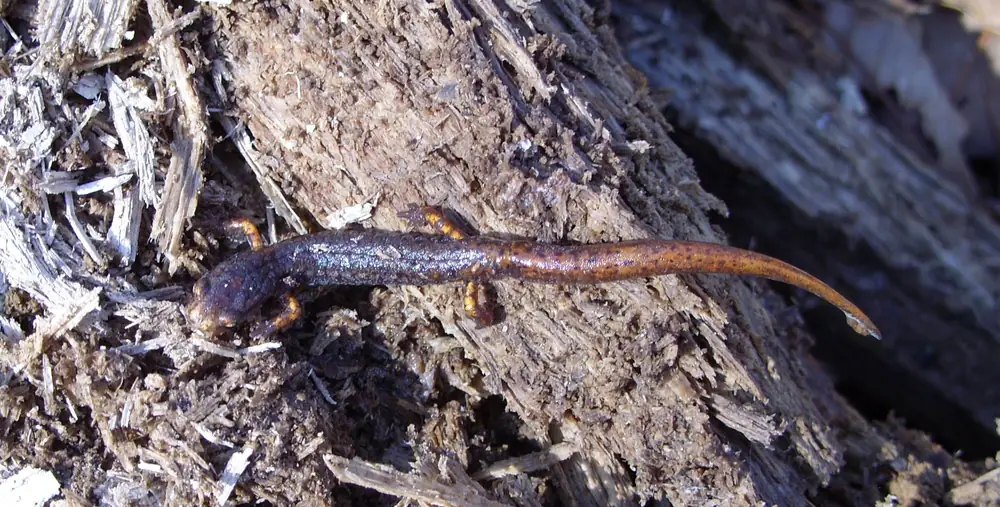
Four-toed salamander, a bog nester
Females lay eggs in April and May · Sphagnum moss in fens, seeps and mossy pool edges
The DNR's salamander field book describes a rusty-brown animal about four inches long, with a white belly flecked with black, a pinched tail base and just four toes on each hind foot. Males stay in the forest; females go to fens and pools to lay about 40 eggs each in hummocks of sphagnum moss, and several females may share a nest of several hundred eggs. If you find one, photograph it from a distance.
-
Ravine salamanders and their relatives
Mating and egg-laying in April and May · Forest floor under logs and rocks; ravine salamanders live west of the high Allegheny ridges
Ravine salamanders are long and slender, with short legs, a tail half their length and gold or white flecks. The northern species lives north of the New and Kanawha rivers. Two look-alikes, the Valley and Ridge and Shenandoah Mountain salamanders, live east of the Alleghenies and probably lay in April and May too, though the field book says West Virginia data are lacking. Put every log and rock back as you found it.
-
Toads and treefrogs
Calling typically begins in April and builds in May; later at higher elevations · Ponds, ditches, wet fields and, for treefrogs, woods near water
The DNR counts 12 frog species and three toads in the state: the Eastern American toad, Fowler's toad and the Eastern spadefoot. The Vermont Reptile and Amphibian Atlas, a Northeast source and not a West Virginia one, puts the start of calling for American toads and gray treefrogs in April, later in shade and at higher elevations. Treat that as a rough guide. Listen for a long, steady trill.
-
Snakes leave their dens
Spring warm-up, in April for most · Rocky slopes, wood edges and trails
Copperheads and timber rattlesnakes are the state's only venomous snakes. Trevor Moore, a biologist at the West Virginia Wildlife Center, told MyBuckhannon that rattlesnakes are leaving their winter dens and looking for food, and that sucking out venom and similar remedies are myths; a bitten person should seek medical care at once. Look before you step over a log or put a hand on a ledge.
Is April still trout-stocking season in West Virginia, and what do you need to fish?
Yes. The hatchery trucks keep rolling through April.
-
How big the April stockings are
Weekly through April; the DNR posts stockings by the end of each business day · Rivers, creeks, tailwaters and lakes statewide
The DNR reported 92 waters stocked in the week of April 3, 2023, among them Anthony Creek, Big Sandy Creek, the Blackwater and Cranberry rivers, Shavers Fork and lakes in its "Gold Rush" program, and 72 waters in the week of April 21, 2025, including the Greenbrier and Williams rivers and Spruce Knob Lake. The agency publishes no schedule ahead of time, and stockings missed in bad weather are made up with extra runs or extra fish.
-
Licenses and where to check
Before every trip · WVdnr.gov fish stocking page; hotline 304-558-3399
Anglers 15 and older need a West Virginia fishing license, a trout stamp for trout and a valid ID. The DNR says the stocking hotline, 304-558-3399, and its stocking page list recently stocked waters. Rules and creel limits change, so read the current fishing regulations summary.
How warm, wet and stormy is April in West Virginia?
Afternoons reach the upper 60s along the rivers while the plateaus lag well behind: the 1991 to 2020 normals show an April high of about 69 °F at Charleston, 55.8 °F at Davis near Canaan Valley and 51 °F at Snowshoe. The National Weather Service puts the normal April mean at 56.9 °F at Charleston and 51.5 °F at Elkins. Extremes are wide. At Charleston, records back to 1885 list the warmest April at 62.4 °F in 1954, the coldest at 48.5 °F in 1926, the wettest at 7.15 inches in 1908 and the driest at 0.50 inches in 1976. At Elkins, back to 1899, the warmest April was 2017 at 56.0 °F and the coldest 1907 at 42.3 °F. Snow is rare but not impossible: both stations had their snowiest April in 1987, with 20.7 inches at Charleston and 24.8 inches at Elkins.
| Station | Average high | Average low | Precipitation | Snowfall |
|---|---|---|---|---|
| Davis 3 SE (Canaan Valley, Tucker County) | 55.8 | 34.3 | 5.31 | 10.6 |
| Snowshoe (Pocahontas County) | 51.0 | 33.0 | 5.17 | 8.5 |
| Elkins Randolph County Airport | 65.6 | 37.3 | 4.10 | 2.3 |
| Beckley Raleigh County Airport | 64.4 | 42.6 | 3.58 | 1.5 |
| Bluefield Mercer County Airport | 62.7 | 42.6 | 3.64 | 0.9 |
| Charleston Yeager Airport | 69.4 | 44.5 | 3.56 | 0.5 |
| Huntington Tri-State Airport | 68.8 | 45.5 | 3.91 | 0.3 |
What to watch. The National Weather Service office in Charleston studied tornado, hail and wind reports for its forecast area from 1950 to March 2020. Tornadoes cluster from April through July, peaking in June; April logged 21, matching May but on fewer tornado days, so April's tend to come in fewer, larger outbreaks. The study also counted 387 severe thunderstorm wind reports and 381 hail reports for April, a big step up from March. These are reports, and population and spotter coverage affect them. Most severe weather arrives in the afternoon and evening, so know where you would shelter on a trail. Heavy rain on wet slopes can raise creeks fast. Each month, near the middle of it, NOAA issues new 90-day outlooks; look there for the current picture. Our weather page and cloud pages help you read the sky.
When is the last spring freeze in West Virginia?
Later than the redbuds suggest. Half of springs are done with 32 °F by April 14 at Parkersburg and Huntington and April 16 at Charleston, yet Elkins waits until May 5 and Canaan Valley until May 15, with a tenth of years still freezing into June. Tomatoes set out on a warm April afternoon can be lost to a late freeze. More stations are on our West Virginia frost dates page.
| Station | One year in ten | Median | Nine years in ten |
|---|---|---|---|
| Canaan Valley #2 (Tucker County, about 3,250 ft) | Apr 26 | May 15 | Jun 1 |
| Elkins Randolph County Airport | Apr 20 | May 5 | May 21 |
| Beckley Raleigh County Airport | Apr 8 | Apr 22 | May 13 |
| Martinsburg E Wv Regional Airport (Eastern Panhandle) | Apr 3 | Apr 20 | May 12 |
| Morgantown Hart Field | Apr 7 | Apr 23 | May 14 |
| Wheeling (Northern Panhandle) | Apr 5 | Apr 20 | May 6 |
| Parkersburg (Mid-Ohio Valley) | Mar 31 | Apr 14 | May 2 |
| Charleston Yeager Airport | Apr 1 | Apr 16 | May 5 |
| Huntington Tri State Airport | Mar 28 | Apr 14 | May 3 |
How much daylight does West Virginia gain in April?
The eight cities below gain between 66 minutes (Bluefield) and 73 minutes (Wheeling) across April, 2.3 to 2.5 minutes a day. Wheeling begins the month with a 12 h 40 m day and ends it at 13 h 53 m; Charleston and Huntington both go from 12 h 38 m to 13 h 46 m. Because the north gains faster, the gap between Wheeling and Bluefield opens from 4 minutes on April 1 to 11 minutes on April 30. West Virginia is on daylight time for the whole month, so no clock change complicates the sunrises and sunsets you read.
| City | Apr 1 | Apr 30 | Gained | Per day |
|---|---|---|---|---|
| Wheeling | 12 h 40 m | 13 h 53 m | 73 min | 2.5 min |
| Morgantown | 12 h 40 m | 13 h 51 m | 71 min | 2.4 min |
| Martinsburg | 12 h 40 m | 13 h 50 m | 70 min | 2.4 min |
| Parkersburg | 12 h 39 m | 13 h 49 m | 70 min | 2.4 min |
| Elkins | 12 h 39 m | 13 h 48 m | 69 min | 2.4 min |
| Charleston | 12 h 38 m | 13 h 46 m | 68 min | 2.3 min |
| Huntington | 12 h 38 m | 13 h 46 m | 68 min | 2.3 min |
| Bluefield | 12 h 36 m | 13 h 42 m | 66 min | 2.3 min |
Try the daylight calculator to see what your own valley or ridge gains.
What can you see in West Virginia's night sky in April 2027?
The month brings a Pink Moon, a Lyrid shower that the same moon spoils, and Jupiter and Mars in the evening. Every time here is Eastern daylight time (EDT). For faint things, use the dark evenings around the new moon on Tuesday, April 6.
-
The Pink Moon
Full on Tuesday, April 20, at 6:27 p.m. EDT; moonrise that evening a little after 8 p.m. · Low in the east-southeast after sunset
SeaSky says early Native American tribes called this moon the Pink Moon for the moss pink (wild ground phlox) that appears around then, and also knew it as the Sprouting Grass Moon and the Fish Moon. The exact full moment comes before the moon is up, so the show is the moonrise itself on the evening of the 20th.
-
The Lyrids under a bright moon
Peak around 9:40 p.m. EDT on Thursday, April 22; the shower is active about April 14 to 30 · Face east to northeast, with the moon behind you
On the peak night a nearly full moon (95 percent lit) climbs above the horizon near 10 p.m., leaving only a short dark stretch beforehand, while Lyra, the shower's home constellation, is only beginning its climb in the eastern sky. SeaSky puts a typical peak at about 20 meteors an hour and says moonlight will hide the faint ones, so expect a few an hour. Better meteor viewing arrives with the Eta Aquariids, which begin about April 19 and peak around May 5 to 7, when there is no moon to spoil it.
-
Jupiter and Mars after dark
Moon beside Jupiter on the evenings of April 14 and 15, and near Mars late on the 15th · High in the south in the evening, in and near the stars of Leo
Jupiter outshines every star around it and stays up into the small hours. Mars, orange and fainter, sits in Leo. The two-thirds-lit moon is closest to Jupiter on the morning of the 15th, so the dusks before and after give the best view, and it sits roughly 3 degrees from Mars late that day. Binoculars show Jupiter's four big moons as dots in a row.
-
Dawn crescent by Venus, dusk crescent by the Pleiades
Mornings of April 3 and 4; the evening of April 9, with the moon still near the Pleiades on the 10th · Low in the east before sunrise; low in the west after sunset
Venus stands out low in the east at first light, and its slow drift toward the Sun trims its head start as the month goes on, from about 75 minutes on April 1 to about 60 by April 30, by our own figures. A thin waning crescent sits beside it on the 3rd and 4th. Days later, by our own computation, a young crescent drifts past the Pleiades, coming within about a degree of the cluster around the 9th and 10th. Saturn slips behind the sun on the 7th.
-
The Milky Way before dawn
Moonless mornings of April 1 to 14 and April 28 to 30, around 40 degrees north · A dark site with a clear southern horizon
The bright heart of the galaxy is returning to the southeast before dawn but stays in true darkness only about two hours at best. Aurora is possible on any clear dark night; the NOAA Space Weather Prediction Center posts a forecast.
| Phase | Date | Time |
|---|---|---|
| Last quarter | Monday, Mar 29 | 8:54 p.m. EDT |
| New moon | Tuesday, Apr 6 | 7:51 p.m. EDT |
| First quarter | Tuesday, Apr 13 | 6:56 p.m. EDT |
| Full moon, the Pink Moon | Tuesday, Apr 20 | 6:27 p.m. EDT |
| Last quarter | Wednesday, Apr 28 | 4:18 p.m. EDT |
| New moon | Thursday, May 6 | 6:58 a.m. EDT |
Every phase for the year is on our moon phase calendar.
What can West Virginia families do outdoors in April?
- Early April onward: a wildflower hunt. Choose a woodland trail and look first for toothwort and trout lily, then trillium. Sketch each bloom and write the date beside it.
- Friday, April 9: Arbor Day. Plant a tree, or visit a big one and measure around its trunk with string.
- An April Saturday: guided walks. Ask Kanawha State Forest about the Osbra Eye walks and Chief Logan State Park about its wildflower hike.
- A Saturday in April: the Feast of the Ramson. Richwood holds it each spring and the 2026 feast was April 18; the chamber can give the 2027 date.
- Tuesday, April 20: Pink Moon night. Settle on a hilltop by 8 p.m. for the moonrise, then look south for bright Jupiter.
- Thursday, April 22: Earth Day. Clear litter from a creek bank, and glance up around 9:40 p.m. for a stray Lyrid despite the moon.
- April 26 to May 1: the New River Birding and Nature Festival. Ask the organizers which trips suit children.
- All month: the eagle cam. Count fish deliveries and track how fast the eaglets change.
- A mild evening: toad listening. FrogWatch USA, an Akron Zoo program, offers training through local chapters so volunteers can report frog and toad choruses between February and August.
- A day trip to French Creek. The DNR's West Virginia Wildlife Center in Upshur County keeps nine-to-five daily hours from April 1 through October 31 and houses black bears, elk, otters and bobcats.
- A free bird project. NestWatch, from Cornell, has you monitor a nest and report what you see.
Write down what you find in the Naturalist's Field Journal. Other months, including March, sit among our nature guides.
Safety notes for April in West Virginia
- Turkey hunters in the woods. Hunting runs April 17 and 18 for youth and April 19 to May 23 for bearded birds, ending each day at 1 p.m. The blaze orange rule is tied to open deer firearms or muzzleloader seasons, and none runs in April, so choose bright clothing yourself before 1 p.m.
- Fire law through May 31. No outdoor burning is allowed between 7 a.m. and 5 p.m. A later fire must be watched, ringed by a 10-foot cleared strip and out by 7 a.m., and the penalty can reach $1,000 plus the cost of fighting an escaped fire.
- Storms and high water. Check the radar before a hike, get off ridges when thunder is close and stay out of flooded roadways. The Forest Service says Dolly Sods fords can be impassable when streams run high.
- Old artillery at Dolly Sods. The wilderness was a World War II training range. Treat any rusty metal object as a possible shell: leave it, and tell the Forest Service.
- Cold snaps and snow. Davis normally gets 10.6 inches of snow in April, and the Mylius Trail can see snow into the last days of the month. Pack layers.
- Snakes. Copperheads and timber rattlesnakes are leaving dens. Step and reach with care, and keep dogs close.
- Ticks. The state health department calls West Virginia a high-incidence Lyme state and says exposure is possible all year, most often late spring through early fall. Use repellent and do a full check afterward.
- Bears and young animals. The DNR says bear conflicts peak in May and June: secure trash, clean grills and pick up pet food, and back away slowly from a bear. Leave fawns, fledglings and other young alone, and keep your distance from eagle nests.
- Ramps. Know which rules apply on the land you are on (first section).
Sources (50)
- West Virginia Tourism: Feast of the Ramson ramp festival, Richwood (2026 listing)
- WOAY: Richwood Feast of the Ramson returns on April 18 (2020)
- National Park Service: changes to ramp harvesting in area parks (effective January 1, 2022)
- West Virginia Public Broadcasting: Monongahela National Forest, here's how you hunt ramps
- Allegheny Mountain Radio: USFS ramp guidelines for Monongahela (March 5, 2024)
- West Virginia Living: save the ramps
- USDA Forest Service: Mylius Trail wildflowers, Monongahela National Forest
- Butterflies and Moths of North America: West Virginia White
- West Virginia Highlands Conservancy: five spring wildflowers you'll likely encounter in West Virginia
- West Virginia Tourism: four best spring wildflower events
- West Virginia Tourism: Osbra Eye Memorial Spring Walks (2024 listing)
- WVDNR: West Virginia Wildflower Pilgrimage, May 6 to 9, 2027
- West Virginia Explorer: spring's pink-flowering redbud trees
- West Virginia Division of Forestry: Arbor Day
- Virginia Tech Tree Fruit Horticulture: frost damage thresholds for fruit bloom (April 2022)
- FreshPlaza: tri-state peach and apple harvests damaged by bad weather (2016)
- Journey North: warbler sightings picking up (April 8, 2020)
- BirdCast: species on the move in mid-April
- Brooks Bird Club
- Brooks Bird Club: Mountwood Bird Club
- WVDNR: revitalizing cerulean warbler habitat in West Virginia
- New River Birding & Nature Festival: official site (2027 dates and registration)
- Visit Fayetteville WV: New River Birding and Nature Festival 2027
- National Park Service: birds of New River Gorge
- U.S. Fish and Wildlife Service: NCTC eagle nest updates (April notes)
- U.S. Fish and Wildlife Service: NCTC Eagle Cam (yearly cycle)
- WVDNR: 2026-27 Hunting and Trapping Regulations Summary
- WVDNR: Salamanders of West Virginia (2024 field book)
- WVNS: frogs and toads found in West Virginia (citing WVDNR)
- Vermont Reptile and Amphibian Atlas: frog calling times (a Northeast guide)
- MyBuckhannon: April creature feature on West Virginia snakes
- WVDNR: fish stocking (how stockings are posted)
- WVDNR: stocks 92 waters during the week of April 3 (2023)
- WVDNR: stocks 72 waters during the week of April 21 (2025)
- NOAA NCEI: 1991-2020 monthly normals for seven West Virginia stations
- National Weather Service Charleston, WV: climate top ten for April at Charleston
- National Weather Service Charleston, WV: climate top ten for April at Elkins
- National Weather Service Charleston, WV: a severe weather climatology for the county warning area
- Climate Prediction Center: seasonal (90-day) outlooks
- WVDNR: basics for avoiding human-bear conflicts this spring
- West Virginia Emergency Management: spring fire season runs from March through May (2026)
- West Virginia Department of Health: preventing tickborne diseases (2022)
- USDA Forest Service: Dolly Sods Wilderness
- WVDNR: West Virginia Wildlife Center spring hours
- Akron Zoo: FrogWatch USA
- Cornell Lab of Ornithology: NestWatch
- U.S. Naval Observatory: moon phases from April 1, 2027
- Fred Espenak, Sky Event Almanac 2027 (April entries)
- Sea and Sky: astronomy calendar 2027
- Photos via Wikimedia Commons; licenses and photographers are credited on each file page