What to look for in nature in West Virginia this March
March is when West Virginia's two seasons trade places. The Canaan Valley plateau still averages 26 inches of snow this month, while in the river valleys the first frogs are calling and red maples are in flower. Eagles that laid eggs in February are now watching them hatch, woodcock are dancing in the dusk above mountain meadows, sugarhouses are boiling their last sap, and weekend trout stockings get going at the state parks. The month ends with the equinox on the 20th, the Worm Moon on the 21st and 22nd, and more than an hour more daylight than it began with. Below are the month's stories, one at a time, with the dates that are fixed and the ones to check.
Other months in West Virginia: October, November, December, January, February, April.
Start here

- Watch for the first pip. Open the Shepherdstown eagle cam during the second half of March. A small hole in a shell, then a wobbling gray chick under a parent, is the moment the watchers wait for.
- Stand at a field edge at dusk. Find an open field next to young woods, arrive before sunset on a calm evening and listen for the nasal peent of a woodcock, then look up as the male spirals into the last light.
- Listen for peepers on a mild, wet evening. Walk to a pond or wooded wetland after dark when rain has fallen and the air is above freezing. A chorus of peeps can be deafening up close.
Keep March in the Naturalist's Field Journal: the date of the first peeper and the night's weather on a map of sounds; the woodcock's dusk display and the minute it began on dusk and dawn watch; each hatch day and chick count on nest observed; red maple flowers and the bluebell buds on a tree through the seasons and the same place twice; and the day's weather and what you saw on the daily field log.
Regions used below: Potomac Highlands and the Allegheny Mountains; Eastern Panhandle; Northern Panhandle and Morgantown; Mid-Ohio Valley; Kanawha Valley and Charleston; Huntington and the Metro Valley; New River Gorge and the southern coalfields.
When do the Shepherdstown eaglets hatch, and how close can you get to a nest?
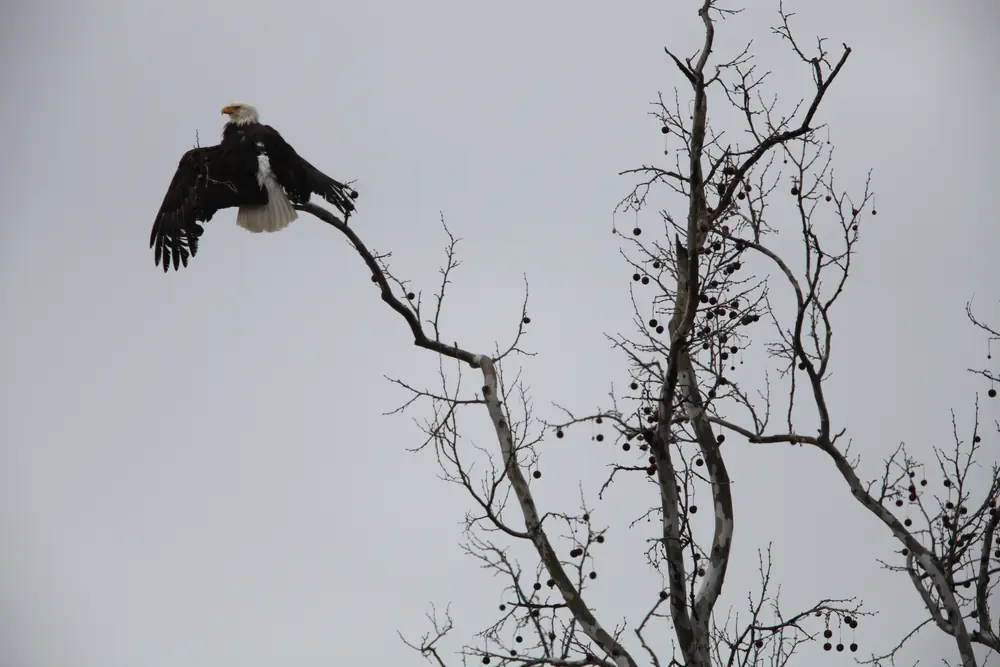
March is hatching month for West Virginia's best-watched bald eagles. The eggs laid in February are now close to the end of their five weeks of warming, and anyone with a screen can follow the wait at the National Conservation Training Center near Shepherdstown. Elsewhere in the state, the same drama plays out quietly in sycamores and tall pines along the rivers, where the right place to stand is far away.
-
Hatch watch at the training center
Usually the second half of March; the cam runs around the clock in nesting season · The U.S. Fish and Wildlife Service's National Conservation Training Center, Shepherdstown, Jefferson County
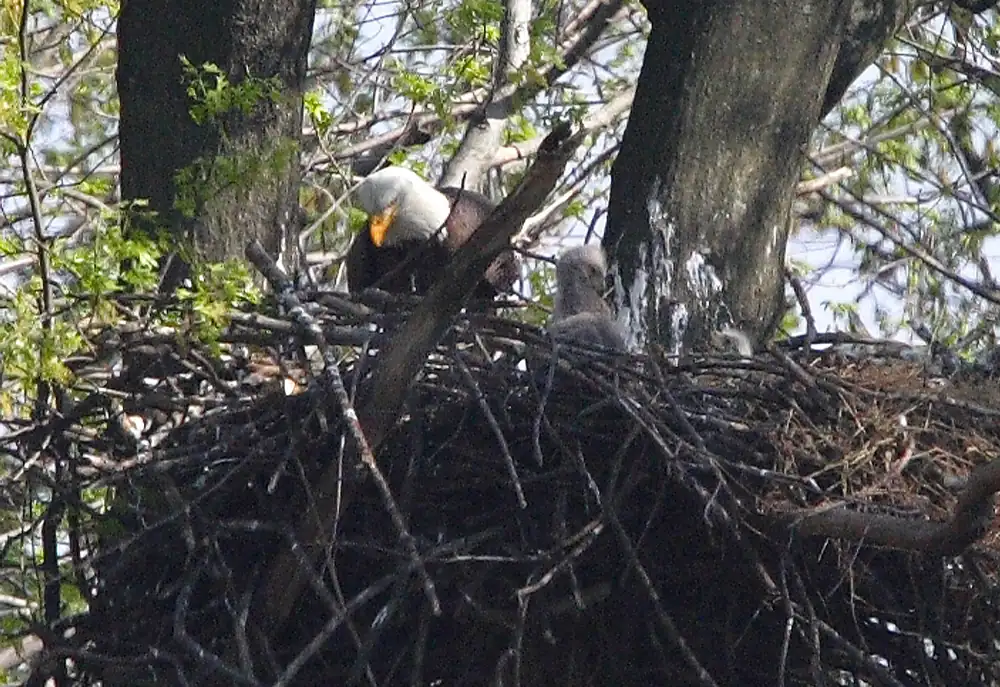
The Service's cam page lays out the yearly cycle: egg laying in mid-February, then 35 to 38 days of steady incubation, with hatching in mid-March and fledging in mid-June. The first sign of a hatch is usually a small hole punched through the shell. In 2026 the nest's staff and viewers were in just that waiting stage on March 27, according to WV MetroNews, with about 37 days of incubation behind the parents. The pair had moved into the backup nest they built the previous fall, about 15 feet below the one the 2025 storm destroyed. Dates for 2027 depend on when the eggs are laid, so treat late March as the window to watch and check the cam page for news.
-
What the nest's own notes show
Hatch dates in the notes run from March 20 to April 8 · The training center nest, as logged by the Service
The agency's season-by-season notes are a good reminder that wild nests do not keep a schedule. The first chick hatched on March 20 in 2021 and again in 2025 (when the three eggs, laid February 10, 13 and 16, hatched on March 20, 22 and 24). In 2020 the dates were March 25 and 27, in 2023 the first egg hatched on March 26, and in 2019 the eaglets arrived on March 29 and 31. In 2024 the eggs came late, between February 27 and March 4, one broke on March 19, and the first chick did not hatch until April 8. The same notes record the hard parts: a chick lost in 2020 and 2019, and in 2025 a sudden windstorm on the night of April 19 that blew the whole nest out of the tree with three four-week-old eaglets inside. A camera shows real wildlife, and not every story ends well.
-
Eagle nests across the state
Nesting begins in January or February; eggs hatch in about 35 days · Large trees near rivers and lakes, along most of the state's major rivers
The Division of Natural Resources' brochure on eagles says West Virginia had 19 pairs attempt to nest in 2005, 14 of them successfully. By the second breeding bird atlas (2009 to 2014) observers had found 53 nest sites, with 40 active in 2014, and as of 2022 more than 130 nests had been documented. Biologists monitor the nests every year. The law protects them: being at a nest site during the nesting season counts as harassment, and a first offense carries a fine of $500 to $5,000 or 60 days to a year in jail. If you find a nest, keep your distance, watch with binoculars or a scope from a road or a boat, and report the location to dnr.wildlife@wv.gov.
Missed the egg-laying and the golden eagles of midwinter? Both are in the West Virginia February guide.
When do spring peepers start calling in West Virginia, and which salamanders cross the road?
This is the month the dark hollows start to ring. A mild rain after dusk in March can send peepers, Jefferson salamanders and other pool breeders on the move in the same night. West Virginia recognizes 36 species of salamanders, according to the DNR's 2024 field book, and a good many of them breed in water that exists only in winter and spring.
-
Spring peepers
Late February in warm valleys, March in most places, and as late as the end of March in the uplands · Wooded wetlands, ponds, roadside ditches and vernal pools, statewide, in the evening
A Marshall University biologist quoted by the DNR said the chorus comes early if the weather is mild and later after a hard winter, and that the frogs spend winter in the forest and come to the wetlands only to breed. The season lasts about a month to a month and a half. Peepers are small, with a dark X on a tan or brown back, and the call is a high, bright peep that many people liken to sleigh bells. A naturalist at Chief Logan State Park told West Virginia Explorer that peepers are the first frog most people hear in spring and that they can survive freezing, so a cold snap rarely silences them for long. The botanic garden near Morgantown notes that peepers and wood frogs make chemicals in their cells that let them freeze and thaw without dying.
-
Jefferson salamanders and their kin
Late winter and early spring, on rainy nights, with February and March the peak in the DNR's account · Woods around fishless vernal pools
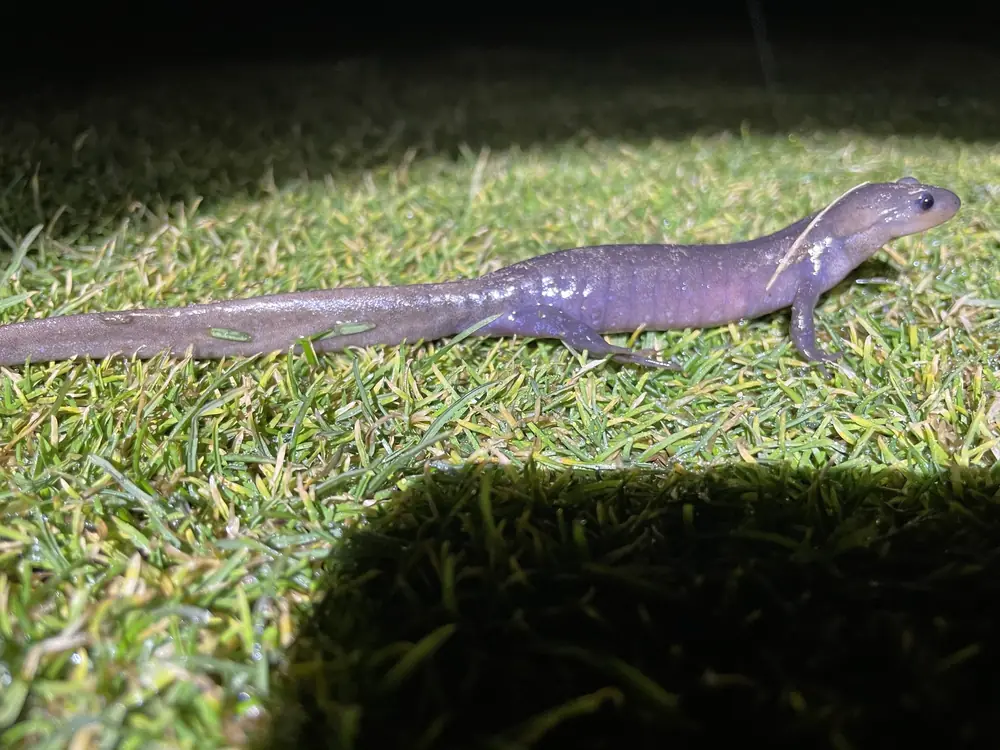
The Jefferson salamander is a large, slender, brown or gray animal up to eight inches long, with very long toes and sometimes faint blue flecks along the sides. The DNR's field book says the adults stay underground until late winter or early spring, then surface on rainy nights and migrate in numbers to breeding pools, where each female lays small clusters of clear eggs on submerged twigs. The small-mouthed salamander, which has a smaller head and silvery marks, breeds in February and March as well. A DNR slide set for pool volunteers lists Jefferson salamanders, wood frogs, spotted salamanders, American toads, gray treefrogs and marbled salamanders as the common pool breeders and notes that the timing of breeding trips varies by species; the marbled salamander is the odd one, laying its eggs in dry pools in September or October. On the first mild, rainy night of the month, drive slowly on back roads near woods and watch the pavement.
-
American toads and the later chorus
Typically a few weeks after the peepers, in the same kinds of ponds; check your local water · Shallow ponds, shorelines and flooded fields
If the long, steady trill of a toad drifts over the pond after the peeper chorus, it is probably an American toad, a brown or gray animal with warts and glands behind the eyes. The DNR's slides describe the call as a long trill, and the eggs as long, thin, often coiled strings. The wood frogs of February, whose chorus the DNR says lasts anywhere from a few days to two weeks at a pool, may already have left tadpoles in the water; those tadpoles change into froglets by early June.
-
Stream salamanders
March and April · Rocky streams, seeps and floodplains in moist forest
Not every salamander story involves a vernal pool. The DNR's field book says female two-lined salamanders lay 35 to 60 eggs in March and April on the undersides of rocks in small streams, guarding them if they are under a stone. Wehrle's salamanders mate in March and April and lay in April. Turn a rock only to look and always replace it as it was; many of these animals live their whole lives under one.
Want to help map the pools? The state Department of Environmental Protection runs a Vernal Pool Monitoring Program for volunteers. In 2026 its training workshops included sessions in February and March, one of them at New River Gorge National Park, and monitors submit their notes online. Contact the Save Our Streams coordinator at saveourstreams@wv.gov for 2027 workshop dates.
Where can you watch the woodcock's sky dance in West Virginia?
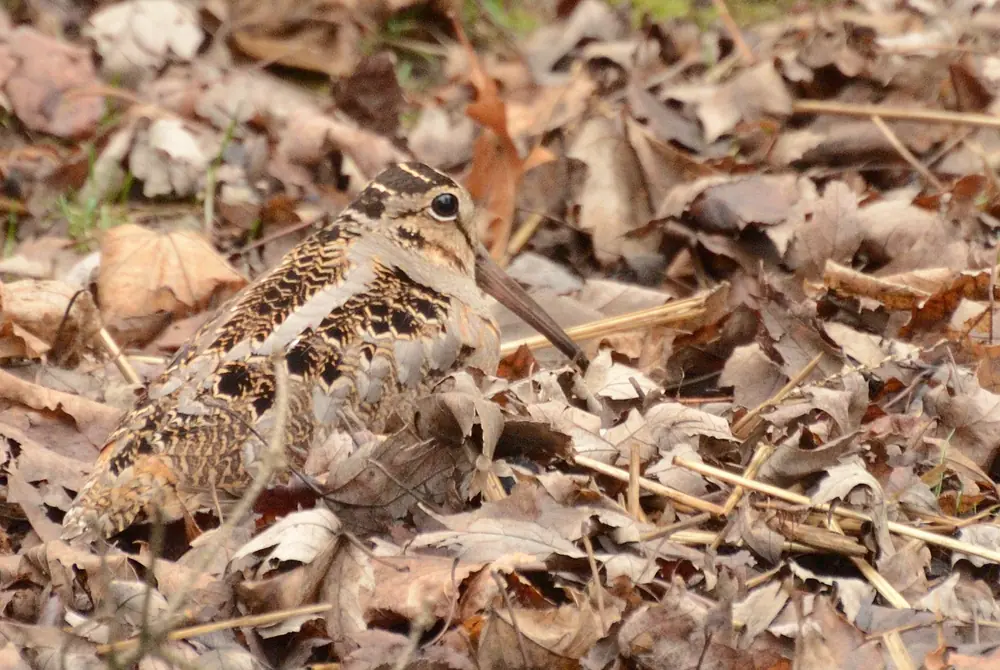
Few birds put on a better show for so little scenery. At dusk, in an open field next to young woods, a male American woodcock walks out onto bare ground and begins to call. Then he rises on twittering wings, spirals high overhead, and drops back to the spot he left. Naturalists have long called it the sky dance, and the best place to find it in West Virginia is the high wet meadow country of Canaan Valley.
-
The dance at dusk
Late winter and early spring; timing is later at higher elevations · Open fields, forest openings and old farmland beside good feeding ground, in the half hour after sunset or before sunrise
Virginia's wildlife agency describes the pattern for its own state: the display begins when the ground is thawed and free of snow, in the half hour before sunrise and after sunset, with a nasal peent from the ground, then an upward flight on wings that twitter, a zigzag high above, and a spiral back to the same spot. Canaan Valley is colder and higher than Virginia's lowlands, so expect the first dancers later, and come on a calm, clear evening. Stay quiet at the field's edge, wait for the peent, and look up against the last light.
-
Canaan Valley, a stronghold
Spring evenings; check with the refuge for programs · Canaan Valley National Wildlife Refuge, Tucker County
The refuge's own pages call the male's sky dance part of the mating ritual and say that the staff count peenting males in different parts of the refuge, band woodcock when they can, and keep grasslands open by burning or mowing on a three-year cycle so shrubs do not take over. The refuge, its friends group and the local Master Naturalists have hosted an evening woodcock program at the visitor center with an indoor talk followed by a listening walk. One announced program was a free Saturday session on April 1 at 7 p.m., with the year not stated in the notice; dates vary, so ask the refuge about 2027.
-
A bird in trouble, and the scientists following it
Research continues; the survey runs every spring · Canaan Valley and across eastern North America
In the fall of 2019 a team at Canaan Valley marked five woodcock with satellite transmitters as part of the Eastern Woodcock Migration Research Cooperative, a collaboration of eleven states and three Canadian provinces led from the University of Maine, according to the account on the West Virginia Highlands Conservancy site. The author notes that woodcock numbers are falling by about 1.1 percent a year, and that North America has lost about one in four birds over 50 years. A Fish and Wildlife Service survey tracks the change: since 1968 volunteers and agency staff have driven set roadside routes each spring and counted singing males, and those counts guide each year's hunting seasons.
Is it too late for maple syrup in March, and which tree flowers first?
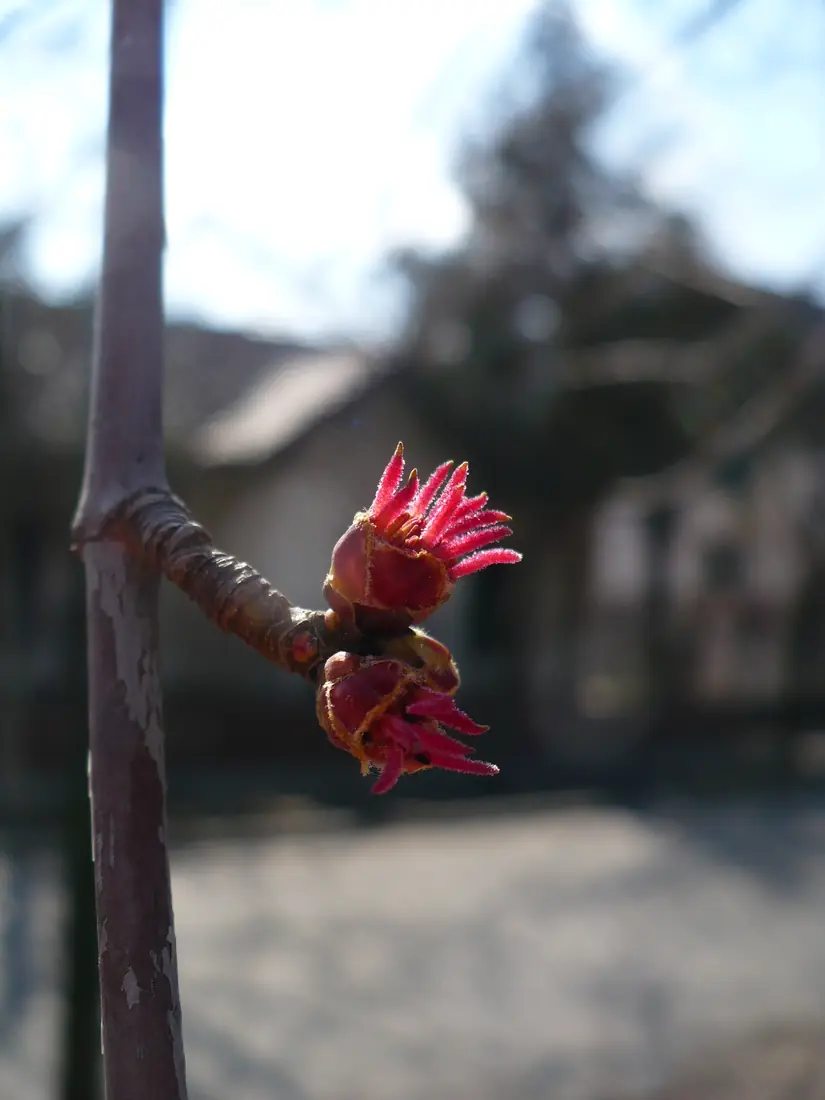
Not yet, but the season is closing. Sap runs when nights freeze and days climb above freezing, and by the end of March the nights are warm enough that most sugarhouses are finishing. The same swing in temperature that ends the sap run is waking another maple, the red maple, which flowers before any leaf shows.
-
The last runs of the sugar season
Usually early February to late March · Sugar bushes across the Allegheny and Potomac highlands
The state's maple harvest runs from early February to late March, a West Virginia news service reported in 2026, when more than 55 commercial producers were in business. Sap builds pressure in the trunk on days that thaw after a freeze, so a run is best on a day that starts below freezing and ends well above. Once nights stay mild the run fades. Producers keep boiling when they can, so a visit in March can still catch steam rising from a sugarhouse.
-
Mountain State Maple Days, the March Saturday
One Saturday in March; in 2026 it was March 21, 10 a.m. to 4 p.m.; the 2027 date has not been announced · Registered sugarhouses statewide
The West Virginia Maple Syrup Producers Association opens member sugarhouses on two Saturdays, one in February and one in March. A county tourism site listed the 2026 pair as February 21 and March 21. Visitors register, then tour the boiling room and often taste and buy syrup and candies. The association warns that this is working-farm ground: dress for mud and steam. Check the association's site, wvmspa.org, for the 2027 dates.
-
Red maple in flower
March through May, depending on elevation and latitude · River valleys, hollows and hillsides statewide, in flower before the leaves open
The Forest Service's silvics manual lists red maple among the earliest trees to bloom, weeks ahead of leaf-bud break, and gives March to May as the flowering window, later at higher elevations and farther north. A bare hillside seen from a distance can take on a reddish haze. Up close, look for red clusters on twigs at eye level along streams and roads. The seeds ripen April to June, before the leaves are fully out.
Which wildflowers bloom first in West Virginia?
The first spring flowers push through leaf litter where the woods are open to sun, and they are quick. Many are ephemerals that bloom, set seed and die back before the trees shade the ground. Elevation matters more than the calendar: lowland woods can be in flower in March while the high ridges are still waiting for May.
-
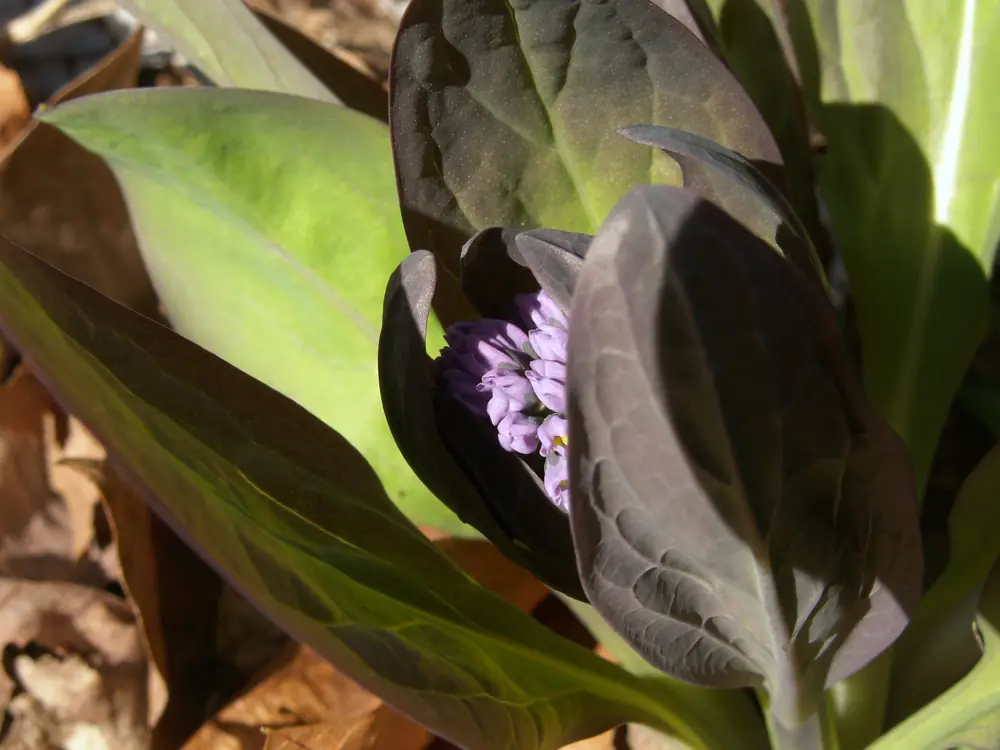
Virginia bluebells
Pushing up in late February and early March in warm lowlands; May in the colder uplands · Rich, moist woods and forest glades
A native plant specialist quoted by West Virginia Explorer said the bluebells come through in late February and early March, show off their flowers, then ripen their seeds and die back. In March, then, look for the first purple-gray leaves and nodding buds, with the pink and blue bells opening a little later in the sun. Where a colony grows, walk on the trail and not through it.
-
Bloodroot
Early spring, soon after the snow leaves · Roadbanks and open woods with dappled sun and well-drained soil
Bloodroot opens a large white flower with many petals soon after winter lets go, and the same source says the blossoms are long-lasting. The red sap inside the underground stem gives the plant its name. Look along sunlit banks beside roads and trails.
-
Trout lily
Early spring, after the first warm days · Forest floors throughout the eastern United States
The plant takes its name from leaves mottled like a rainbow trout, and it has two other common names, adder's tongue and dogtooth violet. It sends up a nodding yellow flower on a single stem. Look in lowland woods first, and plan a second visit later in the month for the uplands.
-
In the garden
March · Gardens and yard beds
The West Virginia Botanic Garden notes that hellebores are among its first flowers and that spring bulbs push up in March. A hellebore, a daffodil sprout and a crocus in the yard are a good way to start a bloom list.
Our Naturalist's Field Journal has plates for exactly this: a tree through the seasons, and the same place twice.
What else wakes up in March: trout, bears and hummingbirds?
A few of the month's changes happen at the water's edge or the back door. State-park trout stockings pick up, bears begin to look for food, and the first hummingbirds are only weeks away.
-
Trout stocking
Through spring; each day's stockings are posted by the end of that business day · State parks, lakes and rivers statewide; the DNR posts the waters
The DNR says it does not release stocking schedules ahead of each event; stockings are posted by the end of each business day on its fish stocking page and on a hotline at 304-558-3399. In past springs it also ran weekend stockings at state parks: in 2020 there were more than 70 on Fridays and Saturdays in March, April and May, at parks including Blackwater Falls, Cacapon, Chief Logan, Holly River, Watoga and Pipestem. The agency stocked 802,481 trout from January through May 2023, 19 percent more than in the same months of 2022, an increase the agency credited to hatchery investments and a mild winter; its hatcheries include Bowden, Edray, Reed's Creek and Tate Lohr. Fishing license and trout stamp rules change, so check the DNR before you go.
-
Bears leave their dens
Early spring; conflicts peak in May and June · Mountain counties and forest edges
The DNR says bears and their cubs leave their dens in early spring, and hungry. Its advice for people is to take bird feeders down before mid-March, keep trash in a secure place until the morning of pickup, remove pet food and clean grills after each use. The agency says encounters occur most often in May and June. If you meet a bear, give it room and back away slowly. The DNR office number is 304-558-6200.
-
Hummingbird feeders, for April
Ruby-throated hummingbirds arrive as early as April 1, per the DNR · Gardens and woodland edges statewide
West Virginia Public Broadcasting, quoting the DNR on April 20, 2026, said ruby-throated hummingbirds arrive as early as April 1 and that sightings spread across the state in mid-April that year. The DNR's recipe is one part sugar to three or four parts water, with no red dye, and the feeder should be cleaned every three to five days. That makes late March the time to wash feeders. If you hang them early, keep them fresh.
How cold, snowy and stormy is March in West Virginia?
March is the most changeable month of the year in the Mountain State. Along the Ohio and Kanawha rivers, afternoon highs in NOAA's 1991 to 2020 normals reach about 57 °F and snow is a few inches. On the Canaan Valley plateau the average high is still 43 °F and the month's snowfall averages 26 inches. A single March can run far from normal. At Charleston, records back to 1885 show a coldest March (by average temperature) of 32.7 °F in 1960 and a warmest of 58.8 °F in 1903. At Elkins, the National Weather Service's records back to 1899 list the snowiest March as 1999 with 41.6 inches, and the coldest as 1960 at an average of 26.5 °F; both stations saw their coldest March in 1960. Charleston's snowiest March was 1914 (21.4 inches), with 1993 second (20.4 inches).
| Station | Average high | Average low | Precipitation | Snowfall |
|---|---|---|---|---|
| Snowshoe (Pocahontas County) | 38.9 | 22.8 | 5.97 | 27.2 |
| Davis 3 SE (Canaan Valley, Tucker County) | 42.9 | 24.0 | 5.90 | 26.0 |
| Elkins Randolph County Airport | 53.5 | 28.5 | 3.98 | 11.4 |
| Beckley Raleigh County Airport | 52.5 | 33.1 | 4.03 | 8.9 |
| Bluefield Mercer County Airport | 51.4 | 33.0 | 3.84 | 6.5 |
| Charleston Yeager Airport | 56.8 | 35.1 | 4.14 | 5.9 |
| Huntington Tri-State Airport | 56.8 | 36.1 | 4.16 | 4.3 |
What to watch. According to the National Climate Assessment's state summary, West Virginia received 23 federal disaster declarations from 2010 to 2020, 18 of them for severe storms and flooding, and in June 2016 a single flood event dropped 8 to 10 inches of rain in under 12 hours and killed at least 23 people. The same summary projects more annual precipitation, with the largest increases in winter and spring, and more numerous and intense extreme precipitation events. Severe-weather season also begins: the state and the National Weather Service hold a Severe Weather Awareness Week each spring, in March in the years we checked (March 20 to 24 in 2023, with the drill at 11 a.m. on the 22nd), with a statewide tornado drill; dates for 2027 had not been announced when this page was written, so follow the NWS offices that serve your county. The spring fire season starts March 1 (see the safety notes). For the latest national outlook, open NOAA's 90-day outlooks, issued each month near mid-month. Our weather page and cloud guide can help you read the sky.
When is the last spring freeze in West Virginia?
Not in March. In half of all springs the last 32 °F reading has come by April 14 at Parkersburg and Huntington, the earliest of the stations below, and by May 15 in Canaan Valley, where nine springs in ten do not finish freezing until June 1. A warm week in March should therefore not fool a gardener or a fruit grower. Our West Virginia frost dates page lets you look up other stations. WVU Extension has said that cool-season vegetables such as cabbage, kale, broccoli, carrots and spinach can go in early because they survive frost, while warm-season crops should wait until after the last frost.
| Station | One year in ten | Median | Nine years in ten |
|---|---|---|---|
| Canaan Valley #2 (Tucker County, about 3,250 ft) | Apr 26 | May 15 | Jun 1 |
| Elkins Randolph County Airport | Apr 20 | May 5 | May 21 |
| Beckley Raleigh County Airport | Apr 8 | Apr 22 | May 13 |
| Martinsburg E Wv Regional Airport (Eastern Panhandle) | Apr 3 | Apr 20 | May 12 |
| Morgantown Hart Field | Apr 7 | Apr 23 | May 14 |
| Wheeling (Northern Panhandle) | Apr 5 | Apr 20 | May 6 |
| Parkersburg (Mid-Ohio Valley) | Mar 31 | Apr 14 | May 2 |
| Charleston Yeager Airport | Apr 1 | Apr 16 | May 5 |
| Huntington Tri State Airport | Mar 28 | Apr 14 | May 3 |
How much daylight does West Virginia gain in March?
Across March the eight cities below add between 71 minutes (Bluefield) and 78 minutes (Wheeling, Morgantown and Martinsburg) of sunshine, a pace of 2.4 to 2.6 minutes per day, which is near the top speed of the year; the fastest gains come around the equinox. Wheeling's day grows from 11 h 19 m to 12 h 37 m. In the southern coalfields Bluefield opens the month with the longest day, 11 h 23 m, yet closes it at 12 h 34 m, a smaller climb, so the spread from top to bottom of the state shrinks from four minutes to three. Charleston and Huntington both run from 11 h 21 m to 12 h 36 m. Around the 20th, day and night are very nearly equal everywhere. When clocks leap forward on Sunday the 14th, the length of the day stays the same, but every sunrise and sunset printed on a clock reads an hour later from then on.
| City | Mar 1 | Mar 31 | Gained | Per day |
|---|---|---|---|---|
| Wheeling | 11 h 19 m | 12 h 37 m | 78 min | 2.6 min |
| Morgantown | 11 h 19 m | 12 h 37 m | 78 min | 2.6 min |
| Martinsburg | 11 h 19 m | 12 h 37 m | 78 min | 2.6 min |
| Parkersburg | 11 h 20 m | 12 h 37 m | 77 min | 2.6 min |
| Elkins | 11 h 20 m | 12 h 36 m | 76 min | 2.5 min |
| Charleston | 11 h 21 m | 12 h 36 m | 75 min | 2.5 min |
| Huntington | 11 h 21 m | 12 h 36 m | 75 min | 2.5 min |
| Bluefield | 11 h 23 m | 12 h 34 m | 71 min | 2.4 min |
Try the daylight calculator to see how many minutes your own valley or ridge gains.
What can you see in West Virginia's night sky in March 2027?
This month has an equinox, a Worm Moon and a lively pre-dawn sky, with Jupiter and Mars holding the evenings. Every time below is Eastern: standard (EST) up to the clock change on Sunday, March 14, and daylight (EDT) afterward. For faint objects, pick the moonless evenings just either side of the new moon on Monday, March 8. Our planet timings come from a single mid-country calculation, so allow up to half an hour either way in the mountains.
-
The clock change and the equinox
Clocks forward at 2 a.m. Sunday, March 14; equinox Saturday, March 20, at 4:25 p.m. EDT · Everywhere
Daylight saving time resumes on Sunday the 14th, with West Virginia's clocks skipping from 2 a.m. straight to 3 a.m. The equinox itself falls on Saturday afternoon the 20th, at 4:25 p.m. EDT (20:25 UTC): the sun stands over the equator and begins its northward run, which astronomers count as the first moment of spring.
-
The Worm Moon
Full on Monday, March 22, at 6:44 a.m. EDT; the best evening to watch it rise is Sunday the 21st · Rising in the east around sunset on the 21st; low in the west at dawn on the 22nd
Tradition names the March full moon the Worm Moon, after the thaw that softens soil and brings worms up. The exact full moment, 6:44 a.m. on the 22nd, comes shortly before sunrise, so that morning a round, pale moon sits low over the western ridges while the east brightens. The evening of the 21st gives the better moonrise: a moon one night from full climbing above the eastern hills around sunset.
-
Mercury and Venus before dawn
Mercury at greatest western elongation on March 17, best from about March 8 to 25; Venus all month · Low in the east and southeast before sunrise
Mercury reaches its widest western separation from the sun, 27.6 degrees, at about 12:20 a.m. EDT on March 17, and the best mornings run from roughly the 8th to the 25th. Aim at the east-southeast sky roughly sixty minutes before dawn, ideally from a hilltop with nothing in the way; the planet shines near magnitude +1 early in the month and a little brighter by mid-month. Venus is easier, a blazing morning star near magnitude -4 that rises close to two hours ahead of the sun on the 1st, with that lead shrinking all month. By our own computation a slender, aging crescent moon sits near Venus at dawn on the 4th, and still close to it on the 5th.
-
Jupiter, Mars and the Moon in the evening
Moon near Jupiter on the evenings of March 18 and 19; Mars and Jupiter 4.3 degrees apart on the evening of March 30 · High in the east to south after dark, in the stars of Leo
Jupiter, in or near Leo, is the brightest star-like object after dark, and on March 1 it sets only as day breaks; Mars, orange and fainter, is in the same constellation. By our own computation the waxing moon, nearly full, slides to within a degree of Jupiter after dark on March 18 and 19, a fine pair for binoculars. By the same computation Mars and Jupiter themselves close to 4.3 degrees apart in the small hours of the 31st, so look on the evening of the 30th, when both stand high in the south by about 8 p.m. EDT. Also by computation, on the 13th a thin crescent moon drifts past the Pleiades after sunset. Saturn is leaving the evening sky, with its last easy views early in the month, and passes the sun on April 7.
-
The Milky Way and the aurora
The Milky Way's core in the last hour or so before dawn; aurora is possible on any night · Dark sites away from towns and valley fog, such as the high country
The galaxy's bright core is about to return to the sky before dawn, but only for a short stretch. By our own calculation for about 40 degrees north, the best moonless mornings are roughly March 5 to 16 and the 31st, and even then the core stands in true darkness for little more than an hour; southern West Virginia gets slightly longer. The aurora can show up on any clear dark night, with March and September tending to run livelier than other months; check the NOAA Space Weather Prediction Center forecast.
| Phase | Date | Time |
|---|---|---|
| Last quarter | Sunday, Feb 28 | 12:16 a.m. EST |
| New moon | Monday, Mar 8 | 4:29 a.m. EST |
| First quarter | Monday, Mar 15 | 12:25 p.m. EDT |
| Full moon, the Worm Moon | Monday, Mar 22 | 6:44 a.m. EDT |
| Last quarter | Monday, Mar 29 | 8:54 p.m. EDT |
| New moon | Tuesday, Apr 6 | 7:51 p.m. EDT |
Our moon phase calendar lists every phase for the year.
What can West Virginia families do outdoors in March?
- All month: follow the eagle cam. Keep a tally of what the parents do each day and watch for the first pecked hole in a shell. The cam and weekly updates are on the Service's NCTC pages.
- Sunday, March 14: clocks spring forward. Evenings suddenly feel long; use the extra daylight for a walk to a pond at dusk.
- Saturday, March 20, 4:25 p.m.: equinox. Measure the shadow of a stick at noon on the 20th and again in June to see how the sun has climbed.
- Sunday, March 21: the Worm Moon rises. Go out at moonrise and watch it clear the eastern hills.
- A mild, rainy evening: a frog and salamander night. Bring a red-filtered flashlight to a woodland pool, keep to the trail or road shoulder, and listen for peepers. FrogWatch USA, managed by the Akron Zoo, trains volunteers through local chapters to report frog and toad calls on evenings from February through August; ask whether a chapter serves your area.
- Vernal pool workshops. The state Department of Environmental Protection has held February and March workshops for volunteers (2026 sessions included one on March 14 and one on March 21). Check for 2027 dates.
- One Saturday in March: Mountain State Maple Days. In 2026 it was March 21, 10 a.m. to 4 p.m., at registered sugarhouses. The 2027 date has not been posted; check wvmspa.org.
- Fridays and Saturdays: trout stocking. See the DNR's stocking page or hotline, and check the license rules first.
- Around dusk on a still evening: a woodcock watch. Find a field next to young woods, arrive before sunset and stand quietly. Ask Canaan Valley National Wildlife Refuge about an organized evening.
- April 1: spring hours begin at the DNR's wildlife center in Upshur County. The center, which houses French Creek Freddie and nearly 30 species of native wildlife, keeps winter hours through March 31; from April 1 to October 31 it is open daily from 9 a.m. to 5 p.m., weather permitting.
- Join a bird project. Cornell's NestWatch invites anyone to record nesting attempts for free, and Journey North takes sightings of the first hummingbirds each spring. Both start when the first nests and travelers arrive.
Record your finds in the Naturalist's Field Journal, and browse the other months in our nature guides, including this state's February guide.
Safety notes for March in West Virginia
- Few hunting seasons are open. Under the DNR's 2026–27 regulations, coyotes, woodchucks, skunks, opossums, weasels, starlings and pigeons may be hunted all year, the split-season crow hunt ends March 6, and beaver trapping runs through March 31. Deer, bear and turkey are all closed in March, so the 400-square-inch blaze orange requirement, which applies only in counties with a deer firearms or muzzleloader season under way, is not in effect. The published 2027 spring turkey dates are April 17 and 18 for the youth hunt and April 19 through May 23 for bearded birds only. Bright colors still help on public land where hunters may be about.
- Spring fire season, March 1 through May 31. By state law no outdoor burning is allowed from 7 a.m. to 5 p.m. during these months. Fires lit after 5 p.m. must be attended, ringed by a 10-foot cleared strip and put out by 7 a.m. The fine is up to $1,000, and an escaped fire makes you liable for the cost of fighting it and for damage. The Division of Forestry reported 50 fires and about 232 acres burned from January 1 to March 26, 2026.
- Floods and high water. Spring rain and snowmelt can swell small streams within hours. Do not drive through water covering a road, and pitch tents and park vehicles on high ground when heavy rain is forecast. At Dolly Sods the Forest Service warns that stream fords may be hard to cross at high water.
- Unexploded shells at Dolly Sods. The Forest Service says the area was used for training in World War II, that a 1997 survey of trails and known campsites found 15 shells, some still live, and that more may remain. Never touch a suspected shell; report it to the Forest Service.
- Late snow in the mountains. Davis averages 26 inches of snow in March, so look up mountain road conditions before heading toward Canaan Valley, Snowshoe or Dolly Sods, and pack water, a blanket and a charged phone.
- Bears and feeders. Bring bird feeders in before mid-March and secure trash, pet food and grills.
- Ticks. West Virginia is a high-incidence Lyme disease state. The Department of Health says tick exposure is possible year-round and most common in summer, with most infections between late spring and early fall; use repellent in woods and brush and check yourself, your gear and pets afterward.
- Nesting and young wildlife. Stay back from eagle nests, and leave fawns and other young animals alone later this spring; the DNR says mother deer often leave their young alone for hours and that removing young animals will almost certainly lead to their death.
Sources (51)
- WVDNR: spring peepers (Marshall University biologist on timing and the call)
- MyBuckhannon: spring peepers signal the season's arrival (March 20, 2020)
- West Virginia Explorer: Groundhog Day and spring peepers (Chief Logan State Park naturalist)
- WVDNR: wood frog
- WVDNR: Salamanders of West Virginia (2024 field book)
- WVDNR amphibian and reptile program: West Virginia's vernal pool amphibians (slides)
- WV Department of Environmental Protection: Vernal Pool Monitoring Program
- West Virginia Botanic Garden: the delight of frogs and flowers
- U.S. Fish and Wildlife Service: NCTC eagle nest updates (season-by-season notes)
- U.S. Fish and Wildlife Service: NCTC Eagle Cam (yearly cycle)
- WV MetroNews: NCTC staff and viewers await arrival of Shepherdstown eaglets (March 27, 2026)
- WVDNR: Eagles of West Virginia (brochure)
- U.S. Fish and Wildlife Service: Canaan Valley National Wildlife Refuge, what we do (woodcock surveys and grasslands)
- U.S. Fish and Wildlife Service: Canaan Valley National Wildlife Refuge species
- Parsons Advocate: American woodcock program at the Canaan Valley refuge visitor center
- West Virginia Highlands Conservancy: Canaan Valley Wildlife Refuge woodcock project
- U.S. Fish and Wildlife Service: American Woodcock Singing-ground Survey
- Virginia Department of Wildlife Resources: listen for the peent to view timberdoodles in flight
- Pocahontas County: 2026 Mountain State Maple Days
- West Virginia Maple Syrup Producers Association: Maple Days
- MyBuckhannon: Mountain State Maple Days invites public to visit sugar shacks in February and March (2026)
- USDA Forest Service, Silvics of North America: red maple
- West Virginia Explorer: five woodland wildflowers you will encounter in West Virginia (March 20, 2025)
- West Virginia Highlands Conservancy: five spring wildflowers you'll likely encounter in West Virginia
- WVDNR: fish stocking (how schedules are posted)
- WVDNR: weekend trout stockings return to state parks (spring 2020)
- WVDNR: 19 percent increase in number of stocked trout in 2023
- WVDNR: basics for avoiding human-bear conflicts this spring
- WVDNR: you might be staying inside, but West Virginia wildlife is coming out to play
- West Virginia Public Broadcasting: hummingbirds sighted in W.Va. (April 20, 2026)
- NOAA NCEI: 1991–2020 monthly normals for seven West Virginia stations (station names as returned by NCEI)
- National Weather Service Charleston, WV: climate top ten for March at Charleston
- National Weather Service Charleston, WV: climate top ten for March at Elkins
- National Weather Service Blacksburg: West Virginia spring weather awareness week (2023)
- NOAA NCICS: West Virginia state climate summary
- Climate Prediction Center: seasonal (90-day) outlooks
- WBOY: when to plant your vegetable garden in West Virginia (WVU Extension)
- West Virginia Emergency Management: spring fire season runs from March through May (March 26, 2026)
- WVDNR: 2026–27 Hunting and Trapping Regulations Summary
- West Virginia Department of Health: preventing tickborne diseases (2022)
- USDA Forest Service: Dolly Sods Wilderness
- WVDNR: West Virginia Wildlife Center spring hours
- WVDNR: French Creek Freddie facts (Wildlife Center hours)
- Akron Zoo: FrogWatch USA
- Cornell Lab of Ornithology: NestWatch
- Journey North: spring migration projects
- U.S. Naval Observatory: moon phases from March 1, 2027
- U.S. Naval Observatory: Earth's seasons, 2027
- Fred Espenak, Sky Event Almanac 2027 (March entries)
- Sea and Sky: astronomy calendar 2027
- Photos via Wikimedia Commons; licenses and photographers are credited on each file page