What to look for in nature in West Virginia this December
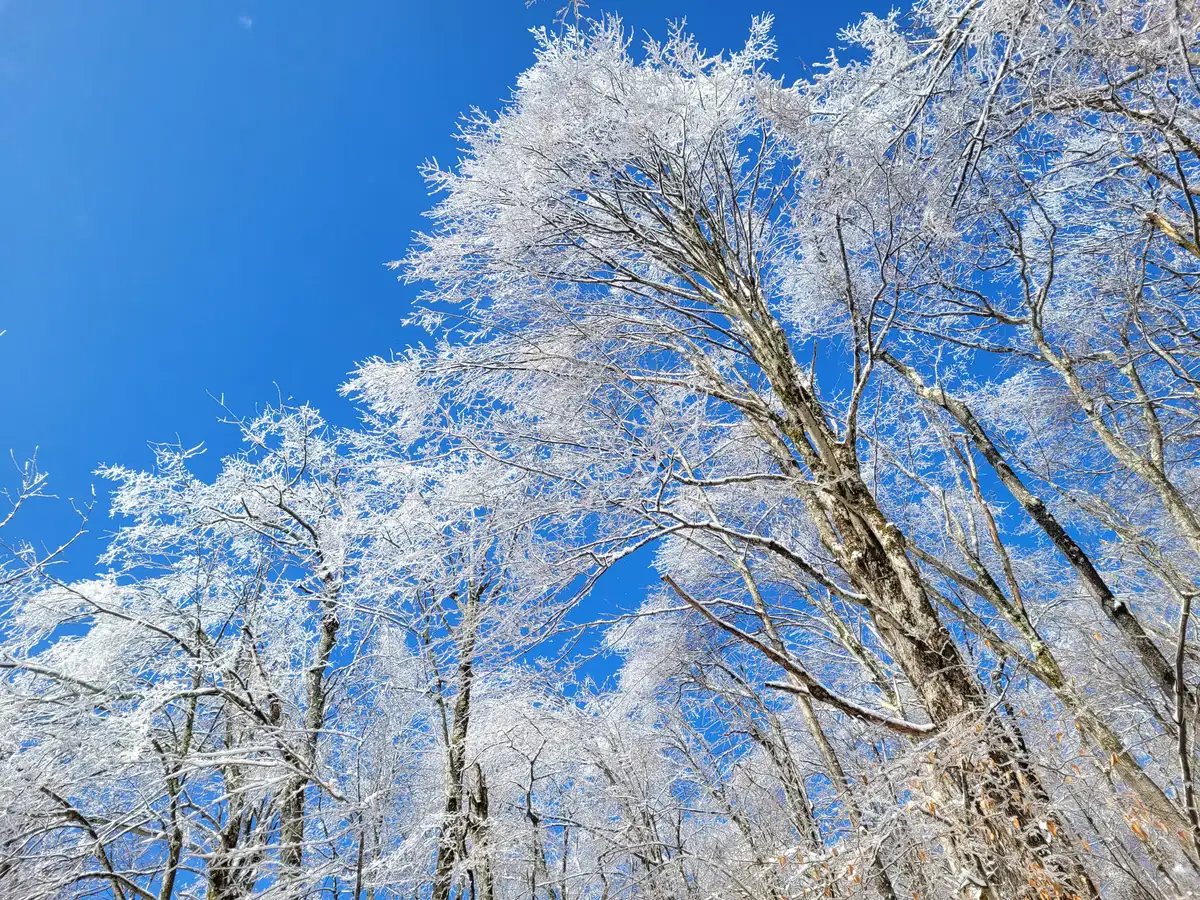
December 1 opens meteorological winter, and in West Virginia the season arrives in layers. Snowshoe and Canaan Valley can already be white while the Ohio and Kanawha bottoms are only damp and gray. Bears have mostly gone to ground, endangered bats hang in tight clusters in a few Pendleton County caves, and on the high ridges snowshoe hares have changed into their white coats. With the leaves gone, the state's evergreens take over the woods: the state flower, the great rhododendron, rolls its leaves into tubes on cold mornings. Bird clubs head out on their holiday counts, great horned owls hoot from the woodlots at dusk, and the year's closest full moon rises two days before Christmas. Below, section by section, is where to find it all.
Other months in West Virginia: October, November.
Start here

- Join a Christmas Bird Count. Counting runs from December 14 through January 5, 2027, Audubon's 127th season. West Virginia has more than two dozen circles, from Wheeling down to McDowell County, and last season most counted on mid- and late-December weekends. The Brooks Bird Club posts each count's date and compiler; beginners are welcome.
- Read the rhododendron. On a frosty morning, look at the big evergreen leaves of the great rhododendron, the state flower, along any mountain stream. Near freezing they droop; colder, they roll into tight cigars. Once the sun warms them they flatten again, a living thermometer you can check from the car window.
- The Geminids and a Cold supermoon. Watch for Geminid meteors, December's big shower, from mid-evening on Sunday the 13th until Monday's dawn; the crescent moon sets early. Then on December 23, at 8:28 p.m. EST, comes the Cold Moon, this year's nearest and brightest full moon.
Use the Naturalist's Field Journal this month for the birds on your count day under birds I have seen; a rhododendron leaf, curled or flat, with the temperature beside it on colours of the day; deer, fox and mouse prints after the first snow on the tracks to know plate; a hemlock twig checked for white wool under reading the signs; and the 5 p.m. sunset on the solstice in your dusk and dawn watch. Note the temperature and the snow depth every time.
Regions used below: Potomac Highlands and the Allegheny Mountains; Eastern Panhandle; Northern Panhandle and Morgantown; Mid-Ohio Valley; Kanawha Valley and Charleston; Huntington and the Metro Valley; New River Gorge and the southern coalfields.
When is the Christmas Bird Count in West Virginia, and how can you join?
Audubon's bird census started in 1900 as an alternative to a Christmas Day shooting contest, and more than a century later it still runs on volunteers. Every count covers a fixed circle 15 miles in diameter, surveyed on one chosen day of the season, which this year lasts from mid-December into the first week of January 2027. Teams take a sector each and record every bird by sight or sound; if your house sits inside a circle, the compiler may let you report your feeder birds too.
-
Last season's counts, as a guide to this one
Most counts fall on the weekends of mid to late December; a few go out in early January · About two dozen circles statewide, plus counts shared with Ohio, Pennsylvania and Maryland
The Brooks Bird Club, the state's oldest birding organization, keeps the statewide schedule. Last season the Pocahontas County and Moorefield counts opened on Sunday, December 14; Charleston, Morgantown, Parkersburg, Oak Hill and the Pipestem area all counted on Saturday, December 20; Canaan, Charles Town, Ona and Raleigh County went out the next day; and Hampshire County, Point Pleasant and Wheeling followed on December 27. Huntington and Lewisburg counted on January 3, and Elkins closed the season on January 5. Counts tend to keep the same weekend each year, but the 2026–27 schedule was not posted in early October; check the club's list in November and write to the compiler before you go.
-
What count teams find
Count day, dawn to dusk (and owlers before dawn) · River bottoms, reservoirs, farm country and town feeders
Winter flocks here are built around year-round residents: Carolina chickadees, tufted titmice, white-breasted nuthatches, downy and red-bellied woodpeckers and northern cardinals, joined by the juncos, white-throated sparrows and golden-crowned kinglets that come down from the north. The WVDNR's winter wildlife checklist adds bald eagles, red-tailed hawks, robins, mourning doves and three owls to the list of birds you can count on in the cold months. Open water draws ducks and geese to the Ohio, Kanawha and Potomac and to the larger lakes.
-
Counting from home
All winter; Project FeederWatch runs through April 30 · Your yard
If no count day fits, the Cornell Lab and Birds Canada's FeederWatch survey asks you to watch your feeders on two days in a row of your choosing, repeated whenever you can through April. By December the winter regulars have settled in, which makes it an easy month to begin.
Which owls can you hear in West Virginia in December?
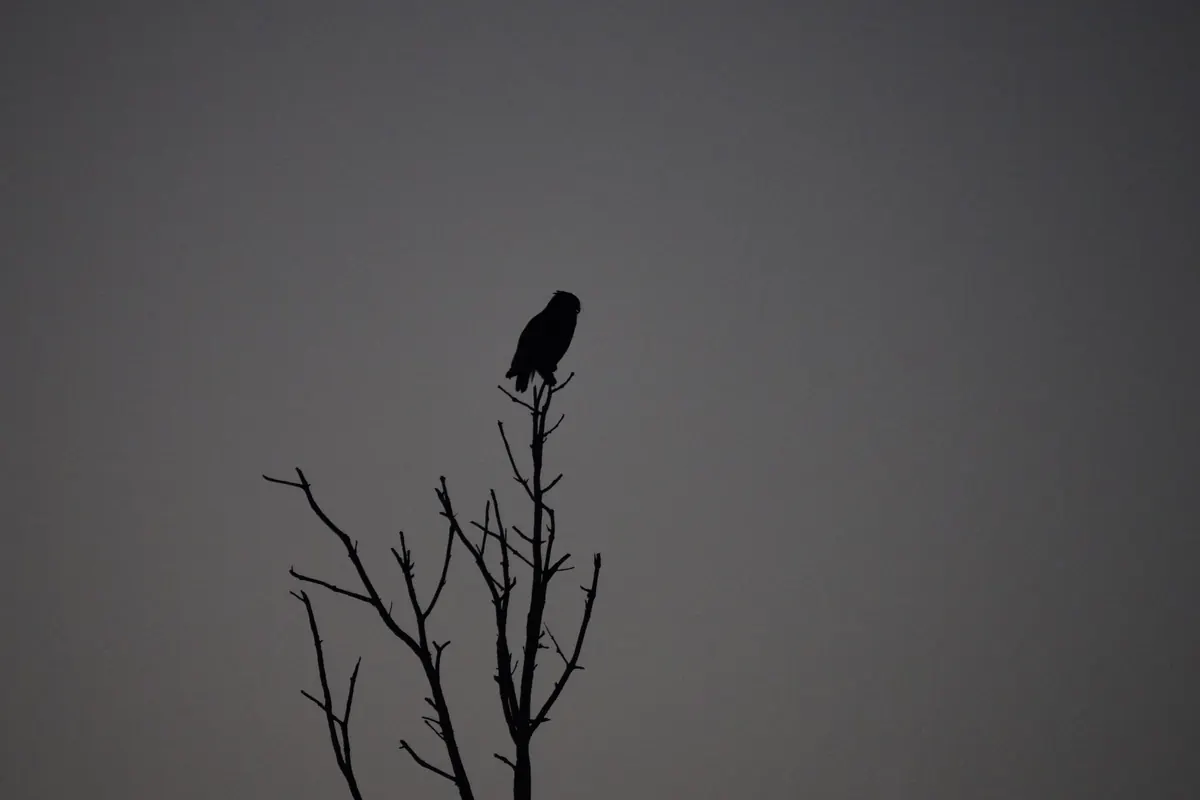
Long nights and bare branches make December a good owl month. The WVDNR's winter wildlife checklist names four owls you can find in the cold months: great horned, barred, eastern screech and the much scarcer barn owl. All of them are year-round residents, and the first three are calling now.
-
Great horned owls start the year's nesting
Hooting builds through December; eggs usually come between late January and March · Farm woodlots, river bottoms and suburban edges statewide
The great horned owl is one of the first birds of the year to nest, and in December mated pairs hoot back and forth at dusk to claim their territory, the male's voice a little deeper than the female's. They do not build their own nests: as the Virginia Department of Wildlife Resources notes, they usually take over an old hawk nest, and most are sitting on eggs by late winter. Listen just after sunset, a little past five o'clock this month, for a soft, rhythmic run of five or so deep hoots.
-
Barred owls in the hollows
Any month; most vocal on still nights · Wooded stream valleys, swamps and big bottomland forest
The barred owl's call is the one people imitate: a rolling eight-note phrase that sounds like a question about who is doing the cooking. Pairs often break into a raucous duet of cackles and caterwauls. Barred owls hunt along creeks in the big hardwood hollows of the Kanawha, Little Kanawha and Guyandotte valleys and also call in daylight on gray winter days.
-
Eastern screech owls in the backyard
All year; easiest to hear on calm December nights · Old trees in towns, parks, orchards and woodland edges
The eastern screech owl is only about the size of a robin and lives closer to people than most of us realize, often in a hollow limb or a wood-duck box. Its usual call is not a screech but a descending whinny and a long, level trill. The Three Rivers Avian Center, a raptor rehabilitation center in Summers County, brings live native owls, screech owls among them, to school and park programs around the state.
Where do West Virginia's bats, bears and groundhogs spend the winter?
December is when the state's sleepers settle in. They do it in very different ways: a groundhog shuts down almost completely, a black bear dozes lightly and can wake, and cave bats hang for months on stored fat that every disturbance burns.
-
Virginia big-eared bats in Pendleton County caves
Hibernation from late fall to spring · A handful of limestone caves in the Potomac Highlands, above all Hellhole in Pendleton County
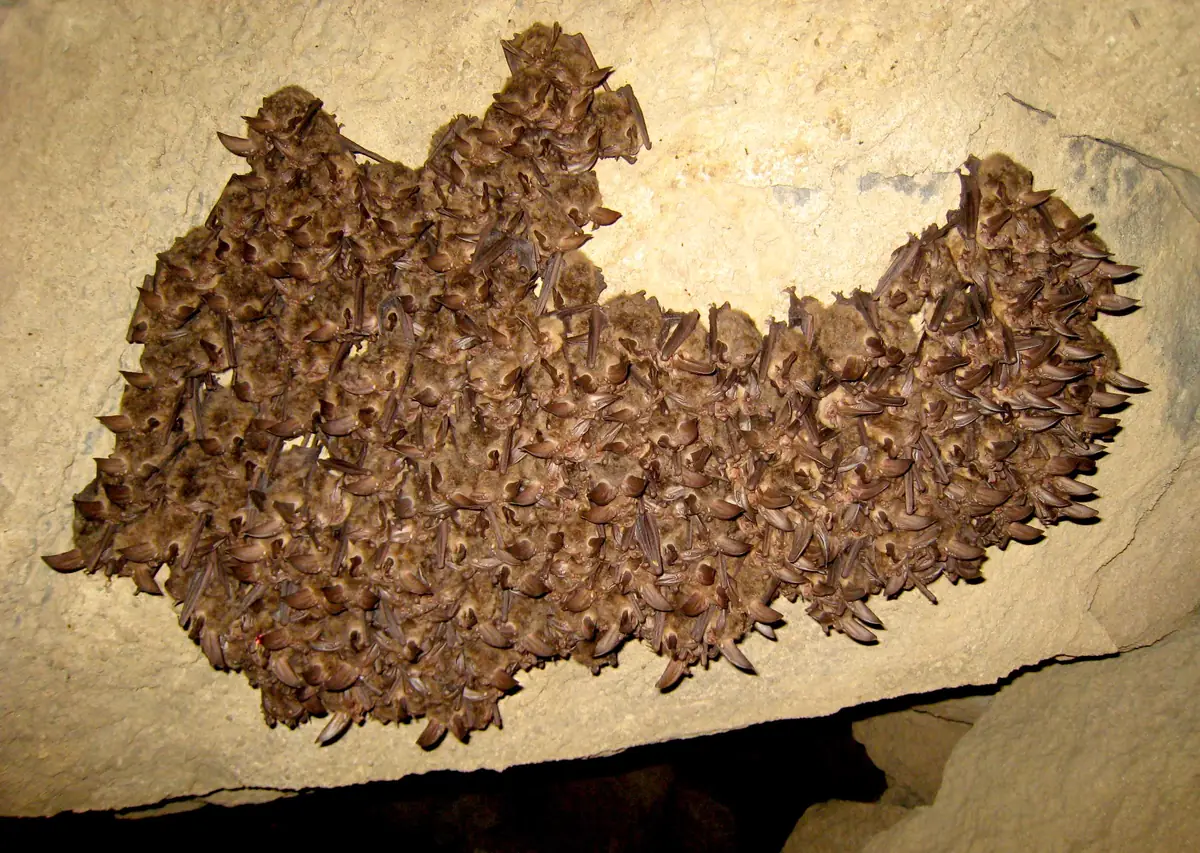
West Virginia holds more Virginia big-eared bats than any other state. This federally endangered bat has ears more than an inch long and two lumps on its nose, and most of the world's population hibernates in just three caves. According to the WVDNR fact sheet on the species, these bats wake more easily than most when people enter a cave, and every arousal burns fat they cannot replace until spring; repeated disturbance can starve them. In the DNR's winter 2016–17 survey, biologists counted 15,354 of them, the most on record, with more than 13,000 in Hellhole alone.
-
The cave bats that are still in trouble
All winter · Caves and old mines statewide
White-nose syndrome, named for the fungus that grows on the muzzles of sleeping bats, reached West Virginia caves in 2009. Infected bats burn through their fat too early and starve, and at some sites more than nine in ten died. Little brown, northern long-eared, Indiana and tricolored bats were hit hardest, while the Virginia big-eared bat has so far shown no sign of the disease.
-
Black bears in their dens
Most denned by December; cubs born in January · Rock crevices, hollow trees, dug-out holes and brush piles, mostly in the mountains
WVU Extension says the state's bears go into their dens from mid-November and come out from mid-March. Dens are not always caves: the DNR's bear project leader has described females digging out a hole in a hillside or curling up in the root mass of a fallen tree. Mothers give birth during the January denning period, and in March DNR crews visit some dens to weigh and measure the cubs.
-
Groundhogs, the true hibernators
Underground from late fall until about February · Burrows along field edges, fencerows and roadsides
Groundhogs are among the few animals that truly hibernate. In the WVDNR's description, a sleeping groundhog's body temperature falls to a few degrees above freezing and its heartbeat and breathing almost stop. The state's own weather groundhog, French Creek Freddie, sleeps through December at the West Virginia Wildlife Center in Upshur County, where the outdoor trail stays open daily through the winter.
What lives in West Virginia's snowy high country in winter?
Above about 3,000 feet, from Tucker and Grant counties south along the Allegheny Front to Greenbrier County, the state has a sliver of the north woods: red spruce, yellow birch and bogs, with the plants and animals that go with them. December snow turns this country into its own small world, and many of its animals are at the southern edge of their range here.
-
Snowshoe hares in white
White coats from about late fall to spring · Dense spruce, rhododendron and young forest in the highest parts of Tucker, Randolph, Pocahontas and Greenbrier counties
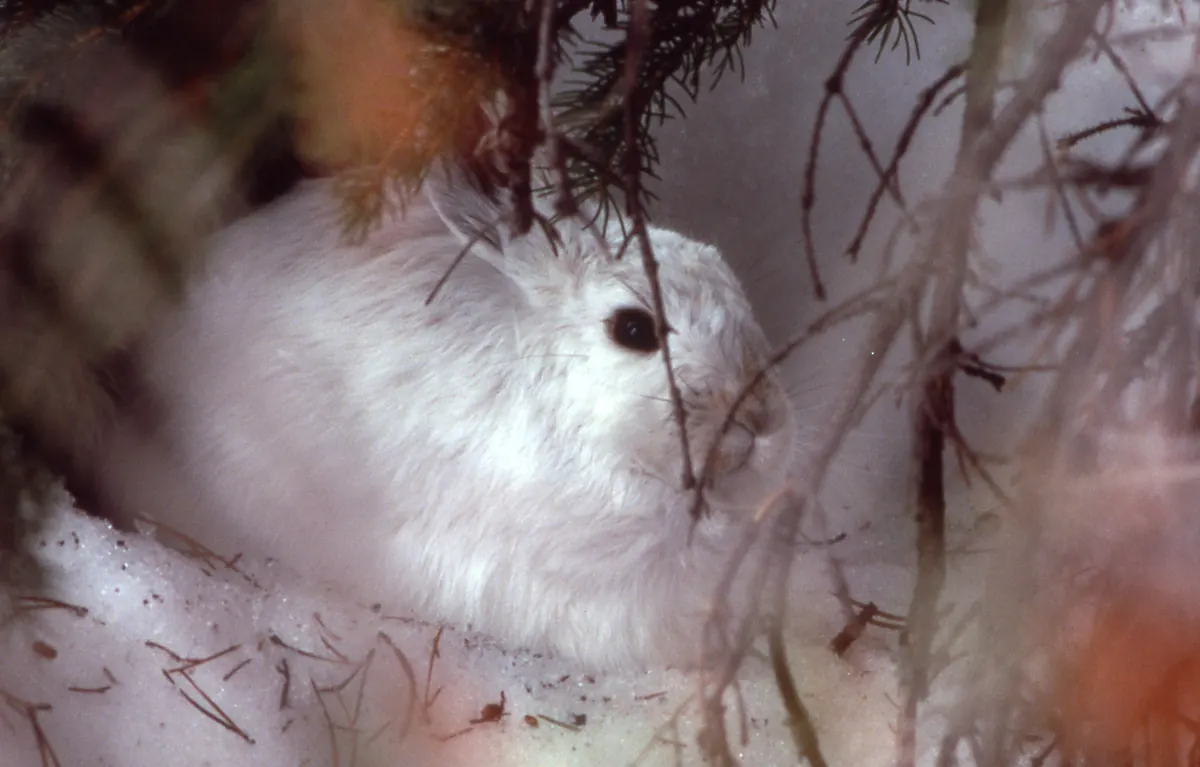
West Virginia is the southern tip of the snowshoe hare's range. The hares live in thick, low cover rather than burrows and change from brown to white for the winter. Because snow here comes and goes, a white hare on bare brown ground is easy for a hawk or bobcat to spot, and researchers are studying how well the state's hares keep their timing as winters shift. The WVDNR has been running a four-year study of where they live and how many there are, using trail cameras and droppings. You will rarely see one, but after a fresh snow their big hind-foot prints, in sets of four, are easy to find along the edges of spruce thickets.
-
Ruffed grouse at night
All winter · Young forest, laurel and rhododendron thickets and conifers on the mountains
Farther north, grouse dive into deep, soft snow and roost under it, where it is much warmer than the open air. A study of grouse night roosts in the central Appalachians found that the snow here is rarely deep or fluffy enough for that, so grouse sleep on the ground or tuck into evergreens, brush piles and leaf litter instead. Young, brushy forest, which grouse need, has grown scarce here, and their numbers have fallen sharply since the late 1980s.
-
Red spruce coming back
Evergreen all year · Cheat Mountain, Canaan Valley, Spruce Knob, the Allegheny Front and Cranesville Swamp
Logging and the fires that followed it in the late 1800s and early 1900s cleared nearly all of the state's red spruce. The Nature Conservancy says about 55,000 acres remain of an original forest of nearly a million, and that some 240 rare plants and animals depend on what is left, including the Cheat Mountain salamander and the West Virginia northern flying squirrel. Through the Central Appalachian Spruce Restoration Initiative, the conservancy and its partners now plant more than 100,000 trees a year, on places like the old strip-mined Mower Tract on Cheat Mountain.
Which evergreens stand out in West Virginia's winter woods?
Once the hardwoods are bare, the woods are mostly gray and brown, and the evergreens jump out. Three of them have December stories worth knowing.
-
Great rhododendron, the leaf thermometer
Every cold morning, December through February · Stream banks and shady north slopes all over the mountains; state parks such as Audra, Watoga, Holly River, Blackwater Falls and Pipestem
West Virginia's schoolchildren voted the great rhododendron (Rhododendron maximum) the state flower, and the Legislature made it official in 1903. In winter its long, leathery leaves move with the temperature. Research led by Virginia Tech's Erik Nilsen found that they begin to curl at about 32 °F to 28 °F, and that by about 21 °F most are rolled tight; they also droop so they hang nearly straight down. The leading explanations are that curled, hanging leaves are shielded from bright winter sun while frozen, and that rolling slows how fast a leaf thaws after a hard freeze.
-
Hemlocks and the white wool
Wool masses show from late fall through spring · Cool ravines, stream banks and north slopes statewide; hemlocks are about 1 percent of the state's forest overall but more in some counties
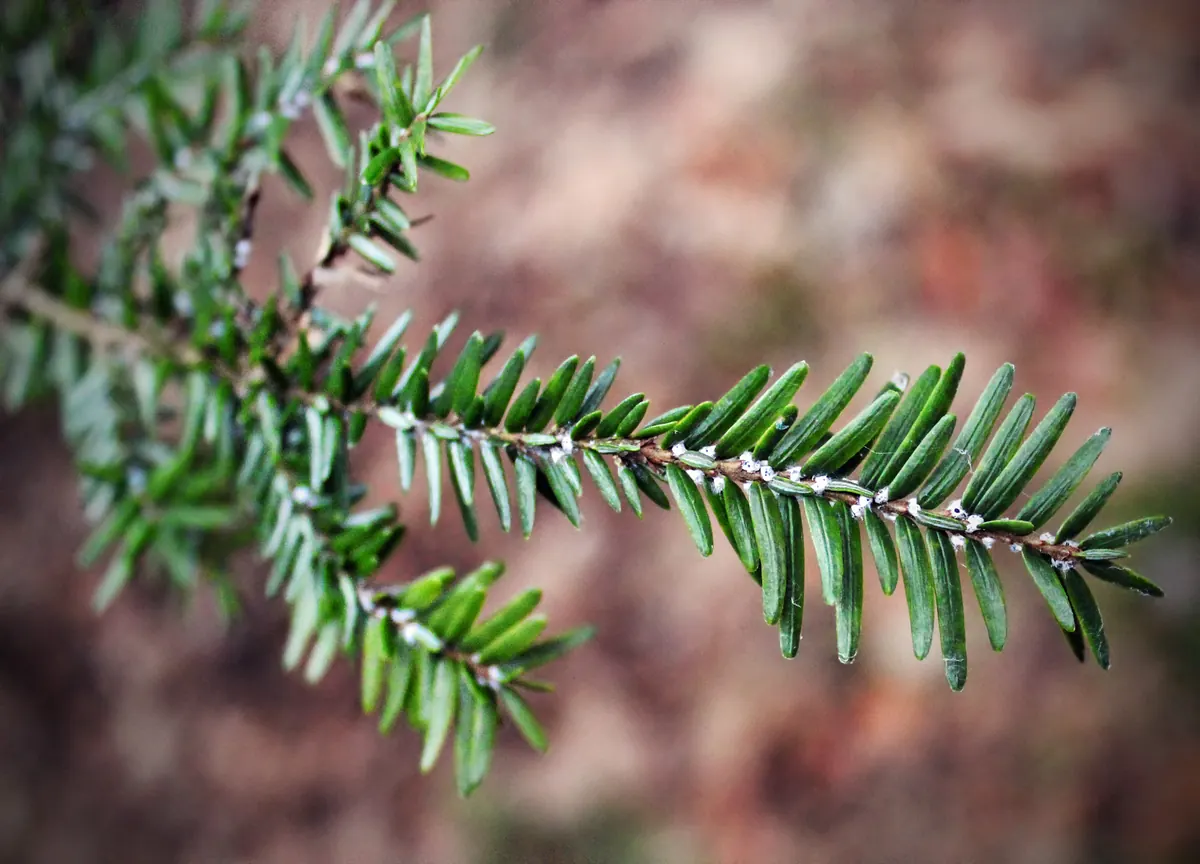
Flip up a low hemlock bough and check where each needle meets the twig. Tiny white tufts, about an eighth of an inch across, mean hemlock woolly adelgid, an aphid-like insect from Asia. The West Virginia Department of Agriculture first found it here in 1992, in Grant, Pendleton, Hardy and Hampshire counties, and it has since spread to all but Brooke and Hancock. The insect's winter generation is active from about October to June, which is why the white wool is easiest to see now. The state has treated high-value hemlocks in parks and forests and released beetles that prey on the insect.
-
Mistletoe in the treetops
Easiest to see from late fall through winter · High in hardwoods such as maples, oaks and elms, especially along streams and in valleys
American mistletoe grows in every one of the state's 55 counties. It is a semi-parasite that sinks rootlike strands into a branch for water and minerals while making its own food in its green leaves, and birds that eat its white berries spread its seeds from tree to tree. In summer the leaves hide it; in December the round green clumps stand out in bare crowns, often visible from the road. All of it is poisonous if eaten.
-
Cut your own tree in the Monongahela
Permits went on sale around December 1 last year · Greenbrier, Marlinton–White Sulphur and Gauley ranger districts only
The Monongahela National Forest sells one Christmas tree permit per household (sold on Recreation.gov or at a district office), and each one is good only on the district it names. Last season's rules allowed a single pine or spruce up to 12 feet tall and 4 inches thick at chest height, cut from a crowded clump at least 100 feet from a road; hemlocks, hardwoods, wilderness and campgrounds were off limits. Fourth graders with the federal Every Kid Outdoors pass got a free one. Check this year's terms when sales open, and wear orange, since deer seasons are still on.
How much snow does December bring in West Virginia, and what could El Niño do this winter?
Weather scientists count winter from December 1: in their bookkeeping, December through February is winter because that trio is coldest on average, while the solstice on the 21st marks the astronomers' version. In West Virginia, December snow is a matter of altitude. NOAA's 1991–2020 normals give Terra Alta in Preston County about 31 inches in an average December and Snowshoe almost 29, while Huntington averages less than 3. The Canaan Valley station near Davis has snow at least an inch deep on nearly 20 days of an average December, against about 3 in Charleston. Snowshoe is also the wettest station in the table, at more than 6 inches of precipitation for the month, largely because moist northwest winds are forced up the Allegheny Front and wring out their moisture there. When the garden catalogs arrive, the average last spring freeze for your town is on the West Virginia frost dates page.
| Station | Average high | Average low | Precipitation | Snowfall | Days with 1 in or more of snow on the ground |
|---|---|---|---|---|---|
| Snowshoe (Pocahontas County) | 34.1 | 19.8 | 6.22 | 28.8 | 17.3 |
| Terra Alta #1 (Preston County) | 38.5 | 22.7 | 4.64 | 30.9 | 16.1 |
| Davis 3 SE (Canaan Valley, Tucker County) | 36.4 | 21.2 | 5.52 | 28.3 | 19.5 |
| Bayard (Grant County) | 39.1 | 20.9 | 4.25 | 22.3 | 14.9 |
| Glady 1 N (Randolph County) | 39.3 | 20.6 | 4.28 | 20.2 | 15.8 |
| Elkins Randolph County Airport | 45.2 | 24.1 | 3.57 | 14.5 | 9.3 |
| Beckley Raleigh County Airport | 43.9 | 28.0 | 3.29 | 11.1 | 7.2 |
| Bluefield Mercer County Airport | 43.2 | 27.9 | 3.01 | 6.6 | 6.2 |
| Charleston Yeager Airport | 47.5 | 29.9 | 3.56 | 5.0 | 3.4 |
| Romney 1 SW (Eastern Panhandle) | 43.9 | 25.0 | 2.60 | 3.8 | 5.3 |
| Huntington Tri-State Airport | 46.7 | 30.4 | 3.57 | 2.7 | 2.0 |
This winter the tropical Pacific will have a loud voice. Pacific watchers at NOAA wrote on September 10 that the odds now top 90 percent for a very strong El Niño to rule this winter. For West Virginia, recent El Niño Decembers show how wide the range can be. December 2015, during the record-strong 2015–16 event, averaged 49.3 °F at Charleston, the warmest December there in records going back to 1885. Yet December 2009, during the 2009–10 El Niño, brought what the Charleston weather office calls Snowpocalypse: on December 18 to 20 a storm dropped 27.9 inches on Beckley, 19.9 inches on Elkins in a single day, and 10.3 inches on Charleston, whose 17.2-inch December still ranks fifth on its list. NOAA's analysts call El Niño mainly a snow suppressor across North America, most of all near the Great Lakes, yet a strong southern storm track can still send one big low up the Appalachians or the coast. NOAA's official winter outlook came out on October 15 and is updated monthly; the current maps are posted with the CPC three-month outlooks. For today's conditions before a drive over the mountains, check our weather page, and use the cloud guide to tell a thin cirrostratus veil, often the first sign of an approaching storm, from the low gray stratocumulus of a cold northwest flow.
When is the earliest sunset in West Virginia?
About two weeks before the shortest day. The tilt of Earth's axis and its slightly oval orbit shift solar noon later through December, so evenings bottom out early in the month and mornings keep darkening into January. Martinsburg, the easternmost town in the table, has the earliest sunset of the lot at 4:48 p.m. on December 7; Huntington's never comes before 5:09. In Charleston, sunset holds at 5:06 p.m. for the first week of December, edges to 5:09 by the solstice and reaches 5:16 on New Year's Eve, while sunrise keeps sliding later, from 7:25 a.m. on December 1 to 7:40 at the solstice and 7:44 by early January. At the solstice (Monday, December 21, 3:50 p.m. EST), Wheeling has 9 hours 20 minutes between sunrise and sunset and Bluefield 9 hours 36 minutes.
| City | Dec 1 | Dec 21 | Dec 31 | Earliest sunset |
|---|---|---|---|---|
| Wheeling | 9 h 32 m | 9 h 20 m | 9 h 22 m | 4:57 p.m., Dec 8 |
| Morgantown | 9 h 35 m | 9 h 22 m | 9 h 26 m | 4:55 p.m., Dec 7 |
| Martinsburg | 9 h 36 m | 9 h 23 m | 9 h 26 m | 4:48 p.m., Dec 7 |
| Parkersburg | 9 h 37 m | 9 h 24 m | 9 h 27 m | 5:03 p.m., Dec 7 |
| Elkins | 9 h 39 m | 9 h 27 m | 9 h 29 m | 4:57 p.m., Dec 7 |
| Charleston | 9 h 41 m | 9 h 29 m | 9 h 33 m | 5:06 p.m., Dec 7 |
| Huntington | 9 h 41 m | 9 h 30 m | 9 h 32 m | 5:09 p.m., Dec 7 |
| Bluefield | 9 h 48 m | 9 h 36 m | 9 h 38 m | 5:07 p.m., Dec 6 |
By December 31 every town has gained back two to four minutes since the solstice, all of it in the evening. For sun times and twilight at your own address, use the daylight calculator; November's numbers are in the West Virginia November guide.
What can you see in West Virginia's night sky in December 2026?
December has the longest nights of the year, and the state's three International Dark Sky Parks, all in Pocahontas County (Watoga, the adjoining Calvin Price forest, and Droop Mountain), make the most of them. The new moon falls at 7:52 p.m. EST on Tuesday, December 8, so the first half of the month has the darkest evenings. The Quadrantid shower, peaking late on January 3, will also have dark skies.
-
The Geminids
Best from mid-evening on Sunday, December 13, until dawn on Monday, December 14 · The whole sky; the radiant, near the bright stars Castor and Pollux, rises in the east-northeast at dusk
The International Meteor Organization rates the Geminids at a zenithal hourly rate of about 150, a theoretical number for an ideal sky with the radiant straight up; under real rural skies, several dozen an hour is a good result. The crescent moon sets in mid-evening, and after that the sky stays dark while rates build with the climbing radiant, peaking near 2 a.m. Geminids are slower than most meteors and often yellowish.
-
Venus at dawn, Saturn at dusk
All month · Venus low in the southeast before sunrise; Saturn in the south and southwest after dark
Venus blazes before sunrise all month, outshining everything but the moon, and its angle from the sun keeps widening until January 3. Before sunup on the 4th and 5th, the old crescent moon and Spica keep it company. In the early evening only one planet shines: ringed Saturn, sinking toward the southwestern hills a little sooner each night. Jupiter rises by mid to late evening by the end of December, and reddish Mars climbs in the morning sky. On solstice evening the waxing moon slides past the Pleiades star cluster.
-
The Cold Moon, the closest full moon of 2026
Full at 8:28 p.m. EST on Wednesday, December 23; nearly as full on Christmas Eve · Rising in the east-northeast around sunset
The moon reaches perigee, its nearest point for the month, about seven hours after it turns full, so this is the closest, largest-looking and brightest full moon of 2026; EarthSky gives its distance as about 356,740 km. It rides higher in the sky than any other full moon, because a winter full moon sits where the summer sun does. The Ursid meteor shower peaks the night before, December 22, but the nearly full moon will wash most of its few meteors out. Follow the phases night by night on the moon calendar.
| Phase | Date | Time |
|---|---|---|
| Last quarter | Tuesday, Dec 1 | 1:08 a.m. |
| New moon | Tuesday, Dec 8 | 7:52 p.m. |
| First quarter | Thursday, Dec 17 | 12:42 a.m. (late on the night of Wednesday, Dec 16) |
| Full moon, the Cold Moon | Wednesday, Dec 23 | 8:28 p.m. |
| Last quarter | Wednesday, Dec 30 | 1:59 p.m. |
| New moon | Thursday, Jan 7, 2027 | 3:24 p.m. |
What can West Virginia families do outdoors in December?
- Tuesday, December 1: start a winter log. It is the first day of meteorological winter. Put a thermometer by a window that looks at a rhododendron or any evergreen, and write down the temperature and what the leaves are doing every morning for a week.
- Early December: a rhododendron walk. Any state park with a stream will do; Audra, Holly River and Blackwater Falls have big stands. Find leaves that are flat, drooping and curled, and see who can guess the temperature closest.
- Saturday and Sunday, December 5–6: moonless evenings. With new moon on the 8th, bring binoculars to Watoga or Droop Mountain and find the Pleiades and the Andromeda Galaxy.
- Sunday night, December 13: the Geminids. Older kids can stay up past moonset; younger ones can watch for the first bright meteors between 9 and 10 p.m.
- Mid-December into early January: a bird count. Most West Virginia counts welcome beginners and families; contact the compiler listed by the Brooks Bird Club, or count the feeder birds if you live inside a circle.
- Any day: visit French Creek Freddie. The West Virginia Wildlife Center near French Creek in Upshur County is open daily from 9 a.m. to 3 p.m. through March 31, with elk, bison, river otters, bears and a 1.25-mile accessible trail. Admission fees are posted for April through October only; call ahead to confirm winter terms.
- Monday, December 21: the solstice. Write down tonight's sunset time and compare it with New Year's Eve to see how much evening light comes back.
- December 23: a moonrise. The Cold Moon clears the eastern hills around sunset; after a snow, try a moonlit walk without a flashlight.
- Late December: a sled run. Last winter, the East Coast's longest sled run at Blackwater Falls State Park opened on December 18, weather permitting, with timed sessions and tickets sold online; watch the park's page for this season's opening.
- New Year's Day 2027: a guided hike. About twenty state parks and forests led free First Day Hikes this past January 1, part of a national America's State Parks program; the 2027 list usually appears in December.
Bird lists, moon sketches and snow tracks all fit in the Naturalist's Field Journal, and the monthly nature index covers the other states.
Safety notes for December in West Virginia
- Hunting seasons and blaze orange. The WVDNR's 2026–27 summary keeps deer hunters in the woods all month. The buck firearms season ends December 6 (it never opens in Logan, McDowell, Mingo or Wyoming counties), and antlerless firearms seasons follow on December 10–13 and 28–31 in selected counties. The muzzleloader season runs December 14–20 everywhere except those same four southern counties, and a youth, Class Q and Class XS antlerless weekend falls on December 26–27. Deer and bear archery and crossbow seasons last through December 31, and bear may be hunted with guns, with or without dogs depending on the county, from December 7 to 31 in many counties. The migratory bird summary has woodcock through December 8, Canada geese from December 8 and ducks from December 21. In any county with a gun or muzzleloader deer season under way, the youth weekend included, state law requires deer hunters on public land or someone else's land to wear an outer layer showing 400 or more square inches of orange, and the DNR applies that to bow and crossbow hunters too; farmers hunting deer on their own land are excused. Hunters may also go out on Sundays (on public hunting land, or on private land with the owner's written OK), so hikers need orange seven days a week, and so do their dogs.
- Stay off the ice. The WVDNR's winter fishing guide is blunt: even when lakes and ponds freeze during a long cold spell, it is never safe to walk on the ice. Keep children and dogs off frozen ponds, too.
- Mountain roads and short days. The highlands average several times the snow of the valleys, and roads over passes such as those on U.S. 33 and U.S. 219 can be icy when it is only raining in town. Sunset comes near 5 p.m. statewide and sooner behind a ridge: be on the trail by late morning, pack a headlamp and a spare layer, and leave your plans with a friend, since phones often lose signal in the mountains and gorges.
- Ice and falling limbs. Glaze, rime and heavy wet snow like December 2009's snap branches and power lines; skip the woods on windy days after an icing.
- Caves are closed for a reason. Disturbing hibernating bats can kill them. Obey closure signs and gates, and decontaminate gear between caves if you are a caver.
Sources
- National Audubon Society: join the Christmas Bird Count (127th count, December 14, 2026 to January 5, 2027)
- National Audubon Society: Christmas Bird Count history and circle map
- Brooks Bird Club: West Virginia Christmas Bird Counts (dates and compilers)
- Brooks Bird Club: West Virginia CBC archives
- WVDNR: West Virginia winter wildlife viewing checklist
- Project FeederWatch (Cornell Lab of Ornithology and Birds Canada)
- Virginia Department of Wildlife Resources: techniques for locating great horned owl and hawk nests
- Three Rivers Avian Center (owl programs and raptor rehabilitation)
- WVDNR and USDA NRCS: Virginia big-eared bat fact sheet
- U.S. Fish and Wildlife Service: Virginia big-eared bat
- West Virginia Highlands Conservancy: white-nose syndrome update (WVDNR winter 2016–17 survey)
- e-WV, the West Virginia Encyclopedia: bats
- WVU Extension: black bears
- WCHS: WV Wildlife, bear cubs study (WVDNR den checks)
- WVDNR: French Creek Freddie facts (groundhog hibernation)
- WVDNR: West Virginia Wildlife Center (hours, admission, animals)
- WV MetroNews: DNR engaged in study of the elusive snowshoe hare (February 9, 2024)
- Charleston Gazette-Mail: W.Va. snowshoe hare study links camouflage and climate changes
- Night roost selection during winter by ruffed grouse in the central Appalachians (journal article)
- Bay Journal: decline of ruffed grouse linked to loss of young-forest habitat
- The Nature Conservancy: restoring red spruce forests in West Virginia
- U.S. Forest Service: Mower Tract restoration project, Monongahela National Forest
- West Virginia Explorer: which rhododendron is the official state flower
- Journal of the American Rhododendron Society: does winter leaf curling confer cold stress tolerance in Rhododendron? (Nilsen)
- Nilsen: why do rhododendron leaves curl?
- e-WV, the West Virginia Encyclopedia: hemlock woolly adelgid
- Virginia Cooperative Extension: hemlock woolly adelgid
- West Virginia Public Broadcasting: Edible Mountain, mistletoe
- USDA Forest Service: mistletoes on hardwoods (Forest Insect and Disease Leaflet 147)
- Recreation.gov: Monongahela National Forest Christmas tree permit
- WDTV: Christmas tree permits available from Monongahela National Forest (December 1, 2025)
- NOAA NCEI: 1991–2020 monthly normals for West Virginia airport stations
- NOAA NCEI: 1991–2020 monthly normals for Snowshoe, Terra Alta, Davis, Bayard, Glady and Romney
- NOAA NCEI: U.S. climate normals, 1991–2020
- National Weather Service Charleston, WV: climate top ten for December at Charleston
- National Weather Service Charleston, WV: top snowstorms (December 18–20, 2009)
- Climate Prediction Center: ENSO diagnostic discussion, September 10, 2026
- Climate Prediction Center: Oceanic Niño Index (2009–10 and 2015–16 El Niño winters)
- Climate Prediction Center: seasonal (90-day) outlooks
- NOAA Climate.gov: how does El Niño affect snowfall over North America?
- Northeast Regional Climate Center: El Niño impacts in the Northeast (2015–16 review)
- U.S. Naval Observatory: moon phases from November 1, 2026
- U.S. Naval Observatory: Earth's seasons, 2026 (December solstice)
- International Meteor Organization: 2026 meteor shower calendar
- EarthSky: what is a supermoon? (2026 full supermoons)
- EarthSky: Venus at greatest western elongation
- Watoga Foundation: Watoga dark sky parks
- West Virginia State Parks: First Day Hikes
- West Virginia State Parks: Blackwater Falls sled run opening (2025–26 season)
- WVDNR: 2026–27 Hunting and Trapping Regulations Summary (deer, bear and small game seasons, blaze orange, Sunday hunting)
- WVDNR: hunting season dates
- WVDNR: 2026–27 Migratory Bird Hunting Regulations Summary (duck, goose and woodcock dates)
- WVDNR: your guide to winter fishing in West Virginia (ice safety)
- West Virginia Code §20-2-60: fluorescent orange for deer hunters
- West Virginia Code §20-2-5: Sunday hunting on private land with written consent and on public land
- Photos via Wikimedia Commons; licenses and photographers are credited under each picture
