What to look for in nature in West Virginia this February
Meteorological winter closes at the end of February, though few West Virginians would call it over. The Canaan Valley plateau still averages more than three feet of snow this month, and the record snowiest Februaries at Charleston and Elkins both came in 2010. Yet under the cold, the new season is already moving. Bald eagles settle onto their eggs by midmonth, rarely seen golden eagles from Quebec still patrol the mountain counties, and on the first mornings that follow a freezing night with a thaw, sap starts to drip from maple taps. Groundhogs stir, and the first rainy nights after a thaw send wood frogs and spotted salamanders to their woodland pools. Overhead, Jupiter and Mars each reach opposition, and the Snow Moon rises on the 20th with a faint eclipse already under way. Here is the month, one story at a time.
Other months in West Virginia: October, November, December, January.
Start here

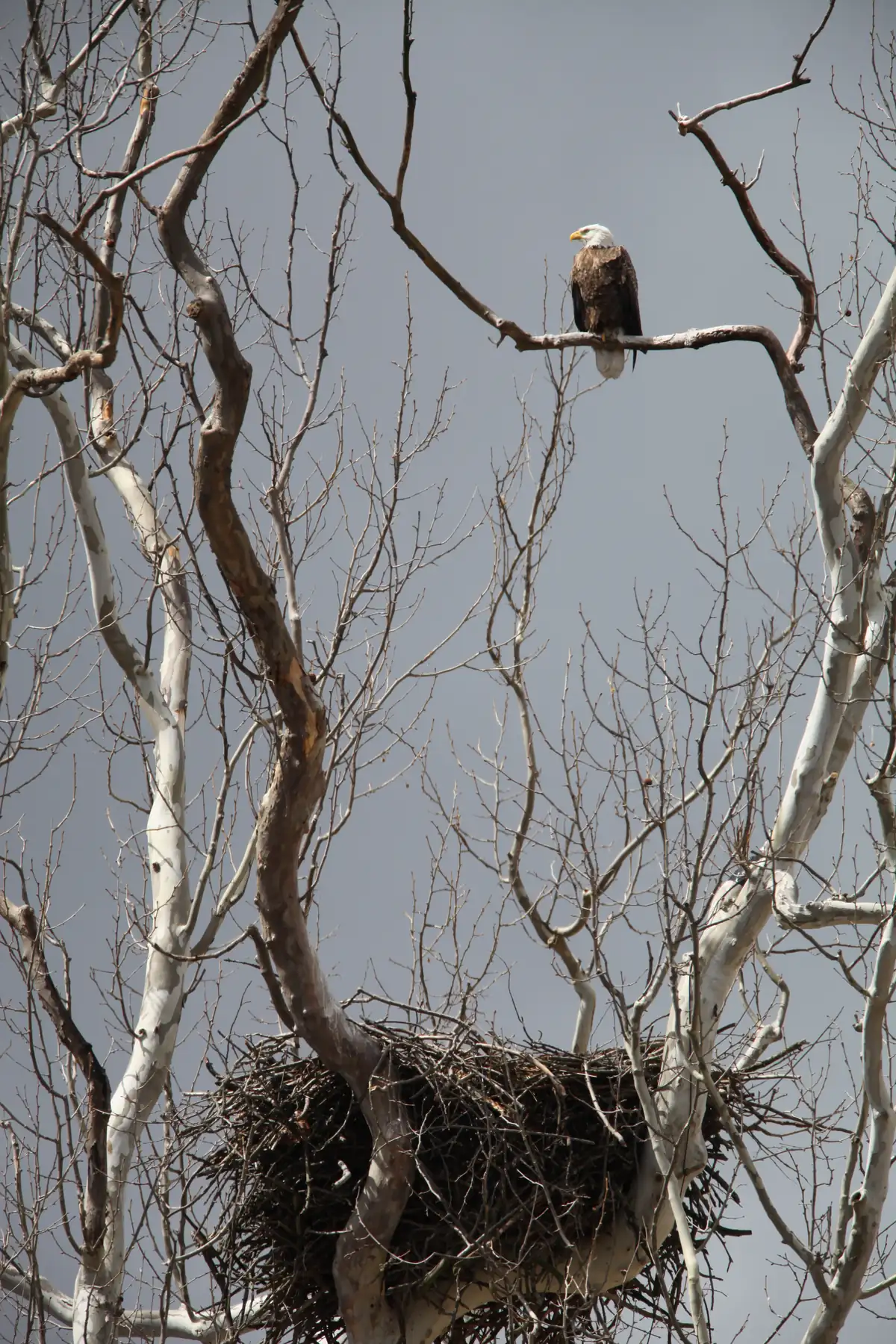
- Watch an eagle sit on eggs. Open the NCTC eagle cam from Shepherdstown from mid-February on. Most of what you will see is a patient adult flattened into the nest cup through snow and wind, trading places with its mate every few hours.
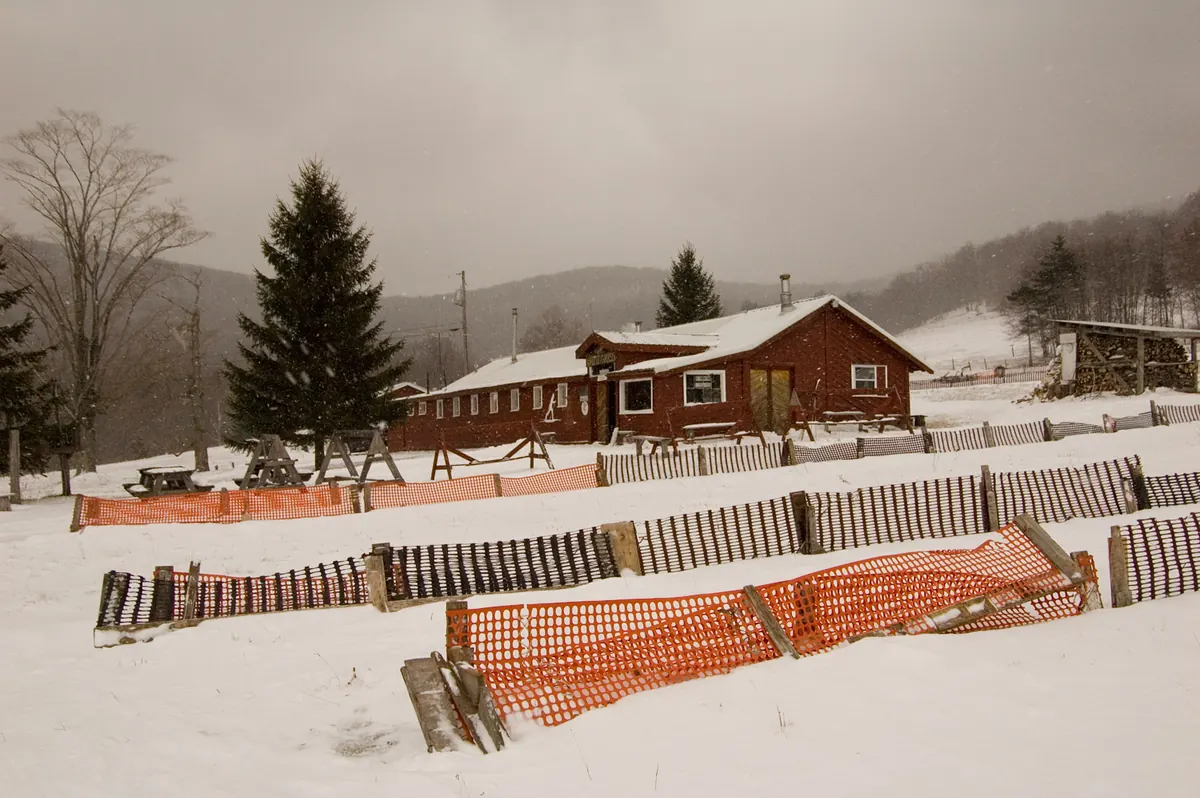
- Visit a sugar shack. On a morning after a hard frost, when the afternoon will climb above freezing, find a maple producer boiling sap. Mountain State Maple Days usually opens sugarhouses statewide on the third Saturday of February; check the producers' association for 2027.
- Listen at a woodland pool. After the first mild rain of late February, stand quietly at a flooded hollow or seasonal pond at dusk. A clucking, ducklike chatter means wood frogs have arrived to breed.
Keep February in the Naturalist's Field Journal: the eagle cam's egg dates and hatch watch on nest observed; each sap run, with that night's low and the next afternoon's high, on reading the signs; the first wood frog chorus and the date you heard it on a map of sounds; a silver maple twig in flower on a tree through the seasons, beside the bark you drew in January; and the Snow Moon rising on dusk and dawn watch.
Regions used below: Potomac Highlands and the Allegheny Mountains; Eastern Panhandle; Northern Panhandle and Morgantown; Mid-Ohio Valley; Kanawha Valley and Charleston; Huntington and the Metro Valley; New River Gorge and the southern coalfields.
When do bald eagles lay eggs in West Virginia, and where do golden eagles spend the winter?
The eagle story moves on this month. The stick-carrying of January turns into incubation, and the state's most famous pair does it on camera. Meanwhile a second, much rarer eagle spends the whole winter in the mountain counties, and most West Virginians never know it is there.

-
Eggs in the Shepherdstown nest
Eggs usually laid in the second half of February; hatching follows about 35 to 38 days later, in late March or early April · The U.S. Fish and Wildlife Service's National Conservation Training Center near Shepherdstown, Eastern Panhandle, about a quarter mile from the Potomac
A pair of bald eagles began building a nest high in a big sycamore on the training center grounds in 2003, and the Service has streamed it online since the 2006 season. According to the agency's own notes, the eggs usually come in the last two weeks of February and need 35 to 38 days of steady warming. In 2025 the female laid her three eggs on February 10, 13 and 16. That April a sudden windstorm tore the 22-year-old nest out of the tree, and the pair moved to an alternate nest they had built the previous fall, about 15 feet lower in the same sycamore. They used it in 2026: WV MetroNews reported two viable eggs after about 37 days of incubation, and both chicks hatched at the end of March. Expect the 2027 eggs in the second half of February again, though no one can promise a date. The cam, run with the Outdoor Channel and the Friends of NCTC, runs around the clock in nesting season.
-
Eagles sitting tight across the state
Through February and into March · Nests along the South Branch, the Ohio, Kanawha, Greenbrier and New rivers and their big lakes
A nest that looked empty in January may now have a white head showing just over the rim, low and motionless. That bird is incubating and must not be flushed. The DNR's eagle brochure notes that people at an active nest count as harassment under the law, and a first offense here is a misdemeanor with a fine of $500 to $5,000. Use a scope from a road or across the river.
-
Golden eagles in the high country
December through March; most leave for the north in spring · The mountains from Tucker County south to Monroe County, especially remote parts of the Monongahela National Forest
Eastern golden eagles nest in Quebec and Labrador and spend the winter in the central Appalachians, and West Virginia turns out to be one of their main winter homes. A West Virginia University researcher working with the DNR set out deer carcasses watched by motion-triggered trail cameras and found the state hosts more wintering golden eagles than almost anywhere east of the Mississippi; he guessed there were probably hundreds, which most residents never see. The DNR's brochure puts them mainly in the mountains from Tucker County south to Monroe, and Virginia's wildlife agency describes wintering birds as present from December through March, heading north in April and May. Golden eagles do not nest anywhere in the eastern United States today, so every one you see in February is a visitor from Canada.
-
Telling the two eagles apart
Any winter day · Ridgelines, high pastures and road-killed deer in the mountain counties
A golden eagle soars on flat wings with only an occasional beat, and its legs are feathered right to the toes. In good light the back of the head and neck shines a tawny gold. Young golden eagles carry a mostly white tail that ends in a broad dark band, plus white patches at the base of the outer wing feathers, a pattern no young bald eagle has; young bald eagles are blotched with white all over the underside instead. Golden eagles weigh 6 to 14 pounds and span 6 to 7.25 feet, according to the DNR. A dark eagle over a high ridge far from any big river is worth a second, careful look, and an eBird report.
When is maple syrup season in West Virginia?
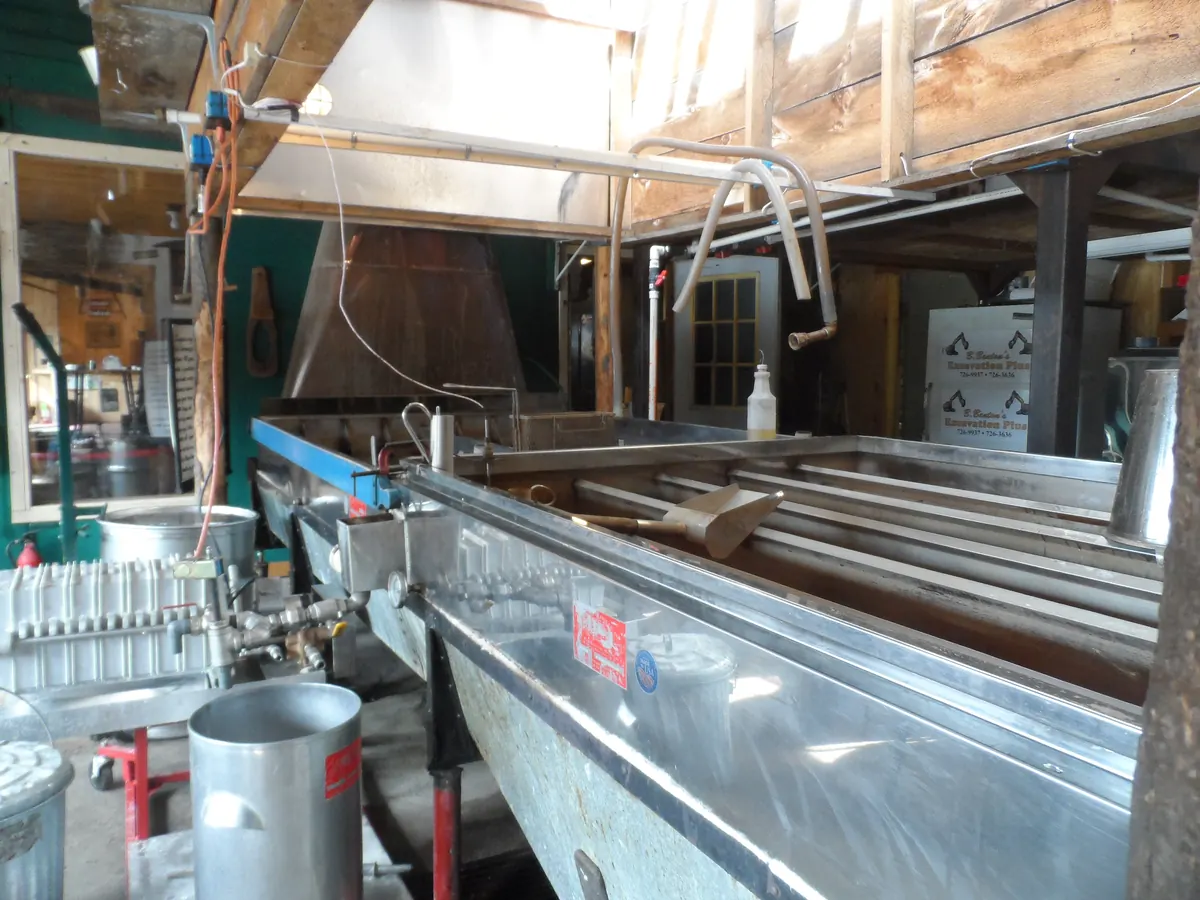
Right about now. In the state's tourism office's words, syrup makers race to reach the maples before the leaves do, in the late-winter weeks of February and March. Sap moves when nights freeze and days thaw: the swing in temperature builds pressure inside the trunk, and on a good afternoon a tap drips steadily into its bucket or line.
-
The sap run
Usually February into March; tapping starts as early as late January in some years · Sugar bushes statewide, from the Northern Panhandle to Monroe County, with many producers in the central and eastern mountains
The West Virginia Department of Agriculture counted about 69,000 taps and 11,000 gallons of syrup in the 2023 season, a dip from the year before that it blamed on unusually warm weather. Weather is everything. The agriculture commissioner described ideal sugaring conditions as nights that freeze and days that rise above freezing, and a string of warm nights stops the flow. You can watch for the pattern yourself: on a sunny afternoon after a hard frost, look for dark, wet streaks running down the bark below a broken branch or a sapsucker's row of holes on a roadside sugar maple.
-
Mountain State Maple Days
Usually the third Saturday of February and again in March; the 2027 dates have not been announced · Registered sugarhouses across the state, from Bruceton Mills and Wheeling to Franklin and Alum Creek
The West Virginia Maple Syrup Producers Association, with Future Generations University in Pendleton County, opens member sugar shacks to the public for one Saturday in February and one in March. Visitors walk the sugar bush, watch sap boil down in the evaporator and taste the result, and local restaurants and shops join in with maple dishes. The state tourism office calls it the only statewide festival in West Virginia held over more than one weekend. Because tapping starts at different times in different places, not every producer is boiling on the February day; the association's participant list shows who is open. In 2026 the dates were February 21 and March 21.
-
Sycamore and black walnut syrup
Winter and early spring, often earlier than maple · Stream banks and river bottoms; research sites at Lewisburg, Hillsboro and Alum Creek
West Virginia producers have been experimenting with trees other than maple. A federally funded project led by Future Generations University tapped sycamores, the pale riverbank trees of the January bark walk, at Lewisburg, Hillsboro and Alum Creek. It found that sycamore sap runs best in long cold spells, needs vacuum tubing to flow at all, and averages only about half a percent sugar, far less than maple, so the researchers suggested tapping earlier than for maples and blending the syrup with maple. Black walnut syrup is a smaller specialty that sells for a high price. Ask at a Maple Days sugarhouse whether they make either.
What happens on Groundhog Day in West Virginia, and when is the real middle of winter?
Groundhogs are true hibernators, and for most of the winter their bodies run barely above freezing. February is when that begins to change, and West Virginia has its own furry forecaster to mark the moment.
-
French Creek Freddie
Tuesday, February 2, 2027; check the DNR for the time · West Virginia Wildlife Center, French Creek, Upshur County
West Virginia's Groundhog Day tradition began in 1978, when the superintendent of the state's wildlife center named the resident groundhog French Creek Freddie while answering a reporter's question. The DNR admits his forecasts have been right about half the time over the past 40 years. On February 2, 2026, the 49th celebration, Freddie saw his shadow on a clear, bitterly cold morning, which the Charleston Gazette-Mail called possibly the coldest Groundhog Day in the event's history, in front of a crowd that included the governor, while Concord Charlie, the groundhog on Concord University's campus in Mercer County, did not. With nearly 30 kinds of native wildlife on its 338 acres, the center makes a good winter outing on any day.
-
Groundhogs on the move
Late February and March; young are born from early April to mid-May · Field edges, pasture banks, road cuts and stone walls statewide
Freddie's real-world cousins are not checking shadows. Cornell Cooperative Extension says woodchucks leave hibernation in late February or March, with the males up first, traveling from burrow to burrow to find females before the breeding season begins. After about a month's gestation, a litter of usually four young arrives in April or May. On a mild late-February afternoon, look for a fresh mound of soil at a burrow entrance on a sunny bank, or a groundhog sitting upright beside it, thin after the long sleep.
-
The true midpoint of winter
February 3 to 4, 2027 · Everywhere
Groundhog Day is a cross-quarter day, one of the traditional dates that split each season in half, but by the sun's clock it runs a little early. In 2027 the sun reaches the exact halfway point along its yearly path on the evening of Wednesday, February 3, Eastern time, while splitting the calendar time from the solstice of December 21 to the equinox of March 20 lands before dawn on Thursday, February 4. Either way, by the first week of February half of astronomical winter is behind you.
When do frogs and salamanders start breeding in West Virginia?
West Virginia has 34 species of salamanders, along with a long list of frogs and toads, and several of them start breeding before winter is out. A mild February can bring the first of them out in its final days; a cold one holds them back until March. The trigger is the same either way: a run of nights above freezing, often with rain.

-
Wood frogs, the first chorus
The DNR's earliest recorded breeding date is February 20; most years it is March · Shallow, seasonal woodland pools and flooded hollows in river floodplains, statewide
Wood frogs are frogs of the north woods that reach their southern limit in the Appalachians and live in every part of West Virginia. The DNR says they gather at their breeding pools after the first several nights in a row above freezing, and that the earliest breeding ever recorded in the state was on February 20. The males float spread-eagled on the surface and call with paired sacs on the sides of the body, a sound naturalists compare to quacking ducks. A pool may be busy for only a few days to two weeks. If a cold snap seals it under new ice, the frogs simply sink to the bottom and wait, and the eggs come through unharmed. At the West Virginia Botanic Garden in Morgantown, staff write that the wood frogs and spring peepers generally wake up around the end of February.
-
Spotted salamanders on rainy nights
Rainy nights from late February through mid-March · Woods around vernal pools in every county, from the highest elevations to the lowest
The spotted salamander, a slate-colored animal up to eight inches long, spotted in yellow down the back in two irregular rows, is the state's most common mole salamander. It spends the year underground and comes up only to breed. On the first warm, rainy nights of late winter, adults leave their burrows together and walk to the same pools where the wood frogs are calling, and each female lays up to 250 eggs in jelly masses that are usually cottony white. The DNR asks drivers to slow down on wet late-winter nights near woodland ponds and, when it is safe, to carry a salamander across the road in the direction it was heading.
What blooms first in West Virginia at the end of winter?
Long before the woods turn green, a few plants flower on bare branches or straight out of cold mud. Most of them are easy to miss unless you know where to look.
-
Silver maple
Can begin in February in a mild spell; more often late February and March in the lowlands · River bottoms and floodplains, especially along the Ohio, Kanawha and Potomac, and as street trees in town
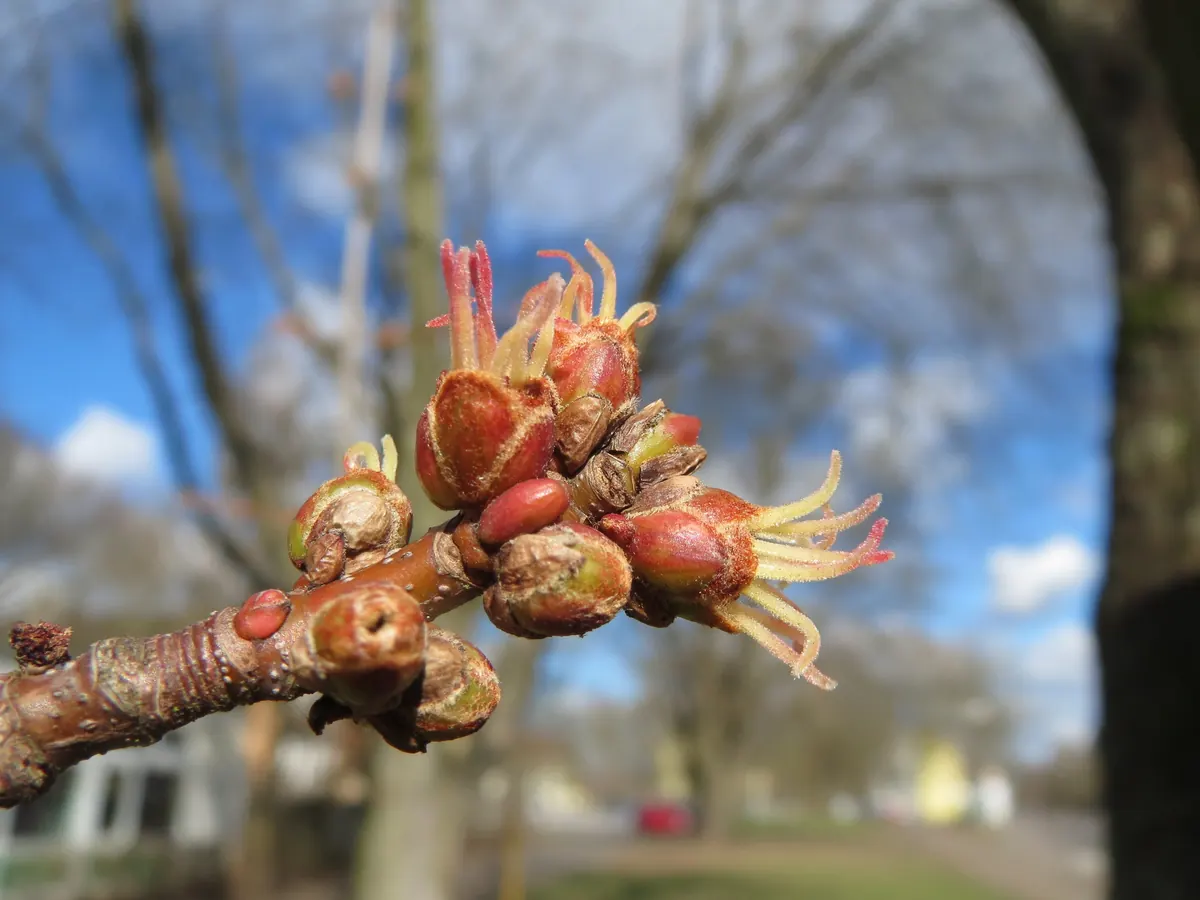
The Forest Service's silvics manual calls silver maple the first maple in North America to bloom, beginning as early as February. The flowers have no petals; they are small, tight clusters of reddish to greenish-yellow that cover the twigs and give a whole riverbank a faint red haze. They come weeks before any leaves, and the winged seeds ripen in spring. Red maple follows close behind. The same manual calls it one of the first trees to flower in spring, several weeks before its leaves open, with the small red blossoms appearing from March to May depending on place and elevation.
-
Skunk cabbage, the plant that makes heat
The main bloom is March and April; in a mild year the first hoods may poke up in late February · Seeps, wet woods and spring-fed swamps, mainly in the eastern half of the state (recorded in 23 counties)
Skunk cabbage pushes a mottled, purple-brown hood through cold mud, often while snow still lies around it. Inside the hood is a knob of tiny flowers that warms itself: the DNR's magazine quotes a West Virginia Wesleyan botanist who says the air inside the spathe can reach 68 °F, and the plant keeps up its heating for 12 to 14 days. The warmth and a faint smell of carrion draw the first flies and gnats of the year. Look for a ring of melted snow around a hood on a frosty morning.
How snowy is February in West Virginia, and what could El Niño do?
February brings a little less snow than January almost everywhere, but not much less in the mountains. In NOAA's 1991–2020 normals, the station near Davis in Canaan Valley still averages 43 inches in February and has snow cover of at least an inch on about 23 February days. In the Eastern Panhandle, Romney actually averages more snow in February (9.7 inches) than in January. Along the Ohio, Huntington's February average is under 6 inches.
Single Februaries can be brutal. The Weather Service office in Charleston lists February 2010 as the snowiest February on record at both Charleston (25.6 inches) and Elkins (43.8 inches), and February 1978 as the coldest at both, with an average temperature of 24.2 °F at Charleston and 16.6 °F at Elkins.
| Station | Average high | Average low | February snowfall | March snowfall | February days with at least an inch of snow cover |
|---|---|---|---|---|---|
| Davis 3 SE (Canaan Valley, Tucker County) | 34.9 | 17.5 | 43.1 | 26.0 | 23.3 |
| Terra Alta #1 (Preston County) | 37.5 | 19.5 | 36.3 | 28.2 | 19.2 |
| Snowshoe (Pocahontas County) | 31.8 | 15.9 | 31.4 | 27.2 | 21.5 |
| Bayard (Grant County) | 38.2 | 18.2 | 30.1 | 19.6 | 19.7 |
| Glady 1 N (Randolph County) | 38.5 | 17.2 | 24.0 | 17.5 | 18.6 |
| Elkins Randolph County Airport | 45.1 | 22.0 | 15.4 | 11.4 | 10.8 |
| Beckley Raleigh County Airport | 44.2 | 26.6 | 15.2 | 8.9 | 8.3 |
| Romney 1 SW (Eastern Panhandle) | 44.2 | 23.0 | 9.7 | 7.5 | 9.6 |
| Bluefield Mercer County Airport | 43.4 | 26.5 | 8.8 | 6.5 | 8.1 |
| Charleston Yeager Airport | 47.8 | 28.6 | 7.7 | 5.9 | 5.4 |
| Huntington Tri-State Airport | 47.3 | 29.1 | 5.8 | 4.3 | 4.3 |
This winter comes with an unusual backdrop. Out over the equatorial Pacific, warm water has been piling up, and in mid-September NOAA's ENSO team (discussion dated the 10th) placed the likelihood of a top-tier event spanning autumn and the winter months north of 90 percent. What that means for a West Virginia February is far from settled. The record February 2010 snows fell during the 2009–10 El Niño, according to NOAA's Oceanic Niño Index, and the Northeast Regional Climate Center notes that nor'easters tend to be more frequent when El Niño is in place, above all in strong events; it names the Presidents' Day snowstorm of February 2003 among the big storms of El Niño years. On the other side of the ledger, the Charleston Weather Service office studied every El Niño winter from 1950 onward, 16 in all, and found that December through February averaged 1.2 °F colder than normal, a little drier, and only modestly snowier (26.5 inches against a normal of 24.4); none of those averages would place on the city's top-ten lists. NOAA’s winter maps come out in mid-October and get revised around the middle of every month after that; the newest maps are posted on the CPC's 90-day outlook page. Before heading into the mountains, check our weather page for current conditions, and learn from our cloud guide how a lumpy, harmless stratocumulus deck differs from the smooth, thickening gray sheet that often comes before snow. Planning a garden? Our West Virginia frost dates give each town's usual last frost of spring, the date most seed packets count from.
How much daylight does West Virginia gain in February?
By February the lengthening days are hard to miss. Each city listed gains roughly an hour of daylight over the month, between 59 and 65 minutes, or a little more than two minutes a day, and the gain per day is still increasing; it tops out at the March equinox. Wheeling, the northernmost, gains the most: from 10 hours 10 minutes on February 1 to 11 hours 15 minutes on the 28th. Bluefield, the farthest south, starts the month with the longest day, 10 hours 21 minutes, but adds only 59 minutes to finish at 11 hours 20 minutes, so the gap between the state's two ends shrinks from 11 minutes to 5. Charleston and Huntington go from 10 hours 17 minutes to 11 hours 19 minutes. Mornings and evenings now share the gain, with dawn arriving a bit sooner and dusk a bit later each day.
| City | Feb 1 | Feb 28 | Gained | Per day |
|---|---|---|---|---|
| Wheeling | 10 h 10 m | 11 h 15 m | 65 min | 2.4 min |
| Morgantown | 10 h 12 m | 11 h 16 m | 64 min | 2.4 min |
| Martinsburg | 10 h 13 m | 11 h 17 m | 64 min | 2.4 min |
| Parkersburg | 10 h 14 m | 11 h 16 m | 62 min | 2.3 min |
| Elkins | 10 h 15 m | 11 h 18 m | 63 min | 2.3 min |
| Charleston | 10 h 17 m | 11 h 19 m | 62 min | 2.3 min |
| Huntington | 10 h 17 m | 11 h 19 m | 62 min | 2.3 min |
| Bluefield | 10 h 21 m | 11 h 20 m | 59 min | 2.2 min |
To see the minutes add up for your own hollow or hilltop, plug it into the daylight calculator.
What can you see in West Virginia's night sky in February 2027?
This month has two planets at opposition, Mercury's finest dusk showing of the winter, and a full moon that comes up already touched by Earth's shadow. For faint stars and star clusters, aim for the evenings before about the 11th, bracketing the new moon of Saturday, February 6. That new moon also brings an annular eclipse of the sun, seen only from the far side of the equator, in South America and Africa; West Virginia gets none of it. Times are Eastern Standard Time.
-
Mercury after sunset
Best from late January to about February 10; greatest elongation on Wednesday, February 3 · Low in the west-southwest, 30 to 45 minutes after sunset
Mercury reaches its widest separation from the sun, about 18 degrees, in the small hours of February 3, which makes the 2nd and 3rd the prime evenings. You need a clear, flat western horizon, which in the hills often means a hilltop, a big field or a river view. On Sunday the 7th a hair-thin crescent moon, a day past new, hangs very close to Mercury in the twilight, a pretty pair for binoculars if you can find a low enough view.
-
Jupiter at opposition
Wednesday, February 10, at 7:21 p.m. · Rising in the east at sunset, high in the south around midnight, among the stars of Leo
Jupiter and the sun now stand on opposite sides of Earth; the planet climbs over the eastern hills at sundown, shines until dawn and reaches magnitude −2.5, brighter than any star. Rest binoculars on a porch rail and its four large moons may appear as specks in a row beside the disk, rearranged from one night to the next.
-
Mars at opposition
Friday, February 19; closest to Earth on the 20th · Rising in the east at dusk, also in Leo, not far from Jupiter
This is a modest opposition. Mars passes about 63 million miles from Earth, a long way by Mars standards, since the planet is approaching aphelion, its greatest distance from the sun, on March 4, and shows as a strong orange point of about magnitude −1.2, not a dazzling one. Its next close approach comes in 2029. On the 22nd it passes a few degrees north of Regulus, the brightest star in Leo, a handy pair to compare: Mars glows orange, Regulus blue-white.
-
The Snow Moon and a faint eclipse
Full on Saturday, February 20, at 6:23 p.m.; penumbral eclipse from 4:12 to 8:13 p.m., deepest at 6:13 p.m. · Rising low in the east-northeast around sunset
The February full moon, traditionally the Snow Moon, comes up around sunset on the 20th already inside Earth's pale outer shadow. The deepest part of this penumbral eclipse falls at 6:13 p.m., close to moonrise, so from West Virginia it happens with the moon low in a bright sky. A careful eye might catch a slight smoky tint along one side of the disk; many watchers will not spot any change at all. Is it a supermoon? A few almanacs say yes; EarthSky's stricter list leaves it off. That night Jupiter, Mars and Regulus all share Leo with the moon, and late on the 19th the almost-full moon slides right past Jupiter. Follow every phase on the moon calendar.
| Phase | Date | Time |
|---|---|---|
| Last quarter | Friday, Jan 29 | 5:55 a.m. |
| New moon (annular solar eclipse, not visible from the U.S.) | Saturday, Feb 6 | 10:56 a.m. |
| First quarter | Sunday, Feb 14 | 2:58 a.m. |
| Full moon, the Snow Moon (penumbral lunar eclipse) | Saturday, Feb 20 | 6:23 p.m. |
| Last quarter | Sunday, Feb 28 | 12:16 a.m. |
| New moon | Monday, Mar 8 | 4:29 a.m. |
What can West Virginia families do outdoors in February?
- Tuesday, February 2: Groundhog Day at French Creek. Freddie emerges for his forecast at the DNR wildlife center near French Creek; the 2026 forecast was delivered on a bitterly cold, sunny morning. The 2027 program has not been posted; check the DNR's site late in January. The center stays on its winter schedule through March 31.
- Presidents' Day weekend, Friday the 12th through Monday the 15th: count for the Great Backyard Bird Count. Audubon lists the 30th count for those four days. Fifteen minutes of watching is enough to take part, anywhere, and enter what you see through eBird or the Merlin app. The DNR's winter wildlife checklist is a good starting list for a yard: northern cardinals, blue jays, mourning doves, goldfinches, American robins and, overhead, red-tailed hawks.
- Mid-February onward: the Shepherdstown eagle cam. Make a calendar of when each egg appears and count about five weeks forward to guess hatch day.
- Usually the third Saturday of February: Mountain State Maple Days. Pick a sugarhouse from the producers' association list, dress for mud and steam, and ask to taste the sap before it is boiled; it is barely sweet.
- The first rainy night above freezing: a pool watch. Take a flashlight with a red filter to a woodland pond near a quiet road or trail and listen for wood frogs. Keep children well back from roads.
- Wednesday evening, February 10: Jupiter night. Even a small telescope shows the planet's two main cloud belts. Count its moons each clear night that week and draw where they sit.
- Around the start of March: the spring eagle count. The Eagle Brigade of southern West Virginia follows its January survey with an early spring count around Bluestone Lake (in 2025 it was held on March 1). Ask the Three Rivers Avian Center about 2027.
Write up egg dates, sap runs and frog nights in the Naturalist's Field Journal; every state and month has its own page in our nature guides. Missed the eagle count and bear-den stories? They are in the West Virginia January guide.
Safety notes for February in West Virginia
- Hunting and trapping still open. Under the WVDNR's 2026–27 regulations, squirrel, ruffed grouse, cottontail and snowshoe hare seasons run through Sunday, February 28, as do raccoon hunting and the hunting and trapping seasons for red and gray foxes and bobcats (fox hunting with lights or night-vision gear is allowed at night through the same date). Raccoon, mink, muskrat and otter trapping also close on the 28th; beaver trapping continues to March 31, nuisance-crow hunting to March 6, and coyotes are open all year. A short wild boar season reopens February 5 to 7, 2027, in Boone, Logan, Raleigh and Wyoming counties. Every duck, goose and brant season closed on January 31, and no deer season is open in February, so the state's 400-square-inch blaze orange rule, which applies where a deer firearms, muzzleloader or Heritage season is running, does not apply this month. Wear orange anyway on public hunting land and in the woods near farms, and dress your dog in it too. Sunday hunting is allowed on public ground, and on private ground when the owner has given written consent.
- Floods from rain and melting snow. Heavy rain on frozen or snow-covered ground can send small streams out of their banks in hours. Between February 15 and 18, 2025, storms brought flooding, landslides and mudslides to southern West Virginia, and FEMA's disaster declaration (DR-4861) went on to cover Logan, McDowell, Mercer, Mingo, Raleigh, Wayne and Wyoming counties for help to households. Never drive into water over a road, and camp and park well above creeks when heavy rain is in the forecast.
- Rotten ice. Late-winter thaws weaken pond and lake ice from below even when the surface looks solid, and the DNR's position is that no ice on West Virginia waters is ever safe to walk on. Keep pets on a leash near frozen water.
- Late snow and cold in the mountains. The high plateaus average 30 to 43 inches of snow this month. Upslope snow and freezing fog can close mountain roads while the valleys see rain, so check road conditions before driving to Canaan Valley, Snowshoe or Dolly Sods, and carry a blanket, water and a charged phone.
Sources
- U.S. Fish and Wildlife Service: NCTC Eagle Cam (nest history, egg-laying and incubation)
- U.S. Fish and Wildlife Service: NCTC eagle nest updates (2025 egg dates, nest loss and new nest)
- U.S. Fish and Wildlife Service: three eaglets hatch at National Conservation Training Center nest (March 2025)
- WV MetroNews: NCTC staff and viewers await arrival of Shepherdstown eaglets (March 27, 2026)
- Friends of NCTC: eagle cam at the National Conservation Training Center
- WVDNR: Eagles of West Virginia (brochure: golden eagle range in the state, identification, legal protection)
- WVU Today: WVU researcher uncovers eagles among us (golden eagles wintering in West Virginia, February 2011)
- Virginia Department of Wildlife Resources: golden eagle research and conservation (winter presence and migration months)
- eBird (Cornell Lab of Ornithology)
- West Virginia Tourism: Mountain State Maple Days celebrates Appalachia's culinary forest heritage
- West Virginia Department of Agriculture: maple houses open doors for the 7th Mountain State Maple Days (2023 taps and gallons)
- West Virginia Maple Syrup Producers Association
- Future Generations University: maple program
- SARE: Sycamore syrup, generating farm income and protecting riparian zones in West Virginia (final report)
- Mybuckhannon: Mountain State Maple Days invites public to sugar shacks in February and March
- WVDNR: French Creek Freddie facts
- WV MetroNews: Freddie sees a shadow, but Charlie does not (February 2, 2026)
- Charleston Gazette-Mail: coldest Groundhog Day ever, French Creek Freddie sees shadow (2026)
- WVDNR: West Virginia Wildlife Center
- Cornell Cooperative Extension of Rockland County: woodchucks (hibernation and breeding)
- U.S. Naval Observatory: Earth's seasons, 2026 and 2027 (solstice and equinox times)
- WVDNR: wood frog
- WVDNR: Salamanders of West Virginia (brochure by Thomas K. Pauley)
- WVDNR: Salamander Saturday, learn more about these gems of West Virginia
- West Virginia Botanic Garden: the delight of frogs and flowers
- USDA Forest Service, Silvics of North America: silver maple
- USDA Forest Service, Silvics of North America: red maple
- Wonderful West Virginia (WVDNR): Nature's winter fire (skunk cabbage)
- NOAA NCEI: 1991–2020 monthly normals for West Virginia airport stations
- NOAA NCEI: 1991–2020 monthly normals for Snowshoe, Terra Alta, Davis, Bayard, Glady and Romney
- NOAA NCEI: U.S. climate normals, 1991–2020
- National Weather Service Charleston, WV: climate top ten for February at Charleston
- National Weather Service Charleston, WV: climate top ten for February at Elkins
- National Weather Service Charleston, WV: El Niño winters at Charleston
- Northeast Regional Climate Center: El Niño impacts and outlook, Northeast region
- Climate Prediction Center: Oceanic Niño Index (ONI) values
- Climate Prediction Center: ENSO diagnostic discussion, September 10, 2026
- Climate Prediction Center: seasonal (90-day) outlooks
- U.S. Naval Observatory: moon phases from December 30, 2026
- Fred Espenak, Sky Event Almanac 2027 (Mercury, Jupiter and Mars oppositions, moon and planet pairings)
- NASA Goddard: lunar eclipses 2021–2030 (penumbral eclipse of February 20, 2027)
- NASA Goddard: solar eclipses 2021–2030 (annular eclipse of February 6, 2027)
- EarthSky: Jupiter at opposition
- SEDS: Mars opposition 2027
- Sea and Sky: astronomy calendar 2027
- Old Farmer's Almanac: eclipses (February 2027 penumbral lunar eclipse)
- National Audubon Society: Great Backyard Bird Count (February 12–15, 2027)
- Yahoo News (Bluefield Daily Telegraph): annual eagle count coming this January and March (December 2024)
- Three Rivers Avian Center (Eagle Brigade member)
- WVDNR: hunting season dates, 2026–27
- WVDNR: 2026–27 Hunting and Trapping Regulations Summary (season table, blaze orange requirement, night hunting)
- WVDNR: 2026–27 Migratory Bird Hunting Regulations Summary
- West Virginia Code §20-2-5: Sunday hunting on private land with written consent and on public land
- FEMA: West Virginia severe storm, straight-line winds, flooding, landslides and mudslides (DR-4861-WV)
- FEMA: West Virginia recovery fact sheet, flooding and mudslides (2025)
- WVDNR: your guide to winter fishing in West Virginia (ice safety)
- Photos via Wikimedia Commons; licenses and photographers are credited under each picture