What to look for in nature in Wyoming this April
April in Wyoming is the month when spring becomes visible but not yet reliable. Bison calves arrive in Yellowstone, the first mountain plovers settle on bare ground in the basins, osprey and hawks return to open water, and the small flowers of the sagebrush country open one after another. Snow can still pile up, especially east of the Divide, and the last freeze for most towns is weeks away. The days grow by 76 to 87 minutes over the month in our table, while the full Pink Moon follows on April 20. Read on for what to look for, and where.
Other months in Wyoming: October, November, December, January, February, March.
Start here
- Look for a mountain plover on bare ground. Scan flat, nearly bald ground in a basin from your vehicle with binoculars, and write down where you see one. April is early, so every bird counts.
- Log the first osprey or swallow. Check open water and bridges, and write down the date. The order of arrival matters as much as the day.
- Kneel at the snowline. Find a south-facing slope where the snow has just left, and look for kittentails, spring beauty or shooting star. Come back a week later and compare.
Wyoming’s April fits several Field Journal plates. A bison calf or bear track belongs on mammal watch and tracks to know, the first osprey or plover on birds I have seen, and a flower on the same place twice. A lek dawn suits dusk and dawn watch, and a spring storm suits reading the signs.
Regions used below: Southeast plains, Cheyenne and Laramie; Central Wyoming and Casper; Northeast: the Powder River Basin and Black Hills; Sheridan and the Bighorn Mountains; The Bighorn Basin and Cody; Wind River country, Riverton and Lander; Southwest: the Red Desert, Green River and Rock Springs; Jackson Hole, Pinedale, Grand Teton and Yellowstone.
When are bison calves born in Wyoming, and what are the bears doing in April?
April is the month when Wyoming’s big mammals begin to show their young. Calving is only starting, and snow can still fall on any day, so the clearest signs are often tracks and tired winter coats. Most of what follows concentrates in the Yellowstone and Teton country, with a few notes for the rest of the state.
-
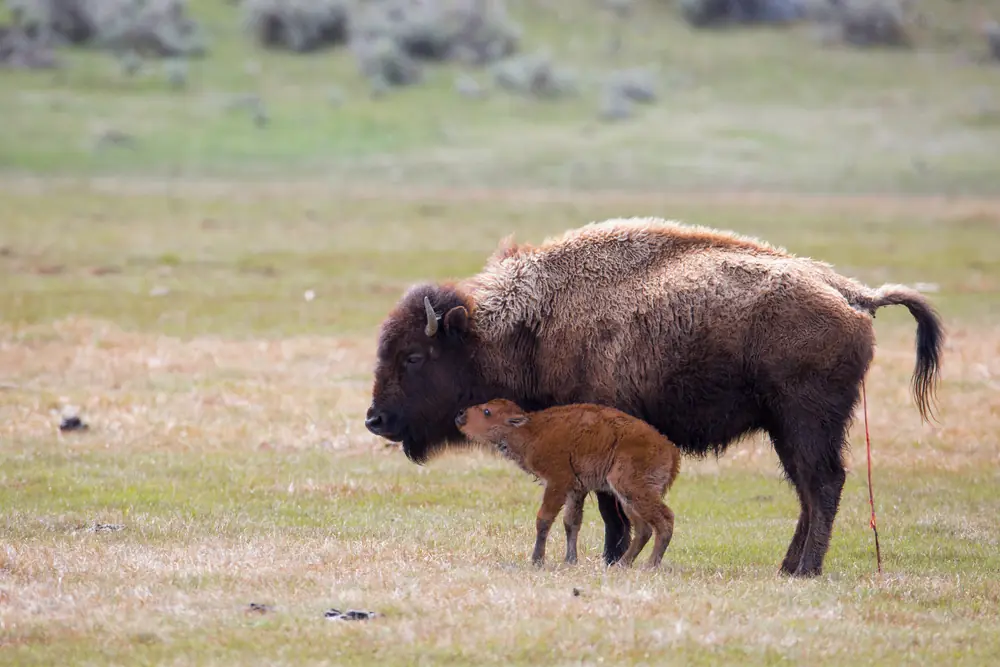
Bison calves, the “red dogs”
Late April and May; early arrivals possible in a warm spring · Lamar and Hayden valleys, and the Madison and Firehole corridors, in Yellowstone
The National Park Service says Yellowstone’s calves arrive from late April into May, following a pregnancy of 9 to 9½ months. Newborns are reddish tan, which earns them the nickname, and they start turning brown at about two and a half months old. Its pre-calving estimate in 2025 was close to 5,300 bison. Because the whole herd calves in a short window, the first weeks are a good time to watch from a pullout, with a long lens or binoculars.
-
Cows with calves are not to be approached
Late April through early summer · Roadsides and trails anywhere young animals are present
The park asks visitors to keep at least 25 yards from bison and elk, and 100 yards from bears, wolves and cougars. It adds that cow elk are especially fierce around their calves from May into early July, and that around Mammoth Hot Springs they sometimes hide calves near cars and buildings. A calm-looking bison has hurt more visitors than any other animal in the park, according to the same page.
-
Grizzlies with cubs come out; black-bear hunters go in
Females with cubs typically April and early May; the spring black bear season usually opens April 1 · The Yellowstone, Teton, Absaroka and Bighorn country, plus other bear habitat
The Park Service says males come out of their dens in early March and females with cubs follow in April and early May, so a trail that was quiet in March can be busy with hungry bears in April. In 2026 a Cowboy State Daily report quoted hunters who found black bears active roughly a month early, and said the season opened April 1 in most of the state and April 15 in the Snowy Range. The same report said mother bears needing green grass and water to make milk were especially aggressive. Game and Fish’s harvest report counted 656 black bears taken in Wyoming in 2025.
-
Shed antlers stay off limits for a few more weeks
Closed until 6 a.m. on May 1 for residents and May 8 for nonresidents; emergency extensions on winter range are possible · Public land west of the Continental Divide, with the Great Divide Basin and some land west of Laramie excluded
Game and Fish describes the closure as a way to reduce stress on big game that are still on winter range. Violations can cost you the antlers, a fine and your hunting and fishing privileges. Picking up antlers in April is tempting because they are easy to find against the thinning snow, but the animals are still weak.
Our field journal offers a mammal watch page for your first bison calf and a tracks page for muddy prints.
Is April still a good month to watch greater sage-grouse on a lek?
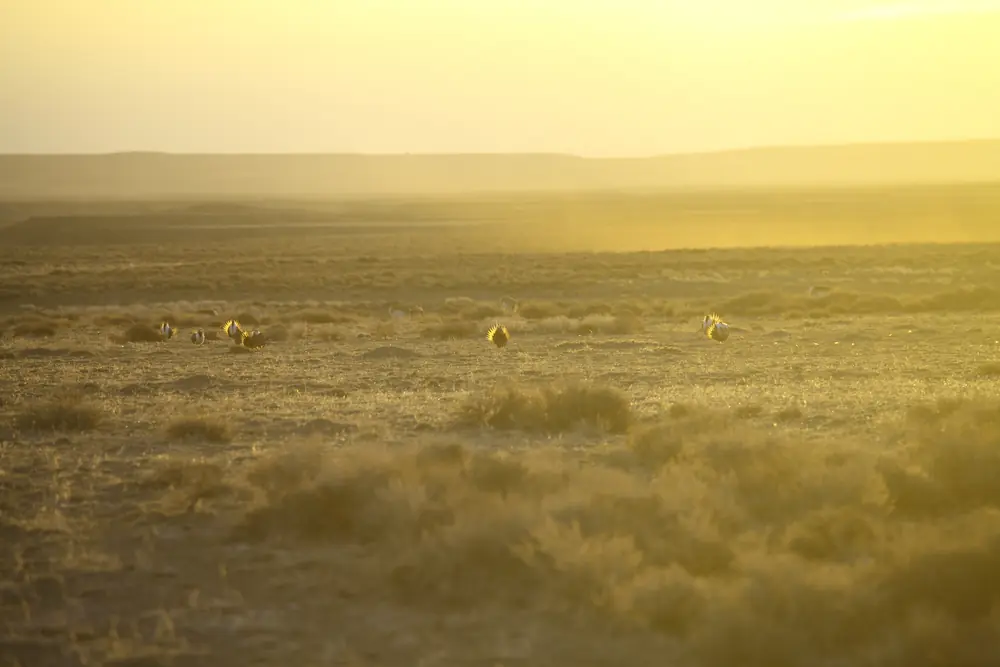
Yes, and in some ways it is a better month for a first-timer than March. Game and Fish says the breeding peak usually falls in early April, and then adds that late April is a good time to go because most of the breeding is over while the males are still strutting. The weather tends to be kinder, too. If you read our March page, think of April as the tail end of the show.
-
Why late April suits a visit
Mid to late April; the hens leave to nest as the month goes on · Public leks in Game and Fish’s viewing guide
By the end of April, the number of hens on a lek has usually dropped, so there are fewer birds to see, but the remaining males still fan their tails and make their popping calls at first light. Dry roads help too: a thawing two-track can swallow a car in an hour. Arrive an hour before sunrise, stay in the vehicle, and let the birds leave before you do.
-
What happens after the dancing
Hens nest near the lek in April and May; chicks hatch in late May or June · Sagebrush within a few miles of the lek
The department’s species account puts nests within about 5 miles (8.5 km) of the lek, and says chicks hatch in late May or early June. Hens that have nested do not move far. At Seedskadee National Wildlife Refuge, the refuge staff say the hens come to wet meadows and the river corridor from mid-June for water, insects and plants, so the story moves to the water in summer.
Jot down the wind, the count of strutting males and the time they leave, using the dusk and dawn watch pages of our Naturalist’s Field Journal.
When do mountain plovers return to Wyoming, and where do you look for them?
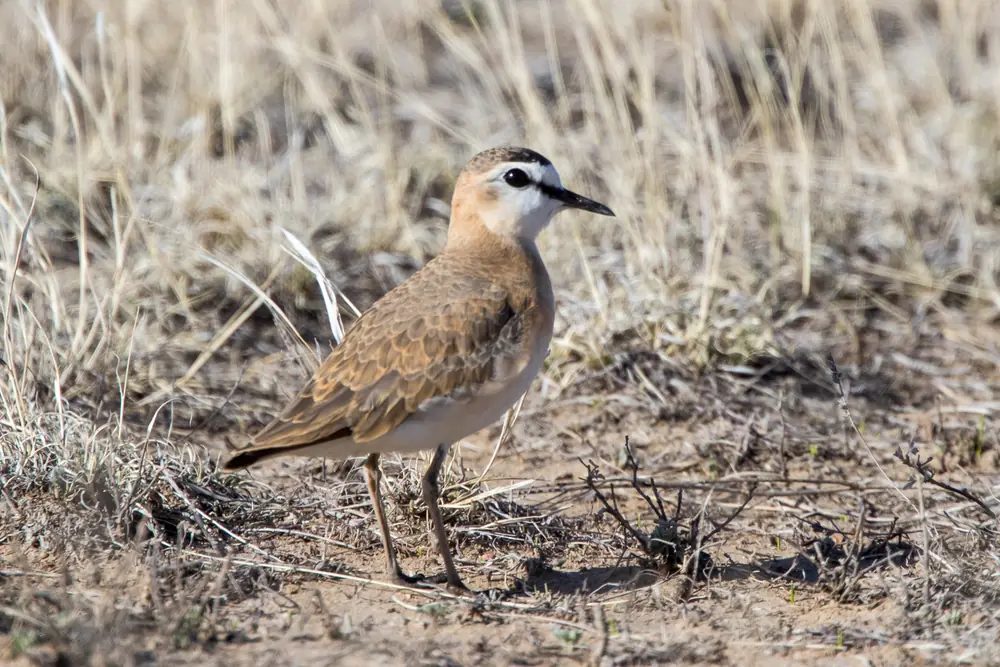
The mountain plover is a bird of bare ground, and Wyoming holds a large part of its breeding range. It is easy to overlook: a sand-colored shorebird that stands upright on flat, nearly bald ground and often shows its black-and-white face only when it lifts its head. Game and Fish’s species account says it arrives by late March or early April, so April is the month when the first ones show up.
-
What a plover habitat looks like
Arrival late March to April; nesting begins by mid-May · Flat, sparsely vegetated land in the Powder River, Shirley, Laramie, Big Horn, Great Divide and Washakie basins
The species account describes habitat with vegetation generally shorter than 5 centimeters (about 2 inches), more than 30 percent bare ground, and a slope of less than 5 percent. Grazing by prairie dogs, bison, pronghorn and livestock keeps the ground open. The state’s population was estimated at 3,393 in 2003, and the department ranks the bird as uncommon here. Nests in farm fields are often lost to machinery, so give any bird you find plenty of room.
-
Reading the clues without flushing a bird
Morning and evening, when birds are feeding · Public roads that cross plover basins, viewed from a vehicle
Scan the ground ahead with binoculars before you stop, because a plover will run in short bursts instead of flying. It eats beetles, grasshoppers, crickets and ants. The species winters in California and farther south and leaves Wyoming by mid-October, per the same account. A bird seen standing alone on a bare patch in April may be one of the earliest of the year.
Add the first plover to the birds I have seen plate, and note the habitat in the margin. A bare patch beside a prairie dog colony counts.
Which birds arrive in Wyoming in April, from osprey to burrowing owls?
April is when the trickle of March becomes a steady stream, especially along open water. The dates depend on altitude and on the winter, and the sources we read give arrival dates for a single year, not a long average. Treat the dates as a guide to the order of arrival, not as a calendar.
-
Hawks, osprey and ducks in Yellowstone
First weeks of April for raptors; ducks through the month · Slough Creek, Blacktail Pond, the Gibbon River and other open water
A Yellowstone Forever naturalist logged red-tailed hawks arriving in numbers in the first week of April 2024, and peregrine falcons and osprey on April 5, turkey vultures on April 6 and sharp-shinned hawks on April 9. By April 18 he had counted nine kinds of ducks at Slough Creek, including wigeons, gadwalls and three kinds of teal. Colder years push these dates back.
-
Shorebirds, swans and geese on the Green River
Shorebird migration peaks from early April through mid-May · Seedskadee National Wildlife Refuge
The refuge says Canada geese and trumpeter swans that wintered nearby are defending nest sites as the river ice melts, new ducks have been arriving since early March, and warblers do not turn up until May. Watch from the road or a pullout, and keep away from nests.
-
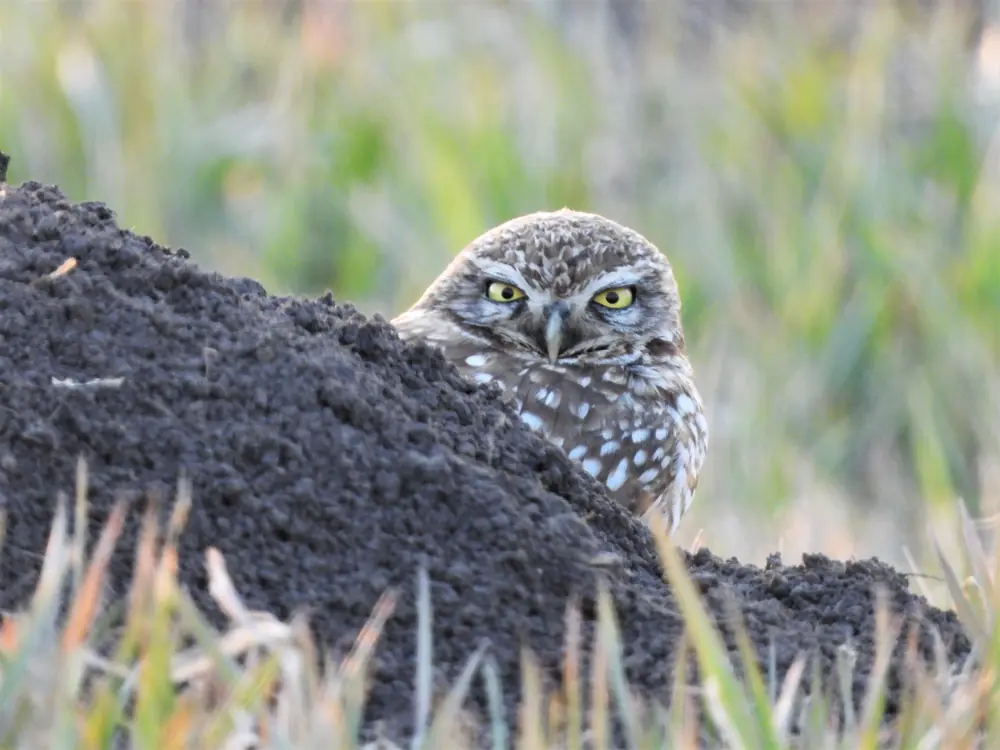
Burrowing owls return to prairie dog towns
Spring; the department’s page does not give an arrival date · Open grassland, most abundant in eastern Wyoming
Game and Fish describes a small owl with long legs, a round head and yellow eyes that nests in burrows dug by prairie dogs or ground squirrels. It is listed as a species of greatest conservation need. Females lay six to twelve eggs, which take 28 to 30 days to hatch, so nesting comes later than the first arrivals. The owls hunt beetles and grasshoppers and are active by day, so look for one on a mound or fence post.
Keep a running list of first dates, because a few years of entries show the season sliding earlier or later. The Naturalist’s Field Journal has the birds I have seen and nest observed plates for exactly this.
Which wildflowers bloom in April, and are frogs, toads and snakes out yet?
April brings a second wave of flowers after the first buttercups. It also brings a quieter question, which is who else is awake. Wyoming’s amphibians are mostly still waiting for ponds and warmth, but the first rattlesnake of the year can show up on a sunny rock, and it pays to know what each animal is up to.
-
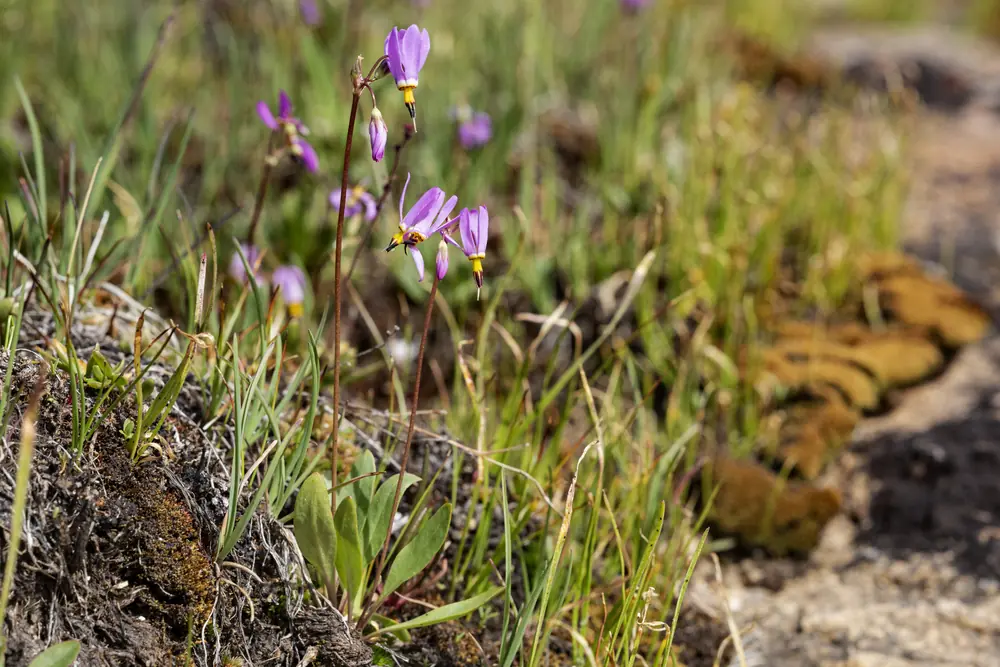
Kittentails, spring beauty, shooting star and more
Late April and early May around Jackson Hole; earlier at low elevations · Sagebrush hillsides and open woods in Teton and Sublette counties; similar plants farther east
Teton Science Schools lists nine blooms its naturalists found in late April and early May: bluebells, spring beauty, Wyoming kittentails, pasqueflower, desert paintbrush, shooting star, yellow bells, Hood’s phlox and desert parsley. All of them are small, so kneel to see them, and check sunny slopes first.
-
Rocky Mountain bluebells and upland beardtongue
Around April · Foothills and slopes; beardtongue in southern Wyoming
Wyoming Public Media’s Native Plant Month feature pictured Rocky Mountain bluebells and upland beardtongue in bloom, and quoted the native plant society’s secretary and treasurer on how local plants save water and feed wildlife. The society counts more than 2,500 native plant species in the state. The governor first named April Native Plant Month in 2023 and renewed the designation in 2025; the 2027 proclamation had not appeared when this page was written.
-
Boreal chorus frogs wait on snowmelt
Calls begin when seasonal ponds thaw and fill · Shallow wetlands in Yellowstone and Grand Teton
The National Park Service says male boreal chorus frogs are only about an inch long yet are by far the loudest amphibian in Yellowstone. They breed in seasonal wetlands filled by snowmelt, which are the first to dry in low-snow years. The Greater Yellowstone Network has surveyed about 300 wetland sites each year since 2006.
-
The Wyoming toad is still underground
Emerges in May or June, after daytime temperatures reach about 70 °F · Mortenson Lake National Wildlife Refuge, Albany County
The Fish and Wildlife Service says the Wyoming toad was declared extinct in the wild and still is, so the toads at Mortenson Lake come from a captive breeding program, with releases in Albany County each year. Breeding runs from mid-May to early June, so April is too early for the toad itself. The refuge is a good place to read about a long recovery.
-
Prairie rattlesnakes leave their dens
Usually April or May, on warm sunny afternoons · All counties east of the Continental Divide, and Carbon County west of it; rocky outcrops, ledges and prairie dog colonies
Game and Fish says prairie rattlesnakes spend the winter in groups in deep crevices and abandoned burrows, hunt in the cooler hours of the day, and bear live young in August or September. The department notes that killing them on sight has hurt their numbers. Step over logs only where you can see the far side, and back away slowly from any buzz.
The tree through the seasons and same place twice plates are good for the flowers, and the map of sounds plate suits a frog evening.
How much snow is left in Wyoming in April, and when does the runoff start?
April 1 is the day water managers take stock of the mountain snowpack. The Natural Resources Conservation Service publishes its Wyoming Basin and Water Supply Outlook Report that day, and the numbers tell you whether to expect high creeks in May and June or a thin runoff and a long summer. We cannot say what the 2027 report will show, so here is how to read one, with last year’s as an example.
-
What the April 1, 2026 report showed
Snapshot from April 1, 2026 · Statewide and by river basin
Snow water equivalent across Wyoming was 38 percent of median that day. The Yellowstone River basin was best at 84 percent, while three eastern basins (the South Platte, Belle Fourche and Cheyenne) showed none on their measured sites. Reservoir storage at the end of March was 80 percent of median statewide, though the Upper Green River reservoirs were at 125 percent. It was a low-snow year, and the report forecast that April-through-September streamflow would average 66 percent of median in most basins.
-
Why the snowpack matters to wildlife
April through July · Mountain streams, seasonal ponds and wet meadows
The Park Service ties chorus frog breeding to ponds filled by snowmelt, and says those ponds are the first to dry in low-snow years. In a year like 2026, expect fewer such ponds by midsummer and an earlier end to the frog chorus.
-
Spring storms still add to the pack
April storms can drop feet of snow in eastern Wyoming · East of the Continental Divide
Riverton’s National Weather Service office calls March and April the snowy season east of the Divide. Its summary of the April 3 to 5, 2023, storm gave Casper a total of 37.4 inches, an all-time record for a single event there, with winds of 30 to 50 mph that built blizzard conditions and drifts of around five feet on Casper Mountain. Such storms melt fast, but they close roads while they last.
Look up the latest report on the NRCS Wyoming snow survey page and compare it with the river forecasts in May. The weather page handles the days just ahead.
When is the last spring freeze in Wyoming?
April is far too early to trust the garden. For most of the stations listed, the typical last freeze falls in mid to late May, and Jackson Hole waits until the second half of June. Each town has three dates below, taken from 1991 to 2020 averages at its main station.
| Station | One year in ten | Median | Nine years in ten |
|---|---|---|---|
| Cheyenne | May 1 | May 12 | May 26 |
| Laramie | May 21 | Jun 2 | Jun 18 |
| Casper | Apr 28 | May 12 | May 26 |
| Gillette | May 1 | May 15 | May 27 |
| Sheridan | May 7 | May 21 | Jun 6 |
| Cody | Apr 27 | May 12 | May 27 |
| Rock Springs | May 5 | May 22 | Jun 9 |
| Moose (Jackson Hole) | Jun 5 | Jun 20 | Jul 9 |
To look up your own town, open the Wyoming frost dates page. In April, cold frames, row covers and hardy seeds such as peas and spinach are the practical choices, with the tender plants waiting for the right-hand column.
How cold and snowy is April in Wyoming?
April in Wyoming is a month of swings. Sunny afternoons in the 50s can be followed by a foot of snow that melts in two days, and the wind rarely rests. The 1991 to 2020 normals show daytime highs in the 50s at the six stations below, with lows still below freezing on roughly 17 to 26 nights of the month.
| Station | Average high | Average low | Snowfall | Precipitation | Nights below 32 °F | Snow days |
|---|---|---|---|---|---|---|
| Cheyenne | 54.8 | 30.8 | 11.3 | 1.79 | 18.0 | 3.2 |
| Laramie Regional Airport | 51.2 | 24.5 | not published | 1.04 | 26.1 | not published |
| Casper Natrona County Airport | 56.3 | 28.2 | 10.5 | 1.41 | 21.1 | 3.2 |
| Sheridan County Airport | 56.7 | 29.7 | not published | 1.87 | 18.0 | not published |
| Lander Hunt Field Airport | 56.2 | 30.3 | 16.4 | 2.07 | 17.2 | 3.6 |
| Rock Springs Airport | 52.8 | 29.7 | 8.8 | 0.91 | 20.7 | 2.4 |
Weather hazards in April are mostly about wind and late snow. Spring blizzards can close interstates and rural highways, and the Wyoming Department of Transportation’s 511 service (1-888-996-7623) carries closures and camera views. Dry, windy days in a low-snow year raise the grass fire risk before green-up, so watch for red flag warnings from the nearest National Weather Service office. Mud season has its own hazards: a two-track that held a truck in March can be bottomless in April. NOAA’s Climate Prediction Center posts a new seasonal outlook each month, near mid-month, and the latest is on its 90-day outlook page.
How fast do the days lengthen in Wyoming in April?
April still adds light quickly, though the pace has begun to ease from its March peak. Between April 1 and April 30, the towns in the table gain between 76 minutes at Cheyenne and 87 minutes at Sheridan.
| City | Apr 1 | Apr 30 | Gained | Per day |
|---|---|---|---|---|
| Cheyenne | 12 h 41 m | 13 h 57 m | 76 min | 2.6 min |
| Laramie | 12 h 41 m | 13 h 58 m | 77 min | 2.7 min |
| Rock Springs | 12 h 42 m | 13 h 59 m | 77 min | 2.7 min |
| Casper | 12 h 43 m | 14 h 04 m | 81 min | 2.8 min |
| Jackson | 12 h 45 m | 14 h 07 m | 82 min | 2.8 min |
| Gillette | 12 h 46 m | 14 h 10 m | 84 min | 2.9 min |
| Sheridan | 12 h 46 m | 14 h 13 m | 87 min | 3.0 min |
| Cody | 12 h 47 m | 14 h 11 m | 84 min | 2.9 min |
These figures measure sun-up to sun-down, which the March 14 clock change left alone. Our daylight page gives sunrise and sunset for any date in your own town, in Mountain Daylight Time.
What can you see in Wyoming’s night sky in April 2027?
April’s sky is rich in moon-and-planet pairings and poor in meteors. All times below are Mountain Daylight Time, since the clocks moved forward on March 14.
-
The Pink Moon
Full at 4:27 p.m. MDT on Tuesday, April 20; rises about 8 p.m. that evening · Any clear eastern horizon
The moon turns full while it is still daytime in Wyoming, so look for it rising round at dusk. The Old Farmer’s Almanac says the name comes from moss pink (creeping phlox), an eastern wildflower, not from the color of the moon. Other traditional names refer to melting ice and the return of ducks and geese.
-
The Lyrids, a poor year
Active about April 14 to 30; maximum near 7:41 p.m. MDT on Thursday, April 22 · Look northeast to east, away from town lights, before the moon rises
The American Meteor Society lists the shower as medium strength with good rates for three nights around the peak. Moonrise comes around 10 p.m., and until then the sky stays dark enough to try. Expect a few meteors an hour at best, plus the chance of a brief surprise burst.
-
The moon visits Jupiter and Mars
Evenings of April 14 and 15 · High in the south-southwest after dusk
Around April 14 and 15 the waxing moon, two-thirds lit, slides past bright Jupiter within a degree and sits roughly 3 degrees from Mars. Jupiter outshines every star and stays up into the small hours.
-
Venus in the morning, with a thin moon
Mornings of April 3 and 4; Venus rises an hour or more before the sun, by our own computation · Low in the east before sunrise
Venus is still a brilliant morning star in April, though it sinks closer to the horizon each week. A thin waning crescent moon sweeps by roughly 3 degrees away, on April 3 and again the next morning. Saturn spends the month too near the sun to see, with its conjunction on April 7.
-
Milky Way season begins before dawn
April 1 to 14 and April 28 to 30 near 40 degrees north; fewer hours farther north · Dark sites with a clear southeast horizon
The bright core rises in the small hours. A sky calculation for 40 degrees north puts the best nights around the April 6 new moon, when the core stands in a dark sky for as long as roughly two hours. Wyoming’s northern towns will see a little less.
| Phase | Date | Time |
|---|---|---|
| New moon | Tuesday, Apr 6 | 5:51 p.m. MDT |
| First quarter | Tuesday, Apr 13 | 4:56 p.m. MDT |
| Full moon, the Pink Moon | Tuesday, Apr 20 | 4:27 p.m. MDT |
| Last quarter | Wednesday, Apr 28 | 2:18 p.m. MDT |
The moon phases page shows each night, and the cloud guide will help you plan around a spring storm.
What can Wyoming families do outside in April 2027?
Most organizers had not announced April 2027 plans at the time of writing. Below are dates fixed by rule and usual timing, so confirm each plan before setting out. Heading to another state? Browse the nature pages we have written for each one.
-
Earth Day
Thursday, April 22 · Parks, schools and libraries across the state
Earth Day is held on April 22 each year, and EARTHDAY.ORG says the first one took place in 1970. Local cleanups and plantings are usually announced a few weeks ahead, so ask your town or conservation district.
-
Wyoming Arbor Day
Monday, April 26 under the state rule; local towns pick their own dates · Towns and schools statewide
Wyoming law sets Arbor Day on the last Monday in April, according to the Wyoming Almanac, which also notes the first territorial observance in 1888. Plant a tree suited to your elevation, and check with a conservation district or the state forestry division for local plans.
-
Native Plant Month
April; 2027 events not yet posted · Chapters of the Wyoming Native Plant Society
The society has run a poster contest for middle school students and an annual Wildflower Weekend; the 2026 gathering was planned at Flaming Gorge for the last days of May. Nothing for 2027 had been posted, so check its site. Try finding Wyoming kittentails on a spring hike and drawing the leaves.
-
Keep a yard bird list
All month · Your own yard
Project FeederWatch says it was built to track winter feeder birds, which is why its season stops before summer birds return. A plain notebook list picks up where it leaves off, and children can learn the early arrivals before the warblers come.
-
Plan a park visit
Teton Park Road opens to vehicles May 1; Yellowstone dates not posted for 2027 · Grand Teton and Yellowstone national parks
Grand Teton lists the Teton Park Road as closed from November 1 to April 30, with the Moose-Wilson Road closed until mid-May depending on conditions. Yellowstone had not posted 2027 road openings when this page was written, so call (307) 344-2117 or check the live road map. Grand Teton’s number is (307) 739-3399. Dates depend on weather and plowing.
Each week, children can draw a flower, a bird and a cloud in the Naturalist’s Field Journal. The March page and February page make handy comparisons.
Safety notes for April in Wyoming
- Spring black bear. The season usually opens April 1 in most areas, and in 2026 the Snowy Range area opened April 15. Seasons close when quotas are reached and areas vary, so read the current regulations and call the department before you go.
- Spring turkey. The Game and Fish Commission’s Chapter 20 turkey regulation, signed April 22, 2026, sets the 2027 spring season at April 20 to May 31 statewide for any male turkey or turkey with a visible beard, with an earlier quota season (Type 3 licenses) from April 1 to May 31 in Converse, Natrona, Campbell, Johnson and Sheridan counties. Quotas, licenses and any later rule changes are the department’s to announce, so confirm the details before you plan around them.
- Orange or pink. The department requires big and trophy game hunters to wear one outer garment in fluorescent orange or pink while firearm seasons are open, and archers and crossbow users must do the same then. Small game and game bird hunters are urged to wear it but are not required to. Ask the department which category your season falls into, and wear bright colors on spring walks in hunting country.
- Bears. Carry EPA-approved bear spray where you can grab it, hike in a group, keep food and birdseed locked up, and stay 100 yards from any bear. Give carcasses a wide berth.
- Bison, elk and moose with young. Stay 25 yards from bison and elk, give a cow moose with a calf far more room, and leave young animals where they are.
- Rattlesnakes. They begin to move in April or May. Wear boots, watch where you step and place your hands, and keep dogs on a leash near rocks.
- Ticks. The state health department says people usually seek care for tick illness starting in May. Tularemia, Rocky Mountain spotted fever and Colorado tick fever are the ones to know, and the tick that carries Lyme disease is not known to live here. Use repellent with 20 percent DEET or picaridin and check yourself after a hike.
- Snow, wind and avalanches. Spring storms close roads quickly, so check Wyoming 511 first. The Bridger-Teton Avalanche Center issues forecasts for four zones around Jackson Hole and Pinedale; read the one for your route before any backcountry trip, and carry a beacon, probe and shovel.
- Fast water. Creeks rise with the first big melts. Keep children and dogs back from swollen banks and stay off rotten ice.
Sources (40)
- Wyoming Game and Fish: spring is a good time to view sage-grouse (April viewing)
- Buckrail: wildlife enthusiasts can view sage grouse breeding behavior in April
- U.S. Fish and Wildlife Service: seasons of wildlife at Seedskadee National Wildlife Refuge
- National Park Service: Yellowstone bison
- National Park Service: Yellowstone safety (distances from wildlife)
- National Park Service: Yellowstone bear management area changes
- Cowboy State Daily: hungry black bears out early, Wyoming spring hunts (March 2026)
- Wyoming Game and Fish: 2025 black bear harvest report
- Wyoming Game and Fish: shed antler and horn hunting season closed for western and southern Wyoming
- Wyoming Game and Fish: species account, mountain plover
- Wyoming Game and Fish: burrowing owl
- Yellowstone Forever: naturalist notes, spring birds (May 2024)
- Teton Science Schools: early spring wildflowers in Jackson Hole
- Wyoming Public Media: April is Native Plant Month in Wyoming (2025)
- National Park Service: taking the pulse of wetlands (boreal chorus frogs)
- U.S. Fish and Wildlife Service: Mortenson Lake National Wildlife Refuge, featured species
- Wyoming Game and Fish: species account, prairie rattlesnake
- USDA NRCS: Wyoming Basin and Water Supply Outlook Report, April 1, 2026
- National Weather Service Riverton: Wyoming snowfall climatology
- National Weather Service Riverton: April 3-5, 2023 snowstorm
- NOAA NCEI: U.S. Climate Normals 1991–2020, April monthly normals for six Wyoming stations
- NOAA Climate Prediction Center: seasonal outlooks
- Amphibian Publishing: Wyoming frost dates
- National Park Service: Yellowstone park roads and seasonal dates
- National Park Service: Grand Teton park roads
- EARTHDAY.ORG
- National Park Service: first Yellowstone grizzly of 2023 and bear safety
- Wyoming Native Plant Society: annual meeting and Wildflower Weekend
- Project FeederWatch: why does the season end?
- Wyoming Almanac: Wyoming's first Arbor Day, 1888
- Wyoming Game and Fish Commission: Chapter 20, Wild Turkey Hunting Seasons (signed April 22, 2026)
- Wyoming Game and Fish: who should wear fluorescent orange or pink when hunting?
- Wyoming Department of Health: don’t let ticks steal warm weather enjoyment
- Bridger-Teton Avalanche Center
- Wyoming Department of Transportation: Wyoming 511 road conditions
- U.S. Naval Observatory: phases of the moon
- American Meteor Society: meteor shower calendar (Lyrids)
- Fred Espenak, AstroPixels: Sky Event Almanac 2027
- Old Farmer’s Almanac: April full moon, the Pink Moon
- Photos via Wikimedia Commons; licenses and photographers are credited under each picture
