What to look for in nature in Wyoming this January
January is the long middle of the Wyoming winter, the stretch when wildlife spends the fat it banked in autumn and the land asks people to tread lightly. On New Year’s Day, public land west of the Continental Divide closes to antler hunters until May. In the first weeks of the month, volunteers drive set routes to count eagles. Burbot, the state’s only freshwater cod, spawn under the ice, and anglers gather on Flaming Gorge to thin the ones that do not belong there. Sage-grouse live on sagebrush leaves alone, and in Yellowstone the wolves are entering the season when they howl most. Evenings stretch too: towns in our table gain between 46 and 54 minutes of daylight by the 31st. Here is the month, with the source behind each date.
Other months in Wyoming: October, November, December, February.
Start here

- Count eagles on a winter morning. Bureau of Land Management offices in Buffalo, Pinedale and Kemmerer send volunteers along fixed routes each January for the national eagle count. Call your local field office in December to ask about the 2027 date and how to sign up.
- Listen for wolves and owls. Drive the Lamar Valley road at first light, or pause beside a cottonwood bottom as darkness falls. Wolves howl far more in late winter than in summer, and great horned owl pairs are calling to each other before they nest.
- See the Wolf Moon rise. Watch the nearest full moon of 2027 lift over the eastern hills at dusk on Thursday, January 21. The exact moment of full comes before sunrise on Friday (5:17 a.m. MST).
In the Naturalist’s Field Journal this month, give the eagle count its own birds-I-have-seen list, splitting bald from golden. A chewed aspen belongs on the tree-through-the-seasons plate, to be visited again in May. Use the reading-the-signs page for grouse tracks, antler rubs and tooth marks on bark, the mammal watch for wolves, elk and deer on their winter range, and a dusk-and-dawn watch to track the sunset creeping later week by week.
Regions used below: Southeast plains, Cheyenne and Laramie; Central Wyoming and Casper; Northeast: the Powder River Basin and Black Hills; Sheridan and the Bighorn Mountains; The Bighorn Basin and Cody; Wind River country, Riverton and Lander; Southwest: the Red Desert, Green River and Rock Springs; Jackson Hole, Pinedale, Grand Teton and Yellowstone.
Why is shed antler hunting closed in western Wyoming from January 1?
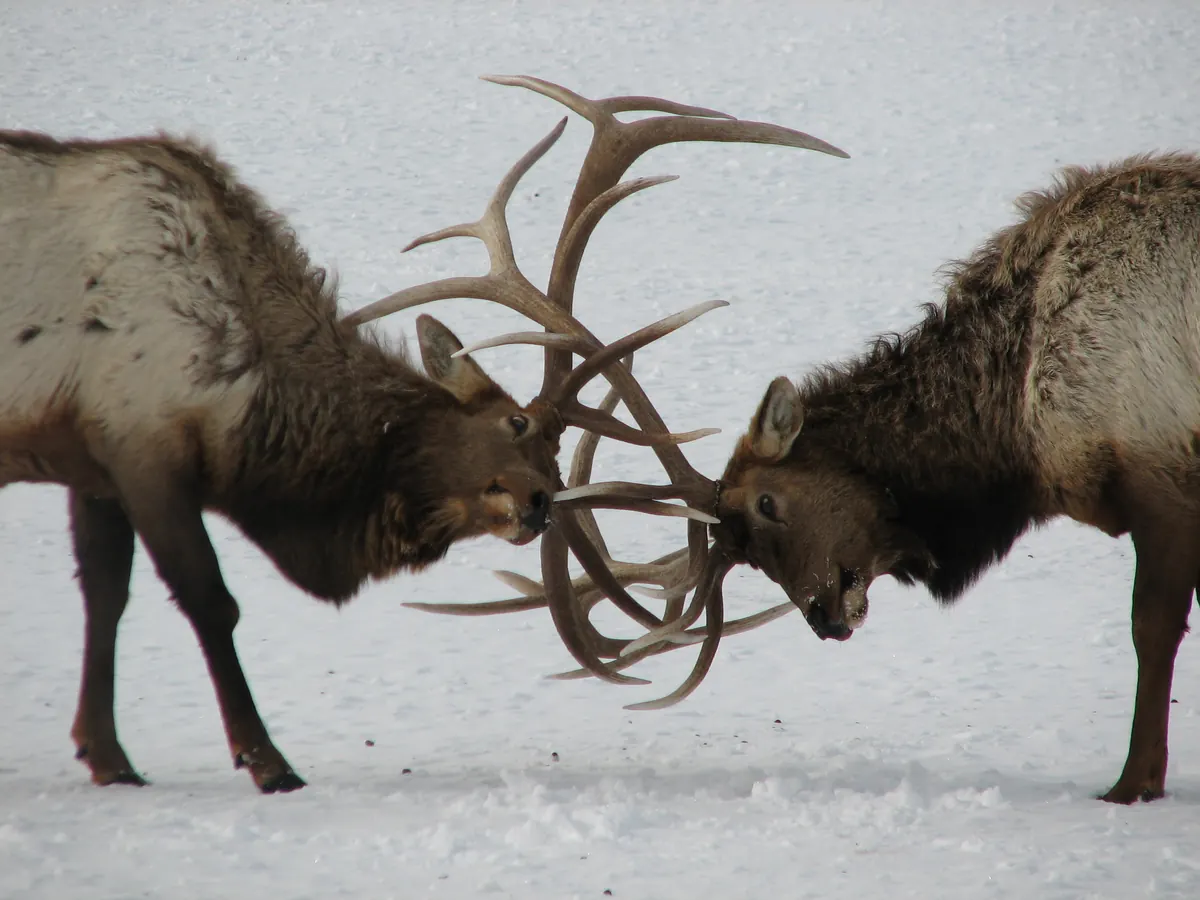
Bull elk and mule deer bucks drop their antlers in late winter, and plenty of people head out to find them. To keep collectors from pushing animals around when they can least afford it, a standing Game and Fish Commission regulation closes public land west of the Continental Divide to antler and horn collecting every year from January 1 until 6 a.m. on May 1. The closure covers national forest and BLM land, state trust land and the Commission’s own wildlife habitat management areas. The Great Divide Basin and some ground west of Laramie are left out. A department deputy chief described the purpose as limiting disturbance and stress to big game on winter range.
-
What the rule covers
January 1 until 6 a.m. on May 1 · Public land west of the Continental Divide, apart from the Great Divide Basin and some land west of Laramie
East of the Divide the public-land closure does not apply, but collecting on private land anywhere in the state needs the landowner’s permission at any time of year. If you find a dead deer, elk or moose with its antlers still on the skull, Game and Fish requires an Interstate Game Tag before you move them. Breaking the rule can cost fines, the antlers and hunting privileges. The department announces the closure each winter; check its current notice for any boundary changes before you go.
-
Why a quiet January matters later
Losses usually show up in April and May · Low winter ranges statewide
Animals on winter range live on stored fat, and a deer chased off by a skier or a loose dog in midwinter pays for it in spring. After the hard winter of 2022–23, Game and Fish reported that more than half of the collared mule deer fawns in the Jackson and Pinedale regions had died and expected deer losses to peak in April and May.
-
When antlers actually fall
Bull elk mostly from early March · The National Elk Refuge and elk winter ranges
In January most bulls still wear their antlers. On the National Elk Refuge, staff start gathering them once shedding begins in early March, and a bull may carry one side for a while after dropping the other.
Our December page lists the winter range closures that began on December 1 and run alongside this one.
When is the Midwinter Bald Eagle Survey in Wyoming, and how many eagles winter here?
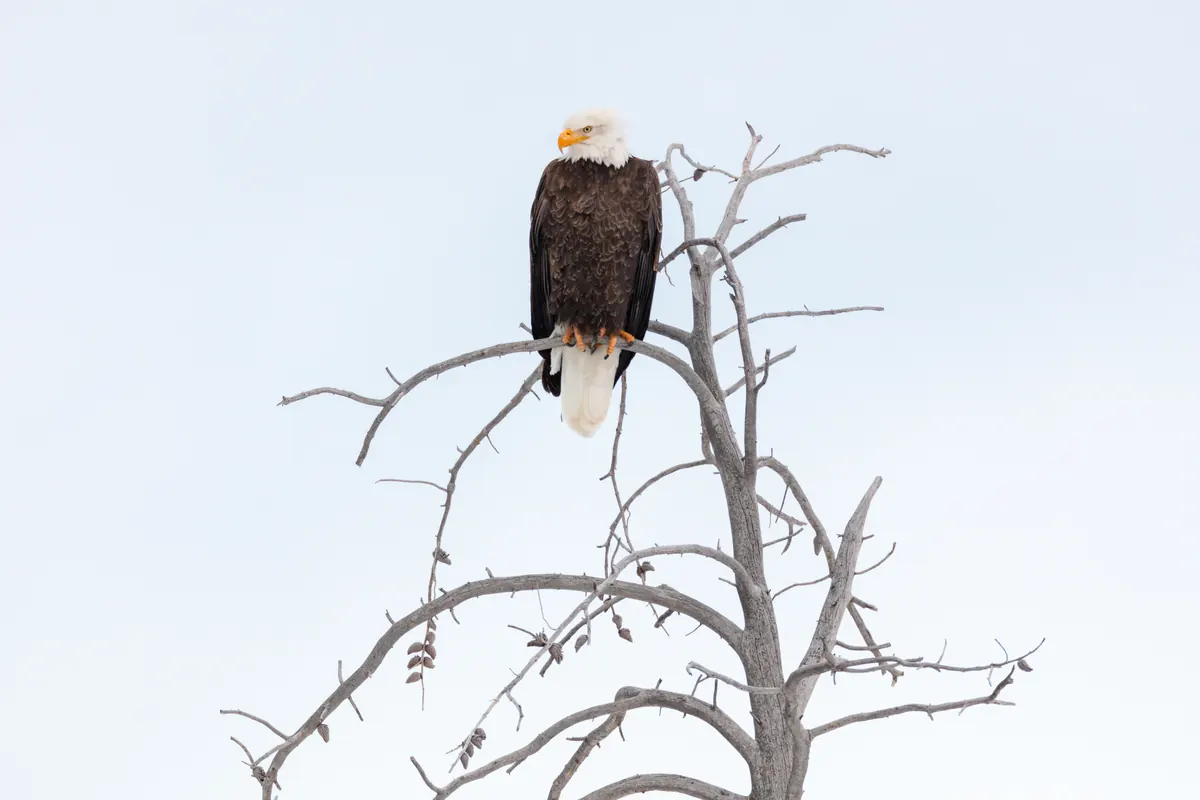
Since 1979, agencies and volunteers have counted bald eagles across the lower 48 states every January to track the winter population. In Wyoming, Bureau of Land Management field offices run many of the routes, and golden eagles go on the tally sheet too.
-
The Powder River Basin count
One Saturday morning in early January; the 2027 date had not been posted in early October · About 1,500 miles of public roads in Campbell, Johnson and Sheridan counties
The BLM Buffalo Field Office has run this count since 2006 with about 90 volunteers, and most years they tally 400 to 500 eagles. Coordinators say bitter cold beforehand draws eagles to roadkill near the highways, while mild weather scatters them. Most bald eagles leave to nest farther north; the golden eagles stay to breed.
-
Pinedale and Kemmerer routes
Early January · Sublette County and the southwest corner of the state
The BLM Pinedale Field Office has run its eagle routes for more than 20 years. In January 2026, 23 volunteers on a very windy day found 51 eagles (31 bald and 20 golden), against 54 the year before (42 bald and 12 golden). The Kemmerer office surveyed 11 routes on January 9, 2026, through river bottoms and sagebrush uplands, and recorded 17 eagles: 13 bald, two golden and two it could not identify, more than in 2025.
-
Eagles to find on your own
All month; best in the first hours of daylight · Open rivers below dams and through towns, big cottonwoods near water, and roadsides where deer and pronghorn are hit
Scan tall riverside cottonwoods at dawn and check carcasses on the plains. By February, mated bald eagles begin repairing their huge stick nests; Teton Raptor Center puts egg laying in the Greater Yellowstone region from early March to mid-April.
| Survey date | Volunteers | Total eagles | Bald eagles | Golden eagles | Not identified |
|---|---|---|---|---|---|
| January 2016 | 90 | 547 | 363 | not given | not given |
| January 11, 2020 | 91 | 464 | 303 | 127 | 34 |
| January 8, 2022 | 95 | 576 | 376 | 153 | 47 |
| January 7, 2023 | 90 | 461 | 296 | 141 | 24 |
| January 6, 2024 | 90 | 436 | 279 | 118 | 39 |
BLM offices usually ask for volunteers in December. Eagles you find on other days belong in eBird.
When is the Burbot Bash, and why do burbot spawn under the ice?
Burbot, called ling by many Wyoming anglers, are the only members of the cod order that spend every stage of life in fresh water, and they do something no other freshwater fish here does: they spawn in midwinter, under the ice. Game and Fish’s species account says that in lakes they spawn in January or February, over gravel in shallow water near shore or on reefs and shoals farther out. Wyoming is the southwestern edge of their range in North America.
-
A native fish east of the Divide
All year; most active in the cold · The Wind–Bighorn drainage, including Boysen Reservoir and Torrey Lake
Burbot once lived in the Wind–Bighorn, Tongue and Powder river systems; today native Wyoming populations survive only in the Wind–Bighorn drainage, where dams and irrigation diversions have fragmented their habitat. Game and Fish monitors them at Boysen and Torrey Lake.
-
An unwanted guest in the Green
All year · Flaming Gorge, Fontenelle and Big Sandy reservoirs and the Green and Big Sandy rivers
Someone moved burbot into the Green River drainage illegally more than 20 years ago, and Game and Fish first found them in Flaming Gorge in 2006. A burbot can swallow a fish up to half its own length; biologists have pulled 15- to 16-inch kokanee from the stomachs of burbot over 30 inches. Smallmouth bass and crayfish crashed. Since 2014 every burbot caught in Flaming Gorge and the other Area 4 waters must be killed, and the department’s netting now finds the fewest burbot since monitoring began in 2006.
-
The Burbot Bash
Late January 2027 (organizers list January 22 to 24), if the ice allows · Flaming Gorge Reservoir, on the Wyoming and Utah sides
The organizers' site lists the 2027 tournament as January 22 to 24 (a nearby line on the same page gives January 23 to 25, so confirm the exact days), with registration opening December 1 and more than $30,000 in cash and prizes. The 2026 event was called off because of poor ice and forecast wind, so treat the date as dependent on the weather. Game and Fish counts 49,984 burbot removed in Burbot Bash tournaments from 2011 through 2025, and another 6,316 at the Ding-the-Ling derby on Fontenelle since 2016. Anglers traditionally jig for them through the ice at night.
Before walking out on any reservoir, read the ice safety notes at the bottom of this page.
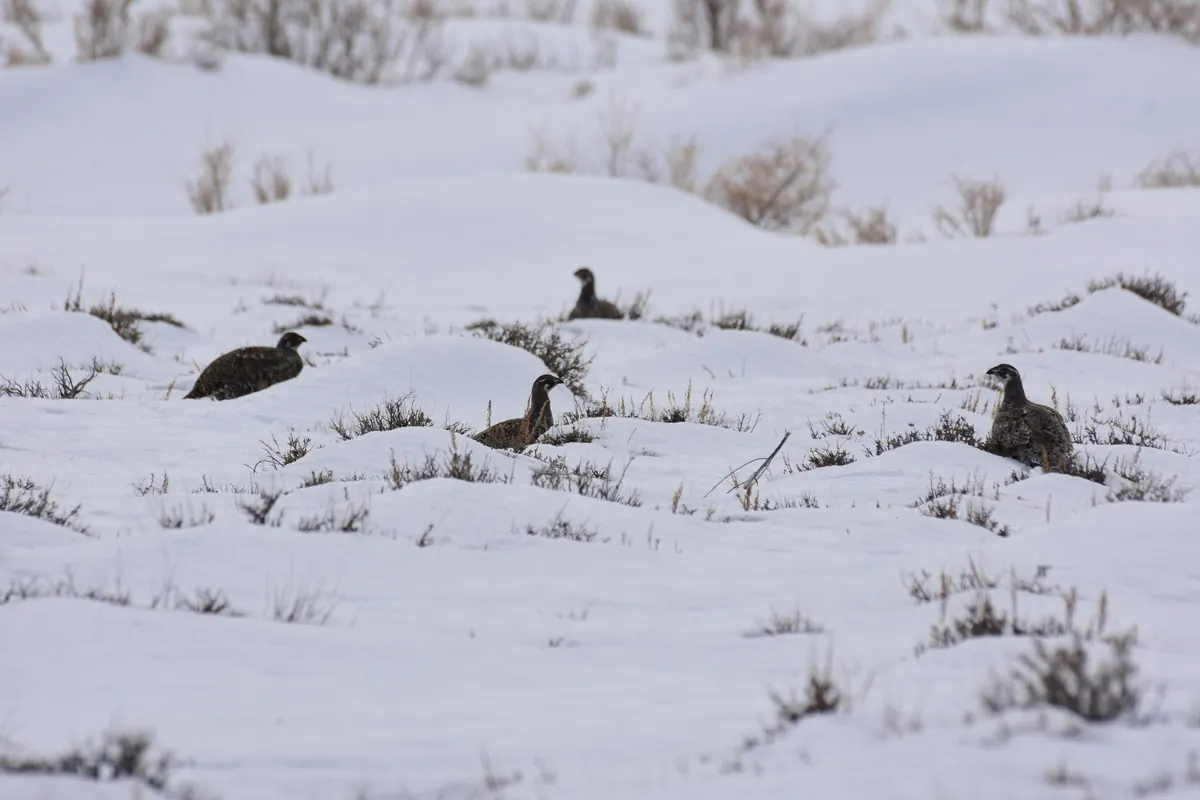
How do sage-grouse survive a Wyoming winter on sagebrush alone?
Wyoming is sage-grouse country. Game and Fish’s species account says the state holds 37 percent of all the greater sage-grouse in North America, and that occupied range covers 70 percent of Wyoming. In January those birds are living on a diet almost no other animal could manage.
-
Nothing but leaves
November to early March · Big sagebrush basins and slopes across most of the state
A Utah State University Extension review of crop contents found that adult sage-grouse eat nearly 100 percent sagebrush from November into early March. Unlike pheasants or chickens, they have no muscular gizzard for grinding grit and seeds; instead, their digestive system copes with the bitter compounds (terpenes) that give sagebrush its smell. The leaves they eat are the shrub’s overwintering ones, described in the plants section below.
-
Flocks where the snow blows off
From the first deep snows until spring · Tall sagebrush and wind-scoured ridges; some flocks winter well away from their breeding grounds
Game and Fish says sage-grouse depend entirely on sagebrush sticking up above the snow, for both food and cover, and that fall snow is what moves them onto winter range. In some areas the birds winter well away from the leks where they breed. Each time a flock is forced to fly it spends energy that a diet of leaves replaces only slowly, so if you find birds near a road, watch from the vehicle and let them be.
In about two months the males will be strutting on their leks, a spectacle our spring pages will cover.
When do Yellowstone’s wolves howl most, and where can you watch them in January?
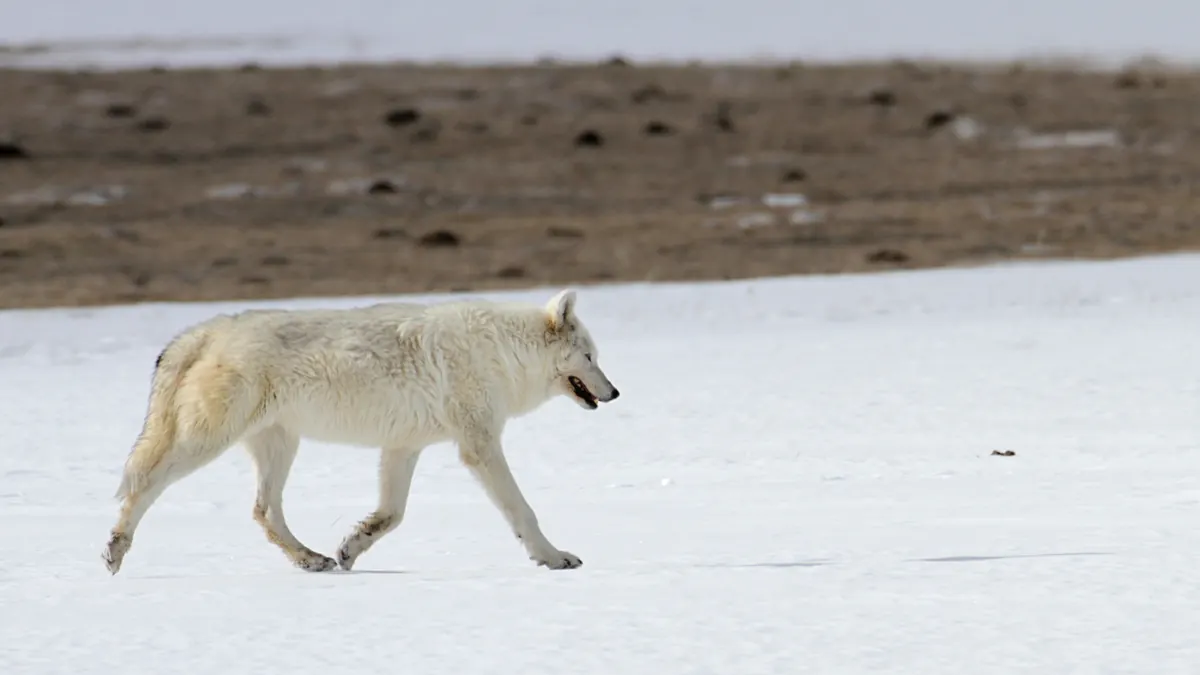
January opens the wolves’ breeding season in Yellowstone, which runs roughly from January into March. Researchers with the park’s Wolf Project went through more than 11,000 howls logged over ten years and found that howling is four times more common in February than in May. The curve follows the yearly rise and fall of reproductive hormones in wolf blood. Through late February, more and more of the answering howls come from rival packs.
-
Courtship on the northern range
Pairs court through winter; mating mostly in February · The Lamar Valley, in the Wyoming part of Yellowstone’s northern range
The Park Service says wolves mate in February and, after about 63 days, give birth to an average of five pups in April. In winter, elk make up more than 96 percent of what Yellowstone’s wolves kill, bison 3 to 4 percent and deer about 1.5 percent. The park’s wolf numbers have ranged between 83 and 123 since 2009.
-
Getting there in January
Dawn and dusk are best · The road from the North Entrance at Gardiner, Montana, to the Northeast Entrance near Cooke City
This is the only road in Yellowstone open to ordinary cars all winter, and it crosses the Lamar Valley. Elsewhere in the park, travel from December 15, 2026, to mid-March 2027 is by guided snowmobile or snowcoach. Stay at least 100 yards from wolves, and use a spotting scope from the pullouts.
-
Owls duetting at dusk
Evenings and before dawn; eggs from mid-February · River bottoms and cottonwood stands
Great horned owls are courting too. Grand Teton National Park suggests listening at dusk and dawn for a pair calling in turn, and Teton Raptor Center puts their egg laying in the Greater Yellowstone region between mid-February and late March, often with snow still on the ground.
For moonrise on a dawn drive, our moon calendar gives the time for any town.
How do pikas and other Wyoming animals get through January without hibernating?
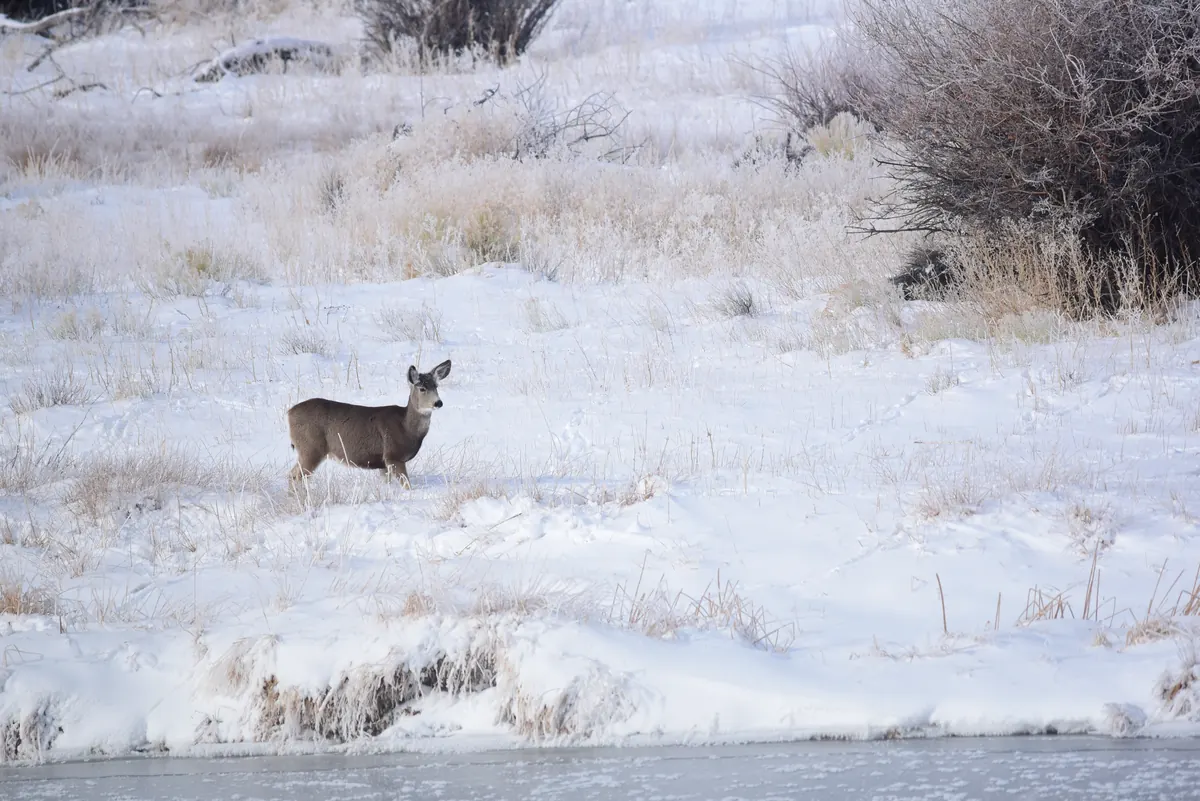
Some Wyoming mammals sleep through winter, but many of the animals you might see or hear this month stay awake through all of it. Their strategies come down to two things: store food ahead of time, or carry it on your body as fat and spend it slowly.
-
Pikas under the snowpack
All winter, out of sight · Talus slopes from about 8,000 feet to 11,000-foot peaks in the central Rockies, the Snowy Range and the Bighorns
A pika does not hibernate. Through the summer it cuts grasses and flowers, dries them in the sun and stacks them under boulders, then lives on those haypiles all winter beneath a blanket of snow, which keeps it insulated. Game and Fish nongame biologists have been surveying them statewide.
-
Deer, elk and pronghorn on a budget
January through April · Low, windswept or south-facing winter ranges
Big game spend the winter drawing down fat, so the severity of the season counts for a great deal: in 2023 Game and Fish warned that mule deer and pronghorn around Casper and Glenrock had the highest risk of above-normal winter losses after a winter of deep snow and cold. Give animals on winter range plenty of room, keep dogs leashed, and do not feed them.
Our December page covers bears, ground squirrels and the animals that turn white for the winter.
What can bare aspens and sagebrush teach you in a Wyoming January?
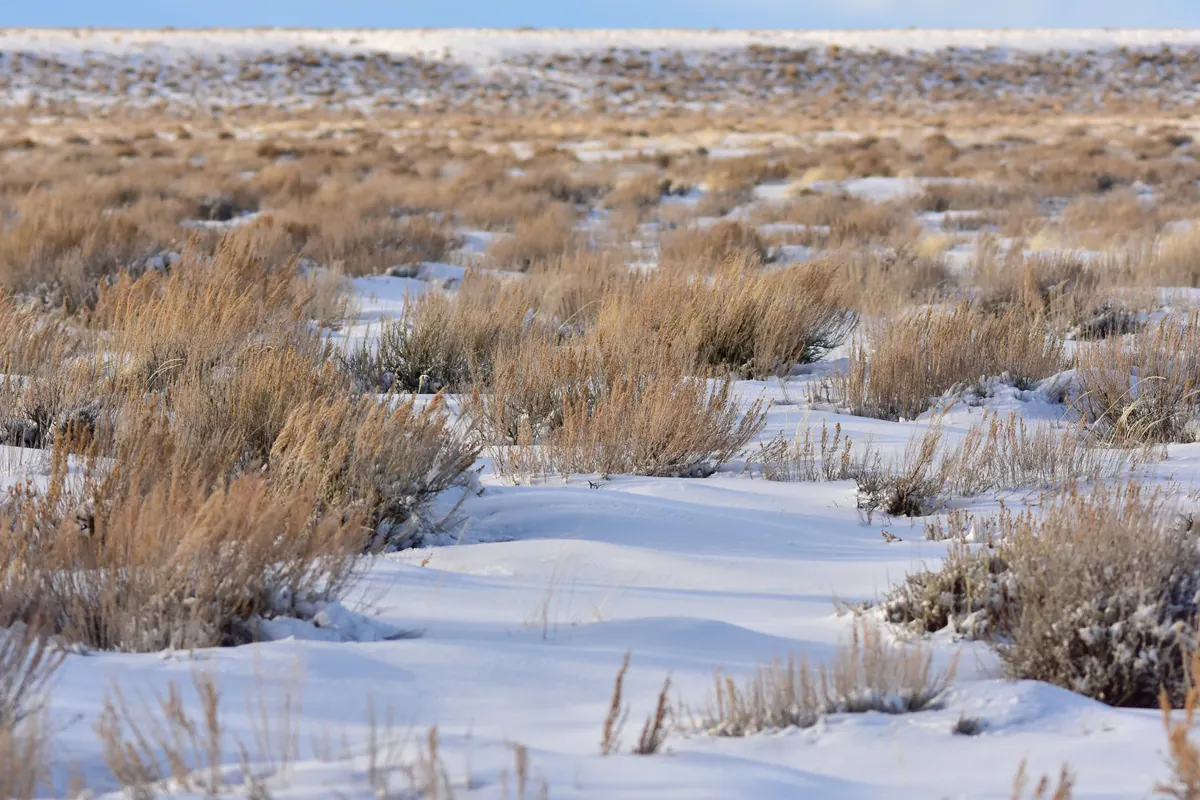
A leafless winter grove is a good place to learn trees by their bark and to read who has been eating them. On the open basins, sagebrush stays leafy through the winter.
-
Aspen’s green bark
All winter · Aspen groves from the foothills to about timberline
Aspen bark is greener than it looks. The Park Service explains that beneath the thin white outer bark is a layer that can photosynthesize, so the tree can keep making sugars in winter when other broadleaf trees are dormant. That same layer makes the bark survival food for deer and elk in hard winters. Many of the black marks on a healthy trunk are scars where lower branches were naturally shed.
-
Groves scarred by elk
Bark is chewed mostly in winter · Aspen stands on elk winter range, such as along the Gros Ventre River east of Jackson
Where elk gather in winter, aspen trunks are often blackened and rough up to the height an elk can reach. A 1972 Forest Service study on the Gros Ventre elk winter range found the trees dying at 3.6 percent a year in 1970, and blamed bark wounds made mostly by elk, and possibly moose, that let in cankers and boring insects. At that rate, the author warned, about two thirds of the tree-sized aspen would be gone by 2000. In Rocky Mountain National Park, rangers have shown bark tooth marks that match the size of elk teeth exactly.
-
Sagebrush leaves in winter
All winter · Basins and plains across the state
Wyoming big sagebrush is an aromatic evergreen with two kinds of leaves. The larger, often lobed leaves of spring drop off in mid- to late summer, but a second set grows in early summer, lives through the winter, and dies the next summer, about 12 to 13 months later. Those winter leaves, mostly under half an inch long and an eighth of an inch wide, are the ones botanists use for identification and the ones sage-grouse live on. Crush one in your fingers on a cold day to smell it.
Sketch one scarred aspen now and the same tree in leaf in June; the bark tells a story that the leaves hide.
How cold is January in Wyoming, and what might a strong El Niño do this winter?
Meteorologists treat December through February as one season, and January is its core. In NOAA’s 1991–2020 normals below, average highs run from 40.0 °F at Cheyenne down to 26.1 °F at Jackson, where an average January brings 11.2 nights below zero and 18.8 days that never climb above freezing. Rock Springs is not far behind with 17.9 such days. Cheyenne, by contrast, has only 7.1. Jackson also tops the snowfall column at 19.1 inches; Cheyenne averages 6.3.
High-country snow piles up through January, the store that feeds Wyoming’s rivers the following summer. Last winter that store fell far short: the Natural Resources Conservation Service reported statewide snow water equivalent at 38 percent of median on April 1, 2026, from 84 percent in the Yellowstone basin down to nothing at all in the South Platte, Belle Fourche and Cheyenne basins.
| Station | Average high | Average low | Snowfall | Days with a high below 32 °F | Nights below 0 °F |
|---|---|---|---|---|---|
| Cheyenne airport | 40.0 | 18.4 | 6.3 | 7.1 | 2.5 |
| Laramie airport | 33.4 | 10.3 | not published | 14.1 | 6.7 |
| Casper airport | 35.2 | 15.0 | 9.0 | 10.7 | 4.2 |
| Sheridan airport | 36.3 | 11.7 | not published | 10.6 | 5.8 |
| Lander airport | 32.8 | 9.8 | 8.2 | 14.6 | 5.8 |
| Rock Springs airport | 29.5 | 13.6 | 8.2 | 17.9 | 3.9 |
| Jackson | 26.1 | 6.3 | 19.1 | 18.8 | 11.2 |
Then there is the overheated Pacific. Wyoming’s coming winter rides on a Pacific that has run hot since summer; the Climate Prediction Center’s September 10 numbers gave this El Niño a better-than-nine-in-ten shot at the top tier by the cold months. In an August 2026 review, USGS climate scientists noted that strong El Niño winters have usually been mild across the northern tier, Wyoming included, while northern Wyoming has more often had near- or below-normal precipitation and risks a thin, early-melting snowpack at low and middle elevations. For the southern half of the state, the Western Regional Climate Center finds no clear wet or dry tilt. These are tendencies, not promises. NOAA’s winter forecast first appears October 15, then gets refreshed each month; the newest maps are on the Climate Prediction Center site. Our forecast page covers the next few days, and our Wyoming frost dates show when planting weather returns.
How much daylight does Wyoming gain in January?
The return of the light is easy to feel by the end of January. Over the month, Laramie gains 46 minutes of daylight, Cheyenne and Rock Springs 48, Jackson 52, and Sheridan and Cody 54. The northern towns start the year with the shortest days, 8 h 53 m at Sheridan on New Year’s Day against 9 h 16 m at Cheyenne, so they catch up fastest. Averaged over the month the gain is 1.5 to 1.8 minutes a day, but it is not steady: the days lengthen slowly in the first week and quicker toward the end, and the pace keeps rising until the March equinox.
| City | Jan 1 | Jan 31 | Gained | Per day |
|---|---|---|---|---|
| Cheyenne | 9 h 16 m | 10 h 04 m | 48 min | 1.6 min |
| Laramie | 9 h 16 m | 10 h 02 m | 46 min | 1.5 min |
| Rock Springs | 9 h 13 m | 10 h 01 m | 48 min | 1.6 min |
| Casper | 9 h 06 m | 9 h 56 m | 50 min | 1.7 min |
| Jackson | 9 h 01 m | 9 h 53 m | 52 min | 1.7 min |
| Gillette | 8 h 56 m | 9 h 49 m | 53 min | 1.8 min |
| Sheridan | 8 h 53 m | 9 h 47 m | 54 min | 1.8 min |
| Cody | 8 h 54 m | 9 h 48 m | 54 min | 1.8 min |
Our daylight calculator will run the numbers for Gillette, Pinedale or any other spot you choose.
What can you see in Wyoming’s night sky in January 2027?
January opens with a meteor shower, Earth’s closest pass to the sun and Venus at its best before dawn, and the Wolf Moon is the closest full moon of 2027. Times are MST.
-
The Quadrantid meteors
Night of Sunday, January 3, into Monday, January 4 · Anywhere dark; the radiant sits low in the north in the evening and climbs in the northeast toward dawn
The Quadrantids have a short, sharp peak, and two forecasts put it at different times: about 8:30 p.m. on the 3rd from the American Meteor Society, about 10:47 p.m. from EarthSky. Either way, the radiant is still low then, so Wyoming watchers will likely see the most in the hours before dawn on Monday. Only a slim waning crescent moon rises late. Expect dozens an hour at best from a dark ranch road, fewer near town.
-
Perihelion and the morning star
Perihelion Saturday, January 2, 7:33 p.m.; Venus at greatest elongation Sunday, January 3 · Venus low in the southeast before sunrise
Earth reaches its nearest point to the sun, about 91.4 million miles, on the evening of the 2nd. Wyoming is cold anyway, because the sun rides low and the nights are long. On the 3rd Venus swings out to its maximum separation, 47 degrees, and dominates the dawn sky for the rest of the month.
-
The Wolf Moon, closest full moon of 2027
Full at 5:17 a.m. on Friday, January 22 · Rising in the northeast around sunset on Thursday, January 21
At the full instant, before dawn on the 22nd, the moon is about 222,229 miles from Earth, near enough that every common definition calls it a supermoon. On Thursday the 21st, catch it rising over the snow. Fred Espenak’s almanac for 2027 puts bright Jupiter about a degree and a half from the moon on the evening of Saturday the 23rd.
-
Mercury and Saturn after sunset
Mercury from the last days of January into early February; Saturn all month · Low in the west-southwest 30 to 45 minutes after sunset; Saturn in the southwest after dark
Look for Mercury low in the dusk from about the last week of January; it reaches greatest elongation on the evening of February 2, Mountain Time. A flat western horizon and binoculars help. Saturn sinks a little lower each week.
| Phase | Date | Time |
|---|---|---|
| New moon | Thursday, Jan 7 | 1:24 p.m. |
| First quarter | Friday, Jan 15 | 1:34 p.m. |
| Full moon, the Wolf Moon | Friday, Jan 22 | 5:17 a.m. |
| Last quarter | Friday, Jan 29 | 3:55 a.m. |
Moonless evenings, best for the Milky Way, run from about January 3 through 12, bracketing the January 7 new moon. The sun’s 11-year cycle has peaked, but big storms remain possible, and northern Wyoming catches the aurora on good nights; NOAA’s Space Weather Prediction Center posts watches and a short-range aurora map. Before you drive out, check our cloud cover map.
What can Wyoming families do outside in January 2027?
Only the Burbot Bash and the elk refuge sleigh rides had their 2026–27 dates posted in early October 2026; for the rest we give the usual timing, so confirm with the organizer first. Winter weather cancels plenty of plans in Wyoming. Away for part of the month? Our state-by-state nature guides cover the rest of the country.
-
First Day Hikes
Friday, January 1, 2027 · Wyoming state parks and historic sites
January 1, 2026, was the 15th year in a row that Wyoming State Parks led free guided New Year’s Day hikes, and day-use fees are waived that day. In 2024 a record 1,132 people joined in at 17 sites. Last year’s schedule was announced December 1; expect the 2027 hikes to be posted around the same time.
-
The last days of the Christmas Bird Count
Through Tuesday, January 5, 2027 · Count circles around the state
Audubon’s 127th count window closes on January 5. A circle that saved its count day for the new year may still need help; Audubon’s circle finder lists compilers, and feeder watchers inside a circle can report too.
-
Bison breakfast at Hot Springs State Park
Daily in late fall and winter, usually at 8:30 a.m. · Hot Springs State Park, Thermopolis
The park’s bison herd, the central herd for Wyoming State Parks, gets a daily supplement in winter, and visitors can watch, but only from inside their vehicles. Afterward, the State Bath House offers a free soak in mineral water held at 104 °F (winter hours 8 a.m. to 5:30 p.m. Monday to Saturday, noon to 5:30 on Sunday). The springs themselves pour more than 8,000 gallons a day over the terraces at a constant 135 °F, so watch children around the steaming edges.
-
Sleighs among the elk
Daily, 10 a.m. to 4 p.m., through April 3, 2027 · National Elk Refuge, Jackson
The rides last about 45 minutes to an hour, with about 90 minutes from check-in to drop-off. Adults pay $43 and children 5 to 12 pay $28 this season; ages 4 and under are free.
-
Snowshoe with a ranger
Usually Tuesdays and Thursdays from early January to mid-March · Grand Teton National Park; reservations at 307-739-3399 on weekdays
Last winter’s walks ran January 6 to March 12, with booking from December 1. They cover a mile or two of gentle ground, snowshoes are provided, and children must be at least 8. The 2027 schedule had not been posted in early October.
One bird, one track and one bud a week, drawn in the Naturalist’s Field Journal, adds up to a January worth keeping.
Safety notes for January in Wyoming
- Hunting seasons. Many antlerless or cow-and-calf elk seasons in the 2026 regulations run through January 31, a few cow-or-calf hunts run January 1 to 15, and on the National Elk Refuge (elk area 77) a limited cow-or-calf hunt runs January 5 to 14; antlerless white-tailed deer seasons in deer area 145 also run to January 31. Check your exact hunt area. Chukar and gray partridge stay open statewide to January 31, and cottontails, snowshoe hares and squirrels to March 31; pheasant seasons closed December 31. For waterfowl, Pacific Flyway ducks close January 8; in the Central Flyway, ducks stay open to January 31 in Zones C1 and C1A and to January 12 in Zone C2, dark geese run to February 14 in C1 and C1A, and a late light goose season runs January 30 to February 14.
- Fluorescent orange or pink. Big and trophy game hunters in any firearm season need at least one outer garment of fluorescent orange or pink that can be seen from all directions; archers and crossbow hunters must too while a firearm season is open, except in archery-only or Type 9 seasons. Game and Fish recommends bright colors for bird and small game hunters, the people with them, their dogs, and hikers and skiers.
- Ice. For fishing, Game and Fish asks for four inches or more of clear ice, and double for cloudy or white ice. Check the thickness every 100 to 150 feet, avoid cracks, wear a life jacket, carry ice picks, never drive onto a frozen lake, stay off frozen rivers, and never fish alone.
- Cold and wind. Jackson averages 11.2 nights below zero in January, and wind can drive the wind chill far lower than the air temperature anywhere on the plains. Cover skin, carry spare dry layers and a hot drink, and turn back early.
- Ground blizzards and closed roads. Wind can lift old snow into a whiteout on a sunny day. Look at WYDOT’s road map before leaving town, and pack the car as if you might spend a night in it: sleeping bag, snacks, water, shovel, and a tank kept at least half full.
- Avalanches. Anyone going into avalanche terrain on skis, snowshoes or a snowmobile should check that day’s forecast from the Bridger-Teton Avalanche Center or the center covering their range, and carry a transceiver, shovel and probe.
- Short days. Even with the evenings lengthening, January days are short, so plan to be off the trail by mid-afternoon and carry a headlamp.
- Closures are the law. Winter range closures and the shed antler closure both carry penalties; check maps before you ski, hike or ride.
Sources
- Wyoming Game and Fish: shed antler and horn hunting season closed for western and southern Wyoming (January 3, 2023)
- Wyoming Game and Fish: what do I need to know about hunting shed antlers and horns in Wyoming?
- Wyoming Game and Fish: cold temperatures, deep snow taking a toll on Wyoming wildlife (March 6, 2023)
- U.S. Fish and Wildlife Service, National Elk Refuge: antler collection begins in early March (photo and caption)
- Bureau of Land Management: volunteers count 436 eagles in the Powder River Basin during midwinter survey (2024)
- Bureau of Land Management: volunteers count 461 eagles in Powder River Basin midwinter survey (2023)
- Bureau of Land Management: volunteers count 576 eagles during 2022 midwinter eagle survey
- Bureau of Land Management: volunteers count 464 eagles during 2020 midwinter eagle survey
- Bureau of Land Management: volunteers needed for Midwinter Bald Eagle Survey (Buffalo Field Office, 2017; 2016 results)
- Bureau of Land Management: Pinedale Field Office completes 2026 mid-winter eagle survey
- Bureau of Land Management: Kemmerer Field Office completes 2026 mid-winter bald eagle survey
- Teton Raptor Center: love is in the air, raptor breeding season begins (February 14, 2023)
- eBird: Wyoming region explorer
- Wyoming Game and Fish: species account, burbot (Lota lota)
- Wyoming Game and Fish, Wyoming Wildlife magazine: Bye-bye burbot
- Wyoming Game and Fish: Flaming Gorge fishing contests take aim at lake trout and burbot (December 19, 2024)
- Burbot Bash, Flaming Gorge Reservoir: 2027 tournament dates and prizes
- Wyoming Game and Fish: species account, greater sage-grouse
- Utah State University Extension: What does a sage-grouse eat? (Dahlgren, Thacker and Messmer, 2015)
- National Park Service, Yellowstone Science: why wolves howl
- National Park Service: wolves in Yellowstone (breeding, diet, population)
- National Park Service: Yellowstone park roads and seasonal dates, winter 2026–27
- National Park Service: Yellowstone safety (distances from wildlife)
- Buckrail: great horned owls search for mates in Grand Teton National Park (February 24, 2026)
- Wyoming Game and Fish, Wyoming Wildlife magazine: monitoring Wyoming’s talus slope sentinel (pikas)
- National Park Service, Bryce Canyon: quaking aspen (photosynthetic bark, winter browse)
- National Park Service, Rocky Mountain National Park: aspen bark and elk tooth marks
- USDA Forest Service: Krebill, R. G. (1972), Mortality of aspen on the Gros Ventre elk winter range
- USDA Forest Service, Fire Effects Information System: Wyoming big sagebrush
- NOAA NCEI: U.S. Climate Normals 1991–2020, January monthly normals for seven Wyoming stations
- USDA NRCS: Wyoming Basin and Water Supply Outlook Report, April 1, 2026
- NOAA Climate Prediction Center: ENSO diagnostic discussion, September 10, 2026
- NOAA Climate Prediction Center: seasonal outlooks (winter outlook issued October 15, 2026, updated monthly)
- U.S. Geological Survey, Climate Adaptation Science Centers: regional super El Niño impacts, North Central U.S. (August 2026)
- Western Regional Climate Center: frequently asked questions about El Niño and La Niña in the West
- Amphibian Publishing: Wyoming frost dates
- U.S. Naval Observatory: phases of the moon
- U.S. Naval Observatory: Earth’s seasons and apsides, 2027 (perihelion)
- U.S. Naval Observatory: sun and moon rise and set data
- American Meteor Society: meteor shower calendar (Quadrantids)
- EarthSky: Quadrantid meteor shower
- Fred Espenak, AstroPixels: Sky Event Almanac 2027
- EarthSky: what is a supermoon? (2027 full supermoons)
- NOAA Space Weather Prediction Center: aurora short-range forecast
- Wyoming State Parks: spend your New Year’s Day at a Wyoming state park or historic site (December 1, 2025)
- Wyoming Outdoor Recreation: Wyoming State Parks and Historic Sites hosts record First Day Hikes (2024)
- National Audubon Society: join the Christmas Bird Count (127th count, December 14 to January 5)
- Wyoming State Parks: about Hot Springs State Park (bison feeding, State Bath House, springs)
- National Elk Refuge Sleigh Rides: 2026–27 season dates, hours and prices
- National Park Service: winter in Grand Teton (ranger-led snowshoe walks)
- Wyoming Game and Fish: Chapter 7, elk hunting seasons, 2026
- Wyoming Game and Fish: Chapter 6, deer hunting seasons, 2026
- Wyoming Game and Fish: Chapter 11, upland game bird and small game seasons, 2026
- Wyoming Game and Fish: Chapter 14, migratory game bird seasons, 2026–27
- Wyoming Game and Fish: who should wear fluorescent orange or pink when hunting?
- Wyoming Game and Fish Commission: Chapter 2, General Hunting Regulation (archery exemption from fluorescent orange or pink)
- Wyoming Game and Fish: stay safe on the ice this winter
- Wyoming Department of Transportation: road and travel information
- Bridger-Teton Avalanche Center
- Photos via Wikimedia Commons; licenses and photographers are credited under each picture
.jpg)
