What to look for in nature in Wyoming this December
December 1 opens meteorological winter (December, January and February, which average colder than any other three months), and in Wyoming it is also the day the land is handed back to the animals. Slopes and river bottoms around Jackson and Pinedale, and most Game and Fish habitat areas statewide, close to people so deer, elk, moose and bighorns can winter undisturbed. Horse-drawn sleighs start carrying visitors among the elk at Jackson on December 19, Yellowstone reopens to snowcoaches on the 15th, birders spread out for the Christmas Bird Count, and the year’s earliest sunsets, between about 4:23 and 4:47 p.m. depending on the town, arrive around December 8 and 9. Below: what to look for, where, and who says so.
Other months in Wyoming: October, November.
Start here
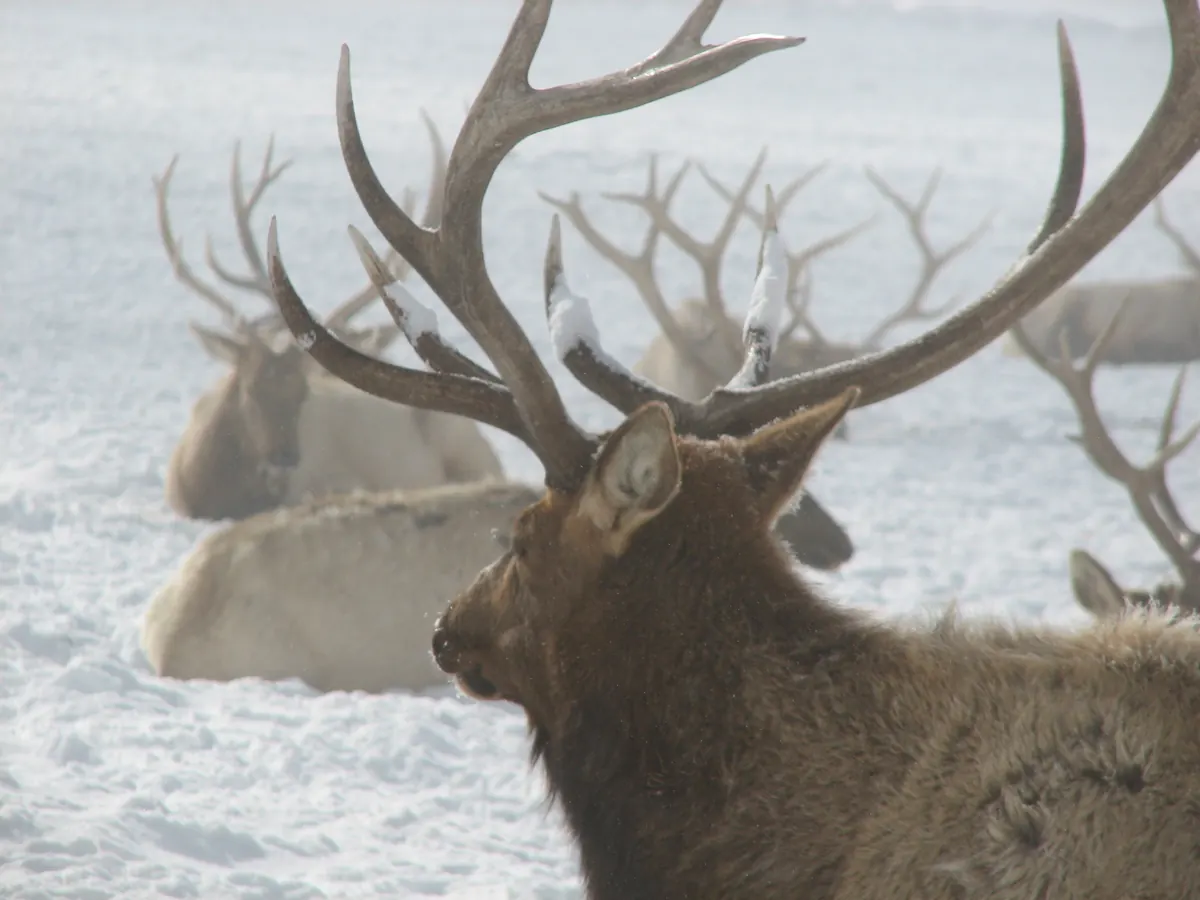
- Ride a sleigh among the elk. Beginning Saturday, December 19, sleighs leave from the refuge on North Cache Street in Jackson daily except Christmas, between 10 a.m. and 4 p.m. You spend 45 minutes to an hour among thousands of wintering elk, often with eagles and coyotes nearby.
- Join a Christmas Bird Count. Counts run from December 14 into early January in about twenty Wyoming circles. Casper’s 79th count is Saturday, December 19, from 7 a.m., and newcomers are teamed with experienced birders. Ask your Audubon chapter for its own date.
- Meteors, the solstice and a big moon. Watch for Geminids from mid-evening on Sunday, December 13, until dawn. The solstice falls on Monday the 21st (1:50 p.m. MST). Two evenings later, on the 23rd, the year’s nearest full moon, the Cold Moon, comes up over the eastern horizon already full.
For your journal: fresh snow is what the tracks-to-know plate was drawn for, a seeds-pods-and-cones page fits the conifer key below, and the birds-I-have-seen list belongs in your pocket on count day. Log the earliest sunset and the solstice on a dusk-and-dawn watch page, and on a still night start a map of sounds: an owl, a coyote chorus, ice groaning on a reservoir.
Regions used below: Southeast plains, Cheyenne and Laramie; Central Wyoming and Casper; Northeast: the Powder River Basin and Black Hills; Sheridan and the Bighorn Mountains; The Bighorn Basin and Cody; Wind River country, Riverton and Lander; Southwest: the Red Desert, Green River and Rock Springs; Jackson Hole, Pinedale, Grand Teton and Yellowstone.
Why do parts of Wyoming close to people in December?
By December the big game have settled on low, wind-swept or south-facing ground, and from now until spring they live mostly off the fat they stored in autumn. Game and Fish calls its winter habitat areas a refuge for animals that must conserve energy. Every flight from a skier or a loose dog burns that reserve, which is why so much winter range closes on December 1. Watch from roadside pullouts instead.
-
Bridger-Teton slopes around Jackson
From December 1 through the winter; the forest’s closure map gives the end dates · Josie’s Ridge and the slopes above U.S. 89 south to Game Creek, above Cache Creek and Nelson Drive, above Hoback Canyon, north of the Gros Ventre Road, and the A&W Trail between Adams and Wilson canyons
The national forest closes this low winter range to all human entry for the sake of deer, elk, moose and bighorn sheep. From December 1 dogs must be leashed at the Cache Creek, Trail Creek and Teton Pass trailheads, and until May 1 in areas next to critical winter range, such as the Woods Canyon and Putt-Putt trails and lower Game Creek. Winter travel maps are free at district offices and in the Avenza Maps app.
-
Game and Fish habitat areas
Most close December 1 and reopen between late April and mid-May · Statewide; for example Camp Creek, Horse Creek and South Park near Jackson; Soda Lake, Fall Creek, Luke Lynch and Black Butte near Pinedale
Most Wildlife Habitat Management Areas close or restrict access in winter, many from December 1 to May 15. On the department’s November 2025 list, Camp Creek and Horse Creek near Jackson closed to people from December 1 until May 1, and Soda Lake, Fall Creek and Black Butte near Pinedale from December 1 through April 30; Luke Lynch closed fully on December 1 after a month of vehicle limits, and South Park stayed open on foot through December 31. A few areas, Ocean Lake among them, stay open all year. The 2026 list was not out in early October, so check the department’s site before you go.
-
Grand Teton’s winter closures
Summits from December 1; river bottoms from December 15 to March 31 · Mount Hunt, Prospectors Mountain and Static Peak; the Snake River and Buffalo Fork bottoms and Kelly Hill
The three summits are closed to all travel until April 30, and skiers are asked to keep out of marked bighorn winter zones. From December 15 the park closes the Snake River and Buffalo Fork bottoms and Kelly Hill, where moose, elk, deer and bison spend the winter in the willows.
-
Moose in willows and firs
All winter; bulls drop antlers from late November on · Willow flats around Jackson, the Gros Ventre and Buffalo Fork; old subalpine fir and Douglas-fir stands up to about 8,500 feet
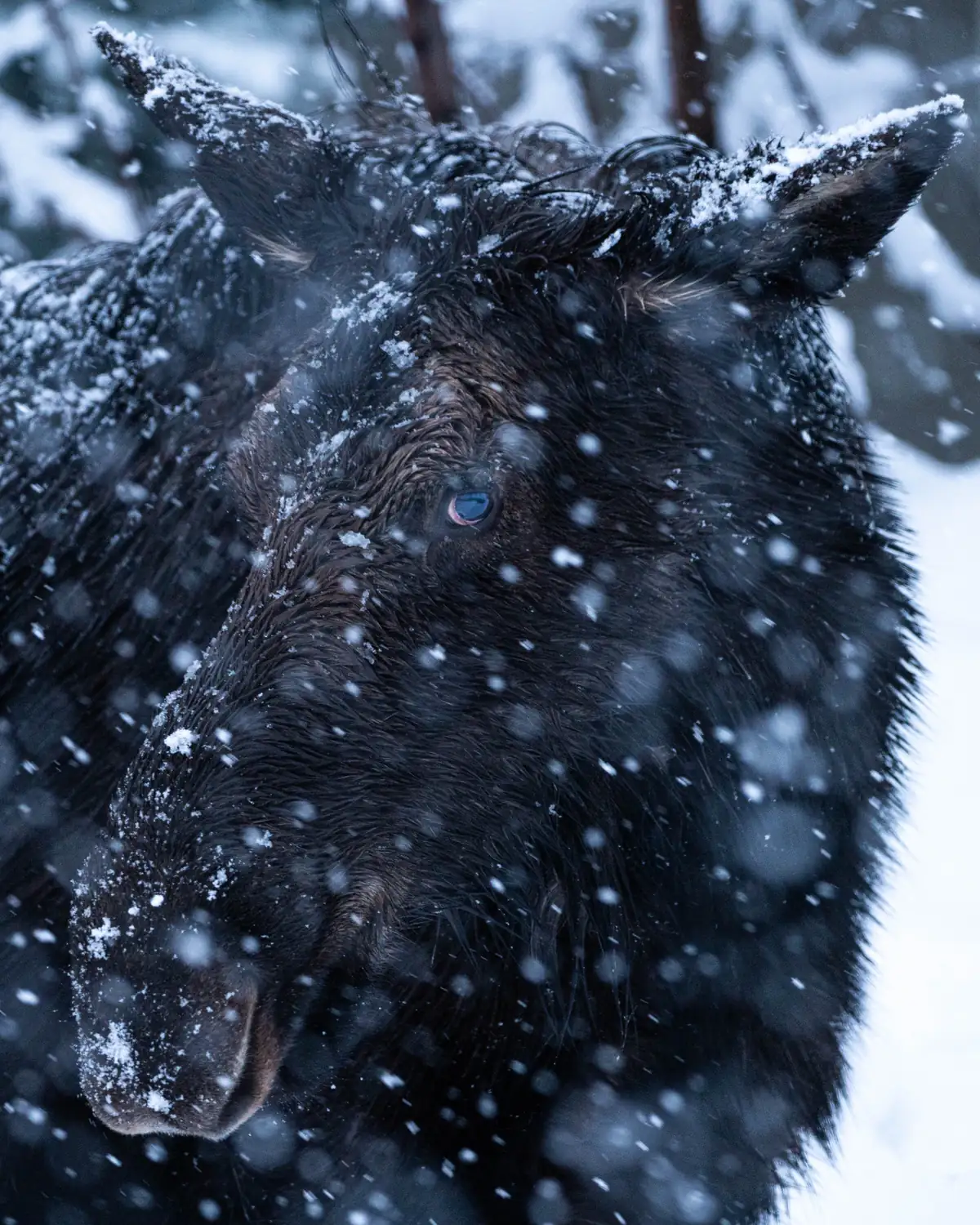
Grand Teton biologists say an adult moose eats 10 to 12 pounds a day in winter, mainly willow twigs. Some move down to valleys where willow sticks up through the snow; others climb into old fir forest, where dense branches keep the snow underfoot shallow. Bulls usually lose their antlers in late November or December, though young bulls may keep theirs until March.
These are the same herds that walked south in October; our November page follows them onto winter range.
When do the National Elk Refuge sleigh rides start, and how many elk winter there?
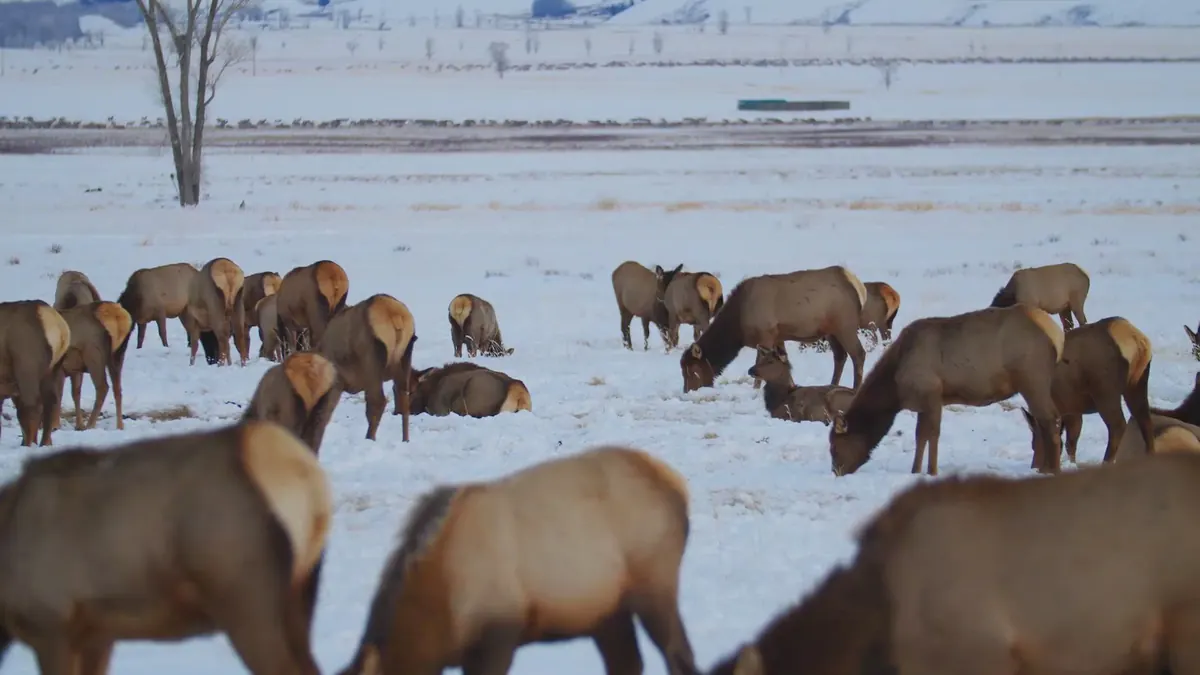
For seeing a lot of big animals without leaving pavement, nothing in Wyoming beats the National Elk Refuge at the north edge of Jackson in December. The Fish and Wildlife Service has put the usual winter count at 7,000 to 8,000 elk and 300 to 500 bison on its roughly 25,000 acres.
-
Sleigh rides
Daily from Saturday, December 19, 2026, to April 3, 2027, 10 a.m. to 4 p.m.; closed December 25 · Tickets and shuttle at the refuge visitor center, 532 North Cache Street, Jackson
The refuge’s sleigh concession lists 2026–27 fares of $43 for adults and $28 for children 5 to 12; children 4 and under ride free, and the driver’s tip is extra. Shuttles leave the visitor center lot every 20 to 30 minutes, and from check-in to drop-off the outing takes about 90 minutes. Reservations are optional, but holiday weeks fill.
-
Feeding, or not
Decided winter by winter · The southern half of the refuge
The refuge has fed elk in hard winters for decades, but feeding now waits on snow and grass. Refuge biologists say feeding is typically warranted once the grass left at key sites drops to about 300 pounds per acre, though elk behavior can also tip the decision. In the very mild winter of 2025–26, local news reported, forage never fell that low and no feeding was needed. December is usually too early in any case: look for elk pawing through the snow to graze.
Teton Science Schools’ wildlife calendar makes December the bighorn month in Jackson Hole; look for sheep along the Refuge Road at Miller Butte.
What happens when Yellowstone’s winter season opens?
Yellowstone’s groomed interior opens to oversnow travel on Tuesday, December 15, 2026. The Park Service keeps the West, South and East entrances and most groomed roads open until March 15, 2027 (Mammoth to Norris closes first, March 7), and winter travel on them is by commercially guided snowmobile or snowcoach only.
-
Old Faithful in winter
Tours from December 15; the Snow Lodge opens December 16 · Upper Geyser Basin, by snowcoach or guided snowmobile
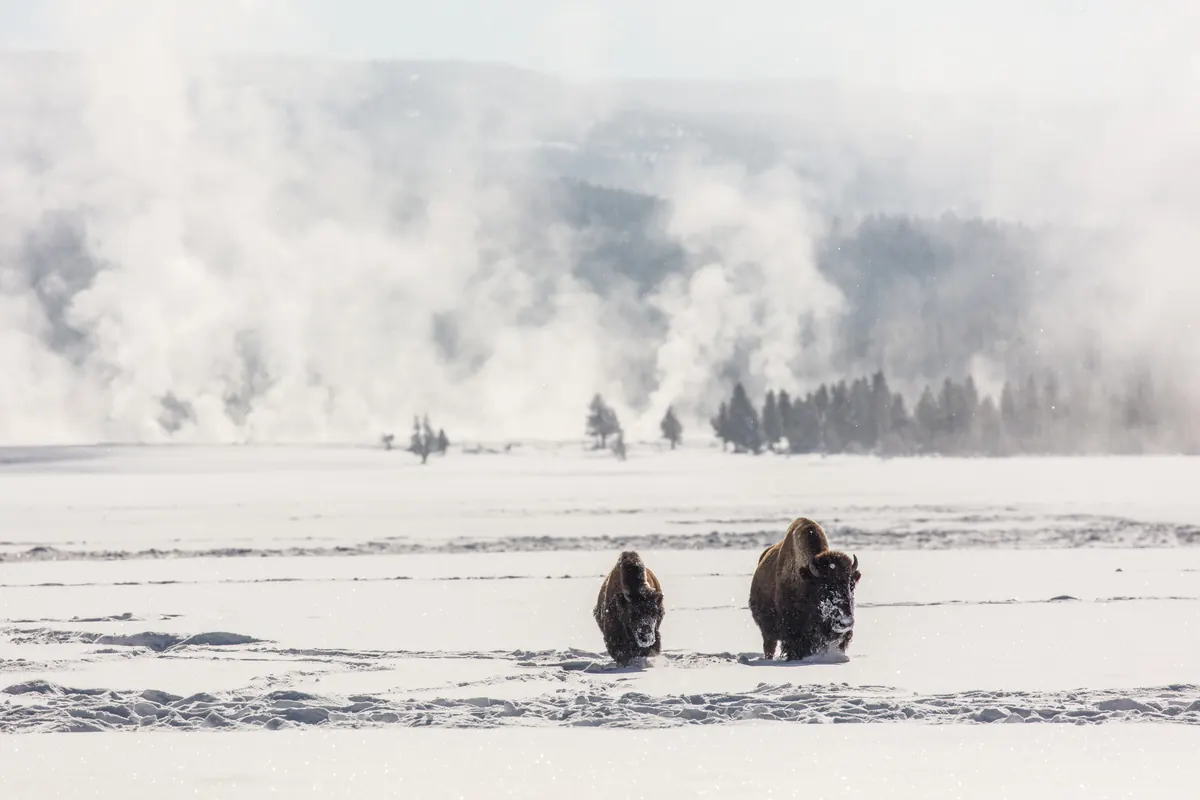
The park’s lodging company lists the Old Faithful Snow Lodge as open December 16 to March 7. In cold air the geyser plumes stand far taller than in summer, rime coats the lodgepoles, and bison graze the warm ground of the basins.
-
Wolves and bison on the northern range
All winter, at dawn and dusk · The year-round road from Gardiner, Montana, through Mammoth and the Lamar Valley to Cooke City
The Park Service ranks the northern range among the world’s best wolf-watching country; in winter, elk are about 90 percent of what wolves eat. Keep 100 yards from wolves and 25 from bison.
When is the Christmas Bird Count in Wyoming, and how can you take part?
Audubon’s 127th Christmas Bird Count opens December 14, 2026, and closes January 5, 2027. Each group picks one day in that window and tallies every bird inside its own 15-mile-wide circle. Audubon’s compiler list shows Wyoming circles at Albany County, Bates Hole, Buffalo, Casper, Cheyenne, Cody, Dubois, Evanston, Guernsey-Fort Laramie, Green River, Jackson Hole, Kane, Lander, Pinedale, Riverton, Story-Big Horn and Sheridan, and Goshen Hole joined in the 123rd count. Beginners are welcome; they go out with experienced counters, and residents of a circle may report from their own feeders.
-
Casper
Saturday, December 19, 2026, 7 a.m. to 5 p.m. · Meet at King’s Corner, 112 South Beech Street, Casper
Murie Audubon bills this as Casper’s 79th count and says people who know no birds can still help by joining a group. Casper often posts big totals: 12,674 birds of 65 species in the 122nd count.
-
Other circles
Each compiler picks a day between December 14 and January 5 · Cheyenne, Laramie, Sheridan, Buffalo, Cody, Lander, Riverton, Jackson Hole, Pinedale, Green River, Evanston and more
Most chapters had not posted 2026 dates by early October; check the local Audubon chapter or Audubon’s national count map.
-
What counters usually find
Count day · Towns, river corridors and open water below dams
In the 122nd count Canada geese were Wyoming’s most numerous bird, ahead of starlings, house sparrows, rock pigeons, mallards and crows, and mallards, bald eagles and black-billed magpies were found on every circle.
| Season | Counts held in Wyoming | Most species on one count | Statewide species |
|---|---|---|---|
| 2020–21 (121st) | 18 | Casper, 61 | 116 |
| 2021–22 (122nd) | 18 | Kane, 66 | 119 |
| 2022–23 (123rd) | 19 | Casper and Kane, 63 each | not published |
| 2023–24 (124th) | 18 | Casper, 58 | not published |
| 2024–25 (125th) | 18 | Buffalo, 68 | not published |
No count near you? Log any winter walk in eBird, or count your feeder birds through April for Project FeederWatch.
Which owls and winter birds can you find in Wyoming in December?
Birding is quiet in December but rarely empty: hawks hunt the hay meadows, ducks crowd what water is left open, and one owl starts its nesting season in the dark.
-
Great horned owls start courting
Hooting builds through December and January · Cottonwood bottoms, shelterbelts, ranch yards and town parks
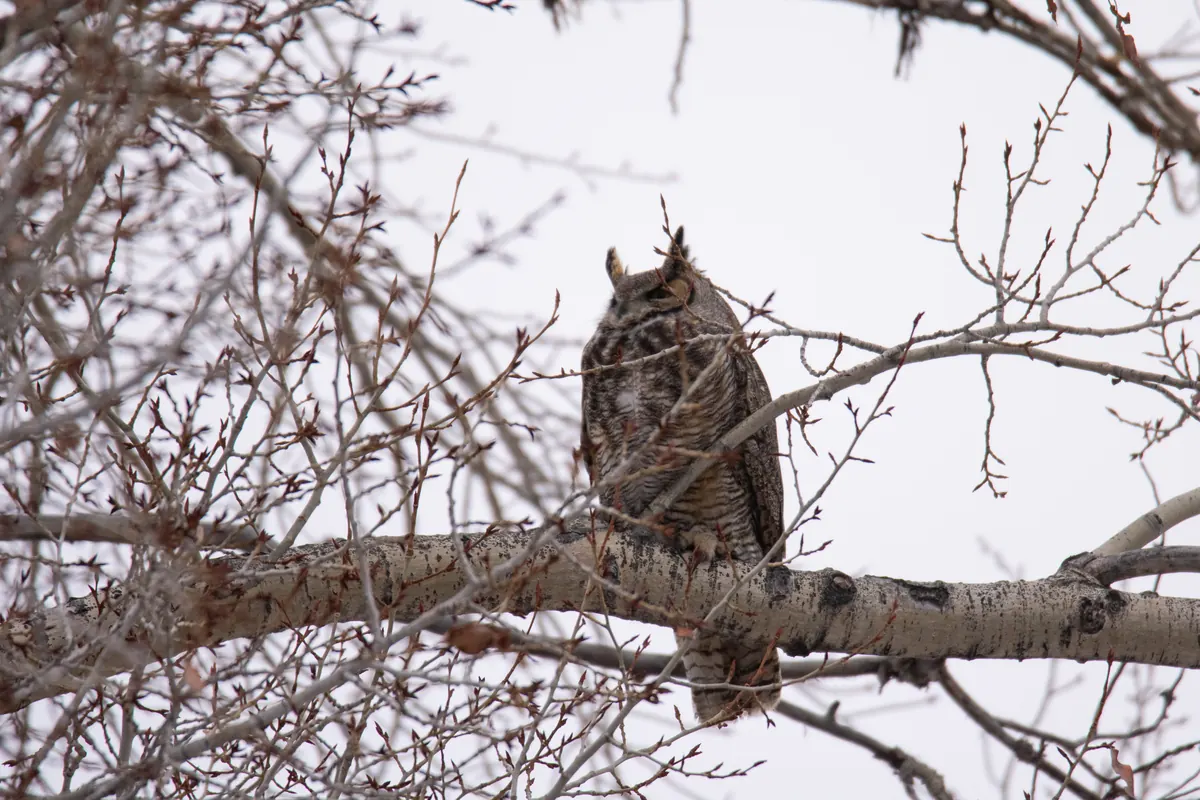
Audubon describes great horned owls courting in the coldest weather: the male hoots, puffs out his white throat and bows, and a bonded pair may stay together for years. They are among the first birds on the continent to nest, often in an old hawk or magpie nest. On a calm night listen for the deep, rhythmic hoots and a higher-pitched reply from the female.
-
Eagles at open water
All month · Below dams and in fast reaches: the Green below Fontenelle, the North Platte through Casper, the Wind River at Riverton, the Bighorn at Thermopolis
Bald eagles were found on every Wyoming count circle in the 122nd count. Where ice locks up the fish, they scavenge and pick off ducks. Check the tallest riverside cottonwoods in the first hour of daylight.
-
A light year for winter finches
This winter · Feeders and conifer stands
The Finch Research Network’s 2026–27 forecast expects good mountain-ash and spruce crops in Canada to hold most Bohemian waxwings and redpolls in the north, and little movement of pine grosbeaks; poor pine crops in the interior West have already sent Type 2 red crossbills east. Expect a winter of residents: chickadees, nuthatches, juncos, magpies and, near the mountains, rosy-finches.
Wyoming has few birders for its size, so one eBird checklist of an unusual bird can matter.
How do Wyoming animals survive the winter, and what tracks do they leave?
Animals get through a Wyoming winter by leaving, sleeping or toughing it out. By December the leavers are gone, the sleepers are down, and everything still awake is counting calories.
-
The sleepers
Bears for four or five months; ground squirrels and chipmunks longer · Dens on mountain slopes; burrows under meadow and sagebrush
Yellowstone Forever says most black and grizzly bears den for four to five months. A denned bear’s heart drops from a summer 40 to 50 beats per minute to between 8 and 12, it breathes about once every 45 seconds, and yet its body stays within 12 °F of its usual 100 to 101 °F. Ground squirrels and chipmunks chill much further, to body temperatures near 40 °F.
-
The toughs
All winter · Everywhere
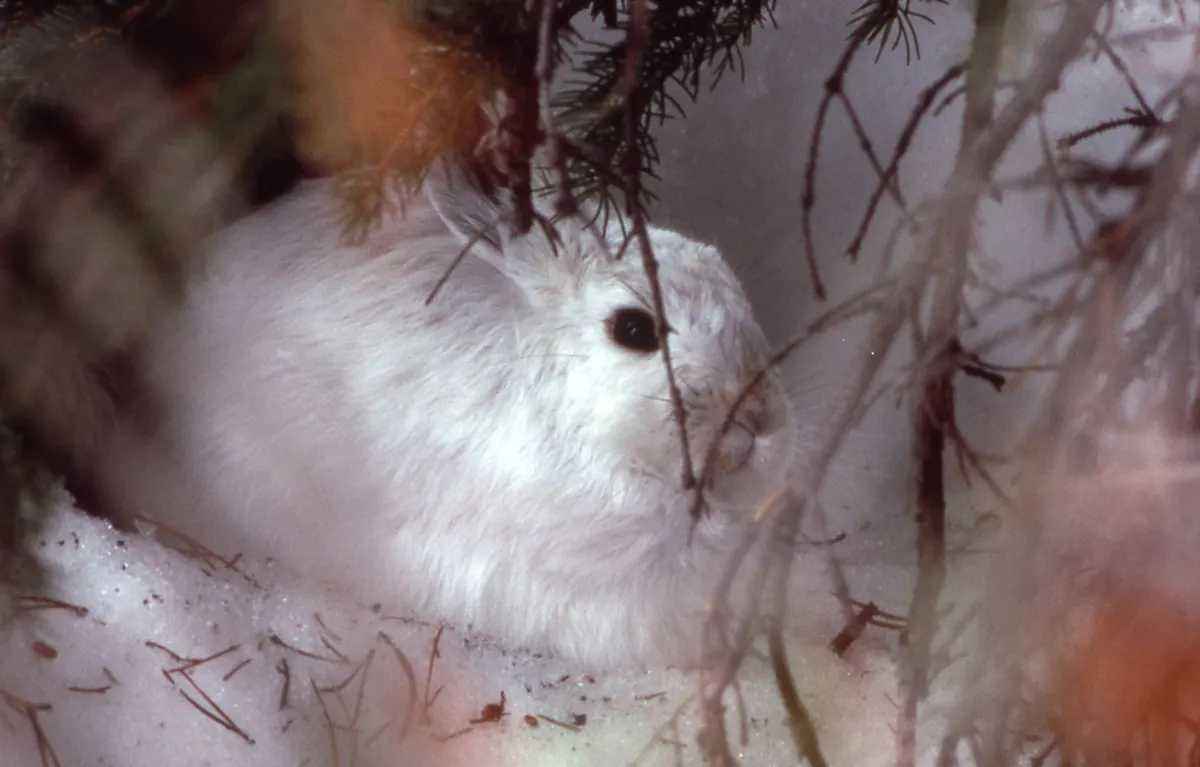
The Park Service notes that snowshoe hares, white-tailed jackrabbits and long-tailed and short-tailed weasels all turn white. Voles live in tunnels at the base of the snowpack, sheltered from cold and from hawks. A chickadee’s half-inch of feathers holds it up to 100 degrees warmer than the air, and at night it lets its body cool from about 108 °F to 88 °F.
-
Reading tracks
The morning after a light snow · Field edges, creek banks, fence lines
Teton Science Schools’ measurements help: a deer leaves a teardrop about 3 inches long and 2.5 wide, an elk a rounder print about 4.5 by 3, and a moose a bigger, heart-shaped one. Coyote prints are about 2.5 by 2 inches with four toes and claw marks, often in a dead-straight line; a red fox’s are a little smaller.
Put a mitten beside a track for scale before taking its picture.
How do you tell Wyoming’s evergreens apart, and where can you cut a Christmas tree?
With the cottonwoods and aspens bare, the conifers have the winter woods to themselves, and they are easier to learn than they look. University of Wyoming Extension counts three native spruces, five native pines and three upright junipers in the state, plus subalpine fir and Douglas-fir. The Biodiversity Institute’s key to Wyoming’s conifer trees, adapted from Robert Dorn’s flora of the state, sorts them with a twig in your hand.
-
Needles in bundles: the pines
Any time · Ponderosa in the northeast and Black Hills; lodgepole across the mountains; limber on dry rocky sites; whitebark near western treeline; pinyon only in southern Sweetwater County
Ponderosa has the longest needles of any Wyoming conifer, 2.5 inches or more. Lodgepole carries short needles in pairs and prickly cones that can cling to the branch for years, some opening only after fire. Limber and whitebark pines have five needles to a bundle; a limber cone is over 3 inches long and stays whole, a whitebark cone is round and breaks up on the tree. Rocky Mountain juniper, with scale leaves and blue berries, is the common juniper of the foothills.
-
Single needles: spruce, fir and Douglas-fir
Any time · Engelmann spruce and subalpine fir up high; Douglas-fir on lower slopes; blue spruce along streams; white spruce in the Black Hills
Pinch a needle and twirl it. A spruce needle is square and sharp and rolls easily; a fir needle is flat, soft and does not. Spruce cones hang down, while subalpine fir cones stand upright and shed their scales on the branch, so whole ones are rarely found. Douglas-fir is not a true fir: three-pointed bracts poke out between its cone scales, which the key compares to mice diving for cover with only their hind ends showing.
-
Cutting your own tree
Permits usually go on sale in November · Bighorn, Medicine Bow, Shoshone, Bridger-Teton and Black Hills national forests
Permits are sold at district offices and on Recreation.gov (a $2.50 processing fee, up to five trees per account), and have cost roughly $8 to $15 a tree in recent years. Fourth graders get theirs free through the Every Kid Outdoors program.
How cold and snowy is December in Wyoming, and what might El Niño do this winter?
December is one of Wyoming’s coldest and driest months. In NOAA’s 1991–2020 normals below, the average high runs from 39.3 °F at Cheyenne down to 26.2 °F at Jackson, which also averages nearly 11 nights below zero. Snow totals mislead: Rock Springs gets just 5.8 inches but has an inch or more on the ground for 16.7 days, while Cheyenne’s 8.8 inches lingers only 9.4 days. Lander keeps snow cover for 20.4 days, and Jackson tops the table with 16.4 inches of snow and 1.76 inches of precipitation.
The backdrop this winter is unusual. NOAA’s Climate Prediction Center put the probability of a very strong El Niño by winter above 90 percent in its September 10 update. A review of past strong events published in August 2026 by the U.S. Geological Survey’s Climate Adaptation Science Centers names warmer-than-average winters across the northern tier, Wyoming included, as one of the clearest signals. Rain and snow split along a north–south line: Colorado and the southern plains have tended wetter, northern Wyoming and Montana near or below normal, and warmth or dryness in the north can mean thinner snowpack and earlier melt. Southern Wyoming sits near the line, so read this as tilted odds. Watch for NOAA’s formal December to February forecast after mid-October among the three-month outlook maps.
| Station | Average high | Average low | Precipitation | Snowfall | Days with 1 in or more of snow on the ground | Nights below 0 °F |
|---|---|---|---|---|---|---|
| Cheyenne airport | 39.3 | 18.1 | 0.48 | 8.8 | 9.4 | 2.2 |
| Laramie airport | 32.7 | 10.2 | 0.32 | not published | not published | 6.6 |
| Casper airport | 34.7 | 14.8 | 0.61 | 11.0 | 16.3 | 4.1 |
| Gillette 4 SE | 35.8 | 16.1 | 0.64 | 8.4 | 14.2 | 3.5 |
| Sheridan airport | 36.7 | 12.2 | 0.54 | not published | not published | 4.7 |
| Cody | 36.5 | 18.0 | 0.46 | 7.5 | 6.3 | 3.2 |
| Lander airport | 32.9 | 10.2 | 0.63 | 9.3 | 20.4 | 5.0 |
| Rock Springs airport | 29.5 | 13.4 | 0.31 | 5.8 | 16.7 | 3.3 |
| Jackson | 26.2 | 6.8 | 1.76 | 16.4 | not published | 10.9 |
For when the last spring freeze usually comes, see our Wyoming frost dates; for the next few days, our local weather page.
When is the earliest sunset in Wyoming, and how short is the shortest day?
At the solstice Sheridan gets 8 h 48 m of daylight, Gillette 8 h 51 m and Cheyenne 9 h 13 m. Between December 1 and the 21st the state loses only 13 to 16 more minutes, since the change slows to a crawl near the solstice, and by the 31st most towns have regained about four.
The surprise is the sunset. Wyoming’s earliest sunsets fall on the 8th or 9th, almost a fortnight ahead of the solstice: 4:23 p.m. at Gillette, 4:27 at Sheridan, 4:30 at Cheyenne and 4:31 at Casper, and 4:47 at Jackson and Rock Springs, which lie far west in the time zone. Sunrise, meanwhile, keeps getting later into early January.
| City | Dec 1 | Dec 21 | Dec 31 | Earliest sunset |
|---|---|---|---|---|
| Cheyenne | 9 h 26 m | 9 h 13 m | 9 h 15 m | 4:30 p.m., Dec 8 |
| Laramie | 9 h 25 m | 9 h 11 m | 9 h 15 m | 4:33 p.m., Dec 8 |
| Rock Springs | 9 h 23 m | 9 h 10 m | 9 h 14 m | 4:47 p.m., Dec 8 |
| Casper | 9 h 15 m | 9 h 01 m | 9 h 05 m | 4:31 p.m., Dec 9 |
| Jackson | 9 h 12 m | 8 h 57 m | 9 h 01 m | 4:47 p.m., Dec 9 |
| Gillette | 9 h 06 m | 8 h 51 m | 8 h 55 m | 4:23 p.m., Dec 9 |
| Sheridan | 9 h 03 m | 8 h 48 m | 8 h 52 m | 4:27 p.m., Dec 9 |
| Cody | 9 h 05 m | 8 h 49 m | 8 h 53 m | 4:36 p.m., Dec 9 |
Our sunrise and sunset calculator gives the times for any town and date.
What can you see in Wyoming’s night sky in December 2026?
Long nights and dry, thin air make December the finest stargazing month in Wyoming if you dress for the cold. Times below are MST.
-
The Geminids
Mid-evening Sunday, December 13, to dawn Monday, December 14 · Anywhere dark; the radiant in Gemini rises in the northeast at dusk and is nearly overhead around 2 a.m.
The International Meteor Organization’s ideal-sky figure for this shower is 150 an hour. A Wyoming ranch road will show you fewer, yet plenty to keep you outside. A thin crescent moon goes down in mid-evening, and North America is well placed for the maximum, which comes around dawn on the 14th. Geminids are slow and often bright.
-
The solstice
Monday, December 21, 1:50 p.m. MST · Note where the sun sets on the southwestern horizon
Noon shadows are at their longest now, and winter starts on the astronomers’ calendar. Afterward the days grow, though only by seconds at first.
-
The Cold Moon
Full at 6:28 p.m. MST, Wednesday, December 23 · Rising in the northeast around sunset
Perigee, when the moon swings nearest Earth, follows full moon by only about seven hours, so this is 2026’s nearest full moon and looks a touch larger than any other. Wyoming sees it rise practically full on the 23rd, and it still looks round on Christmas Eve.
-
Planets
All month · Venus and Mars in the southeast before dawn; Jupiter in the east by mid-evening late in the month; Saturn in the southwest after dusk
In the morning twilight Venus has no rival; its greatest elongation, 47 degrees west of the sun, comes January 3. Look for the old crescent moon beside it on the 4th and closer still on the 5th, with Spica nearby. Jupiter, in Leo, rises a little sooner every night, reaching the eastern sky by mid-evening near month’s end, while Mars brightens slowly nearby before dawn. After sunset, Saturn alone shines among the bright planets, setting a few hours after the sun by the 31st. On the evening of the 21st the nearly full moon slides close to the Pleiades.
-
Aurora and a comet to come
Any clear night; the comet later in winter · Low in the north for aurora
Solar activity has passed its maximum but can still produce strong storms, and northern Wyoming has the best chance when NOAA’s Space Weather Prediction Center posts a watch. Comet Encke, source of the Taurid meteors, begins brightening this month and should be within reach of binoculars low in the evening twilight in late January and February.
| Phase | Date | Time |
|---|---|---|
| Last quarter | Monday, Nov 30 | 11:08 p.m. MST |
| New moon | Tuesday, Dec 8 | 5:52 p.m. MST |
| First quarter | Wednesday, Dec 16 | 10:42 p.m. MST |
| Full moon, the Cold Moon | Wednesday, Dec 23 | 6:28 p.m. MST (also looks full on Christmas Eve) |
| Last quarter | Wednesday, Dec 30 | 11:59 a.m. MST |
| New moon | Thursday, Jan 7, 2027 | 1:24 p.m. MST |
Will Geminid night be clear? Our cloud forecast answers that, and the moon page gives moonrise for your town.
What can Wyoming families do outside in December 2026?
Each event below was on its organizer’s calendar on October 2, 2026. Winter weather can cancel plans and fees can change, so confirm before you drive. Traveling for the holidays? Our nature guides by state cover the rest of the country.
-
Conservatory of Lights and story time
Lights December 3 to 26, 5 to 7 p.m.; story time Fridays, December 4, 11 and 18, at 11 a.m. · Cheyenne Botanic Gardens, Lions Park, Cheyenne
For its fourth year the gardens string holiday lights through the tropical conservatory, with cocoa and a scavenger hunt, all free. The Friday story time for young children, with a craft, is free too; the calendar also lists Christmas Day, so check before going that morning.
-
Sleighs among the elk
From Saturday, December 19, daily; closed Christmas Day · National Elk Refuge, 532 North Cache Street, Jackson
About an hour on the sleigh: $43 for adults, $28 for ages 5 to 12, under 5 free. The free visitor center lends binoculars and offers Junior Naturalist activities.
-
Casper Christmas Bird Count
Saturday, December 19, from 7 a.m. · King’s Corner, 112 South Beech Street, Casper
Older children who can handle a cold morning can join a group; Murie Audubon’s event page lists the phone numbers for signing up.
-
Snowshoeing with a ranger
In past winters booking opened December 1; walks start in January · Grand Teton National Park; call 307-739-3399 on weekdays
The park’s ranger-led snowshoe walks cover a mile or two on gentle ground, with snowshoes provided, for ages 8 and up. Last winter they ran Tuesdays and Thursdays, early January to mid-March; 2027 dates were not yet posted in early October.
-
First Day Hikes, January 1, 2027
New Year’s Day · Wyoming state parks and historic sites
On January 1, 2026, Wyoming State Parks led 19 free guided hikes at 17 parks and historic sites, among them Curt Gowdy, Guernsey, Sinks Canyon, Keyhole and Hot Springs, and day-use fees were waived. Last year’s list came out on December 1, so look for the 2027 hikes in early December.
-
Science you can help with
All month · Home, schoolyard or count circle
Project FeederWatch, a Christmas count, eBird, or measuring yard snowfall for CoCoRaHS all welcome young helpers.
One track, one cone and one bird sketched each week add up to a winter worth remembering; the plates in our Naturalist’s Field Journal are made for that.
Safety notes for December in Wyoming
- Hunting seasons. Wyoming sets dates hunt area by hunt area, so check the 2026 regulations for the exact area. Many antlerless or cow-and-calf elk seasons run through December 31 and some to January 31. In Grand Teton National Park (elk area 75) the limited antlerless hunt ends December 6; on the National Elk Refuge (area 77) a general period runs November 30 to December 6 and a limited cow-and-calf hunt December 7 to 18. Many doe-and-fawn or antlerless white-tailed deer seasons last to December 31. Pheasant season runs through December 31 in most areas, chukar and gray partridge through January 31. Pacific Flyway ducks stay open to January 8 (no scaup after December 20) and geese to December 31; Central Flyway Zones C1 and C1A stay open to January 31, while Zone C2 (Albany, Campbell, Crook, Johnson, Laramie, Niobrara, Sheridan, Weston and eastern Carbon counties) closes November 29 and reopens December 12 through January 12.
- Fluorescent orange or pink. During any open firearm season for big or trophy game, Game and Fish requires those hunters to wear one exterior piece of clothing in fluorescent orange or pink that shows from every direction. Bowhunters and crossbow hunters hunting while a firearm season is open must comply too, as must wild bison hunters and pheasant hunters on certain department lands. Skiers, hikers and riders are not required to wear it, but the department urges them to.
- First ice. Ponds and some reservoirs, Boysen among them, freeze early; larger lakes such as Lake Hattie later. Game and Fish wants at least four inches of clear ice for fishing, and twice that if it is white or cloudy. Test it every 100 to 150 feet, carry ice picks, wear a life jacket, never drive onto a frozen lake, and stay off frozen rivers.
- Ground blizzards. Wind can whip old snow into a whiteout under a blue sky, and I-80 and other highways close often. Check WYDOT road reports before every trip and carry blankets, food, water, a shovel and a full tank.
- Avalanches. Backcountry skiers and snowmobilers should read the daily avalanche forecast, such as the Bridger-Teton Avalanche Center’s, and carry a beacon, shovel and probe.
- Short days and hard cold. With sunset between about 4:20 and 4:50 p.m. in mid-December, aim to be back at the trailhead by mid-afternoon with a headlamp in your pack.
- Closures are the law. Closed winter range is closed to people and dogs alike; check the maps before skiing or hiking near it.
Sources
- Bridger-Teton National Forest: winter wildlife restrictions begin December 1 (November 25, 2025)
- Wyoming Game and Fish: many wildlife habitat management areas close for winter (December 2024, statewide list)
- Wyoming Game and Fish: seasonal closures approach for WHMAs (November 17, 2025; Jackson and Pinedale areas)
- National Park Service: Grand Teton temporary and wildlife closures
- National Park Service: Grand Teton moose (winter diet, habitat, antler shedding)
- National Elk Refuge Sleigh Rides: 2026–27 season dates, hours and prices
- U.S. Fish and Wildlife Service: National Elk Refuge (elk and bison numbers, supplemental feeding)
- U.S. Fish and Wildlife Service: wildlife watching on the National Elk Refuge
- U.S. Fish and Wildlife Service: National Elk Refuge biological update, January 2017 (300 pounds per acre feeding criterion)
- Jackson Hole Radio: National Elk Refuge February 2026 biological update (no feeding in 2025–26)
- Teton Science Schools: wildlife calendar of Grand Teton and Yellowstone
- National Park Service: Yellowstone park roads and seasonal dates, including winter 2026–27 oversnow travel
- Yellowstone National Park Lodges: opening and closing dates (Old Faithful Snow Lodge, winter 2026–27)
- National Park Service: wolves in Yellowstone
- National Park Service: winter ecology in Yellowstone (bison, chickadees, color change)
- National Park Service: Yellowstone safety (wildlife distances)
- National Audubon Society: join the Christmas Bird Count
- National Audubon Society: count circles, codes and compilers, 124th Christmas Bird Count
- National Audubon Society: the 121st Christmas Bird Count in Wyoming
- National Audubon Society: the 122nd Christmas Bird Count in Wyoming
- National Audubon Society: the 123rd Christmas Bird Count summary
- National Audubon Society: the 124th Christmas Bird Count summary
- National Audubon Society: the 125th Christmas Bird Count summary
- Murie Audubon Society: Casper Christmas Bird Count, December 19, 2026
- Cheyenne Audubon
- Bighorn Audubon (Sheridan): events
- National Audubon Society: when the mercury drops, great horned owls gear up for courtship
- Finch Research Network: winter finch forecast 2026–2027
- Project FeederWatch
- eBird: Wyoming region explorer
- Yellowstone Forever: naturalist notes on hibernation
- Teton Science Schools: tracking in the Greater Yellowstone Ecosystem
- University of Wyoming Extension, Barnyards and Backyards: conifer diversity (native spruces, pines and junipers)
- University of Wyoming Biodiversity Institute: key to the conifer trees of Wyoming
- Bridger-Teton National Forest: Christmas tree permits available on Recreation.gov (November 2025)
- NOAA NCEI: U.S. Climate Normals 1991–2020, monthly normals for nine Wyoming stations
- NOAA Climate Prediction Center: ENSO diagnostic discussion, September 10, 2026
- NOAA Climate Prediction Center: seasonal outlooks (winter outlook issued October 15, 2026)
- U.S. Geological Survey, Climate Adaptation Science Centers: regional super El Niño impacts, North Central U.S. (August 2026)
- Amphibian Publishing: Wyoming frost dates
- U.S. Naval Observatory: phases of the moon
- U.S. Naval Observatory: Earth’s seasons, 2026 (December solstice)
- U.S. Naval Observatory: sun and moon rise and set data
- International Meteor Organization: 2026 meteor shower calendar
- EarthSky: what is a supermoon? (2026 full supermoons)
- NASA JPL Horizons: planetary and lunar positions
- NOAA Space Weather Prediction Center: solar cycle progression
- Star Walk: Comet Encke in 2027
- Cheyenne Botanic Gardens: events, December 2026
- National Park Service: winter in Grand Teton (snowshoe walks, Teton Park Road, pets)
- Wyoming State Parks: spend your New Year’s Day at a Wyoming state park or historic site (December 1, 2025)
- CoCoRaHS: Community Collaborative Rain, Hail and Snow Network
- Wyoming Game and Fish: Chapter 6, deer hunting seasons, 2026
- Wyoming Game and Fish: Chapter 7, elk hunting seasons, 2026
- Wyoming Game and Fish: Chapter 11, upland game bird and small game seasons, 2026
- Wyoming Game and Fish: Chapter 14, migratory game bird seasons, 2026–27
- Wyoming Game and Fish: who should wear fluorescent orange or pink when hunting?
- Wyoming Game and Fish: Chapter 2, General Hunting Regulation (archery exemption from fluorescent orange or pink)
- Wyoming Game and Fish: stay safe on the ice this winter
- Travel Wyoming: top places for ice fishing (Boysen, Lake Hattie)
- Wyoming Department of Transportation: road and travel information
- Bridger-Teton Avalanche Center
- Photos via Wikimedia Commons; licenses and photographers are credited under each picture
