What to look for in nature in Wyoming this February
February closes out meteorological winter, and for Wyoming wildlife it is usually the leanest month of all. Elk on the western feedgrounds have been eating hay for weeks, and the bighorns at Dubois and Jackson are living on what the wind has uncovered. Trumpeter swans from Canada crowd the few rivers that stay open, while a great horned owl may already be sitting on eggs in the snow. Flocks of rosy-finches, among the highest-nesting birds on the continent, drop into valley towns. Up high, snow surveyors weigh the snowpack that will become next summer’s water. The light is gaining fast too: the towns in our table gain between 68 and 78 minutes of daylight by the 28th. Below, each sighting comes with its place, its timing and its source.
Other months in Wyoming: October, November, December, January.
Start here
- Drive the Refuge Road for bighorns. From the north end of Jackson, the National Elk Refuge keeps 3.5 miles of road open all winter. Watch the cliffs of Miller Butte for sheep, pull fully into a turnout to look, and if one comes to lick salt off your car, ease away slowly.
- Count birds over Presidents’ Day weekend. Bird lovers on every continent take part in the Great Backyard Bird Count from February 12 through 15, 2027. Fifteen minutes beside a feeder in Pinedale or Laramie could add a rosy-finch flock to the global count; submit it with eBird or Merlin.
- Watch the Snow Moon rise full. On Saturday, February 20, the moon turns full at 4:23 p.m. MST, before it rises, so it comes up over the eastern horizon at dusk already round. Look for bright Jupiter not far away and reddish Mars, one day past opposition, a little to the east.
Wyoming’s February suits a handful of Field Journal plates. Give a great horned owl or bald eagle pair the nest-observed plate, dated the first day you see a bird sitting tight. Put bighorn ewes and rams on the mammal watch, a rosy-finch flock and your bird count tally under birds I have seen, and a trumpeter swan feather, if one drifts ashore, on the feather-found page. A dusk-and-dawn watch, kept weekly, will show the evenings stretching later.
Regions used below: Southeast plains, Cheyenne and Laramie; Central Wyoming and Casper; Northeast: the Powder River Basin and Black Hills; Sheridan and the Bighorn Mountains; The Bighorn Basin and Cody; Wind River country, Riverton and Lander; Southwest: the Red Desert, Green River and Rock Springs; Jackson Hole, Pinedale, Grand Teton and Yellowstone.
Why does Wyoming feed elk in winter, and what changes in February on the feedgrounds?
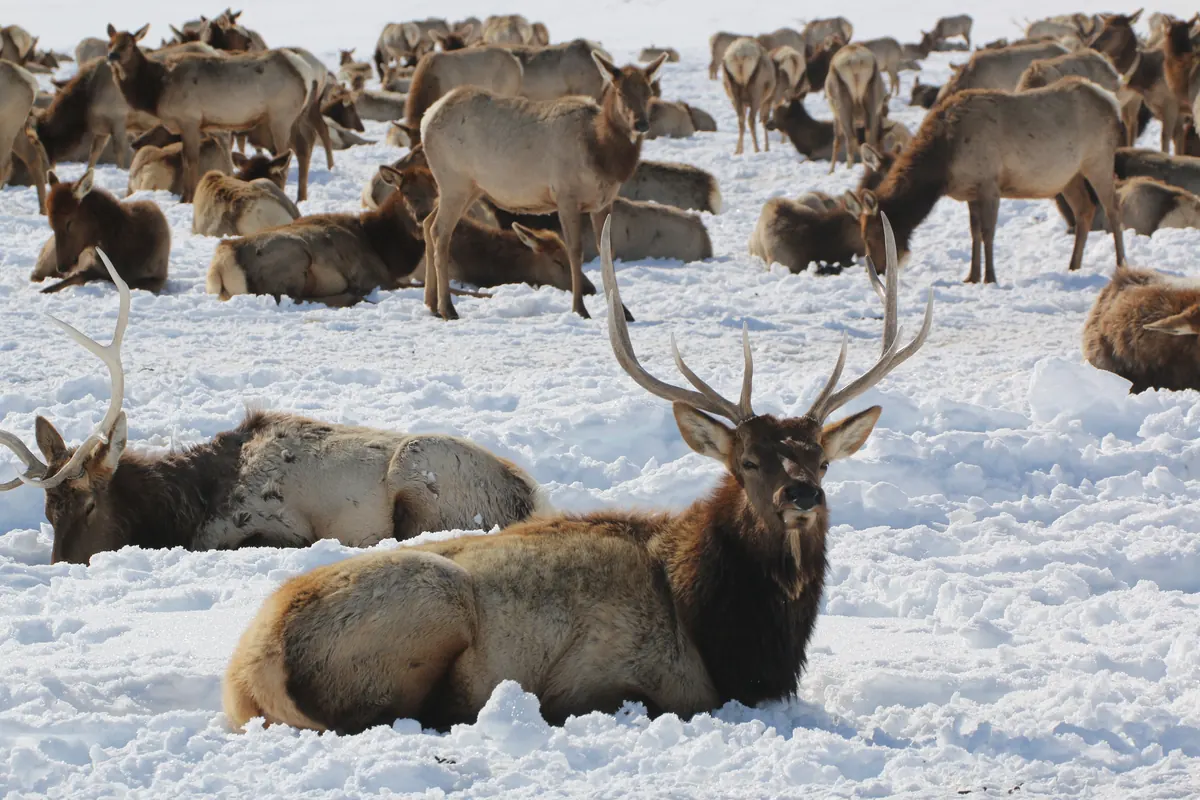
No other state runs anything like it. Every winter, Game and Fish feeds hay to elk on 21 feedgrounds in Teton, Lincoln and Sublette counties, and the Fish and Wildlife Service feeds on the National Elk Refuge at Jackson when conditions call for it. By February every feedground that will be used this winter is in operation, and the hardest stretch for wintering elk, along with the start of the disease season that worries biologists most, lies just ahead.
-
A program more than a century old
Since the winter of 1909–10 · The Jackson and Pinedale regions, west of the Continental Divide
The department’s 2024 management plan traces winter feeding around Jackson to 1909–10, before Game and Fish existed; the federal refuge followed in 1912. Feeding began to keep elk from starving and later spread through Sublette County to keep elk out of ranchers’ haystacks and away from cattle. From 2001 through 2021 the state feedgrounds fed an average of 14,928 elk and spread an average of 6,333 tons of hay a season, and the long-term average season lasts 122 days.
-
Feeding starts early, ends late
Starts between mid-November and January; ends between late February and early May · Each feedground on its own schedule
The plan says crews start feeding anywhere from mid-November to January, depending on early snow, how much native range is open and the risk of elk mixing with cattle. Feeding continues until few or no elk return, which usually follows the retreating snow. Since 2008 the department has tried to end feeding as early as it can in late winter, for a reason that begins in February.
-
Brucellosis season begins
February through June, peaking March to May · Feedgrounds and the National Elk Refuge
Brucellosis is a bacterial disease that can cause elk and cattle to abort, and the plan puts its transmission period at February through June. Crowded on hay, elk on feedgrounds carry it at far higher rates: the long-term average exposure among yearling and older cow elk on feedgrounds is 22 percent, against 0 to 5 percent in unfed herds south of Greater Yellowstone. The plan notes that most of the difference between feedgrounds is explained by how late feeding ends.
-
Chronic wasting disease arrives
An ongoing concern · Western Wyoming feedgrounds
Chronic wasting disease, a fatal prion disease of deer, elk and moose, has now been found in elk on feedgrounds, according to the department's 2024 feedground plan. A department coordinator told Wyoming Public Media in 2024 that the disease could eventually cut feedground elk numbers by half if it takes hold. The Game and Fish Commission approved a new feedground plan in March 2024 that aims to wean elk off hay gradually, herd by herd, and public workshops on those herd plans were scheduled for February 2026.
The state feedgrounds are working sites rather than viewing areas. To see wintering elk up close, take one of the National Elk Refuge sleigh rides, which run daily through April 3, 2027; our December page has the details.
Where do trumpeter swans spend February in Wyoming?
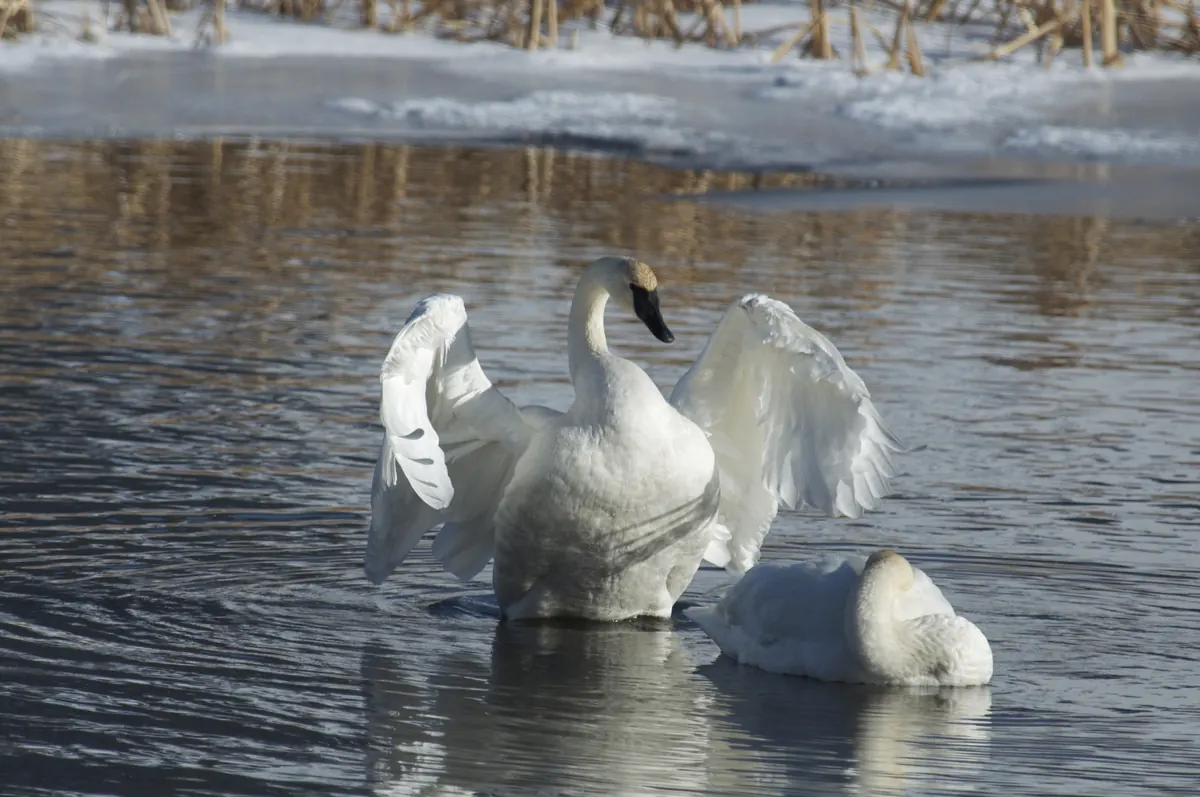
The trumpeter swan is the largest waterfowl in the world, with a wingspan of 6.5 to nearly 8 feet, and market and subsistence hunting had almost wiped it out by 1900. In late winter Wyoming holds more of them than at any other time of year, because swans from interior Canada join the small resident flock on the few rivers and spring creeks that never freeze.
-
Three times the summer count
Late fall through mid-March · Western Wyoming
Game and Fish’s species account reports that a February 2015 count found 931 trumpeter swans in the state (776 adults and 155 young), compared with 303 the previous September, before the migrants came. The coordinated winter surveys were dropped after 2015 for lack of money, so that February tally is the most recent statewide winter count the department cites. The Canadian birds arrive from late October through November and head north again in March.
-
Jackson Hole’s open water
All winter · Flat Creek on the National Elk Refuge, the Snake River and spring-fed ponds around Jackson
More than half of Wyoming’s wintering swans still crowd into the Jackson area, where open water runs short in a hard winter. The species account warns that the migrants may be eating down the water plants that the resident pairs need in late winter and early spring. Scan Flat Creek with binoculars from the visitor center lot in Jackson.
-
The Green River below Fontenelle
All winter · Seedskadee National Wildlife Refuge, north of Green River
Releases from Fontenelle Dam keep a stretch of the Green open through Seedskadee even in the coldest weather. Game and Fish has worked since 1994 to build a second swan population in the Green River basin, and new wintering areas have grown on the Salt and the Green as a result. Resident pairs may claim their nest sites before the ice is off, though eggs come much later, with nesting starting about late April.
Adult trumpeters are all white with black bills, legs and feet, while young birds stay grayish into their second year. Game and Fish cautions that the smaller tundra swan, an uncommon migrant here, can be hard to tell apart in the field, so note size and call along with color.
Where can you see bighorn sheep on their winter range in February?
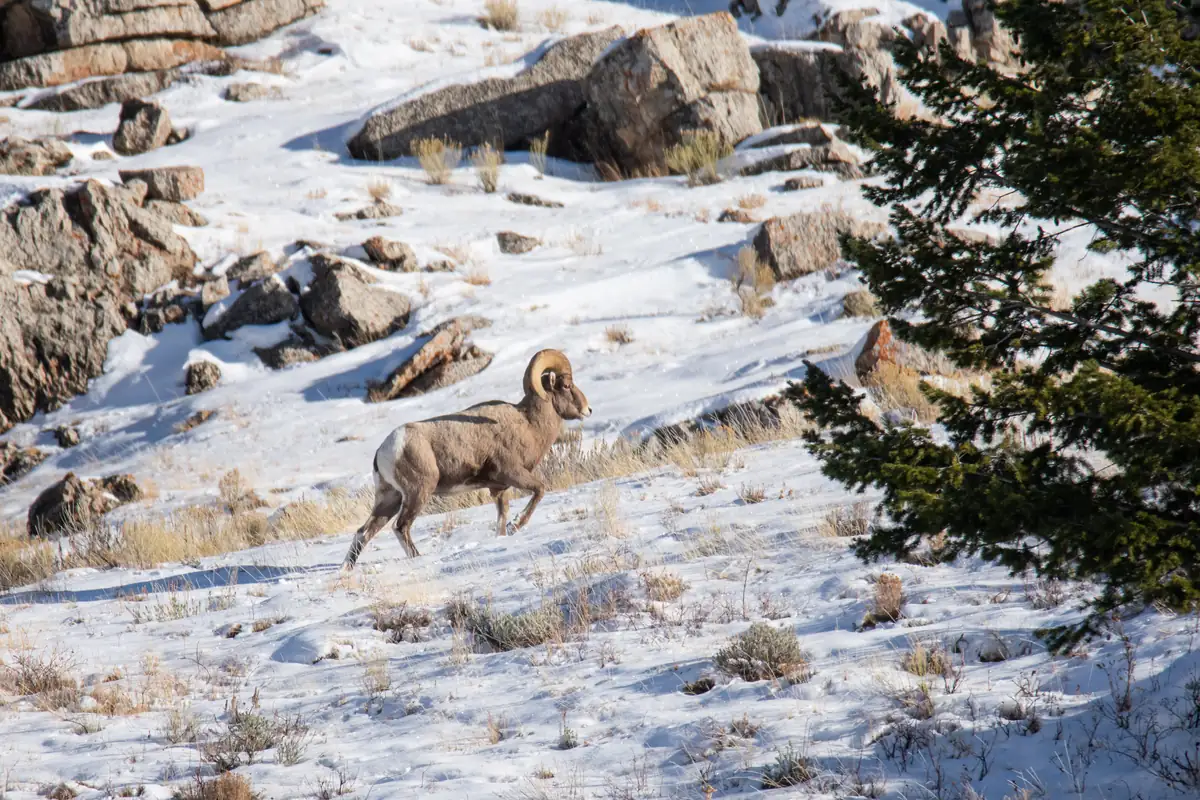
Bighorn sheep winter on steep, wind-scoured slopes where grass and shrubs stay within reach. Mating starts in November, the Park Service says, and lambs are born in May or June, so by February the ewes are carrying lambs through the hungriest weeks of the year. Two dependable places to watch them lie in western Wyoming.
-
Miller Butte on the National Elk Refuge
Autumn through spring; the Refuge Road is open December 1 to April 30 · The Refuge Road, reached from East Broadway in Jackson
The refuge tells visitors to look for sheep on Miller Butte from autumn through spring, and they are often right beside the 3.5 miles of road kept open in winter. The refuge’s viewing guide explains that the sheep walk up to cars to lick road salt and minerals off them, a habit that harms their health and could spread pneumonia, which has cut bighorn herds across the Rocky Mountain West. Some wear GPS collars that track their travels between seasonal ranges. Keep to the 30 mph limit, stop only in pullouts, and stay at least 25 yards from the sheep.
-
Whiskey Basin near Dubois
Vehicles kept out December 1 to May 15; foot and horse travel allowed · Whiskey Basin Wildlife Habitat Management Area, about 4 miles east of Dubois off U.S. 26/287
Game and Fish set aside this roughly 12,800-acre habitat area in 1954 as winter range for bighorns, and the BLM in 2020 renewed for 20 more years a withdrawal of about 1,431 acres of federal land southeast of Dubois, calling it one of the largest wintering herds of Rocky Mountain bighorns in North America. The department asks visitors to watch from their vehicles in winter.
-
A herd still recovering
Since 1991 · Whiskey and Arrow mountains and the north and east side of the Wind River Range
The Whiskey Mountain herd once numbered about 2,500 sheep. A pneumonia outbreak killed animals of every age in 1991, and Game and Fish’s current herd page puts the population at about 750, held down mainly because so few lambs survive their first months, probably because of lingering lamb pneumonia. The habitat area’s page still gives an older figure of 1,200.
Morning and late afternoon are good hours to scan the slopes, when the sheep are often up and feeding. A spotting scope set up beside the car lets you watch for a long time without pushing the herd uphill.
Which owls and eagles are nesting in Wyoming in February?
Last month the talk was courtship. In February some raptors move on to the real thing, laying eggs while the nights still fall below zero.
-
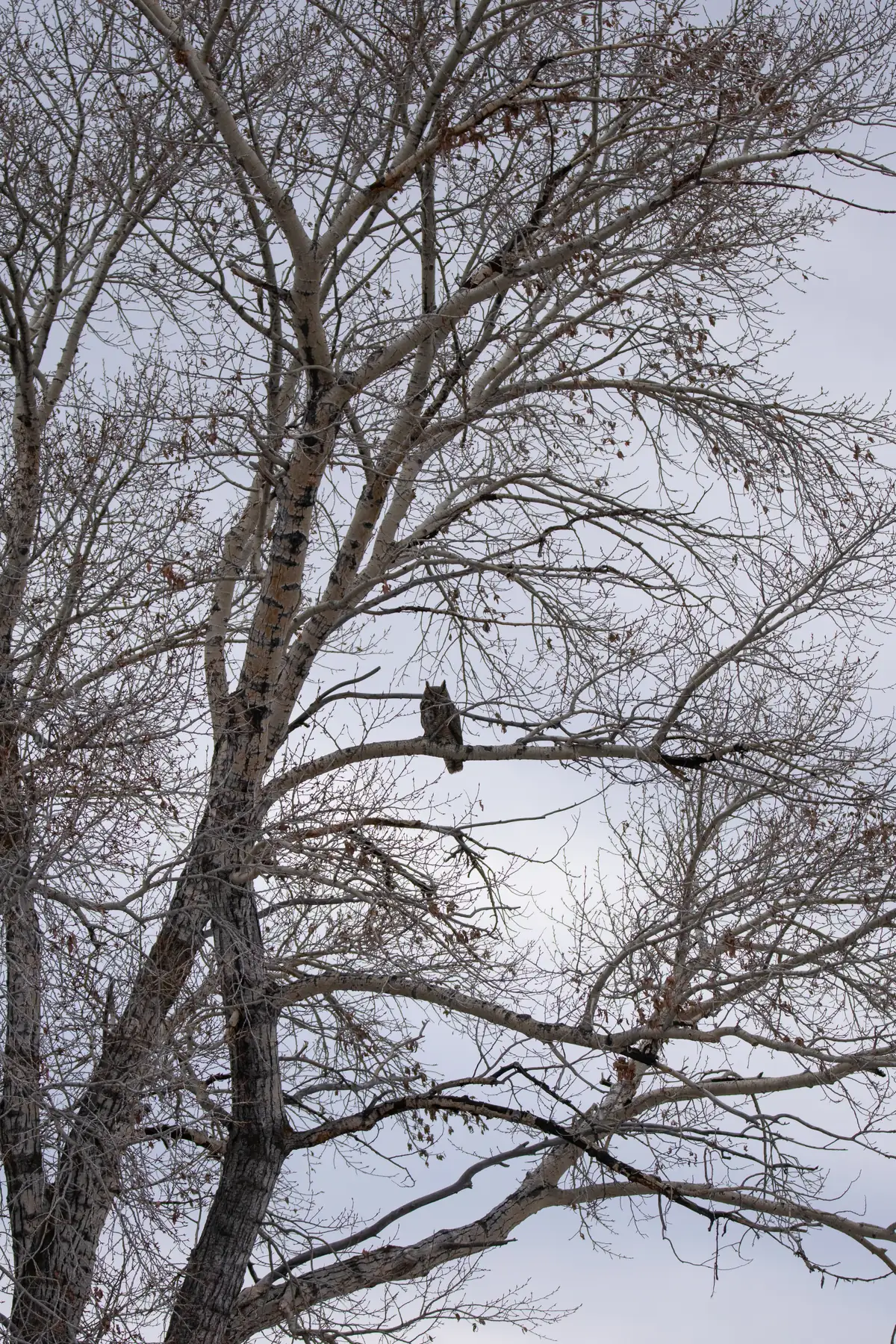
Great horned owls on eggs
Egg laying typically mid-February to late March · Old hawk, eagle and magpie nests in cottonwoods, cliffs and broken snags
Teton Raptor Center says the first eggs usually appear between mid-February and late March in the Greater Yellowstone region. Pairs build nothing, moving instead into a snag, a ledge or another large bird’s old stick nest. In night surveys the center ran around Jackson Hole from 2013 to 2015, great horned owls answered more often than any other species, with 217 detections. If you spot a hen hunkered down under fresh snow, look from far off and do not linger.
-
Great gray owls begin to call
Courtship from mid-February into April · Older Douglas-fir and lodgepole forests near meadows in western Wyoming; in winter, river bottoms in southern Jackson Hole
Teton Raptor Center surveyed for great gray owls during their courtship season, mid-February through April, working at night on skis and snowshoes. Over three years the team mapped 40 territories across about 80 square miles and found that the owls shift toward riparian areas in winter, concentrated in the southern half of the valley. Wyoming ranks this owl among its species of greatest conservation need, and the same surveys also recorded boreal, northern saw-whet, northern pygmy and long-eared owls.
-
Bald eagles fixing their nests
Nest work in February; eggs from early March to mid-April · Big cottonwoods and conifers along the Snake, Green, Wind, Bighorn and North Platte rivers
The raptor center describes February as the month when bald eagle pairs build new stick nests or rebuild their huge old ones. Watch for the cartwheel display, in which a pair climbs high, locks talons and tumbles toward the ground before breaking apart.
Owl calls carry farthest on a still night after a cold, clear day. Write down the night you first hear a pair answering each other, and check it against next winter.
What are rosy-finches, and where do they spend the winter in Wyoming?
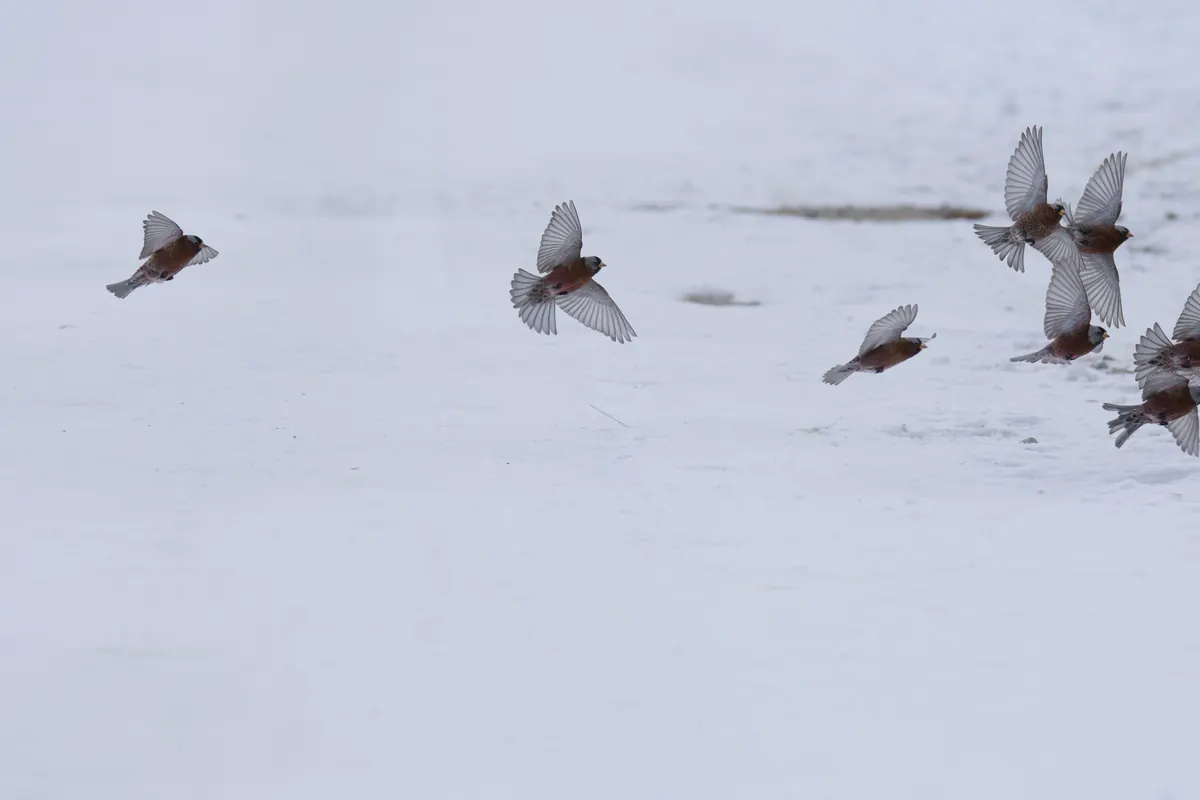
Rosy-finches are sparrow-sized finches of the high peaks that come down in winter to wind-blown fields, roadsides and backyard feeders. All three North American species occur in Wyoming, though Game and Fish notes that recent genetic work suggests they may turn out to be a single species.
-
Black rosy-finch
Lower elevations in winter · Breeds on peaks above about 10,000 feet in the Tetons, Gros Ventre, Absaroka, Wind River, Wyoming, Salt and Snake River ranges; winters in valleys of the southern half of the state
A Bridger-Teton National Forest review says black rosy-finches descend to valleys between about 4,000 and 7,000 feet in winter and travel at least 300 miles south. A researcher quoted in Game and Fish’s Wyoming Wildlife magazine called them possibly the highest-breeding vertebrate in North America, and the state counts them among its Species of Greatest Conservation Need.
-
Gray-crowned rosy-finch
Through the winter · Open valleys, refuges and towns statewide
Audubon notes that mountain populations of this species move to lower elevations in winter and sometimes stray east onto the plains, living almost entirely on weed and grass seeds. Fish and Wildlife Service photographers have caught flocks on the National Elk Refuge in February and on Seedskadee in midwinter.
-
Brown-capped rosy-finch
Winter, uncommon · Southeastern Wyoming; breeds only on the highest peaks of the Snowy Range
Game and Fish rates this species very rare in Wyoming. Its Wyoming breeding range is limited to a few high summits west of Laramie, but in winter it moves downhill with deep snow and, the department notes, regularly visits feeders in towns. Its plain brown head, with no gray on the crown, separates it from the other two.
If a flock lands in your yard, photograph it; mixed flocks are easier to sort out from a picture than on the fly. Then report it to eBird, where winter records help map how far these birds wander.
How is Wyoming’s mountain snowpack measured, and how did February look last winter?
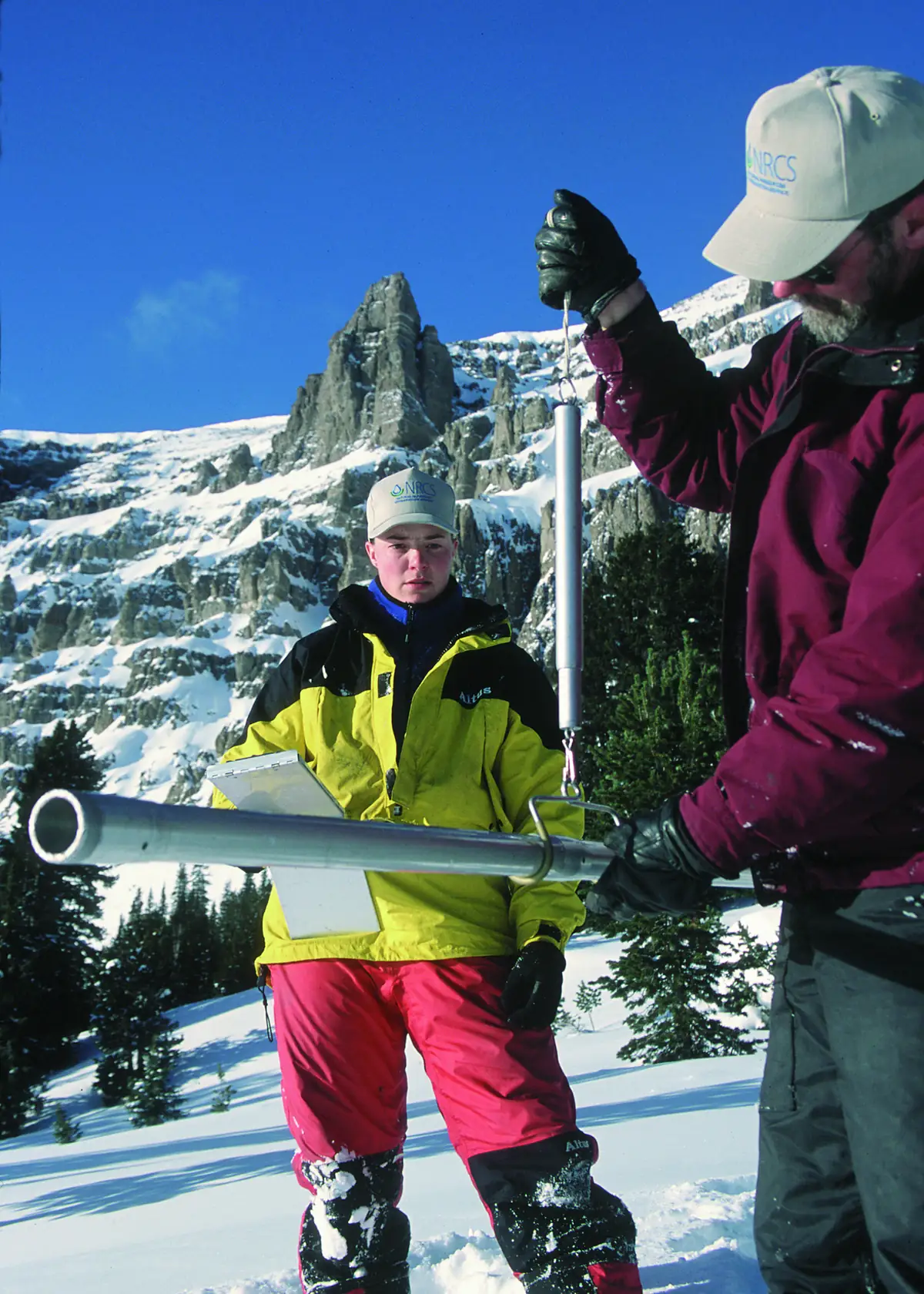
Most of the water that flows in Wyoming’s rivers each summer starts as snow in the mountains. On the first of every month from January into spring, the Natural Resources Conservation Service publishes a report on how much water that snow holds, called snow water equivalent, measured by automated SNOTEL stations and by surveyors who push a metal tube through the snow at fixed snow courses and weigh the core. The numbers are compared with the 1991–2020 median for each site.
-
Last winter as an example
Reports dated the 1st of each month · All of Wyoming’s river basins
The table below follows winter 2025–26. On February 1, 2026, statewide snow water stood at 77 percent of median, with the Yellowstone basin at 109 percent and the South Platte at 20. It held near that level through February, then collapsed in March.
-
Snow courses with long memories
Some records go back to the 1930s · For example, Pole Mountain between Cheyenne and Laramie
The February report lists the driest February 1 readings at the Pole Mountain snow course in records that begin in 1937. The lowest, under an inch of water, came in 1937 and 1960.
| Report date | Statewide | Highest basin | Lowest basin |
|---|---|---|---|
| January 1, 2026 | 84% | Yellowstone, 137% | South Platte, 5% |
| February 1, 2026 | 77% | Yellowstone, 109% | South Platte, 20% |
| March 1, 2026 | 76% | Yellowstone, 106% | South Platte, 25% |
| April 1, 2026 | 38% | Yellowstone, 84% | South Platte, Belle Fourche and Cheyenne, 0% |
The February 1, 2027, report will appear in early February on the University of Wyoming’s Water Resources Data System site, which archives the NRCS reports.
How cold and snowy is February in Wyoming, and what could a strong El Niño mean for late winter?
February closes meteorological winter and runs a little milder than January, though not by much. According to NOAA’s current climate normals (1991–2020), a typical February afternoon reaches 40.6 °F at Cheyenne but only 30.4 °F at Jackson, and Jackson still averages 8.0 nights below zero. February brings more snow than January to several of the plains and basin towns in the table: Lander’s normal is 12.1 inches, Casper’s 10.9 and Cheyenne’s 9.0. Jackson leads again with 15.6 inches of snow and 1.43 inches of total precipitation, against 0.32 inches at Laramie.
| Station | Average high | Average low | Snowfall | Precipitation | Days with a high below 32 °F | Nights below 0 °F |
|---|---|---|---|---|---|---|
| Cheyenne airport | 40.6 | 18.4 | 9.0 | 0.52 | 6.9 | 1.8 |
| Laramie airport | 35.6 | 12.1 | not published | 0.32 | 10.5 | 4.5 |
| Casper airport | 37.8 | 15.4 | 10.9 | 0.56 | 8.2 | 3.3 |
| Sheridan airport | 38.4 | 13.7 | not published | 0.65 | 8.7 | 4.7 |
| Lander airport | 36.6 | 13.3 | 12.1 | 0.70 | 9.4 | 3.2 |
| Rock Springs airport | 32.9 | 15.7 | 7.9 | 0.37 | 12.3 | 2.6 |
| Jackson | 30.4 | 9.3 | 15.6 | 1.43 | 11.8 | 8.0 |
Sea surface warmth along the equator says El Niño has been building toward the very strong category, and on September 10, 2026, NOAA’s forecasters said the odds of it holding that top rank through autumn and Wyoming’s winter topped 90 percent. For late winter in Wyoming, published analyses point in a few directions. A USGS climate science summary from August 2026 notes that warmer weather in strong El Niño years can cut snow accumulation and hasten the melt, above all on lower and mid-elevation slopes, where rain can replace snow and rain-on-snow storms raise the risk of flooding. The Western Regional Climate Center adds that across southern Wyoming the effects of El Niño are ambiguous, with no strong association toward wet or dry. None of this is a forecast for 2027. NOAA’s seasonal outlook for winter arrives in the middle of October, with a fresh version monthly at cpc.ncep.noaa.gov. Our forecast page handles the next several days, and the Wyoming frost dates tell gardeners how many weeks remain before planting.
How much daylight does Wyoming gain in February, and when is the real middle of winter?
By February nobody needs a table to notice the light coming back. Over the month, Cheyenne gains 68 minutes of daylight, Laramie and Rock Springs 69, Jackson 74, and Sheridan and Cody 78. That averages 2.5 to 2.9 minutes a day, and the daily gain is still growing; it tops out near the March equinox. On the 28th, all eight towns enjoy over 11 hours of sun.
Groundhog Day is Tuesday, February 2, while the astronomical halfway point between the December solstice and the March equinox comes a day or two later, on February 3 and 4.
| City | Feb 1 | Feb 28 | Gained | Per day |
|---|---|---|---|---|
| Cheyenne | 10 h 06 m | 11 h 14 m | 68 min | 2.5 min |
| Laramie | 10 h 05 m | 11 h 14 m | 69 min | 2.6 min |
| Rock Springs | 10 h 04 m | 11 h 13 m | 69 min | 2.6 min |
| Casper | 9 h 58 m | 11 h 10 m | 72 min | 2.7 min |
| Jackson | 9 h 56 m | 11 h 10 m | 74 min | 2.7 min |
| Gillette | 9 h 52 m | 11 h 08 m | 76 min | 2.8 min |
| Sheridan | 9 h 49 m | 11 h 07 m | 78 min | 2.9 min |
| Cody | 9 h 50 m | 11 h 08 m | 78 min | 2.9 min |
Try our sunrise and sunset calculator for Dubois, Pinedale or your own ranch road.
What can you see in Wyoming’s night sky in February 2027?
Planet watchers get a double treat. Jupiter faces the sun across the sky on February 10 and Mars does the same on the 19th, both in Leo, and the full moon drifts by the pair around the 20th. Times below are MST.
-
Jupiter at opposition
Wednesday, February 10, 5:21 p.m. · Rising in the east at sunset, highest around midnight
Jupiter climbs out of the eastern horizon as the sun goes down and stays in view the whole night, outshining every star at magnitude −2.5 from roughly 405 million miles away. With binoculars held steady against a gatepost, you can pick out its largest moons as tiny points lined up beside the planet.
-
Mars at opposition
Friday, February 19, about 8 a.m.; closest to Earth on the 20th · In Leo, rising in the east around sunset
Mars reaches aphelion, its greatest distance from the sun, only weeks later, so this pass is a modest one: about 63 million miles at closest, and a ruddy point of light near magnitude −1.2 rather than a dazzling one. Through a telescope its disk is small. The next opposition of Mars comes in 2029.
-
The Snow Moon
Full at 4:23 p.m. on Saturday, February 20 · Rising in the east around sunset
Almanacs split on calling it a supermoon; near-supermoon is the honest middle ground. That evening, look for Jupiter, Mars and Leo’s brightest star, Regulus, clustered around the moon. There is also a faint penumbral eclipse that afternoon, finishing at 6:13 p.m. In eastern Wyoming the moon is only just rising by then, and farther west the eclipse is over before moonrise; a shading that slight is invisible so low in twilight, so expect nothing. The night before, the nearly full moon passes very close to Jupiter.
-
Mercury and a thin crescent
Evening of Sunday, February 7 · Very low in the west-southwest, 30 to 45 minutes after sunset
About a day and a half after new moon, a very thin crescent sits close to Mercury in the evening twilight. A flat western horizon and binoculars help; Mercury fades from view by about the 10th. The annular solar eclipse of February 6 happens over South America, the South Atlantic and Africa and no part of it is visible from any U.S. state.
| Phase | Date | Time |
|---|---|---|
| New moon | Saturday, Feb 6 | 8:56 a.m. |
| First quarter | Sunday, Feb 14 | 12:58 a.m. |
| Full moon, the Snow Moon | Saturday, Feb 20 | 4:23 p.m. |
| Last quarter | Saturday, Feb 27 | 10:16 p.m. |
For a moonless sky, aim for the evenings from about February 2 to 11, either side of new moon. The sun’s sunspot cycle peaked in late 2024, yet big eruptions remain possible, so on a clear night it is worth checking NOAA’s aurora forecast from northern Wyoming. Our cloud map shows where the sky is clear, and the moon phase calendar gives rise and set times.
What can Wyoming families do outside in February 2027?
Only the bird count below had a confirmed 2027 date on October 2, 2026. For the others we give the usual timing and last winter’s dates, so confirm with the organizer ahead of the trip. Traveling out of state? Our nature guides for every state can help.
-
The Great Backyard Bird Count
Friday, February 12, to Monday, February 15, 2027 · Anywhere: a yard, a schoolyard, a refuge road
Audubon and Birds Canada, partners in the count, have both posted these dates. A single 15-minute session on any of the four days is enough for a checklist. A short list of magpies, juncos and chickadees is as welcome as a rare bird.
-
Ice fishing derbies in the southwest
Usually February; 2027 dates not yet posted · Fontenelle Reservoir near LaBarge, and Flaming Gorge
The LaBarge Events Committee’s Ding the Ling derby, which targets illegally stocked burbot, ran February 6 to 8 in 2026, and anglers took 1,277 burbot at the 2025 event. On Flaming Gorge, the Mac Attack lake trout contest was held February 20 to 22, 2026. Both depend on safe ice; Game and Fish usually announces each winter’s derbies in December.
-
Sleigh rides and the visitor center in Jackson
Daily, 10 a.m. to 4 p.m., through April 3, 2027 · National Elk Refuge, 532 North Cache Street
Afterward, drive the Refuge Road toward Miller Butte for the sheep.
-
Snowshoe walks in Grand Teton
In past winters, Tuesdays and Thursdays until mid-March · Grand Teton National Park; reservations by phone, 307-739-3399
Rangers lead short walks on gentle ground and lend snowshoes; last winter’s minimum age was 8.
-
Bighorns in Dubois
Winter hours vary; check with the center · National Bighorn Sheep Center, Dubois
The National Bighorn Sheep Center in Dubois has exhibits on the herd and can point you to Whiskey Basin for a look at the sheep from the car. Confirm winter hours and admission with the center before the drive.
Children who sketch one bird, one track and one sky each week in the Naturalist’s Field Journal will have a February to compare with the next one.
Safety notes for February in Wyoming
- Hunting seasons. Wyoming’s deer and elk seasons all ended by January 31, and trophy-game wolf hunting closed December 31. Still open in February: in the Central Flyway, dark geese in Zones C1 and C1A and the late light goose season to February 14, with the light goose conservation order taking over from February 15 to April 30; rabbits, hares and tree squirrels until the end of March. Under Chapter 42 as adopted in July 2025, mountain lion seasons in most hunt areas run September 1 to March 31 (a few areas longer), each closing early if its mortality limit is reached. Bobcat hunting and trapping runs November 15 to March 1 under the furbearer rule. Confirm against the current regulations before you go.
- Orange or pink. Game and Fish rules require hunters to wear a fluorescent orange or pink outer garment, visible from every direction, for anyone hunting big or trophy game in an open firearm season; mountain lion is trophy game. With big game closed, few people in the field this month fall under the rule, but bright colors are still a good idea for anyone walking in lion country or near goose fields.
- Avalanches. The mountain snowpack is deep and often layered by February. Before skiing, snowshoeing or riding a snowmobile in the backcountry, check the current avalanche danger rating (the Bridger-Teton Avalanche Center covers the Jackson area), carry a beacon, probe and shovel, and travel with a partner.
- Late-season ice. Ice that held in January can turn soft and rotten as the sun climbs, and it is weakest near inlets, springs and pressure ridges. Game and Fish’s minimum for walking out to fish is four inches of clear, solid ice, with more needed if it is white or slushy. Test it with a spud bar or auger every few steps, keep picks around your neck, and fish with a buddy.
- Wind and blowing snow. February gales can lift loose snow into whiteouts and close interstates within minutes. Check WYDOT road conditions before every trip, keep the fuel tank well above half, and carry warm clothes, water and a shovel in case you are stuck for hours.
- Cold. Jackson averages eight nights below zero in February. Wind chill can be far colder than the thermometer reading on the open plains, so cover every bit of skin and head for the car at the first sign of uncontrolled shivering.
- Nests and winter range. Stay well back from owl and eagle nests, which adults may abandon if disturbed, and remember that Whiskey Basin, many Game and Fish habitat areas and much of the land west of the Divide remain closed to vehicles or antler gathering into spring.
Sources
- Wyoming Game and Fish: Wyoming Elk Feedgrounds Management Plan (2024)
- Wyoming Game and Fish: elk feedgrounds (feedground locations, CWD detections, herd action plans)
- Wyoming Public Media: What’s the future of elk feedgrounds in Wyoming? (April 26, 2024)
- National Elk Refuge Sleigh Rides: 2026–27 season dates and hours
- Wyoming Game and Fish: species account, trumpeter swan
- Wyoming Game and Fish: how does Game and Fish survey trumpeter swans?
- U.S. Fish and Wildlife Service: National Elk Refuge, visit us (Refuge Road winter access, Miller Butte)
- U.S. Fish and Wildlife Service: wildlife watching at the National Elk Refuge
- U.S. Fish and Wildlife Service: National Elk Refuge Winter Wildlife Viewing Guide
- National Park Service: bighorn sheep in Yellowstone (mating and lambing)
- Wyoming Game and Fish: Whiskey Basin Wildlife Habitat Management Area
- Wyoming Game and Fish: Whiskey Mountain bighorn sheep
- Bureau of Land Management: Whiskey Mountain bighorn sheep winter range withdrawal extended for another 20-year term (March 23, 2020)
- Teton Raptor Center: love is in the air, raptor breeding season begins
- Teton Raptor Center: occupancy, nest success and habitat use of great gray owls in western Wyoming, 2013–2015 report
- USDA Forest Service, Bridger-Teton National Forest: species evaluation, black rosy-finch
- Wyoming Game and Fish, Wyoming Wildlife magazine: Rappelling for Rosy
- Wyoming Game and Fish: species account, brown-capped rosy-finch
- National Audubon Society: Guide to North American Birds, gray-crowned rosy-finch
- National Audubon Society: Guide to North American Birds, black rosy-finch
- eBird: Wyoming region explorer
- USDA NRCS: Wyoming Basin and Water Supply Outlook Report, January 1, 2026
- USDA NRCS: Wyoming Basin and Water Supply Outlook Report, February 1, 2026
- USDA NRCS: Wyoming Basin and Water Supply Outlook Report, March 1, 2026
- USDA NRCS: Wyoming Basin and Water Supply Outlook Report, April 1, 2026
- NOAA NCEI: U.S. Climate Normals 1991–2020, February monthly normals for seven Wyoming stations
- NOAA Climate Prediction Center: ENSO diagnostic discussion, September 10, 2026
- NOAA Climate Prediction Center: seasonal outlooks (winter outlook issued October 15, 2026, updated monthly)
- U.S. Geological Survey, Climate Adaptation Science Centers: regional super El Niño impacts, North Central U.S. (August 2026)
- Western Regional Climate Center: ENSO frequently asked questions
- Amphibian Publishing: Wyoming frost dates
- U.S. Naval Observatory: phases of the moon
- U.S. Naval Observatory: Earth’s seasons, 2026–27 (solstice and equinox)
- U.S. Naval Observatory: sun and moon rise and set data
- Fred Espenak, AstroPixels: Sky Event Almanac 2027
- EarthSky: Jupiter at opposition
- SEDS: Mars opposition of 2027
- NASA Goddard: lunar eclipses of 2021–2030 (penumbral eclipse of February 20, 2027)
- NASA Goddard: solar eclipses of 2021–2030 (annular eclipse of February 6, 2027)
- Old Farmer’s Almanac: eclipses (February 20, 2027, visibility)
- NOAA Space Weather Prediction Center: aurora short-range forecast
- Birds Canada: Great Backyard Bird Count (February 12–15, 2027)
- National Audubon Society: Great Backyard Bird Count (February 12–15, 2027)
- Wyoming Game and Fish: help southwest fisheries by harvesting burbot and lake trout (winter 2026 derbies; December 22, 2025)
- National Park Service: winter in Grand Teton (ranger-led snowshoe walks)
- Wyoming Game and Fish: Chapter 7, elk hunting seasons, 2026
- Wyoming Game and Fish: Chapter 6, deer hunting seasons, 2026
- Wyoming Game and Fish: Chapter 11, upland game bird and small game seasons, 2026
- Wyoming Game and Fish: Chapter 14, migratory game bird seasons, 2026–27
- Wyoming Game and Fish: Chapter 42, mountain lion hunting seasons (July 2025)
- Wyoming Game and Fish: Chapter 47, gray wolf hunting seasons (July 2026)
- Wyoming Game and Fish: Chapter 4, furbearing animal hunting or trapping seasons
- Wyoming Game and Fish: who should wear fluorescent orange or pink when hunting?
- Wyoming Game and Fish: stay safe on the ice this winter
- Wyoming Department of Transportation: road and travel information
- Bridger-Teton Avalanche Center
- Photos via Wikimedia Commons; licenses and photographers are credited under each picture
