What to look for in nature in Wyoming this May
May in Wyoming is the month when the young arrive. Bison calves are already up in Yellowstone, elk, pronghorn and moose follow, and bighorn lambs and wolf pups are not far behind. Warblers drop into the cottonwoods along the Green River, harlequin ducks visit the whitewater, and cranes, swans and owls settle on their eggs. The shed antler closure west of the Divide ends, the park roads open, and freezing nights are still possible at every station. Days grow by about an hour in our table, the Eta Aquariids peak at a new moon, and the May 20 Flower Moon doubles as a Blue Moon by the old seasonal count.
Other months in Wyoming: October, November, December, January, February, March, April.
Start here
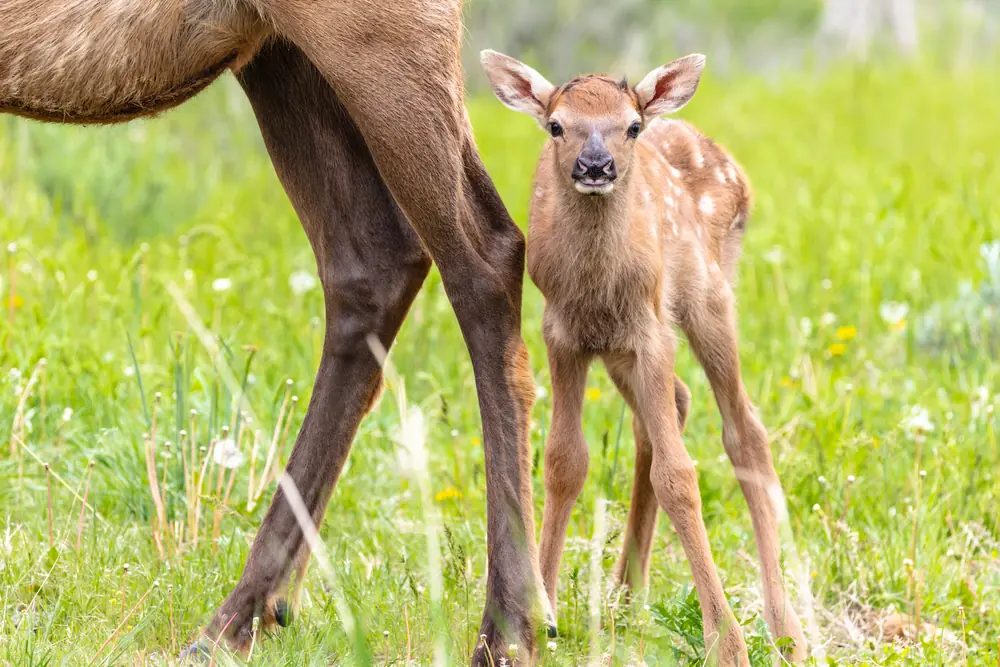
- Watch a roadside for hiding young. From a pullout with binoculars, scan the edge of a meadow or sagebrush flat for a lone fawn, calf or lamb, and note the date. Stay in your vehicle, and stay far back.
- Log your first warbler. Walk a cottonwood river bottom at sunrise and write down each new songbird you hear or see. May migrants may stay only a day or two.
- Spend an evening with the Flower Moon. On Wednesday, May 19, watch the moon clear the eastern horizon near 8 p.m. in the south of the state, and sketch its color and shape.
Wyoming’s May suits several Field Journal plates. The first warbler or harlequin duck belongs on birds I have seen, a nest from a distance goes on nest observed, and a calf, fawn or lamb on mammal watch. Antler knobs and tracks go on tracks to know, and the evening moon on dusk and dawn watch.
Regions used below: Southeast plains, Cheyenne and Laramie; Central Wyoming and Casper; Northeast: the Powder River Basin and Black Hills; Sheridan and the Bighorn Mountains; The Bighorn Basin and Cody; Wind River country, Riverton and Lander; Southwest: the Red Desert, Green River and Rock Springs; Jackson Hole, Pinedale, Grand Teton and Yellowstone.
When are elk, pronghorn and moose calves and fawns born in Wyoming, and how close can you go?
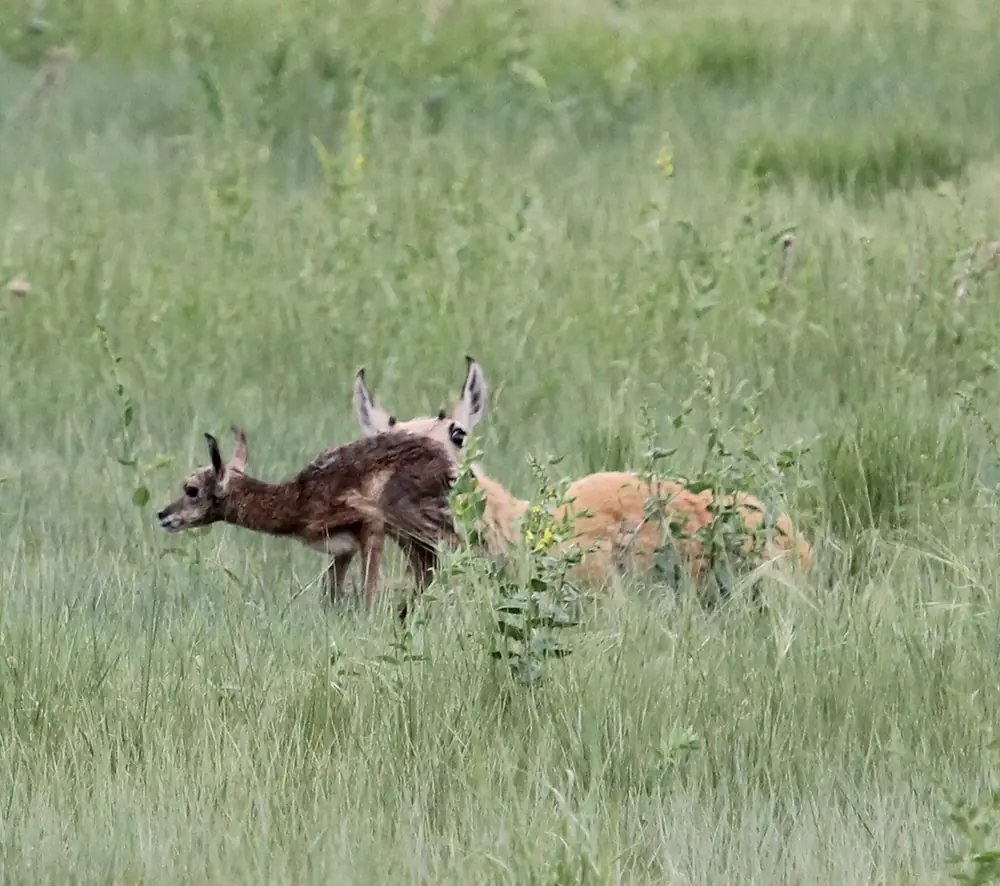
May is the start of the birthing season for most of Wyoming’s hooved animals. Bison calve first, and the elk, deer, pronghorn and moose follow in a wave that runs well into June. The newborns are hard to see, because hiding is their first defense, and the best thing a visitor can do for them is stay far back.
-
Bison calving reaches its peak
May; the Yellowstone herd calves from late April · Lamar and Hayden valleys and the Madison corridor, Yellowstone
Teton Science Schools’ wildlife calendar says bison usually hit the peak of calving in May, earlier than most hooved animals, and the National Park Service puts Yellowstone’s calf arrivals between late April and May. Calves are reddish tan at first, so a scan of a herd for small orange shapes beside the dark cows pays off. Visitors are asked to stay 25 yards or more from bison.
-
Elk calves arrive from May into late June
May to late June, with the exact timing set by green-up · Elk summer range in Yellowstone, the Tetons and the Bighorn and Wind River mountains
The park service says a single elk calf is born from May to late June, timed to coincide with the most nutritious plant growth. Migratory cows leave the winter range when snow melts and the grass greens up, so a late spring delays them and an early one pulls them uphill sooner. The same page warns that newborn calves are vulnerable, and that bears, mountain lions and other predators depend on elk, so a calf’s first weeks are a risky time.
-
Pronghorn and deer fawns, and the moose calf
Born in May and into June · Open sagebrush, river bottoms and willow thickets; Seedskadee National Wildlife Refuge is one good place
Seedskadee National Wildlife Refuge says pronghorn fawns, mule deer and white-tailed deer fawns and moose calves are all born there in May and into June. Yellowstone’s page on mule deer gives late May to early August for fawns. Before a moose cow calves she drives off last year’s young and seeks out a thicket, says Grand Teton National Park, and the calf weighs only about 25 to 35 pounds yet walks within hours. The park calls cows with calves unpredictable, noting that they have chased people.
-
One long pronghorn commute
Spring, as the snow lets go · Between the upper Green River basin and Grand Teton National Park
Teton Science Schools describes a western Wyoming pronghorn herd that travels about 100 miles south to the upper Green River basin each autumn and returns the following spring along the same corridor. Other pronghorn populations in the state move far less, from 5 to 30 miles or not at all. A pronghorn doe on the sagebrush flats in late May may be either a long-distance traveler or a homebody that never left.
-
Let the young animals be
All of May and June · Anywhere newborns are on the ground
Teton Science Schools says many young hooved animals are orange, a camouflage that works because most mammal predators are red-green color blind, and that nearly all hooved animals reach the peak of birthing in June. A newborn’s best protection is not being noticed, so take your picture from a distance and move on. The park’s rules are 25 yards from elk and other hooved animals and a much larger 100 yards away from any bear, wolf or cougar.
Can you pick up shed antlers in Wyoming in May, and are bighorn lambs out?
The antlers on this year’s bulls are growing while last winter’s lie in the sagebrush. Collecting the old ones is restricted on public land west of the Continental Divide, and the dates matter.
-
Shed antler season west of the Continental Divide
Closed January 1 until early May; confirm the current dates · Public land west of the Divide, including national forest, BLM and state land
Game and Fish’s notices show the winter closure ending at 6 a.m. on May 1 each year. A January 2024 notice listed residents at May 1 and nonresidents at May 8, while a January 2023 notice gave May 1 without that split. The rules may have changed since, so check the department’s page for the current dates and map. The closure also includes searching for or possessing shed antlers during the closed period, and you need the owner’s permission to enter private land at any time. Violations can cost fines, the antlers and hunting and fishing privileges.
-
New antlers are already growing
Bulls start in April or May; growth ends around August · Elk, moose and mule deer on their spring range
Yellowstone says most of its bulls lose their antlers in March or April and then regrow a new set, over about 90 days for yearlings and up to about 140 days for healthy mature bulls. Velvet-covered knobs show up on moose in April or May according to Grand Teton, and mule deer bucks begin in April or May and keep going until August or September. Look for the fuzzy, swollen tines on a summer-range bull at a distance.
-
Bighorn lambs in the canyon country
Lambs arrive in May or June · Gardner Canyon, Dunraven Pass and Mount Washburn in Yellowstone; Whiskey Basin near Dubois
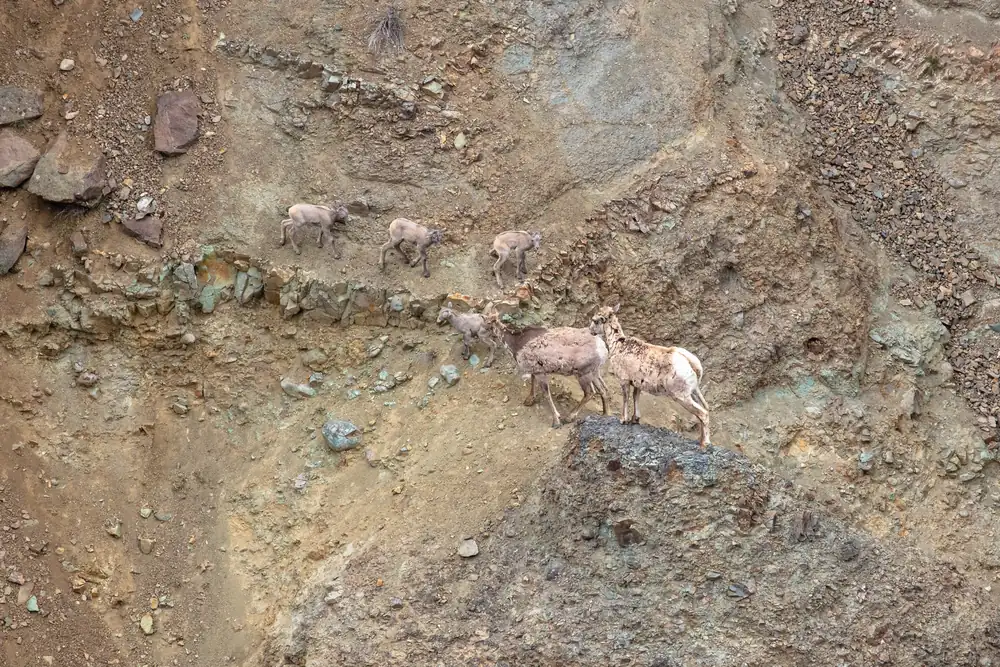
Yellowstone says its bighorn ewes lamb in May or June, with one or two lambs each, and most sheep move to higher ground between May and October. Game and Fish says the Whiskey Mountain herd near Dubois numbers about 750 now, down from an estimated 2,500, with poor lamb survival that it thinks is due to lamb pneumonia. Watch lambs from a distance and use binoculars.
What are Yellowstone’s wolves and grizzlies doing in May?
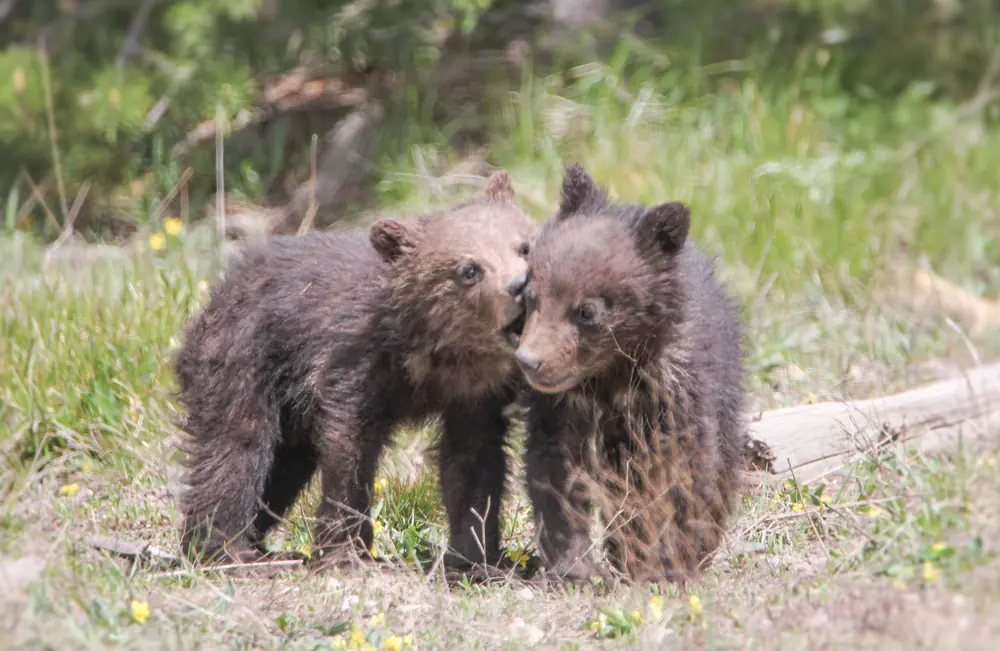
Spring is the season when bears and wolves are easiest to find, and also the season when they have the most to protect. Both are raising young, and both are hungry after winter.
-
Wolf dens come alive
Pups born in mid-April, by the park’s account; dens stay busy for weeks · Northern range and Lamar Valley, Yellowstone
Yellowstone’s wolf page says the average litter is five pups born in mid-April, that pups come above ground at 10 to 14 days of age and that a pack may stay at its den for three to ten weeks unless disturbed. Wolf numbers in the park have generally fluctuated between 83 and 123 since 2009, per the same page. It calls the northern range one of the best places in the world to watch wolves, and they are most active at dawn and dusk. Bring a spotting scope, park only in pullouts and stay 100 yards from any wolf that comes near.
-
Grizzlies and black bears are on the move
Spring, with sightings that peak in April by Teton Science Schools’ account · Open meadows, burn slopes and the road corridors of Yellowstone and Grand Teton
Game and Fish’s spring notice tells people that bears have left their dens and gives the usual advice: keep garbage, pet food and birdseed out of reach, and carry bear spray that you can grab quickly. A grizzly will defend a carcass, so avoid any place with a carcass or a gathering of scavenging birds. Yellowstone adds that 91 percent of the people hurt by its bears were alone or in a party of two, and recommends groups of three or more, making noise and hiking in daylight.
-
Hunting and fishing in bear country
Spring black bear and turkey seasons · National forest and public land
Game and Fish’s hunting advice includes hunting with a partner, learning to read tracks, scat and digging, and knowing where seasonal food is. It advises hanging quartered meat 10 to 15 feet off the ground, hauling out meat quickly and keeping a gut pile well away. Fish should be cleaned at a station or at home. Wyoming’s spring black bear seasons are set in Chapter 3 of its regulations, and they differ by area, so check the latest edition before heading out.
Which birds are passing through Wyoming in May, from warblers to harlequin ducks?
May is the busiest week of the year for the songbirds that fly from the tropics to northern nesting grounds, and Wyoming’s rivers and cottonwoods act as rest stops. Seedskadee National Wildlife Refuge says its spring migrations usually begin in February and end by June, so May sits right in the middle.
-
Warblers in the cottonwoods
May · Seedskadee National Wildlife Refuge, from headquarters to the base of Fontenelle Dam
The refuge says secretive warblers arrive in May to rest and feed on insects in the new leaves of narrowleaf cottonwood, some from as far away as southern South America. The stretch between the headquarters and the base of Fontenelle Dam is one of Wyoming’s best places to see them in spring. The refuge also says birding is usually good along the river, and that wildlife viewing is best in the early morning or late evening.
-
Harlequin ducks on whitewater
A short visit, usually in May · Fast rivers in Yellowstone, such as Soda Butte Creek and LeHardy Rapids
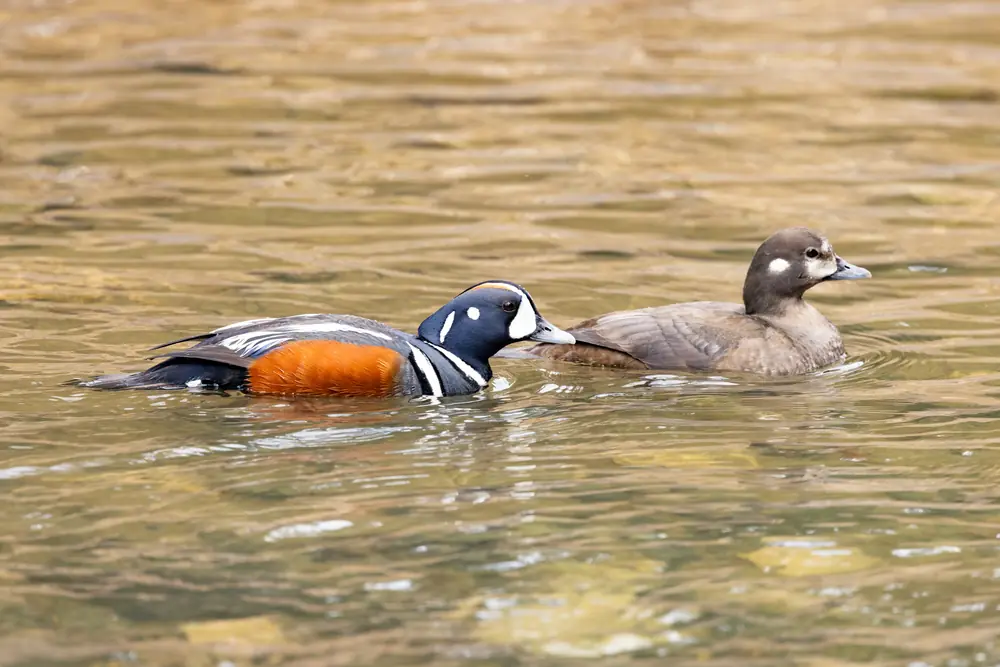
Teton Science Schools’ calendar says harlequin ducks make a brief visit, arriving from Pacific winter homes to feed and court in whitewater before they leave for the year. A Yellowstone Forever field note reports harlequins, yellow warblers, redheads, eared grebes, northern shovelers, lesser yellowlegs and yellow-headed blackbirds all appearing for the first time in one mid-May week.
-
Lakes, shorebirds and migrant traps
Shorebirds peak from April into mid-May; songbirds through the month · Hutton Lake near Laramie, Keyhole State Park, Edness Kimball Wilkins State Park, Lions Park and the Wyoming Hereford Ranch in the southeast
Audubon’s Wyoming birding guide singles out several places. Hutton Lake National Wildlife Refuge has logged nearly 30 shorebird species across spring and fall and more than 15 duck species in migration. Keyhole and Edness Kimball Wilkins draw ducks, loons, grebes, gulls, terns and shorebirds, and Cheyenne’s Lions Park and its Sloan Lake are described as a migrant oasis in spring. The Seedskadee page says shorebird passage runs from early April through mid-May, so late May belongs to the songbirds.
-
Meadowlarks are on their nests
Males sing in late April and early May to attract mates · Open grassland statewide
A Game and Fish article calls the western meadowlark’s song an introductory declaration of Wyoming’s spring. The female builds in a ground depression and lays about five eggs, with the parents sharing feeding duties. Walk grassland edges slowly in May and you may flush one off a nest; step back the way you came.
Who is nesting in Wyoming in May: cranes, pelicans, swans, owls and falcons?
By mid-May, many of Wyoming’s birds have settled down to eggs. That means fewer showy displays and more patient sitting, which is easier to watch at a respectful distance.
-
Sandhill cranes and white pelicans in Yellowstone
Nesting through the early summer; about 150 species nest in the park · Hayden Valley for cranes; the Molly Islands, in the southeast arm of Yellowstone Lake, for pelicans
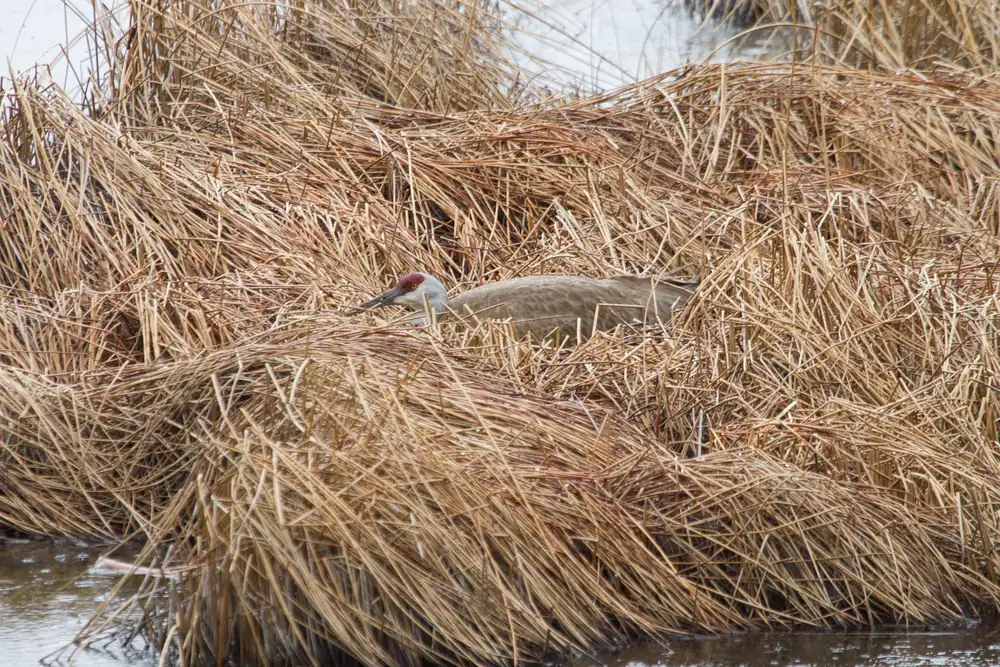
The park service says sandhill cranes nest in Yellowstone in summer, often in Hayden Valley, and that American white pelicans nest mainly on the Molly Islands. It suggests early morning walks from mid-May through early July. Pelicans can also be seen cruising the Yellowstone River in Hayden Valley.
-
Trumpeter swans on the water
Pairs sit on eggs in May; cygnets start hatching around mid-June at Seedskadee · Green River basin, Seedskadee, Yellowstone and Grand Teton
Game and Fish flies three aerial surveys of western Wyoming swans, in May, July and September, counting occupied nests, hatchlings and survivors. The 2016 survey found 68 percent of the state’s adults nesting in the Green River basin, where swans were absent in the early 1990s. Audubon says eggs hatch in 32 to 37 days and clutches are usually four to six, so a May nest is almost always still on eggs. Keep your distance from nest sites.
-
Burrowing owls move into the prairie dog towns
Eggs and young in late spring and early summer · Eastern Wyoming grasslands, most abundantly
Game and Fish says burrowing owls nest underground, often in tunnels excavated by prairie dogs or ground squirrels, and that females lay 6 to 12 eggs on average with incubation of about 28 to 30 days. The agency calls them most abundant in eastern grasslands. Watch from your vehicle and let the birds decide how close the encounter will be.
-
Prairie falcons and swifts on the Tower
Nesting season; call for dates · Devils Tower National Monument
The park’s bird checklist marks the prairie falcon and white-throated swift as breeding species, and Audubon points birders to the Tower for nesting prairie falcons. The checklist does not give nesting dates, so call the monument at 307-467-5283 extension 635 before you plan a trip around them.
Is the Wyoming toad out yet, and what is blooming at the snowline in May?
May is when the cold-blooded and the low-growing catch up. Amphibians wake once afternoons warm, and the flowers that opened on bare ground in April make room for the next wave.
-
The Wyoming toad wakes up
Adults emerge in May or June, once daytime highs reach 70 °F; eggs from mid-May to early June · Mortenson Lake National Wildlife Refuge, closed to the public
The Fish and Wildlife Service says adults come out of hibernation in May or June after daytime highs reach 70 degrees Fahrenheit, that males call to draw females and that eggs are laid in gelatinous strings between mid-May and early June. The agency’s refuge page says Mortenson Lake is closed to public use to avoid harming the toad and points visitors to public access areas nearby, such as Meeboer Lake, Gelatt Lake and Twin Buttes. In 2023 the Service and partners acquired 1,078 acres near Hutton Lake for a Wyoming Toad Conservation Area.
-
Buttercups, turkey peas and yellow bells
Early flowers open as the snow retreats; yellow bells show up in late-spring lists · Gravelly slopes at the snowline, Jackson Hole
A Teton Science Schools post written in mid-May describes sagebrush buttercup, turkey peas and steer’s head as some of the first blossoms to appear in the sagebrush as snow melts, on rocky soil at the snowline. Yellow bells are on the same author’s list of late-spring sightings. Mountain flowers bloom later at each step uphill, so a hike up a drainage in May can show spring, early summer and leftover snow in a few hours.
-
The state’s native plant society meets late in May
Usually the end of May; 2027 plans not posted · A different part of the state each year
The Wyoming Native Plant Society’s 2026 annual meeting and Wildflower Weekend ran May 29 to 31 at Firehole Canyon Campground near Flaming Gorge, with guided hikes and registration due May 19. The society’s page had nothing about 2027, so watch wynps.org for the next announcement.
When is the last spring freeze in Wyoming?
May is the month when a Wyoming gardener has to hold back. At the majority of the places listed, the median last freeze falls in the last half of May, while Jackson Hole’s main station waits until late June. The columns draw on NOAA’s 1991 to 2020 averages: the first describes an early spring, the middle a typical one, and the last gives the date by which freezing has ended in nine springs out of ten.
| Station | One year in ten | Median | Nine years in ten |
|---|---|---|---|
| Cheyenne | May 1 | May 12 | May 26 |
| Laramie Regional Airport | May 21 | Jun 2 | Jun 18 |
| Casper | Apr 28 | May 12 | May 26 |
| Gillette | May 1 | May 15 | May 27 |
| Sheridan County Airport | May 7 | May 21 | Jun 6 |
| Cody | Apr 27 | May 12 | May 27 |
| Rock Springs Airport | May 5 | May 22 | Jun 9 |
| Moose (Jackson Hole) | Jun 5 | Jun 20 | Jul 9 |
Look up any other town on the Wyoming frost dates page. The practical message of the table is that a warm May week is not permission to plant tomatoes outdoors in most places; a sheet or row cover can save a transplant on the odd cold night, and hardy greens cope better with frost than tomatoes do.
How warm, wet and stormy is May in Wyoming?
May is milder but still unsettled. Highs at the six stations below run from the low 60s to the high 60s, each station records more precipitation than in April, and every one still has freezing nights, from under 5 at Lander to nearly 13 at Laramie.
| Station | Average high | Average low | Snowfall | Precipitation | Nights below 32 °F |
|---|---|---|---|---|---|
| Cheyenne | 64.4 | 40.2 | 3.4 | 2.44 | 5.0 |
| Laramie Regional Airport | 61.5 | 33.4 | not published | 1.75 | 12.6 |
| Casper Natrona County Airport | 66.8 | 37.1 | 2.6 | 2.21 | 7.5 |
| Sheridan County Airport | 66.1 | 38.7 | not published | 2.68 | 5.7 |
| Lander Hunt Field Airport | 66.1 | 39.4 | 4.5 | 2.68 | 4.6 |
| Rock Springs Airport | 63.2 | 38.4 | 2.7 | 1.27 | 7.2 |
Three hazards deserve attention. First, hail: the National Weather Service in Cheyenne says June has the most hail reports and July is second, with the daily chance of a report climbing above 10 percent from early May. Second, runoff: the Weather Service’s numbers are sobering: 6 inches of rushing water can bowl over a person, 12 inches can carry off most cars and 24 inches can carry an SUV or truck, so turn around at a flooded road. Third, lightning: the Weather Service says it strikes the country about 25 million times a year, mostly in summer, and kills about 20 people, and its “Flash, Dash Inside” slogan, created by and for the Deaf and Hard of Hearing community, is a good rule for everybody. NOAA’s Climate Prediction Center publishes a new seasonal outlook each month, and the current one sits on the Climate Prediction Center site. To learn how to read forecast maps, open our weather guide.
How fast do the days lengthen in Wyoming in May?
The days still lengthen in May, but the gains are slower than they were in March. On May 31, daylight lasts between 14 hours 55 minutes and 15 hours 20 minutes across the towns in the table.
| City | May 1 | May 31 | Gained | Per day |
|---|---|---|---|---|
| Cheyenne | 13 h 59 m | 14 h 55 m | 56 min | 1.9 min |
| Laramie | 14 h 00 m | 14 h 57 m | 57 min | 1.9 min |
| Rock Springs | 14 h 01 m | 14 h 58 m | 57 min | 1.9 min |
| Casper | 14 h 06 m | 15 h 06 m | 60 min | 2.0 min |
| Jackson | 14 h 09 m | 15 h 10 m | 61 min | 2.0 min |
| Gillette | 14 h 13 m | 15 h 16 m | 63 min | 2.1 min |
| Sheridan | 14 h 15 m | 15 h 20 m | 65 min | 2.2 min |
| Cody | 14 h 14 m | 15 h 18 m | 64 min | 2.1 min |
The table counts sun-up to sun-down and ignores the March clock change. Use our daylight page to see sunrise and sunset in Mountain Daylight Time for your own town.
What can you see in Wyoming’s night sky in May 2027?
May’s sky offers a meteor shower with no moon to spoil it, a full moon that carries two names, and Mercury at its evening best. Times below are Mountain Daylight Time.
-
The Eta Aquariids, a very good year
Active about April 19 to May 28; best mornings May 5, 6 and 7 before dawn · Low in the east, toward dawn, away from town lights
The American Meteor Society’s calendar lists the shower’s peak as the night of May 5 into May 6, with almost no moonlight in the way because the moon is a 2 percent sliver and the new moon arrives on May 6. The tropics see the strongest show. The society’s figure for northern skies is 10 to 30 meteors every hour, counted in the final dark stretch ahead of sunrise, and good activity lasts about a week around the peak. Wyoming is near the northern edge, and Aquarius, the constellation the meteors seem to spring from, clears the horizon only shortly before sunrise here, so expect fewer. Dress warmly and lie back facing east.
-
The Flower Moon, a seasonal Blue Moon
Full at 4:59 a.m. MDT on Thursday, May 20; look the evening of Wednesday, May 19 · Any clear eastern horizon after sunset
The moon is full in the early morning, so it looks full both the evening before and the evening after. By our calculations moonrise on May 19 falls near 8 p.m. in the southern part of the state, a little later farther north. May’s full moon is commonly called the Flower Moon. Four full moons crowd into the span between spring’s first day and summer’s, and an old almanac convention calls the third full moon in a season of four the Blue Moon. By that count May 20 qualifies; by the more familiar two-in-a-month count, no month of 2027 does.
-
Mercury at its best evening
Greatest elongation Friday, May 28; look May 12 to June 5, and especially May 27 and 28 · Low in the west-northwest, 45 to 90 minutes after sunset
On May 28 Mercury reaches its farthest point from the Sun in the evening sky, roughly 23 degrees out; Thursday and Friday, May 27 and 28, give the best chances. By our calculations it sets barely 20 minutes behind the Sun early in the month, that lag has grown past 90 minutes by mid-month, and in June it dims rapidly. Seek an open western horizon and start looking while the sky is still fading.
-
Jupiter, Mars and the first-quarter moon
Evenings of May 12 and 13 · High in the south-southwest after dusk
The first-quarter moon stands close to bright Jupiter on May 12, about 1 degree apart, and sits near Mars, roughly 3 degrees away, on May 13. Jupiter is easy to spot by its steady glare, while Mars is a modest, orange-tinted point.
-
Venus meets Saturn before dawn
Morning of Friday, May 7; also nearby mornings · Low in the east before sunrise
On May 7 Venus passes just 0.6 degrees from Saturn. Both hug the eastern horizon, with Venus rising barely an hour before sunrise, so go out early with binoculars and a clear view. Saturn is far fainter than its bright neighbor.
-
Milky Way season is opening
May 1 to 14 and May 25 to 31 near 40 degrees north; fewer hours in the north · Dark sites with a clear southern horizon, before dawn
The galactic center, in Sagittarius, sits low in the south and only clears the ridgelines in the small hours. A sky calculation puts up to about 3.8 hours of dark core viewing on the best nights at 40 degrees north, and under two hours at 48 degrees north, because nights are short. Northern lights remain possible under clear, dark skies while the Sun is on the declining side of Solar Cycle 25, but check NOAA’s aurora forecast rather than counting on a display.
| Phase | Date | Time |
|---|---|---|
| New moon | Thursday, May 6 | 4:58 a.m. MDT |
| First quarter | Wednesday, May 12 | 10:44 p.m. MDT |
| Full moon, the Flower Moon | Thursday, May 20 | 4:59 a.m. MDT |
| Last quarter | Friday, May 28 | 7:58 a.m. MDT |
Every night’s moon is listed on our moon phases page, and the cloud guide helps you plan for clear skies.
What can Wyoming families do outside in May 2027, and which park roads are open?
May is when Yellowstone and Grand Teton open their interior roads, so a park trip is the biggest plan of the month, and dates come from the parks, not the calendar. Most other organizers had not announced May 2027 programs. Everything below is an annual event with typical timing or something you can do on any day, so check with the organizer before you set out. If you are traveling, the nature pages cover other states.
-
Yellowstone’s interior roads open in stages
Spring openings spread across April and May; 2027 dates had not been posted · Yellowstone National Park
For 2026, the park projected April 17 for the West and North entrances and their main roads, May 1 for the East Entrance over Sylvan Pass and the Canyon to Bridge Bay road, May 8 for the South Entrance, West Thumb and Craig Pass, and May 22 for Dunraven Pass. The park’s April 2026 release shows a late-season storm pushed back that year’s first-day opening to noon, which is a reminder that all dates depend on weather. Spring means limited services and snow-covered trails. Call (307) 344-2117 or look at the live road map.
-
The Beartooth Highway
Typically the Friday of Memorial Day weekend; check · US 212 and the Chief Joseph Scenic Byway, WY 296
The park service says the Beartooth Highway typically opens the Friday of Memorial Day weekend and may close early if winter weather returns. Monday, May 31 is Memorial Day this year, but the actual opening day will depend on the plow crews and the snow.
-
Grand Teton’s roads, and a wildlife closure
Teton Park Road open from May 1; Moose-Wilson Road mid-May by conditions; Willow Flats closed May 15 to July 15 · Grand Teton National Park
The park says the Teton Park Road is closed from November 1 to April 30 and that keeps the Moose-Wilson Road shut until about mid-May, with conditions deciding. Willow Flats is closed to public entry from May 15 through July 15, or when posted, and the Grassy Lake Road in the Rockefeller Parkway stays closed through May 31 or later because of snow. Call (307) 739-3399 for current road status.
-
Fishing in Yellowstone
Usually the Saturday of Memorial Day weekend · Yellowstone National Park
The park’s regulations say the general fishing season runs from the Saturday of Memorial Day weekend through October 31, which in 2027 would be May 29. Some stretches of the Firehole, Gibbon and Madison rivers get a head start on May 1, and the Gardner River and lower Madison are open all year. Check the park’s current regulations because streams can be closed for low water or heat.
-
Global Big Day and World Migratory Bird Day
Annual in May; 2026 was May 9 and the 2027 date had not been posted · Your backyard, a local park or a refuge
The World Migratory Bird Day site lists its 2026 events on May 9 and October 10 and had no 2027 date when we looked. The Cheyenne chapter of Audubon listed Global Big Day and World Migratory Bird Day together on May 9, 2026. Count what you see for 15 minutes and enter it in eBird.
-
Big Day bird counts
Annual in May; check with the chapter · Cheyenne, Platte and Goshen counties, and the Sheridan area
Cheyenne Audubon’s 2026 calendar had a Cheyenne Big Day Bird Count starting at Lions Park on May 16 and a Platte and Goshen counties count at Guernsey Fish Ponds on May 9. Bighorn Audubon in Sheridan lists a Spring Count, with the last date posted being May 10, 2025, and a monthly walk at The Brinton Museum on the third Saturday in its 2026 calendar. Neither chapter had posted 2027 plans, so write to them. The Casper chapter, Murie Audubon, meets the second Thursday of September through May.
-
Join NestWatch
Nest season, through June · A shrub, nest box or fence line near you
Cornell’s NestWatch is open to anyone and asks you to read its Code of Conduct before you look for nests, then record what you see. The point is to watch from a distance and keep your visits short, never to peer into every nest.
-
Become a weather watcher
Any day · Your yard
CoCoRaHS says it is the largest source of daily precipitation reports in North America, with more than 28,000 observers measuring rain, hail and snow, and that it takes about five minutes a day. A May hailstorm is just the kind of event it likes to map.
-
Memorial Day weekend
Monday, May 31, 2027 · National parks and state parks
The long weekend is when Yellowstone fishing opens and the Beartooth Highway usually reopens, and parks will be crowded. Go early, carry bear spray, and plan for a road that is still closed.
In the Naturalist’s Field Journal, children can sketch a bird, a flower and a cloud each week. Compare this month with the April page and the March page.
Safety notes for May in Wyoming
- Bears. Carry EPA-approved bear spray in a holster you can reach, hike in a group of three or more, make noise and stay 100 yards from any bear, wolf or cougar. Yellowstone says to stay 25 yards from bison, elk and other wildlife.
- Mother animals. Cow moose with calves, elk cows with new calves and bison cows with calves need the most room of any animals this month. Give them more space than the minimum and never get between a mother and her young.
- Spring turkey season. Wyoming’s spring turkey seasons usually run from April into May 31 and differ by hunt area. Game and Fish’s turkey seasons page links to a 2026/2027 regulation (Chapter 20) that sets the dates and hunt areas, but we could not read the 2027 dates there, so check that page for your hunt area before you walk in turkey country at dawn.
- Orange or pink. Hunters of big and trophy game must put on a fluorescent orange or pink outer garment while any firearm season is open, according to Game and Fish, and small game and bird hunters are strongly encouraged to follow suit. The page is silent on turkey hunters, so ask the department. On a May hike in hunting country, wear a bright hat or vest.
- Black bear hunters. Read Chapter 3 of the regulations, hunt with a partner and keep meat away from camp. Never try to scare a bear off a carcass it has claimed.
- Ticks. Wyoming health officials expect visits for tick bites to begin in May. Diseases carried here include tularemia, Colorado tick fever and Rocky Mountain spotted fever; Lyme disease is not known here because its ticks do not live in the state. Treat clothing with permethrin, use repellent with at least 20 percent DEET or picaridin, steer clear of brushy tall grass and do a full-body check after a hike.
- Fast water. Creeks and rivers rise with snowmelt, and cold water can end a day quickly. Keep kids and pets away from the edges of swollen creeks, and follow the flood advice above.
- Storms and road closures. Late snow, hail and lightning can arrive in a single afternoon. Check Wyoming 511 before you drive, and carry extra layers even for a day trip.
- Fishing and sheds. Know which waters are open and when a shed antler closure ends, and stay out of any closed area.
Sources (58)
- Wyoming Game and Fish: shed antler and horn hunting season closed for western and southern Wyoming (January 2024)
- Wyoming Game and Fish: shed antler and horn season closed west of the Divide (January 2023)
- Wyoming Game and Fish: regulations index (black bear Chapter 3, shed antlers Chapter 61)
- Wyoming Game and Fish: wild turkey hunting seasons (2026/2027 regulation)
- Wyoming Game and Fish: who should wear fluorescent orange or pink when hunting?
- Wyoming Game and Fish: hunting and fishing in bear country
- Wyoming Game and Fish: Wyoming bears are starting to wake and become active (March 2024)
- Wyoming Game and Fish: how does Game and Fish survey trumpeter swans?
- Wyoming Game and Fish: burrowing owl
- Wyoming Game and Fish: western meadowlark emergence (April 2017)
- Wyoming Game and Fish: spring is a good time to view sage-grouse (March 2017)
- Wyoming Game and Fish: Whiskey Mountain bighorn sheep
- National Park Service: Yellowstone park roads and seasonal dates
- National Park Service: Yellowstone fishing
- National Park Service: Yellowstone safety (distances from wildlife, bear spray)
- National Park Service: Yellowstone news release, April 16, 2026 (spring opening delayed by storm)
- National Park Service: Yellowstone bison
- National Park Service: Yellowstone elk
- National Park Service: Yellowstone mule deer
- National Park Service: Yellowstone bighorn sheep
- National Park Service: Yellowstone wolves
- National Park Service: Yellowstone birds
- National Park Service: Grand Teton park roads
- National Park Service: Grand Teton temporary and wildlife closures
- National Park Service: Grand Teton moose (calving, antler growth)
- National Park Service: Devils Tower bird checklist
- U.S. Fish and Wildlife Service: Seedskadee National Wildlife Refuge, seasons of wildlife
- U.S. Fish and Wildlife Service: Seedskadee National Wildlife Refuge, activities
- U.S. Fish and Wildlife Service: Mortenson Lake National Wildlife Refuge, featured species (Wyoming toad)
- U.S. Fish and Wildlife Service: Mortenson Lake National Wildlife Refuge
- U.S. Fish and Wildlife Service: Hutton Lake National Wildlife Refuge
- U.S. Fish and Wildlife Service: black-footed ferret
- Teton Science Schools: wildlife calendar of Grand Teton and Yellowstone
- Teton Science Schools: pronghorn migration to Grand Teton National Park
- Teton Science Schools: early spring wildflowers in Jackson Hole
- Yellowstone Forever: naturalist notes, spring birds
- Audubon: birding Wyoming
- Audubon field guide: trumpeter swan
- Cheyenne Audubon calendar
- Bighorn Audubon events
- Murie Audubon Society (Casper)
- World Migratory Bird Day
- Cornell Lab of Ornithology: NestWatch
- CoCoRaHS: Community Collaborative Rain, Hail and Snow Network
- Wyoming Native Plant Society: annual meeting and Wildflower Weekend (2026)
- Wyoming Department of Health: don’t let ticks steal warm weather enjoyment (April 2024)
- National Weather Service Cheyenne: hail climatology
- National Weather Service: Turn Around Don’t Drown
- National Weather Service: lightning
- NOAA NCEI: U.S. Climate Normals 1991–2020, May monthly normals for six Wyoming stations
- NOAA Climate Prediction Center: seasonal outlooks
- NOAA Space Weather Prediction Center: aurora 30 minute forecast
- NOAA Space Weather Prediction Center: solar cycle progression
- U.S. Naval Observatory: phases of the moon
- American Meteor Society: meteor shower calendar (Eta Aquariids)
- Fred Espenak, AstroPixels: Sky Event Almanac 2027
- Amphibian Publishing: Wyoming frost dates
- Photos via Wikimedia Commons; licenses and photographers are credited under each picture
