What to look for in nature in California this April
April is when California’s spring stops being a single event and becomes a staircase. The valleys and foothills are at their greenest, the low deserts are fading and the slopes a few thousand feet higher are just coming into flower. The great Central Valley winter flocks are gone, and in their place come hawks that have flown from South America, godwits stopping on their way to the prairies and gulls heading inland to a salt lake in the Sierra. On the coast the daytime tides drop low, elephant seals shed their coats and the grunion season is closed so the fish can spawn in peace. High in the mountains winter lingers: the big Yosemite roads are shut and the waterfalls have yet to peak. Where a 2027 date is not yet published, we say so and name who to ask.
Other months in California: October, November, December, January, February, March.
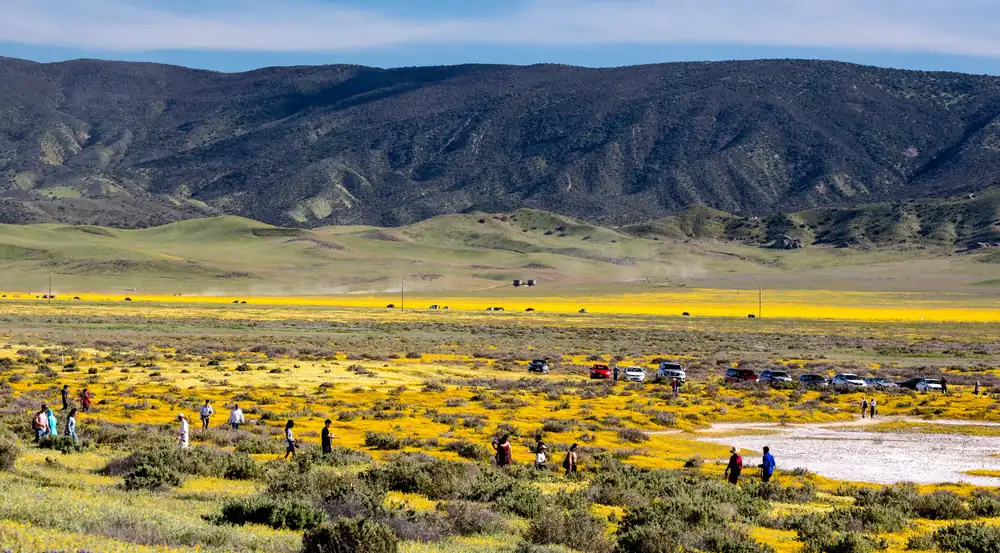
Start here
- Find a Swainson’s hawk nest. The hawks reach the Central Valley from the second week of March and by April they are building or rebuilding nests in tall trees, often a lone tree beside an alfalfa field. Watch from the roadside with binoculars and look for a bird carrying sticks; do not walk up to the tree.
- Visit a wildflower field on a weekday. Carrizo Plain, North Table Mountain near Oroville and the foothill grasslands are all in or near their usual April prime. Check the agency’s bloom line first, arrive early, stay on the trail and leave every flower where it grows.
- Time a low-tide walk. NOAA’s predictions show low daytime tides in the days around April 9 to 16 and again on April 22 and 23. Choose the day, arrive an hour before low water and look at the pools without moving anything.
Log the first hawks, godwits and gulls on your “birds I have seen” plate, follow a Swainson’s hawk pair on the nest observed plate, record a valley oak coming into leaf on the tree through the seasons plate, revisit a March hillside with the same place twice plate, write up a low-tide morning in the daily field log, and sit out the Pink Moon rise on April 20 with the dusk and dawn watch plate.
Regions used below: North Coast and the redwoods; Shasta Cascade and the far north; Sacramento Valley; Bay Area; Central Coast; Sierra Nevada and the Eastern Sierra; San Joaquin Valley; Southern California coast and Los Angeles; Mojave and Colorado deserts; San Diego.
Which birds arrive in California in April: hawks, godwits and shorebirds?
For many birds April is the month of arrival. The winter ducks, geese and cranes of the Central Valley have mostly left, and what replaces them has come from the opposite direction: Swainson’s hawks that crossed the tropics to reach farm country, and marbled godwits massing on the North Coast before heading to the northern prairies. California gulls, bound for the Eastern Sierra, appear in the Sierra section below.
-
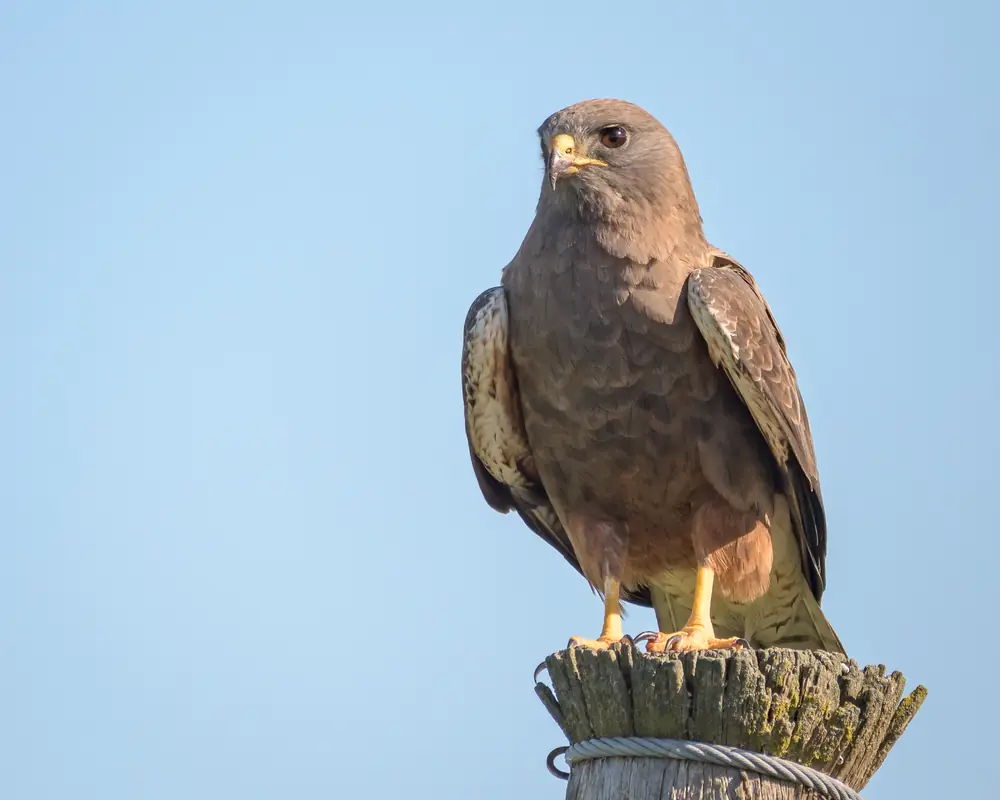
Swainson’s hawks on their nests
Early arrivals from the second week of March; nest building through April · Sacramento, Yolo, Contra Costa and San Joaquin counties have the most nests; also Carrizo Plain and other grasslands
A Tuleyome column on the return of the hawks says the first birds circle above their old nest trees in the second week of March, and that by April pairs are building or rebuilding. The nests sit high in tall, older trees, so look for a bird flying in with sticks in its beak. These hawks forage over alfalfa fields and irrigated pasture, so the roads around farm country are the best places to watch. CDFW has listed the species as threatened since 1983, citing habitat loss, including the conversion of farmland to housing. Chicks are not expected to leave the nest until about the start of July, so a nest found in April can be watched all spring. Watch from your car or well back; never approach the tree.
-
Marbled godwits on Humboldt Bay
Spring migration; the festival is timed to it · Arcata Marsh and Humboldt Bay on the North Coast
The Godwit Days organizers describe a godwit subspecies that winters mainly around Arcata Marsh and Humboldt Bay, and say the birds arrive by the thousands before leaving for nesting grounds on the central United States and Canadian prairies. The bird is large, with a long, slightly upturned bill. The Godwit Days Spring Migration Bird Festival has run for more than thirty years, and the festival’s own home page shows its 2027 dates as April 15 to 18 in Arcata, with a Big Sit on April 18. Check the organizer’s site for trips and registration.
Use your Naturalist’s Field Journal to log each arrival with a date, because the first date you see a bird in your own yard is a better record than any average. For the winter side of the Pacific Flyway, see California’s February page, and for the geese and cranes that were still leaving, see March.
Where are California’s wildflowers at their best in April?
April is the middle of the bloom in the grasslands and foothills and the end of it in the low desert. Rain, elevation, wind and heat decide the details each year, so treat the places below as a list of whom to call, not a forecast.
-
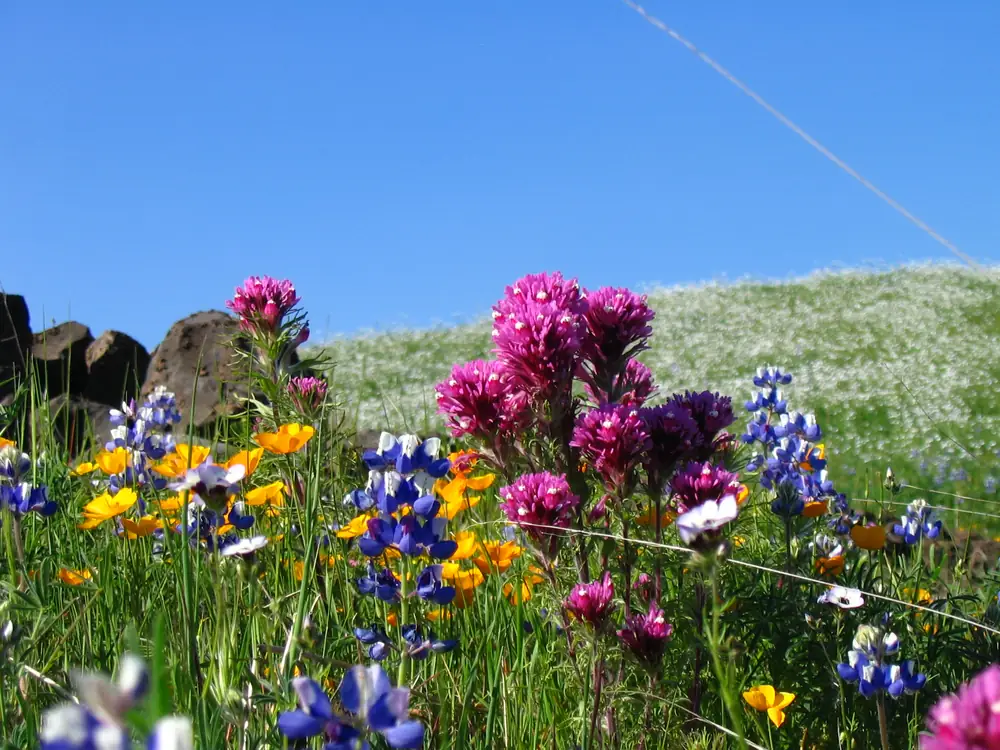
Carrizo Plain National Monument
A typical peak in early April, according to the BLM’s own announcements; fades as warm weather arrives · San Luis Obispo County, east of the Coast Ranges
A BLM announcement from a good bloom year described goldfields and baby blue eyes near Soda Lake and hillside daisies on the Temblor Range, with greater bloom expected through early April; it also warned that parking lots often fill by 7 a.m. on weekends and that fuel, food and water are not available within about 70 miles. The monument’s information line is 661-391-6193, with a ranger on 661-391-6191. The Goodwin Education Center is open Thursday to Sunday, 9 a.m. to 4 p.m., from December 1 through May 31. Access is restricted near Painted Rock between March 1 and July 15, and dirt roads become muddy after rain, so high clearance helps.
-
North Table Mountain Ecological Reserve
Spring; check with CDFW for bloom conditions · About 8 miles north of Oroville, Butte County
CDFW’s page for the 3,300-acre reserve describes colorful spring wildflowers, rare basalt-flow vernal pools and seasonal waterfalls on a flat-topped lava mesa. CDFW says the reserve currently has no guided trips, so plan to go on your own. Anyone 16 and older needs a Lands Pass unless they hold a valid hunting or fishing license, dogs must be leashed (10 feet at most), and drones, bicycles, horses and fires are not permitted. Trails are unpaved and rough.
-
Antelope Valley California Poppy Reserve
Bloom generally mid-March through May; peak usually late March or early April · Near Lancaster, Los Angeles County
The reserve’s interpretive center stays open until Mother’s Day (May 9, 2027), and the bloom hotline is (661) 724-1180. April is often the tail of the main display, so call before driving. State Parks warns of wind and big temperature swings; dogs and drones are not allowed.
-
Redwood forest wildflowers
Giant trillium February to May; calypso orchid March to July · Redwood National and State Parks, Del Norte and Humboldt counties
The National Park Service’s bloom guide gives giant trillium February to May on moist wooded slopes, western trillium March to June, and the calypso orchid, rare in dark, moist conifer forest, March to July. Call 707-464-6101 for current bloom news. Calscape, the California Native Plant Society’s database, calls Douglas iris a winter and spring bloomer of the coast.
A hillside you checked last month is a useful comparison, so use the same place twice page and see California in March for the earlier poppy and vernal pool stories.
Which butterflies fly in California in April, and where is the Bay checkerspot?
Butterflies are one of the best reasons to be outdoors in April, because the same grasslands that carry the wildflowers also feed the caterpillars. Two stories stand out: a rare Bay Area butterfly with a very short season, and the western monarch, whose spring is a quiet recovery.
-
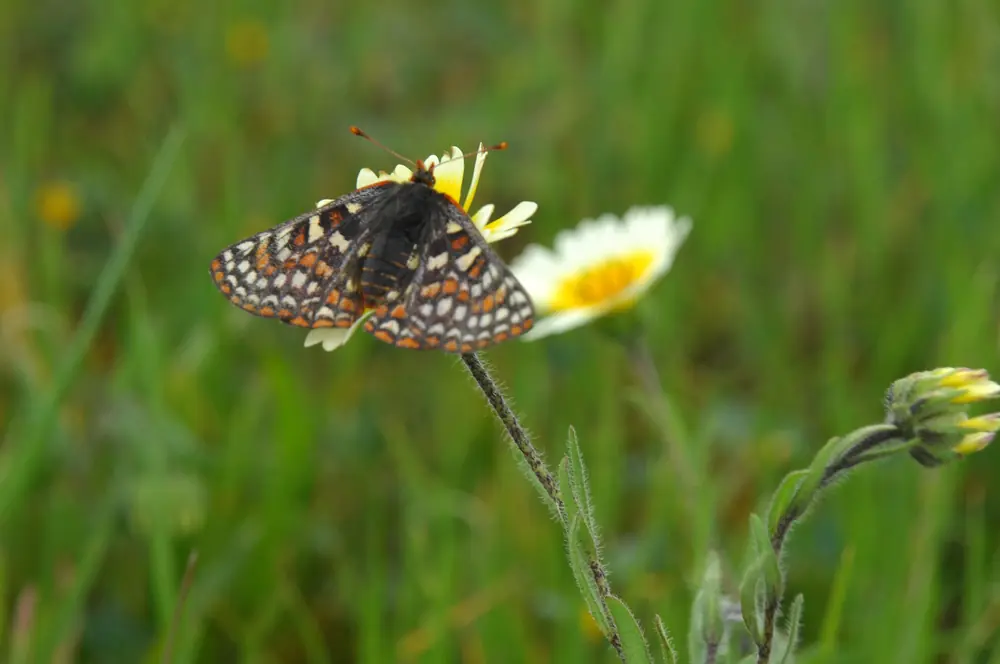
Bay checkerspot on Coyote Ridge
Adults fly from late February to early May, for about four to six weeks · Máyyan ’Ooyákma, Coyote Ridge Open Space Preserve, near San Jose and Morgan Hill; also San Mateo County
USFWS lists the butterfly as threatened since 1987, with only a few core populations left in Santa Clara and San Mateo counties. Its caterpillars eat dwarf plantain and, later, purple owl’s clover and exserted paintbrush. The Santa Clara Valley Open Space Authority shortens the preserve’s hours during the mating season so that caterpillars and butterflies are not trampled, and it runs a Butterfly Pass system, so check the Authority’s site for how to book. Stay on the trail: one footstep can crush the plants the next generation will feed on.
-
Western monarchs on the move
Spring breeding across the West · Inland from the coastal groves, wherever milkweed and nectar plants grow
The Xerces Society’s count that ended January 11, 2026 found 6,464 western monarchs at 193 sites, a 47 percent drop from the mid-season tally of 12,260. Clusters break up from the new year, and radio-tagged monarchs have been tracked up to 90 miles inland. The Society asks gardeners to plant native milkweed, avoid pesticides and report sightings through the Project Monarch Science app.
For the overwintering groves, see California’s February page.
Are the deserts still in bloom in April, and what comes out in the heat?
The desert bloom moves uphill. By April the sunbaked basins are finished or finishing, but the next band up is in its prime and the high slopes are only starting. Where you go matters more than when.
-
Death Valley by elevation
Mid-April to early May at 3,000 to 5,000 feet; early May to mid-July at 5,000 to 11,000 feet · Panamint Range and the higher benches and canyons
The National Park Service lists desert dandelion, brittlebush, desert paintbrush, Fremont phacelia, Mojave aster and desert globemallow among the mid-elevation April flowers. It adds that the low-elevation display in 2026 was over by the end of March because of early heat. NOAA’s April normal high at Death Valley is 91.0 °F.
-
Joshua Tree National Park
Lower elevations January to mid-April; 3,000 to 5,000 feet early March to early May; above 5,000 feet April through June · Hidden Valley, Indian Cove, Jumbo Rocks, then Black Rock Canyon and Covington Flat
The park lists beavertail cactus as blooming April through June at the higher elevations, and prohibits picking vegetation. April is a good month to climb a few hundred feet and find a second round of flowers.
-
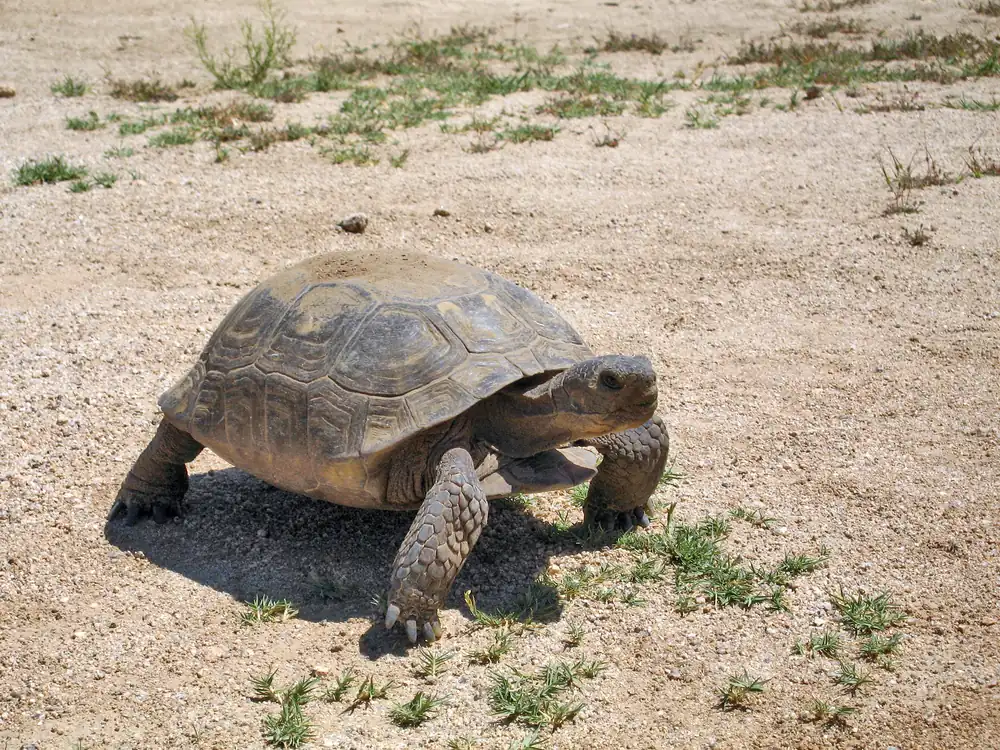
Desert tortoises leave their burrows
Spring, as soil warms · Mojave and Colorado deserts
Joshua Tree National Park notes that tortoises spend winter in a burrow and emerge each spring, and that the species has been federally threatened since 1990. If you meet one, step back and give it room.
Dryness and heat are the other half of the desert story, so read the weather section below before a long drive.
What is April like in the Sierra Nevada: Yosemite, snow and Mono Lake?
In the mountains April is a month of waiting. Valley roads are open, but the high country is under snow and the biggest runoff is still ahead. On the east side, however, one of the largest bird colonies in the state begins to form.
-
Yosemite in April
Valley waterfalls growing; peak flows mostly in May · Yosemite Valley, Wawona, Hetch Hetchy
The park calls April the start of waterfall season: most falls peak in May, Nevada and Vernal falls in late May or June, and says Horsetail Fall (December to April) and Sentinel Falls (March to June) are the ones running in April. It says it is too early for wildflowers in the park, though poppies may bloom at lower elevations on the way in, and that redbud and dogwood tend to bloom in May. The Mariposa Grove Road usually opens sometime in April. Tioga Road and Glacier Point Road stay closed by snow, often until late May or June; the park says plowing generally begins about April 15 and takes one to two months, and that opening dates cannot be predicted.
-
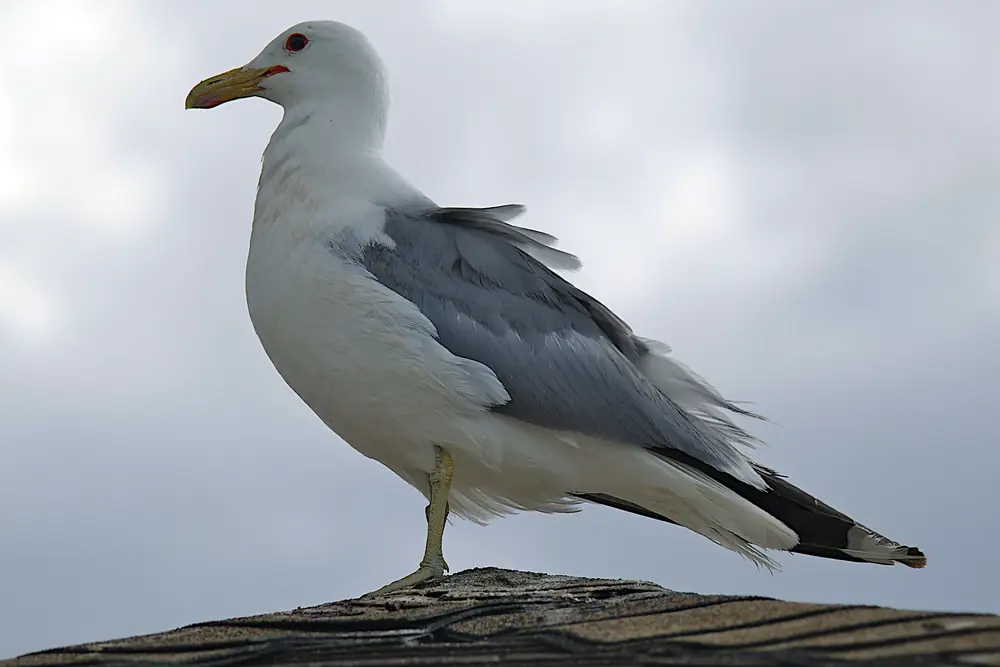
Gulls arriving at Mono Lake
Island closure April 1 to August 1; osprey buffer April 1 to September 1 · Mono Lake Tufa State Natural Reserve, near Lee Vining on Highway 395
California State Parks says access to the lake’s islands is restricted between April 1 and August 1 each year to protect nesting gulls, and that boaters must stay 200 yards from osprey nests on the offshore tufa towers from April 1 through September 1. State Parks says the reserve supports one to two million birds a year. The county-park boardwalk was closed after the Inn Fire when the page was read, so check its status before you go.
Chains may still be needed on mountain roads, so check conditions the night before and carry a physical map. See the weather page for forecasts by town.
What can I see on the California coast in April: low tides, seals, whales and grunion?
April on the coast is about sea level. NOAA’s predictions show low tides in daylight pulling water well back from rocky shores in the second week of April and again on the 22nd and 23rd, which is the time for tidepools while the big animals are still passing. The table lists the lowest low tide between 7 a.m. and 7 p.m. at six NOAA gauges.
-
Elephant seals molt on the beach
Adult females and juveniles arrive from late March; molting through spring · Piedras Blancas rookery, near San Simeon
According to the Friends of the Elephant Seal, females that left after weaning their pups, and juveniles that spent winter at sea, begin returning late in March to molt. They shed skin and hair together, so they look patchy, and shuffle between damp and dry sand as the day warms. Males spar in the water and on the beach. Check the Friends’ site for current viewing rules.
-
Gray whale mothers and calves
Northbound pairs pass between March and May · High headlands, including Piedras Blancas and Point Reyes
NOAA Fisheries counts mother-calf pairs from the Piedras Blancas Light Station, where whales generally pass within 500 meters of observers; the 2025 figure of 85 calves is the low point of a series begun in 1994. At Point Vicente, American Cetacean Society volunteers counted 445 northbound whales, 16 of them calves, before the census ended May 25, 2026. Point Reyes recommends a high point on a windless day and a lookout for a short, heart-shaped spout.
-
Grunion: watch, but do not catch
Closed season for taking grunion: April, May and June; runs follow high tides after full and new moons · Southern California beaches
CDFW says grunion may be taken in March, July and August but not in April, May or June; watching is still allowed, and the closure was extended in 2022 to protect peak spawning. Spawning starts after high tides, peaks from late March to early June, and the best runs are usually on the second and third nights of a four-night stretch. CDFW had not published 2027 run dates by early October 2026, so watch its page.
-
Tule elk calves at Point Reyes
Most calves are born in May and June, a few earlier · Tomales Point, Limantour and Drakes Beach areas at Point Reyes National Seashore
CDFW says most calves arrive in May and June, a few as early as February or March, and that cows give birth away from the herd in cover; about 5,700 tule elk live in the state. The National Park Service suggests the thumb rule for distance, extra care around cows with calves, and no feeding.
| Station | Date | Time | Height |
|---|---|---|---|
| Crescent City | Thursday, Apr 22 | 7:27 a.m. | −1.1 ft |
| San Francisco | Thursday, Apr 22 | 7:08 a.m. | −0.8 ft |
| Monterey | Friday, Apr 23 | 7:15 a.m. | −0.7 ft |
| Port San Luis | Saturday, Apr 10 | 7:32 a.m. | −0.6 ft |
| Los Angeles | Thursday, Apr 15 | 12:24 p.m. | −0.4 ft |
| La Jolla | Thursday, Apr 15 | 12:20 p.m. | −0.4 ft |
These are predictions for each named gauge, not for your beach, and the times shift by minutes from one beach to the next, so look up your own nearest station on NOAA Tides and Currents. Use the weather page to check wind and swell before you go.
What is April weather like in California, and what hazards should I plan for?
April in California runs from a damp, cool North Coast to a desert that already behaves like summer. The table gives NOAA’s 1991 to 2020 normals for eleven stations, named as NCEI names them. Tahoe City’s April normal also includes 14.0 inches of snow, and Death Valley’s normal high of 91.0 °F is more than 40 degrees warmer than Tahoe City’s 50.1 °F.
| Station | Average high | Average low | Precipitation |
|---|---|---|---|
| Arcata Eureka AP | 57.7 | 42.8 | 4.11 |
| Redding Muni AP | 71.8 | 47.0 | 2.41 |
| Sacramento Executive AP | 72.1 | 47.0 | 1.26 |
| San Francisco Intl AP | 65.6 | 49.1 | 1.36 |
| Fresno Yosemite Intl AP | 73.7 | 50.9 | 1.04 |
| Bishop AP | 73.7 | 36.7 | 0.22 |
| Tahoe City | 50.1 | 27.6 | 2.23 |
| Los Angeles Intl AP | 68.1 | 54.2 | 0.60 |
| San Diego Lindbergh Fld | 68.8 | 57.1 | 0.65 |
| Palm Springs Rgnl AP | 86.7 | 59.1 | 0.09 |
| Death Valley NP | 91.0 | 64.8 | 0.10 |
The hazards of the month follow from those numbers. Yosemite warns of occasional winter storms in April, so carry chains in the mountains. Wind can be strong at the Poppy Reserve, and rain turns Carrizo’s dirt roads to mud. Anza-Borrego recommends a gallon of water per person per day in the desert. The Climate Prediction Center publishes updated seasonal outlooks at its 90-day outlook page; we do not summarize it here, so check the latest issue. For forecasts by town, see our weather page.
When is the last spring freeze in California?
At every main station in the table the median last freeze comes before April begins, and the mildest coastal and southern stations finish in winter. Eureka’s median last freeze is February 22, with nine springs in ten done by March 23, while Redding’s median is March 3 and its late date is April 9. Mountain towns run much later, so check the frost tables for yours. Look up the station closest to your own town on California’s frost date tables.
| Station | One year in ten | Median | Nine years in ten |
|---|---|---|---|
| Eureka | Dec 31 | Feb 22 | Mar 23 |
| Redding | Jan 31 | Mar 3 | Apr 9 |
| Sacramento | Jan 10 | Feb 22 | Apr 1 |
| San Francisco | Dec 11 | Dec 29 | Jan 13 |
| Fresno | Dec 22 | Jan 14 | Feb 11 |
| Palm Springs | Dec 12 | Jan 1 | Jan 18 |
| San Diego | Dec 13 | Jan 6 | Feb 5 |
A median is the middle of the range, so half of all springs freeze later than it. Cold air pools in low spots on clear, still nights, so cover young transplants when a freeze is forecast, even after the median has passed. Fruit trees in bloom are the most vulnerable.
How much daylight does California gain in April?
Over the month the days lengthen by 55 minutes in San Diego and 75 minutes in Eureka, about 2 to 2.6 minutes each day, and by April 30 even San Diego has 13 hours and 27 minutes of daylight.
| City | Apr 1 | Apr 30 | Gained | Per day |
|---|---|---|---|---|
| Eureka | 12 h 41 m | 13 h 56 m | 75 min | 2.6 min |
| Redding | 12 h 41 m | 13 h 54 m | 73 min | 2.5 min |
| Sacramento | 12 h 38 m | 13 h 47 m | 69 min | 2.4 min |
| San Francisco | 12 h 38 m | 13 h 44 m | 66 min | 2.3 min |
| Fresno | 12 h 36 m | 13 h 41 m | 65 min | 2.2 min |
| Los Angeles | 12 h 34 m | 13 h 31 m | 57 min | 2.0 min |
| Palm Springs | 12 h 33 m | 13 h 31 m | 58 min | 2.0 min |
| San Diego | 12 h 32 m | 13 h 27 m | 55 min | 1.9 min |
Enter one trailhead or tide pool in the daylight calculator for its own sunrise and sunset. California is on daylight time all month, so no clock change affects these numbers.
What can I see in California’s night sky in April?
April brings the Pink Moon, a Lyrid shower washed out by a nearly full Moon, a crescent beside Venus early in the month, and the Moon visiting Jupiter and Mars in the evening. All times below are Pacific daylight time.
-
The Pink Moon
Full at 3:27 p.m. PDT, Tuesday, April 20; best evening April 20 · Rising in the east around sunset
The Moon is full during the afternoon, so it is the rise at dusk that counts: in Los Angeles it clears the horizon at about 7:41 p.m. that evening. SeaSky links the name to moss pink, a wild ground phlox that is among the earliest spring blooms.
-
Lyrids, a poor year
Active about April 14 to 30; sources place the best night between April 21 and 23 · Anywhere with a dark sky and a view toward the northeast
AMS lists the peak night as April 21 to 22 and SeaSky as April 22 to 23, so watch on both, and expect a few shooting stars an hour, not a shower. SeaSky gives about 20 an hour under ideal skies but warns that bright moonlight will drown most of the dimmer streaks. We calculate the Moon about 95 percent lit, rising near 9:49 p.m. in Los Angeles on April 22, so only the early evening is truly dark.
-
Venus and the old crescent Moon
Mornings of April 3 and 4 · Low in the east before sunrise
Low but dazzling, Venus is still the morning star; we calculate it clears the horizon roughly an hour and a quarter ahead of sunrise on April 1. A thin waning crescent, about 9 percent lit, passes close by on those mornings. Saturn goes behind the Sun on April 7 and is lost to view for most of the month.
-
The Moon passes Jupiter and Mars
Evenings of April 14 and 15 · High in the south after dark, in Leo
By our calculation, the Moon (about 68 percent lit) sits within a degree of Jupiter on April 15 and about 3 degrees from Mars the same day. The conjunction itself occurs during California’s daytime, so the evenings of the 14th and 15th are the nights to look. Jupiter stays up well past midnight early in the month.
-
Milky Way hours before dawn
About April 1 to 14 and again April 27 to 30 · Dark sites in the south and southeast, in the last hours of the night
Before dawn, the Milky Way’s bright core climbs back into view. Our own calculation for latitudes 30 to 40 degrees north finds up to about two hours of dark, moonless sky with the core well up, around the April 6 new moon. No almanac publishes these windows, so treat them as a guide.
| Phase | Date | Time |
|---|---|---|
| New moon | Tuesday, Apr 6 | 4:51 p.m. PDT |
| First quarter | Tuesday, Apr 13 | 3:56 p.m. PDT |
| Full moon (Pink Moon) | Tuesday, Apr 20 | 3:27 p.m. PDT; looks full Apr 19 to 21 |
| Last quarter | Wednesday, Apr 28 | 1:18 p.m. PDT |
Plan around the moon phase calendar and look at the cloud outlook the day before.
What can families do outdoors in California in April?
- Godwit Days. The Arcata festival lists April 15 to 18, 2027 on its own home page. Check the organizer for field trips and registration.
- City Nature Challenge. The organizers’ 2027 dates are April 30 to May 3 for taking observations and May 4 to 16 for identifying them, with results on May 20. The page did not list California regions, so ask the Academy or your local natural history museum which area you can join.
- Earth Day, Thursday, April 22. The 2027 theme is Food for Our Planet; pick one wild plant and one wild animal near home and keep a list.
- A low-tide morning. Pick one of the low-tide days in the coast section and move slowly, looking, not touching.
- A hawk watch from the car. Find a lone tree near farmland and watch for a bird carrying sticks.
- Pink Moon picnic. Eat dinner outside on April 20 and watch the moonrise.
National parks are free only on certain days, and the National Park Service had not posted its 2027 fee-free dates when this page was written, so check its list. For other months, see the nature calendar; our field journal has room for notes on every outing.
What should I watch out for in California in April?
- Spring turkey season. CDFW lists the 2026–27 general season as March 27 to May 2, 2027, an archery-only season May 3 to 16, and junior hunts March 20 to 21 and May 3 to 16, with a limit of one bearded turkey a day and three a season. Nonlead ammunition is required when hunting with a firearm. The CDFW page I read made no mention of a blaze-orange rule for turkey, so check the regulations for the area you visit, wear bright clothing on public land and do not stalk turkey sounds.
- Trout opener. CDFW’s general trout season usually opens on the last Saturday in April; it was April 25 in 2026. Confirm the 2027 date and local exceptions in CDFW’s freshwater fishing regulations, and carry a license if you are 16 or older.
- Ticks. The California Department of Public Health says western blacklegged ticks have been found in 56 of the state’s 58 counties and that nymphs, which are smaller than a poppy seed, are active mainly in spring and early summer. CDC advises repellent, permethrin-treated gear, a full body check, a shower within two hours, and ten minutes of high heat in the dryer.
- Rattlesnakes. CDFW says they prefer to be left alone and that most bites happen when someone handles or accidentally touches one. Look before you step or reach, and call 911 after a bite.
- Bears. Store food and scented items in bear canisters or lockers, as CDFW advises, and make your presence known on trails.
- Fast cold water. Yosemite warns that rock near waterfalls is extremely slick, even when dry, and the current in rivers and creeks is very powerful. Stay on trail.
- Surf and tidepools. The National Weather Service says never to turn your back on the ocean and to swim only at lifeguarded beaches.
- Closures that protect nests. Stay off Mono Lake’s islands from April 1 to August 1, as State Parks requires, and keep 200 yards from osprey nests on the tufa towers.
- Desert travel. Carry water (Anza-Borrego suggests a gallon per person per day) and tell someone your route.
Sources (47)
- California Department of Fish and Wildlife: California grunion facts and expected runs
- Bureau of Land Management: Carrizo Plain National Monument
- Bureau of Land Management: wildflower season at Carrizo Plain National Monument (March 2024 announcement)
- Godwit Days Spring Migration Bird Festival, Arcata (2027 dates)
- Godwit Days: about the marbled godwit and the festival
- City Nature Challenge: 2027 dates
- Friends of the Elephant Seal: April at Piedras Blancas
- National Park Service: Joshua Tree wildflower viewing
- National Park Service: Joshua Tree, the desert tortoise emerges
- California State Parks: Anza-Borrego Desert State Park
- California State Parks: colorful wildflower displays expected at desert state parks (January 2026)
- California State Parks: Antelope Valley California Poppy Reserve
- California Department of Fish and Wildlife: upland game birds and wild turkey
- California Department of Fish and Wildlife: get hooked, trout season 2026
- Tuleyome Tales: return of the Swainson’s hawk
- California Department of Fish and Wildlife: Swainson’s hawk
- National Park Service: when to expect the blooms at Redwood National and State Parks
- National Park Service: visiting Yosemite in spring
- National Park Service: Yosemite waterfalls
- National Park Service: Tioga Road opening and closing
- California State Parks: Mono Lake Tufa State Natural Reserve
- Earth Day Network: Earth Day
- California Department of Fish and Wildlife: tule elk
- National Park Service: viewing tule elk at Point Reyes
- California Department of Fish and Wildlife: black bears
- California Department of Fish and Wildlife: snakes and rattlesnakes
- Santa Clara Valley Open Space Authority: protecting the Bay checkerspot butterfly
- U.S. Fish and Wildlife Service: Bay checkerspot butterfly
- Xerces Society: western monarchs head into spring with a small migratory population
- Calscape (California Native Plant Society): Douglas iris
- National Park Service: Death Valley wildflowers
- North Table Mountain Ecological Reserve (CDFW)
- NOAA Fisheries: gray whale condition and calf production
- American Cetacean Society Los Angeles: gray whale census and today’s count
- National Park Service: whale watching at Point Reyes
- NOAA CO-OPS: tide predictions, April 2027 (San Francisco shown; Crescent City 9419750, Monterey 9413450, Port San Luis 9412110, Los Angeles 9410660, La Jolla 9410230 queried the same way)
- NOAA NCEI: monthly climate normals, 1991–2020 (April; Arcata, Bishop, Death Valley, Palm Springs, Tahoe City)
- NOAA NCEI: monthly climate normals, 1991–2020 (April; Redding, San Francisco, Sacramento, Fresno, Los Angeles, San Diego)
- Climate Prediction Center: seasonal outlooks
- U.S. Naval Observatory: moon phases, April 2027
- SeaSky: astronomy calendar 2027
- American Meteor Society: meteor shower calendar
- California Department of Public Health: Lyme disease fact sheet
- Centers for Disease Control and Prevention: preventing tick bites
- National Weather Service: rip current safety
- National Park Service: fee-free days
- Photos via Wikimedia Commons; licenses and photographers are credited under each picture
