What to look for in nature in California this November
November is when California turns over from the long dry season to the wet one. The geese and ducks of the Pacific Flyway reach their winter numbers in the Central Valley, the monarchs settle into their coastal groves, the first big elephant seal bulls lumber up the beaches, and the first soaking storm sends newts walking and salmon running up the coastal creeks. The evenings close in fast after the clocks change on the first. Here is the month, with the dates and the places.
Other months in California: October, December.
Start here
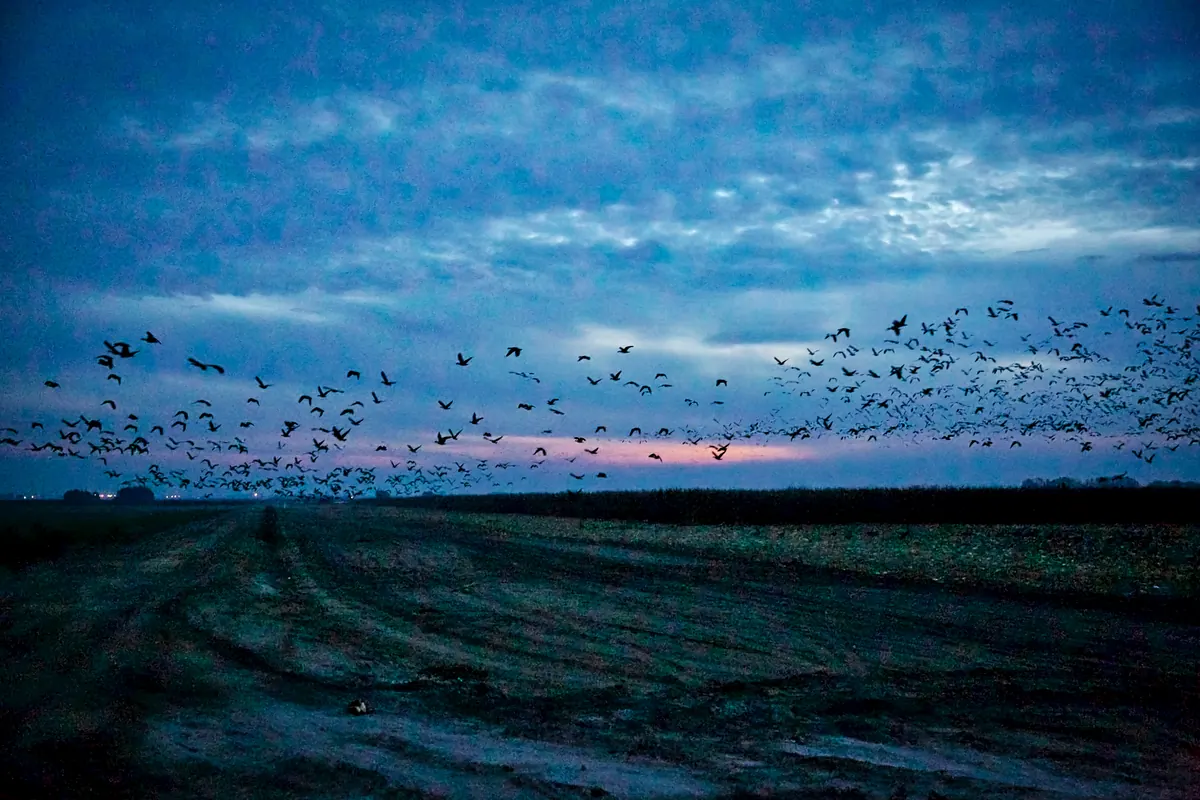
- Geese by the hundred thousand. The Sacramento National Wildlife Refuge complex says its duck and goose numbers peak in November and December, regularly topping half a million ducks and a quarter million geese. Take the auto tour at Sacramento, Colusa or Gray Lodge early or late in the day, when the snow geese rise off the ponds in roaring white sheets.
- Cranes, then monarchs. Lodi’s Sandhill Crane Festival runs November 6 to 8, with free admission and dusk fly-in tours. Then go to the coast: the Pacific Grove sanctuary expects its monarch peak around the end of the month, and the Western Monarch Count’s Thanksgiving window runs November 14 to December 6.
- Walk out after the first real rain. The first soaking storm of the season changes everything at once: California newts start their walk to the breeding pools, coho push up Lagunitas Creek in Marin, and the brown hills begin to green. Go out the evening after, with a flashlight, and watch where you put your feet.
Three plates in the Naturalist’s Field Journal suit this month. Put the snow geese, Ross’s geese and cranes on the bird list, use the dusk and dawn watch for a fly-in or a Leonid morning, and give the first storm a “reading the signs” entry: the date, the rainfall, and who came out to walk in it. If you have one creek you love, the same place twice page is for before and after that rain.
Regions used below: North Coast and the redwoods; Shasta Cascade and the far north; Sacramento Valley; Bay Area; Central Coast; Sierra Nevada and the Eastern Sierra; San Joaquin Valley; Southern California coast and Los Angeles; Mojave and Colorado deserts; San Diego.
When do the geese and ducks peak in California?
Now. The Central Valley is the winter end of the Pacific Flyway, and November is the month it fills. Federal refuge managers say that on the Sacramento complex waterfowl are present from September to April and that “duck and goose numbers peak on the Complex in November and December,” regularly passing 500,000 ducks and 250,000 geese. The pintail came first, in August, and the white-fronted geese in September; by November the snow and Ross’s geese that only began to show in October have arrived in force, and a field of them going up at once sounds like surf.
-
Snow geese and Ross’s geese
Through November and December · Sacramento Valley refuges, Klamath Basin, Merced
Two white geese with black wingtips travel together, and telling them apart is a good winter puzzle. Ross’s goose is the smaller, with a round head and a short, stubby bill; the snow goose is larger, and its longer bill shows a dark “grin patch” along the edge. Dark-bodied, white-headed blue snow geese are mixed in.
-
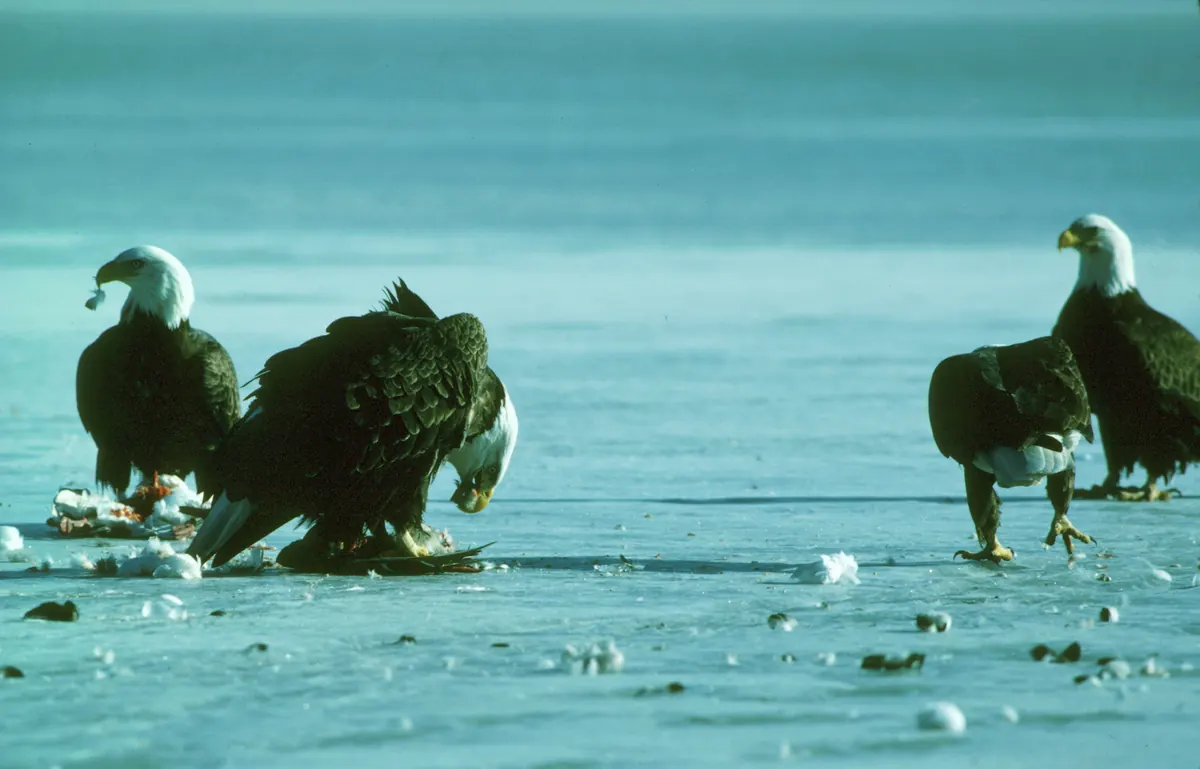
The first eagles of the Klamath Basin
Arriving in November; most in January and February · Lower Klamath and Tule Lake refuges, near Tulelake
Klamath Basin Audubon says migrant bald eagles “begin arriving in the basin in November,” drawn by the waterfowl, and that the biggest numbers come in January and February, when more than 500 are usually there. Early in the month you will see a few, perched on the dikes and the bare cottonwoods, watching the flocks for the sick and the slow. The refuge visitor center at 4064 Hill Road is staffed from 9 to 4, Tuesday to Saturday; the refuge itself stays open daily from sunrise to sunset.
| Place | Region | What November brings |
|---|---|---|
| Sacramento NWR (auto tour) | Sacramento Valley, near Willows | Ducks and geese at or near their seasonal peak, which runs through December; 500,000-plus ducks and 250,000 geese in a typical winter |
| Gray Lodge Wildlife Area (CDFW) | Sacramento Valley, near Gridley | More than a million waterfowl a year, peak activity October to February; 3-mile auto loop where you stay in your car; lands pass for ages 16 and up |
| Tule Lake and Lower Klamath NWRs | Far north, Klamath Basin | The fall build-up usually crests in mid-November; snow geese fly out at dawn and back at dusk; migrant bald eagles begin arriving |
| Merced and San Luis NWRs | San Joaquin Valley | Arctic geese and sandhill cranes on the auto tour routes through the winter; no entrance fee |
| Sonny Bono Salton Sea NWR | Imperial Valley, low desert | Waterfowl migration peaks in November on ponds flooded since late summer |
Where can I watch sandhill cranes fly in at sunset?
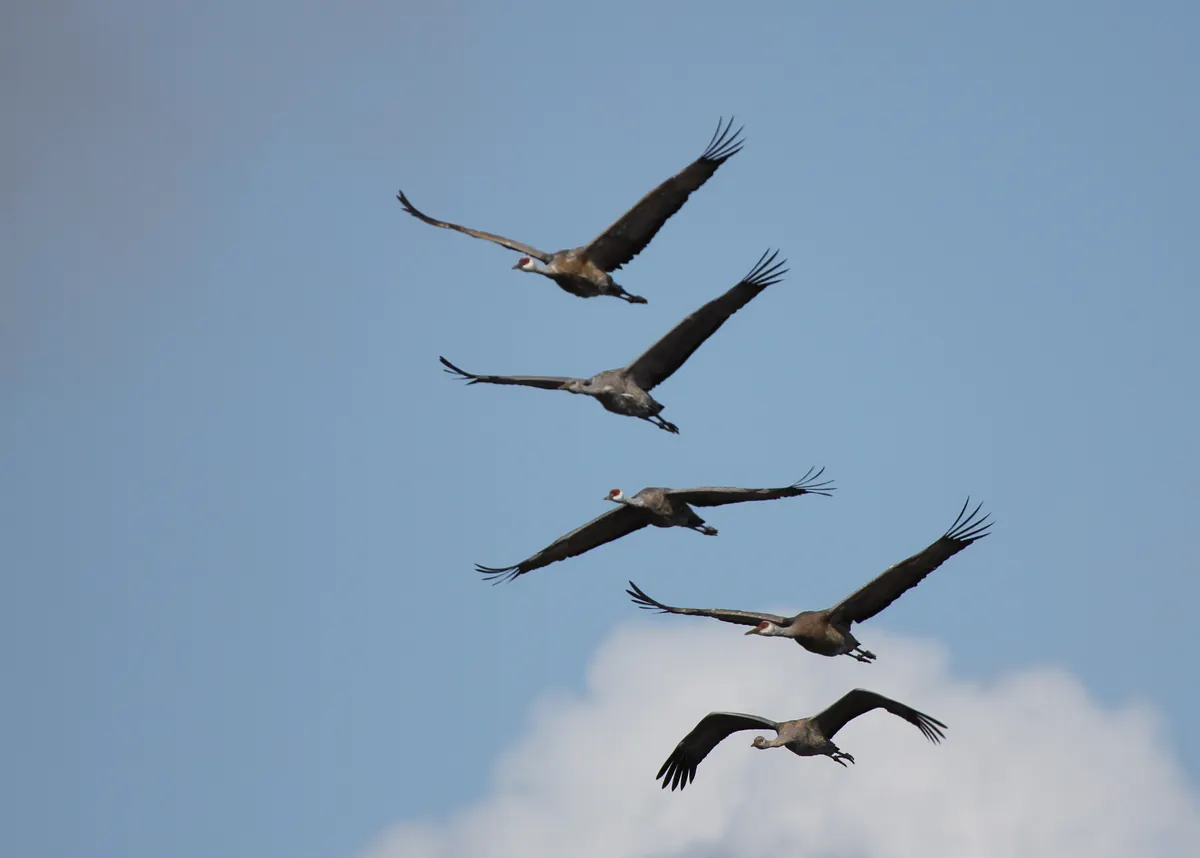
Sandhill cranes winter in the Delta and the San Joaquin Valley from late September into March, and November is the month to make an evening of them. They feed in the harvested corn and rice by day and fly back at dusk to roost standing in shallow water, in long ragged lines, calling the whole way: a rolling, wooden rattle you can hear a mile off. The best of it is the last half hour before dark.
-
Lodi Sandhill Crane Festival
Friday to Sunday, November 6–8 · Hutchins Street Square, 125 S. Hutchins St., Lodi
The festival’s 28th year. Admission to the festival itself is free; the tours vary from about $15 to $100 and include dawn fly-outs, evening fly-ins at the Woodbridge reserve, Delta boat trips and farm-field trips on Staten Island. Two of the family offerings are cheap or free: a family waterfowl outing at the Cosumnes River Preserve and a family birding walk with a crane fly-in at Stone Lakes. The popular tours fill, so book early.
-
CDFW crane tours at Woodbridge
First three weekends of each month, October to February · Isenberg Crane Reserve, Woodbridge Ecological Reserve, near Lodi
The state wildlife department’s guided tours begin an hour and a half ahead of sunset and run roughly two hours. Reservations for a given month go live at 12 noon on the previous month’s first business day, so December’s open at noon on Monday, November 2, since November 1 is a Sunday. Everyone 16 and older needs a one-day lands pass.
-
On your own: Cosumnes and Merced
Any evening · Desmond Road, Cosumnes River Preserve; Merced NWR auto tour
The Cosumnes River Preserve’s crane numbers keep climbing toward a mid-December high, and the pullouts on Desmond Road are the classic free fly-in spot. Merced National Wildlife Refuge, south of Merced, can hold up to 20,000 cranes and 60,000 arctic-nesting geese in winter; drive its five-mile auto tour in late afternoon.
-
Central Valley Birding Symposium
Thursday to Sunday, November 19–22 · Stockton Hilton
The Central Valley Bird Club’s 30th symposium: talks, identification workshops and Delta field trips. It is paid and registered, aimed at keen birders.
When are the most monarchs in California’s coastal groves?
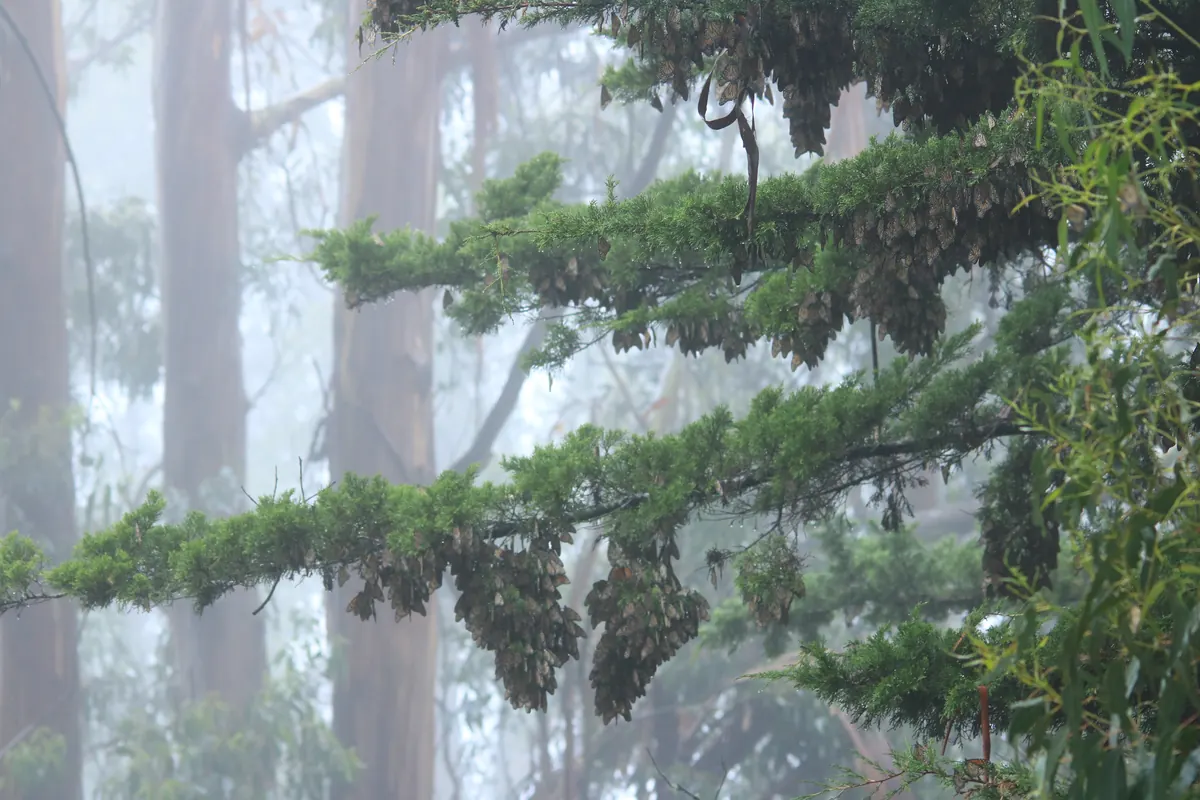
Late November. The western monarchs that trickled into the eucalyptus, pine and cypress groves in October keep arriving through the month, and the Pacific Grove Museum of Natural History, whose volunteers staff the town’s Monarch Sanctuary, expects the peak “around the end of November.” Natural Bridges State Beach in Santa Cruz, California’s only state monarch preserve, says the same: late October and all of November are the best viewing. On a cold morning the butterflies hang in tight brown clusters that look like dead leaves; as the sun reaches them they open, flash orange and drift off to drink.
-
The Thanksgiving count
November 14 to December 6 · Registered groves along the coast and inland
The Xerces Society’s Western Monarch Count has tracked the population for nearly three decades, and its mid-season window brackets Thanksgiving. Volunteers must register each year and are assigned a site; families can still take part by visiting a grove during the window and sending notes to Journey North. Last year’s Thanksgiving tally was about 12,260 butterflies at 249 sites, among the lowest on record, so a careful count of even a few dozen is a real contribution.
-
Natural Bridges State Beach
Self-guided daily, 11 a.m. to 5 p.m., October 19 to January 18 · West Cliff Drive, Santa Cruz
A boardwalk leads down into the eucalyptus grove, and the visitor center is open daily from 11 to 4 through January. In 2024 the park counted about 10,000 overwintering monarchs. Parking in the day-use lot carries a fee.
-
Pacific Grove and Pismo Beach
November to February · Ridge Road, Pacific Grove; Pismo State Beach grove off Highway 1
Pacific Grove’s docents are generally on site from 11 a.m. to 3 p.m. in good weather, and the museum posts a weekly count once the butterflies settle. Pismo State Beach’s grove has its season from November into February.
When do the elephant seal bulls come ashore?
At the end of the month. Through early November the beaches at Piedras Blancas, Año Nuevo and Point Reyes hold mostly juveniles, resting through the fall haul-out. Then the breeding season begins: Friends of the Elephant Seal, who run the docents at Piedras Blancas, write that “the annual cycle begins in November with the arrival of mature males at the end of the month.” The bulls are enormous, with the long, drooping nose the species is named for, and they spend December fighting for beach space before the females arrive to give birth.
-
Piedras Blancas
Free, every day; bulls from late November · Highway 1, north of San Simeon
A boardwalk above the beach puts you within easy sight of the animals without a ticket or a reservation. Look for the first bulls in the last week of the month; listen for the deep, clapping snort they use to warn each other off.
-
Año Nuevo State Park
Self-guided permits to November 30; closed December 1–14; guided walks from December 15 · San Mateo County coast, near Pescadero
Until the end of November you can still get a visitor permit and walk out to the viewing area on your own, between 8:30 a.m. and 3:30 p.m. The viewing area then closes from December 1 to 14, and from mid-December to March you may only go with a docent. Those walks book on ReserveCalifornia 56 days ahead, so in November you are booking for late December and January.
-
Point Reyes
Bulls in December · Elephant Seal Overlook, Chimney Rock
The Point Reyes colony runs a little later: the park says the males are the first to arrive there, in December.
What comes out after the first big rain?
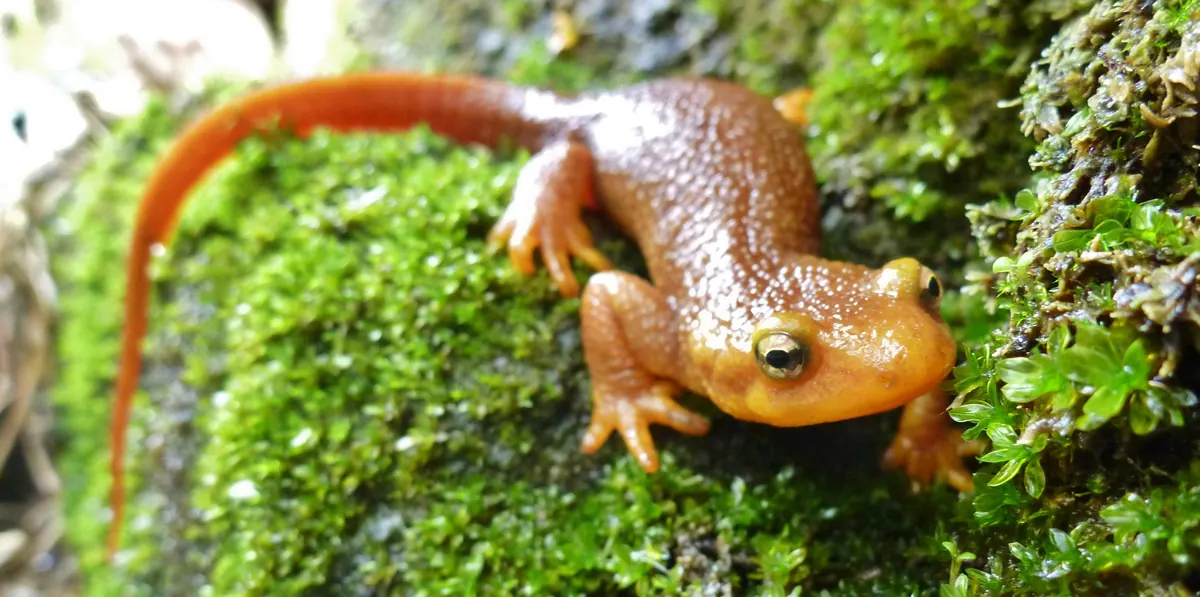
California’s seasons do not run on the calendar so much as on the first soaking storm. When it comes, in October on the North Coast in many years and in November or later farther south, the state changes in a week: the grass seed that has waited all summer germinates and the brown hills go faintly green, the newts walk, mushrooms push up under the oaks, and the salmon in the coastal creeks finally get the water they need to move.
-
Newts on the move
Rainy and foggy nights, November into spring · Bay Area hills, the Coast Ranges, the Sierra foothills
California newts and rough-skinned newts spend the dry months under logs and in burrows, then walk back to the ponds and streams where they breed, sometimes from more than two miles away. The East Bay Regional Park District says they “respond to moisture in the air, emerging after rainfall or even heavy fog,” and for years it has closed South Park Drive in Tilden Regional Park to cars from November 1 into early April so the slow-moving animals can cross; last season the closure ran November 1 to April 2. Walkers and cyclists are welcome on the closed road. Look without handling them, and keep dogs away: newts are poisonous to pets. Check the park district’s site for this season’s dates.
-
Coho in Lagunitas Creek
After the first good storms; most spawning in December and January · Samuel P. Taylor State Park and the Leo T. Cronin Fish Viewing Area, west Marin
Lagunitas Creek holds one of the last strong runs of wild coho salmon in California, and the fish wait in the ocean and the lower pools until rain raises the creek. In a wet November, Marin Water’s biologists have counted the first few dozen coho by mid-month; in a dry one they hold off until December, which the agency calls “coho salmon time.” The Leo T. Cronin viewing area, Devil’s Gulch and the Cross Marin Trail are the places to stand, and stay off the gravel where the redds are. SPAWN, the Salmon Protection and Watershed Network, leads small guided creek walks in season ($15, or free for member families); its calendar posts this winter’s dates.
-
Chinook at Nimbus, below Folsom
Hatchery operations from early November to mid-December · Nimbus Fish Hatchery, Rancho Cordova; the lower American River
Fall-run Chinook spawn in the gravel of the lower American River in late fall, and the state hatchery at Nimbus Dam takes its fish from the beginning of November through mid-December. CDFW says it cannot open the visitor center until further notice, so call ahead; the river parkway below the dam is another place to look for fish on the riffles.
-
Toyon, the Christmas berry
Berries reddening now, ripe into winter · Chaparral and oak woodland statewide
Toyon’s berries turn from orange to scarlet as the month goes on, and Calscape notes the shrub’s winter clusters of red fruit. Robins, cedar waxwings and mockingbirds strip them through the winter; a toyon in fruit is the best place to wait for a flock of waxwings.
What will the El Niño mean, and what is tule fog?
The tropical Pacific is running hot. The federal Climate Prediction Center’s September 10 update set the odds that this El Niño grows very strong over our fall and winter at better than nine in ten, and the Weather Service’s forecast offices across California, in a mid-September guide, say 98 percent, and give three chances in four that it outdoes every El Niño on the books since 1950. El Niño tilts the odds; it does not promise. NOAA’s Climate.gov notes that in the two most powerful events of recent decades, 1982–83 and 1997–98, much-above-median rain fell across the entire state, while weak and moderate events split roughly into thirds between wet, near-normal and dry winters. The Weather Service guide adds the caveat that even very strong events do not bring the expected result everywhere, as 2015–16 showed when it underdelivered in the south.
The NWS guide lists what a strong El Niño winter tends to bring here: long, heavy rain events and flash flooding; debris flows on steep slopes and fresh burn scars; big surf, coastal erosion and flooding at high tide; and storms that run warm, lifting snow levels, while still piling up deep snow at the highest elevations of the Sierra. Climate.gov places the effects in the cold half of the year, most clearly from December to February. Use November to clear gutters and drains. The official NOAA winter outlook comes out October 15, after this page was written; find it, with its monthly updates, among the CPC three-month outlooks.
-
Tule fog
Calm nights after rain, November to March · Sacramento and San Joaquin valleys
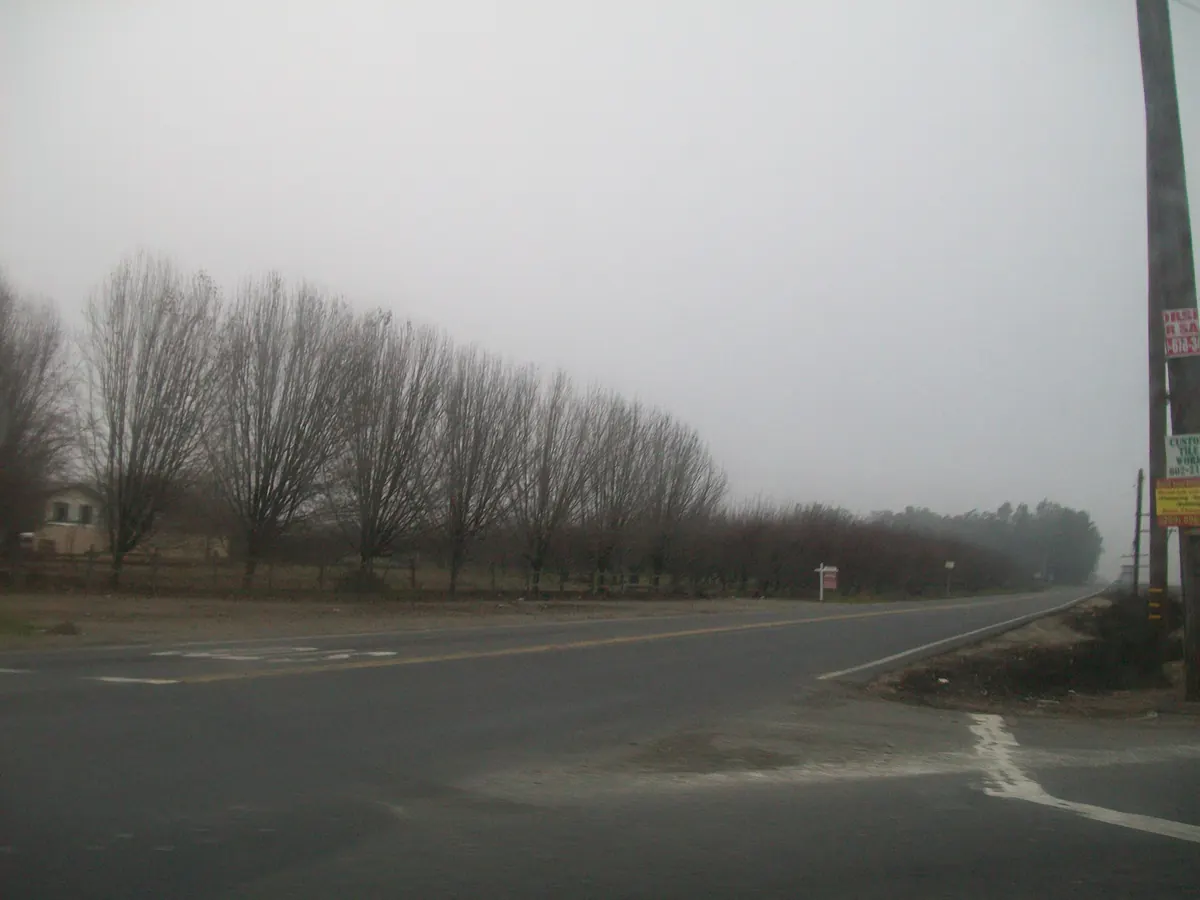
Tule fog is the Central Valley’s winter ground fog, named for the tule marshes that once covered the valley floor. It needs wet ground from a recent storm, long clear nights, and high pressure that traps a lid of warm air over the valley. In late November 2024 the Weather Service office in Hanford logged the whole recipe: storms on the 22nd and 25th, then a ridge, an inversion about 4,000 feet deep, and fog every night from the 27th to the end of the month. It can hide the edge of the road and sit all day; from the foothills on a clear morning it is a flat white sea.
-
Santa Ana season
Most frequent from November into winter · Southern California mountains, passes and coastal valleys
Offshore winds do not stop when the calendar turns. In a 2022 paper covering seven decades of records, fire scientists found Santa Ana days rising through the autumn, from one every other September on average to over seven in a typical November. Until the first real rain, every one of them is a fire wind; after it, they bring the clearest, driest days of the year, when you can see the Channel Islands from the hills.
-
Snow to stay in the high Sierra
Mid to late November, most years · Tioga Pass, Sonora Pass, Lake Tahoe
November’s normal snowfall is 9.4 inches at Tahoe City and 11.9 at Truckee. Yosemite closes the Tioga and Glacier Point roads for the season when snow comes, usually some time in November, and chains can be required on park roads from late fall. Watch the current weather for the first storm that leaves the passes white for good.
Has it frozen yet where I live in California?
Depends on your elevation. In the Sierra the answer is yes: Tahoe City has frozen by October 10 in nine years out of ten, and Truckee can freeze in any month. In the valleys and on the coast, November is the start of the frost season rather than the middle. Redding’s median first freeze is November 22 and the Arcata airport station’s is November 30, so the far north and the North Coast usually see a frost this month. In the Central Valley about one year in ten brings a freeze by late November (November 25 at Fresno, November 28 at Sacramento, November 30 at Bakersfield), but the typical date is mid-December. San Francisco, Palm Springs and San Diego’s Brown Field normally wait until late December, and at the LAX and Lindbergh airport stations a freeze is too rare for NOAA to put a date on.
| Station | One year in ten | Median | Nine years in ten |
|---|---|---|---|
| Tahoe City | Sept 7 | Sept 24 | Oct 10 |
| Truckee | Any month (year-round frost risk) | — | — |
| Eureka (Arcata airport) | Nov 1 | Nov 30 | Jan 4 |
| Redding | Nov 4 | Nov 22 | Dec 13 |
| Fresno | Nov 25 | Dec 11 | Jan 8 |
| Sacramento | Nov 28 | Dec 16 | Jan 14 |
| Bakersfield | Nov 30 | Dec 15 | Jan 12 |
| San Francisco (airport) | Dec 11 | Dec 26 | Jan 13 |
| Palm Springs | Dec 11 | Dec 31 | Jan 16 |
| San Diego (Brown Field) | Dec 11 | Dec 31 | Jan 30 |
| Los Angeles (LAX) and San Diego (Lindbergh) | No computable date | — | — |
Frost forms first in low spots: a valley-floor orchard or a garden at the bottom of a slope can freeze while the airport stays above 32. For tender plants, the first clear, calm night after a cold storm is the one to watch. Your own town’s odds are on the frost dates for California page; note down the morning you first find ice on the birdbath.
How much daylight does California lose in November?
Between 42 and 56 minutes over the month: 56 at Eureka and Redding, 51 at San Francisco, 43 at Los Angeles and 42 at San Diego, or a little under two minutes a day in the north and about a minute and a half in the south. That is less than October took, because the days shorten more slowly as the solstice approaches. San Diego still ends the month with 10 h 10 m of daylight; Eureka is down to 9 h 29 m.
| City | Nov 1 | Nov 30 | Lost | Per day |
|---|---|---|---|---|
| Eureka | 10 h 25 m | 9 h 29 m | 56 min | 1.9 min |
| Redding | 10 h 26 m | 9 h 30 m | 56 min | 1.9 min |
| Sacramento | 10 h 33 m | 9 h 41 m | 52 min | 1.8 min |
| San Francisco | 10 h 36 m | 9 h 45 m | 51 min | 1.8 min |
| Fresno | 10 h 39 m | 9 h 51 m | 48 min | 1.7 min |
| Los Angeles | 10 h 47 m | 10 h 04 m | 43 min | 1.5 min |
| Palm Springs | 10 h 47 m | 10 h 05 m | 42 min | 1.4 min |
| San Diego | 10 h 52 m | 10 h 10 m | 42 min | 1.4 min |
The change you will notice is the clock, not the sun. On Saturday, October 31, San Francisco’s sun sets at 6:12 p.m. daylight time; on Sunday, November 1, after the clocks fall back at 2 a.m., it sets at 5:11. By November 15 sunset is 4:58 there, 4:49 in Los Angeles and 4:47 in San Diego, and by the 30th it is 4:44 in Los Angeles and 4:45 in Sacramento. For a campsite or a trailhead, the Field almanac works out the sun’s times for any spot on the map.
What can I see in California’s night sky in November?
-
The Leonids
Before dawn, Wednesday, November 18 · Look east and overhead after the moon sets
The International Meteor Organization predicts the Leonid maximum at 23:45 UT on November 17, which is 3:45 p.m. Pacific, in daylight here; California’s best window is therefore the following morning. A dark site gives perhaps 15 an hour at best, and nothing unusual is forecast this year. The half-lit moon is down by about midnight, and Leo is highest in the hour before first light, so 3 to 5 a.m. is the time to be outside.
-
Taurid fireballs in a dark sky
Peaks around November 5 and November 12 · Anywhere dark, most of the night
The two branches of the Taurids are slow and thin, rarely more than ten an hour, but they are famous for the occasional big, slow fireball. Their parent is Comet Encke. With new moon on November 8, between them, both peaks get moonless skies; the southern branch peaks around the 5th and the northern around the 12th.
-
The Beaver Moon, a supermoon
Evenings of Monday and Tuesday, November 23–24 · Low in the east at sunset
Full at 6:53 a.m. Pacific on the 24th, so it rises nearly full on both evenings; Tuesday is the closer. The moon reaches perigee about 30 hours after it is full, which makes this a modest supermoon by the usual definition. That Monday night it slides across the Pleiades, whose stars vanish in the moonlight.
-
Planets before dawn
All month, best in the second half · East and south before sunrise
The morning sky is the crowded one. Venus, past its passage between Earth and sun in late October, climbs fast out of the dawn and shines at its brightest of this appearance around November 24 to 27. Jupiter rises around midnight in Leo and stands high in the south at dawn, with Mars close by: the pair closes to roughly 1.2 degrees, a finger’s width or two, in the dawn sky of Sunday and Monday the 15th and 16th. Little Mercury makes it a foursome, hugging the horizon in the brightening east; try between roughly the 18th and the 25th.
-
Saturn alone in the evening
After dusk, all month · South and southwest
The only bright planet of the evening is Saturn, a steady, yellowish point among the faint stars of Pisces.
| Phase | Date | Time |
|---|---|---|
| Last quarter | Sunday, Nov 1 | 12:28 p.m. |
| New moon | Sunday, Nov 8 | 11:02 p.m. (Nov 9 in UTC, so some calendars list the 9th) |
| First quarter | Tuesday, Nov 17 | 3:48 a.m. |
| Full moon (Beaver Moon) | Tuesday, Nov 24 | 6:53 a.m.; full-looking on the evenings of Nov 23 and 24 |
| Last quarter | Monday, Nov 30 | 10:08 p.m. |
Clocks fall back an hour early on Sunday the 1st. Coastal fog and valley fog can both wipe out a meteor morning, so check the cloud forecast the night before, and look up the rise and set of the moon for your own spot on the moon phase calendar.
What can families do outdoors in California this November?
- Start Project FeederWatch on November 1. The Cornell Lab project runs to April 30: choose two days a week, note the largest flock of each species in view at one moment, and report it. Golden-crowned sparrows, yellow-rumped warblers and Anna’s hummingbirds are winter regulars in many California yards.
- The Lodi Sandhill Crane Festival, November 6–8. Free admission at Hutchins Street Square; free or low-cost family crane and waterfowl outings at Cosumnes and Stone Lakes.
- A free national park day on Wednesday, November 11. Veterans Day is a fee-free entrance day at national parks this year, for U.S. citizens and residents.
- Count monarchs, November 14 to December 6. Visit Natural Bridges (self-guided, 11 a.m. to 5 p.m. daily) or Pacific Grove during the Thanksgiving count window and note what you see.
- A Leonid morning, November 18. Out at 4 a.m. with blankets and a thermos; count every meteor.
- A newt walk. After the first good rain, walk a closed park road such as South Park Drive in Tilden at dusk and count newts. Hands off.
- Book the winter now. CDFW’s December crane tours open at noon on Monday, November 2; Año Nuevo’s guided seal walks start December 15 and book 56 days ahead; the Central Valley Birding Symposium is November 19–22 in Stockton.
Local Audubon chapters run free field trips nearly every weekend in November; most post them on their own calendars.
What should I watch out for in California in November?
- Hunting seasons. Ducks and geese are open statewide this month: October 3 to January 13 in the Northeastern zone (white geese there close November 29 and reopen January 1), on the Colorado River from October 23, and in the remaining zones from October 24, all running to January 31. Pheasant (to December 27), fall turkey (to December 13) and the second dove season (to December 28) all open Saturday, November 14; quail and chukar are open; bear season runs to December 27 unless 1,700 bears are taken first. Most deer zones have closed, but CDFW’s 2026 schedule keeps some open: D-3 to D-7, D-17 and D-19 to November 1; D-11, D-13, D-14, D-15 and X-9c to November 8; D-16 to November 22; and D-12 opens November 7 and runs to November 29. California sets no statewide hunter-orange requirement, though CDFW’s hunter-education course tells hunters to wear fluorescent orange whether the law requires it or not, and CDFW’s own junior hunts make it mandatory. Hikers on national forest, BLM land or a wildlife area in season should wear a bright color too, and keep dogs close.
- Atmospheric rivers and floods. Never drive into a flooded road. Below a recent burn scar, a few hours of intense rain can bring a debris flow with little warning; heed evacuation orders and stay out of canyon bottoms during a storm.
- Tule fog on the road. In dense valley fog, slow down, use low beams, leave a long gap, and if you must stop, pull completely off the road and turn off your lights so no one follows you onto the shoulder.
- Early dark. With standard time back, every California city in the daylight table above sees the sun go down before 5 p.m. by November 15. Set out early, pack a headlamp, and be off rough ground before dusk.
- Big winter surf. The first long-period swells of winter reach the coast this month. Stay well back from the wash on steep beaches and jetties, never turn your back on the ocean, and keep children and dogs off wet sand and rocks.
- Sierra storms. Carry chains, water, food and warm layers on any pass, and expect Tioga, Sonora and the other high passes to close with the first big snow, possibly for the season.
Sources
- U.S. Fish and Wildlife Service: Sacramento National Wildlife Refuge, species and seasons
- U.S. Fish and Wildlife Service: Sacramento NWR complex seasons graphic
- CDFW: Gray Lodge Wildlife Area
- U.S. Fish and Wildlife Service: Tule Lake National Wildlife Refuge (visitor center hours)
- U.S. Fish and Wildlife Service: Lower Klamath National Wildlife Refuge
- Klamath Basin Audubon Society: Basin birds (bald eagle arrival and numbers)
- Klamath Basin Birding Trails: migration numbers and timing
- U.S. Fish and Wildlife Service: Merced National Wildlife Refuge
- U.S. Fish and Wildlife Service: San Luis National Wildlife Refuge
- U.S. Fish and Wildlife Service: Sonny Bono Salton Sea National Wildlife Refuge
- Lodi Sandhill Crane Festival, November 6–8, 2026
- CDFW: Sandhill Crane Wetland Tours, Woodbridge Ecological Reserve
- Cosumnes River Preserve: see the sandhill cranes
- Central Valley Bird Club: Central Valley Birding Symposium, November 19–22, 2026
- Pacific Grove Museum of Natural History: Monarch Sanctuary
- California State Parks: Natural Bridges State Beach (monarch season, visitor center)
- Visit Santa Cruz County: Natural Bridges monarch self-guided tours, October 19, 2026 to January 18, 2027
- California State Parks: Pismo State Beach Monarch Butterfly Grove
- Xerces Society: Western Monarch Count, 2026–27 survey windows
- Xerces Society: western monarch numbers remain at historic low (Thanksgiving 2025 count)
- Journey North: monarch sightings
- Friends of the Elephant Seal: Piedras Blancas through the year
- California State Parks: Año Nuevo State Park, seal seasons, permits and walks
- National Park Service: elephant seals at Point Reyes
- East Bay Regional Park District: annual South Park Drive closure for newt migration
- Marin Water: Lagunitas Creek spawner update, November 2021
- Marin Water: Spawners make a splash (December is coho time)
- Turtle Island Restoration Network (SPAWN): creekwalk tours
- CDFW: Nimbus Fish Hatchery
- Calscape (California Native Plant Society): toyon
- Climate Prediction Center: ENSO diagnostic discussion, September 10, 2026
- National Weather Service California offices: El Niño in California, information and preparedness guide (mid-September 2026)
- NOAA Climate.gov: United States El Niño impacts
- Climate Prediction Center: seasonal outlooks (winter outlook issued October 15, 2026)
- National Weather Service Hanford: November 2024 weather summary (tule fog)
- International Journal of Wildland Fire (2022): autumn precipitation, Santa Ana winds and Southern California fires
- NOAA NCEI: U.S. Climate Normals 1991–2020 (snowfall and first-freeze probabilities)
- National Park Service: Yosemite roads and current conditions
- U.S. Naval Observatory: moon phases 2026
- International Meteor Organization: 2026 meteor shower calendar
- EarthSky: what is a supermoon (2026 list)
- NASA JPL Horizons: planet and moon positions, November 2026
- Project FeederWatch: how to participate
- National Park Service: 2026 fee-free days
- CDFW: 2026–27 waterfowl seasons by zone
- CDFW: 2026–27 upland game bird seasons
- CDFW: approved 2026 deer seasons by zone (PDF)
- CDFW: bear hunting, 2026 season
- CDFW: hunter education instructor policy and course materials (fluorescent orange)
- CDFW: Ash Creek Wildlife Area junior hunt information (blaze orange mandatory)
- National Park Service: beach safety at Point Reyes
- Photos via Wikimedia Commons; licenses and photographers are credited under each picture
