What to look for in nature in Idaho this May
May in Idaho is the month the green finally reaches the high ground. Camas turns the Weippe Prairie pale blue, lupine opens on the Boise foothills, and the Snake River canyon becomes a raptor nursery. In the north, ducklings hatch on the Kootenai refuge, and in the south, willets and curlews call at Silver Creek. Hummingbirds and the first tanagers arrive, bats gather in the dam at Swan Falls, and fawns lie hidden in the grass. The night sky adds the Eta Aquariid meteors and a Flower Moon on May 19 that rises with the sunset. Below, each of these gets its dates, its places and its cautions.
Other months in Idaho: October, November, December, January, February, March, April.
Start here
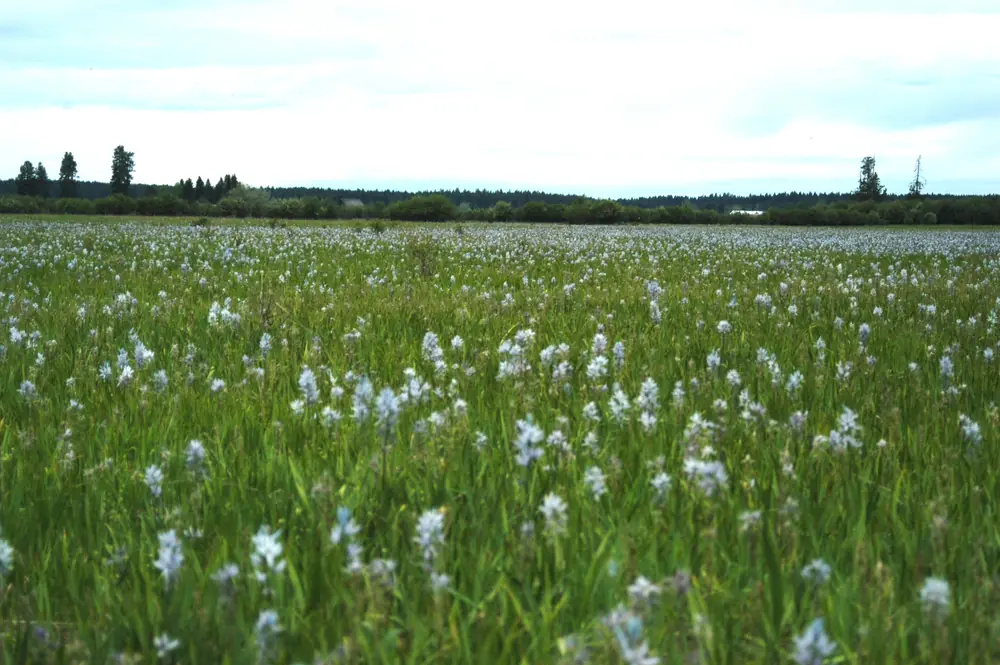
- Find a camas meadow. Look for a blue meadow along a roadside or a creek, and note the date it opens. Camas is one of the few wildflowers you can read from a car window.
- Take an evening lupine walk. Pick one foothill trail and walk it at sunset once a week through May. Note which flowers are open, and photograph the same spot each time.
- Sit by a pond for ten minutes. Choose a marsh, pond or river bend and count the nests, broods and calls you notice, then record the date of your first hummingbird.
In May the Naturalist’s Field Journal earns its keep. Log the firsts on the “daily field log” (first camas, first hummingbird, first brood). Hawks, willets, pelicans and tanagers belong on “birds I have seen.” A nest or a heron colony deserves a “nest observed” page, and a marsh at dawn suits “a map of sounds.” One foothill slope visited in early and late May makes a good “the same place twice” page, and “dusk and dawn watch” fits the Eta Aquariid mornings.
Regions used below: North Idaho and the Panhandle; Lewiston and the Clearwater country; Central Idaho mountains, McCall to the Sawtooths; Boise and the Treasure Valley; Magic Valley and the Snake River Plain; Eastern Idaho and the Upper Snake.
What blooms and nests around north Idaho’s Kootenai refuge in May?
By May the ice is long gone from the Panhandle’s ponds, and the refuge beside Bonners Ferry turns to nesting and bloom. The refuge’s watchable wildlife brochure walks through the spring in order: geese hatching in late April, ducklings from May, wildflowers through June. Road work closed the auto-tour route to vehicles in summer 2026, and a refuge notice expected it to reopen by the October 2026 waterfowl hunt opener. Phone the office at (208) 267-3888 or check the refuge’s visit page before a drive, because the route also shuts when conditions turn unsafe.
-
A refuge in flower
May through June, according to the refuge brochure · Forest edges, meadows and shrub thickets on and around the Kootenai refuge
The brochure names a long list of blooms for these two months: paintbrush, lupine, tiger lily, subalpine mariposa lily, bear grass, orange honeysuckle, chokecherry, elderberry, thimbleberry, mountain ash and Oregon grape. It does not say which flower opens first, and the valley bottom runs ahead of the hills, so expect the lower blooms in May and more of the list as June arrives. Admire plants where they stand, and keep to the trail edge.
-
Ducklings, goslings and a quiet marsh
Geese hatch in late April; ducklings begin to hatch in May, with broods most visible in June · Ponds and sloughs along the refuge roads and trails
The same brochure puts duck broods at their most prominent in June, so May is the start of it. A car makes a fine blind. A female with young will lead them off if you walk toward her, and a brood left alone is safer than one that has been chased, so settle in and let binoculars do the closing in. The brochure counts about 300 kinds of vertebrate animals on the refuge, and the species page lists waterfowl, bald eagles, osprey and songbirds among the nesters by late spring.
-
Moose, mostly later
May sightings are occasional; the brochure calls mid-June to mid-July the best weeks · Willow and wet meadow edges on the refuge
The refuge lists moose as a sight you may get on occasion in May and June, and points to the later weeks of summer for the best chances. A cow with a newborn deserves the widest berth of anything on the refuge: stay far back, never put yourself between mother and calf, and stay in the car if one is near. The brochure also lists painted turtles leaving the water in June to look for nesting sites on land.
The ice-out and the first birds of the thaw are on the Idaho March page, and the arriving ospreys and drumming grouse are on the April page.
Where can you see camas in bloom in Idaho in May?
Common camas sends up a spike of pale blue flowers in wet meadows, and in a good year a whole field looks like standing water from a distance. The Nez Perce people have dug its bulbs for generations. Two places in the state give a good look, one in the Clearwater country and one at the edge of Boise.
-
Weippe Prairie
May to June, according to the National Park Service; one NPS page lists April to May and says the dates shift each year · Along Idaho Highway 11 near the town of Weippe
The prairie is part of Nez Perce National Historical Park. The park service says the flowers can be seen from the roadside and gives about 10 to 60 minutes for the visit. A pullout with a sign about three miles southeast of Weippe marks the spot where William Clark entered the prairie in 1805. Much of the land is private, and the park service says permission must come from landowners before anyone harvests camas, so look from the road. Because the park service gives two bloom windows, check recent reports before a long drive.
-
Currant Creek, north of Boise
Early May is the walk’s listed timing in a botanist’s guide · Dry Creek Road foothills, a moderate walk of about 2 to 2.5 miles round trip
The Treasures of the Boise Front guide calls the Currant Creek camas the largest and most accessible population in the area, with a colony of Tolmie’s onion on a northwest-facing slope and a patch of freckled milkvetch it describes as the only known one on the Boise Front. The author suggests an evening walk once days warm, and the guide warns that heavy clay soil is slick and that western poison-ivy grows along the optional return route. Camas is edible, but the guide says too few plants remain to harvest, so leave the bulbs in the ground.
-
Not every camas is camas
Early in the foothill season · Grassy slopes in the Boise foothills
A different plant, the foothill death-camas, shows up early on the Miller Gulch plant list. The name is a warning: it is not the edible camas, and no one should dig or eat a wild bulb on a hunch. Learn plants by their flowers and leave the digging to people who know them.
What wildflowers bloom in the Boise foothills in May?
April’s balsamroot is still golden on many south slopes, but May belongs to lupine and to the rarer natives that a botanist’s trail guides single out. The guides give a window for each walk, and the dates move with the year’s weather, so treat them as a range. The Ridge to Rivers trail system lists the Central Ridge Trail (Trail 22) among its best flower routes.
-
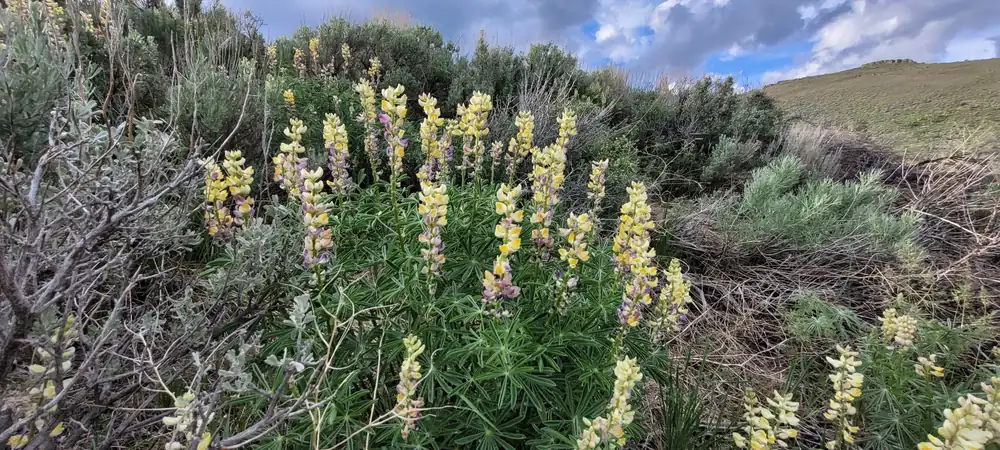
Longspur lupine at Miller Gulch
Early to mid-May; peak bloom is the point of the walk · Miller Gulch trailhead, just past milepost 3 on Bogus Basin Road
The guide’s main attraction is a patch of longspur, or polychrome, lupine near the ridge crest, about a mile round trip with roughly 300 feet of climbing. It lists plants in the order you pass them, and adds that some will not be open in a given year. The return loop includes a stretch beside the road. The page asks visitors not to pick or dig native plants on popular trails.
-
A rare milkvetch on Camel’s Back and Hulls Gulch
Mid to late May · Camel’s Back Park and the Hulls Gulch trails, from the 9th Street trailhead
The 1½-mile loop with about 350 feet of climbing is the guide’s pick for mid to late May and works well on a warm evening. Look on the sandy flat along the Red Fox Trail for Mulford’s milkvetch, which the guide calls a rare local endemic, and stay on the trail so the flat is not trampled. Red-winged blackbirds can be aggressive near nests, poison-hemlock is highly toxic, and most of the route is on-leash and pedestrian-only. The firecracker penstemon with bright red flowers is a planted species, not a native.
-
Later May and June options
Mid-May to mid-June for the Bucktail loop and Bonneville Point · Bucktail, Shane’s and Three Bears loop; Bonneville Point, on the Oregon Trail
The same guide lists both walks as mid-season routes running into June, when syringa, Idaho’s state flower, and checkermallow take over on the creek trails. Cobb Trail’s window ends in mid-May, and the guide notes that it burned in 2024.
Earlier spring flowers, from violets to balsamroot, are on the March page and the April page.
Which birds are nesting and arriving at Idaho’s refuges and marshes in May?
The waterfowl show winds down in May and the songbird show begins. Water is the question this year in the south, so call ahead before any drive.
-
Camas National Wildlife Refuge, if it has water
Waterbirds through mid-May; songbirds from late May to mid-June · Camas refuge, near Hamer off Interstate 15
The refuge’s species page puts the waterfowl and shorebird peak from March through mid-May and the songbird peak from late May through mid-June. Its main page carries a stark warning, though: it describes drought since summer 2024 and groundwater curtailment that began in 2025, and says there is a high probability that no water will be on the refuge. Boise State’s Intermountain Bird Observatory banded 1,412 birds of 65 species there from April 16 to June 15, 2023, noting that migration was slow to start and then picked up during the final week of May and the first week of June. Check the refuge page for conditions before you go.
-
Silver Creek Preserve, near Picabo
Spring, March through May in The Nature Conservancy’s bird list · A spring-fed creek and wetlands north of Highway 20
The preserve’s checklist, revised in 2019, marks sandhill cranes as common in spring and a confirmed breeder, and lists long-billed curlews, willets and Wilson’s phalaropes as common spring birds. It lists sora and Virginia rail as uncommon and counts more than 170 species in all. Access is by foot or boat only, with no pets, bikes or fires, and visitors must sign in each day. Much of the surrounding land is private, so the checklist advises birding from the road; the preserve’s office number is (208) 788-7910.
-
Herons and grebes at Deer Flat
April and May for the heron rookeries; late April and May for songbird migrants · Deer Flat National Wildlife Refuge, Lake Lowell and the Snake River islands near Nampa
The refuge says great blue herons nest in large rookeries on some of its Snake River islands in April and May, and that the Lake Lowell unit hosts one of Idaho’s three largest nesting colonies of western and Clark’s grebes. Islands are best watched from a distance with a scope. Disturbance can send adults off their nests.
-
White pelicans at Minidoka
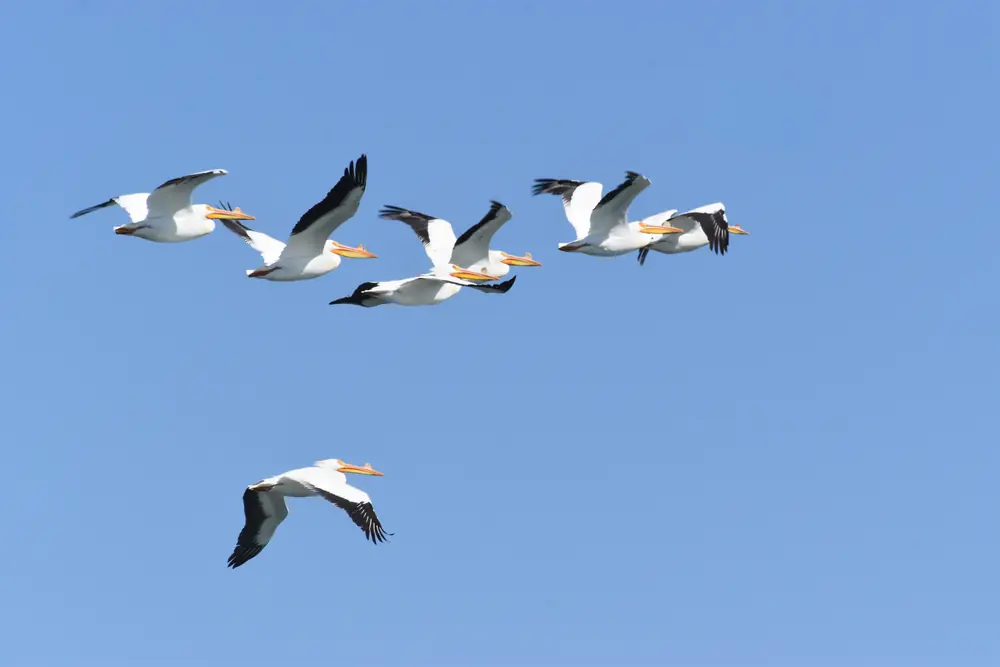
The refuge page shows pelicans on nesting islands but gives no dates · Minidoka National Wildlife Refuge, near Rupert on the Snake River
The refuge welcomes visitors all year and its page pictures dozens of American white pelicans resting on nesting islands. The Silver Creek checklist lists the species as uncommon there in spring, and dates vary, so phone the refuge at (208) 436-3589 for what is on the water.
What are the raptors doing at the Snake River Birds of Prey in May?
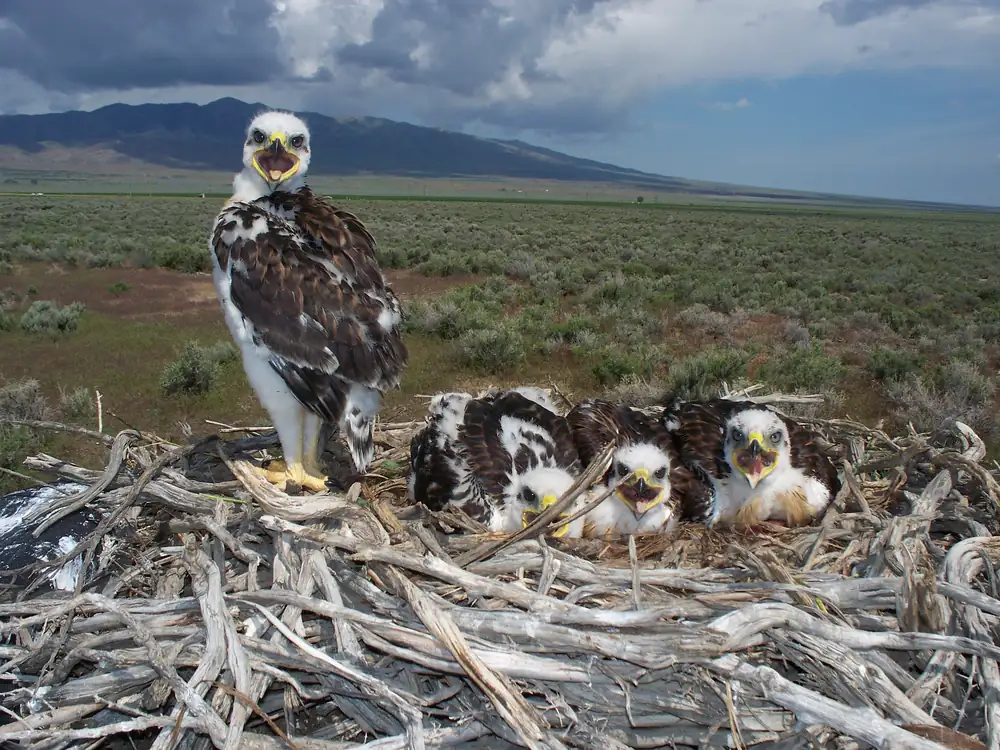
The BLM’s visitor guide calls this stretch of canyon south of Kuna a giant natural raptor nursery. It says sixteen species nest here each spring and that about 200 pairs of prairie falcons raise young on the cliffs, an important share of the known population. March brought the first hunters back, and April found many sitting on eggs. May is when they feed chicks.
-
A good month to watch
The guide rates mid-March, May and June as the best viewing, early and late in the day · Dedication Point and the roads across the plateau
With nestlings to feed, adults hunt more often and travel less far from the canyon rim. The guide notes that Dedication Point gives a quick turnaround between plateau food and cliff nests. Bring binoculars, check fence posts and power poles, and look up for soaring birds.
-
What feeds a raptor nursery
Spring and early summer · The sagebrush plateau above the canyon
The guide ties prairie falcon nesting success to the abundance of Piute ground squirrels, and golden eagle success to the population cycles of black-tailed jackrabbits. It also reports one of the densest badger populations in the world on the plateau. A year with few squirrels can mean fewer fledglings, a reminder that the show depends on the ground as much as the sky.
-
Hawks in a ground-level nursery
Ferruginous hawks are listed April through July; Swainson’s hawks April through September · Plateau and canyon rim
North America’s largest hawk, the ferruginous, is on the guide’s list, and its own photo shows juveniles crowded on a stick nest. Ground nesters in the area, among them burrowing owls, northern harriers and short-eared owls, regularly raise young on or near the ground. The guide says it is normal for these chicks to be found out of the nest, with parents close by. If a bird is uninjured, leave it where it is.
Bring water: the guide says the area has few services, summer temperatures often pass 100 degrees, and rattlesnakes and scorpions live here. Cliff rims are crumbling rock and walking them can disturb nesting raptors. The first prairie falcons and burrowing owls are on the March page, and the arriving Swainson’s hawks on the April page.
What changes in Idaho’s high country in May?
May is the month the high country wakes up slowly, and the sources agree that snow can last longer than the calendar suggests.
-
Craters of the Moon, a late spring
Snowpack may last into early May; the main bloom is early to mid-June · Craters of the Moon National Monument and Preserve, near Arco
The park service says the seven-mile Loop Road usually opens to vehicles in mid-April, that April and May snowstorms can close it again, and that caves may be shut for hazardous ice in April and May. Wild onion opens first, in late April, and its wildflower checklist includes dwarf monkeyflower, bitterroot, silverleaf phacelia, lupine, paintbrush and sego lily, with the peak in early to mid-June. The park’s basic information page puts the best hiking in mid to late June. So May is the early act: expect a few flowers, cold nights and variable weather.
-
Harriman State Park
The park lists the Becker Yurt as open May 15 to October 15; one park page gives a different May opening for the backcountry yurt, so call before booking · Harriman State Park, near Island Park
The park lists moose, elk and trumpeter swans as common sights and recommends carrying bear spray and a bell. Call (208) 558-7368 for current trail conditions, since snow and mud can hold on in May.
-
Hells Canyon, from the river to the ridge
Bloom moves uphill: early April to early June at Pittsburg Landing; early May to mid-June at Cow Creek Saddle; late May to late July at Bear Basin · Hells Canyon and the Seven Devils country
A regional wildflower site gives typical peaks for each site and says bloom can shift by as much as a month with the year’s weather. The ladder is the lesson: lower sites go first, and a trip in late May catches the middle elevations at their best.
Which animals are arriving or raising young in Idaho in May?
Fish and Game calls it the spring baby boom, and the cardinal rule is to watch and leave.
-
A fawn alone is not a lost fawn
May and June, the peak of births · Fields, yards, roadsides and forest edges statewide
Fish and Game’s guidance says many apparently abandoned young have a mother close by. Deer, elk and pronghorn hide their young and return to them later. Move an animal only if it sits in harm’s way, such as in the road. The agency calls the idea that birds abandon young that a person has touched a myth and says most birds have a poor sense of smell. Raising wild animals at home is illegal for most species, and the agency says most animals taken in by well-meaning people do not survive. If a young bird is on the ground, you can set it in a shrub or on a branch to keep it from cats.
-
Hummingbirds on the move
Spring migration; dates vary by year and valley · Feeders, flowers and shrubs, including along the Boise River
Fish and Game says five hummingbirds make Idaho their home: rufous, calliope, broad-tailed, black-chinned and occasionally Anna’s. We found no current Idaho source that dates the arrivals, so the first-of-year dates are yours to record: note the day each species first appears at a feeder or flowering shrub, and compare one valley with another.
-
Bats at Swan Falls
Each spring, when the females return to give birth · Swan Falls Dam on the Snake River
About 2,000 adult female Yuma myotis bats gather in the dam each spring in what Fish and Game calls the largest known bat maternity colony in the state. Fish and Game and Idaho Power began acoustic monitoring in 2019 to learn when the bats return, and the work doubles as an early warning for white-nose syndrome, which had not been found in Idaho when the article was written. All of Idaho’s bats are protected nongame species. If you find one hanging in its usual roost, leave it alone and keep pets and children away.
How much daylight does Idaho gain in May?
Daylight is still growing in May, though more slowly each week as the June solstice draws near. Sandpoint climbs from 14 h 33 m to 15 h 48 m, a gain of 75 min or about 2.5 min a day. Boise goes from 14 h 10 m to 15 h 12 m, and Twin Falls gains the least, 60 min. The clock does not change those figures, and Idaho has kept daylight time since March 14.
| City | May 1 | May 31 | Gained | Per day |
|---|---|---|---|---|
| Sandpoint | 14 h 33 m | 15 h 48 m | 75 min | 2.5 min |
| Coeur d'Alene | 14 h 29 m | 15 h 42 m | 73 min | 2.4 min |
| Lewiston | 14 h 23 m | 15 h 32 m | 69 min | 2.3 min |
| McCall | 14 h 16 m | 15 h 21 m | 65 min | 2.2 min |
| Boise | 14 h 10 m | 15 h 12 m | 62 min | 2.1 min |
| Twin Falls | 14 h 05 m | 15 h 05 m | 60 min | 2.0 min |
| Pocatello | 14 h 06 m | 15 h 07 m | 61 min | 2.0 min |
| Idaho Falls | 14 h 09 m | 15 h 10 m | 61 min | 2.0 min |
Naval Observatory tables give Boise a 6:37 a.m. sunrise and an 8:47 p.m. sunset on May 1 (Mountain daylight time), and a 6:07 a.m. sunrise and 9:19 p.m. sunset on May 31. In Coeur d’Alene, on Pacific time, the sun sets at 8:23 p.m. on May 19. For your own street, try the daylight page.
What is May weather like in Idaho, and when is the last spring freeze?
May is warm by day and still cool at night. By NOAA’s 1991–2020 normals, the average high runs from 72.3 degrees at Boise and 72.0 at Lewiston down to 61.4 at McCall, and the average low from 48.1 at Lewiston to 34.9 at McCall. Precipitation ranges from 1.40 inches at Pocatello to 2.72 at Sandpoint, with McCall next at 2.41. Nights at or below freezing still average about 10.8 at McCall and 5.8 at Idaho Falls, against less than one in Boise and none at Lewiston.
| Station | One year in ten | Median | Nine years in ten |
|---|---|---|---|
| Sandpoint | Apr 23 | May 8 | May 25 |
| Coeur d'Alene | Apr 4 | Apr 22 | May 6 |
| Lewiston | Mar 20 | Apr 6 | Apr 26 |
| McCall | Jun 3 | Jun 22 | Jul 10 |
| Boise | Apr 27 | May 17 | Jun 10 |
| Twin Falls | Apr 25 | May 9 | May 28 |
| Pocatello | May 6 | May 23 | Jun 13 |
| Idaho Falls | May 20 | Jun 11 | Jul 1 |
The table shows when the last 32-degree morning typically arrives, so one warm May day proves nothing. Boise’s station reaches its median on May 17 and Pocatello’s on May 23, McCall’s comes on June 22 and Idaho Falls’s on June 11, and Lewiston is usually finished by April 6. Set tender plants out only after your own town’s median has passed. The Idaho frost page has more towns.
Snow melts in May, and the water arrives in rivers. National Weather Service Boise says Idaho’s snowpack typically peaks in early April, that spring flooding mostly takes a long warm spell or a rain on top of the snow, and that small streams can spill over even when the big rivers stay in their banks. It adds that wildfire burn scars can raise local flood risk. Burning outside city limits statewide requires a free permit from May 10 through October 20, according to the Idaho Department of Lands. Each month, near its middle, NOAA’s Climate Prediction Center releases updated seasonal outlooks, which you can find on its 90-day page. The local forecast covers the next several days, and NWS Boise posts river levels.
What can you see in Idaho’s night sky in May 2027?
The month brings a dependable meteor shower, a full Moon that wears two labels, and the year’s best evening look at Mercury. The times below use Mountain daylight time, and the Panhandle and the Lewiston area run an hour earlier on Pacific daylight time. Idaho’s clocks moved ahead on March 14, so no May time is standard time.
-
Eta Aquariid meteors, with no Moon
Best mornings May 5, 6 and 7, in the hours before dawn · Away from town lights, looking toward the southeast and east after the radiant rises
The sources differ by a day on the peak. For the American Meteor Society it is May 5 to 6, while SeaSky says May 6 to 7, so plan on three mornings. May 6 is also the new Moon, which keeps moonlight out of the picture. The Society calls the shower medium, 10 to 30 an hour just before dawn anywhere from the equator north, and SeaSky offers about 30 an hour for the Northern Hemisphere. Aquarius, the patch of sky the meteors fan out from, clears the eastern horizon late. In Idaho that happens an hour or two before first light, which argues for the low end of that range, or less.
-
Venus and Saturn low in the dawn
Mornings of May 6 to 8 · Very low in the east, before sunrise
By our own calculation the bright morning star Venus passes within about a degree of Saturn on those mornings, closest around May 7. Half an hour before sunrise each stands just a few degrees up, so a flat horizon and binoculars help. SeaSky lists no May entry for either planet, so treat this as a calculated sight, not a published one.
-
A Moon beside Jupiter, then the Flower Moon
First quarter on Wednesday, May 12; full Moon on Thursday, May 20; best evening to watch is Wednesday, May 19 · High in the south after dark on May 12; rising in the east at dusk on May 19
By our own calculation, the half-lit Moon of May 12 sits about a degree from Jupiter that evening. The full Moon itself lands at 4:59 a.m. MDT (3:59 a.m. PDT) on May 20, hours before it would rise, which makes May 19 the evening to go out: moonrise is 9:00 p.m. in Boise (sunset 9:07), 8:42 p.m. in Idaho Falls (sunset 8:50) and 8:20 p.m. in Coeur d’Alene (sunset 8:23). Almanacs name it the Flower Moon. SeaSky also lists it as a seasonal Blue Moon, the third of the spring’s four full moons (the others fall on March 22, April 20 and June 19). The calendar-month kind, two full moons in one month, does not occur in 2027.
-
Mercury’s best evening
Greatest eastern elongation on Friday, May 28; the evenings of May 27 and 28 are both close · Low in the west-northwest after sunset
SeaSky lists the planet 22.9 degrees from the Sun on May 28. Begin looking about 45 minutes after sunset and keep going for another 45, which is around 10 p.m. in Boise, where the Sun goes down at 9:15 p.m. on May 27; allow half an hour either way. A clear western horizon matters, and Mercury is far fainter than the morning Venus.
-
Milky Way mornings and the dark-sky reserve
Dark windows run about May 1 to 14 and May 25 to 31 at 40° N; shorter in the north · The Central Idaho Dark Sky Reserve around Stanley, or any dark valley
Our calculation puts the Milky Way’s bright core in the dark before dawn on those dates, with up to about 3.8 hours of darkness at 40° N and under two hours at 48° N, because the nights are short. The Central Idaho Dark Sky Reserve covers about 1,400 square miles from near Stanley to Sun Valley, and its stargazing guide advises planning around the new Moon, using a red light and allowing up to 15 minutes for your eyes to adjust.
| Phase | Date | Time |
|---|---|---|
| New moon | Thursday, May 6 | 4:58 a.m. MDT / 3:58 a.m. PDT |
| First quarter | Wednesday, May 12 | 10:44 p.m. MDT / 9:44 p.m. PDT |
| Full moon, the Flower Moon | Thursday, May 20 | 4:59 a.m. MDT / 3:59 a.m. PDT |
| Last quarter | Friday, May 28 | 7:58 a.m. MDT / 6:58 a.m. PDT |
Use the moon phases page to find moonrise where you live, and the cloud forecast to see where skies stay clear.
What can Idaho families do outside in May?
- Take part in the City Nature Challenge. The organizers list photo-taking from April 30 through May 3 and identifying from May 4 through 16. Ask whether a nearby region has registered; you can upload to iNaturalist regardless.
- A wildflower evening. Walk to the Miller Gulch lupine in early to mid-May, or the Camel’s Back loop in mid to late May, and stay on the path.
- A camas drive. Take the roadside at Weippe Prairie and look without stepping onto private land.
- Birds of prey up close. The Peregrine Fund’s center in Boise is open Tuesday to Sunday, ten to five, runs live raptor programs at 11, 1 and 3, and opens Mondays too from Memorial Day (May 31). The last entry is 4:15 p.m., so confirm hours before you drive.
- World Migratory Bird Day. The organizers’ 2026 dates were May 9 and October 10. Their site showed no 2027 dates at the time of writing, so look there for the new ones.
- Dawn meteors. Set an alarm for May 5, 6 or 7 and watch the Eta Aquariids from a blanket.
- Join a bird walk. Golden Eagle Audubon leads guided trips in the Boise area; see its calendar for May listings.
Take a Naturalist’s Field Journal on each outing, and see the nature guides for other states. The Idaho April page has the osprey poles and the first rufous hummingbirds.
Safety notes for May in Idaho
- Spring turkey. Idaho’s 2026 and 2027 rules list the general spring season for male or bearded turkeys as April 15 through May 25 in most units. Youth-only hunts run April 8 to 14 in most units, and April 8 to May 25 in some. Archery is the only method allowed at Farragut State Park and Wildlife Management Area, which opens April 15 and closes April 30. Check the unit entry in the booklet.
- Spring black bear. According to the 2026 big game booklet, the 2027 spring seasons open April 15 in most units, and April 1 in a few. Closing dates run from April 30 to July 31 (including May 31, June 15 and June 30) depending on the unit. A female with young is off limits, bait sites may sit on forest roads, and the rules warn that grizzly bears may be encountered in several northern, central and eastern units. Keep dogs close and make noise on forest roads.
- Bright colors. Idaho’s hunter orange rule does not cover spring turkey or bear hunting. Even so, Fish and Game urges anyone in hunting country to dress brightly, and turkey hunters often wear camouflage.
- Fire. A free burn permit is required for any burning outside city limits statewide from May 10 through October 20. Park away from dry grass, since a hot exhaust can start a fire.
- Cold, fast water. Snowmelt pushes creeks high and cold. Hold children and dogs well back from the edge, and skip any crossing where you cannot see the bottom.
- Snakes and scorpions. The BLM guide says rattlesnakes and scorpions live in the Birds of Prey area, and Fish and Game lists the western rattlesnake as native to Idaho. Look before you step or reach on sunny rock.
- Plants. Poison-hemlock is highly toxic and western poison-ivy grows along the Snake River and on some foothill routes. Do not eat anything you cannot name with certainty.
- Ticks. The CDC advises walking in the center of trails, treating clothing with permethrin, using an EPA-registered repellent, drying clothes on high heat, and checking your body and pets within two hours of coming indoors.
- Young animals. Stay away from nesting birds, mothers with young and any fawn lying alone. Watch from a distance and leave quietly.
- Fishing. Fish and Game’s 2025 to 2027 fishing brochure is the authority on seasons and rules for each water. Check it before you go.
Sources (51)
- U.S. Fish and Wildlife Service: Kootenai National Wildlife Refuge watchable wildlife brochure (Seasons on the Refuge; PDF)
- U.S. Fish and Wildlife Service: Kootenai National Wildlife Refuge, seasons of wildlife
- U.S. Fish and Wildlife Service: Kootenai National Wildlife Refuge, visit (auto tour, contact)
- U.S. Fish and Wildlife Service: Camas National Wildlife Refuge
- U.S. Fish and Wildlife Service: Camas National Wildlife Refuge, species and seasons
- U.S. Fish and Wildlife Service: Deer Flat National Wildlife Refuge, seasons of wildlife
- U.S. Fish and Wildlife Service: Minidoka National Wildlife Refuge
- National Park Service: see the camas flowers bloom on Weippe Prairie
- National Park Service: visit Weippe Prairie (Nez Perce National Historical Park)
- National Park Service: Craters of the Moon, wildflowers
- National Park Service: Craters of the Moon, basic information
- Bureau of Land Management: Morley Nelson Snake River Birds of Prey NCA visitor guide (PDF)
- The Peregrine Fund: visit the World Center for Birds of Prey (hours)
- Idaho Parks and Recreation: Harriman State Park
- Ridge to Rivers: Spring wildflowers
- Treasures of the Boise Front: wildflower walks (timing table)
- Treasures of the Boise Front: Miller Gulch wildflower walk
- Treasures of the Boise Front: Camel’s Back and Hulls Gulch wildflower walk
- Treasures of the Boise Front: Redtail and Currant Creek walk
- Northwest Wildflowers: Hells Canyon area bloom timing
- The Nature Conservancy: Birds of Silver Creek Preserve checklist (PDF, revised 2019)
- Intermountain Bird Observatory (Boise State): How has migration changed at Camas National Wildlife Refuge? (Nov. 1, 2023)
- Idaho Fish and Game: May kicks off the wildlife baby boom (May 4, 2018)
- Idaho Fish and Game: Learn all about hummingbirds, June Wildlife Express (June 12, 2023)
- Idaho Fish and Game: Bats find the perfect hideout at Swan Falls Dam (October 2019)
- Idaho Fish and Game: western rattlesnake species catalog
- Idaho Fish and Game: Upland Game, Turkey and Furbearer 2026 & 2027 Seasons and Rules (PDF)
- Idaho Fish and Game: Big Game 2026 Seasons and Rules, including spring 2027 black bear (PDF)
- Idaho Fish and Game: hunter orange
- Idaho Fish and Game: fishing seasons and rules brochure 2025 to 2027
- Idaho Department of Lands: fire management and burn permits
- National Weather Service Boise: Idaho Spring Flood and Water Resources Outlook, March 5, 2026 (PDF)
- National Weather Service Boise
- NOAA Climate Prediction Center: seasonal (90-day) outlooks
- NOAA NCEI: U.S. climate normals 1991–2020, monthly, May (eight Idaho stations)
- NOAA Global Monitoring Laboratory: solar calculator (sunrise and sunset method)
- U.S. Naval Observatory: moon phases from May 1, 2027
- U.S. Naval Observatory: sunrise, sunset and moonrise for Boise, May 19, 2027
- U.S. Naval Observatory: sunrise, sunset and moonrise for Boise, May 1, 2027
- U.S. Naval Observatory: sunrise, sunset and moonrise for Boise, May 27, 2027
- U.S. Naval Observatory: sunrise, sunset and moonrise for Boise, May 31, 2027
- U.S. Naval Observatory: sunrise, sunset and moonrise for Idaho Falls, May 19, 2027
- U.S. Naval Observatory: sunrise, sunset and moonrise for Coeur d’Alene, May 19, 2027
- SeaSky: astronomy calendar 2027
- American Meteor Society: meteor shower calendar (Eta Aquariids 2027)
- Stanley Chamber of Commerce: A stargazer’s guide to the Central Idaho Dark Sky Reserve
- City Nature Challenge: 2027 dates
- World Migratory Bird Day
- Golden Eagle Audubon Society
- Centers for Disease Control and Prevention: preventing tick bites
- Photos via Wikimedia Commons; licenses and photographers are credited under each picture