What to look for in nature in Idaho this December
Winter starts on December 1 by the weather service’s calendar, and Idaho takes it seriously. Bald eagles crowd the shoreline snags at Wolf Lodge Bay, ducks crowd Lake Lowell and the warm springs at Hagerman, and thousands of mule deer and elk settle onto the brown foothills above Boise. Volunteers fan out with clipboards and tally sheets, great horned owls start their low duets at dusk, and the sun goes down before four in Sandpoint on all but the last few days of the month. Below is what to watch for, where, and roughly when, from the Panhandle lakes to the Upper Snake.
Other months in Idaho: October, November.
Start here

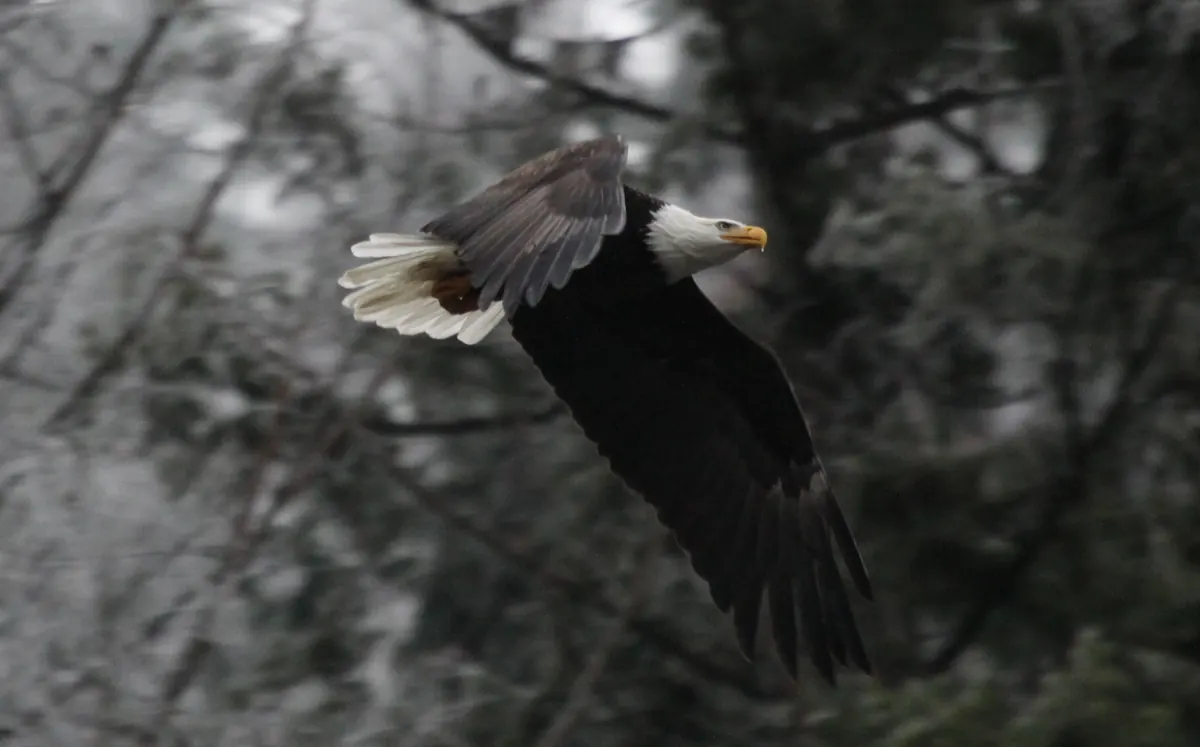
- Eagles at their December best. The Bureau of Land Management says the eagle numbers around Wolf Lodge Bay have historically topped out in the middle to end of December. Coeur d’Alene Audubon sets up spotting scopes, with stools so small children can reach the eyepiece, at Higgens Point on Saturday and Sunday, December 5 and 6.
- Join a Christmas Bird Count. Idaho circles pick one day each between Monday, December 14, and Tuesday, January 5. Idaho has more than a dozen count circles, from Moscow-Pullman and Coeur d’Alene to Boise, Hagerman, Pocatello and Idaho Falls, and most welcome beginners on a field team or counting at a home feeder.
- The closest full moon of 2026. The Cold Moon is exactly full at 6:28 p.m. MST (5:28 p.m. PST) on Wednesday, December 23, only hours from the moon’s nearest approach of the year. Look east as it clears the hills that evening, and again on Christmas Eve.
For the Naturalist’s Field Journal this month: sketch the prints along one fence line or creek after a fresh snow on “tracks to know,” fill in “reading the signs” with chewed cones, browsed twigs and owl pellets, give a conifer in your neighborhood its own “seeds, pods and cones” entry, and note the clock time of sunset on the solstice in the daily field log so you can compare it with the first week of December. Put the date and the temperature on every page.
Regions used below: North Idaho and the Panhandle; Lewiston and the Clearwater country; Central Idaho mountains, McCall to the Sawtooths; Boise and the Treasure Valley; Magic Valley and the Snake River Plain; Eastern Idaho and the Upper Snake.
When is the best time to see bald eagles at Lake Coeur d’Alene and on Idaho’s rivers?
December is the month the Panhandle eagle show is usually at its fullest. The birds come for spawned-out kokanee along the lakeshore gravel, and they stay as long as the fish hold out. In the south, the gathering is slower and lasts longer: Idaho Fish and Game’s bald eagle leaflet says migrants reach their traditional wintering grounds from October, but numbers there do not peak until January and February.
-
Wolf Lodge Bay at its peak
Usually mid to late December; varies with the kokanee · Higgens Point, the Mineral Ridge boat ramp and the Mineral Ridge trailhead, about 11 miles east of Coeur d’Alene
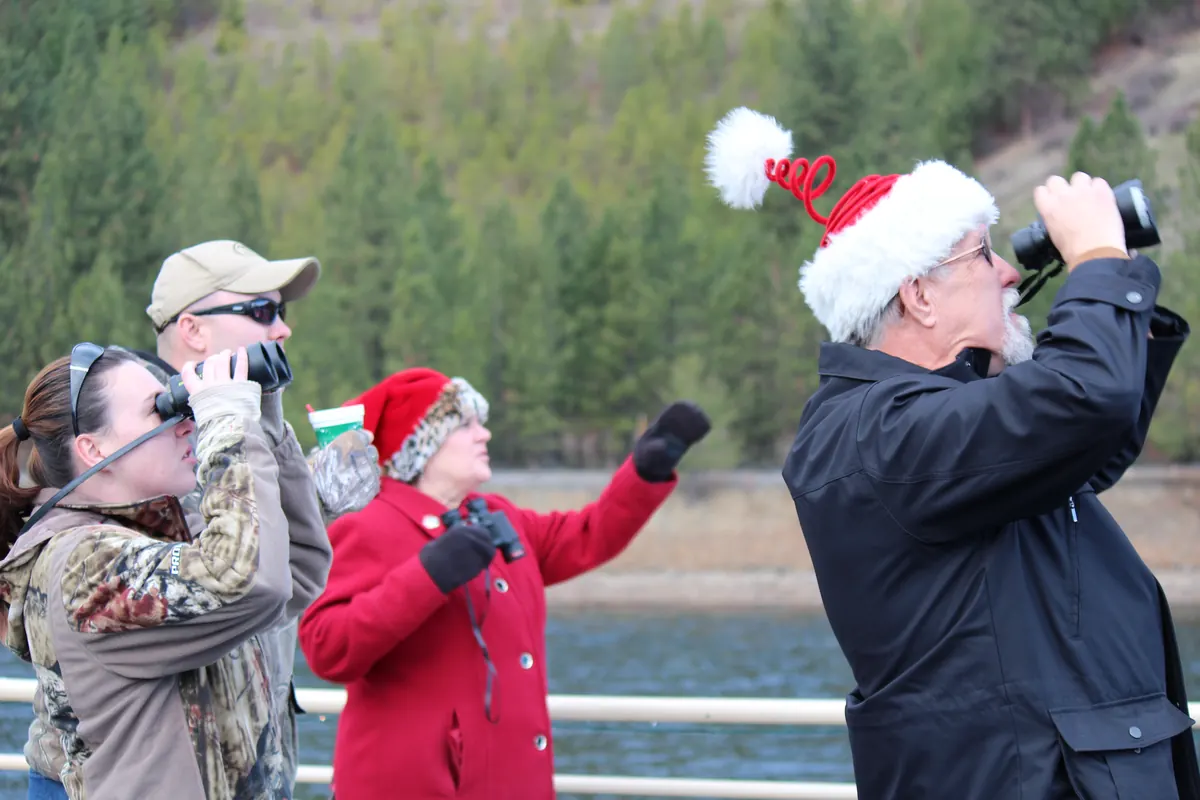
The BLM has counted these birds every winter since 1974, and its page puts the historical high point in the middle and latter part of December. The best tally ever came on December 20, 2023: 409 eagles, of which 363 were white-headed adults. Last winter shows how much the timing can shift. The weekly count was 157 on December 3, still 148 on December 10, and only 20 by December 19. Go on a gray, calm morning, scan the snags along the shore with binoculars, and expect a different number every week. Pull fully off the road; stopping in a lane of Interstate 90 or Highway 97 is illegal.
-
Scopes at Higgens Point
Saturday and Sunday, December 5 and 6, 2026 · Higgens Point, at the end of East Coeur d’Alene Lake Drive
Coeur d’Alene Audubon members bring spotting scopes, spare binoculars and step stools for young viewers. The chapter had not posted start times when this page went up, so check its events page the week before. Dress for wind off the lake; the point is exposed.
-
Eagles on the Boise, Snake and Salmon
Building through December; most birds in January and February · Barber Pool Conservation Area east of Boise; the Snake River below the big reservoirs; the Salmon River corridor
IDFG lists sections of the Snake, Salmon and Boise rivers, along with the two big northern lakes, among the places where wintering bald eagles concentrate. On the Boise, a BLM study of the communal roost in the old cottonwoods of Barber Pool in the late 1990s found eagles using it all winter, with nightly counts reaching 13 birds in January and February, during the coldest spells. Watch the big cottonwoods along the Greenbelt early and late in the day. Idaho’s statewide midwinter eagle survey has ranged from 480 to 832 birds over the years.
-
Resident pairs already nest-building
October through February · Tall trees and cliffs near rivers and reservoirs
Not every eagle you see is a visitor from Canada. Fish and Game says Idaho’s nesting pairs often stay on territory all year when the winter allows, adding sticks to old nests or starting new ones any time from October to the end of February. If you see an adult carrying a branch in December, note the tree; eggs usually follow from late February.
When is the Christmas Bird Count in Idaho, and how can you join?
Every winter from December 14 to January 5, National Audubon coordinates the Christmas Bird Count. Each count covers one day inside a fixed circle, and every bird seen or heard by every team goes into a record that began in 1900, when 27 birders in 25 places counted birds instead of shooting them. Idaho has more than a dozen circles; the volunteer-run Idaho Birds site lists results from Sandpoint, Spirit Lake and Coeur d’Alene down to Bruneau, Twin Falls, Bear Lake Valley and Craters of the Moon. Most 2026 dates had not been announced at the start of October. In 2025 the Boise, Coeur d’Alene and Moscow-Pullman counts all fell on Saturday, December 20, so watch for a similar weekend and check the chapter pages below in November.
-
Boise
One day in the count window; 2025 was December 20 · A circle centered on the Idaho State Capitol
Golden Eagle Audubon fielded 128 volunteers in 2025, split among 14 zone leaders’ field teams plus six people counting at home feeders, and they found 97 species on a calm, sunny day. European starlings led the tally at 6,542, but the list also held a black-and-white warbler, a great egret and three Virginia rails.
-
Coeur d’Alene
2025 was the 35th count, on December 20 · Coeur d’Alene, the Rathdrum Prairie and the north end of the lake
Thirty-six people on twelve teams, plus six feeder watchers, logged 71 species and 7,304 birds last year. They set a record of 38 bald eagles, along with records for hooded mergansers (111) and Townsend’s solitaires (21), and turned up a Pacific loon on the lake and a snow bunting and short-eared owl on the prairie. Oddly, no American coots turned up, though they had appeared on 32 of the 34 earlier counts.
-
Moscow-Pullman and the Palouse
2025 was the 55th straight count, on December 20 · Moscow and Pullman, straddling the Idaho–Washington line
Palouse Audubon has run this count 55 years in a row, and 72 times in all. In 2024 a record 71 people on 28 field teams and 19 feeder stations tallied 11,429 birds of 71 species, and for the first time since 1971 found no rough-legged hawks. Registration runs through Audubon’s online sign-up, and the chapter posts feeder-watcher instructions and tally sheets.
-
Hagerman and the Magic Valley
Dates set by Prairie Falcon Audubon each fall · The Hagerman Valley and four other Magic Valley circles
Prairie Falcon Audubon runs five counts each winter, and its Hagerman circle has been counted for half a century. Spring water keeps the valley open in hard cold, and one statewide summary on the Idaho Birds site has Hagerman leading Idaho with 102 species, against 16 on the lava at Craters of the Moon.
If you cannot join a team, you can still help: Project FeederWatch keeps running all winter, and any list you enter in eBird during the count window adds to what scientists know about Idaho’s winter birds. Find the nearest circle on Audubon’s count map.
Where do ducks and geese spend December in Idaho?
Once the shallow marshes lock up, Idaho’s waterfowl crowd onto whatever stays liquid: big reservoirs that freeze late, spring-fed creeks that never freeze at all, and the open channels of the Snake.
-
The duck peak on Lake Lowell
Mid-December · Deer Flat National Wildlife Refuge, south of Nampa
The refuge’s species page gives mid-December as the height of the duck season on Lake Lowell, with as many as 150,000 birds on the water at once. The geese peaked a month earlier. Bald eagles patrol the edges for sick or crippled birds, so a raft of ducks that suddenly lifts off the lake is worth a second look at the sky.
-
Hagerman’s warm ponds
All winter; best in hard cold snaps · Hagerman Wildlife Management Area, 2 miles south of Hagerman, along Highway 30
Springs pouring out of the basalt cliffs feed the Hagerman ponds with water at a steady 58 °F. Fish and Game’s management plan says the open water supports roughly 50,000 ducks, mostly mallards, and 4,000 Canada geese through the winter, and that some birds delay migrating because of it. This was the first wildlife management area in Idaho, bought starting in 1940 for wintering waterfowl. The department’s page counts five viewing blinds, and all the ponds are closed to fishing from November 1 to the end of February so the birds can rest.
Duck and goose seasons are open on parts of all these waters through December, so hunting blinds and early shotgun fire are normal. Use the refuge and WMA viewing areas, which are signed.
Which owls and winter songbirds can you find in Idaho in December?
The summer birds are long gone, but December has its own cast: owls that start courting while the snow is falling, and flocks of northern songbirds that wander south when their food runs short.
-
Great horned owls start hooting
From December, mostly at sundown · Cottonwood bottoms, farm windbreaks, city parks and canyon cliffs statewide
An Idaho Fish and Game biologist writing about winter owls notes that great horned owl courtship can begin as early as December. Pairs call back and forth in a deep, soft duet, and although the female is the larger bird, hers is the higher voice. Go out at dusk on a still evening and listen near big cottonwoods or a farm shelterbelt. The same article says northern saw-whet owls sometimes come down into the valleys in winter, and northern pygmy owls call most at sunrise and sunset in mountain woodlands.
-
Bohemian waxwings
Irregular; some winters many, some none · Crabapples, mountain ash, juniper and other fruiting trees in towns
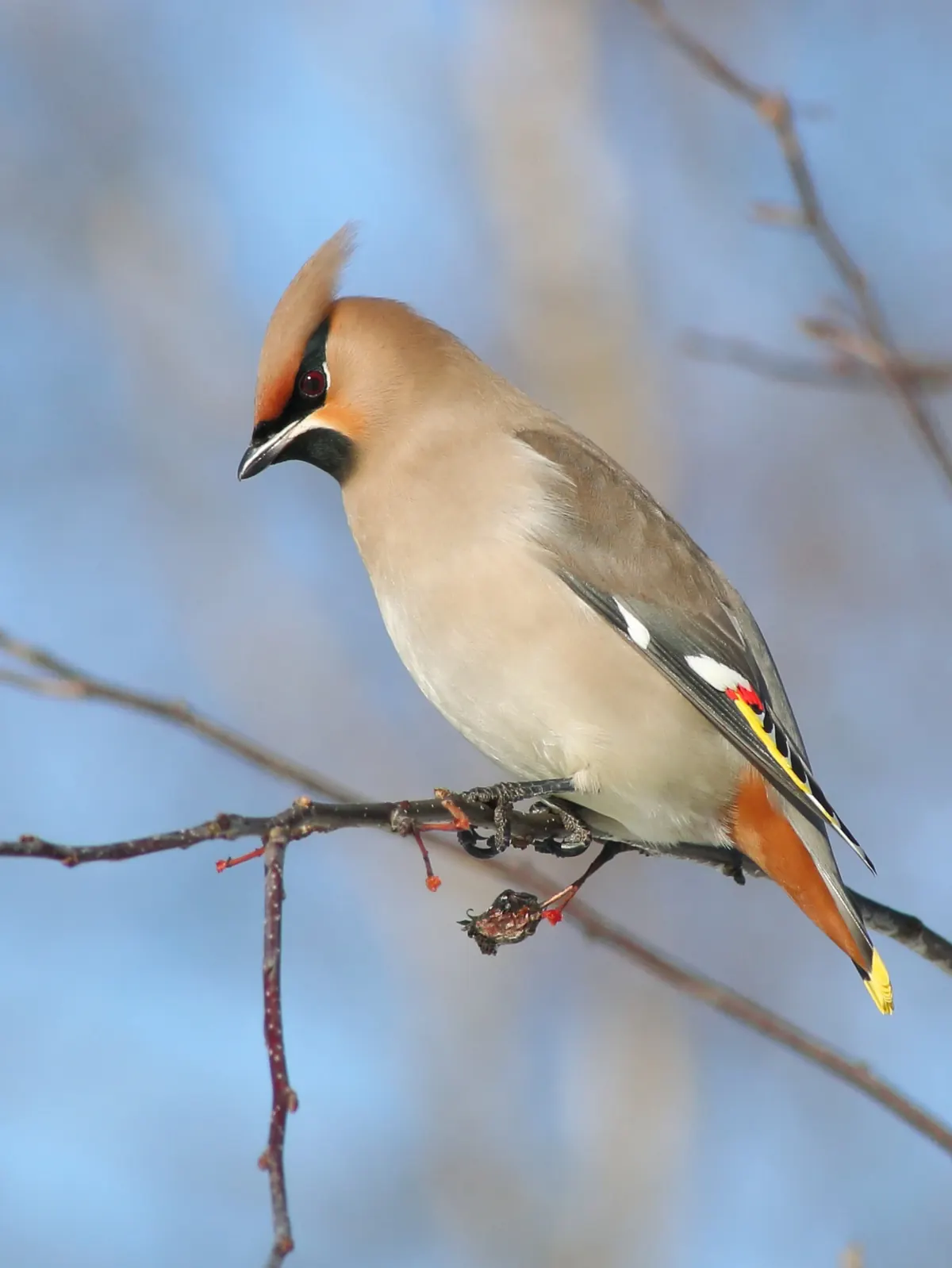
Idaho has two waxwings. The cedar waxwing is here year round, but the larger Bohemian waxwing, almost 9 inches long, comes south from the boreal forest only in some winters. Look for gray-brown birds with a crest, a black mask, a tail tipped in yellow, white and yellow marks on the wings, and rusty feathers under the tail. IDFG’s Wildlife Express tells of a flock of 2,000 that stripped a crabapple tree in under an hour, and a Bear Lake Valley count once tallied 650. A chorus of high, thin whistles from a fruit tree is often the first clue.
Where do Idaho’s deer and elk go for the winter?
Snow pushes big game downhill. By December most of Idaho’s mule deer and elk have left the high country for lower, south-facing slopes where wind and sun keep forage uncovered, and some of the most important of those slopes are within sight of the state capital.
-
The Boise Foothills winter range
December through April · Boise River Wildlife Management Area, along Highway 21 and above Warm Springs Avenue east of Boise
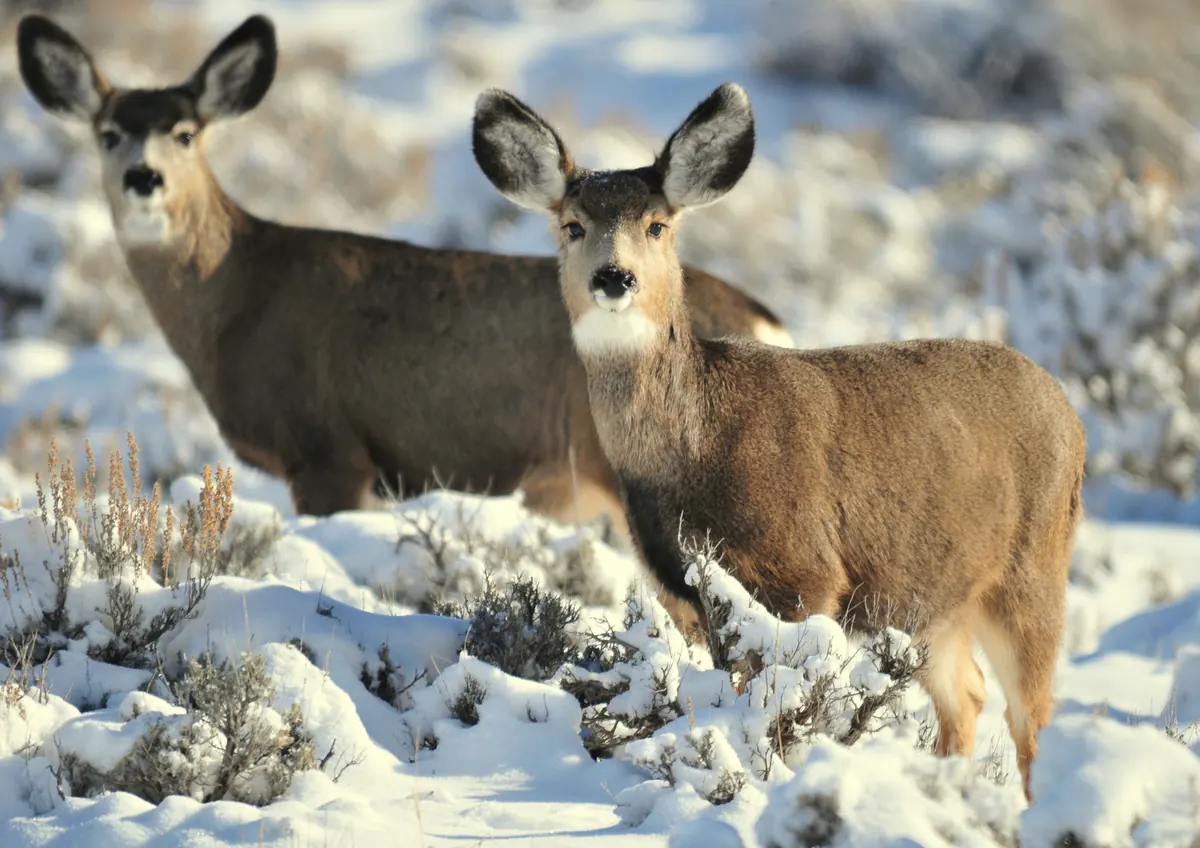
Fish and Game estimates that 5,000 to 8,000 mule deer and about 1,800 elk winter on this WMA every year, some of them walking in from as far away as the Sawtooths. Dogs must be on a leash there from November 16 to April 30, because deer and elk treat a loose dog as a predator and run, burning fat they need to reach spring. The department has fenced the highway, built an underpass and added a wildlife overpass to cut down on collisions. Watch from a pullout on Highway 21 at dawn or dusk, and do not walk toward animals on the slopes.
-
Land still healing from the Valley Fire
This winter and next · The part of the WMA west of Highway 21
The 2024 Valley Fire burned nearly 10,000 acres of this winter range, which feeds about 2,400 mule deer and 650 elk. With less forage and almost no cover, the department closed the burned section to all entry from February 1 to April 14, 2026, the second winter in a row. Check IDFG’s notices for this winter’s plan before any foothills hike.
Every winter IDFG asks people to give wintering animals space. The simplest rule: if a deer or elk lifts its head and stares at you, you are already too close.
How do Idaho animals survive the winter, and what tracks do they leave?
Each Idaho animal has a different answer to cold, short days and buried food. Some sleep, some store, some change color, and many simply keep moving. Snow keeps a written record of all of it.
-
Pikas living off their haypiles
All winter, under the snow · Rock slides and talus slopes in the mountains
Pikas do not hibernate. They spend the summer cutting grass and flowers and stacking them among the rocks, then live on that store through the winter. The Nature Conservancy in Idaho explains that deep snow keeps their dens near 34 °F. The same article warns that thinner snowpacks and drier summers leave them colder and shorter of food, a worry in a mild El Niño winter.
-
Snowshoe hares and their white coats
Coats turn white in late fall · Conifer forests in the mountains and the north
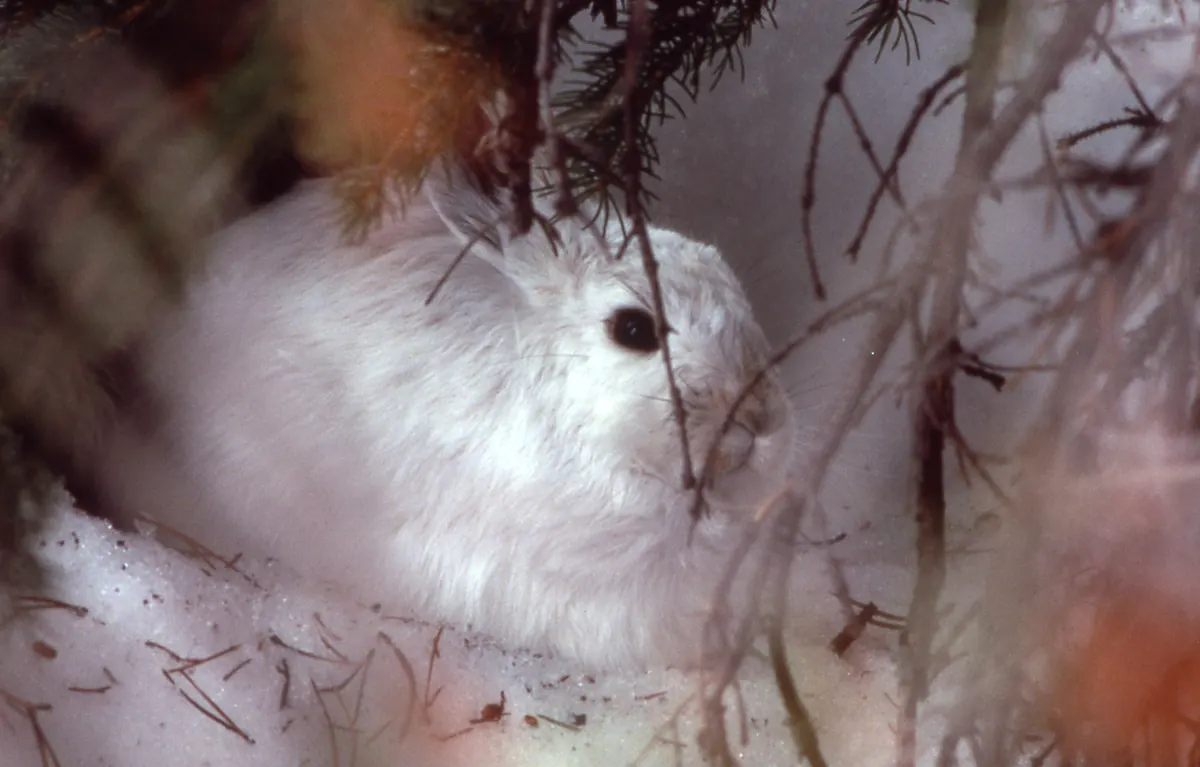
The hare’s change of coat is set by day length, not by snow, so in a mild, brown December a white hare can stand out like a lamp. Its oversized, furry hind feet act as snowshoes. Canada lynx, which hunt them, have the same trick: broad, furred paws and light bones for running on top of deep snow.
-
Sleepers underground
Through the winter · Dens, burrows and rock piles statewide
Ground squirrels went underground months ago. Fish and Game’s Wildlife Express says the northern Idaho ground squirrel sleeps for about eight months and may need to triple its weight in summer to make it; its southern cousin, on the other hand, retires in July and can be back above ground as early as January.
-
Reading tracks in fresh snow
The morning after a light snowfall · Field edges, creek banks, trail margins and backyards
IDFG’s tips for young trackers start with counting toes. Hares leave five toes on the front feet and four on the back; weasels have five toes front and back, though only four may print; coyotes usually show four clear toes, and their front prints are always bigger than the hind prints. Look around the track too, for chewed twigs, scat, feathers or a spot where a hawk’s wings brushed the snow. Craters of the Moon shuts its Loop Road to cars in mid-November, and the visitor center lends snowshoes Thursday to Monday, 9 a.m. to 2:30 p.m., for a suggested donation.
How do you tell Idaho’s evergreens apart in winter?
With the aspens and larches bare, the conifers have the woods to themselves, which makes this the season to learn them. Most can be told apart by the needles alone: how many come out of one spot, how long they are, and whether they are flat or square, soft or sharp. Cones on the ground help with the rest.
-
Western white pine, the state tree
Evergreen · Moist forests of north Idaho
The western white pine is Idaho’s state tree, and north Idaho holds the largest remaining stand of it in the country. Its needles come in bundles of five and run 3 to 5 inches; its cones are long, stalked and nearly straight, 5 to 15 inches. The Idaho Forest Products Commission says white pine blister rust, a fungus that reached North America around 1910 on nursery shrubs from France, had become epidemic in Idaho by the 1940s, and rust-resistant seedlings have been planted since the 1970s. The tallest known tree of the species, 219 feet, stands near Elk River.
-
Ponderosa and lodgepole pines
Evergreen · Ponderosa on warm, dry lower slopes; lodgepole almost everywhere at middle elevations
Ponderosa has long needles, 5 to 10 inches, in bundles of two or three, and mature bark broken into broad, scaly plates like a jigsaw puzzle. Lodgepole’s needles are short and stiff, 1 to 2 inches, always in twos, and many of its small, prickly cones stay sealed until the heat of a fire opens them.
-
Douglas-fir and grand fir
Evergreen · Douglas-fir statewide; grand fir mostly north and west-central
Douglas-fir is now Idaho’s most widespread forest type. Its soft needles, about an inch and a half, stick out all around the twig, and its hanging cones have three-pointed bracts poking out between the scales, like the hind feet and tail of a mouse diving in. Grand fir has flat, blunt needles and dense foliage that often reaches nearly to the ground, and its cylindrical cones have a greenish cast.
Last year the Idaho Panhandle National Forests sold permits for $5 each, up to three per household, through Recreation.gov and ranger stations, and fourth graders with an Every Kid Outdoors pass could get one free apart from a small reservation fee; the agency says cutting small trees from crowded stands opens room for wildlife forage. Check your forest’s 2026 rules first.
When is the earliest sunset and the shortest day in Idaho?
The earliest sunset comes before the shortest day. In Sandpoint the sun sets at 3:52 p.m. PST every evening from December 6 to December 16, centered on December 11, and after that the evenings slowly lengthen even while the mornings keep getting darker. Coeur d’Alene bottoms out at 3:55 p.m. around December 11 and Lewiston at 4:01 p.m. around December 10. South of the time-zone line the clock reads an hour later: McCall bottoms out at 5:03 p.m. MST around December 10 and Boise at 5:08 p.m. around December 9, all in the second week of the month. The solstice arrives at 1:50 p.m. MST (12:50 p.m. PST) on Monday, December 21, when Sandpoint gets 8 hours 19 minutes of daylight and Twin Falls, farther south, gets 9 hours 4 minutes.
| City | Dec 1 | Dec 21 | Dec 31 | Earliest sunset |
|---|---|---|---|---|
| Sandpoint | 8 h 38 m | 8 h 19 m | 8 h 25 m | 3:52 p.m., Dec 11 |
| Coeur d'Alene | 8 h 42 m | 8 h 25 m | 8 h 29 m | 3:55 p.m., Dec 11 |
| Lewiston | 8 h 52 m | 8 h 35 m | 8 h 39 m | 4:01 p.m., Dec 10 |
| McCall | 9 h 03 m | 8 h 47 m | 8 h 51 m | 5:03 p.m., Dec 10 |
| Boise | 9 h 11 m | 8 h 56 m | 9 h 00 m | 5:08 p.m., Dec 9 |
| Twin Falls | 9 h 18 m | 9 h 04 m | 9 h 06 m | 5:04 p.m., Dec 8 |
| Pocatello | 9 h 16 m | 9 h 02 m | 9 h 04 m | 4:55 p.m., Dec 9 |
| Idaho Falls | 9 h 12 m | 8 h 57 m | 9 h 01 m | 4:52 p.m., Dec 9 |
Between the solstice and New Year’s Eve, the table’s cities win back only 2 to 6 minutes of daylight. For your own street, the sunrise and sunset calculator lists twilight as well.
How snowy is December in Idaho, and what could a strong El Niño mean?
December is when Idaho’s high valleys settle into deep winter and its low valleys start fighting fog. The NOAA normals below tell the story: McCall averages 33.5 inches of December snow and has at least an inch on the ground on 29 days of the month, while Boise averages 5.6 inches and has snow cover on about 6 days. Lewiston, in its sheltered canyon, is the mildest of the eight with an average high of 41 °F. Sandpoint is the wettest, with 4.61 inches of precipitation.
| Station | Average high | Average low | Precipitation | Snowfall | Days with 1 in or more of snow on the ground | Nights below 0 °F |
|---|---|---|---|---|---|---|
| Sandpoint | 34 | 23 | 4.61 | 19.3 | 18.2 | 0.8 |
| Coeur d’Alene | 36 | 26 | 3.47 | not published | not published | 0.0 |
| Lewiston airport | 41 | 30 | 1.13 | 4.1 | 3.1 | 0.1 |
| McCall | 30 | 13 | 3.48 | 33.5 | 29.0 | 4.7 |
| Boise airport | 39 | 25 | 1.54 | 5.6 | 5.9 | 0.3 |
| Twin Falls | 37 | 21 | 1.44 | 6.0 | not published | 0.8 |
| Pocatello airport | 34 | 17 | 1.13 | 10.1 | 14.7 | 2.3 |
| Idaho Falls airport | 30 | 13 | 0.78 | not published | not published | 4.0 |
In the Treasure Valley, Idaho’s Department of Environmental Quality warns that winter inversions trap cold air and pollution near the ground, and that fine-particle levels there have gone above federal health standards during them. Burn bans on wood stoves can follow, and DEQ posts a daily air quality forecast.
This winter brings a strong push from the tropical Pacific, and federal forecasters are confident about it. Their ENSO update of September 10 says Idaho’s winter will almost surely unfold with a very strong El Niño in place (their estimate tops 90 percent), meaning an exceptionally warm band of equatorial Pacific water. In a September interview with Boise State Public Radio, a NOAA meteorologist said the odds favor a winter one to three degrees warmer than normal, with fewer winter storms rather than none, and lower elevations more likely to see rain instead of snow. He added that the effect is strongest in north Idaho, where above-normal temperatures and a smaller snowpack are the better bet, while southern Idaho is closer to a coin flip. The USDA’s Northwest Climate Hub sums up the regional pattern the same way, warmer and drier in Idaho, Oregon and Washington during El Niño, while warning that the typical effects are not a certainty. NOAA’s own winter maps come out on October 15 among the 90-day outlooks. Before a mountain drive, check today’s weather; and for spring planting, the last-frost dates for every Idaho station are on the Idaho frost page.
What can you see in Idaho’s night sky in December?
The longest nights of the year and Idaho’s protected dark-sky country make December a fine month for stargazing in Idaho, if you dress for it. Times below are standard time, with Pacific time north of the Salmon River and Mountain time to the south.
-
The Geminids
Night of Sunday, December 13, into Monday, December 14 · Anywhere dark; the radiant in Gemini is highest around 2 a.m.
The year’s richest meteor shower, with a theoretical rate of about 150 an hour under a perfect sky, peaks on a near-ideal night. The only moonlight comes from a thin crescent that drops behind Idaho’s western ridges well before the meteors get going. Bring a sleeping bag, a reclining chair and a thermos; in Idaho in mid-December that is not optional.
-
The Cold Moon, the year’s nearest
Evening of Wednesday, December 23; nearly as full on the 24th · Rising in the east-northeast around sunset
The moon is exactly full at 6:28 p.m. MST, and the moon swings through perigee, the nearest bend of its orbit, roughly seven hours later. No full moon this year comes closer, so this one fully earns the supermoon label. Watch it rise behind a ridge or a stand of trees, where the size is easiest to judge. Watch for it near the Seven Sisters star cluster on solstice night, two days ahead of full.
-
Venus at dawn
All month; with the crescent moon on December 4 and 5 · Southeast before sunrise
Venus is the brilliant morning star all month, outshining every star and planet. At dawn on the 4th and the 5th the waning crescent sits about a fist’s width from Venus, with the star Spica between them on the 4th. By late December Jupiter clears the eastern horizon in mid-evening, while ringed Saturn keeps the southwestern evening sky to itself.
| Phase | Date | Time |
|---|---|---|
| Last quarter | Monday, Nov 30 | 11:08 p.m. MST / 10:08 p.m. PST |
| New moon | Tuesday, Dec 8 | 5:52 p.m. MST / 4:52 p.m. PST |
| First quarter | Wednesday, Dec 16 | 10:42 p.m. MST / 9:42 p.m. PST |
| Full moon, the Cold Moon | Wednesday, Dec 23 | 6:28 p.m. MST / 5:28 p.m. PST |
| Last quarter | Wednesday, Dec 30 | 11:59 a.m. MST / 10:59 a.m. PST |
Moonrise and moonset for your town are on the moon calendar; check the cloud forecast before driving to Craters of the Moon or the Central Idaho Dark Sky Reserve. The Quadrantid meteors follow on the night of January 3, with a dark sky.
What can Idaho families do outside this December?
- Saturday and Sunday, December 5 and 6: eagle watch at Higgens Point with Coeur d’Alene Audubon, with scopes and stools for children. Check the chapter’s site for times.
- Sunday night, December 13: the Geminids. Children can watch the first hour after the moon sets and go to bed happy; the real show is after midnight.
- December 14 through January 5: Idaho’s bird count days. Ask Golden Eagle Audubon in Boise, Coeur d’Alene Audubon, Palouse Audubon or Prairie Falcon Audubon in the Magic Valley which circle covers your home, and whether you can count at your feeder.
- Monday, December 21: a solstice walk. Photograph the exact spot on the skyline where the sun goes down, then shoot it again from the same place in March.
- Tuesday to Sunday through December: the World Center for Birds of Prey on the hill south of Boise keeps winter hours of 10 a.m. to 4 p.m. from December through February, with live raptor presentations at 11 a.m., 1 p.m. and 3 p.m., and is closed December 24 and 25 and January 1. Adult tickets are $14 and youth tickets $9.
- Friday, January 1, 2027: First Day Hikes. Last New Year’s Day, Idaho state parks led a snowshoe trek at Harriman, ranger walks at Lucky Peak, a hike to the Buttonhook overlook at Farragut, and self-guided outings at Hells Gate and Eagle Island. The state parks calendar had no December 2026 events posted when this page went up; the First Day Hikes list usually appears the last week of December.
- Citizen science. Keep counting for Project FeederWatch, add eagle and swan numbers to eBird, and report any Bohemian waxwing flock.
Tuck a Naturalist’s Field Journal into the car for the eagle drive. If you missed November’s swan and eagle arrivals, the Idaho November page has them, and other states are on the nature guides page.
Safety notes for December in Idaho
- Late hunts are still running. Duck seasons stay open through December in all three areas (to January 31 in Area 1, January 15 in Area 2 and January 22 in the Panhandle’s Area 3), and Canada goose season is open in every goose area, closing December 31 in Area 4 around Bear Lake. Light goose hunting closes December 23 in Area 4 and December 24 in Area 3. Pheasant runs to December 31, and chukar, gray partridge and California quail to January 31. For deer, the Panhandle’s archery white-tailed season reopens December 10–24 in Units 1, 2, 3, 4, 4A, 5, 6, 7 and 9; white-tailed muzzleloader hunts run December 2–14 in Unit 8A, December 2–11 in Unit 10A (antlerless only), to December 5 in Units 14 and 18 and to December 9 in Unit 16, and a number of controlled deer and elk hunts also run into December; and archery hunting in Unit 28, near Salmon, is open all month. Panhandle muzzleloader hunters may take antlerless elk December 2–8 on or near private land, and archery hunters antlered elk December 10–16.
- Hunter orange. Idaho requires at least 36 square inches of visible hunter orange above the waist only for bird hunters on the stocked pheasant release areas where an Upland Game Bird Permit applies, and on sponsored hunts; an orange hat usually covers it. There is no general orange rule for big game, but Fish and Game encourages everyone in hunting country to wear it and notes that bright red, yellow and pink also stand out. Skiers, snowshoers and dog walkers sharing public land with late-season hunters are easier to see in blaze orange; a cap and a dog vest cost little.
- Ice. Fish and Game says ice is usually thick enough to fish on most Idaho waters only in December or January. The department’s minimum for a single person on foot is three to four inches of solid ice, more for a group, and 10 inches for an ATV or snowmobile; ice on Idaho lakes and reservoirs does not typically get thick enough for cars and trucks. Drill test holes as you go, and stay away from inlets, outlets, springs and docks. Fernan Lake, just east of Coeur d’Alene, is one of the Panhandle’s popular perch lakes once it locks up.
- Avalanches. Backcountry skiers, snowshoers and snowmobilers should read the daily bulletin from the Sawtooth Avalanche Center or the regional center for their range before heading out, and carry a beacon, probe and shovel with a partner who knows how to use them.
- Short days. Early in the month the Panhandle sun sets before 4 p.m. and Boise’s by 5:10, so an afternoon outing needs a headlamp, spare gloves and a plan someone else knows.
- Collisions. Mule deer and elk on winter range cross Highway 21 and Warm Springs Avenue at dawn and dusk; slow down through the foothills.
Sources
- Bureau of Land Management: Lake Coeur d’Alene Eagle Watch (viewing sites, 2025–26 weekly counts, record count)
- Coeur d’Alene Audubon Society: events (Higgens Point eagle watch, December 5 and 6, 2026)
- Idaho Fish and Game: Bald Eagles in Idaho (wintering, roosts, nesting season, midwinter survey; PDF)
- Bureau of Land Management: continued monitoring of Boise’s wintering bald eagles (Technical Bulletin 2001-09, PDF)
- National Audubon Society: Christmas Bird Count
- National Audubon Society: join or start a Christmas Bird Count (count map)
- Golden Eagle Audubon Society: 2025 Boise Christmas Bird Count
- Golden Eagle Audubon Society: Christmas Bird Count
- Coeur d’Alene Audubon Society: Christmas Bird Count 2025 field report
- Palouse Audubon Society: 2025 Moscow-Pullman Christmas Bird Count
- KIVI-TV: Audubon’s 50th annual Christmas Bird Count in Hagerman (Prairie Falcon Audubon)
- Idaho Birds: Christmas Bird Counts in Idaho (circle results)
- Idaho Fish and Game: Christmas Bird Count, a local birding tradition (2010)
- U.S. Fish and Wildlife Service: Deer Flat National Wildlife Refuge, species and seasonal waterfowl numbers
- Idaho Fish and Game: Hagerman Wildlife Management Area
- Idaho Fish and Game: Hagerman Wildlife Management Area management plan (spring temperature, wintering waterfowl; PDF)
- Idaho Fish and Game: Hagerman WMA, a gem for winter wildlife viewing
- Idaho Fish and Game: From the Field, owls of winter (2011)
- Idaho Fish and Game: Wildlife Express, Waxwings (February 2014, PDF)
- Project FeederWatch: how to participate
- Idaho Fish and Game: Boise River Wildlife Management Area (wintering deer and elk, dog leash dates)
- Idaho Fish and Game: give wintering wildlife a break on the Boise River WMA
- Idaho Fish and Game: Boise River WMA restricts access for a second winter (Valley Fire burn area)
- Idaho Fish and Game: Wildlife Express, Mountain Goats and Tracks! (November 2012, PDF)
- The Nature Conservancy in Idaho: how climate change affects winter wildlife (pikas, snowshoe hares, lynx, bears)
- Idaho Fish and Game: Wildlife Express, Incredible Idaho Ground Squirrels (February 2008, PDF)
- National Park Service: Craters of the Moon in winter (Loop Road, snowshoe loans)
- Idaho Secretary of State: Idaho state symbols (western white pine)
- Idaho Forest Products Commission: western white pine
- Idaho Forest Products Commission: ponderosa pine
- Idaho Forest Products Commission: lodgepole pine
- Idaho Forest Products Commission: Douglas-fir
- Idaho Forest Products Commission: grand fir
- U.S. Forest Service: Christmas tree permits on the Idaho Panhandle National Forests (November 2025)
- NOAA NCEI: U.S. climate normals 1991–2020, monthly (Boise, Pocatello, Idaho Falls, Lewiston, McCall, Coeur d’Alene, Sandpoint, Twin Falls)
- Idaho Department of Environmental Quality: priority air quality areas (Treasure Valley winter inversions)
- Idaho Department of Environmental Quality: air quality forecasts
- NOAA Climate Prediction Center: ENSO diagnostic discussion, September 10, 2026
- NOAA Climate Prediction Center: seasonal (90-day) outlooks
- Boise State Public Radio: latest predictions point to a warmer fall and winter across Idaho (September 8, 2026)
- USDA Northwest Climate Hub: El Niño in the Northwest, what can we expect?
- U.S. Naval Observatory: moon phases from November 1, 2026
- U.S. Naval Observatory: Earth’s seasons, 2026 (December solstice)
- International Meteor Organization: 2026 meteor shower calendar (PDF)
- EarthSky: what is a supermoon (2026 full supermoons)
- NASA JPL Horizons: solar system ephemerides (moon and planet positions)
- NOAA Space Weather Prediction Center: solar cycle progression
- NOAA Global Monitoring Laboratory: solar calculator (sunrise and sunset method)
- The Peregrine Fund: visit the World Center for Birds of Prey (winter hours, holiday closures, prices)
- Idaho Parks and Recreation: First Day Hikes, January 1, 2026
- Idaho Parks and Recreation: events calendar
- Idaho Fish and Game: Migratory Game Bird 2026–2027 Seasons and Rules (PDF)
- Idaho Fish and Game: Upland Game, Furbearer and Turkey 2026–2027 Seasons and Rules (PDF)
- Idaho Fish and Game: hunter orange
- Idaho Fish and Game: Big Game 2026 Seasons and Rules (PDF)
- Idaho Fish and Game: ice fishing safety
- Idaho Fish and Game: where to go ice fishing this winter
- Idaho Fish and Game: ice fishing in the Panhandle (Fernan Lake perch)
- Sawtooth Avalanche Center (U.S. Forest Service)
- Photos via Wikimedia Commons; licenses and photographers are credited under each picture
