What to look for in nature in Idaho this October
Idaho’s October happens on two clocks and at every altitude. By the first of the month most of the Snake River Plain and every mountain valley has already had its first freeze, while Lewiston and Boise wait until late in the month. Aspens go gold in the Sawtooths first, tamaracks light up the northern forests later, hawks and owls stream south over the Boise Ridge, kokanee turn red in Panhandle creeks, and the last cranes feed in eastern Idaho stubble fields. This guide takes the state a region at a time, dates included.
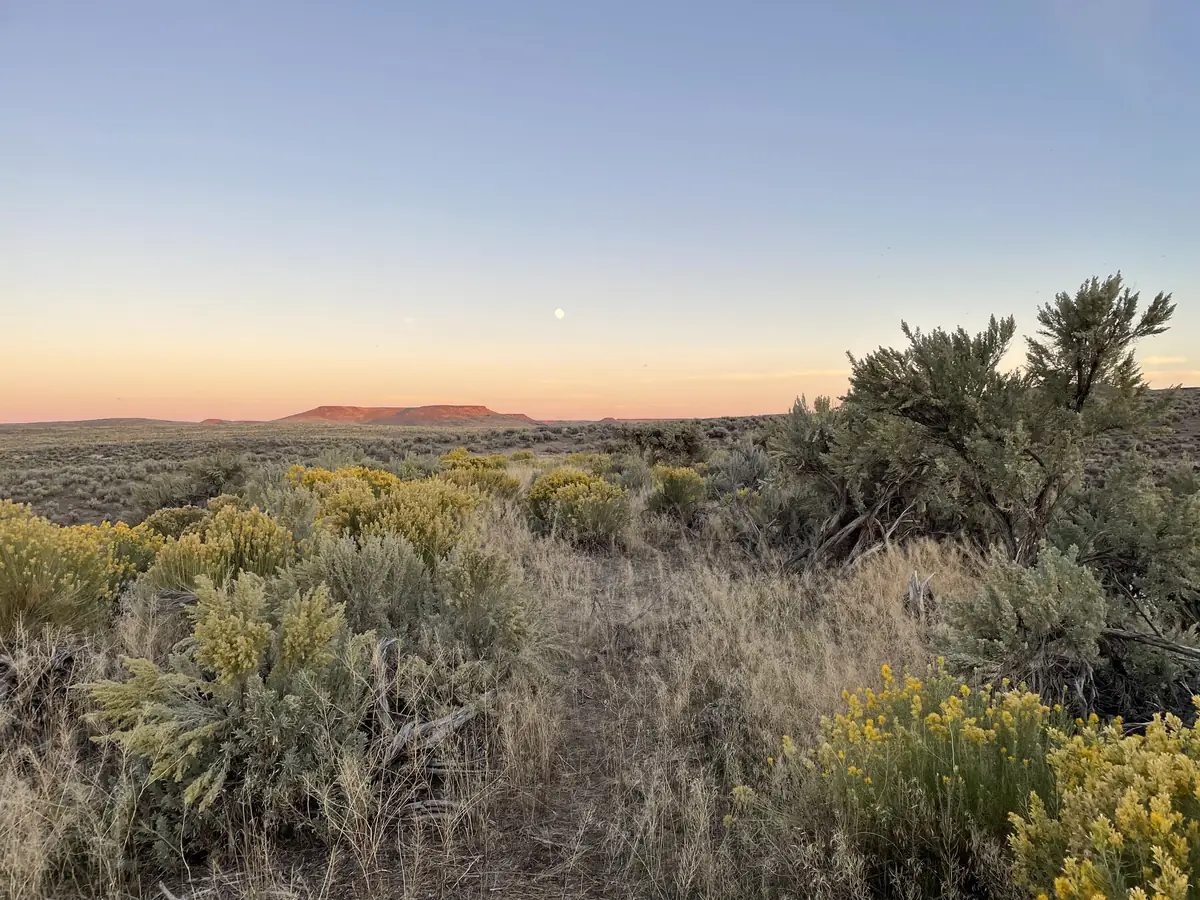
Start here

- Hawks and owls over the Boise Ridge. The Intermountain Bird Observatory’s station on Lucky Peak, above Boise, counts and bands migrating raptors from 10 a.m. to about 6 p.m. through the end of October, and owl banding runs until October 28. Small groups can drop in without booking, but the last six miles are a steep dirt road that needs a high-clearance four-wheel or all-wheel-drive vehicle.
- Gold on the mountainsides. Aspens around Stanley are usually past their best by the first days of October, while Idaho City, Mores Creek Summit and McCall tend to peak in the first half of the month. The western larch, which the north calls tamarack, follows in the second half of October from McCall to the Panhandle and along the Lochsa.
- Red fish and a full moon. Kokanee finish their run up Trestle Creek, off Lake Pend Oreille, in early October. The Hunter’s Moon is technically full on Sunday evening, October 25 (10:12 p.m. Mountain, 9:12 p.m. Pacific), and it rises round and orange that evening and the next.
For the Naturalist’s Field Journal this month: give one aspen or tamarack you pass every week its own tree-through-the-seasons page, add the first rough-legged hawk and the last crane to “birds I have seen,” note an elk bugling at first light on the dusk-and-dawn watch, and press a larch cone and a sprig of fluffy rabbitbrush onto the seeds, pods and cones plate. Put a date on every page.
Regions used below: North Idaho and the Panhandle; Lewiston and the Clearwater country; Central Idaho mountains, McCall to the Sawtooths; Boise and the Treasure Valley; Magic Valley and the Snake River Plain; Eastern Idaho and the Upper Snake.
When do the aspens and tamaracks turn in Idaho?
Idaho has two fall color seasons, a month apart. The first belongs to quaking aspen, cottonwood and the shrubs, and it starts high and early. The second belongs to western larch, a conifer that drops all its needles every autumn after turning them yellow-gold; the Forest Service’s fall color guide singles out the larches that “light up the rugged Bitterroots” along the Lochsa River corridor. No agency publishes an Idaho color forecast, so the dates below are the usual windows reported by local guides, and any given year can slip a week either way.
| Place | What turns | Usual peak |
|---|---|---|
| Stanley and the Sawtooth Valley | Aspen | Mid-September to about October 5 |
| Idaho City and Mores Creek Summit | Aspen, cottonwood, shrubs | October 1 to 15 |
| McCall and Long Valley | Aspen first, then larch | Aspen October 1 to 12; larch October 15 to 31 |
| Boise River Greenbelt and the North End | Cottonwood, street maples and oaks | Mid-to-late October; some parks hold color past Halloween |
| Lochsa corridor and the Panhandle forests | Western larch (tamarack) | Second half of October into early November |
| Teton Valley and the Caribou-Targhee | Aspen, cottonwood, shrubs | Late September into early October |
Aspen groves are mostly clones, and the Forest Service notes that clones differ in timing, leaf shape and bark, which is why one patch goes orange while the next is still green. In the north, larch needles go from green to pale yellow to deep gold, then fall in a few windy days; for a week or two the ridges above Coeur d’Alene and Sandpoint look lit from inside.
Where can you see migrating hawks, owls and cranes in Idaho in October?
Idaho sits under a real flyway. Raptors follow the long ridges south, sandhill cranes gather in the Upper Snake valleys before crossing Utah, and ducks and geese build up on the reservoirs. The birding in October is less about warblers, which have mostly gone, and more about big birds on the move.
-
The Lucky Peak hawk watch
Raptor count through the end of October; owl banding to October 28 · Top of Lucky Peak, Boise Ridge, off Highway 21 east of Boise
The Intermountain Bird Observatory, part of Boise State University, has run its fall raptor count on this ridge for more than 30 years; 2025 was its 32nd season. Visitors gather by the radio tower on the summit, where counters call out birds from 10 a.m. to about 6 p.m.; morning songbird banding ends October 15. The Valley Fire of October 2024 burned much of the station, which reopened in 2025 without overnight camping; that fall the crew banded more than 300 northern saw-whet owls. Watch for the first rough-legged hawks down from the Arctic. Highland Valley Road is six miles of steep dirt; stay off it within an hour of rain.
-
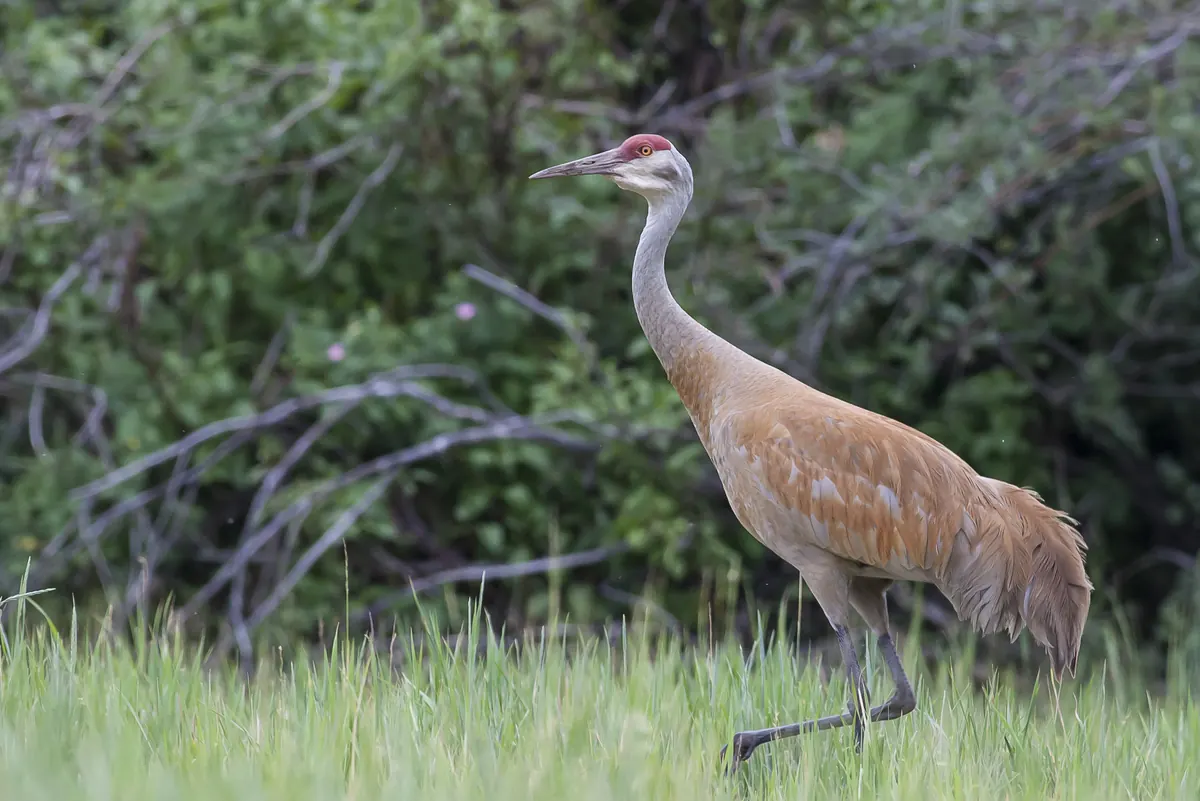
The last sandhill cranes
Staging September to mid-October; stragglers into November · Teton Valley, Grays Lake, Camas National Wildlife Refuge, Mud Lake and Market Lake
The Teton Regional Land Trust describes Teton Valley as holding the largest pre-migration gathering of sandhill cranes in the Greater Yellowstone, and the Fish and Wildlife Service calls Grays Lake, near Soda Springs, home to the largest breeding concentration of the species in North America; up to 3,000 cranes can use it in the fall. Most of those birds leave by early October. Later in the month the best bet is the stubble fields around Hamer, south of Camas refuge, and near Mud and Market lakes, where a local writer counted close to a thousand cranes at one dawn in October 2024 and expected flocks to keep passing into November. Arrive at first light and watch from the car.
-
Ducks and geese on the reservoirs
Building from October through January · Lake Lowell (Deer Flat refuge), Camas refuge, Kootenai refuge near Bonners Ferry
Deer Flat National Wildlife Refuge, on Lake Lowell near Nampa, closes the lake to boating after September 30, and the refuge suggests October through January for watching “large flocks of ducks and geese” there, mostly mallards and Canada geese. Camas refuge, near Hamer, lists tundra swans among its fall migrants and has 3.5-mile and 7-mile auto routes. Duck seasons open in October, so expect hunters on parts of these waters.
-
Crossbills, nutcrackers and a poor cone year
Fall and winter · Mountain conifers; sometimes backyard spruces
The Finch Research Network reports a widespread failure of limber, whitebark, ponderosa and pinyon pine cones across the interior mountain West this year, which set some red crossbills moving eastward as early as July. Any crossbill or evening grosbeak in town this fall is worth writing down.
Saturday, October 10, is the global October Big Day; any list you enter in eBird that day, from a backyard or a trailhead, counts. The “birds I have seen” page is the place for your first rough-leg and your last crane.
When do kokanee and salmon spawn in Idaho?
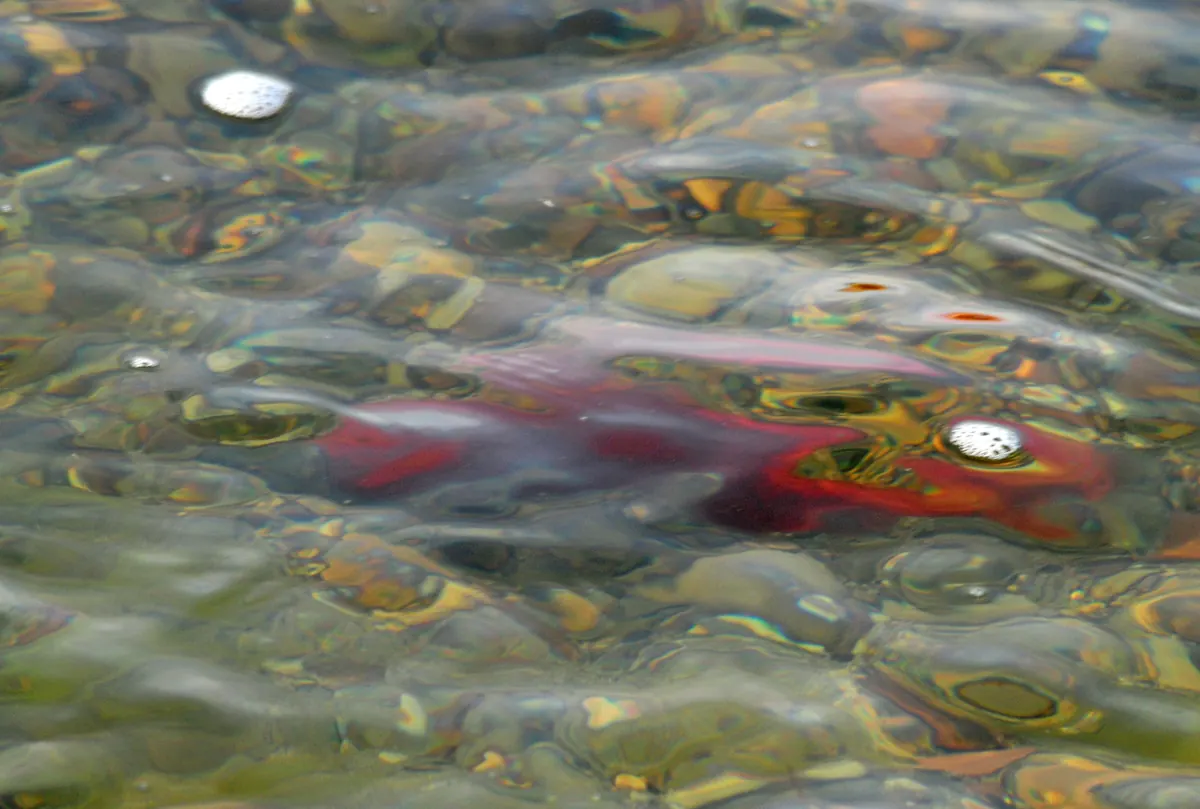
Fall is when Idaho’s fish put on color. Kokanee, the landlocked form of sockeye salmon, trade their silver-blue lake coat for scarlet bodies and green heads before they spawn and die, and sea-run salmon and steelhead finish the long climb from the Pacific up the Columbia and Snake.
-
Kokanee in Trestle Creek
September into early October · Trestle Creek Road, a quarter mile off Highway 200 east of Sandpoint
Idaho Fish and Game points visitors to a small parking lot and interpretive site on Trestle Creek Road, where kokanee from Lake Pend Oreille crowd the creek from September into early October. The creek is closed to fishing. Runs near Boise, in Mores Creek and the Boise River forks, start around Labor Day and are mostly over by October. In the big northern lakes shoreline spawning peaks around Thanksgiving, when IDFG says large groups of bald eagles gather to feed on the spent fish.
-
Sockeye in Redfish Lake
Spawning peaks in October · Redfish and Pettit lakes, Sawtooth Valley near Stanley
NOAA Fisheries’ status review says Snake River sockeye reach the Sawtooth lakes in August and September and that spawning in the lakeshore gravel peaks in October, at the end of their long climb from the sea. The run is endangered and still tiny; natural-origin returns remain “extremely low,” and most fish that reach the lakes come from a captive broodstock program. We found no 2026 spawner count to report yet.
-
A record-low steelhead year
Fall season through December 31 · Snake, Salmon and Clearwater rivers
On September 15, IDFG reported that the 2026 steelhead count at Bonneville Dam is forecast at 61,500, “the lowest steelhead count on record,” and cut the daily limit to two fish statewide, with only one longer than 28 inches on the Clearwater, from September 17. Fall Chinook fishing closes October 31, and a week or two earlier (October 14) on the Clearwater between Memorial Bridge and the Orofino bridge. If you fish, check the rules page the morning you go; seasons are changing quickly.
-
Walleye on the move in Lake Pend Oreille
Early fall · Clark Fork delta, Dover to Sandpoint, the lake’s southern basin
IDFG has tracked more than 90 tagged walleye in Lake Pend Oreille since 2019 and finds that they “cover more ground in early fall than at any other time of year,” dropping from about 13 feet deep in September to more than 20 feet by December. The department wants them caught: walleye compete with the kokanee that feed bull trout and big rainbows, so there is no size or bag limit, and some tagged fish carry a $1,000 reward.
Children remember the red fish. Log the count and the date in the daily field log, and next year you will know whether the run was early.
When is the first frost and freeze in Idaho?
For most of Idaho the question has already been answered. Pocatello’s airport reaches its median first freeze on September 18, Idaho Falls on September 20 and McCall’s airport on September 10, so by October 1 the average garden above 4,500 feet has been bitten at least once. The places still waiting are the low valleys that drain toward the Columbia: Coeur d’Alene’s median is October 18, Boise’s airport October 21, Lewiston’s October 26, and deep in Hells Canyon, Brownlee Dam holds out until November 5. Cold air drains into basins on still, clear nights, so a farm on the valley floor can freeze a week or more before a house on the bench above it.
| Station | One year in ten | Median | Nine years in ten |
|---|---|---|---|
| Sandpoint Experiment Station (Panhandle) | Sep 11 | Sep 28 | Oct 11 |
| Coeur D'Alene (Panhandle) | Oct 4 | Oct 18 | Nov 5 |
| Lewiston Nez Perce County Airport (Clearwater) | Oct 10 | Oct 26 | Nov 12 |
| Mccall Airport (central mountains) | Aug 29 | Sep 10 | Sep 25 |
| Salmon-Ksra (Lemhi Valley) | Sep 9 | Sep 24 | Oct 5 |
| Boise Air Terminal (Treasure Valley) | Oct 5 | Oct 21 | Nov 5 |
| Twin Falls-Kmvt (Magic Valley) | Sep 24 | Oct 9 | Oct 24 |
| Pocatello Regional Airport (southeast) | Sep 3 | Sep 18 | Oct 4 |
| Idaho Falls Fanning Field (Upper Snake) | Sep 1 | Sep 20 | Oct 4 |
Every station in the state, with spring dates too, is on the Idaho frost dates page. In Boise and Lewiston there is still time to dig the potatoes and pick the last tomatoes green before the first clear, windless night. Wherever you live, write down the morning the car windshield first needs scraping; that date, kept for a few years, is your own frost record.
How much daylight does Idaho lose in October?
Between 83 and 102 minutes, and the farther north the town, the bigger the loss. Sandpoint loses 102 minutes over the month, more than three minutes a day, while Boise, Twin Falls and Pocatello lose 83 to 84. In Boise, sunrise slides from 7:43 to 8:19 a.m. MDT and sunset from 7:25 to 6:37 p.m.; in Coeur d’Alene, on Pacific time, sunrise moves from 6:46 to 7:30 a.m. and sunset from 6:26 to 5:31 p.m. Idaho sets its clocks back an hour at 2 a.m. that Sunday morning, November 1, and Boise’s sunsets then read about 5:36.
| City | Oct 1 | Oct 31 | Lost | Per day |
|---|---|---|---|---|
| Sandpoint | 11 h 39 m | 9 h 57 m | 102 min | 3.4 min |
| Coeur d'Alene | 11 h 40 m | 10 h 01 m | 99 min | 3.3 min |
| Lewiston | 11 h 41 m | 10 h 06 m | 95 min | 3.2 min |
| McCall | 11 h 42 m | 10 h 12 m | 90 min | 3.0 min |
| Boise | 11 h 42 m | 10 h 18 m | 84 min | 2.8 min |
| Twin Falls | 11 h 44 m | 10 h 21 m | 83 min | 2.8 min |
| Pocatello | 11 h 44 m | 10 h 20 m | 84 min | 2.8 min |
| Idaho Falls | 11 h 43 m | 10 h 18 m | 85 min | 2.8 min |
The Field almanac gives twilight times and this week’s minutes lost for any address.
What is October weather like in Idaho, and what will El Niño do to the winter?
October is usually a dry, bright month across southern Idaho and the first wet one in the north. NOAA’s 1991–2020 normals give Boise an average October high of 65 °F and low of 42 °F, with only 0.81 inch of precipitation; Twin Falls and Pocatello are nearly as warm by day but six to nine degrees colder at night, and Idaho Falls averages 59 and 31. The mountains and the Panhandle are cooler and wetter: McCall averages 57 and 28 with 1.81 inches, Coeur d’Alene 58 and 39 with 2.02 inches, and Sandpoint gets 2.95 inches. October snow is mostly a high-country affair (2.1 inches is normal at McCall), but November brings 17.3 inches there.
This winter comes with a strong push from the Pacific. In its discussion dated September 10, the Climate Prediction Center called a very strong El Niño better than a nine-in-ten bet for the cold season, and gave three-in-four odds that October through December will beat any El Niño on record back to 1950. They update October 8, with the national winter outlook to follow in the middle of the month. North Idaho has a good track record to go on. The Spokane weather office, which covers the Panhandle and the Lewiston area, says El Niño winters “often bring warmer than normal temperatures and below normal snowfall”: in past El Niño winters Coeur d’Alene averaged 44.0 inches of snow, 86 percent of normal, and Lewiston 11.1 inches, 72 percent. It adds that one El Niño winter still buried Spokane under 78 inches. South of the Salmon River the signal is weaker and less certain; NOAA’s general pattern tilts the whole Northwest mild and dry, which would mean a thinner snowpack for the rivers that feed southern Idaho’s farms, but no agency promises it. October itself will feel little of this. Check the Weather now page before any trip into the mountains.
What is in Idaho’s night sky this October?
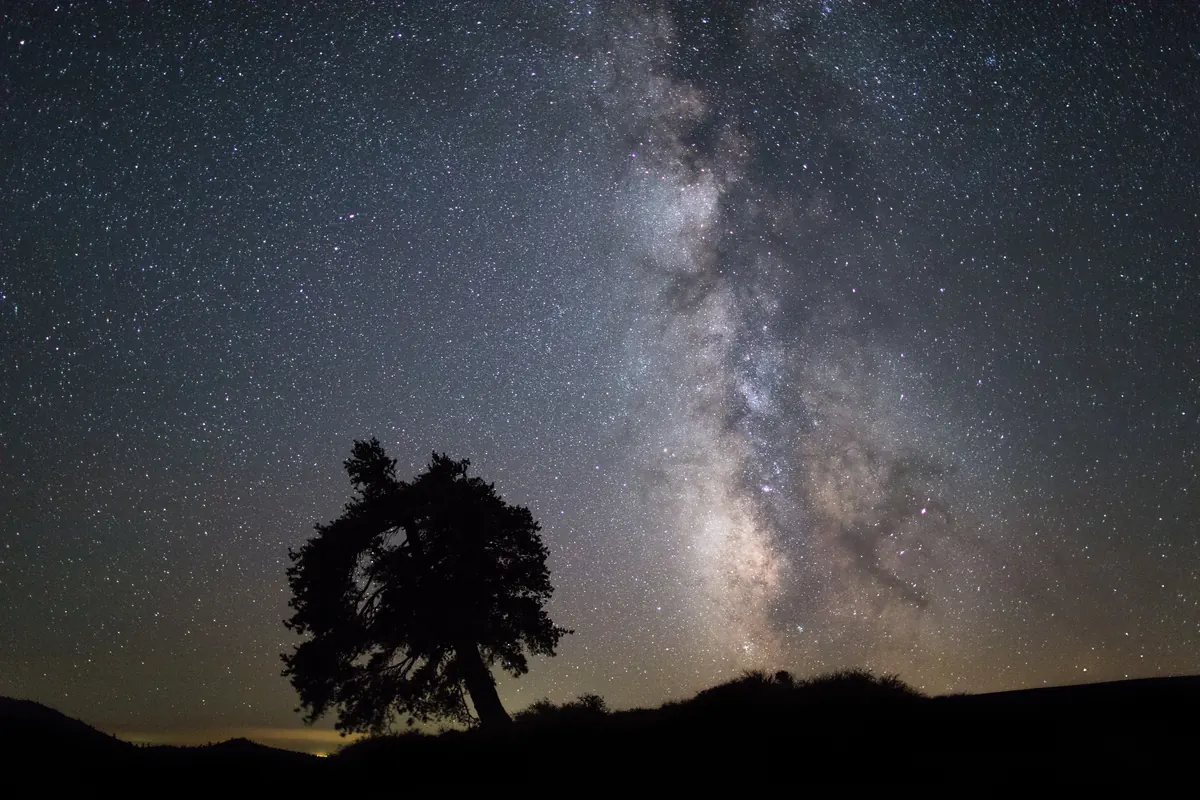
Idaho has some of the darkest sky in the country and several places set aside to keep it that way. The Central Idaho Dark Sky Reserve, around Ketchum, Sun Valley and Stanley, became the first gold-tier dark sky reserve in the United States in December 2017, and Craters of the Moon was named an International Dark Sky Park the same year. Remember the time zone line: the Panhandle and the Clearwater country north of the Salmon River keep Pacific time, the rest of the state Mountain time, so every clock time below comes in both.
-
The moon and Jupiter rise together
Early Tuesday, October 6, from about 3 a.m. MDT (2 a.m. PDT) · Due east-northeast, on a flat, open horizon
Farther east, the thin crescent moon passes in front of Jupiter this morning. Idaho is at the western edge of the event, and here the moon rises with the planet already emerging or just emerged. The International Occultation Timing Association lists no Idaho city; its nearest prediction, for Salt Lake City, has Jupiter reappearing at 3:09 a.m. MDT with the moon one degree up. The Naval Observatory has the moon rising at 2:57 a.m. MDT in Idaho Falls, 3:00 in Pocatello, 3:09 in Twin Falls and 3:14 in Boise, and at 2:06 a.m. PDT in Coeur d’Alene. On paper, then, observers in eastern Idaho might just catch the bright dot slipping off the moon’s dark edge a few minutes after moonrise, very low; in Boise and westward the planet is already clear when the pair come up. The published tables do not settle whether the Panhandle is inside the event’s northern limit. Either way, the pair almost touching is a fine binocular sight once they clear the haze.
-
The Hunter’s Moon
Sunday, October 25, and Monday, October 26, at dusk · Low in the east
The moon is exactly full at 10:12 p.m. MDT (9:12 p.m. PDT) on Sunday the 25th. In Boise it rises at 6:12 p.m., about half an hour before the 6:45 sunset, and on Monday at 6:43, a minute before sundown; in Coeur d’Alene the times are 5:05 and 5:31 p.m. PDT. It is not a supermoon this year.
-
Orionid meteors
Before dawn, October 21 and 22 (active October 2 to November 7) · Anywhere dark; lie back and look high in the south and east
Fragments of Halley’s Comet, fast and often bright, peaking broadly around October 21–22. A waxing gibbous moon lights the first half of the night, but it goes down early: on the morning of the 22nd it sets at 4:07 a.m. in Boise and 3:05 a.m. PDT in Coeur d’Alene, which leaves two or three hours of dark before the eastern sky starts to pale. Ten to twenty meteors an hour from a truly dark site is a good showing.
-
Draconid meteors
Evening of Thursday, October 8 · High in the north and northwest after dark
A thin, slow-moving shower whose best hours come soon after dark, so children can watch it before bed. The moon, two days short of new, stays out of the evening sky; streetlights are the only enemy. Expect a few meteors an hour at most, and be pleased with any.
-
Saturn all night; Jupiter and Mars at dawn
Saturn at opposition October 4; Mars and the Beehive October 11 · Saturn in the southeast at dusk; Jupiter and Mars in the east before sunrise
Opposition night for Saturn is October 4, so the ringed planet is visible from dusk to dawn all month; any small telescope shows the rings. On the 23rd and 24th the moon, well past half, drifts by. Venus is lost in the sunset after the first handful of evenings and passes between Earth and sun on the 23rd. In the dawn sky, look east for brilliant Jupiter and, higher, the rusty dot of Mars, which crosses the Beehive cluster on the 11th; binoculars show the stars around it.
-
Where to go: Bruneau Dunes and Craters of the Moon
Bruneau observatory Fridays and Saturdays, October 2–3, 9–10 and 16–17 · Bruneau Dunes State Park; Craters of the Moon National Monument
Bruneau Dunes State Park, south of Mountain Home, runs its public observatory program on six October nights, 6 to 11 p.m. MDT, with a planetarium show, a talk and telescope viewing for $5 a person or $20 a family, plus the $7 vehicle fee. At Craters of the Moon, the Loop Road stays open around the clock from spring through fall, and the park suggests Devil’s Orchard, Inferno Cone and the Spatter Cones for stargazing; the Milky Way stands out about two hours after sunset. Volunteers from the Pocatello Astronomical Society host star parties through the summer and fall, but we could not find a confirmed October 2026 date, so check the park’s calendar or call before driving out. Do not hike the lava after dark.
| Phase | Date | Mountain time | Pacific time |
|---|---|---|---|
| Last quarter | Saturday, Oct 3 | 7:25 a.m. MDT | 6:25 a.m. PDT |
| New moon | Saturday, Oct 10 | 9:50 a.m. MDT | 8:50 a.m. PDT |
| First quarter | Sunday, Oct 18 | 10:12 a.m. MDT | 9:12 a.m. PDT |
| Full moon, the Hunter’s Moon | Sunday, Oct 25 | 10:12 p.m. MDT | 9:12 p.m. PDT (looks full the evenings of Oct 25 and 26) |
| Last quarter | Sunday, Nov 1 | 1:28 p.m. MST | 12:28 p.m. PST |
Before a night drive to a dark site, look at the Today’s sky cloud forecast; for moonrise and moonset in your own town, the moon phases page has them.
What is blooming and turning in Idaho in October?
-
Rubber rabbitbrush, the desert’s last bloom
Late summer into October · Sagebrush flats, roadsides and burn scars across southern Idaho
When the rest of the sagebrush steppe has gone tan, rubber rabbitbrush turns the roadsides mustard yellow. The USDA’s plant guide calls it one of the few native plants in the Intermountain West that feeds pollinators in late summer and fall, drawing butterflies and small bees, and jackrabbits and sage-grouse shelter under it. Crush a flower head and sniff; the smell is strong and a little medicinal. By late October the flowers have turned to tufts of seed.
-
Tamarack, the conifer that goes bare
Second half of October · North and west-central Idaho, roughly 1,500 to 5,500 feet in the north
The Forest Service’s species review calls western larch “a fast growing, long-lived, deciduous conifer” of northern and west-central Idaho. Its needles never live more than a few months, which keeps them full of water and lets the tree shed them every fall without harm. The bare branches look dead all winter until soft new needles return in spring.
-
Cottonwoods along the rivers
Mid-to-late October · Boise River Greenbelt, Snake River bottoms, the Henrys Fork
Cottonwoods are the last big trees to turn in the southern valleys and the most reliable. Boise guides put the Greenbelt’s cottonwoods at their gold best from about October 15 to 30. Next spring’s sticky buds are already formed at the twig tips.
-
Monarchs: a note on the western population
Gone by October in most years · Southern Idaho milkweed patches in late summer
Idaho’s monarchs belong to the western population, which winters on the California coast, and nearly all have left by October. The Xerces Society’s Thanksgiving count found only about 12,260 in 2025, the third-lowest since 1997, so a late Idaho monarch is worth reporting to Journey North.
What are elk, bears and other Idaho animals doing in October?
-
Elk bugling winds down
Rut early September to mid-October · Mountain meadows statewide; Harriman State Park near Island Park
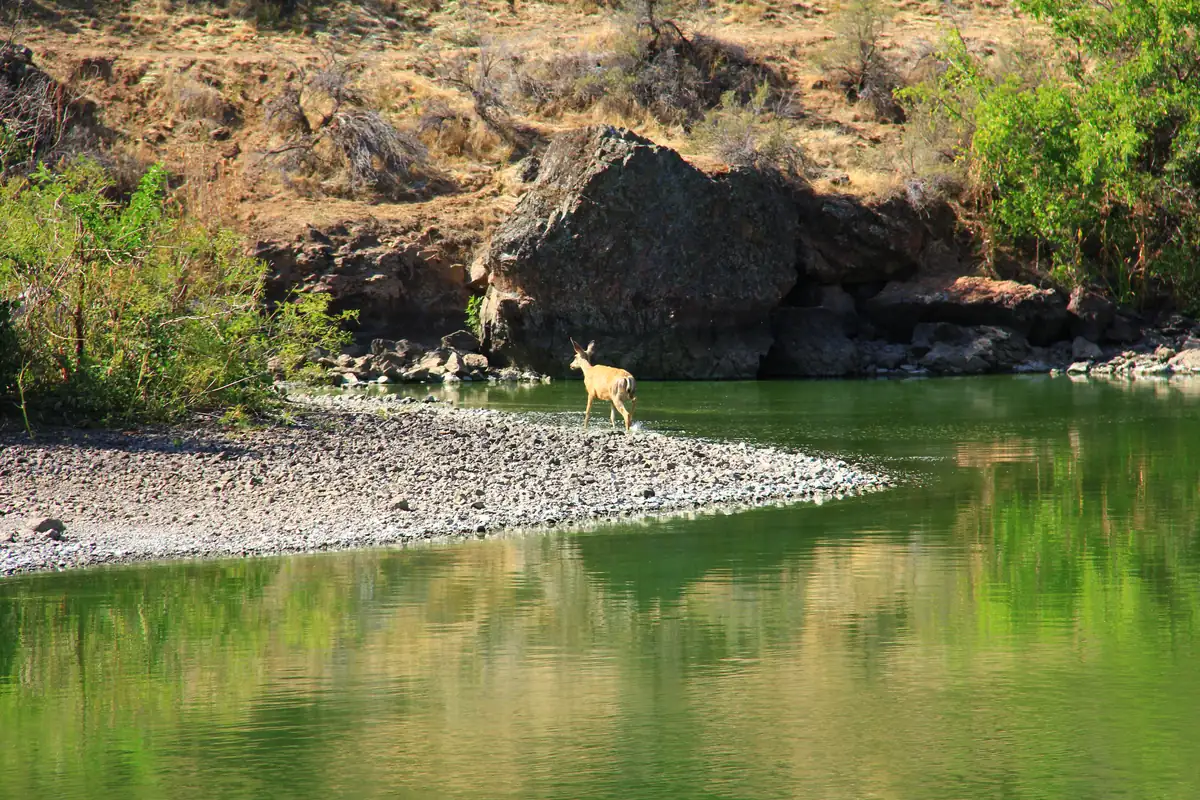
Yellowstone’s biologists put the elk rut from early September to mid-October, and the same calendar holds across the border in Island Park, where Harriman State Park advertises its “famous Harriman elk bugle in the fall.” The best listening is at dusk and just before dawn, when a bull’s high, squealing whistle carries a long way across open ground. Record the first and last bugle you hear on the dusk-and-dawn watch page.
-
Bears eating around the clock
August through November · Forests statewide; grizzlies in the Panhandle, Island Park and the Yellowstone border country
Bears are in hyperphagia, an eating drive that runs for two to four months before they den. The Fish and Wildlife Service lists four grizzly recovery areas that reach into Idaho: the Selkirks and the Cabinet-Yaak in the north, the Greater Yellowstone in the east, and the Bitterroot in central Idaho, though no established population lives there yet. Black bears are the common bear elsewhere, and hungry ones find fruit trees and garbage, so pick up windfall apples.
-
Mule deer and pronghorn on the move
October into November · Snake River Plain, Craters of the Moon, the desert foothills
Mule deer drift down from summer range as the snow line lowers, and the Park Service notes that pronghorn cross Craters of the Moon in spring and fall migrations. General deer season opens across most of the state on October 10, which also pushes animals around. Watch for deer crossing roads at dusk, especially where highways cut through winter range.
-
Bats in the lava tubes
Settling into winter · Caves at Craters of the Moon
The monument’s caves shelter 11 species of bats through the year. Several caves are permanently closed to protect them; Indian Tunnel and Dewdrop Cave remain open with a free permit, picked up in person at the visitor center. Leave any bat you see undisturbed.
What can Idaho families do outside this October?
- Fridays, Saturdays and Sundays through October 31: Fall Flights at the World Center for Birds of Prey in south Boise. The Peregrine Fund’s 45-minute outdoor program flies owls, falcons, hawks and vultures over the crowd, and the ticket covers the interpretive center; buy ahead online.
- Any clear day through October: the Lucky Peak hawk watch. Small groups drop in without booking; bring layers, water and a high-clearance vehicle.
- October 2–3, 9–10 and 16–17: Bruneau Dunes observatory nights, 6 to 11 p.m. MDT, with a planetarium show before the telescopes.
- Thursday, October 8: Ranch Fest at Castle Rocks State Park, near Almo, 4 to 8 p.m., $7, celebrating the park’s ranching past and the families who still ranch around it; the Draconids are out after dark the same evening.
- Saturday, October 10: October Big Day. Count every bird you see and enter the list in eBird. In the Salmon Region, IDFG holds a youth pheasant hunt the same day.
- Friday and Saturday, October 23–24: Haunts of Harriman at Harriman State Park in Island Park, from 5 p.m., $10.
- Citizen science. Report a late monarch to Journey North, enter crane flock counts in eBird, and join Project FeederWatch before its November start.
Pack the Naturalist’s Field Journal for any of these, and find the other states’ October pages at the nature hub.
Safety notes for October in Idaho
- Hunting seasons are open nearly everywhere. Sharp-tailed grouse opens October 1, and the general any-weapon deer season opens October 10 in most units, closing on dates that vary by unit, from October 24 in parts of the south to December 1 for white-tailed deer in the Panhandle. Elk seasons vary by zone; for example, Panhandle Zone any-weapon A-tag hunting for antlered elk runs October 25–29, and the McCall Zone has a spike-only hunt October 5–14. Duck seasons open October 3 in eastern Idaho and Valley County (Area 2), October 10 in the five Panhandle counties (Area 3) and October 19 across the rest of the state (Area 1). Youth pheasant season runs October 8–14, general pheasant opens October 15, and sage-grouse closes October 31.
- Hunter orange. Idaho does not require hunter orange for most hunting. The Fish and Game Commission requires at least 36 square inches of it above the waist only when hunting pheasants where the Upland Game Bird Permit is required, such as stocked Fish and Game properties, and on sponsored hunts such as organized youth hunts; an orange hat usually satisfies the rule. IDFG recommends it everywhere else. Hikers, mushroom pickers and dog walkers should wear a bright orange hat or vest on public land this month, and put an orange vest on the dog.
- Bears. Carry bear spray in the Panhandle, Island Park and along the Montana and Wyoming lines, keep it where you can reach it, and hang or lock up food and game.
- Smoke and closures. The Sawtooth National Forest plans prescribed burns in hunting units 43 (north of Fairfield), 54 (southeast of Twin Falls) and 55 (the Albion Mountains) with closures possible from September 28 through October 31. Check the forest’s map and the air quality forecast first.
- Cold at altitude. Nights below freezing are routine in the mountains now, and early snow can close high roads. Look at Weather now before you go, and remember that a hunter or hiker who tells someone the route and return time is easy to find.
- Chronic wasting disease. The management zones are Units 14 and 18 and part of Unit 1; whole deer and elk carcasses may not leave them, deer taken there must be tested, and deer testing is also mandatory in Units 23, 63A, 64 and 69.
Sources
- Idaho Fish and Game: kokanee spawning at Trestle Creek, north Idaho (September 2021)
- Idaho Fish and Game: kokanee salmon add color to Idaho streams (spawning streams and timing)
- Intermountain Bird Observatory: Lucky Peak station, visitor information
- Intermountain Bird Observatory: recovering from the Valley Fire, 2025 Lucky Peak results
- Intermountain Bird Observatory: banding stations and visiting Lucky Peak
- The Peregrine Fund: Fall Flights at the World Center for Birds of Prey, 2026
- Idaho Parks and Recreation: events calendar (Ranch Fest, Haunts of Harriman, October 2026)
- Idaho Parks and Recreation: observatory program at Bruneau Dunes State Park
- Idaho Parks and Recreation: Harriman State Park (trumpeter swans, elk bugle, Haunts of Harriman)
- Idaho Fish and Game: important dates to help plan your October (2026)
- Idaho Fish and Game: Big Game 2026 Seasons and Rules (PDF)
- Idaho Fish and Game: Migratory Game Bird 2026–2027 Seasons and Rules (PDF)
- Idaho Fish and Game: hunter orange policy
- Idaho Fish and Game: youth pheasant hunting season kicks off Thursday, Oct. 8 (2026)
- Idaho Fish and Game: Salmon Region youth pheasant hunt, Saturday, Oct. 10, 2026
- Idaho Fish and Game: 2026 Idaho steelhead update (September 15, 2026)
- Idaho Fish and Game: fall walleye on the move in Lake Pend Oreille (September 29, 2026)
- Idaho Fish and Game: prescribed fire in the Sawtooth National Forest in October (September 30, 2026)
- Idaho Fish and Game: what hunters need to know about CWD requirements for 2026
- Local News 8: safety as Idaho hunters prepare for upcoming seasons (September 28, 2026)
- NOAA Fisheries: Snake River sockeye salmon species and critical habitat summary update (April 2026, PDF)
- U.S. Fish and Wildlife Service: Grays Lake National Wildlife Refuge
- U.S. Fish and Wildlife Service: Camas National Wildlife Refuge, visiting
- U.S. Fish and Wildlife Service: Deer Flat National Wildlife Refuge, visiting
- Visit Idaho: spot sandhill cranes in Idaho this fall
- East Idaho News: thousands of sandhill cranes in eastern Idaho during the fall migration (October 2024)
- Teton Regional Land Trust: Greater Yellowstone Sandhill Crane Initiative
- BirdsCaribbean: October Big Day 2026 (Saturday, October 10)
- Finch Research Network: winter finch forecast 2026–2027
- U.S. Forest Service: fall colors (Nez Perce-Clearwater and Caribou-Targhee national forests)
- This Is Boise: where to see fall colors in Boise and across Idaho
- Tamarack Resort: fall colors in Idaho (western larch near McCall)
- U.S. Forest Service Fire Effects Information System: western larch
- U.S. Forest Service Fire Effects Information System: quaking aspen
- USDA NRCS: plant guide for rubber rabbitbrush (PDF)
- Xerces Society: western monarch numbers remain at historic low (January 29, 2026)
- Journey North: monarch sightings
- National Park Service: elk in Yellowstone (rut timing)
- U.S. Fish and Wildlife Service: grizzly bear recovery ecosystems and hyperphagia
- National Park Service: mammals of Craters of the Moon (pronghorn, bats)
- National Park Service: Craters of the Moon current conditions (caves and permits)
- National Park Service: Craters of the Moon night sky
- National Park Service: stargazing at Craters of the Moon
- Idaho Dark Sky Alliance: Central Idaho Dark Sky Reserve
- NOAA NCEI: U.S. climate normals 1991–2020, monthly (Boise, Pocatello, Idaho Falls, Lewiston, McCall, Coeur d’Alene, Sandpoint, Twin Falls)
- NOAA Climate Prediction Center: ENSO diagnostic discussion, September 10, 2026
- National Weather Service Spokane: El Niño and Inland Northwest winters
- NOAA Climate.gov: how El Niño and La Niña affect the winter jet stream and U.S. climate
- U.S. Naval Observatory: sunrise, sunset, moonrise and moonset (data API; example for Boise, October 6)
- U.S. Naval Observatory: moon phases 2026
- International Occultation Timing Association: lunar occultation of Jupiter, October 6, 2026 (city timings)
- EarthSky: meteor shower guide (Draconids and Orionids)
- NIST: daylight saving time
- Project FeederWatch: how to participate
- Photos via Wikimedia Commons; licenses and photographers are credited under each picture
