What to look for in nature in Idaho this February
February in Idaho can look exactly like January, with about two feet of new snow in an average McCall February and subzero mornings around Idaho Falls. But underneath, the year is turning. Bald eagles are finishing their nests, great horned owls are already on eggs, and the first prairie falcons are back on the cliffs of the Snake River canyon. On the dry hills near Emmett, a squirrel found nowhere else on Earth pokes its head out after seven months underground. Snow geese start dropping into Fort Boise by the thousands, burbot gather to spawn in the dark of the Kootenai, and a yellow buttercup or two opens on a sunny slope above Boise. This guide covers what to look for in every part of the state, with dates and the best places to go.
Other months in Idaho: October, November, December, January.
Start here
- Check an eagle nest. Find a known bald eagle nest along a river and look in once a week from a distance. When an adult starts sitting low in the nest for hours at a stretch, sometime from late February on, the eggs have probably been laid.
- Be at Fort Boise at sunrise. If the snow geese have arrived, climb the viewing platform at Fort Boise WMA near Parma before the flocks lift off to feed, and stay until they come back to the ponds by mid-morning.
- Two planets at opposition. Jupiter reaches opposition on Wednesday, February 10, and Mars nine days later. When the Snow Moon rises on Saturday, February 20, both planets and the bright star Regulus shine near it in the east.
In your Naturalist’s Field Journal this month: use “nest observed” for one eagle or owl nest you can check from the same spot every week, starting a fresh line each visit; add snow geese, Ross’s geese and the first prairie falcon to “birds I have seen”; use “reading the signs” for a winter-range walk, noting browsed shrubs, beds in the snow and any dropped antler you leave in place; and keep a running list on the “daily field log” of firsts: first ground squirrel, first buttercup, first coyote chorus. Next February, compare the dates.
Regions used below: North Idaho and the Panhandle; Lewiston and the Clearwater country; Central Idaho mountains, McCall to the Sawtooths; Boise and the Treasure Valley; Magic Valley and the Snake River Plain; Eastern Idaho and the Upper Snake.
When do bald eagles and owls start nesting in Idaho?
In February the raptor year turns over. Wintering eagles still crowd the rivers, but the birds that will nest in Idaho are settling onto territories, and a few are already sitting on eggs in the snow. Keep enough distance that a nesting bird carries on as if you were not there.
-
Bald eagles finish their nests and lay
Nest work through the end of February; eggs from late February into early April · Big cottonwoods and conifers near water: the South Fork of the Snake, the Boise River, the Payette, the Salmon, and the lakes of the Panhandle
Idaho Fish and Game’s eagle leaflet says resident pairs that can stay on territory through the winter keep adding sticks to old nests, or start new ones, from October until the end of February. Then the female lays, usually one or two eggs and never more than four, at some point between late February and early April. Incubation takes about 35 days, so the first eaglets appear in mid-April or early May. Known nesting territories in the state climbed from 11 in 1979 to 234 by 2007. Once an adult stops leaving the nest empty for long stretches, incubation has probably begun.
-
Great horned owls on eggs
Incubating through February in most of the state · Old hawk and magpie nests and tree hollows, along rivers, in shelterbelts and in town parks
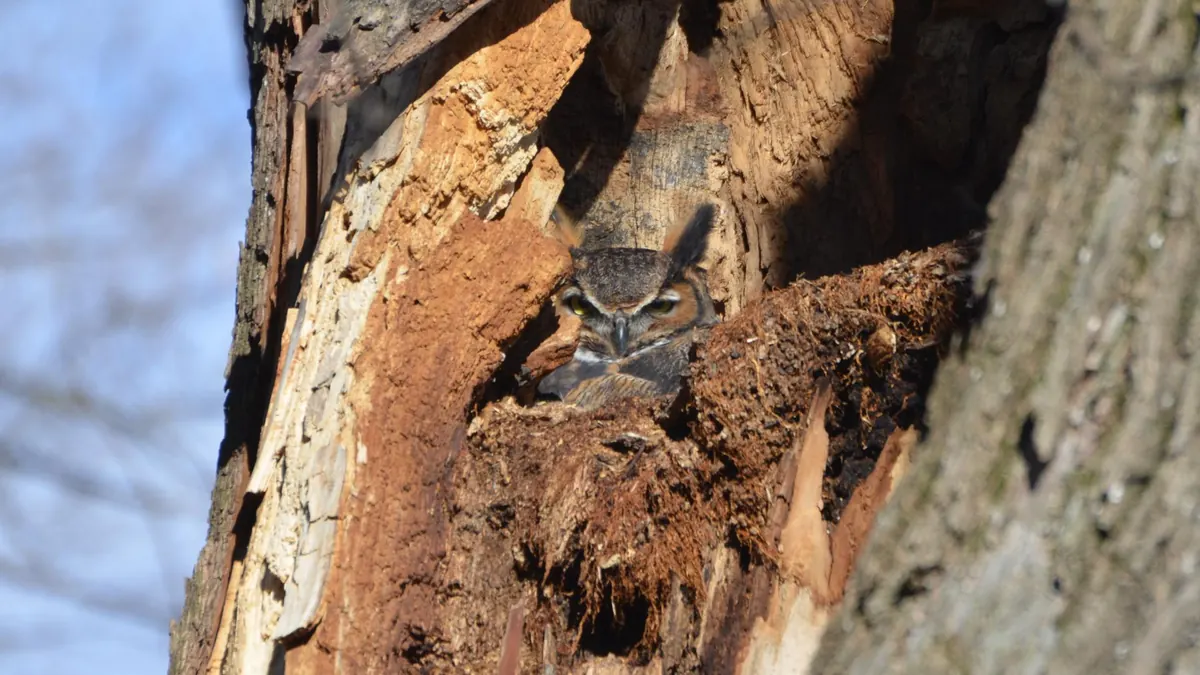
Great horned owls court from November into January, according to the state’s owl booklet, so by February many females have laid two to four eggs in a borrowed stick nest or a hollow and are sitting tight. The eggs take about 33 to 35 days to hatch. In a leafless cottonwood, scan old stick nests for two feathered horns showing over the edge. If the owl turns to stare at you, back away.
-
Great gray owls go house hunting
Courtship feeding in late winter; nest searching from mid-February · Mountain meadows edged with lodgepole pine or fir: Island Park, west-central Idaho, the Panhandle and the Frank Church country
Great grays hunt more by day than most owls. Fish and Game’s booklet describes the male feeding small voles or shrews to the female in late winter to cement the pair bond, and says the pair begins looking for a nest, usually an old hawk nest, in mid-February. Its hearing is keen enough to find a vole moving under the snow, and it plunges feet first to catch it; around Island Park, pocket gophers are favored prey.
-
Prairie falcons come back to the canyon
February onward; the canyon is busiest from mid-March · The Morley Nelson Snake River Birds of Prey National Conservation Area south of Kuna: Dedication Point and the road to Swan Falls Dam
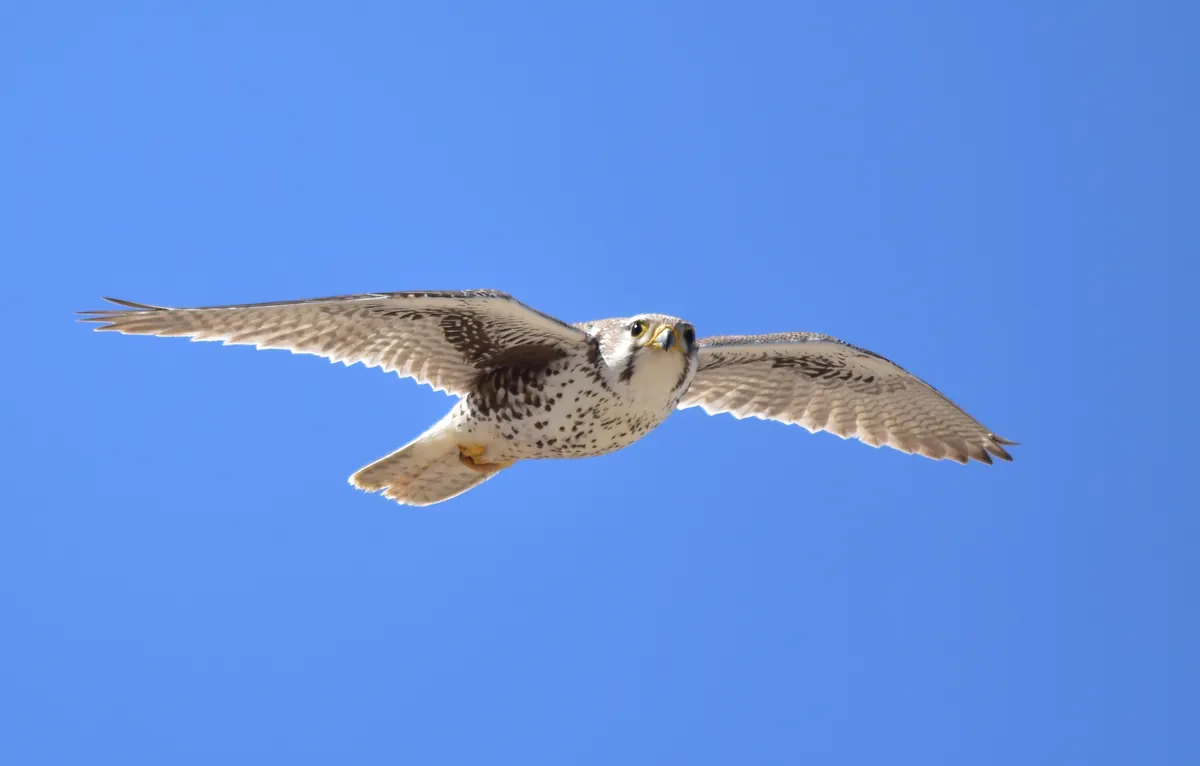
The Bureau of Land Management says this stretch of canyon holds the greatest concentration of nesting birds of prey in North America, with sixteen species nesting each spring on cliffs up to 700 feet tall. Its visitor guide lists prairie falcons there from February through late July; about 200 pairs nest in the conservation area, and their success tracks the Piute ground squirrels on the plateau (see the next section). The guide says viewing tends to be best in mid-March, May and June, so a late-February trip catches the first arrivals. Golden eagles live there all year.
In north Idaho and the Frank Church country, barred owls start courting this month and can be heard calling in daylight near their nests. At any nest, watch through a scope, keep visits brief, and do not use playback.
Which Idaho animals wake up or pair off in February?
Groundhog Day celebrates a marmot waking up. Idaho’s version stars ground squirrels on the dry southwestern hills, while coyotes everywhere are pairing off.
-
Southern Idaho ground squirrels come up
Usually emerging in late January or February · Rolling sagebrush and grass hills north of the Payette River around Emmett, Payette and Weiser, north toward Midvale and Indian Valley; nowhere else on Earth
This little gray-brown squirrel lives only in Idaho, and only in a few hill country valleys of Payette, Gem and Washington counties. A Fish and Game guide to the region’s ground squirrels says most ground squirrels spend about eight months of the year underground, so their whole active year is squeezed into a few months. Fish and Game’s Wildlife Express says this one sleeps from about July to January in a normal year, mates as soon as it emerges, with young above ground about six weeks later. Only about 4,000 were counted when that issue was written, and cheatgrass has replaced much of its native bunchgrass. Watch from the road and let it be.
-
Piute ground squirrels and the raptors that need them
Up from about January on the western Snake River Plain; later in eastern Idaho · Sagebrush and winterfat flats across the Snake River Plain, especially the plateau above the Birds of Prey canyon
The Birds of Prey area guide says prairie falcon nesting success is closely linked to how many Piute ground squirrels there are, and the squirrels wake early on the western plain. A good squirrel year means a good falcon year. On a sunny afternoon, scan burrow mouths along the Swan Falls road for a small, pale squirrel sitting up, and for a falcon skimming the sagebrush.
-
Coyotes court, and get touchy about dogs
Breeding mostly in February and March; denning into June · Everywhere, including the Boise Foothills, city parks and river corridors
Fish and Game’s Southwest Region says February brings the start of coyote breeding season, when the animals turn more territorial, mostly toward other canines. Conflicts with dogs can happen at any time of year, but the risk climbs from late February through June as pairs settle into dens and raise pups. The department has had repeated reports of coyotes and dogs tangling in the Boise Foothills, including at Hulls Gulch and the Military Reserve. The department urges leashing dogs on all foothills trails from March through June, even off-leash ones, and earlier where coyotes have caused trouble before.
When do the snow geese come through Idaho?
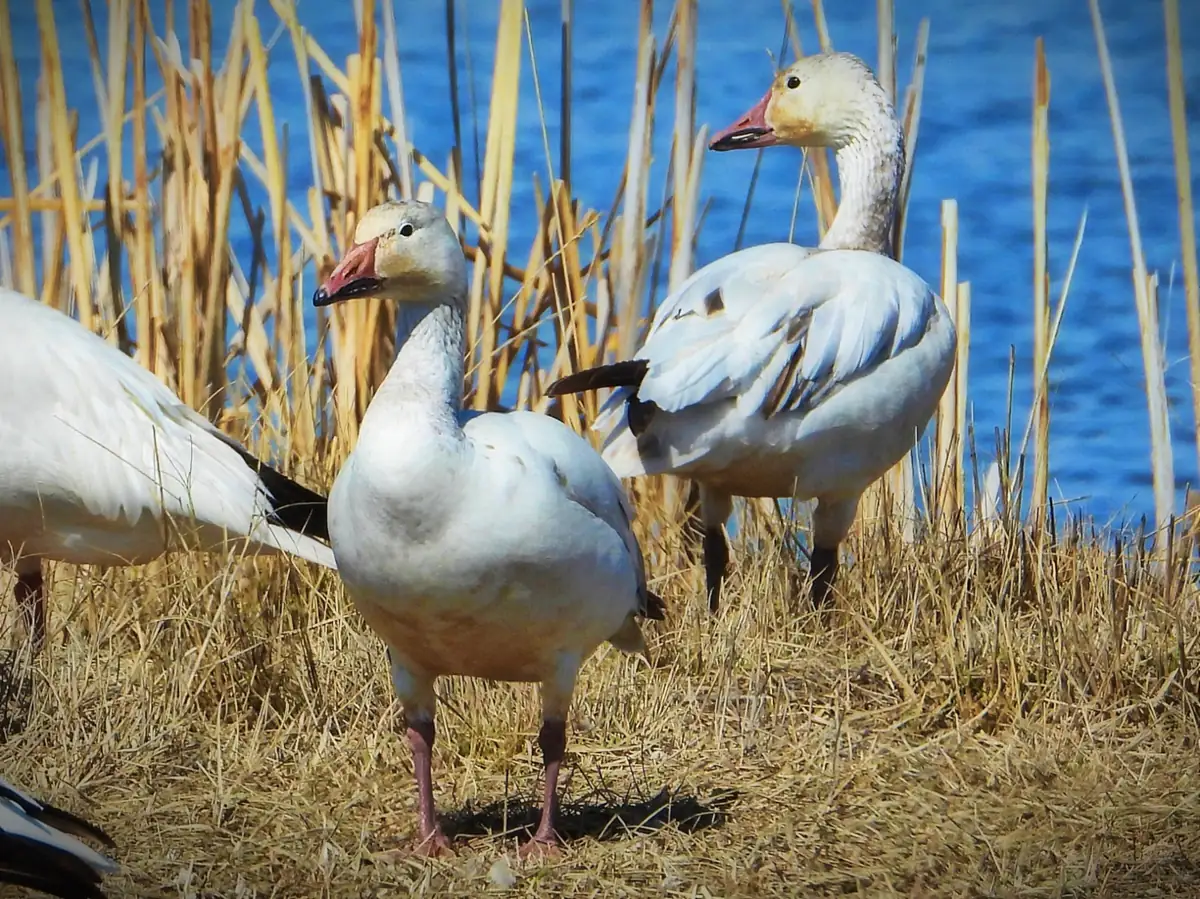
Snow geese mostly fly straight over Idaho in the fall. In spring, Fish and Game says, about 60,000 stop to rest in southern Idaho, waiting for snow to clear farther north. The first flocks usually reach the southwest in late February.
-
Fort Boise Wildlife Management Area
Usually late February through March; most birds gone by early April · Fort Boise WMA near Parma, where the Boise River meets the Snake
Fish and Game calls the spring stopover here one of the largest wildlife migrations in southwest Idaho. Up to 60,000 snow geese, white-fronted geese and other waterfowl use the 1,630-acre area, coming up from wintering grounds as far south as Baja California and northern California and following the retreating snow line. They linger about six weeks, then head north, some all the way to Siberia. A viewing platform 15 feet off the ground looks over ponds hidden behind dikes; share the windows on busy weekends.
-
The daily routine
Every day while the flocks are in · Fort Boise and nearby farm fields; the Roswell Marsh Wildlife Habitat Area west of Parma
The geese keep a fairly regular schedule. They leave the ponds around sunrise to feed in fields nearby, then come back in waves by mid-morning, spiraling down onto the water by the thousands in what the department describes as a mix of aerial ballet and dogfight. Much of the interior of Fort Boise and Roswell Marsh is closed February 1 through July 31 for nesting birds, so stick to open roads and viewing spots.
-
Spring geese farther east
Late winter into April · Market Lake WMA near Roberts; farm fields of the Upper Snake
Fish and Game says that more than 1 percent of the snow geese in their whole regional population use Market Lake WMA during spring migration, which is one of the reasons the area is managed as a stopover for migrating waterfowl. At a distance, black wingtips separate a snow goose from a swan.
Look for Ross’s geese, smaller and stubbier-billed, among the snow geese, and enter your counts in eBird.
What fish are spawning or running in Idaho rivers in February?
Two Idaho fish matter this month: a cod relative that spawns in midwinter, and steelhead waiting out the cold in Idaho rivers.
-
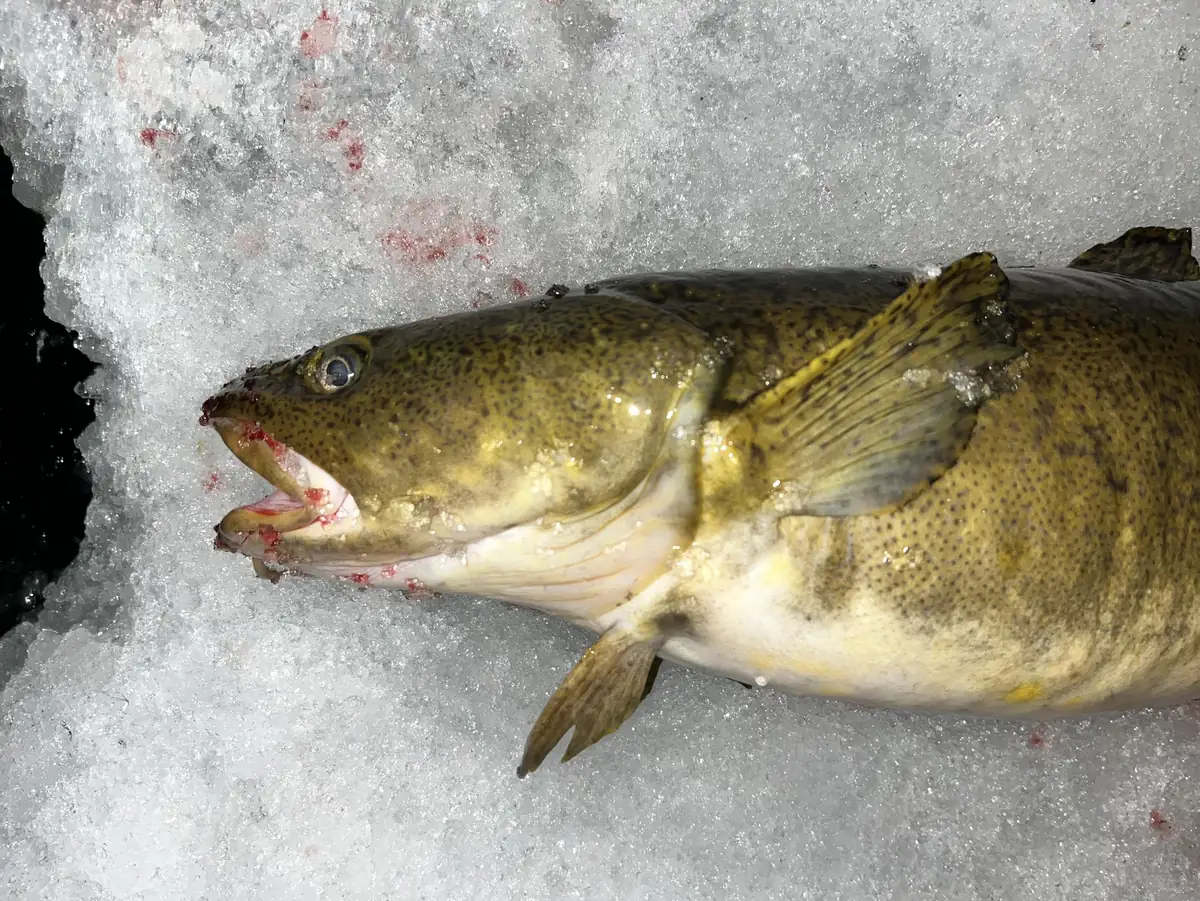
Burbot spawning in the Kootenai
Spawning from December to March; most fish mid-February to mid-March · The Kootenai River near Bonners Ferry and its tributaries, including Deep, Smith and Boundary creeks
Fish and Game calls the burbot North America’s only freshwater cod, and the Kootenai is the one Idaho water where it is native. Fish and Game says that once February arrives, burbot leave the deep pools of the river and Kootenay Lake in British Columbia and move into shallow water to spawn, some after a trip of nearly 75 miles from Canada. They do not dig nests. Instead, males and females twist together in a writhing “spawning ball” and release eggs and milt into the current, and the eggs, each about a millimeter across, settle to the bottom. A big female can carry more than 3 million. Sampling has found the most adults from mid-February to mid-March.
-
A comeback story
Ongoing; fishing reopened in 2019 · The Kootenai Tribe of Idaho hatchery near Bonners Ferry, and the river itself
By 2004, researchers estimated that only about 50 burbot were left in the whole Kootenai River in Idaho, and fishing had been closed since 1992. The Kootenai Tribe of Idaho, Fish and Game, and biologists in British Columbia and Montana built a recovery program around a tribal hatchery, which raises young burbot from eggs collected each February from a healthy population in Moyie Lake, B.C. The crews spend about two weeks there, catching adults through the ice. The fishery reopened in 2019; anglers fish after dark where creeks join the river.
-
Steelhead from a record-low run
In the rivers all winter; spawning in spring · The Clearwater, Salmon and Snake rivers
The steelhead holding in Idaho rivers this winter came from what Fish and Game called, in September 2026, one of the poorest returns in modern history: the count of the main index groups at Bonneville Dam was the lowest since the dam was built in 1938. Bag limits were cut statewide. The silver lining: over 90 percent spent two years at sea, so they run large, and big females carry more eggs. Spring 2027 rules were not yet set when this was written, and some rivers closed last spring, so check Fish and Game’s steelhead rules first.
Why is late winter the hardest time for Idaho’s deer and elk?
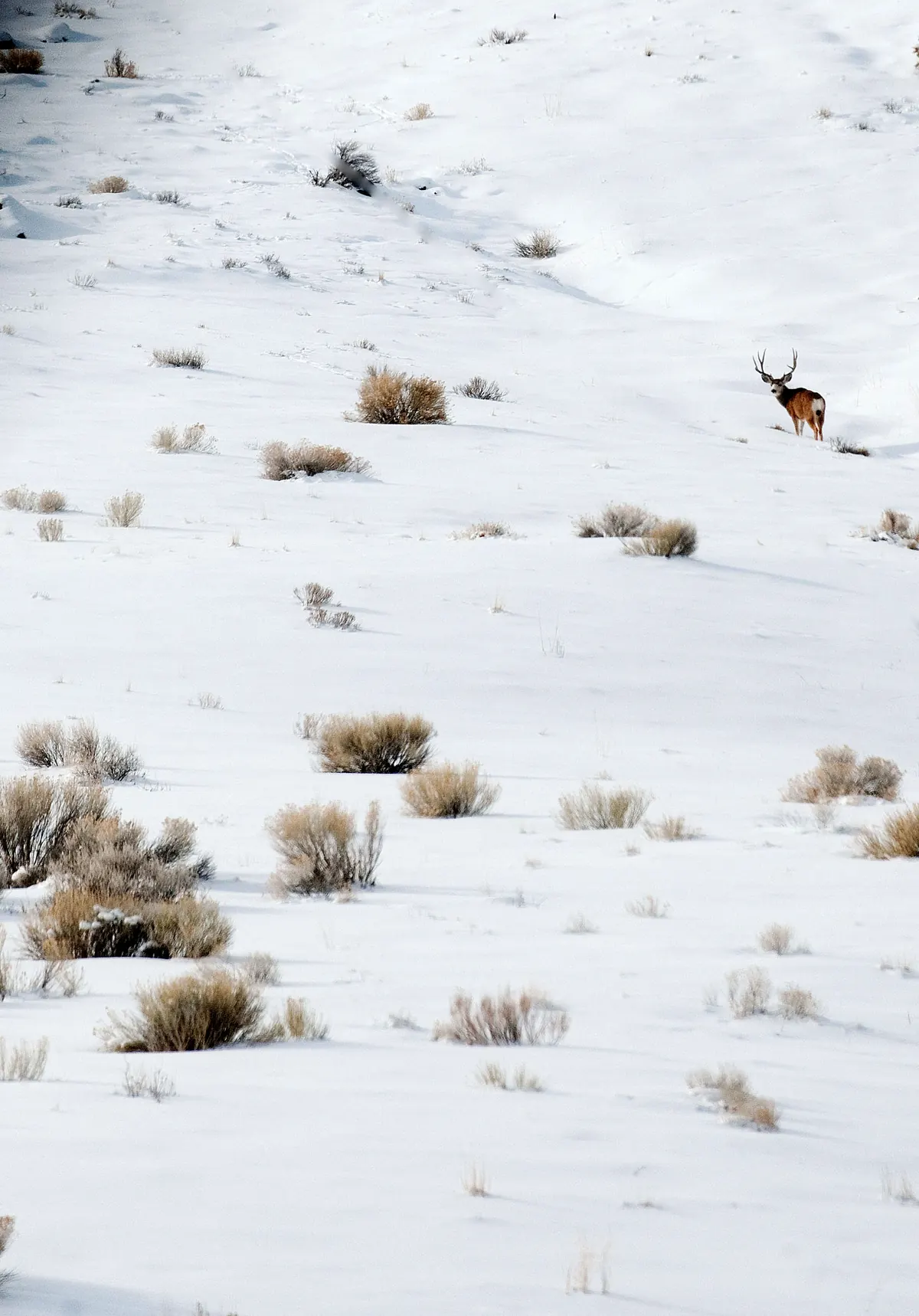
By February deer and elk have lived on stored fat for months, with green grass still weeks off. Any disturbance now costs them the most.
-
Counting the survivors
Monthly updates through spring · Collared mule deer fawns and elk calves across southern and central Idaho
Each December and January, Fish and Game biologists put tracking collars on a sample of mule deer fawns and elk calves, then follow them through the winter. In the long run, about 60 percent of fawns survive their first winter, though hard winters can push that much lower. In the snowy winter of 2022–23, 72 percent of collared fawns and 92 percent of collared calves were still alive at the end of February statewide, but in Unit 69 near Idaho Falls 43 percent of the fawns had already died, and in Unit 76 on the Wyoming line, 67 percent. March and April are often deadlier still, the department notes, as fat runs out and young animals’ digestion shifts to new green forage.
-
Antlers on the ground
Mule deer drop antlers from late December through March; elk from mid-March through April · Winter ranges: bedding areas, trails, brushy draws and migration routes
Mule deer bucks drop their antlers from late December through March, and shed hunting has become a popular late-winter outing. Fish and Game asks people to hold off. Disturbing deer and elk on winter range, whether by car, dog or someone on foot looking for antlers, can push them to burn energy they cannot spare. Idaho has no set shed season, but the Fish and Game Commission can close parts of the state after a severe winter, as it did on public land in the Southeast and Upper Snake regions from January 1 through April 14, 2024, the first such closure since 2002. Nonresidents need an Idaho hunting license to gather antlers.
When do the first wildflowers bloom in Idaho?
Idaho’s first wildflowers open before spring does, on low slopes around Boise, sometimes beside lingering snow.
-
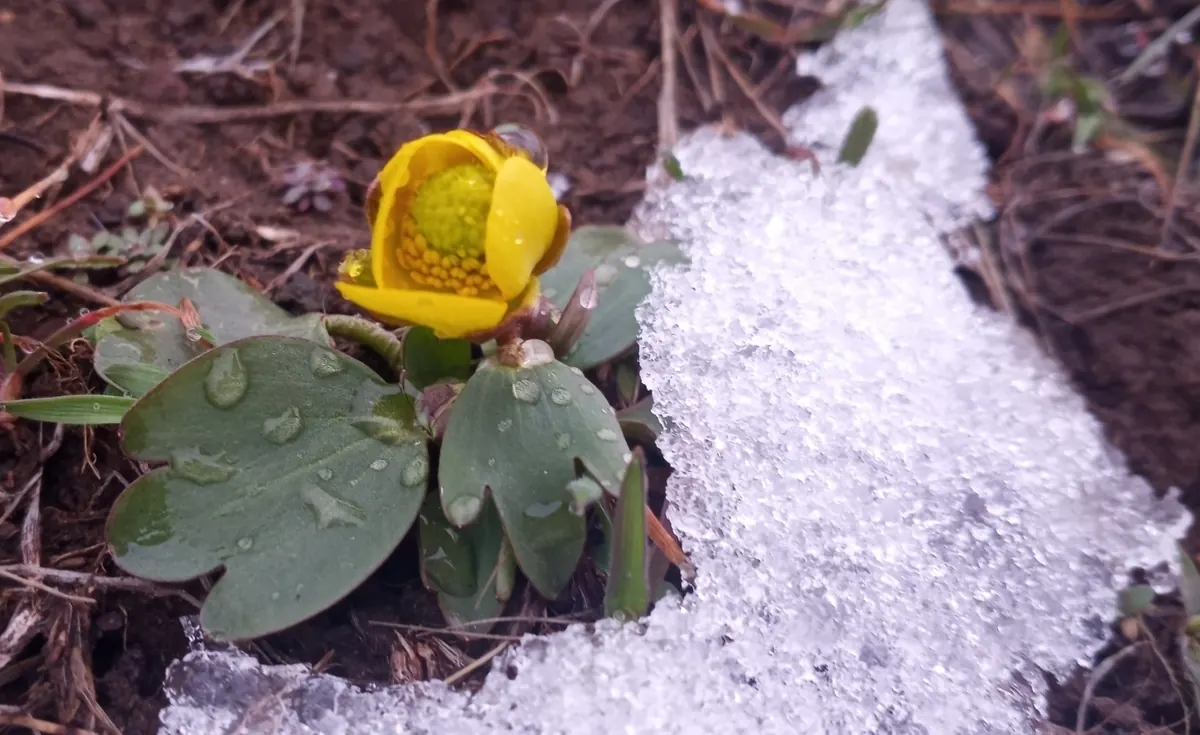
Sagebrush buttercup
As early as February; some years not until March · The Boise Foothills; a large, early patch along the Big Springs Loop in the western foothills
Ridge to Rivers, which manages the foothills trail system, says the shiny yellow sagebrush buttercup is among the first flowers to show and can appear as early as February. A local botanical guide notes that it pops up after any stretch warm enough to thaw the ground, and that some flowers carry more than the usual five petals. Most patches grow on clay that turns to gumbo in a thaw, so go on a frozen morning.
-
Salt-and-pepper
Often by late February, sometimes in January · Dry, open slopes in the Boise Front
This little member of the carrot family, Lomatium linearifolium, sometimes blooms even before the buttercups. Its tight clusters of tiny white flowers come up before the leaves, and the dark purple anthers sprinkled over white petals give it the common name. Near old snow, the guide warns, the blooms are easily mistaken for snow flecks.
Keep a first-bloom list with date, place and weather, and compare it next year.
How much daylight does Idaho gain in February?
February is the month the extra light really shows. By February 28, each city listed has well over an hour more daylight than it had on February 1. The Panhandle gains the most: Sandpoint goes from 9 hours 31 minutes to an even 11 hours, a gain of 89 minutes or about 3.3 minutes a day, and by the end of the month it has caught up with Coeur d’Alene. Twin Falls, the southernmost city in the table, gains the least, 72 minutes. Boise climbs from 9 hours 55 minutes to 11 hours 9 minutes. The daily gain is still speeding up and will peak around the March equinox; clocks spring forward to daylight time on March 14.
| City | Feb 1 | Feb 28 | Gained | Per day |
|---|---|---|---|---|
| Sandpoint | 9 h 31 m | 11 h 00 m | 89 min | 3.3 min |
| Coeur d'Alene | 9 h 34 m | 11 h 00 m | 86 min | 3.2 min |
| Lewiston | 9 h 41 m | 11 h 04 m | 83 min | 3.1 min |
| McCall | 9 h 48 m | 11 h 07 m | 79 min | 2.9 min |
| Boise | 9 h 55 m | 11 h 09 m | 74 min | 2.7 min |
| Twin Falls | 9 h 59 m | 11 h 11 m | 72 min | 2.7 min |
| Pocatello | 9 h 58 m | 11 h 11 m | 73 min | 2.7 min |
| Idaho Falls | 9 h 56 m | 11 h 10 m | 74 min | 2.7 min |
The groundhog gets his say on Tuesday, February 2, but the season’s true middle, halfway in the sun’s journey from solstice to equinox, falls a day or two after him, on the 3rd or 4th. Sunrise and sunset times for any Idaho address are on the daylight page.
Is February still winter in Idaho, and what does El Niño mean for it?
In the mountains, yes. By NOAA’s 1991–2020 normals, McCall averages 24.1 inches of February snow and keeps at least an inch on the ground almost every day of the month. Lower down, the grip loosens: Lewiston and Boise average highs of 46 to 47 °F with under four inches of snow, though Idaho Falls still averages a 16 °F low and nearly four subzero mornings.
| Station | Average high | Average low | Precipitation | Snowfall | Days with 1 in or more of snow on the ground | Nights below 0 °F |
|---|---|---|---|---|---|---|
| Sandpoint | 38 | 24 | 2.91 | 8.4 | 15.6 | 0.3 |
| Coeur d’Alene | 41 | 27 | 2.11 | not published | not published | 0.3 |
| Lewiston airport | 47 | 32 | 1.04 | 3.8 | 2.6 | 0.1 |
| McCall | 36 | 15 | 2.30 | 24.1 | 28.2 | 4.3 |
| Boise airport | 46 | 29 | 1.00 | 3.3 | 2.6 | 0.0 |
| Twin Falls | 42 | 25 | 0.81 | 5.5 | not published | 0.3 |
| Pocatello airport | 39 | 20 | 0.97 | 7.6 | 10.1 | 1.4 |
| Idaho Falls airport | 34 | 16 | 0.56 | not published | not published | 3.7 |
This winter, the tropical Pacific has its thumb on the scale: the Climate Prediction Center’s September 10 update put the chance of El Niño staying very strong through the cold months above 90 percent. A USGS Northwest Climate Adaptation Science Center review of past events explains why that matters here: El Niño usually shifts the Pacific storm track south, so northern Idaho tends to be warmer and drier, while precipitation in southern Idaho is not consistently affected either way. There are exceptions. The very strong El Niño winters of 1982–83 and 2015–16 were wetter than normal over much of the Northwest, while 1997–98 was dry in northern Idaho. Lower-snow winters are more common in El Niño years, especially at the warmer low and middle elevations, and the review warns that even a dry winter can bring heavy rain and rain-on-snow events. NOAA refreshes its seasonal outlook maps each month, so look there for the newest version, and look at the local forecast before heading into the mountains. Gardeners can look up typical last-frost dates on the Idaho frost page.
What can you see in Idaho’s night sky in February 2027?
Two planets take turns at opposition, the point where Earth sits directly between a planet and the sun: Jupiter first, then Mars nine days later. Times are Mountain standard time, with Pacific time given for north Idaho.
-
Mercury in the evening twilight
Late January to about February 10; best around February 2 · Low in the west-southwest, 30 to 45 minutes after sunset
Mercury swings farthest from the sun late on February 2, Idaho time, its best evening showing this winter, so look low over a flat western horizon. About a day and a half after the new moon, on the evening of the 7th, the thinnest of crescents hangs near the planet in twilight.
-
Jupiter at opposition
Wednesday, February 10 · Rising in the east at sunset; high in the south around midnight
Opposition comes at 5:21 p.m. MST (4:21 p.m. PST) on February 10. Jupiter rises at dusk, sets at dawn, and outshines everything in the evening sky but the moon. Braced binoculars show its moons as tiny points in a line.
-
Mars at opposition
Friday, February 19 · The east after dark, in Leo, near the star Regulus
Mars is opposite the sun around 8 a.m. MST (7 a.m. PST) on February 19 and closest to us a day later, roughly 63 million miles off. Mars is swinging through the outer stretch of its orbit right now, so Idaho gets a modest view this time: a steady orange dot rather than a dazzling one. That night, February 19–20, the almost-full moon slides close by Jupiter.
-
The Snow Moon, and an eclipse Idaho will miss
Saturday, February 20 · Rising in the east around sunset
Full moon is at 4:23 p.m. MST (3:23 p.m. PST) on February 20, before it rises in Idaho; almanacs disagree on calling it a supermoon. A faint penumbral eclipse that afternoon ends at 6:13 p.m. MST, and the Naval Observatory gives moonrise at 6:09 p.m. in Idaho Falls and 6:27 p.m. in Boise, so for practical purposes Idaho sees none of it. Watch the moon rise with Jupiter, Mars and Regulus nearby instead. Idaho also misses the February 6 annular solar eclipse entirely; only skies over South America, Antarctica and Africa get it.
-
Aurora, if the sun cooperates
Darkest evenings roughly February 2 to 11 · Looking north from the Panhandle, Island Park, Stanley and other dark valleys
Sunspots have been fading since the 2024 solar maximum, though one strong eruption could still light up the northern horizon over Idaho. Try the moonless nights around the February 6 new moon, after a look at NOAA’s aurora forecast.
| Phase | Date | Time |
|---|---|---|
| New moon | Saturday, Feb 6 | 8:56 a.m. MST / 7:56 a.m. PST |
| First quarter | Sunday, Feb 14 (MST) / Saturday, Feb 13 (PST) | 12:58 a.m. MST / 11:58 p.m. PST |
| Full moon, the Snow Moon | Saturday, Feb 20 | 4:23 p.m. MST / 3:23 p.m. PST |
| Last quarter | Saturday, Feb 27 | 10:16 p.m. MST / 9:16 p.m. PST |
Moonrise times for Idaho towns are on our moon phases page; use the cloud forecast to judge whether it is worth driving up above a foggy valley.
What can Idaho families do outside in February?
- To February 6: McCall Winter Carnival. Visit McCall lists the 2027 carnival for January 28 through February 6: snow sculptures, music and vendors above Payette Lake, closing with the Mardi Gras Parade on the last day. See the sculptures early, before the sun softens them.
- Weekends: ranger snowshoe hikes at Craters of the Moon. The park offers guided snowshoe walks on weekends from late January through February, with no experience needed. Reserve by calling the visitor center, (208) 527-1335, and be there by 10:30 a.m. for a two-hour outing; each group is limited to 25.
- Idaho counts birds too (February 12–15). Audubon’s calendar puts this year’s Great Backyard Bird Count, its thirtieth, across the long Presidents’ Day weekend. Pick a Boise feeder, a Snake River overlook or a snowy ranch fence, tally birds for fifteen minutes or longer, and post the list at birdcount.org.
- Late February: snow geese at Fort Boise. If the flocks are in, climb the platform near Parma at sunrise with a thermos and count the skeins.
- The World Center for Birds of Prey. The Peregrine Fund’s center south of Boise keeps winter hours through February (10 a.m. to 4 p.m., closed Mondays) and shows live birds at 11, 1 and 3, a good warm-up before looking for wild falcons on the canyon.
- All month: citizen science. Keep Project FeederWatch going, and put ground squirrel, falcon and goose sightings into eBird or iNaturalist.
Pack a Naturalist’s Field Journal for each outing, and compare notes with other states on the nature guides page. The Idaho January page covers midwinter eagles, swans and ice fishing.
Safety notes for February in Idaho
- Seasons open in February. Fish and Game’s 2026–2027 migratory bird rules keep Canada goose open to February 15 in its goose Area 3, which covers the Panhandle, the Magic Valley and every other county outside Areas 1, 2 and 4, and white-fronted goose open to February 15 in the southwest and Magic Valley counties. The spring light goose season for snow and Ross’s geese opens February 1 in southwest and Magic Valley counties and February 16 in much of southeast Idaho, running to March 10, with Fort Boise and Payette River WMAs, part of Roswell Marsh and the Snake River Islands Unit of Deer Flat refuge closed to it. Cottontails, snowshoe hares and red squirrels stay open through March 31. Extra antlerless elk hunts run all February in Unit 41 and until February 15 in parts of Units 51, 63 and 69. Many units allow wolf and mountain lion hunting all year. Read the rules for your unit.
- Orange. Idaho requires 36 square inches of hunter orange above the waist only in limited cases, chiefly pheasant hunting where the Upland Game Bird Permit applies. The department urges hikers and everyone else in hunting areas to wear it, noting that bright red, yellow or pink also stand out.
- Traps. Bobcat season ends February 16; beaver, mink and muskrat trapping continues to April 15 and otter to March 31 in most regions, and Hagerman WMA opens to mink and muskrat trapping only from February 15 to 28. A federal court order closes wolf trapping in 19 counties for part of each year; check the Fish and Game site for dates. Keep dogs close and learn how to free one from a trap.
- Avalanches. Check the Sawtooth, Payette or Idaho Panhandle avalanche forecast every day you travel in steep terrain, and carry rescue gear with a partner trained to use it.
- Late-season ice. Sun and thaws rot ice from the top even when it looks thick. Test as you go and avoid inlets, springs and cracks.
- Rain on snow and mud. A warm storm can raise low-country creeks quickly and turn foothill trails to gumbo; turn around rather than widening a muddy trail.
- Coyotes and dogs. Leash dogs where coyotes den, and avoid places with recent incidents for a few weeks.
- Roads. Hungry deer and elk feed along shoulders at dawn and dusk; drive slowly near winter ranges.
Sources
- Idaho Fish and Game: Bald Eagles in Idaho (nest building, egg laying, incubation, nesting territories; PDF)
- Idaho Fish and Game: Owls of Idaho (great horned, great gray and barred owl nesting; PDF)
- Bureau of Land Management: Morley Nelson Snake River Birds of Prey National Conservation Area
- Bureau of Land Management: Morley Nelson Snake River Birds of Prey NCA visitor guide (prairie falcons, viewing seasons; PDF)
- Idaho Fish and Game: Ground-dwelling squirrels of the Pacific Northwest (southern Idaho and Piute ground squirrel hibernation; PDF)
- Idaho Fish and Game: Wildlife Express, Idaho Ground Squirrels (February 2008, PDF)
- Idaho Fish and Game: Be vigilant during coyote mating and denning seasons
- Idaho Fish and Game: See and hear a massive spring waterfowl migration at Fort Boise WMA
- Idaho Fish and Game: Massive spring snow goose migration at Fort Boise WMA
- Idaho Fish and Game: Hunting spring snows in southern Idaho (about 60,000 snow geese in spring)
- Idaho Fish and Game: Market Lake Wildlife Management Area
- Idaho Fish and Game: Burbot fishing ramps up with peak spawning season in the Kootenai River
- Idaho Fish and Game: Collection and spawning of burbot for stocking the Kootenai Basin
- Idaho Fish and Game: Wildlife Express, Burbot (PDF)
- Idaho Fish and Game: 2026 Idaho steelhead update (September 15, 2026)
- Idaho Fish and Game: Spring steelhead seasons and rules
- Idaho Fish and Game: Mule deer fawn and elk calf survival through February (March 13, 2023)
- Idaho Fish and Game: How mule deer fawns and elk calves fared through mid-March (2025)
- Idaho Fish and Game: Shed hunt responsibly (March 2025)
- Idaho Fish and Game: The fine points of shed hunting (when deer and elk drop antlers)
- Idaho Fish and Game: Commission approves temporary antler gathering closure for the Upper Snake and Southeast regions (2024)
- Idaho Fish and Game: Nonresidents need an Idaho hunting license to gather antlers
- Ridge to Rivers: Spring wildflowers in the Boise Foothills
- Boise Front Nature: Sagebrush buttercup (Ranunculus glaberrimus)
- Boise Front Nature: Lomatium linearifolium (salt-and-pepper)
- NOAA Global Monitoring Laboratory: solar calculator (sunrise and sunset method)
- U.S. Naval Observatory: Earth’s seasons, 2027 (equinox and solstice times)
- NOAA NCEI: U.S. climate normals 1991–2020, monthly (Boise, Pocatello, Idaho Falls, Lewiston, McCall, Coeur d’Alene, Sandpoint, Twin Falls)
- NOAA Climate Prediction Center: ENSO diagnostic discussion, September 10, 2026
- NOAA Climate Prediction Center: seasonal (90-day) outlooks
- USGS Northwest Climate Adaptation Science Center: Regional super El Niño impacts, Northwest U.S.
- Boise State Public Radio: Latest predictions point to a warmer fall and winter across Idaho (September 8, 2026)
- USDA Northwest Climate Hub: El Niño in the Northwest, what can we expect?
- U.S. Naval Observatory: moon phases from December 30, 2026
- U.S. Naval Observatory: moonrise and sunset for Boise, February 20, 2027
- U.S. Naval Observatory: moonrise and sunset for Idaho Falls, February 20, 2027
- NASA Goddard: Lunar eclipses 2021–2030 (penumbral eclipse of February 20, 2027)
- NASA Goddard: Solar eclipses 2021–2030 (annular eclipse of February 6, 2027)
- Fred Espenak: Sky Event Almanac 2027 (Mercury elongation, Jupiter and Mars oppositions)
- EarthSky: Jupiter at opposition
- NOAA Space Weather Prediction Center: aurora 30-minute forecast
- Visit McCall: McCall Winter Carnival 2027
- National Park Service: Craters of the Moon in winter (ranger-led snowshoe hikes, groomed Loop Road)
- National Audubon Society: Great Backyard Bird Count (30th count, February 12–15, 2027)
- Great Backyard Bird Count
- The Peregrine Fund: visit the World Center for Birds of Prey (winter hours)
- Project FeederWatch: how to participate
- Cornell Lab of Ornithology: eBird
- Idaho Fish and Game: Migratory Game Bird 2026–2027 Seasons and Rules (PDF)
- Idaho Fish and Game: Upland Game, Furbearer and Turkey 2026–2027 Seasons and Rules (PDF)
- Idaho Fish and Game: Big Game 2026 Seasons and Rules, including 2027 extra antlerless elk hunts and 2026–27 wolf and lion seasons (PDF)
- Idaho Fish and Game: hunter orange
- Idaho Fish and Game: ice fishing safety
- Sawtooth Avalanche Center (U.S. Forest Service)
- Payette Avalanche Center
- Idaho Panhandle Avalanche Center
- Photos via Wikimedia Commons; licenses and photographers are credited under each picture
