What to look for in nature in Iowa this May
May is when Iowa fills up. The warbler wave moves through the oaks in the first half of the month, shorebirds drop onto flooded fields, treefrogs and toads take over the ponds at night, and the grassland songsters settle on the prairie. Ospreys sit on eggs, trumpeter swans guard their nests, and bats begin to hunt over the creeks. It is also the month when a late freeze can still bite and the first big thunderstorms arrive. The sky adds the Eta Aquariid meteors around May 6, the Flower Moon on May 20 (a seasonal Blue Moon), and Mercury in the western dusk at month’s end. The sections below take it one subject at a time.
Other months in Iowa: October, November, December, January, February, March, April.
Start here
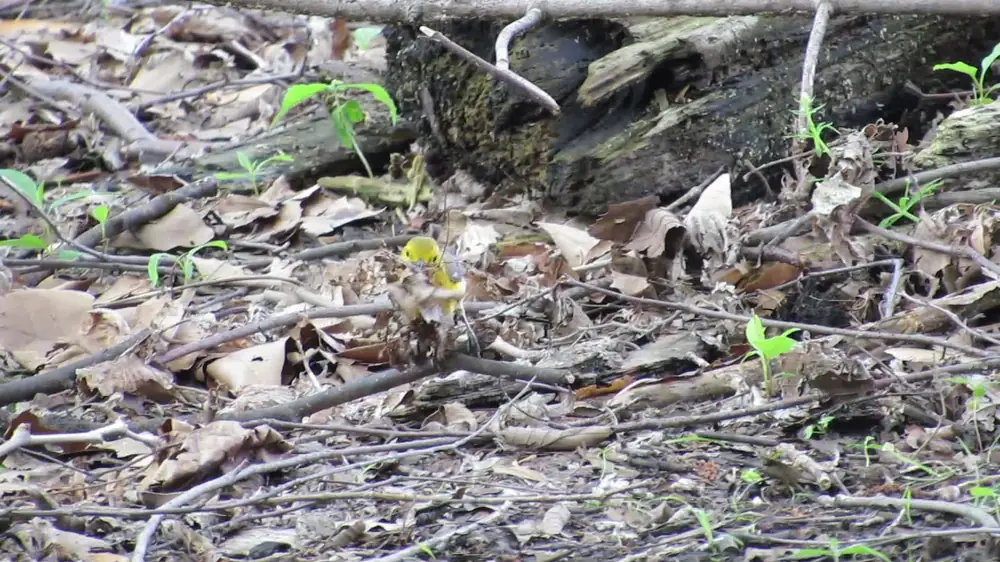
- Go out at first light on a still morning in the first half of the month. Pick a wooded creek bottom or a river park, stand still for twenty minutes, and count the warblers moving through the canopy. Overcast mornings after a southerly night are often the busiest, and the whole show is over by the time the oaks are in full leaf.
- Walk a prairie edge in the last week of May. Grassland birds are on territory by then. Listen for the bubbling song of a bobolink and the buzzy phrase of a dickcissel, and keep your distance from the nests hidden in the grass.
- Hold a flashlight vigil at a pond after a warm rain. Gray treefrogs, American toads and cricket frogs all start calling in May. Sit at the edge, wait for your eyes to adjust, and write down which voices you can tell apart.
In the Naturalist’s Field Journal for May, “birds I have seen” will fill fastest, so use “a map of sounds” for a dawn chorus or a frog pond, “nest observed” for a nest watched from a respectful distance, “seeds, pods and cones” for the first mayapple and cottonwood fluff, “mammal watch” for fawns and bats at dusk, and “the same place twice” for one wooded trail walked in the first week and again in the last.
Regions used below: Northeast Iowa and the Driftless; Eastern Iowa and the Mississippi River; Central Iowa and Des Moines; Northwest Iowa and the Iowa Great Lakes; Western Iowa and the Loess Hills; Southern Iowa.
When does the warbler wave peak in Iowa in May, and where do shorebirds stop?
May is the month that makes birders call in sick. The Iowa Natural Heritage Foundation notes that warblers eat insects, so they do not show up until late April or early May, when it is warm enough for flying bugs, and that numerous species pass through Iowa each spring. Expect the core of the show in roughly the first three weeks, with stragglers into the last days of the month. Weather steers the details: a southerly flow brings a wave in overnight, and a cold snap can stall one in place for a day or two. Treat every date below as a window, and look at eBird for your county the evening before you go.
-
The warbler wave in woodlots and river bottoms
Early to late May, with the busiest mornings usually in the first half · Wooded creek corridors, city parks with mature trees, and river floodplain forest statewide
The INHF says to search on overcast days in layered woods, and that yellow-rumped, magnolia and black-and-white warblers are among the easier ones to learn. Start with the commonest and add a species a week. Mornings, when the birds are hungry after a night of flying, beat afternoons. -
Warblers that stay to nest
Arrive in the first three weeks of May, then sing from fixed territories through June · The Iowa River Bird Conservation Area in the four counties along its 45 river miles, and the Mississippi River floodplain
The DNR’s guide to the Iowa River corridor lists prothonotary, cerulean and yellow warblers among the birds that breed there, along with Baltimore orioles and indigo buntings. The Omaha Audubon migration notes for May name several more summer warblers, such as northern parula, ovenbird, Louisiana waterthrush and American redstart, as best seen early in the month. The Upper Mississippi River refuge runs 261 river miles from Wabasha, Minnesota to Rock Island, Illinois, along Iowa’s eastern edge; at its Port Louisa unit, the refuge’s own photographer recorded a prothonotary warbler gathering nest material on May 16, 2016. -
Shorebirds on flooded fields and mudflats
Early May: Hudsonian godwit, stilt sandpiper, short-billed dowitcher. Mid May: black-bellied plover, ruddy turnstone, white-rumped sandpiper. Late May into early June: sanderling · Missouri Valley wetlands and shallow reservoir shores; DeSoto National Wildlife Refuge and the Council Bluffs area are the usual starting points
These timing windows come from an Omaha-area Audubon calendar, so they describe the Missouri Valley best and the rest of Iowa roughly. Shallow water is the key: a wet spring that floods a stubble field can hold more shorebirds in a day than a whole dry year. The same Audubon note says that piping plovers nest on Platte River sandbars and the power-plant ponds south of Council Bluffs, which is a reminder to stay back from bare sand and gravel bars that look empty.
The Iowa Ornithologists’ Union keeps a list of where to find birds on public land, and county conservation boards often run bird walks in spring. Ask each one for its own schedule, because few have posted 2027 dates yet.
Where can you hear grassland birds and see prairie in Iowa in May?
The places that kept some native grass are worth a trip in May, when the new growth is up and the males are singing from fence posts and tall stems. The prairie chicken booming at Kellerton is a late March to early May sight, according to the DNR, so by May its season is closing and the grassland songsters take over.
-
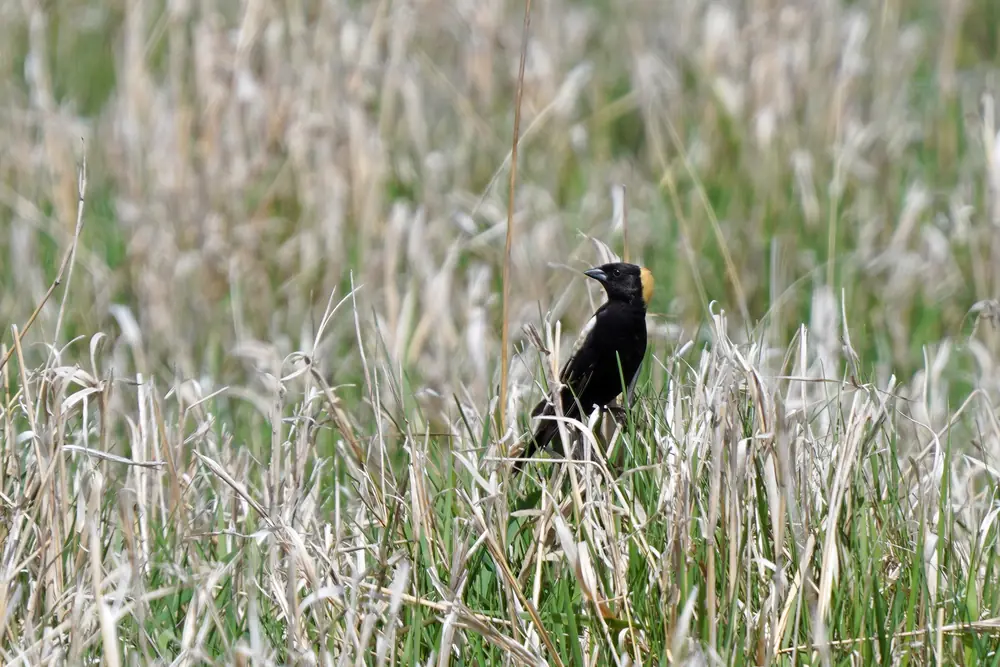
Bobolink, dickcissel and grasshopper sparrow
Late May is a safe window for finding all three on territory · Restored grasslands, wildlife areas and hay meadows; the Iowa River corridor lists all three
The DNR’s Iowa River article names bobolinks, dickcissels and grasshopper sparrows among the grassland birds of the corridor, together with northern harrier, American kestrel and short-eared owl. Bobolinks sing on the wing and perch on stalks, and dickcissels sing from the top of the tallest forb. Photograph from the road shoulder and never walk into the grass, where nests lie on the ground. -
Neal Smith National Wildlife Refuge
Outdoor areas open sunrise to sunset daily · Near Prairie City, east of Des Moines
The refuge highlights bison, elk and grassland birds. Its Prairie Learning Center has been closed because of storm damage and was expected to stay closed for an extended period, though the outdoor trails stay open. Check the refuge page for current contact details and any road closures before you drive out. -
Loess Hills State Forest
Pisgah visitor center open May 1 to October 31: Tuesday to Friday 8:30 a.m. to noon, Sunday 1 to 4 p.m. · Harrison and Monona counties, western Iowa
The forest manages prairie ridges that hold 100 to 350 plant species on some sites, with big and little bluestem, Indiangrass, sideoats grama, pasque flower, lead plant and yucca. More than 60 miles of trail cross four units, and Brent’s Trail is an eight-mile marked route along ridges and valleys with wide views. The footing is rugged, so wear boots. The DNR burns about 2,500 acres a year across all seasons, so check the park alerts page for closures.
Which Iowa birds are nesting in May, and how close is too close?
Spring is a bad time to be curious at close range. Whatever you see in May, an adult bird is probably close by and watching you, and every minute you spend near a nest is a minute its eggs or chicks go without care.
-
Ospreys on eggs
Females typically lay in May; young fly about 53 days after hatching · Reservoirs, big rivers and communication towers; the Wells Fargo platform in West Des Moines has a live camera
According to the DNR, there were 54 active osprey nests in Iowa in 2025, and at least 30 of them produced 58 young. Ospreys favor the tallest tree or a human-built platform, and the DNR says they especially like communication towers. Young ones begin returning to Iowa at about two years old, then roam the state before they pick a nest site at four or five. -
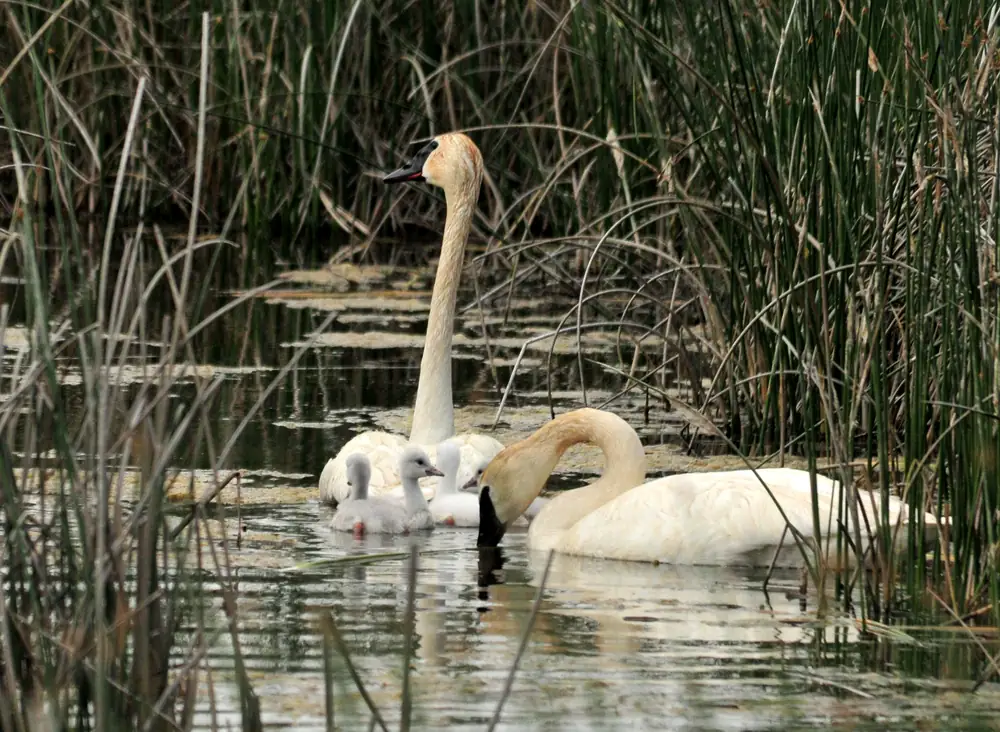
Trumpeter swans and their cygnets
Nesting season through early summer · Wetlands such as Union Slough; the DNR says more than 130 pairs nest across Iowa
The first modern Iowa cygnets hatched from a wild pair in Dubuque County in 1998. Today a swan with a colored neck collar or leg band is part of a tracking effort: the DNR asks for the marker type, its color and the code (an example is Green 6P2), reported through its swan observation form. Union Slough National Wildlife Refuge in Kossuth County calls itself the epicenter of trumpeter swan nesting in Iowa. Keep well back from any family on the water. -
Eastern bluebirds and nest boxes
Many pairs raise more than one brood a summer · Open country, cemeteries and golf-course edges
The DNR advises placing boxes at least 100 yards from buildings, in the open and facing away from brush, and pairing each with a swallow box to cut competition. A clutch is two to seven pale blue eggs. Clean the box between broods because blowfly larvae build up, and expect raccoon attacks to rise as the season goes on.
When do hummingbirds, monarchs and bumble bees show up in Iowa in May?
Three of the most trackable arrivals have citizen science behind them, so you can compare your yard with maps built by thousands of other people. Journey North runs the hummingbird and monarch maps. Because they are sightings from volunteers, each one is a record that depends on weather and on who happened to be looking.
-
Ruby-throated hummingbirds
Journey North says the birds move north at an average of about 20 miles a day; in 2026 sightings reached the Upper Midwest by mid-April · Feeders and gardens statewide
Journey North’s review of the 2026 migration reported that every state but Vermont and North Dakota had at least one sighting before May, and that the Upper Midwest was reporting by mid-April. It gave no Iowa-only dates, so use the live sighting map to see how far north the front has reached before you hang a feeder. Because migration follows the earliest blooming flowers, a cool, late spring pushes everything back. -
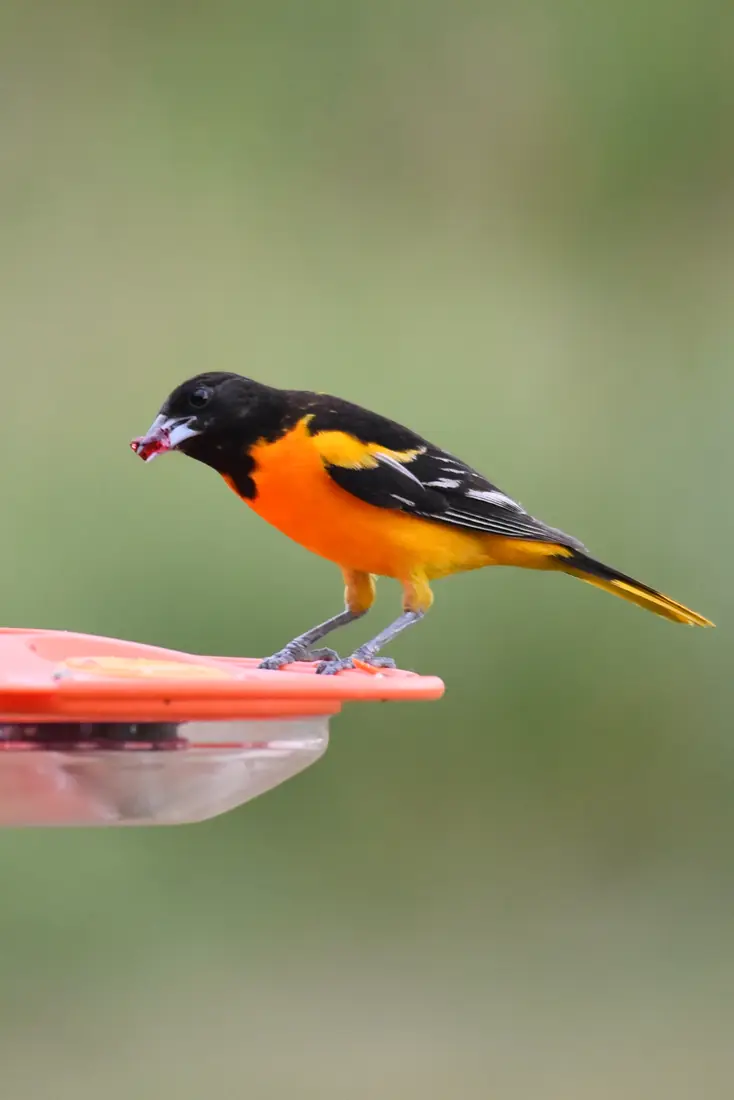
Baltimore orioles
Watch the eBird maps for the first reports in your county · Tall trees along rivers and in towns
The DNR’s Iowa River article lists Baltimore oriole as a breeding bird of the river corridor, and the male’s orange-and-black plumage is easy to spot against new leaves. I did not find an Iowa agency date for their arrival, so local reports are the best guide. -
Monarchs heading north
Spring migration is a multi-generational trip; first sightings are what Journey North asks for · Anywhere milkweed is coming up
Journey North says that monarchs start north in spring and asks volunteers to report their first sighting in each category: eggs, caterpillars and adults. It does not publish an Iowa arrival date. The most useful thing to do in May is to leave milkweed shoots alone along fence lines and ditches, because milkweed is the plant monarch caterpillars depend on. -
Rusty patched bumble bees
The Fish and Wildlife Service says activity begins around April 10 north of 42 degrees north latitude, and queens fly through spring · Anywhere in the eastern and midwestern states it historically occupied
The Fish and Wildlife Service describes a queen as 19 to 23 millimeters with the first two abdominal segments entirely yellow, and workers as having a rusty patch on the second segment. Look-alikes are common, and brown-belted bumble bees are the most often confused. If you think you have one, photograph it from the top, side and head, then post it to BumbleBeeWatch, BeeSpotter or iNaturalist for review.
What blooms in Iowa’s woods and prairies in May, and when is the last freeze?
The woodland ephemerals that peaked in April are fading by May, and a second cast takes over as the canopy closes. The DNR’s weekly woodland wildflower series ended with its final 2026 reports on May 18 and 19, which gives a sense of the season’s length. In the northern report, the peak had already passed. The flowers it named that week make a reasonable preview of the third and fourth weeks of a normal May.
In northern Iowa those reports named Jack-in-the-pulpit, red columbine, blue phlox, bristly buttercup, nodding trillium and cut-leaved toothwort in Emmet County, with wild geranium and mayapples at Floyd County’s Tosanak Recreation Area. Central Iowa had false Solomon’s seal, dwarf larkspur and Virginia waterleaf at Fort Des Moines Park, and southern Iowa had sweet cicely, aniseroot, mayapple and green dragon in Appanoose County. In the west the list included woodland phlox, bluebells, ginger, honeysuckle, lilac and columbine. Those are one year’s observations, not a calendar. A cold spring delays everything and a warm one pulls it forward.
-
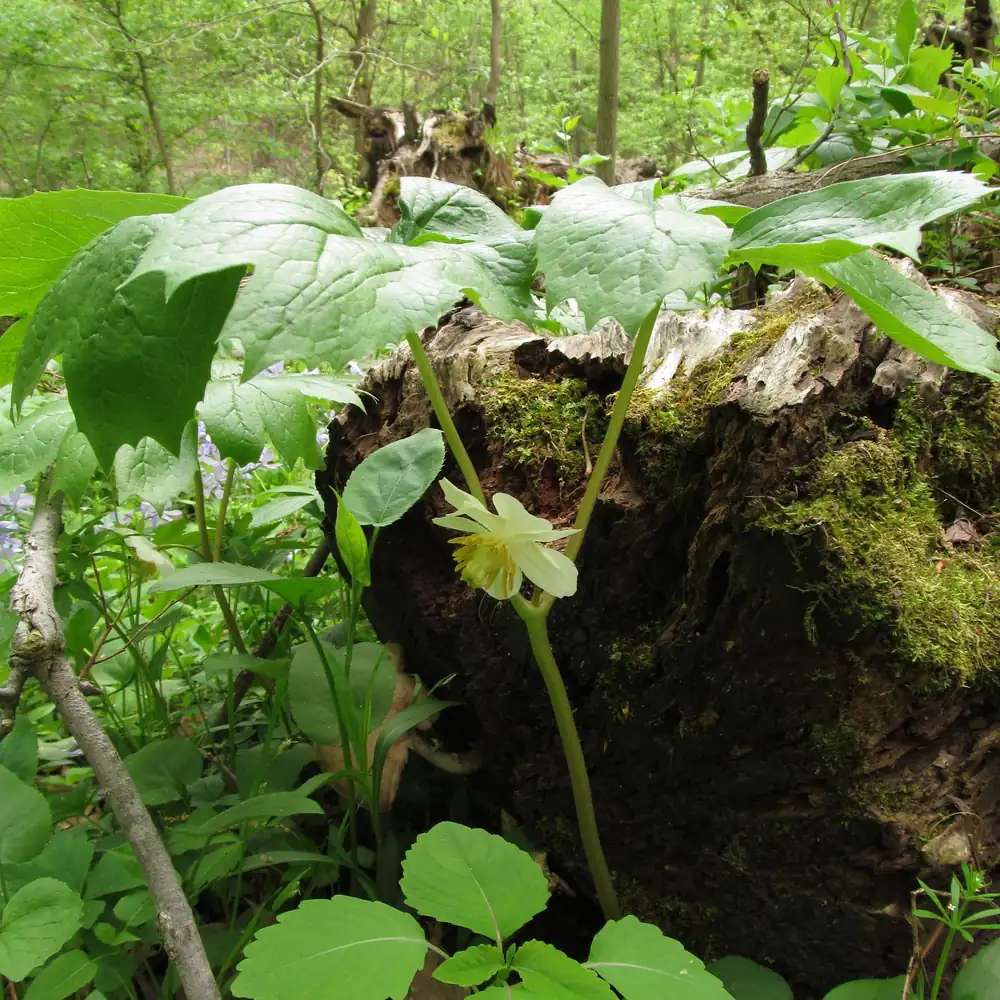
Mayapple
Leaves open like umbrellas in late April; the single white flower hides beneath them · Rich woods and stream terraces, statewide
The DNR’s morel guide uses open mayapple leaves as a sign that the fungus season is on, and the 2026 reports show the plant in bloom in northern, central and southern Iowa by mid-May. -
Jack-in-the-pulpit, columbine and nodding trillium
Seen in the final weeks of the 2026 reports, May 18 and 19 · Cool, shaded northern Iowa woods
Jack-in-the-pulpit hides a spike inside a striped hood. Red columbine hangs its nodding, spurred flowers from rock ledges, and nodding trillium keeps its single bloom beneath the leaves, so you have to crouch to see it. -
Wild geranium and sweet William
Sweet William opens in mid-April and keeps blooming through May at Hunt Woods in Des Moines County · Woodland edges and river terraces
Wild geranium appears in the DNR's northern Iowa reports from 2026, and the DNR's southern Iowa report of May 3, 2025 (relayed by KCII Radio) described it as new that week. Sweet William is the one spring ephemeral that a Des Moines County naturalist says carries on through May. -
Prairie flowers on the Loess Hills
Check what is open with the forest or the county conservation board · Loess Hills State Forest
The Loess Hills State Forest page names pasque flower, lead plant and yucca among the forbs of its prairie ridges. I could not find a primary-source bloom date for any of them, so go and look and keep your own record. -
Look, but do not pick
All month · State parks, preserves and refuges
Take pictures, not bouquets. Plants on public land are protected, and the flower you pick is next spring’s seed set that never forms.
| Station | One year in ten | Median | Nine years in ten |
|---|---|---|---|
| Estherville Municipal Airport (northwest) | Apr 19 | May 2 | May 14 |
| Mason City Municipal Airport (north central) | Apr 19 | May 3 | May 15 |
| Decorah (northeast) | Apr 19 | May 3 | May 16 |
| Sioux City Gateway Airport (west) | Apr 16 | Apr 29 | May 14 |
| Cedar Rapids Municipal Airport (east central) | Apr 13 | Apr 27 | May 11 |
| Des Moines International Airport (central) | Apr 4 | Apr 18 | May 2 |
| Clarinda (southwest) | Apr 11 | Apr 25 | May 7 |
| Burlington Municipal Airport (southeast) | Apr 2 | Apr 15 | May 1 |
The table above gives each station’s record for the last frost of spring in NOAA’s 1991 to 2020 normals. Even a median date in early May means about half of all years still have a 32 °F night after that date. Find your own town on the frost page for Iowa, and hold tender seedlings back until the nine-years-in-ten date has gone by. In May 2021 a freeze overnight into May 29 reached stations in northern and eastern Iowa, according to the Iowa Department of Agriculture and Land Stewardship, and it caused sporadic crop damage.
Which frogs, toads and bats can you find in Iowa in May?
A second wave of callers joins the chorus on warm nights. The same warmth brings insects out in numbers, and that is the signal for bats to start hunting at dusk.
-
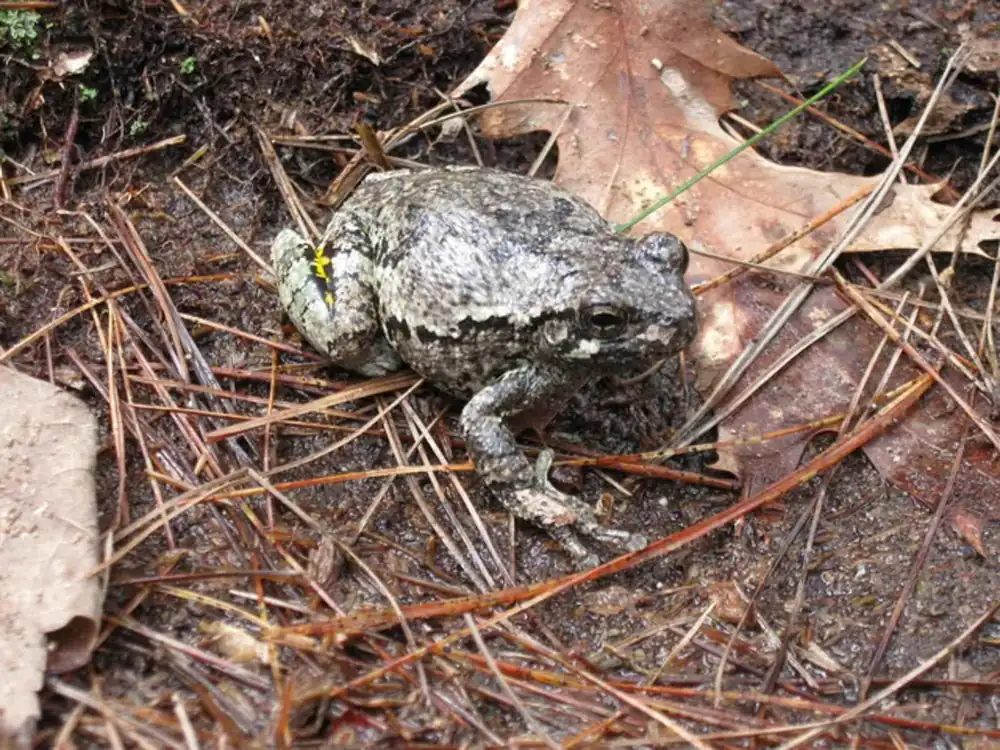
Treefrogs, cricket frogs and toads
According to the Iowa DNR: American toads late April or early May, then Cope’s gray treefrog, eastern gray treefrog, Blanchard’s cricket frog and Woodhouse’s or Fowler’s toad starting around May · Shallow, semi-permanent ponds, flooded ditches and roadside wetlands
The DNR describes Cope’s gray treefrog as a short mechanical trill and the eastern gray treefrog as a short musical trill, with the cricket frog less abundant in northern Iowa. American toads gather in shallow water to mate and can arrive at a wetland in large numbers on the same night. Go out after dark with a flashlight; a trill from a tree near water is probably a gray treefrog. -
Take part in the frog and toad call survey
The survey is more than 30 years old · Routes across Iowa, or design a new one
The DNR invites volunteers to join an established route near them or set up a new route if none is nearby. The INHF notes that many county conservation boards also hold public frog and toad events. -
Bats at dusk
The DNR says mothers are giving birth and the young are flightless from May through July · Forest edges, creeks and ponds at dusk
Iowa has nine bat species, and the DNR says all of them are insect eaters; most rely on forests. Big brown, little brown and northern long-eared bats are named. Because pups cannot fly in these months, the DNR asks that tree removal be avoided if at all possible. To help bats, leave standing dead trees where it is safe, avoid insecticides, and consider planting shagbark hickory, white oak or American elm. Maquoketa Caves State Park closes its caves each year from November 15 to April 1 to protect hibernating bats, so they are open to visitors in May. -
Fawns and other young animals
The DNR says deer move to their fawning areas in spring · Fields, yards and woodland edges
A fawn lying still and alone has often not been abandoned, since a doe commonly keeps away and returns later. Leave it where it is, keep dogs back and do not touch it. The DNR directs questions about a fawn found alone to 515-725-8200.
What is in season in Iowa in May: turkeys, morels and spawning fish?
May is the tail end of the spring turkey season and the middle of the spawn for several popular fish, which means the woods and shorelines are busier than they look.
-
Spring turkey season, last stretch
Season 4 runs April 28 to May 16, 2027; archery-only runs April 12 to May 16, 2027 · Public and private land statewide
These dates come from the DNR’s turkey page. Gun shooting hours are a half hour before sunrise to sunset, and bow hours extend to a half hour after sunset. Hunters must report their turkey by midnight on the day after tagging. If you are not hunting, wear bright clothes on public land during these weeks. -
Morel mushrooms into mid-May
The DNR says to start looking in early April and keep going through mid-May · Woods where oaks are leafing out
The DNR says to start looking when the soil reaches 53 °F, with daytime highs in the 60s and nights in the 50s. Cues include oak leaves the size of squirrel ears, lilacs budding and open mayapple leaves. Always cook morels, and never eat one you cannot identify with confidence. -
Crappie on the nest
The DNR says the spawn begins when water reaches 56 to 64 °F, which is typically around May · Shallow, warm bays
Before spawning crappie move into shallow water that warms quickly. Males build nests over gravel, sand or muck. The DNR’s weekly fishing report is emailed every Thursday, and it is the best source for what is biting. -
Largemouth bass guarding nests
Spawning follows water temperature; bass move toward spawning areas as the water warms to about 55 °F · Ponds, lakes and impoundments
The DNR says males guard eggs for 10 to 14 days and the fry for another one to two weeks. They do not feed during the spawn and attack intruders, including lures, so they stay catchable, but overall success drops quickly. If you fish a nest, release the male gently and quickly so the eggs are not left unguarded.
The DNR’s published list of continuous open seasons also includes groundhog and coyote, and the light goose conservation order ends on May 1. Check the regulations booklet for any season you plan to join.
What is May weather like in Iowa, and what could go wrong?
Average highs climb from the upper 60s into the low 70s, and the same warm, moist air that wakes the frogs can feed strong thunderstorms. These are NOAA’s 1991 to 2020 normals for May at five airport stations:
| Station | Average high | Average low | Precipitation | Snowfall | Days with 0.10 in or more |
|---|---|---|---|---|---|
| Mason City (north central) | 69.6 °F | 46.8 °F | 5.15 in | 0.3 in | 8.6 |
| Waterloo (northeast) | 72.8 °F | 50.2 °F | 4.61 in | 0.1 in | 8.2 |
| Dubuque (Mississippi River) | 69.2 °F | 48.5 °F | 4.30 in | 0.0 in | 8.4 |
| Sioux City (west) | 72.3 °F | 48.7 °F | 3.87 in | 0.0 in | 7.4 |
| Des Moines (central) | 72.4 °F | 52.3 °F | 5.24 in | 0.2 in | 8.5 |
The state climatologist’s monthly summaries show how far a single May can stray from those normals. May 2024 was the eighth wettest May in 152 years of statewide records, with 7.43 inches, about 2.59 inches above normal, and on May 21 a rare “Particularly Dangerous Situation” tornado watch covered most of Iowa. A violent tornado hit Greenfield in Adair County that day, killing five people and injuring 35. May 2021, by contrast, averaged 3.71 inches of rain, 1.13 inches below normal, and ended with a late freeze.
Plan for the season. Know your county, have a way to get warnings that wakes you at night, and pick your shelter before the watch is issued. The National Weather Service in Des Moines points to its preparedness pages and to SKYWARN storm spotter training. If you want to measure the rain yourself, the volunteer network CoCoRaHS says it takes about five minutes a day and the state climatologist’s office cites its gauges in the monthly summaries. For the newest NOAA Climate Prediction Center outlook, open the three-month outlook page, which is revised monthly; this page does not restate it. For your own routine, the weather page and the cloud guide will help you read the sky.
How much daylight does Iowa gain in May?
The days are already long on May 1, and they keep stretching. Every Iowa city in the table gains between 55 and 62 minutes across the month, a slower pace than in March or April, and the gain tapers to about a minute per day by the end of the month as the June solstice approaches. The northern cities add the most. Decorah goes from 14 hours 8 minutes to 15 hours 10 minutes, while Burlington in the southeast ends the month at 14 hours 53 minutes. Clocks stay on daylight time all month. Use the daylight page to look up your own town.
| City | May 1 | May 31 | Gained | Per day |
|---|---|---|---|---|
| Decorah | 14 h 08 m | 15 h 10 m | 62 min | 2.1 min |
| Mason City | 14 h 08 m | 15 h 08 m | 60 min | 2.0 min |
| Dubuque | 14 h 04 m | 15 h 04 m | 60 min | 2.0 min |
| Sioux City | 14 h 04 m | 15 h 05 m | 61 min | 2.0 min |
| Cedar Rapids | 14 h 02 m | 15 h 01 m | 59 min | 2.0 min |
| Des Moines | 14 h 01 m | 14 h 58 m | 57 min | 1.9 min |
| Council Bluffs | 14 h 00 m | 14 h 56 m | 56 min | 1.9 min |
| Burlington | 13 h 58 m | 14 h 53 m | 55 min | 1.8 min |
What can you see in Iowa’s night sky in May 2027?
The new moon on May 6 hands the first week of the month a truly dark sky. The Moon table below is in Central Daylight Time, which Iowa keeps all month, and the moon phase calendar covers other months.
-
Eta Aquariid meteors before dawn
Mornings of May 5, 6 and 7, with the shower peaking around May 6 · A spot with a low eastern horizon, in the last hour or two before the sky brightens
With the Moon a sliver of 1 or 2 percent, SeaSky rates 2027 an excellent year for this shower. The source of the meteors, a constellation of Aquarius, climbs above the horizon late, so northern states see fewer than southern ones. For the Northern Hemisphere SeaSky lists up to about 30 an hour; from Iowa, plan on anywhere from a handful to a couple of dozen. Bring a reclining chair and a blanket. -
The Flower Moon, and a seasonal Blue Moon
Full at 5:59 a.m. CDT on Thursday, May 20; the evening of Wednesday, May 19 is the one to watch · Rising in the east around 8 p.m.
Folklore names May’s full moon the Flower Moon. Under the older seasonal count, SeaSky notes, it also qualifies as a blue moon: astronomical spring holds four full moons and this is number three. Under the newer rule, two full moons in a single calendar month, there is no blue moon in 2027. Moonrise in Des Moines on May 19 is 8:18 p.m. by the Naval Observatory table, so look for it a little after 8 p.m. across the state. -
Mercury low in the west
Look from about May 12 to June 5; greatest elongation is May 28 · Low in the west-northwest, roughly 45 to 90 minutes after sunset
At its greatest eastern elongation on May 28 Mercury stands about 22.8 degrees from the Sun (SeaSky gives 22.9), which puts the best viewing on the last two evenings of the window, the 27th and 28th. The 45-to-90-minute window and its brightness near magnitude -0.6 on May 15 come from our own calculations, not a published almanac; it fades fast after that. A clear, flat horizon and binoculars help. -
Jupiter, Mars, Venus and Saturn
Jupiter and Mars in the evening; Venus and Saturn before sunrise · Jupiter high in the evening; Venus and Saturn low in the east before dawn
Our own calculations have Jupiter setting roughly seven hours after the Sun on May 1, with the first-quarter Moon beside it on the evening of May 12, and Mars setting around 2 a.m. early in the month. The same calculations put Venus and Saturn within 1 degree of each other on the mornings of May 6 to 8, closest on May 7, yet both hug the horizon, a few degrees up, 30 minutes before sunrise, so bring binoculars. These pairings are calculated, not taken from a published calendar.
| Phase | Date | Time |
|---|---|---|
| New moon | Thursday, May 6 | 5:58 a.m. CDT |
| First quarter | Wednesday, May 12 | 11:44 p.m. CDT |
| Full moon, the Flower Moon (a seasonal Blue Moon) | Thursday, May 20 | 5:59 a.m. CDT |
| Last quarter | Friday, May 28 | 8:58 a.m. CDT |
What can Iowa families do outdoors in May?
May rewards short, patient trips. Pick a place where you can reach water, woods and grass in one walk, and let children choose what to watch.
- Join a count. Journey North takes hummingbird and monarch sightings, the DNR runs the frog and toad call survey, and BumbleBeeWatch, BeeSpotter and iNaturalist take photographs of bumble bees. CoCoRaHS welcomes new rain-gauge volunteers.
- World Migratory Bird Day. The event is held on two days a year, in May and October. The organizers list May 9 and October 10 for 2026 only, so look to their site for later dates and nearby events. In October 2026 the Iowa DNR listed a hawk watch at the High Trestle Trail Overlook near Madrid as part of the day.
- Watch a nest from the couch. The DNR links to an osprey camera on the Wells Fargo campus in West Des Moines.
- Visit a refuge. The Driftless Area National Wildlife Refuge in northeast Iowa protects cold-air talus slopes and allows wildlife observation and photography at its Howard Creek, Fern Ridge and Pine Creek units.
- Visit a nature center. County conservation boards, nature centers and the Loess Hills visitor center post their own May programs; most have not announced 2027 dates, so check with the organizer.
- Fireflies. Xerces describes them as animals of summer evenings and suggests turning off outdoor lights to help them, so expect the main show after May.
- Memorial Day. Monday, May 31, 2027, is Memorial Day, and many parks fill up on the weekend before it.
For more ideas on keeping a record, see the Naturalist’s Field Journal, and for earlier spring months, read the March and April pages. The full list of states is on the nature index.
Safety notes for May in Iowa
- Ticks. The CDC says to walk in the center of trails, treat boots, clothing and gear with 0.5 percent permethrin, and use an EPA-registered repellent. After you come in, shower within two hours, tumble clothes on high heat for 10 minutes, and do a full-body check, including armpits, behind the knees, hair and the waistband.
- Turkey season. Season 4 and archery-only turkey hunting run through May 16, 2027. The DNR’s turkey page mentions no orange rule, so check the regulations booklet. The DNR’s morel guide tells mushroom hunters to avoid red, white and blue and to wear blaze orange.
- Severe storms. Thunderstorm season is under way. Pay attention to watches, have a place to shelter that is not a vehicle, and leave water-covered roads alone.
- High water. Spring rivers can be cold and fast even on a warm day. Stay off banks that may have undercut, and keep children and dogs back.
- Nesting birds and young animals. Do not touch fawns, nestlings or eggs. Keep your distance from swan and eagle nests.
- Snakes. Timber rattlesnakes live in the rocky bluffs of eastern Iowa and are protected by state law. Give every snake room and keep hands out of crevices.
- Mushrooms. Morels must always be cooked. Do not eat anything you cannot identify, and keep dogs away from unknown mushrooms.
- Prescribed burns. The Loess Hills forest burns on a rotation across all seasons. Obey closures and stay out of smoke.
Sources (46)
- Iowa DNR: spring turkey hunting, 2027 seasons
- Iowa DNR: Iowa hunting seasons, 2026-2027
- Iowa DNR: Iowa frog and toad calls
- Iowa Natural Heritage Foundation: spring peeping (April 20, 2023)
- Iowa Natural Heritage Foundation: spring phenology (March 21, 2023)
- World Migratory Bird Day: organizers' home page (2026 dates)
- U.S. Fish and Wildlife Service: Neal Smith National Wildlife Refuge
- U.S. Fish and Wildlife Service: DeSoto National Wildlife Refuge
- U.S. Fish and Wildlife Service: Union Slough National Wildlife Refuge
- U.S. Fish and Wildlife Service: Driftless Area National Wildlife Refuge
- U.S. Fish and Wildlife Service: Upper Mississippi River National Wildlife and Fish Refuge
- U.S. Fish and Wildlife Service: rusty patched bumble bee
- Iowa DNR: woodland wildflowers and weekly reports (final 2026 report dated May 18-19)
- Des Moines County Conservation: chasing ephemerals
- Journey North: hummingbird migration
- Journey North: all about ruby-throated hummingbird migration
- Journey North: looking back at the 2026 ruby-throated hummingbird migration
- Journey North: monarch butterfly migration
- Iowa DNR: crappie (spawning temperature)
- Iowa DNR: largemouth bass (spawning behavior)
- Iowa DNR: fishing (weekly fishing report)
- Iowa DNR: Loess Hills State Forest
- Iowa DNR: white-tailed deer
- Iowa DNR: trumpeter swans
- Iowa DNR: bald eagle
- Iowa DNR: osprey
- Iowa DNR: let's celebrate bats (October 28, 2025)
- Iowa DNR: Maquoketa Caves State Park
- Iowa DNR: greater prairie chicken
- Iowa DNR: eastern bluebird
- Iowa DNR: habitat variety attracts birds and birders to the Iowa River Bird Conservation Area (November 25, 2024)
- Iowa DNR: news releases (October 2026 hawk watch listing)
- Iowa DNR: top tips to spot morel mushrooms
- Audubon Society of Omaha: May bird migration information
- Iowa Department of Agriculture and Land Stewardship: Iowa monthly weather summary, May 2024
- Iowa Department of Agriculture and Land Stewardship: Iowa monthly weather summary, May 2021
- NOAA NCEI: 1991-2020 monthly normals for Iowa stations (data API)
- NWS Des Moines: severe weather preparedness
- Climate Prediction Center: three-month outlooks
- CoCoRaHS: Community Collaborative Rain, Hail and Snow Network
- CDC: preventing tick bites
- Xerces Society: fireflies
- U.S. Naval Observatory: moon phases (data API)
- SeaSky: astronomy calendar 2027 (Eta Aquariids, Flower Moon, Mercury)
- U.S. Naval Observatory: Des Moines sun and moon times, May 19, 2027
- Photos via Wikimedia Commons; licenses and photographers are credited under each picture
.jpg)