What to look for in nature in Iowa this January
January is the deep middle of an Iowa winter. NOAA’s daily normals hit their low point in mid-month, ice that barely skimmed the ponds at Christmas grows thick enough for anglers, and the state’s wintering bald eagles, tallied by volunteers in the first half of the month, crowd the last stretches of open river. Great horned owls are already on eggs, coyotes are pairing up, and trumpeter swans bugle over a few deep quarries and spring-fed ponds that never freeze. What follows is organized by subject, with places to go in each.
Other months in Iowa: October, November, December, February.
Start here
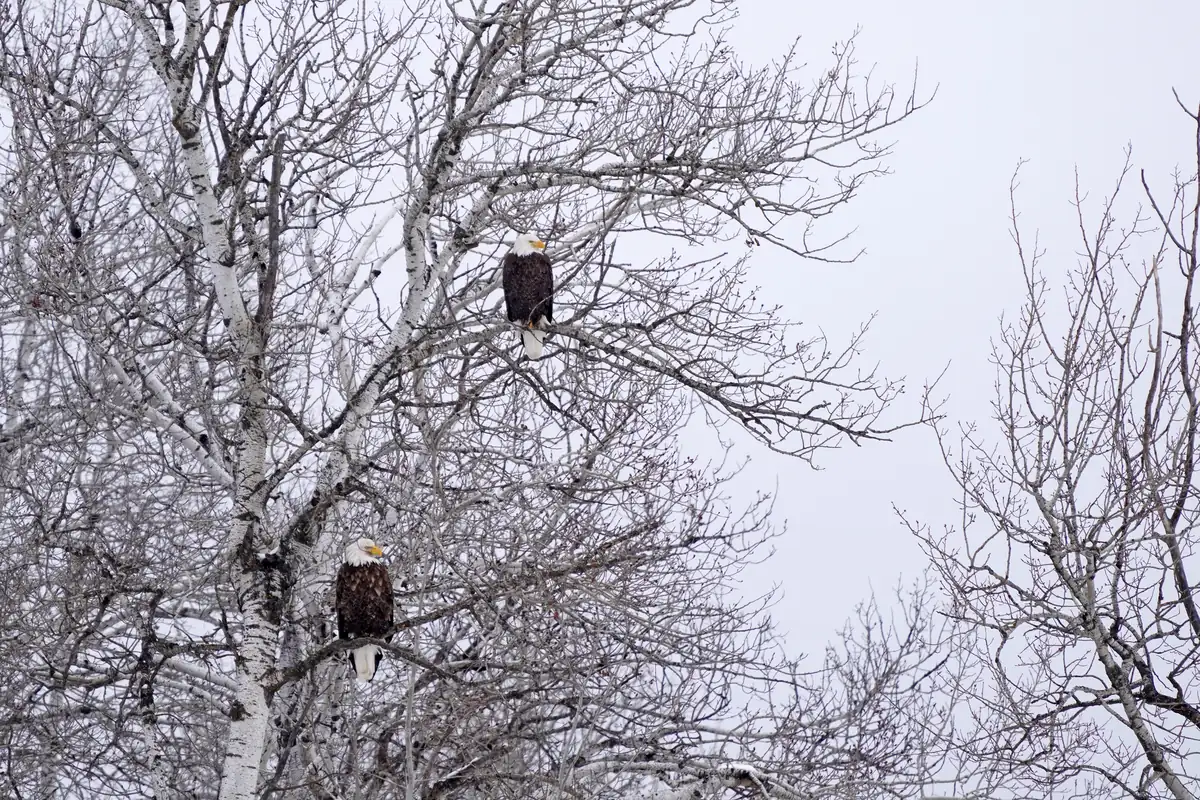
- Count the eagles below a dam. January is the month Iowa’s wintering bald eagles are counted, and the totals lately run into the thousands. On a bitter, bright morning, scan the cottonwoods along a tailwater on the Des Moines River below Saylorville or Red Rock, or along the Mississippi below one of the locks, and tally adults and brown immatures separately.
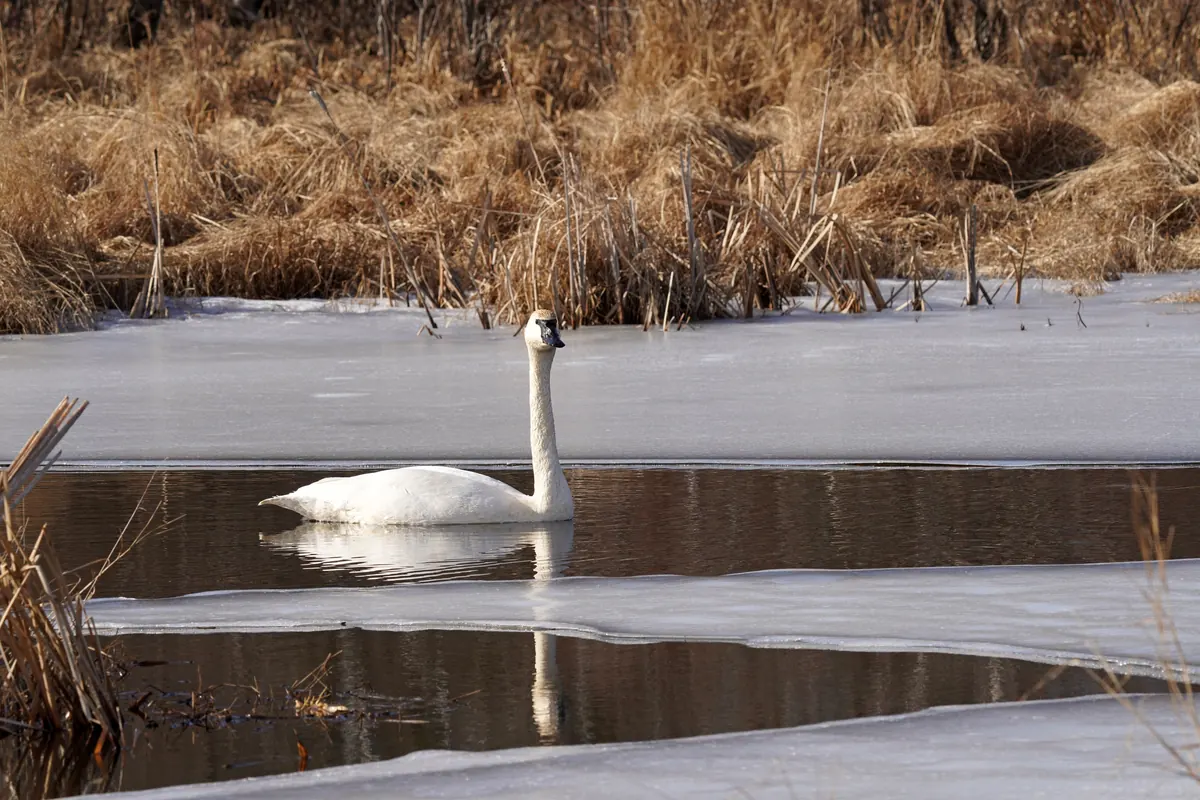
- Listen for swans at an open quarry. Trumpeter swans, gone from Iowa for more than a century until the DNR brought them back, now spend the winter wherever deep or spring-fed water stays open. Schildberg Quarry in Atlantic has hosted them in all but one of the last 28 winters, and Ada Hayden Heritage Park in Ames is another regular site.
- Meteors, then the biggest full moon of 2027. The Quadrantid shower is best on Sunday night, January 3, while the moon is just a slim waning crescent. On the morning of Friday, January 22, the Wolf Moon becomes the closest full moon of 2027; catch it climbing over a snowy field on Thursday evening, the 21st.
In the Naturalist’s Field Journal for January, tally adults and immature eagles separately on the “birds I have seen” page, sketch a coyote’s straight-line trail on “tracks to know,” draw the bark of a shagbark hickory or bur oak on the “tree through the seasons” plate, write the night you first hear a great horned owl duet on “a map of sounds,” and use “the same place twice” for one pond or river bend at New Year and again at month’s end. Beside each entry, note the air temperature and how much of the water was open.
Regions used below: Northeast Iowa and the Driftless; Eastern Iowa and the Mississippi River; Central Iowa and Des Moines; Northwest Iowa and the Iowa Great Lakes; Western Iowa and the Loess Hills; Southern Iowa.
Where are the most bald eagles in Iowa in January?
In December the eagles were still trickling in as ice formed. By January most have arrived, and the coldest weeks pack them into whatever water is still moving. This is when the Iowa DNR counts them. The Bald Eagle Midwinter Survey runs in the first two weeks of January on fixed routes along the Mississippi, Des Moines, Iowa, Cedar and a dozen other rivers, plus Saylorville, Red Rock and Rathbun lakes, the same stretches surveyed since the early 1990s. It is Iowa’s share of a national count coordinated by the U.S. Army Corps of Engineers.
-
A record count, and a new leader
Survey window January 1–15, 2025 · 49 routes, 1,668.5 miles of river and lake shore
The January 2025 survey found 5,795 bald eagles, a new high for the state, beating the 5,709 of 2022 and nearly double the previous ten-year average of about 3,067. About 70 percent were white-headed adults and 28 percent immatures. The DNR’s report notes that the Mississippi traditionally held the most birds, but the Des Moines River has been used more heavily in recent years, and in 2025 it edged ahead, 2,451 eagles to the Mississippi’s 2,427.
-
Why the numbers swing
Varies from year to year · Statewide
Iowa’s total can rise or fall by thousands from one winter to the next: 2021 was the lowest since 2002, and 2022 set a record. The DNR’s report calls the cause mostly speculation but names weather as the obvious suspect, since icier winters drive more birds down from Minnesota and Wisconsin and crowd them onto fewer open stretches. In 2025 a mild December turned cold just as the survey started. If El Niño brings a mild January, as it often does, expect eagles to be more spread out.
-
Where to stand
Mornings after a hard freeze · Saylorville and Red Rock tailwaters; Mississippi locks and dams from Lock and Dam 9 near Harpers Ferry to Lock and Dam 19 at Keokuk
The Mississippi had the densest concentration in 2025, more than nine eagles per mile of route, against about seven and a half on the Des Moines. On the Mississippi, the classic spots are the tailwaters just downstream of the locks, where the churned water stays open and fish are within reach. On the Des Moines, look below the Corps dams at Saylorville north of Des Moines and Red Rock near Pella. Scan the tallest cottonwoods and sycamores along the bank for the white heads of adults.
-
Eagle festivals along the river
Annual, mostly mid-January to early February; 2027 dates not yet posted · Burlington, LeClaire, Keokuk, Clinton
Des Moines County Conservation’s Eagle Watch at the Port of Burlington pairs a naturalist talk with a caravan to Lock and Dam 18; it was on a Saturday in mid-January last time. The LeClaire Eagle Festival, with live raptors and scopes on the riverbank, was the third weekend of January in 2026. Keokuk’s Bald Eagle Appreciation Days are a long-running January tradition, and the Clinton Bald Eagle Watch at Lock and Dam 13 has been held in late January or early February. None had posted a 2027 date by early October, so check with each host in December.
| Waterbody | Bald eagles | Adults | Immatures | Miles surveyed | Eagles per mile |
|---|---|---|---|---|---|
| Des Moines River | 2,451 | 1,778 | 604 | 320.5 | 7.65 |
| Mississippi River | 2,427 | 1,572 | 824 | 258 | 9.41 |
| Iowa River | 377 | 317 | 51 | 68 | 5.54 |
| Cedar River | 91 | 66 | 19 | 68 | 1.34 |
| Maquoketa River | 86 | 41 | 37 | 133 | 0.65 |
| Wapsipinicon River | 73 | 49 | 19 | 106 | 0.81 |
| Missouri River | 69 | 53 | 16 | 182 | 0.38 |
| State total | 5,795 | 4,036 | 1,625 | 1,668.5 | 3.47 |
Adults and immatures do not add up to the total because a few birds could not be aged; surveyors also logged two golden eagles. Every flush costs an eagle energy it can hardly spare in January, so the DNR advises staying 400 yards back from a perched bird and leaving feeding areas alone in the early morning. A parked car makes a good blind. Iowa’s resident pairs are getting ready to nest: the DNR says the state’s eagles nest from January through August, mostly February to July, and it counted 832 active territories after the 2025 season.
Where do trumpeter swans spend the winter in Iowa?
Trumpeter swans once nested across Iowa, but drained wetlands and unregulated shooting wiped them out; the last wild nesting pair before restoration was recorded in 1883 near Belmond. The DNR began a restoration plan in 1993, released more than 1,200 swans, and celebrated the first wild cygnets of modern times in Dubuque County in 1998. Today more than 130 pairs nest in the state. Many fly on to Missouri and Kansas, but where open water and food hold out, plenty stay; the DNR’s swan page puts Iowa’s wintering count at over 5,000 in some years.
-
Schildberg Quarry, Atlantic
Usually late November to late February or March · Schildberg Recreation Area, Atlantic, Cass County
Cass County Conservation says trumpeters have used this deep quarry in at least 27 of the last 28 winters. It stays open all year because of its depth and the crowd of waterfowl paddling on it. Last winter the swans arrived December 1 and left February 24, averaging 34 birds with a high of 56 at once; after mid-January the flock held at about 30.
-
Other traditional sites
December through February, as long as water stays open · Ada Hayden Heritage Park, Ames; Dale Maffitt Reservoir southwest of Des Moines; ponds near Webster City and Nora Springs; a quarry near Fertile
The DNR’s restoration reports list a handful of “traditional” wintering spots that developed as the flock grew, most of them quarries, reservoirs and aerated or spring-fed ponds. Several are private, so watch from public roads and parks.
-
Reading the neck collars
Any time · Statewide
Some Iowa trumpeters wear a neck collar or leg band. If you spot one, write down the type of marker, its color and the exact code, and report it on the DNR’s swan observation form.
Tundra swans also pass through Iowa, so look closely: trumpeters are the larger birds and have all-black bills, while a tundra often shows a little patch of yellow just ahead of the eye. Listen too; a trumpeter’s call is a low, honking bugle that carries across the ice. Swans that stay are living close to the edge, so watch from far enough back that the flock keeps feeding.
Which Iowa owls are nesting in January?
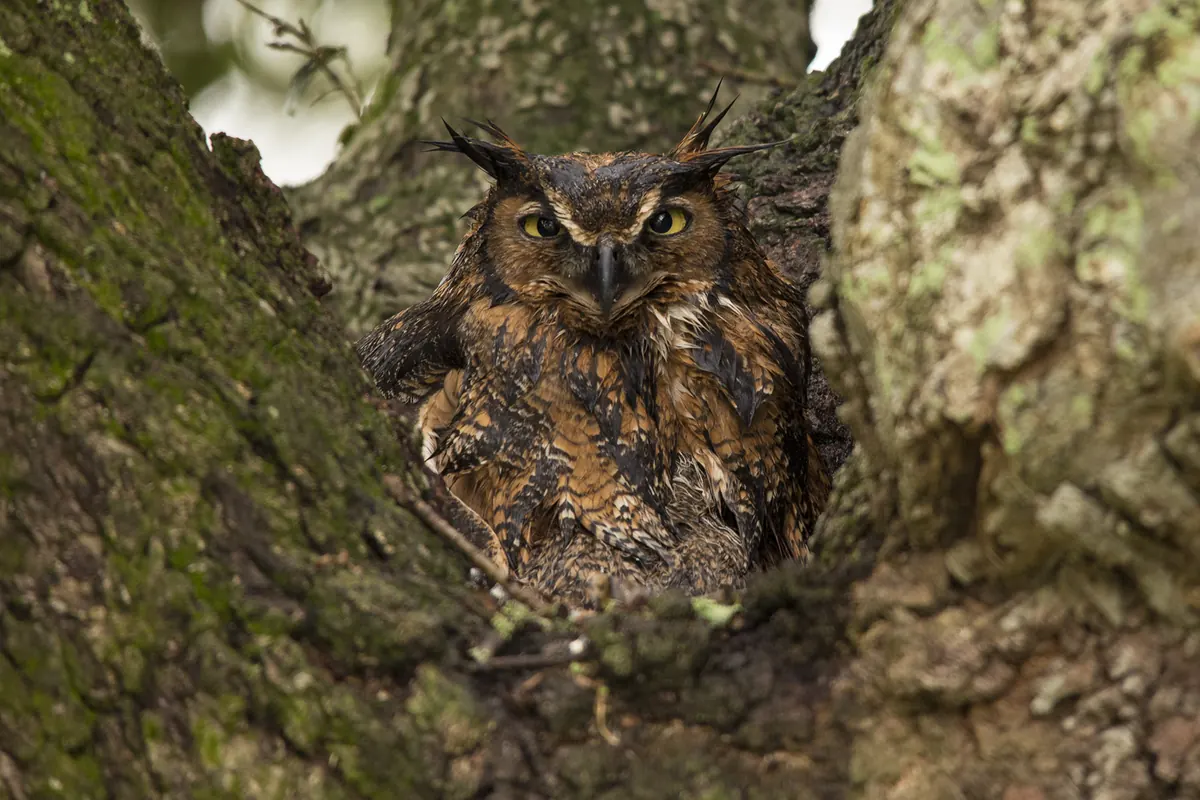
Most birds wait for spring. The great horned owl does not. It is Iowa’s earliest-nesting bird of prey, and by the DNR’s account it often lays its eggs in January, when the woods are silent and the snow may be deep. Listen at dusk and before dawn.
-
Great horned owls on eggs
Egg-laying often in January; duets at dusk · River timber, woodlots, shelterbelts, cemeteries and city parks statewide
Great horned owls skip nest building. A pair moves into an old stick nest, often a red-tailed hawk’s from a past year, or settles into a large tree cavity. In January the female may sit through snowstorms while the male hunts and calls nearby. Look for two “ear” tufts poking above the rim of a hawk nest in a bare tree. Listen for the deep, muffled run of hoots; male and female often trade calls, the female’s voice the higher of the two.
-
Barred owls calling
Late winter evenings · Mature river bottom forest, especially in eastern Iowa
The DNR describes the barred owl as a bird of mature forests and wooded waterways. Its strong, rhythmic hooting, which birders remember as “who cooks for you,” carries well across a frozen river valley on a calm evening.
-
Screech owls in the backyard
All year; easiest to hear on still winter nights · Older neighborhoods, farmsteads and wooded parks
Iowa’s small year-round owl, the eastern screech owl, is more often heard than seen. The DNR describes its main song as a falling whinny, and it also gives a long trill on one steady pitch.
Never play recordings to draw owls in during nesting season; it can pull a parent off its eggs in the cold. Hitchcock Nature Center in the Loess Hills runs a homeschool program on owls, “Whoo’s In The Woods?”, on Wednesday, January 13, at 10 a.m. and again at 1 p.m. ($5 per child).
Which winter finches might reach Iowa this January?
Some winters, birds from the northern forests come south when their seed crops fail. The Finch Research Network’s forecast for 2026–27, released September 25, calls it a mixed year: cones and seeds are plentiful from central Ontario east and from British Columbia to Alaska, but poor across the central boreal forest, which tends to send birds east toward the Great Lakes and the Northeast rather than south into the Plains. Iowa sits at the edge of that picture, so treat any irruption here as a bonus.
-
Pine siskins
Any time from late fall; often at feeders in midwinter · Nyjer and sunflower feeders, conifers and birches
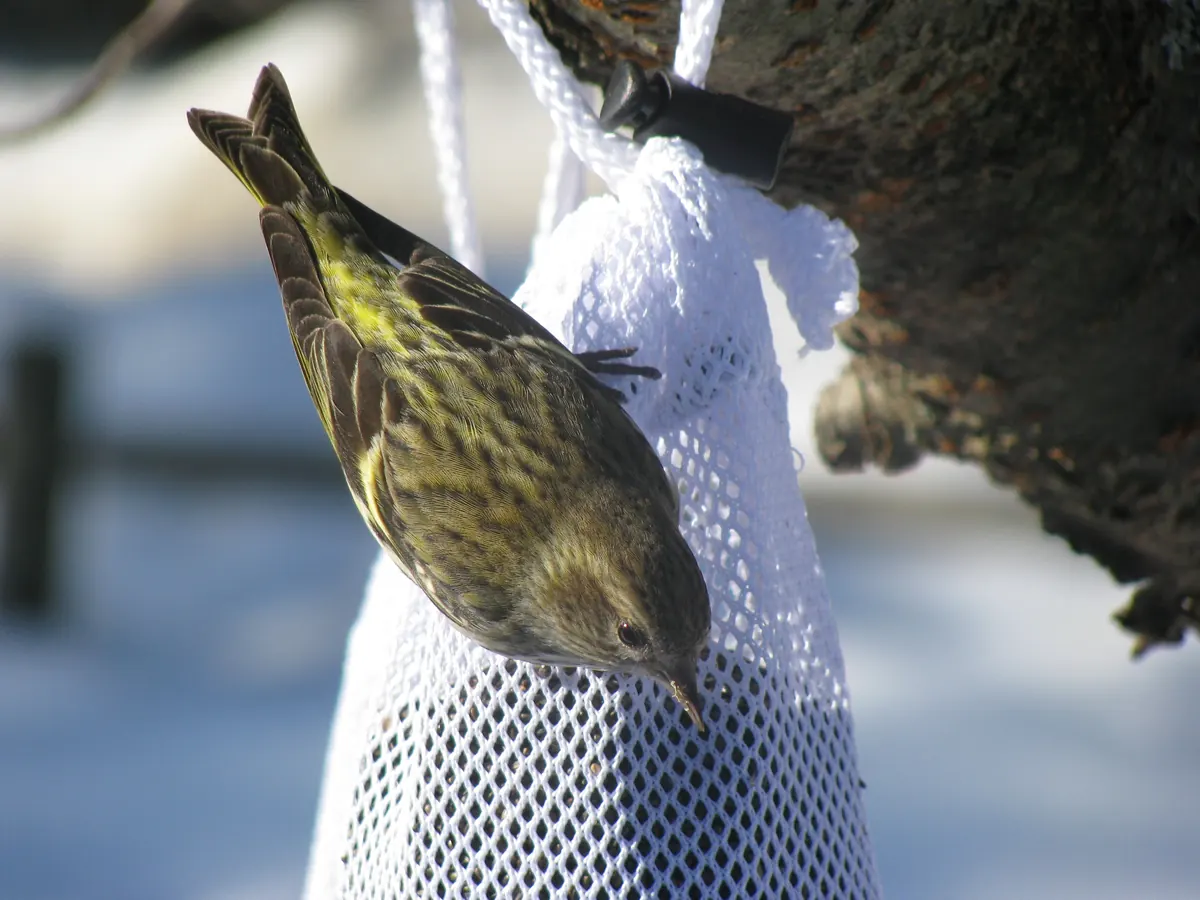
The forecast notes daily counts above 1,000 siskins at Hawk Ridge in Duluth in September and heavy seed crops on cedar and white pine in the east, which siskins favor. Siskins look like streaky little goldfinches with flashes of yellow in the wing and tail, and they wheeze and bicker at feeders. Some may spill into Iowa.
-
Red crossbills and redpolls
Irregular · Pine plantings, spruces and birches; weedy fields
The forecast notes Type 2 red crossbills on the move across the country since summer, which may bring some east. Redpolls are expected mostly to stay in Canada this winter, with perhaps a modest flight into the western Great Lakes.
Project FeederWatch runs from November 1 through April 30: you watch your feeder on two consecutive days, as often as weekly, and report each species’ biggest single flock. Note on your journal list the first day a new northern visitor shows up.
What are Iowa’s mammals doing in the middle of winter?
Snow turns the countryside into a record of who walked where overnight. January is also the start of the breeding season for some of Iowa’s predators, which keeps them moving even in the cold.
-
Coyotes pairing up
Breeding season January through March; pups born in April or early May · Farmland, river corridors, and city edges statewide
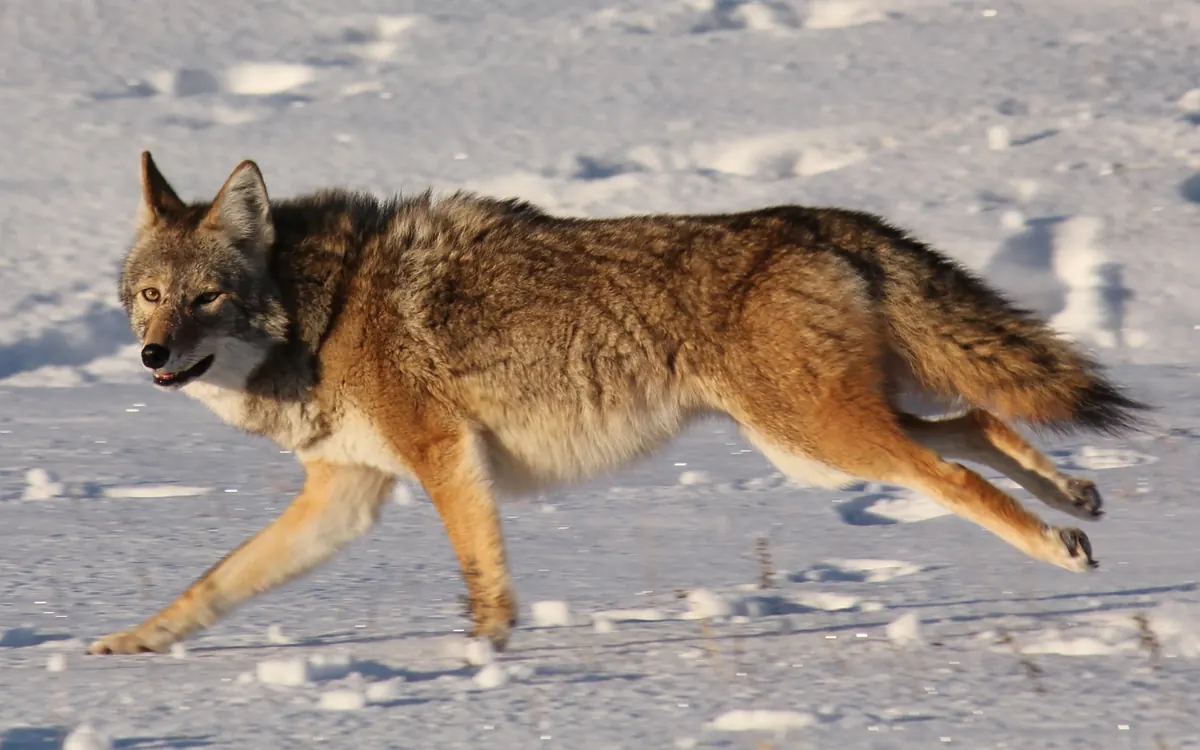
The DNR says coyotes, often solitary in summer, form groups in winter when food is scarce, and their breeding season runs from January through March. That is why their high yips, barks and howls are so common on January nights: family groups are announcing themselves. Urban coyotes are more noticeable now too. Keep dogs on a leash where coyotes are known, never feed them, and if one comes close, make noise and look big.
-
Flying squirrels in a heap
All winter, after dark · Oak and hickory woods and floodplain timber, mostly in eastern Iowa
Southern flying squirrels do not hibernate; they glide between trees all winter at night. To stay warm, several share one tree hole, and the DNR reports finding as many as 50 in a single den. They are a species of special concern in Iowa and depend on old trees with cavities.
-
Reading tracks in the snow
The morning after a light, fresh snowfall · Field edges, creek banks, woodland trails
A coyote or fox leaves a neat, nearly straight line of oval prints, each hind foot landing in the front foot’s track, while a house dog’s trail wanders. Cottontails leave Y-shaped groups of four, squirrels a set of four that ends at a tree, and deer split hearts sunk deep in soft snow. Low morning light from the side shows the most detail.
The DNR says the white-tailed deer breeding season, which peaked in November, winds down by mid-January. Photograph tracks beside a glove for scale.
How can you identify Iowa trees in winter?
Without leaves, bark and twigs carry the clues. First check whether buds and side branches sit in opposite pairs (maples, ashes, dogwoods) or alternate along the twig (oaks, hickories, walnuts and most others). Iowa State University Extension’s tree pages describe each species.
-
Bur oak
All winter; brown leaves sometimes hang on · Savannas, upland woods and old pastures statewide
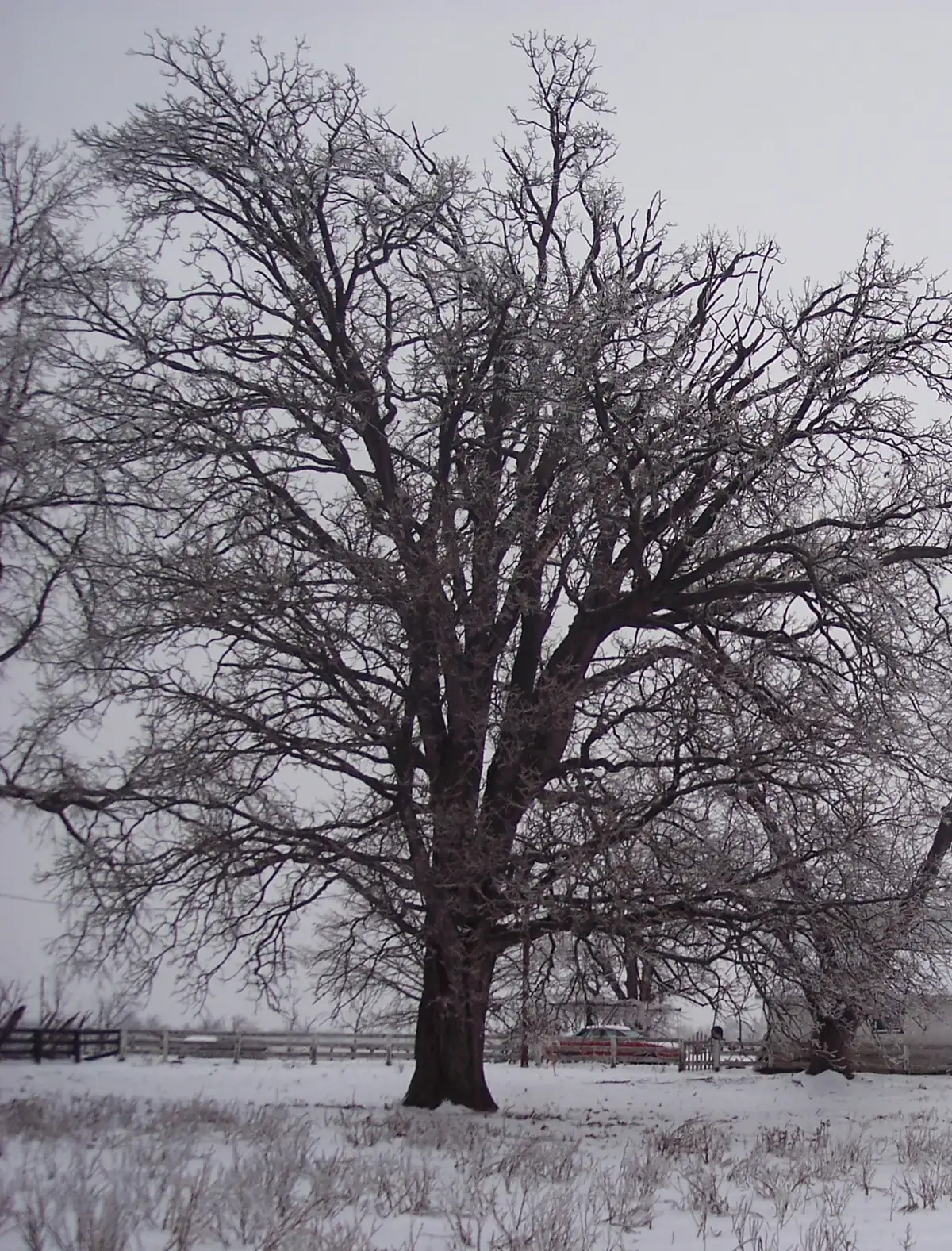
Bark dark gray and deeply ridged. Older twigs grow corky ridges, and the buds cluster at the tip, small and covered in fine gray hairs. Under the tree, look for the big acorn caps with their shaggy fringe along the rim, which give the species its name.
-
Shagbark hickory
All winter · Dry upland woods and bluffs in roughly the eastern two-thirds of Iowa
The easiest tree in the woods to name from a distance: its bark breaks into long plates that peel outward at top and bottom. Up close, the terminal buds are large, egg-shaped and up to three-quarters of an inch long, and the leaf scars are big and heart-shaped. ISU notes that shagbark thins out toward the west, reaching about the Boyer and Raccoon rivers.
-
Hackberry
All winter; fruits persist into late winter · Throughout Iowa, especially bottomlands
Look for gray bark covered in warty bumps that grow into narrow corky ridges on older trees, and slender zigzag twigs. The small dark purple fruits hang on into late winter, and many kinds of birds eat them.
-
Black walnut
All winter · Bottomlands, stream terraces and sheltered slopes in most of Iowa
Dark, deeply furrowed bark with interlacing ridges, and stout twigs. Slice one lengthwise and you will see the pith is divided into small chambers, tan to light brown, a feature it shares with hackberry near the buds.
Hitchcock Nature Center near Honey Creek holds a Winter Tree ID class through its folk school on Saturday, January 9, from 10 a.m. to noon ($10, ages 16 and up). Pick one tree near home and add its bark and a twig to your journal every season.
When is the ice safe on Iowa lakes in January?
January is the heart of ice fishing season on Iowa’s natural lakes in the north, the Iowa Great Lakes and Clear Lake among them, and on county lakes and ponds farther south. The DNR’s weekly fishing report for January 22, 2026, shows how uneven the ice can be in the same week: 11 to 12 inches on Clear Lake, where yellow bass and perch were biting, more than a foot on most of Spirit Lake, 10 to 12 inches on Volga Lake in Fayette County, but anywhere from 1 to 7 inches on Lake Anita in Cass County.
-
How thick is thick enough
Check every time you go out · Lakes and ponds statewide
The DNR’s guideline is four inches of clear ice at minimum before walking out to fish, and more for machines: a snowmobile or ATV needs five inches or better (seven is safer), a bigger utility vehicle at least seven. It adds that no ice is ever fully safe. Drill or chisel test holes as you go, and turn back from slushy, dark or honeycombed patches and from snow that looks discolored.
-
University of Okoboji Winter Games
Thursday, January 28, to Sunday, January 31, 2027 · Okoboji and the Iowa Great Lakes, Dickinson County
A long-running community festival held, its organizers say, always on the last weekend of January. The schedule includes broomball, a winter kite festival on the ice, a polar plunge, a chili cook-off and fireworks. Events on the ice depend on conditions, so check the organizers’ site before driving up.
Rivers are another matter: current wears ice thin from below, so stay off river ice altogether.
When are the coldest days of the year in Iowa, and what might El Niño do?
Right about now. NOAA’s 1991–2020 daily normals bottom out in mid-January: at Des Moines the typical high sits at 30.5 °F from about January 13 to January 20 and the typical low at 13.2 °F from about January 18 to January 24, while at Mason City the normal high flattens at 23.8 °F and the low at 6.4 °F around the same weeks. January is also when Iowa has the most nights below zero. On average, according to the same normals, Mason City sees about 10 such nights in January, Waterloo 9, Dubuque about 7 and a half, Des Moines about 5 and Burlington about 4.
Snow is usually on the ground for much of the month in the north. Mason City averages 11.3 inches of January snowfall, and on roughly 24 of the month's 31 days its ground stays white under an inch or more; Dubuque 10.7 inches, Des Moines 9.4 and Sioux City 7.7. January is a dry month by liquid measure, though, with normal precipitation from 0.69 inch at Sioux City to 1.45 inches at Burlington.
The tropical Pacific may tip the odds this winter: federal forecasters, writing on September 10, gave the El Niño now under way better than a 90 percent chance of being very strong through the winter. NOAA’s official winter outlook (first issued October 15, revised monthly) lives on the CPC outlooks page; check there for the latest. History offers mixed signals. The Des Moines weather office found that strong events have left Iowa winters about 2.5 to 3.5 °F above normal, with six of eight milder than average at Des Moines and Waterloo, and that they lean wetter, most clearly in southern Iowa. The La Crosse office found Upper Mississippi Valley snowfall averaging up to 10 inches below normal in strong events, yet up to a third of them were snowier than normal. State Climatologist Justin Glisan expected a milder, drier pattern when he spoke in July. So: likely milder, with precipitation a toss-up, and an Arctic outbreak still possible. Before you head out, check current conditions, and for when the growing season returns, see the Iowa frost dates.
How much daylight does Iowa gain in January?
The latest sunrises of the winter come in the first week of January, and from then on both ends of the day move in your favor, the evenings faster than the mornings. Between January 1 and 31, Iowa cities gain 47 to 52 minutes of daylight.
| City | Jan 1 | Jan 31 | Gained | Per day |
|---|---|---|---|---|
| Decorah | 9 h 02 m | 9 h 54 m | 52 min | 1.7 min |
| Mason City | 9 h 03 m | 9 h 55 m | 52 min | 1.7 min |
| Dubuque | 9 h 08 m | 9 h 57 m | 49 min | 1.6 min |
| Sioux City | 9 h 08 m | 9 h 57 m | 49 min | 1.6 min |
| Cedar Rapids | 9 h 11 m | 10 h 00 m | 49 min | 1.6 min |
| Des Moines | 9 h 14 m | 10 h 02 m | 48 min | 1.6 min |
| Council Bluffs | 9 h 16 m | 10 h 03 m | 47 min | 1.6 min |
| Burlington | 9 h 18 m | 10 h 05 m | 47 min | 1.6 min |
The northern cities, which had the least light at the solstice, gain the most through January. The gain also speeds up as the month goes on, from well under a minute a day at New Year to around two minutes a day by the end of the month. The daylight calculator gives the exact times, twilight included, wherever you live.
What can you see in Iowa’s night sky in January 2027?
Cold, dry Arctic air often brings crisp, steady skies to Iowa in January, and the nights are still long. This month brings a nicely timed meteor shower and a supermoon.
-
The Quadrantids
Active December 28 to January 12; peak on the night of Sunday, January 3, into Monday, January 4 · Radiant low in the north in the evening, climbing high before dawn
This shower has a narrow peak lasting only a few hours, and predictions for 2027 differ: one puts it at about 9:30 p.m. CST on January 3, another near 11:45 p.m. Both fall during Iowa’s night, which is lucky. Because the radiant keeps rising until dawn, the early hours of Monday often bring the best rates even after the peak has passed. From a dark site well away from town, a few dozen an hour is a fair hope. The moon is only a sliver of a crescent, up only in the last hours of the night, so it will barely interfere.
-
The Wolf Moon, the closest full moon of 2027
Full at 6:17 a.m. CST on Friday, January 22 · Rising in the east-northeast at dusk on the 21st
Perigee, the moon’s closest approach, arrives about 14.5 hours earlier than full moon, making this the year’s largest supermoon. The full moment falls just before dawn on Friday, so plan to go out Thursday, January 21, when it rises close to sunset and rides high at midnight. It still looks full on Friday evening. On Saturday evening, the 23rd, it passes close to bright Jupiter.
-
Earth closest to the Sun
8:33 p.m. CST on Saturday, January 2 · No viewing needed
Earth makes its nearest pass of the year to the Sun, about 91.4 million miles. Iowa’s winter has nothing to do with distance; it comes from the tilt of Earth’s axis, which keeps the sun low and the days short.
-
Venus at its best before dawn
All month; greatest elongation January 3 · Southeast before sunrise
Venus, the dazzling morning star, reaches its farthest from the Sun on January 3 and rises long before dawn all month. Saturn sinks into the southwest after dark, and Jupiter climbs higher in the east each evening. Mercury edges into the evening twilight, very low in the west-southwest, during January’s last few days, on its way to a better showing in early February.
| Phase | Date | Time |
|---|---|---|
| New moon | Thursday, Jan 7 | 2:24 p.m. |
| First quarter | Friday, Jan 15 | 2:34 p.m. |
| Full moon, the Wolf Moon | Friday, Jan 22 | 6:17 a.m. |
| Last quarter | Friday, Jan 29 | 4:55 a.m. |
The darkest evenings, best for faint stars, bracket the new moon of January 7. For cloud cover tonight, open Today’s sky; the moon phases page has moonrise times wherever you are.
What can Iowa families do outdoors in January?
- Friday, January 1: First Day Hikes. Iowa’s state parks hold New Year’s Day walks every year; 44 parks took part on January 1, 2026, with guided or self-guided routes. The DNR’s First Day Hikes page will carry the 2027 list.
- January 1 to 5: final Christmas Bird Count days. Audubon’s 127th season wraps up Tuesday, January 5; the Iowa Ornithologists’ Union posts counts on its calendar as compilers schedule them.
- Wednesday, January 6, and Saturday, January 9: Preschool Trail Trekkers, Winter Water Wonders at Indian Creek Nature Center in Cedar Rapids, 10 to 11 a.m., snow and ice for 3- to 5-year-olds and their grown-ups ($5 each).
- Saturday, January 9: Winter Tree ID at Hitchcock Nature Center, 10 a.m. to noon, ages 16 and up ($10).
- Wednesday, January 13: Whoo’s In The Woods? at Hitchcock, a homeschool owl program, 10 a.m. or 1 p.m. ($5 per child).
- Mid-January: eagle watching. Burlington, LeClaire, Keokuk and Clinton hold free eagle events most winters; confirm 2027 dates with the hosts.
- January 28 to 31: University of Okoboji Winter Games on the Iowa Great Lakes.
- Saturday, January 30: Backcountry Film Festival at Indian Creek Nature Center, 6 to 9:30 p.m. (also in Iowa City the night before).
- All month: Project FeederWatch from your own window.
Iowa’s other months, and guides for every state, are on the nature hub; last month’s Iowa guide is at /nature/iowa/december. Winter programs change with the weather, so check with the host before you set out.
Safety notes for January in Iowa
- Deer seasons into January. According to the Iowa DNR’s 2026–27 season list, the late muzzleloader and late archery deer seasons run through January 10, the nonresident holiday season through January 2, and the January antlerless seasons from January 11 to 24. Pheasant season closes January 10; quail, gray partridge, ruffed grouse and squirrel stay open until January 31, and cottontails until February 28. Goose seasons end January 9 in the north zone, January 16 in the central zone and January 23 in the south, and the light goose conservation order opens statewide on January 24. Crow season reopens January 14, most furbearer seasons run to February 28, and coyote hunting is open all year.
- Blaze orange. Iowa Code 481A.122 requires firearm deer hunters to have on a visible outer garment of solid blaze orange, such as a coat, vest, shirt or sweatshirt; a hat alone does not count. Upland bird hunters need at least one outer item, which can be a cap, that is at least half solid orange. If you hike on public hunting land during the January deer seasons, wear orange yourself and dress your dog in it too.
- Ice. Follow the DNR’s minimum thickness guidelines above, fish with a partner, tell someone where you will be, and wear ice picks around your neck. Avoid river ice and the edges of any lake near inlets, culverts or aerators.
- Cold and wind chill. Below-zero nights are common, and wind over open farmland makes them worse. Dress in layers, cover fingers, ears and nose, and head in if anyone is shivering hard or has numb, waxy skin.
- Snow and blowing snow. On the open prairie, strong winds after a snowfall can drop visibility to near zero in minutes even under a blue sky. Check the forecast and road reports, carry a winter kit, and if you slide off the road, stay inside the car and wait for help.
Sources
- Iowa DNR: Bald Eagle status in Iowa, 2025 (Midwinter Survey and nest monitoring report, Stephanie Shepherd)
- Iowa DNR: bald eagle (nesting season, viewing distances)
- U.S. Army Corps of Engineers: National Midwinter Bald Eagle Survey
- Des Moines County Conservation: Soaring Through Winter (Eagle Watch, Burlington)
- Visit LeClaire: LeClaire Eagle Festival
- Keokuk Area Convention and Tourism Bureau: bald eagles returning to Keokuk
- KWQC: 41st annual Bald Eagle Watch held in Clinton (February 9, 2025)
- U.S. Army Corps of Engineers, Rock Island District: 42nd annual Clinton Bald Eagle Watch, January 31, 2026
- Iowa DNR: trumpeter swans (wintering numbers, reporting marked swans)
- Iowa DNR: Iowa Trumpeter Swan Restoration, 2023 summary (Hoffman, Evelsizer and Buckardt Thomas)
- Iowa DNR via The Trumpeter Swan Society: Iowa trumpeter swan restoration (traditional wintering sites)
- Cass County Conservation Board: Conservation Quarterly, fall 2025 (Schildberg Quarry swans)
- Iowa DNR: owls of Iowa
- Finch Research Network: Winter Finch Forecast 2026–2027 (Tyler Hoar, September 25, 2026)
- Project FeederWatch: how to participate
- Iowa DNR: coyotes
- Iowa DNR: southern flying squirrel
- Iowa DNR: white-tailed deer
- Iowa State University Extension and Outreach Forestry: bur oak
- Iowa State University Extension and Outreach Forestry: shagbark hickory
- Iowa State University Extension and Outreach Forestry: hackberry
- Iowa State University Extension and Outreach Forestry: black walnut
- Iowa DNR: stay safe on the ice this winter (December 9, 2025)
- Iowa DNR weekly fishing report, January 22, 2026 (via KCHA News)
- University of Okoboji Winter Games
- NOAA NCEI: 1991–2020 monthly normals for Iowa stations, January (data API)
- NOAA NCEI: 1991–2020 daily normals, Des Moines and Mason City (data API)
- NOAA NCEI: U.S. Climate Normals 1991–2020
- Climate Prediction Center: ENSO diagnostic discussion, September 10, 2026
- Climate Prediction Center: three-month outlooks
- NWS Des Moines: El Niño impacts in Iowa (Craig Cogil, PDF)
- NWS La Crosse: temperatures and precipitation in the ten strongest El Niño winters
- KSCJ: El Niño means Iowa may be warm and dry for a while (State Climatologist Justin Glisan, July 17, 2026)
- U.S. Naval Observatory: moon phases (data API)
- U.S. Naval Observatory: Earth’s seasons and apsides, 2027
- Fred Espenak: Sky Event Almanac 2027
- American Meteor Society: meteor shower calendar
- EarthSky: Quadrantid meteor shower
- EarthSky: what is a supermoon
- Sea and Sky: astronomy calendar 2027
- Iowa DNR: First Day Hikes
- Iowa Ornithologists’ Union: Christmas Bird Counts
- Indian Creek Nature Center, Cedar Rapids: events, January 2027
- Pottawattamie Conservation: events calendar (Hitchcock Nature Center, January 2027)
- Iowa DNR: Iowa hunting seasons, 2026–2027
- Iowa Code 2026, section 481A.122: hunters’ orange apparel (PDF)
- Photos via Wikimedia Commons; licenses and photographers are credited under each picture
