What to look for in nature in Iowa this December
Winter, by the weather bureau’s reckoning, begins December 1; the three months from then through February are the coldest in Iowa on average. The duck seasons close zone by zone, ice starts to edge out from the riverbanks, and bald eagles move to the few places where the water stays open: the tailwaters below the Mississippi locks and the big reservoir dams. Owls begin to hoot from the timber, Christmas Bird Count volunteers fan out across 15-mile circles from mid-month, and the sun sets earlier in the second week than at any other time of year. The notes below go through it place by place.
Other months in Iowa: October, November.
Start here
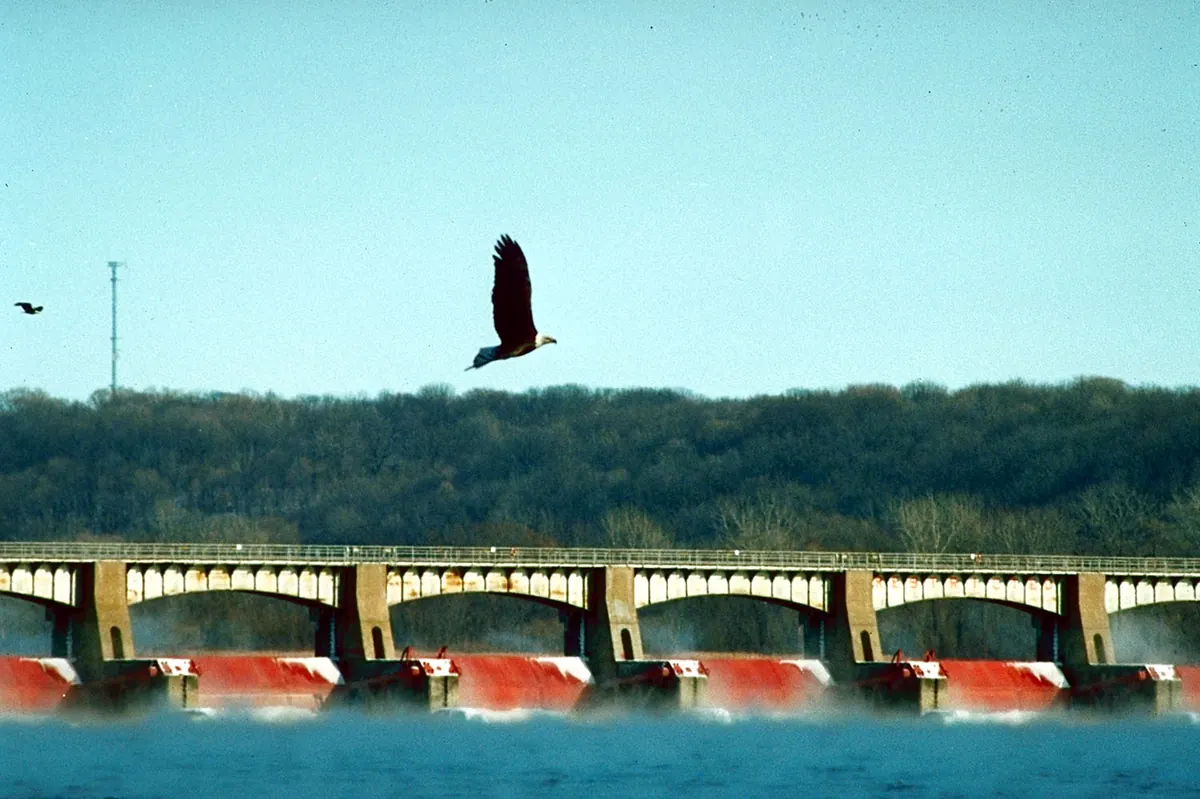
- Eagles where the river stays open. As ice forms in December, bald eagles pack into the stretches of unfrozen river just downstream of the Mississippi’s locks and dams. Lock and Dam 14 at LeClaire and the Highway 61 stretch between Mediapolis and Burlington are dependable places to start, and DeSoto National Wildlife Refuge on the Missouri expects its eagle peak early in the month.
- Count birds for Audubon. This season’s Christmas Bird Count, Audubon’s 127th, has a count window of December 14 through January 5. Iowa ran 35 counts in the 125th, in 2024–25, the latest with a published state summary. Beginners are welcome: contact a local compiler before count day, or, if you live inside a circle, tally the birds that visit your feeder.
- Geminids, then the year’s closest full moon. The Geminids, usually the richest meteor shower of the year, reach their peak on the night of Sunday, December 13, under a thin crescent that sets in mid-evening. Ten days later, at 7:28 p.m. Central on Wednesday, December 23, comes the Cold Moon, the nearest and largest-looking full moon of 2026.
In the Naturalist’s Field Journal for December, list every eagle, owl and swan of your Christmas Bird Count day under “birds I have seen,” draw a cottontail or fox trail in fresh snow on “tracks to know,” follow one eastern redcedar on the “tree through the seasons” plate, add a white pine cone to “seeds, pods and cones,” and time the year’s earliest sunset for the dusk and dawn watch. Beside each entry, write where you were, the date and the temperature.
Regions used below: Northeast Iowa and the Driftless; Eastern Iowa and the Mississippi River; Central Iowa and Des Moines; Northwest Iowa and the Iowa Great Lakes; Western Iowa and the Loess Hills; Southern Iowa.
Where can you see bald eagles in Iowa in December?
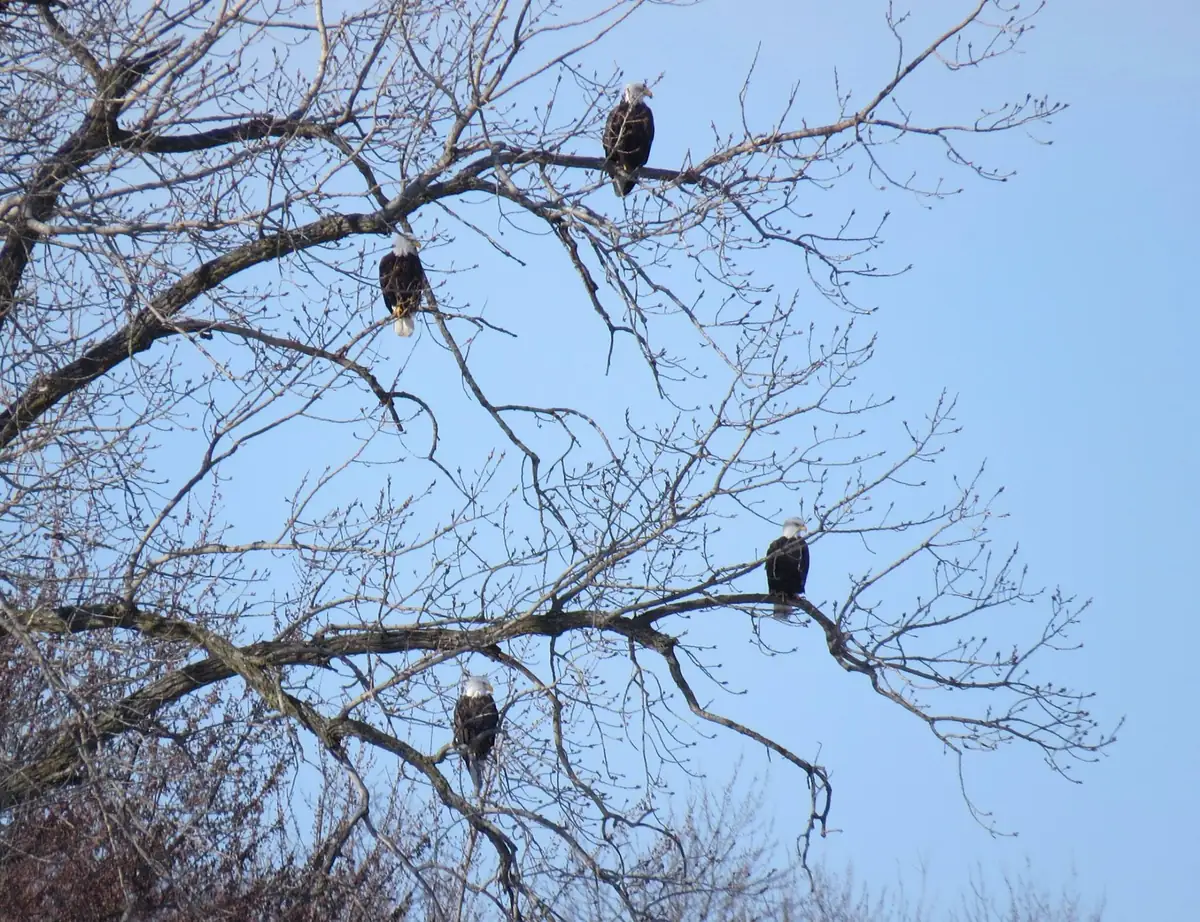
In November the eagles were still on the move, trailing the swans and geese south. December is when they start to settle. As the backwaters and lakes freeze, the birds collect wherever moving water keeps a channel open and fish within reach. The Iowa DNR names the Mississippi as the place with the highest winter concentration of eagles in the Midwest, especially below the locks and dams and near power plants that keep the river from icing over.
-
Lock and Dam 14 at LeClaire
Gathering from December, as ice forms; staying into late February or early March · Mississippi River just off Highway 67, south of Interstate 80, Scott County
LeClaire’s tourism office says the eagles begin to collect on the south side of the dam once ice starts to form in December. Next to the dam, The Nature Conservancy’s Lock and Dam No. 14 Eagle Area protects a strip of riverside woods (cottonwood, silver maple, sycamore and river birch) where the eagles roost; the families who gave the land worked out its management with the Army Corps of Engineers.
-
Highway 61 and Lock and Dam 18
December through February; mornings are best · Highway 61 from Mediapolis to Burlington; Flint Creek at Starr’s Cave; Lock and Dam 18 near Gladstone, Illinois
Des Moines County Conservation calls December through February the peak season around Burlington and lists the treetops along Highway 61, Flint Creek at Starr’s Cave and the levee near the 4th Pumping Station campground as reliable spots. Numbers swing with the weather: mild winters bring fewer, while in cold winters the county says as many as 1,000 eagles may gather. Its main Eagle Watch comes in January, but the birds are already here by Christmas.
-
Below Saylorville Dam
Late fall through early spring · Des Moines River below Saylorville Dam, north of Des Moines
Central Iowa has its own version. The tailwater below the Corps of Engineers dam at Saylorville stays open in hard cold, and a BirdWatching site guide lists bald eagles at Saylorville from fall through spring alongside winter gulls and waterfowl.
-
DeSoto and the Missouri
Peak in early December; a second peak in early March · DeSoto National Wildlife Refuge, Missouri Valley, Harrison County
On the western border, the refuge expects its eagle numbers to top out in early December, when the tail of the snow goose flight is still on DeSoto Lake. Scan from the visitor center windows (open Tuesdays through Saturdays, closed Christmas Day), the Missouri River Overlook or the Bob Starr Wildlife Overlook. The refuge itself is open from half an hour before sunrise to half an hour after sunset. A few miles south, the Hitchcock Nature Center hawk watch keeps counting into mid-December, and its HawkCount record shows some of its biggest bald eagle days in early December.
Eagles in winter live on a tight energy budget, and the DNR asks watchers to keep at least 400 yards from a perched bird, to stay across the water from them where possible, and to leave feeding areas alone before 9 a.m., since most of an eagle’s feeding happens early.
When is the Christmas Bird Count in Iowa, and how can you join?
The Christmas Bird Count is the longest-running community science project there is. Every count is one day inside a fixed circle 15 miles wide, on a date its compiler picks between December 14 and January 5. This winter’s round is the 127th. The Iowa Ornithologists’ Union has gathered the state’s results and published them in Iowa Bird Life every year since 1937.
-
What the 125th count found
125th count, December 2024 to January 2025 · 35 count circles statewide
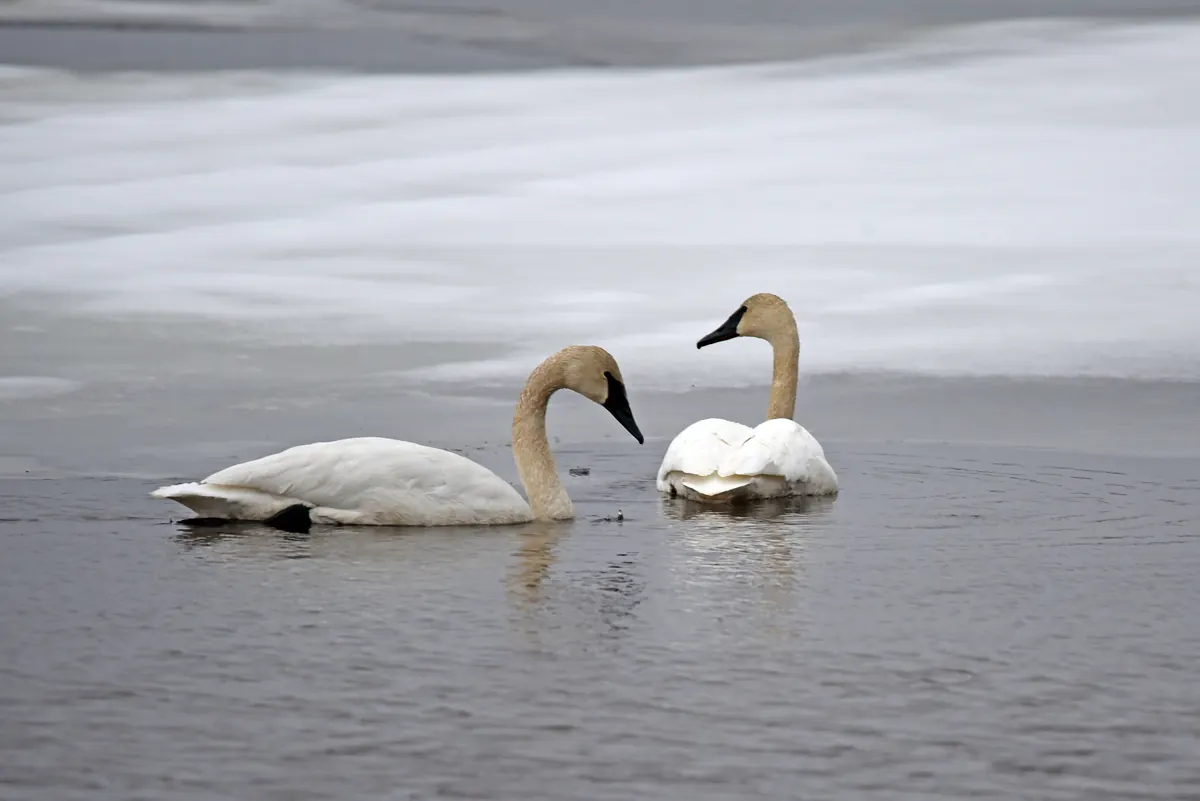
Iowa’s regional editor reported 139 species, a few below the state average. Davenport and Saylorville tied for the most, 94 each, followed by Muscatine (92) and Keokuk (88); DeSoto led the western counts with 79 and Northwest Clayton County led the north with 62. Seventeen regular species set state records. More than 5,000 trumpeter swans were counted statewide and more than 2,000 tundra swans at Clinton and Princeton, while canvasbacks ran well below their average. Bald eagles “counted extremely well,” barred owls came close to a record, and the season’s only snowy owl was a count-week bird at Iowa City. Fog, rain and icy roads hampered the first weekend, and only eight counts had any snow on the ground.
-
The record to beat
Set in the 124th count, 2023–24 · Saylorville, north of Des Moines
In the 124th count, Saylorville found 102 species, the highest total ever on an Iowa count, during what the editor described as Iowa’s warmest December since 1889. The statewide list that winter reached 154 species, a record.
-
Joining a count
Sign up in early December; counts run December 14 to January 5 · Any of the state’s count circles
The Iowa Ornithologists’ Union keeps a calendar of the season’s counts on its website, which compilers fill in as they set their dates; as of early October it was still empty. Audubon’s online map lists each circle with its compiler’s contact. The Iowa City count, held every year since 1951, shows how it works: small field parties go out with an experienced leader, people inside the circle can count their own feeders, and everyone meets at midday to compare notes. In 2025 its sign-ups closed four days before the count.
If you would rather stay home, Project FeederWatch runs all winter, and Indian Creek Nature Center in Cedar Rapids hosts an open FeederWatch session in its Bird Room on Tuesday, December 1, from 1 to 3 p.m. Add every species you see to the journal’s list with the date.
Which owls can you find in Iowa in winter?
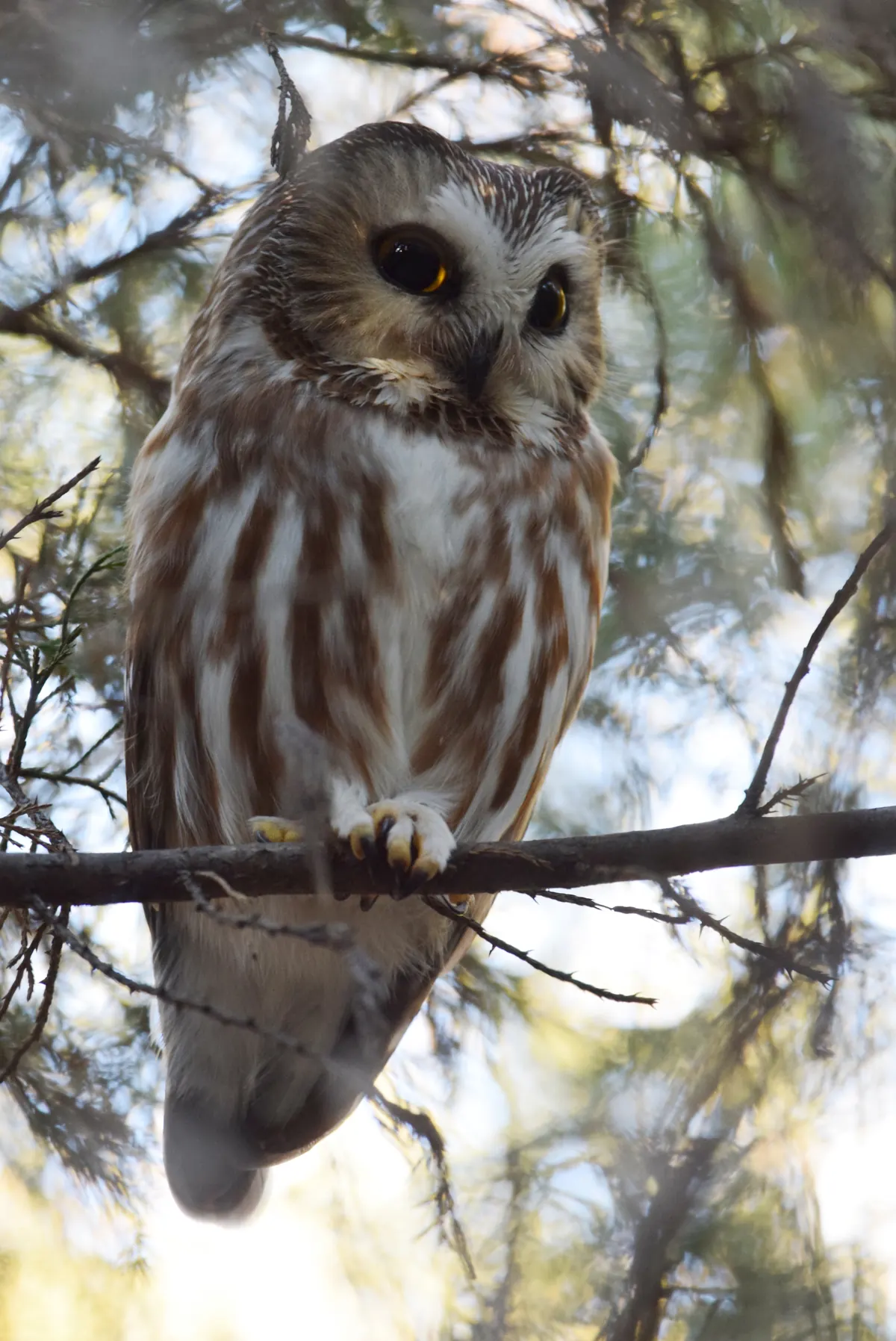
The DNR counts nine owl species that turn up in Iowa regularly or now and then. Some live here all year; others come down from the north only for the cold months. December is a good time to look, because the leaves are down and the residents are getting loud.
-
Great horned owls start the year early
Hooting through December; eggs often in January · Woodlots, river timber, shelterbelts and town parks statewide
The great horned owl is Iowa’s earliest-nesting bird of prey, and the DNR notes it often lays its eggs in January, frequently in an old red-tailed hawk nest. That means pairs are claiming territory now, and the deep, muffled series of hoots carries a long way on a still December night. In winter these owls sometimes stash extra prey; when hungry, they sit on the frozen cache to thaw it before eating.
-
Saw-whet and long-eared owls in the cedars
Winter visitors, roosting by day · Dense redcedar and pine stands, especially near grassland
Northern saw-whet owls, about 8 inches tall and weighing some 3 ounces, are a common winter visitor that roosts in cedars and other conifers. Long-eared owls, listed as threatened in Iowa, also arrive for winter and often roost together, returning to the same few groves year after year. Both are easiest to find by their sign: whitewash on the branches and gray pellets of fur and bone on the ground below. If you find one, look from a distance and leave quietly.
-
Snowy owls, some winters
Irregular; in irruption years sightings can start by late November · Open farm country, airports, big flat fields
The heaviest owl in North America breeds on the Arctic tundra, and when lemmings there run short, young snowy owls push south. In those years Iowa’s flat open land suits them, and they hunt by day from fence posts, field-edge mounds and grain bins. Nobody can predict an irruption months ahead; the 125th Christmas Bird Count in Iowa found just one, and only as a count-week bird. Report any you see to eBird, and give the bird plenty of room.
-
Short-eared owls over the grasslands
Late afternoon in winter · Large grasslands in southern and western Iowa
Once a common nesting bird of Iowa’s prairies, the short-eared owl is now mainly a winter visitor and is listed as endangered in the state. Look for it at dusk over big grassland tracts, coursing low on floppy, moth-like wingbeats, often where northern harriers hunt by day.
Dallas County Conservation leads a free daytime Owl Prowl at Voas Nature Area near Minburn on Monday, December 28, from 1 to 3 p.m., searching off trail for pellets, whitewash and roosting owls in the cedars; registration is required.
Which evergreens are native to Iowa, and where do the rare ones grow?
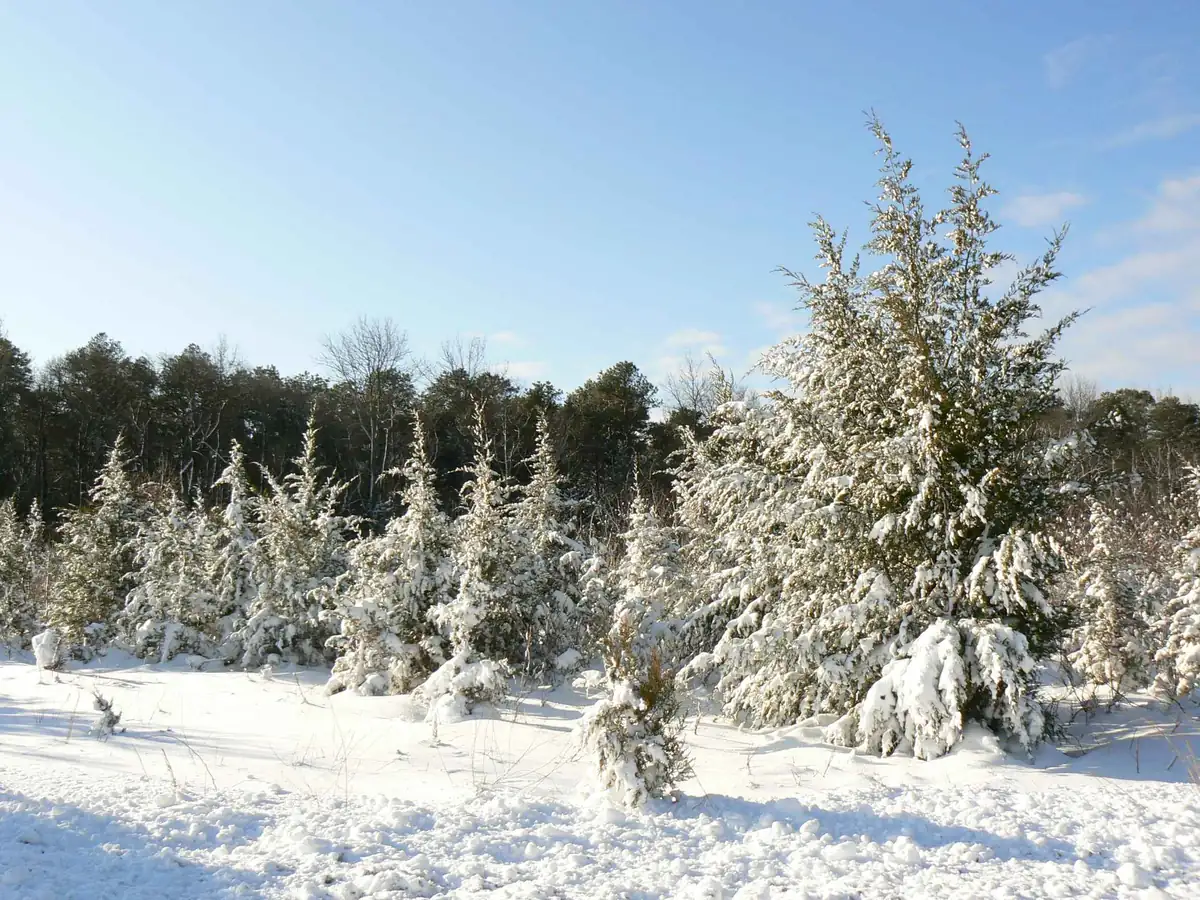
Bare woods make December the month to notice conifers. Most of the pines and spruces in Iowa’s yards, windbreaks and cemeteries were planted; Iowa State University Extension counts only five evergreens native to the state: eastern redcedar, eastern white pine, balsam fir, common juniper and Canada yew.
-
Eastern redcedar, everywhere
All winter; berries persist · Bluffs, pastures, fence lines and old fields statewide
Extension foresters call it probably the most important conifer in Iowa, native to every part of the state. Look for shaggy, reddish bark that peels in strips, twigs that feel square, and two kinds of leaves: tiny scales pressed flat and sharper, spreading awl-shaped ones. The dusty blue “berries” are really fleshy cones, and they hang on through winter as food for cedar waxwings and many other birds, which spread the seeds along fence rows.
-
White pine on the northeast bluffs
All year · Steep slopes of the Driftless; isolated native stands in Hardin and Muscatine counties
White pine is the one native pine, and the easiest conifer to name: soft, bluish needles 3 to 5 inches long in bundles of five, and long, slender cones with no prickles. Its natural home is the sandy or rocky slopes and ridges of northeast Iowa, though it has been planted so widely that you will see it across the state.
-
Balsam fir and yew on the ice-age slopes
The slopes take in cold air through the winter · Algific talus slopes in northeast Iowa; most refuge units are closed to the public
A few slopes in the Driftless hold plants that normally grow in a colder, more northern climate. The Fish and Wildlife Service explains how: in summer, air sinks through sinkholes, passes over ice in the rock and blows out of vents on the slopes, holding them between just above freezing and about 55 °F. In winter the flow runs the other way, cold air is drawn into the vents and the groundwater freezes again, recharging the system for next summer. Balsam fir and yew survive there, and so does the Iowa Pleistocene snail, a quarter-inch relict known only from fossils until 1955. Driftless Area National Wildlife Refuge protects many of these sites, which are too fragile for visitors; the forested bluffs of Yellow River State Forest and Pikes Peak give a sense of the country.
A quick key from Iowa State’s conifer guide: scale-like leaves mean a cedar or juniper; flat single needles with notched, blunt tips mean balsam fir; needles in bundles mean a pine (five for white pine, two for red, Scotch or Austrian). Collect a cone from each tree you name and draw them together on the journal’s seeds, pods and cones page.
How do Iowa’s animals get through winter?
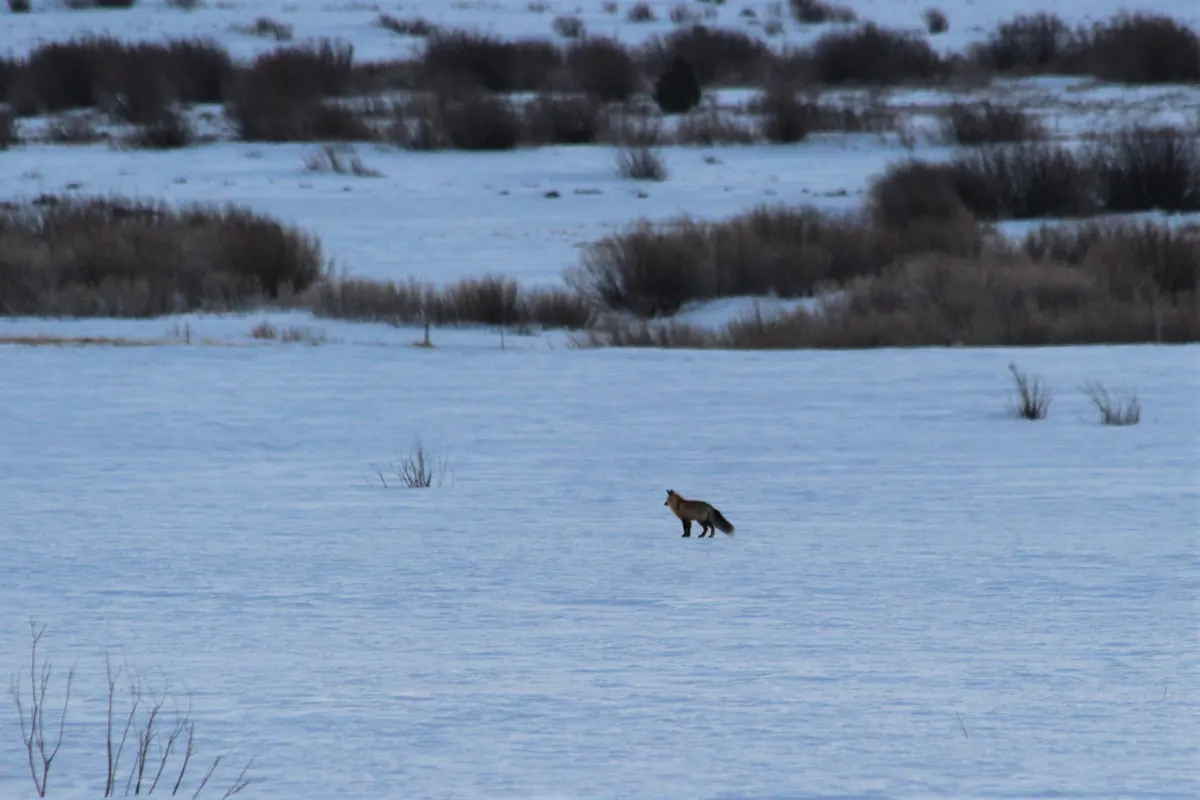
By December almost everything that is going to leave has gone, and what stays has a strategy. The DNR sorts them roughly this way: sleep it out, slow down for days at a time, or stay active and stay fueled.
-
True hibernators
Through midwinter · Burrows, caves and dens
Woodchucks, ground squirrels, some mice and the bats in Iowa’s caves are true hibernators: heart rate, breathing, body temperature and metabolism all drop far below normal for weeks at a time.
-
Sleepers that wake up
Cold snaps, from a few days to two weeks · Hollow logs, dens, attics and culverts
Raccoons, skunks, badgers and chipmunks do not truly hibernate. They hole up through a cold spell in a deep sleep that can last days to a couple of weeks, then come out on mild nights.
-
Frogs, turtles and fish below
All winter · Pond bottoms, mud, leaf litter
Cold-blooded animals burrow below the frost line or into the mud of a pond or lake bottom and slow their bodies almost to a stop. Gray treefrogs go further, making glycerol and other chemicals that work like antifreeze in their blood. Fish simply take the temperature of the water, and because ice forms on top and floats, the deeper water stays liquid and livable.
-
Life under the snow
Whenever snow covers the ground · Grassy fields, prairie plantings, yards
Mice and voles tunnel through the space beneath the snow, where it is warmer than the open air and they are hidden from hawks and owls. Deer and wild turkeys feed hard before a storm, then wait it out in the shelter of evergreens, often on south-facing slopes that catch the low sun. After a fresh snow, a walk along a field edge reads like a newspaper: a fox’s single straight line, a cottontail’s paired back feet ahead of its front feet, the place where a vole tunnel surfaces.
Hitchcock Nature Center’s Winter Survival Secrets workshop, inspired by Aldo Leopold, explores exactly this on Saturday, December 12, from 9 a.m. to noon ($15). Draw the tracks you find on the journal’s tracks-to-know plate.
How much snow does Iowa get in December, and what could El Niño change?
December is when Iowa’s average high falls below freezing in the north. NOAA’s 1991–2020 normals give a typical December high of 29.7 °F at Mason City, 31.8 °F at Dubuque, 35.9 °F at Des Moines and 37.4 °F at Burlington, with average lows from 13.5 °F at Mason City to 22.3 °F at Burlington. December is the first month that usually brings real snow cover, though the amounts vary a lot from year to year: at Dubuque, one December in four gets less than about 2 inches, and another one in four more than 17.
| Station | Average snowfall | Median snowfall | Days with 1 inch or more on the ground |
|---|---|---|---|
| Mason City (north central) | 9.4 in | 7.5 in | 16.3 |
| Waterloo (northeast) | 9.9 in | 7.7 in | 13.0 |
| Dubuque (Mississippi River) | 10.3 in | 7.3 in | 13.2 |
| Sioux City (west) | 7.6 in | 5.0 in | 12.9 |
| Des Moines (central) | 7.9 in | 6.7 in | 10.2 |
At every station the median is below the average, because a handful of very snowy Decembers lift the average. Mason City, the coldest of the five, keeps its snow longest, about half the month on average. Freeze dates for every station, including the spring ones you will be waiting for, are on our Iowa frost dates page.
This winter the tropical Pacific will have its say. On September 10 federal forecasters gave this El Niño more than a nine-in-ten chance of reaching very strong status by winter. NOAA’s official December-to-February outlook is issued October 15, too late for this page, and is posted with monthly updates on the CPC three-month outlook page. On the history, Iowa State Climatologist Justin Glisan said in July that the pattern points toward warmer temperatures, drier conditions and less snowfall. The La Crosse weather office, looking at the strongest El Niños, found Upper Mississippi Valley seasonal snowfall running as much as 10 inches below normal, while noting a spread of about 45 inches between the leanest and snowiest of those winters. The Des Moines office’s study adds that strong events have left Des Moines about 2.6 °F warmer than normal for December through February. Treat all of that as loaded dice, not a forecast for any one storm; the Weather now page is the place to check before a trip.
When is the earliest sunset in Iowa?
Not on the shortest day. The winter solstice arrives at 2:50 p.m. Central on Monday, December 21, and that is the day with the least daylight. But the earliest sunsets fall in early December, before the 10th, and the latest sunrises don’t arrive until early January. The reason is that the solar day runs a little longer than 24 hours around the solstice, so sunrise and sunset both drift later on the clock while the day is still shrinking.
| City | Dec 1 | Dec 21 | Dec 31 | Earliest sunset |
|---|---|---|---|---|
| Decorah | 9 h 13 m | 8 h 58 m | 9 h 02 m | 4:31 p.m., Dec 9 |
| Mason City | 9 h 14 m | 9 h 00 m | 9 h 02 m | 4:37 p.m., Dec 9 |
| Dubuque | 9 h 18 m | 9 h 04 m | 9 h 07 m | 4:29 p.m., Dec 9 |
| Sioux City | 9 h 17 m | 9 h 04 m | 9 h 07 m | 4:52 p.m., Dec 9 |
| Cedar Rapids | 9 h 21 m | 9 h 07 m | 9 h 10 m | 4:35 p.m., Dec 8 |
| Des Moines | 9 h 23 m | 9 h 09 m | 9 h 13 m | 4:44 p.m., Dec 8 |
| Council Bluffs | 9 h 25 m | 9 h 12 m | 9 h 15 m | 4:54 p.m., Dec 8 |
| Burlington | 9 h 28 m | 9 h 15 m | 9 h 18 m | 4:37 p.m., Dec 8 |
Between December 1 and the solstice, Iowa cities lose about 14 minutes of daylight, and the north has the least of it: on December 21, Decorah gets 8 h 58 m of sun, Burlington 9 h 15 m. The minimum sunset is shallow, so the date in the table matters less than the minute; in Des Moines the sun sets at 4:45 p.m. on December 1, bottoms out at 4:44 around December 8, and is back to 4:48 on the solstice and 4:54 by New Year’s Eve, while sunrise keeps slipping from 7:38 to 7:41. Western Iowa sits far from the center of its time zone, so Sioux City’s winter sunrise comes at 7:52 on the solstice, about 23 minutes after Dubuque’s. Look up your own town’s times, twilight included, in the Field almanac.
What can you see in Iowa’s night sky in December?
Long nights and a sky that often clears behind a cold front make December a fine month for stargazing, if you dress for it. The year’s best meteor shower comes in the middle of the month with almost no moonlight.
-
The Geminids
Active December 4–20; best on the night of Sunday, December 13, into Monday morning · Radiant in Gemini, up in the east by mid-evening
The International Meteor Organization expects a rate of about 150 an hour under ideal skies at the peak, which it places on the morning of Monday, December 14, by Iowa clocks; other predictions put it a few hours earlier. Either way, Sunday night into Monday is the one to watch. The moon is a slim crescent, about a fifth lit, that sets around 9 p.m., and the radiant is highest at about 2 a.m., when rates are best. Expect fewer than the ideal figure from anywhere with a glow on the horizon, so drive away from town lights if you can.
-
The Cold Moon, the closest full moon of 2026
Full at 7:28 p.m. CST on Wednesday, December 23 · Rising in the east at dusk and up all night
Full moon and the month’s perigee, the moon’s nearest point to Earth, come roughly seven hours apart this time, so it is the nearest and largest-looking full moon of 2026, the year’s last supermoon. It is full on the evening of the 23rd and still looks round on Christmas Eve. On snow-covered ground, expect moon shadows sharp enough to walk by.
-
Venus before dawn, Saturn after dusk
All month · Venus low in the southeast before sunrise; Saturn in the south and southwest after dark
Venus is the brilliant morning star, far brighter than anything but the moon. Before sunrise on the 4th and 5th, a waning crescent hangs close by, with the star Spica between them. Jupiter and reddish Mars share the dawn sky; by Christmas week Jupiter clears the eastern horizon by mid-evening. In the evening, Saturn is the only bright planet, setting a few hours after dark by month’s end. On the 21st, after dark, the moon, nearly full, drifts right by the Pleiades.
-
The Quadrantids, a New Year’s bonus
Peak about 9:25 p.m. CST on Sunday, January 3, 2027 · Best in the hours before dawn
The Quadrantids have a sharp, short peak, with rates around 80 an hour in a good year, and this time the moon is a thin waning sliver near new, out of the way. Because the peak falls in the evening for Iowa, try both the late evening of January 3 and the hours before dawn on January 4.
| Phase | Date | Time |
|---|---|---|
| Last quarter | Tuesday, Dec 1 | 12:08 a.m. |
| New moon | Tuesday, Dec 8 | 6:52 p.m. |
| First quarter | Wednesday, Dec 16 | 11:42 p.m. |
| Full moon, the Cold Moon | Wednesday, Dec 23 | 7:28 p.m. |
| Last quarter | Wednesday, Dec 30 | 12:59 p.m. |
For tonight’s cloud cover, open Today’s sky, and find when the moon rises over your town on the moon phases page.
What are the best December outings for Iowa families?
- Tuesday, December 1: FeederWatch in Cedar Rapids. An open session in Indian Creek Nature Center’s Bird Room, 1 to 3 p.m.
- Saturday, December 5: Nature’s Noel at Indian Creek Nature Center, 9 a.m. to 1 p.m., a holiday market of handmade decorations, gifts and baked goods.
- Wednesday, December 9, and Saturday, December 12: Preschool Trail Trekkers: Stars at Indian Creek, 10 a.m., an introduction to stars and constellations for small children with an adult.
- Saturday, December 12: winter at Hitchcock. Wild Sprouts for little ones, 9 to 10 a.m. ($5 per adult), and the Winter Survival Secrets workshop for teens and adults, 9 a.m. to noon ($15).
- Sunday night, December 13: the Geminids. For children, the first hour or two after the moon sets, around 9 p.m., is plenty.
- Thursday, December 17: Story Weaver, Festive Folktales at Hitchcock Nature Center, 6 to 7:30 p.m., free with park admission.
- Monday, December 21: Winter Solstice Celebration at Hanging Rock Park in Redfield, 7 to 8 a.m., watching the sunrise with a Dallas County naturalist at the park’s astronomical clock on the ridge; register so you hear about weather changes.
- December 14 to January 5: a Christmas Bird Count. Sign up with a compiler, or count your own feeder inside a circle.
- Monday, December 28: Voas Owl Prowl near Minburn, 1 to 3 p.m., free with registration. Dallas County follows with a Winter Survival program at Kuehn Conservation Area near Earlham on Wednesday, December 30, at 1 p.m.
- December 29 to 31: winter break camps at Indian Creek Nature Center, 9 a.m. to 3 p.m. daily, with themes from scales and slime to feathers and fur.
- New Year’s Day 2027: First Day Hikes. On New Year’s Day 2026, staff and volunteers led free hikes at 23 state parks and 21 more suggested self-guided trails. The DNR usually posts the new list in December.
Iowa’s other months, and every other state, are linked from the nature hub. Winter programs are the ones most likely to change with the weather, so confirm with the host on the morning of the event.
Safety notes for December in Iowa
- Gun deer seasons. The Iowa DNR’s 2026–27 dates put the first shotgun season on December 5–9 and the second on December 12–20, with the late muzzleloader season and the late archery split both running December 21 to January 10. Deer archery’s early split ends December 4. These are the busiest days in the Iowa woods; last year the DNR expected more than 100,000 hunters for the gun seasons. Pheasant (to January 10), quail, partridge and ruffed grouse (to January 31), rabbits and squirrels stay open all month. The duck seasons close December 8 in the north zone, December 15 in the central zone and December 22 in the south, and fall turkey reopens for resident archers on December 21.
- Orange during gun season. State law (Iowa Code 481A.122) says a firearm deer hunter must have on a visible outer vest, coat, jacket, shirt, sweater, sweatshirt or pair of coveralls made of solid blaze orange; an orange cap by itself is not enough. Pheasant and quail hunters need one outer item, a cap included, that is at least half solid orange. The DNR urges deer hunters to wear more than the minimum. Anyone walking on wildlife areas or in state forests during the shotgun seasons should wear bright orange, and so should dogs; on public land, consider a walk somewhere else that week.
- Early ice. The DNR says no ice is ever completely safe and asks for at least four inches of clear ice before anyone walks out to fish, five to seven for a snowmobile or ATV. Snow on top insulates the ice and slows its growth while hiding weak spots, and river ice is about 15 percent weaker than lake ice. Never go out alone, and carry ice picks and a rope.
- Cold and short days. With the sun setting before 5 p.m. across Iowa for most of the month, aim to be walking back toward the car by mid-afternoon, carry a headlamp, and dress in layers that stay warm when wet.
- Winter roads. The first real snows and freezing drizzle usually come this month. Check Weather now and road conditions before any long winter drive, and keep a blanket and water in the car.
Sources
- Iowa DNR: bald eagle (winter concentrations, viewing distances)
- Visit LeClaire: bald eagle viewing at Lock and Dam 14
- The Nature Conservancy: Lock and Dam No. 14 Eagle Area
- Des Moines County Conservation: Soaring Through Winter (eagle viewing near Burlington, January 3, 2025)
- BirdWatching: Saylorville Lake hotspot guide
- U.S. Fish and Wildlife Service: DeSoto National Wildlife Refuge, visit (eagle peaks, hours, closures)
- HawkCount (Hawk Migration Association of North America): Hitchcock Nature Center site profile
- Iowa Ornithologists’ Union: Christmas Bird Counts for 2026–2027
- National Audubon Society: the 125th Christmas Bird Count in Iowa (Chris Caster)
- National Audubon Society: the 124th Christmas Bird Count in Iowa
- National Audubon Society: join the Christmas Bird Count (count map and compilers)
- Iowa City Bird Club: Christmas Bird Count
- Project FeederWatch: how to participate
- Iowa DNR: owls of Iowa (species accounts)
- Iowa DNR Wildlife Diversity Program: Owls of Iowa (PDF, 2012)
- Des Moines County Conservation: Whooo Loves Winter? (February 9, 2026)
- Radio Iowa: snowy owls are visiting Iowa this winter (December 28, 2021)
- Dallas County Conservation Board: Voas Owl Prowl, December 28, 2026
- Dallas County Conservation Board: Winter Solstice Celebration at Hanging Rock Park, December 21, 2026
- Dallas County Conservation Board: Winter Survival at Kuehn Conservation Area, December 30, 2026
- Iowa State University Extension and Outreach Forestry: eastern redcedar
- Iowa State University Extension and Outreach Forestry: white pine
- Iowa State University Extension: identification of conifer trees in Iowa (Pm-1383)
- U.S. Fish and Wildlife Service: Driftless Area National Wildlife Refuge
- U.S. Fish and Wildlife Service: Driftless Area National Wildlife Refuge brochure (algific talus slopes)
- Iowa DNR: how Iowa’s wildlife deals with extreme cold (January 29, 2019)
- Pottawattamie Conservation: events calendar, December 2026 (Winter Survival Secrets, Wild Sprouts, Story Weaver)
- Indian Creek Nature Center, Cedar Rapids: events calendar, December 2026
- NOAA NCEI: 1991–2020 monthly normals for Iowa stations, December temperature and snowfall (data API)
- NOAA NCEI: U.S. Climate Normals 1991–2020
- Climate Prediction Center: ENSO diagnostic discussion, September 10, 2026
- Climate Prediction Center: three-month outlooks (winter outlook issued October 15, 2026)
- KSCJ: El Niño means Iowa may be warm and dry for a while (State Climatologist Justin Glisan, July 17, 2026)
- NWS La Crosse: temperatures and precipitation in the ten strongest El Niño winters
- NWS Des Moines: El Niño impacts in Iowa (PDF)
- U.S. Naval Observatory: Earth’s seasons 2026 (solstice time)
- U.S. Naval Observatory: moon phases (data API)
- NASA: phases of the moon, 2001 to 2100 (Espenak)
- International Meteor Organization: 2026 meteor shower calendar (PDF)
- EarthSky: what is a supermoon (2026 list)
- EarthSky: Geminid meteor shower guide
- EarthSky: Venus before sunrise, greatest elongation
- BBC Sky at Night: supermoons 2026
- Iowa DNR: First Day Hikes
- Iowa DNR: Iowa hunting seasons, 2026–2027
- Iowa Code 2026, section 481A.122: hunters’ orange apparel (PDF)
- Iowa DNR: safety first during the gun deer seasons (December 2, 2025)
- Iowa DNR: stay safe on the ice this winter (December 9, 2025)
- Photos via Wikimedia Commons; licenses and photographers are credited under each picture
