What to look for in nature in Minnesota this May
May is when Minnesota finally turns green. In the first days of the month, warblers in full breeding plumage drop into the leafing-out trees of the river valleys, and broad-winged hawks spiral past Duluth by the thousands. The last prairie chickens boom on the western grasslands, Franklin's gulls move onto the northwestern marshes, and the last dwarf trout lilies bloom in the southeastern woods. The big northern lakes lose their ice around the first week of the month, in a late year closer to the end of it, and loons settle on their nests. White-tailed fawns arrive in the second half of May, moose calves and bat pups are on the way, and the first ticks are out. The freeze is not quite finished: the median last freeze falls on May 29 at International Falls. Exact dates below come from agencies and organizers; everything else is a typical window to compare with what you see outside.
Other months in Minnesota: October, November, December, January, February, March, April.
Start here
- Spend a May morning with the warblers. The DNR calendar says the first part of May is the best time to see warblers in breeding plumage. Pick a river valley or park with tall trees, arrive near sunrise and use BirdCast's evening map to choose the day.
- Keep your distance from nests and young. Fawns, loon nests, trumpeter swans on their mounds and moose calves all depend on being left alone. Watch with binoculars from a distance and log what you see.
- Check the lakes and the opener before you drive north. The DNR's season page lists a general fishing opener on May 15, 2027, and the record-late ice-out dates on the northern lakes run to May 23. Call ahead, wear a life jacket and carry a warm layer.
Keep a record: put every first you hear or see (hummingbird, toad trill, new warbler, loon on a nest) into the birds plate and the map of sounds; write the wind and the hour beside each dawn warbler walk in dusk and dawn watch; for a fawn or a nest, record only what you saw from far away in nest observed; follow one tree through leaf-out in a tree through the seasons; and return weekly to one woodland for the same place twice.
Regions used below: Arrowhead and the North Shore; Northwest and the Red River Valley; North-central lakes and bogs; Twin Cities and central Minnesota; Southwest prairie; Southeast bluffs and the Mississippi.
Which warblers and other migrants pass through Minnesota in May?
May is the month when the woods fill with song. Minnesota sits where the eastern forest meets the northern forest and the prairie, so birds heading for Canada funnel through in waves, and a handful of species stay to nest. The state DNR’s wildlife calendar says the first part of May is the best time to see warblers in full breeding plumage, with indigo buntings, scarlet tanagers and rose-breasted grosbeaks arriving alongside them. Arrivals shift with each year’s weather, so read every window below as a guide to the season rather than a promise for one morning.
-
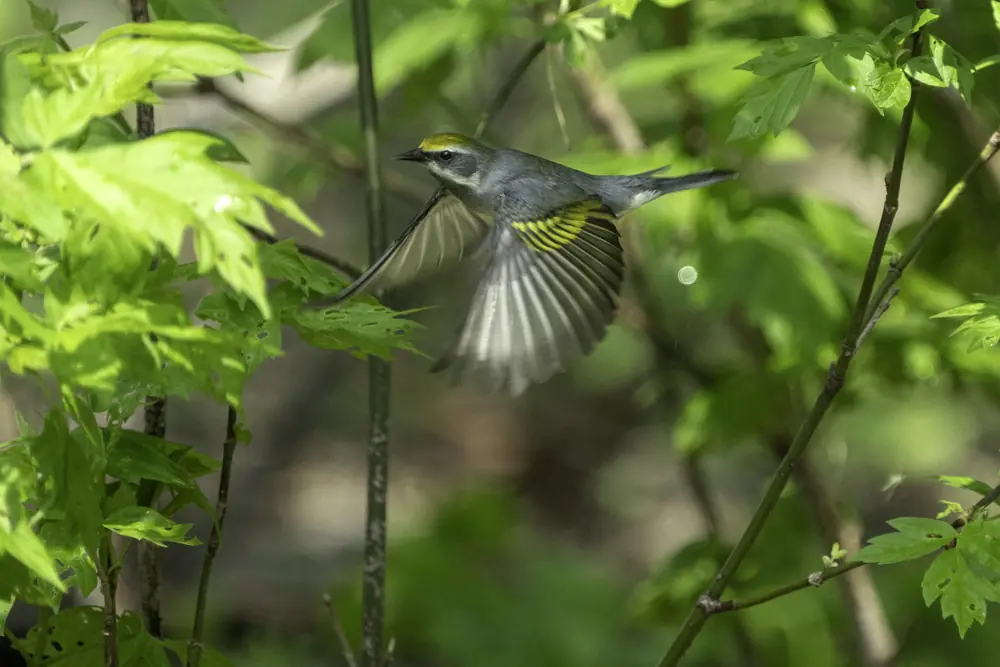
Warblers in breeding plumage
The first part of May is the best time, per the DNR · Wooded river valleys, lakeshore trees and any park with tall, leafing-out trees
Warblers move north at night and drop into the nearest trees at dawn, so the best hour is the first one after sunrise. Look along the St. Croix and Minnesota river valleys, where Interstate State Park and the Minnesota Valley National Wildlife Refuge are both described by their managers as stopovers for migrating songbirds. A cool, clear morning after a night of south wind tends to leave birds low and hungry. In the last days of the month the DNR suggests driving up the Gunflint Trail near the Canadian border, where warblers can still be found on the last weekend of May for anyone who missed the main wave farther south.
-
Golden-winged warblers at Tamarac
Spring and early summer, singing from woodland edges · Tamarac National Wildlife Refuge, Becker County
The U.S. Fish and Wildlife Service says Minnesota hosts 42 percent of the global breeding population of golden-winged warblers, and Tamarac’s lakeshore edges are good habitat. The song is a thin buzz, often written as “zee bee bee bee,” and the bird sings from the tops of low trees at the forest edge. The refuge visitor center lists seasonal hours that begin on May 15, open Wednesday to Saturday in the daytime and on Sunday afternoons; confirm before a long drive, because the trails and wildlife drive are the real draw.
-
The tail end of the broad-winged hawk flight
Peaks run roughly May 1 to 10; the count continues daily through May 31 · West Skyline Parkway, Duluth (Hawk Ridge)
Hawk Ridge Bird Observatory’s spring guide names the broad-winged hawk as its main May species, with peak days between May 1 and 10 and as many as 3,000 to 4,000 birds a day. Broad-wings travel in rising spirals called kettles on warm, sunny afternoons with a southerly breeze. By mid-May the flight tapers off, but the daily count goes on until the end of the month, and the staff lead naturalist programs on weekends through May.
-
Reading the night sky for birds
Any night in May · Anywhere with a view of a forecast map
Most songbirds migrate in the dark. Cornell’s BirdCast live migration maps turn weather-radar echoes into a picture of the birds overhead, how many and which way, between local sunset and sunrise. Look at the map in the evening: a bright patch over Minnesota with arrows pointing north means the next morning may be a good one for new arrivals. Radars can go offline, so a blank map is not proof of an empty sky.
Where do prairie chickens, gulls and swans nest in northwestern Minnesota?
The flat country along the Red River Valley and the marshes of the northwest are quieter than the river valleys in May, but their displays and nesting colonies are among the most unusual in the state. Prairie-chicken booming is winding down, marsh birds are setting up colonies, and trumpeter swans are on their nests.
-
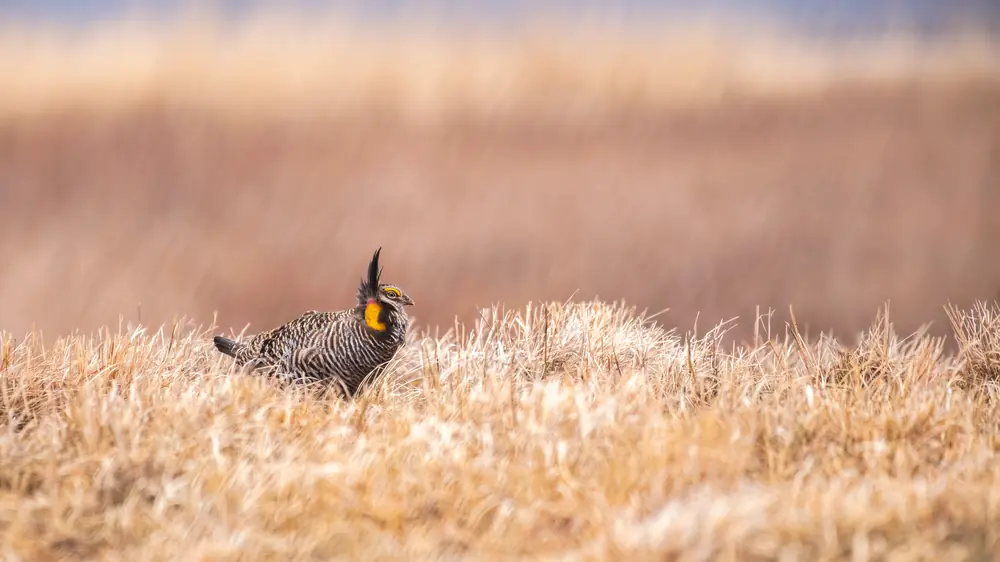
The last of the prairie-chicken booming
Mornings from mid-March to mid-May, winding down in May · The eastern edge of the Red River Valley, from the Crookston area south toward Fergus Falls
A Minnesota Conservation Volunteer article on the birds says booming runs every morning from mid-March into mid-May, and that the display wraps up in May. The state’s greater prairie-chickens live mainly in a narrow band along the eastern side of the valley. Watch from a distance and stay in a parked vehicle if you can; birds that are flushed from a booming ground stop displaying. If you want a guided trip, the annual Festival of Birds in Detroit Lakes advertises prairie chicken viewing, described below.
-
Detroit Lakes Festival of Birds
The festival’s own page lists May 20 to 22, 2027, as its 30th annual event · Detroit Lakes, Becker County
Visit Detroit Lakes, which hosts the festival, shows the 2027 dates as May 20 to 22 and adds “check back for updates.” Its most recent published schedule, for 2026, offered guided bus field trips to Bluestem Prairie, Hamden Slough National Wildlife Refuge and Tamarac National Wildlife Refuge, along with dinner talks, vendors and a silent auction. Sponsors include the Minnesota Prairie Chicken Society and Friends of Tamarac. Registration runs through the Detroit Lakes Chamber, so confirm the 2027 program there.
-
Franklin’s gulls, terns and shorebirds at Agassiz
Late spring; colonies set up in isolated marshes · Agassiz National Wildlife Refuge, Marshall County
The refuge reports that up to 20,000 pairs of Franklin’s gulls can set up colonies in remote marsh, and that black terns, eared grebes and black-crowned night-herons also nest in colonies. About 7,500 duck pairs nest there in an average year, and mudflats draw phalaropes, sandpipers and plovers on their way north. Two resident wolf packs live on the refuge, and bald eagles have used a nest near the Parker Pool observation deck since 1992.
-
Trumpeter swans on their nests
Nesting in May; the DNR places cygnet hatching in mid-June · Marshes in central and northern Minnesota, including Tamarac and Rice Lake refuges
The DNR’s seasonal wildlife guide says trumpeter swans can be seen nesting in central and northern marshes, with cygnets hatching in mid-June. Tamarac reports more than 50 successful nesting pairs, and Rice Lake National Wildlife Refuge lists trumpeter swans among its nesters. Use binoculars from a roadside or overlook; an adult sitting on a mound of cattails is not a bird to approach for a better photo.
What is blooming in Minnesota’s woods in May?
The spring ephemerals, wildflowers that bloom before the tree canopy closes, stretch into May in the southern and eastern woods, and the first flowers of late spring join them. The DNR notes that by late May the leaves fill the canopy at Interstate State Park, so the shaded floor turns green fast. Timing slides with the weather; use the dates below as a typical window and check with the park before a long drive.
-
Minnesota dwarf trout lily, the last bloom
Late April to mid-May, per the U.S. Fish and Wildlife Service · Goodhue, Rice and Steele counties, including Nerstrand Big Woods State Park
This tiny lily grows only in three southeastern counties and is listed as endangered by both the state and the federal government. Its flowering season runs from late April to mid-May, so early May is the end of it. Large patches of leaves often carry very few flowers. It looks much like the common white trout lily, which has six petals where the dwarf usually has four or five; either way, stay on the boardwalk and trails, because stepping off crushes the plants that spread underground.
-
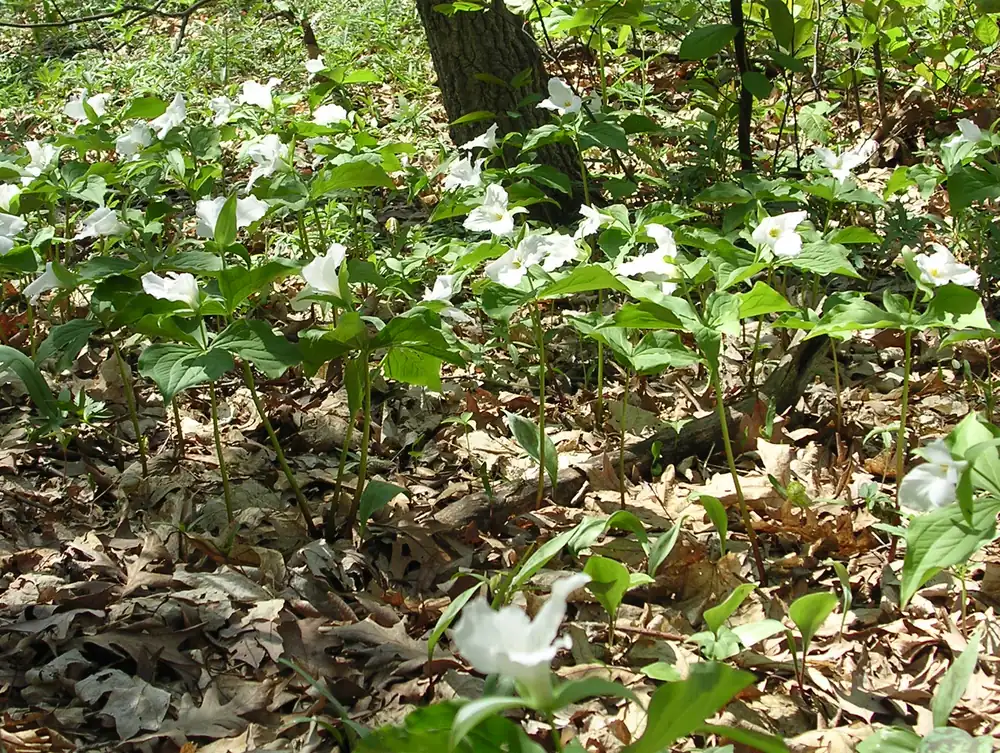
Large-flowered trillium
May into June · Rich, shaded hardwood forest across the state
Minnesota Wildflowers calls it the largest trillium in the state: a single white flower above a whorl of three leaves, 8 to 18 inches tall, often aging to pink. Plants take several years to flower from seed, which is the best reason not to pick one. Ants spread the seeds. Interstate State Park lists trillium among the wildflowers along its Sandstone Bluffs Trail, and picking flowers is against park rules.
-
Virginia bluebells and Dutchman’s breeches
April through June for bluebells; early spring for Dutchman’s breeches · Moist woods and river floodplains in the south and east
Virginia bluebells prefer moist woods and floodplains near streams. They last longer under shade as summer comes. Interstate State Park names Dutchman’s breeches among its early flowers along the St. Croix.
-
Showy lady’s slipper, a month away
June to July · Moist prairies, sedge meadows and fens, and bogs in the north
Minnesota’s state flower is not a May bloom. Minnesota Wildflowers puts its flowering in June and July, with peak in mid-to-late June, and notes that the site will not publish locations because people dig the plants up. Late May is the time to learn the leaves so you can find the plant when it opens. It is the only state emblem that is an orchid.
When does the last lake ice go, and how do loons nest?
In a normal year the last ice leaves the northern lakes in early May, and in a late year it lingers close to the end of the month. The DNR keeps ice-out records, and they put the dates in perspective: Lake of the Woods has a median ice-out of May 3 and a latest on record of May 21, in 2014, while Rainy Lake has a median of May 4 and a latest of May 22, in 1950. Leech Lake and the lake the DNR table spells Vermillion share May 23, 1950, as their latest date on record.
-
Ice-out and the fishing opener
Median early May on the northern border lakes; the latest on record is May 23 · Lake of the Woods, Rainy Lake, Leech Lake and other northern lakes
The DNR table lists 2018 ice-out as May 14 for Lake of the Woods, May 12 for Rainy Lake and May 11 for Mille Lacs. Mille Lacs’s latest on record is May 16, 2013. The DNR’s season page lists a general fishing opener of May 15, 2027, about two weeks after the median ice-out on the border lakes, so anglers on the far-northern lakes should check conditions and local access before they travel.
-
Common loons on their nests
Loons are usually back by April; incubation runs nearly a month, then chicks ride on a parent’s back · Lakeshores statewide, most of all the northern forest
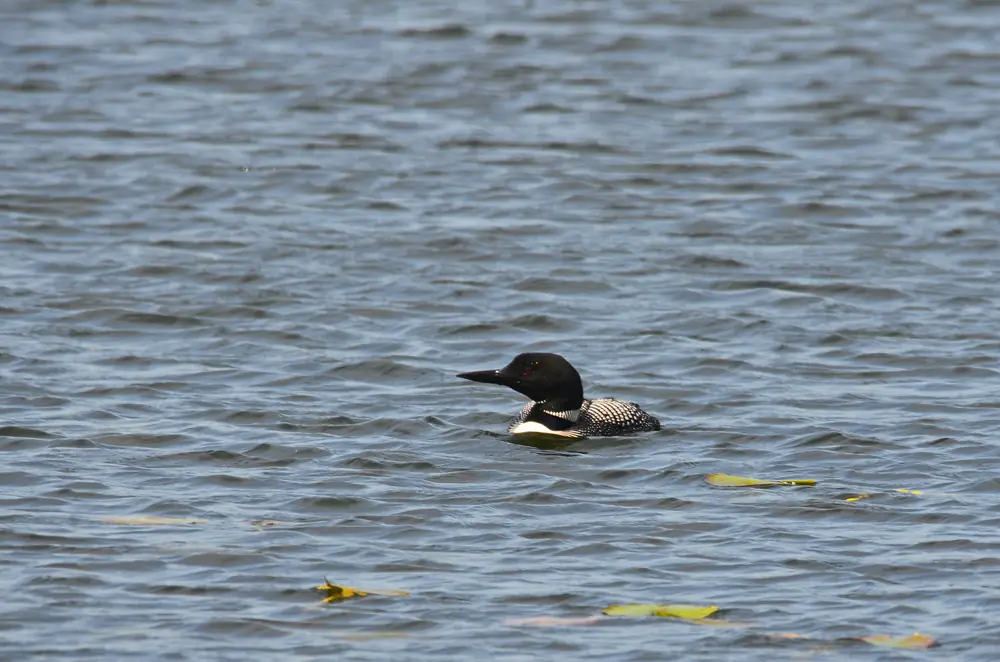
Season Watch records for Itasca County show an average first loon call on April 22, and as late as May 21 in 2002, when the ice held on. By May the pairs are on nests at the water’s edge. The DNR says females lay one or two eggs, that both parents share about 28 to 30 days of incubation, and that the parents carry young on their backs to protect them from fish and turtles. The DNR counts roughly 12,000 loons in the state, a number surpassed only in Alaska. A nest at the shore is easy to flush: give it space, keep boats away from shoreline reeds, and watch with binoculars.
-
Painted turtles and egg-laying turtles
Late spring and early summer; no single date · Wetlands and sandy road shoulders statewide
Interstate State Park notes turtles coming ashore to lay eggs along the St. Croix, and the Minnesota Valley refuge reports snapping and painted turtles laying eggs in wetland areas. Neither source gives a start date, so treat the season as roughly late spring into early summer. If you stop to help a turtle across a road, move it in the direction it was heading.
Which baby animals will you see in May, and what should you do?
May is the start of the nursery season. The most useful thing a visitor can do is leave young animals where they are, because the parent is almost always nearby and listening.
-
White-tailed deer fawns
Most fawns are born from mid-May to mid-June, per the DNR · Meadow edges, lawns, tall grass, brushy fields
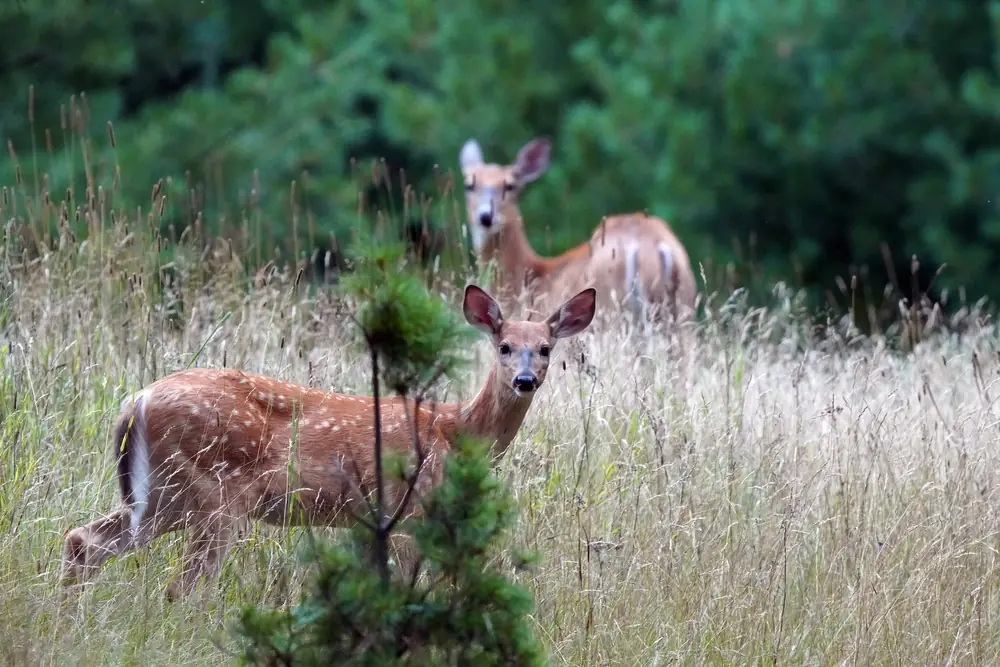
The DNR’s wildlife almanac says fawns often lie still while the doe watches from nearby, so a fawn alone is likely fine. Don’t touch or move it; if it looks wounded or truly orphaned, consult a wildlife rehabilitator first, since moving a fawn can harm it and spread disease. Keep dogs leashed so they don’t flush a bedded fawn.
-
Moose calves
Cows give birth in May or June, per the DNR · The northeastern and northwestern forests and bogs
A new moose calf weighs about 25 to 35 pounds and can walk and swim within a week. The DNR describes moose as seldom aggressive, with two exceptions: a bull in the rut and a cow who feels her calf is in danger. Never put yourself between a cow and a calf, and give the pair far more room than seems necessary.
-
Bats and their pups
Colonies raise pups from May through August · Barns, old trees and bat boxes
The DNR says females usually have one pup a year, and that exclusions at buildings should wait until pups can fly because flightless young can be abandoned. A bat resting on a wall in spring may be a migrant that will leave after two or three days. White-nose syndrome, first confirmed in Minnesota in the winter of 2016 to 2017 at Forestville/Mystery Cave State Park, cut the number of bats at Soudan Underground Mine and Mystery Cave by more than 90 percent by 2021, so every healthy colony counts.
-
Black bears out and about
Mating season runs May through July · Northern forest and its edges
According to the DNR, cubs arrive in January, and they usually leave the den in early April. In its spring advice on living with bears, it recommends taking down bird feeders, because bird feeders can become bear feeders, and keeping garbage, grills and pet food out of reach. A bear that finds food once will likely return.
Which frogs call in May, and are morels up?
The early frog choruses are over and the later singers take their turns. The DNR’s frog and toad calendar lets you work out who should be calling on a given night, and fungi hunters get their turn in the south.
-
American toads and gray treefrogs
American toad early May to early June; gray treefrog late May to late June · Shallow ponds, ditches, wetland edges and woodland pools
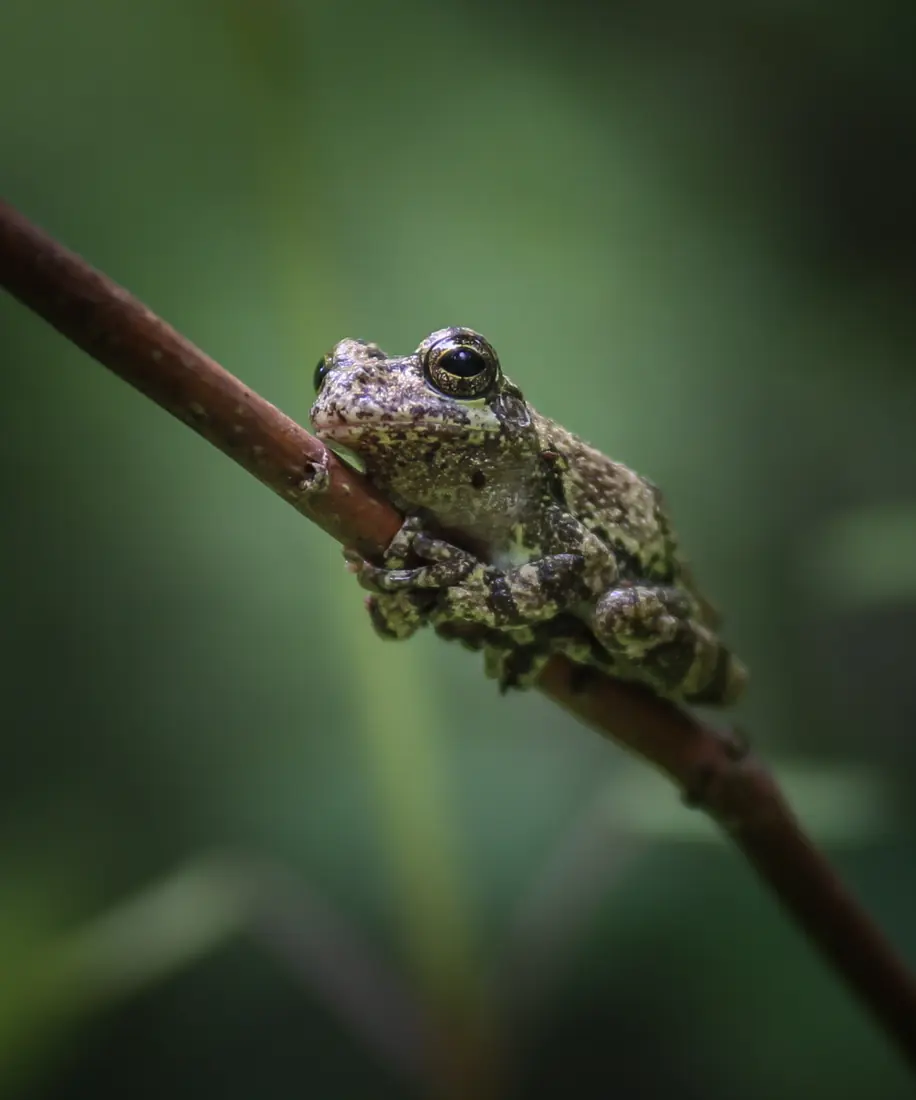
The DNR’s calendar has the American toad’s long, musical trill running from early May to early June, then the gray treefrog’s short, bird-like trill beginning in late May and continuing into late June. Spring peepers and northern leopard frogs are at the end of their season by early May, and green frogs, whose call is a twanged banjo string, begin in early June. Weather can nudge every date.
-
Morel mushrooms
Late April through May in the south; into June in the north, per University of Minnesota Extension · Hardwood woods after spring rain
Extension says morels appear after adequate rainfall. It stresses “when in doubt, throw it out,” warns that the false morel is poisonous, and recommends cutting the stem just above the soil and carrying the mushrooms in an onion bag. For poison questions it gives Poison Control, 1-800-222-1222. It does not cover harvest rules on state land, so check with the DNR before collecting in a state park or forest.
How warm is May in Minnesota, and what can the weather do?
May is the month Minnesota thaws: the Twin Cities average a high near 69 °F, but Duluth’s normal high is only 63.0 °F, and a late frost can still arrive in the north. The seasonal outlook from NOAA’s Climate Prediction Center is posted once a month near mid-month; see its seasonal outlook page for the latest, and we leave the forecast to them. For the day’s forecast, see our weather page.
-
Severe weather ramps up
May averages 5.7 tornadoes; June is the peak · Statewide; the south and west see the most storm days
Tornado counts kept by the State Climatology Office for 1991 to 2020 give an annual average of about 46 tornadoes in Minnesota, with 5.7 (13.0 percent) in May, 14.2 in June and 11.7 in July. More than 85 percent of the state’s tornadoes happen between May and August, and most come between 2 p.m. and 9 p.m. Pick your safest room before a storm day begins. The NWS office in the Twin Cities holds Severe Weather Awareness Week each April with statewide drills, a good reminder for the month ahead.
-
A late freeze is still possible
The median last freeze runs from late April in the Twin Cities to May 29 at International Falls · North of the Twin Cities most of all
In an average May, Duluth records about 3.6 freezing nights and International Falls about 8.8, against 0.5 at Minneapolis/St. Paul. Snow in May is rare: Duluth’s normal is 0.8 inch and the Twin Cities’ is zero. Garden transplants in the north often wait for the “nine years in ten” column of the table below rather than the median.
-
Fire danger before the full green-up
After the snow is gone and before vegetation greens up · Dry grass and brush, mostly in the north and west in early May
The DNR describes the weeks between snowmelt and green-up as a risky time for wildfire. Look up the statewide fire danger and burning restrictions first, apply for a burning permit online where one is required, and keep campfires to about three feet across and three feet tall at most.
| Station | Average high | Average low | Precipitation | Snowfall | Nights at or below 32 °F |
|---|---|---|---|---|---|
| INTL FALLS INTL AP | 64.2 °F | 38.1 °F | 3.06 in | 0.2 in | 8.8 |
| DULUTH | 63.0 °F | 41.0 °F | 3.37 in | 0.8 in | 3.6 |
| ST CLOUD RGNL AP | 67.8 °F | 44.6 °F | 3.66 in | 0.1 in | 2.6 |
| MINNEAPOLIS/ST PAUL AP | 69.2 °F | 49.9 °F | 3.91 in | 0.0 in | 0.5 |
| ROCHESTER INTL AP | 68.0 °F | 47.1 °F | 4.35 in | 0.5 in | 1.1 |
When is the last spring freeze in Minnesota?
A frost can still kill tender seedlings in May, and in Minnesota the date of the final freeze in the far north trails the Twin Cities by over a month. Read across the median column: April 23 in Minneapolis, May 13 in Duluth, May 20 at Grand Marais, May 29 at International Falls. In the unluckiest tenth of springs the Twin Cities still dip to 32 °F on May 7 or later, and International Falls into mid-June. Our Minnesota frost chart has more stations.
| Station | One year in ten | Median | Nine years in ten |
|---|---|---|---|
| International Falls | May 13 | May 29 | Jun 16 |
| Moorhead | Apr 23 | May 5 | May 20 |
| Duluth | Apr 29 | May 13 | May 29 |
| Grand Marais | May 3 | May 20 | Jun 6 |
| St. Cloud | Apr 24 | May 7 | May 23 |
| Minneapolis | Apr 8 | Apr 23 | May 7 |
| Rochester | Apr 15 | Apr 30 | May 13 |
| Worthington | Apr 19 | May 3 | May 15 |
How much daylight does Minnesota gain in May?
May gains less daylight per day than April, and by May 31 even the southern edge of the state has more than 15 hours of light. All clock readings are daylight time. Use our daylight calculator for any town.
| City | May 1 | May 31 | Gained | Per day |
|---|---|---|---|---|
| International Falls | 14 h 34 m | 15 h 50 m | 76 min | 2.5 min |
| Grand Marais | 14 h 30 m | 15 h 43 m | 73 min | 2.4 min |
| Bemidji | 14 h 28 m | 15 h 41 m | 73 min | 2.4 min |
| Moorhead | 14 h 25 m | 15 h 36 m | 71 min | 2.4 min |
| Duluth | 14 h 24 m | 15 h 35 m | 71 min | 2.4 min |
| Minneapolis | 14 h 16 m | 15 h 22 m | 66 min | 2.2 min |
| Rochester | 14 h 11 m | 15 h 14 m | 63 min | 2.1 min |
| Worthington | 14 h 10 m | 15 h 12 m | 62 min | 2.1 min |
What can you see in the Minnesota sky in May?
May’s sky has a good meteor shower at new moon, a Blue Moon by the old seasonal rule, and a long evening with Mercury. Every time here is Central Daylight Time. Moon data are the Naval Observatory’s, and the planet and meteor notes come from our own calculations. For cloud odds see the cloud climate page; for other months, try the moon phase calendar.
-
Eta Aquariid meteors
Strongest on the mornings of May 5, 6 and 7; active from about April 19 to May 28 · Southeast sky in the final hours before dawn
The shower peaks about May 5 to 6, with a thin crescent Moon, one to two percent lit, giving no interference. Their radiant in Aquarius climbs above the horizon barely an hour or two ahead of sunrise this far north, so Minnesota sees fewer than southern states: expect rates of 10 to 30 per hour in the southern two-thirds of the country in the last hours before dawn, and noticeably fewer here. Lie back facing southeast with no lights.
-
Flower Moon and seasonal Blue Moon
Full at 5:59 a.m. CDT on Thursday, May 20; the rounder-looking evening is Wednesday, May 19 · Climbing out of the eastern horizon at dusk
Flower Moon is the traditional almanac name. By the older seasonal rule it is also a Blue Moon, the third of four full moons in the spring that runs March 20 to June 21; by the modern calendar-month rule there is none in 2027. It becomes full before sunrise on the 20th. Minneapolis moonrise on May 19 is about 8:29 p.m. by our calculation, and the moon looks round that evening and the next.
-
Mercury at dusk
Evenings from about May 12 into early June, widest on May 27 and 28 · Just above the northwestern horizon after sunset, well before the sky is dark
Late May brings Mercury’s finest dusk showing of the year, about 23 degrees from the Sun, at its widest on May 28. Our computations for the central US have it setting well over an hour after the Sun in mid-May, and a little later still around June 1, as it dims from a bright minus 0.6 to a faint plus 0.9. Use a flat horizon and binoculars if the sky is hazy; it fades fast in June.
-
Venus and Saturn before dawn; Jupiter at dusk
Venus and Saturn close May 7; first-quarter Moon beside Jupiter on May 12 · Eastern horizon at dawn; Jupiter high in the evening
The two planets reach their closest, 0.6 degrees, during the daylight of May 7; on the mornings either side they sit about one degree apart. Both hug the eastern horizon in twilight, so scan with binoculars from a spot with a clear low view. Jupiter stays in the evening sky all month; the first-quarter Moon passes near it the evening of May 12.
| Phase | Date | Time |
|---|---|---|
| New moon | Thursday, May 6 | 5:58 a.m. |
| First quarter | Wednesday, May 12 | 11:44 p.m. |
| Full moon, the Flower Moon | Thursday, May 20 | 5:59 a.m. |
| Last quarter | Friday, May 28 | 8:58 a.m. |
What can Minnesota families do outside in May?
Every date below is one that an agency or organizer has published, or that falls by the calendar; the rest are seasons, so confirm before you drive.
- Saturday, May 1 to Monday, May 10: Hawk Ridge’s broad-winged hawk window, with a daily count through May 31.
- Wednesday, May 5 to Friday, May 7: the best mornings for the Eta Aquariid meteors.
- Saturday, May 15: the DNR season page lists a general fishing opener for Minnesota waters.
- May 20 to 22: the Detroit Lakes Festival of Birds, as its own page lists it; confirm the program with the Detroit Lakes Chamber.
- Thursday, May 20: the Flower Moon, a seasonal Blue Moon.
- All of May: Arbor Month in Minnesota, a good time to plant a tree or adopt one and record when its leaves open.
- Monday, May 31: Memorial Day, and the last day of the spring turkey seasons.
- World Migratory Bird Day: the organizer has posted only 2026 dates (May 9 and October 10, 2026), so check its site for 2027.
- Any evening: listen for toads and, late in the month, gray treefrogs.
- Any week: report your first hummingbird to Journey North, whose maps show their progress north, and check Cornell’s BirdCast.
- State park days: the DNR lists four free entrance days a year; its page showed only the one on November 27, 2026, so check later for 2027.
Storms can cancel programs, so phone ahead. Browse more months and states from the nature index, with log pages for each thing named above in the Naturalist’s Field Journal. Our Minnesota April page covers what comes just before.
Safety notes for May in Minnesota
Anglers, turkey hunters, hikers and paddlers all crowd the outdoors this month, and the dangers are everyday ones: cold water, ticks, storms and fire.
-
Spring turkey seasons
D May 5 to 11, E May 12 to 18, F May 19 to 31, 2027; youth and archery through May 31 · Statewide
In the DNR’s 2027 table, firearm season D covers May 5 to 11, E covers May 12 to 18 and F covers May 19 to 31, while youth and archery hunters have April 14 through May 31. Check the regulations for licenses and shooting hours. Hunters wear camouflage and call from the ground, so a walker on public land at dawn should speak up and wear something bright.
-
Blaze orange
Not required for turkey · Statewide
On its blaze clothing page the DNR names turkey hunting among the exceptions to the small-game requirement when no deer season is open, and the bear hunt is listed as an exception too. Its lottery deadline for the 2027 bear hunt is May 7.
-
Ticks
Adult blacklegged ticks peak in May; nymphs become active in mid-May, peaking late May through June · Wooded and brushy areas
The Minnesota Department of Health says adults emerge right after snowmelt, peak in May and stay active through June, while nymphs start mid-May. Stay on mowed trails, wear light clothing, check yourself and pets after time outdoors, and remove ticks promptly: blacklegged ticks usually need 24 to 48 hours attached to transmit Lyme disease.
-
Cold water and late ice
All month on northern lakes · Boundary lakes and Lake Superior
With ice-out dates as late as May 23, the far-northern lakes can still carry ice or float it on the wind in opener week. The water is cold, so wear a life jacket and avoid shore ice that has pulled away.
-
Storms and burn rules
Afternoons and evenings · Statewide
Know your safest room and where you would shelter on a boat or trail. If you light a burn pile or campfire, follow the DNR’s fire guidance, and keep fires small.
-
Caves, mushrooms and nests
Season-long · Caves and woods
Honor cave closures to protect bats from white-nose syndrome, and wash gear after any cave visit. Eat only wild mushrooms you can identify with certainty.
Sources (57)
- Minnesota DNR: upland bird, crow and turkey season dates
- Minnesota DNR: hunting season dates
- Minnesota DNR: fishing season dates
- Minnesota DNR: wild turkey
- Minnesota DNR: fishing
- Hawk Ridge Bird Observatory: spring visitor's guide
- Visit Detroit Lakes: Festival of Birds
- Minnesota DNR: common loon
- Season Watch: common loon
- Season Watch: ruby-throated hummingbird
- Journey North: hummingbirds
- BirdCast: live migration maps
- World Migratory Bird Day
- Minnesota DNR: Nerstrand Big Woods State Park, Wildflower Ambassadors
- Minnesota DNR: Nerstrand Big Woods State Park
- Minnesota Wildflowers: large-flowered trillium
- Minnesota Wildflowers: showy lady's slipper
- Minnesota Wildflowers: Virginia bluebells
- Minnesota Wildflowers: dwarf trout lily
- U.S. Fish and Wildlife Service: Minnesota fawnlily (dwarf trout lily)
- Minnesota Conservation Volunteer: Discover Interstate State Park in spring (2026)
- Minnesota DNR: moose
- Minnesota DNR: bats
- Minnesota DNR: black bear
- Minnesota DNR: prevent conflicts with bears this spring by being BearWise (March 23, 2026)
- Minnesota Department of Health: ticks
- Minnesota DNR: wildlife viewing in a theater of seasons
- U.S. Fish and Wildlife Service: Agassiz National Wildlife Refuge, seasons of wildlife
- U.S. Fish and Wildlife Service: Minnesota Valley National Wildlife Refuge, seasons of wildlife
- U.S. Fish and Wildlife Service: Sherburne National Wildlife Refuge, birding
- U.S. Fish and Wildlife Service: Tamarac National Wildlife Refuge
- U.S. Fish and Wildlife Service: Rice Lake National Wildlife Refuge
- U.S. Fish and Wildlife Service: Big Stone National Wildlife Refuge
- Minnesota Conservation Volunteer: dueling chickens (May-June 2022)
- Minnesota DNR: sharp-tailed grouse
- University of Minnesota Extension: harvesting morel mushrooms
- Minnesota DNR: frog and toad breeding calendar
- Minnesota DNR State Climatology Office: Minnesota tornado history and statistics
- Minnesota DNR: wildfire
- National Weather Service Twin Cities: Severe Weather Awareness Week
- Minnesota DNR: lake ice out records for selected lakes
- Minnesota DNR: Arbor Day and Arbor Month history
- Minnesota DNR: blaze orange and pink requirements
- Minnesota DNR: Fish and Wildlife Almanac, May 4, 2026
- Minnesota DNR: Fish and Wildlife Almanac, April 6, 2026
- Minnesota DNR: free entrance days at Minnesota state parks
- Minnesota DNR: state parks
- Minnesota DNR: living with wildlife
- NOAA Climate Prediction Center: seasonal (90-day) outlooks
- NOAA NCEI: 1991-2020 monthly normals, International Falls station file
- NOAA NCEI: 1991-2020 monthly normals, Duluth station file
- NOAA NCEI: 1991-2020 monthly normals, St. Cloud station file
- NOAA NCEI: 1991-2020 monthly normals, Minneapolis/St. Paul station file
- NOAA NCEI: 1991-2020 monthly normals, Rochester station file
- U.S. Naval Observatory: phases of the moon, 2027
- U.S. Naval Observatory: earth's seasons, 2027
- Photos via Wikimedia Commons; licenses and photographers are credited under each picture
