What to look for in nature in Minnesota this December
Meteorologists start winter on December 1, since December through February average out as Minnesota’s three coldest months; the stargazers’ winter waits for the solstice on the 21st. In Minnesota the change is easy to see. Lakes lock up one after another, and the birds that stay crowd onto whatever water still moves: thousands of trumpeter swans on the Mississippi at Monticello, bald eagles below the dams in the southeast, and a few dozen golden eagles hunting the bluff prairies above them. Birders head out with clipboards for the Christmas Bird Count, great horned owls start their winter duets, and every fresh snowfall records who walked where overnight. Here is the month by region, dated where a source allows.
Other months in Minnesota: October, November.
Start here
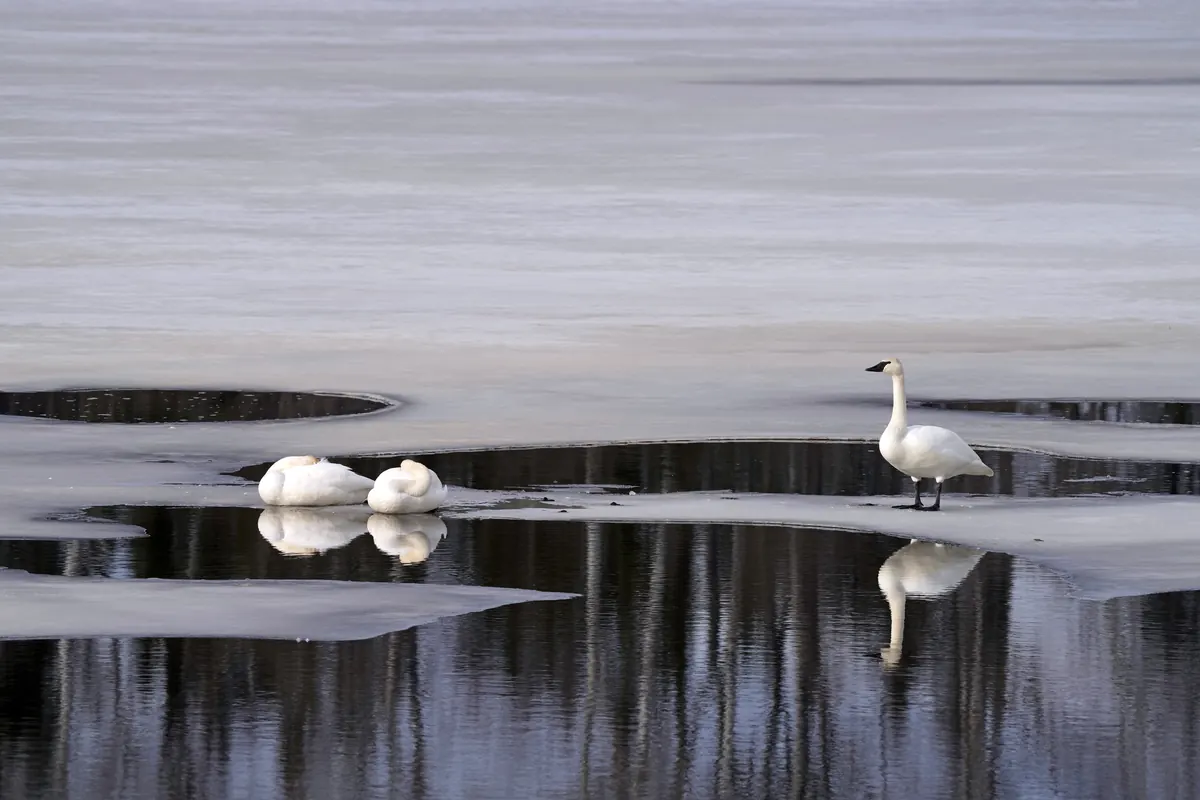
- Swans on the warm river. As ponds and lakes freeze, trumpeter swans gather where the Mississippi stays open downstream of the Monticello power plant. Swan Park, on Mississippi Drive at the east end of town, overlooks the stretch where the flock rests and feeds, from December into late winter.
- Count birds for science. Minnesota volunteers ran about 90 count circles in the 2024 to 2025 season, and the 127th count opens on December 14 and closes January 5. Rochester and Bloomington both count on Saturday, December 19, and beginners are welcome in both; a backyard feeder inside a count circle can be tallied too.
- Stay out for the Geminids. Sunday night, December 13, through dawn Monday is the Geminid peak, and no shower this year is stronger. The thin crescent moon sets in mid-evening, leaving a dark sky until dawn; the hours around 2 a.m. are usually best, when the radiant in Gemini stands highest.
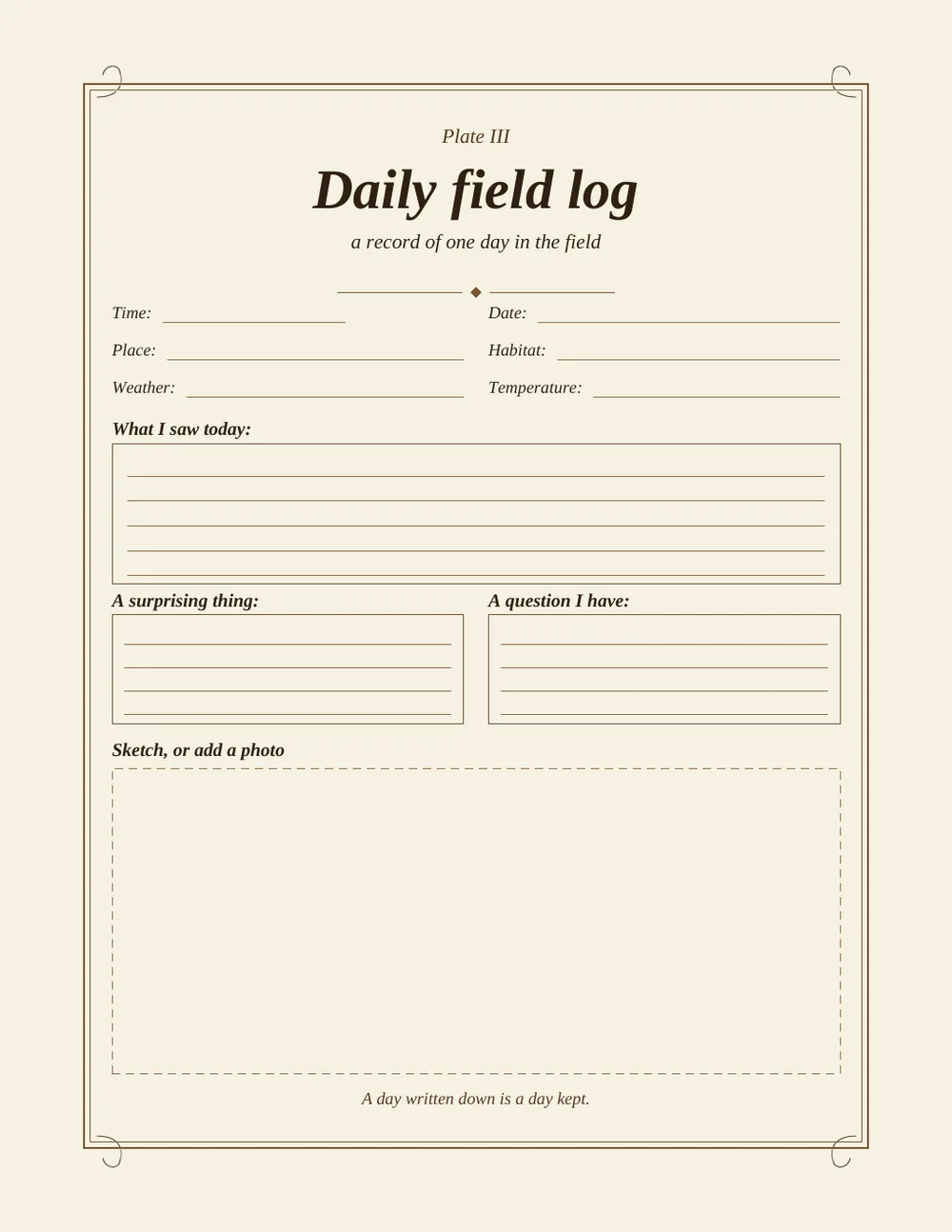
Keep a record: in the field journal this month, press a balsam fir needle and sketch a white pine bundle on the seeds, pods and cones plate, copy the first clear set of hare or fox prints onto tracks to know, log the earliest sunsets, minute by minute, on the dusk and dawn watch page, and list each eagle, swan and owl under birds I have seen. Add the day’s low temperature and the snow depth to every entry.
Regions used below: Arrowhead and the North Shore; Northwest and the Red River Valley; North-central lakes and bogs; Twin Cities and central Minnesota; Southwest prairie; Southeast bluffs and the Mississippi.
Where do trumpeter swans spend the winter in Minnesota?
Hunting and the loss of wetlands had wiped trumpeter swans out of Minnesota by the 1880s, and in the 1930s only 69 were left in the lower 48 states. The comeback began in the 1960s, when a park district brought birds in from Montana; the DNR’s Nongame Wildlife Program joined in 1982 and made its first releases in 1987. The 2023 breeding survey estimated 51,860 trumpeters in the state. Unlike the tundra swans that pass through in November on the way to the Atlantic coast, many of these birds simply stay, moving only as far as they must to find water that does not freeze.
-
Trumpeter swans at Monticello
December through February, building as the lakes freeze · Swan Park, Mississippi Drive, Monticello
Warm discharge from Xcel Energy’s nuclear plant keeps a stretch of the Mississippi open all winter, and the Minnesota Breeding Bird Atlas names it one of the state’s two great winter swan sites. Explore Minnesota describes more than 1,500 swans on the river from December to the end of February. Watch from the park above the river and listen for the deep, horn-like calls that gave the bird its name. Counts swing with the weather, so call the city or check local reports before a long drive.
-
Telling a trumpeter from a tundra swan
Any time both could be present · Open water statewide
Both are pure white with black bills and feet, and both dwarf a snow goose. By December, though, most tundra swans have moved on toward the East Coast, so a swan on open water here this month is most likely a trumpeter. The DNR reminds anyone who hunts geese that every wild swan is protected by state and federal law.
The 125th Christmas Bird Count, in the winter of 2024 to 2025, set an all-time Minnesota high for trumpeter swans, a measure of how far the restoration has come.
Where can you see bald and golden eagles in Minnesota in December?
Two very different eagles share the southeast corner this month. Bald eagles are fish eaters and stay close to the river, collecting below dams and in channels the current keeps open. Golden eagles hunt the land: squirrels and wild turkeys on the steep, south-facing goat prairies and hardwood slopes of the bluff country.
-
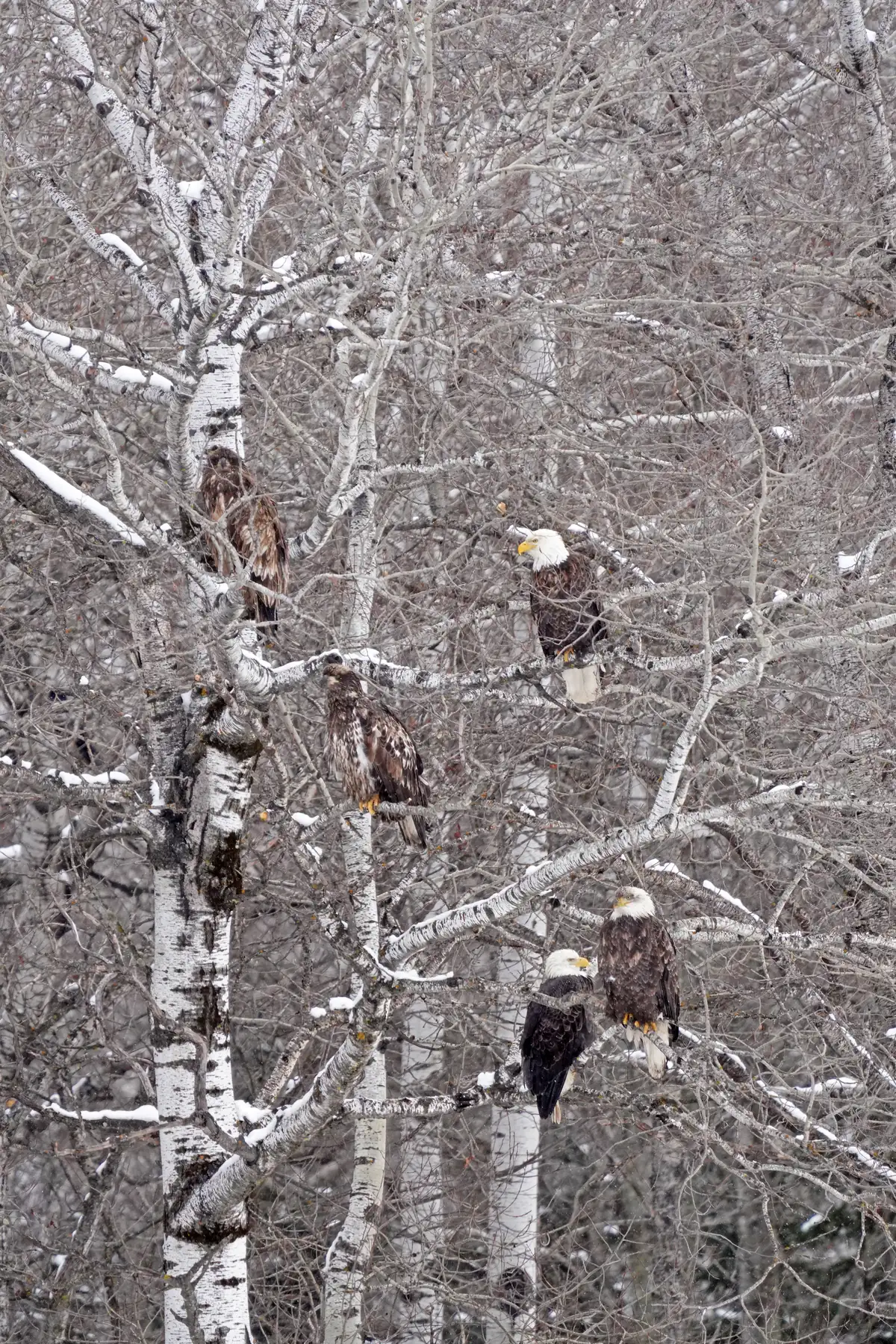
Bald eagles at open water
All month, more as the backwaters freeze · The Mississippi from Red Wing to La Crescent, especially near Wabasha
The National Eagle Center in Wabasha says that in winter hundreds more bald eagles come to the river looking for open water. Look for them perched in shoreline cottonwoods, standing on the ice edge or riding low over a riffle. Young birds are mottled brown and white, so a single tree can hold eagles that look like two different species.
-
Golden eagles in the blufflands
November through March · Bluffs, coulees and goat prairies along the Mississippi in the southeast
About 50 to 60 golden eagles winter in Minnesota’s bluff country, part of a regional population of more than 100 that spreads into western Wisconsin, northeast Iowa and northern Illinois, according to the DNR’s Minnesota Conservation Volunteer. Since 2005 the Golden Eagle Project, run by Audubon Minnesota, the National Eagle Center and the DNR’s nongame program, has surveyed and satellite-tracked them; the tagged birds flew more than 2,500 miles to breeding grounds in the far north of Canada. A perched golden is easy to dismiss as a lump in a tree. Compared with a young bald eagle, it has a smaller head and bill, a golden wash on the nape, and dark, unmottled underwings.
The center’s guided bald eagle field trip on Saturday, December 12 (12:30 to about 3:30 p.m., by shuttle bus, registration required) visits scouted spots along the river; its golden eagle outings begin at the end of January.
When is the Christmas Bird Count in Minnesota, and how can you take part?
Counting season for 2026 to 2027 is December 14 through January 5. Every circle picks one day in that window, and its volunteers try to tally every bird within the boundary. Minnesota joined early: the first counts here were held in Minneapolis and Red Wing in 1905, the count’s sixth year, according to the Minnesota Ornithologists’ Union, which keeps the state’s results. In the 2024 to 2025 season, 2,103 people covered 90 circles and found 132 species; frozen lakes left Canada geese well below their ten-year average, while white-winged crossbills set a record, red crossbills had their second-best count and purple finches their best in 20 years.
-
Rochester count
Saturday, December 19; meet at 7:15 a.m. · Silver Lake, Rochester, with a midday tally at Quarry Hill Nature Center
The Zumbro Valley Audubon Society sends teams out by car and on short walks across the circle, meets at Quarry Hill from noon to 1 p.m. to compare notes, and ends with a final tally and potluck supper. All skill levels are welcome. Residents inside the circle can count their feeders on the day using the chapter’s feeder form; to sign up, contact the compiler listed on the chapter’s website.
-
Bloomington count walk
Saturday, December 19, 9:30 to 11 a.m. · East Marsh Lake Park; meet at the Hillcrest School lot, 9301 Thomas Road
A free, no-registration walk for the Minnesota River Valley Audubon Chapter’s count, with experienced birders to help. Bring warm layers, binoculars and water.
-
Itasca State Park winter bird count
Tuesday, December 15 · Itasca State Park, near Park Rapids
The DNR’s state park calendar lists a winter bird count at Itasca, in the pine country around the Mississippi headwaters. Call the park for the meeting time and whether newcomers can join.
To join a count anywhere else in the state, use the Minnesota Ornithologists’ Union’s Christmas Bird Count pages, which link to every circle and its compiler. If you cannot get out on count day, Project FeederWatch, which runs from November to April, takes counts from your own window.
Which owls can you find or hear in Minnesota in December?
Long nights and bare trees make December a good month for owls, and the still, cold evenings carry sound a long way.
-
Great horned owls hooting
Evenings and before dawn, building through the month · Woodlots, river bottoms, parks and suburbs statewide
Great horned owls are the first raptors in Minnesota to nest, laying eggs in January or February, often in an old hawk or crow nest. The University of Minnesota’s Raptor Center explains that the young need six or seven months of training before they can fend for themselves, so the adults start early. Males begin reclaiming territory with deep hoots soon after last year’s young leave in late fall, and as the cold deepens the pair settles into duets for a week or two: the male’s lower voice answered by the female’s higher one. Step outside on a calm night after dark and listen.
-
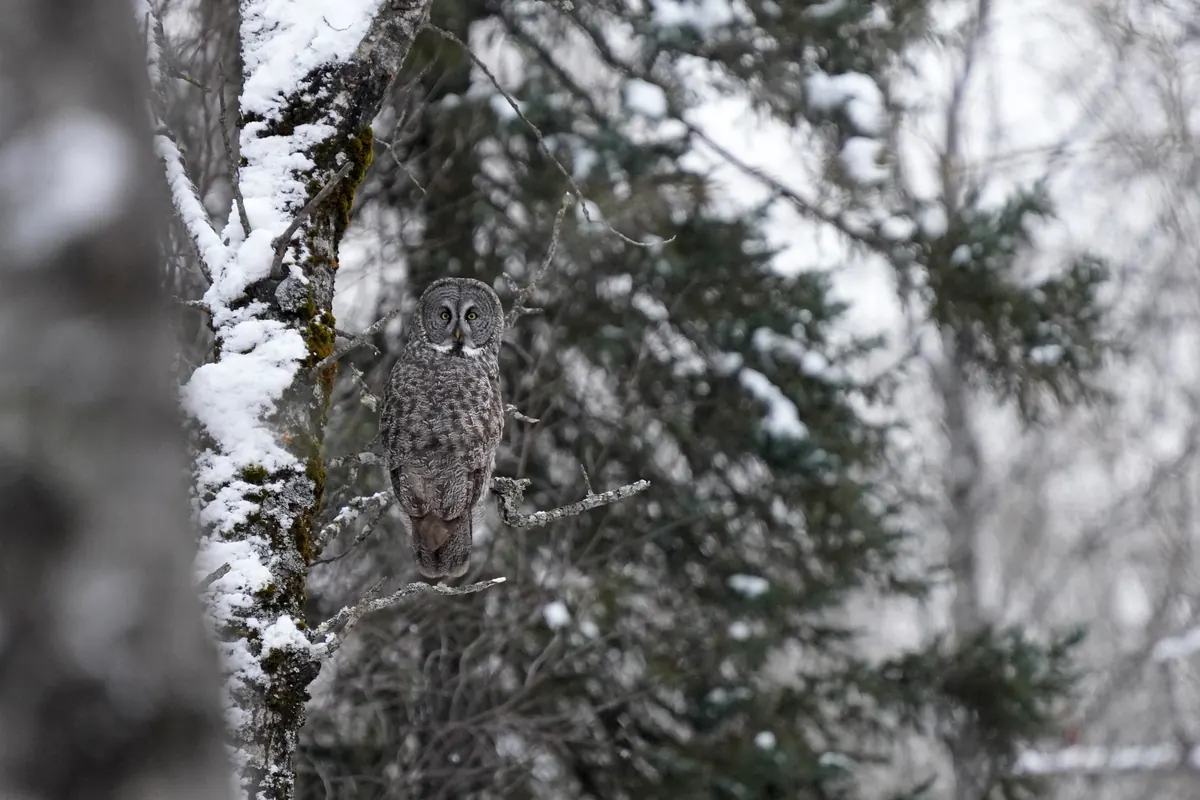
Great gray owls
Most reliable from early December to early March · Bogs and conifer edges of the north; the Sax-Zim Bog northwest of Duluth
Minnesota sits at the southern edge of this owl’s range. The DNR calls it the largest owl in North America, up to 33 inches tall, and it hunts by day, listening for voles under the snow and plunging through the crust to grab them. The Friends of Sax-Zim Bog say their Welcome Center reopens in early December, open daily from 10 a.m. to 3 p.m., and that the bog’s winter specialties are found most reliably from then until the start of March. Watch from the road, keep your distance and do not bait owls.
Owls are protected: the DNR notes that none may be captured, kept or transported without a permit. If you find one perched low by a road, enjoy it from the car and move on.
Which evergreens are native to Minnesota, and how can you tell them apart?
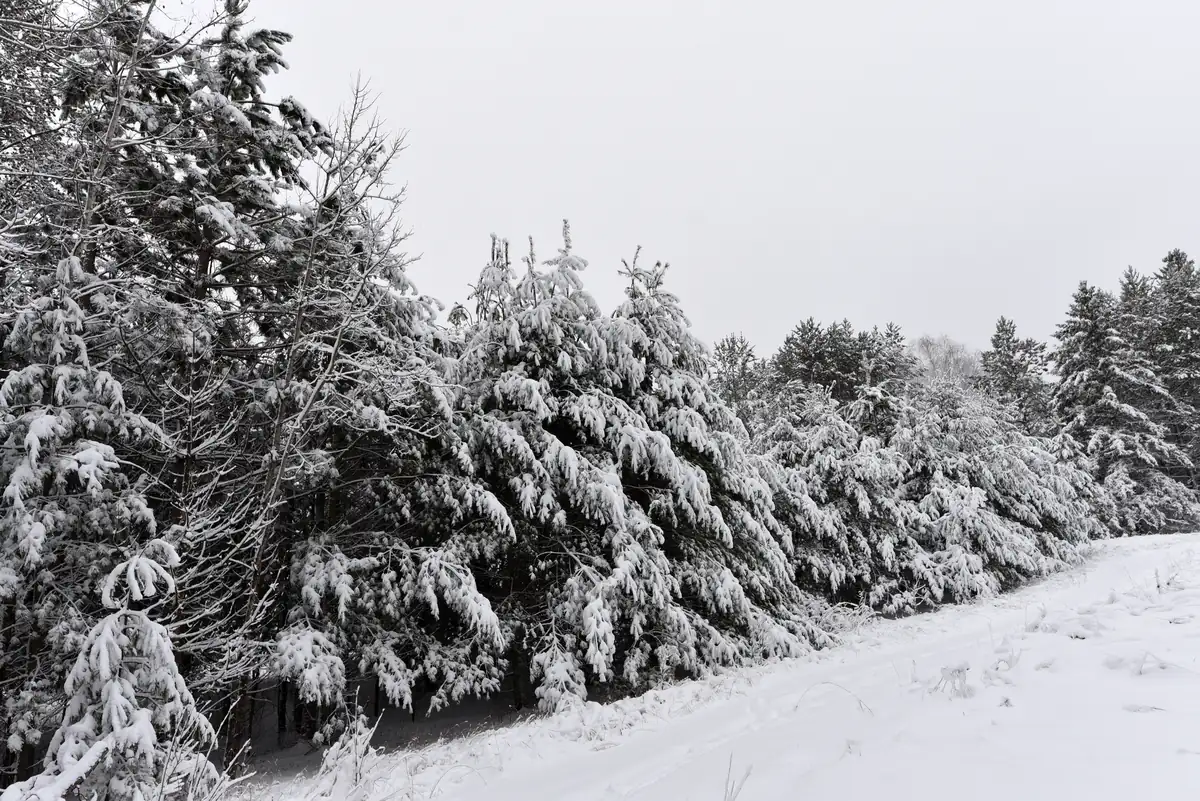
Snow on dark needles makes December the month the conifers announce themselves. The University of Minnesota Landscape Arboretum counts ten native conifers in the state, and nine keep their needles all winter; the tenth, tamarack, dropped its needles in October.
-
The three pines
All winter · North and east-central forests; plantings statewide
Count the needles in a bundle. White pine carries five soft needles, 3 to 5 inches long (white has five letters), and is the state’s tallest conifer. Red pine, the state tree, has two long, brittle needles of 4 to 6 inches and reddish, plated bark. Jack pine also has two needles, but short ones, under an inch and a half, and curved cones that can stay sealed on the branch for years until fire opens them.
-
Balsam fir and the spruces
All winter · Northern forests, with balsam fir scattered in the southeast
Roll a needle between your fingers. Spruce needles are square in cross-section and roll easily; fir needles are flat and will not. The DNR describes balsam fir needles as soft, blunt, half an inch to an inch long, dark green above and silvery beneath, with smooth gray bark dotted with blisters of resin. It is the state’s only native fir, and the classic Minnesota Christmas tree and wreath bough. White spruce gives off a sharp, unpleasant smell when crushed; black spruce has smaller cones and grows in bogs.
-
Two cedars that are not cedars
All winter · Swamps and lakeshores (white cedar); dry bluffs and old fields (red cedar)
Northern white cedar and eastern red cedar both carry tiny scale-like leaves and belong to the cypress family. White cedar fills northern swamps, where deer gather under it in deep snow; red cedar grows on the dry, sunny bluffs of the south.
-
Eastern hemlock, the rarest
All winter · Carlton County, southwest of Lake Superior
According to the DNR, hemlock barely reaches Minnesota: it is native in Carlton County, with a few scattered trees in Aitkin and St. Louis counties. More than a quarter of the state’s hemlocks grow at Hemlock Ravine Scientific and Natural Area, beside Jay Cooke State Park. The ravine’s slopes erode easily, so it is managed as a sanctuary where visits are discouraged. Its short, flat, blunt needles lie in two rows, with cones barely half an inch long.
How do Minnesota animals survive the cold?
Some animals leave, some sleep, and the rest have tricks for getting through nights well below zero. A few of the most impressive belong to the smallest animals.
-
Chickadees
All winter · Woods, yards and feeders statewide
A black-capped chickadee is about five inches long and lives here year-round. The DNR’s Minnesota Conservation Volunteer describes how it gets through: it hides seeds in bark crevices and small holes to retrieve later, shivers to make heat, roosts in tree cavities on the coldest nights, and lets its body temperature drop overnight to stretch its fat reserves to morning.
-
Ruffed grouse in the snow
Once powdery snow is deep enough · Aspen and conifer forests of the north and center
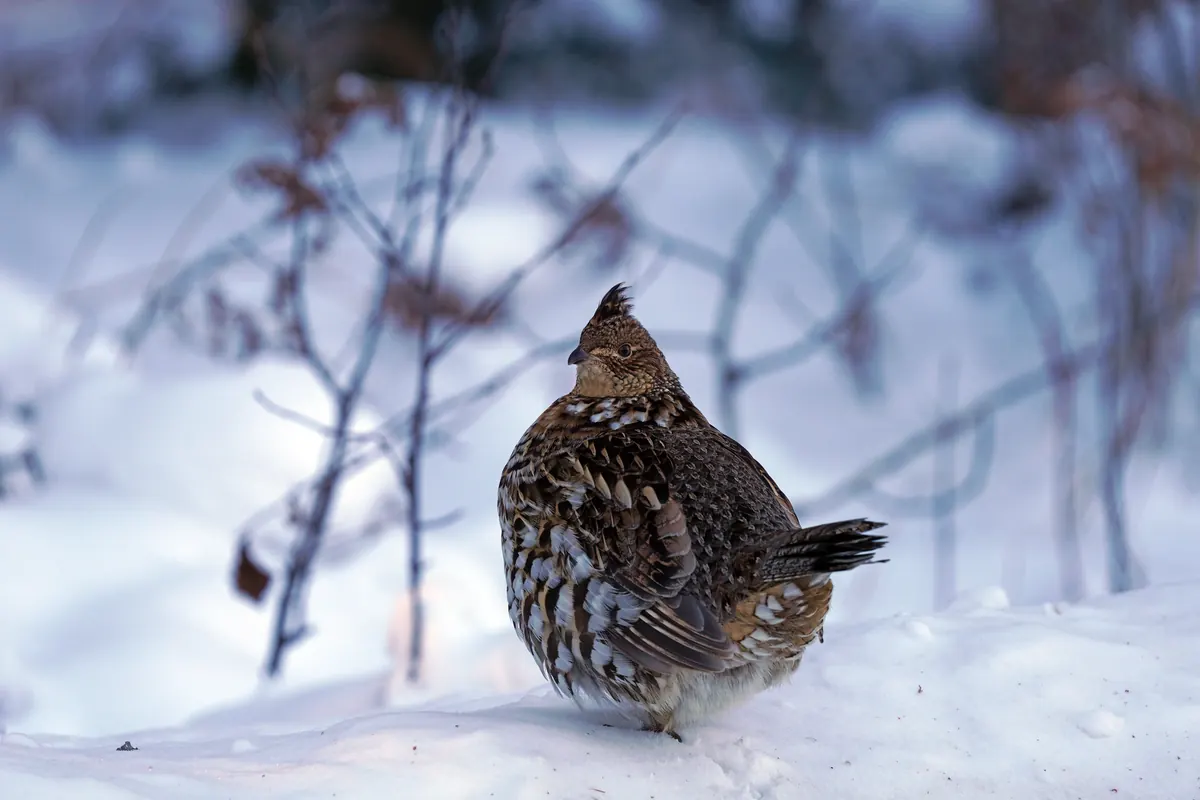
A grouse will fly headfirst into soft snow and burrow in, spending cold nights and much of the day in the hole it makes. The DNR says that in winter the birds spend nearly all of their time in these snow burrows, and it notes the comb-like fringes on their toes in winter, which work like snowshoes. They eat aspen buds and twigs.
-
Life under the snow
Once at least 6 inches of snow cover the ground · Fields, prairies and woods statewide
Between the ground and the bottom of the snowpack lies the subnivean zone. At Carleton College’s Cowling Arboretum in Northfield, naturalists explain that six inches of snow is enough to shelter mice, voles and shrews, a foot is better, and the space underneath stays near 32 °F all winter while the animals tunnel to grass, seeds and insects. Look for small air holes in the surface. Owls can hear the movement below from as far as 30 yards away.
-
Bats in the mine
Hibernation until late March or early April · Soudan Underground Mine and Mystery Cave
Four of Minnesota’s bat species hibernate here; the others fly south. The little brown bat, northern long-eared bat and tri-colored bat winter only underground, in caves and mines, while the big brown bat can also hibernate in buildings. The two biggest known hibernation sites, the Soudan Underground Mine on Lake Vermilion and Mystery Cave in Forestville/Mystery Cave State Park, have lost more than 90 percent of their bats to white-nose syndrome since it arrived. If a bat turns up in your house this winter, the DNR advises leaving healthy hibernating bats undisturbed.
What tracks can you find in Minnesota snow in December?
A fresh snowfall overnight wipes the slate clean, and by morning it holds a record of everything that moved. The DNR uses exactly that. Every winter since the early 1990s, after a fresh snow, observers travel 10-mile routes along back roads and trails across northern Minnesota and count the tracks of fishers, martens, bobcats, wolves, coyotes, foxes and other carnivores, plus the presence of snowshoe hares. In the 2025 to 2026 season, 37 routes were run between December 1 and March 19, with an average snow depth of 10 inches. Fisher and marten indices hit their lowest point since the survey began, wolf tracks were near their low, and bobcats held near or above their long-term average.
-
Snowshoe hare
All winter · Northern forests and swamps
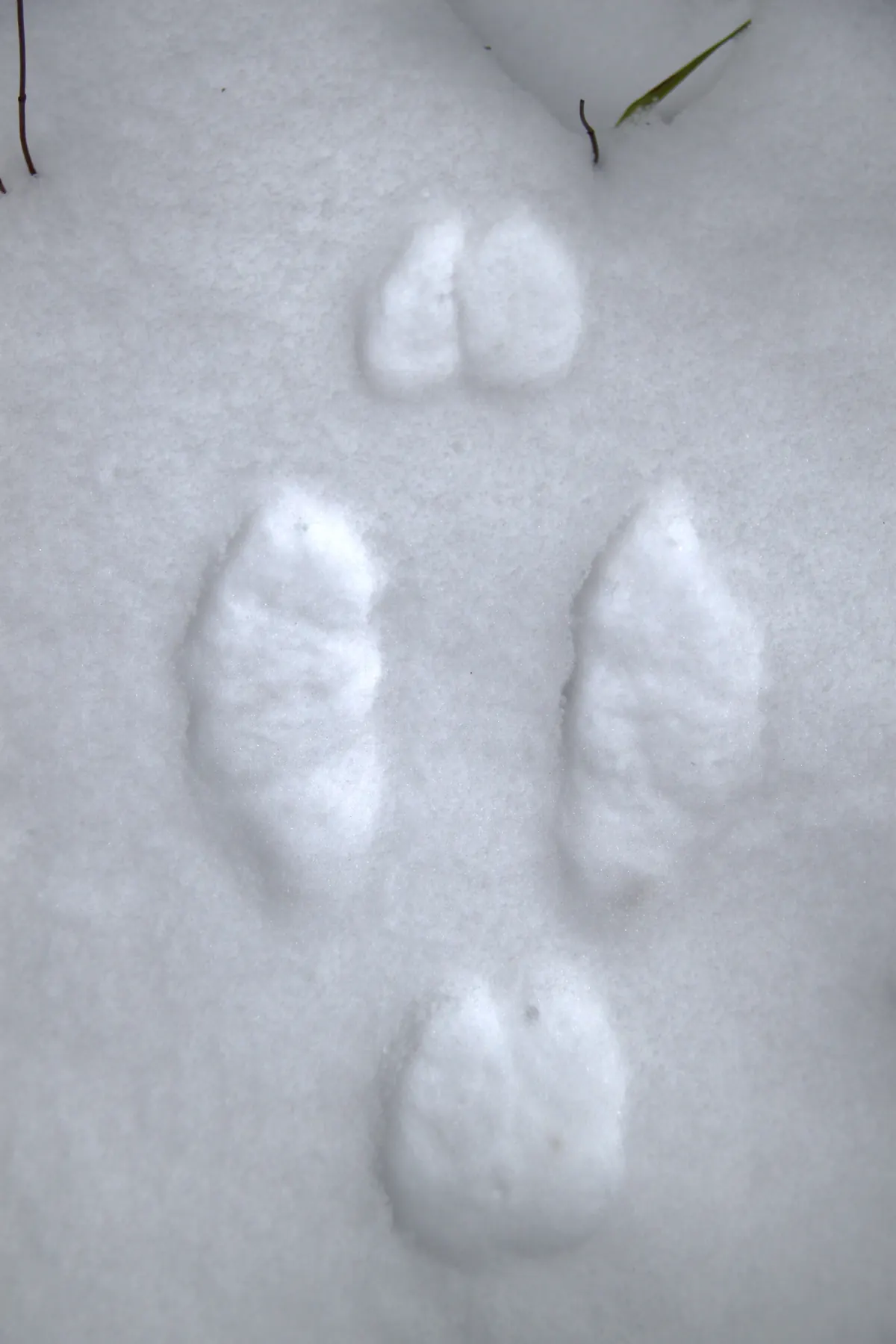
Hares bound, so their tracks come in groups of four: two big, splayed hind feet landing ahead of two small front feet. In its white winter coat the hare itself is hard to spot, so the tracks are often the only sign of it.
-
Foxes and coyotes
All winter, often along field edges and trails · Statewide
A walking fox places each hind foot almost exactly in the print of the front foot, leaving a neat single line, as if it walked a tightrope. Coyote prints are larger and follow the same purposeful line; dogs wander. Watch for a spot where the line ends in a crater: a fox or coyote pouncing on a vole it heard under the snow.
-
Deer, squirrels and grouse
Every snowfall · Parks, woodlots and backyards
Deer leave split hearts and trails worn into paths; gray squirrels leave paired front feet behind larger hind feet, going from tree to tree; a grouse leaves a chain of three-toed prints that may end in a snow roost or in wing marks where it flew.
Tracks are clearest the morning after a light, calm snowfall, with the sun low to cast shadows in each print.
How much snow does Minnesota get in December, and what might El Niño change?
Duluth averages the most December snow of these stations, 18.7 inches, partly because Lake Superior adds moisture to storms that cross it. The Twin Cities average 11.4 inches, the southwest less than 9. Snow cover usually lasts: about 27 December days at International Falls have an inch or more of snow cover, and even Worthington about 20. Median snowfall runs below the average almost everywhere, because a few big storms pull the averages up.
| Station | Average snowfall | Median snowfall | Days with 1 inch or more on the ground |
|---|---|---|---|
| International Falls (far north) | 15.8 in | 14.4 in | 27.4 |
| Duluth (airport, above the lake) | 18.7 in | 15.6 in | 27.1 |
| Grand Marais (North Shore) | 13.4 in | 11.5 in | 21.4 |
| Moorhead (Red River Valley) | 10.8 in | 7.6 in | 22.7 |
| St. Cloud (central) | 9.3 in | 8.4 in | 21.0 |
| Minneapolis/St. Paul (metro) | 11.4 in | 9.4 in | 20.9 |
| Rochester (southeast) | 12.4 in | 9.7 in | 19.8 |
| Worthington (southwest) | 8.6 in | 8.2 in | 20.1 |
On the North Shore, the first very cold mornings bring sea smoke: when arctic air flows over a lake still in the 30s, water evaporates and condenses at once into drifting columns of steam. On December 22, 2021, when Effie, north of the Iron Range, fell to 17 below, it rose off western Lake Superior along the shore near Duluth. Inland, December is usually when the big lakes finish freezing over, though the DNR does not post ice-in dates in real time because early ice can still break up.
Minnesota’s winter of 2026 to 2027 also comes with a powerful El Niño. NOAA’s September 10 discussion of the tropical Pacific set the odds of a very strong event lasting into the winter months above 90 percent. Its winter outlook, published October 15 (we wrote this page two weeks before), will appear on the CPC 90-day outlook page. The State Climatology Office, writing on September 29, counted 27 El Niño winters since 1950: on average they averaged 2.4 °F milder across the state than the remaining years, and the Twin Cities averaged 43.1 inches of seasonal snow against 56.8 in the rest, about a quarter less. Averages are not promises, the office adds: the Halloween Blizzard of 1991 came in a very strong El Niño year. The last El Niño December, in 2023, was Minnesota’s warmest and wettest since statewide records began in 1895, 12.2 °F above normal; lakes that had frozen in late November thawed, and many did not freeze again until early January. See the forecast for your town on our weather now page, and learn the cloud deck that comes ahead of a snowstorm with our cloud guide.
When is the earliest sunset in Minnesota?
Not on the solstice. The earliest sunsets come about ten days before it: Duluth and Minneapolis bottom out around December 10, at 4:20 and 4:31 p.m., and International Falls reaches its earliest, 4:18 p.m., around December 11. After that the evenings lengthen while the mornings keep getting darker. Minneapolis sunrise is 7:31 a.m. on December 1, 7:48 at the solstice and 7:51 on New Year’s Eve, and it stays at 7:51 into early January. The solstice itself arrives at 2:50 p.m. CST on Monday the 21st, the afternoon when International Falls has 8 hours 17 minutes of daylight and Worthington 8 hours 56 minutes.
| City | Dec 1 | Dec 21 | Dec 31 | Earliest sunset |
|---|---|---|---|---|
| International Falls | 8 h 35 m | 8 h 17 m | 8 h 22 m | 4:18 p.m., Dec 11 |
| Grand Marais | 8 h 42 m | 8 h 25 m | 8 h 29 m | 4:09 p.m., Dec 11 |
| Bemidji | 8 h 45 m | 8 h 27 m | 8 h 31 m | 4:28 p.m., Dec 11 |
| Moorhead | 8 h 48 m | 8 h 31 m | 8 h 36 m | 4:38 p.m., Dec 10 |
| Duluth | 8 h 49 m | 8 h 32 m | 8 h 37 m | 4:20 p.m., Dec 10 |
| Minneapolis | 9 h 02 m | 8 h 46 m | 8 h 50 m | 4:31 p.m., Dec 10 |
| Rochester | 9 h 08 m | 8 h 53 m | 8 h 56 m | 4:32 p.m., Dec 9 |
| Worthington | 9 h 11 m | 8 h 56 m | 8 h 59 m | 4:45 p.m., Dec 9 |
Grand Marais has the earliest sunset on this list, 4:09 p.m., because it lies farther east than any other town in the table. The minimum is shallow, so sunset stays within a minute of it for several days either side. Any town’s times are on our daylight calculator, and last month’s numbers are in the Minnesota November guide.
What can you see in the Minnesota night sky in December?
By about 6:45 p.m. the sky is fully dark even in the southwest, so a December evening gives hours of sky before bedtime. Northern Minnesota’s long nights also give the best aurora chances of the year; solar activity is declining from its 2024 maximum, yet big geomagnetic storms remain possible, and they can only be forecast a day or so ahead.
-
Venus before sunrise
Every morning; near the crescent moon December 4 and 5 · Southeast before dawn
Venus blazes before sunrise all month; apart from the moon, nothing in the predawn sky comes close to it. The old crescent moon drops in beside it at dawn Friday and Saturday, December 4 and 5, with blue-white Spica between the two on Friday.
-
The Geminids
Night of Sunday, December 13, into Monday morning · Anywhere dark; the radiant in Gemini climbs in the east
On paper the Geminids deliver about 150 an hour (the International Meteor Organization’s zenithal rate, which presumes flawless darkness), and the moon is only a crescent that sets in mid-evening, which leaves the rest of the night dark. The radiant is highest around 2 a.m. Expect fewer from a backyard.
-
The solstice
Monday, December 21, 2:50 p.m. CST · Watch the low noon sun in the south
At midday on the solstice the sun climbs only about 18 degrees above the southern horizon at International Falls and about 22 degrees at Minneapolis. A shadow you mark that day will be the longest of the year.
-
The Cold Moon
Wednesday, December 23, 7:28 p.m. CST; Christmas Eve looks nearly as full · Rising in the northeast at dusk
Perigee, the moon’s nearest pass, follows within the same night, so December’s moon outdoes November’s as 2026’s biggest supermoon.
-
Planets
All month · Saturn southwest after dusk; Jupiter and Mars in the east late at night and before dawn
Saturn is the lone bright planet in the early evening, sinking earlier each week. Jupiter rises by mid-evening at the end of the month and is high before dawn; Mars, near it in Leo, is steadily brightening. Ursid meteors peak on the night of December 22 but with a nearly full moon, and the Quadrantids follow on the night of January 3 into the 4th under darker skies.
| Phase | Date | Time |
|---|---|---|
| Last quarter | Tuesday, Dec 1 | 12:08 a.m. |
| New moon | Tuesday, Dec 8 | 6:52 p.m. |
| First quarter | Wednesday, Dec 16 | 11:42 p.m. |
| Full moon, the Cold Moon | Wednesday, Dec 23 | 7:28 p.m. (Dec 24 nearly as full) |
| Last quarter | Wednesday, Dec 30 | 12:59 p.m. |
For moonrise and moonset times through the holidays, check our moon calendar.
What can Minnesota families do outside in December?
- Saturday and Sunday, December 5 and 6: Quarry Hill, Rochester. The nature center’s Nature Art Show and Sale is free (9 a.m. to 4 p.m. Saturday, noon to 4 Sunday), and on Sunday at 1:30 p.m. a free bird banding program shows wild birds up close; call ahead to register.
- Tuesday, December 8: hibernating bats for preschoolers. Quarry Hill’s Good Natured Kids session, Who’s in the Cave?, is for 3- and 4-year-olds with an adult (fee). The center also offers free tours of its 1882 sandstone cave on December 13 and 27, and a bat program on December 20, all at 1:30 p.m. with registration.
- Saturday, December 12: eagles by shuttle. The National Eagle Center’s bald eagle field trip leaves Wabasha at 12:30 p.m. (fee; register online).
- Tuesday, December 15: Itasca’s winter bird count. Listed on the state park calendar.
- Saturday, December 19: two Christmas Bird Counts. Rochester (7:15 a.m., Silver Lake) and the free Bloomington walk at East Marsh Lake Park (9:30 a.m.). The state park calendar also lists a beginners’ snowshoe outing at Fort Snelling State Park that day; confirm with the park, since it depends on snow.
- Monday, December 21: solstice walk. Go out at 4:30 p.m. and watch the sun go down on the shortest day, then find the moon and the Pleiades together in the east once it is dark.
- Friday, January 1, 2027: First Day Hikes. First Day Hikes are a national New Year’s Day program of America’s State Parks; the DNR’s list for 2027 so far includes Fort Snelling, and more parks are usually added in December. The hikes are free, but a vehicle permit is needed.
- From home: start a track journal. After each snowfall, check the same patch of yard or park and sketch what crossed it.
Weather can cancel winter programs, so confirm times with the organizer before driving. Our nature guides cover other states and months, and the Naturalist’s Field Journal has pages for tracks, cones and winter birds.
Safety notes for December in Minnesota
- Hunting seasons this month. The muzzleloader deer season runs to Sunday, December 13, and archery deer to December 31; a late chronic wasting disease hunt is scheduled for December 18 to 20 in designated areas. Duck season in the south zone closes December 6. Canada goose stays open to December 25 in the north zone, December 30 in the central zone and January 6 in the south zone. The pheasant, grouse (ruffed and spruce) and Hungarian partridge seasons last until January 3; rabbit, hare and squirrel to February 28; fox, raccoon, badger and opossum to March 15.
- Orange or pink. Until the muzzleloader season ends on the 13th (and in any late firearms deer hunt), every hunter and trapper afield (waterfowl hunters and trappers on the water excepted) must show blaze orange or blaze pink on the cap and on whatever outer layer shows above the waist (sleeves and gloves do not count). After that, small-game hunters still need at least one visible blaze garment above the waist. If you hike public land in December, wear a bright hat and vest and dress the dog in something bright too.
- New ice. Early-season ice is the most variable of the year, and the DNR repeats that no ice is ever completely safe. Check thickness yourself with a spud bar or auger, stay away from inlets, outlets, pressure ridges and the open water swans and eagles favor, and carry ice picks.
- Cold. Average December lows are in the single digits across the inland north and around 15 °F in the Twin Cities, and a cold wave can drop the north well below zero. Dress children in layers, cover fingers, ears and noses, and come in when anyone stops shivering normally or turns quiet and clumsy.
- Short days and long drives. Through mid-month the sun is down before 4:50 p.m. in every town in the table above. Start hikes early, carry a headlamp, and keep a winter kit, blanket and charged phone in the car for trips north.
Gardeners: the ground has frozen by now nearly everywhere; first-freeze and last-frost dates for every station are on our Minnesota frost dates page.
Sources
- Minnesota DNR: trumpeter swan restoration project
- Minnesota DNR: trumpeter swan identification
- Minnesota Breeding Bird Atlas: trumpeter swan
- Explore Minnesota: Swan Park, Mississippi Drive, Monticello
- National Eagle Center: eagle viewing field trips, 2026–27
- National Eagle Center: 2026/2027 field trip schedule announced
- Minnesota Conservation Volunteer: our golden eagles
- Minnesota DNR: monitoring Minnesota’s golden eagles
- National Audubon Society: the 125th Christmas Bird Count in Minnesota
- National Audubon Society: Christmas Bird Count
- Minnesota Ornithologists’ Union: Minnesota Christmas Bird Count
- Zumbro Valley Audubon Society: Rochester Christmas Bird Count, December 19, 2026
- City of Bloomington: Bloomington Christmas Bird Count naturalist program, December 19, 2026
- Minnesota DNR: state parks calendar by date (December 2026 programs)
- Project FeederWatch: how to participate
- University of Minnesota Raptor Center: the earliest of early birds (great horned owls)
- Minnesota DNR: great horned owl
- Minnesota DNR: great gray owl
- Friends of Sax-Zim Bog: plan your visit
- University of Minnesota Landscape Arboretum: forever green, Minnesota’s native conifers
- Minnesota DNR: balsam fir
- Minnesota DNR: eastern hemlock
- Climate Change Response Framework: Hemlock Ravine Scientific and Natural Area (Minnesota DNR project)
- Minnesota Conservation Volunteer: black-capped chickadee profile
- Minnesota DNR: ruffed grouse
- Carleton College Cowling Arboretum: life in the subnivean zone
- Minnesota DNR: bats of Minnesota
- Minnesota DNR: furbearer winter track survey summary, 2025 (PDF)
- NOAA NCEI: U.S. climate normals 1991–2020, monthly data for Minnesota stations
- MPR News: frigid morning brings sea smoke to Lake Superior (December 22, 2021)
- Minnesota DNR: lake ice-in dates
- Minnesota DNR: HydroClim Minnesota for early January 2024 (December 2023)
- NOAA Climate Prediction Center: ENSO diagnostic discussion, September 10, 2026
- NOAA Climate Prediction Center: seasonal (90-day) outlooks
- Minnesota State Climatology Office: “El Niño” is coming (September 29, 2026)
- U.S. Naval Observatory: phases of the moon, 2026
- U.S. Naval Observatory: earth’s seasons, 2026
- U.S. Naval Observatory: sun and moon rise and set data
- International Meteor Organization: 2026 meteor shower calendar
- EarthSky: what is a supermoon?
- NOAA Space Weather Prediction Center: solar cycle progression
- Quarry Hill Nature Center: calendar (December 2026)
- Minnesota DNR: First Day Hikes
- Minnesota DNR: hunting season dates
- Minnesota DNR: deer hunting (2026 season dates)
- Minnesota DNR: waterfowl hunting seasons are on the horizon (August 31, 2026)
- Minnesota DNR: upland bird season dates
- Minnesota DNR: blaze clothing requirements
- Minnesota frost dates (NOAA 1991–2020 normals)
- Photos via Wikimedia Commons; licenses and photographers are credited under each picture
