What to look for in nature in Minnesota this November
November is when Minnesota changes hands. The leaves are down except on the oaks, the loons and cranes have mostly gone, and the birds that replace them come from the tundra and the boreal forest: tundra swans by the tens of thousands on the Mississippi backwaters, snowy owls on airport grass and stubble fields, crossbills and siskins in the spruce. Deer move recklessly in the rut just as the clocks fall back and the evening drive slips into dusk. Small lakes skin over and Lake Superior throws its first big storms. Below, the month is laid out by region, with dates wherever a source gives them.
Other months in Minnesota: October, December.
Start here
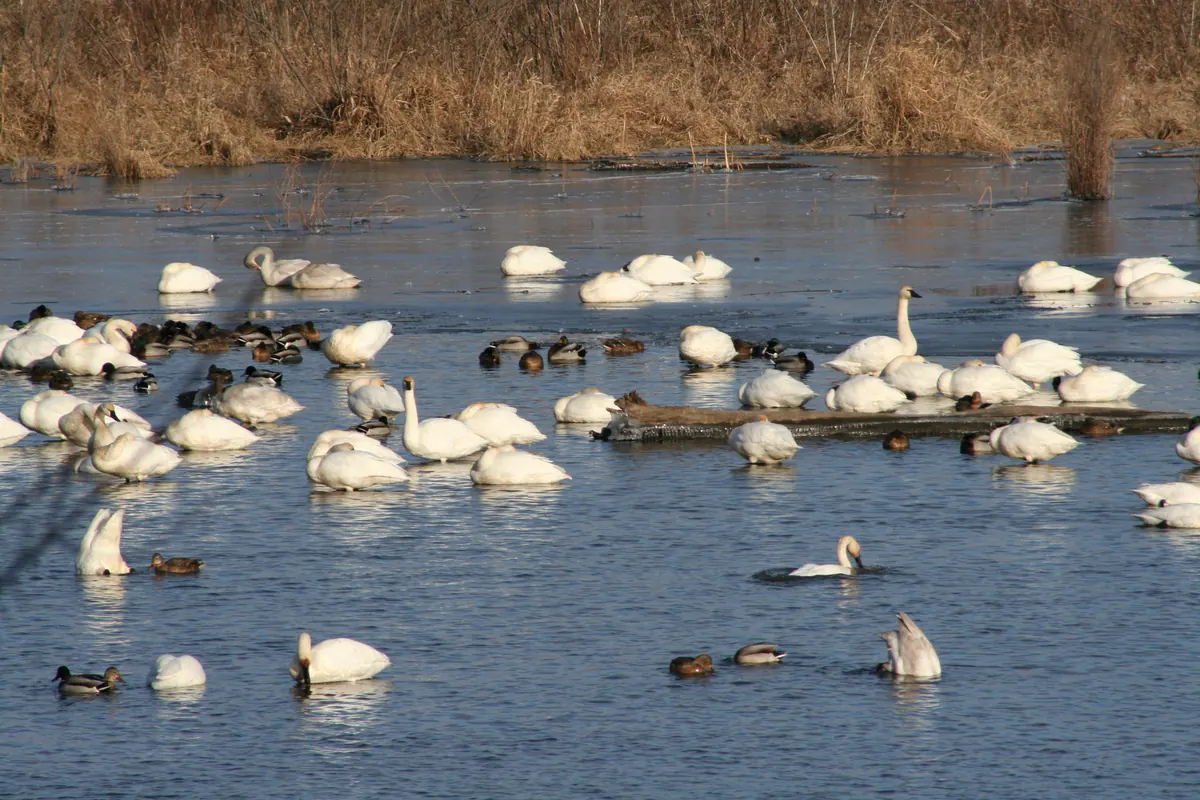
- Swans on the backwaters. The tundra swan flight on the Upper Mississippi usually crests in November, with 10,000 to 45,000 birds on the refuge at the top of a good year. Bring binoculars to the Brownsville Overlook south of La Crescent or the hilltop pullout at Weaver Bottoms, and go on a weekday morning if you can.
- Deer at dusk. The rut, the November 7 firearms opener and the switch to standard time all land in the same fortnight, so the evening commute now runs through the hours when deer cross roads most. Slow down between about 6 and 9 p.m. and brake rather than swerve.
- A big Beaver Moon. November’s full moon arrives on the morning of Tuesday the 24th, at 8:53 Central time, near enough to Earth to count as a modest supermoon. Both Monday and Tuesday evenings (the 23rd and 24th) give a round moonrise over the fields.
Keep a record: in the field journal, add the swans, snowy owls and crossbills to “birds I have seen,” draw the first deer or rabbit trail in the new snow on the tracks-to-know plate, return to one marsh or lakeshore and log it on “the same place twice” before and after it freezes, and on a still evening fill in a map of sounds with geese, owls and the creak of shore ice. Note the temperature and whether the water is open beside each entry.
Regions used below: Arrowhead and the North Shore; Northwest and the Red River Valley; North-central lakes and bogs; Twin Cities and central Minnesota; Southwest prairie; Southeast bluffs and the Mississippi.
When do tundra swans and geese peak in Minnesota in November?
The Mississippi below Red Wing is the state’s great November flyway. The river is braided into pools and backwater marshes behind the locks and dams, and the U.S. Fish and Wildlife Service says more than 40 percent of North America’s waterfowl travel this corridor south. On the prairie side of the state, the old goose capital at Lac qui Parle has quietly moved its season to the end of the month.
-
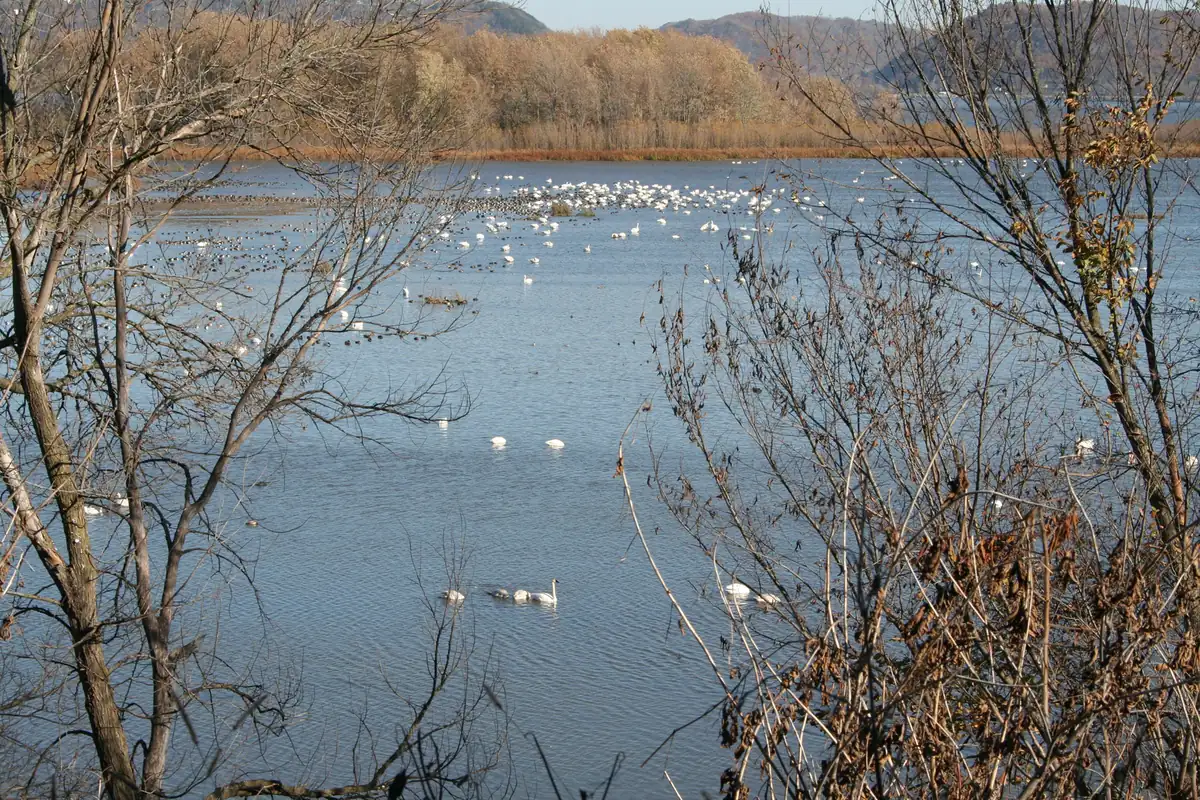
Tundra swans
Building through early November; peak most years in mid-November · Brownsville Overlook on Highway 26; Weaver Bottoms off Highway 61
These swans nest on the Arctic coast and stop on the river on their way to the mid-Atlantic coast. The refuge counts somewhere between 10,000 and 45,000 at the high point, and the Minnesota DNR calls the November gathering at Weaver Bottoms one of the region’s more spectacular birding sights. Brownsville Overlook, about three miles south of Brownsville, has a paved lot, mounted scopes and restrooms into mid-November; if it is full, the Reno Bottoms canoe access is 3.5 miles farther south. For Weaver Bottoms, the refuge suggests parking on the west side of Highway 61 at 116th Avenue.
-
Diving ducks and the first wintering eagles
All month · Open pools of the Mississippi from Red Wing to the Iowa line
Canvasbacks, ring-necked ducks and goldeneyes sit in tight rafts on the open pools, and bald eagles work the edges for crippled ducks and fish. The National Eagle Center in Wabasha says hundreds more eagles move to the river as winter closes in, because it stays open where lakes freeze. Its Tundra Swan, Waterfowl and Bald Eagle field trip on Saturday, November 14 leaves the center at 12:30 p.m. on its small shuttle bus and returns by about 4 p.m.; it costs $60 ($50 for members), seats are few, and there is a waiting list.
-
Canada geese at Lac qui Parle
Late November into early December · Lac qui Parle Wildlife Management Area near Watson
From the 1950s to the 1980s, migrant geese reached this western Minnesota refuge in mid-September and peaked in October, and at the height of the restoration program more than 150,000 were counted. The DNR’s 2024 to 2034 management plan says the timing has slid ever later: geese now arrive in late November or early December, and recent peaks have been about 11,000 to 20,000 birds. The same plan notes that greater white-fronted geese, with their yelping calls, have been increasing.
Duck season on these southern river pools stays open into early December, and goose season longer, so watch from overlooks and refuge roads rather than walking the shoreline.
Which winter birds arrive in Minnesota in November?
Each fall, biologist Tyler Hoar reads the seed and cone crops across Canada and predicts where the northern finches will go. His forecast for 2026 to 2027, posted by the Finch Research Network on September 25, finds a poor crop in the boreal forest west of Lake Superior and good crops in the east, which tends to push birds through the Great Lakes rather than deep into the southern states. For Minnesota, that means a fair chance of finches in the north woods, more often at cones and catkins than at feeders.
-
Pine siskins and red crossbills
Already moving; more through November · Conifers statewide, especially spruce and pine in the north
The forecast rates siskin prospects as excellent and notes that counters at Hawk Ridge in Duluth have already logged more than 1,000. Expect plenty of red crossbills as well, with a western type moving east into the western Great Lakes, and Hawk Ridge reported above-normal August totals. Crossbills feed by prying open cones with their crossed bill tips; listen for their sharp, repeated kip notes overhead.
-
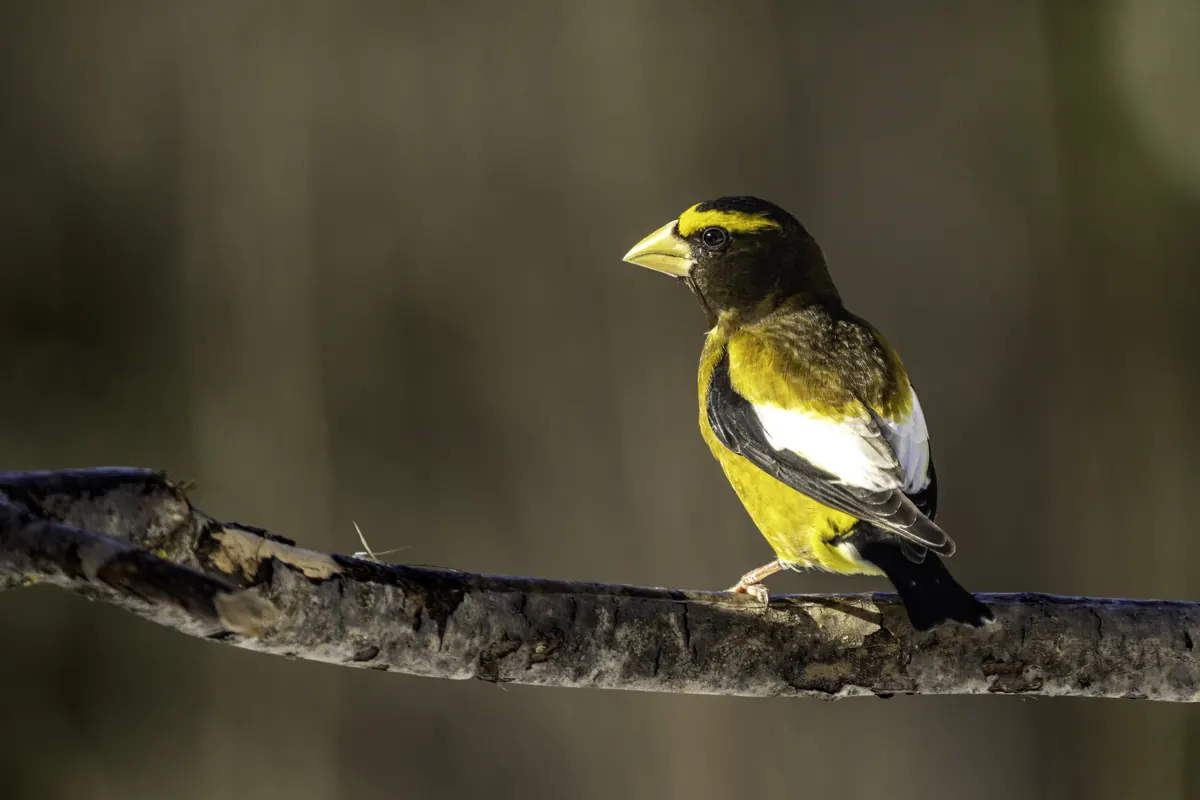
Evening grosbeaks and redpolls
Late November onward · Northern feeders, birch stands, the Sax-Zim Bog
Evening grosbeaks, fed by spruce budworm outbreaks in the east, are forecast to move in moderate numbers through the Great Lakes. Redpolls are hard to call, the forecast admits, but a small to modest movement into the western Great Lakes is possible. Pine grosbeaks and Bohemian waxwings are expected to stay mostly north this year, held there by a heavy mountain-ash berry crop.
-
Snowy owls
From early November, in years when they come · Open country: farm fields, airports, the northern half of the state
The DNR describes snowy owls as irregular: in some winters hundreds reach Minnesota and in others almost none. They hunt from fence posts, hay bales and rooftops in flat, open land that looks like tundra, and Minneapolis–St. Paul International Airport has a viewing area from which they are often seen in winter. Watch one from the car or from well back, and never flush it: a resting owl is saving energy it badly needs.
-
Boreal birds at the Sax-Zim Bog
Winter visitors start arriving mid- to late November · Sax-Zim Bog, about 45 miles northwest of Duluth off U.S. 53
The Friends of Sax-Zim Bog say wintering species begin arriving in the middle to end of November. Great gray owls, boreal chickadees, Canada jays and black-backed woodpeckers are the draws, with rough-legged hawks and northern shrikes often lingering into April. The Welcome Center on Owl Avenue is closed in fall and reopens in early December, but the roads and the outhouse are open, and the Friends ask visitors not to aim binoculars at homes and to pull over when cars approach.
The new Project FeederWatch season starts November 1 and lasts through April. Participants choose back-to-back count days and note, for each species, the most birds seen together at any moment; Minnesota counts help show whether this forecast came true.
When is the deer rut in Minnesota, and when does firearms deer season open?
Whitetail bucks spend early November chasing does, rubbing saplings and scraping the ground under low branches, and they pay little attention to roads. The University of Minnesota’s Center for Transportation Studies describes a major peak in deer-vehicle collisions from October to early December, driven by the breeding season.
-
Rubs and scrapes
Late October into mid-November · Field edges and woodlots statewide
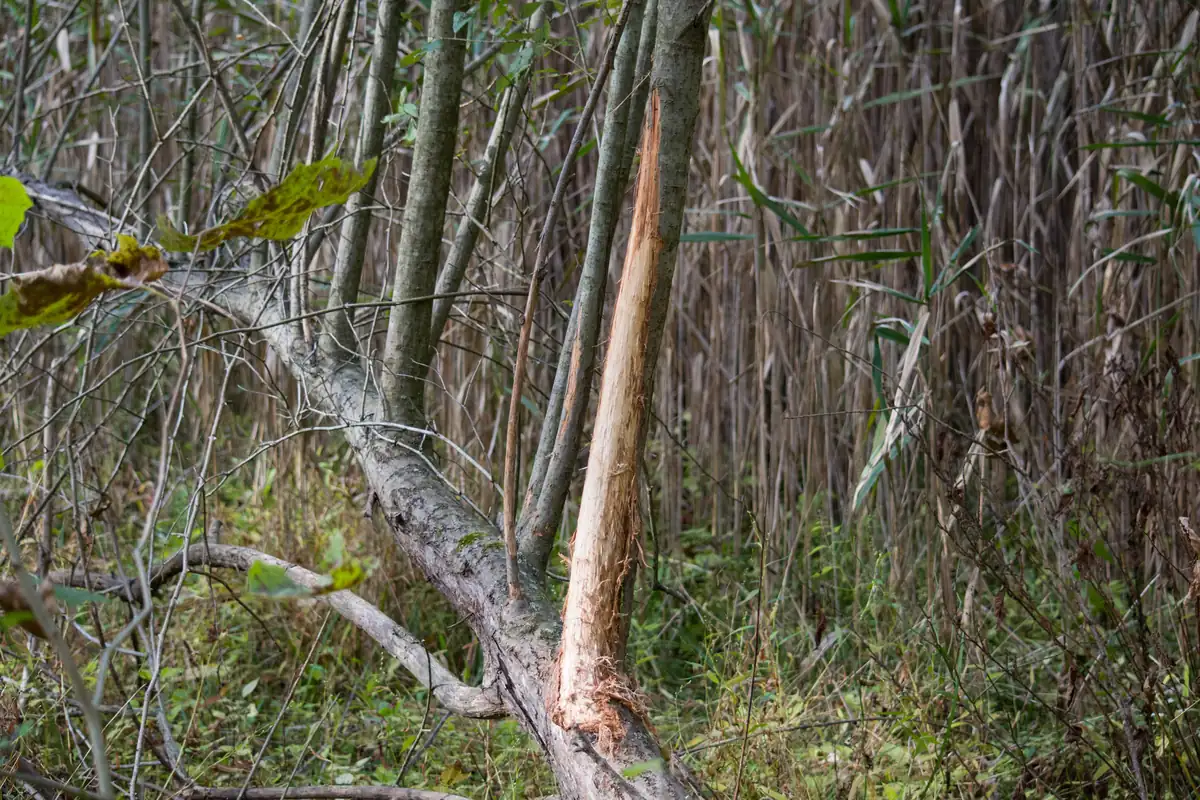
A rub is a young tree a buck has scraped bare with his antlers, usually between knee and belt height; a scrape is a pawed patch of bare soil, often beneath an overhanging twig that he has chewed and marked. Both are easy to find once the leaves are down and make a good tracks-and-signs walk with children.
-
Deer on the roads
Worst at dusk, especially early in the month · Rural highways, river corridors, suburban edges
The Department of Public Safety asks drivers to be most careful from 6 to 9 p.m., when deer move most, and not to swerve, which can put a car into a ditch or oncoming traffic. Researchers add that deer rarely travel alone, so a second one often follows the first.
-
The firearms opener
Saturday, November 7 · Statewide
Firearms season A opens November 7 and runs through the 15th in the 200- and 300-series permit areas and through the 22nd in the 100 series. The late southeast season in the 300-series areas runs November 21 to 29, and the muzzleloader season opens November 28.
How do Minnesota animals get ready for winter in November?
Leave, sleep, store food or tough it out: by month’s end, most animals here have committed to one of these.
-
Black bears going to den
Late fall into early winter · Mostly the northern forests
Bears settle into dens under windfalls, in brush piles or in dug burrows, and stay as long as six or seven months. In that time, the DNR says, they neither eat nor drink, and they recycle their body wastes. Females give birth in January, and the cubs grow to five or six pounds before the family leaves the den, usually in early April.
-
Beavers and their food piles
Through freeze-up · Ponds, streams and lake bays statewide
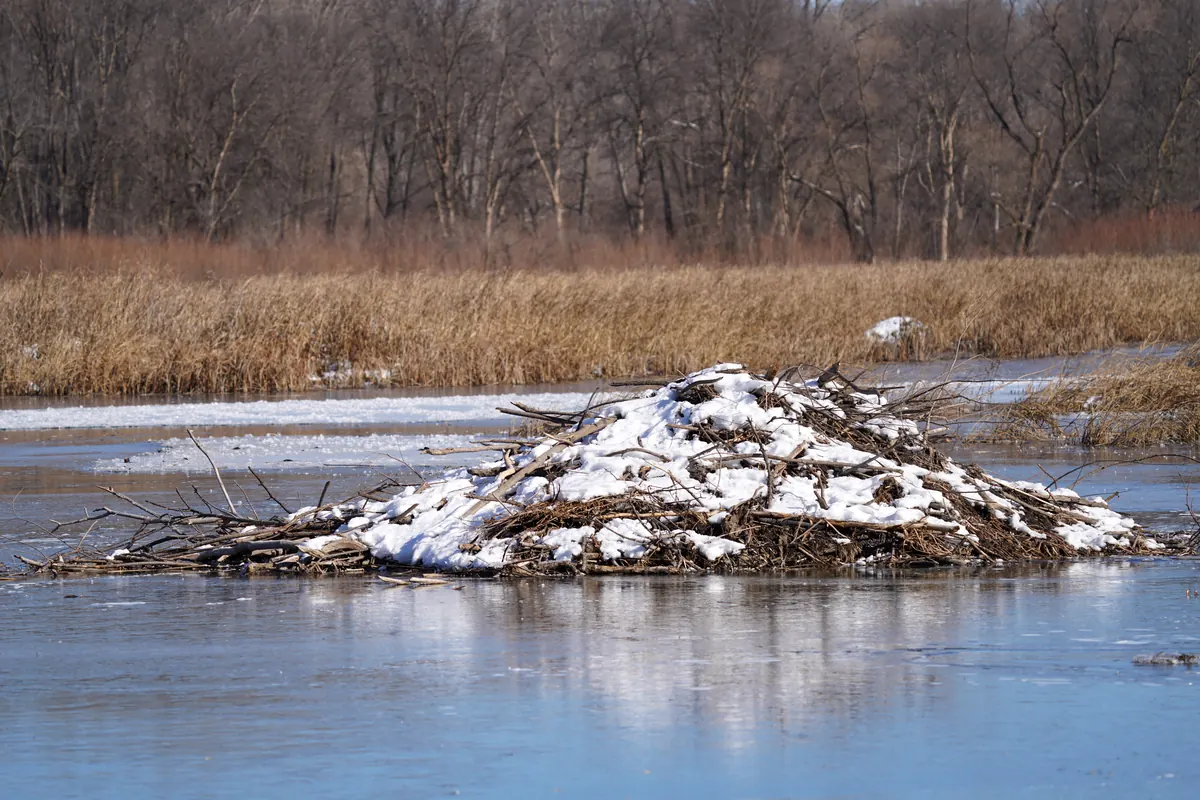
The Beaver Moon is well named. In the last open-water weeks beavers cut aspen, willow and other branches and sink them by the lodge, and once the ice forms they swim out under it to eat from this stored pile. A winter colony usually holds the two adults, the spring’s kits and often last year’s young. Look for a raft of fresh-cut branches beside a lodge, with green tips poking up through the first ice.
-
Wood frogs that freeze
From the first hard freezes · Leaf litter in the north, east-central and southeast
The wood frog does not burrow deep. It tucks into the leaves on the forest floor and lets ice form inside its body; breathing and heartbeat stop. Sugar released from its liver protects the cells, and in spring it thaws and hops off. A pile of unraked leaves in a shady corner may shelter one.
-
The last trout and salmon redds
Until the streams ice over, late October or early November · North Shore rivers below the first barrier falls
The DNR’s Lake Superior fisheries staff note that brook and brown trout, coho, chinook and pink salmon all spawn in the fall, from September until ice forms on the streams. Early in November, look into a clear pool below a bridge for a pale, scoured patch of gravel: that is a redd, a nest where eggs lie buried until spring. Stay out of the water so the gravel is not disturbed.
Which trees and plants still show color in a Minnesota November?
Once the maples and aspens are bare, the November woods are a study in brown, gray and dark green, which makes it the easiest time of year to learn trees by their shape and bark. A few plants stand out.
-
Oaks, ironwood and blue beech that keep their leaves
All winter · Hardwood forests and parks across the south and center
White oaks, swamp white oaks, ironwood (hop-hornbeam) and blue beech often hold dry, tan leaves until spring, a habit called marcescence. Three Rivers Park District naturalists explain that the layer of cells that normally cuts a leaf loose does not finish forming until spring, and that it shows up mostly on the young, not-yet-flowering parts of a tree. One idea is that the rattling dead leaves protect next year’s buds from browsing deer and drying wind.
-
Bare tamaracks
Needles already shed in September and October · Bogs of the north and north-central
The gold of October is gone and the tamaracks stand like dead trees among the dark black spruce, though they are only resting. Look closely at a twig: the needles grew in tufts of 12 to 30 on short, wart-like spurs, and those spurs will sprout a new set in spring. The small cones have already let go of nearly all their seed.
-
Winterberry
Red fruit all winter on female shrubs · Swamps and wet woods, mainly in the east
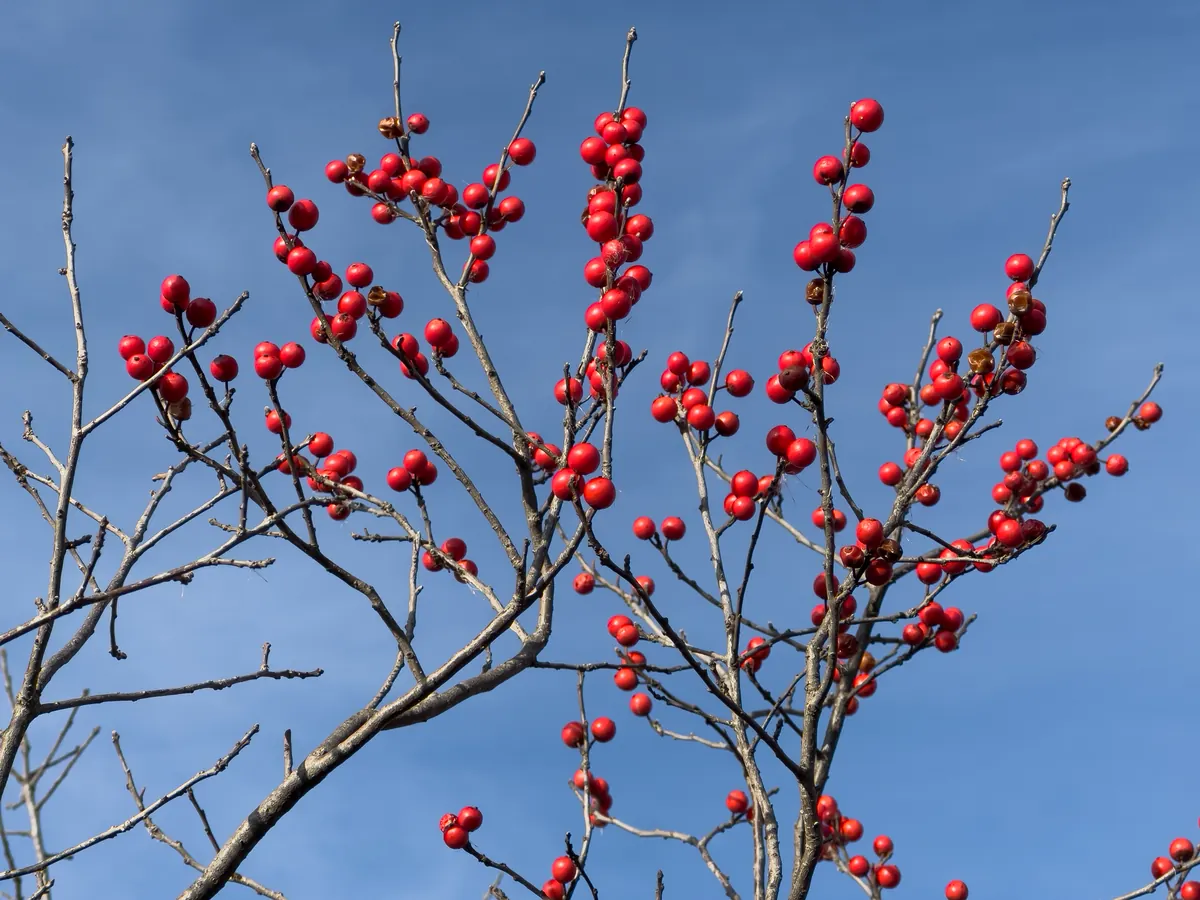
This deciduous holly reaches the western edge of its range in Minnesota. Once its leaves drop, red berries a quarter to a third of an inch across crowd the bare stems. Only female shrubs bear fruit, so a patch may show red on some plants and none on the next.
-
Buckthorn, the last green leaves
Through much of November · Woods and fencerows, especially in the south and metro
Common and glossy buckthorn keep green leaves for weeks after native shrubs are bare, so November is a good month to map an infestation.
If you want to see how a single tree changes from now until spring, pick one oak near home and take a picture of it weekly from one fixed spot; you can set it beside our Minnesota October guide to see what it looked like in color.
Has Minnesota had its first freeze by November?
Almost everywhere, yes. When November begins, all nine stations listed here are normally past their first 32 °F night. Even the warm Minneapolis/St Paul airport, the last holdout among these sites, has frozen by October 31 in nine years out of ten. In a warm autumn, the last holdouts tend to be the Mississippi river towns of the southeast; the La Crescent lock and dam station has a median of October 28.
| Station | One year in ten | Median | Nine years in ten |
|---|---|---|---|
| International Falls International Airport (far north) | Aug 30 | Sep 13 | Sep 28 |
| Moorhead (Red River Valley) | Sep 22 | Oct 3 | Oct 18 |
| Duluth (on the hill) | Sep 18 | Oct 1 | Oct 16 |
| Duluth Harbor Station (lakeshore) | Sep 25 | Oct 12 | Oct 26 |
| Grand Marais (North Shore) | Sep 22 | Oct 5 | Oct 20 |
| St Cloud Regional Airport (central) | Sep 16 | Sep 30 | Oct 12 |
| Minneapolis/St Paul Airport (metro) | Oct 1 | Oct 18 | Oct 31 |
| Worthington 2 NNE (southwest) | Sep 21 | Oct 4 | Oct 18 |
| Rochester International Airport (southeast) | Sep 22 | Oct 6 | Oct 20 |
So in November the question shifts from the first frost to the hard freeze, when the ground stiffens and garden work ends. Plant garlic and spring bulbs before the soil locks up, and mulch strawberries once it does. Every station’s spring and fall dates are on our frost dates for Minnesota page.
How much daylight does Minnesota lose in November?
A little over an hour everywhere: 63 minutes in Worthington, in the southwest corner, and 77 in International Falls, which ends the month with 8 hours and 37 minutes between sunrise and sunset, losing about 2.7 minutes a day. Minneapolis drops from 10 h 09 m to 9 h 03 m. With the switch off daylight time in the small hours of November 1, the Minneapolis sun rises that Sunday at 6:52 rather than near 8 and sets at 5:01. By November 30 it rises at 7:30 a.m. and sets at 4:33 p.m.
| City | Nov 1 | Nov 30 | Lost | Per day |
|---|---|---|---|---|
| International Falls | 9 h 54 m | 8 h 37 m | 77 min | 2.7 min |
| Grand Marais | 9 h 57 m | 8 h 44 m | 73 min | 2.5 min |
| Bemidji | 9 h 59 m | 8 h 46 m | 73 min | 2.5 min |
| Moorhead | 10 h 01 m | 8 h 50 m | 71 min | 2.4 min |
| Duluth | 10 h 01 m | 8 h 50 m | 71 min | 2.4 min |
| Minneapolis | 10 h 09 m | 9 h 03 m | 66 min | 2.3 min |
| Rochester | 10 h 13 m | 9 h 09 m | 64 min | 2.2 min |
| Worthington | 10 h 15 m | 9 h 12 m | 63 min | 2.2 min |
The evenings are close to their darkest by month’s end. Minneapolis reaches its earliest sunset of the season, 4:31 p.m., around December 9, almost two weeks before the solstice, and after that the afternoons slowly stretch while the mornings keep getting later into January. For your own town, enter an address in our daylight calculator.
What is November weather like in Minnesota, and what will El Niño bring this winter?
November is the month Minnesota gets its winter storms back. The cold air mass over Canada is building while the Gulf of Mexico is still warm, and the contrast feeds strong lows that track across the Upper Midwest. The State Climatology Office ranks the Armistice Day Blizzard of November 11, 1940, as the defining blizzard of the twentieth century here. The day began mild, and the warmth drew duck hunters onto the river; by afternoon heavy snow and winds near 30 mph had cut visibility to almost nothing, Collegeville got 26.6 inches, drifts near Willmar were said to reach 20 feet, and 49 Minnesotans died, many of them hunters stranded on river islands.
On Lake Superior the same storm season is remembered as the gales of November. The freighter Edmund Fitzgerald went down in one on November 10, 1975, with all 29 of its crew. Each year on that date the Minnesota Historical Society holds a memorial at Split Rock Lighthouse, followed by the lighting of its beacon (see the families section). The Duluth weather office lists 50.1 inches of snow in November 1991 as Duluth’s snowiest single November, and its listed average date for the first one-inch snowfall there is November 4. Use our cloud identification guide to spot the thickening altostratus that often means a storm is half a day away.
Behind the storms sits a larger question. NOAA’s September 10 diagnostic discussion gives a very strong El Niño a greater than 90 percent chance of lasting from fall right through the winter. The government’s winter forecast follows in mid-October (it had not appeared when we wrote this); look for it on the CPC seasonal outlook page. The two very strong events before 2015, 1982–83 and 1997–98, both gave the Twin Cities a December-to-February season among the six warmest in more than a century, according to the climatology office; yet 1982–83 also brought 74.4 inches of snow, about 20 inches above normal, while 1997–98 brought 45.0. The National Weather Service office in La Crosse found that strong El Niño winters in the Upper Mississippi Valley average up to 10 inches less snow than normal, but that as many as a third of them came in above normal. The most recent El Niño, in 2023–24, gave Minnesota its warmest December and warmest winter on record.
Check the forecast for your county on our weather page before any long drive or day on the water this month.
When do Minnesota lakes freeze over, and when is the ice safe?
Freeze-up runs north to south and small to large. Shallow ponds and bays in the north often skin over in November, while big, deep lakes hold their heat into December. In 2024, the state climatology office reported, lakes froze over from late November into the second week of December. The DNR keeps a map of median ice-in dates for hundreds of lakes, where ice-in means the whole lake is covered and stays covered for the winter.
-
The DNR’s thickness guide
Every time you go out · Any frozen lake or river
For new, clear ice the DNR advises staying off anything under 4 inches, 4 inches for walking or ice fishing, 5 to 7 inches for a snowmobile or small ATV, and 9 to 10 for a small car. White ice, made from snow that melted and refroze, is only about half as strong, so double those numbers. The agency does not measure ice on any lake, and thickness can change from two feet to one inch within a few yards, especially near inlets, springs, docks and aerators.
What can you see in the Minnesota night sky in November?
With standard time back and the Twin Cities sun setting at 5 p.m. or earlier all month, November is the easiest month of the year to stargaze before dinner. Long nights also give the northern half of the state its best odds for aurora. Solar activity has passed its 2024 maximum yet strong storms still happen; none can be predicted weeks out, so keep an eye on short-term alerts.
-
Taurid fireballs
Southern Taurids peak about November 5; Northern Taurids about November 12 · High in the southeast to south late in the evening
Taurid rates stay low, rarely above ten an hour, yet the shower is famous for the odd slow, brilliant fireball. Comet Encke shed the grit behind both branches. The 9th brings new moon, midway between the maxima, so the sky stays dark for each.
-
Mars meets Jupiter before dawn
Mornings of November 15 and 16 · High in the south and southeast in Leo
Closest approach, a little over a degree, comes on the evening of the 15th by Minnesota clocks, when both are below the horizon, so check the predawn sky on Sunday and Monday (November 15 and 16), when bright Jupiter and fainter, orange Mars sit almost touching. Venus blazes low in the east-southeast before sunrise and climbs higher each week, growing brightest from about the 24th to the 27th, and Mercury joins it low near the horizon on the mornings of roughly November 18 to 25.
-
The Leonids
Best before dawn on Wednesday, November 18 · Face east or overhead after midnight
The nominal peak falls at 5:45 p.m. Central on the 17th, before Leo has risen, so the best Minnesota viewing is the following morning. Around midnight the half-lit moon goes down, and from then until twilight the sky is moonless while the radiant climbs, reaching its highest just before dawn. Under dark rural skies, figure on roughly 15 meteors in an hour; forecasters see no outburst this year.
-
The Beaver Moon
Evenings of November 23 and 24 · Rising in the east-northeast around sunset
Perigee follows the full phase by about a day, which is why this one qualifies as a mild supermoon. On Monday night it crosses the Pleiades, or skims their edge, and the little cluster all but disappears in the glare. December’s Cold Moon will be closer still.
-
Saturn and Uranus in the evening
All month after dark · Saturn in the south after dusk; Uranus near the Pleiades
After dark, only one bright planet is up: Saturn, a steady yellowish point in the south. Faint Uranus, opposite the sun on November 25, stays up all night in Taurus; you need binoculars and a chart, and a dark night early or late in the month, since the full moon sits close by around the 25th.
| Phase | Date | Time |
|---|---|---|
| Last quarter | Sunday, Nov 1 | 2:28 p.m. CST |
| New moon | Monday, Nov 9 | 1:02 a.m. CST |
| First quarter | Tuesday, Nov 17 | 5:48 a.m. CST |
| Full moon, the Beaver Moon | Tuesday, Nov 24 | 8:53 a.m. CST (looks full the evenings of Nov 23 and 24) |
| Last quarter | Tuesday, Dec 1 | 12:08 a.m. CST |
For moonrise and moonset on any date this month, open our moon phase calendar.
What can Minnesota families do outside in November?
- Sunday, November 1: the FeederWatch season opens. Put a feeder within sight of a window and let the children keep the tally.
- Saturday, November 7: woodpeckers and Lake Pepin. The state parks calendar lists a Woodpecker Hike and a nature storytime at Nerstrand Big Woods, and a bird walk out to Sand Point at Frontenac State Park on Lake Pepin.
- Tuesday, November 10: the Split Rock beacon. The Edmund Fitzgerald memorial at Split Rock Lighthouse begins at 4 p.m., followed by the lighting of the beacon, which stays lit until about 6 p.m. Tickets include site admission; the ceremony is also livestreamed by the Minnesota Historical Society.
- Saturday, November 14: swans and eagles. The National Eagle Center’s afternoon field trip from Wabasha, or a self-guided visit to the Brownsville Overlook. The same day, Nerstrand Big Woods offers Birding in the Big Woods.
- Saturday, November 21: skulls and sleeping animals. Science of Skulls and a Woods and Waterfall Hike at Nerstrand Big Woods, a Rare, Common, or Invasive nature table at William O’Brien, and The Story Tree: Time to Sleep at Lake Bemidji State Park.
- Friday, November 27: Free Park Day. The DNR waives the vehicle permit at every state park and recreation area the day after Thanksgiving; camping, lodging and rentals are still charged.
- Volunteer. Teens and adults can cut buckthorn at William O’Brien on November 1, 4 and 7, and at Wild River on November 4 and 11, with Buckthorn Buddies sessions there on the 14th and 21st (registration required).
- Plan ahead. Christmas Bird Count circles meet between December 14 and January 5; sign up with a compiler now.
Program times are on the DNR state parks calendar and can change with the weather, so check the listing or call the park before you go. Find guides for every state on our nature pages, and give a young naturalist a field journal for the feathers, tracks and first-ice dates they collect.
Safety notes for November in Minnesota
- Hunting seasons this month. Firearms deer season A opens Saturday, November 7: through November 15 in the 200- and 300-series permit areas and through November 22 in the 100 series. The late southeast season (300 series) is November 21 to 29, muzzleloader opens November 28 and runs to December 13, and archery deer continues to December 31. Duck season closes November 24 in the north zone, November 29 in the central zone and December 6 in the south zone; Canada goose runs later in every zone. Pheasant, ruffed and spruce grouse and Hungarian partridge stay open to January 3, sharp-tailed grouse in the northwest to November 30, mourning dove to November 29, woodcock to November 2 and fall turkey to November 1. Fox, raccoon and other furbearer seasons are open.
- Blaze orange or blaze pink. While any firearms or muzzleloader deer season is open, hunters and trappers in Minnesota need blaze orange or blaze pink covering what shows of the cap and of the outer layer above the waist (sleeves and gloves excepted); a blaze camouflage pattern qualifies only if each square foot is at least half blaze. Deer hunters in fabric or synthetic ground blinds on public land must top the blind with a blaze orange cover visible all the way around, or put at least 144 square inches of blaze orange on every side. When no firearms deer season is open, small-game hunters still need one blaze garment showing above the waist. Anyone walking public hunting land this month is wise to copy them, with an orange hat and vest and something bright on the dog.
- Thin ice. Stay off anything less than 4 inches of clear ice, keep children and pets off ponds that have only just frozen, and remember that rivers and spring-fed spots may never be safe.
- Cold water and cold air. Lakes are near freezing; late-season paddlers and duck hunters in boats should wear life jackets and carry dry clothes. Learn the lesson of 1940: a mild November morning can turn into a blizzard by afternoon, so check the forecast and pack for winter.
- Short days. Duluth and International Falls see sunset before 4:30 p.m. in the last days of November. Pack a headlamp for afternoon outings and leave word of where you are going.
- Deer crossings. Ease off the gas in the evening twilight, use high beams on empty roads, and brake hard instead of swerving.
Sources
- USFWS: wildlife watching at Upper Mississippi River National Wildlife and Fish Refuge
- Minnesota DNR: tundra swans
- National Eagle Center: eagle viewing field trips, 2026–27 schedule
- National Eagle Center: 2026/2027 winter field trip schedule announced
- Minnesota DNR: Lac qui Parle Wildlife Management Area master plan, 2024–2034 (PDF)
- West Central Tribune: times are changing at Lac qui Parle Wildlife Management Area (2024)
- Minnesota DNR: waterfowl hunting seasons are on the horizon (August 31, 2026)
- Finch Research Network: Winter Finch Forecast 2026–2027 (Tyler Hoar, September 25, 2026)
- Cornell Lab of Ornithology, All About Birds: finches in the forecast for winter 2026
- Minnesota DNR: snowy owl
- Minnesota Conservation Volunteer: snowy owl profile
- Friends of Sax-Zim Bog: plan your visit
- Friends of Sax-Zim Bog: bird report
- Project FeederWatch: how to participate
- University of Minnesota Center for Transportation Studies: identifying deer-vehicle collisions in Minnesota
- Minnesota Department of Public Safety: deer-vehicle safety
- Minnesota DNR: deer hunting (2026 season dates)
- Minnesota DNR: hunting season dates
- Minnesota DNR: black bear
- Minnesota DNR: beaver
- Minnesota DNR: wood frog
- Minnesota DNR: Lake Superior fishing reports (fall spawning of trout and salmon)
- Three Rivers Park District: why do some trees keep their leaves through winter?
- Minnesota Seasons: tamarack
- Minnesota Wildflowers: winterberry
- Minnesota DNR: buckthorn
- Minnesota frost dates (NOAA 1991–2020 normals)
- U.S. Naval Observatory: sun and moon rise and set data
- U.S. Naval Observatory: phases of the moon, November 2026
- Minnesota State Climatology Office: the Armistice Day Blizzard, November 11, 1940
- Minnesota State Climatology Office: top five weather events of the 20th century, #2 Armistice Day Blizzard
- Minnesota Historical Society: Edmund Fitzgerald memorial beacon lighting at Split Rock Lighthouse
- Minnesota Historical Society: tickets on sale for the Edmund Fitzgerald Great Lakes memorial (June 17, 2026)
- NWS Duluth: Northland winter season climate stats and records
- NOAA Climate Prediction Center: ENSO diagnostic discussion, September 10, 2026
- NOAA Climate Prediction Center: seasonal (90-day) outlooks
- Minnesota State Climatology Office: “El Niño” is coming (2026)
- Minnesota State Climatology Office: strong El Niño and winter in the Twin Cities
- NWS La Crosse: temperatures, snowfall and precipitation during strong El Niño winters
- Minnesota DNR: lake ice-in dates
- Minnesota DNR: HydroClim Minnesota for early January 2025
- Minnesota DNR: ice thickness guidelines
- International Meteor Organization: 2026 meteor shower calendar
- EarthSky: what is a supermoon?
- EarthSky: Uranus at opposition
- NOAA Space Weather Prediction Center: solar cycle progression
- Minnesota DNR: state parks calendar by park (November 2026 programs)
- Minnesota DNR: free entrance days at Minnesota state parks
- National Audubon Society: Christmas Bird Count
- Minnesota DNR: upland bird season dates
- Minnesota DNR: blaze clothing requirements
- Minnesota Statutes 97B.071: clothing and ground blind requirements
- Photos via Wikimedia Commons; licenses and photographers are credited under each picture
