What to look for in nature in Minnesota this October
October in Minnesota starts with the north at or just past peak and ends with the southeast bluffs still orange. Big eagles and rough-legged hawks ride northwest winds past Duluth, sandhill cranes flood the marshes at Sherburne at dusk, tamaracks turn gold in the bogs just before they go bare, and the first tundra swans reach the Mississippi below Red Wing. This year it all happens in a drought, with lakes low and El Niño building for winter. What follows is a region-by-region guide, dated where the sources allow.
Start here

- Big raptors over Hawk Ridge. October is the month for bald and golden eagles, rough-legged hawks, red-tailed hawks and northern goshawks over the Duluth ridge. Naturalists are at the main overlook on East Skyline Parkway from 9 a.m. to 4 p.m. daily through October 31; go between 10 and 2 on a day with west or northwest wind.
- Cranes at dusk, swans on the river. Thousands of sandhill cranes roost at Sherburne National Wildlife Refuge near Zimmerman through October, and the refuge’s biggest single-day counts usually come in the last week of the month. Tundra swans begin arriving in the southeast in mid-October, ahead of their November peak at Weaver Bottoms and the Brownsville Overlook.
- The moon covers Jupiter. Early on Tuesday, October 6, the thin crescent slides over Jupiter at about 3:28 a.m. in Minneapolis and 3:32 in Duluth, low in the east, and Jupiter reappears around 4:13 or 4:14, with the sky still fully dark. Watch the Hunter’s Moon lift over the fields near sundown on the 25th, and again, still round, on the 26th.
Keep a record: in your copy of the Naturalist’s Field Journal, enter the eagles, cranes and first juncos under “birds I have seen,” give one tamarack or maple you can visit weekly its own tree-through-the-seasons plate, sketch a red pine cone on the seeds-pods-and-cones page beside a witch hazel capsule, and mark the evening the cranes fly in on the dusk-and-dawn watch. Write the date and the wind direction beside each entry.
Regions used below: Arrowhead and the North Shore; Northwest and the Red River Valley; North-central lakes and bogs; Twin Cities and central Minnesota; Southwest prairie; Southeast bluffs and the Mississippi.
When is peak fall color in Minnesota in 2026?
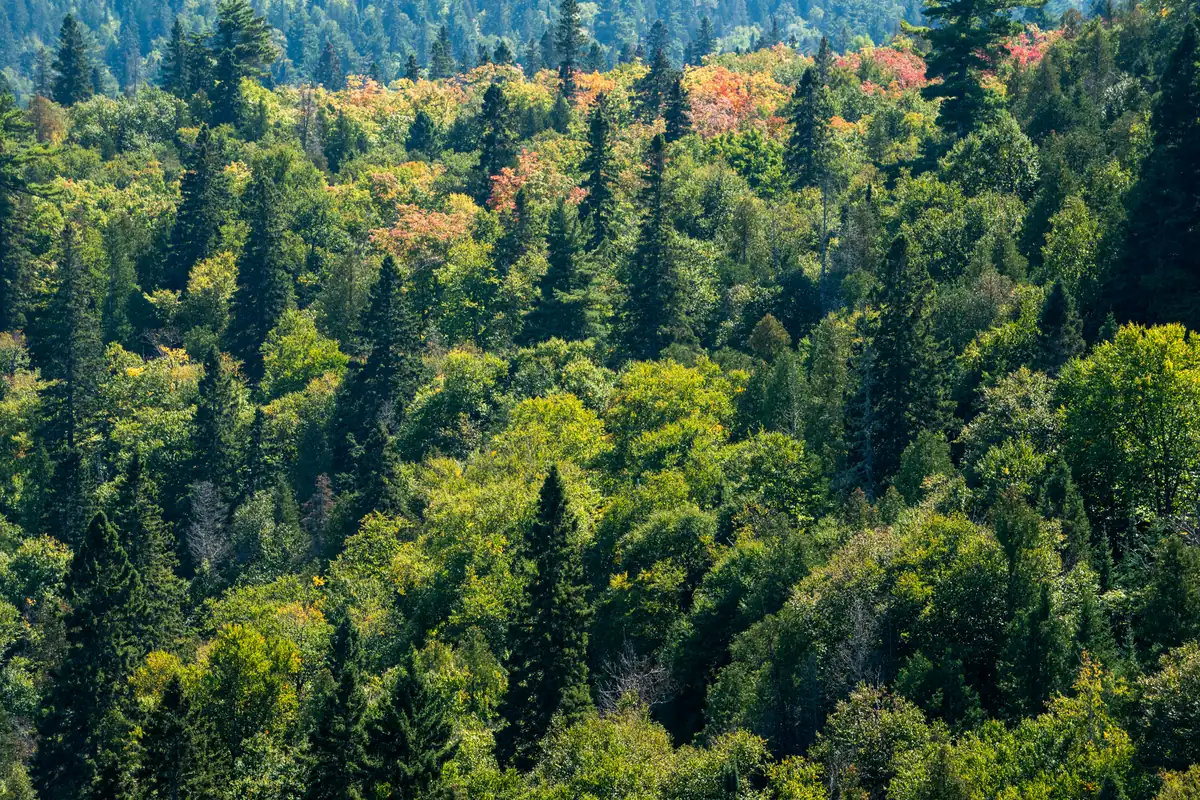
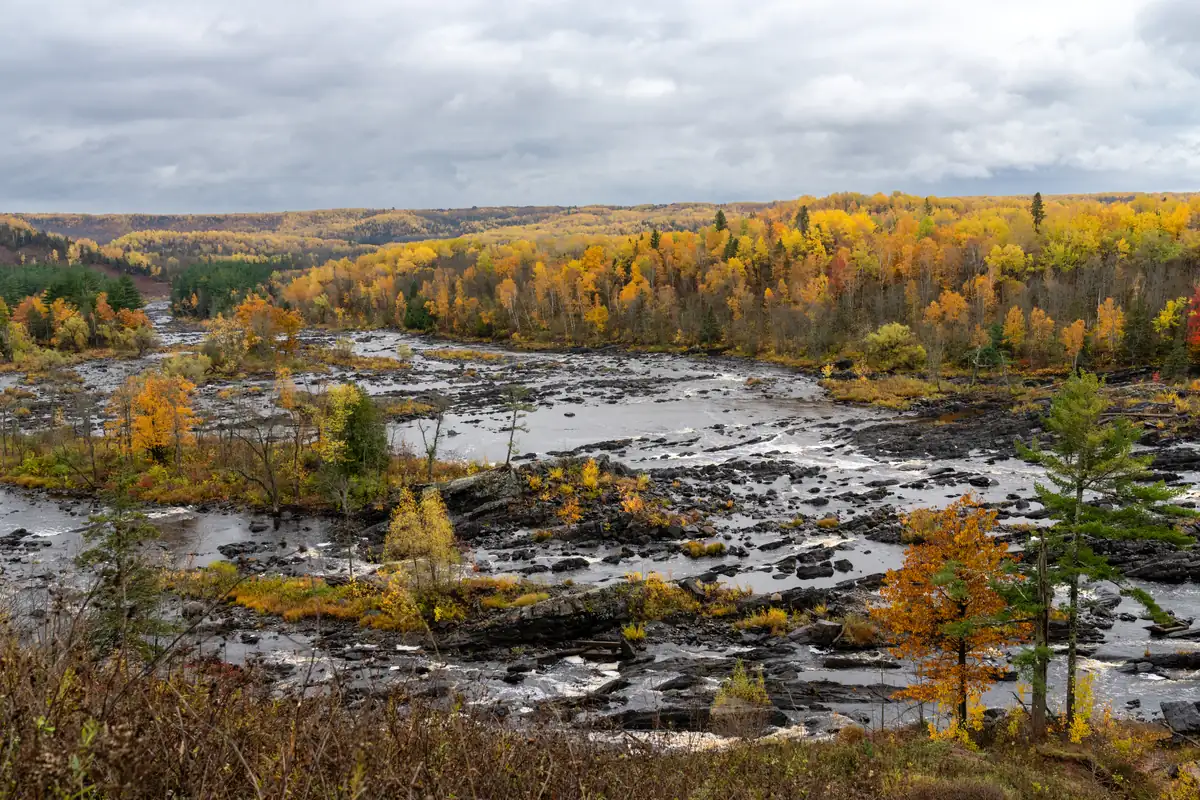
Minnesota colors from the northwest corner toward the southeast. The DNR puts the statewide window at late September through mid-October, with any one place holding its peak for roughly a week. This year there is a complication: by early September more than half the state was in severe drought or worse, and the Twin Cities had just come through one of their hottest and driest summers. DNR forest health specialist Brian Schwingle warns that severe drought “can lessen the brilliance of some colors” and can push some trees to drop leaves early, or turn late, depending on species. Expect a patchier year, with more tans and bronzes, and stands on moist soils holding the brightest reds.
| Region | Reference places | Typical peak |
|---|---|---|
| Northwest and north-central | Itasca, Bemidji, the Big Bog | Late September to early October; first in the state |
| Arrowhead and the North Shore | Bear Island State Forest near Ely, Boundary Waters, Superior National Forest | Late September to early October |
| Central lakes | Wealthwood State Forest at the north end of Mille Lacs | Early to mid-October |
| Twin Cities and central | Metro parks, the St. Croix valley | Mid-October, near the end of the state window |
| Southeast bluffs | Richard J. Dorer Memorial Hardwood State Forest, Barn Bluff at Red Wing | Mid- to late October |
| Southwest prairie | Prairie parks and wildlife areas | Grasses turn bronze through the month |
The DNR’s Fall Color Finder map is updated every Thursday through the end of October, and you can get the report by text or email. For a drive, the DNR suggests three state forests: Bear Island near Ely for aspen and birch among red and white pine, Wealthwood for sugar maple, basswood and red oak on rolling glacial hills, and the Dorer hardwoods near Red Wing, where the Barn Bluff hike looks down on the Mississippi. The best color comes after sunny days and nights between about 32 and 45 °F. If you want to know how long your trees will keep their leaves, the Field almanac estimates leaf-off for any address.
What is flying over Hawk Ridge in Duluth in October?
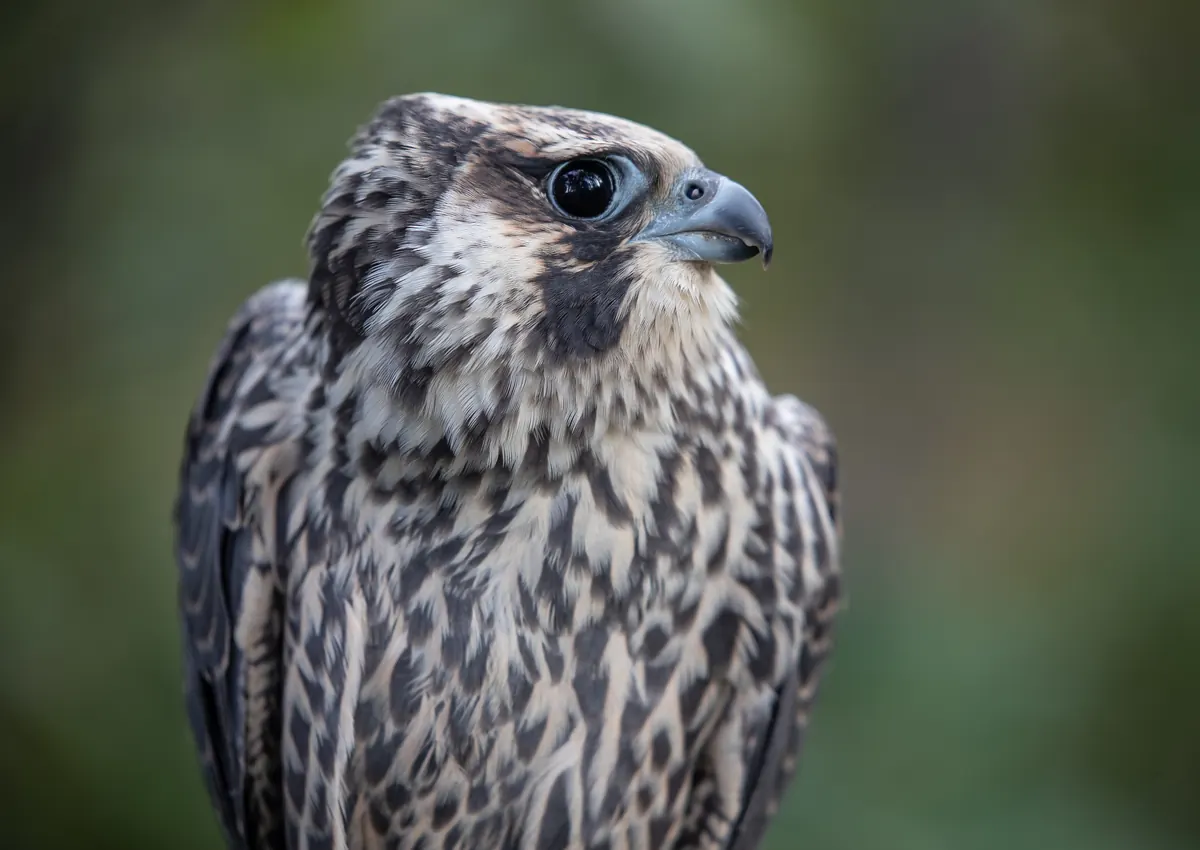
Hawk Ridge, on the hill above Duluth, sits where southbound raptors pile up rather than cross Lake Superior. The observatory has counted every fall since 1951, and daily since 1972, from August 15 to November 30, averaging more than 60,000 raptors and over 200,000 other birds a season. The broad-winged hawk flood is a September event; by October the big, heavy birds take over.
-
Bald and golden eagles
All month, building late · Main overlook, East Skyline Parkway
The DNR’s magazine puts the season’s totals at around 5,000 bald eagles and 200 golden eagles. Goldens are the prize: look for a dark eagle with a golden nape, wings held in a slight dihedral, and no white head.
-
Rough-legged hawks and red-tails
October into November · Along the ridge
Rough-legs come down from the Arctic tundra and are the October bird that most visitors have never seen: dark belly band, dark wrist patches under the wing, a white tail with a black band, and a habit of hovering. Red-tailed hawks come through in large numbers on the same winds.
-
Northern goshawks
October and later · Low along the ridge, often fast
Big, gray and fierce, goshawks are scarce everywhere, and a cold October day on the ridge is as good a chance at one as most birders get. Adults show a bold white eyebrow.
-
Northern saw-whet owls
Nights, late September through October · Banding nets in the woods (not open to casual visitors)
The observatory bands about 500 saw-whet owls a fall, drawn in by an audio lure that repeats the owl’s tooting call through the night. The busiest nights often come early in October; the single-night record, 292 owls, was set on October 6 and 7, 1989. Check the observatory’s calendar for any public owl programs.
Wind is everything. The observatory’s guide says west or northwest winds bring the big flights, while south or east winds make for slow days, so watch the forecast on our Weather now page and go the day after a cold front passes. Entry is free. The road closes for the season on December 1.
Where can you see sandhill cranes, swans and ducks in Minnesota in October?
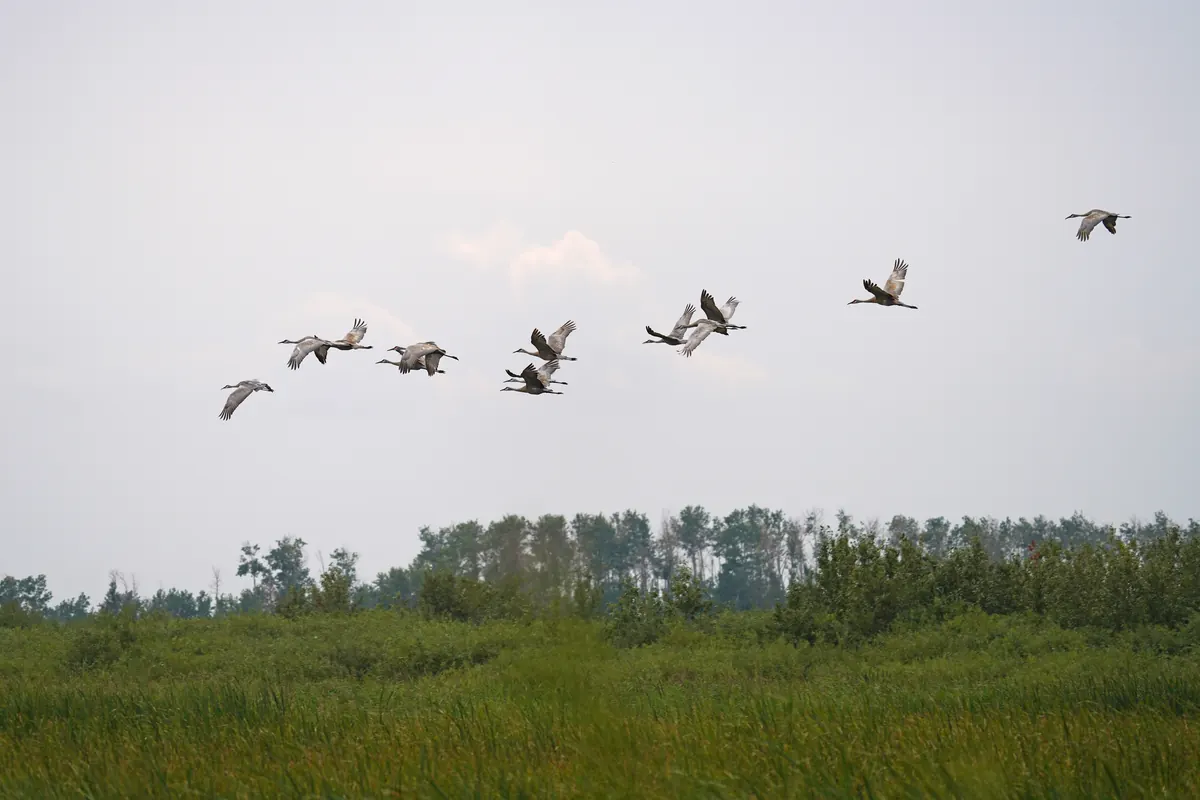
Two big shows bracket the month: cranes at Sherburne through October, and swans and diving ducks on the Mississippi at the end of it. The DNR’s spring survey counted 677,868 breeding ducks, not counting divers, 62 percent more than in 2025 and 11 percent above the long-term average, so the fall flight should be a good one.
-
Sandhill cranes at Sherburne
Mid-October to early November; dawn and dusk · Sherburne National Wildlife Refuge near Zimmerman
The cranes spend the day gleaning harvested fields and fly back to roost in the refuge marshes at sundown. The refuge’s peak single-day counts usually come in the last week of October and have topped 29,000 birds; in 2024 more than 9,000 were already present in early October. Watch from the parking area on Sherburne County Road 70, or scout freshly harvested fields north and west of the refuge. In past years volunteers have staffed crane-viewing stations on late-October afternoons; check the refuge’s events page for 2026.
-
Diving ducks on the river
From early October · Upper Mississippi River refuge pools below Wabasha
Canvasbacks, ring-necked ducks, goldeneyes and buffleheads gather in open-water rafts from late September on, joining the dabbling ducks already there. A spotting scope turns a gray smudge on the water into several thousand individual birds.
-
Tundra swans
First arrivals mid-October; peak usually in November · Weaver Bottoms and the Brownsville Overlook
The DNR says the viewing season runs from mid-October through mid-November, and the refuge counts 10,000 to 45,000 swans on the river at the peak, which in most years is the second or third week of November. Brownsville Overlook is off Highway 26 about three miles south of Brownsville, with mounted scopes and a portable restroom from mid-October; at Weaver Bottoms, park on the service road west of Highway 61 at 116th Avenue.
-
Young loons leaving
October · Northern lakes
Minnesota has roughly 12,000 loons, more than any state but Alaska. The adults left in September for the Gulf and the southern Atlantic coast; the young of the year, now gray and white, linger on the lakes and follow about a month later.
Hunting is on at many of these places, so keep to the overlooks and refuge roads. The central duck zone reopens October 10 and the south zone October 17 after their split.
What is happening in the Minnesota northwoods and on the North Shore?
-
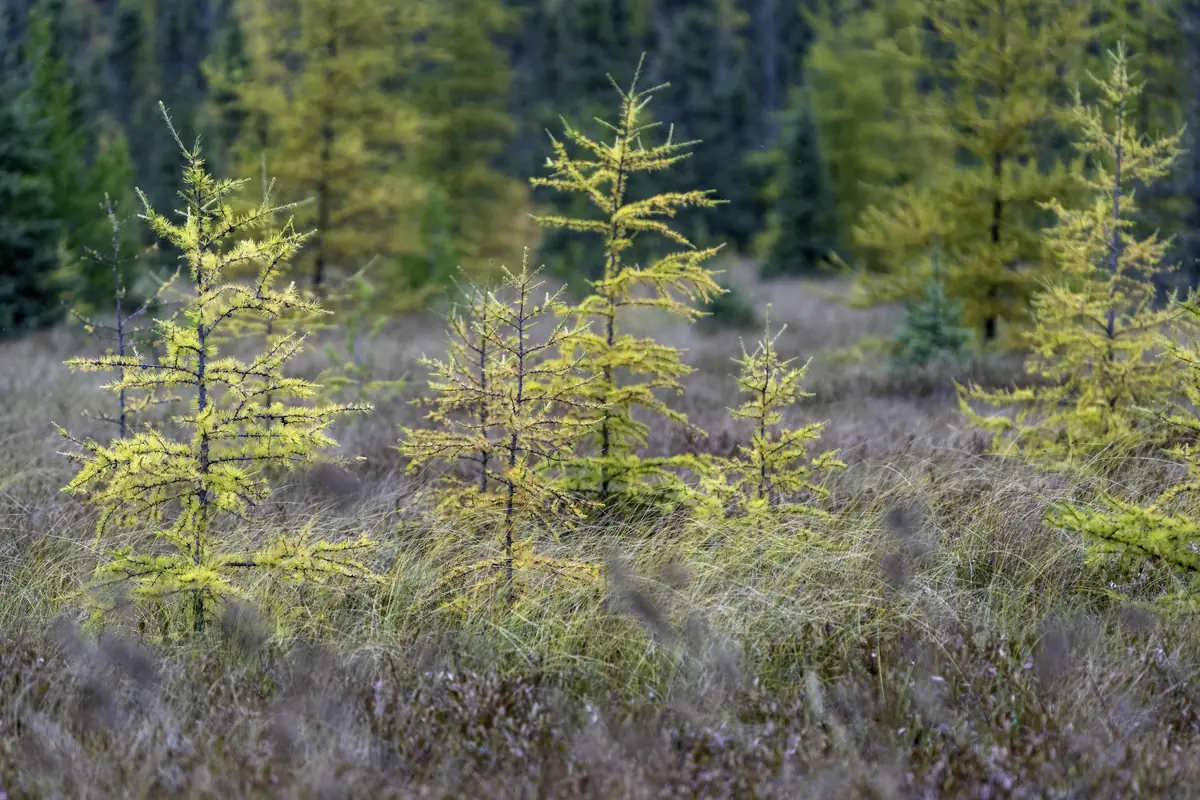
Tamaracks turn gold
Usually mid- to late October in the north · Bogs and swamps across the north
The tamarack is a conifer that drops its needles. After the aspens and birches are done, the bogs turn yellow-gold, then brown, and then the trees stand bare until May. The DNR’s fall preview names golden tamarack as the northern color to look for. See them from the Big Bog boardwalk near Waskish, along Highway 210 in Carlton County, or in any black spruce and tamarack swamp along the highways north of Duluth.
-
The moose rut
Mid-September to mid-October · The Arrowhead and the northwest
Bulls are on the move and short-tempered through the first half of October. Moose are generally not aggressive, but a rutting bull is the DNR’s stated exception. Watch from a car or from far off; a moose can run 35 mph.
-
Salmon in the North Shore rivers
Early October · Gooseberry River below Lower Falls; the Lester and French rivers near Duluth
Pink salmon, a Pacific species that established itself in Lake Superior, run up the Gooseberry River to spawn and die. Coho run the Duluth-area streams in fall too, from September to November. Posted boundaries split each stream into upper and lower reaches with different fishing rules.
-
A record red pine cone crop
Through October · Red pine stands across the north
The DNR expects the best crop of cones on the state tree in a decade and is paying $95 a bushel for clean, ripe cones that are still closed, hoping to buy about 1,000 bushels to grow nearly a million seedlings. Collectors must now register as suppliers first; your local DNR Forestry office will say where to bring them.
-
Black bears fattening up
Until they den · Mostly the northern third of the state
Minnesota has an estimated 13,000 to 18,000 black bears, and in fall they travel long distances to acorns, hazelnuts and corn before returning home to den. Bring in the bird feeders and lock the garbage.
When is the first frost and freeze in Minnesota?
Across most of the north it has already happened. The typical first 32 °F night at International Falls comes on September 13, and by the first week of October most stations in the north and center have passed their median date. The metro holds out the longest because of its concrete: the Minneapolis/St Paul airport station’s median is October 18, five weeks after International Falls. Lakes do the same work on a smaller scale; the Duluth harbor station, at the lake’s edge, freezes eleven days later than the Duluth station up on the hill.
| Station | One year in ten | Median | Nine years in ten |
|---|---|---|---|
| International Falls International Airport (far north) | Aug 30 | Sep 13 | Sep 28 |
| Moorhead (Red River Valley) | Sep 22 | Oct 3 | Oct 18 |
| Duluth (on the hill) | Sep 18 | Oct 1 | Oct 16 |
| Duluth Harbor Station (lakeshore) | Sep 25 | Oct 12 | Oct 26 |
| Grand Marais (North Shore) | Sep 22 | Oct 5 | Oct 20 |
| St Cloud Regional Airport (central) | Sep 16 | Sep 30 | Oct 12 |
| Minneapolis/St Paul Airport (metro) | Oct 1 | Oct 18 | Oct 31 |
| Worthington 2 NNE (southwest) | Sep 21 | Oct 4 | Oct 18 |
| Rochester International Airport (southeast) | Sep 22 | Oct 6 | Oct 20 |
River towns in the southeast are the late ones: the La Crescent lock and dam station, on the Mississippi, has a median of October 28. Every Minnesota station is on the Minnesota frost dates page. In a drought, clear dry nights cool quickly, so a garden in a low spot can frost well ahead of the nearest station; cover tender plants on any calm, starry evening forecast in the mid-30s.
How much daylight does Minnesota lose in October?
Between an hour and 26 minutes and an hour and 43 minutes, depending on latitude. Worthington and Rochester lose 86 minutes over the month; International Falls, the farthest north, loses 103, or 3.4 minutes a day. In Minneapolis the sun rises at 7:11 a.m. on October 1 and at 7:50 on the 31st, and sets at 6:53 p.m. and then 6:02, a 90-minute loss. Central Daylight Time gives way to standard time at 2 a.m. Sunday, November 1, and on that first evening the Minneapolis sun sets at 5:01.
| City | Oct 1 | Oct 31 | Lost | Per day |
|---|---|---|---|---|
| International Falls | 11 h 39 m | 9 h 56 m | 103 min | 3.4 min |
| Grand Marais | 11 h 39 m | 10 h 01 m | 98 min | 3.3 min |
| Bemidji | 11 h 40 m | 10 h 02 m | 98 min | 3.3 min |
| Moorhead | 11 h 40 m | 10 h 04 m | 96 min | 3.2 min |
| Duluth | 11 h 41 m | 10 h 05 m | 96 min | 3.2 min |
| Minneapolis | 11 h 42 m | 10 h 12 m | 90 min | 3.0 min |
| Rochester | 11 h 42 m | 10 h 16 m | 86 min | 2.9 min |
| Worthington | 11 h 43 m | 10 h 17 m | 86 min | 2.9 min |
By Halloween, International Falls is down to less than ten hours of daylight. The Field almanac gives the same figures for any address you enter.
What is October weather like in Minnesota, and what will El Niño do this winter?
October is the month Minnesota swings between summer and winter, and this one starts warm and dry. The state climatology office’s early-September summary had 42 percent of Minnesota in severe drought and 4.3 percent in extreme drought, the seventh straight August above normal temperature, and September running 7.6 °F above normal through the 10th. Lake levels are down: White Bear Lake about a foot below last year and Minnetonka 0.8 feet lower, and the DNR has warned of shallow boat ramps and exposed stumps and rocks. A wet October would do more to ease the fire danger than to refill the lakes.
Snow is possible but seldom sticks this early. The Twin Cities’ first one-inch snowfall has averaged November 18 over the long record, though an inch fell as early as September 26, 1942, and an inch lay on the ground as early as October 13, 1959. The north and the Iron Range usually see flakes first. Our cloud guide will help you read the gray, low lake-effect decks and the high cirrus that runs ahead of an October storm.
Then there is the winter. NOAA’s mid-September ENSO discussion (dated the 10th) called the chance of a very strong event over the cold season better than nine in ten, and the Minnesota climatology office, writing on September 29, lays out what that has usually meant here. The 27 El Niño winters since 1950 averaged 2.4 °F warmer statewide than other winters and brought the Twin Cities about 24 percent less snow. Strong and very strong events did better still, averaging 16.2 °F against 11.1 °F in non-El Niño winters, with 44.1 inches of snow in the Twin Cities instead of 56.8. The winter of 1997–98, among the warmest on record, came in one. The office adds a caution worth keeping: the Halloween Blizzard of 1991 also arrived during an El Niño, and an Arctic front can still deliver a brutal week. October itself takes little from the Pacific; the signal is a winter one, and NOAA’s winter outlook is due in mid-October.
What can you see in the Minnesota night sky in October?
-
Jupiter disappears behind the moon
Tuesday, October 6, about 3:28 to 4:14 a.m. CDT · Low in the east; you need a flat horizon
The International Occultation Timing Association’s predictions give Minnesota a good view of both halves. The crescent, about a fifth lit, rises at 2:34 a.m. in Minneapolis, the planet tucked against it. The bright limb swallows Jupiter at 3:28 a.m. in Minneapolis, 3:30 in Princeton, 3:32 in Duluth, 3:34 in Hibbing and 3:37 in International Falls, with the moon only 8 to 10 degrees up, so find a hilltop or a lakeshore facing east. Jupiter reemerges on the dark side at about 4:14 in Minneapolis, 4:13 in Duluth, 4:12 in Hibbing and 4:10 in International Falls, with the moon by then 15 or 16 degrees high and the sky dark for well over an hour afterward. In binoculars the planet simply goes out; through a small telescope its four bright satellites disappear in turn.
-
Saturn at its best
Opposition October 4; the moon passes it October 23 and 24 · Low in the east at dusk, high in the south around midnight
Saturn reaches opposition on October 4, coming up as the sun goes down and up all night, and the rings show in any telescope. On October 23 and 24 the fattening moon slides past it.
-
Draconid meteors
Evening of Thursday, October 8 · Face north after dark
The Draconids come from a comet named Giacobini–Zinner and, unusually, are best in the evening. A typical year yields just a few per hour, yet in 2026 the moon is a 4 percent sliver that does not rise until 5:04 a.m., so the whole evening is dark.
-
Jupiter, Mars and the Beehive before dawn
Mornings all month; Mars in the Beehive October 11 · East before sunrise
Before first light, look east for Jupiter, the brightest thing in that part of the sky. Mars crosses the Beehive star cluster in the predawn hours of October 11; binoculars show the red planet among a spray of faint stars.
-
Orionid meteors
Active October 2 to November 7; best before dawn October 21 and 22 · Anywhere dark, facing south
The Orionids are debris from Halley’s Comet, quick and sometimes leaving trains. The waxing moon brightens the evenings around the broad peak, so wait for moonset: 2:20 a.m. in Minneapolis on the morning of the 21st and 3:29 on the 22nd (3:22 in Duluth, 3:42 in Moorhead), which leaves a dark stretch until morning twilight begins.
-
The Hunter’s Moon
Evenings of October 25 and 26 · Rising in the east-northeast
The instant of full is late Sunday evening, 11:12 p.m. Central. In Minneapolis it rises at 5:36 p.m. that evening, 35 minutes before the 6:11 sunset, and at 6:04 p.m. on Monday, within minutes of sunset. It is an ordinary full moon in size, not a supermoon, but a low moon over a harvested field is worth the walk. Venus, by contrast, is gone: only in October’s opening evenings does it show, very low in the west, before its October 23 passage between Earth and sun.
| Phase | Date | Time |
|---|---|---|
| Last quarter | Saturday, Oct 3 | 8:25 a.m. CDT |
| New moon | Saturday, Oct 10 | 10:50 a.m. CDT |
| First quarter | Sunday, Oct 18 | 11:12 a.m. CDT |
| Full moon, the Hunter’s Moon | Sunday, Oct 25 | 11:12 p.m. CDT (looks full the evenings of Oct 25 and 26) |
| Last quarter | Sunday, Nov 1 | 2:28 p.m. CST |
Every phase, moonrise and moonset for the month is on our moon phase calendar.
What is blooming, turning and dropping in Minnesota in October?
-
New England aster
Into October, and sometimes November · Moist fields, roadsides, woods’ edges statewide
Few flowers are left for insects by now, so on a warm afternoon the purple asters they are covered in bumblebees and the odd late monarch. Minnesota Wildflowers lists them blooming from August through October, occasionally later.
-
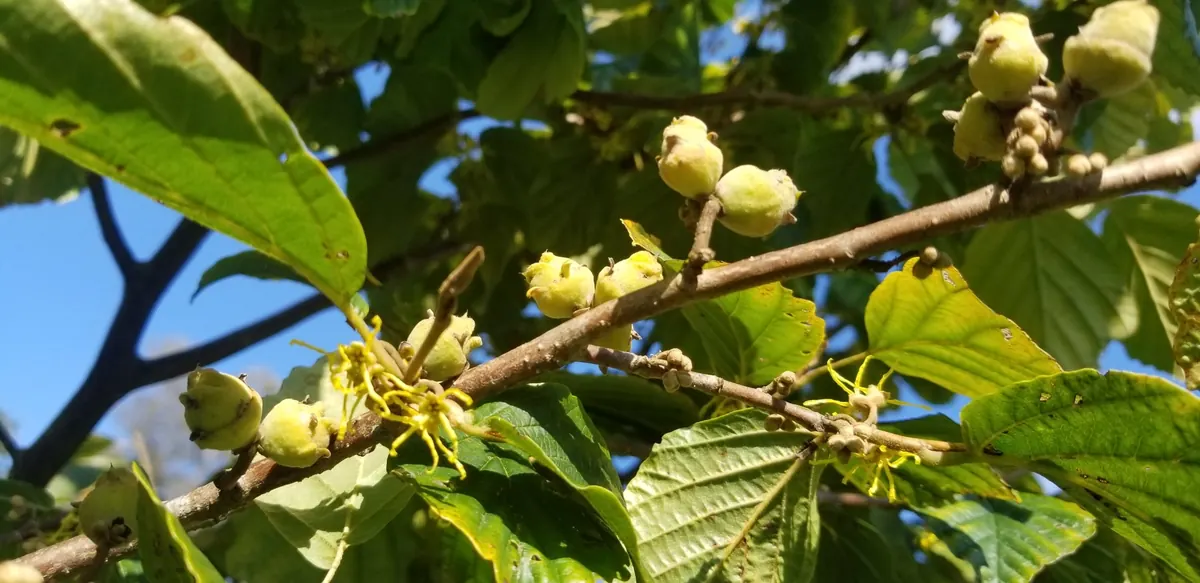
Witch hazel
Flowers September to November · Shaded hardwood slopes at the eastern edge of the state
Minnesota is the northwest tip of its range and the shrub is listed as threatened here, known from only a handful of sites. Its thin yellow ribbons open as the leaves fall, while capsules from last year’s flowers crack open and shoot seeds up to 30 feet.
-
Buckthorn stands out
Late October · Woods and hedgerows, especially in the south and metro
When the native shrubs are bare, common and glossy buckthorn are still green, which makes October the easiest month to find it. Common buckthorn has a thorn at the twig tip and black berries; glossy buckthorn has no thorns and berries that go from red to dark purple. Several state parks hold volunteer cutting days this month.
-
Oaks, sumac and the last reds
Through the month · Southern and central hardwoods
Oaks hold their russet and brown leaves long after the maples, and staghorn and smooth sumac turn scarlet on south-facing slopes. The drought may dull them this year, so note what you see: a year of pale color is useful data too.
-
Tamarack and red pine seed
Tamarack seed shed into late October · Bogs and pine stands
Tamaracks shed most of their seed in September and the rest by late October, about when the needles drop; red pine cones are ripe and closed now, which is why the DNR is buying them this month.
What are pheasants, insects and other animals doing in Minnesota in October?
-
More pheasants this year
Season opens October 10 at 9 a.m. · Central, south-central and west-central Minnesota
The DNR’s 2026 roadside survey counted 90 pheasants per 100 miles of road, up from 75 in 2025, with more than 130 in parts of the central and south-central regions and a 74 percent jump in the west-central region. The southeast, east-central and southwest counted fewer. A mild winter and a dry, warm spring helped the chicks, the DNR’s biologist says. The Governor’s Pheasant Hunting Opener is in Northfield October 9–10.
-
Lady beetles at the windows
Late September to late October, on days above 65 °F · Sunny south and west walls
Multicolored Asian lady beetles fly to buildings to overwinter on the first warm afternoons after a cold snap. University of Minnesota Extension says sealing cracks is the only real fix; once they are inside the walls, vacuum up the ones that appear, using a stocking over the hose if you want to release them outdoors.
-
Monarch stragglers
Early October only · Southern Minnesota gardens and prairies
Monarch Watch puts the main passage well before October: August 24 to September 5 at the latitude of Grand Rapids and August 29 to September 10 at the Twin Cities’. A monarch seen in October is late, and worth reporting to Journey North.
-
Adult deer ticks
Late September until hard freeze or snow · Brushy woods, especially in the east and north-central
The Minnesota Department of Health says adult blacklegged ticks become active again at the end of September and stay active through October until temperatures drop below freezing or snow covers the ground.
What can Minnesota families do outside in October?
- Saturday, October 3: salmon at Gooseberry Falls. The DNR calendar lists Celebrate the Salmon Run from 1:30 to 3:30 p.m., with naturalists below Lower Falls; one listing gave September 26 instead, so confirm with the park before driving up.
- Saturdays, October 3 and 10: Fall Color Extravaganza at St. Croix State Park; Nerstrand Big Woods holds a fall luminary event on October 3.
- Tuesday, October 6, before dawn: the moon covers Jupiter. Worth waking the kids for, if the eastern horizon is clear.
- Friday, October 9: Look to the Stars at Wild River State Park, the evening after the Draconids.
- Saturday, October 10: a candlelit evening at Lake Bemidji State Park (Fall Fest Candlelight Adventure), animal-track programs for junior naturalists at Itasca, and eBird’s October Big Day (check ebird.org for the rules).
- Sunday, October 11: peregrine falcons at Fort Snelling State Park.
- Friday, October 16: owl pellets at William O’Brien State Park, repeated as a Halloween program on October 31.
- Saturday, October 17: Candlelight Boardwalk Hike at Big Bog State Recreation Area, north unit, among the tamaracks.
- Saturday, October 24: Glow Walk at Glacial Lakes State Park.
- Saturday, October 31: bats, owls and creepy critters at William O’Brien, Nerstrand Big Woods and Fort Snelling.
- Any day through October 31: Hawk Ridge, where naturalists often show a banded bird up close.
- Help out. William O’Brien has seed-collection days on October 1, 3, 4, 14 and 17; Wild River collects prairie seed on October 16 and cuts buckthorn on October 21 and 24. Report late monarchs to Journey North, enter bird lists in eBird, and register for Project FeederWatch before its November-to-April season begins.
State park programs are listed on the DNR’s calendar, and times change; call the park or check the listing on the day. The other states’ October pages are on our nature hub. A child who comes home with a feather, a cone or a crane story can file it in the Naturalist’s Field Journal.
Safety notes for October in Minnesota
- Hunting seasons. Open this month: archery deer (September 19 to December 31), ruffed and spruce grouse and Hungarian partridge (to January 3), sharp-tailed grouse in the northwest zone (to November 30), woodcock (to November 2), fall turkey (October 3 to November 1), bear (to October 18), squirrel and rabbit, and waterfowl, with the north zone open straight through and the central and south zones reopening October 10 and 17. Pheasant opens October 10 at 9 a.m. The youth deer season and the early antlerless season both run October 15–18, and the firearms deer opener is Saturday, November 7.
- Blaze orange or blaze pink. During any open firearms deer season, including the October 15–18 hunts, Minnesota law requires every hunter and trapper afield to wear blaze orange or blaze pink on the visible part of the cap and outer clothing above the waist, not counting sleeves and gloves; camouflage patterns count only if at least half of each square foot is blaze. The rest of the month, small-game hunters must show at least one blaze article above the waist. Fabric ground blinds on public land need a blaze orange cover visible from every direction or a 144-square-inch blaze orange patch on each side. Hikers, dog walkers and mushroom hunters on wildlife management areas and state forests should wear it too.
- Cold water and low water. The DNR reminds boaters that survival odds fall sharply as the water cools; wear a life jacket, and choose a foam one over an inflatable. With lakes low, launch at idle speed, winch rather than power-load, and watch for rocks and stumps that were under water in July.
- Fire. With so much of the state in drought, wildfire potential stays elevated until the ground freezes or snow falls. Check the DNR’s burning restrictions before lighting a leaf pile or a campfire.
- Moose, bears and ticks. Give rutting bulls a wide berth into mid-October, keep food away from bears, and check for ticks after every walk until the ground freezes.
Sources
- Minnesota DNR: celebrate autumn with the 2026 foliage predictions and Fall Color Finder (September 9, 2026)
- Minnesota DNR: take a scenic fall color drive through the state forests (September 29, 2026)
- Minnesota DNR: Fall Color Finder
- Minnesota DNR: fall colors forecast (what makes a good year)
- CBS Minnesota: drought could take the brilliance out of fall colors (2026)
- Hawk Ridge Bird Observatory: fall visitor’s guide
- Hawk Ridge Bird Observatory: bird monitoring
- Minnesota Conservation Volunteer: bucket list, bird watch at Hawk Ridge
- Duluth News Tribune: Hawk Ridge banders work the night shift for science
- USFWS: birding at Sherburne National Wildlife Refuge
- USFWS: Sherburne National Wildlife Refuge events
- St. Cloud Live: record 9,000 sandhill cranes counted at Sherburne (October 2024)
- USFWS: wildlife watching at Upper Mississippi River National Wildlife and Fish Refuge
- Minnesota DNR: tundra swans
- Minnesota DNR: Fish and Wildlife Almanac, September 21, 2026 (breeding duck survey)
- Minnesota DNR: common loon
- Minnesota Seasons: tamarack
- Minnesota DNR: moose
- Minnesota DNR: black bear
- Minnesota DNR: fishing the North Shore
- Minnesota DNR: help Minnesota’s state tree grow (red pine cone collection, September 3, 2026)
- Minnesota frost dates (NOAA 1991–2020 normals)
- U.S. Naval Observatory: sun and moon rise and set data
- Minnesota DNR: HydroClim Minnesota for early September 2026
- Minnesota DNR: low water levels create challenges for boat launching (September 3, 2026)
- Minnesota DNR: Twin Cities earliest and latest first snowfall and snow cover
- Minnesota State Climatology Office: “El Niño” is coming (September 29, 2026)
- Minnesota State Climatology Office: strong El Niño and winter in the Twin Cities
- NWS La Crosse: temperatures, snowfall and precipitation during strong El Niño winters
- NOAA Climate Prediction Center: ENSO diagnostic discussion, September 10, 2026
- International Occultation Timing Association: occultation of Jupiter, October 6, 2026
- Minnesota Wildflowers: New England aster
- Minnesota Wildflowers: witch hazel
- Minnesota DNR: buckthorn
- Grand Forks Herald: Minnesota DNR says the pheasant season looks promising (2026 roadside survey)
- Minnesota DNR: Northfield readies for the 2026 Governor’s Pheasant Hunting Opener
- University of Minnesota Extension: multicolored Asian lady beetles
- Monarch Watch: peak migration dates by latitude
- Journey North: monarchs
- Minnesota Department of Health: ticks
- Minnesota DNR: state parks calendar by park (October 2026 programs)
- Minnesota DNR: state parks calendar by date
- eBird: October Big Day 2026
- Project FeederWatch: how to participate
- Minnesota DNR: hunting season dates
- Minnesota DNR: deer hunting (2026 season dates)
- Minnesota DNR: upland bird season dates
- Minnesota DNR: waterfowl hunting seasons are on the horizon (August 31, 2026; duck zone dates)
- Minnesota DNR: Fish and Wildlife Almanac, September 29, 2026 (fall turkey, pheasant)
- Minnesota DNR: blaze clothing requirements
- Minnesota Statutes 97B.071: clothing and ground blind requirements
- Minnesota DNR: archery hunters set to begin season (September 14, 2026; youth and early antlerless seasons, ground blinds)
- Minnesota DNR: stay safe when the water temperature drops (September 24, 2026)
- Photos via Wikimedia Commons; licenses and photographers are credited under each picture
