What to look for in nature in Nevada this May
May is the month the Nevada desert switches from small annual flowers to cactus, yucca and flowering shrubs, while the mountains finally begin to give up their snow. At Red Rock Canyon, the staff’s weekly reports from two past springs show hedgehog cactus, cliffrose, Apache plume, indigobush and buckhorn cholla taking their turns through the month. The Lahontan Valley wetlands near Fallon are in the middle of the shorebird window, and the springs at Moapa and Pahranagat hold small, rare fish and a long list of birds. In the Snake Range, the Wheeler Peak Scenic Drive usually opens around Memorial Day, which falls on May 31 in 2027, though the park says snow can set it anywhere from April to July. The Eta Aquariid meteors peak at a nearly invisible Moon on the morning of May 6, the Flower Moon climbs out of the east, full, the night of May 19, while Mercury hangs low in the dusk at the end of the month. Read on from the Mojave to the Lahontan Valley.
Other months in Nevada: October, November, December, January, February, March, April.
Start here
- Follow one shrub or cactus. Pick a hedgehog cactus, a cliffrose or an Apache plume near you, and record when the first bloom opens and when the last petal drops.
- Watch an oasis at dawn. Spend one early morning at a spring-fed refuge such as Pahranagat or the Lahontan Valley wetlands and list every bird you can name.
- Mark the moon on May 19. Watch the Flower Moon rise near sunset on Wednesday, May 19, and note how its color and size change as it climbs.
In the Naturalist’s Field Journal, enter wetland and oasis visitors on “birds I have seen,” each shrub and cactus on “a tree through the seasons” or “reading the signs,” and your bloom wash on “the same place twice.” “Dusk and dawn watch” fits a refuge morning or the Eta Aquariids, and “colours of the day” suits the cactus magentas and the cliffrose yellows.
Regions used below: Reno, Carson City and Lake Tahoe; Northern Nevada: Winnemucca, Elko and the Ruby Mountains; Central Nevada: Fallon, Austin and Tonopah; Eastern Nevada: Ely and Great Basin National Park; Southern Nevada: Las Vegas, the Spring Mountains and the Mojave.
Which cacti bloom at Red Rock Canyon and around Las Vegas in May?
The small annuals that dominated April fade through May, and the show passes to the cacti, the agaves and the shrubs. Red Rock Canyon National Conservation Area published weekly bloom reports in the springs of 2019 and 2020, and the two sets show the same order of events with different dates. Treat them as examples of one sequence, not a calendar: the amount of winter rain decides how many flowers appear, and the Lake Mead recreation area notes that without favorable winter and early spring rain the seeds simply stay dormant.
-
Hedgehog cactus and its neighbors
Late April into May in the 2019 and 2020 reports · Red Rock Canyon National Conservation Area, west of Las Vegas
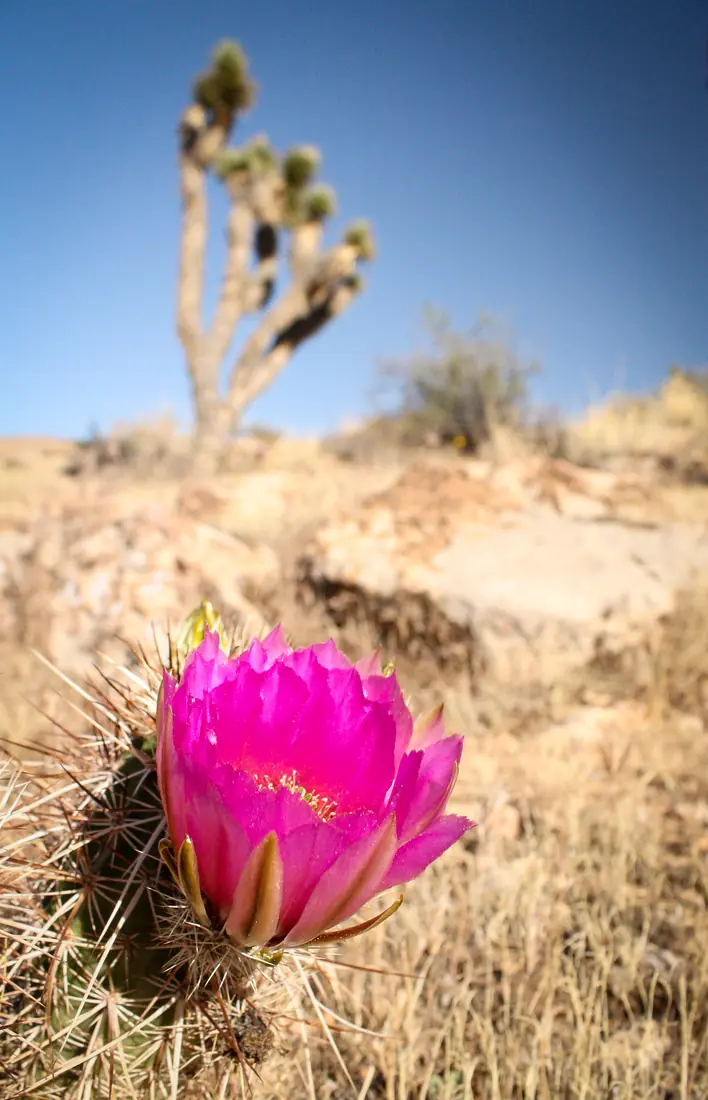
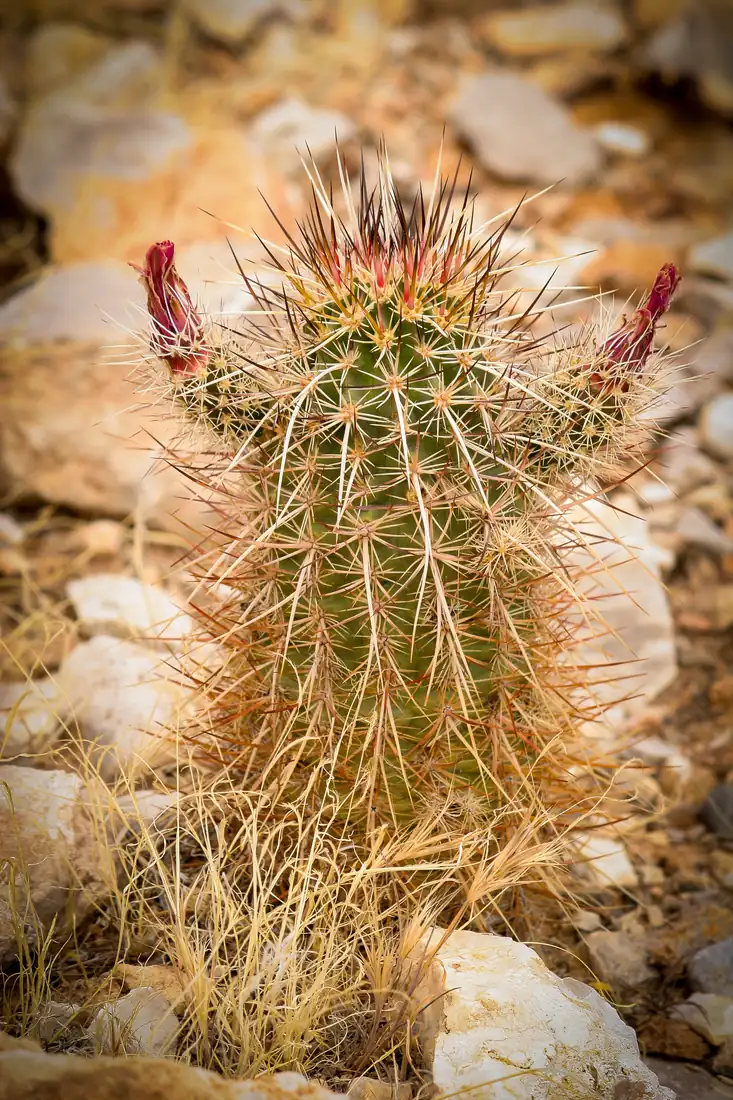
The reports for the last week of April 2019 list beavertail, hedgehog and prickly pear cactus in flower, and the report for May 5, 2020 describes magenta hedgehog cactus blooms with straggling mariposa lily and giant four o’clock. By then the same staff counted about 60 flowering species during scout hikes. A hedgehog cactus is easy to spot because its flower is a hot pink cup that opens right at the top of a small, very spiny barrel, often in the open on rocky ground. Buds look like dark red fingers pressed against the spines, which is how they show in many photographs from early May. Prickly pear flowers follow, and the May 21, 2020 report lists several kinds.
-
Late-May plants: agave, cholla and datura
The last week of May in both reports · Red Rock Canyon trails and the Scenic Drive
In 2019, the week of May 26 brought yerba mansa, pygmy or Utah agave, buckhorn cholla and desert willow. In 2020, the report for May 28 added sacred datura, California buckwheat, thistle, Utah agave and buckhorn cholla. Utah agave sends up a tall stalk with yellow flowers, and its leaves form a tight rosette close to the ground. Sacred datura opens large white trumpets that are tied to evening and night visitors, so go early or late in the day to see them open. Do not touch datura: all parts of the plant are poisonous, a common warning that applies to the whole genus.
-
A visit plan for Red Rock
Reservations required through May 31; the Scenic Drive runs 6 a.m. to 8 p.m. from April to September · Red Rock Canyon Scenic Drive and State Route 159
According to the conservation area’s website, daytime entry to the Scenic Drive needs a reservation between the first of October and the last day of May, and the April to September schedule runs 6 a.m. to 8 p.m. A weekly program called Flower Friday is linked from the same site. Everything here can change, so read the current page before you drive out, and use the same hour each week if you keep a bloom photo log. Stay on trails, since desert soil crusts take years to recover, as the Park Service says in its writing on Lake Mead plants.
The “same place twice” plate in the Naturalist’s Field Journal suits this exercise: draw one patch of ground on May 1 and again on May 28, and write what opened in between.
Which desert shrubs and trees flower in Nevada in May?
Most visitors look at the ground in April. In May the bigger bloom is at eye level: the shrubs of the Mojave and the higher desert flower in sequence, and many of them feed insects and animals through the summer. The Red Rock reports are again our best published sequence for the south, and they are specific about species.
-
Cliffrose, Apache plume and brittlebush
Mid to late April through the third week of May in the reports · Red Rock Canyon, and similar desert slopes statewide
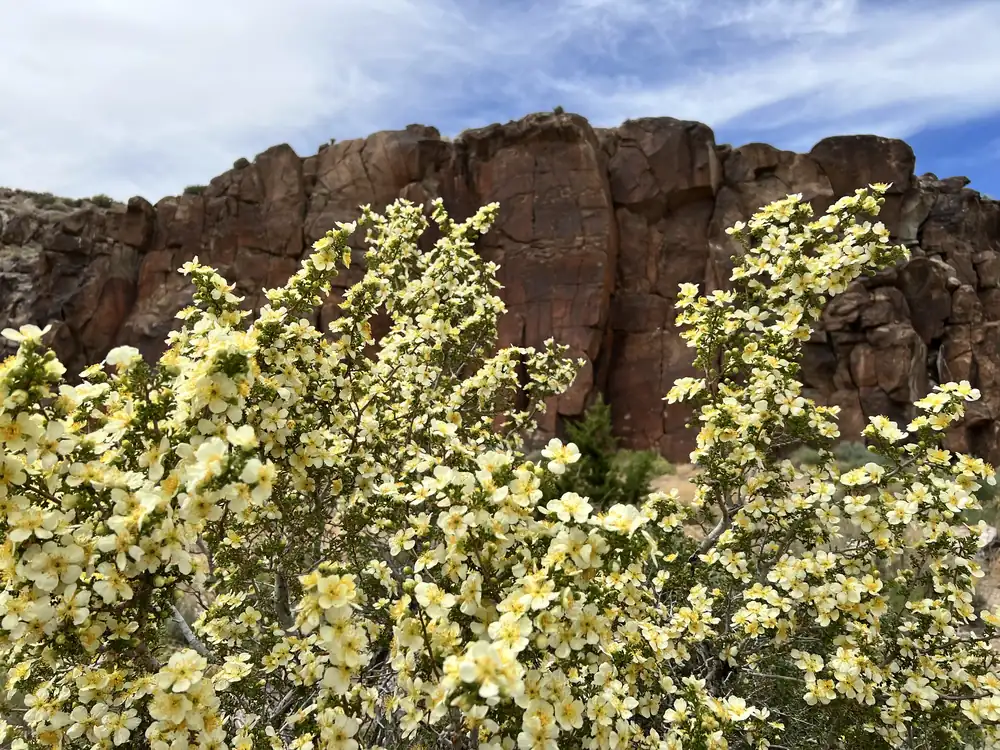
In 2020, the May 13 report lists Virgin River brittlebush, cliffrose, Apache plume, creosote bush and Palmer’s penstemon. In 2019, cliffrose and Apache plume were on the list for the week of April 21 and again in the week of May 19 beside desert thistle, hoary aster and honey mesquite. Cliffrose has fragrant pale yellow flowers with five broad petals, and Apache plume shows white blossoms followed by pink, feathery seed heads. Seen together on a slope, they can look like patches of snow in the middle of the desert.
-
Indigobush, desert marigold and yerba santa
First and second weeks of May in 2019; mid-May in 2020 · Washes and canyon mouths in the Mojave
The week of May 5, 2019 brought indigobush, brittlebush, creosote bush and scarlet gaura. A week later the list included desert marigold, yerba santa, Mexican bladdersage, paperflower and jimsonweed. On May 21, 2020, the staff reported indigobush, white-stemmed paperflower, yerba mansa and bush penstemon. Indigobush flowers are a deep purple that stands out against gray rock, and creosote bush, the most common shrub of the Mojave, has small yellow flowers followed by fuzzy white seed balls.
-
A shrub farther north
Late spring into June in the central Great Basin · Slopes around Goldfield and the Basin and Range country
The cliffrose seen near Goldfield, in central Nevada, in a Bureau of Land Management photograph taken on June 2, 2024, shows the plant still in bloom at that elevation. The caption says cliffrose is a popular food for mule deer, bighorn sheep and elk, which is one reason its flowering matters to wildlife managers.
Pick one shrub, return each week and write down what visits its flowers. Journey North and eBird both accept observations about spring change, as listed in the families section below.
Is May the best month for shorebirds in the Lahontan Valley and northern Nevada?
April brought the first shorebirds to the wetlands near Fallon, as our April page describes. May is the fuller stretch of the same migration window, with many species passing through in a few weeks. The wetlands are in the Lahontan Valley, a site the Audubon article names as part of the Western Hemisphere Shorebird Reserve Network.
-
What the surveys have shown
April and early May in the one spring on file · Stillwater National Wildlife Refuge, Carson Lake and the Humboldt Wildlife Management Area
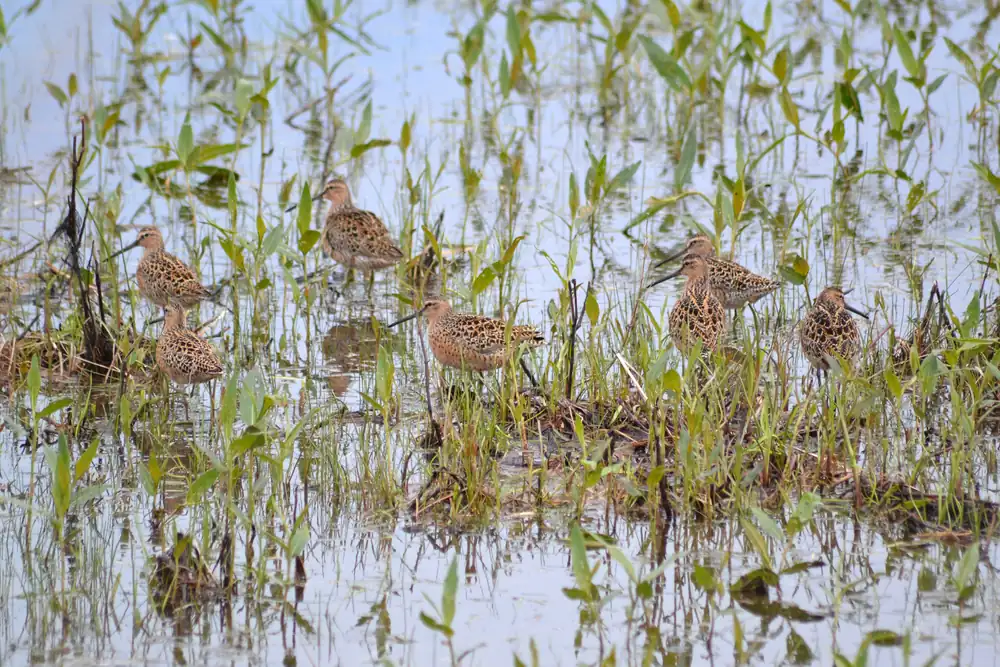
Audubon’s write-up of the spring 2022 migration describes three volunteer surveys, with the last one on May 5. Species the surveys turned up include dowitchers, dunlin, two small sandpipers and snowy plovers, and two wetland units at Stillwater held more than 500 birds between them. The article does not give a peak date; it says the survey data will help managers determine the peak migration pattern. It also shows how much the water matters. That year the irrigation allocation was only 70%, the state could hold only about 200 acres of wet habitat at Carson Lake while the birds passed, and the Humboldt Wildlife Management Area had no water at all during a visit in late April. Check conditions with the managers before you travel.
-
Wading birds and a long bird list
Open year-round; spring and fall are the busy migration seasons · Stillwater National Wildlife Refuge, about 17 miles northeast of Fallon
The refuge lists American avocet and long-billed dowitcher as key shorebirds, with tundra swan, canvasback, great blue heron and great egret among the other waterbirds, and says more than 250 bird species have been seen there through the seasons. An auto tour loop starts at Stillwater Point Reservoir and circles Lower Foxtail Lake. The refuge cautions that algal blooms in its water are highly toxic to dogs and recommends reading current advisories before you go. For nesting and event details it points to its email, stillwater@fws.gov. The spring bird festival that Fallon hosts had no trustworthy 2027 page when we looked, so we leave its dates out.
-
Ruby Lake and the other northern refuges
Open daily, one hour before sunrise to one hour after sunset · Ruby Lake NWR south of Elko; Sheldon NWR in the northwest; Anaho Island in Pyramid Lake
Ruby Lake National Wildlife Refuge sits at the south end of Ruby Valley, around 6,000 feet, on 40,048 acres of marsh and meadow. Harrison Pass is not maintained year-round, and the refuge points winter and bad-weather drivers to Secret Pass, reached from Interstate 80 exit 321 at Halleck. Its auto tour route can close temporarily for habitat work in Unit 14, so call 775-779-2237 or write rubylake@fws.gov first. Sheldon National Wildlife Refuge was established in 1931 to protect the American pronghorn and now also shelters greater sage-grouse and California bighorn sheep, according to the Fish and Wildlife Service. Anaho Island, part of the Pyramid Lake Paiute Reservation, has been a bird colony preserve since 1913 and is closed to the public, so scan it only from tribal-permitted spots on the lake.
Bring binoculars, write down species and counts on a single morning, and compare with your April list. Use the “birds I have seen” plate for it.
When does the Wheeler Peak Scenic Drive open, and what is May like at Great Basin National Park?
For many visitors, May in the Snake Range is the shoulder between snow and summer. The valley around Baker is mild, while the high country still holds drifts. The park’s own pages are blunt that the schedule depends on spring melt.
-
The Scenic Drive and the bristlecone groves
Usually around Memorial Day (May 31, 2027); sometimes as early as April, sometimes as late as July · Wheeler Peak Scenic Drive and the Bristlecone Trailhead
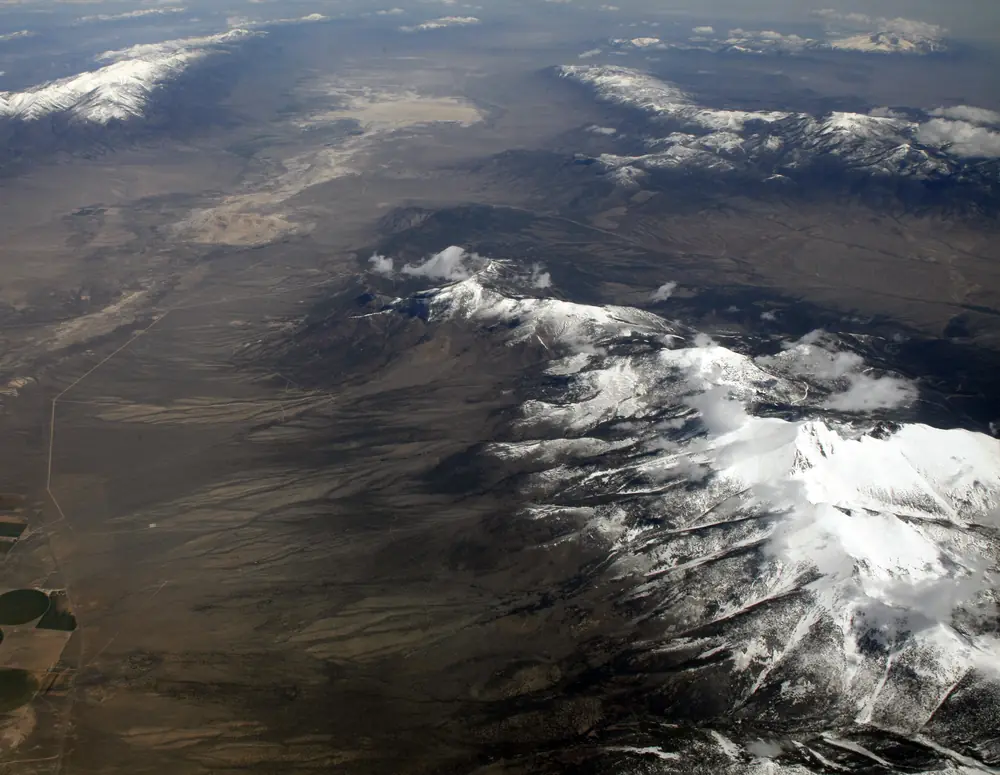
The Park Service says that after a typical winter the Bristlecone Trailhead opens in late May, around Memorial Day, and that melt conditions can make it as early as April or as late as July. When the drive is shut, the bristlecone trails stay open but the only access is on foot by the Lehman Creek Trail, which adds 6.4 miles round trip, and the park says that is not recommended without significant backcountry and winter experience and equipment. Its conditions page lists the drive as closed in winter and after snowfall, and says most park roads usually open between Memorial Day and late October. Call the park at 775-234-7331 or read the alerts page the week you go.
-
What the weather is really like
All of May · Lehman Caves Visitor Center, 6,825 feet, and the high country above
The park lists the average May high at the visitor center as 66 °F and the average low as 40 °F, with about 1.1 inches of precipitation on roughly 7 days and about 5 thunderstorms. It also says the wettest May on record there brought 4.7 inches and that the snowiest brought 23 inches, so a May snowstorm is not a freak event. Valley days can be hot while the snowpack above has not melted.
-
Birds, bats and fawns
Arrivals through May; evening and early morning are best · Baker Creek, Upper Lehman Creek and the Wheeler Peak campground
The park’s bird page lists sagebrush species such as golden eagle, western meadowlark, loggerhead shrike and horned lark on the drive up from Baker, mountain chickadee and warbling vireo among the ponderosa pines along Lehman Creek, and Clark’s nutcracker, Steller’s jay and pygmy nuthatch near the Wheeler Peak campground. It adds that summer dusk and dawn bring common poorwill, great horned owl and common nighthawk. The mammal page says deer groups usually consist of a doe with fawns and a few yearlings and feed most visibly in early morning and at dusk. At least ten bat species live near the park, and the bat page notes that Rose Guano Cave, visible from US 6 and 50 in the northwest of the range, holds a maternity colony of several thousand big free-tailed bats. The park reports no confirmed white-nose syndrome, though monitoring continues.
The park lists over 800 plant species. Many bloom only in years with enough water, so expect good displays to be patchy and to move up the slope as the season warms.
What is special about the Moapa dace refuge and Pahranagat in May?
Southern Nevada’s springs are islands of water in the desert, and several hold animals found nowhere else. Two are within a day trip of Las Vegas, and both are easy to include in a spring itinerary.
-
Moapa Valley National Wildlife Refuge and the Moapa dace
Open Friday to Sunday, 8 a.m. to 4 p.m., September through May; closed June to August · Moapa, about an hour north of Las Vegas
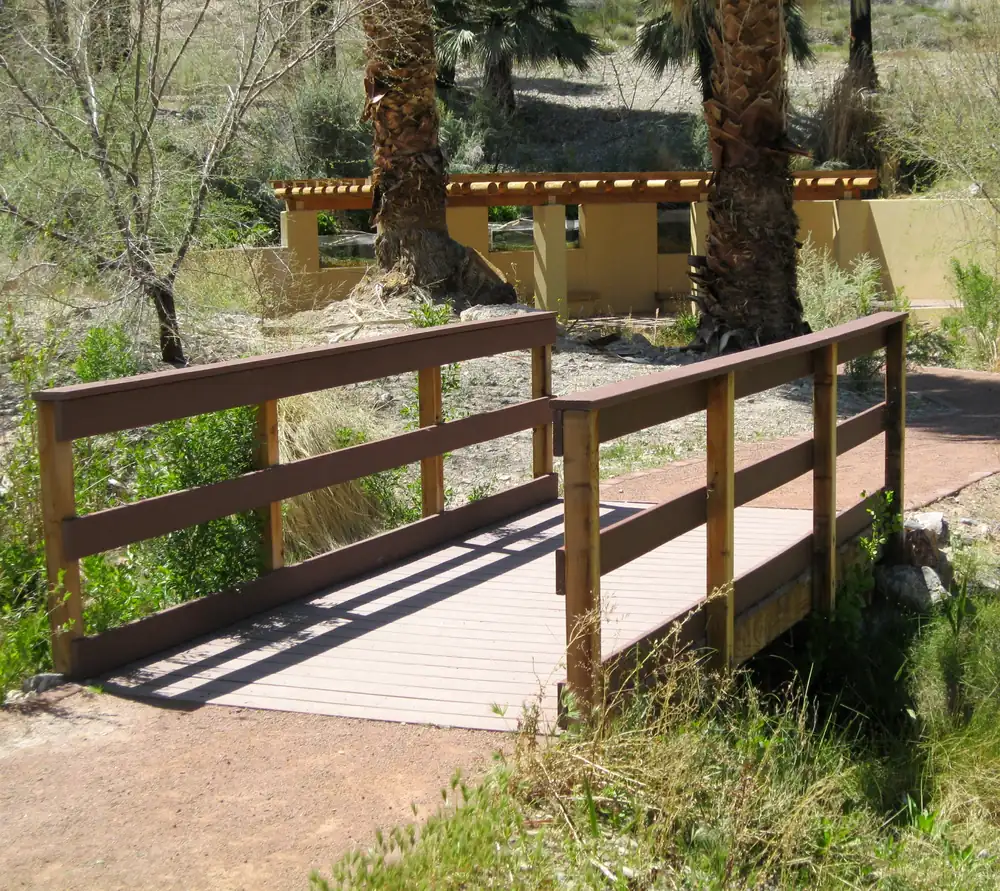
May is the last month before the 136-acre refuge closes for the summer. It was set aside in 1979 to protect the endangered Moapa dace, a fish found only in the Muddy (Moapa) River and its thermal springs in Clark County. The Fish and Wildlife Service says the dace grows up to 4.7 inches, lives four or more years and prefers water between 82.4 and 89.6 °F. The refuge says populations are recovering but remain below the stable goal of 6,000, and the species page says adults were found in low numbers in restricted parts of three springs. Visitors can walk the streamside path, look at the fish through a stream viewing window or hike the half-mile Overlook Trail. Fishing, drones, swimming and camping are not allowed, and dogs must be leashed. Entry is free; call 775-725-3417 to confirm hours.
-
Pahranagat National Wildlife Refuge
Spring migration; open year-round, check events · Pahranagat Valley, Lincoln County, along US 93
This 5,382-acre refuge has spring-fed lakes, marshes and wet meadows beneath tall cottonwoods, and it is a stopover on the Pacific Flyway for waterfowl and songbirds in both seasons. The Fish and Wildlife Service has recorded 264 bird species there, more than half of all the birds recorded in Nevada, and the endangered southwestern willow flycatcher lives in its riparian forests. Gambel’s quail, cottontails, jackrabbits, coyotes, owls, mule deer and mountain lions are among the animals visitors may see. Entry is free. The ranger events on the refuge’s page were all scheduled in October through December of 2026, so none are posted for May yet.
Both refuges reward an early start. Keep your list by habitat, and note which birds sat in cottonwoods and which stayed on the water.
When are desert tortoises active, and what else lives at Desert National Wildlife Refuge and Lake Mead?
By May the desert tortoise is well out of its burrow, and the other reptiles are right behind it. The large southern refuges and the lake add birds, bats and sheep.
-
Tortoises on the move
Spring through fall; also after summer storms · Lake Mead National Recreation Area and the Mojave generally
The Park Service says tortoises leave their burrows in spring to feed and mate and stay active through fall, and that they spend much of life underground. About 98% of eggs and hatchlings do not survive to adulthood, but an adult can live 60 to 80 years. The species was listed as threatened under the federal Endangered Species Act in 1990, and disturbing one in any way is prohibited, so stand back and take a photo. Do not pick up a tortoise, because a frightened animal can empty its bladder and lose water it needs. A tortoise crossing a road is best left where it is unless it is in immediate danger, and then only experts should move it.
-
Desert National Wildlife Refuge
Backcountry roads open 24 hours; the visitor center keeps seasonal hours · North of Las Vegas
The refuge protects the largest intact bighorn habitat in the Mojave Desert, and lists more than 320 bird species and 32 reptile species. Backcountry roads are open to passenger vehicles and street-legal motorcycles, but off-highway vehicles are banned throughout, and unreported washouts and loose rock are possible. Hours at the visitor center vary through the year, so look at the refuge’s own page first.
-
Lake Mead, peregrines and bats
All spring · Lake Mead National Recreation Area, Lake Mohave and Black Canyon
The recreation area has recorded more than 240 kinds of birds and at least 19 species of bats. The Park Service says that by 2010 there were 33 nesting pairs of peregrine falcons in almost all areas of the park. It also describes the desert bighorn as wary of people, so watch from a distance. For current viewing tips, call the Visitor and Recreation Information line, 702-293-8990.
Make the “mammal watch” page a place to log sheep, coyotes and cottontails by date and place, and keep every sighting at a respectful distance.
How warm, dry and windy is May in Nevada?
May is the month the south turns hot and the north turns mild. By NOAA’s 1991 to 2020 normals, the typical May afternoon reaches about 88.5 °F in Las Vegas, near 74 °F in Reno, Winnemucca and Tonopah, and near 63 °F at Mt. Charleston. Las Vegas gets only 0.07 inch of rain in the month. Elko averages 1.22 inches, the wettest of the valley stations in the table.
| Station | Average high | Average low | Precipitation | Snowfall |
|---|---|---|---|---|
| Reno (airport) | 74.1 °F | 46.6 °F | 0.55 in | 0.1 in |
| Carson City | 70.4 °F | 42.9 °F | 0.51 in | 0.0 in |
| Winnemucca (airport) | 73.7 °F | 39.1 °F | 1.13 in | 0.1 in |
| Elko (airport) | 70.0 °F | 38.5 °F | 1.22 in | 0.4 in |
| Ely (airport) | 68.9 °F | 34.0 °F | 1.05 in | 2.0 in |
| Great Basin National Park | 64.3 °F | 40.2 °F | 1.25 in | 0.7 in |
| Tonopah (airport) | 74.0 °F | 44.1 °F | 0.51 in | not published |
| Mt. Charleston Fire Station | 63.3 °F | 37.1 °F | 0.82 in | 1.6 in |
| Las Vegas (airport) | 88.5 °F | 66.1 °F | 0.07 in | 0.0 in |
The hazards of the month are wind, dust, sharp swings in temperature and, in the south, the first real heat. The National Weather Service in Las Vegas says the strong winds of the cold season are most common in the spring months and the season for them stretches from late September to early June. Winds over 50 mph are infrequent, but blowing dust and sand make them among the most disruptive weather events, and they usually arrive from the southwest or pass through from the northwest. The same office says spring is usually considered the most ideal season, though rather sharp temperature changes can occur. Flash floods are rare in May but remain possible when a storm settles over a range.
The Climate Prediction Center updates its longer-range maps on a seasonal outlook page, which we leave for you to read. Day-to-day forecasts live on the weather page, and the cloud guide explains the sky overhead.
When is the last spring freeze in Nevada?
Freezing nights are over in southern Nevada but not in the north. The 1991 to 2020 NOAA normals put the median last 32 °F night on April 20 in Reno, April 30 in Tonopah, May 6 in Fallon and May 29 in Elko. At Ely the median is June 12, and nine springs in ten are not finished with freezing there until June 28. In Las Vegas the final freeze normally arrives in winter, in January or February.
| Station | One year in ten | Median | Nine years in ten |
|---|---|---|---|
| Reno | Apr 6 | Apr 20 | May 5 |
| Fallon | Apr 21 | May 6 | May 25 |
| Winnemucca | May 10 | May 31 | Jun 19 |
| Elko | May 10 | May 29 | Jun 16 |
| Ely | May 29 | Jun 12 | Jun 28 |
| Tonopah | Apr 14 | Apr 30 | May 22 |
| Las Vegas | Dec 20 | Jan 20 | Feb 14 |
| Laughlin | Dec 11 | Jan 5 | Feb 13 |
Each row describes one weather station rather than a region, and high towns can lag the valleys by weeks, so gardeners in Elko or Ely should still guard tender plants in May. For towns missing here, see the Nevada frost dates page.
How much daylight does Nevada gain in May?
Across the state, cities add between 45 minutes (Laughlin) and 57 minutes (Elko) of daylight over May, an average of 1.5 to 1.9 minutes each day, slower than in April. By May 31 the sun is up about 14 and a half hours in Las Vegas and almost 15 hours in Winnemucca and Elko. The gain keeps shrinking toward the June 21 solstice.
| City | May 1 | May 31 | Gained | Per day |
|---|---|---|---|---|
| Reno | 13 h 53 m | 14 h 46 m | 53 min | 1.8 min |
| Fallon | 13 h 53 m | 14 h 46 m | 53 min | 1.8 min |
| Winnemucca | 13 h 59 m | 14 h 54 m | 55 min | 1.8 min |
| Elko | 13 h 57 m | 14 h 54 m | 57 min | 1.9 min |
| Ely | 13 h 52 m | 14 h 43 m | 51 min | 1.7 min |
| Tonopah | 13 h 47 m | 14 h 37 m | 50 min | 1.7 min |
| Las Vegas | 13 h 40 m | 14 h 27 m | 47 min | 1.6 min |
| Laughlin | 13 h 37 m | 14 h 22 m | 45 min | 1.5 min |
Longer evenings let you add a dusk visit to the wetlands, but the first two hours after sunrise are still the most productive for birds. Find your own town on the daylight page.
What is in the night sky over Nevada in May?
May offers a meteor shower at a perfect moon phase, a full moon with two names, Mercury at its best for the year and the start of the long Milky Way season. All clock times below are Pacific daylight time (in West Wendover, on Mountain time, they are an hour later), and since clocks changed in March, May has no standard time.
-
Eta Aquariid meteors
Best mornings May 5, 6 and 7, in the last hours before dawn · A dark site with a clear eastern and southern view; the radiant is in Aquarius
Meteors from this stream can be seen between about April 19 and May 28. The peak falls on May 6, in the daytime for Nevada, so the mornings before and after are the best. New Moon arrives at 3:58 a.m. Pacific time on May 6, and the Moon is a one or two percent sliver, so there is no moonlight at all. Skywatchers in the southern states may see something like 10 to 30 meteors an hour in the final stretch before dawn, while the north sees fewer because the radiant climbs so late. Within Nevada that favors Las Vegas and Laughlin over Elko or Winnemucca.
-
Flower Moon, a seasonal Blue Moon
Full at 3:59 a.m. Pacific time on Thursday, May 20; best evening is Wednesday, May 19 · Any clear eastern horizon at dusk
Since the Moon turns exactly full before dawn on the 20th, the Moon that rises near sunset on Wednesday, May 19 is the one that looks full. By the older seasonal rule, the Blue Moon is whichever full moon is third among four in a single astronomical spring, and this spring, running from the equinox on March 20 to the solstice on June 21, has four full moons, with May’s as the third. The newer rule asks for two in one calendar month, which does not happen in 2027. Think of it as a Flower Moon first. The Moon is not a supermoon.
-
Mercury in the evening
Best from about May 12 to June 5; greatest elongation May 28 · Low in the west-northwest, 45 to 90 minutes after sunset
Mercury’s widest evening angle from the Sun, 22.8 degrees to the east, comes on May 28, and both the 27th and the 28th are close to that best view. Around mid-month, at middle latitudes, it follows the Sun down by roughly an hour and a half (97 minutes on May 15) and shines near magnitude minus 0.6. Of all its evening appearances this year, this one is the most favorable for northern states. A level west-northwest horizon helps, and binoculars will catch it if twilight is bright.
-
Jupiter, Mars and the first-quarter Moon
Evening of May 12 and 13 · High in the south to southwest after dark, in Leo
Jupiter and Mars are still evening objects, and on May 1 each one does not set until about seven hours after dark falls, near 2 a.m. in the west. The first-quarter Moon slides within about 1.2 degrees of Jupiter at 2:52 p.m. Pacific time on May 12, still daylight, which means the pair stands close together as the sky darkens that evening. Mars follows the next night, with the Moon about 3 degrees away on the 13th.
-
Venus and Saturn before sunrise
Morning of May 7, with the 6th and 8th nearly as good · Very low in the east, in Pisces
By our own computation the two are only about 0.6 degrees apart on May 7, with Venus around magnitude minus 3.9 and Saturn near plus 0.7. Half an hour before sunrise both sit just 3 to 6 degrees up, so success depends on a clear, level horizon and a pair of binoculars. Present it as a try, not a promise.
-
The Milky Way core returns
May 1 to 14 and May 25 to 31 at about 40 degrees north latitude · Dark sites such as Great Basin National Park and open desert
The best windows have the Milky Way’s center at least 10 degrees up with no Moon and full darkness, lasting up to about 3.8 hours at 40 degrees north. The core is in the south before dawn, and the window moves earlier in the night through the summer. We worked these windows out ourselves, so take them as approximate.
| Phase | Date | Time |
|---|---|---|
| New Moon | May 6 | 3:58 a.m. PDT |
| First Quarter | May 12 | 9:44 p.m. PDT |
| Full Moon (Flower Moon) | May 20 | 3:59 a.m. PDT |
| Last Quarter | May 28 | 6:58 a.m. PDT |
The moon phase page has the rest. Note that the first quarter falls on the evening of May 12 in Pacific time, though the date in UTC is May 13.
What can families do outdoors in Nevada in May?
Organizers announce many programs late, so most 2027 dates are not set yet. These are things you can plan without a posted date.
- Visit the oases. Plan a trip to Pahranagat or the Moapa refuge, and note that the Moapa refuge’s weekend schedule ends after May. Look for the fish through the viewing window.
- Keep a bloom log. Photograph one cactus or shrub weekly and compare with the Red Rock reports above.
- Count birds. The Great Basin Bird Observatory’s site lists a Nevada Bird-a-thon; check the observatory for its 2027 date and rules. World Migratory Bird Day is held each May, and the 2026 date was May 9; for 2027, ask the organizers, because no date had been posted.
- Report sightings. Journey North takes reports for monarchs, hummingbirds and other migratory species, and eBird takes any bird list.
- Memorial Day weekend. The holiday is May 31, 2027. Great Basin National Park’s drive usually opens around then, so check its alerts page before you go.
- Moonrise picnic. Watch the Flower Moon rise on Wednesday, May 19.
- Keep a journal. The Naturalist’s Field Journal includes pages for arrivals and for revisiting a single place. The nature index lists other states, and Nevada in April covers the earlier part of spring.
Safety notes for May in Nevada
May mixes desert heat, mountain snow and busy holiday roads.
- Spring turkey hunting ends early in May. The Nevada Department of Wildlife’s adopted regulation lists the 2027 junior hunt (0138) and the limited-entry hunts (0131 and 0132) running through May 2 in the listed units, in Elko, White Pine, Lyon, Lincoln, Lander, Eureka and Pershing counties; most run from the last Saturday in March to the first Sunday in May. Great Basin National Park is closed to hunting. We found no blaze orange requirement for these hunts in the document, so confirm the rule for yours.
- Heat. The Las Vegas average May high is 88.5 °F. Begin desert walks at first light, bring more water than seems necessary and head back once the heat builds.
- Rattlesnakes. Six kinds live in the state, and the wildlife department says they are active from March through October. Its advice: check the ground before stepping, sitting or reaching, keep dogs on a short leash and let any snake be. Young snakes can bite with venom too.
- Tortoises. Disturbing a desert tortoise is prohibited. Stay back and do not pick one up.
- Flash floods. By the National Weather Service’s figures, an adult can be knocked down by just 6 inches of fast water, a foot can lift most cars, and two feet can carry off a truck or SUV. Do not drive around road barriers.
- Wind and dust. Strong spring winds with blowing dust can cut visibility on highways, so slow down and pull off the road if you cannot see.
- Snow and altitude. Great Basin National Park warns of rapidly changing high-elevation weather and altitude sickness, and snow is possible in May.
- Algae. Stillwater’s harmful algal blooms can be highly toxic to dogs. Keep pets out of discolored water.
- Remote roads. Gravel routes to Ruby Lake and the backcountry at Desert National Wildlife Refuge have washouts and loose rock. Tell someone your route.
- Wildlife with young. Mule deer fawns and lambs lie hidden or stay with their mother; keep your distance, and keep dogs leashed.
- Fire. Fire restrictions are posted by the forest and the district. The Humboldt-Toiyabe National Forest’s page shows restriction alerts when they are in force, so read them before a campfire.
Check the local forecast before heading out.
Sources (35)
- National Park Service, Great Basin National Park: Visiting in spring
- National Park Service, Great Basin National Park: Alerts and conditions
- National Park Service, Great Basin National Park: Weather
- National Park Service, Great Basin National Park: Birds
- National Park Service, Great Basin National Park: Bats
- National Park Service, Great Basin National Park: Mammals
- National Park Service, Great Basin National Park: Plants
- Red Rock Canyon National Conservation Area: Spring 2019 wildflower report
- Red Rock Canyon National Conservation Area: Spring 2020 wildflower report
- Red Rock Canyon National Conservation Area: Visitor information
- National Park Service, Lake Mead National Recreation Area: Plants
- National Park Service, Lake Mead National Recreation Area: Birds
- National Park Service, Lake Mead National Recreation Area: Mammals
- National Park Service, Lake Mead National Recreation Area: Peregrine falcon
- National Park Service, Lake Mead National Recreation Area: Desert tortoise
- U.S. Fish and Wildlife Service: Stillwater National Wildlife Refuge
- Audubon: Collaborative efforts elevate shorebirds during spring migration in the Lahontan Valley
- U.S. Fish and Wildlife Service: Ruby Lake National Wildlife Refuge
- U.S. Fish and Wildlife Service: Sheldon National Wildlife Refuge
- U.S. Fish and Wildlife Service: Anaho Island National Wildlife Refuge
- U.S. Fish and Wildlife Service: Desert National Wildlife Refuge
- U.S. Fish and Wildlife Service: Pahranagat National Wildlife Refuge
- U.S. Fish and Wildlife Service: Moapa Valley National Wildlife Refuge
- U.S. Fish and Wildlife Service: Moapa dace
- Nevada Department of Wildlife: Living with rattlesnakes
- NDOW Commission Regulation 26-13 as adopted: upland game, furbearer and spring turkey seasons
- NOAA NCEI data service: monthly normals 1991–2020 for ten Nevada stations
- National Weather Service Las Vegas: Climate of Las Vegas
- National Weather Service: Turn around, don’t drown
- NOAA Climate Prediction Center: Seasonal outlooks
- Journey North: Tracking wildlife migration and seasonal change
- World Migratory Bird Day
- Great Basin Bird Observatory
- U.S. Forest Service: Humboldt-Toiyabe National Forest
- Photos via Wikimedia Commons; licenses and photographers are credited under each picture
