What to look for in nature in Nevada this February
February is the hinge of Nevada’s year. Winter still holds the mountains, and on Mount Charleston and in Great Basin National Park this is, on average, the snowiest month of all. Yet down in the valleys the season is already turning. Sandhill cranes leave the lower Colorado River and fly north up the eastern side of the state, desert bighorn ewes slip off to give birth on the cliffs above Lake Mead, golden eagles settle onto eggs, and pinyon jay flocks start picking out the woodland edges where they will nest. Coyotes are pairing up, and the Mojave’s first wildflowers are waiting on rain. The midpoint of winter falls on February 3 to 4, and the night sky offers two planets at opposition just over a week apart. The sections below follow the month from the Mojave to the Ruby Mountains.
Other months in Nevada: October, November, December, January.
Start here

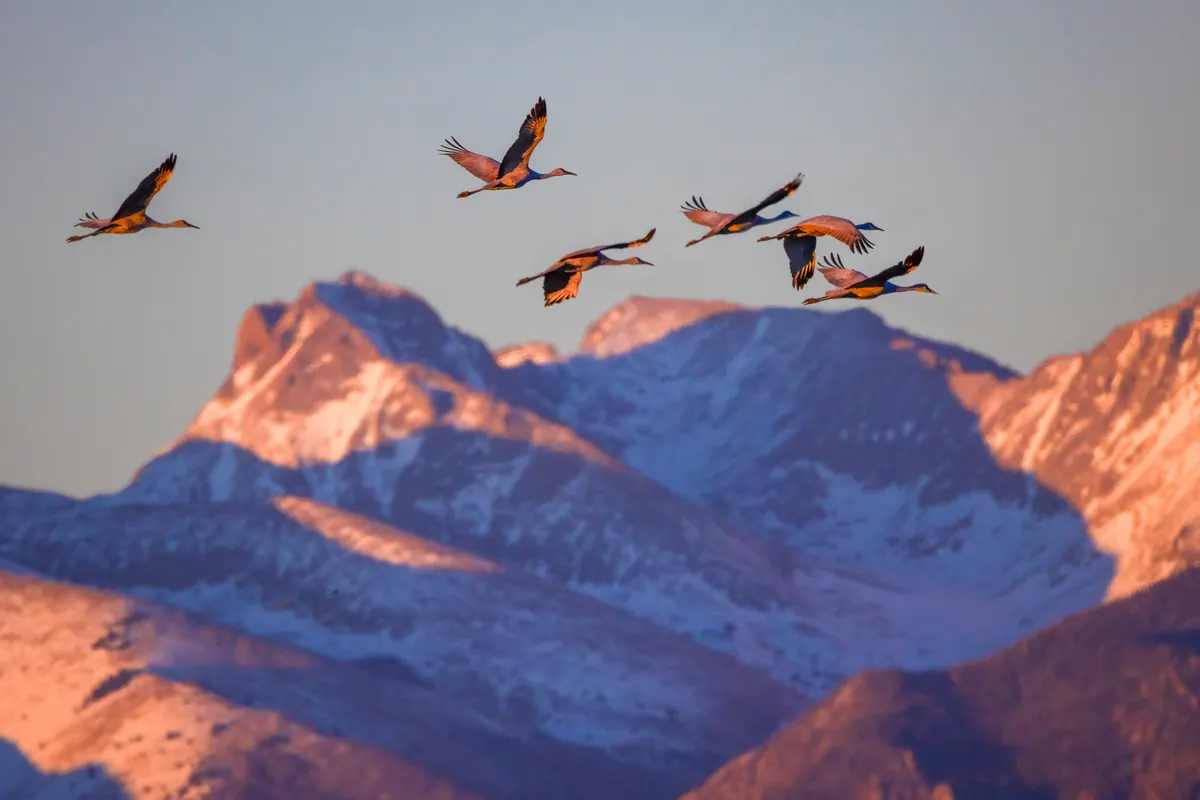
- Listen for cranes overhead. From mid-February, stand on any open spot in the Pahranagat or White River valleys on a calm afternoon and listen for a rolling, bugling call far overhead. Sandhill cranes are heading north toward Lund and Elko County.
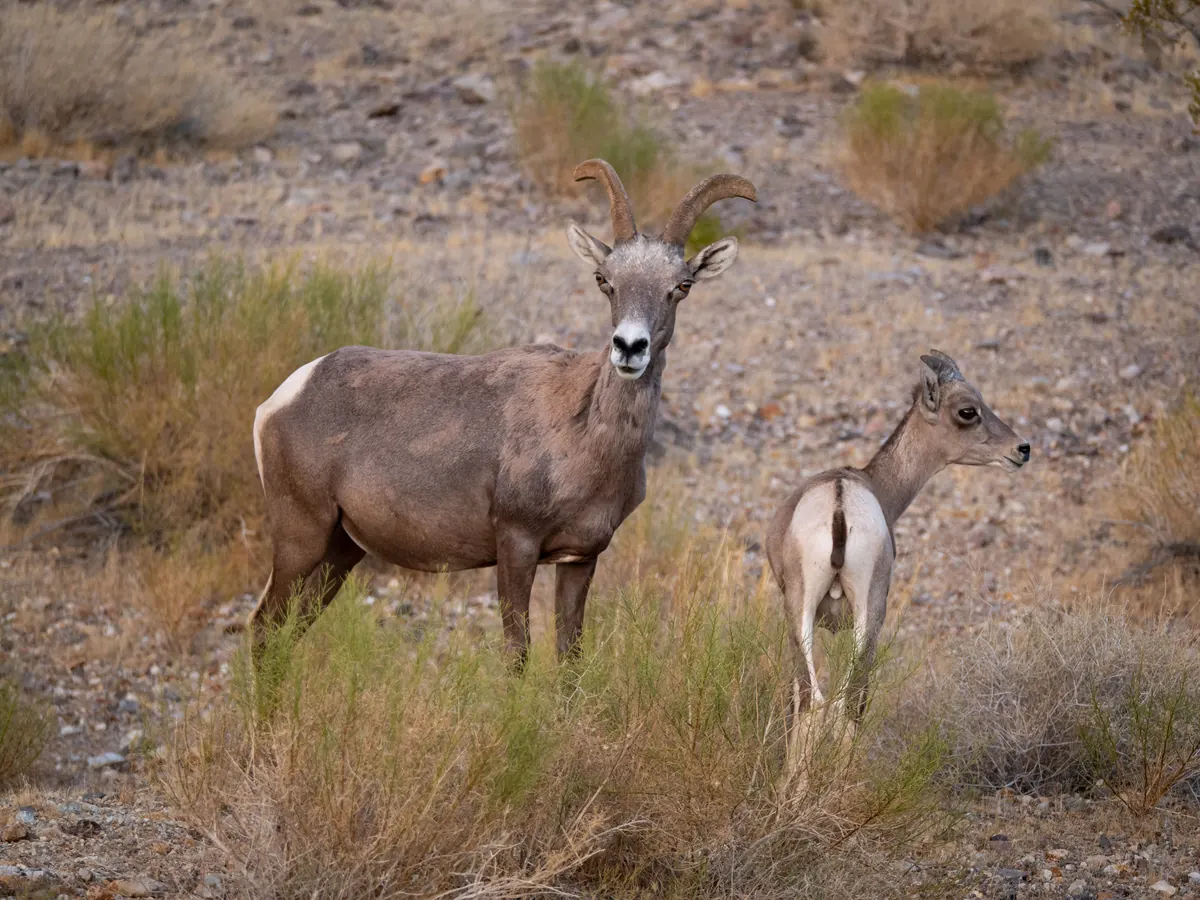
- Look up at the cliffs. February is the start of lambing for desert bighorn, Nevada’s state animal. Scan the ledges above the road at Valley of Fire or Lake Mead with binoculars, and keep a long distance from ewes and lambs.
- Two planets, one constellation. Jupiter is at opposition on the evening of February 10, Mars follows on February 19, and the pair shine in Leo all night. On February 20 the full Snow Moon joins them.
In the Naturalist’s Field Journal, enter the first sandhill cranes you hear under “birds I have seen,” use “mammal watch” for bighorn and coyotes, and pick a pinyon pine near a jay colony for “a tree through the seasons.” A dusk and dawn watch suits the Jupiter and Mars oppositions, and “a map of sounds” is the right page for a night of coyote song.
Regions used below: Reno, Carson City and Lake Tahoe; Northern Nevada: Winnemucca, Elko and the Ruby Mountains; Central Nevada: Fallon, Austin and Tonopah; Eastern Nevada: Ely and Great Basin National Park; Southern Nevada: Las Vegas, the Spring Mountains and the Mojave.
When do sandhill cranes fly north through Nevada?
Nevada’s cranes are not the vast flocks of the Platte River. The state is home to a small breeding population, and the Nevada Department of Wildlife (NDOW) lists the greater sandhill crane as a protected priority species with no hunting season. The Great Basin Bird Observatory’s species account gives the spring passage as mid-February to early April, so the first birds of the year arrive this month.
-
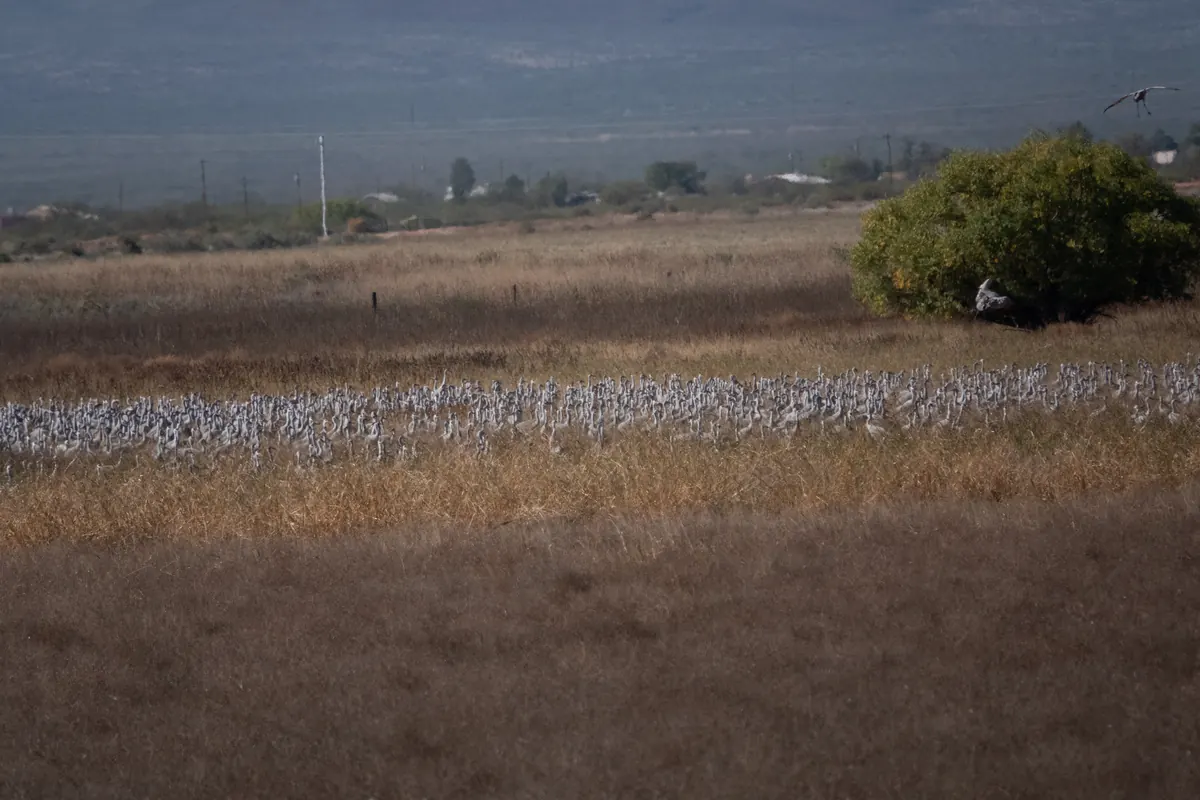
A small flock from the Colorado River
Departures from early February to mid-March · Wintering grounds along the lower Colorado River in Arizona and California
Many of the cranes that nest in Nevada spend the winter far to the south, in a group biologists have named for the Lower Colorado River Valley; of all the migratory crane populations, it has the fewest birds. Its winter home is mainly at Cibola National Wildlife Refuge and nearby wetlands on the Arizona and California border. A satellite-tracking study led by Texas Tech University and the U.S. Fish and Wildlife Service fitted transmitters to some of these birds in early 2014, and the tagged cranes left their winter quarters between early February and the middle of March. The study notes that the main breeding grounds are thought to lie in Elko and White Pine counties.
-
Stopovers on the way north
Late February into April · Pahranagat Valley near Alamo, Kirch Wildlife Management Area, Lund and the White River Valley
The tracked cranes rested on ranch land north of Alamo, at the Wayne E. Kirch Wildlife Management Area and in the Ruby Valley before settling to nest. NDOW notes that migrating cranes may cover 200 miles in a day, yet in spring they linger for several weeks near Lund in the White River Valley. Pahranagat National Wildlife Refuge, beside US 93 south of Alamo, is an easy place to check for early arrivals feeding in its fields and marsh edges. Look for tall gray birds with a red cap, walking slowly in pairs or small groups.
-
Dancing in the northeast
Mostly March, after the snow loosens · Ruby Valley and Lamoille Valley, southeast of Elko
NDOW names Ruby Valley and Lamoille Valley, southeast of Elko, as the two largest crane staging areas in Nevada. Most cranes reach the Elko country after February ends, but late-month mild spells can bring the first pairs north early. Once there, they begin the courtship display that makes cranes famous: wings spread, heads bob, and birds bow and spring into the air. Their call is a loud, rolling rattle that carries a long way, so you will often hear cranes long before you find them.
Record the date and place of your first crane in eBird. A run of first-arrival dates from the same valley, kept year after year, is one of the most useful notes a naturalist can make.
When are desert bighorn lambs born in Nevada?
Nevada adopted the desert bighorn sheep as its state animal in 1973, and the southern ranges hold some of the best bighorn country in the Southwest. Breeding took place in late summer and fall, and after a gestation of about six months, the first lambs arrive in the depth of winter.
-
Lambing season
Peak usually February and March; some from mid-December to June · Steep, rocky slopes in the Mojave ranges
The California Department of Fish and Wildlife’s natural history of desert bighorn notes that without hard winters to avoid, desert ewes can give birth anywhere from mid-December to mid-June, with the peak usually in February and March. Each ewe has a single lamb as a rule, and twins are rare. She gives birth in rough, broken terrain where predators struggle to follow, and the lamb is surprisingly nimble within a few days. A long season may be an advantage in an unpredictable desert, where one bad month could otherwise wipe out a whole year of lambs.
-
The Boulder City herd
Often grazing in the early morning · Hemenway Park and the River Mountains, Boulder City
The sheep that walk down onto the lawns of Hemenway Park belong to the River Mountains herd, and they carry a lung disease. NDOW identified a bacterial pneumonia, Mycoplasma ovipneumoniae, in the herd in 2013, and in August 2024 testing found that three of 11 sheep carried a new strain. Lambs are hit hardest once they are weaned. In January 2026, the city reported that pneumonia had cut the herd from about 350 animals to fewer than 200, and NDOW says little can be done beyond keeping people and dogs away from the sheep. Watch from a distance, keep dogs well away, and never offer food; the city streams the park on its Ram Cam.
-
Where else to look
Early and late in the day · Lake Mead National Recreation Area; Valley of Fire State Park
The National Park Service says bighorn at Lake Mead blend into the rock so well that a sighting is a special event, and the park’s sheep have been moved to restock ranges elsewhere in Nevada and as far away as Texas. Valley of Fire, a state park since 1935, is open from sunrise to sunset. Drive slowly, scan ridgelines and the shade at the foot of cliffs, and look for the white rump patch, which is often easier to see than the sheep.
A ewe that keeps looking back at one spot, or stands on a ledge without moving off, may have a newborn tucked among the rocks. Back away and watch from much farther off.
Which birds of prey are nesting in Nevada in February?
While the wintering bald eagles enjoy their last weeks in the farm valleys, Nevada’s resident raptors have already started the next generation. February is a month of nest repair, courtship flights and eggs.
-
Golden eagles on the cliffs
Eggs from late January onward · Cliff faces and rimrock above open sagebrush and desert, statewide
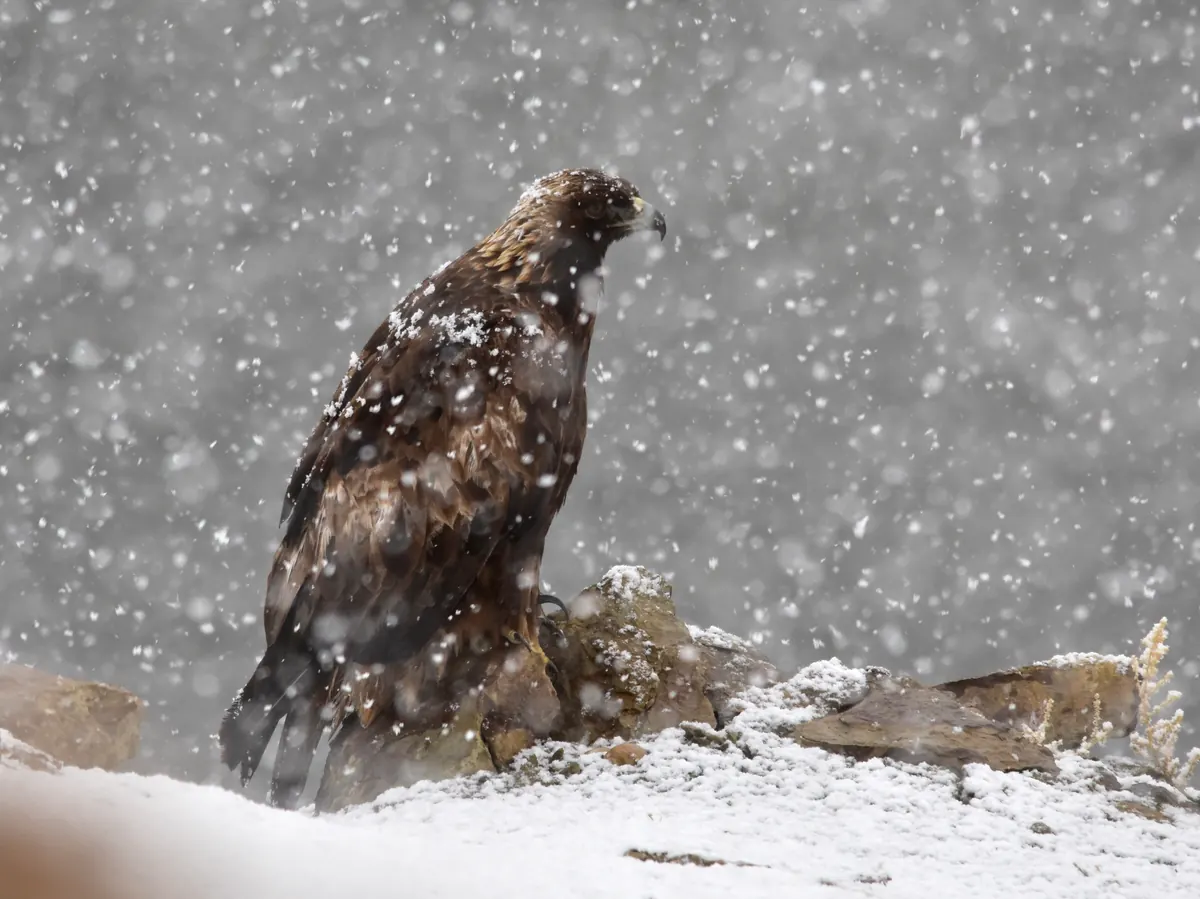
The Great Basin Bird Observatory, which runs the Nevada Bird Count, estimates that about 3,000 golden eagles live in Nevada, and its species account lists breeding dates in the state from late January through August. Pairs hold the same territory for years and keep adding sticks to a favorite nest, mostly on cliffs, though NDOW notes they also use power towers and windmills. Clutches hold one to four eggs, the female does most of the sitting, and NDOW says hatching takes about 40 days. On calm days, watch for a pair circling together above the nesting cliff.
-
The first owlets
Hatching from about February · Old stick nests in cottonwoods, on cliffs and in quiet corners of city parks
Great horned owls that laid eggs in January have about a month of incubation behind them by now, so some nests in the Truckee Meadows and the Las Vegas valley hold downy gray owlets this month. The female broods them closely through cold nights while the male hunts. If you have been watching a nest since January, note the day you first see a fuzzy head beside the adult.
-
Bald eagles’ last weeks
Through February · Carson Valley ranches; Lake Mead’s Overton Arm
The National Park Service gives December through February as the high season for bald eagles at Lake Mead, so this is the month to catch them before they head north. In the Carson Valley, the chamber of commerce holds its Eagles and Agriculture weekend each winter (in 2026 it was held February 5 to 8), with ranch tours, an owl prowl and a raptor drive. Confirm this winter’s schedule and tour sign-ups with the chamber before driving over.
Stay well back from any active raptor nest; a bird flushed off eggs on a cold morning can lose them quickly.
Why do pinyon jays start nesting so early?
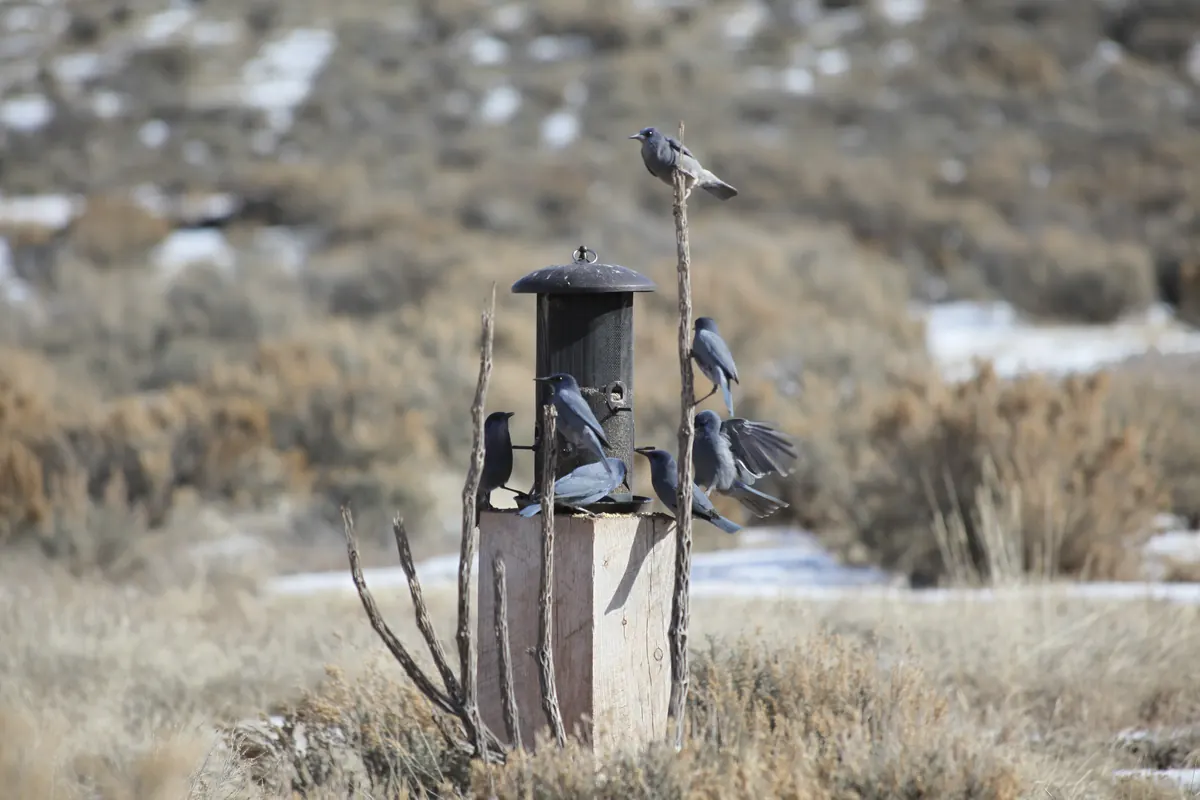
Nevada has two official state trees, and one of them, the singleleaf pinyon, feeds one of the West’s most social birds. Pinyon jays live in noisy flocks year round, and the Great Basin Bird Observatory estimates that Nevada holds more than 10 percent of the world’s population, which gives the state a large share of the responsibility for a species in steep decline.
-
Picking a colony site
Late winter and early spring · Where pinyon-juniper woodland thins out into open sagebrush
Pinyon jays nest in loose colonies, and the Great Basin Bird Observatory writes that in late winter and early spring each flock settles on a nesting site, usually at the upper edge of the transition between open country and pinyon-juniper woodland. Nest building can begin as early as February when the weather allows. In Nevada, the observatory’s records of actual nesting run from late March to August, so February is mostly a month of scouting and courtship.
-
Living off last fall’s pine nuts
All winter · Pinyon woodland in the Pine Nut, Toiyabe, Egan and Spring mountains, among many other ranges
A U.S. Forest Service review of the species says a single jay can cache more than 20,000 seeds in one season, and that stored seeds make up most of the diet from November through February. Those caches fuel courtship and nest building; studies summarized in the review found that after a big cone crop, jays breed early in the year, but when the crop fails they skip late-winter nesting and may breed in late summer instead. The National Park Service notes that young hatch after about 16 to 17 days and leave the nest about three weeks later. Listen for a nasal, laughing chorus moving through the trees, then watch for dozens of dull blue, crestless jays flying in a loose stream.
-
Why they need counting
Surveys run spring through summer · Statewide
The observatory gives rangewide declines of roughly 4 to 6 percent a year, a startling rate for a bird that once seemed everywhere. In 2024 it ran statewide pinyon jay surveys in Nevada, searching square plots for three hours each and mapping cone crops at the same time. Every flock you log in eBird, with a count and a location, adds to that picture.
If you find a flock carrying twigs, note the date and keep your distance; colonies can abandon a site if disturbed early in the season.
Why are coyotes so noisy and bold in February?
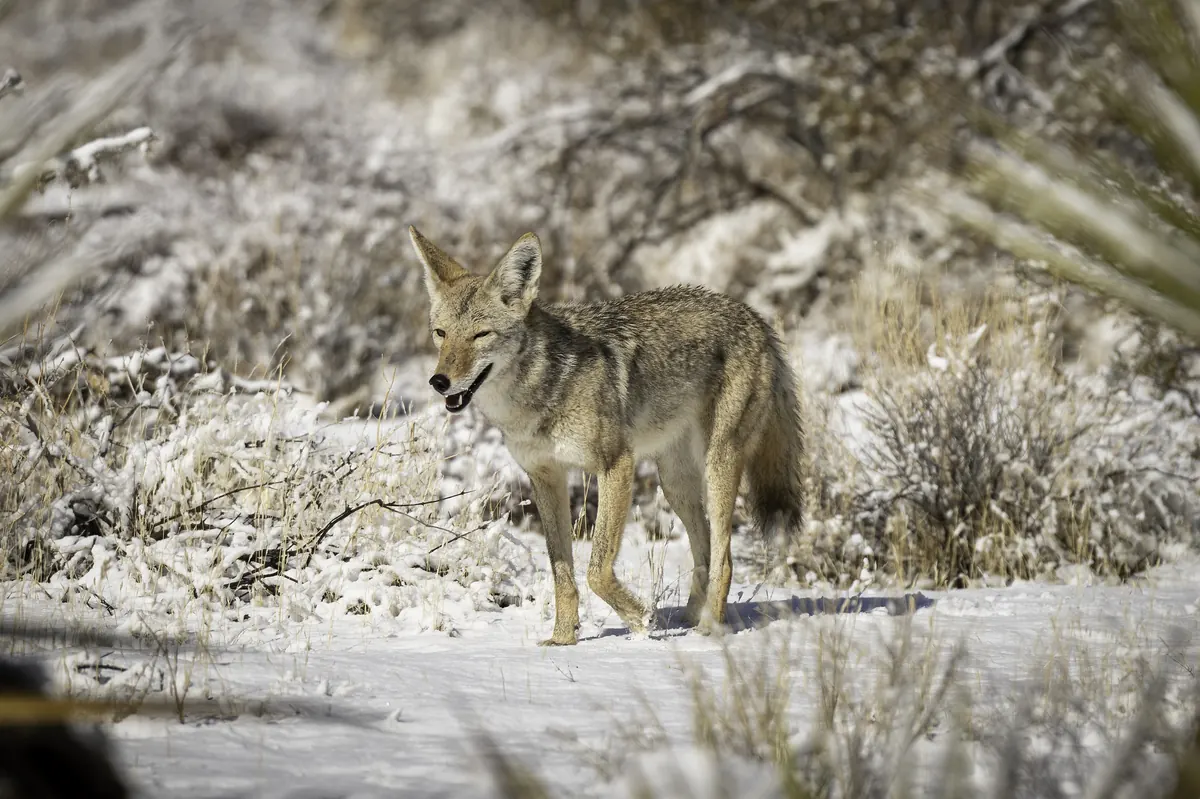
NDOW says coyote breeding usually runs from January to March, so this is the heart of the season. Pairs travel together, defend their ground loudly and start looking for a quiet place to dig a den, which brings them into view more often, including in Reno, Henderson and Las Vegas.
-
Song dogs
Mostly at dusk and through the night · Everywhere from the Black Rock Desert to suburban washes
NDOW points out that coyotes earned the name “song dogs” for the range of yips, barks and howls they use to keep in touch. Only the dominant pair in a group breeds, and the others help defend the territory. A family usually has a single litter a year, often around six pups. On a still February night, step outside after dark and try to count the separate voices.
-
Keeping town coyotes wild
Especially during denning season · Yards, parks and golf courses
NDOW urges people to haze any coyote that lingers near homes: stand your ground, make yourself big and loud, and never run. It also asks residents to remove what draws them in, including pet food, birdseed, trash, fallen fruit and the rodents those attract. Feeding coyotes, the agency warns, makes them bold and is illegal. Keep cats indoors and dogs on a short leash, especially at dawn and dusk.
Fresh snow in the north records coyote travel as a tidy, nearly straight line of oval prints.
Is it wildflower season yet around Las Vegas?
Not quite, but February decides it. The National Park Service notes that the country around Lakes Mead and Mohave gets less than 6 inches of rain a year, and that without good winter and early spring rains the seeds of desert annuals simply wait for a better year.
-
Rain first, flowers later
Winter storms from November to March · Mojave Desert lowlands
Annual wildflowers sprout after soaking autumn or winter rains and spend the cool months as small rosettes hugging the ground. In February, look closely at the gravel of washes and road edges: a carpet of tiny green leaves means a bloom is coming, and bare ground means it probably is not. In NOAA’s 1991 to 2020 normals, February is the wettest month of the year at the Las Vegas airport, so storms this month matter.
-
When the color comes
Early March to late May at Red Rock Canyon; peak usually April · Red Rock Canyon National Conservation Area; Lake Mead National Recreation Area
Past wildflower reports posted for Red Rock Canyon, from the 2019 and 2020 springs, described a season running from early March to late May, with April the usual peak; each year differs with the rain. Low, warm spots near the Colorado River usually bloom first and the higher slopes of the Spring Mountains last. Early bloomers named in past Red Rock reports include filaree and desert paintbrush.
-
Will El Niño help?
Late winter 2027 · Clark County and southern Nye and Lincoln counties
Extension specialists at the University of Nevada, Reno found that El Niño winters in southern Nevada are often, but not always, cooler and wetter than usual. If this winter follows that pattern, March and April 2027 could bring a better than average bloom, but nothing is certain until the rain actually falls.
Photograph the same patch of wash each week from February through April to build your own record of the bloom.
Is February Nevada’s snowiest month, and what could El Niño bring?
For the valleys, no. Elko averages less snow in February than in January, and Reno gets about the same amount in both months. Up high it is a different story: in NOAA’s 1991 to 2020 normals, February is the snowiest month of the year at both the Mt. Charleston Fire Station and Great Basin National Park, and it is also the wettest month at Mt. Charleston and the Las Vegas airport.
| Station | Average high | Average low | Precipitation | Snowfall |
|---|---|---|---|---|
| Reno (airport) | 52.1 °F | 29.0 °F | 1.03 in | 5.2 in |
| Carson City | 49.5 °F | 27.1 °F | 1.48 in | 1.7 in |
| Winnemucca (airport) | 49.4 °F | 23.9 °F | 0.71 in | 3.7 in |
| Elko (airport) | 42.8 °F | 20.5 °F | 0.89 in | 6.8 in |
| Ryndon, near Elko | 41.6 °F | 18.8 °F | 0.81 in | not published |
| Ely (airport) | 43.8 °F | 16.2 °F | 0.84 in | 9.1 in |
| Great Basin National Park | 40.6 °F | 20.6 °F | 1.49 in | 20.7 in |
| Tonopah (airport) | 49.3 °F | 25.1 °F | 0.53 in | not published |
| Mt. Charleston Fire Station | 44.4 °F | 21.9 °F | 5.12 in | 29.3 in |
| Las Vegas (airport) | 62.9 °F | 44.1 °F | 0.80 in | 0.0 in |
Ely’s average February low of about 16 °F is the lowest in the table, while Las Vegas afternoons average near 63 °F. The Mt. Charleston station, on the slopes above Las Vegas, averages more than 29 inches of snow in February, the most of any month there.
The odds favor an unusual late winter. Forecasters at NOAA, in an El Niño update issued September 10, 2026, gave odds above 90% that the Pacific warming would reach very strong El Niño levels during the 2026–27 cold season. Nevada’s published research tempers expectations, though. Khoh and McAfee’s Extension fact sheet, written while McAfee was state climatologist, finds that across most of northern and central Nevada, El Niño and La Niña give no reliable hint of a wet or dry season, while the southern counties lean cooler and wetter. A National Weather Service study of the Las Vegas record from 1951 to 2007 adds a twist: the wettest cold seasons during El Niño years came in weak and moderate episodes, not strong ones, and the wet tilt shows up more weakly when only December through February is considered. The same study found winter temperatures near or below normal in the strong events. NOAA posts its latest seasonal outlooks each month. When the soil thaws enough to dig, check our Nevada frost dates to see when the final spring freeze usually comes.
How much daylight does Nevada gain in February, and when is the middle of winter?
Days lengthen faster in February than in January everywhere in Nevada, and the pace keeps building until the March equinox. Groundhog Day is Tuesday, February 2. Astronomers would put the middle of winter, halfway between solstice and equinox, a day or two afterward, on February 3 to 4.
| City | Feb 1 | Feb 28 | Gained | Per day |
|---|---|---|---|---|
| Reno | 10 h 12 m | 11 h 16 m | 64 min | 2.4 min |
| Fallon | 10 h 12 m | 11 h 16 m | 64 min | 2.4 min |
| Winnemucca | 10 h 06 m | 11 h 14 m | 68 min | 2.5 min |
| Elko | 10 h 07 m | 11 h 14 m | 67 min | 2.5 min |
| Ely | 10 h 13 m | 11 h 17 m | 64 min | 2.4 min |
| Tonopah | 10 h 18 m | 11 h 19 m | 61 min | 2.3 min |
| Las Vegas | 10 h 25 m | 11 h 22 m | 57 min | 2.1 min |
| Laughlin | 10 h 30 m | 11 h 24 m | 54 min | 2.0 min |
Winnemucca and Elko pick up the most light, so the north closes the gap with Las Vegas through the month. Plug your town into the daylight calculator to get exact sunrise and sunset times.
What is in the night sky over Nevada in February?
February 2027 brings an uncommon pairing: Jupiter and Mars both reach opposition, eight days apart, in the constellation Leo. Moonless evenings from about February 2 to 11 give the best dark skies for the Milky Way and faint galaxies.
-
Mercury after sunset
Late January to about February 10 · Low in the west-southwest, 30 to 45 minutes after sunset
Nevadans get their best winter look at the elusive inner planet now, since Mercury hits greatest eastern elongation late on February 2, Pacific time. Five days later, at dusk on February 7, a hairline crescent hangs right next to it; you will need a clear, flat view toward the west-southwest, such as a playa edge.
-
Jupiter at opposition
Wednesday, February 10 · Rising in the east at sunset, highest around midnight
Jupiter is opposite the sun at 4:21 p.m. Pacific time, meaning it comes up at sunset, stays up until dawn and gleams at magnitude −2.5. Rest your binoculars against a car roof and the Galilean moons appear as tiny points in a row.
-
Mars at opposition
Friday, February 19; closest to Earth on the 20th · In Leo, near Jupiter and the star Regulus
Mars is a small target this time. Mars is nearly as far from the sun as it ever gets, which keeps this opposition modest: at closest approach, about 63 million miles away, it reaches only magnitude −1.2, a strong orange point rather than the blazing beacon of better years. After this, the red planet’s next opposition waits until 2029.
-
The Snow Moon
Saturday, February 20, exactly full at 3:23 p.m. Pacific time · Rising in the east around sunset
February’s full moon is often called the Snow Moon. The Old Farmer’s Almanac labels it a supermoon; EarthSky’s tighter cutoff leaves it off, so think of it as nearly super. On the night of the 19th it slides very close to Jupiter, and by Saturday evening the moon, Jupiter, Mars and Regulus form a tight group in Leo. A faint penumbral lunar eclipse also takes place that afternoon, but it ends before the moon rises over Nevada, so there is nothing to see here. The ring-of-fire solar eclipse on February 6 happens far to the south, over Chile, Argentina and the Atlantic, and none of it reaches U.S. skies.
-
Venus and Saturn
All month · Venus in the southeast before dawn; Saturn low in the southwest after dusk
Venus remains the brilliant morning star. Saturn drops lower into the dusk each week and will vanish into the sun’s glare by spring.
| Phase | Date | Time |
|---|---|---|
| New moon | Saturday, Feb 6 | 7:56 a.m. |
| First quarter | Saturday, Feb 13 | 11:58 p.m. |
| Full moon, the Snow Moon | Saturday, Feb 20 | 3:23 p.m. (looks full the nights of Feb 19 to 21) |
| Last quarter | Saturday, Feb 27 | 9:16 p.m. |
Before a late night out, check the cloud forecast map; the moon calendar lists moonrise times for every Nevada town.
What can families do outdoors in Nevada in February?
- Join the Great Backyard Bird Count. The 2027 count is February 12 to 15, a Friday through Presidents’ Day Monday. A single 15-minute tally from a backyard, a park bench or a refuge road counts, and lists go in through eBird or Merlin. Look for pinyon jays, cranes or a golden eagle to make the list special.
- Go eagle and owl watching in the Carson Valley. The Eagles and Agriculture weekend falls in January or February; in 2026 it was February 5 to 8. Check carsonvalleynv.org for 2027 dates and tour sign-ups.
- Watch the Ram Cam, then visit. Boulder City streams Hemenway Park’s bighorn online. Count the lambs you see in February and check again in spring.
- Stand under the cranes. Spend a late-February afternoon at Pahranagat National Wildlife Refuge or the Kirch Wildlife Management Area and listen for cranes calling high overhead.
- Mark the middle of winter. On February 3 or 4, measure a fence post’s noon shadow, then measure it again on the spring equinox and compare.
Children can log birds, tracks and the planets in the Naturalist’s Field Journal. Revisit Nevada in January, or explore other states on the nature index.
Safety notes for February in Nevada
- Upland seasons end early in the month. Under NDOW’s adopted upland game regulation (CR 26-13), Sunday, February 7, 2027 is the last day to hunt chukar and Hungarian partridge and all three of Nevada’s quail: California, Gambel’s and mountain quail. Cottontail and white-tailed jackrabbit hunting runs through February 28, as do kit fox and red fox seasons. Bobcat and gray fox seasons close on the third Sunday in February, February 21 this year. Trapping for beaver, mink and muskrat stays open statewide until April 30, so watch your dog near streams and ditches.
- Late waterfowl hunts. Regular duck and goose seasons are over, but NDOW’s 2026–27 small game guide lists a youth waterfowl day in the Northwest Zone on February 13 and youth days in the South Zone on February 13 and 14, plus a late snow and Ross’s goose season from February 22 to March 7 in the Northwest and Northeast zones. Ruby Valley is closed to snow and Ross’s geese all season, and the Mason Valley and Scripps (Washoe Lake) wildlife management areas close for the late goose season.
- Desert bighorn hunts. NDOW’s 2026 big game guide lists management ram and archery hunts in southern units 262 to 268 running January 5 to February 20, so expect a few hunters in the southern ranges.
- Wear a bright color. Hunter orange is not required by Nevada law, though an NDOW checklist for bird hunters rates orange clothing, a vest plus a hat, as highly recommended so others in the field can see you. Hikers and birders on open land should wear something bright too, and dogs need a bright vest or collar.
- Mountain storms and avalanches. February is the snowiest month on average in the Spring Mountains and the Snake Range. Check the Sierra Avalanche Center’s daily forecast before heading into the Carson Range; no center forecasts for the Rubies, the Snake Range or Mount Charleston, so carry your own avalanche gear and training.
- Rotting ice. Late-season ice on Cave Lake, Comins Lake and other reservoirs weakens quickly in sun and wind, even when it looks solid. Read NDOW’s latest fishing report before stepping out.
- Flash floods. If El Niño storms reach the south, washes around Las Vegas and Lake Mead can flood fast. Never drive into running water.
- Give wildlife room. Keep well back from bighorn ewes, nesting raptors and denning coyotes, and keep pets leashed.
Before any long drive or hike, check the local forecast.
Sources
- Nevada Department of Wildlife: Greater Sandhill Crane
- Great Basin Bird Observatory: Sandhill Crane species account (PDF)
- Conring, Collins and Grisham (Texas Tech University and USFWS): Lower Colorado River Valley sandhill crane breeding and wintering ecology (PDF)
- U.S. Fish and Wildlife Service: Pahranagat National Wildlife Refuge
- Nevada Revised Statutes chapter 235: state symbols (state animal, state trees)
- California Department of Fish and Wildlife: Desert bighorn sheep natural history
- Nevada Department of Wildlife: Desert Bighorn Sheep
- National Park Service, Lake Mead National Recreation Area: Desert bighorn sheep
- City of Boulder City: Nevada Department of Wildlife update regarding bighorn sheep health (January 2025)
- City of Boulder City: Local bighorn herd continues to ail (January 27, 2026)
- Nevada State Parks: Valley of Fire State Park
- Great Basin Bird Observatory: Golden Eagle species account (PDF)
- Nevada Department of Wildlife: Golden Eagle
- Audubon: Why great horned owls start nesting in the winter
- National Park Service, Lake Mead National Recreation Area: Bald Eagle
- Carson Valley Chamber of Commerce: Eagles & Agriculture
- Great Basin Bird Observatory: Pinyon Jay species account (PDF)
- Great Basin Bird Observatory: Pinyon jay surveys (September 2024)
- National Park Service, Grand Canyon-Parashant National Monument: Pinyon Jay
- Nevada Department of Wildlife: Coyote
- Nevada Department of Wildlife: Change of seasons means increased coyote activity
- Nevada Department of Wildlife: Living with coyotes
- National Park Service, Lake Mead National Recreation Area: Plants
- Red Rock Canyon National Conservation Area: Spring 2019 wildflower report
- Red Rock Canyon National Conservation Area: Spring 2020 wildflower report
- University of Nevada, Reno Extension (Khoh and McAfee, 2019): El Niño, La Niña and what they mean for winter precipitation in Nevada
- NWS Las Vegas (Stachelski and Czyzyk): El Niño and La Niña episodes and their impact on the weather in the Las Vegas Valley (PDF)
- NOAA Climate Prediction Center: ENSO diagnostic discussion, September 10, 2026
- NOAA Climate Prediction Center: 90-day outlooks
- NOAA NCEI: U.S. Climate Normals, 1991–2020
- NOAA NCEI data service: monthly normals 1991–2020 for the Nevada stations in the table
- U.S. Naval Observatory: Phases of the Moon
- U.S. Naval Observatory: Earth’s seasons and apsides
- U.S. Naval Observatory: Sun and Moon rise, set and transit
- Fred Espenak: Sky Event Almanac 2027 (GMT)
- EarthSky: Jupiter at opposition
- SEDS: Mars opposition of 2027
- Sea and Sky: Astronomy calendar of celestial events 2027
- NASA Eclipse Web Site: Lunar eclipses 2021–2030
- NASA Eclipse Web Site: Solar eclipses 2021–2030
- Old Farmer’s Almanac: Eclipse dates
- Audubon: About the Great Backyard Bird Count (2027 dates)
- Birds Canada: Great Backyard Bird Count (2027 dates)
- NDOW 2026–27 Small Game Hunting Guide (eRegulations): Migratory game bird seasons
- NDOW: Commission Regulation 26-13 as adopted, upland game and furbearer seasons 2026–2028 (PDF)
- NDOW 2026–27 Small Game Hunting Guide (eRegulations): Upland game bird, rabbit, dove and crow
- NDOW 2026 Big Game Hunting Guide (eRegulations): Bighorn sheep
- NDOW: Upland game hunting checklist (orange clothing recommendation)
- Sierra Avalanche Center
- Nevada Department of Wildlife: Cave Lake
- eBird
- U.S. Forest Service Fire Effects Information System: Pinyon jay species review
- Friends of Nevada Wilderness: The desert in bloom
- EarthSky: What is a supermoon?
- Photos via Wikimedia Commons; licenses and photographers are credited under each picture
