What to look for in nature in Nevada this December
December opens meteorological winter, and Nevada settles into its winter shape. Bird counters head out with clipboards from the Truckee Meadows to the Snake Valley; hawks down from the Arctic hunt the alfalfa valleys around Lovelock and Eureka; black bears in the Carson Range and Pine Nut Mountains crawl into their dens; sage-grouse live on sagebrush leaves; and in the Mojave, phainopeplas guard clumps of mistletoe while Las Vegas waits for its first freeze. Sunsets bottom out around the end of the first week, the solstice comes on the 21st, and the year’s closest full moon rises two days later. Here is the month across the state, dated wherever the sources allow.
Other months in Nevada: October, November.
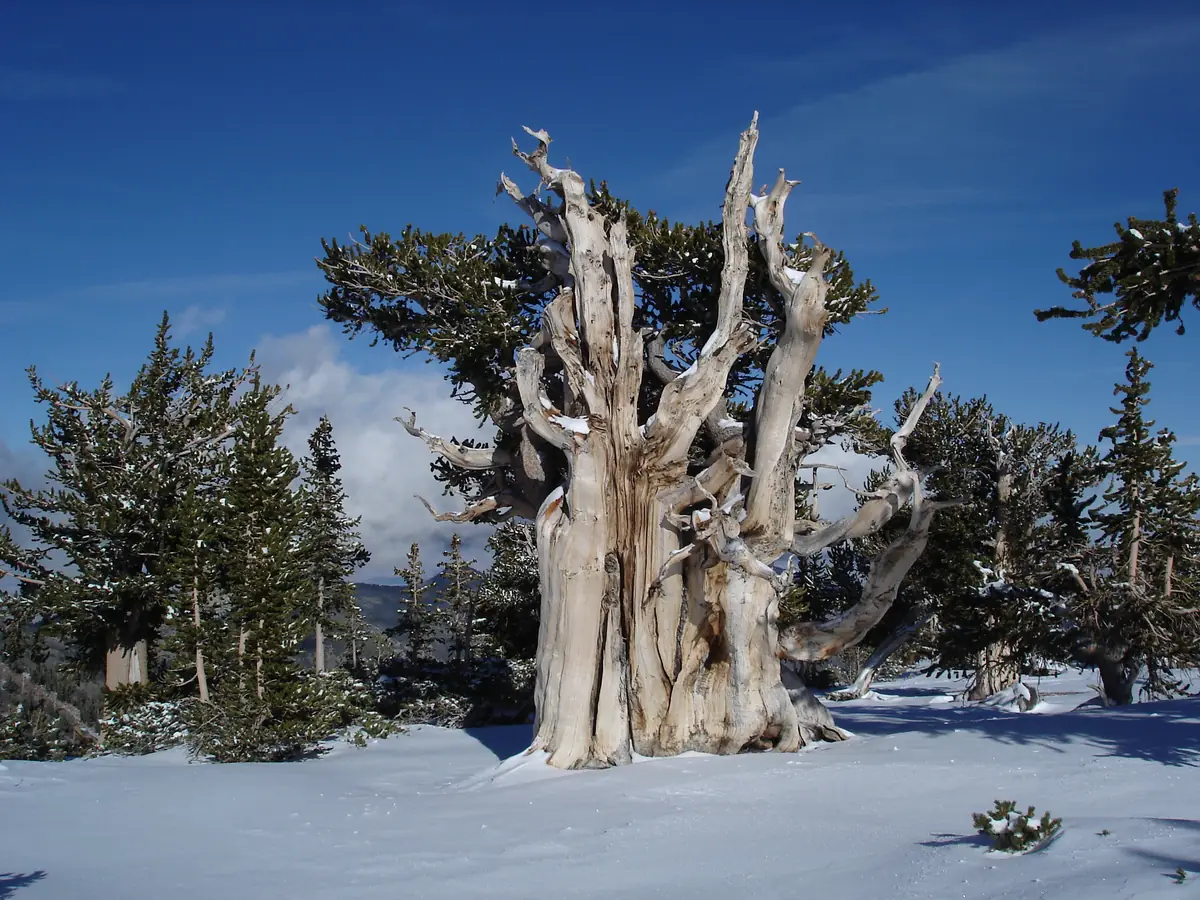
Start here

- Count birds for science. This season’s Christmas Bird Count window is December 14 to January 5, with circles from Reno and Fallon to Ruby Lake, the Snake Valley and Las Vegas. It is free, beginners are welcome, and a feeder inside a circle counts too.
- Arctic hawks in farm country. Rough-legged hawks winter in Nevada’s open valleys. Drive the back roads around Lovelock, Yerington or Diamond Valley near Eureka on a calm morning and watch for a big hawk hovering over a hayfield.
- Geminids, solstice and the Cold Moon. The Geminids peak before dawn on Monday the 14th under a nearly moonless sky. The solstice falls at 12:50 p.m. PST on the 21st, and the full Cold Moon of the 23rd is the closest full moon of 2026.
In the Naturalist’s Field Journal, enter your Christmas Bird Count tally and your first rough-legged hawk under “birds I have seen,” draw a bristlecone or pinyon cone on the seeds, pods and cones page, use “tracks to know” for prints in new snow or wash mud, and log the solstice sunset or the Geminids on a dusk and dawn watch. Write the time and the temperature beside each entry.
Regions used below: Reno, Carson City and Lake Tahoe; Northern Nevada: Winnemucca, Elko and the Ruby Mountains; Central Nevada: Fallon, Austin and Tonopah; Eastern Nevada: Ely and Great Basin National Park; Southern Nevada: Las Vegas, the Spring Mountains and the Mojave.
When is the Christmas Bird Count in Nevada, and can anyone join?
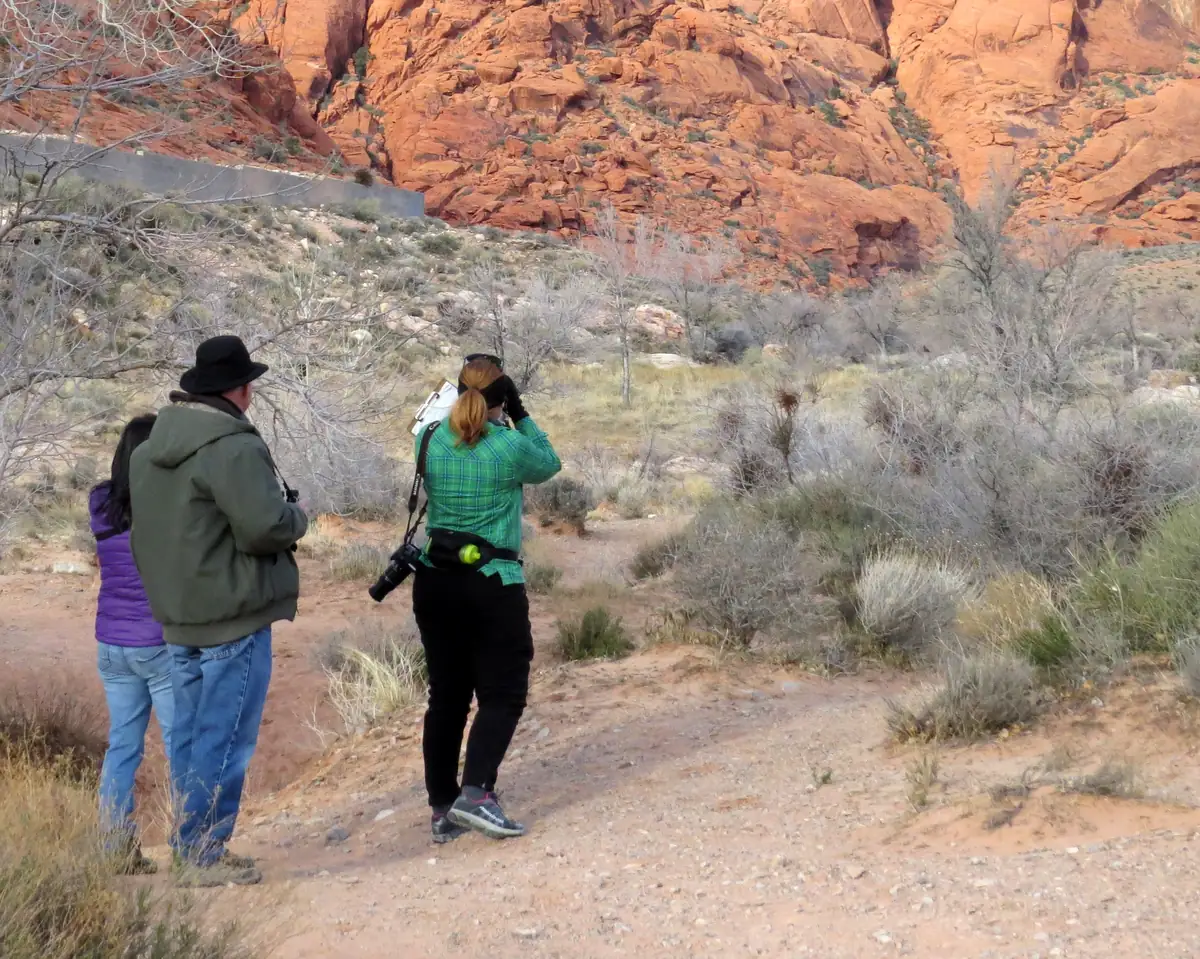
Birders have kept Audubon’s Christmas Bird Count going every winter since 1900, which makes it the oldest community science survey there is. Each count is a single day inside a circle 15 miles across, with teams logging every bird seen or heard. For 2026–27 the counting period is Monday, December 14, through Tuesday, January 5, and every circle sets its own date. Audubon’s Nevada summary of the 123rd count includes circles at Truckee Meadows, Carson City, Pyramid Lake, Fallon, Winnemucca, Elko, Ruby Lake, the Sheldon refuge, Snake Valley, Corn Creek, Red Rock, Henderson and Southern Pahranagat.
-
Six counts around Las Vegas and the southern refuges
Each count picks a day between December 14 and January 5 · Ash Meadows, Desert (Corn Creek), Pahranagat and Muddy River refuges; Red Rock Canyon; Henderson
Red Rock Audubon Society looks after the counts in Clark, Lincoln and Nye counties. Its Henderson circle takes in neighborhoods and parks in Whitney, Henderson and Lake Las Vegas plus the eastern side of Lake Mead, including Clark County Wetlands Park and the Henderson Bird Viewing Preserve, while the Red Rock circle reaches Spring Mountain Ranch and Lovell Canyon. The Corn Creek count at Desert National Wildlife Refuge has a long record: the Fish and Wildlife Service called the 2022 count there the 61st annual in southern Nevada, with 86 species and 3,308 birds in the Corn Creek circle. Sign-ups, and in past years an early-December meeting for new counters, are on its events page.
-
Snake Valley, beside Great Basin National Park
One day in the count window; the 2023 count was December 15 · Baker, Garrison and the east side of the Snake Range
This circle began in 1996 and has been counted every winter since. The Park Service reports that its 2023 count drew 19 all-day volunteers, its biggest turnout, and found a record 64 species and 3,702 birds, with first-ever Say’s phoebe and California scrub-jay for the circle. Nineteen species have turned up on at least 27 of the 28 counts, among them mallard, golden eagle, horned lark, pinyon jay and mountain chickadee: a fair picture of what lives in eastern Nevada through the winter.
-
Northern Nevada’s circles
Dates set by each circle’s compiler · Truckee Meadows, Carson City, Pyramid Lake, Fallon, Winnemucca, Elko, Ruby Lake and more
Volunteer compilers run each circle. The 123rd-count summary gives a sense of what turns up: 165 trumpeter swans at Ruby Lake, a high count for the state; 1,086 pinyon jays statewide, the most in five years; and a very rare eastern phoebe in the Truckee Meadows circle.
No 2026 dates for the Nevada circles had been posted by early October. Audubon says the count costs nothing and takes birders of any skill; its online Circle Finder lists each count with its compiler, and anyone whose feeder sits inside a circle can count from home on count day. Contact the compiler early.
Where do hawks and eagles spend the winter in Nevada?
Nevada’s farm valleys are winter hunting grounds. Alfalfa fields and pasture between about 4,000 and 6,000 feet hold voles and other small mammals all winter, and hawks gather where the food is. A HawkWatch International study ran roadside counts in these valleys every winter from 1985 to 2011, driving set routes slowly and logging every raptor on the poles and fence lines. Its 2010–11 report found the biggest concentrations in western Nevada: 311 raptors around Lovelock, the most in the study’s history, including 65 northern harriers; 221 in Mason Valley around Yerington; 149 in Smith Valley; and 134 in Diamond Valley near Eureka.
-
Rough-legged hawks from the Arctic
Roughly November to April · Open valleys of the north and center; Diamond Valley near Eureka held the study’s largest numbers
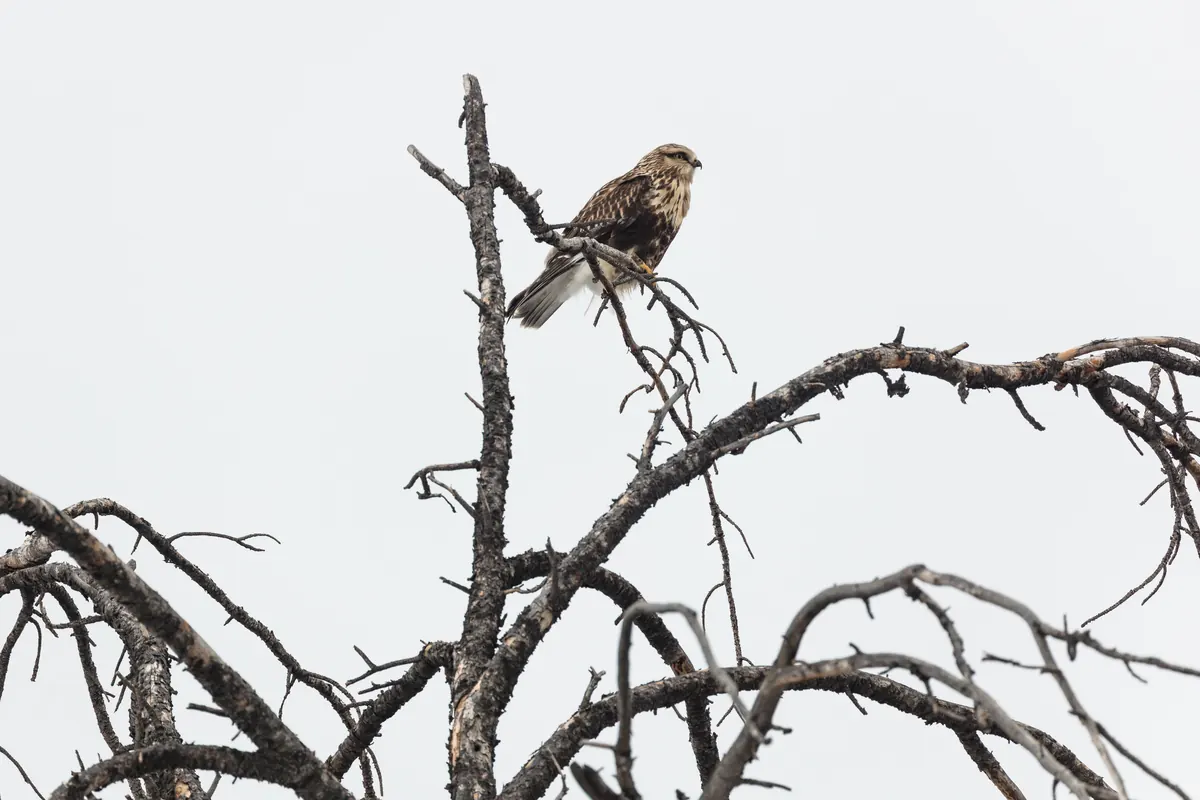
These hawks nest on the Arctic tundra and come south for the winter, rarely farther than Arizona and New Mexico, the Park Service notes. Look for a big hawk hovering on beating wings over a field, or holding still in the wind, marked by a dark band across the belly and a black wrist mark under each wing; the legs are feathered right down to the toes, an adaptation to the cold. In the HawkWatch counts Diamond Valley had more of them than any other site, with 58 in 2010–11, and numbers swing a great deal from winter to winter.
-
A hawk roost near Lovelock
Late afternoon in midwinter · Reservation Road area, Lovelock valley, Pershing County
The same report describes a winter roost where 44 hawks, mostly ferruginous and then rough-legged, gathered for the night. Watch from a public road toward sunset, stay in the car, and leave if birds flush. Red-tailed hawks, American kestrels, prairie falcons and golden eagles share these valleys.
Bald eagles, which arrived in November, also reach their winter peak between December and February; the November guide covers where to find them. For the hawks, drive the same back-road route once a month and log each trip in eBird.
How do sage-grouse and pygmy rabbits survive a Nevada winter?
In winter the sagebrush that covers so much of Nevada is food and shelter at once, and two of the state’s signature animals need little else. The state’s Sagebrush Ecosystem Program warns that this habitat recovers slowly after fire, with cheatgrass quick to take over.
-
Greater sage-grouse on a sagebrush diet
All winter · Sagebrush valleys and benches, about 4,000 to 9,000 feet
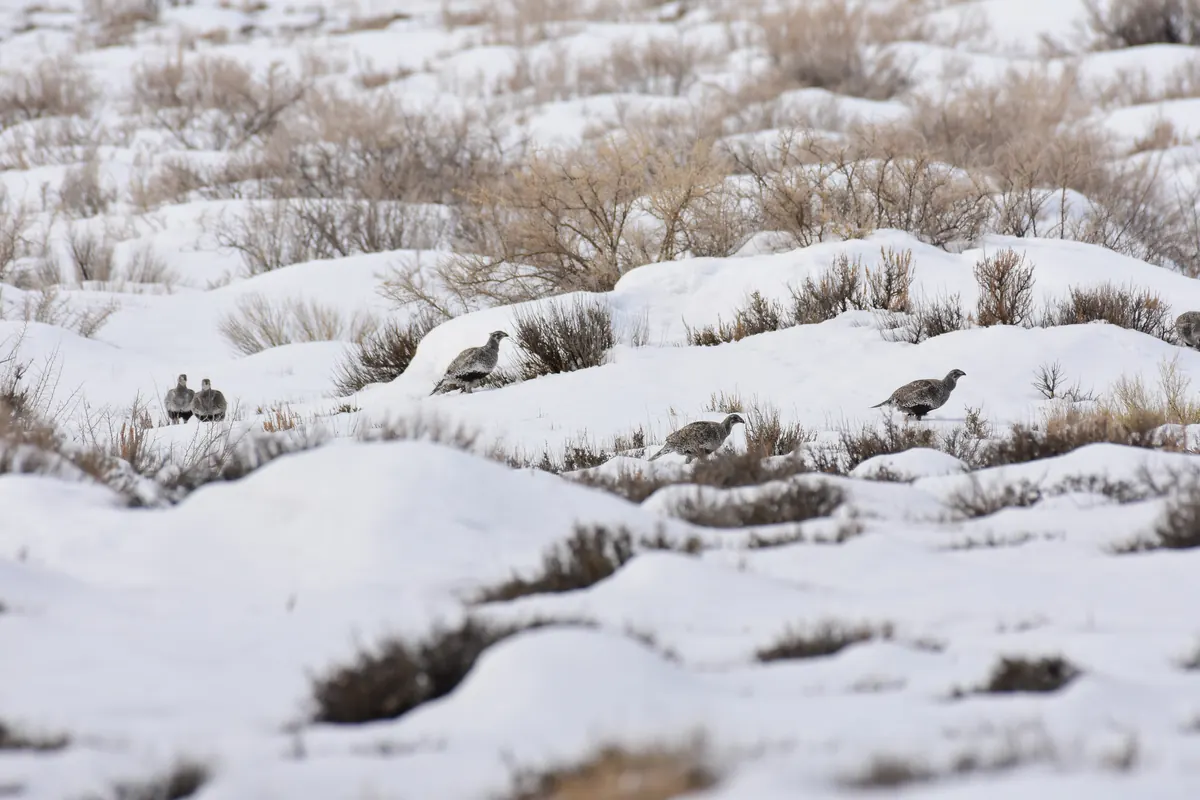
The program’s fact sheet says that in winter, sage-grouse can live entirely on sagebrush, eating its leaves and buds when nothing else is available. Flocks feed on the tips of plants that poke through the snow and sit tight under them when weather turns. NDOW lists the species as state protected and as a conservation priority, so watch from a distance and never chase a flock: flushing birds in deep cold costs them energy they cannot easily replace.
-
Pygmy rabbits under the snow
All winter; tracks easiest after a fresh snowfall · Tall, dense big sagebrush on deep soils
At under a foot long and about a pound, it is easy to overlook. NDOW notes it is the only Nevada rabbit that digs its own burrows, that it depends on sagebrush for both food and cover, and that it generally stays close to its burrow through winter. Look for small round holes at the base of big shrubs and tiny tracks between them.
After a light snow, look between shrubs for rows of three-toed grouse prints and for the paired prints of rabbits. Sketch them on the tracks-to-know page of your journal.
When do Nevada’s black bears go into their dens?
Black bears live along Nevada’s western edge, in the Carson Range above Lake Tahoe and in the Pine Nut Mountains and Virginia Range east of it. December is the month most of them disappear. A study by the University of Nevada, Reno and NDOW, which tracked dens from 2011 to 2022, found that females went into their dens around December 6 on average and males around December 16, give or take a little over two weeks. Females stay in until about March 28, males about March 12; the females are the ones giving birth in the den.
-
Where the bears sleep
Early December to spring · Steep, rugged slopes with good cover
Researchers identified 116 den sites. Bears in the wooded Carson Range used hollow trees and rock piles, while bears in the sparser Pine Nut Mountains and Virginia Range mostly chose rock piles. They pick a new den every year rather than going back to an old one.
-
The Tahoe exception
All winter · Lake Tahoe Basin towns
An NDOW spokesperson has said that most valley bears do den, but that around Lake Tahoe hibernation is close to nonexistent, because bears there keep finding food in garbage, bird feeders and pet food. Feeding bears, on purpose or by accident, is illegal in Nevada and California, so keep trash locked and feeders down in bear country even in December.
Other mammals sit winter out in other ways: Great Basin National Park’s yellow-bellied marmots hibernate from August until March, and bats hibernate in the region’s caves. Desert tortoises in the Mojave spend the cold months brumating in their burrows; Mojave Max, Clark County’s mascot tortoise, will not be seen again until spring.
What is happening in the Mojave around Las Vegas in December?
Southern Nevada’s winter starts late and stays mild by day. By NOAA’s 1991–2020 normals, Las Vegas averages a December high of 57 °F and a low of 40, and measurable snow at the official station comes only about once every four or five years, according to the National Weather Service in Las Vegas. December is also when the valley typically gets its first freeze.
-
The first freeze in Las Vegas
Median December 15; before November 28 in one year in ten · Las Vegas valley floor
NOAA’s records for the airport put the typical first 32 °F night at December 15. In nine years out of ten it has arrived by January 7, so a frost-free winter in the valley is rare. Outlying neighborhoods and low spots get cold earlier than the airport. The station closest to you is on the Nevada first and last frost page.
-
Phainopeplas and desert mistletoe
Winter in the low desert · Mesquite and catclaw washes with clumps of mistletoe
The male is glossy black with a crest and red eyes, the female a dull brown. Phainopeplas winter in the desert and summer higher up, and in winter they live largely on desert mistletoe berries; the Park Service says one bird can eat up to 1,000 a day. The seeds pass through and stick to branches, where new mistletoe sprouts, so the birds plant their own food, and a male will guard a good clump. Count volunteers photographed one in Ash Canyon at Red Rock Canyon in January 2016.
-
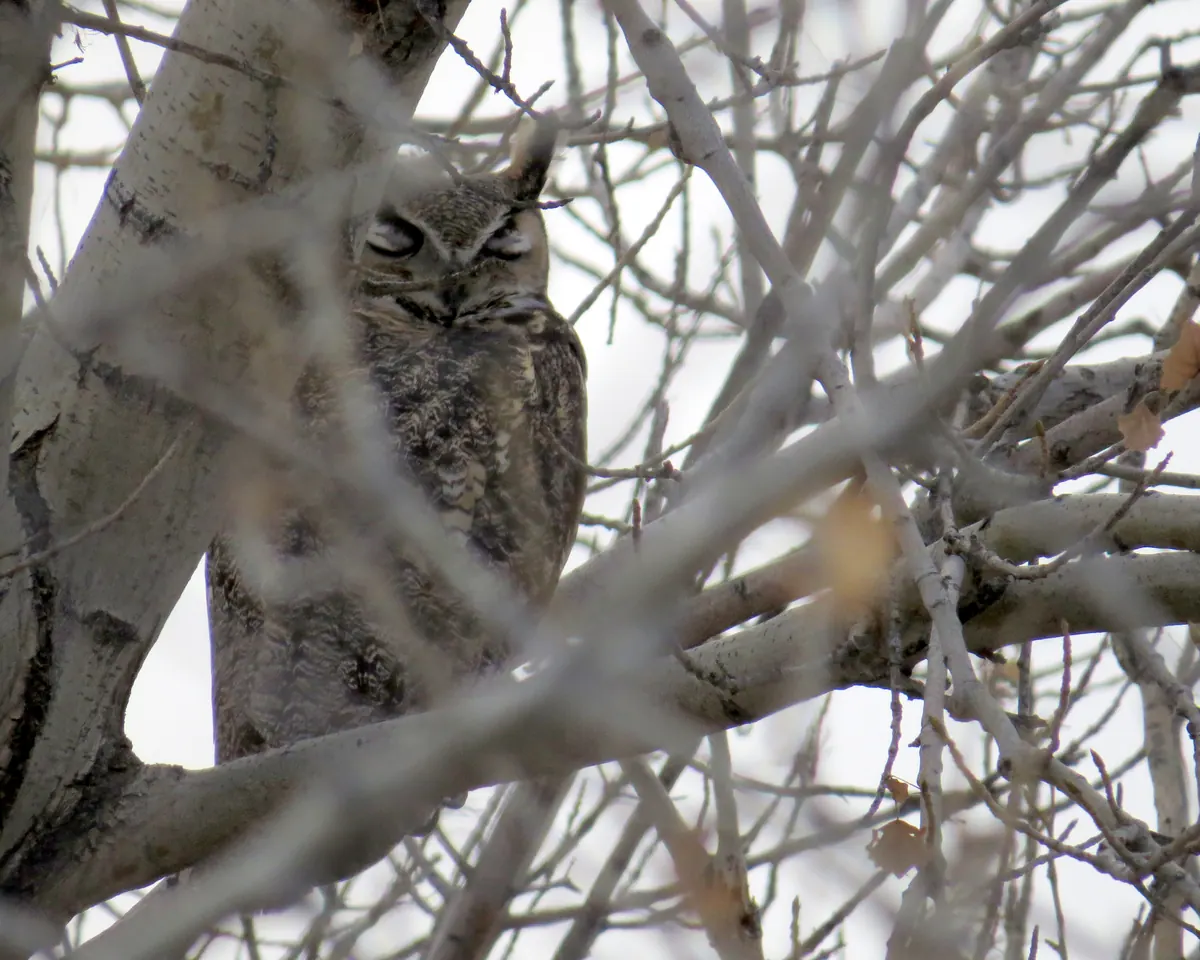
Great horned owls start to duet
Evenings and before dawn, from December · Cottonwoods, cliffs and old hawk nests from Red Rock Canyon to the Wetlands Park
Few birds nest as early in the year. Audubon notes that pairs begin hooting back and forth at night in December, and that eggs follow by midwinter, with about a month of incubation. Listen at dusk for two deep voices answering each other from a cottonwood or a cliff, and keep your distance once you find a nest.
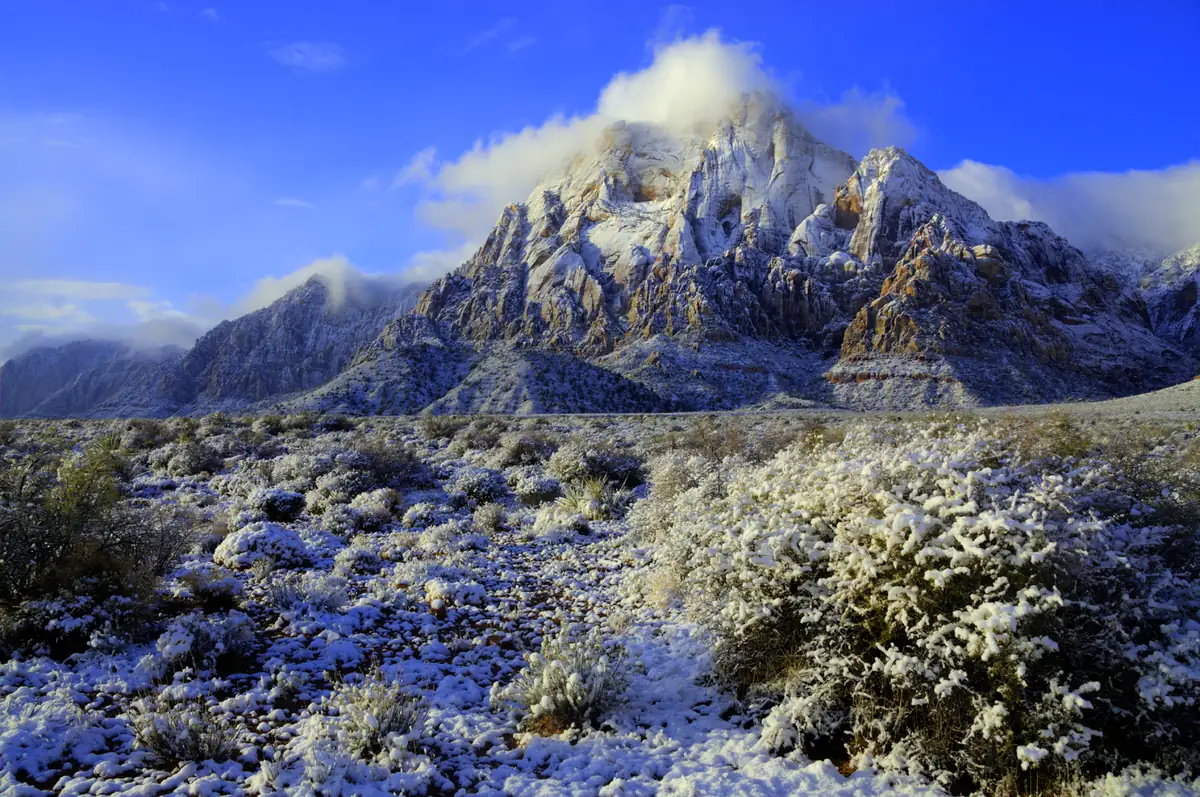
Snow is routine higher up: the Mount Charleston station in the Spring Mountains averages about 16 inches in December. Now and then a storm dusts the desert floor at Red Rock Canyon too, as a BLM photo from mid-December 2012 shows; such snow rarely lasts the day, so go early.
How can you tell Nevada’s evergreens apart in winter?
December strips the cottonwoods and aspens, and the conifers take over the scenery. Nevada is unusual in having two official state trees, both evergreen pines: the singleleaf pinyon, named in 1953, and the Great Basin bristlecone pine, added in 1987, according to the Nevada Legislature.
-
Great Basin bristlecone pine
All year; best reached in winter on snowshoes · Wheeler Peak Grove and other high groves in Great Basin National Park
The Park Service calls these the oldest non-clonal species on the planet. A tree known as Prometheus had 4,862 growth rings, about 4,900 years, when it was cut in 1964. To identify one, look for needles in bundles of five, about an inch long, packed all around the branch and running a foot or more back from the tip, like a bottle brush. The cones carry a sharp, curved bristle on each scale, which gives the tree its name.
-
Limber pine, its neighbor
All year · Same high ridges as the bristlecones
Limber pine also bundles its needles in fives, but they are longer, roughly one and a half to three inches, and grow mostly toward the tips of the branches. Its cones have no bristles. Where the two grow together, comparing a branch of each is the quickest lesson in conifer ID the state offers.
-
Singleleaf pinyon and Utah juniper
All year · Pinyon-juniper woodland on mid-elevation slopes statewide
The pinyon usually carries its short, stiff needles singly rather than in bundles, which is where the name comes from. Juniper has tiny overlapping scales instead of needles and bluish, berry-like cones that birds eat through the winter. If you cut a Christmas tree on a Forest Service permit, those permits are sold until December 24.
-
Getting up there in winter
December to spring · Great Basin National Park, near Baker
In winter the upper Wheeler Peak road belongs to snowshoers and skiers once it is closed to vehicles, and the Lehman Creek Trail suits all ages. Lehman Caves Visitor Center lends snowshoes free, in limited numbers, and cave tours run all year. Trails are not groomed, there is no food service, and the park warns that avalanches are common in the high Snake Range.
Sketch a twig and a cone from each tree you identify; side by side they become your own winter key.
When is the ice safe in Nevada?
Only the high, cold reservoirs of the northeast reliably freeze hard enough to walk on, and some winters they barely do. In January 2025, NDOW warned anglers off Wildhorse and South Fork reservoirs, Comins Lake and other waters in Elko, Eureka and White Pine counties because a warm spell had left thin ice and open water. Treat any ice you find in December as new and untested.
-
NDOW’s thickness rule
Every time you step on · Any frozen pond, reservoir or marsh
NDOW’s guidance is to stay off ice four inches thick or less; thicker clear ice is suitable for walking and fishing. Carry ice picks or claws, a rope, crampons and dry clothes, and drill test holes as you go, since thin spots are hard to see and conditions change fast. Snow-covered ice, ice near inlets and springs, and ice that has thawed and refrozen are all weaker than they look.
-
Why Lake Tahoe never freezes
All winter · Lake Tahoe
The director of the UC Davis Tahoe Environmental Research Center has explained that Tahoe holds too much deep water to freeze: as surface water cools it sinks and warmer water rises in its place, and the whole column would have to cool to about 39 °F before ice could form on top.
For children the rule is simple: nobody steps onto ice an adult has not checked. River edges on the Truckee and Humboldt are especially risky, since moving water thins the ice from below.
How cold and snowy is December in Nevada, and what might El Niño do?
December 1 is the start of meteorological winter, which forecasters count as December, January and February, the three coldest months on average. The normals below show how much a Nevada December depends on elevation and latitude: Las Vegas nights are milder than Elko afternoons, while Mount Charleston, above Las Vegas, is the snowiest station listed.
| Station | Average high | Average low | Precipitation | Snowfall |
|---|---|---|---|---|
| Reno (airport) | 47 °F | 26 °F | 1.10 in | 5.2 in |
| Carson City | 45 °F | 24 °F | 1.50 in | 6.4 in |
| Winnemucca (airport) | 43 °F | 19 °F | 1.02 in | 5.9 in |
| Elko (airport) | 38 °F | 15 °F | 1.20 in | 10.2 in |
| Ruby Lake National Wildlife Refuge | 39 °F | 15 °F | 1.50 in | 9.4 in |
| Ely (airport) | 41 °F | 12 °F | 0.67 in | 9.6 in |
| Great Basin National Park | 40 °F | 20 °F | 0.99 in | 9.6 in |
| Mount Charleston Fire Station | 44 °F | 21 °F | 3.16 in | 16.3 in |
| Las Vegas (airport) | 57 °F | 40 °F | 0.45 in | 0.2 in |
Ely has the coldest nights in the table, with an average December low of 12 °F. Winter also brings flood risk when warm storms hit deep snow. From December 30, 1996, to January 3, 1997, a moist subtropical flow lifted the freezing level over Reno to 10,700 feet on New Year’s Eve and 11,700 feet the next afternoon; rain on a heavy Sierra snowpack gave the region its worst floods since 1955, according to the National Weather Service office in Reno.
Warm storms are part of this year’s El Niño question. NOAA’s Climate Prediction Center gave better than a 90% chance, on September 10, that the El Niño under way will be very strong through the winter. Nevada’s state climatologist told a Reno television station in July that Reno was much wetter than normal in the strong 1982–83 event, but that strong El Niños run a little warm, raising the odds of rain rather than snow at lower elevations. An analysis by University of Nevada, Reno Extension finds the clearest signal in the far south, where El Niño winters lean cooler and wetter around Las Vegas and in southern Nye and Lincoln counties, with no dependable pattern farther north. NOAA’s official December-through-February outlook appears on October 15 on its seasonal outlook page; for this week’s conditions where you live, use our weather tool.
When is the earliest sunset in Nevada?
Not on the shortest day. Across Nevada the earliest sunsets fall between December 5 and December 8, a little later in the north than in the south, while the solstice on December 21 brings the least daylight and the darkest mornings are still to come in early January.
| City | Dec 1 | Dec 21 | Dec 31 | Earliest sunset |
|---|---|---|---|---|
| Reno | 9 h 35 m | 9 h 23 m | 9 h 25 m | 4:35 p.m., Dec 7 |
| Fallon | 9 h 36 m | 9 h 23 m | 9 h 26 m | 4:31 p.m., Dec 7 |
| Winnemucca | 9 h 26 m | 9 h 14 m | 9 h 17 m | 4:23 p.m., Dec 8 |
| Elko | 9 h 28 m | 9 h 15 m | 9 h 18 m | 4:15 p.m., Dec 8 |
| Ely | 9 h 37 m | 9 h 24 m | 9 h 27 m | 4:16 p.m., Dec 7 |
| Tonopah | 9 h 43 m | 9 h 31 m | 9 h 34 m | 4:29 p.m., Dec 6 |
| Las Vegas | 9 h 53 m | 9 h 42 m | 9 h 45 m | 4:26 p.m., Dec 6 |
| Laughlin | 9 h 58 m | 9 h 47 m | 9 h 49 m | 4:26 p.m., Dec 5 |
Elko’s sunset is the earliest in the table, 4:15 p.m. around December 8, because the town lies so far east for a place on Pacific time; Ely follows at 4:16 p.m. around December 7. Reno’s earliest is 4:35 p.m. around December 7, and Las Vegas bottoms out at 4:26 p.m. around December 6. Each of those clock times holds for several days on either side. Day length still shrinks until the solstice, when Reno has 9 h 23 m and Winnemucca just 9 h 14 m. By New Year’s Eve each town has won back only two or three minutes, all of it in the evening, since the mornings are still darkening. Times for your own street are on the daylight calculator.
What is in the night sky over Nevada in December?
With over 14 hours of darkness and dry air, December is a fine month to look up, if you dress for a night well below freezing.
-
Geminid meteors
Night of Sunday, December 13, into Monday, December 14 · Anywhere dark; the radiant in Gemini is high in the south around 2 a.m.
The year’s richest shower, and 2026 is a good year for it. The meteor organization’s forecast puts the peak near 6 a.m. Pacific time on the 14th, in Nevada’s last dark hour, and the thin crescent moon sets during the evening. Its rate of about 150 an hour is an ideal-sky figure, so expect fewer, but Geminids are slow and often bright. Go out from about 10 p.m., give your eyes 20 minutes, and look about halfway up.
-
The Cold Moon, the year’s closest full moon
Evening of Wednesday, December 23 · Rising in the northeast at dusk
The moon is exactly full at 5:28 p.m. Pacific time on the 23rd, and it reaches its nearest point to Earth only about seven hours later. No full moon of 2026 comes nearer or looks bigger; it is the year’s last supermoon. It still looks nearly full on Christmas Eve.
-
The winter solstice
Monday, December 21, at 12:50 p.m. Pacific time · Everywhere
At that moment the sun stands farthest south and noon shadows are at their longest. Note the point on the skyline where it goes down; over the coming weeks it creeps back north.
-
Planets and pairings
All month · Venus before dawn in the southeast; Saturn in the south and southwest after dark
Venus blazes before dawn and keeps gaining height, with its widest separation from the sun still ahead on January 3. Two mornings, the 4th and the 5th, bring a thin waning moon into a loose trio with Venus and the bright star Spica. Mars and Jupiter belong to the small hours as well, though Jupiter is up by mid-evening as the year closes. Saturn is the lone bright planet after dusk and by the 31st it follows the sun down roughly four hours after sunset. On the 21st, after dark, the waxing moon lies just beside the Pleiades.
-
Weaker showers, and one to plan for
Ursids December 22; Quadrantids January 3 · North and northeast
The Ursids of December 22 will be lost in bright moonlight. Plan instead for the Quadrantids: the organization’s peak is about 7:25 p.m. Pacific time on January 3, 2027, with the moon nearly new. Comet Encke may brighten enough for binoculars after sunset in late January and February, though comet forecasts often miss.
| Phase | Date | Time |
|---|---|---|
| New moon | Tuesday, Dec 8 | 4:52 p.m. |
| First quarter | Wednesday, Dec 16 | 9:42 p.m. |
| Full moon, the Cold Moon | Wednesday, Dec 23 | 5:28 p.m. |
| Last quarter | Wednesday, Dec 30 | 10:59 a.m. |
| New moon | Thursday, Jan 7, 2027 | 12:24 p.m. |
Check the cloud outlook before driving to a dark site, and see local moonrise times on the moon phase page.
What can families do outdoors in Nevada in December?
- Join a Christmas Bird Count. Counts are free and welcome beginners; children can walk with a team or tally a backyard feeder inside a count circle. Find a circle on Audubon’s Circle Finder or through Red Rock Audubon in the south.
- Paint and listen to stories at the Las Vegas Wetlands Park. Clark County’s schedule has a Winter Trees watercolor class for ages 4 to 17 on Sunday, December 6 (11 a.m. to noon, $5, parents take part), two free drop-in Nature Tales sessions at 11 a.m., on how animals prepare for winter (Wednesday, December 9) and on beavers (Saturday, December 12), and a Winter Trees watercolor class for adults on Sunday, December 20 ($10). Over the holidays, a raptor birding walk is listed for Saturday, January 2, from 8 to 10 a.m. for ages 10 and older ($5). The county’s program page gives days but no year, so call the park (702-455-7522) to confirm before you go, and book the paid programs ahead.
- Borrow snowshoes at Great Basin National Park. Kid and adult sizes are free at Lehman Caves Visitor Center while they last, and the Lehman Creek Trail suits all ages. Warm up afterward on a Lehman Caves tour, which runs all year.
- Plan a First Day Hike on Friday, January 1, 2027. The idea began in Massachusetts in 1992 and went national in 2012 under America’s State Parks. Nevada State Parks listed First Day Hikes for 2026 at parks including Spring Mountain Ranch near Las Vegas and Mormon Station in Genoa; the 2027 list had not been posted by early October, so watch the parks events calendar in December.
- Go on a track hunt. After a snowfall or along a muddy wash, look for rabbit, coyote, quail and deer prints and photograph each beside a coin for scale.
Families can record all of it, from the count tally to the solstice sunset, in the Naturalist’s Field Journal. Earlier months for this state begin with October in Nevada, and every state and month is listed in the nature guide index.
Safety notes for December in Nevada
- Waterfowl hunting continues on most marshes. NDOW’s 2026–27 seasons keep ducks open through December in the Northwest Zone (to January 3, then January 6 to 31) and the South Zone (to January 31). In the Northeast Zone, which covers Elko, Eureka, Lander and White Pine counties, the season pauses from December 2 to 11 and reopens December 12 through January 18. The permit swan hunt in Churchill, Lyon and Pershing counties follows the Northwest Zone’s dates, with a two-day break on January 4 and 5.
- Upland and big game seasons overlap the month. Chukar, Hungarian partridge and quail run to February 7, 2027; blue and ruffed grouse to December 31; rabbits through February; bobcat and gray fox from the second Saturday in November to the third Sunday in February. Under NDOW’s 2026–27 big game seasons, a handful of late mule deer hunts are open (for example units 015 and 081 from December 11 to January 1, and units 201, 202 and 204 to 208 with muzzleloaders from December 1 to 15), several elk hunts run December 5 to January 1, and desert bighorn ram hunts in many southern and central ranges run November 20 to January 1.
- Orange is wise even though it is optional. Nevada does not require hunter orange, but NDOW calls it highly recommended for upland hunters. Hikers, birders on count day and dog walkers in hunted country should wear a bright hat or vest too.
- Bitter nights and early dark. With average December lows in the teens or colder across the north and east, and the earliest sunsets between 4:15 and 4:35 p.m. in the towns in the daylight table, aim to finish hikes by mid-afternoon, pack a light and spare insulation, and expect no cell signal across much of central Nevada.
- Thin ice. Follow NDOW’s four-inch rule, never go out alone, and keep dogs on a leash near frozen water.
- Winter roads and avalanches. Carry chains, water and blankets; Great Basin National Park warns of hypothermia and avalanches in the high Snake Range.
- Bears around Tahoe. Bears in the basin may stay active all winter, so keep garbage secured and bird feeders out of reach.
Sources
- Audubon: join the Christmas Bird Count (dates, free participation, feeder counts, Circle Finder)
- Audubon: Christmas Bird Count circle map
- Audubon: the 123rd Christmas Bird Count in Nevada
- Red Rock Audubon Society: the Christmas Bird Count in southern Nevada
- U.S. Fish and Wildlife Service: 2022 Southern Nevada Christmas Bird Count
- National Park Service: Snake Valley Christmas Bird Count results
- HawkWatch International and A. Hinde: Wintering raptors of the Great Basin, census and banding study 1985–2011
- National Park Service: rough-legged hawk
- NDOW: bald eagle
- Nevada Sagebrush Ecosystem Program: frequently asked questions (sage-grouse winter diet)
- NDOW: greater sage-grouse
- NDOW: pygmy rabbit
- University of Nevada, Reno, Nevada Today: how bears select spots for winter dens
- Ecology and Evolution (2024): den site selection and denning chronology of black bears in the eastern Sierra Nevada and western Great Basin
- Carson Now: valley bears waking while Tahoe bears likely never went to sleep (NDOW)
- National Park Service: mammals of Great Basin National Park
- National Weather Service Las Vegas: climate of Las Vegas
- National Park Service, Grand Canyon-Parashant National Monument: phainopepla
- National Park Service, Saguaro National Park: desert mistletoe and phainopeplas
- Audubon (BirdNote): why great horned owls start nesting in the winter
- Nevada Legislature: Nevada’s state symbols
- National Park Service: identifying bristlecone pines, Great Basin National Park
- National Park Service: visiting Great Basin National Park in winter
- Humboldt-Toiyabe National Forest: Christmas tree permits
- Ely Times: NDOW advises against ice fishing, January 2025 (ice thickness guidance)
- Tahoe Daily Tribune: why Lake Tahoe doesn’t freeze in winter (UC Davis Tahoe Environmental Research Center)
- NOAA National Centers for Environmental Information: U.S. climate normals, 1991–2020
- Regional Climate Centers: Applied Climate Information System (ACIS) station normals
- NWS Reno: precipitation forecasts during the December 1996 to January 1997 flooding (Western Region Technical Attachment 97-13)
- NOAA Climate Prediction Center: ENSO diagnostic discussion, September 10, 2026
- NOAA Climate Prediction Center: 90-day (seasonal) outlooks
- KRNV News 4: Nevada state climatologist on the strengthening El Niño, July 23, 2026
- University of Nevada, Reno Extension: El Niño, La Niña and winter precipitation in Nevada
- U.S. Naval Observatory: phases of the moon
- U.S. Naval Observatory: Earth’s seasons, 2026 (solstice)
- U.S. Naval Observatory: sun and moon rise and set data
- International Meteor Organization: 2026 meteor shower calendar
- EarthSky: supermoons of 2026
- EarthSky: Venus at greatest western elongation
- Clark County Wetlands Park: interpretive programs
- California State Parks: history of America’s State Parks First Day Hikes
- Nevada State Parks: events calendar
- Nevada Department of Wildlife 2026–27 small game hunting guide: migratory game bird seasons (eRegulations)
- NDOW: CR 26-10, 2026–2027 migratory game bird seasons (commission draft)
- NDOW: CR 25-07, 2025–2026 and 2026–2027 big game seasons
- NDOW: CR 26-13, 2026–2027 upland game and furbearer seasons
- Mojave Max (Clark County Desert Conservation Program)
- NDOW: upland game hunting checklist (hunter orange recommendation)
- Photos via Wikimedia Commons; licenses and photographers are credited under each picture
