What to look for in nature in New Mexico this May
May is when New Mexico’s spring turns toward summer. The hummingbirds fill the feeders and refuge thickets, the endangered willow flycatcher settles into its streamside nesting ground, and the snowmelt rivers of the north reach their fullest. In the south the desert is already hot, the last freeze is long past, and the White Sands dunes still blow with sand on windy afternoons. The Carlsbad bats begin their formal nightly program at Memorial Day weekend, bears bring out their cubs, and fire season runs ahead of the summer rains. Overhead, the Eta Aquariid meteors fall at new moon, the Flower Moon on May 20 also carries a seasonal Blue Moon label under an older rule, and Mercury climbs into the dusk sky in the last week. Dates here are typical windows; confirm with the source before driving far.
Other months in New Mexico: October, November, December, January, February, March, April.
Start here

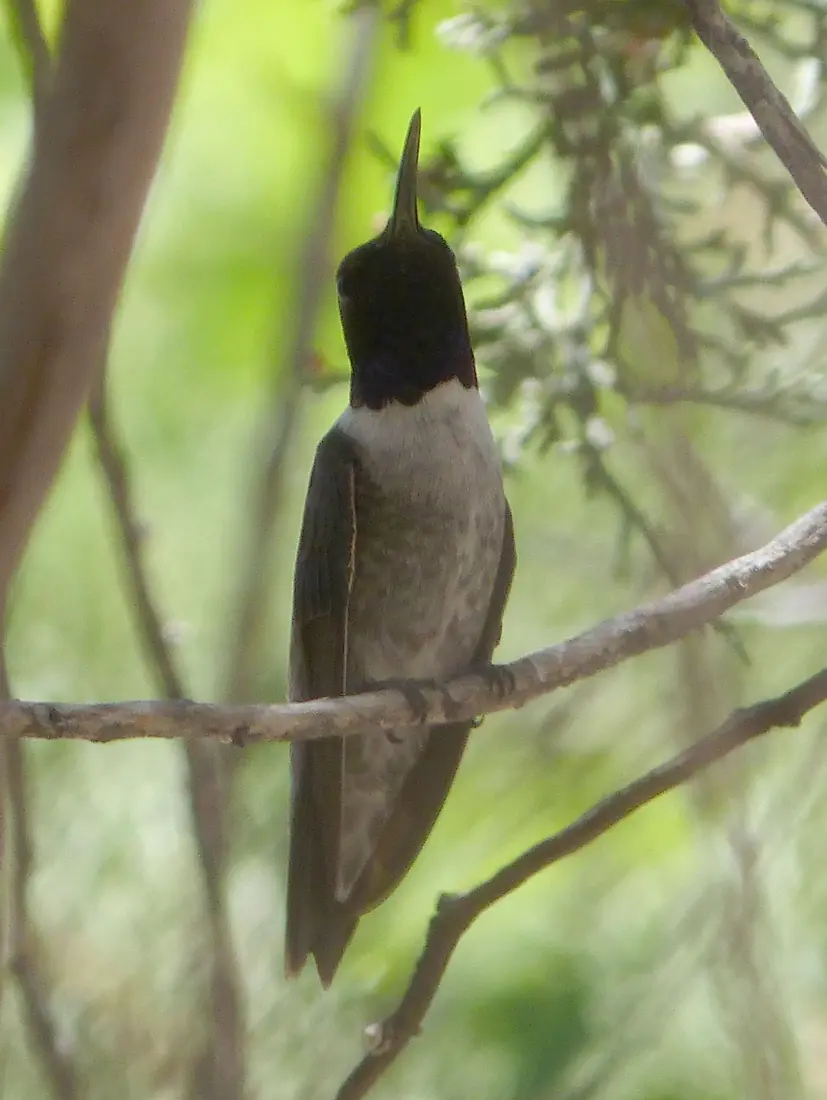
- Watch the hummingbirds arrive. Bosque del Apache lists mid-May as the start of its summer season, with black-chinned, calliope, broad-tailed and rufous hummingbirds named for it. Go in the morning, when the birds are busiest.
- See the Flower Moon rise on Wednesday, May 19. The moon is full at 4:59 a.m. MDT on May 20, but in Albuquerque it rises at about 7:52 p.m. on the 19th, roughly a quarter hour before sunset, so it climbs out of the east in daylight. By an older seasonal rule the May 20 moon is also called a Blue Moon.
- Get up before dawn on May 6 for the Eta Aquariids. The Moon is new that morning, so the sky is dark for these Halley’s Comet meteors. Face east in the last hours before the sky brightens, about 5:44 a.m. in Albuquerque.
Suggested pages in the Naturalist’s Field Journal: put the year’s first hummingbird on “birds I have seen.” Visit a cottonwood weekly for “a tree through the seasons.” A baby animal watched from far away fits “mammal watch,” a pre-dawn meteor session belongs in “dusk and dawn watch,” and a trip to the dunes or the river suits “the same place twice.”
Regions used below: Northern mountains, Taos and the Enchanted Circle; Four Corners and the northwest; Santa Fe and the Jemez; Albuquerque and the middle Rio Grande; Eastern plains; Southeast and the Pecos valley; Southwest, the Gila and Las Cruces.
Which birds arrive or nest in New Mexico in May?
May is the last big push of spring migration and the first week of summer for the birds that stay. By mid-May the Fish and Wildlife Service describes the season at Bosque del Apache National Wildlife Refuge as having turned from spring to summer, and the list of visitors changes with it: the warblers and flycatchers that were passing through give way to hummingbirds, young quail and territorial nesters. The birds are easiest to find early in the morning, before the wind rises and the heat builds.
-
Hummingbirds take over the refuge
Summer season at Bosque del Apache begins in mid-May · Bosque del Apache National Wildlife Refuge, near Socorro
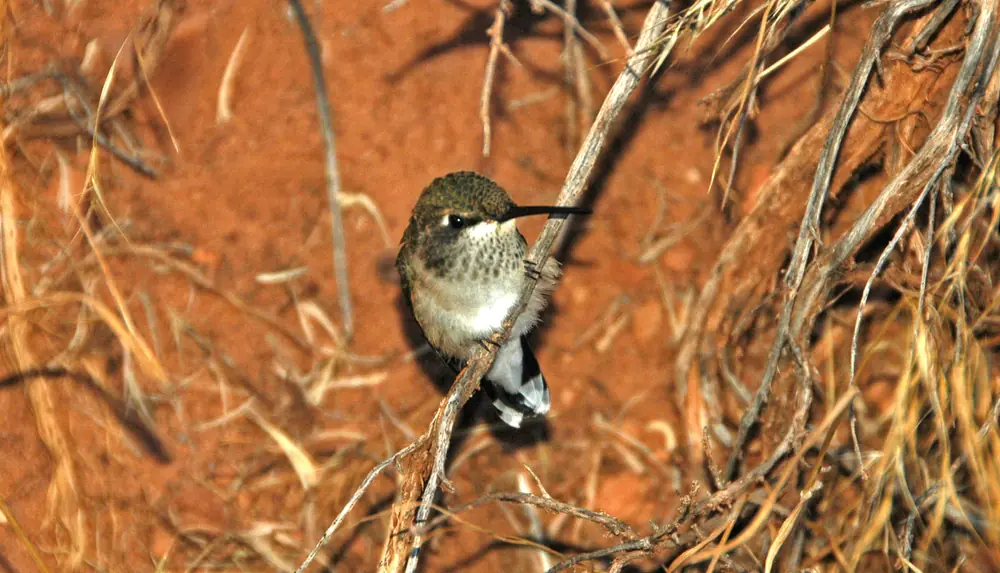
The refuge treats mid-May through mid-September as its summer season, naming black-chinned, calliope, broad-tailed and rufous hummingbirds as the colorful regulars of that season. It also points out that many young birds are on the move by then, and that quail run in long single files with a dozen chicks or more behind them. The refuge suggests mornings and evenings for watching, since most animals rest in shade at midday. At the same time, the spring list that ends in mid-May still includes migrating flycatchers, vireos and roughly twelve warbler species, so a trip early in May can catch both crowds.
-
Broad-tailed hummingbirds already on territory
Males back by the second week of April in one recent year · Randall Davey Audubon Center, Santa Fe
Staff at the Audubon center in the Santa Fe foothills wrote in 2025 that male broad-tailed hummingbirds had returned in the second week of April to claim their territories and that black-chinned hummingbirds were there too. They expected rufous hummingbirds only in late July or early August and called the calliope, the smallest breeding bird in North America, a possible arrival near the end of summer. So in May a hummingbird at a Santa Fe feeder is most likely a broad-tailed or a black-chinned, and a rufous would be a surprise.
-
Southwestern willow flycatcher on the move
Arrives late April to early May; nesting starts late May or early June · Dense willow and cottonwood thickets along streams
The Fish and Wildlife Service says this endangered songbird reaches its breeding grounds from late April to early May and that pairs start nesting around the last days of May or the first days of June. It is a small bird, just under six inches with its tail, olive-brown above and pale yellow below, with two light wing bars and no pale ring around the eye. The agency says its voice is the best clue: a sharp whit or a sneezy fitz-bew. Nest abandonment is a real risk when people crowd a nesting thicket, so listen from a distance and never play recordings to draw one out.
-
Plovers, terns and the tail of the songbird run
Neotropical songbirds migrate through roughly March to May; shorebirds all summer · Bitter Lake National Wildlife Refuge, near Roswell
Bitter Lake describes a March-to-May window for neotropical songbirds and says snowy plovers, least terns, other shorebirds and wading birds can be seen all summer, with the exposed salt flats serving as nesting and feeding ground for plovers, avocets and least terns. Stay on the marked routes: a plover nest is a scrape in open ground and easy to step on.
-
A free bird walk every weekend
Saturdays and Sundays at 8:30 a.m., all year · Rio Grande Nature Center State Park, Albuquerque
The park’s volunteer naturalists lead walks from the Candelaria wetland blind with no sign-up, and binoculars can be borrowed. More than 300 species have been recorded in the park, and the visitor center keeps a whiteboard of recent sightings. A whiteboard check before the walk tells you which migrants stayed.
Write down each first-of-the-year bird and the day you saw it in the Naturalist’s Field Journal. Migrants that came earlier are on our New Mexico April page.
When do New Mexico’s rivers peak in May?
Snowmelt crests in May across the northern half of the state. Forecasters at the Albuquerque weather office report that rivers draining northern New Mexico and the far south of Colorado usually top out in mid to late May, whereas those in the south crest from March through April. The table lists median peak dates for the May gauges, taken from the office’s compilation of long-term U.S. Geological Survey flows. They are medians over many years, not predictions, and the agency noted in a recent dry spring that a thin snowpack can bring the peak early and leave later hazards to rain or dam releases.
-
The middle Rio Grande at its fullest
Median peaks May 23 to 25 at Albuquerque, Otowi Bridge and San Marcial · Rio Grande valley
The river through Albuquerque has a median peak of 3,260 cubic feet per second on May 23, Otowi Bridge 3,510 on May 24 and San Marcial 1,890 on May 25. High water spreads into the bosque, and cold, fast channels are risky for children and dogs even where the surface looks calm.
-
Where a river is the star
Spring spawning season for a rare minnow lasts one to two months · Rio Grande from Cochiti Dam to Elephant Butte Reservoir
Per the Fish and Wildlife Service, the Rio Grande silvery minnow now occupies about 7 percent of its historic range, only the Rio Grande between Cochiti Dam and the upper end of Elephant Butte Reservoir. Its eggs are semi-buoyant and drift just below the surface, hatching within one to two days. The agency does not name a month for spawning, so treat the high-water weeks as a general guide, not a date. You are unlikely to see the fish, but the shallow backwaters it favors are worth knowing when you walk the river edge.
-
Gauges to watch
Mid to late May in the north · Jemez, Chama, Pecos and Taos area rivers
The Jemez River’s median peak comes earliest, on May 8, followed by the Rio Chama on May 15, the Rio Pueblo de Taos on May 23 and the Pecos near Pecos on May 25. The upper Rio Grande at Embudo peaks last, on May 30. If you plan to fish or float, check a live gauge the same day.
| River and gauge | Median peak runoff | Median peak flow (cubic feet per second) |
|---|---|---|
| Jemez River near Jemez | May 8 | 198 |
| Rio Chama at La Puente | May 15 | 1,920 |
| Embudo Creek near Dixon | May 16 | 280 |
| Costilla Creek near Costilla | May 21 | 105 |
| Red River near Questa | May 22 | 133 |
| Rio Grande at Albuquerque | May 23 | 3,260 |
| Rio Grande at Otowi Bridge | May 24 | 3,510 |
| Pecos River near Pecos | May 25 | 358 |
| Rio Grande at Embudo | May 30 | 1,540 |
Our weather page has forecast links, and our clouds guide helps you read the sky before a river trip.
Can you float the Rio Grande Gorge in May?
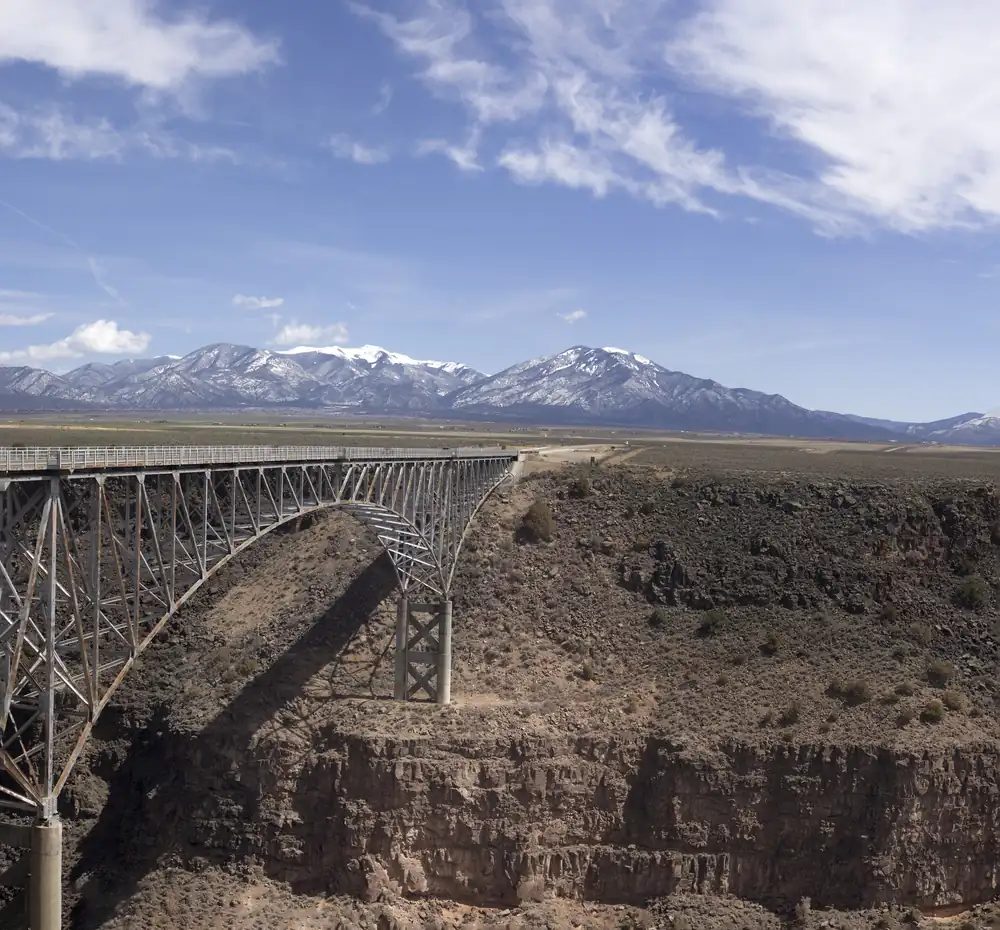
The Bureau of Land Management manages the Rio Grande and Red River Wild and Scenic Rivers in northern New Mexico, and May is when the ice is long gone and the water is both high and cold. Parts of the river are for experts only, and one stretch is closed while the raptors nest.
-
The Ute Mountain section stays closed through May
April and May · Ute Mountain section, Rio Grande Wild and Scenic River
The agency closes this section to all boating in April and May to protect nesting raptors, and says the section reopens in June. From June through March it asks boaters to reserve a launch date in advance, with one launch a day. The closure is for the birds on the cliffs, so give the canyon rim a wide berth as well.
-
Racecourse and Taos Box
Runoff season, with flows that change daily · Lower Gorge along NM 68
The Racecourse is a five-mile whitewater run in the Lower Gorge, easier than the Taos Box, a 15-mile Class III to V stretch that takes six to eight hours and calls for expert skills and prior knowledge of the river. The agency calls the Taos Box the best whitewater in New Mexico. Flows are unpredictable, so it tells boaters to check U.S. Geological Survey data or phone the Taos Field Office before heading out.
-
Life jackets are the law
Every trip · All public waters in the state
The state’s BOAT Act requires every boater on public water to wear a Coast Guard-approved life jacket. Cold snowmelt can cause shock within minutes of falling in, which is a stronger reason than any rule.
The cottonwoods along the river are in full leaf by now, a good subject for the journal’s tree-through-the-seasons page: Naturalist’s Field Journal.
What starts at Carlsbad Caverns on Memorial Day weekend?
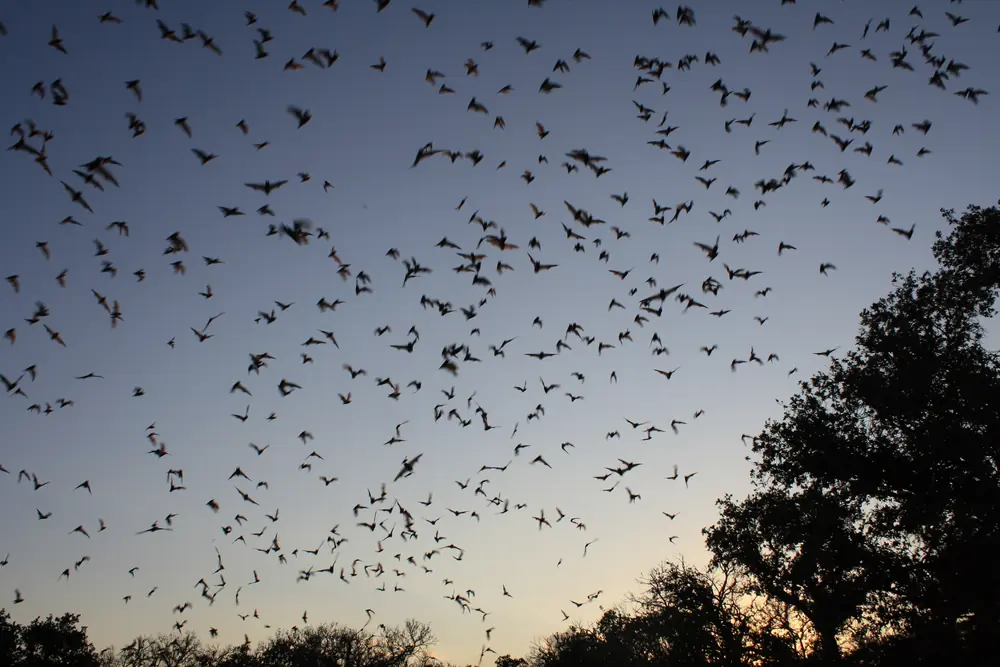
Memorial Day is Monday, May 31, 2027, so the holiday weekend runs May 29 to 31. At Carlsbad Caverns National Park that weekend is the traditional start of the nightly Bat Flight Program, which the National Park Service says runs every evening from Memorial Day weekend through October.
-
The nightly bat flight
Every evening from Memorial Day weekend (May 29 to 31, 2027) through October · Bat Flight Amphitheater, Carlsbad Cavern natural entrance
The program is free and needs no reservation. The park says the start time shifts through the summer as sunset moves, so ask at the visitor center or check the park’s status page for the exact hour. Phones, cameras, laptops and music players are banned in the amphitheater and the area around it, to protect the bats. Lightning can cancel an evening. The park’s outflight page adds that bats with pups may come back to feed at any time, that returning bats are usually busiest near dawn, and that the colony leaves in a spiral around the entrance for as long as three hours.
-
Heat and wind
May through summer · Chihuahuan Desert, southeastern New Mexico
The park describes windy, mild weather in March through May and summer temperatures from about 90 °F to the low 100s, with rain mostly in late summer and early fall. Bring water for the desert trails, hike early and wear a hat.
-
Birds that nest in the cacti and canyons
Year-round residents and spring nesters · Carlsbad Caverns National Park
The park’s bird list has 357 species. The cactus wren, a year-round resident, builds its nest in cacti, and the rock wren, the black-throated sparrow and the ladder-backed woodpecker also stay. Three state-threatened birds, Bell’s vireo, the gray vireo and the varied bunting, find some of their best New Mexico breeding habitat here.
Our New Mexico April page describes the earlier outflights, before the formal program begins.
What blooms and what blows at White Sands in May?
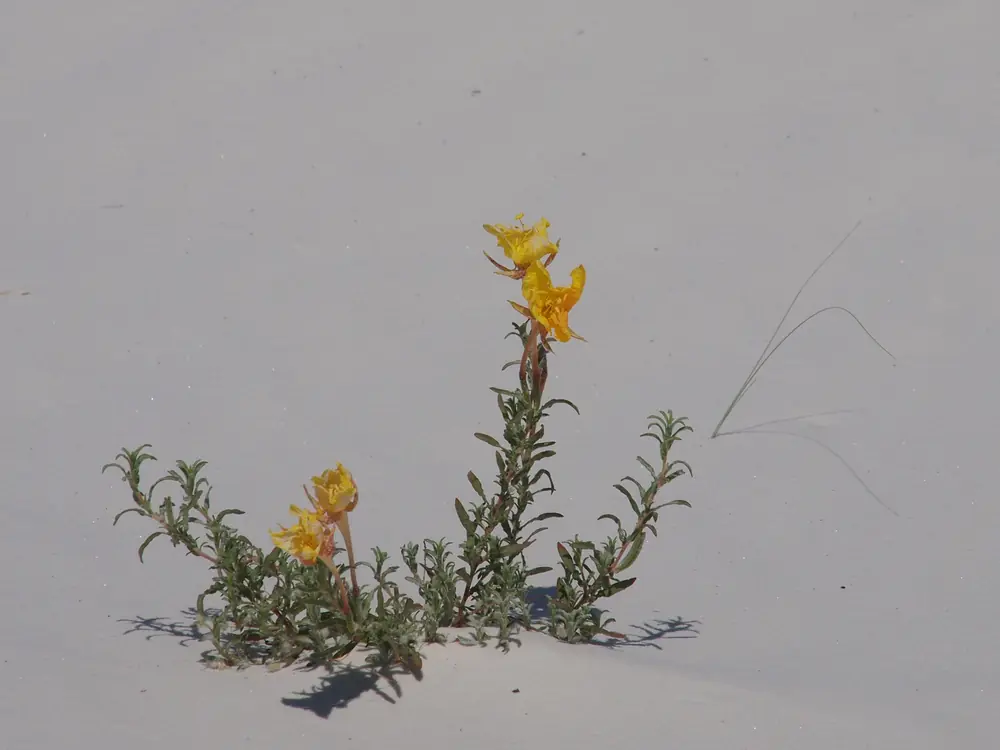
White Sands National Park lies in the Tularosa Basin at an elevation of 4,235 feet. The National Park Service says its flowers appear in nearly every season, and that mid-May brings a second wave of species to the dunes.
-
Mid-May additions
Mid-May · Dunes and interdunal flats
Gypsum centaury, white evening primrose and greenthread join the early bloomers around the middle of May, the park says. The gypsum centaury is described as blooming from April to October, and the Colorado four o’clock from April to mid-September. Purple sand verbena blooms from late April into May. Other plants may flower into summer, especially after the monsoon rains.
-
Wind until the monsoon
Sudden windstorms are frequent from February through May · Dunes Drive and trails
The park reports spring gusts up to 50 mph, with blowing sand that can make visibility poor and breathing difficult. It says wind can knock over trail posts, and advises turning back if you cannot see the next one.
-
Heat arrives early
May · Dunes with no shade
The park lists an average May high of 88 °F and a low of 50 °F, with about half an inch of rain, and a May record high of 104 °F. It advises avoiding hiking and strenuous activity once the temperature passes 85 °F, and packing one gallon of water for each person daily, since water is available only at the visitor center. Venomous snakes and scorpions can hide in the sand, so wear closed shoes. The rainy season begins in early July.
Photograph each bloom you find for your Naturalist’s Field Journal, and check the forecast for wind before you drive in.
When is the last freeze in May, and what flowers follow?
Freezing is over for most of the state by now. The final freeze of spring is already behind Las Cruces, Silver City, Albuquerque and Roswell, but at Taos the median last freeze is May 19, and about one spring in ten does not finish freezing until after May 31. The table lists early, median and late dates at eight stations.
-
Two flowering seasons
Spring, then again after the monsoon rains · Southern and eastern New Mexico
A New Mexico State University garden column explains that wildflower bloom depends heavily on moisture, with one season after good winter and spring precipitation and another in mid to late summer after the monsoon. Desert chicory flowers for only a few weeks. By May the spring show in the lowlands is mostly done, and the next one waits for July rains.
-
Find out what you are looking at
Chapter meetings and field trips run through the year · Albuquerque, Santa Fe, Taos, Las Cruces, Silver City, Alamogordo
The state’s Native Plant Society has chapters from Taos and Santa Fe south through Albuquerque, Las Cruces, Silver City and Alamogordo, and links a wildflower guide. Field trips and workdays go on a statewide calendar, the best place to look for May outings.
-
Planting by the table
Late spring · Gardens statewide
In northern towns, wait until after the nine-years-in-ten date before planting anything tender. In the south and in Albuquerque the date has passed, and the heat now becomes the main concern.
| Station | One year in ten | Median | Nine years in ten |
|---|---|---|---|
| Taos | May 7 | May 19 | May 31 |
| Farmington Regional Airport | Apr 20 | May 2 | May 18 |
| Clayton 1 N (northeast plains) | Apr 21 | May 4 | May 19 |
| Santa Fe County Municipal Airport | Apr 22 | May 4 | May 17 |
| Albuquerque International Airport | Mar 17 | Apr 6 | Apr 23 |
| Roswell Climat (Roswell) | Mar 31 | Apr 13 | Apr 28 |
| Fort Bayard (Silver City area) | Mar 14 | Apr 4 | Apr 22 |
| State Univ (Las Cruces) | Feb 23 | Mar 12 | Apr 2 |
For more towns, use the New Mexico frost dates page.
What happens with baby animals in May, and what should you do?
Late spring is when many large animals give birth, and well-meaning visitors sometimes carry off a youngster that was never in trouble.
-
Fawns, calves and cubs
Spring and early summer · Forests, meadows and roadsides
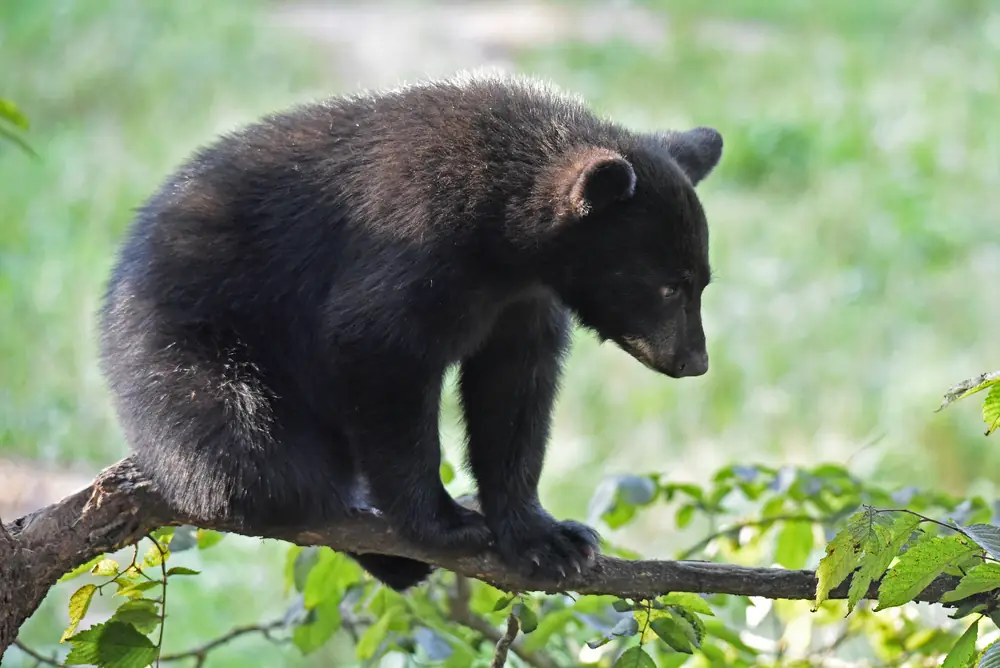
The Department of Wildlife says young deer, elk and bears are often hidden while their mother feeds, usually a few hundred yards off. Do not touch or move a baby animal, because returning it later seldom works, and walk away quietly. If you think one is truly abandoned, mark the spot and call the local conservation officer.
-
Black bear sows with cubs
Emerge around May · Mountain forests
A department bear-safety release says that males and independent young bears come out first, while sows with cubs emerge around May. Never come between a mother and her cubs. Take down bird feeders, pick up fallen fruit, store garbage and pet food, and give any bear room to leave. Aggressive bears can be reported at 888-248-6866 (the department’s information line).
-
Young birds on the ground
From mid-May · Bosque del Apache and any wooded park
The refuge notes many young birds on the move in summer. A fledgling hopping on the ground with feathers and a parent calling nearby usually needs nothing from you.
Quiet sightings of mammals can be logged in the field journal.
How dry, windy and fire-prone is May in New Mexico?
The Albuquerque weather office describes May as among the driest months on the calendar across western and central New Mexico, and says April and May are the windiest. Its wind page explains that the strengthening sun heats the ground, the warm air rises to roughly 7,500 to 10,000 feet and mixes strong winds from aloft to the surface. The office warns of high wind when sustained speeds reach 40 mph or gusts hit 58 mph. The table sets normal May temperature and rainfall at eight stations beside the May 2026 figures, a month that ran close to normal in temperature.
-
A soaking Memorial Day weekend in 2026
May 24 to 26, 2026 · Statewide
The office named a Memorial Day weekend soaker its weather event of the month: a Pacific low pulled deep subtropical moisture across the state, almost every location got at least a tenth of an inch, and the Albuquerque Sunport received more rain in 24 hours than a typical whole May. The office said the rain eased fire danger for a short time, with no severe storm or flash flood reports apart from a couple of stray gusts. One year does not set a pattern; most Mays are drier than this.
-
Fire already burning
Mid-May · Central and northern mountains
The same report was illustrated with a photo of the Seven Cabins Wildfire on May 17, 2026, a reminder that fire season is under way before the summer storms. The State Forestry Division posts current fire restrictions and wildfire information on its website and offers an alert sign-up. Check the page before any campfire or burn.
-
What to watch
All month · Plains, highways and foothills
Wind and dust, red flag fire weather, late snow in the highest northern peaks and swift snowmelt rivers are the month’s hazards. Heavy but local thunderstorms are possible on the eastern plains.
| Station | Normal average temperature | May 2026 average temperature | Normal precipitation | May 2026 precipitation |
|---|---|---|---|---|
| Gallup | 55.6 °F | 56.4 °F | 0.57 in | 0.66 in |
| Las Vegas | 56.5 °F | 56.9 °F | 1.32 in | 0.41 in |
| Raton | 57.2 °F | 56.7 °F | 1.06 in | 1.54 in |
| Santa Fe | 59.7 °F | 60.5 °F | 0.63 in | 0.64 in |
| Farmington | 60.4 °F | 61.7 °F | 0.53 in | T |
| Clayton | 61.5 °F | 62.0 °F | 1.85 in | 2.82 in |
| Albuquerque Sunport | 66.1 °F | 67.6 °F | 0.44 in | 1.04 in |
| Roswell | 72.3 °F | 71.0 °F | 1.14 in | 1.67 in |
The newest seasonal outlook sits at the Climate Prediction Center’s 90-day page, updated monthly. For your town’s forecast, see our weather page.
How much daylight does New Mexico gain in May?
The towns in the table gain between 41 and 48 minutes of daylight over May, about a minute and a half more each day, which is slower than in March or April as the June solstice nears. Raton goes from 13 h 43 m to 14 h 31 m, and Las Cruces from 13 h 27 m to 14 h 08 m. Naval Observatory times for Albuquerque show the sun rising at 6:12 a.m. and setting at 7:55 p.m. on May 5, then rising at 6:00 a.m. and setting at 8:06 p.m. on May 19, and rising at 5:56 a.m. and setting at 8:12 p.m. on May 27. All are daylight time, in effect all month.
| City | May 1 | May 31 | Gained | Per day |
|---|---|---|---|---|
| Raton | 13 h 43 m | 14 h 31 m | 48 min | 1.6 min |
| Farmington | 13 h 42 m | 14 h 30 m | 48 min | 1.6 min |
| Santa Fe | 13 h 38 m | 14 h 24 m | 46 min | 1.5 min |
| Albuquerque | 13 h 36 m | 14 h 21 m | 45 min | 1.5 min |
| Tucumcari | 13 h 37 m | 14 h 21 m | 44 min | 1.5 min |
| Roswell | 13 h 31 m | 14 h 12 m | 41 min | 1.4 min |
| Silver City | 13 h 29 m | 14 h 10 m | 41 min | 1.4 min |
| Las Cruces | 13 h 27 m | 14 h 08 m | 41 min | 1.4 min |
Use the daylight calculator to find sunrise and sunset in your own town.
What can you see in New Mexico’s night sky in May?
The month opens with a meteor shower under a moonless sky, brings a full Flower Moon that also carries the seasonal Blue Moon label, and ends with Mercury standing out at dusk. Clock times here are Mountain daylight time.
-
Eta Aquariids at new moon
Best mornings May 5, 6 and 7; peak night May 5 to 6 or May 6 to 7 depending on the source · Dark sites with a view to the east
This shower comes from Halley’s Comet. With the Moon new on May 6, almost no moonlight interferes, which favors the shower this year. Watch in the last hours before dawn, because Aquarius, where the meteors appear to originate, only just rises before daybreak. Rates of roughly 10 to 30 an hour are typical in the southern two-thirds of the country, and one calendar cites about 30 an hour in the Northern Hemisphere. The sky begins to brighten near 5:44 a.m. in Albuquerque on May 5.
-
The Flower Moon and a seasonal Blue Moon
Full at 4:59 a.m. MDT on Thursday, May 20; best view the evening of Wednesday, May 19 · Anywhere with a clear eastern horizon
In Albuquerque the sun sets at 8:06 p.m. on May 19 and the moon rises at 7:52 p.m., about a quarter hour earlier. Four full moons fall between the March 20 equinox and the June 21 solstice (March 22 and April 20 came first, June 19 follows). By the seasonal rule that predates the calendar-month one, the one in third place earns the Blue Moon name. Counting two full moons inside one calendar month gives no Blue Moon in 2027. Names come from folklore.
-
Mercury at its best in the evening
Greatest elongation Friday, May 28 (7:14 a.m. MDT); look May 12 to June 5 · Low in the west-northwest after sunset
Mercury stands about 23 degrees east of the Sun on the 28th, which makes both May 27 and May 28 good evenings. Scan the west-northwest during the hour or so after dusk fades, ideally over a flat horizon. In Albuquerque the sun sets about 8:12 p.m. on May 27. The timing comes from our own calculations and one other calendar.
-
Jupiter, the Moon and a hard conjunction
Moon near Jupiter the evening of May 12; Venus and Saturn on the mornings of May 6 to 8 · High in the south for Jupiter; low in the east before sunrise for the pair
The first-quarter Moon sits beside Jupiter on the evening of May 12, a good easy pairing. Early on May 7, Venus and Saturn are only about 0.6 degrees apart in Pisces, but both hug the eastern horizon before sunrise, so a clear view and binoculars are essential. Those pairings are our own calculations.
-
Milky Way season begins
Early to mid-May and late May · South, in the dark hours
In our calculations for the central United States, the galaxy’s bright core clears the horizon during full darkness for as much as four hours during the first two weeks of May and again in the final week. Chaco Culture National Historical Park, a certified International Dark Sky Park since August 2013, runs summer evening programs that usually include telescope viewing and are held around the new moon in summer, depending on staffing. Check the park calendar.
| Phase | Date | Time |
|---|---|---|
| New moon | Thursday, May 6 | 4:58 a.m. MDT |
| First quarter | Wednesday, May 12 | 10:44 p.m. MDT |
| Full moon, the Flower Moon | Thursday, May 20 | 4:59 a.m. MDT |
| Last quarter | Friday, May 28 | 7:58 a.m. MDT |
All the year’s phases are on the moon phase calendar.
What can New Mexico families do outdoors in May?
Few organizers have posted 2027 dates yet. Where a date is given, it comes from the organizer’s own page; otherwise we say when an event is usually held.
-
City Nature Challenge
Observations April 30 to May 3, 2027; identification May 4 to 16; results May 20 · Any smartphone, any city
Organizers have posted these dates. Participants photograph or record wild plants and animals and share them through iNaturalist or a city’s chosen platform. The site does not say whether New Mexico cities have signed up for 2027, so check its participate page.
-
World Migratory Bird Day
Held each May; the 2027 date had not been posted · Parks, refuges and your yard
The 2026 observance was May 9, with the theme “Every Bird Counts.” Organizers had not announced 2027 details when we looked, so look at the official site and ask the Bosque del Apache or Rio Grande Nature Center for local events.
-
Smokey Bear Days and a firefighter observance
Usually the first days of May and the Memorial Day period; check the park · Smokey Bear Historical Park, Capitan
The state park in Capitan tells the story of the orphaned cub with burned paws found after a wildfire in the Capitan Mountains. It is open Tuesday through Sunday, 9 a.m. to 4:30 p.m. In 2026 it held Smokey Bear Days in early May and a Wildland Firefighter Observance on Memorial Day weekend. Dates for 2027 were not posted, so call the park at 575-354-2748.
-
State park fees return
From May 1 · New Mexico State Parks
The resident exemption from day-use fees ends April 30. From May 1 residents pay $5 a day and non-residents $10, and camping fees apply year-round.
Safety notes for May in New Mexico
Turkey hunters, heat, fast water and fire need attention in May.
-
Spring turkey season
In 2026 the open season was April 15 to May 15; check the 2027 dates · Statewide, except closed areas listed in the rules
In the state’s 2026–2027 hunting booklet, the spring turkey season for 2026 ran April 15 to May 15, and hunters could take two bearded birds. Only shotguns, bows and crossbows are legal. A new license year starts April 1, which means the 2027 season will be in the next booklet. Verify the dates, and dress brightly on forest trails during hunting weeks.
-
Blaze orange
Whenever you hunt or hike · Military land and Valles Caldera
State rules demand blaze orange only in a few places, military reservations among them, though the department encourages every hunter to wear it.
-
Hantavirus
Any time of year, wherever mice live · Cabins, sheds and trailers
The state health department says rodent control in and around the home is the main way to prevent hantavirus, which spreads through the urine, droppings or saliva of infected rodents when dust is breathed in. It lists 142 cases and 55 deaths statewide from 1975 through 2025. Air out closed buildings before you enter them.
-
Heat, wind and fire
May · Deserts, plains and foothills
Carry water, start hikes early, and heed red flag warnings. Never park on dry grass.
-
Sandia Crest closure
Closure in place until further notice; projects run through fall 2027 · Ellis Trailhead and the road above the 10K lot
The Cibola National Forest’s area closure began April 30, 2026, and the Forest Service says the projects affect access through fall 2027 and the closure stays in place until further notice. The La Luz Trail stays open up to the tramway, which keeps running.
More months and more states live on the nature hub.
Sources (38)
- NWS Albuquerque: May 2026 climate highlights (normals, Memorial Day weekend rain, Seven Cabins Wildfire)
- NWS Albuquerque: high wind climatology (April and May windiest, warning thresholds)
- NWS Albuquerque: climatological spring runoff data
- Climate Prediction Center: seasonal outlooks
- USFWS Bosque del Apache NWR: wildlife watching (spring and summer seasons, hummingbirds)
- USFWS Bosque del Apache NWR: seasons of wildlife
- USFWS Bitter Lake NWR: refuge overview (songbirds, plovers, terns, dragonflies)
- USFWS: southwestern willow flycatcher (arrival, nesting, identification)
- USFWS: Rio Grande silvery minnow (range, eggs, spawning)
- Audubon Southwest: hummingbirds and haiku (Randall Davey Audubon Center, June 2025)
- Friends of the Rio Grande Nature Center: birding at the park (weekend walks)
- World Migratory Bird Day: official site (2026 dates and theme)
- City Nature Challenge: 2027 dates
- Bureau of Land Management: Rio Grande Wild and Scenic River (Ute Mountain closure, Taos Box, Racecourse, life jackets)
- National Park Service, Carlsbad Caverns: Bat Flight Program (Memorial Day weekend through October)
- National Park Service, Carlsbad Caverns: Brazilian free-tail bat outflight
- National Park Service, Carlsbad Caverns: birds (357 species, cactus wren, threatened nesters)
- National Park Service, Carlsbad Caverns: weather (windy spring, hot summer, late-summer rain)
- National Park Service, White Sands: wildflowers (mid-May bloomers)
- National Park Service, White Sands: weather (May temperatures, wind, monsoon timing)
- National Park Service, White Sands: safety (heat, water, wind, snakes)
- National Park Service, Chaco Culture: night sky programs (International Dark Sky Park)
- NMSU Southwest Yard and Garden: spring wildflowers (two flowering seasons)
- Native Plant Society of New Mexico: chapters and wildflower guide
- New Mexico Department of Wildlife: public reminded to leave young wildlife alone (May 20, 2020)
- New Mexico Department of Wildlife: bear aware in spring
- New Mexico Department of Wildlife: 2026-2027 hunting rules and information (spring turkey, blaze orange, license year)
- New Mexico Department of Health: hantavirus in New Mexico (case counts, prevention)
- New Mexico Forestry Division: fire restrictions, wildfire updates and Smokey Bear Historical Park links
- New Mexico Forestry Division: Smokey Bear Historical Park (hours, Smokey Bear Days, firefighter observance)
- New Mexico State Parks: fees and permits (resident day-use exemption ends April 30)
- Cibola National Forest: Sandia Crest area projects update and closure
- Sea and Sky: astronomy calendar of celestial events, 2027 (Eta Aquariids, Blue Moon, Mercury)
- U.S. Naval Observatory: rise, set and transit times for Albuquerque, May 5, 2027
- U.S. Naval Observatory: rise, set and transit times for Albuquerque, May 19, 2027
- U.S. Naval Observatory: rise, set and transit times for Albuquerque, May 27, 2027
- U.S. Naval Observatory: moon phases, May 2027
- Photos via Wikimedia Commons; licenses and photographers are credited under each picture
