What to look for in nature in New Mexico this December
Meteorological winter, the coldest quarter of the year by the calendar weather scientists use, starts on December 1, and in New Mexico it begins with the crane season at full strength. Tens of thousands of sandhill cranes and white geese work the Rio Grande and Pecos valleys, rosy-finches come down from the alpine tundra, and on the high peaks the snow finally starts to stay. Sunset bottoms out during December’s opening week, the solstice falls on Monday the 21st, and two Ancestral Puebloan great houses still mark it as they did nine centuries ago. Below, the month moves from the valley floor to the summits and then up into the night sky.
Other months in New Mexico: October, November.
Start here

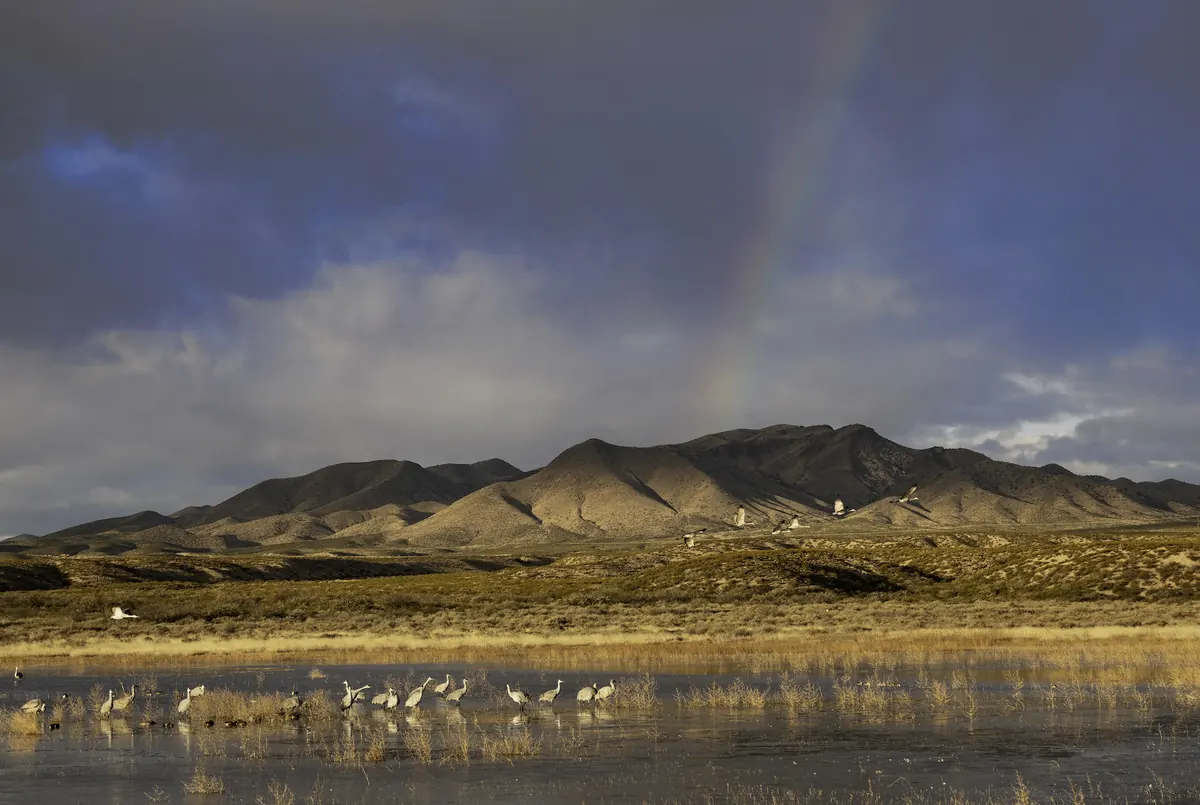
- The Festival of the Cranes. From Wednesday, December 2, through Saturday, December 5, Socorro hosts the 37th Festival of the Cranes, with more than 85 tours, workshops and talks built around Bosque del Apache National Wildlife Refuge. Even without a ticket, the refuge’s dawn ponds are open to anyone with a warm coat.
- Sunset on the solstice. At Aztec Ruins National Monument the north wall of the great house called Aztec West lines up with the setting sun at the winter solstice, which arrives at 1:50 p.m. MST on Monday the 21st. The park opens the alignment to visitors only through ranger programs, so check its calendar.
- Geminids, then the biggest full moon of 2026. Sunday night, December 13, brings the Geminids, best after midnight and with the slim crescent long gone. On the 23rd the Cold Moon reaches full at 6:28 p.m. MST, the nearest full moon of the whole year.
For the Naturalist’s Field Journal: a crane fly-out at first light deserves the dusk and dawn watch page, and put a rosy-finch or any bird from a count day onto “birds I have seen.” Snow in the Jemez or the Sangres is the time for “tracks to know,” and the stripped twigs under a ponderosa, where an Abert’s squirrel has eaten, are a fine entry for “reading the signs.” A juniper sprig with its blue berries, or a cone from your Christmas tree, suits the seeds, pods and cones plate.
Regions used below: Northern mountains, Taos and the Enchanted Circle; Four Corners and the northwest; Santa Fe and the Jemez; Albuquerque and the middle Rio Grande; Eastern plains; Southeast and the Pecos valley; Southwest, the Gila and Las Cruces.
Is December a good month to see sandhill cranes in New Mexico?
It is one of the best. Bosque del Apache National Wildlife Refuge puts its peak season between mid-November and late January, and its manager has said the state’s wintering cranes mostly finish arriving during November and December. By now the flocks keep a daily routine: a night standing in shallow water, a morning flight out to the fields, a return before dark. Learn that rhythm and you can find cranes in farm country up and down the middle and lower Rio Grande.
-
The Festival of the Cranes
Wednesday, December 2 – Saturday, December 5, 2026 · Socorro and Bosque del Apache National Wildlife Refuge
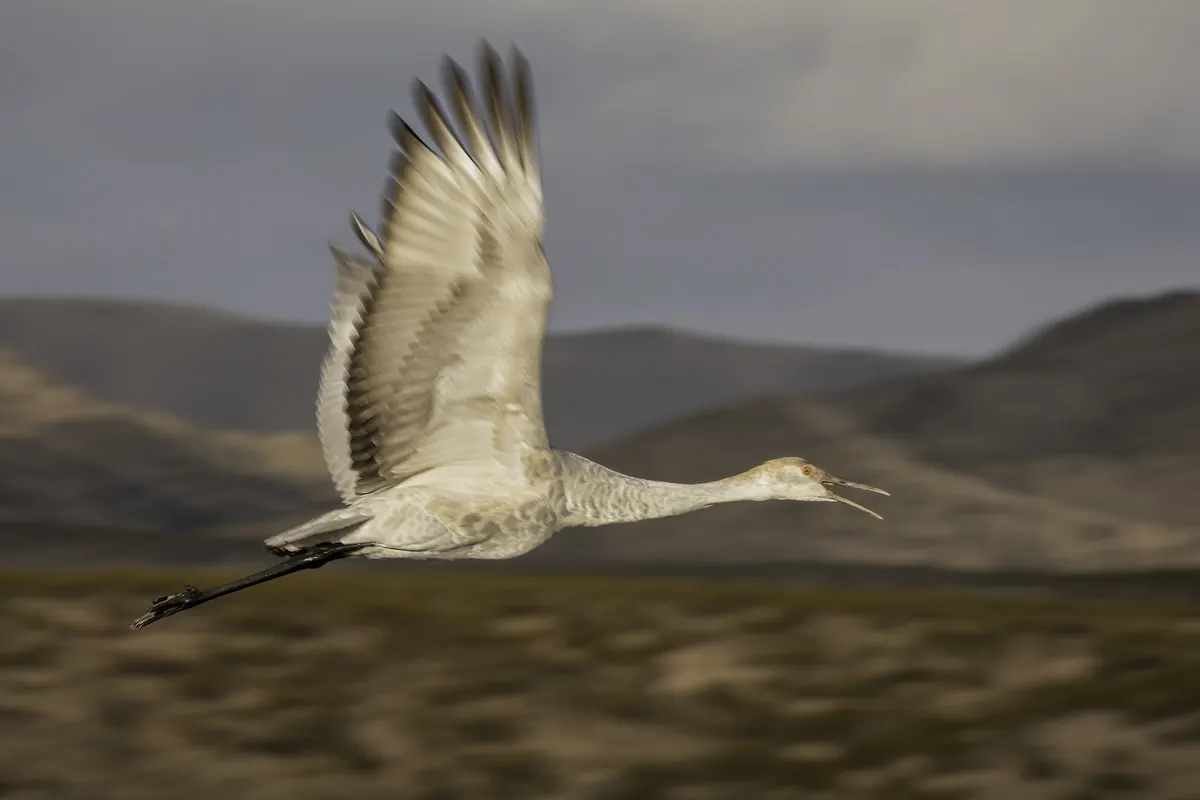
The Friends of Bosque del Apache hold this festival each December, and 2026 is the 37th. It opens on the evening of the 2nd with a keynote at the Socorro Convention Center and fills four days with more than 85 birding tours, photography workshops, hikes and talks, plus a camera and optics expo. Many field trips need advance registration, and popular ones fill early.
-
Fly-outs and fly-ins at Bosque del Apache
Daily: fly-out around sunrise, fly-in toward dusk · South of Socorro, off I-25 at San Antonio
Gates open an hour ahead of sunrise and close an hour after sunset. Arrive in the dark, find a pond with birds on it, and wait: the snow and Ross’s geese tend to lift off together in a single roaring wave, while the cranes leave in smaller family groups over the following hour. In late afternoon the order reverses, and the cranes glide back in with legs dangling. Bring gloves; December dawns in the valley are often well below freezing.
-
Bitter Lake and the Pecos valley
Through December · Bitter Lake National Wildlife Refuge, northeast of Roswell
East of the mountains, the smaller lesser sandhill cranes of the Central Flyway use Bitter Lake from October through December, with thousands of snow geese and ducks. Numbers peak around Thanksgiving, so early December still finds big flocks. Drive the tour loop in the last hour of daylight, when flocks return to the water.
Closer to Albuquerque, the Open Space Visitor Center farms fields for wintering cranes, and Valle de Oro refuge has crane programs for small children (see the families list). Cranes are also hunted by permit: the Middle Rio Grande draw hunt is December 12–13 and the Estancia Valley hunt December 12–15 and 17–20, and east of the mountains a free-permit season runs through January 21, mostly on private land, so birds in open fields may be warier on hunt days.
Where can you see rosy-finches in New Mexico this winter?
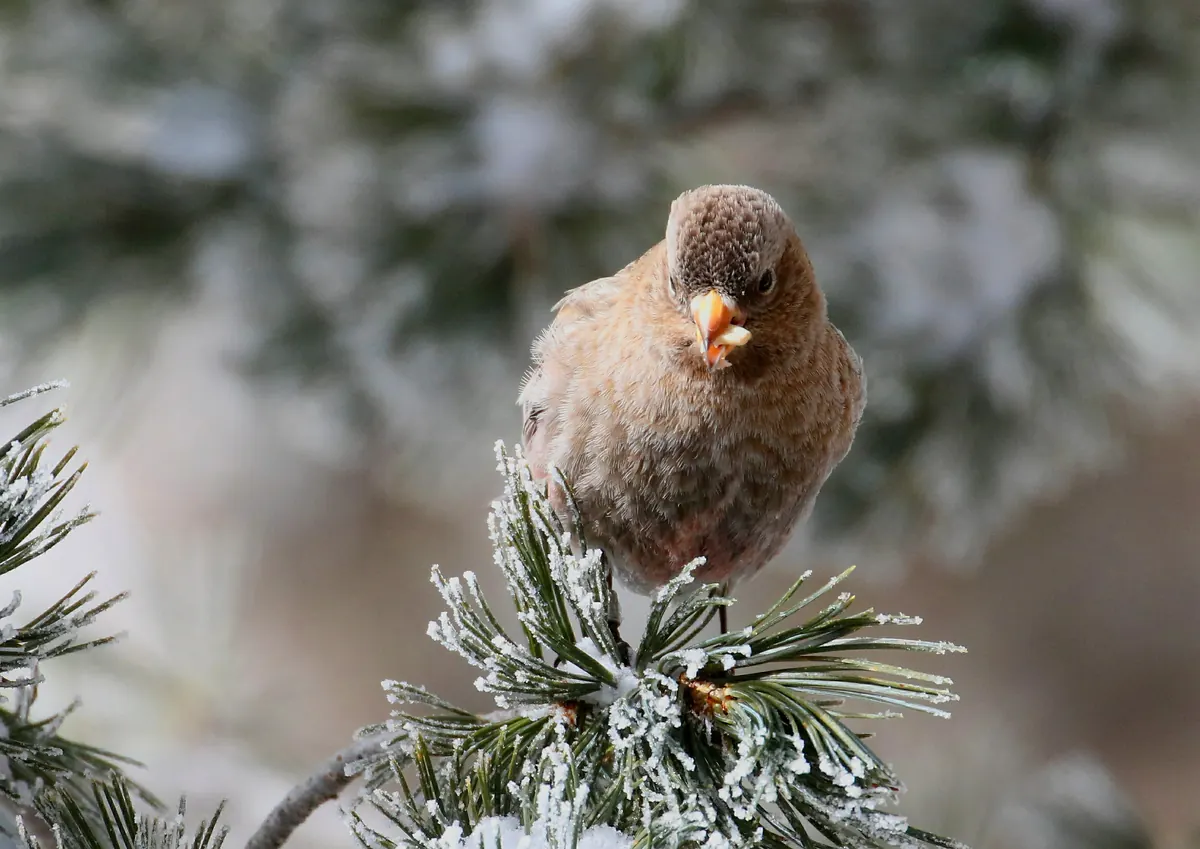
Rosy-finches are small, cinnamon-and-pink finches that breed on alpine tundra and come lower only when snow buries their food. In winter all three North American species, black, gray-crowned and brown-capped, can turn up together in New Mexico, and for two decades the place to see them was the top of the Sandias. The Bird Alliance of Central New Mexico tells how feeding at Sandia Crest, begun in the winter of 1999–2000, drew the mixed flocks in daily, and banders there have marked thousands of birds since 2003, some living eight years.
-
Sandia Crest is closed this winter
April 30, 2026 through fall 2027 · Sandia Crest Recreation Site, the Ellis Trailhead and NM 536 beyond the 10K Trailhead
The Cibola National Forest is enforcing an area closure at the top of the Sandias while it removes hazard trees and rebuilds the summit site. Demolition of the old Crest House began in August 2026, and the Forest Service expects the closure to last through the fall of 2027. The crest parking area, where the famous feeder stood, is inside the closed zone, and hikers coming up the La Luz Trail can ride the Sandia Peak Tramway but cannot walk over to the crest. The classic rosy-finch stakeout is off the table this December.
-
Where to look instead
December through March, in most years · High country of the Sangre de Cristos, the Sandias and the northern ranges
Birders have long found that rosy-finches start arriving in early November and that a few linger into March, with December through February the surest stretch. Without the crest feeder they are harder to pin down, so watch recent eBird reports from ski areas and high villages after a snowstorm, when flocks often drop lower. The brown-capped rosy-finch breeds only in the high Rockies from northern New Mexico north into Colorado, and any sighting is worth recording carefully.
Feeding at a mountain cabin? Hulled sunflower chips leave no mess and will not sprout, and taking feeders in at night guards against a bear roused by a warm spell.
How do I join a Christmas Bird Count in New Mexico?
Audubon’s 127th count season spans 23 days, opening on December 14 and closing on January 5, 2027. Within that window each circle’s compiler picks one day, and New Mexico has fielded more than 30 circles in recent decades, from the Sangre de Cristos to the bootheel. Taking part is free, beginners join experienced birders, and many counts also take tallies from people watching their feeders at home.
-
Find a circle and its compiler
Sign up in November or early December · Audubon’s CBC Circle Finder; local bird clubs and nature centers
Open Audubon’s online circle finder, pick the count nearest you and write to the compiler with your experience and how far you can walk. In the north, the Pajarito Environmental Education Center runs the Los Alamos count, always on a weekend, with a date set in October once the northern counts have sorted out conflicts; recent years have turned up 74 to 87 species. In Albuquerque, the Bird Alliance of Central New Mexico, formerly Central New Mexico Audubon, has long supported the city’s count.
-
What New Mexico counts find
Count day · Statewide
Audubon’s summary of the 2014–15 season gives a sense of scale: 33 New Mexico circles found 237 species between them. Caballo, along the Rio Grande below Truth or Consequences, led with 129, ahead of Albuquerque and Las Cruces, and the Bosque circle, centered on the crane refuge, tallied roughly 100,000 individual birds.
When is the winter solstice in New Mexico, and where can you watch it?
The sun reaches its southernmost point at 1:50 in the afternoon, Mountain Standard Time, on Monday, December 21, 2026. For several days around it, the place where the sun sets on the horizon barely moves from one evening to the next, which is why people have watched and marked this week for so long. In northwestern New Mexico, two great houses built by Ancestral Puebloan people still frame the solstice sun.
-
Aztec West at sunset
Around December 21; in 2025 the program was held December 22 · Aztec Ruins National Monument, Aztec
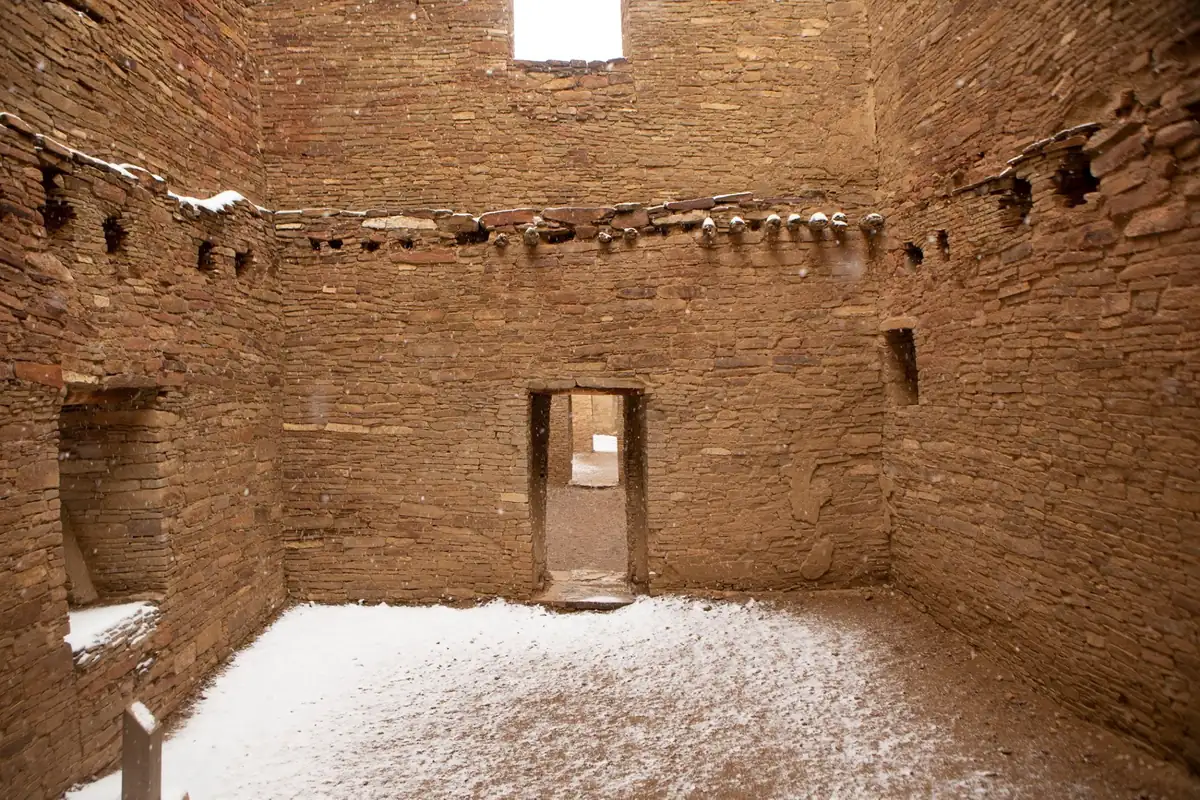
The Park Service explains that the north wall of the great house was laid out about 900 years ago so that it lines up with the sun touching the horizon at summer solstice sunrise and again at winter solstice sunset. To protect the site, the alignment can be seen only during special programs. In December 2025 the park held a free, no-reservation observation, with rangers leading visitors to the viewing spot late in the afternoon. Watch the park’s calendar for the 2026 date, and hope for a clear western horizon.
-
Sunrise at Kin Kletso
Around December 21 · Chaco Culture National Historical Park
Chaco holds a winter solstice program at Kin Kletso, a smaller great house a short walk from the Pueblo del Arroyo parking area, where park astronomers point out the sun rising into place. Winter weather can make the roads into Chaco slick, so call the park before you drive out.
You can mark the solstice at home. From early December, note where the sun sets on your skyline, from the same spot each time, and watch its march south slow, stop and turn. The same place twice page in the journal was made for this.
When are the shortest days and earliest sunsets in New Mexico?
The shortest day is December 21, but the earliest sunset is not. The earth is speeding toward its closest approach to the sun, reached in early January, and that pushes solar noon a little later each December day; across New Mexico the earliest sunsets fall in the first week of December (the table gives the middle of each town’s run of equal sunset times, December 3 to 6), and the latest sunrises wait until early January. Albuquerque’s earliest sunset is 4:54 p.m. on December 4 and 5; by New Year’s Eve it has slipped back to 5:05. Raton and Farmington, in the north, have the shortest days in this table, 9 hours 38 minutes at the solstice, while Las Cruces gets 24 minutes more.
| City | Dec 1 | Dec 21 | Dec 31 | Earliest sunset |
|---|---|---|---|---|
| Raton | 9 h 49 m | 9 h 38 m | 9 h 40 m | 4:41 p.m., Dec 6 |
| Farmington | 9 h 50 m | 9 h 38 m | 9 h 42 m | 4:57 p.m., Dec 6 |
| Santa Fe | 9 h 55 m | 9 h 44 m | 9 h 48 m | 4:50 p.m., Dec 5 |
| Albuquerque | 9 h 58 m | 9 h 48 m | 9 h 50 m | 4:54 p.m., Dec 5 |
| Tucumcari | 9 h 58 m | 9 h 47 m | 9 h 50 m | 4:43 p.m., Dec 5 |
| Roswell | 10 h 06 m | 9 h 57 m | 9 h 59 m | 4:50 p.m., Dec 4 |
| Silver City | 10 h 09 m | 9 h 59 m | 10 h 02 m | 5:07 p.m., Dec 4 |
| Las Cruces | 10 h 11 m | 10 h 02 m | 10 h 04 m | 5:02 p.m., Dec 3 |
Our daylight calculator gives any town’s sunrise, sunset and twilight, and how quickly the light comes back after the solstice.
What can you see in New Mexico’s night sky in December?
Long, dry, cold nights make December the year’s best month for stargazing in much of New Mexico, provided you dress for it. All times are Mountain Standard Time, which the whole state, Navajo Nation included, keeps until March.
-
The Geminids
From Sunday evening, December 13, until Monday’s dawn · Anywhere dark; the radiant in Gemini is high after midnight
This is the year’s richest shower. The International Meteor Organization gives it a peak rate of about 150 an hour, a figure that assumes a perfectly dark sky with the radiant overhead; what you actually see will be fewer, yet more than any other night of the year. The young moon goes down by mid-evening, and the hours after midnight, when Gemini climbs highest, are the most productive.
-
The Cold Moon, the closest full moon of 2026
Full at 6:28 p.m. MST, Wednesday, December 23 · Rising in the east-northeast around sunset
Full and perigee fall only about seven hours apart, so this is the largest and brightest-looking full moon of the year, a true supermoon. Watch it lift out of the east-northeast in the dusk of the 23rd; on Christmas Eve it still looks round. Two nights before full, the moon drifts past the Pleiades, and moonlight swamps the cluster.
-
Venus and the morning planets
Before dawn all month · Southeast to south
Venus outshines everything but the moon in the dawn sky, mounting higher each morning on its way to greatest western elongation in early January. Look low in the southeast on December 4 and 5 for the waning crescent near Spica and Venus. Jupiter and Mars are in Leo, also morning objects; by Christmas, Jupiter is rising in the middle of the evening.
-
Saturn after dark, and the year’s last showers
Evenings; Ursids December 22; Quadrantids evening of January 3 · South and southwest at dusk; north for the meteor radiants
Saturn, low in the south-southwest, is the only bright planet in the dusk sky, and by late December it follows the sun down within about four hours. The Ursids peak around the 22nd with the moon almost full, so expect very little. The Quadrantids are a better bet: the meteor organization times their peak for 8:25 p.m. MST on Sunday, January 3, before a dark new-moon week, though the burst is brief.
| Phase | Date | Time |
|---|---|---|
| Last quarter | Monday, Nov 30 | 11:08 p.m. |
| New moon | Tuesday, Dec 8 | 5:52 p.m. |
| First quarter | Wednesday, Dec 16 | 10:42 p.m. |
| Full moon, the Cold Moon | Wednesday, Dec 23 | 6:28 p.m. (a supermoon; still nearly full on Dec 24) |
| Last quarter | Wednesday, Dec 30 | 11:59 a.m. |
| New moon | Thursday, Jan 7, 2027 | 1:24 p.m. |
Faint targets such as the Milky Way do best in the dark week after the December 8 new moon. Plan a dark-sky night with our moon calendar.
Which evergreens can you identify in New Mexico in winter?
With the cottonwoods bare, winter is the time to learn the conifers, and the state’s Envirothon study guide lists a dozen native ones, from desert-edge junipers to the spruces and firs below timberline. That guide also gives the quickest rule: pines carry their needles in bundles, spruces have single needles that are square, stiff and sharp, and firs have single needles that are flat and soft, or in the guide’s phrase, friendly.
-
Piñon, ponderosa and the junipers
All year; easiest to compare in winter · Foothills, mesas and lower mountain slopes
Piñon, the state tree, has short needles in pairs, one to two inches long, and squat cones about as wide as they are long. Ponderosa pine has bundles of three, five to ten inches long, and old trees wear thick, cinnamon-colored bark. Southwestern white pine, higher up, has bundles of five. Among the junipers, one-seed juniper has scale-like leaves on slightly square twigs, Rocky Mountain juniper has tiny leaves pressed tight to the branch, and alligator juniper is unmistakable for its checkered, square-plated bark.
-
Spruce, fir and Douglas-fir
All year · Higher mountain slopes and canyons
Roll a needle in your fingers. If it rolls, it is a spruce: blue spruce is stiff and very sharp, Engelmann spruce softer. If it is flat, it is a fir or a Douglas-fir. White fir has flat needles two to three inches long that curve upward. Douglas-fir cones hang down, with three-lobed bracts poking out between the scales that the study guide likens to dragons’ tongues.
-
Mistletoe in the bare trees
Most visible in winter · Junipers, piñon, and cottonwoods along the Rio Grande
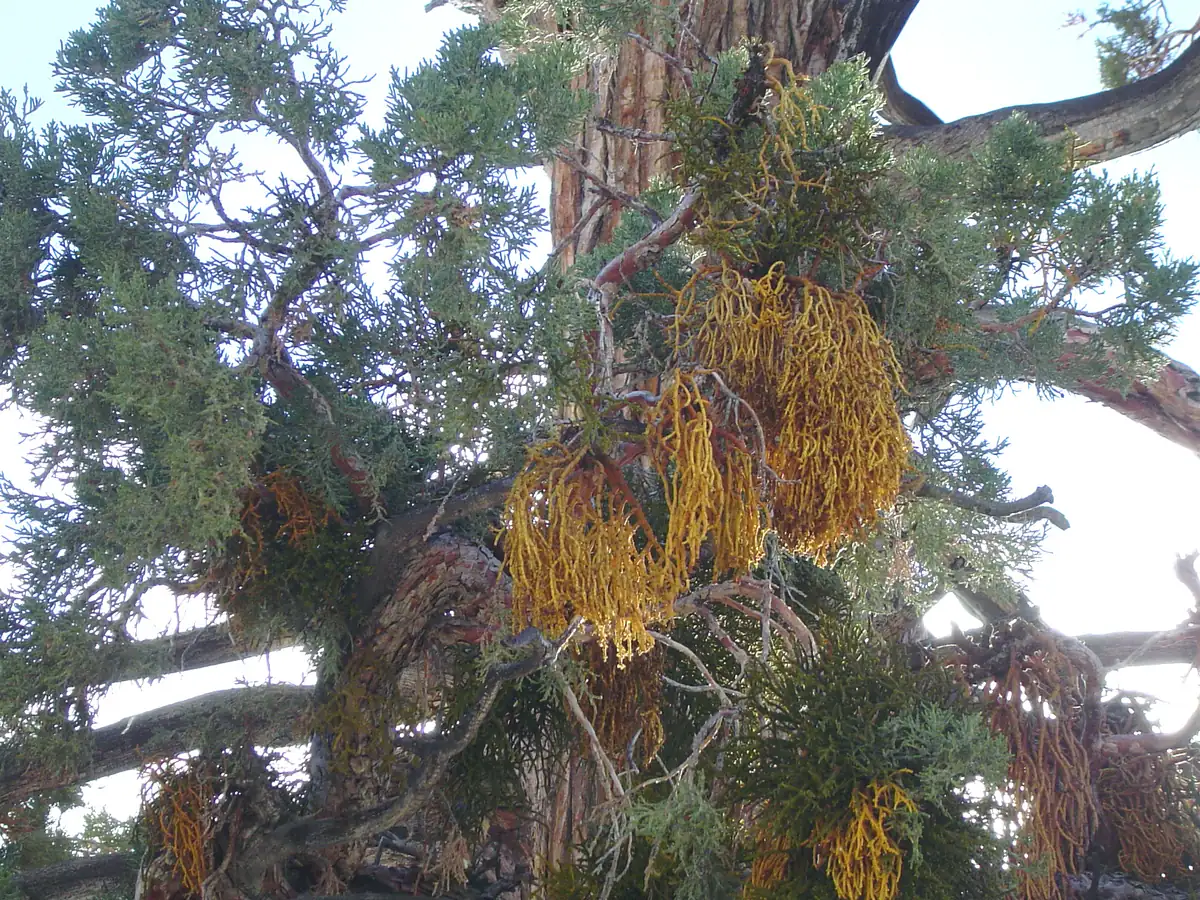
In a 2019 column, New Mexico State University’s extension horticulturist described two native mistletoes on the state’s woodland trees: juniper mistletoe on junipers, and piñon dwarf mistletoe, which is harder on its host. A broadleaf mistletoe on cottonwoods has been spreading farther north along the Rio Grande each year and stands out in a bare winter canopy. Birds eat the berries, and some forest scientists now treat mistletoes as a keystone of the woods rather than simply a pest.
-
Cutting your own Christmas tree
Carson National Forest permits on sale November 12 – December 31, 2026 · Designated areas on New Mexico’s national forests; permits on Recreation.gov
All five national forests in the state sell tree-cutting permits online and by phone. On the Carson, a tree up to 10 feet tall costs $5, 10 to 15 feet $10 and 15 to 20 feet $15, with a limit of three permits a year; the other forests set their own prices and dates. Any fourth grader holding the federal Every Kid Outdoors pass is entitled to one tree at no charge beyond the online processing fee.
For the spring end of the calendar, when the last freeze usually lets go where you live, see our New Mexico frost dates.
How do New Mexico’s animals get through the winter?
Some sleep, some move, and some simply keep eating whatever is left. In December you can see most of these strategies at once.
-
Black bears in their dens
Most denned by mid-November; out again from late March to May · Mountains statewide
The Department of Wildlife says most of the state’s bears are in their dens by November 15 and come out between about April 1 and May 1, with females emerging later than males. Cubs are born in the den over the winter. A warm spell can still rouse one briefly, so keep trash secured.
-
Abert’s squirrels eat the trees
All winter; inner bark is most of the diet from November to April · Ponderosa pine forest: the Jemez, the Sandias, the Sacramentos, the Gila
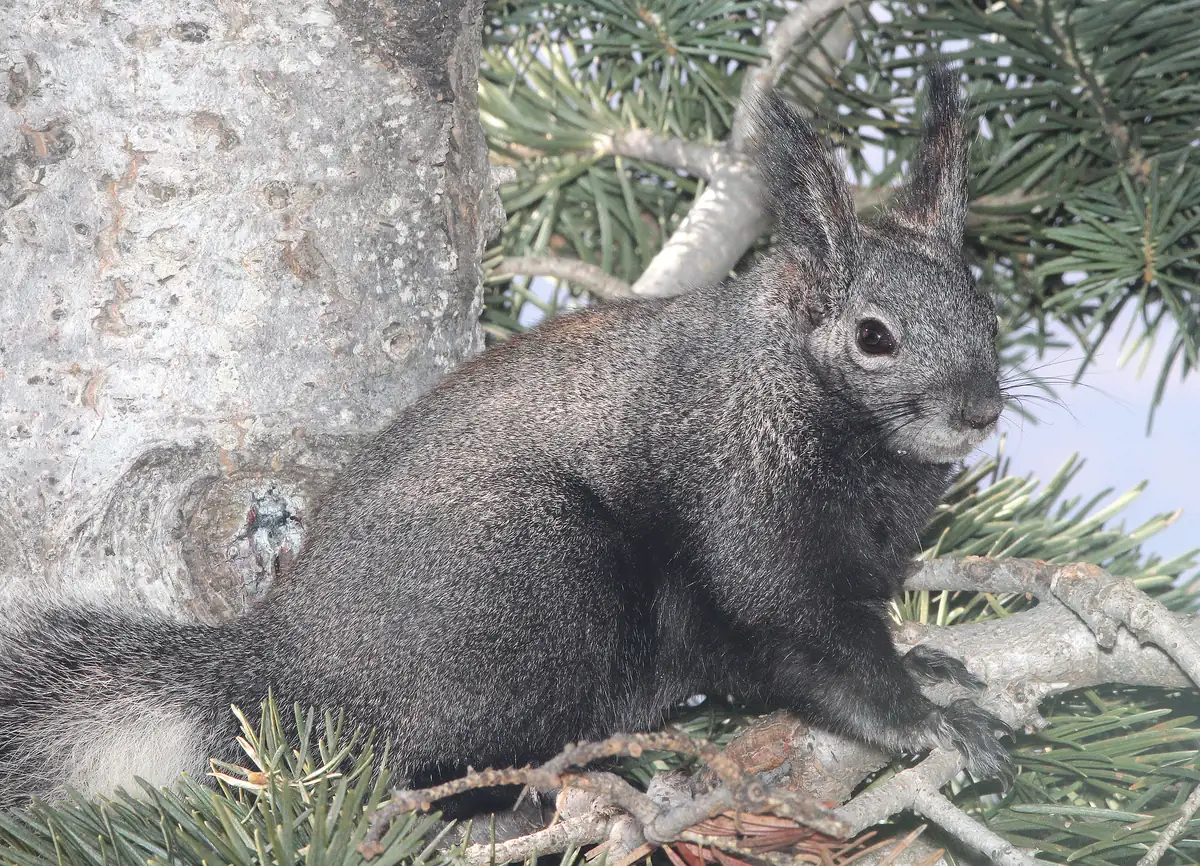
The tassel-eared squirrel of the ponderosa forest stays active all winter. Once the cones are gone it lives on the tender inner bark of pine twigs, clipping a twig, dropping the needle cluster and stripping the bark, and the Forest Service’s species review puts its winter appetite at about 45 twigs a day. Look under a ponderosa after a snow for a scatter of clipped, green-tipped twigs. In the cold months an adult female and a young one often share a nest.
-
Asleep for most of the year
Hibernating about eight or nine months · Streamside meadows of the Jemez, the Sangres and the Sacramentos
The endangered New Mexico meadow jumping mouse makes the bear look restless. The U.S. Fish and Wildlife Service says it hibernates eight or nine months a year, waking for only three or four summer months to breed, raise young and fatten up again, and it needs tall, dense streamside plants to survive.
-
Bats in the caves
Through the winter · Fort Stanton Cave, near Capitan, and other caves
While Carlsbad’s free-tailed bats have flown to Mexico, other species hibernate in New Mexico caves. The Bureau of Land Management closes Fort Stanton Cave in winter to protect them, and recreational caving there is on hold altogether because of white-nose syndrome, the fungal disease that has killed millions of bats in the East. A bat woken from hibernation burns fat it cannot replace, so leave closed caves alone.
-
Tracks in the snow at Valles Caldera
Ski and snowshoe season usually mid-December to mid-March · Valles Caldera National Preserve, Jemez Mountains
From November 15 the preserve limits winter driving to the Cabin District, and once the snow is deep enough rangers groom ski and snowshoe trails, though not on a guaranteed schedule. The open grasslands of the caldera, home to one of the state’s largest elk herds, are a fine place to read tracks of elk, coyote and mule deer. Some areas can close to protect wintering wildlife, so ask at the entrance.
How cold and snowy is December in New Mexico, and what might El Niño bring?
December is a cold, mostly dry month across New Mexico. Most of the stations below average only about half an inch of precipitation, much of it as snow, and in the mountains the snowpack that feeds next year’s rivers is only beginning to build. Year to year the swings are large: in December 2024, the Albuquerque office reported the state’s second-warmest and third-driest December on record, while a storm on December 3–4, 2025, dropped a foot of snow at Cedar Crest in a single day.
| Station | Average temperature | Precipitation |
|---|---|---|
| Gallup | 29.5 °F | 0.73 in |
| Raton | 30.2 °F | 0.36 in |
| Farmington | 31.3 °F | 0.57 in |
| Clayton | 35.3 °F | 0.42 in |
| Albuquerque Sunport | 36.9 °F | 0.53 in |
| Tucumcari | 38.6 °F | 0.52 in |
| Roswell | 42.4 °F | 0.56 in |
December snowfall normals in the office’s summaries are 2.8 inches at the Sunport, 3.8 inches at Roswell and 6.8 inches at Clayton, where a single plains storm can bring all of it at once.
The El Niño question. In its September 10, 2026 update, NOAA’s Climate Prediction Center said a very strong El Niño was more than 90 percent likely for the fall and winter, and gave 75 percent odds that the October–December index would beat every event on record back to 1950. For New Mexico, the Albuquerque office’s study of past events, 23 of them from 1911 to 2010 with nine strong, found that El Niño tips the odds toward a wetter winter and spring. At Fort Sumner, for instance, every strong El Niño winter brought more precipitation than average. The office is careful to add that other patterns in the atmosphere can override it, so a wet winter is favored, not promised. NOAA publishes its own winter outlook on October 15, alongside the other 90-day outlooks. For this week’s weather where you are, use our forecast page, and when a storm is on its way, our guide to clouds will help you read its approach.
What can New Mexico families do outdoors in December?
Every New Mexico resident gets free day use at state parks from October 1 through April 30, and the refuges and nature centers around Albuquerque have a busy December. These dates come from the organizers’ 2026 calendars; confirm before you set out, since winter weather can cancel outdoor events.
- December 2–5: Festival of the Cranes in Socorro and at Bosque del Apache (registration for most field trips).
- Friday, December 4: Nature Tots: Cranes, for the youngest children, at Valle de Oro National Wildlife Refuge from 10 until 11:30 a.m.
- Saturday, December 5: tin stamping, Southwestern-style metal art, at the Valle de Oro visitor center from 10 in the morning until 1.
- Friday, December 11: Nature Kids: Cranes, the same refuge’s program for school-age children, also 10 until 11:30 a.m.
- Saturday, December 12: a full day. Learn to birdwatch with Albuquerque Open Space staff at Los Poblanos Open Space, 7:30 to 9:30 a.m.; walk the bosque with a guide on the nature center’s monthly second-Saturday outing at 10:30; then go back to Valle de Oro for the Luminaria Walk and Star Party, 6 to 9 p.m., with a thousand luminarias on the trails and telescopes from the Albuquerque Astronomical Society, four days after new moon.
- Saturday, December 19: a solstice seed mandala at the Open Space Visitor Center, 9 a.m. to 2 p.m., with a Family Nature Club hike from 10 to noon; or a story hour for ages 5 to 10 in the nature center’s outdoor classroom, beginning at 10:30.
- Monday, December 21: solstice programs at Aztec Ruins and Chaco, if the parks schedule them as in past years.
- Tuesday, December 22: First Day of Winter tours at Valle de Oro, 45-minute ranger-led rides in an electric shuttle, starting whenever visitors arrive between 9:30 and 2.
- Every Saturday and Sunday: free bird walks at 8:30 a.m. from the Rio Grande Nature Center, no registration. The nature center is closed on Christmas and New Year’s Day, as is Valle de Oro’s visitor center.
- Friday, January 1, 2027: First Day Hikes. New Mexico State Parks joins this national New Year’s tradition each year. On January 1, 2026, guided walks ran at parks from Sugarite Canyon to Brantley Lake; look for the 2027 list in December.
Citizen science. Christmas Bird Counts need extra eyes, FeederWatch runs all winter, and eBird takes every checklist; the Department of Wildlife’s 2026 Birding Big Year accepts sightings through December 31. With younger children, draw five common birds on a tally sheet and let them mark each one seen from the window at breakfast.
Safety notes for December in New Mexico
- Hunting, and when to wear orange. December is quieter than November but far from closed. The Department of Wildlife’s 2026–27 rules list late elk hunts in many units on November 28–December 2, December 5–9, 12–16 and 19–23, with youth-only elk hunts on November 28–December 2 and December 26–30; a few deer hunts, most of them for white-tailed deer, mostly falling between December 5 and 16 with a handful later in the month; and archery deer seasons that reopen January 1–15 in many units. Quail stays open until February 15, pheasant runs December 10–13, and squirrel and dusky grouse close December 31. Duck and goose seasons stay open through the month. Blaze orange is the law in only two settings here: military land, where hunters need 144 square inches or more (and Fort Bliss, McGregor Range included, requires a vest), and firearm elk hunts on Valles Caldera National Preserve, which call for 244 square inches. Elsewhere the department only urges it, but anyone walking public land during a hunt is wise to wear a bright cap and coat and to dress the dog in orange as well.
- Winter storms on the highways. A single storm can shut stretches of I-25 and I-40 for hours. Check NMRoads before a mountain or plains drive, carry blankets, water and a shovel, and keep the tank at least half full.
- Thin and changing ice. Mountain lakes freeze unevenly and late. Eagle Nest Lake State Park opened for ice fishing on December 31 in 2019 but not until late January in 2026, and the park announces when the ice is safe. The department’s advice: never fish alone, wear a life jacket on the ice, keep holes under eight inches across, spread out, and stay away from inlets, springs, cracks and dark patches. Keep children and dogs off stock tanks and ponds altogether.
- Short days. With sunset around 5 p.m. or earlier in most towns, a hike begun after lunch can finish by flashlight. Pack a headlamp and tell someone where you are going.
- Closures. Sandia Crest and its trails are closed through fall 2027 for the renovation project, and road gates across the state close for snow.
Last month’s cranes, eagles and first snows are on our New Mexico November page, and the rest of the country is collected on the nature hub. Whatever winter brings you this month, from a rosy-finch to a line of tracks in fresh snow, there is room for it in the Naturalist’s Field Journal.
Sources
- Friends of Bosque del Apache: Festival of the Cranes, December 2–5, 2026
- Friends of Bosque del Apache: sandhill crane questions answered by the refuge manager
- USFWS Bosque del Apache NWR: wildlife watching (peak season mid-November to late January)
- USFWS Bosque del Apache NWR: visit us (hours)
- USFWS Bitter Lake NWR: cranes October through December; auto tour hours
- City of Albuquerque: sandhill cranes at the Open Space Visitor Center
- City of Albuquerque Open Space: events, December 2026
- USFWS Valle de Oro NWR: events, December 2026
- Friends of the Rio Grande Nature Center: Bosque Tracks, October–December 2026 (walks, stories, poetry, holiday closures)
- Bird Alliance of Central New Mexico: the rosy-finch story at Sandia Crest
- Cibola National Forest: Sandia Crest area projects update and closure order (July 30, 2026; updated September 30, 2026)
- Cibola National Forest: Sandia Crest Highway (winter road advice)
- The New Mexico Travel Guy: birding Sandia Crest for rosy-finches (arrival and departure, feeder)
- National Audubon Society: join the Christmas Bird Count (December 14 – January 5)
- National Audubon Society: the 115th Christmas Bird Count in New Mexico
- Pajarito Environmental Education Center: Los Alamos Christmas Bird Count
- National Park Service, Aztec Ruins: archeoastronomy (solstice alignments of Aztec West)
- Farmington Convention and Visitors Bureau: Winter Solstice Observation at Aztec Ruins, December 22, 2025
- National Park Service, Chaco Culture: night sky program and winter solstice at Kin Kletso
- U.S. Naval Observatory: Earth’s seasons, 2026 (solstice time)
- U.S. Naval Observatory: moon phases, November 2026 onward
- International Meteor Organization: 2026 meteor shower calendar (archived copy)
- International Meteor Organization: 2027 meteor shower calendar (Quadrantids)
- EarthSky: what is a supermoon (2026 full supermoons)
- EarthSky: Venus at greatest western elongation, January 3, 2027
- RASC Observer’s Handbook 2026: lunar occultations (Pleiades passes)
- New Mexico Envirothon: tree identification study guide (conifers of New Mexico)
- NMSU Extension, Desert Blooms: mistletoe ranges are changing
- USDA Forest Service Southwestern Region: Christmas tree permits
- Carson National Forest: permits (2026 Christmas tree permits, November 12 – December 31)
- New Mexico Department of Wildlife: building a bear den (denning and emergence dates)
- Forest Service Fire Effects Information System: Abert’s squirrel (winter diet)
- U.S. Fish and Wildlife Service: what is a New Mexico meadow jumping mouse?
- Bureau of Land Management: Fort Stanton–Snowy River Cave NCA recreation (winter closure for hibernating bats)
- National Park Service, Valles Caldera: winter activities
- NWS Albuquerque: December 2025 climate highlights (normals, December 3–4 storm)
- NWS Albuquerque: December 2024 climate and weather summary (snowfall normals, warm and dry December)
- NWS Albuquerque: El Niño and New Mexico winter and spring precipitation
- Climate Prediction Center: ENSO diagnostic discussion, September 10, 2026
- Climate Prediction Center: seasonal outlooks (winter outlook issued October 15, 2026)
- New Mexico Department of Wildlife: 2026–2027 hunting rules and information (big game, upland seasons, blaze orange)
- New Mexico Department of Wildlife: 2026–2027 migratory game bird rules (crane, duck and goose seasons)
- New Mexico Department of Wildlife: Eagle Nest Lake State Park open to ice fishing (December 31, 2019; ice safety)
- KRTN: ice fishing season opens at Eagle Nest Lake State Park (January 27, 2026)
- New Mexico Department of Wildlife: 2026 Birding Big Year contest
- New Mexico State Parks: fees and permits (resident day-use exemption October 1 – April 30)
- Albuquerque Journal: New Mexico State Parks First Day Hikes, January 1, 2026
- America’s State Parks: First Day Hikes
- Project FeederWatch: project overview
- New Mexico Department of Transportation: NMRoads road conditions
- Photos via Wikimedia Commons; licenses and photographers are credited under each picture
