What to look for in nature in New Mexico this January
January is the deep middle of meteorological winter, the three-month block of December, January and February that weather scientists treat as the cold season. In New Mexico it is the month of counting. Volunteers line the shores of Corps of Engineers lakes to tally bald eagles, a helicopter crew flies the Gila country to count Mexican wolves, and the cranes along the Rio Grande are surveyed while they are still here in force. Great horned owls are already hooting over the nests they mean to use, and on the first weekend of the year Earth swings closest to the sun while the Quadrantids streak across a dark sky.
Other months in New Mexico: October, November, December, February.
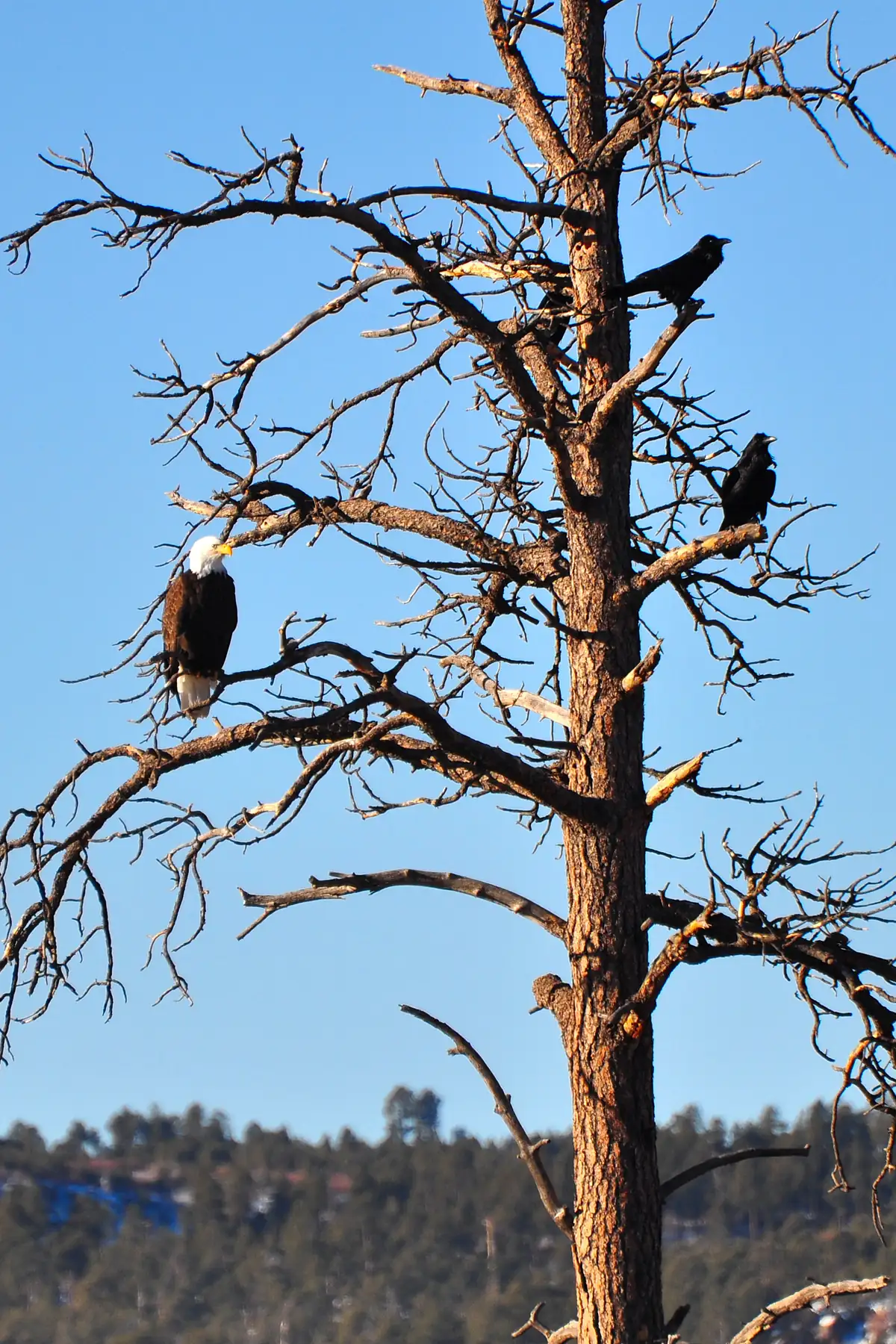
Start here

- Count eagles at a Corps lake. Each January the Albuquerque District of the Army Corps of Engineers runs midwinter eagle surveys at Abiquiu, Cochiti, Conchas and Santa Rosa lakes, and Abiquiu welcomes volunteers. In 2026 the count there was held on Saturday, January 10. Ask the lake office for the 2027 date in December.
- Stay up for the Wolf Moon. January’s full moon is the closest of 2027, a supermoon, and it reaches full at 5:17 a.m. MST on Friday the 22nd. Watch it rise in the dusk of Thursday the 21st and ride high all night.
- Listen for owls at dusk. Step outside on a still evening and listen for a deep, stuttering five-note hoot, often answered by a second, higher voice. A great horned owl pair duetting in January is staking out the nest where eggs may be laid within weeks.
For the Naturalist’s Field Journal: an adult bald eagle on a lakeside snag belongs on “birds I have seen,” noting the lake, and the owls you hear at nightfall make a fine start to “a map of sounds.” A trail of webbed prints ending in a belly slide on a snowy riverbank is worth sketching on “tracks to know,” and a bighorn ram on the gorge rim, or a coyote crossing a frosted field, fits the mammal watch page. On the morning of the Wolf Moon’s setting, the dusk and dawn watch plate is waiting.
Regions used below: Northern mountains, Taos and the Enchanted Circle; Four Corners and the northwest; Santa Fe and the Jemez; Albuquerque and the middle Rio Grande; Eastern plains; Southeast and the Pecos valley; Southwest, the Gila and Las Cruces.
Where can you see bald eagles in New Mexico in January?
Winter is when New Mexico has the most bald eagles. A raptor identification guide written by Hawks Aloft for the New Mexico Avian Protection Working Group says numbers peak in the cold months, that only a few pairs nest here, and that the birds roost in big, often dead trees near lakes and rivers. By January the wintering birds have settled in, which is why the national count happens now.
-
The midwinter eagle survey at Corps of Engineers lakes
Early to mid-January; dates set by each lake · Abiquiu, Cochiti, Conchas and Santa Rosa lakes
The Midwinter Bald Eagle Survey has run across the country since 1984. Its aim is to index the wintering population of the lower 48 states and find the places they depend on. The Albuquerque District has counted at Abiquiu since the 1980s, and in 2026 its staff and volunteers covered four New Mexico lakes plus two in Colorado. At Abiquiu, nearly 70 volunteers found 11 adult bald eagles and an adult golden eagle on January 10, 2026; at Cochiti, a dozen volunteers working from the bluffs, the dam crest road and a boat counted seven. The lake offices set their own dates each year, so call ahead or watch the district’s news page from December.
-
The Rio Chama below Abiquiu and El Vado
December through February · The Rio Chama between Abiquiu and El Vado reservoirs, Rio Arriba County
The same raptor guide names this reach of the Chama as the state’s best-known winter gathering place, with surveys over an eight-year period finding 40 to 80 adult eagles along it. Open water below the dams draws fish-eating birds. Scan the tall cottonwoods and ponderosas from pullouts, stay in your car when an eagle is close, and remember that a bird flushed from its perch on a cold morning burns energy it needs.
-
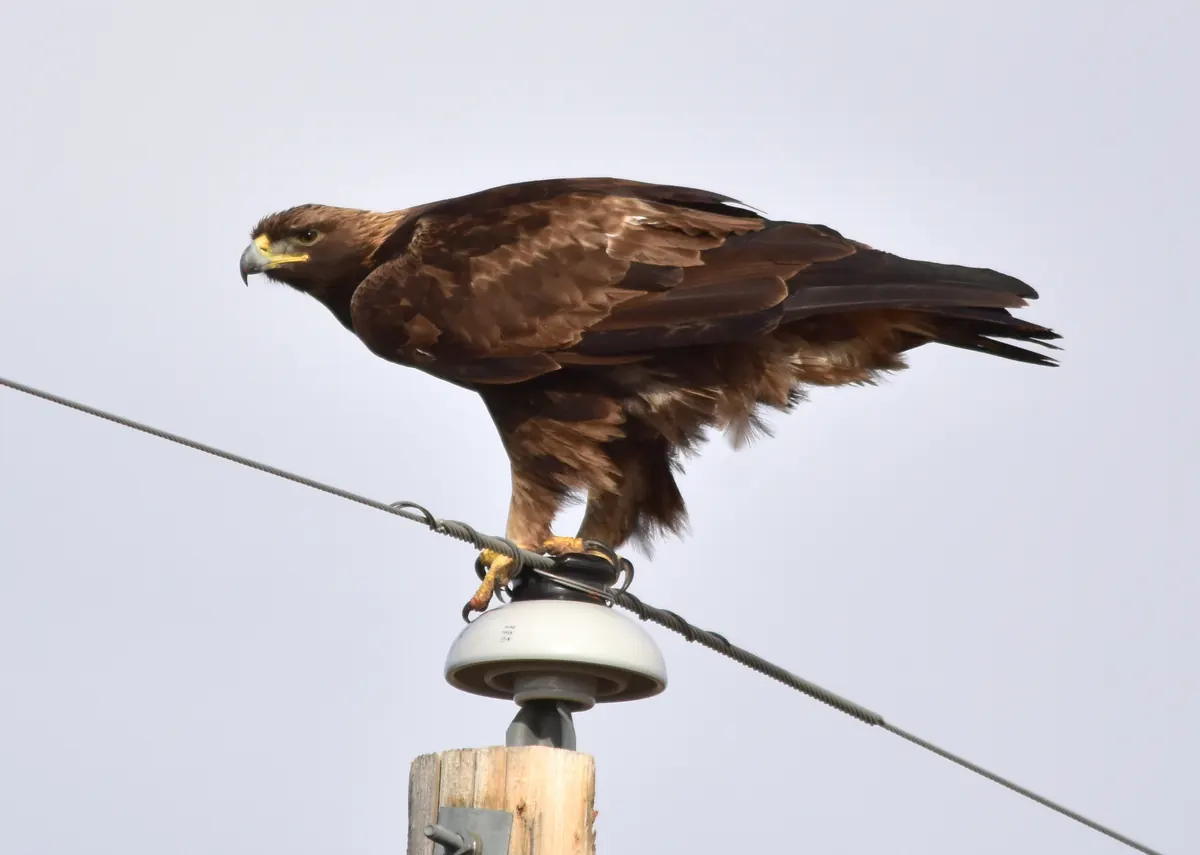
Golden eagles on the open range
All winter · Highways across the plains and high valleys
In winter golden eagles spread across the state, and the guide notes they use power poles along highways near open range. A golden eagle has a tawny-gold nape and legs feathered to the toes; a young bald eagle is blotched with white below.
| Lake | 2025 survey | Eagles in 2025 | 2026 survey | Eagles in 2026 |
|---|---|---|---|---|
| Abiquiu Lake | January 11 | 17 (13 adult and 2 immature bald, 1 adult and 1 immature golden) | January 10 | 12 (11 adult bald, 1 adult golden) |
| Cochiti Lake | January 11 | 14 | January 10 | 7 |
| Santa Rosa Lake | January 15 | 4 bald (1 adult, 3 immature) | January 14 | 3 adult bald |
| Conchas Lake | Not in the 2025 report | Not reported | January 16 | 2 (1 bald, 1 golden) |
Counts swing from year to year with the weather and the amount of open water; Abiquiu’s ranger called the 2025 tally the best since 2015. Maxwell National Wildlife Refuge, north of Springer, reports that its own wintering eagles peak in February, so a late-winter visit there can be the payoff for a January count.
Are the sandhill cranes still along the Rio Grande in January?
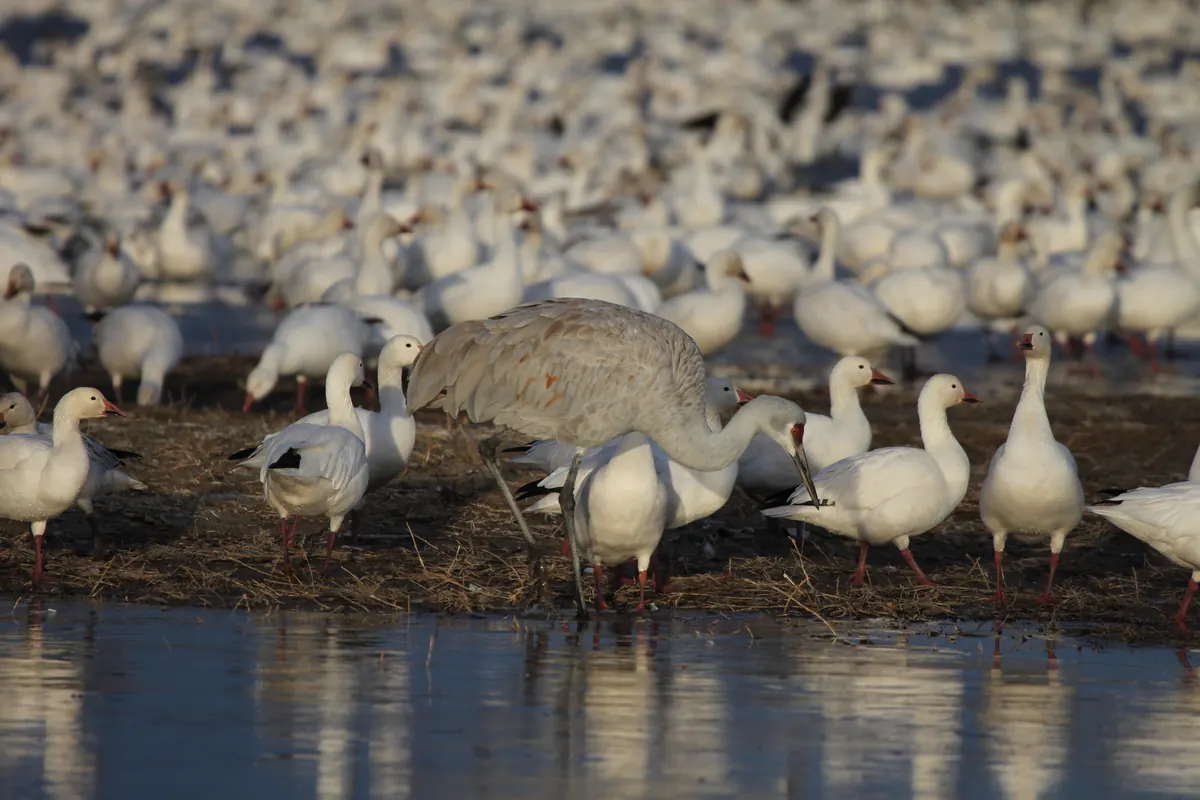
Yes, and in good numbers. The refuge manager at Bosque del Apache National Wildlife Refuge has advised visitors who want the most cranes to come in December or January, and the refuge itself gives early November to late January as the window for the biggest flocks. What changes during the month is the feeling of an ending: by the last week the first restless flocks start to drift north, and by early February the refuge’s crane season is winding down.
-
Counting cranes in midwinter
Early January · Middle Rio Grande Valley, Albuquerque to below Socorro
Each January the national Mid-winter Waterfowl Survey also tallies cranes. In one recent winter it found 13,257 sandhill cranes in the Middle Rio Grande Valley, and the refuge alone held upwards of 6,500 overwintering cranes during 2022–23. Late-January counts have found more than 4,000 on the refuge, so the birds do not all leave at once.
-
What the cranes are eating
Daylight hours · Refuge fields and moist-soil wetlands
Cranes eat seeds, roots, snakes and even mice, and they spend the day in grain fields and in shallow wetland units that the refuge manages for native plants. The manager singles out chufa, a sedge with small edible tubers, as a favorite. The refuge suggests a stop at the visitor center to learn which ponds and fields the flocks are using, because roost and feeding sites shift through the winter.
-
Snow geese and the conservation order
Regular light goose season to January 31; conservation order February 1 – March 10, 2027 · Rio Grande valley and eastern plains
Snow and Ross’s geese share the roost ponds with the cranes and lift off together at dawn in a white storm of wings. Their regular hunting season ends on January 31, and from February 1 the Light Goose Conservation Order opens, with no bag limit for hunters who hold its free permit.
Crane hunting also continues into January by permit: the Middle Rio Grande Valley draw hunts fall on January 2–3 and 9–10, the southwestern hunt on January 2–3, and the free-permit Eastern hunt closes on January 21. Most of it happens on private farmland, away from the refuge tour loops. A longer look at the fly-out and fly-in routine is on our December page for New Mexico.
When and how are Mexican wolves counted in New Mexico?
The Mexican gray wolf, a small and rare subspecies of the gray wolf, lives wild again in the mountains of southwestern New Mexico and east-central Arizona. Every winter an interagency field team of biologists tallies the population, and January is the heart of the count.
-
Ground counts, then the helicopter
Ground counts November through January; helicopter work at the end of January · The Gila and Apache national forests and surrounding country
The field team’s 2025 work plan describes the routine. Crews spend November through January counting on the ground, and from December they set out food caches watched by remote cameras to find wolves that wear no collar. At the end of January a helicopter crew flies for about ten days, counting packs in remote wilderness that ground teams could not reach and capturing some wolves to fit or replace radio collars. The plan says ground counts have often been more reliable than aerial ones for learning the true size of a pack, so the team now leans on them first.
-
What the last count found
Announced February 25, 2026 · New Mexico and Arizona together
The count made last winter found at least 319 wild Mexican wolves at the end of 2025, up from 286 a year before, according to the New Mexico Department of Wildlife. That figure is a minimum, since biologists count only animals they can document. The recovery goal for moving the wolf from endangered to threatened is an average of 320 a year over four years, so the population now sits at the edge of that line. Results of the count being made in January 2027 should come out in late February or early March.
A low helicopter circling one Gila drainage in late January may well be the count crew.
When do great horned owls start nesting in New Mexico?
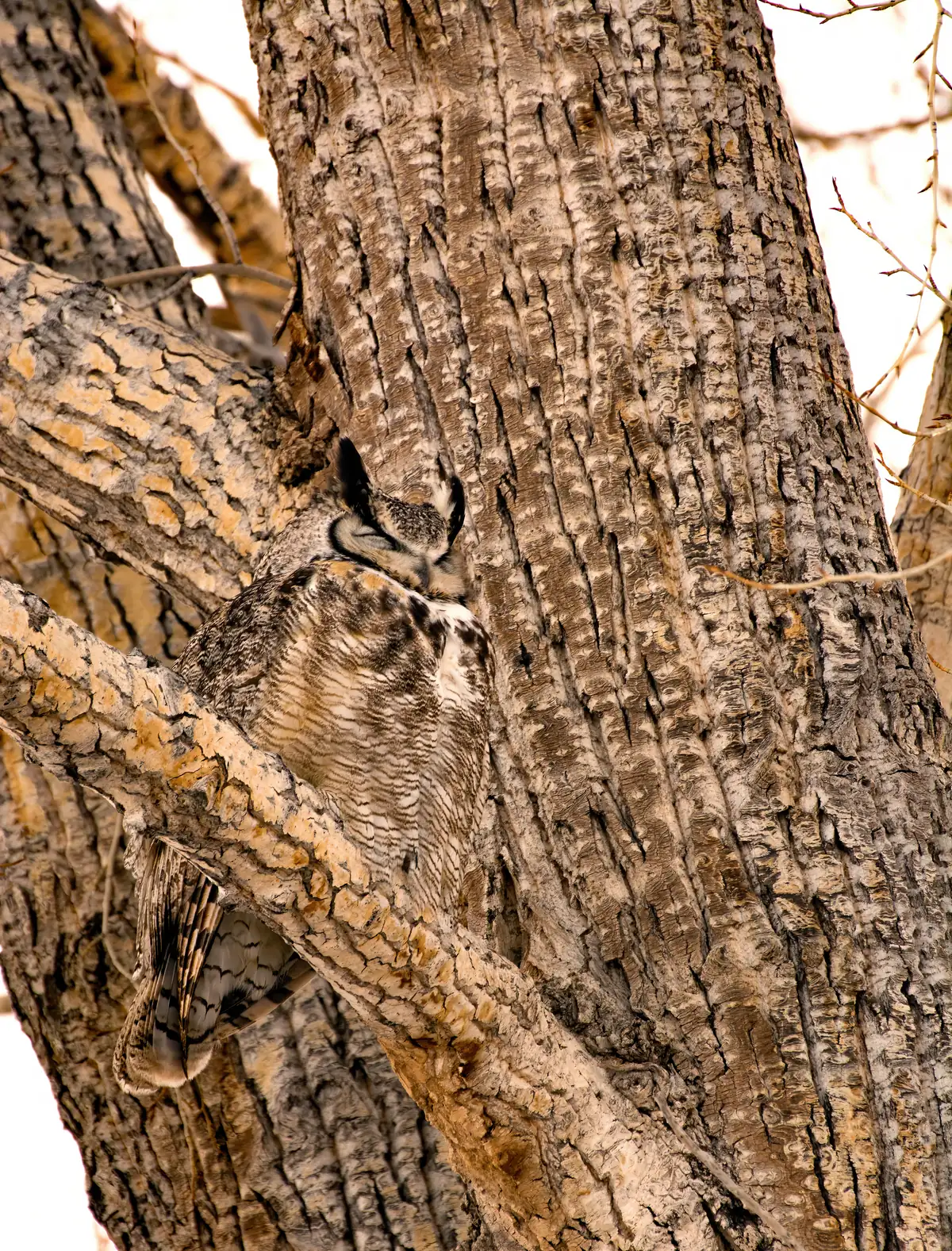
Long before any songbird thinks of nesting, great horned owls are at it. They live year-round across the whole state, from cottonwood bosques to piñon hills and city parks, and the National Park Service describes January and February as the months these big owls establish territories and court, with young produced in March. The Hawks Aloft raptor guide for New Mexico says the first clutch is usually laid in late January or February.
-
Duets in the dark
Dusk and the hours before dawn, all month · Bosques, canyons, farm windbreaks and older neighborhoods with big trees
Listen on a calm evening for a deep, rhythmic hooting, then a reply. The female is larger than the male but her voice is higher, so a pair calling back and forth sounds like two notes of a conversation.
-
Borrowed nests
Late January into February · Old hawk and raven nests, cliff ledges, broken treetops
These owls never build. They move into a raven’s or red-tail’s leftover platform of sticks, a cliff shelf, or a cavity where a big trunk has broken off. If you find an occupied nest, watch from a distance; the female will sit for weeks and should not be pushed off her eggs.
-
The owl on the power pole
Daytime roosting · Utility poles in open country
Out where trees are scarce, Hawks Aloft’s guide notes that great horned owls often roost on power poles, pressing in close to the center pole near the transformer so they look like part of the hardware. That bump on a pole along a ranch road may have ear tufts.
What are the hawks on the power poles in winter?
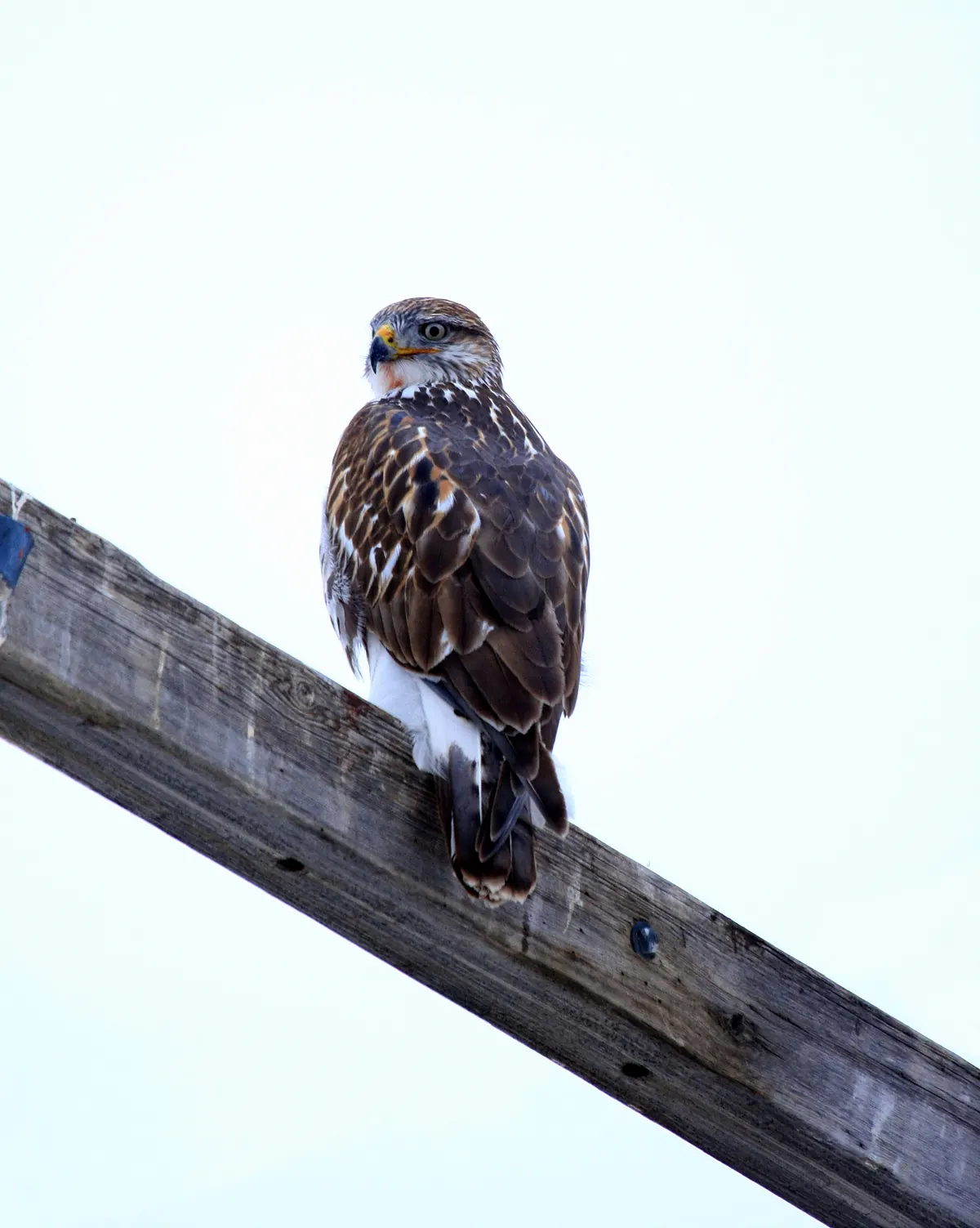
Drive any rural highway in New Mexico in January and you will pass hawks hunched on poles and fence posts. Winter brings raptors from the north to join the residents, and the open farmland and grassland make them easy to see. Hawks Aloft, the Albuquerque raptor conservation group, has driven raptor survey routes along the levees and back roads of the Rio Grande and Estancia valleys since 1995.
-
Red-tailed hawks
All year; more in winter · Statewide
The everyday roadside hawk, with a dark belly band and, in adults, a brick-red tail. On a February 2026 survey of a 20-mile route along the Rio Grande near Socorro, Hawks Aloft counted 20 red-tails among 43 raptors.
-
Ferruginous hawks
Winter visitors to grasslands statewide · Prairie dog towns, plains and big valleys
North America’s largest hawk is named for the rusty patches on its shoulders. Their plumage runs from nearly white below to almost black. They hunt from power poles, often near prairie dog colonies. On that same 2026 Socorro survey the team found nine, and the group’s director said they had never seen so many on a single day.
-
Prairie falcons and northern harriers
Winter · Grasslands, roadsides, wetlands and the Rio Grande corridor
Prairie falcons nest on high cliffs in summer but move lower in winter, when the raptor guide calls them a fairly common sight on poles and rock outcrops along roads. Look for a pale brown falcon with dark patches in the wingpits when it flies. Northern harriers, slim hawks with a white rump patch, are common in winter over wetlands and along the Rio Grande, tilting low over the grass with wings held in a shallow V.
Mountain birds may also wander more than usual this winter. The Finch Research Network’s 2026–27 forecast reports widespread failure of piñon and ponderosa cone crops in the interior West, and with seed scarce in the high country, seed-eaters can turn up in the valleys and at feeders.
What lives in the Rio Grande Gorge in winter?
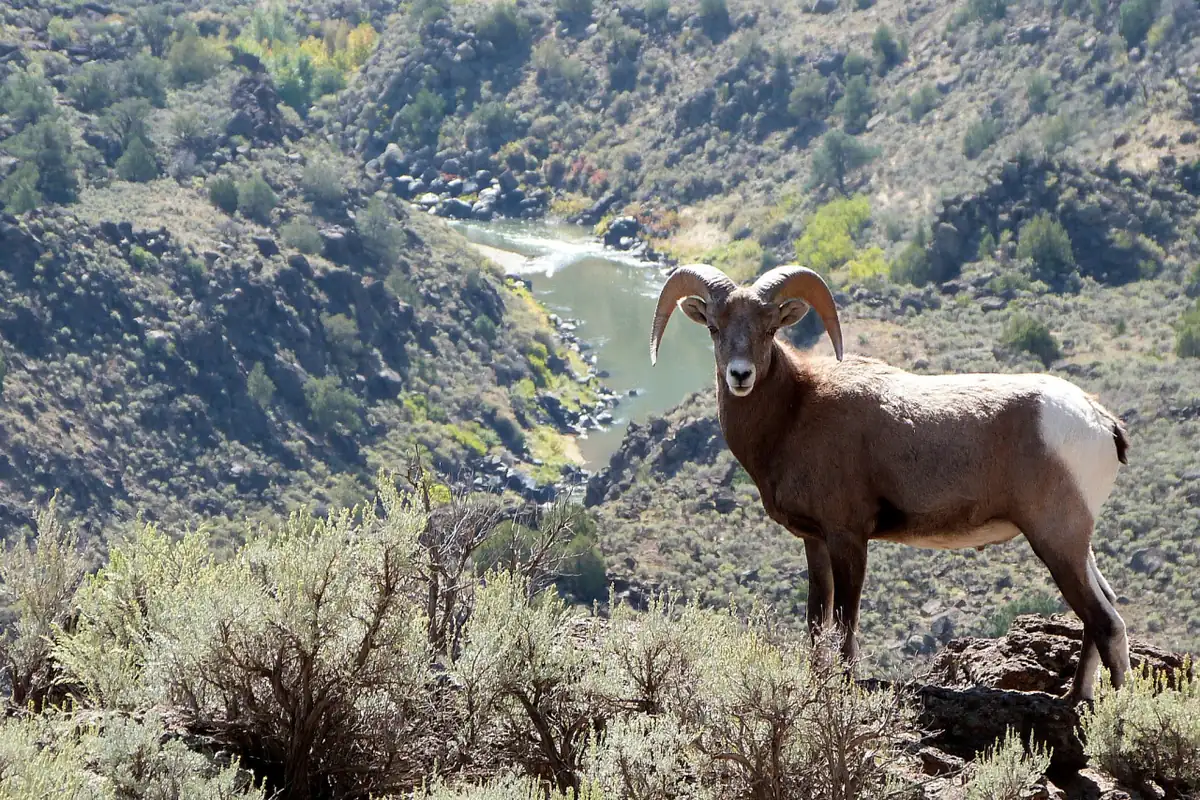
North of Taos the Rio Grande runs in a basalt canyon up to 800 feet deep, protected as the Rio Grande del Norte National Monument and the Rio Grande Wild and Scenic River. The Bureau of Land Management calls the monument an important area for wintering animals and a corridor for wildlife moving between the mountain ranges on either side. In January, bare cottonwoods and snow on the talus make it easier to spot what moves there.
-
River otters
All year; tracks and slides show best on snow · The Rio Grande and Rio Pueblo de Taos, and now farther downstream
River otters once lived on the Gila, the Rio Grande, the Mora, the San Juan and the Canadian, but none were confirmed in New Mexico after 1953. In October 2008, Taos Pueblo, the Department of Game and Fish (now the Department of Wildlife), the BLM and a coalition of conservation groups released the first five otters, brought from Washington state, on the Rio Pueblo de Taos. Amigos Bravos, one of the partners, puts the founding group at 33 and has run trail cameras since 2016; its sightings map shows otters spreading down the upper Rio Grande and into the middle valley. In snow, an otter trail is unmistakable: bounding paired prints broken by long belly slides.
-
Bighorn sheep on the rims
Winter mornings · Rio Grande del Norte National Monument and Orilla Verde Recreation Area
The BLM lists bighorn sheep among the wildlife of Orilla Verde, along with eagles and hawks, beaver, ringtail, bobcat and mule deer. Scan the steep, sunny slopes, where snow melts first, for tan shapes with white rumps.
Seen an otter? Amigos Bravos collects sightings from the public to help track how far the animals have spread.
When is the ice thick enough for ice fishing in New Mexico?
Only a handful of New Mexico lakes freeze hard enough to walk on, all of them in the high country, and the date they open varies from year to year. Eagle Nest Lake State Park, at 8,200 feet in the Moreno Valley, says ice fishing is usually possible from January into March, depending on conditions.
-
Nine inches before anyone walks out
Opening set each winter by the park · Eagle Nest Lake State Park and other high lakes
When Eagle Nest opened for ice fishing on January 16, 2009, the state said ice would be considered safe once it was at least nine inches thick, and only the areas around the boat ramps were opened at first. Park staff measure from the shore outward and watch for cracks, water on top of the ice, and open water. In 2011 the lake opened on January 29, once the ice was about a foot thick, and in 2013 it opened in the first days of January. In each case only foot traffic was allowed; no snowmobiles, all-terrain vehicles or cars.
Ice on a stock tank or valley pond seldom bears even a child’s weight, and a dog chasing ducks can break through. Pressure ridges, inlets and springs stay weak even on a frozen lake.
How cold is January in New Mexico, and will El Niño make it snowy?
January is usually the coldest month in New Mexico and one of the driest. Valley and plains stations in the table below average a third to four-tenths of an inch of precipitation, and in the mountains this is the stretch of winter when the snowpack that feeds spring rivers either builds or stalls. The averages hide wild swings, as the last two Januaries showed.
-
January 2025: bitter and dry
January 2025 · Statewide
The Albuquerque office called it bitterly cold and dry. The statewide average of 30.8 °F was 2.8 degrees under the long-term normal. Around January 20–21, wind chills fell to −41 °F on the east slopes of the Sangre de Cristos, and by month’s end the mountain snowpack was far below normal for midwinter.
-
January 2026: wet in the south
January 2026 · South-central and southeastern New Mexico
A year later the Sunport caught 0.98 inch, almost three times its normal, and a storm from January 23 to 25 brought what the office called the most significant snowfall in years to parts of the south-central and southeastern plains and mountains, with freezing rain that downed trees around Ruidoso and up to 31 inches of snow in the Sacramento Mountains. A volunteer observer near Alto measured 42 inches for the month. Behind the storm, wind chills dropped below −10 °F on the eastern plains, and Clayton stayed below freezing for 89 hours straight.
| Station | Average temperature | Precipitation |
|---|---|---|
| Gallup | 29.8 °F | 0.81 in |
| Farmington | 31.1 °F | 0.72 in |
| Clayton | 35.5 °F | 0.33 in |
| Albuquerque Sunport | 37.4 °F | 0.36 in |
| Tucumcari | 38.6 °F | 0.40 in |
| Roswell | 42.7 °F | 0.36 in |
Snowfall normals for January, from the same office’s summaries, are 1.4 inches at the Albuquerque Sunport, 2.4 inches at Roswell and 3.7 inches at Clayton.
What a very strong El Niño may mean. The CPC’s diagnostic discussion dated September 10, 2026, put above 90 percent the chance that this El Niño would reach the very strong category during late fall and winter. NOAA climate scientist Nat Johnson, writing on climate.gov, found that the seven strongest El Niño winters since 1950 together leaned wet across the southern tier of the country, which takes in New Mexico. He also points out that two of those strong winters, 1957–58 and 2015–16, came out much less wet than expected over the southern United States, and even dry in places, because ordinary weather chaos can swamp the El Niño signal in any single season. So a wetter January and late winter are favored, not assured. NOAA’s seasonal maps for winter appeared in mid-October and are reissued monthly; look for the newest set among the CPC 90-day outlooks. For this week, see our weather page; when high clouds thicken from the west, our cloud guide helps judge whether a storm is coming.
How much daylight does New Mexico gain in January?
The days have been lengthening since the December solstice, slowly at first and then faster. Over the month each town in the table adds between 33 and 40 minutes of daylight, and the daily gain grows through the month, so the end of January feels noticeably brighter than the start. Nearly all of it is added after noon, since mornings stay dark late for the first couple of weeks while evenings stretch steadily. Southern towns start the month with more daylight than the northern ones, but the northern towns gain it back a little faster.
| City | Jan 1 | Jan 31 | Gained | Per day |
|---|---|---|---|---|
| Raton | 9 h 41 m | 10 h 21 m | 40 min | 1.3 min |
| Farmington | 9 h 43 m | 10 h 21 m | 38 min | 1.3 min |
| Santa Fe | 9 h 47 m | 10 h 25 m | 38 min | 1.3 min |
| Albuquerque | 9 h 51 m | 10 h 28 m | 37 min | 1.2 min |
| Tucumcari | 9 h 51 m | 10 h 27 m | 36 min | 1.2 min |
| Roswell | 9 h 59 m | 10 h 34 m | 35 min | 1.2 min |
| Silver City | 10 h 02 m | 10 h 36 m | 34 min | 1.1 min |
| Las Cruces | 10 h 05 m | 10 h 38 m | 33 min | 1.1 min |
To find sunrise, sunset and twilight for your own town on any date, try our daylight calculator.
What can you see in New Mexico’s night sky in January?
The first weekend of 2027 is crowded with sky events. Times below are MST; clocks in New Mexico do not spring forward until March 14.
-
Earth closest to the sun
Saturday, January 2, 7:33 p.m. MST · Everywhere
The distance at perihelion, about 91.4 million miles, is the smallest of 2027. The season comes from the tilt of our hemisphere, not the distance.
-
The Quadrantids
Night of Sunday, January 3, into Monday, January 4 · A dark site; the radiant sits low in the north in the evening and climbs before dawn
This is a short, sharp shower, with a peak lasting only a few hours. Forecasts for the peak range from about 8:30 p.m. to about 10:45 p.m. MST on the 3rd, and the radiant, low in the north in the evening, climbs higher toward dawn, so the best hours to watch are likely the dark ones before sunrise on the 4th. Only a thin crescent moon comes up, a few hours before the sun, so it barely interferes. Far from town lights, a lucky watcher could log several dozen in the best hour.
-
Venus at its greatest distance from the sun
Sunday, January 3, and mornings all month · Southeast before dawn
Venus, the dazzling light low in the southeast before sunup, swings 47 degrees clear of the sun on January 3. A small telescope shows it half lit.
-
The Wolf Moon, the closest full moon of 2027
Full at 5:17 a.m. MST, Friday, January 22 · Rising in the east-northeast at dusk on Thursday the 21st
The moon passed perigee, its closest point in its orbit, about fourteen and a half hours before it turned full, so this full moon is the nearest of the year at roughly 222,000 miles and counts as a supermoon in every listing. Plan on Thursday night, the 21st: the moon comes up near sunset and is still in the west at first light, and it turns exactly full in the small hours before dawn.
-
The moon beside Jupiter
Saturday evening, January 23 · East after dark
A day past full, the moon appears very close to brilliant Jupiter, with the star Regulus nearby. Jupiter is approaching its February 10 opposition and is already above the horizon for most of the night.
-
Mercury and Saturn at dusk
Late January into early February · West-southwest and southwest after sunset
Mercury reaches its greatest distance east of the sun late on February 2, MST, giving the best evening view of this little planet all winter. From the last days of January, search close to the west-southwest horizon in the first hour after sunset. Saturn, in the southwest at nightfall, is slipping toward the sun’s glare.
| Phase | Date | Time |
|---|---|---|
| Last quarter | Wednesday, Dec 30, 2026 | 11:59 a.m. |
| New moon | Thursday, Jan 7 | 1:24 p.m. |
| First quarter | Friday, Jan 15 | 1:34 p.m. |
| Full moon, the Wolf Moon | Friday, Jan 22 | 5:17 a.m. (a supermoon; best seen the night of Jan 21) |
| Last quarter | Friday, Jan 29 | 3:55 a.m. |
| New moon | Saturday, Feb 6 | 8:56 a.m. |
With the moon new on the 7th, the first dozen nights of January are the moonless ones for faint galaxies and the winter Milky Way. Solar activity has passed its cycle maximum, though a big geomagnetic storm might yet redden the northern horizon; for a short-term aurora outlook, see NOAA’s Space Weather Prediction Center. Plan your dark nights with our moon phase calendar.
What can New Mexico families do outdoors in January?
State parks charge New Mexico residents nothing for day use all winter, so January outings cost little. Most 2027 calendars are not posted yet, so confirm with each organizer.
- New Year’s Day, Friday, January 1: First Day Hikes. Parks across the state lead guided New Year’s walks. On January 1, 2026, ten parks held guided walks, from a Lake Maloya loop at Sugarite Canyon to a “Polar Stomp” at Eagle Nest Lake. Look for the 2027 list in late December.
- January 1 to 5: Christmas Bird Count days remain. Audubon’s count season ends on January 5, and a circle may still hold its count on one of those early January days.
- A Saturday in early or mid-January: the Abiquiu eagle watch. Abiquiu Lake has held its volunteer eagle count every January for decades, on January 11 in 2025 and January 10 in 2026. Ask the lake office for the 2027 date.
- Every Saturday and Sunday at 8:30 a.m.: bird walks at Rio Grande Nature Center State Park in Albuquerque, year round, with no sign-up.
- The second Saturday of each month at 10:30 a.m.: a family nature walk in the bosque with a volunteer naturalist from the same nature center, limited to twelve people.
- Next month: the Great Backyard Bird Count, a four-day count set for February 12 to 15, 2027, according to Birds Canada, one of its organizers.
Citizen science. Project FeederWatch runs through April 30, and a single two-day count from a kitchen window still adds to the data. Every walk can become an eBird checklist. River otter sightings in the Rio Grande watershed go to Amigos Bravos. Families can adopt one big tree and listen there at dusk each week for owls.
Safety notes for January in New Mexico
- Who is hunting, and the orange rule. Under the Department of Wildlife’s 2026–27 rules, archery deer hunts run January 1–15 in many units, with some white-tailed deer bow hunts January 16–31; a few resident elk hunts fall on January 23–27 in Units 34 and 36; bow hunting for javelina is open January 1–31; and oryx hunts run on parts of White Sands Missile Range. Quail season lasts until February 15. Duck seasons close January 13 in the Central Flyway’s north zone and January 31 elsewhere, regular goose seasons end January 31, and crane hunts continue as described above. The state requires blaze orange only on military reservations, where hunters must show at least 144 square inches (a full vest at Fort Bliss and McGregor Range), and for anyone on a firearm elk hunt at Valles Caldera, who needs 244 square inches or more. The department strongly recommends orange for every hunter, and hikers on public land during a hunt should dress brightly too.
- Traps. Furbearer seasons for bobcat, fox, badger and others run November 1 to March 15, but setting a trap or snare on public land is illegal in New Mexico. Traps remain legal on private land, so leash dogs there.
- Cold and wind chill. Arctic outbreaks can drop wind chills far below zero in the mountains and on the eastern plains, as in January 2025. Dress in layers and watch children for numb, pale skin.
- Winter roads. Ground blizzards on the northeastern plains and Raton Pass can close interstates for hours. Check NMRoads before driving, and carry water, food, blankets and a shovel.
- Ice. Stay off frozen lakes until the park or wildlife agency says the ice is open, and never go out alone.
- Short days and closures. Even with the days lengthening, the light is gone by late afternoon in the canyons, so pack a headlamp. The top of the Sandias, including Sandia Crest and the Ellis Trailhead, remains closed for the Forest Service’s rebuilding project.
December’s cranes, rosy-finches and solstice sunsets are on our New Mexico December page, and when you want to wander further, the nature hub gathers every state and month. Whatever January brings you, from an eagle over the Chama to otter slides on the snow, the Naturalist’s Field Journal has a page ready. And when spring planting is on your mind, our New Mexico frost dates give the typical date of the final spring frost.
Sources
- U.S. Army Corps of Engineers Albuquerque District (via DVIDS): eagle surveys held at six lakes in January 2026
- U.S. Army: volunteers spot 80 eagles at five USACE Albuquerque District lakes, January 2025
- USACE Albuquerque District: eagle surveys held at six lakes in January (district news story)
- Hawks Aloft for the New Mexico Avian Protection Working Group: identification of raptors and other large birds of New Mexico
- USFWS Maxwell National Wildlife Refuge: wildlife (wintering bald eagles)
- USFWS Bosque del Apache NWR: wildlife watching (greatest numbers early November to late January)
- Friends of Bosque del Apache: sandhill crane questions answered by the refuge manager
- New Mexico Department of Wildlife: 2026–2027 migratory game bird rules (crane, duck and goose seasons; light goose conservation order)
- New Mexico Department of Wildlife: Mexican wolf population count complete (February 25, 2026)
- U.S. Fish and Wildlife Service: Mexican wolf population statistics and radio collars, 1998–2025
- U.S. Fish and Wildlife Service: 2025 Interagency Field Team work plan for the Mexican Wolf Recovery Program
- Arizona Game and Fish Department: Mexican wolf population count complete (February 25, 2026)
- National Park Service, Rocky Mountain National Park: great horned owl (January territory and courtship)
- Hawks Aloft: about the organization
- El Defensor Chieftain: Hawks Aloft records 43 raptors in Socorro (February 2026 survey)
- Finch Research Network: winter finch forecast 2026–2027
- Bureau of Land Management: Rio Grande del Norte National Monument (wintering wildlife and corridor)
- Bureau of Land Management: Orilla Verde Recreation Area (wildlife, winter conditions, fees, campground closure)
- Bureau of Land Management: Wild Rivers Recreation Area
- New Mexico Department of Game and Fish: first river otters released on the Rio Pueblo de Taos (October 14, 2008)
- Amigos Bravos: reintroduction of river otters to New Mexico (monitoring and sightings)
- New Mexico State Parks: Eagle Nest Lake State Park (ice fishing January to March)
- New Mexico Department of Game and Fish: limited ice fishing opens January 16, 2009, at Eagle Nest Lake (nine-inch standard)
- New Mexico Department of Game and Fish: Eagle Nest Lake opens to ice fishing, January 29, 2011
- New Mexico Department of Game and Fish: Eagle Nest Lake open to ice fishing (January 2, 2013)
- NWS Albuquerque: January 2026 climate highlights (normals, January 23–25 storm)
- NWS Albuquerque: January 2025 climate and weather summary (cold, wind chills, snowfall normals)
- Climate Prediction Center: ENSO diagnostic discussion, September 10, 2026
- Climate Prediction Center: seasonal outlooks (winter outlook issued October 15, 2026, updated monthly)
- NOAA Climate.gov ENSO blog: how does El Niño influence winter precipitation over the United States? (Nat Johnson)
- NWS Albuquerque: El Niño and New Mexico winter and spring precipitation
- U.S. Naval Observatory: moon phases, December 2026 to March 2027
- U.S. Naval Observatory: Earth’s seasons and apsides, 2027 (perihelion)
- Fred Espenak: Sky Event Almanac 2027 (Venus, Mercury, Jupiter and moon conjunctions)
- American Meteor Society: meteor shower calendar (Quadrantids 2027)
- EarthSky: Quadrantid meteor shower
- EarthSky: what is a supermoon (2027 full supermoons)
- Sea and Sky: astronomy calendar of celestial events, 2027
- NOAA Space Weather Prediction Center: aurora 30-minute forecast
- New Mexico State Parks: fees and permits (resident day-use exemption October 1 – April 30)
- Albuquerque Journal: New Mexico State Parks First Day Hikes, January 1, 2026
- America’s State Parks: First Day Hikes
- National Audubon Society: join the Christmas Bird Count (December 14 – January 5)
- Friends of the Rio Grande Nature Center: birding at the park (weekend bird walks)
- Friends of the Rio Grande Nature Center: nature walks (second Saturday)
- Project FeederWatch: project overview
- New Mexico Department of Wildlife: 2026–2027 hunting rules and information (big game, upland, furbearers, blaze orange, traps on public land)
- Cibola National Forest: Sandia Crest area projects update and closure
- New Mexico Department of Transportation: NMRoads road conditions
- Birds Canada: Great Backyard Bird Count, February 12–15, 2027
- Photos via Wikimedia Commons; licenses and photographers are credited under each picture
