What to look for in nature in New Mexico this February
February closes out meteorological winter, the three coldest months of December, January and February, and New Mexico spends it both saying goodbye and starting over. The sandhill cranes that spent the winter along the Rio Grande start to spiral up on warm afternoons and head for Colorado, while bald eagles at Maxwell refuge reach their highest numbers of the year. Great horned owls are already on eggs, Mexican wolves are pairing in the Gila, and on the eastern prairie the first lesser prairie-chickens start dancing at dawn. In town, the first puffs of juniper pollen tell allergy sufferers that spring is on its way, whatever the snow says.
Other months in New Mexico: October, November, December, January.
Start here

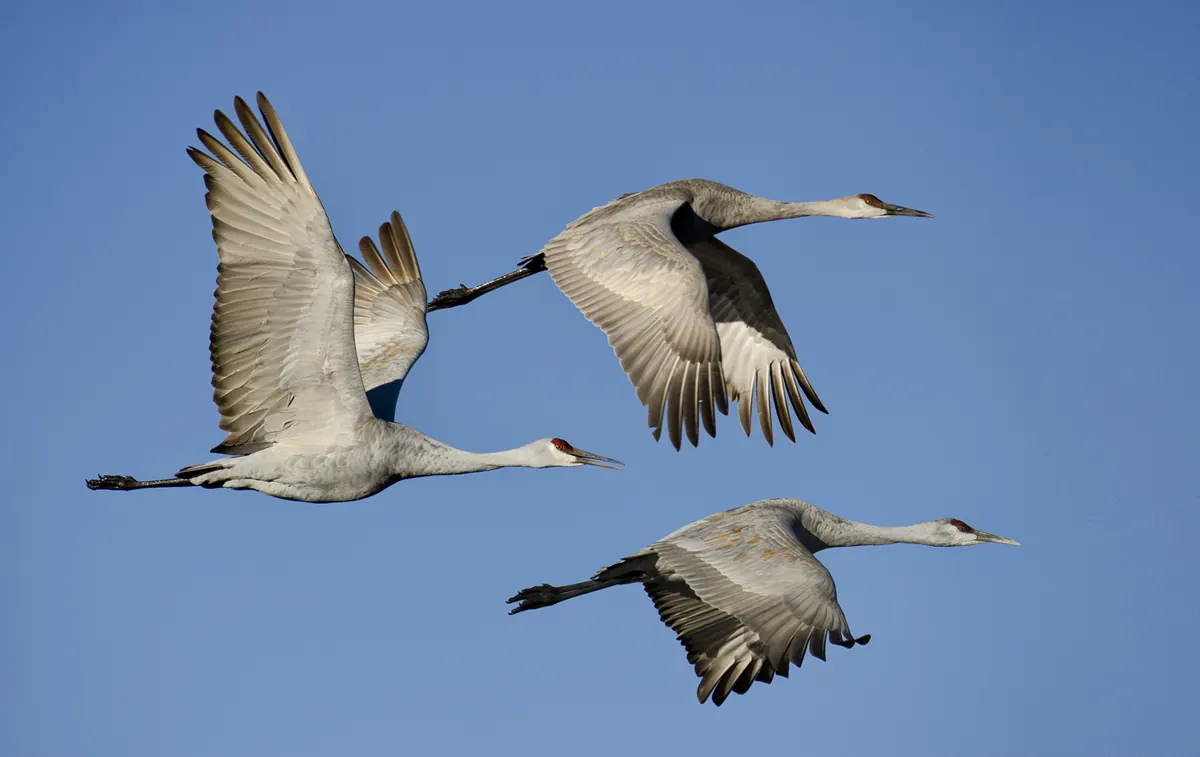
- Say goodbye to the cranes. Spend a sunny mid- to late-February afternoon at Bosque del Apache and watch for flocks circling higher and higher on rising air before they peel off to the north. It is the start of the cranes’ trip to Colorado’s San Luis Valley.
- Drive the tour loop at Maxwell. Bald eagles at Maxwell National Wildlife Refuge usually peak in February. The roads are open sunrise to sunset; check the cottonwoods around Lake 13 and the edges of any ice.
- Find Jupiter and Mars. Jupiter’s opposition night is the 10th and Mars follows on the 19th, both among the stars of Leo. Any clear evening late in the month, look east after dark for a brilliant white planet and an orange one, not far apart.
For the Naturalist’s Field Journal: a kettle of departing cranes fits the dusk and dawn watch page or “birds I have seen,” and an eagle at Maxwell can join them. An owl’s ear tufts above an old stick nest belong on “nest observed,” with the date so you can check back for owlets. A juniper sprig shedding pollen, or a cluster of Siberian elm flowers, suits “a tree through the seasons,” and a windy February day, with its dust and racing clouds, makes a lively entry for “colours of the day.”
Regions used below: Northern mountains, Taos and the Enchanted Circle; Four Corners and the northwest; Santa Fe and the Jemez; Albuquerque and the middle Rio Grande; Eastern plains; Southeast and the Pecos valley; Southwest, the Gila and Las Cruces.
Where are the most bald eagles in New Mexico in February?
For eagle watchers, February is the payoff month in the northeast. Maxwell National Wildlife Refuge, a patchwork of lakes and grain fields on the high plains near the village of Maxwell, says it has hosted as many as 60 bald eagles in winter, and that their numbers there usually peak in February. The birds come for the open water, the fish and the waterfowl that crowd the refuge lakes.
-
Bald eagles at Maxwell National Wildlife Refuge
All month; the refuge’s peak · Maxwell NWR, off Interstate 25 at Exit 426, Colfax County
You can drive the refuge’s gravel tour roads any day between first and last light; staff are in the visitor center on weekdays from 8 to 4. Lake 13, the largest body of water, is the place to start. Scan the shoreline cottonwoods and the edge of the ice, where eagles stand waiting for a weak duck or a fish. The refuge warns that weather near the foot of the Rockies can turn quickly, so carry layers even on a bright morning.
-
Golden eagles on the poles and fence lines
All winter · Open range across the northeastern plains
Golden eagles live in New Mexico all year. The Hawks Aloft raptor guide, prepared for the state’s Avian Protection Working Group, notes that they nest mostly on cliffs and begin laying eggs here in March, so a February golden eagle may already be a resident bird holding territory rather than a winter visitor.
-
The few eagles that nest here
Egg-laying may begin in January or February · Reservoirs in the northern third of the state
Only a few pairs of bald eagles nest in New Mexico, and the same guide says they are mostly tied to reservoirs in the northern third of the state. Across the southern United States egg-laying usually begins in January or February, and incubation lasts about 35 days. If you happen on a big stick nest with an eagle sitting low in it, back away and watch from far off.
By March most of the wintering bald eagles will be heading north again, so February is the last full month to count them. A January eagle survey at the Corps of Engineers lakes is described on our New Mexico January page.
When do the sandhill cranes leave New Mexico?
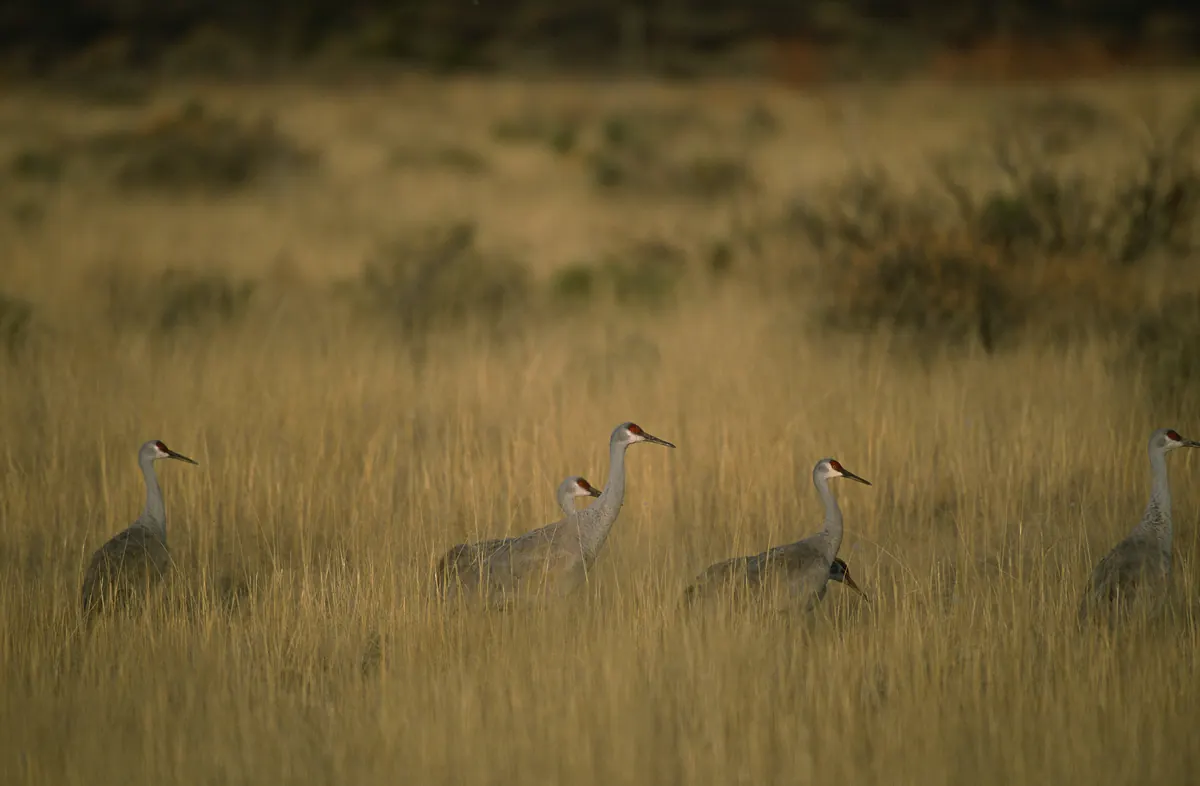
The Friends of Bosque del Apache say the cranes usually begin leaving the refuge for the north in mid to late February each year. Most of the birds wintering along the Rio Grande are greater sandhill cranes of the Rocky Mountain Population, about 22,000 strong, and they nest in wetlands of Idaho, Wyoming, Montana, Utah and Colorado. The refuge itself counts mid-February as the start of its spring season.
-
Kettling before they go
Mid to late February, on warm, sunny afternoons · Bosque del Apache NWR and fields along the middle Rio Grande
Before a flock departs, the cranes gather in a rising spiral called a kettle, circling up on warm air until they are specks, then sliding off to the north. The Friends group says they average about 30 miles an hour, or 50 with a good tailwind, and can cross passes in the Colorado mountains as high as 14,000 feet.
-
The first stop: Colorado’s San Luis Valley
Late February through March · Monte Vista National Wildlife Refuge, Colorado
Most of the Rocky Mountain cranes stop first in southern Colorado’s San Luis Valley, where they spend three to four weeks feeding on waste grain and roosting in shallow water around Monte Vista refuge. The Friends group says they put on about a third of their body weight there before the last push north to their nesting marshes.
-
Snow geese and the Light Goose Conservation Order
February 1 to March 10, 2027 · Middle Rio Grande valley and the eastern plains
Snow and Ross’s geese linger after the cranes begin to move. Their regular season closed on January 31, and from February 1 through March 10 the Department of Wildlife’s Light Goose Conservation Order lets hunters with a free permit take them with no bag limit. At Bernardo, north of Socorro, the Ponds Unit and Unit D open for this hunt on Mondays, Wednesdays and Saturdays, so expect gunfire near those fields on those days.
As the water in the refuge’s wetland units drops later in the spring, shorebirds arrive to feed on the mud, and by May the warblers and flycatchers are passing through. The cranes return at the end of October. Our December page follows them at the height of their stay.
Which New Mexico animals start families in February?
Spring nesting begins in late winter for the biggest predators. While snow still lies in the mountains, owls are sitting on eggs and wolves are pairing up, weeks ahead of the songbirds.
-
Great horned owls on eggs
First eggs late January into February; all laid by early March · Bosques, canyons, windbreaks and big city trees statewide
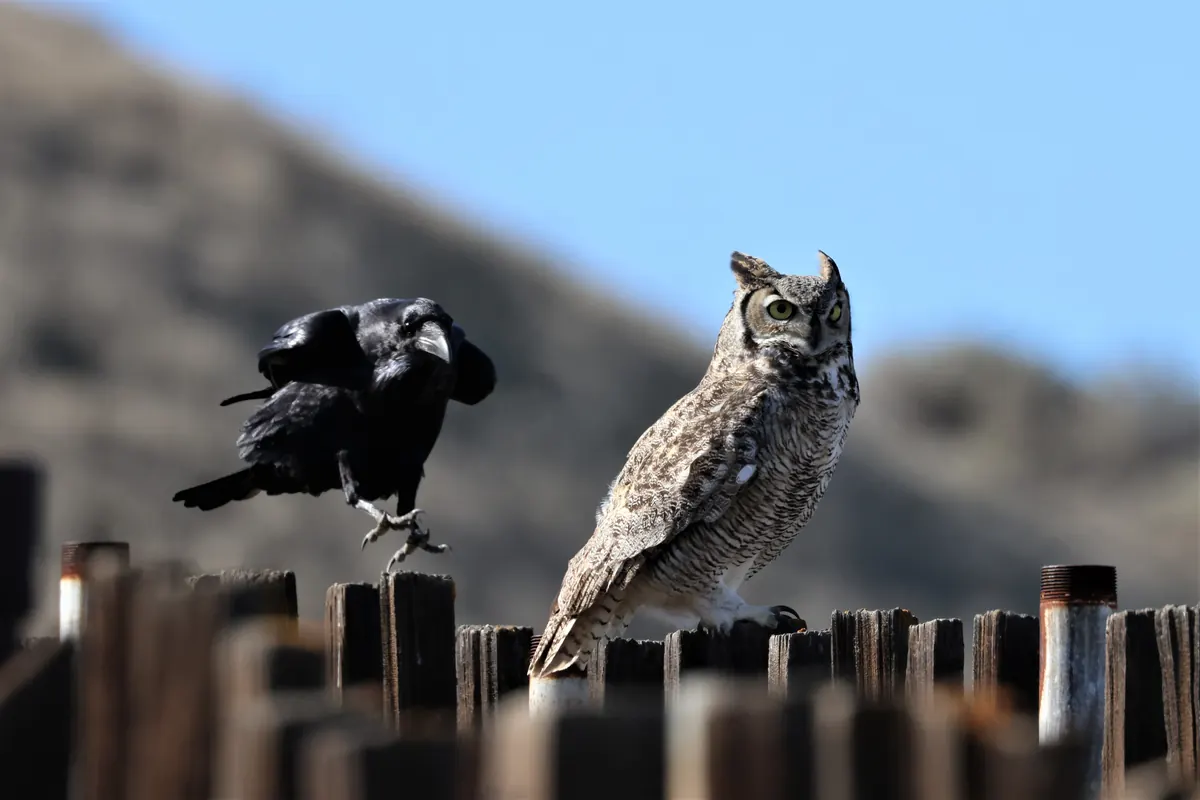
In January these owls were hooting over their chosen nests. By February many females are sitting. Hawks Aloft’s guide says the species is an early breeder that usually lays its first clutch in late January or February and has finished laying by early March. Incubation lasts 30 to 37 days, and the owlets fledge roughly 50 days after hatching. A female on eggs sits tight and low, so the only clue may be two feathered horns poking over the edge of a borrowed hawk or raven nest.
-
Ravens and golden eagles getting ready
Eggs from March · Cliffs, power poles, towers and bridges
Common ravens and golden eagles both start laying in March in New Mexico, according to the same guide, and ferruginous hawks in March as well. Ravens often build on power poles and towers, sometimes weaving baling wire into the sticks. A raven flying past with a stick in its bill in late February is a reliable sign that the season is about to begin.
-
Mexican wolves breeding
Breeding season in February; pups in April or early May · The Gila country and the Blue Range Wolf Recovery Area
The National Park Service says February is the breeding season for Mexican wolves. In a pack only the dominant pair usually breeds, and after about two months the female gives birth to four to six pups in April or early May. So while the interagency team is finishing its winter count, the packs it is counting are already starting the next generation.
The count itself is announced late in the winter: last year the New Mexico Department of Wildlife released it on February 25, 2026, reporting that the wild population had grown from at least 286 animals to at least 319 during 2025. Watch the department’s news page in late February or early March 2027 for the new figure.
When do lesser prairie-chickens start dancing in New Mexico?
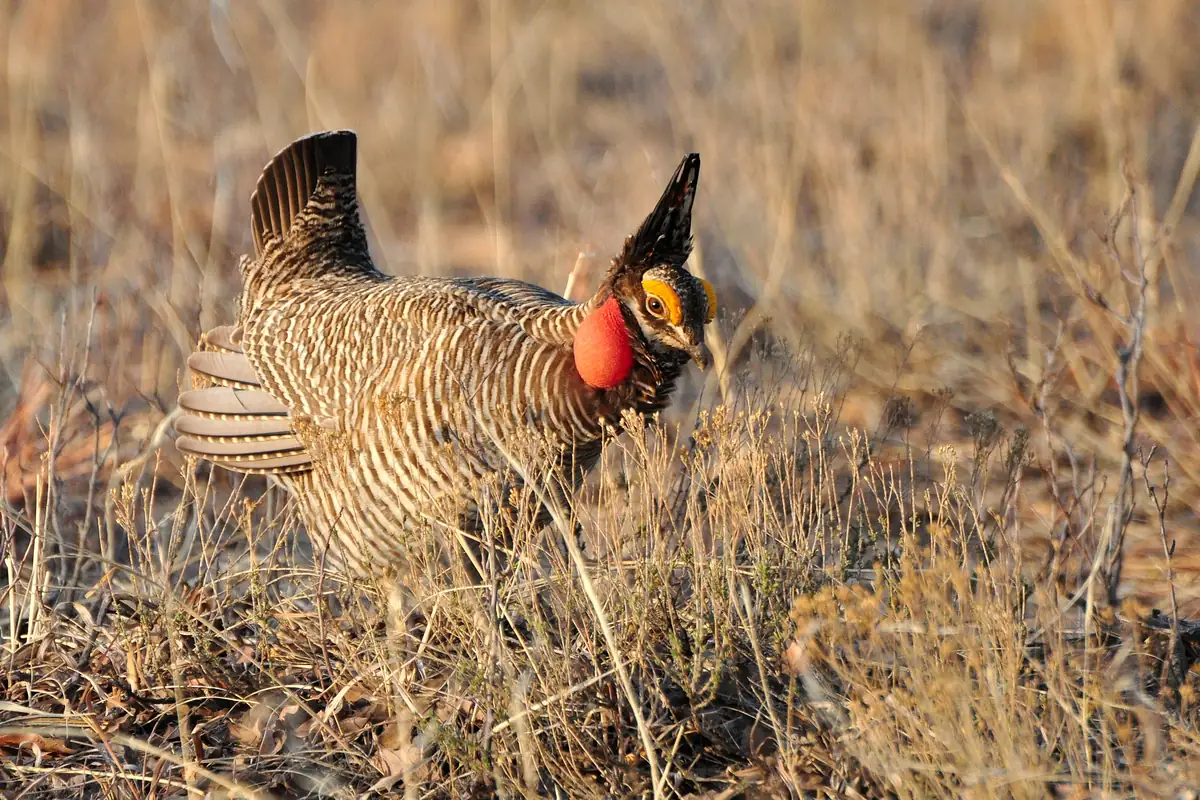
On the sand-shinnery oak prairie of eastern New Mexico, south of Portales, one of the strangest dawn performances in North America begins in late winter. Working Lands for Wildlife, a USDA partnership, says that from late February through April lesser prairie-chickens gather at dawn on their traditional display grounds, called leks.
-
What happens on a lek
Before sunrise, late February into spring · Low rises with short, sparse grass in the shinnery oak sandhills
The males raise long feathers behind the head like horns, fan their tails, stamp their feet in rapid bursts and puff out red air sacs on the sides of the neck to make bubbling, popping sounds. The display grounds are on slightly raised spots with short vegetation, so the birds can see and be seen. Hens visit to choose a mate and lay their eggs about two weeks later.
-
Milnesand, the heart of the range
Spring · Roosevelt County, about 35 miles south of Portales
The Nature Conservancy’s Milnesand Prairie Preserve, some 28,000 acres, holds more than 50 leks, which the Conservancy calls an extraordinary density of birds; the booming can carry more than a mile. The preserve is closed to the public, so the birds are best left to their mornings.
-
Access to the Prairie Chicken Areas
Closure dates under review; check with the department · Department of Wildlife Prairie Chicken Areas, about 25 miles southeast of Portales
The state has bought land for lesser prairie-chickens since 1940, and its Prairie Chicken Areas now cover more than 21,000 acres in scattered parcels. An older department guide to the areas, still linked from its State Wildlife Commission lands page, says they close to all access from February 16 to June 29 to protect the birds through the display and nesting season. Yet the 2026–27 hunting rules allow nongame hunting on the Prairie Chicken Areas until March 15, 2027, and the department notes its rules for these lands are being updated. Check with the department on the current access dates before you plan a visit.
What are the first signs of spring in New Mexico?
Spring in the Rio Grande valley announces itself first by sneezing. The wind-pollinated trees flower long before anything leafs out, and the City of Albuquerque’s air quality program counts their pollen every weekday.
-
Juniper pollen
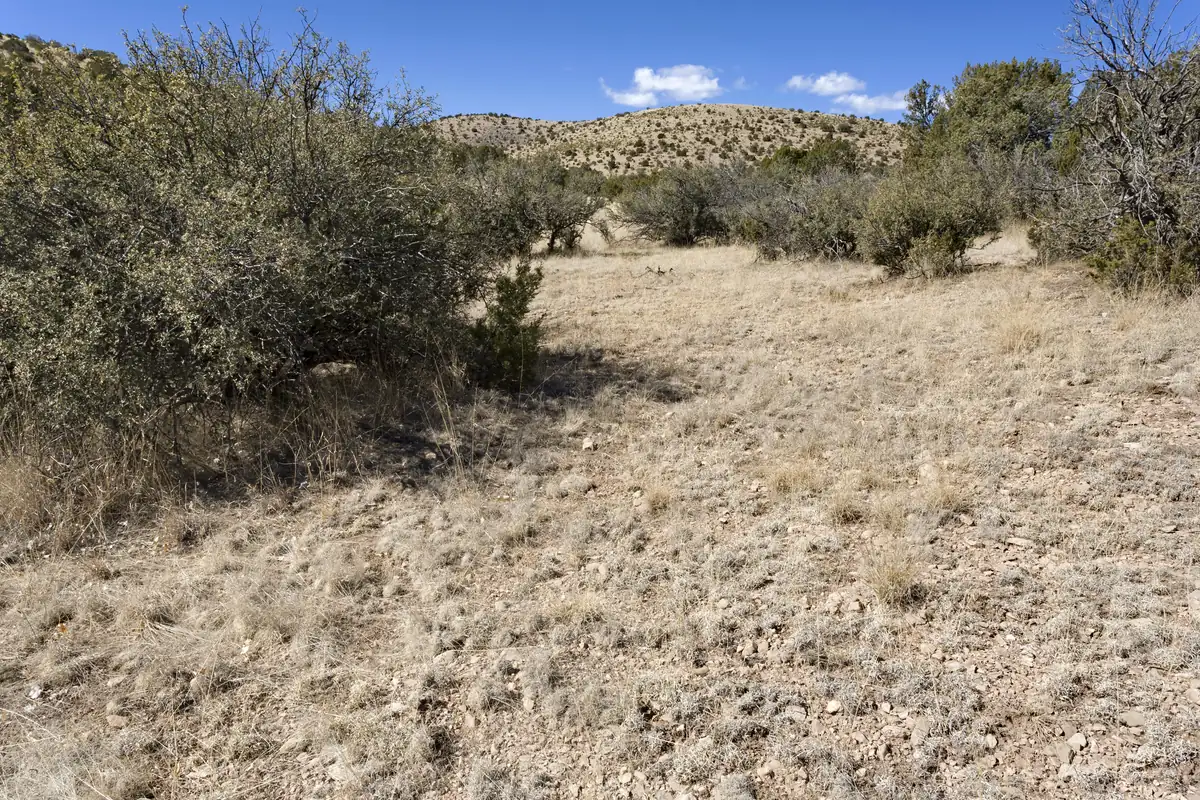
Usually from the second or third week of February · Piñon-juniper hills statewide; heavy in the Albuquerque area
An allergist at the University of New Mexico says juniper usually begins to shed pollen around the second or third week of February. Over 14 years of city data, juniper ranks second only to mulberry among Albuquerque’s heaviest pollen producers. The amount swings widely between years: on February 20, 2024, the city’s west-side sampler counted 1,720 juniper grains, a “very high” reading, while on the same date in 2025 both samplers read low, under ten.
-
Siberian elm in flower
Late winter · Towns, ditches and the bosque
Most elm pollen in Bernalillo County comes from the Siberian elm, a tough non-native tree that has spread along acequias and riverbanks. Its tiny reddish flower clusters open on bare twigs before the leaves, and on February 20, 2024, the city counted elm pollen in the “high” range on both sides of town. Albuquerque’s pollen ordinance restricts new plantings of most elms, junipers and cottonwoods for this reason.
-
Antlers and early shorebirds
Late February onward · Valles Caldera, Bandelier and Bosque del Apache
In the Jemez Mountains, the Park Service counts the shedding of deer and elk antlers among the signs of spring, though at Valles Caldera most bulls drop theirs in March and April. Collecting sheds is illegal there and at Bandelier, because the fallen antlers are a source of minerals for mice, squirrels and other small animals. Down the river, Bosque del Apache marks mid-February as the start of its spring season, when falling water levels in its wetlands begin to draw shorebirds.
Pollen counts rise on dry, windy days. If you have allergies, check the city’s daily report before a long walk in the foothills.
Is February warm or cold in New Mexico, and how windy does it get?
February sits between the two halves of the New Mexico year. It is still winter on the calendar, and snow can fall anywhere, but the sun is climbing and the first spring-style wind storms usually arrive. Normal February averages run a few degrees warmer than January’s, and most valley and plains stations expect less than half an inch of precipitation.
-
February 2026: the warmest on record
February 2026 · Central and northern New Mexico
Last February was the warmest in the record at the Sunport, Roswell, Clayton, Raton, Las Vegas and Farmington. At Clayton the month ran more than ten degrees above normal. It was also dry on the eastern plains, where Roswell and Clayton caught only a trace and Tucumcari a hundredth of an inch.
-
The mid-February wind storm
February 16 to 18, 2026 · Statewide
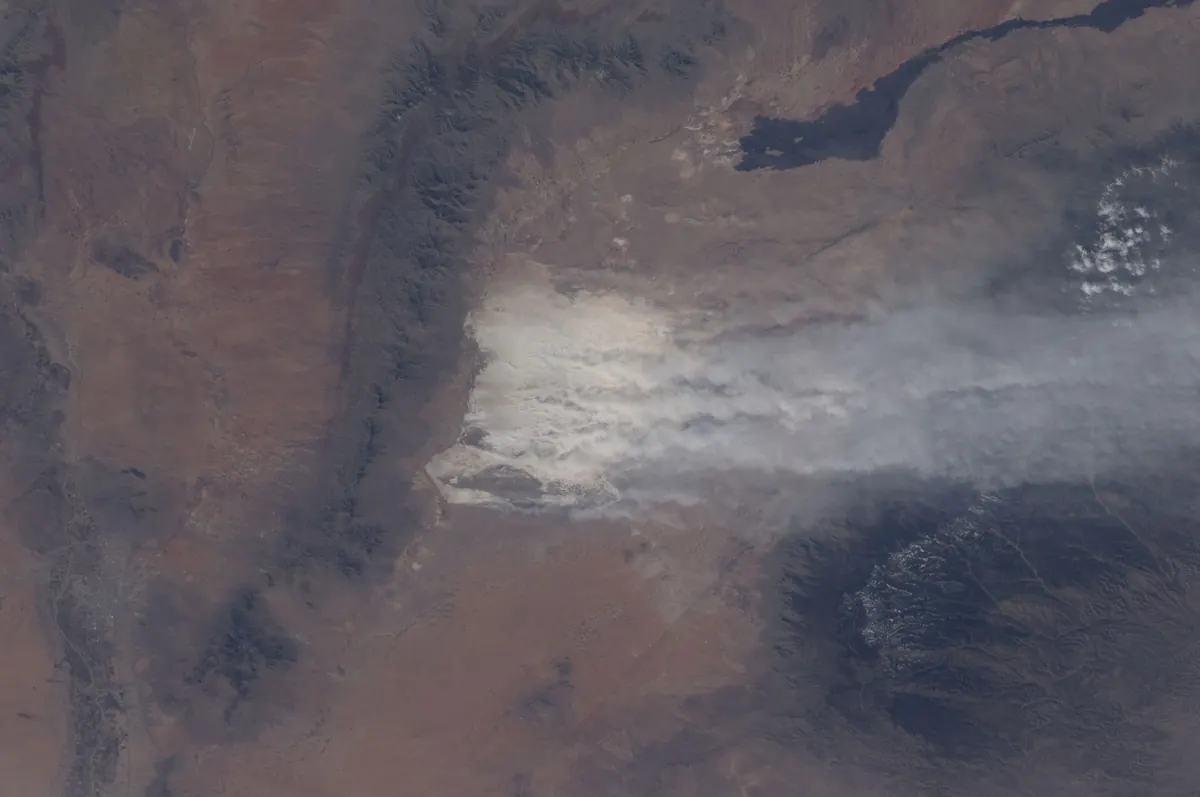
A series of spring-like storms brought strong winds, blowing dust and critical fire weather. The Albuquerque office logged gusts of 50 mph or more in every corner of the state, topped by 72 mph at Raton, and a grass fire in Harding County burned more than 3,000 acres. The western and northern mountains got a little welcome rain and snow from the fast-moving fronts.
-
February 2025: dry, warm and windy
February 2025 · Central and northern New Mexico
The year before was similar: the office called it very dry and unusually warm, with several windy, spring-like days. The Sunport recorded 0.05 inch of precipitation and no snow at all against a normal of 1.5 inches, and ranked its second-warmest February. One mid-month storm left 13 inches at the Chamita SNOTEL site in the Tusas Mountains, and an arctic push on February 19 dropped wind chills to −12 °F at Clovis.
| Station | Normal average temperature | Normal precipitation | February 2026 average temperature |
|---|---|---|---|
| Gallup | 34.4 °F | 0.71 in | 38.1 °F |
| Raton | 33.7 °F | 0.32 in | 41.3 °F (warmest on record) |
| Las Vegas | 35.4 °F | 0.32 in | 43.3 °F (warmest on record) |
| Santa Fe | 36.3 °F | 0.35 in | 42.5 °F (second warmest) |
| Farmington | 36.5 °F | 0.65 in | 41.8 °F (warmest on record) |
| Clayton | 37.5 °F | 0.30 in | 47.8 °F (warmest on record) |
| Albuquerque Sunport | 41.9 °F | 0.43 in | 49.4 °F (warmest on record) |
| Tucumcari | 42.5 °F | 0.36 in | 49.7 °F (second warmest) |
| Roswell | 47.8 °F | 0.35 in | 52.5 °F (warmest on record) |
February snowfall normals in the office’s summaries are 1.5 inches at the Sunport, 1.1 inches at Roswell and 2.7 inches at Clayton. The Albuquerque office says New Mexico’s windiest season is April and May, with March close behind; the reason is that the jet stream is still overhead while the stronger sun stirs the lower air deep enough to pull those fast winds down to the ground. Late February is when that pattern first takes hold. For the forecast where you are, try our weather page.
Will El Niño bring a wet end to winter in New Mexico?
A very strong El Niño by late fall and winter was judged a better than nine-in-ten bet in the federal forecasters’ ENSO discussion of September 10, 2026. That makes the late-winter and spring question an important one for New Mexico’s rivers, ranges and fire season.
-
Why El Niño favors storms here
Winter and spring · Statewide
The Albuquerque forecast office explains that during El Niño the jet stream stretches farther east and shifts toward the equator over the eastern Pacific, steering a more active storm track into the Southwest. Its review of past events found wetter-than-normal conditions more likely across the southern tier of the country, New Mexico included, through both winter and spring.
-
A closer look at spring in the Rio Grande valley
March through May · Albuquerque and Socorro
The office’s spring statistics for the central valley carry a useful warning. Averaged over seven strong El Niño events, March to May precipitation came to 124 percent of the long-term average at Albuquerque and 125 percent at Socorro. Yet in only three of those seven springs was precipitation actually above normal. A couple of very wet springs pulled the average up; the others were ordinary or dry. Socorro is so dry in spring, with a normal of 1.46 inches, that a single wet event can tip its average.
In short, a strong El Niño improves the chances of a moist February and spring without promising one, and the warm, windy Februaries of the last two years are a reminder of what the other side looks like. NOAA’s outlook for the season appeared on October 15 and is revised each month; find the latest maps with the other CPC 90-day outlooks. When thickening high clouds hint that a storm is on the way, our cloud guide helps you read them.
How much daylight does New Mexico gain in February?
February is when the lengthening days become obvious. From February 1 to 28 the towns in the table add 48 to 58 minutes, roughly two minutes each day, and the rate keeps rising toward the March equinox, when it peaks. Gains are biggest up north, where December’s days were shortest: Raton and Farmington add almost an hour, while Las Cruces adds 48 minutes. Unlike in January, the mornings now share in it. In Albuquerque, the U.S. Naval Observatory has sunrise moving from 7:06 a.m. on February 1 to 6:37 a.m. on February 28, and sunset from 5:35 p.m. to 6:01 p.m.
| City | Feb 1 | Feb 28 | Gained | Per day |
|---|---|---|---|---|
| Raton | 10 h 23 m | 11 h 21 m | 58 min | 2.1 min |
| Farmington | 10 h 23 m | 11 h 21 m | 58 min | 2.1 min |
| Santa Fe | 10 h 27 m | 11 h 23 m | 56 min | 2.1 min |
| Albuquerque | 10 h 29 m | 11 h 24 m | 55 min | 2.0 min |
| Tucumcari | 10 h 29 m | 11 h 23 m | 54 min | 2.0 min |
| Roswell | 10 h 36 m | 11 h 26 m | 50 min | 1.9 min |
| Silver City | 10 h 38 m | 11 h 28 m | 50 min | 1.9 min |
| Las Cruces | 10 h 40 m | 11 h 28 m | 48 min | 1.8 min |
Our daylight calculator gives the sun’s timetable for your own town on any day of the year.
What can you see in New Mexico’s night sky in February?
Leo hosts a planetary double feature in February: within eight days, Jupiter and then Mars line up across from the sun. Times are Mountain Standard Time; clocks change on March 14.
-
The midpoint of winter
Groundhog Day, Tuesday, February 2; true midpoint February 3–4 · Everywhere
Groundhog Day jumps the gun slightly. The true middle of astronomical winter, halfway between solstice and equinox, comes on the evening of February 3 or just after midnight on the 4th, by two slightly different reckonings.
-
Mercury at dusk, then a thin moon beside it
Greatest elongation late on February 2; crescent moon nearby on Sunday, February 7 · Low in the west-southwest after sunset
Late on February 2, Mercury swings to its widest separation east of the sun, giving the best evening view of the innermost planet this winter. Your window runs from the end of January to about February 10: scan low in the west-southwest while twilight is still bright, between half an hour and 45 minutes past sunset. On the 7th a hair-thin crescent, only a day past new, hangs close to it in the twilight. That new moon of the 6th lines up for an annular eclipse, yet the moon’s shadow stays far south, over Chile, Argentina and the Atlantic toward West Africa, so New Mexicans will notice nothing.
-
Jupiter at opposition
Wednesday, February 10, 5:21 p.m. MST · Rising in the east at sunset, up all night
Jupiter lies directly opposite the sun, rising at dusk and setting at dawn. It is nearer and brighter now than at any other time this year, roughly 405 million miles off, and outshines every star. Binoculars held steady show up to four of its moons strung out in a line.
-
Mars at opposition
Friday, February 19; closest to Earth on February 20 · East after dark, near Jupiter and Regulus in Leo
Opposition for Mars comes the morning of February 19; on the 20th it comes nearest, roughly 63 million miles from us. That is a modest approach, because in early March Mars reaches the outermost point of its orbit, and so a telescope shows a smaller disk than at some recent oppositions. Even so, its orange glow lasts from dusk to dawn, and Earth and Mars won’t meet this closely again before 2029.
-
The Snow Moon
Full at 4:23 p.m. MST, Saturday, February 20 · Rising in the east around sunset
The full moon rises at about 5:56 p.m. in Albuquerque on the 20th, with Jupiter, Mars and Regulus, the brightest star of Leo, clustered nearby. A night earlier, on the 19th, the moon just short of full sits almost on top of Jupiter. Some almanacs call this a supermoon, though by stricter definitions it is only near one. The moon also skims Earth’s pale outer shadow that day in a penumbral eclipse, but the shading is slight and wraps up at 6:13 p.m. MST, barely a quarter hour after the moon clears the Albuquerque horizon in bright twilight; for New Mexico it is effectively invisible.
| Phase | Date | Time |
|---|---|---|
| Last quarter | Friday, Jan 29 | 3:55 a.m. |
| New moon | Saturday, Feb 6 | 8:56 a.m. (an annular solar eclipse, not visible from the U.S.) |
| First quarter | Sunday, Feb 14 | 12:58 a.m. |
| Full moon, the Snow Moon | Saturday, Feb 20 | 4:23 p.m. |
| Last quarter | Saturday, Feb 27 | 10:16 p.m. |
| New moon | Monday, Mar 8 | 2:29 a.m. |
Star clusters, galaxies and the Milky Way look best in the evenings from about the 1st to the 11th, with no moonlight to wash them out. Solar activity is easing after the 2024 maximum, but big storms still happen in the declining years; NOAA’s space weather forecasters publish an aurora outlook covering the next half hour or so. For every phase through the year, see our moon phase calendar.
What can New Mexico families do outdoors in February?
Residents still pay no day-use fee at New Mexico State Parks, an exemption that runs from October 1 through April 30. Few 2027 event calendars are posted yet, so check with each place before you go.
- Great Backyard Bird Count weekend, February 12 to 15. Families anywhere can join by keeping a list for a short spell, a quarter hour is plenty, and entering it online. It is a fine excuse for a family trip to a crane field before the flocks leave.
- A crane farewell at Bosque del Apache. Mid to late February is the time to watch the last big flocks lift off. The tour loop is open daily; ask at the visitor center which ponds the birds are using.
- Eagles at Maxwell. The refuge’s winter peak makes a February drive on its tour roads worthwhile; bring binoculars and a thermos.
- Saturday and Sunday mornings in Albuquerque. Volunteer naturalists at Rio Grande Nature Center State Park lead free bird walks at 8:30 a.m. every weekend, meeting at the wildlife blind on the north side of the parking lot. Loaner binoculars are available, and no reservation is needed.
- Valle de Oro, the urban national wildlife refuge on Albuquerque’s south side, offers shuttle tours and programs for children on a changing schedule; call its visitor center for February plans.
Citizen science. Project FeederWatch continues through April 30, and the first juniper sneezes of the year can start a family pollen diary to compare with the city’s daily counts. Any walk can become an eBird checklist. Children can try listening at dusk near a big cottonwood for owls, then come back in late March to look for fuzzy owlets peering over the nest rim.
Safety notes for February in New Mexico
- Who is hunting, and what to wear. Under the Department of Wildlife’s 2026–27 rules, February brings any-legal-weapon javelina hunts from February 1 to March 31 across much of the state, quail season through February 15, Barbary sheep hunts on February 1–7, 12–18 and 21–27 in several southeastern units, a resident elk hunt on February 6–10 in Unit 34 in the Sacramento Mountains, and oryx hunts on White Sands Missile Range. The Light Goose Conservation Order runs until March 10, while duck and regular goose seasons have closed. The state’s orange rule is narrow: 144 square inches or more on military land, with McGregor Range and the rest of Fort Bliss demanding a whole vest, and 244 square inches or more for anyone carrying a firearm on an elk hunt in Valles Caldera. Elsewhere it is optional, though the department strongly urges every hunter to wear it. Hikers on public land should wear a bright color too.
- Traps. The furbearer season for bobcat, fox, badger, ringtail and weasel continues to March 15. No trap or snare may be set on public land here, yet trapping remains legal on private ground, so leash dogs on ranch roads and private tracts.
- Wind, dust and fire. The National Weather Service issues a high wind warning for sustained winds of 40 mph or more or gusts of 58 mph or more. On those days blowing dust can drop visibility to near zero on open highways, and a stray spark can start a fast grass fire. Check NMRoads before a long drive, and don’t burn anything on a windy day.
- Late-season ice. Eagle Nest Lake’s ice fishing usually lasts into March, but warm spells weaken the ice from the edges and around inlets. Stay off any lake until the park says it is open, and never go out alone.
- Cold snaps. Even in a mild February an arctic front can drop wind chills below zero on the eastern plains, as at Clovis in February 2025. Carry warm layers, water and food in the car.
- Closures. The Prairie Chicken Areas closed in mid-February under the department’s older guide, but their rules are being updated; check with the department for 2027. At the top of the Sandias, Sandia Crest, the Ellis Trailhead and the highway beyond the 10K Trailhead parking area remain closed for Forest Service rebuilding work, which the Cibola National Forest expects to last through fall 2027; cars turn around at the 10K lot.
For eagles at the Corps lakes and the Wolf Moon, read our January page for New Mexico, and to explore other states and months, start at the nature hub. A kettle of departing cranes, a booming dawn on the prairie or an owl’s ear tufts above a nest are worth sketching in the Naturalist’s Field Journal. With planting season close, our New Mexico frost dates show the typical last frost for your part of the state.
Sources
- USFWS Maxwell National Wildlife Refuge: wildlife (bald eagles peak in February)
- USFWS Maxwell National Wildlife Refuge: visit us (hours, Lake 13, directions)
- Hawks Aloft for the New Mexico Avian Protection Working Group: identification of raptors and other large birds of New Mexico (nesting dates)
- Friends of Bosque del Apache: sandhill crane migration, an annual cycle (departure mid to late February)
- Friends of Bosque del Apache: bidding farewell to the cranes as spring migration begins
- USFWS Bosque del Apache NWR: wildlife watching (spring season from mid-February)
- New Mexico Department of Wildlife: 2026–2027 migratory game bird rules (light goose conservation order, Bernardo)
- National Park Service, Valles Caldera: Mexican wolf (February breeding season)
- New Mexico Department of Wildlife: Mexican wolf population count complete (February 25, 2026)
- Working Lands for Wildlife (USDA): lesser prairie-chicken, about the bird (leks late February through April)
- The Nature Conservancy: Milnesand Prairie Preserve
- New Mexico Department of Game and Fish: Prairie Chicken Wildlife Areas, older guide (closed February 16 – June 29)
- New Mexico Department of Wildlife: State Wildlife Commission lands (access rules being updated)
- UNM Health Sciences: New Mexico allergy season survival guide (juniper from the second or third week of February)
- City of Albuquerque Air Quality: daily status and pollen counts, February 20, 2024
- City of Albuquerque Air Quality: daily status and pollen counts, February 20, 2025
- City of Albuquerque: pollen identification images (Siberian elm, juniper)
- City of Albuquerque: restricted trees for pollen control (top pollen producers)
- National Park Service, Valles Caldera: Rocky Mountain elk (antler shedding in March and April)
- Los Alamos Reporter: collecting shed antlers illegal at Bandelier and Valles Caldera (NPS notice, March 2021)
- National Park Service, Valles Caldera: need to know (no collecting of antlers)
- NWS Albuquerque: February 2026 climate highlights (normals, record warmth, February 16–18 wind storm)
- NWS Albuquerque: February 2025 climate and weather summary (snowfall normals, storm reports)
- NWS Albuquerque: high wind climatology for New Mexico
- NWS Albuquerque: El Niño and New Mexico winter and spring precipitation
- NWS Albuquerque: El Niño spring precipitation for the central valley (Climate Division 5)
- Climate Prediction Center: ENSO diagnostic discussion, September 10, 2026
- Climate Prediction Center: seasonal outlooks (winter outlook issued October 15, 2026, updated monthly)
- U.S. Naval Observatory: moon phases, December 2026 to March 2027
- U.S. Naval Observatory: rise, set and transit times for Albuquerque, February 20, 2027 (moonrise)
- U.S. Naval Observatory: Earth’s seasons, 2027
- Fred Espenak: Sky Event Almanac 2027 (Mercury, Jupiter and Mars oppositions, moon conjunctions)
- NASA Eclipse Web Site: lunar eclipses 2021–2030 (penumbral eclipse of February 20, 2027)
- NASA Eclipse Web Site: solar eclipses 2021–2030 (annular eclipse of February 6, 2027)
- SEDS: Mars opposition of 2027
- Sea and Sky: astronomy calendar of celestial events, 2027
- NOAA Space Weather Prediction Center: aurora 30-minute forecast
- Birds Canada: Great Backyard Bird Count, February 12–15, 2027
- New Mexico State Parks: fees and permits (resident day-use exemption October 1 – April 30)
- Friends of the Rio Grande Nature Center: birding at the park (weekend bird walks)
- Friends of Valle de Oro: things to do
- Project FeederWatch: project overview
- New Mexico Department of Wildlife: 2026–2027 hunting rules and information (javelina, Barbary sheep, elk, oryx, quail, furbearers, blaze orange, traps on public land)
- New Mexico State Parks: Eagle Nest Lake State Park (ice fishing January to March)
- Cibola National Forest: Sandia Crest area projects update and closure
- New Mexico Department of Transportation: NMRoads road conditions
- Photos via Wikimedia Commons; licenses and photographers are credited under each picture
