What to look for in nature in New Mexico this October
New Mexico’s October is a month of clear, cold mornings and warm, blue afternoons. Balloons hang in the Albuquerque Box, the aspens finish on the high peaks, piñon cones crack open, the red chile is picked, and at the end of the month the first sandhill cranes drop into the Rio Grande valley. Freeze arrives in Taos around October 3 and in Las Cruces not until the middle of November, so where you stand matters as much as the date. What follows is sorted by elevation as often as by region.
Start here

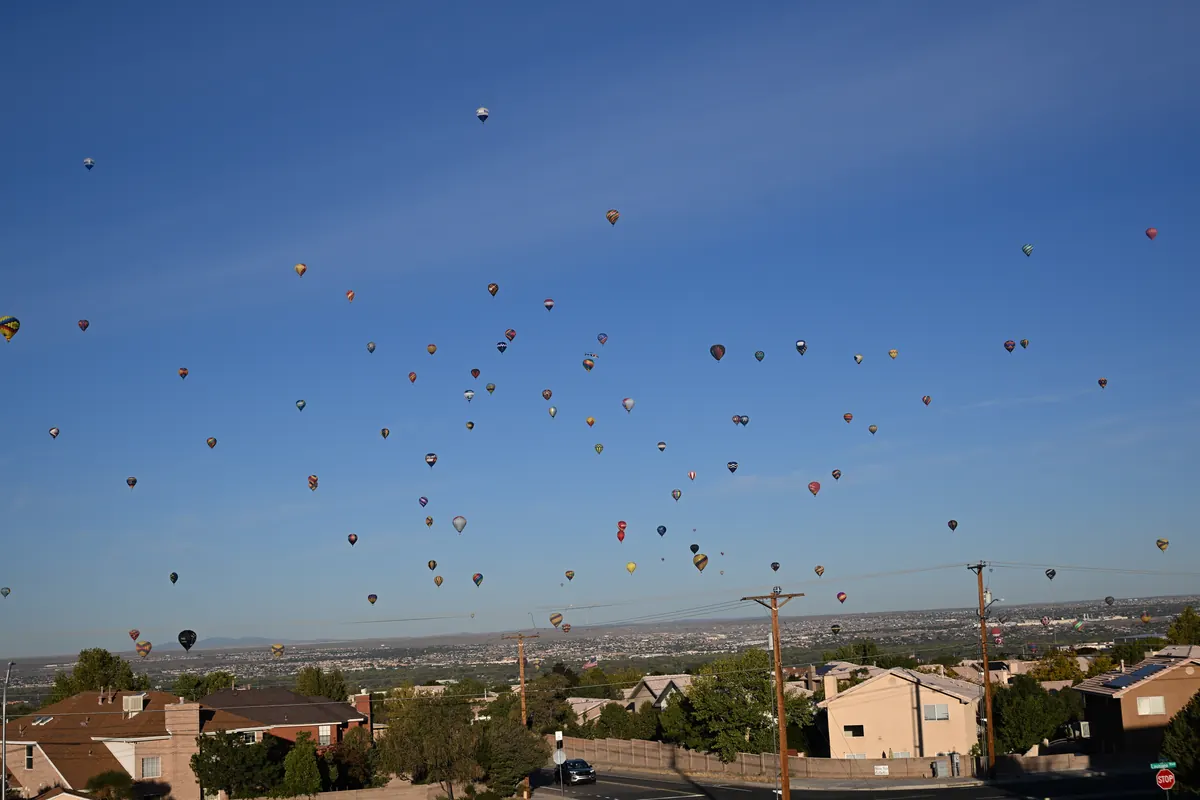
- Balloons and the Albuquerque Box. The 54th Albuquerque International Balloon Fiesta runs October 3–11, with mass ascensions on the two Saturdays, the two Sundays and Wednesday. On calm, clear mornings cold air drains south down the valley while the wind a few hundred feet up blows north, and pilots ride that loop back toward the launch field.
- The first cranes. Bosque del Apache National Wildlife Refuge says its first sandhill cranes and snow geese typically arrive at the end of October. Listen for a rolling, wooden call from far overhead before you find the flock, anywhere along the Rio Grande from Española to Las Cruces.
- Jupiter comes back out, then the Hunter’s Moon. On the morning of Tuesday, October 6, the crescent rises with Jupiter hidden behind it, and the planet reappears at about 3:11 a.m. MDT, only a few degrees above the eastern horizon; the flat eastern plains have the best view. The Hunter’s Moon reaches full at 10:12 p.m. MDT on Sunday, October 25.
Journal pages to reach for: the first crane and junco go on the “birds I have seen” list; one aspen or bosque cottonwood gets the tree-through-the-seasons page; a piñon cone belongs with seeds, pods and cones; the Carlsbad bats or the dawn balloons fill a dusk and dawn watch. All are plates in the Naturalist’s Field Journal. Write the elevation beside each date, since in New Mexico it says nearly as much as the calendar.
Regions used below: Northern mountains, Taos and the Enchanted Circle; Four Corners and the northwest; Santa Fe and the Jemez; Albuquerque and the middle Rio Grande; Eastern plains; Southeast and the Pecos valley; Southwest, the Gila and Las Cruces.
When do the aspens and cottonwoods turn in New Mexico?
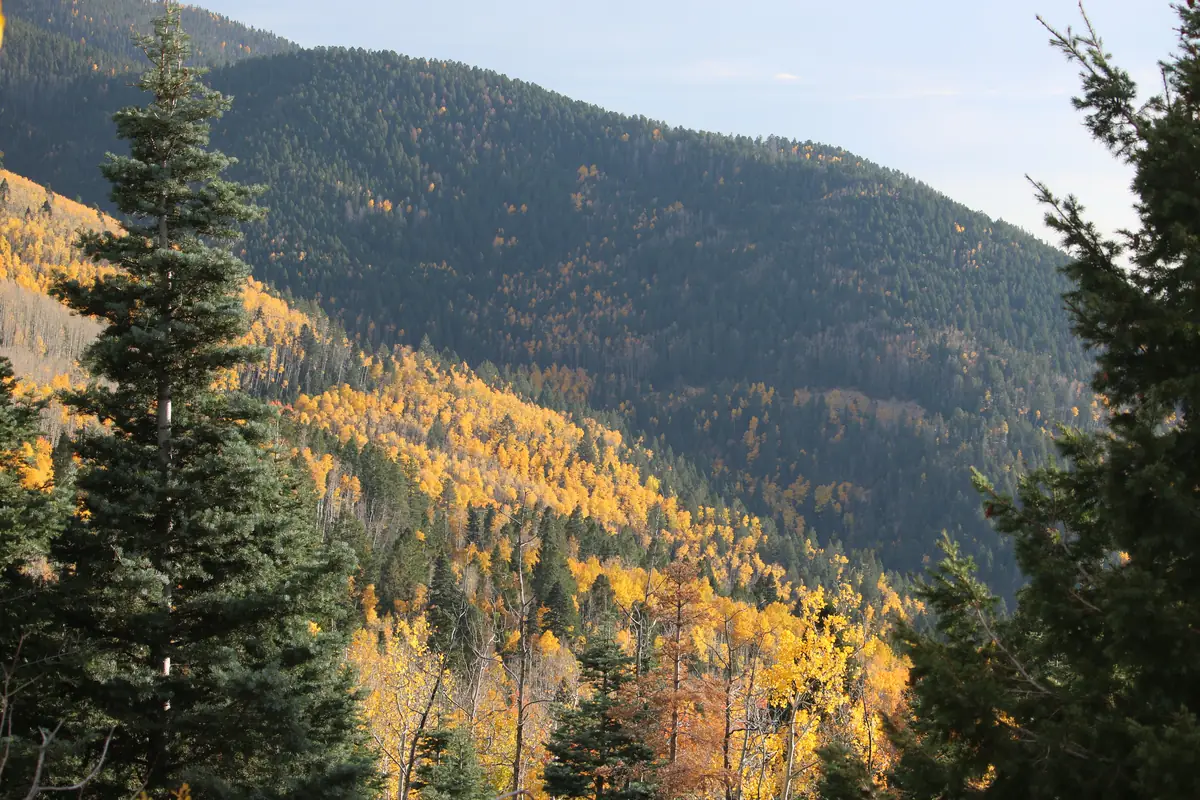
Color in New Mexico runs downhill. The aspens on the high peaks go first, and the state tourism department’s guide places the gold between Hyde Memorial State Park and Ski Santa Fe in late September, warning that it lasts only about a week in most places and is hard to predict. By October the highest groves in the Sangre de Cristos are often past their best, while lower slopes, the Jemez and the Sacramento Mountains may still be turning; every year runs differently. The cottonwoods along the rivers come afterward. Plan the dates, then drive to wherever the color is.
-
Aspen Vista and the Santa Fe ski road
Late September into the first days of October · Hyde Park Road (NM 475) from Santa Fe to Ski Santa Fe
The Forest Service singles out the Aspen Vista Trail near Ski Santa Fe as one of the Southwest’s signature fall hikes, a closed road climbing through almost pure aspen. Go on a weekday morning, and early in October rather than late.
-
The Enchanted Circle
Late September to early October · Taos, Questa, Red River, Eagle Nest, Angel Fire
The loop around Wheeler Peak takes in Bobcat Pass above Red River, the Moreno Valley and Taos Canyon. Red River’s station has usually frozen by September 7 and Angel Fire’s by September 8, so color up here comes with frost on the windshield, and Taos’s visitor bureau says the first dusting of snow in town often lands near the end of October.
-
Cloudcroft and the Sunspot byway
October, varying from year to year · Sacramento Mountains, Lincoln National Forest
In the south, the Forest Service points to the Sunspot Scenic Byway out of Cloudcroft, where aspens, maples and oakbrush color the high Sacramentos. The road is numbered 6563, after the wavelength in angstroms that solar astronomers use to watch the sun, and ends at the observatories at Sunspot.
-
Cottonwoods in the bosque and the Gila canyons
After the aspens; timing varies by river and by year · Rio Grande bosque, Rio Chama, Gila and Mimbres rivers
The valley trees turn after the mountains finish. A Forest Service summary for Fremont cottonwood, the tree of the Gila and the southern rivers, puts yellowing in late September and leaf drop from mid-October in general terms; the Rio Grande cottonwood of the Albuquerque bosque usually holds its gold later. Treat those as rough windows. The Bosque Ecosystem Monitoring Program collects fallen leaves in tubs every month at sites along the Rio Grande, a good model for a home record: note the week your tree is half gold and the week it is bare.
In the Gila the Forest Service adds sycamores and bigtooth maples to the canyon cottonwoods. A warm, dry fall can mute the color and one hard freeze can brown it overnight, so check a recent photo or a ranger station before a long drive.
What is the Albuquerque Box, and what will El Niño do this winter?
October is the state’s gentlest month. The National Weather Service office in Albuquerque describes it as the time when the summer storms have faded and the jet stream has not yet dropped south, which leaves long runs of dry air, deep blue sky and light wind. Over the first fifteen days of the month the Sunport averages a high near 75 °F and a low near 49 °F, and on 84 percent of those days no rain falls at all.
-
The Albuquerque Box
Clear, calm mornings; about 3 of the first 15 days of October on average · Balloon Fiesta Park and the middle Rio Grande valley
After a clear night the ground cools the air above it, and the cold, heavy air drains down the valley from north to south in a layer usually no more than a few hundred feet deep. Above an inversion, a weak south wind often blows the other way. A pilot who launches heads south toward downtown, then climbs into the upper current and drifts back north. The forecast office’s climatology finds a textbook box on roughly three of the first fifteen October days, and the same study notes that dawn at the north-valley launch field often runs five to ten degrees colder than at the airport. Sunlight over the Sandias breaks the inversion and the box dissolves by mid-morning.
-
Canyon winds and early storms
Any October morning with a front east of the mountains · East side of Albuquerque, below Tijeras Canyon
When high pressure piles up on the plains, air squeezes west through the Tijeras gap; on October 15, 2015, gusts reached 68 mph below the canyon. A system dropping through the Rockies can also bring hail or snow, as it did to Albuquerque and Rio Rancho on October 4–5, 2004.
-
The first snow
Average late November in Albuquerque; earlier in the mountains · Statewide
At the Sunport the average first snowfall comes on November 29, and the earliest on record fell on October 5, 2004. Write down the day you first see snow on the Sandias, the Sangres or Sierra Blanca.
El Niño this winter. The Climate Prediction Center’s September 10, 2026 update gives better than nine-in-ten odds that a very strong El Niño persists into winter. For New Mexico that usually tips the cool season wet: the Albuquerque forecast office’s review of past events shows a more active storm track reaching the Southwest and wetter-than-normal winters and springs across the southern tier, and at Fort Sumner every strong El Niño in the record brought above-average winter precipitation. The same office cautions that El Niño shifts the odds and guarantees nothing. October itself is barely touched; the effect builds from December on, and the Climate Prediction Center’s updated winter outlook is due in mid-October. Current conditions for your town are on our weather page.
When do the sandhill cranes come back to New Mexico?
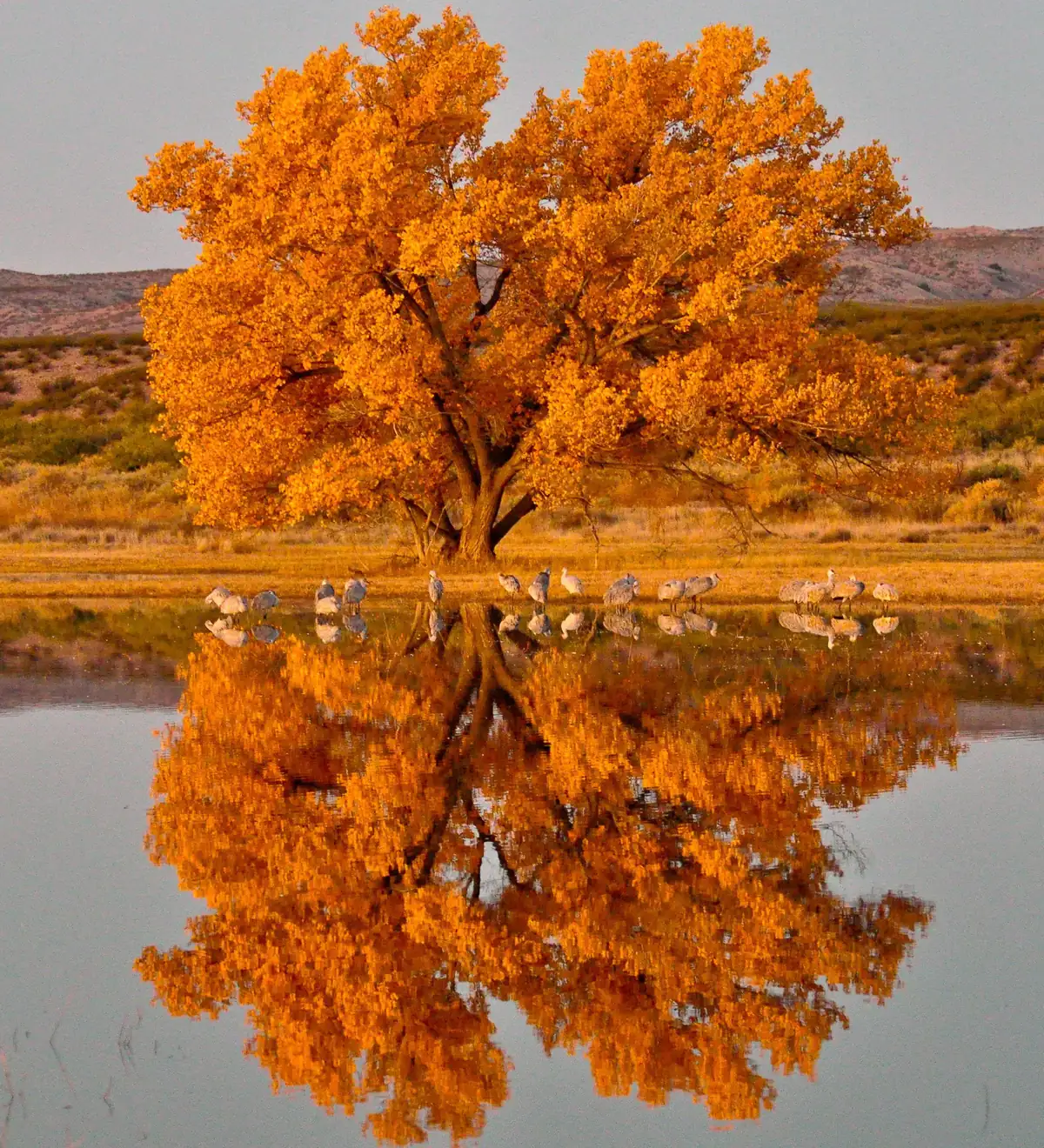
Late in the month. Bosque del Apache National Wildlife Refuge, south of Socorro, says the first cranes and geese typically show up at the end of October, and that the great crowds of snow geese, Ross’s geese and cranes roosting in its ponds belong to mid-November through late January. October is the month of the scouts.
-
Sandhill cranes in the valley
First arrivals at the end of October; peak mid-November to late January · Bosque del Apache; Albuquerque’s Open Space Visitor Center; Bernardo and the Rio Grande farm fields
Albuquerque’s Open Space Visitor Center on Coors Boulevard farms corn, sorghum, millet and alfalfa for wintering birds and has viewing windows toward the fields and the Sandias. At Bosque del Apache the Tour Loop is open from an hour before sunrise to an hour after sunset, the refuge warns of intermittent road closures from construction that began around September 29, and entry is free on October 11 and October 27. The Festival of the Cranes follows on December 2–5.
-
The Manzano HawkWatch is closed this year
Normally August 27 – November 5 · Capilla Peak, Manzano Mountains
HawkWatch International has counted migrating raptors from Capilla Peak since 1985, usually 5,000 to 7,000 birds a fall of up to 18 species, with Swainson’s hawks, turkey vultures and sharp-shinned and Cooper’s hawks most common. In 2026 it will not count at all: the Whiskey Fire and the clean-up after it have closed the area, and the Cibola National Forest has closed Forest Road 245 to Capilla Peak and its campground since July 9. The birds still migrate with no one counting them, so any open view of the Manzano or Sandia ridgelines on a clear afternoon may turn up a few.
-
Bird walks in the Albuquerque bosque
Every Saturday and Sunday, 8:30 a.m. · Rio Grande Nature Center State Park, Candelaria Road
Volunteer naturalists lead a free walk from the Candelaria Wetland blind every weekend morning, with loaner binoculars; the park’s list tops 300 species. As October goes on, look for the first wintering ducks on the wetland and the first juncos and white-crowned sparrows in the brush.
Birders can log October sightings toward the New Mexico Department of Wildlife’s 2026 Birding Big Year contest, and Saturday, October 10 is October Big Day on eBird. Duck seasons open on several October dates (see the safety notes), so on a refuge or wildlife area check which units are open to hunting before you walk.
Can you still see the bat flight at Carlsbad Caverns in October?
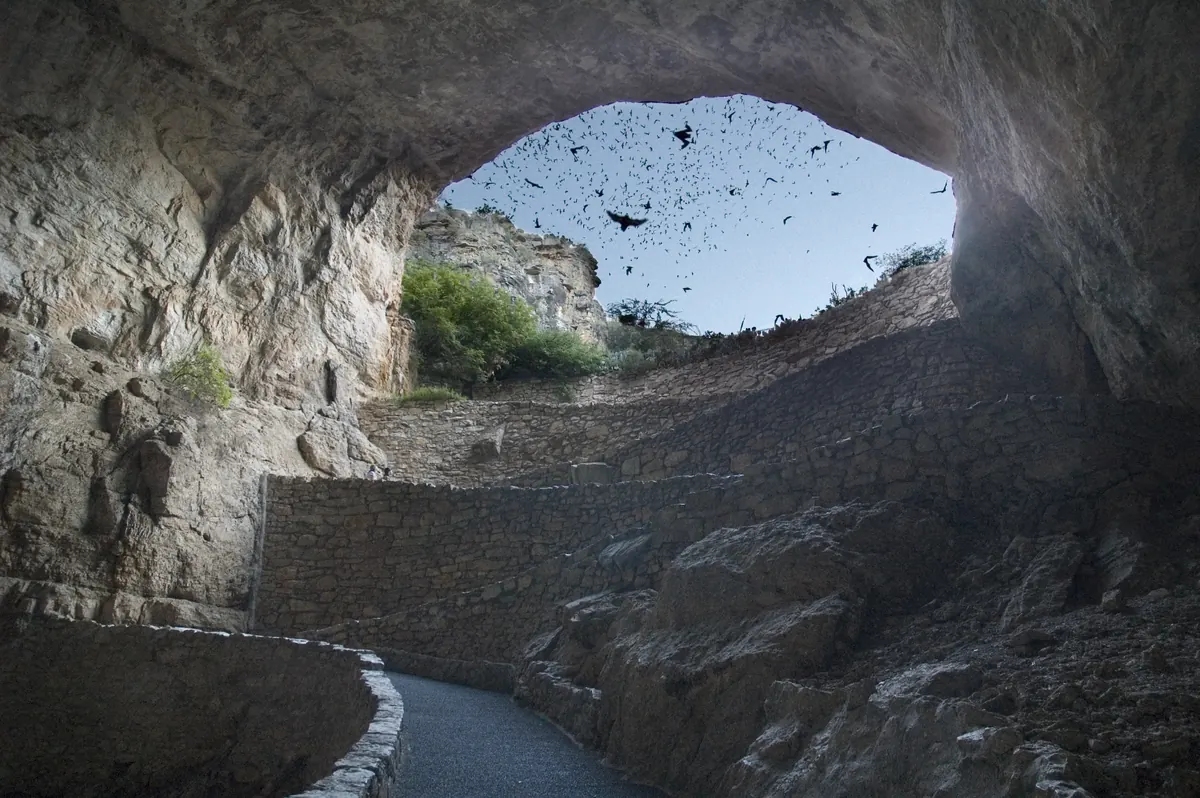
Yes, but it is the last month. The ranger-led Bat Flight Program runs every evening from April through October at the amphitheater by the cavern’s Natural Entrance, a five-minute walk from the visitor center. It is free, needs no reservation, and starts at a time that follows sunset, so check with the park the day you go. Cameras and phones are not allowed; the park bans all electronic devices at the program to protect the bats.
-
Brazilian free-tailed bats
Around sunset, nightly through October · Carlsbad Caverns National Park
The colony is mostly Brazilian free-tailed bats, each about half an ounce with an 11-inch wingspan, and numbers change from night to night and season to season. Park counts put the resident summer colony near 400,000 in 2005, with as many as 793,000 bats during the spring and fall migrations. The park calls August and September the best months, when the year’s young and bats passing through from colonies farther north join the flight. By October the evenings are shorter and cooler and the spiral out of the cave comes earlier; what you see on any given night is up to the bats.
-
The dawn return
About 4 to 6 a.m. · Natural Entrance
Early risers can watch the bats come home, folding their wings and diving into the entrance from hundreds of feet up at 25 mph or more. It is quieter than the evening flight and, for many people, more astonishing.
Cave myotis and fringed myotis also roost in the cavern, and rangers will ask whether you have been in other caves, to keep white-nose syndrome away from a colony it has not reached.
When is kokanee snagging season in New Mexico?
It opens October 1. Kokanee are landlocked sockeye salmon, not native to the Southwest but thriving in a few deep, cold New Mexico lakes. In late fall the four-year-old fish school up to spawn and then die, turning red as they go, and the kokanee are the only fish in the state that may be legally snagged, and only in this special season. Each fall the New Mexico Department of Wildlife, formerly the Department of Game and Fish, also collects millions of kokanee eggs and milt to raise the fry that restock Navajo and Eagle Nest lakes.
-
Where snagging is open
October 1 – December 31 · Navajo Lake, the Pine River, El Vado Lake, the Rio Chama below El Vado, Eagle Nest Lake
The bag limit in the snagging season is 12 kokanee a day, 24 in possession. Any other fish snagged goes straight back. At Navajo Lake the buoyed no-wake areas and shoreline at the Pine River and Simms boat ramps stay closed to snagging all season.
-
Heron Lake and Willow Creek wait
Closed October 1 – November 10; open November 11 – December 31 · Heron Lake and Willow Creek, Rio Arriba County
These waters close while the department takes eggs, and anglers may not have any kokanee in possession while fishing there during the closure. Even without a rod, a shallow cove full of crimson salmon is a sight worth the drive.
Note the water temperature and the color of the fish in the daily field log. A few Octobers of those notes will show you when the run really peaks on your lake.
When is the first freeze in New Mexico?
Here the first freeze follows elevation and drainage more than latitude. Taos, Santa Fe and Las Vegas typically freeze in the first half of October, the Four Corners by mid-month, and the lower Rio Grande and Pecos valleys not until November. Cold air pools in valleys on still nights, so the Albuquerque Valley station freezes about ten days before the Sunport up on the mesa, and frost can whiten the grass at 36 °F before the thermometer reaches freezing.
| Station | One year in ten | Median | Nine years in ten |
|---|---|---|---|
| Taos | Sep 23 | Oct 3 | Oct 14 |
| Farmington Regional Airport | Sep 29 | Oct 13 | Oct 25 |
| Clayton 1 N (northeast plains) | Sep 30 | Oct 11 | Oct 22 |
| Santa Fe County Municipal Airport | Oct 4 | Oct 15 | Oct 25 |
| Albuquerque Valley | Oct 13 | Oct 24 | Nov 4 |
| Albuquerque International Airport | Oct 21 | Nov 3 | Nov 16 |
| Roswell Climat (Roswell) | Oct 16 | Oct 30 | Nov 11 |
| Fort Bayard (Silver City area) | Oct 23 | Nov 8 | Nov 24 |
| State Univ (Las Cruces) | Oct 30 | Nov 13 | Nov 24 |
Every station in the state, from Red River to Carlsbad, is on our New Mexico frost dates page. Before the first clear, windless night in your median week, pick the last green chile and tomatoes, drain the hoses and bring in the potted geraniums, and then write down the morning the frost actually comes.
How much daylight does New Mexico lose in October?
About an hour. Raton, near the Colorado line, loses 68 minutes between October 1 and October 31; Albuquerque loses 62, and Las Cruces 57. In Albuquerque the sun rises at 7:02 a.m. on the first and 7:27 on the last day of the month, and sets at 6:50 and then 6:13 p.m. When daylight time ends early on Sunday, November 1, the clock sunset jumps an hour earlier overnight.
| City | Oct 1 | Oct 31 | Lost | Per day |
|---|---|---|---|---|
| Raton | 11 h 48 m | 10 h 40 m | 68 min | 2.3 min |
| Farmington | 11 h 48 m | 10 h 41 m | 67 min | 2.2 min |
| Santa Fe | 11 h 48 m | 10 h 44 m | 64 min | 2.1 min |
| Albuquerque | 11 h 48 m | 10 h 46 m | 62 min | 2.1 min |
| Tucumcari | 11 h 49 m | 10 h 46 m | 63 min | 2.1 min |
| Roswell | 11 h 49 m | 10 h 51 m | 58 min | 1.9 min |
| Silver City | 11 h 51 m | 10 h 53 m | 58 min | 1.9 min |
| Las Cruces | 11 h 51 m | 10 h 55 m | 56 min | 1.9 min |
Type your own town into the Field almanac to get sunrise, sunset, twilight and this week’s loss in minutes.
What can you see in New Mexico’s night sky in October?
Dry air and big dark places make New Mexico one of the best states in the country for looking up, and October’s calendar is generous. Times are Mountain Daylight Time until November 1.
-
Jupiter reappears from behind the moon
Tuesday, October 6, about 3:10–3:11 a.m. MDT · Very low in the east; best from the eastern plains
Farther east, the crescent covers Jupiter in a dark sky. Here the moon comes up with the planet already behind it. By the International Occultation Timing Association’s tables, Jupiter slides back out from the dark edge at about 3:10 a.m. in Las Cruces and Roswell and 3:11 a.m. in Albuquerque, Santa Fe, Farmington and Clovis. Naval Observatory tables give moonrise at 2:38 a.m. in Clovis and 2:51 in Albuquerque, so the moon stands only 2 to 6 degrees up at the moment, highest on the east side of the state. The Sandias block that part of Albuquerque’s sky and the Sangres block Santa Fe’s; this one belongs to Clovis, Portales, Tucumcari and Roswell, with a flat horizon and binoculars. Everyone else can watch the pair climb together, Jupiter just off the crescent’s dark edge, until dawn.
-
Saturn all night
Opposition October 4; the moon alongside October 23–24 · Rising in the east at sunset
Saturn reaches opposition on the 4th, so it rises at dusk, rides highest around midnight and sets at dawn, a steady cream-colored light in a sparse part of the sky. Even a small telescope shows its rings. A gibbous moon drifts past it on the 23rd and 24th.
-
Draconids in a moonless evening
Evening of Thursday, October 8 · Face north after dark
An early-evening shower, so children can stay up for it. In Albuquerque the 4 percent crescent sets at 5:34 p.m., before sunset, and the moon is new two days later, so the whole night is dark. Rates are usually low and occasionally surprising.
-
Orionids before dawn
Active October 2 – November 7; broad peak October 21–22 · Anywhere dark, after moonset
The waxing gibbous moon sets in Albuquerque at 2:32 a.m. on the 21st and 3:33 a.m. on the 22nd, and dawn twilight begins about 6:52, which leaves three to four dark hours. Rates in a strong year reach 10 to 20 an hour: swift grains shed by Halley’s Comet.
-
Venus leaves, Mars meets the Beehive
Venus in the first days of October; Mars on the morning of October 11 · West after sunset; east before dawn
Venus hangs low in the western twilight only at the very start of the month, then reaches inferior conjunction on the 23rd, lined up between us and the sun. Before dawn Jupiter blazes in the east; on the 11th, Mars crosses the Beehive star cluster, a fine sight in binoculars.
-
The Hunter’s Moon
Full at 10:12 p.m. MDT, Sunday, October 25; looks full on the 25th and 26th · Low in the east at dusk
Albuquerque sees it rise at 5:50 p.m. on Sunday, about half an hour ahead of the 6:19 sunset, and at 6:27 p.m. on Monday, a few minutes after sundown, so both evenings it comes up round and orange over the mountains. It is not a supermoon; it is near its average distance.
-
White Sands by moonlight
Sunday, October 25 (Full Moon Night); Monday, October 26 (Moonlight Hike) · White Sands National Park, west of Alamogordo
The park stays open until 8 p.m. on October 25 for its last Full Moon Night of the year, with a 5:30 p.m. talk on fossilized footprints; no tickets are needed, but allow time for the drive in. The ticketed Moonlight Hike on the 26th starts at 6 p.m. and usually sells out within minutes. Missile range activity or weather can cancel either.
| Phase | Date | Time |
|---|---|---|
| Last quarter | Saturday, Oct 3 | 7:25 a.m. MDT |
| New moon | Saturday, Oct 10 | 9:50 a.m. MDT |
| First quarter | Sunday, Oct 18 | 10:12 a.m. MDT |
| Full moon, the Hunter’s Moon | Sunday, Oct 25 | 10:12 p.m. MDT (looks full the evenings of Oct 25 and 26) |
| Last quarter | Sunday, Nov 1 | 1:28 p.m. MST |
The dark-moon week brings the Enchanted Skies Star Party, October 6–11 at Montosa Ranch near Magdalena and the Very Large Array (a registered event; ask the organizers about space), and Albuquerque’s Open Space Visitor Center hosts a free Cosmic Carnival and Star Party with the Albuquerque Astronomical Society on Saturday, October 17, 1 to 10 p.m. Check the cloud forecast on our Today’s sky page before you drive out, and look up moonrise for your own town on the moon phases page.
What is blooming, ripening and dropping in New Mexico in October?
October is harvest month in New Mexico, in the fields and in the wild.
-
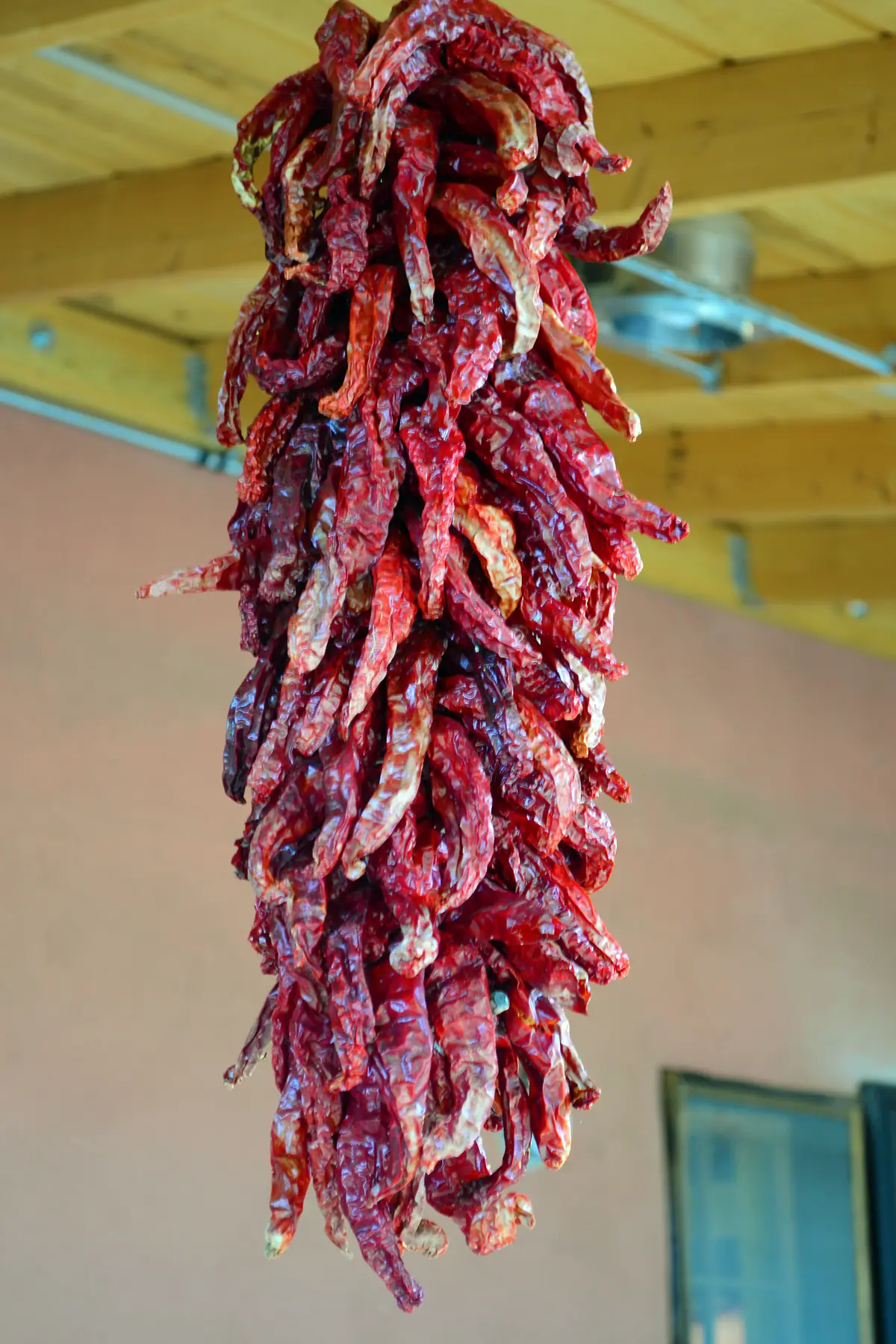
Red chile and ristras
Early October for the red harvest · Hatch and the Mesilla valley, the Rio Grande valley, backyard gardens
New Mexico State University’s growing guide calls early October the ideal time to harvest red chile, when most pods are ripe and partly dried and before any frost. A hard freeze on succulent red pods bursts the cells and lets mold in, so the pick is a race against the first cold night. Early-planted fields gave a green harvest in August and then ripened red. Watch for strings of drying pods on porches and fence rails.
-
Piñon nuts
Cones open late September and October · Piñon–juniper woodland statewide
A two-needle piñon cone needs about two summers to ripen, and the Forest Service’s species review says the cones open in late September and October. Big crops are irregular, every three to seven years, and dry years cut them short, so a heavy crop is news. On the Santa Fe National Forest no permit is needed to gather up to a bushel for personal use. Pick from the ground, and leave plenty for the piñon jays, Steller’s jays, scrub jays and Clark’s nutcrackers that cache the seeds and plant the next generation of trees.
-
Chamisa in bloom
August to November · Roadsides, arroyos and vacant lots statewide
Rubber rabbitbrush, the chamisa of every New Mexico roadside, is the late-season gold of the lowlands. According to the Lady Bird Johnson Wildflower Center it flowers from August into November, and its dense yellow heads feed bees, butterflies and the occasional late monarch. Navajo people made a yellow dye from the flower heads.
-
Monarchs: a mixed picture
Stragglers into early October · Chamisa and late asters, statewide
New Mexico sits where the eastern and western monarch migrations blur. The Southwest Monarch Study, which tags butterflies across the region, has found that they do not all winter in the same place; some reach central Mexico and some the California coast. A monarch on chamisa this month is worth a photo and a report.
Press one chamisa sprig and keep one piñon cone, dated, for the seeds, pods and cones plate. The cone tells you whether this was a good year for the jays.
What are elk, bears and other animals doing in October?
-
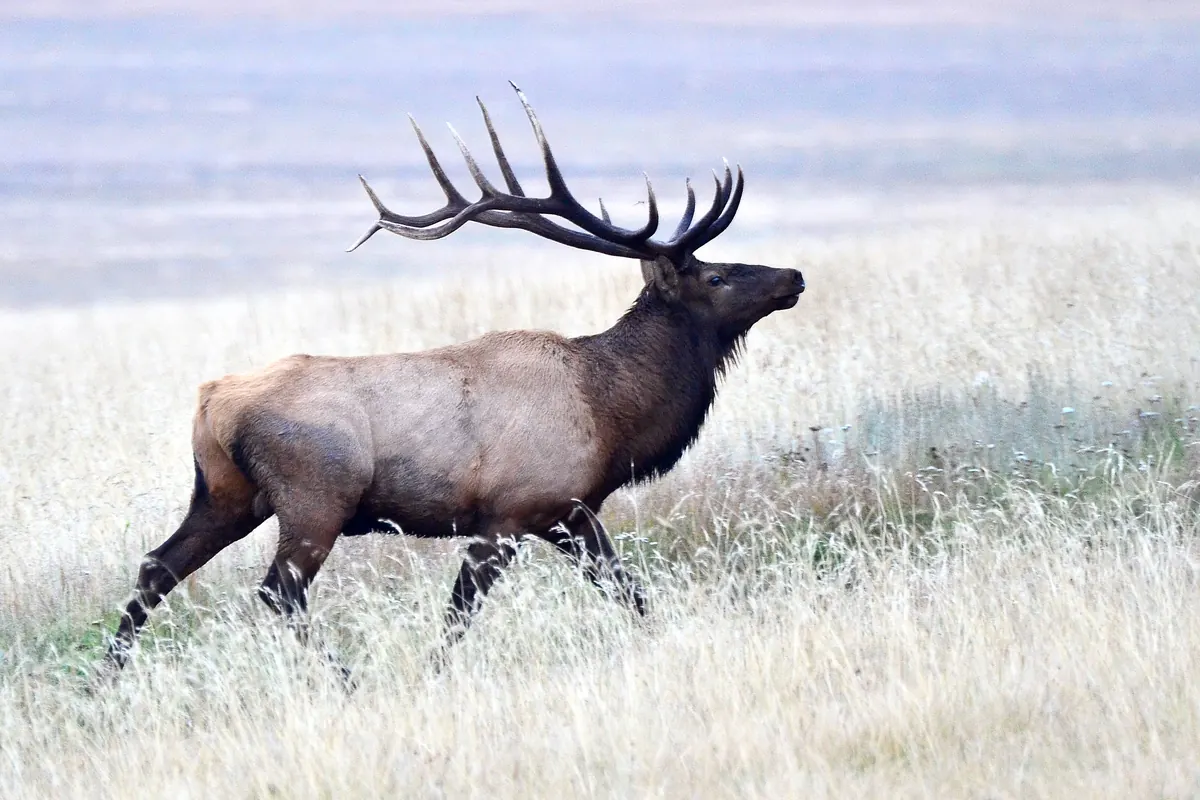
Elk: the rut winds down
September into early October · Valles Caldera National Preserve, Bandelier, the Pecos and Sangre de Cristo high country
The Park Service counts 2,500 to 3,000 elk in the Valles Caldera and calls the fall rut, with sparring bulls and bugling across the meadows, one of the preserve’s biggest draws; at Bandelier rangers describe the bugle as a high whistle in the upper canyons. The calling fades as October goes on and herds start drifting toward lower ground. Watch from the road with binoculars and stay well back from bulls.
-
Bears fattening up
Through October, before denning · Foothills of Santa Fe, Albuquerque, Los Alamos, Ruidoso, Cloudcroft and Raton
Black bears feed heavily in the fall before they den, and foothill neighborhoods offer easy calories. The New Mexico Department of Wildlife tells foothill residents to remove bird feeders while bears are active, because birdseed is rich and easy. Lock trash away, pick up fallen fruit, and keep pet food indoors.
-
New World screwworm near Mimbres
Detected September 17, 2026 · Grant County and the surrounding surveillance zone
The U.S. Department of Agriculture confirmed a case of New World screwworm, a fly whose larvae feed on living flesh of warm-blooded animals, near Mimbres in September. The Department of Wildlife asks hunters and anyone outdoors to watch for live or freshly dead animals with maggots or white egg masses in a wound, especially during the rut when bucks and bulls injure one another. Note the GPS location and call the department at 888-248-6866 for wildlife or the Livestock Board at 505-841-6161 for livestock.
-
The last crickets
Until the first hard freeze · Any warm evening
Field and tree crickets sing slower each cooler night until the cold stops them. For the cricket thermometer page, count a tree cricket for 14 seconds and add 40 to estimate the Fahrenheit temperature; the night the singing stops often falls within a few days of your first freeze.
What can New Mexico families do outdoors in October?
- October 3–11: Balloon Fiesta dawns. Mass ascensions on October 3, 4, 7, 10 and 11, weather permitting. Compare the flags at the north end of the field with the drift of the balloons overhead; when they disagree, you are watching the Albuquerque Box.
- Saturday, October 3: bats at Valle de Oro. The South Valley refuge holds “All About Bats,” 10 a.m. to 1 p.m., with crafts and open-air electric shuttle tours.
- Saturday, October 10: count birds. Bird-survey training for fall World Migratory Bird Day at Valle de Oro, 8 to 11 a.m.; October Big Day on eBird; and the Rio Grande Nature Center’s second-Saturday family walk at 10:30 a.m. (twelve people).
- Saturday, October 17: a day in the bosque. Owl stories (“Who Cooks for You?”) under the cottonwood at the Rio Grande Nature Center, 10:30 a.m.; then the Cosmic Carnival and Star Party at the Open Space Visitor Center, 1 to 10 p.m.
- Saturday, October 24: learn to birdwatch with city Open Space staff at USS Bullhead Memorial Park, 7:30 a.m.
- October 25–26: moonlight on gypsum at White Sands (see the sky section).
- Friday, October 30: Spooky Night Out at Valle de Oro, 6:30 p.m., a night shuttle ride and dark walk; reservations required.
- Any evening: the Carlsbad bat flight, then an alarm for the dawn return.
Times come from the organizers’ October 2026 calendars and can change; check before you drive.
Citizen science. Report monarchs to the Southwest Monarch Study and birds to eBird and the Birding Big Year. At home, have a child read the thermometer every breakfast for a month and draw the line on the colours of the day page; by Halloween it tells the season’s story.
Safety notes for October in New Mexico
- Hunting seasons, and orange. The New Mexico Department of Wildlife sets most 2026–27 big-game seasons by unit, but the common October windows are pronghorn October 3–5; elk muzzleloader October 10–14; elk rifle October 17–21 and 24–28; and deer rifle October 24–28 and October 31–November 4 in many units. Bear is open in most zones, though zones 2, 3, 9 and 12 had closed by mid-September. Duck season opens October 10 in the North Zone east of the Continental Divide, October 19 west of it and October 28 in the South Zone; the eastern sandhill crane season opens October 24. There is no statewide hunter-orange law: orange is required only on military land (144 square inches; a vest on Fort Bliss and McGregor Range) and for firearm elk hunters on the Valles Caldera (244 square inches), and the department strongly encourages it everywhere else. Hikers on forest and BLM land should wear a bright color on hunt weekends and give the dog an orange collar or vest.
- Fire closures. The Whiskey Fire closure on the Mountainair Ranger District and the Capilla Peak road closure remain in force, and the Sandia Crest “Switchback” hazard-tree project area is closed through January 15, 2027. Prescribed burns are planned on the Valle Vidal this fall. Check the forest’s alerts page before you go.
- Cold dawns, high altitude. Early October at the Sunport averages 75 °F in the afternoon and 49 °F at dawn, and the mountains can see snow any day. Carry a warm layer and a headlamp, and sunscreen above 10,000 feet.
- Plague and hantavirus. About half of all U.S. plague cases each year occur in New Mexico, and a rodent tested positive in Santa Fe County in July 2026. Keep pets on flea control, don’t handle sick or dead rodents or rabbits, and air out closed sheds before sweeping out mouse droppings.
- Screwworm, bears and bats. Report maggot-infested wounds on wildlife to the Department of Wildlife (see the animals section). Take down feeders in bear country. Never pick up a bat on the ground; call animal control.
- Canyon wind and flash floods. Strong east winds can blow through Tijeras Canyon with little warning, and an early storm can still fill a dry arroyo in minutes. Never drive into a flooded crossing.
Other states and months are collected on the nature hub, and our Naturalist’s Field Journal has room for every sighting on this page.
Sources
- Albuquerque International Balloon Fiesta: 2026 dates (October 3–11) and daily events
- Visit Albuquerque: Balloon Fiesta 2026 (54th event, mass ascension days)
- Albuquerque International Balloon Fiesta: weather information (gap winds and the Albuquerque Box)
- NWS Albuquerque: Balloon Fiesta climatology and the “Albuquerque Box” (PDF)
- NWS Albuquerque: El Niño and New Mexico winter and spring precipitation
- NWS Albuquerque: dates of first snowfall
- NWS Albuquerque: fall freeze dates for New Mexico
- Climate Prediction Center: ENSO diagnostic discussion, September 10, 2026
- Climate Prediction Center: seasonal outlooks
- New Mexico Tourism Department: fall colors routes (Enchanted Circle, Sunspot, Santa Fe byway)
- USDA Forest Service: fall colors, Southwestern Region (Aspen Vista, Sunspot byway, Gila)
- Taos.org: fall in Taos (first snow in town often near the end of October)
- Forest Service Fire Effects Information System: Fremont cottonwood (leaf senescence and fall)
- Bosque Ecosystem Monitoring Program: about BEMP science (litterfall monitoring)
- USFWS Bosque del Apache NWR: wildlife watching (first cranes and geese at the end of October)
- USFWS Bosque del Apache NWR: visit us (hours, fee-free days, construction closures)
- Friends of Bosque del Apache: Festival of the Cranes, December 2–5, 2026
- City of Albuquerque: sandhill cranes at the Open Space Visitor Center
- City of Albuquerque: Open Space Visitor Center fields for wintering birds
- City of Albuquerque Open Space: events calendar, October 2026
- HawkWatch International: Manzano Mountains HawkWatch (2026 season suspended)
- Cibola National Forest: alerts and closures (Whiskey Fire, Capilla Peak road, Sandia Crest)
- Friends of the Rio Grande Nature Center: birding and weekend bird walks
- Friends of the Rio Grande Nature Center: second-Saturday nature walks
- Friends of the Rio Grande Nature Center: fall 2026 newsletter (storytelling schedule)
- USFWS Valle de Oro NWR: events, October 2026
- BirdsCaribbean: October Big Day, Saturday, October 10, 2026
- New Mexico Department of Wildlife: 2026 Birding Big Year contest
- National Park Service, Carlsbad Caverns: Bat Flight Program
- National Park Service, Carlsbad Caverns: bats
- New Mexico Department of Wildlife: 2026–2027 fishing rules and information (kokanee snagging season)
- New Mexico Department of Wildlife: 2026–2027 hunting rules and information (season dates, blaze orange)
- New Mexico Department of Wildlife: 2026–2027 migratory game bird rules and information
- New Mexico Department of Wildlife: bear zone closure update (September 2026)
- New Mexico Department of Wildlife: hunters asked to watch for New World screwworm (September 18, 2026)
- New Mexico Department of Wildlife: news (Valle Vidal prescribed burn notice, September 21, 2026)
- New Mexico Department of Wildlife: bear activity in the Santa Fe foothills (bird feeders)
- National Park Service: Valles Caldera National Preserve (fall elk rut)
- National Park Service: Valles Caldera hunting (elk numbers, 2026 hunt dates)
- National Park Service, Bandelier: elk
- National Park Service, White Sands: Full Moon Night 2026
- National Park Service, White Sands: Moonlight Hike 2026 schedule
- Enchanted Skies Star Party, October 6–11, 2026
- Santa Fe National Forest: non-wood forest products (piñon nuts, mushrooms)
- Forest Service Fire Effects Information System: two-needle pinyon (cone opening, seed crops, seed-caching birds)
- New Mexico State University: H-230, Growing Chiles in New Mexico
- Lady Bird Johnson Wildflower Center: rubber rabbitbrush (chamisa)
- Southwest Monarch Study
- New Mexico Department of Health: plague
- New Mexico Department of Health: zoonotic diseases and 2026 news (plague-positive rodent, Santa Fe County)
- International Occultation Timing Association: occultation of Jupiter, October 6, 2026 (New Mexico reappearance times)
- U.S. Naval Observatory: sun and moon rise and set times
- EarthSky: meteor shower guide (Draconids and Orionids)
- EarthSky: visible planets (Saturn at opposition, Venus, Jupiter and Mars)
- Fred Espenak: full moons at perigee, 2001–2100
- NIST: daylight saving time
- Photos via Wikimedia Commons; licenses and photographers are credited under each picture
