What to look for in nature in New York this May
May is when New York finishes turning green. Warblers pour through Montezuma and Central Park in the middle of the month, bobolinks drop into the hayfields, and Atlantic sturgeon, a fish that can reach 14 feet, climb the Hudson to spawn. Piping plovers lay eggs on Long Island sand, loons settle onto their nests, turkey hens sit on a dozen eggs, and moose calves are born in the Adirondacks. Trillium, mayapple and lilacs bloom in the same weeks, the last spring freezes slip away in the north, and on May 20 the full Flower Moon takes an older Blue Moon label as well. Bring binoculars, a rain shell and tick repellent; May rewards early mornings.
Other months in New York: October, November, December, January, February, March, April.
Start here
- Be in the woods by 7 a.m. on a mid-May morning. Warblers and thrushes are most active in the first hours of daylight. Pick a refuge trail, a city park or a wooded lake edge, stand still, and let the treetops come to you. Montezuma says warbler numbers peak in the middle of the month.
- Stand at the edge of a hayfield at dusk. From about the middle of the month, bobolinks arrive and begin nesting in large open fields. Listen for the bubbling song over tall grass, and keep to the field edge so you do not trample a nest.
- Watch one tree or flower through the whole month. Choose a lilac, a trillium patch or a maple near home, visit it weekly, and write the date of each stage. Your notes can also go into a national phenology project.
Field Journal plates that fit May in New York: “birds I have seen” for the warblers, vireos and orioles of the second and third weeks; “a map of sounds” for the dawn order of thrushes and warblers and the first gray treefrog trill; “nest observed” for a loon, osprey or plover pair kept at a respectful distance; “the same place twice” pairing early March with the last week of May; “a tree through the seasons” for leaf-out from bud to canopy; “mammal watch” for a doe, a turkey hen with her brood or a northern moose; and “dusk and dawn watch” for the meteor mornings and the Flower Moon.
Regions used below: Adirondacks and North Country; Western New York and the Lake Erie shore; Finger Lakes and Central New York; Southern Tier and Catskills; Capital Region and Hudson Valley; New York City and Long Island.
Where can you see the warbler and shorebird peak in New York in May?
May is the month when birdwatchers across the state set an alarm. Songbirds that wintered in Central and South America move north at night and drop out of the sky at dawn, hungry, into whatever trees and marsh edges they find. The refuges and parks below are places where the pattern is easy to see.
-
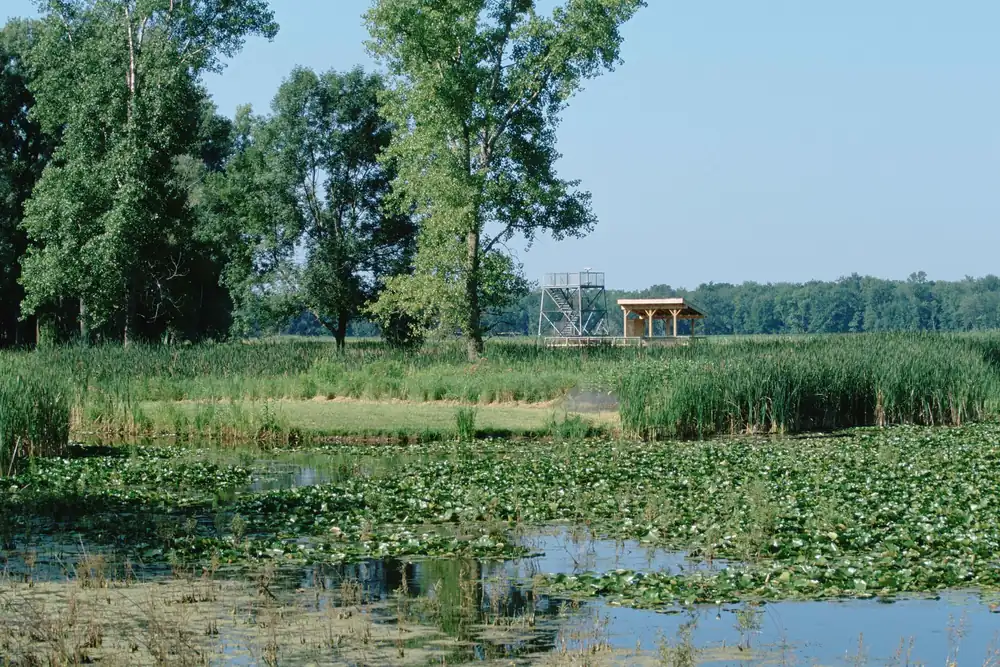
Warblers at Montezuma National Wildlife Refuge
The refuge says warbler numbers peak in mid-May · Seneca Falls, Finger Lakes
The U.S. Fish and Wildlife Service points birders to the Esker Brook Trails for migrating warblers. The refuge’s Wildlife Drive and Visitor Center are open daily from April 1 through November 30 (the Visitor Center from 10 a.m. to 3 p.m., depending on volunteer staffing), and one section, the Seneca Trail, stays off limits until September for the eagles’ sake, which leaves the Esker Brook paths and the drive for May.
-
Shorebirds on the refuge pools
Common from early May to mid-June at Montezuma · Montezuma and Iroquois refuges
Montezuma lists shorebirds as common from early May to mid-June, with peregrine falcons hunting over the flocks. Iroquois National Wildlife Refuge in western New York says shorebirds and warblers generally peak in May. Water levels move the birds: a pool with exposed mud will hold more sandpipers than one that is full to the edge.
-
Iroquois: goslings, herons and a cerulean warbler trail
Goslings first appear in May · Iroquois National Wildlife Refuge, near Alabama
Iroquois reports that goslings make their first appearance in May. The refuge also names a great blue heron rookery along Route 63, south of Oak Orchard Ridge Road, and says cerulean warbler, northern waterthrush and yellow-throated vireo can be found along Swallow Hollow Trail. Staff there lend binoculars and bird guides free.
-
Central Park and other city oases
Audubon says warblers peak in May and early June · Central Park, New York City
Audubon’s guide to Central Park calls the Ramble the most popular wooded spot for birding, especially along the stream known as the Gill, and adds that Summit Rock, with its treetop views, sometimes gives birders up to ten warbler species in a morning. It recommends arriving by 8 a.m., when birds are most active and the crowds are smaller. The NYC Bird Alliance, the city’s Audubon chapter, runs walks; its calendar for May 2027 was not posted yet, so look there nearer the date.
BirdCast, from the Cornell Lab and partners, runs its migration forecasts and live radar maps from March 1 to June 15, so a quick look the night before tells you whether a big flight is under way. Tally your species in the “birds I have seen” section of the Naturalist’s Field Journal, and read our April guide for the hawk flights and early arrivals that come first.
Where do bobolinks and other grassland birds nest in New York?
Hayfields and old pastures look quiet in May, but they hold some of the state’s most threatened nesters. Bobolinks, upland sandpipers and meadowlarks sit low in the grass, which is why a mowing date matters more to them than almost anything else.
-
Bobolinks arrive and begin nesting
Around mid-May, DEC says · Large open fields statewide
DEC says bobolinks reach New York and start nesting around mid-May in open grasslands and former hayfields with medium-tall grass and few shrubs or trees. A field of 5 to 10 acres is the minimum for successful breeding, and bigger fields hold more pairs. Bobolink numbers have fallen about 2 percent per year across North America since 1966, and in New York cutting hay during the nesting season is the main cause of nest failure. DEC recommends waiting to cut until after August 1, when the chicks have fledged, or mowing from the inside out so adults and older young can escape.
-
Washington County Grasslands
Nesting season runs from May into summer · Fort Edward, Washington County
DEC’s grassland management area lists bobolink, upland sandpiper, Henslow’s sparrow and eastern meadowlark among the birds to watch for, and part of it is a National Audubon Important Bird Area. The area is free and open year-round, with parking on Black House Road. Stay on the designated trails, and obey any sign that closes a section to protect birds in a critical phase of their lives.
-
The Grassland Bird Trust trail
Annual events; check the organizer · Washington County
The Grassland Bird Trust protects land for threatened grassland birds and keeps a birding trail through the county. Its 2026 raptor festival was held on a May Saturday, and a spring treasure hunt along the trail ran from May 1 to 15 that year; the group’s 2027 schedule was not out yet, so ask the organizer before planning a trip around either.
If you own or rent a hayfield, a call to your county Soil and Water office or to DEC’s regional wildlife staff is the quickest way to find out about delayed-mowing programs.
What is spawning in the Hudson River in May?
The Hudson is a tidal estuary, so its spring runs bring ocean fish a long way inland. By May the shad and herring runs are winding down and a much larger, older fish takes the stage.
-
Atlantic sturgeon return to spawn
May and June, with DEC monitoring near Hyde Park from mid-May through June · Hudson River Estuary
DEC says adult Atlantic sturgeon come back to the Hudson to spawn in May and June, then return to the ocean, while juveniles stay in the river for two to six years. The species can reach 14 feet and 800 pounds. NOAA Fisheries listed Atlantic sturgeon as endangered in 2012, and recreational and commercial fishing for them is prohibited in the Hudson River and the Marine District of New York. A 2024 stock assessment update suggests the coastwide population has probably risen since the 1998 fishery closure but remains far below historic levels. If you catch one by accident, release it carefully and report it to DEC. Do not handle a dead sturgeon; report it through DEC’s Marine Life Incident Report survey.
-
The end of the shad and river herring runs
DEC’s spawning-stock surveys run April through June · Hudson River
DEC’s Hudson River Spawning Stock Survey samples American shad from April through June with a haul seine and an electrofishing boat, measuring and tagging fish before returning them. For river herring (alewife and blueback herring), the surveys cover April through early June. Fishing for shad is prohibited in the Hudson River and the Marine District, and all Hudson shad fisheries closed in 2010, so any shad you catch by accident has to go back at once.
-
Eagles on Peebles Island
A May 21 Almanac entry from Waterford · Waterford, Capital Region
The Hudson River Almanac, DEC’s weekly natural history newsletter built from volunteer observations, includes a May 21 entry from Waterford that describes a bald eagle nest on Peebles Island “nearly fully camouflaged by leafy branches,” with three nestlings verified and the adults perching across the river to watch. The lesson for May is that leaf-out hides nests, so scan with binoculars from a respectful distance and watch the adults rather than the tree.
DEC’s Estuary Program also recruits volunteers to monitor juvenile glass eels in Hudson tributaries from late March through May. Check DEC’s regulations before you fish, and see the weather page for forecast tools before a day on the water.
Which birds and animals are raising young in New York in May?
May is the heart of the nesting season. A bird that looks lonely on a beach or lake is often sitting on a nest, and your best contribution is distance.
-
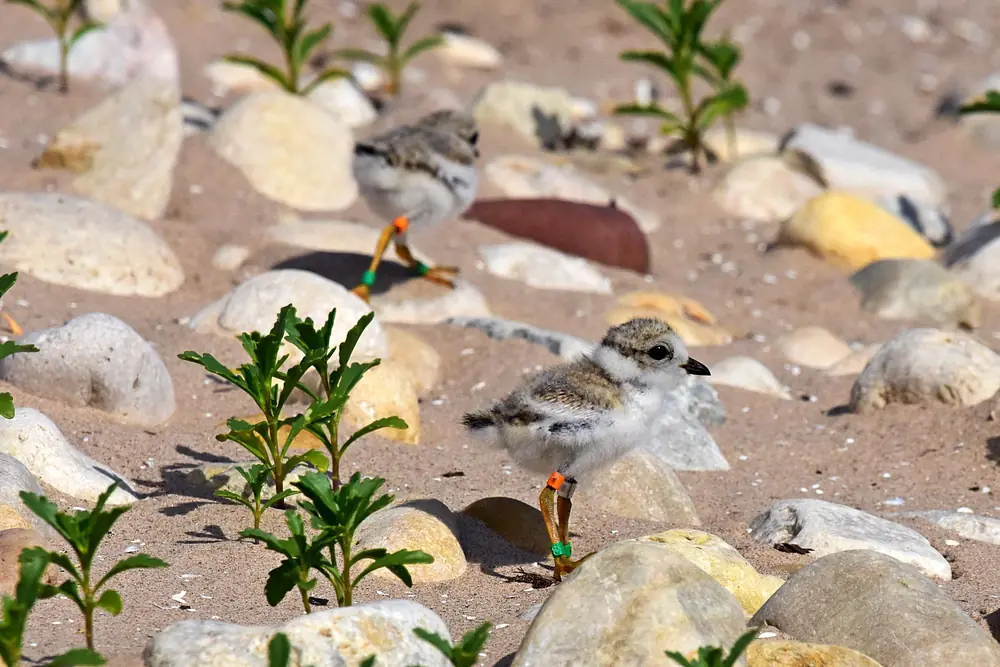
Piping plovers on Long Island sand
Eggs are laid in May and June, DEC says · Ocean beaches such as Fire Island
DEC says plovers arrive in early to mid-March, lay about one egg every other day until a clutch of around four is complete, incubate for 25 to 31 days, and need 28 to 35 days after hatching before the chicks can fly. DEC puts about 200 pairs of the Atlantic Coast’s roughly 800 pairs in New York, based on recent surveys. At Fire Island National Seashore, the Park Service says courtship and mating run from late March to early June and that pets, driving and kites are restricted on parts of the ocean beaches in nesting season; where dogs are allowed, they must be leashed. Stay out of the string fencing along the upper beach, and give a running chick room.
-
Loons on northern lakes
Two eggs are laid between mid-May and June · Lakes in the northern part of the state
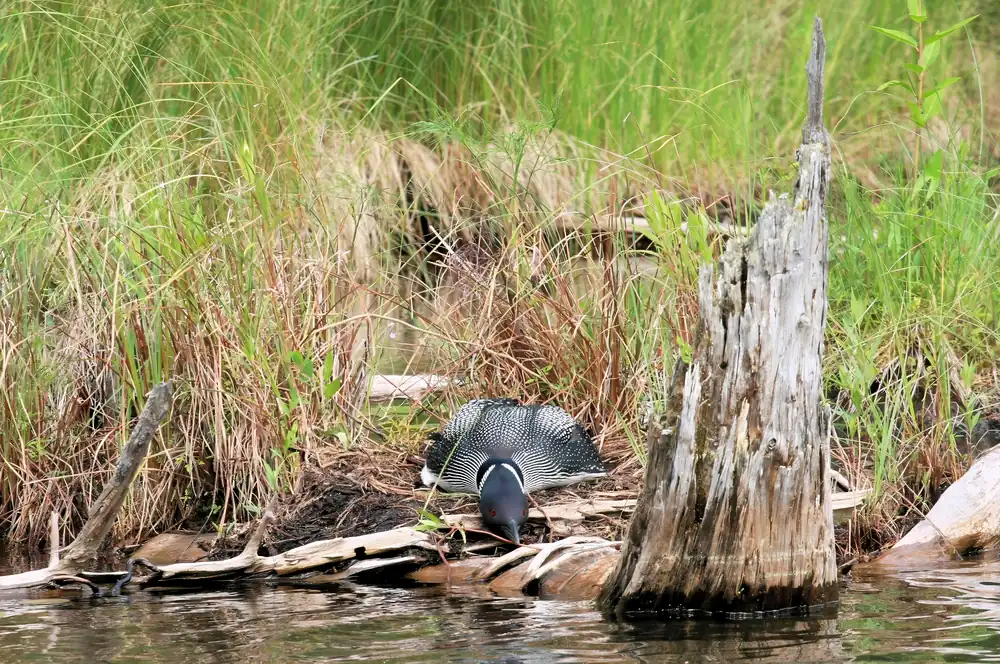
DEC advises staying back from nesting loons and loons with chicks, whether you are on land or in a boat. It also says boating that disrupts nest sites and nursery areas should be kept away from them in the breeding season. If a loon calls loudly or splashes toward your boat, back off.
-
Ospreys and bald eagles
Osprey young fledge at about eight weeks; eaglets leave the nest at about twelve · Platforms and tall trees near water
DEC says ospreys lay one to four eggs, usually three, and that nests are reused each year and can grow up to ten feet high. For bald eagles, DEC’s guidance defines the breeding season as January 1 to August 31 and says young leave the nest at around 12 weeks, in mid to late summer. Its distance table asks that activities within 660 feet of a nest be discussed with the U.S. Fish and Wildlife Service first; drones and aircraft have a larger distance of 1,000 feet. In plain terms: use a spotting scope and keep your drone at home.
-
Wild turkey hens on the nest
Eggs hatch after about 28 days, usually late May or early June · Woodland edges and fields statewide
DEC says the breeding season runs from early April to early June, and that hens nest alone and lay 10 to 12 eggs. Young turkeys can fly at about two to three weeks old. A hen that flushes from the ground near a trail may be leaving a nest, so back away quietly.
-
Fawns and other baby animals
Spring and early summer · Statewide
DEC’s guidance on watching wildlife says to leave wild baby animals where you find them, keep quiet, move slowly and be patient. Do not feed wildlife. A young animal alone is usually waiting for a parent that is feeding nearby.
Cornell Lab’s NestWatch project shows beginners how to find and log nests without disturbing them. Note any pair you watch in the “nest observed” pages of the Naturalist’s Field Journal, with date, weather and how far away you stood. When in doubt about an animal that seems abandoned, call DEC’s Bureau of Wildlife at 518-402-8883 before touching it.
Which frogs and toads are calling in New York in May?
The peepers have gone quiet in most places by May, but the pond has not. A new cast of callers takes over as the water warms, and the sounds are easy to learn by ear.
-
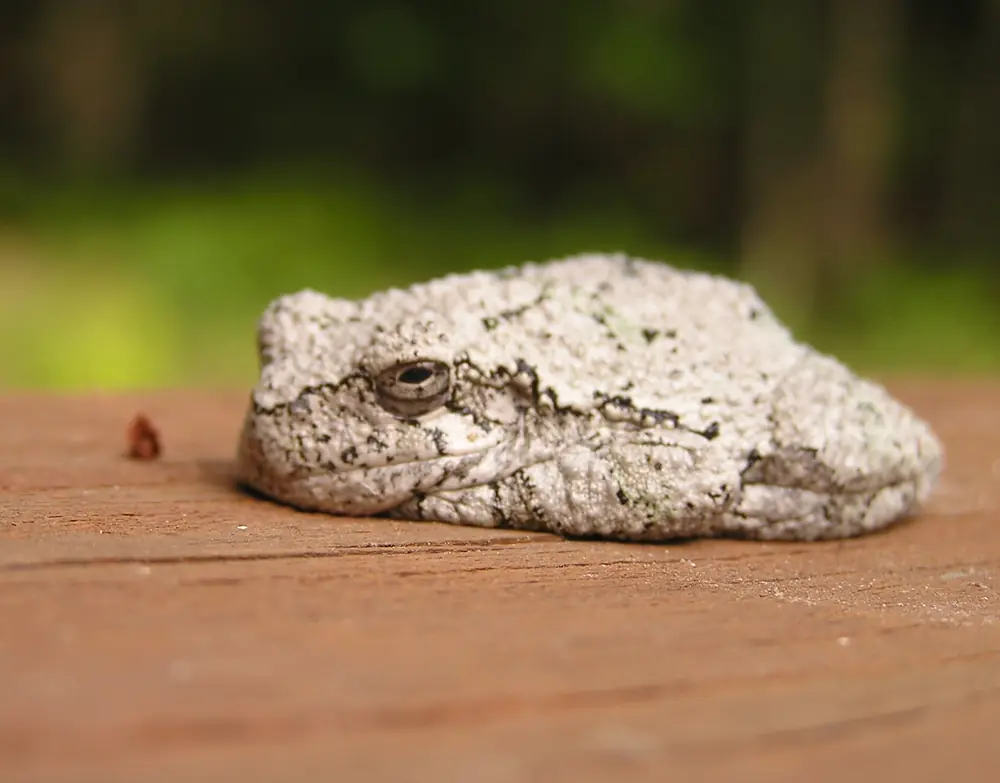
Gray treefrog
Breeding from late April to July, DEC says · Beaver ponds and red maple swamps
DEC’s guide describes a hearty trill, often sung from high in a tree near the breeding wetland. Adults gather at semi-permanent wetlands, usually beaver ponds and red maple swamps. You are more likely to hear a gray treefrog than to see one.
-
Green frog
Breeds from May to August · Ponds, marshes and lake edges
The male’s call sounds like plucking a loose banjo string. DEC’s guide notes the dorsolateral ridges that run down its back, which help tell it from the larger bullfrog. Bullfrogs breed later, starting in June, and the northern mink frog breeds from June to early August.
-
Eastern spadefoot after hard rain
April through September after intense storms · Sandy soils, including Long Island
DEC lists the eastern spadefoot as a Species of Special Concern. It breeds in temporary pools formed after intense rainstorms, and its voice is a coarse, repetitive “wank, wank, wank.”
Write your first date for each caller on the “a map of sounds” plate. Our April page covers the earlier chorus of chorus frogs, peepers and toads.
What blooms in New York in May?
May is when the woods floor flowers under a leafing canopy and parks turn into a color show. The Brooklyn Botanic Garden’s May list gives a useful sequence for the southern part of the state.
-
Woodland wildflowers
May at Brooklyn Botanic Garden · Woodlands, preserves and botanic gardens
The Garden’s May bloom list includes yellow trout lily, white wake-robin (the trillium), mayapple and spotted geranium, plus Canadian columbine, moss phlox, eastern shooting star, flame azalea and golden ragwort. Eastern redbud, flowering dogwood and fringe tree are the notable May trees. Bloom comes later in the mountains and the north, so treat the list as a sequence rather than a calendar.
-
Lilacs in Highland Park
Rochester Lilac Festival, May 7 to 16, 2027 · Highland Park, Rochester
The festival organizers say the 129th Rochester Lilac Festival will run May 7 to 16, 2027, in Highland Park, which they call home to the world’s largest collection of lilacs. They did not give a bloom forecast, and lilacs follow the weather, not the festival schedule, so check the bloom report before you go. The Garden’s May list also names lilacs, including the cultivars ‘Sensation’ and ‘Vesper Song’.
-
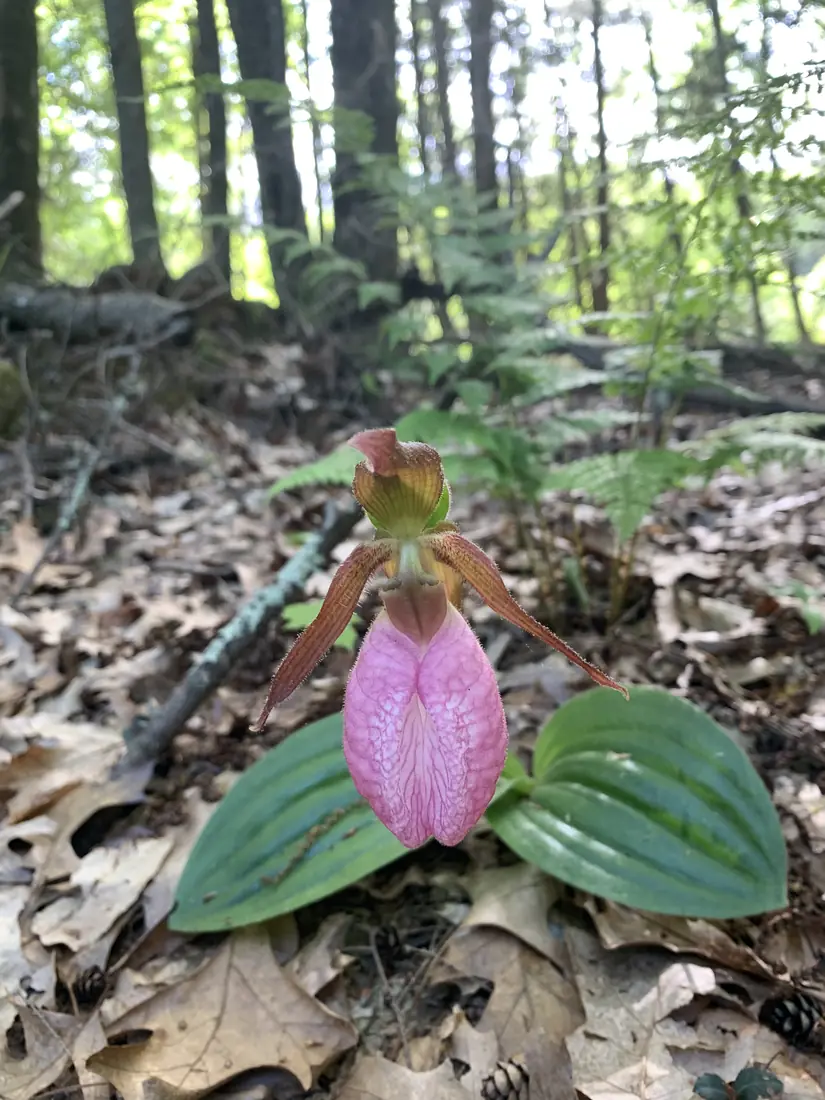
Pink lady’s slipper
The Forest Service says it flowers from May through July across the East · Acidic woods of pine, hemlock and birch
The U.S. Forest Service describes this orchid as growing in mixed hardwood and conifer stands on rocky or mossy slopes with deep humus and acidic, well-drained soil. Its seeds depend on a soil fungus to germinate, and the agency says harvesting wild lady’s slipper roots is not sustainable. Look, photograph and leave it where it grows.
-
Track the green-up
Leaf-out reaches the north in May · Statewide
The USA National Phenology Network publishes a Spring Leaf Index and Spring Bloom Index based on recent temperatures, using lilac and honeysuckle as stand-ins for the start of spring, and invites anyone to record observations in Nature’s Notebook, including through a cloned and common lilac campaign. Your notes help check the model.
Draw one flower on a “colours of the day” or “seeds pods and cones” plate of the Naturalist’s Field Journal and date it.
When is the last spring freeze in New York?
May is the last month a hard freeze can wreck a garden, a fruit blossom or a seedling in the north. Each city’s main station supplies three NOAA normals (1991–2020): an early date (the earliest tenth of springs were already finished with freezing), the median, and a late one (nine springs in ten had finished). A median of May 6 means half of all springs still see a freeze after it.
-
The north stays risky longest
Into the third week of May · North Country, Southern Tier
In the table, Plattsburgh’s nine-years-in-ten date is May 19 and Binghamton’s is May 18. Rochester and Buffalo are done with freezing by about May 8 to 9 in nine springs out of ten, while Montauk and the city finish in April. Higher ground, such as the Adirondacks and Catskills, can lag all of these stations.
-
Use the frost page for your own town
Any time · Statewide
Look up your own town on the New York frost page. A cold clear night after a warm day is the setup for a late freeze, so check the forecast and cover tender plants whatever the calendar says.
| Station | One year in ten | Median | Nine years in ten |
|---|---|---|---|
| Plattsburgh | Apr 24 | May 6 | May 19 |
| Buffalo | Apr 11 | Apr 24 | May 9 |
| Rochester | Apr 12 | Apr 24 | May 8 |
| Syracuse | Apr 16 | Apr 29 | May 13 |
| Albany | Apr 16 | Apr 27 | May 11 |
| Binghamton | Apr 19 | May 2 | May 18 |
| New York (JFK Airport) | Mar 20 | Apr 2 | Apr 13 |
| Montauk | Mar 26 | Apr 7 | Apr 20 |
These are statistical normals, not forecasts; the next mid-month update from the Climate Prediction Center is the place for the latest official outlook.
How warm and stormy is May in New York?
May swings from sweatshirt mornings to shirt-sleeve afternoons, and thunderstorms become a real part of the picture. The table gives NOAA’s 1991 to 2020 monthly normals for eight stations. Average lows run from 43.9 °F at Massena to 55.0 °F in Central Park, and every station averages between 2.86 and 3.96 inches of precipitation. For the newest official outlook, open the Climate Prediction Center and choose the 90-day product, which is refreshed once a month.
-
Thunderstorms, tornadoes and flash floods
Severe weather risk continues from spring into summer · Statewide
According to NWS Buffalo, New York averages six tornadoes a year, along with about 400 severe thunderstorm warnings, 17 tornado warnings and 150 flash flood warnings. The office names flooding as the greatest threat to life and property among the state’s hazards, and stresses that every thunderstorm produces dangerous lightning.
-
The burn ban ends May 14
March 16 through May 14 · Statewide
DEC’s statewide ban on residential brush burning runs every year from March 16 through May 14, and its March 2026 notice repeated those dates. DEC ties the ban to a simple fact: backyard debris fires start more spring wildfires than anything else. Small cooking fires and campfires in modest pits are still allowed, and burning garbage or leaves is banned all year.
| Station | Average high | Average low | Precipitation |
|---|---|---|---|
| Massena airport (St. Lawrence Valley) | 67.9 °F | 43.9 °F | 3.14 in |
| Syracuse airport | 69.2 °F | 47.3 °F | 3.42 in |
| Rochester airport | 69.4 °F | 48.2 °F | 2.86 in |
| Buffalo airport | 67.4 °F | 48.3 °F | 3.37 in |
| Binghamton airport | 66.2 °F | 46.1 °F | 3.78 in |
| Albany airport | 71.2 °F | 48.1 °F | 3.41 in |
| Central Park | 71.4 °F | 55.0 °F | 3.96 in |
| Islip (Long Island) | 68.3 °F | 50.8 °F | 3.28 in |
The weather page lists forecast tools, and the clouds guide helps you spot a storm building.
How much daylight does New York gain in May?
Days keep stretching in May, but the gain slows as the June solstice nears. Across the month Plattsburgh adds 64 minutes of daylight, Buffalo and Rochester 61, and Manhattan 55, roughly two minutes a day. By May 31 sunrise to sunset spans about 14 hours 52 minutes in the city and more than 15 hours upstate.
| City | May 1 | May 31 | Gained | Per day |
|---|---|---|---|---|
| Plattsburgh | 14 h 15 m | 15 h 19 m | 64 min | 2.1 min |
| Buffalo | 14 h 06 m | 15 h 07 m | 61 min | 2.0 min |
| Rochester | 14 h 08 m | 15 h 09 m | 61 min | 2.0 min |
| Syracuse | 14 h 07 m | 15 h 07 m | 60 min | 2.0 min |
| Albany | 14 h 05 m | 15 h 05 m | 60 min | 2.0 min |
| Binghamton | 14 h 03 m | 15 h 01 m | 58 min | 1.9 min |
| New York | 13 h 57 m | 14 h 52 m | 55 min | 1.8 min |
| Montauk | 13 h 59 m | 14 h 55 m | 56 min | 1.9 min |
For any other town, the daylight tool gives sunrise, sunset and day length by date.
What can you see in the New York night sky in May 2027?
All times below are Eastern Daylight Time. May has a dark-moon start and a bright-moon middle, a meteor shower made for the new moon, and the year’s best evening view of Mercury at the very end of the month.
-
The Eta Aquariids at new moon
Best mornings May 5, 6 and 7 before dawn · Any dark site with a view to the east-southeast
The new moon on May 6 means almost no moonlight, which is why this is an excellent year for the Eta Aquariids. Its season stretches from about April 19 to May 28. SeaSky names the night of May 6 into May 7 as the peak, and our own arithmetic lands a day sooner, so any of three pre-dawn watches (May 5, 6 or 7) is reasonable. SeaSky quotes up to about 30 meteors an hour across the Northern Hemisphere in ideal conditions. New York sits well north of the shower’s best latitudes, and the source point in Aquarius clears the horizon late, leaving a short window before dawn, so expect fewer: lie back, give it an hour and be patient.
-
The Flower Moon, also a seasonal Blue Moon
Full at 6:59 a.m. EDT on Thursday, May 20; look on the evening of Wednesday, May 19 · Eastern horizon at moonrise
The Moon turns full at 6:59 a.m., not long after sunrise, so the better show is moonrise on the evening of May 19, about 7:52 p.m. in New York City. Folklore calls the May moon the Flower Moon, and this one lands in the middle of lilac season. Astronomical spring 2027 has four full moons; the third, on May 20, is the one the older seasonal rule calls a Blue Moon; the modern two-in-one-month rule gives none in 2027. Neither name changes the Moon’s color.
-
Mercury in the evening
Greatest elongation May 28, best evenings about May 12 to June 5 · Low in the west-northwest after sunset
Mercury sits 22.9 degrees from the Sun in the evening sky on May 28, at greatest elongation, per SeaSky. Our calculations make mid-May to early June the window, with the planet low in the west-northwest roughly 45 to 90 minutes after sunset, and its best evening appearance of 2027 for northern observers. Start with a clear horizon and binoculars; a planet shines without twinkling.
-
Jupiter and the Moon, and a faint pairing before dawn
Evening of May 12; morning of May 7 · High in the evening sky; low in the east before sunrise
On the evening of May 12 our calculations place a half-lit Moon right beside Jupiter, easy to find without optics. Around May 7, Venus and Saturn sit less than a degree apart low in the east before sunrise, but they are so close to the horizon that you will want binoculars and an open view.
| Phase | Date | Time |
|---|---|---|
| New moon | Thursday, May 6 | 6:58 a.m. EDT |
| First quarter | Thursday, May 13 | 12:44 a.m. EDT |
| Full moon, the Flower Moon | Thursday, May 20 | 6:59 a.m. EDT |
| Last quarter | Friday, May 28 | 9:58 a.m. EDT |
The moon phases page shows the Moon for any date, and the clouds guide helps you judge a clear night.
What can New York families do outdoors in May 2027?
Spring is the season for counting things. These projects need nothing more than a phone, a notebook or a bit of patience.
-
City Nature Challenge
Observations April 30 to May 3; identifications May 4 to 16; results May 20, 2027 · Participating cities and regions
The organizers’ 2027 dates are posted. Participants photograph or record sound of wild plants and animals in their area, upload to iNaturalist or the region’s chosen platform, and help identify what others found. Not every region takes part, so check the challenge’s city list.
-
World Migratory Bird Day
Held each May; no 2027 date posted yet · Refuges, parks and nature centers
The organizers hold the North American celebration each May (it was May 9 in 2026), but they had not posted a 2027 date, theme or event list, so check the official site and ask local refuges and Audubon chapters.
-
Lights Out for migrating birds
Spring migration, March 1 to June 15 on BirdCast · Any building with night lighting
BirdCast says over 80% of the continent’s migrants fly at night, and that bright lights plus glass along their route can kill. Switching off decorative and unneeded lights on big migration nights costs nothing.
The nature hub links to every month and state.
Safety notes for May in New York
May brings the first real exposure to ticks and spring turkey hunters, and the usual hazards of fast water and storms.
-
Ticks
Active whenever temperatures are above freezing · Woods, brush, tall grass and leaf litter
The state Department of Health recommends long pants and long sleeves in wooded or grassy areas, a repellent with DEET, picaridin or IR3535, frequent tick checks, a shower soon after coming indoors, and about ten minutes in a hot dryer for the clothes you wore. To remove one, grip it with fine-point tweezers close to the skin and pull straight up. Lyme disease is spread when a tick stays attached for 36 hours or more; the most common sign is an expanding or bull’s-eye rash, and fever, chills, aches or fatigue can follow within 30 days.
-
Spring turkey season
Recent seasons have opened May 1 and run through May; check the 2027 dates in DEC’s regulations guide · Wooded edges statewide
In spring only bearded birds may be taken, DEC says (the season dates are set each license year), with hunting from 30 minutes before sunrise until noon and a limit of two bearded birds for the season, one a day. A hunting license and a turkey permit are required. DEC recommends orange when you walk into and out of the woods and an orange item hung on a tree beside your calling spot, and it tells hunters to avoid wearing red, white or blue. If you hike in turkey woods in May, a bright orange hat or vest is cheap insurance.
-
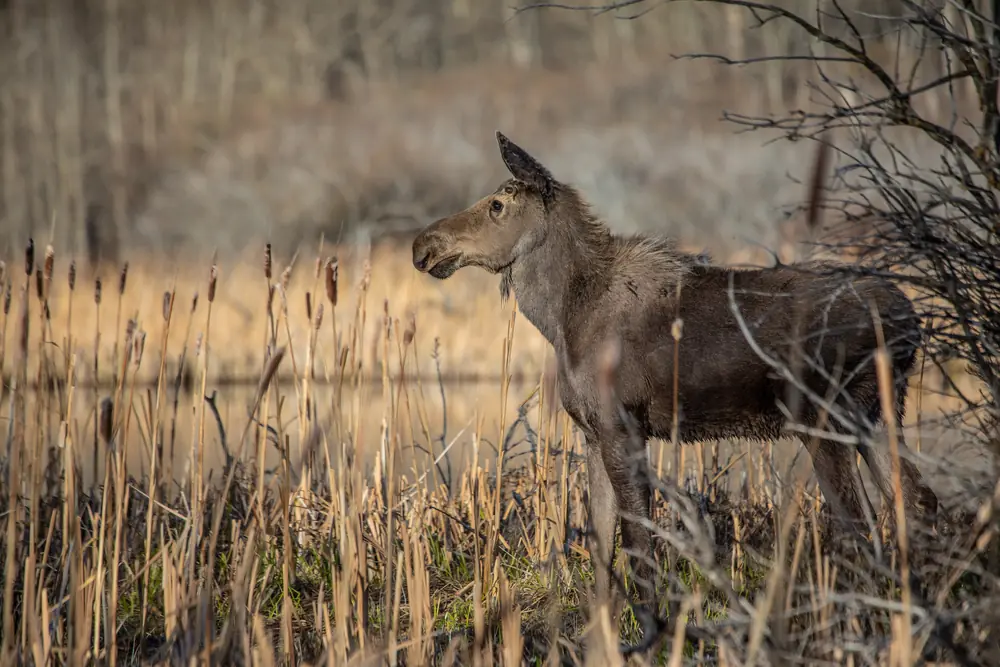
Moose calves
Born in late May or early June · Adirondacks
DEC says moose calves are typically born in late May or early June, after a pregnancy of about 230 days, and weigh 20 to 25 pounds at birth. The department estimated roughly 600 to 700 moose in the Adirondack region as of 2018. DEC says the best way to avoid hitting a moose is to slow down, especially from dusk to dawn.
-
Turtles crossing roads
May and June · Roads near rivers and marshes
DEC says native turtles are on the move in May and June, looking for sandy areas or loose soil to lay eggs, and that vehicles kill thousands of them every year. Slow down near water. If it is safe to stop, move a turtle to the shoulder in the direction it was facing, hold most turtles at the sides of the shell, not the tail, and take extra care with snapping turtles. Do not take a turtle home: native turtles are protected and cannot be collected without a permit.
-
Fishing seasons
Trout harvest season has been open since April 1; stocking runs into early June · Streams and lakes statewide
DEC’s trout news says stocking runs from March into early June. Seasons and limits for other fish vary by species and water, so check the current regulations guide, and confirm the 2027 rules when DEC posts them.
-
Black bears and bird feeders
Spring, when natural foods are scarce · Adirondacks, Catskills and beyond
DEC says about 50 to 60 percent of New York’s bears live in the Adirondacks and 30 to 35 percent in the Catskills, with well-established populations in Tug Hill, the Hudson Valley and the Southern Tier. Feeding bears on purpose is illegal, and bird seed is on DEC’s list of foods that draw them, so take feeders in at night and keep garbage and camp food sealed.
-
Trail conditions
DEC issues advisories each spring · Adirondack High Peaks and other high trails
DEC’s spring conditions advisory for the Adirondacks, issued in March 2024, urged hikers to avoid trails above 2,500 feet while thin snowpack, icy “monorails” and post-holing made footing unreliable. At low elevations it warned of ice, thick mud, flooded areas and slush. It advises walking through mud rather than around it to limit erosion, avoiding stream crossings in high water, because cold water can cause fast hypothermia, and carrying the ten essentials. That advisory was for that year; each spring DEC posts a fresh one and weekly backcountry updates, so check before you go.
See the weather page before any outing.
Sources (45)
- USFWS: Montezuma National Wildlife Refuge, species
- USFWS: Montezuma National Wildlife Refuge, visit us
- USFWS: Iroquois National Wildlife Refuge, seasons of wildlife
- USFWS: Iroquois National Wildlife Refuge
- Audubon: the insider’s guide to birding in Central Park
- NYC Bird Alliance
- BirdCast: migration forecasts and live maps
- World Migratory Bird Day
- DEC: bobolink
- DEC: Washington County Grasslands Wildlife Management Area
- Grassland Bird Trust
- DEC: Atlantic sturgeon
- DEC: American shad in the Hudson River
- DEC: river herring
- DEC Hudson River Estuary Program: community science volunteer opportunities
- DEC Hudson River Estuary Program: Hudson River Almanac
- DEC: piping plover
- NPS Fire Island National Seashore: piping plovers
- DEC: common loon
- DEC: osprey
- DEC: bald eagle
- U.S. Forest Service: pink lady’s slipper (plant of the week)
- DEC: wild turkey
- DEC: wild turkey hunting
- DEC: turkey hunting regulations
- DEC: moose
- DEC: black bear
- DEC: white-tailed deer (watching wildlife and baby animals)
- DEC: amphibians and reptiles (turtles on the move)
- DEC: frogs and toads of New York (Conservationist reprint)
- Brooklyn Botanic Garden: plants in bloom in May
- Rochester Lilac Festival
- USA National Phenology Network: Status of Spring
- NOAA NCEI: 1991–2020 monthly normals, station files
- National Weather Service Buffalo: Severe Weather Awareness Week
- DEC: statewide residential brush burning prohibition (2026 notice)
- Climate Prediction Center: seasonal (90-day) outlooks
- DEC: spring conditions advisory for the Adirondacks (March 2024)
- New York State Department of Health: tick prevention
- DEC: April 1 start of spring trout season (2024)
- City Nature Challenge
- Cornell Lab of Ornithology: NestWatch
- Sea and Sky: astronomy calendar of celestial events 2027
- U.S. Naval Observatory: phases of the Moon
- Photos via Wikimedia Commons; licenses and photographers are credited under each picture
