What to look for in nature in Pennsylvania this April
April is when Pennsylvania’s woods change from brown to green in public. Red maples and serviceberry flower first, and the forest floor fills with trillium and Virginia bluebells in the middle of the month. Broad-winged hawks stream past Hawk Mountain, bald eagle eggs hatch, ruffed grouse drum, peepers and green frogs sing, and the first wave of warblers arrives in the last week. Trout season opens at creeks across the state, timber rattlesnakes leave their dens, and the days gain more than an hour. Full Pink Moon arrives on Tuesday the 20th.
Other months in Pennsylvania: October, November, December, January, February, March.
Start here
- Walk a creek-side trail in mid-April. Pick a morning when the canopy is still bare and look for trillium, bluebells and trout lily on moist slopes. Take a notebook and leave the plants alone.
- Watch the sky from a ridge. On a mild, cloudy day with a south wind, sit at an open overlook and look for hawks riding the air. Hawk Mountain’s count runs through mid-May.
- Listen after dark on a warm night. Stand at the edge of a wooded pond a few minutes after dusk and listen for peepers, then count the species of frogs you can pick out.
On the Naturalist’s Field Journal plates, put the first warbler and hummingbird of spring on birds I have seen, follow one maple or serviceberry on a tree through the seasons, log an eagle or osprey on nest observed, revisit one trillium patch for the same place twice, and note the wind and cloud on the daily field log on hawk days.
Regions used below: Northwest and Lake Erie; Allegheny National Forest and the Northern Tier; Laurel Highlands and Pittsburgh; Central Ridge and Valley and State College; Poconos and the Northeast; Susquehanna Valley and Harrisburg; Southeast and Philadelphia.
Which songbirds arrive in Pennsylvania in April, and where do they land first?
April is when northbound migration stops being a trickle. The first half of the month belongs to hardy early birds such as kinglets, towhees and phoebes. The last week brings the first real wave of warblers. Powdermill Nature Reserve, a banding station in Westmoreland County, kept a diary of one spring that shows the order well: in 2009 an eastern towhee was banded on April 9, a ruby-crowned kinglet on April 12, a yellow-rumped warbler on April 22, and then the last week of April brought the first push of warblers, with April 25 the best banding day of the month (75 birds of 27 species, including a worm-eating warbler). One spring is only one spring, so treat those dates as a rough sequence rather than a schedule.
-
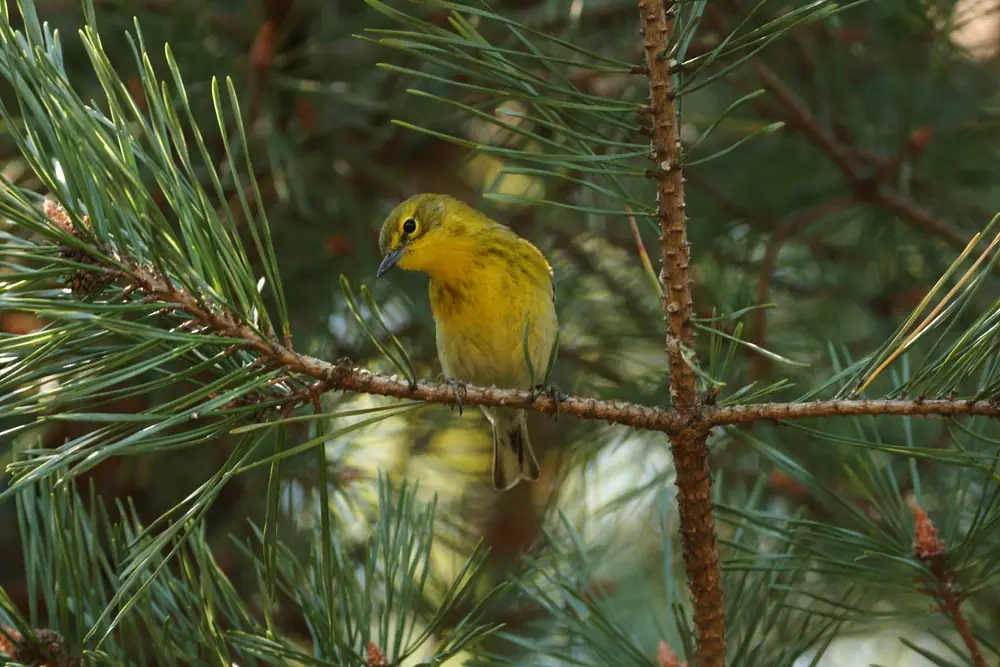
Pine and yellow-throated warblers
Early April in the southeast, with more species each week · Pine woods and wooded river bottoms near Philadelphia; John Heinz National Wildlife Refuge at Tinicum
The Delaware Valley Ornithological Club’s April guide says neotropical migrants begin to appear in the region early in the month, with pine and yellow-throated warblers among the first. Its Pennsylvania recommendation is the Heinz refuge at Tinicum in Philadelphia County, which it calls great for passerine migration. A pine warbler is a plain yellow bird that sings a musical trill from the tops of pines, a good first target before the brighter warblers come through.
-
Kinglets, black-throated greens and the first warbler wave
Mid-April for kinglets; last week of April for the first warbler push · Woodland edges, creek bottoms and shrubby hillsides statewide
Penn State Extension’s April phenology notes list ruby-crowned kinglets and black-throated green warblers among the birds returning during the month, at about the same time that deer shed their winter coats and bats come out of hibernation. A ruby-crowned kinglet is a tiny olive bird that flicks its wings constantly. Look for the first mixed flocks in the last week of the month, when trees are still bare enough to see into.
-
Presque Isle and the Lake Erie shore
Waterfowl and early migrants in April; songbird diversity peaks in mid-May · Head of the Bay, the Pine Tree, Dead Pond and Fry’s Landing trails, and Gull Point at Presque Isle State Park
Presque Isle Audubon’s birding guide says the peninsula’s shape and its place on Lake Erie’s south shore concentrate migrant land birds, especially in spring, and that songbirds peak in mid-May, with shorebirds a week or so later. April is the shoulder: early migrants and waterfowl, with raptors streaming above the bluff as they follow the shoreline to the northeast. The Department of Conservation and Natural Resources (DCNR) notes that the easternmost part of Gull Point is closed to protect resting and nesting shorebirds, though visitors can watch from the observation platform along the Gull Point trail. The brochure and the DCNR page give different closing dates for that closure, so read the park’s current signs.
-
Ruby-throated hummingbirds
Typically around May 1, with some arriving in late April · Feeders and flower beds statewide
According to the Game Commission, ruby-throated hummingbirds usually reach Pennsylvania about May 1, and in early springs a few show up sooner. Many return to the exact feeder they used the year before, so late April is the time to clean and fill yours, and to write the date of the first visitor in your journal.
Record each first arrival in your Naturalist’s Field Journal. After a few years your own dates will be more useful than any chart. For the late-winter birds that this month replaces, see the March page.
When and where can you watch hawks migrate over Pennsylvania in April?
March was for golden eagles. April belongs to broad-winged hawks, the small crow-sized hawks that spend winters in Central and South America and travel north in loose flocks over the ridges.
-
Hawk Mountain’s spring watch
The count has run from April 1 to May 15 in recent years; mid-to-late April is the usual peak · North Lookout, Hawk Mountain Sanctuary, Berks and Schuylkill counties
The sanctuary has counted the spring flight since the 1960s and reports an average of about 1,000 raptors per season, far fewer than in autumn. Hawk Mountain says the best days are in mid-to-late April, especially with southerly winds and cloud, when more than 100 birds can pass in a day. The 2025 season shows how lumpy it can be: 1,271 raptors in all, including a record 885 broad-winged hawks, and one big day on April 18 with 581 birds, after storms elsewhere pushed migrants through in a concentrated pulse. The count ended early that year because of fog and rain. Published hours in recent years were daily, roughly 9 a.m. to 4 p.m.; check the sanctuary for its 2027 schedule and fees.
-
Raptors along Lake Erie
April into May · The bluff and shoreline at Presque Isle State Park
Presque Isle’s guide notes that raptors can be seen anywhere on the peninsula, with the highest numbers streaming above the bluff as they follow the shoreline to the northeast. DCNR lists ospreys and bald eagles among the birds seen during migration there.
-
Reading the day
Warm, cloudy mornings with a south wind · Any open ridge or hilltop with a wide view
Hawks ride rising air, so a still, cold morning is quiet and a mild, breezy one from the south is often busy. Bring binoculars, a folding chair and patience, and note the wind direction in your log.
The cloud page helps with the second half of that rule: low gray cloud with a south wind is exactly the kind of day Hawk Mountain describes.
What are eagles, ospreys, grouse and turkeys doing in Pennsylvania in April?
April is nest month. The woods are still open enough to see into, and several of the state’s showiest birds are busy at one place, which makes them easy to find.
-
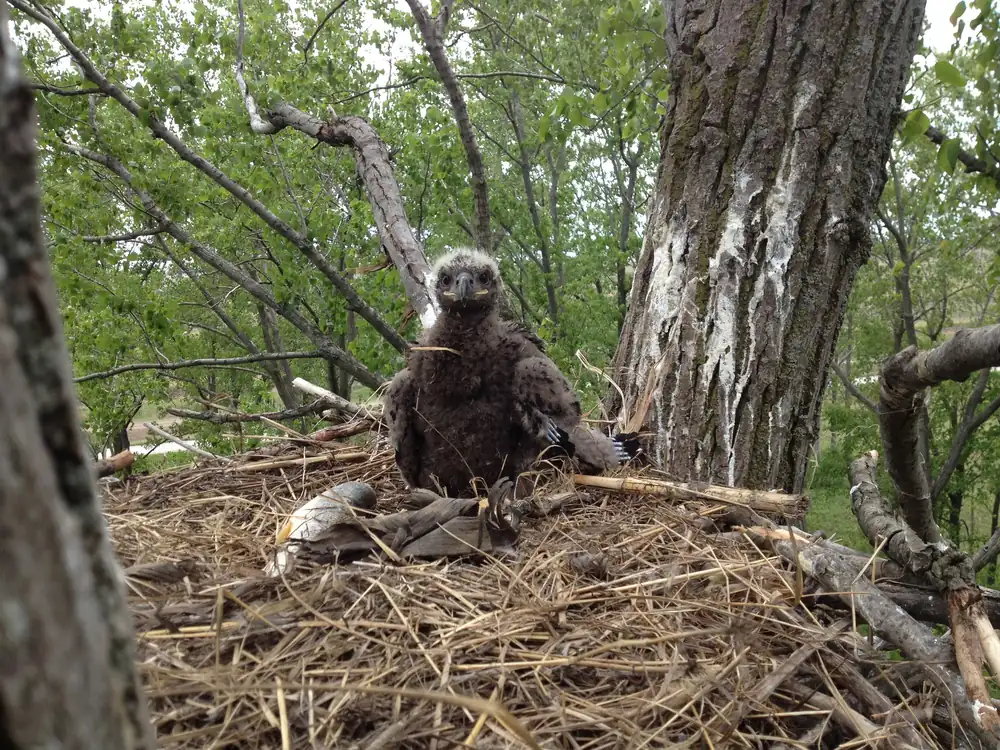
Bald eagle eggs hatching
Eggs commonly hatch in April; late April is the best time for nest watching · Heinz refuge at Tinicum, Middle Creek, the lower Susquehanna, Raystown Lake, Lake Glendale at Prince Gallitzin State Park, the upper Delaware, State Game Lands 180 at Shohola Lake, Promised Land and Bald Eagle State Park
According to the Game Commission, incubation takes about 35 days, the eggs hatch one at a time with one to four days between, and the eaglets spend roughly 8 to 14 weeks in the nest before flying in late June or July. Its eagle-watching page adds that late April is probably the best time to see nesting activity, with adults busy feeding the growing eaglets before the trees leaf out. Nesting has recovered from three pairs in 1980 to more than 300 nests today. Watch through binoculars or a scope from a respectful distance.
-
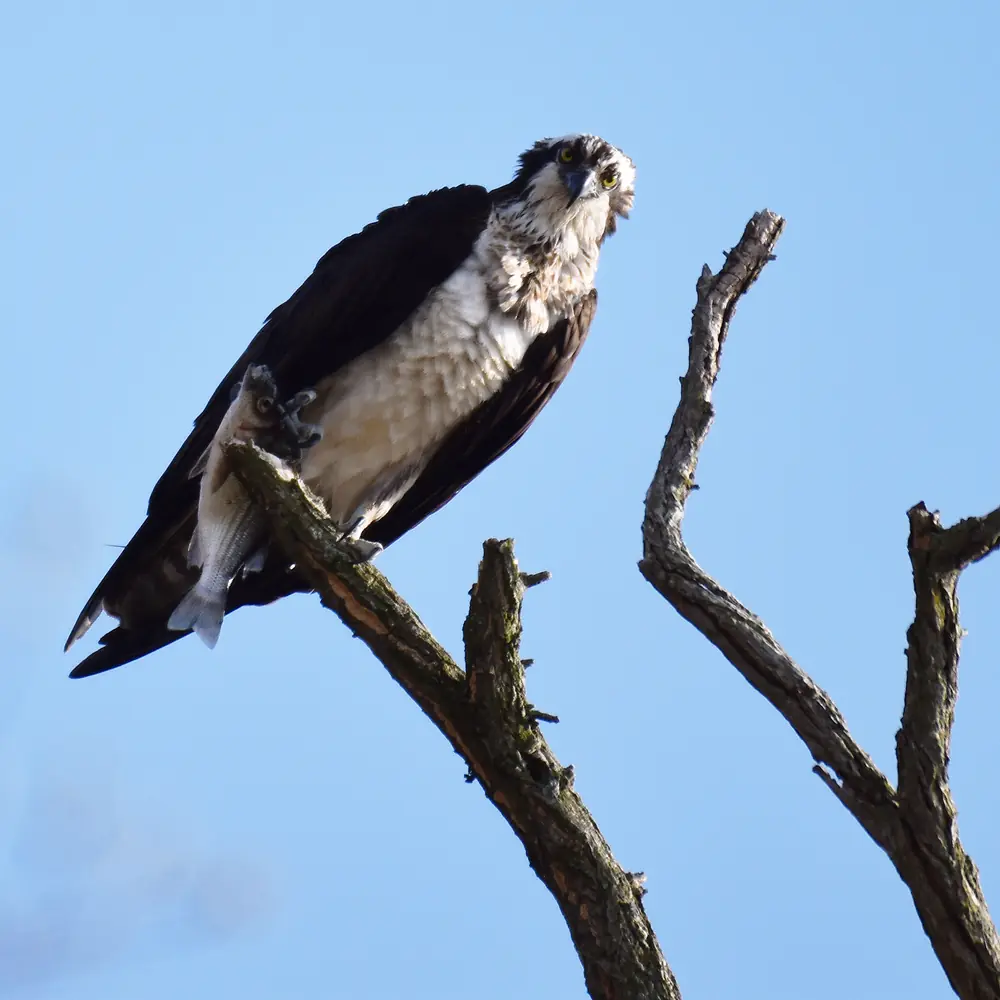
Ospreys on their platforms
Back since late March or early April; nest building and egg laying in April · Lakes, reservoirs and rivers; platforms and poles
In the Game Commission’s wildlife note, ospreys are back by late March or early April, and most nests sit on artificial structures, bulky piles of sticks that grow larger each year. Ospreys came back to the state in the 1980s, and the first nesting pair since 1910 was recorded in 1985. The note adds that a 2010 survey counted 115 nests in 21 counties. Ospreys fish by hovering and diving feet first, so a good place to look is open water with a nest pole nearby.
-
Ruffed grouse drumming
March and April · Young forest, thick brush and logging cuts
Pennsylvania’s state bird since 1931 attracts mates by drumming. The male stands on a log or boulder and beats his wings until the beats merge into a whir. The Game Commission says grouse do best in brushy, young forests less than 20 years old. In the morning it is a soft thump heard through the woods more than seen. A hen later lays 6 to 16 eggs in a leaf-lined hollow at the base of a tree or beside a log.
-
Gobbling turkeys
Dawn, all month · Open woods next to fields
The Game Commission’s spring turkey advice tells scouts to listen at daybreak for gobbles. You do not need a license to listen. Youth hunters have their own spring days before the regular season; the dates are in the safety section.
When do trillium and Virginia bluebells bloom in Pennsylvania?
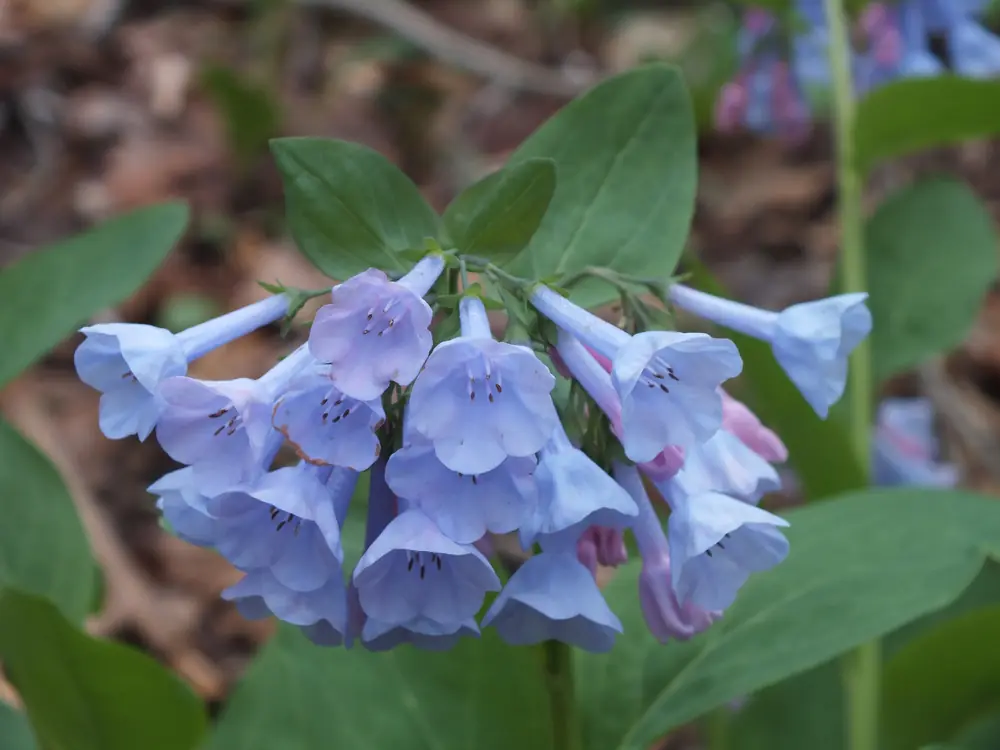
The forest floor does its work before the canopy closes. Penn State Extension’s notes say the woodland carpet begins early in April with trailing arbutus, hepaticas, wild ginger, twinleaf and violets, and the larger showpieces follow as the month goes on. The Pink Moon on April 20 is traditionally named for moss pink, or wild ground phlox, which is another early flower.
-
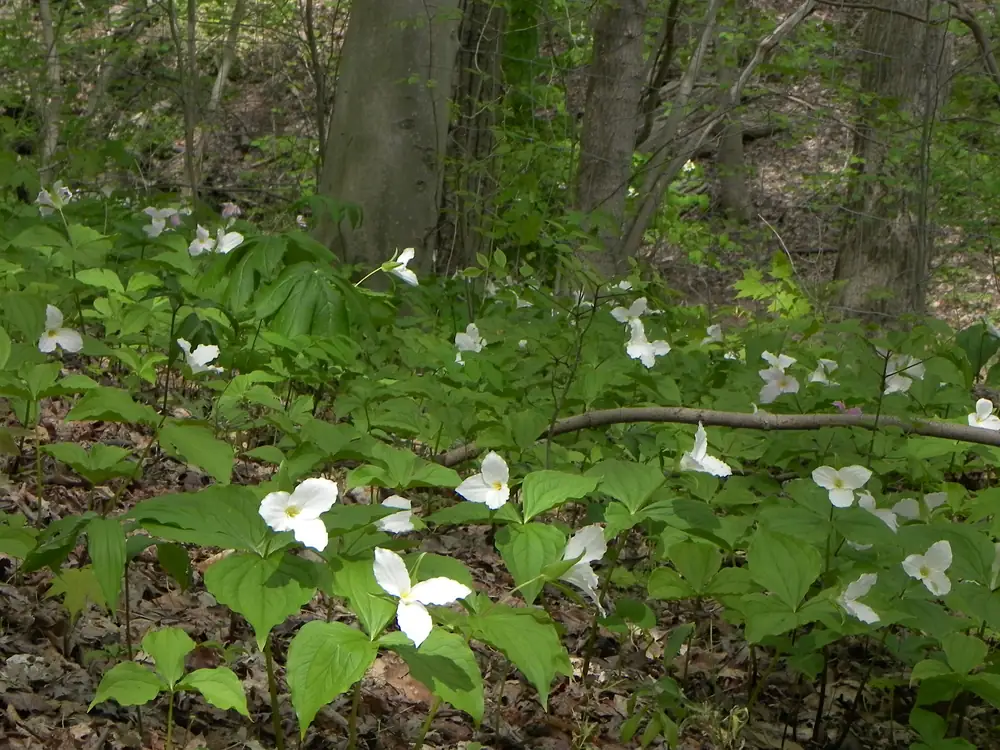
Trillium at Ohiopyle
April is when trillium thrives; the park’s annual DCNR wildflower hike was held April 18 in 2026 · Great Gorge Trail and the Cucumber Falls area at Ohiopyle State Park, Fayette County
A local guide to the park recommends parking at Cucumber Falls, then crossing the bridge to the Great Gorge Trail, where the most abundant flowers grow on the stretch just right of the bridge’s end. Red and white trillium are the stars. DCNR runs a springtime wildflower hike at the McCune trailhead, but no 2027 date is posted, so ask the park office. Trillium are slow growers, so photograph rather than pick.
-
Virginia bluebells and woodland ephemerals
Especially vivid from mid-April through May · Bowman’s Hill Wildflower Preserve, Bucks County
The preserve calls Virginia bluebells a signature spring plant and describes carpets of spring ephemerals from mid-April through May. Its published hours in April to June have been 9 a.m. to 5 p.m. daily, with last admission at 4 p.m.; confirm the 2027 hours before you go. The flowers open and fade quickly in warm weather, so go early in the season rather than late.
-
Trout lily, hepatica and Dutchman’s breeches
April, depending on elevation and weather · Rich woods and shaded creek slopes
Trout lily leaves, mottled like a brook trout’s back, carpet moist hillsides well before the yellow flowers open. Hepatica leaves persist through winter and the small flowers appear on warm slopes. Note where you find them in April and return next year to compare dates.
The March page covers the very first bloomers, such as spring beauty and bloodroot. Look, take a photograph and leave the plants where they are.
When do Pennsylvania’s trees flower and leaf out, and when is the last frost?
The trees do their own calendar in April. Penn State Extension says red maples flower first and give the landscape a reddish hue, followed soon by aspen, birch and tulip poplar, while spicebush shrubs show small yellow-green flowers. A DCNR forester told ABC27 that serviceberry is often the first tree to flower, that silver maples show buds earliest, and that northern hardwoods such as maples and birches leaf out before oaks and hickories, with soil near 50 °F starting leaf growth and buds taking about a month to become leaves.
-
Morel season
Extension’s guide ties it to weather, not a date: days near 60 °F with nights above 40 °F, typically mid-to-late April · Old orchards, tulip poplar and ash woods; check land rules before foraging
Penn State Extension describes morels as emerging when daytime highs are around 60 and nights stay above 40. Never eat a wild mushroom unless you are certain of the species, and ask permission or check the rules before collecting on public land.
-
Earth Day and Arbor Day
Earth Day is Thursday, April 22, 2027; Pennsylvania’s Arbor Day is the last Friday in April, which is April 30, 2027 · Your own block, a park or a school
The Congressional Research Service’s fact sheet lists the last Friday in April for Pennsylvania. It is a good week to pick one tree near home and follow it: swelling buds, flowers, leaves, and the date each stage begins. The journal’s tree through the seasons plate is made for this.
| Station | One year in ten | Median | Nine years in ten |
|---|---|---|---|
| Bradford | Apr 30 | May 18 | May 31 |
| Wilkes-Barre/Scranton | Apr 9 | Apr 23 | May 10 |
| Johnstown | Apr 14 | Apr 29 | May 17 |
| Williamsport | Apr 12 | Apr 24 | May 11 |
| Harrisburg | Apr 1 | Apr 15 | May 2 |
| Pittsburgh | Apr 9 | Apr 23 | May 12 |
| State College | Apr 7 | Apr 20 | May 6 |
| Erie | Apr 10 | Apr 26 | May 13 |
| Philadelphia | Mar 21 | Apr 4 | Apr 17 |
Each row is one main weather station per city, so a town at a different elevation can run days off these dates; our frost page lists more places. A warm week can open buds well ahead of the median, and in one spring out of ten a hard freeze still arrives after the last column, which is why many gardeners hold tender plants until May.
What frogs, salamanders and snakes are active in Pennsylvania in April?
The frogs and toads that began in March keep singing, and the snakes begin to wake. Warm rain remains the cue for most of them.
-
Spring peepers in full chorus
April evenings, especially after a warm rain · Wooded ponds, swamps and wet ditches
The National Park Service describes the peeper’s call as one clear note repeated about once a second, a high piping whistle that slurs upward, and says peepers in the northern parts of their range breed from March to June. A big chorus sounds like sleigh bells from a distance. The singer is a frog about an inch long, so look for the glow of a dim flashlight on a swelling throat sac and then turn it off.
-
Green frogs
Spring through summer; the banjo call usually begins when the weather settles warm · Pond edges, slow streams and swamps
The Chesapeake Bay Program’s field guide says green frogs breed from spring into summer and that their call resembles a plucked banjo string, a single brief “gunk.” They are two to four inches long, bigger than the peepers.
-
Spotted salamander eggs and hatching
Breeding starts after the ground thaws; eggs hatch in four to seven weeks · Fishless woodland pools
The same field guide says spotted salamanders migrate to breeding pools in response to the first spring rains, with males arriving first, and that females produce between 100 and 300 eggs. Adults reach six to nine inches and can live 20 to 30 years. By April the adults are gone and the egg masses remain; look, do not touch, and stay out of the water.
-
Timber rattlesnakes leaving their dens
Mid-to-late April, then active through October · Rocky, south-facing slopes in forested hills; rarely seen
The Fish and Boat Commission’s fact sheet says timber rattlesnakes leave their dens from mid-April to late April and bask near the den in spring and fall. Adult males may travel up to two miles from the den by autumn, while pregnant females stay close. A rattlesnake that is seen is best left alone: step back and give it room.
When does trout season open in Pennsylvania, and what else is running in April?
For many Pennsylvanians the year starts at a creek on trout opening day. The Fish and Boat Commission has run a single statewide opener since 2021, and it announces each year’s date; the 2027 date was not posted on the pages we read, so check fishandboat.com.
-
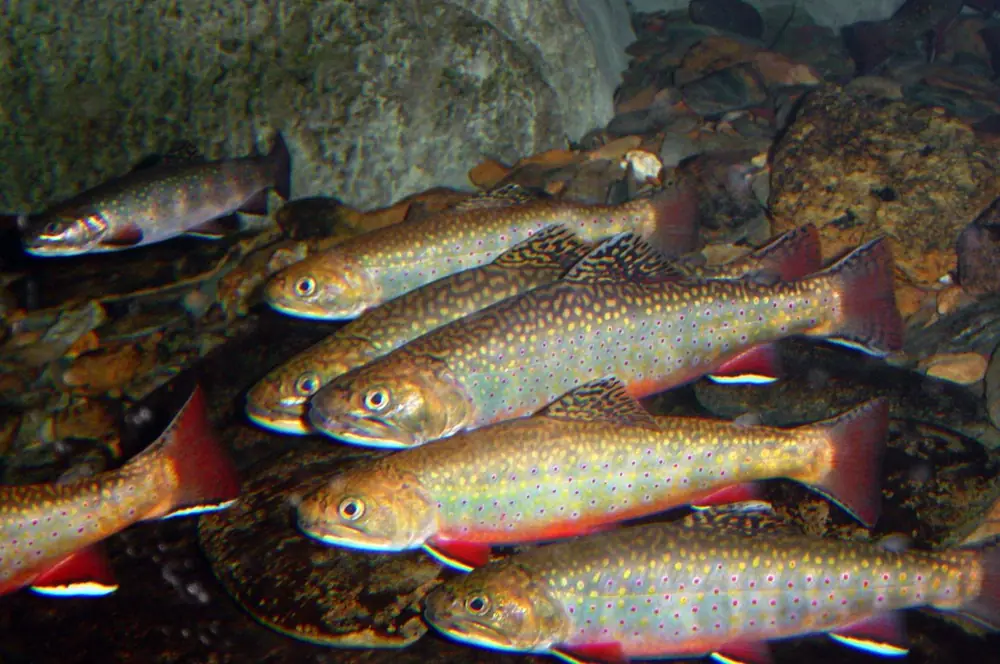
Trout opening day
2026 opened Saturday, April 4 at 8 a.m., after a Mentored Youth Trout Day on March 28; 2027 dates to be announced · Stocked streams and lakes in all 67 counties
During the regular season, which runs from opening day to Labor Day, anglers may keep up to five trout a day that measure at least seven inches. From November 1 through April 30 anyone aboard a boat under 16 feet, including canoes, kayaks and paddleboards, must wear a life jacket, which matters on cold, high April water. The commission’s stocking of adult fish has included rainbow, brown and brook trout, and the brook trout, with pale spots on a dark back, is the one to look for in small, cold headwater streams.
-
American shad on the Delaware
Spring runs, with timing depending on water temperature · The Delaware River and its tributaries
The Delaware River Basin Commission says shad return from the sea to spawn in spring and that the stock is currently low. The commission says the limit stayed at two fish a day on the main river in 2024 and 2025, with catch-and-release only on the Lehigh and Schuylkill, after a 33 percent cut in harvest began in 2023; check the current Pennsylvania fishing regulations for 2027 limits. The Fish and Boat Commission is working to restore shad on the Susquehanna system, stocking nearly 1.2 million into the Juniata River in 2025, and notes that the fish lift at Conowingo Dam in Maryland operates from mid-March to the start of June.
-
Lake Erie steelhead
Runs from late fall to early spring · Elk Creek and other Erie tributaries
DCNR describes Elk Creek near Erie Bluffs State Park as a world-class shallow-stream steelhead fishery, with steelhead, a type of rainbow trout, running from late fall to early spring. By April the best of it is usually over, so treat this as a final chance rather than a plan.
How much daylight does Pennsylvania gain in April?
April adds between 72 minutes (Philadelphia) and 77 minutes (Erie) of daylight, or about 2.5 minutes each day, and by April 30 the sun is up for nearly 14 hours across the whole state, from 13 hours 52 minutes in Philadelphia to 14 hours 0 minutes at Erie. The gain is steady rather than dramatic, but it is what drives the month’s bloom, bird song and migration. Because daylight time began on March 14, every sunrise and sunset you read off a clock now lands an hour later than standard time would put it.
| City | Apr 1 | Apr 30 | Gained | Per day |
|---|---|---|---|---|
| Erie | 12 h 43 m | 14 h 00 m | 77 min | 2.7 min |
| Scranton | 12 h 42 m | 13 h 58 m | 76 min | 2.6 min |
| Williamsport | 12 h 42 m | 13 h 57 m | 75 min | 2.6 min |
| State College | 12 h 41 m | 13 h 56 m | 75 min | 2.6 min |
| Pittsburgh | 12 h 40 m | 13 h 53 m | 73 min | 2.5 min |
| Harrisburg | 12 h 40 m | 13 h 53 m | 73 min | 2.5 min |
| Philadelphia | 12 h 40 m | 13 h 52 m | 72 min | 2.5 min |
For a figure tailored to your own town, try the daylight page. The table measures sunrise to sunset, which does not depend on the clock.
What is April weather like in Pennsylvania, and what hazards should you expect?
April is the month when Pennsylvania’s climate shows its two halves. In the 1991 to 2020 climate record kept by NOAA, an April afternoon reaches about 65 °F at Philadelphia but only about 56 °F at Bradford and Erie, and the thermometer drops to 32 °F or lower on about 16 April nights at Bradford but fewer than one at Philadelphia. Erie still averages 2.6 inches of snow in April.
| Station | High | Low | Nights ≤ 32 °F | Precipitation | Snowfall | Days with 1 in.+ snowfall |
|---|---|---|---|---|---|---|
| Erie | 56.8 | 38.0 | 8.2 | 3.47 | 2.6 | 0.8 |
| Bradford | 56.1 | 33.6 | 15.9 | 3.55 | n/a | n/a |
| Pittsburgh | 62.4 | 40.7 | 6.3 | 3.32 | 1.0 | 0.3 |
| State College | 59.2 | 39.4 | 6.5 | 3.51 | 0.9 | 0.3 |
| Williamsport | 61.7 | 39.0 | 6.8 | 3.62 | 0.8 | 0.3 |
| Wilkes-Barre | 61.1 | 39.3 | 7.3 | 3.26 | 0.8 | 0.2 |
| Harrisburg (Middletown) | 63.8 | 42.5 | 2.7 | 3.55 | 0.4 | 0.1 |
| Philadelphia | 64.7 | 44.3 | 0.8 | 3.47 | 0.3 | 0.1 |
What to watch. Rain on warm, saturated ground is the main hazard, and low-lying roads flood fast. The National Weather Service’s Turn Around Don’t Drown campaign warns that six inches of fast flood water can topple an adult and twelve can float away most cars. Severe thunderstorms and tornadoes become more likely as spring advances: in the 1950 to 2019 tornado record cited by an ABC27 story based on National Weather Service data, the busiest months were May, June and July, and the state’s only F5 tornado came in May 1985, so April is early rather than safe. DCNR says the greatest wildfire danger comes in March, April and May, that humans cause 99 percent of Pennsylvania wildfires, and that readers should follow current burn bans. For the latest, see the NOAA three-month outlook, posted each month near its middle, and use our weather page for the coming days.
What can you see in the Pennsylvania night sky in April 2027?
Everything here is Eastern Daylight Time, which is in effect all month.
-
The Pink Moon
Full at 6:27 p.m. Tuesday, April 20; best evening is that same Tuesday · Rising in the east just before dark
The name comes from the early appearance of moss pink, or wild ground phlox. On April 20 the Moon clears the horizon at about 7:50 p.m. at New York City; eastern Pennsylvania will be within minutes of that and the west a little later. It also looks full on the 19th and 21st.
-
A poor year for the Lyrids
Peak around the evening of Thursday, April 22 into the morning of April 23 (the American Meteor Society lists the night of April 21 to 22) · Any dark yard; look toward the northeast
The Lyrids come from the direction of Lyra, which is low in the northeast in the early evening. With the Moon roughly 95 percent lit and rising near 10 p.m., just the early evening is dark. Expect at best a few meteors an hour. The same evening is Earth Day.
-
Jupiter, Mars and the Moon
Evenings of April 14 and 15 · High in the south and southwest after dark, in Leo
A waxing gibbous Moon, about two-thirds lit, passes within about one degree of bright Jupiter, and on the 15th Mars lies roughly three degrees from the lunar disk. Jupiter stays up for most of the night in April and sets in the pre-dawn hours. Mars is a modest reddish point beside it.
-
Venus before dawn
Early April; the thin Moon is near it on the mornings of April 3 and 4 · Low in the east before sunrise
Brilliant Venus is the lone bright morning planet, rising roughly an hour and a quarter before the Sun on April 1 at 40 degrees north, with that lead shrinking a little each week. Early risers in Pittsburgh or Scranton will find that Saturn is hidden by solar glare after April 7, and Mercury never gets clear of it this month, so Venus is the only bright planet for the dawn sky.
-
Milky Way, before dawn
April 1 to 14 and April 28 to 30, around the new moon of April 6 · Dark sites; low in the south-southeast in the last hours of the night
Our calculations for 40 degrees north, about the latitude of Harrisburg, find the Milky Way’s brightest part rising high enough for roughly two hours of dark sky before dawn at best, with less farther north. Treat the exact hours as approximate.
| Phase | Date | Time |
|---|---|---|
| New moon | Tuesday, Apr 6 | 7:51 p.m. EDT |
| First quarter | Tuesday, Apr 13 | 6:56 p.m. EDT |
| Full moon, the Pink Moon | Tuesday, Apr 20 | 6:27 p.m. EDT |
| Last quarter | Wednesday, Apr 28 | 4:18 p.m. EDT |
The planet and Milky Way details are our own calculations, so take the hours as approximate. See the moon page for phases in other months.
What are good April nature outings for families in Pennsylvania?
- Count at a hawk watch. Hawk Mountain’s spring count has run April 1 to May 15 in recent years; call or check the sanctuary for 2027 hours.
- Join the City Nature Challenge. In 2027 observations are collected April 30 to May 3, identifications continue until May 16 and results come out May 20; see whether a city near you takes part.
- Help build the Pennsylvania Bird Atlas. The third atlas is a five-year effort that began in 2024, uses the eBird tool and welcomes volunteers of any skill level.
- Walk a wildflower trail. Pick a morning from mid-April, take a camera and leave the plants where they are.
- Keep counting at your feeder. Project FeederWatch runs through April 30.
- Visit a nest cam or an eagle site. Late April is when the nests are busiest, and the Game Commission lists viewing sites in every region.
- Plant a tree on Arbor Day, April 30, or adopt a tree to follow all spring.
- Taste maple syrup in April. The Pennsylvania Maple Festival in Meyersdale held its 2026 dates on April 18 and 19 and April 22 to 26. Its site did not show 2027 dates when we looked, so check before you plan a trip.
Event pages change often, so confirm with each host before you leave home.
Safety notes for April in Pennsylvania
- Youth turkey days. The Game Commission’s 2026-27 table lists the Youth Spring Gobbler Season for April 24 and 25, 2027, with hunting hours ending at noon. The regular spring gobbler season runs May 1 to 15 until noon and May 16 to 31 until a half hour after sunset. The Game Commission has said that fluorescent orange is not required in spring turkey season, though it recommends it, so wear a bright hat or vest when you walk in the woods on those mornings.
- Other open seasons. Woodchucks may be hunted through June 30, 2027; check the full table for anything else before you walk game lands.
- Trout waters. Cold water and high flow make April creeks dangerous. Wear a life jacket aboard any small boat through April 30 and stay out of flooded streams.
- Flooded roads. Turn around rather than drive through water.
- Wildfire. DCNR names April among the spring months of greatest danger. Keep campfires small and attended and follow burn bans.
- Rattlesnakes. Timber rattlesnakes emerge in mid-to-late April on rocky, south-facing slopes. Stay on trails and watch where you put hands and feet.
- Ticks. Penn State Extension advises caution especially from May through July, when nymphs seek hosts, and says adults are active whenever temperatures are above freezing. Stay near the center of trails, and check yourself afterward.
- Eagles and nests. Use binoculars and keep well back from any nest tree.
- Gull Point. Part of Presque Isle’s Gull Point natural area is closed beginning April 1 to protect shorebirds; watch from the platform.
- Severe weather. Know where you will shelter before you head out on a stormy afternoon.
Sources (44)
- Pennsylvania Fish and Boat Commission: opening day of trout season, April 4, 2026 (hours, limits, life jacket rule)
- Pennsylvania Fish and Boat Commission: statewide opening day of trout season, April 3, 2021 (single statewide opener)
- Pennsylvania Fish and Boat Commission: Mentored Youth Program (March 28, 2026 trout day)
- Pennsylvania Fish and Boat Commission: American shad restoration
- Delaware River Basin Commission: American shad in the Delaware
- Pennsylvania DCNR: Erie Bluffs State Park fishing (Elk Creek steelhead)
- Penn State Extension: spring phenology notes (April blooms, morels, returning birds)
- ABC27: when will Pennsylvania trees get their leaves (DCNR forester)
- Congressional Research Service: Arbor Day fact sheet (state dates)
- Powdermill Nature Reserve: 2009 spring arrival banding diary
- Delaware Valley Ornithological Club: April birding recommendations
- Pennsylvania DCNR: Presque Isle State Park wildlife watching (Gull Point)
- Presque Isle Audubon: birding at Presque Isle State Park (spring highlights)
- Local 21 News (Harrisburg): Game Commission on hummingbird arrival
- We Conserve PA: Hawk Mountain spring hawk watch (April 1 to May 15, peak timing)
- Lehigh Valley Public Media: Hawk Mountain spring migration count, 2025 results
- Pennsylvania Game Commission: bald eagles (hatching, nestling period, nests)
- Pennsylvania Game Commission: bald eagle watching (viewing sites, late April)
- Pennsylvania Game Commission: eagles and osprey (wildlife note, PDF)
- Pennsylvania Game Commission: ruffed grouse (drumming, habitat, nesting)
- Pennsylvania Game Commission: spring gobbler season is calling (2025 release; orange, hours)
- Pennsylvania Game Commission: seasons and bag limits, 2026-27
- Bowman’s Hill Wildflower Preserve: home page (spring hours)
- Bowman’s Hill Wildflower Preserve: what is in season
- Interesting Pennsylvania: spring wildflowers at Ohiopyle State Park
- PA DCNR events: Youghopoly spring wildflower hike (April 18, 2026)
- National Park Service: spring peeper
- Chesapeake Bay Program field guide: green frog
- Chesapeake Bay Program field guide: spotted salamander
- Pennsylvania Fish and Boat Commission: timber rattlesnake fact sheet (PDF)
- Penn State Extension: ticks and tickborne disease
- Pennsylvania DCNR: urges caution as wildfire risk rises in spring
- ABC27: how common are tornadoes in Pennsylvania (National Weather Service data)
- National Weather Service: Turn Around Don’t Drown
- NOAA NCEI: 1991–2020 monthly normals for Pennsylvania stations (data API, April)
- Climate Prediction Center: seasonal outlooks (issued monthly near mid-month)
- U.S. Naval Observatory: 2027 moon phases (data API)
- Sea and Sky: astronomy calendar of celestial events 2027
- American Meteor Society: 2027 meteor shower calendar (Lyrids)
- Pennsylvania Game Commission: Pennsylvania Bird Atlas
- City Nature Challenge: 2027 dates
- Project FeederWatch: how to participate (November 1 to April 30)
- Pennsylvania Maple Festival, Meyersdale (site shows 2026 dates)
- Photos via Wikimedia Commons; licenses and photographers are credited under each picture
