What to look for in nature in Pennsylvania this February
Pennsylvania’s February is winter’s closing act on the weather calendar, yet it is also when the swing toward spring becomes something you can actually see. Philadelphia and Harrisburg average a little more snow now than in January, Lake Erie usually reaches its widest ice, and in the northern mountains snowshoe hares are still dressed in white. Yet by the closing week tens of thousands of snow geese are usually crowding the lake at Middle Creek, the first eagle pairs are sitting on eggs, male woodchucks are leaving their burrows to look for mates, and red-winged blackbirds are back singing in the cattails. On sunny afternoons after a hard night the maple sap runs. In the evening sky, Jupiter and Mars come to opposition nine days apart, and the Snow Moon rises on February 20 in a faint eclipse. Here is what to watch for across the state.
Other months in Pennsylvania: October, November, December, January.
Start here
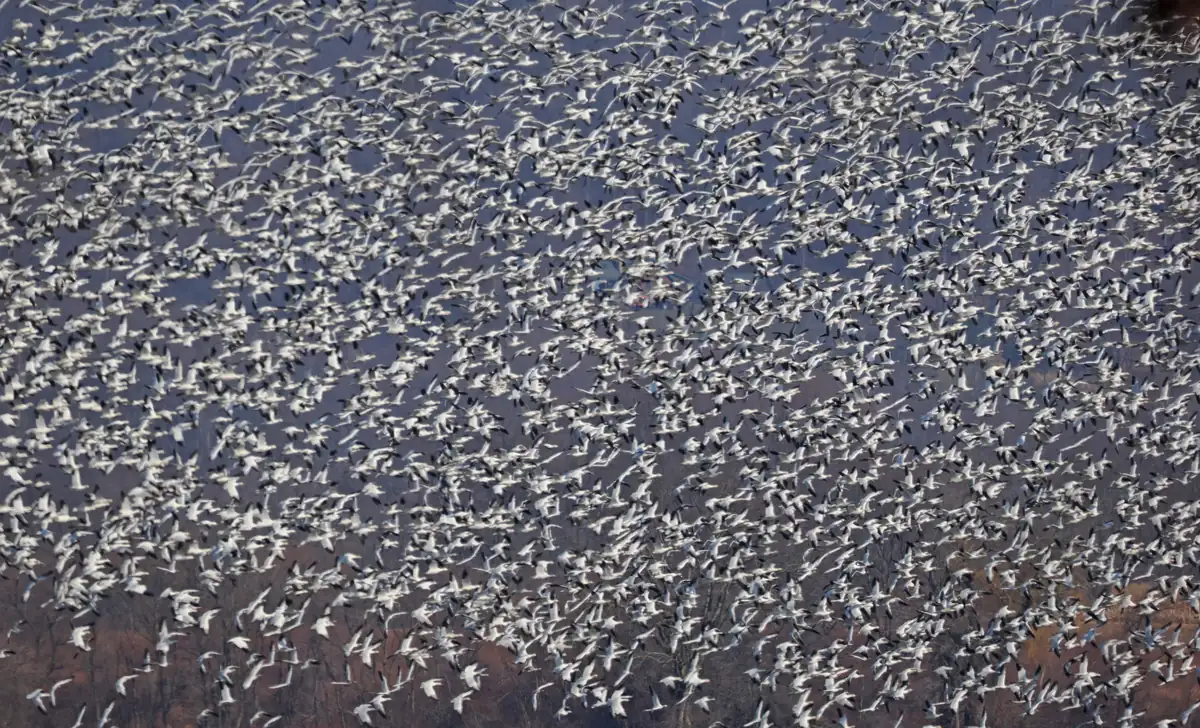
- Sunset at Willow Point. Late in the month, walk the short paved path to Willow Point at Middle Creek Wildlife Management Area on the Lancaster and Lebanon county line about an hour before sunset, and wait for the snow geese to come back from the fields. Check the Game Commission’s migration update first, since the flocks come and go with the ice.
- Jupiter on February 10. Wednesday, February 10, is Jupiter’s opposition night. Watch the giant planet clear the eastern skyline at sunset; it will still be shining at daybreak. Rest binoculars on a car roof and up to four little moons appear lined up beside the disk.
- Count birds for four days. The Great Backyard Bird Count fills the long holiday weekend, February 12 to 15. Fifteen minutes on any one of the four days, at a feeder or a pond, makes a valid checklist.
Middle Creek and the cattails give the Naturalist’s Field Journal plenty this month: write a goose tally and the day the redwings came back on the birds you have seen pages; give the dusk and dawn watch plate to a sunset at Willow Point as the geese return; give nest observed to an eagle nest watched through a scope or on a live cam; and let reading the signs hold a mottled skunk cabbage hood in a ring of melted snow, or fresh dirt at a woodchuck burrow.
Regions used below: Northwest and Lake Erie; Allegheny National Forest and the Northern Tier; Laurel Highlands and Pittsburgh; Central Ridge and Valley and State College; Poconos and the Northeast; Susquehanna Valley and Harrisburg; Southeast and Philadelphia.
When do the snow geese come to Middle Creek in Pennsylvania?
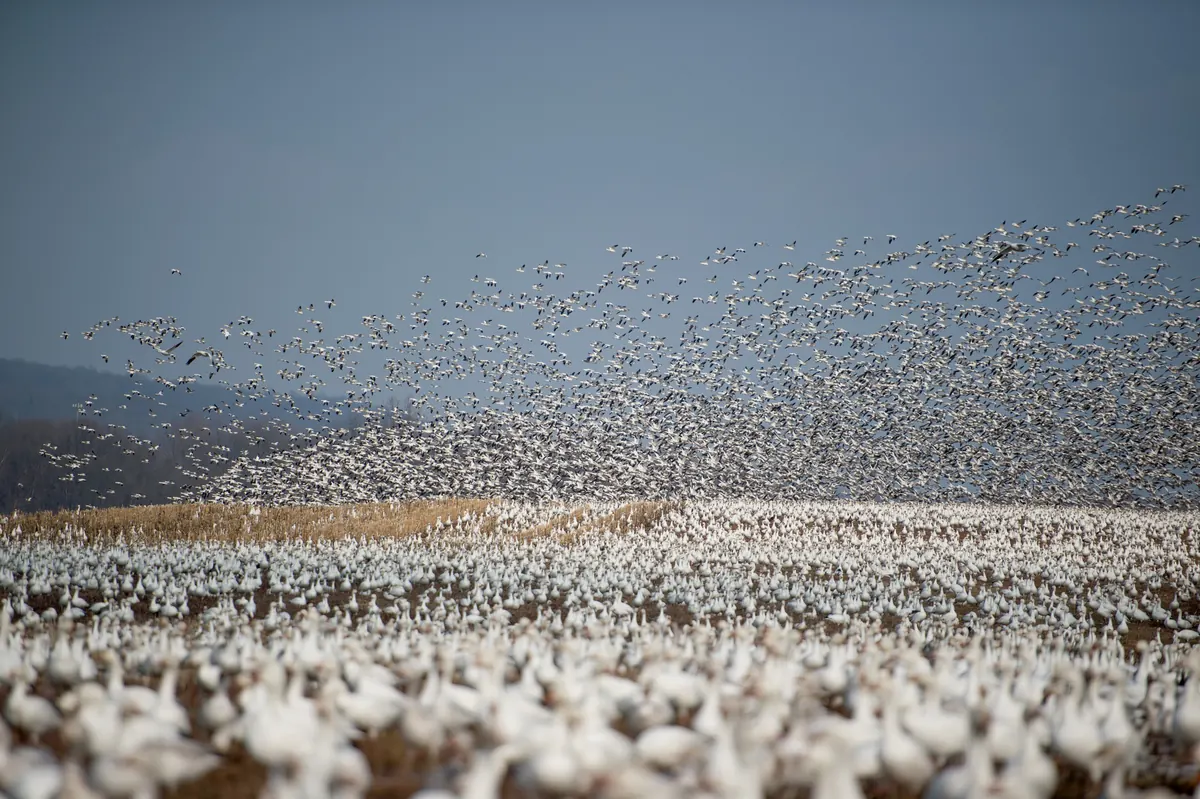
The best-known wildlife spectacle of late winter in Pennsylvania happens on a lake in the farm country where Lancaster and Lebanon counties meet. Middle Creek Wildlife Management Area, run by the Game Commission, is a resting stop for snow geese and tundra swans on their way north. The agency says the flight usually peaks between late February and early March, but the timing shifts every year with ice and snow. In 2026, the agency noted, winter weather held most of the geese and swans to the south until the last week of February. Once they arrive, they spend the night on the lake and fly out each morning to feed in the surrounding fields.
-
Snow geese by the tens of thousands
Mid-February to mid-March in most years; the busiest days usually in the last week of February or the first days of March · The main lake at Middle Creek; Willow Point; nearby farm fields
The largest count in the Game Commission’s records is 200,000 snow geese on February 21, 2018, and peak counts have run from 70,000 to 105,000 in each season from 2022 through 2025. The flock lifts off around sunrise in a roar of wings, then returns in long, noisy skeins in the late afternoon. Mixed in are a few dark-bodied birds, the “blue” morph of the very same species. A bald eagle cruising over the lake can put the whole flock into the air at once, as photographers at Middle Creek have recorded.
-
Tundra swans
Same window as the geese · The lower end of the Wildlife Drive near the first stop; open water on the main lake
Tundra swans, bigger and slower than the geese and with all-black bills, pass through at the same time. The record count is 5,500 on February 22, 2018. The agency names the lower end of the Wildlife Drive as a normally excellent spot for the swans, but that road is closed to cars until March 1, so in February look for them from the public roads and parking areas around the lake.
-
Visiting in February
Visitor center open Tuesday through Sunday, 8 a.m. to 4 p.m., from the Tuesday after Martin Luther King Jr. Day · The visitor center; the short walk to Willow Point
After its winter break, which begins at Thanksgiving, the visitor center reopens on the Tuesday following the King holiday, January 19 in 2027, and stays open all through February except Mondays. The best show is at sunrise, before the geese leave to feed, and at sunset when they come back. Sunny weekends at the peak can draw thousands of visitors and back up local roads, so a weekday or a cloudy morning is calmer. If you cannot go, the Game Commission streams a live snow goose camera from Willow Point.
| Date (2026) | Snow geese | Tundra swans | Canada geese |
|---|---|---|---|
| Feb 24 | 60,000 | 550 | 50 |
| Feb 27 | 2,500 in the morning; 35,000+ by midday | 600 | 50 |
| Mar 3 | 8,000 | 500 | 150 |
| Mar 6 | 65,000 | 1,000 | 2,200 |
| Mar 10 | 600 | 860 | 780 |
| Record counts (2018) | 200,000 (Feb 21) | 5,500 (Feb 22) | 7,500+ (Feb 15) |
As the 2026 log shows, a flock of 60,000 can vanish overnight and return two days later. Check the latest posted count before a long drive.
When do bald eagles lay eggs in Pennsylvania?
January was about where eagles gather; February is about what they do at home. Pennsylvania’s resident pairs, which have spent the winter adding sticks to their nests, begin laying. The Game Commission says most clutches are laid between mid-February and mid-March, with early March the peak, so in February only the earlier pairs will be sitting tight.
-
Eggs in the snow
From mid-February; the peak of laying comes in early March · Large stick nests near rivers, lakes and reservoirs across the state
A clutch is one to three eggs, most often two, and each egg takes about 35 days to hatch, so an egg laid in mid-February should hatch around the third week of March. Both adults incubate, though the female spends more time on the eggs, and the two trade places through the day. A nest that looks empty may hold an eagle lying flat with only the top of its white head showing over the rim. In a February snowstorm the sitting bird simply stays put and lets the snow pile up on its back.
-
The Hanover and Farm Country cams
Streaming all season · The Game Commission’s wildlife cams page
The Game Commission and HDOnTap stream two eagle nests. The Hanover nest, near Codorus State Park in York County, has been on camera since 2015. In 2026 its first egg came on March 2, a reminder that many Pennsylvania eagles wait until March. The Farm Country nest belongs to a pair that has nested in the area for at least 15 years and has raised three young in most of them.
-
Giving a nest room
Especially from egg laying to hatching · Any active nest
Eggs left uncovered in bitter cold chill quickly, so a disturbed eagle can lose its whole clutch. Watch from a road or the far side of the water with binoculars or a scope, keep the agency’s 1,000-foot buffer, and leave if the bird on the nest lifts its head and stares at you.
Eagles are not the only early nesters. Great horned owls are already incubating in many woodlots, and the earliest owlets may hatch around the turn of the month.
What really happens to groundhogs in Pennsylvania in February?
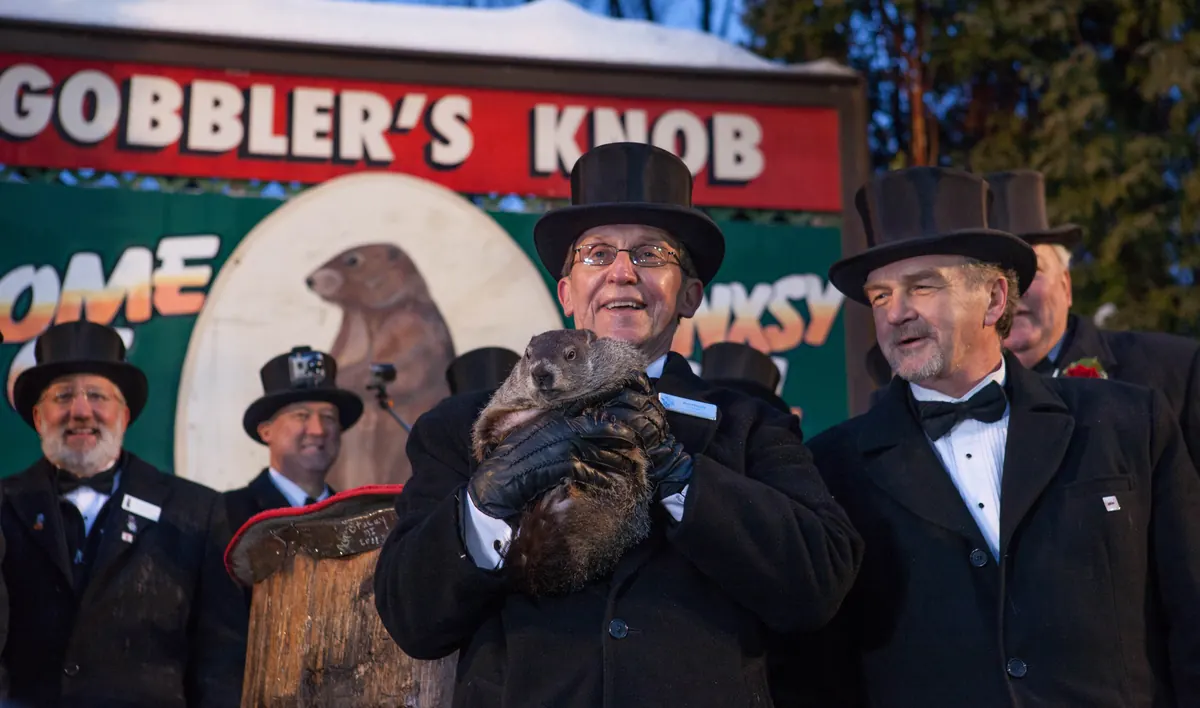
On Tuesday, February 2, the eyes of the country turn to Gobbler’s Knob outside Punxsutawney in Jefferson County. The Punxsutawney Groundhog Club traces its first trek to the Knob to 1887, and the club ties the custom to old European beliefs about Candlemas Day. Meanwhile, out in the fields, wild woodchucks are starting their own year.
-
Groundhog Day at Gobbler’s Knob
Tuesday, February 2, 2027, around sunrise · Gobbler’s Knob, Punxsutawney, Jefferson County
The rule is simple: if Phil sees his shadow, six more weeks of winter. In 2026 he saw it at 7:25 a.m., in a temperature of 3 below zero. Gate times, shuttles and the 2027 schedule were not yet posted when we checked in early October; see groundhog.org before you plan the trip, and dress for a long wait in the dark. As a forecaster, Phil is better at drawing crowds than at calling the weather: NOAA’s National Centers for Environmental Information, comparing his calls with national temperatures, found him right only 30 percent of the time over the past 10 years.
-
Wild woodchucks waking up
Males from February; mating late February into March · Burrows in field edges, fencerows, road banks and pastures statewide
Woodchucks hibernate in earnest. The Game Commission’s wildlife note says in deep hibernation a woodchuck cools from above 90 °F to somewhere in the low 40s, while its pulse drops from more than 100 to about four beats per minute. Males come out before females, and through February and March they fight over territory and mates. They live on the last of their fat during the mating season of late February and March, when little green food is up, and young are born about 28 days later, in April and early May. A fresh fan of dirt at a burrow entrance on a February thaw is a sign the owner is up and about.
-
The true middle of winter
February 3 to 4 · Everywhere
Measured by the sun, winter is half over late on February 3 or early on the 4th, a day or two after Phil’s big moment. From here on, the sun climbs a little higher at noon every day.
What are the first signs of spring in Pennsylvania in February?
Snow may still cover the ground, but several plants and birds start their year in February, especially in the southeast and the lower river valleys. Watch the wettest corners of the woods, the cattail marshes and the brushy old fields.
-
Skunk cabbage melting its way up
From late February in the Philadelphia area; March and April in most of the state · Seeps, springs, swamps and stream edges in wet woods
The Schuylkill Center in Philadelphia finds the hoods up as early as late February, and elsewhere in the state they usually come later, in March and April. What makes the plant famous is its heat. Inside the mottled, maroon-and-green hood, the flowering knob makes its own heat, the native plant society notes, enough to melt a hole through snow and ice and helping spread the rotten-meat smell that draws early flies and bees. The big leaves come later. Despite the odor, the native plant society notes it is not poisonous.
-
Red-winged blackbirds and grackles
First flocks in the last week or two of February; most arrive in March and April · Marshes, wet meadows, pond edges and farm fields
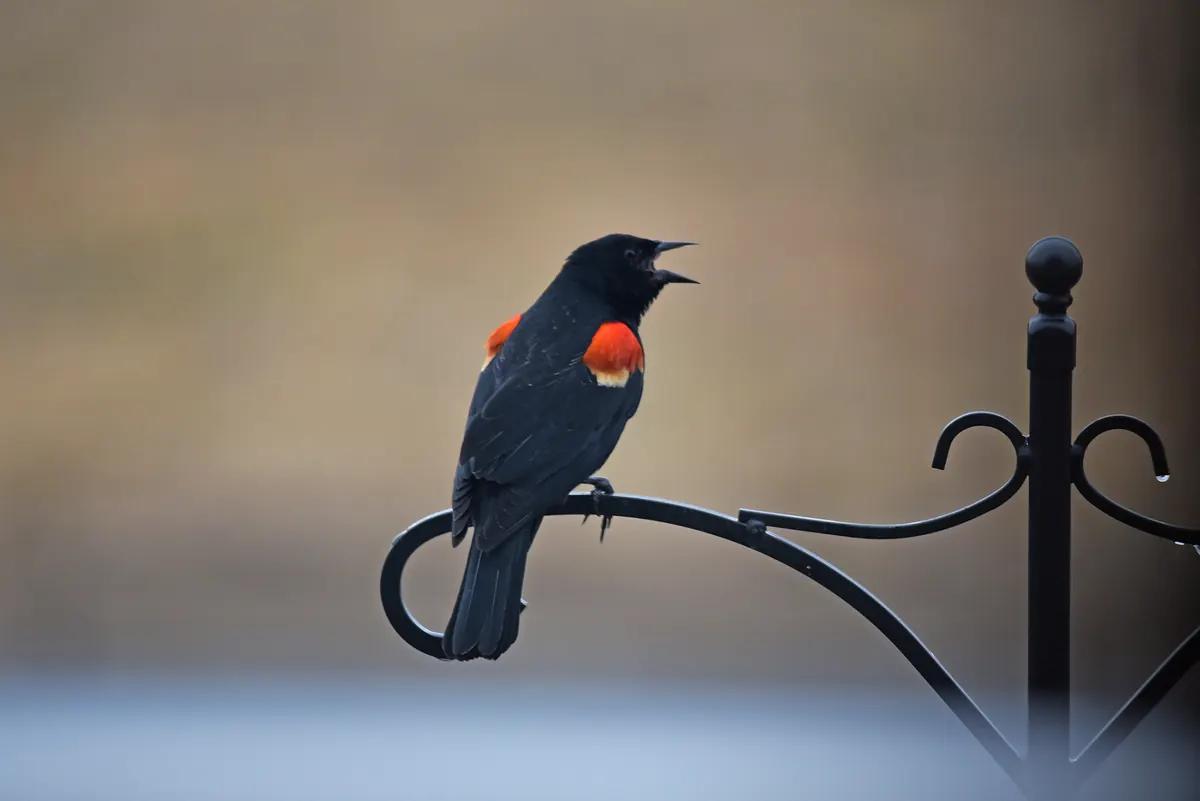
The Game Commission says red-winged blackbirds start arriving on their breeding grounds in late February and early March, earlier when the winter is mild, and that males come a week or two ahead of the females. The first birds you see will almost all be adult males, perching on last year’s cattails, flaring their red shoulder patches and singing a gurgling “conk-a-ree.” Common grackles, glossy black with long keeled tails, are among the other early arrivals.
-
The first woodcock
Late February in some years; most in March · Brushy old fields and young woods next to wet ground
Game Commission staff at Middle Creek heard woodcock peenting during their February 24 count in 2026. On a calm, mild evening at the end of the month, stand at the edge of a brushy field after sunset and listen for a nasal “peent” from the ground, followed by the twittering of a male spiraling up two or three hundred feet in his sky dance. The full show belongs to March and April.
When does the maple sap run in Pennsylvania?
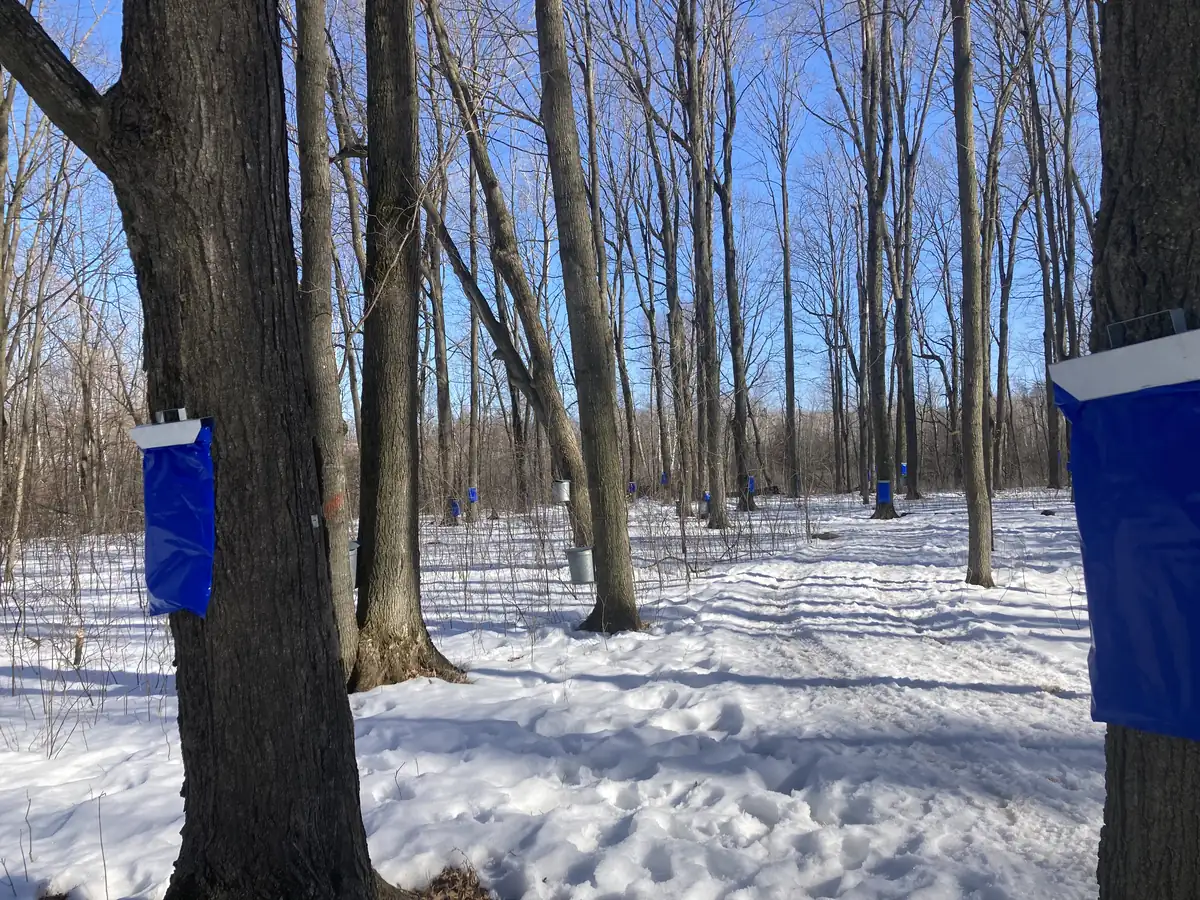
Maple sugaring is a February and March business in Pennsylvania, and it depends entirely on the weather. Penn State Extension explains that in the Northeast sap can start to flow in late January or early February, but the most productive runs usually come from mid-February through March, sometimes into early April. What starts the flow is a swing of temperatures: nights below 32 °F followed by days above 40 °F.
-
Why freezing nights matter
Any stretch of hard frosts and sunny thaws · Sugar maples and red maples in woodlots, yards and farm sugarbushes
Frost at night lets the tree pull water in from the roots; a sunny thaw the next day raises pressure inside the trunk and forces sap from any opening, a tap hole or a snapped twig alike. That is why you may see icicles hanging from a snapped maple branch in late winter: they are frozen sap. Sugar maple sap is thin and only faintly sweet. Penn State Extension says it takes roughly 43 gallons of it to make a gallon of syrup, boiled down until it is about two-thirds sugar.
-
Tapping your own tree
When the forecast shows a run of freeze-and-thaw days · A healthy maple of at least 10 inches across, on your land or with the owner’s permission
Penn State’s guidance is to put one tap in a tree 10 to 12 inches in diameter, and no more than two in trees wider than 18 inches, drilling about 1.5 to 2 inches deep with a slight upward slope.
-
Sugaring demonstrations
Usually late February and March · State parks, environmental education centers and sugarhouses
State parks and nature centers often hold maple programs as the season gets going. When we looked in early October, DCNR’s February 2027 calendar had none yet; look again after New Year’s.
Where is it still deep winter in Pennsylvania in February?
While the southeast tunes up for spring, the high plateaus and the Lake Erie shore are still firmly in winter’s grip. Two things to look for there:
-
Snowshoe hares in white
All winter; courtship begins in early March · Parts of the Allegheny Mountains, the high plateaus of the northwest and the Pocono region
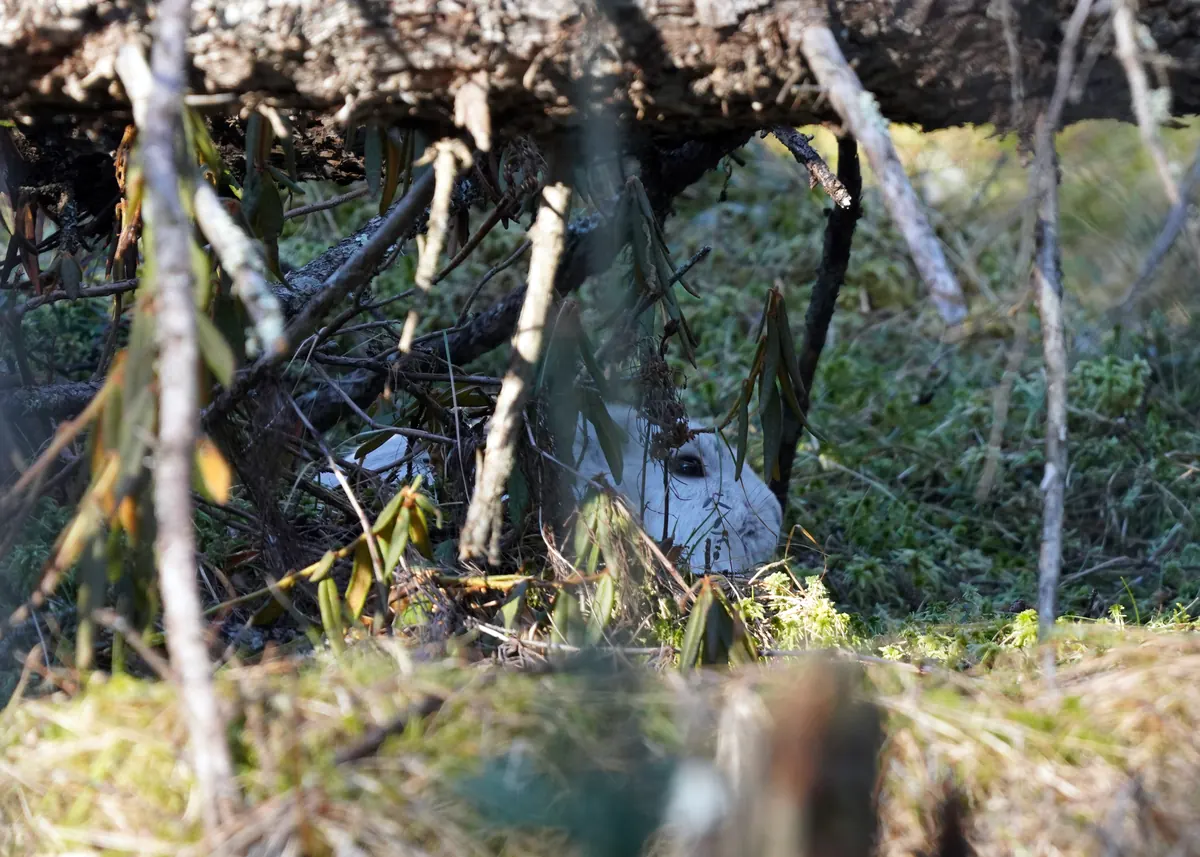
Pennsylvania sits at the southern edge of the snowshoe hare’s eastern range. The Game Commission explains that the hare’s change to a white coat is set off by shortening days in fall and takes about 10 weeks, so in February the animals are still white. They live in mixed woods with conifers and thick cover such as rhododendron and mountain laurel,. In winters with little snow the hares are left white on brown ground, a mismatch that makes them easy for predators to spot. Lackawanna State Park holds a free evening talk on their future on February 19 (see the family list below).
-
Lake Erie ice at its widest
Usually mid- to late February · Presque Isle Bay and the open lake off Erie
According to NOAA’s Great Lakes lab in Ann Arbor, Erie and the other lower lakes usually hit their greatest ice extent in the second half of February. How much ice forms swings wildly from year to year. The lab’s long-term average peak for Erie is about 83 percent, and the lake froze over completely in 1978, 1979 and 1996. Once the lake is frozen over, the lake-effect snow machine largely shuts down, and any diving ducks still around tend to bunch up in the remaining open water.
For the January side of the winter, from bear cubs in the den to ice dunes at Presque Isle, see Pennsylvania in January.
How much daylight does Pennsylvania gain in February?
February brings the fastest gains of the winter so far. Each city in the table below gains over 60 minutes of daylight across the month, and the daily gain keeps growing toward the March equinox. Northern towns pick up a little more than Philadelphia because their days started shorter.
| City | Feb 1 | Feb 28 | Gained | Per day |
|---|---|---|---|---|
| Erie | 10 h 01 m | 11 h 12 m | 71 min | 2.6 min |
| Scranton | 10 h 05 m | 11 h 13 m | 68 min | 2.5 min |
| Williamsport | 10 h 05 m | 11 h 13 m | 68 min | 2.5 min |
| State College | 10 h 07 m | 11 h 14 m | 67 min | 2.5 min |
| Pittsburgh | 10 h 08 m | 11 h 15 m | 67 min | 2.5 min |
| Harrisburg | 10 h 09 m | 11 h 15 m | 66 min | 2.4 min |
| Philadelphia | 10 h 11 m | 11 h 15 m | 64 min | 2.4 min |
Daylight saving time begins on Sunday, March 14, which makes February the final month of early standard-time dusk. For sunrise and sunset in your own town, try the daylight calculator.
Is February Pennsylvania’s snowiest month, and what could El Niño bring?
It depends on where you live. Going by NOAA’s 1991 to 2020 climate normals, February snowfall edges past January’s at Philadelphia (8.4 inches against 7.1), Harrisburg (9.4 against 9.1) and State College (11.6 against 11.3). At Erie the lake-effect season is winding down, with 19.4 inches in February after 31.8 in January, and Pittsburgh, Williamsport and Wilkes-Barre also average a bit less than in January. Temperatures climb a few degrees over the month, but most February nights still fall to freezing or below in every corner of the state.
| Station | High | Low | Nights ≤ 32 °F | Nights ≤ 0 °F | Snowfall | Days with 1 in.+ snowfall |
|---|---|---|---|---|---|---|
| Erie | 36.5 | 21.4 | 23.8 | 0.9 | 19.4 | 5.8 |
| Bradford | 33.4 | 16.4 | 25.9 | 3.1 | n/a | n/a |
| Pittsburgh | 39.6 | 23.2 | 23.0 | 0.7 | 11.7 | 3.9 |
| State College | 36.8 | 21.5 | 24.6 | 0.7 | 11.6 | 3.4 |
| Williamsport | 38.7 | 21.5 | 24.6 | 0.9 | 9.3 | 2.7 |
| Wilkes-Barre/Scranton | 38.8 | 21.9 | 24.0 | 0.8 | 10.9 | 3.6 |
| Harrisburg | 42.0 | 24.7 | 23.1 | 0.2 | 9.4 | 2.7 |
| Philadelphia | 44.3 | 27.5 | 19.6 | 0.0 | 8.4 | 1.9 |
Hanging over all of this is an unusually powerful El Niño. Consider the September 10 verdict from the Climate Prediction Center in College Park, Maryland: over 90 percent odds that this event ranks as very strong through the season. For the western half of the state, a National Weather Service study posted by the Cleveland office found that El Niño winters in the Ohio Valley and lower Great Lakes averaged warmer than normal with below-normal snowfall at many stations, though lake-effect snow can mask that signal near the lake. In the southeast, the Mount Holly forecast office wrote in a 2009 analysis that seasonal snowfall varies enormously once El Niño reaches moderate strength: a stronger southern jet stream sends more storms up the coast but also more mild air. Since 1950, it found, Philadelphia averaged 16.6 inches of snow in strong El Niño winters, against 28.1 in weak ones. It also noted that most El Niños peak in December and fade over the rest of the winter. Forecasters update the official three-month outlook maps monthly; for this week’s weather use our forecast page, and gardeners can start planning with the Pennsylvania frost dates.
What can you see in the Pennsylvania night sky in February 2027?
All times are Eastern Standard Time. February’s darkest evenings come in the first half of the month, around the February 6 new moon. The same new moon makes a ring-of-fire solar eclipse whose path runs through southern South America and out across the ocean; Pennsylvania sees none of it, not even a partial bite.
-
Mercury at dusk
Roughly February 1 to 10; farthest from the sun early on February 3 · Low in the west-southwest, 30 to 45 minutes after sunset
This is the winter’s best evening look at the smallest planet. Climb to a hilltop or go to a big field where the west-southwest horizon is clear, and wait until the sun is completely below the horizon before using binoculars. Sunday evening, February 7, adds a bonus: a hairline crescent, barely a day old, keeps Mercury company in the glow, if you have a high spot to watch from.
-
Jupiter at opposition
7:21 p.m. Wednesday, February 10 · Rising in the east at sunset, high in the south around midnight, in Leo
With the sun directly behind us, Jupiter shines at magnitude −2.5, its peak for 2027, and only the moon outshines it after dark. It stays up from dusk to dawn. Steady binoculars show its four large moons, and their positions change from one night to the next. Late on the 19th and into the 20th, the moon, nearly full, glides past Jupiter at very close range.
-
Mars at opposition
Friday, February 19; closest to Earth February 20 · In Leo, rising in the east at dusk
The red planet is opposite the sun on Friday the 19th and nearest us, at about 63 million miles, a day later. Because this year’s meeting happens with Mars well away from the sun, the planet stays relatively far off: expect a steady, ruddy point of light at magnitude −1.2 and only a tiny disk in a backyard telescope. It shares the constellation Leo with Jupiter and the bright star Regulus.
-
The Snow Moon and a faint eclipse
Full at 6:23 p.m. Saturday, February 20; eclipse 4:12 to 8:13 p.m., greatest at 6:13 p.m. · Rising in the east around sunset
The February full moon is a penumbral eclipse: the moon passes through Earth’s pale outer shadow and misses the dark inner one. Here in Eastern time, moonrise lands close to mid-eclipse, which gives Pennsylvania one of the better views in the country, modest as it is. At most, sharp eyes may see a faint gray dimming on one edge of a moon sitting low in bright twilight. The better show may be the company it keeps: once darkness falls, Jupiter, Mars (a day after opposition) and the star Regulus all cluster near the full moon in Leo.
| Phase | Date | Time |
|---|---|---|
| New moon | Saturday, Feb 6 | 10:56 a.m. |
| First quarter | Sunday, Feb 14 | 2:58 a.m. |
| Full moon, the Snow Moon | Saturday, Feb 20 | 6:23 p.m. |
| Last quarter | Sunday, Feb 28 | 12:16 a.m. |
Before sunrise, Venus still blazes in the southeast, while Saturn sinks into the western twilight as the month goes on. Solar activity is declining from its peak, yet a strong storm is still possible; NOAA’s Space Weather Prediction Center has the current aurora forecast. Rising and setting times for the moon where you are can be found on our moon phase pages, and if clouds roll in, put a name to them with our cloud guide.
What are good February nature outings for families in Pennsylvania?
- Tuesday, February 2: Groundhog Day. Watch the Gobbler’s Knob ceremony on the news, then go find a real woodchuck burrow on a field edge and check it again on each thaw for fresh dirt or tracks.
- A goose evening at Middle Creek. Late in the month, walk to Willow Point an hour before sunset and ask children to estimate one small flock, then the whole lake. The visitor center is open Tuesday to Sunday.
- Presidents’ Day weekend bird count, February 12 to 15. Audubon gives these four days for the 30th Great Backyard Bird Count. Count at the kitchen window or a park pond for 15 minutes or more and send the list in through birdcount.org.
- Friday, February 19: snowshoe hares at Lackawanna State Park. A free ECO101 talk on the future of the state’s snowshoe hares, 6 p.m. in the park office classroom.
- Saturday, February 20: a full moon hike at Vosburg Neck State Park, Wyoming County, 6:30 p.m., free with registration. It is the Snow Moon night, eclipse and all.
- An eagle morning. The Delaware Highlands Conservancy’s weekend eagle watch at Lackawaxen has run through February in recent winters; check its calendar for 2027. On weekdays, keep the Hanover or Farm Country eagle cam open and log when the first egg appears.
- Tap one maple. On your own land, set a single tap during a freeze-and-thaw week, measure the sap each day and boil a little down.
- Keep counting. Project FeederWatch continues through April, and eBird takes a list from any walk.
We gathered these from DCNR’s event calendar and organizers’ pages in early October 2026. Snow and ice can cancel programs, so confirm with the host before you go. Every state and month is listed on our nature guide index, and a copy of the Naturalist’s Field Journal keeps the season’s notes in one place.
Safety notes for February in Pennsylvania
- Small game until February 28. The late seasons for squirrels, cottontail rabbits and pheasants all close on the last day of the month. Under 58 Pa. Code § 141.20 anyone chasing these species needs 250 square inches or more of blaze orange spread over head, chest and back, showing in every direction, so expect to see it in the woods and fields.
- Seasons without orange. Fox and raccoon hunting continues to February 21, bobcat hunting ends February 3, and coyotes may be hunted all year. Crows are open Thursdays through Sundays to March 21. Furbearer, crow and waterfowl hunters are exempt from the orange rule (coyote hunters need it only while a deer, bear or elk firearms season is open), so they may be hard to see.
- Geese. The regular season on snow and Ross’s geese stays open to March 10 in both goose zones, and the Resident Population zone has a late Canada goose segment from January 29 to February 20. Whether a spring conservation season follows depends on the spring population surveys. Sunday hunting stays closed for ducks, geese and other migratory birds.
- Traps along the water. Beaver trapping runs until the end of March, so keep dogs leashed along streams, ponds and beaver flowages.
- Game lands. The rule that makes non-hunters on state game lands wear orange covers October 1 through January 31, so it lapses in February. Wear a bright hat or vest anyway while small game seasons are open.
- Late-winter ice. February thaws and refreezes leave ice layered, gray and weaker than it looks. Check thickness with a spud bar as you walk, keep ice picks around your neck, bring a partner, and avoid inlets, springs and any current. Never walk out on Lake Erie’s shelf ice from the beaches.
- Middle Creek crowds. On sunny weekends at the peak, roads around the lake back up. Park only in marked areas, and do not stop on the road shoulder for photos.
- Sick or dead birds. Highly pathogenic bird flu has circulated in Pennsylvania’s wild birds since early 2022, and last winter crews removed about 2,000 carcasses, mostly snow geese, from a Northampton County quarry. Leave sick or dead birds alone and call the Game Commission at 1-833-PGC-WILD.
- Storms and thaws. A nor’easter can drop heavy, wet snow in the east while the west gets rain, and a sudden thaw with rain can break river ice into jams that flood low roads. Check the forecast and river levels before heading out.
Sources
- Pennsylvania Game Commission: snow goose and waterfowl migration update, Middle Creek (record counts, 2026 counts, Willow Point, visitor center, Wildlife Drive)
- Pennsylvania Game Commission: it’s heating up at Middle Creek (peak timing, weekend crowds, live stream)
- Pennsylvania Game Commission: wildlife cams (snow goose cam, Hanover and Farm Country eagle cams)
- Pennsylvania Game Commission: bald eagles (egg laying, clutch size, incubation, viewing distance)
- HDOnTap: Hanover eagles nest live cam (nest history, 2026 egg dates)
- Pennsylvania Game Commission: owls (wildlife note, PDF; great horned owl nesting)
- Punxsutawney Groundhog Club: history of Groundhog Day
- Punxsutawney Groundhog Club
- NOAA NCEI: Groundhog Day forecasts and climate history (Phil’s record, updated January 30, 2026)
- Pennsylvania Game Commission: woodchuck (wildlife note, PDF; hibernation and mating)
- Pennsylvania Native Plant Society: skunk cabbage
- The Schuylkill Center for Environmental Education: the first wildflower of spring is skunk cabbage
- Pennsylvania Game Commission: blackbirds (red-winged blackbird and grackle arrival)
- Penn State Extension: a sign of spring (red-winged blackbirds)
- Pennsylvania Game Commission: American woodcock (spring arrival, sky dance)
- Penn State Extension: maple syrup production (sap season, temperatures, tapping)
- Pennsylvania Game Commission: snowshoe hare (range, winter coat, mismatch, cooperator survey)
- NOAA Great Lakes Environmental Research Laboratory: Great Lakes ice cover (timing of maximum, Lake Erie extremes)
- NOAA Climate.gov: how warm winters and low ice may affect the Great Lakes
- NOAA NCEI: 1991–2020 monthly normals for Pennsylvania stations (data API)
- Climate Prediction Center: ENSO diagnostic discussion, September 10, 2026
- Climate Prediction Center: seasonal outlooks
- National Weather Service Cleveland: ENSO and winter in the Ohio Valley and lower Great Lakes
- National Weather Service Philadelphia/Mount Holly: winter analogs for 2009–2010 (El Niño snowfall in Philadelphia, PDF)
- U.S. Naval Observatory: moon phases (data API)
- U.S. Naval Observatory: 2027 seasons (data API)
- Fred Espenak: Sky Event Almanac 2027
- NASA Goddard: lunar eclipses 2021–2030
- NASA Goddard: solar eclipses 2021–2030
- Old Farmer’s Almanac: eclipses
- EarthSky: Jupiter at opposition
- SEDS: Mars opposition of 2027
- Sea and Sky: astronomy calendar of celestial events 2027
- NOAA Space Weather Prediction Center: aurora 30-minute forecast
- 15 U.S.C. § 260a: daylight saving time
- National Audubon Society: Great Backyard Bird Count (30th count, February 12–15, 2027)
- Great Backyard Bird Count
- Project FeederWatch: how to participate
- eBird: explore recent sightings by county
- PA DCNR calendar of events: February 2027
- PA DCNR calendar: February 19, 2027 (snowshoe hare program, Lackawanna State Park)
- PA DCNR calendar: February 20, 2027 (full moon hike, Vosburg Neck State Park)
- Delaware Highlands Conservancy: eagle watching
- Pennsylvania Game Commission: seasons and bag limits, 2026–27
- Pennsylvania Game Commission: 2026–27 migratory game bird seasons set
- 58 Pa. Code § 141.20: protective material (fluorescent orange) required
- 58 Pa. Code § 135.41: fluorescent orange on state game lands
- PA DCNR: state parks Winter Report (ice and snow conditions)
- Pennsylvania Game Commission: monitoring avian influenza in wild birds (February 23, 2026)
- Photos via Wikimedia Commons; licenses and photographers are credited under each picture
.jpg)