What to look for in nature in Pennsylvania this December
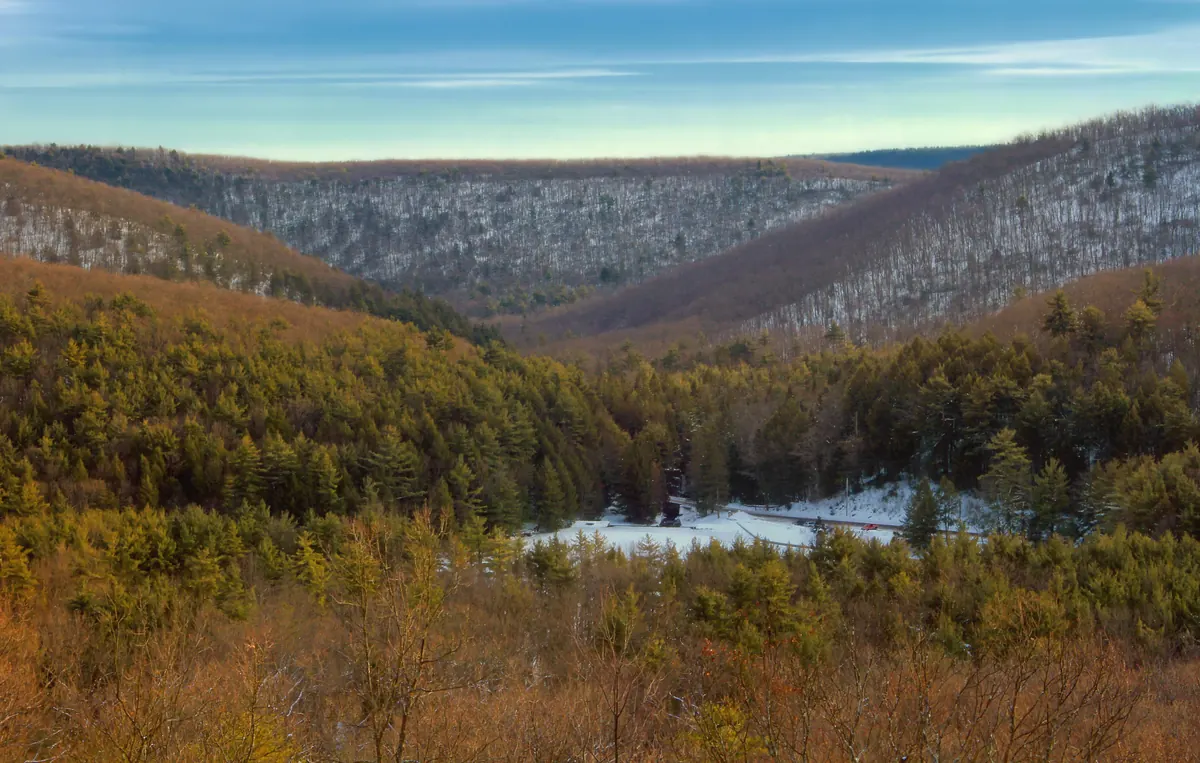
Weather records start winter on December 1, treating December, January and February as one cold season, and in Pennsylvania this is when the woods fall silent. Woodchucks and cave bats are already asleep, the last golden eagles slip down the ridges in the first week, and short-eared owls quarter the grasslands of old strip mines in Clarion County at dusk. Erie’s lake-effect season is in full swing, with more than two feet of snow in an average December, while Philadelphia usually sees little more than a dusting. Birders head out for the Christmas Bird Count from December 14, the year’s earliest sunsets arrive between about December 7 and 9, and two nights before Christmas a full moon rises that is nearer to us than any other in 2026. The guide below goes through it region by region.
Other months in Pennsylvania: October, November.
Start here
- Short-eared owls at dusk. The state lists this owl as endangered, but in winter several can hunt together over the grasslands of reclaimed strip mines. The Game Commission points to the Piney Tract in Clarion County and the Imperial Grasslands west of Pittsburgh. Park on the road shoulder half an hour before sunset, stay in or beside the car, and watch for moth-like flight low over the grass.
- A Christmas Bird Count. Count days fall between December 14 and January 5. Compilers welcome beginners, and if your house sits within a count circle, your feeder tally counts too. Use Audubon’s circle finder to reach your local compiler by early December.
- Geminids, the solstice and the Cold Moon. Sunday night, December 13, is Geminid night; the crescent moon is gone by about 9 p.m. The solstice arrives on Monday, December 21, at 3:50 p.m. On Wednesday, December 23, at 8:28 p.m., the Cold Moon turns full, and no full moon of 2026 comes nearer.
Keep a record: an owl seen at dusk belongs on the dusk-and-dawn watch plate of the Naturalist’s Field Journal, a line of fox prints across new snow on the tracks-to-know page, a hemlock twig with its two white stripes among the seeds, pods and cones, and your count-day tally in the “birds I have seen” pages. Ten minutes on a cold morning will do.
Regions used below: Northwest and Lake Erie; Allegheny National Forest and the Northern Tier; Laurel Highlands and Pittsburgh; Central Ridge and Valley and State College; Poconos and the Northeast; Susquehanna Valley and Harrisburg; Southeast and Philadelphia.
Where can you see owls in Pennsylvania in winter?
The Game Commission counts eight owl species that nest in Pennsylvania or visit it regularly in winter. Three of them (great horned, barred and eastern screech-owl) stay all year; the others come and go. December suits owl watching: bare branches, long nights, and two winter visitors that hunt in daylight or twilight.
-
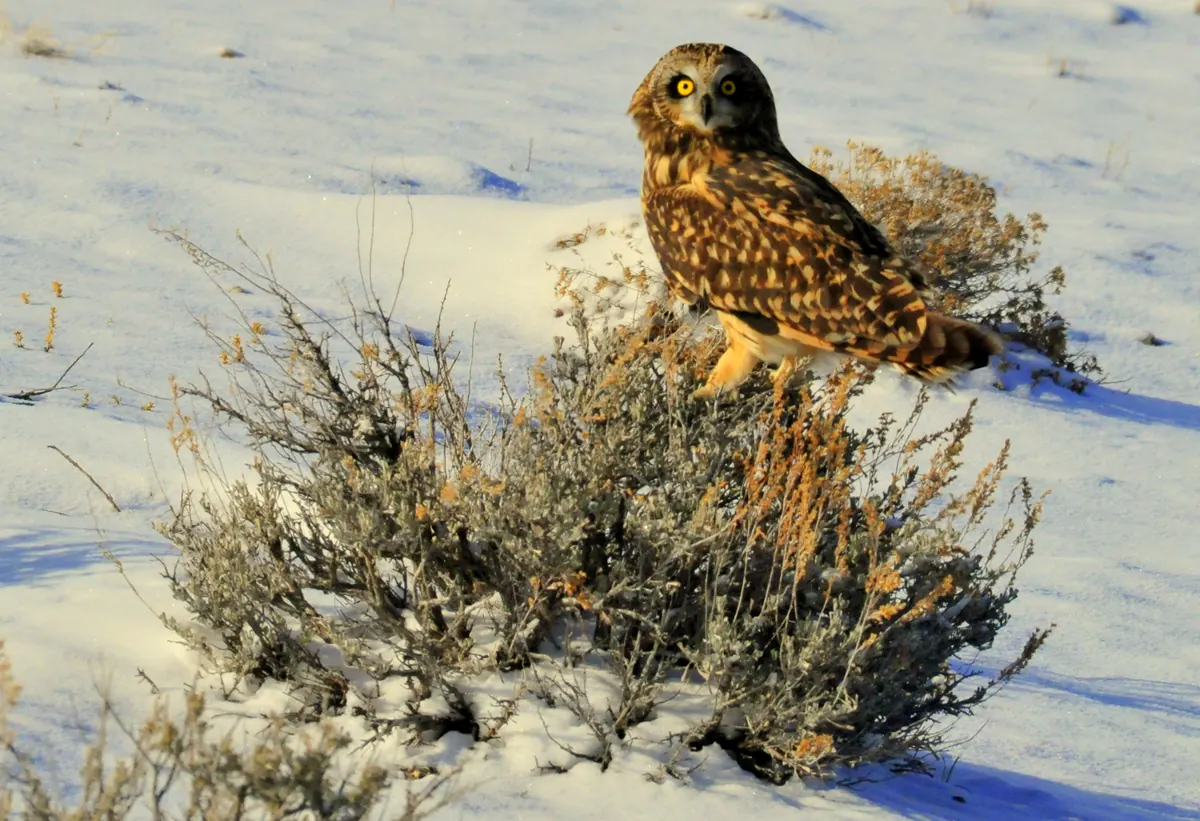
Short-eared owls over the old strip mines
Late October through winter; best in the last half hour of daylight · Piney Tract in Clarion County; Imperial Grasslands in western Allegheny County; big hayfields and reclaimed mine grasslands statewide
This is the Game Commission’s endangered “marsh owl,” a rare breeder here that arrives in late September and October and may stay the winter if voles are plentiful and the cold is not too harsh. It hunts low over open ground on long wings, mostly at dusk and dawn, and in a good year several work the same field. The agency names the Piney Tract Important Bird Area in Clarion County and the Imperial Grasslands in Allegheny County, both reclaimed strip mines; until the late 1980s dozens wintered in the tall grass around Philadelphia’s airport. Listen for the raspy bark the Commission compares to a small terrier flying overhead. Watch from the road and stay out of the grass.
-
Snowy owls, in some winters
Mainly November to January, in irruption years · Open, treeless ground: big farm fields, airports, lakeshores
Snowy owls are rare and irregular visitors. In the Game Commission’s account they appear mainly from November through January, and big flights follow a good lemming year on the Arctic tundra; the cycle tends to repeat every four or five years. Unlike most owls they hunt by day, often from a fence post or the middle of a frozen field. There is no reliable forecast for a flight, so check eBird’s recent sightings for your county. Should you spot one, stay inside your vehicle, do not walk toward it, and do not post the exact spot of a bird on private land.
-
Great horned owls dueting
Hooting from fall into early winter; on eggs from February, sometimes late January · Woodlots, farm country, city parks and suburbs statewide
The great horned owl is the most widespread owl in the state and the earliest nester. Pairs court from fall into early winter, and on a still December night you can hear the male and female hooting back and forth, a deep, measured five-note call that carries a long way. Females are usually on eggs in February and early March, now and then by late January, sometimes under a coat of snow. Step outside after dark on a calm evening, listen for a few minutes, and write down the date and time of the first duet.
-
Long-eared and saw-whet owls in the evergreens
Through the winter · Dense groves of pine, spruce and red cedar; vine tangles
Both are secretive. Long-eared owls roost in thick conifer stands, often several together, and the Game Commission warns that they are sensitive to disturbance at winter roosts. The tiny northern saw-whet owl, the smallest owl in Pennsylvania at seven or eight inches long, roosts in red cedars, other tight evergreens and vine tangles. Whitewash and pellets under a dense pine give a roost away; look once, from a distance, and leave.
Owl calls travel farthest on calm, clear evenings; the tonight’s clouds page shows whether yours will be one.
Where do bald eagles gather in Pennsylvania in December?
Pennsylvania’s bald eagle story is one of the great recoveries. In 1983 only three nesting pairs were left, all in Crawford County; the Game Commission then brought 88 eaglets from Saskatchewan between 1983 and 1989 and raised them in hacking towers. By 1998 there were 25 nesting pairs, by 2006 more than 100 nests, and by 2013 more than 250, with eagles now nesting in nearly every county. In December the resident pairs are joined by birds from farther north, and all of them follow the open water.
-
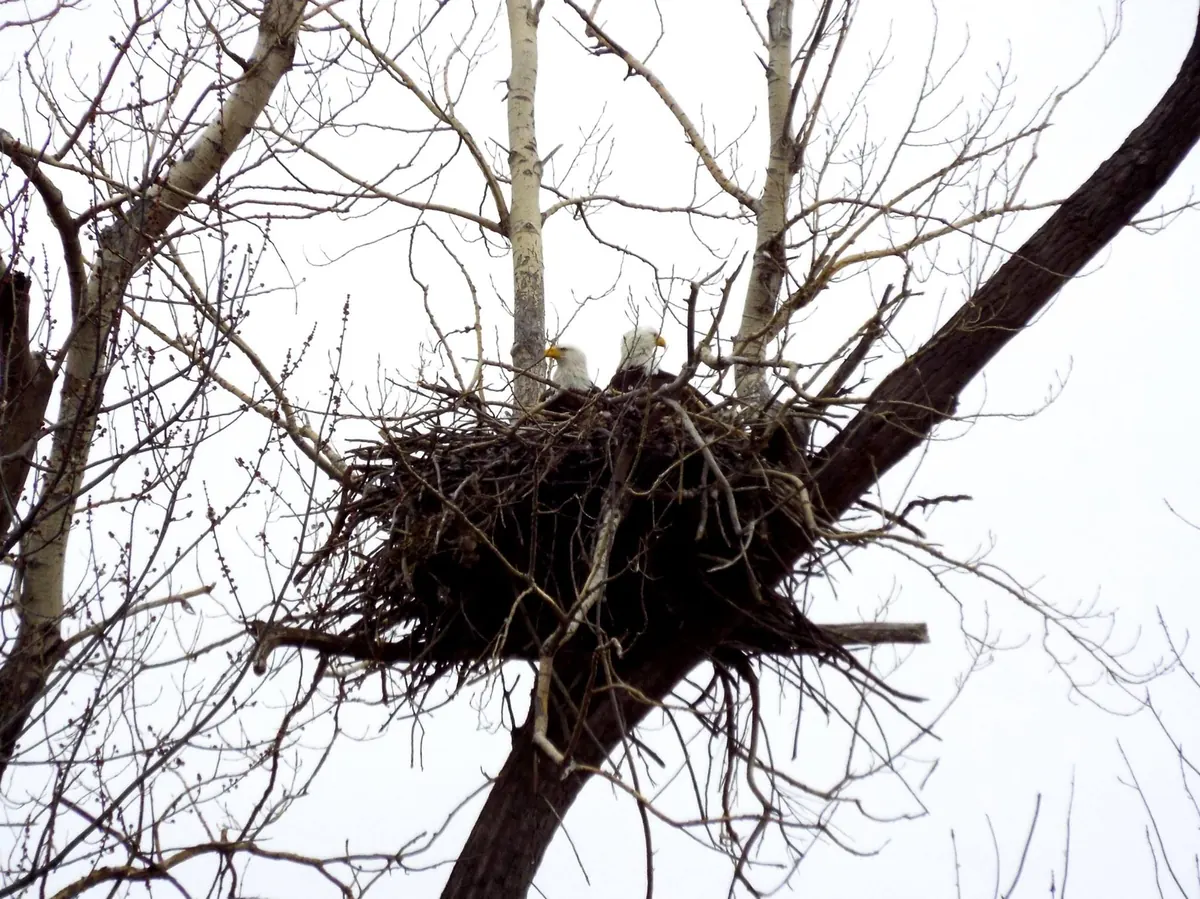
Eagles at open water
All month, and more as lakes freeze · River rapids, dam tailwaters and the deep reservoirs that freeze last, such as Raystown Lake
When cold weather locks up the smaller lakes, eagles crowd onto whatever stays open: river rapids, dam tailwaters and the deep reservoirs that freeze last. The Game Commission’s viewing guide notes that its midwinter survey has recorded as many as 19 bald eagles at Raystown Lake, and volunteers help the agency run that count every winter. Young bald eagles are brown, blotched with white, for several years before the white head comes in, and they are easy to mistake for a golden eagle. Watch with a scope from the car.
-
Pairs on their territories
Through the winter; stick-carrying from mid-January; eggs February to April · Rivers and lakes statewide; the Hanover and Farm Country nest cams online
Many nesting pairs stay on their territories all year, perching together near last year’s nest. The Game Commission says the pairs begin adding sticks as early as mid-January as part of courtship, and eggs follow between February and April. Nests are reused and grow each year, some until they break the tree. Federal guidelines keep people at least 660 feet from an active nest. The easiest way to follow a pair is the Game Commission’s Hanover bald eagle cam, streaming since 2015, and its Farm Country cam, where eagles have nested for at least 15 years.
-
The last golden eagles, and the end of the counts
Golden eagles mid-October to early December; Hawk Mountain counts to December 15, the Allegheny Front to December 31 · Hawk Mountain near Kempton; the Allegheny Front Hawk Watch near Central City
The Game Commission describes golden eagles as regular migrants through Pennsylvania from mid-October through early December, using the ridges between the Allegheny Front and the Kittatinny Ridge, and a few stay the winter out of sight in remote forest. The first cold front of December can still bring a late golden eagle or a rough-legged hawk past the lookouts. Hawk Mountain closes its count on December 15; the Allegheny Front keeps counting until the last day of the year. Check HawkCount for the day’s totals before you go.
How can you join a Christmas Bird Count in Pennsylvania?
Audubon’s Christmas Bird Count is the longest-running volunteer bird census in North America, more than a century old. Each count is one day long, on a date its compiler sets somewhere from mid-December to early January, inside a fixed circle that is surveyed year after year, so the results can be compared across decades. Count circles cover much of Pennsylvania, from Presque Isle, where the count falls within about ten days of Christmas, to the suburbs of Philadelphia. The Pennsylvania Society for Ornithology posts the state’s count data sheets for every season from 2015 through 2025, and summaries of past counts appear in its journal, Pennsylvania Birds.
-
Join a field party
One day per circle, December 14 to January 5 · Find your circle with Audubon’s online Circle Finder
Each circle has a compiler who sets the date and splits the circle into sections; beginners join a team with an experienced leader. You walk, drive and stop, counting every bird and the number of each species, and in the evening many counts gather for a tally supper. Participation is free. Reach the compiler by early December, because most dates are set by then; local Audubon chapters and bird clubs usually post them in November.
-
Count from your kitchen window
The day of your local count · Any home inside a count circle
Feeder counters keep a tally of everything that visits their yard during set hours on count day and send it to the compiler. For each species, record the biggest group in view at once rather than adding up visits, or one busy chickadee becomes twelve. If you already count for Project FeederWatch, the method is the same.
-
What December counts find
Every count · Statewide
Most Pennsylvania counts turn up the winter regulars (juncos, white-throated sparrows, cardinals, chickadees, titmice, woodpeckers, red-tailed hawks), with ducks and gulls on open water and Lake Erie. Irruption species are the surprise: this winter’s finch forecast calls a small flight of evening grosbeaks into Pennsylvania quite possible and expects more red crossbills in the Northeast as the winter goes on, while purple finches look less likely to come south.
How do Pennsylvania’s animals get through the winter?
There are three strategies: leave, sleep, or tough it out. The migrants left in the fall. December is the month to notice the other two.
-
Woodchucks: true hibernators
Denned since the hard frosts of October; males wake in February · Burrows under fields, fencerows and sheds
The Game Commission says woodchucks begin denning with October’s hard frosts and few are still active after the first of November. In hibernation a woodchuck’s body temperature drops from above 90 °F into the low 40s and its pulse falls from over 100 to about four beats a minute. It lives all winter on fat, and males come out first, in February, the real story behind the Punxsutawney groundhog. Rabbits sometimes borrow the upper tunnels while it sleeps.
-
Cave bats, and white-nose syndrome
Hibernating from October and November to spring · Limestone caves, old mines and tunnels
Nine bat species occur regularly in Pennsylvania. Three migrate south; six hibernate underground, usually in caves, clustered on the ceiling with their body temperature close to the air around them. A fungal disease, white-nose syndrome, makes them wake too often and burn their fat too fast, and the Game Commission reports a 99 percent decline across all six hibernating species. A caver’s visit does the same harm, so stay out of caves and old mines until spring. A bat flying on a winter afternoon is in trouble; report it to the Game Commission rather than handling it.
-
Wood frogs, frozen solid
Under the leaf litter from late fall to the first warm rain of March · Moist woods statewide
The wood frog spends the winter just under the leaves, and on a hard-frozen night much of it freezes. The Chesapeake Bay Program describes ice forming within its skin, with its heart, breathing and blood flow all stopping until it thaws. It is one of the first frogs to call in spring, from the first warm rain in March.
-
Chickadees: caching and cold nights
All winter · Feeders, woodlots and backyards
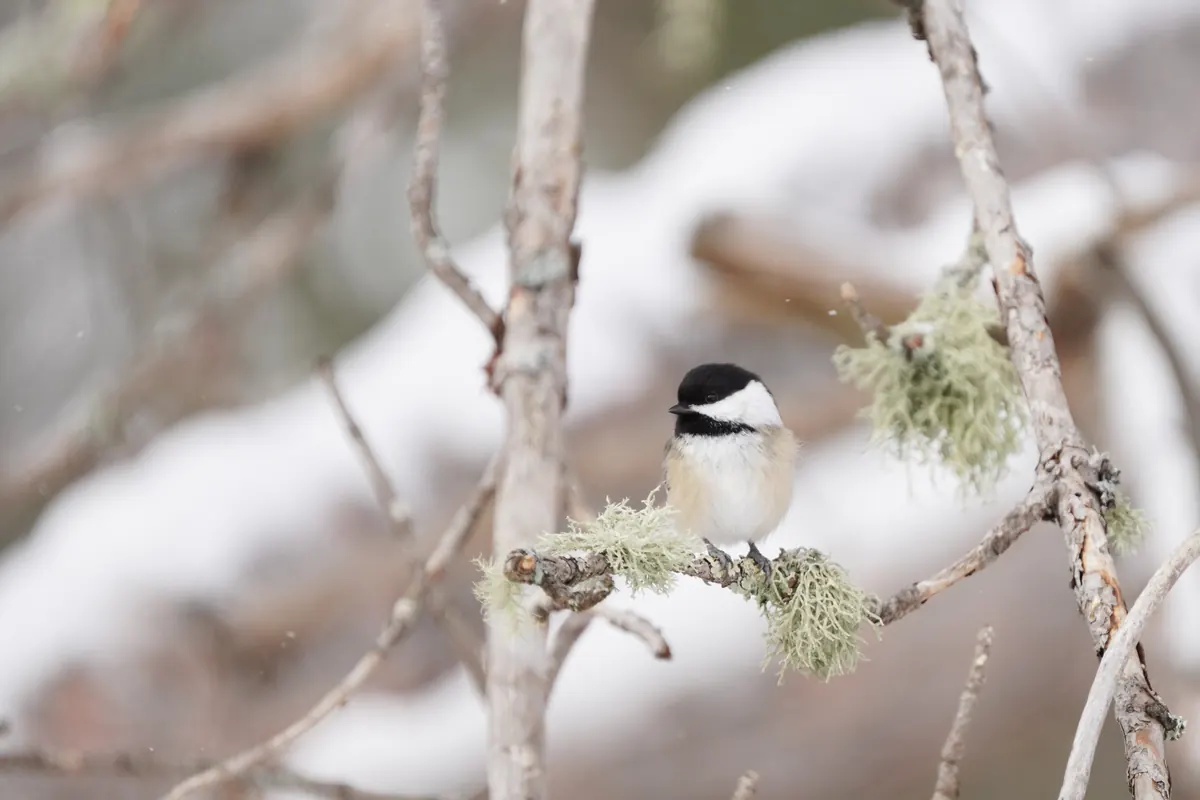
Chickadees store seeds in bark crevices, curled leaves and clumps of pine needles in the fall and remember where they put them. Winter flocks of three to twelve often pick up titmice, nuthatches and downy woodpeckers. At night each one roosts alone in a cavity or dense evergreen, and on cold nights its body temperature can fall by as much as 20 degrees, a controlled chill that saves fuel. The Game Commission notes that a chickadee loses weight every night and must refuel the next day, which is why a full feeder matters most after a frigid night.
-
Black bears in the den, red foxes in the open
Bears denned through winter, cubs born in January; foxes bark in late winter · Statewide
By December most of Pennsylvania’s black bears are in their dens, the males having followed the pregnant females a few weeks behind, though a mild spell can bring one out to feed. Red foxes do the opposite: according to the Game Commission they seldom use dens in winter, sleeping in the open with the tail curled over the nose, and they mate in February after a late-winter season of barking at night.
Pick one animal and follow it all winter. Log every encounter in the mammal-watch pages of the field journal: date, temperature, behavior.
Which evergreen trees can you identify in a Pennsylvania winter?
Once the hardwoods are bare, the conifers stand out on every slope, and four of them cover most of what you will meet.
-
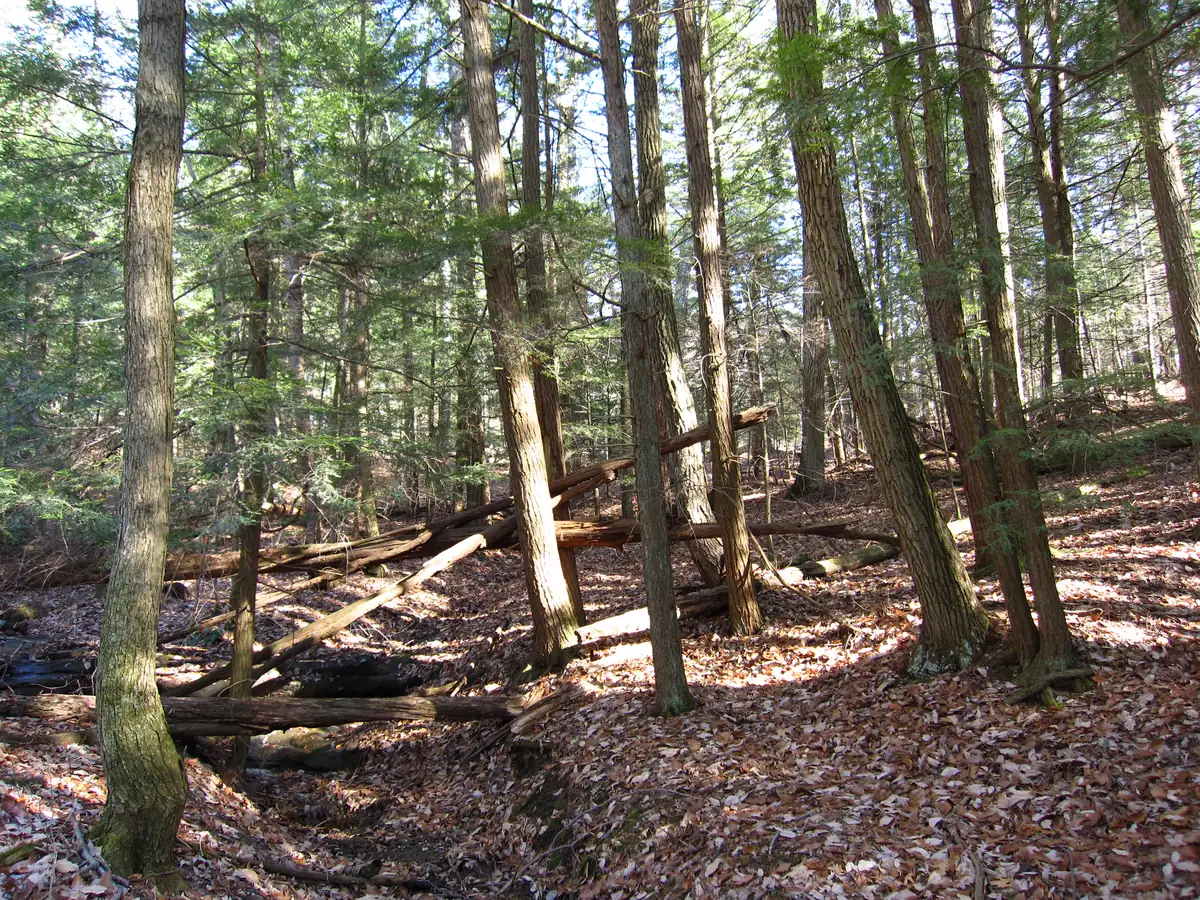
Eastern hemlock, the state tree
All year; adelgid wool most visible in winter · Shaded ravines and stream valleys statewide; Cook Forest, Ricketts Glen and the Pine Creek gorge
Hemlock needles are flat and short, from a quarter inch to a half inch, blunt at the tip, with two white bands underneath, and the little cones hang from the twig tips. Hemlocks line cool stream valleys, shade the water for trout and give deer and birds shelter from wind and snow. DCNR reports that an aphid-like pest from Asia, the hemlock woolly adelgid, had turned up in every one of the 67 counties by the close of 2023. Flip a twig: white, cottony tufts clinging under the newest growth, like the ends of cotton swabs, mean the tree is infested.
-
Eastern white pine
All year · Old fields, ridges and plantations statewide
Often the tallest tree in a Pennsylvania woodlot. Its soft, bluish-green needles come in bundles of five, which is easy to remember because “white” has five letters, and the cones are long and slender, six to eight inches. Crossbills, if they come this winter, will be in the white pines.
-
Pitch pine
All year · Dry ridgetops, rocky slopes and the Pocono plateau
Stiff, yellow-green needles in bundles of three, and dark, scaly, plated bark. Pitch pine grows where little else will, on thin, dry, rocky ground, and its trunk often sprouts tufts of needles directly from the bark after a fire or injury.
-
Eastern red cedar
All year; bluish “berries” in winter · Old fields, fencerows and limestone valleys, especially in the south
Not a true cedar but a juniper, with scale-like leaves and dusty blue, berry-like cones that feed birds through the winter; the cedar waxwing is named for it. Its dense foliage shelters roosting sparrows and small owls.
A sprig and a cone, sketched with a note on where they grew, make a fine page in the seeds-pods-and-cones plate.
What tracks and signs can you find in Pennsylvania snow and mud?
A fresh inch of snow turns a December walk into a reading lesson. In an average December Erie gets almost seven days with an inch or more of fresh snowfall and Philadelphia fewer than one, so the snowbelt and the northern counties get the most chances; elsewhere, look for tracks in the mud along creek banks and at the edges of puddles after a thaw.
-
Fox: a single line
Any morning after fresh snow · Field edges, farm lanes, woods roads
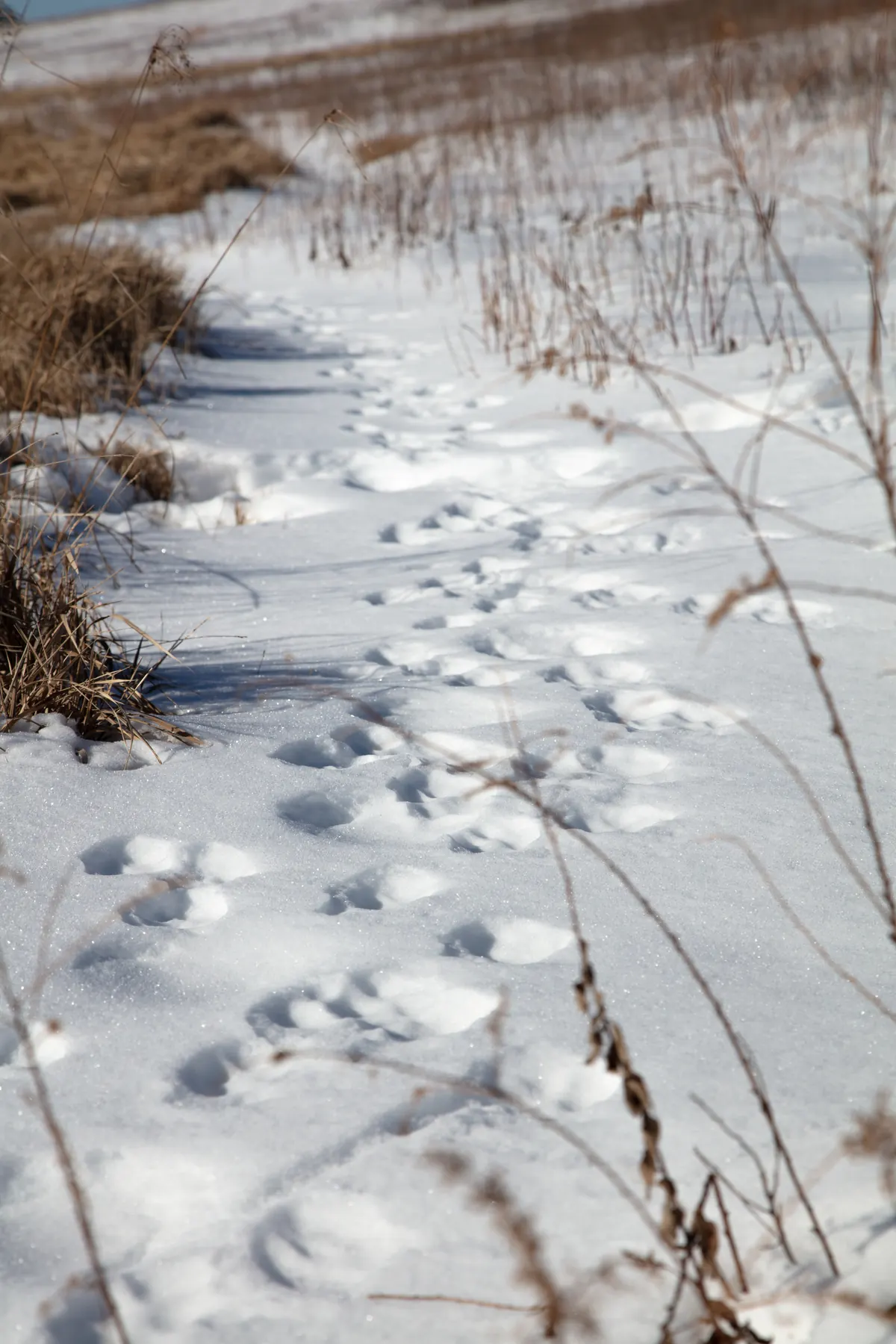
A walking fox sets each back paw almost exactly where the front paw fell, so its trail reads as one tidy row of prints, nearly in a straight line. The Game Commission notes that the gray fox has larger toe pads on a smaller foot than the red, and biologists use that difference to tell the two apart in snow. Tracking studies suggest a fox covers about five miles a night hunting in winter, so follow a trail for a while: it will lead to mouse holes, brush piles and the spot where it pounced.
-
Deer, turkey, squirrel and rabbit
All month · Woods and edges statewide
Deer leave split hearts, with the points facing the way they went. Wild turkeys leave big three-toed prints and scratched patches where they have raked the leaves for acorns. Gray squirrels hop, leaving the long hind prints ahead of the front ones, and the trail runs from tree to tree. Cottontails leave a Y-shaped group of four prints and, at the edge of a thicket, twigs clipped off at a clean angle.
-
Signs that don’t need snow
All winter · Everywhere
Gnawed acorn and hickory shells on a stump; a ring of feathers where a hawk ate; buck rubs from the fall, now gray; bark stripped at the base of a young tree by voles under the snow; woodpecker holes ringed with fresh chips. Date each find on the reading-the-signs plate.
When is the earliest sunset in Pennsylvania, and how short is the shortest day?
Pennsylvania’s shortest day falls on Monday, December 21, with the solstice itself at 3:50 p.m. Eastern time, yet sunset bottoms out about a fortnight before it and sunrise keeps getting later into January. Because the earth moves fastest in its orbit in early January, solar noon drifts later through December, and that pulls both sunrise and sunset later. In Philadelphia the sun sets at 4:35 p.m. on December 8, the earliest of the year, and at 4:39 on the solstice; by New Year’s Eve it is 4:45. In Pittsburgh the earliest sunset is 4:53 p.m., and the sun is still rising as late as 7:43 a.m. into the first days of January.
| City | Dec 1 | Dec 21 | Dec 31 | Earliest sunset |
|---|---|---|---|---|
| Erie | 9 h 20 m | 9 h 07 m | 9 h 09 m | 4:48 p.m., Dec 9 |
| Scranton | 9 h 25 m | 9 h 11 m | 9 h 14 m | 4:33 p.m., Dec 8 |
| Williamsport | 9 h 26 m | 9 h 12 m | 9 h 15 m | 4:39 p.m., Dec 8 |
| State College | 9 h 28 m | 9 h 15 m | 9 h 18 m | 4:44 p.m., Dec 8 |
| Pittsburgh | 9 h 30 m | 9 h 17 m | 9 h 20 m | 4:53 p.m., Dec 8 |
| Harrisburg | 9 h 31 m | 9 h 18 m | 9 h 21 m | 4:41 p.m., Dec 7 |
| Philadelphia | 9 h 33 m | 9 h 20 m | 9 h 23 m | 4:35 p.m., Dec 8 |
After the solstice the evenings lengthen first; the mornings do not start to brighten until January. Type in your town on the daylight page for sunrise, sunset and dusk times where you live.
How much snow does Pennsylvania get in December, and what could El Niño mean this winter?
For Erie, December is the heart of the lake-effect season: the airport averages 26.3 inches, second only to January’s 31.8, as cold air streams across a lake that has not yet frozen and bands of snow set up off the shore. Inland the numbers drop quickly. Pittsburgh, Wilkes-Barre/Scranton and State College average between 7 and 8 inches, Harrisburg 4.4 and Philadelphia 3.5, and Philadelphia averages 17 nights at or below freezing to Bradford’s 27.
| Station | High | Low | Nights ≤ 32 °F | Precipitation | Snowfall | Days with 1 in.+ snowfall |
|---|---|---|---|---|---|---|
| Erie | 40.2 | 28.0 | 21.5 | 4.17 | 26.3 | 6.7 |
| Bradford | 35.1 | 21.8 | 27.1 | 3.17 | n/a | n/a |
| Pittsburgh | 40.6 | 26.7 | 23.4 | 2.84 | 7.7 | 2.8 |
| State College | 38.4 | 26.0 | 24.9 | 3.18 | 7.6 | 1.9 |
| Williamsport | 39.7 | 25.8 | 24.1 | 3.27 | 6.9 | 1.7 |
| Wilkes-Barre/Scranton | 40.3 | 26.3 | 23.9 | 2.80 | 7.7 | 2.8 |
| Harrisburg | 43.3 | 28.2 | 22.4 | 3.43 | 4.4 | 1.2 |
| Philadelphia | 46.0 | 31.2 | 17.2 | 3.97 | 3.5 | 0.7 |
This winter’s wild card is El Niño: NOAA’s ENSO team wrote on September 10 that odds top 90 percent for a very strong event spanning fall and winter. NOAA’s own analysis of past El Niño winters, written by Michelle L’Heureux and Brian Brettschneider for Climate.gov, finds less snow than usual around the Great Lakes and in interior New England, with the shortfall tending to grow in moderate and strong events. Erie is a special case: a study by the Cleveland forecast office found that lake-effect and terrain-driven snow can mask the El Niño signal in the snowbelt, so a mild winter there need not be a snowless one. The likeliest result is a milder winter, with the north and west more often short of snow and the southeast still exposed to a big coastal storm. NOAA will issue its winter outlook on October 15 on the federal three-month outlook maps. For this week’s weather where you live, open the local forecast. Spring’s last-frost dates are on the Pennsylvania frost page.
When is the ice safe on Pennsylvania lakes and ponds?
Rarely in December. Across most of the state early ice is thin and patchy, the northern ponds and high lakes freeze first, and a few mild days can undo any of it. DCNR’s guidance is plain: four inches of solid ice is the minimum for one skater and seven inches for a small group. Test the ice with an auger before you trust it, spread people out, stay away from cracks, inlets, docks and anything sticking up through the surface, and keep off river ice entirely, because moving water wears it thin from underneath. Wear a life jacket, carry ice picks and a rope, and never go out alone.
DCNR does not measure ice for the public, but from December through spring thaw the state parks post a weekly Winter Report listing where the ice is thick enough for skating or ice fishing and where there is enough snow for sledding, skiing and snowshoeing.
What is in the Pennsylvania night sky in December 2026?
All times are Eastern Standard Time. With the year’s longest nights, night has fully fallen by around six, well before bedtime.
-
The Geminids, the best shower of the year
Night of Sunday, December 13 into Monday the 14th · Anywhere dark; the radiant near Castor and Pollux climbs high in the east
At its best the shower can reach roughly 150 an hour for one watcher beneath a flawless, moonless sky, by the International Meteor Organization’s reckoning, and this year the moon is no problem: it is a thin crescent that sets around 9 p.m. From then until dawn the sky is dark, and the meteors come fastest about 2 a.m., with Gemini nearly overhead. From a backyard you might see a quarter of that; from a dark site like Cherry Springs State Park in Potter County, far more. Wear every layer you own, lie flat on a pad or a lawn chair, and let your eyes adapt for twenty minutes.
-
The Cold Moon, the closest of 2026
Full at 8:28 p.m. Wednesday, December 23 · Rising in the northeast at sunset
Perigee, when the moon swings closest to us, comes a mere seven hours or so after the moment of full, so this is the biggest-looking full moon of 2026. EarthSky and the BBC’s Sky at Night both list it as the year’s last supermoon. Watch it rise behind bare trees on the evening of the 23rd; on Christmas Eve it is still nearly full. On the evening of the solstice the swelling moon slides just past the Pleiades, so look for the cluster through binoculars before the glare wins.
-
Planets: Venus at dawn, Saturn at dusk
All month · Southeast before sunrise; south and southwest after sunset
Venus blazes in the southeast before dawn and keeps gaining height until January 3, when it stands farthest from the sun. Early on Friday, December 4, the thin moon, Spica and Venus form a short line low in the southeast, with the star in the middle; the next morning the moon has slipped nearer the planet. Mars and Jupiter share Leo before dawn, and by Christmas week Jupiter is already up by mid-evening. After dusk, Saturn alone holds the southern sky. The comet that sheds the Taurid meteors, 2P/Encke, starts its brightening this month, but it will not reach binocular range until late January.
| Phase | Date | Time |
|---|---|---|
| Last quarter | Tuesday, Dec 1 | 1:08 a.m. |
| New moon | Tuesday, Dec 8 | 7:52 p.m. |
| First quarter | Thursday, Dec 17 | 12:42 a.m. |
| Full moon, the Cold Moon | Wednesday, Dec 23 | 8:28 p.m. (also nearly full on Christmas Eve) |
| Last quarter | Wednesday, Dec 30 | 1:59 p.m. |
The Quadrantid meteor shower peaks on the night of January 3 into January 4, with only a thin moon. For moonrise and moonset times in your town, see the moon phase calendar.
What can families do outside in Pennsylvania in December?
- Count birds for Audubon between mid-December and early January. Find a nearby circle with Audubon’s Circle Finder; children can join a field team with a parent or keep the tally at a home feeder.
- Stay up for the Geminids, Sunday, December 13. Go out after the moon sets around 9 p.m.; even an hour under a clear sky from a dark backyard can show dozens.
- Holiday open house at Jennings, Sunday, December 13. Jennings Environmental Education Center in Butler County holds its Foltz School Holiday Open Day from noon to 4 p.m. at the Foltz School, near Route 8 and Weeks Road.
- Light Up Little Buffalo, December 17 to 23. Little Buffalo State Park in Perry County lights up its holiday evenings every night from 6 to 9 p.m. at the Shoaff’s Mill Day Use Area.
- A virtual Lehigh Gap. A virtual-reality “Lehigh Gap Story” at Jacobsburg Environmental Education Center on Thursday, December 3, with free half-hour sessions from 6 to 7:30 p.m. (registration).
- Elk without the crowds. The Elk Country Visitor Center near Benezette is open Thursday through Monday, 8 a.m. to dusk, in December. The October crowds are long gone.
- Start 2027 on a trail. DCNR’s calendar already lists hikes at Ridley Creek State Park (10 a.m. to noon), Pine Grove Furnace State Park (1 p.m., from the Fuller Lake bathhouse) and Cowans Gap State Park (Lakeside and Overlook trails at 1 and 2 p.m., free, registration required); more parks usually add hikes in December.
We took these dates from DCNR’s calendar and the hosts’ own listings in early October; check with the host before setting out, since winter programs change. The nature guides for every state have more month-by-month ideas, and Pennsylvania in November shows what came just before.
Safety notes for December in Pennsylvania
- Rifle deer season until December 13. The regular firearms deer season runs from November 28 through Sunday, December 13, and every rifle hunter wears a combined 250 square inches of fluorescent orange spread over head, chest and back. Most seasons now include Sundays, so there is no quiet day of the week.
- Orange on game lands until January 31. Under 58 Pa. Code § 135.41, hikers, birders and anyone else on state game lands who is not hunting, trapping or fishing must keep wearing that same 250 square inches, seen from all sides, or else a fluorescent orange hat, until January 31. Wear it on state forest and state park trails open to hunting too, and put orange on the dog.
- Bear seasons. Extended firearms bear seasons run alongside deer season until December 6 in units 3A–3D, 4C, 4E and 5A, and until December 13 in units 2B, 5B, 5C and 5D.
- After Christmas. Flintlock deer season, late archery deer season and the extended antlerless firearms season in the 2B, 5C and 5D units near the two big cities all open December 26 and run to January 24, 2027; in units 4A, 4C, 4D and 5A the extended antlerless season closes January 18. Extended antlerless hunters must wear orange; flintlock and bow hunters need not, so treat any movement in the woods with care.
- Small game, waterfowl and trapping. Ruffed grouse closes December 24; rabbit, squirrel and pheasant close that day and reopen December 26. Duck seasons are open on most waters (the Northwest zone opens December 21), Canada geese open December 4 in the Atlantic Population zone and December 15 in the Resident zone, and there is no Sunday hunting for migratory birds. Bobcat and fisher trapping opens December 19.
- Ice. Four inches for one person, seven for a small group, never on rivers, never alone (see above).
- Short days. Through mid-month, sunset across the state comes between about 4:33 p.m. in Scranton and 4:54 in Pittsburgh. Start back from any hike by 3 p.m., pack a headlamp, and leave your plan with someone at home.
- Cold and wet. Wind and drizzle near freezing chill faster than dry cold; wear wool or synthetics and pack a dry spare layer.
- Lake-effect squalls and freezing rain. Snow bands off Lake Erie can bring whiteouts on I-90 and I-79 within minutes; check the forecast before driving the snowbelt. Freezing rain glazes ridge roads in the central counties.
- Deer on the road. December is among the three worst months for collisions with deer. Slow down at dusk, which now falls before the evening commute is over.
Sources
- Pennsylvania Game Commission: owls (wildlife note, PDF)
- Pennsylvania Game Commission: short-eared owl (Piney Tract, Imperial Grasslands)
- eBird: explore recent sightings by county
- Pennsylvania Game Commission: eagles and osprey (wildlife note, PDF; restoration history, nesting)
- Pennsylvania Game Commission: bald eagle watching (Raystown midwinter survey, viewing sites)
- Pennsylvania Game Commission: wildlife cams (Hanover and Farm Country bald eagle cams)
- HawkCount: Allegheny Front Hawk Watch site profile (count through December 31)
- HawkCount: Hawk Mountain Sanctuary site profile
- Hawk Mountain Sanctuary: autumn hawk migration (count August 15 to December 15)
- National Audubon Society: join the Christmas Bird Count (December 14 to January 5)
- Pennsylvania Society for Ornithology: Pennsylvania Christmas Bird Counts (data sheets 2015–2025)
- Tom Ridge Environmental Center Foundation: Presque Isle by month (December Christmas Bird Count)
- Finch Research Network: Winter Finch Forecast 2026–2027
- Project FeederWatch: how to participate
- Pennsylvania Game Commission: woodchuck (wildlife note, PDF)
- Pennsylvania Game Commission: bats (wildlife note, PDF; white-nose syndrome)
- Chesapeake Bay Program field guide: wood frog
- Pennsylvania Game Commission: chickadees, nuthatches, titmouse and brown creeper (wildlife note, PDF)
- Pennsylvania Game Commission: black bear (wildlife note)
- Pennsylvania Game Commission: foxes (wildlife note, PDF)
- PA DCNR: hemlock woolly adelgid (all 67 counties by 2023)
- Chesapeake Bay Program field guide: eastern hemlock
- Lady Bird Johnson Wildflower Center: eastern white pine
- Lady Bird Johnson Wildflower Center: pitch pine
- Lady Bird Johnson Wildflower Center: eastern red cedar
- PA DCNR: forests and trees (forest types, Common Trees of Pennsylvania)
- NOAA NCEI: 1991–2020 monthly normals, December temperature, freezing nights, precipitation, snowfall and snow depth (data API)
- Climate Prediction Center: ENSO diagnostic discussion, September 10, 2026
- Climate Prediction Center: seasonal outlooks (winter outlook issued October 15)
- NOAA Climate.gov: snow pain or snow gain, how El Niño affects snowfall over North America (L’Heureux and Brettschneider, 2023)
- NWS Cleveland: ENSO and the Great Lakes region (lake-effect snow and El Niño)
- PA DCNR: sledding and ice skating (ice thickness guidance)
- PA DCNR: state parks Winter Report
- U.S. Naval Observatory: moon phases (data API)
- U.S. Naval Observatory: 2026 solstices and equinoxes (data API)
- International Meteor Organization: 2026 meteor shower calendar (PDF)
- EarthSky: what is a supermoon (2026 list)
- BBC Sky at Night: supermoons in 2026
- EarthSky: Venus before sunrise, greatest western elongation
- NASA JPL Horizons: planetary and lunar ephemerides
- Star Walk: Comet Encke in 2027
- PA DCNR calendar of events: December 2026
- PA DCNR calendar of events: First Day Hikes, January 1, 2027
- Elk Country Visitor Center: programs, tours and seasonal hours
- Pennsylvania Game Commission: final 2026–27 hunting seasons
- Pennsylvania Game Commission: seasons and bag limits, 2026–27 (fluorescent orange by season)
- Pennsylvania Game Commission: 2026–27 migratory game bird seasons
- 58 Pa. Code § 135.41: fluorescent orange on state game lands
- State Farm: how likely are you to have an animal collision (peak months)
- Photos via Wikimedia Commons; licenses and photographers are credited under each picture
